Ferns are a diverse group of land plants that have a worldwide distribution, but the paleontological record of ferns is incomplete. Three evolutionary radiations of homosporous leptosporangiate ferns have been proposed. The first radiation occurred during the Palaeozoic (Rothwell Reference Rothwell1999), and the second radiation can be traced back to the early Triassic (Skog Reference Skog2001), where fossils assignable to modern genera Osmunda sensu lato (s.l.) were found in the Triassic of Antarctica (Phipps et al. Reference Phipps, Taylor, Taylor, Cuneo, Boucher and Xao1998). By the Jurassic, all the basal families of living leptosporangiate ferns were produced (Skog Reference Skog2001; Smith et al. Reference Smith, Pryer, Schuettpelz, Korall, Schneider and Wolf2006; Rothwell & Stockey Reference Rothwell, Stockey, Ranker and Haufler2008). The families represented in this radiation encompass Osmundaceae, Gleicheniaceae, Hymenophyllaceae, Dipteridaceae, Matoniaceae, Schizaeaceae s.l., and Cyatheaceae s.l. (Smith et al. Reference Smith, Pryer, Schuettpelz, Korall, Schneider and Wolf2006). These families are well represented in different Middle Jurassic floras worldwide (Barale & Ouaja Reference Barale and Ouaja2002; Wang Reference Wang2002; Cleal & Rees Reference Cleal and Rees2003; Birkenmajer & Ociepa Reference Birkenmajer and Ociepa2008; Mehlqvist et al. Reference Mehlqvist, Vajda and Larsson2009; Barbacka Reference Barbacka2011; Vaez-Javadi Reference Vaez-Javadi2011; Kostina & Herman Reference Kostina and Herman2013; Scanu et al. Reference Scanu, Kustatscher and Pittau2015), but their distribution is far from understood in low-latitude regions such as Mexico.
The study of Jurassic ferns in Mexico dates back to the beginning of the last century with Wieland's study of ‘The Liasic Mixteca Alta Flora’ (Reference Wieland1914–1916) and later Silva-Pineda (Reference Silva-Pineda1978) reviewed the material and made several taxonomic refinements. Afterwards, Person & Delevoryas (Reference Person and Delevoryas1982) described a variety of fossil plants in the Middle Jurassic Flora of Oaxaca, Mexico. More recently, further research has reported new findings, though the efforts to understand members of these spore-producing organisms are still scarce (Lozano-Carmona & Velasco-de León Reference Lozano-Carmona and Velasco-de León2016).
The Middle Jurassic fern fronds from Mexico are Piazopteris Lorch, Cladophlebis Brongniart and Coniopteris Brongniart and other closely related taxa such as Sphenopteris Brongniart (Person & Delevoryas Reference Person and Delevoryas1982). For decades, most studies were carried out in Jurassic localities from Oaxaca State (e.g., Silva-Pineda Reference Silva-Pineda1969, Reference Silva-Pineda1978; Person & Delevoryas Reference Person and Delevoryas1982; Lozano-Carmona & Velasco-de León Reference Lozano-Carmona and Velasco-de León2016). However, new plant-fossil occurrences were discovered from the Otlaltepec Formation at Santo Domingo Tianguistengo locality in Puebla.
By analysing the morphological and reproductive features of newly collected specimens and comparing them with both extinct and extant species, we aim here to contribute to the knowledge of low-latitude Middle Jurassic floras. This could have implications for understanding the global distributions of families at the end of the second evolutionary radiation of leptosporangiate ferns. Here, we present the first systematic description of the newly collected ferns from the Otlaltepec Formation.
1. Material and methods
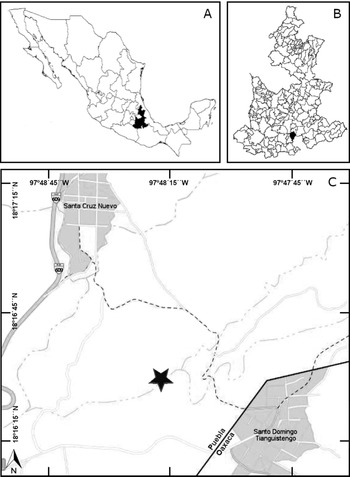
Specimens were collected from an outcrop located between Santo Domingo Tianguistengo and Santa Cruz Nuevo, in the ‘Totoltepec de Guerrero’ Municipality, Puebla [18.18°N, 97.40°W] (Fig. 1). The locality is situated in the Magdalena Creek where the Otlaltepec Formation crops out. The Otlaltepec Basin fill is composed of a more than 2000-m-thick clastic sedimentary succession (Martini et al. Reference Martini, Ramírez-Calderón, Solari, Villanueva-Amadoz, Zepeda-Martínez, Ortega-Gutiérrez and Elías-Herrera2016). The stratigraphy and structure of the Otlaltepec Basin is poorly defined, but Morán-Zenteno et al. (Reference Morán-Zenteno, Caballero-Miranda, Silva-Romo, Ortega-Guerrero and Gonzáles-Torres1993) and Verde-Ramírez (Reference Verde-Ramírez2016) divided it into four units – namely, from base to top, the Tianguistengo, Piedra Hueca, Otlaltepec, and Magdalena formations (Martini et al. Reference Martini, Ramírez-Calderón, Solari, Villanueva-Amadoz, Zepeda-Martínez, Ortega-Gutiérrez and Elías-Herrera2016).
The locality of plant fossils of Santo Domingo Tianguistengo, in the Magdalena Creek, Puebla, Mexico. (a) A map of Mexico with Puebla state highlighted in black. (b) Puebla with Totoltepec de Guerrero Municipality highlighted in black. (c) Star pointing the place of the locality where the Otlaltepec Formation outcrops.

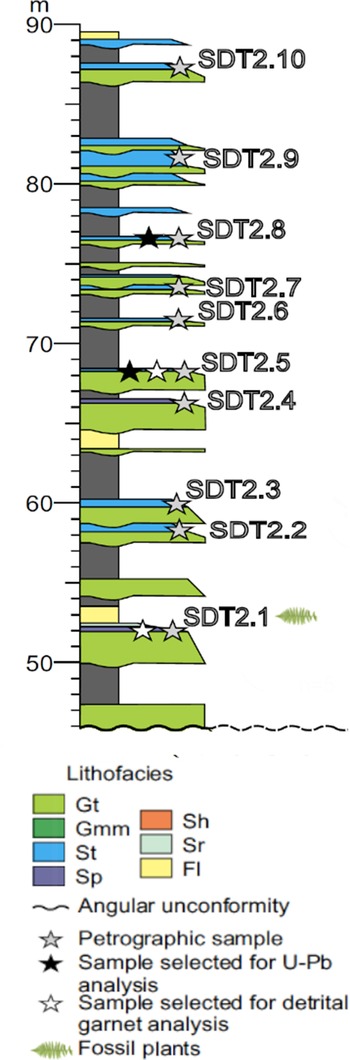
The plant fossils are found in the Otlaltepec Formation, which is composed of an alternation of lithofacies including conglomerates, palaeosols, horizontally interlaminated mudstones, siltstones and very fine-grained sandstones, and fine to very coarse-grained sandstone displaying trough cross-bedding (Fig. 2; Martini et al. Reference Martini, Ramírez-Calderón, Solari, Villanueva-Amadoz, Zepeda-Martínez, Ortega-Gutiérrez and Elías-Herrera2016). Detailed information on the lithostratigraphic section is given in Martini et al. (Reference Martini, Ramírez-Calderón, Solari, Villanueva-Amadoz, Zepeda-Martínez, Ortega-Gutiérrez and Elías-Herrera2016). Martini et al. (Reference Martini, Ramírez-Calderón, Solari, Villanueva-Amadoz, Zepeda-Martínez, Ortega-Gutiérrez and Elías-Herrera2016) analysed the provenance of the sandstones of the Otlaltepec Formation, where the studied fossils were discovered, and determined that the depositional age of the Otlaltepec Formation is constrained between 163.5 ± 1 and 167.5 ± 4 Ma (Late Bathonian–Callovian, late Middle Jurassic age). The ferns from this work were found in the horizontally interlaminated mudstone, siltstone, and very fine-grained sandstone (Fig. 2). In recent years, other fossil plant taxa have been collected from this locality but have not yet been formally described (Morales-Toledo Reference Morales-Toledo2016). Among them are abundant foliage and reproductive structures with bennettitalean affinity, as well as conifer shoots, cones, and leaves (Morales-Toledo Reference Morales-Toledo2019).
Stratigraphic column representative of the Otlaltepec Formation (modified from Martini et al. Reference Martini, Ramírez-Calderón, Solari, Villanueva-Amadoz, Zepeda-Martínez, Ortega-Gutiérrez and Elías-Herrera2016). SDT - Santo Domingo Tianguistengo. Gt - Scoop-shaped bodies of trough-cross-bedded conglomerate typically cut into each other both laterally and vertically.
Gmm - Matrix-supported, poorly sorted conglomerate characterized by the lack of clast framework. Beds of this lithofacies have sharp but non-erosional relationship with underlying deposits. St - Fine- to very coarse-grained sandstone displaying trough cross-bedding. Sp - Fine-to coarse-grained sandstone displaying planar cross-bedding. Sh - Very fine- to coarse-grained sandstone with horizontal lamination. Sr - Very fine- to coarse-grained sandstone displaying ripple crosslamination. Fl - Horizontally interlaminated mudstone, siltstone, and very fine-grained sandstone.

The fossil material consists of stems and moderately well-preserved compressions of sterile and fertile frond fragments. The fossils were studied using a dissecting microscope (Olympus Stemi DV4 and Zeiss Stemi 200-C). The in situ spores were obtained by the methods described by Brown et al. (Reference Brown, Nelson, Mathewes, Vogel and Southon1989, Reference Brown, Farwell, Grootes and Schmidt1992). The samples were boiled in 6 % Potassium hydroxide (KOH) for 20 min and sieved in a 180 μm grid, then they were treated with Hydrofluoric acid (HF) (48 %) in a boiling water bath for about 25 min, and finally they were treated in a 1 % sodium chloride solution in a boiling water bath for 10 min. The treated samples were mounted in glycerine jelly. Photographs were taken with a digital camera (Canon EOS Rebel T2i), while the detailed structures were obtained with an Axio Zoom.V16 and Discovery.V8 microscope. The fossils and slides are housed in the ‘Colección Paleobotánica del Museo de Paleontología’ (National Paleontological Collection), Instituto de Geología, Universidad Nacional Autónoma de México under the prefix ‘IGM-PB’. The classification used in this work is based on Chase & Reveal (Reference Chase and Reveal &2009) and Christenhusz et al. (Reference Christenhusz, Zhang and Schneider2011).
2. Systematic descriptions
Order Cyatheales A.B. Frank, 1877
Family Dicksoniaceae M.R. Schomb., 1849
Genus Paralophosoria Morales-Toledo, Mendoza-Ruiz & Cevallos-Ferriz, gen. nov.
Diagnosis. Similar to the fronds of Lophosoria quadripinnata but deeply incised pinnatifid pinnules, the sori are round to kidney-shaped, and the spores are triangular to rounded-triangular in shape with a reticulate perispore.
Etymology. From Greek para (beside) + Lophosoria.
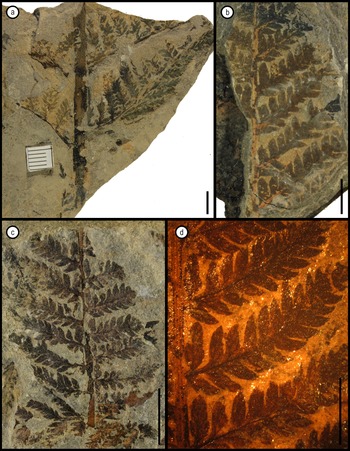
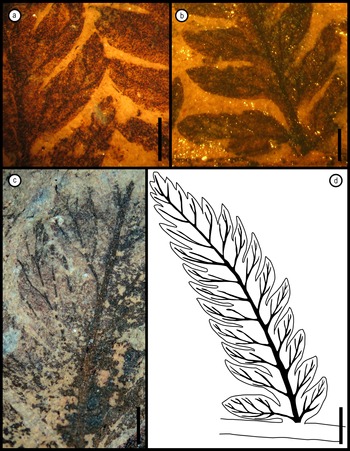
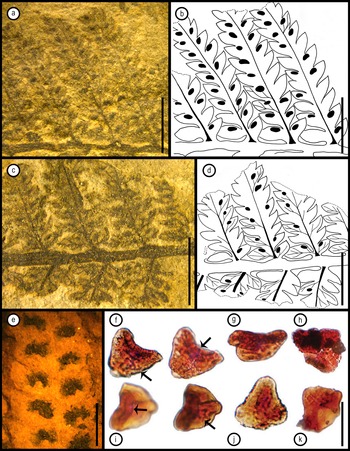
Discussion. Paralophosoria and Lophosoria share bipinnate-pinnatifid fronds with alternate pinnules (Fig. 3a); lobed to pinnatifid, sessile, ultimate segments (Figs 3a–d, 4d, 5a–d, 6a–b); pinnate free veins (Figs 4, 5c–d, 6a–b); and exindusiate sori on a terminal vein (Figs 5a–d, 6b), but they differ in sorus and spore shape, and spore ornamentation. Paralophosoria has round to kidney-shaped sori (Fig. 5a–e) while Lophosoria has round sori (Fig. 6b). Spores differ in that Paralophosoria has triangular to rounded-triangular spores (Fig. 5f–k) with reticulate perispore (Fig. 5f, h, k), in contrast to Lophosoria spores that are spheroidal, with a prominent equatorial flange, and the distal face is strongly perforate and more or less covered by a granulate perispore deposit.
Paralophosoria jurassica sp. nov. (a–d) (IGM-PB 118 to IGM-PB 121). (a) Sterile fronds with the number of divisions and arrangement. (b) Distal sterile pinna with pinnules arrangement, and the first acroscopic ultimate segment lobed. (c) Proximal sterile pinna with pinnules arrangement, and acroscopic ultimate segment lobed. (d) Detailed section of a sterile pinna with ultimate segments having the venation pattern. Scale bars = 1 cm (a–c); 0.1 cm (d).

Paralophosoria jurassica sp. nov. (a–d) (IGM-PB 121 to IGM-PB 122). (a) Sessile ultimate segments of pinnules with pinnate venation. (b) First acroscopic ultimate segment lobed with pinnate venation. (c) Sessile ultimate segments of pinnules with pinnate venation. (d) Schematic drawing of a complete pinnule. Scale bars = 0.1 cm (a, b); 0.2 cm (c, d).

Paralophosoria jurassica sp. nov. (a–d) (IGM-PB 123 to IGM-PB 125). (a) Fossil fertile frond having the same venation pattern and sori position. (b) Schematic drawing of (a) showing the venation pattern and sori position. (c) Fossil fertile frond showing position, number, and shape of sori. (d) Schematic drawing of (c) showing the venation pattern and sori position (e) Fertile fragment having sori with small leptosporangia. (f) Equatorial view of the trilete spore showing reticulate exine (left arrow) and labrum (right arrow). (g) Deformed spore, showing the labrum. (h) Deformed spore with reticulate exine. (i) Equatorial view of the trilete spore showing labrum (left arrow) and reticulate exine (right arrow). (j) Polar view of the spore showing the trilete surrounded by a labrum. (k) Deformed spore with reticulate exine. Scale bars = 0.5 cm (a–d); 0.2 cm (e); 20 μm (f–k).

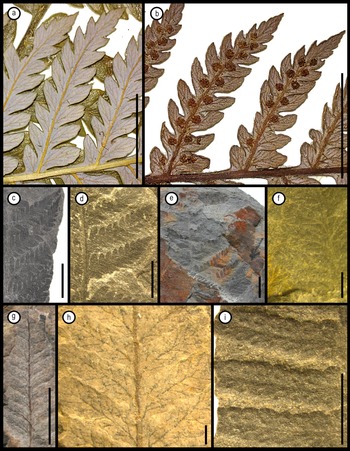
Lophosoria quadripinnata (a, b) and Cladophlebis browniana as described in Person & Delevoryas (Reference Person and Delevoryas1982) (c–i). (a) Sterile pinnule with ultimate segments having pinnate venation, Missouri Botanical Garden Herbarium, 6,212,483 (barcode from the specimen). (b) Fertile pinnule with ultimate segments having pinnate venation and sori, Missouri Botanical Garden Herbarium, 04911731 (barcode from the specimen). (c) Vegetative fronds showing the number of divisions and arrangement, IGM-PB 401. (d) Vegetative frond showing the shape of the ultimate segments of the pinna, IGM-PB 403. (e) Pinna showing the number of divisions and phyllotaxy, IGM-PB 404. (f) Detailed section of (e), showing the venation pattern. (g) Pinnules showing the ultimate segments' arrangement, IGM-PB 406. (h) Detailed section of (g), showing the venation pattern. (i) Fertile fronds showing the position, number, and shape of sori, IGM-PB 405. Scale bars = 1 cm (a–c, e, g); 0.5 cm (d, i); 0.2 cm (f); 0.1 cm (h).

Paralophosoria jurassica Morales-Toledo, Mendoza-Ruiz & Cevallos-Ferriz, sp. nov.
Holotype. IGM-PB 1312, Figures 3–5.
Paratypes. IGM-PB 118 to IGM-PB 262.
Repository. ‘Colección Paleobotánica del Museo de Paleontología’ (National Paleontological Collection), Instituto de Geología, Universidad Nacional Autónoma de México.
Type locality. Santo Domingo Tianguistengo locality, located in the Magdalena Creek between the town Santo Domingo Tianguistengo, Oaxaca, and Santa Cruz Nuevo, Puebla, at [18.18°N, 97.40°W].
Stratigraphic horizon. Otlaltepec Formation, Middle Jurassic.
Etymology. From the Jurassic period.
Diagnosis. Frond bipinnate-pinnatifid, adaxial surface glabrous, rachis sulcate, pinnae alternating along the rachis, asymmetric. Deeply incised pinnatifid pinnules with the first acroscopic ultimate segment lobed. Rest of the ultimate segments are sessile, trapezoid shaped with an acute apex. Middle ultimate segments larger than the basal and apical ultimate segments. Pinnate free veins. Sori at the end of the veins, exindusiate, one per ultimate segment, trilete spores, trilete mark surrounded by a labrum.
Description. The new taxon is represented by fertile and vegetative fronds with no morphological differentiation (Figs 3–5). Fronds bipinnate-pinnatifid (Fig. 3a). Preserved part of the lamina 6 cm long, 9 cm wide. Rachis glabrous, 0.4 cm wide, tapering towards the apex of the lamina. Pinnae pinnate-pinnatifid (Fig. 3b, c), alternate, inserted along the main rachis at 1.5–2 cm of distance each, arising at acute angles (50–65°), 4.5 cm long, 2–3 cm wide. Deeply incised pinnatifid pinnules, alternate, 1–1.5 cm long, 0.3 cm wide, first acroscopic ultimate segment lobed, rest of the ultimate segments are sessile, trapezoid shaped with an acute apex (Figs 3d, 4d, 5a–d). Veins in the ultimate segments pinnate, catadromous (Fig. 4a–d). Sori alternate, exindusiate, abaxial, one per ultimate segment, terminal on a vein, rounded to kidney-shaped (Fig. 5a–e). Spores triangular to rounded-triangular, trilete mark reaching the spore edge, trilete surrounded by a 4-μm-wide labrum, triangular in polar view, concave edges, equatorial diameter 21–27 μm, reticulate perispore about 1 μm wide (Fig. 5f–k).
Discussion. The material from the Santo Domingo Tianguistengo locality is similar to the vegetative material of Cladophlebis browniana (Dunker) Seward from the Middle Jurassic of Oaxaca (Person & Delevoryas Reference Person and Delevoryas1982), with the exception of specimen IGM_PB_406-EIV_8_13 (Fig. 6c–i). They share key characters such as deeply incised pinnatifid pinnules (Figs 3–4, 5a–d, 6c–f), first acroscopic ultimate segment lobed (Figs 3b–d, b, d, 6c–e), and rest of the ultimate segments trapezoid shaped with acute apex (Fig. 3a–c, 6c–f). However, the fertile material of C. browniana from the Middle Jurassic of Oaxaca highly contrasts with ours in that it has pinnules with eight to ten pairs of circular-oval soral scars (Fig. 6i), while our material has one rounded to kidney-shaped sori per ultimate segment, at the end of each vein (Fig. 5a–e).
Cladophlebis Brongniart is characterised by large bipinnate fronds, the blades are not decurrent, are attached to the rachis by their hole base, and the veins are simple, double-forked, or dichotomously arched (Brongniart Reference Brongniart1849; Bodor & Barbacka Reference Bodor and Barbacka2008). The ultimate segments (each pinnule) of Cladophlebis possess a prominent and persistent midvein that gives off secondary forked veins (Seward Reference Seward1898–1919). These Cladophlebis diagnostic characters have been reported on other Jurassic Cladophlebis species from Bornholm, Denmark (Mehlqvist et al. Reference Mehlqvist, Vajda and Larsson2009), Sardinia, Italy (Scanu et al. Reference Scanu, Kustatscher and Pittau2015), Yorkshire, UK (Harris Reference Harris1961), Alborz, Iran (Vaez-Javadi Reference Vaez-Javadi2011), Clarence-Moreton Basin, Australia (Jansson et al. Reference Jansson, McLoughlin, Vajda and Pole2008), Queensland, Australia (McLoughlin & Drinnan Reference McLoughlin and Drinnan1995), and Antarctica (Birkenmajer & Ociepa Reference Birkenmajer and Ociepa2008), but are absent in our material or the one described by Person & Delevoryas (Reference Person and Delevoryas1982). Therefore, the material should not be referred to Cladophlebis but it can be placed within Dicksoniaceae.
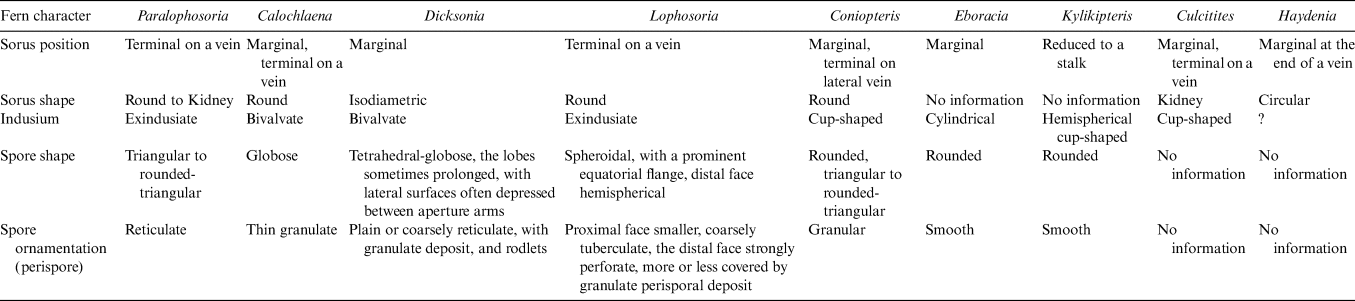
The Jurassic fossil record for Dicksoniaceae is known from different floras worldwide (e.g., Barale & Ouaja Reference Barale and Ouaja2002; Wang Reference Wang2002; Cleal & Rees Reference Cleal and Rees2003; Birkenmajer & Ociepa Reference Birkenmajer and Ociepa2008; Mehlqvist et al. Reference Mehlqvist, Vajda and Larsson2009; Barbacka Reference Barbacka2011; Vaez-Javadi Reference Vaez-Javadi2011; Kostina & Herman Reference Kostina and Herman2013; Scanu et al. Reference Scanu, Kustatscher and Pittau2015). We compared the fossil material to extant and extinct genera from Dicksoniaceae and it appears to show a unique combination of features (Table 1). Our material can be distinguished from Calochlaena (Maxon) M.D. Turner & R.A. White and Dicksonia M.R. Schomb. due the lack of sori with bivalvate or cuplike indusium in a marginal position (Smith et al. Reference Smith, Pryer, Schuettpelz, Korall, Schneider and Wolf2006). It differs from fossil genera such as Coniopteris Brongniart and Eboracia Thomas due the lack of marginal sori with a cup-shaped indusium (Harris Reference Harris1961; Li et al. Reference Li, Miao, Zhang, Ma and Hao2020). Kylikipteris Harris has fertile parts reduced to stalked pinnules with a hemispherical cup-shaped indusium (Harris Reference Harris1961), unlike our fossils, and Culcitites Appert has a marginal pocket-shaped indusium (Appert Reference Appert1973), which is not seen in our material. Finally, our material can be distinguished from Haydenia thyrsopteroides Seward due the lack of a crenate margin on the ultimate segments of fertile material, ultimate segments with forked veins coming from a midvein in the non-fertile material (see Appert Reference Appert1973, Abb. 42–43 and pl. 59, fig. 4, pls. 61–63), or fertile fronds with irregularly lobed pinnules with numerous marginal sori (Seward Reference Seward1912).
Useful characteristics that distinguish Paralophosoria from other genera within Dicksoniaceae (characters from: Seward Reference Seward1912; Harris Reference Harris1961; Appert Reference Appert1973; Gastony & Tryon Reference Gastony and Tryon1976; Van Konijnenburg-Van Cittert Reference Van Konijnenburg-Van Cittert1989; Kramer Reference Kramer, Kramer and Green1990b; Tryon & Lugardon Reference Tryon and Lugardon1991; Smith et al. Reference Smith, Pryer, Schuettpelz, Korall, Schneider and Wolf2006; Li et al. Reference Li, Miao, Zhang, Ma and Hao2020).

The material shares characters with extant Lophosoria quadripinnata C. Presl, such as the number of divisions of the frond (Smith et al. Reference Smith, Pryer, Schuettpelz, Korall, Schneider and Wolf2006) and exindusiate sori that are single and dorsal on the veins (Kramer Reference Kramer, Kramer and Green1990b; Smith et al. Reference Smith, Pryer, Schuettpelz, Korall, Schneider and Wolf2006). In particular, some foliage characters (e.g., deeply incised pinnatifid pinnules and ultimate segments with pinnate veins) and exindusiate sori at the end of one vein are shared between L. quadripinnata C. Presl and Paralophosoria jurassica. Nevertheless, the P. jurassica can be distinguished from L. quadripinnata because the second species lacks sessile ultimate segments with an entire margin (Fig. 6a, b), and just have round to kidney-shaped sori (Fig. 6b).
The in situ spores of Paralophosoria do not have the conspicuous characters diagnostic of Lophosoria (e.g., equatorial cingulum and proximal inter-radial sculpture/protuberances) as reported by Gastony & Tryon (Reference Gastony and Tryon1976). Furthermore, Paralophosoria has triangular to rounded-triangular spores (Fig. 5f–k), as seen in Coniopteris (Van Konijnenburg-Van Cittert Reference Van Konijnenburg-Van Cittert1989), but the perispore is granular in the latter and reticulate in our material. A reticulated perispore is present in some members of Dicksonia (Tryon & Lugardon Reference Tryon and Lugardon1991) and Paralophosoria, whereas perispore is smooth in Eboracia and Kylikipteris and is thin and granulate in Calochlaena (Table 1).
The spores of Paralophosoria can be compared with fossil spores from members of Matoniaceae due to the distinct raised laesurae (treated here as a labrum) (van Konijnenburg-van Cittert Reference Van Konijnenburg-Van Cittert1993; Givulesco & Popa Reference Givulescu and Popa1998; Popa & van Konijnenburg-van Cittert Reference Popa and Van Konijnenburg-Van Cittert1999). However, these spores are psiliate to faintly granulate or granulate, contrasting with the reticulate perispore from our material, and none of the more 140 specimens have recorded the morphological features of Matoniaceae. Based on the unique combination of pinnae morphology, venation patterns, sori position and shape, and spore surface and shape, we recognise this material as a new taxon within Dicksoniaceae, a family with higher diversity during the Jurassic than today.
Incertae sedis
Genus cf. Aspidistes Harris, Reference Harris1961
Aspidistes silvapinedae Morales-Toledo, Mendoza-Ruiz & Cevallos-Ferriz, sp. nov.
Holotype. IGM-PB 263, Figure 7.
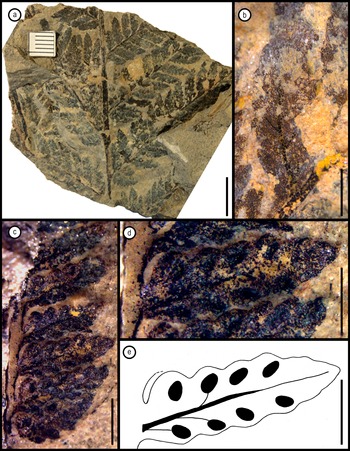
Aspidistes silvapinedae (a–e) (IGM-PB 263 to IGM-PB 264). (a) Number of divisions and arrangement of sterile fronds. (b) Pinnules with venation pattern. (c) Position, number, and shape of sori of fertile fronds. (d) Closer magnification of (c) showing venation pattern and sori position. (e) Schematic drawing of (d) showing the venation pattern and sori position. Scale bars = 1 cm (a); 0.1 cm (b, c); 0.05 cm (d, e).

Paratypes. IGM-PB 263 to IGM-PB 265.
Repository. ‘Colección Paleobotánica del Museo de Paleontología’ (National Paleontological Collection), Instituto de Geología, Universidad Nacional Autónoma de México.
Type locality. Santo Domingo Tianguistengo locality, located in the Magdalena Creek between the town Santo Domingo Tianguistengo, Oaxaca, and Santa Cruz Nuevo, Puebla, at [18.18°N, 97.40°W].
Stratigraphic horizon. Otlaltepec Formation, Middle Jurassic.
Etymology. The specific epithet silvapinedae honours Dr Alicia Silva-Pineda, whose contributions to the study of the Jurassic palaeobotany in Mexico are far-reaching.
Diagnosis. Bipinnate catadromous fronds. Rachis glabrous. Pinnae alternate, width constant towards the lamina apex. First basal acroscopic pinnules are shorter. Pinnules alternate, basally lobed to dentate towards the apex margin, first basal ultimate segment slightly rounded. Venation pinnate, free. Sori round, on medial to supra-medial position, at the end of a vein.
Description. Frond bipinnate, catadromous (Fig. 7a). Preserved part of the laminae 5.2 cm long, 5.5 cm wide. Rachis glabrous, 0.2 cm wide, tapering towards the apex of the frond. Pinnae linear, alternately inserted each 1.5 cm along the main rachis, arising at acute angles (34–57°), 4 cm long, 1.2 cm wide, not overlapping with other pinnae, with first basal acroscopic pinnule shorter. Pinnules alternate, 0.7–0.8 cm long, 0.2 cm wide, constricted acroscopic bases, slightly decurrent basiscopic bases, crenate–dentate margins on sterile segments and crenate to rounded margins on fertile segments (Fig. 7b–e). Venation pinnate, free (Fig. 7b, d). Sori round, 0.5 mm in diameter, on medial to supra-medial position, at the end of a vein, eight sori per pinnule (Fig. 7c–e).
Discussion. Harris (Reference Harris1961) placed Aspidistes in the Aspidiaceae, which is included in Dryopteridaceae by Smith et al. (Reference Smith, Pryer, Schuettpelz, Korall, Schneider and Wolf2006). However, Lovis (Reference Lovis1975) remarked on the controversial placement of Jurassic material in the Polypodiales Link and discussed that Aspidistes thomasii could represent a member of Thelypteridaceae Ching ex Pic. Serm. The only reliable way to decide if our material is in Thelypteridaceae is with the recovery of bilateral spores with monolete scars (as is found in almost all genera of this family), or tetrahedral spores with a trilete scar, as in Trigonospora Holttum. Unfortunately, no spores were retrieved from our material, so placement in Thelypteridaceae is tentative.
Our fossil material shares some characters with Aspidistes, such as repeatedly pinnate fronds with catadromic branching, diverging branch veins, similar sterile and fertile leaves, and round sori (Harris Reference Harris1961), but the indisium is not visible in our material. Aspidistes silvapinedae can be distinguished from A. thomasii Harris from the Jurassic of Yorkshire, UK, Aspidistes delicatula Barale & Ouaja from Merbah El Asfer, South Tunisia (Barale & Ouaja Reference Barale and Ouaja2002), and Aspidistes sewardi Watson from the Wealden district in the UK (Watson Reference Watson1969), by the fertile pinnule margin, number of sori per pinnule, number of sori per lobe, and sori size (Table 2).
Useful characteristics that distinguish Aspidistes silvapinedae from other species of the world (characters from: Harris Reference Harris1961; Watson Reference Watson1969; Barale & Ouaja Reference Barale and Ouaja2002).

Person & Delevoryas (Reference Person and Delevoryas1982) illustrate fertile pinnules attributed to Cladophlebis browniana (Dunker) Seward, but we suggest that fertile material does not represent the actual pinnules of C. browniana (discussed above). Their material consists of a fragment that bears at least 12 rounded sori (Fig. 6i). Due to the possible presence of Aspidistes in the Otlaltepec Formation, we suggest that Person & Delevoryas (Reference Person and Delevoryas1982) material should be reviewed and possibly moved to this taxon.
Genus Sphenopteris Sternberg
Sphenopteris sp.
(Fig. 8a–e)
Specimens examined. IGM-PB 108 to IGM-PB 117.
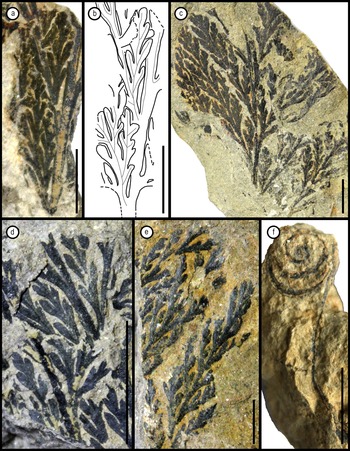
Sphenopteris sp. (a–e) (IGM-PB 108 to IGM-PB 111) and Spiropteris sp. (f) (IGM-PB 266). (a) Pinnate-pinnatifid pinna with venation and constricted bases. (b) Schematic drawing of (a) showing the venation reaching every segment. (c) Vegetative fronds with the number of divisions and phyllotaxy. (d) Ultimate segments with round or acute apex and a decurrent-base pinnule segment. (e) Ultimate segments with round or acute apex and a decurrent-base pinnule segment (barcode from the herbarium). (f) Fragment of a crozier circinate frond. Scale bars = 1 cm.

Description. Fragments of vegetative fronds with bipinnate-pinnatifid blade, 4 cm long, 3.6 cm wide (Fig. 8a–e). Rachis glabrous, non-sulcate, 0.2 cm wide, tapering towards the apex of the lamina. Pinnae alternate, inserted at intervals about 1 cm along the main rachis, arising at acute angles (65–70°), 2.8 cm long, 1 cm wide (Fig. 8c). Pinnules pinnatifid, alternate, some opposite, with decurrent basicopic and constricted acroscopic margin (Fig. 8d, e), 0.5–0.6 cm long, 0.3 cm wide, tapering towards pinnule apex (lanceolate). Ultimate segments with a rounded or acute apex (Fig. 8a–e). Each ultimate segment with a single vein (Fig. 8a–b, d).
Discussion. Wieland (Reference Wieland1914–1916) reported similar foliage in Oaxaca, and Person & Delevoryas (Reference Person and Delevoryas1982) assigned them to Sphenopteris goepperti Seward. The shared characters between our material and S. goepperti from Oaxaca are the lamina division, rachis width, pinnae arrangement, the rounded shape of the ultimate segments (‘spatula shaped’ in Person & Delevoryas Reference Person and Delevoryas1982), and the prominent mid veins. However, S. goepperti was transferred to Ruffordia goepperti by Seward (Reference Seward1894). Seward (Reference Seward1894) describes the venation as being ‘of the types Caenopteridis and Sphenopteridis’, but in his plate VI of figure 1a, the venation of a piece of a pinna is shown that differs from our material in having flabellate venation rather than each last segment with a single vein. Furthermore, Mohr et al. (Reference Mohr, Bernardes-de Oliveira, Loveridge, Pons, Sucerquia and Castro-Fernándes2015) described a well-preserved specimen of R. goepperti where the main vein of the pinnule emerges from the pinna rachis and ends in the middle of the first lobe division, then free veins diverge and dichotomise several times, reaching the edge of each lobe in a flabellate venation pattern, contrasting with a single vein in each ultimate segment of our material.
Sphenopteris (s.l.) is generally characterised by pinnules constricted at the base, with an oval outline and almost entirely margined, or lobed, and are usually decurrent, giving the pinna axes a distinctly winged shape (Taylor et al. Reference Taylor, Taylor and Krings2009). Our material has the characters needed to be placed in Sphenopteris but not into S. goepperti as reported by Person & Delevoryas (Reference Person and Delevoryas1982) since S. goepperti has changed to R. goepperti and our material is not a Ruffordia. Other genera, such as Onychiopsis Yokoyama and Coniopteris Brongniart are similar to Sphenopteris sp., but fertile structures are needed to justify the placement of our material within any of these Dicksoniaceous genera.
Genus Spiropteris Schimper, Reference Schimper1869
Spiropteris sp.
(Fig. 8f)
Specimens examined. IGM-PB 266 to IGM-PB 269.
Description. Fragment of a young frond that shows the laminae rolled from apex to base with the apex in the centre of coil (crosier circinate) (Fig. 8f). Petiole is 3 cm long. Coil about 1 cm in diameter.
Discussion. Spiropteris is a morphotaxon including distinctive fossil circinately coiled frond tips that could not be assigned to foliage-based genera due to the absence of lamina features (Mehlqvist et al. Reference Mehlqvist, Vajda and Larsson2009).
‘Fern type 1’
(Fig. 9a–d)
Specimens examined. IGM-PB 104 to IGM-PB 107.
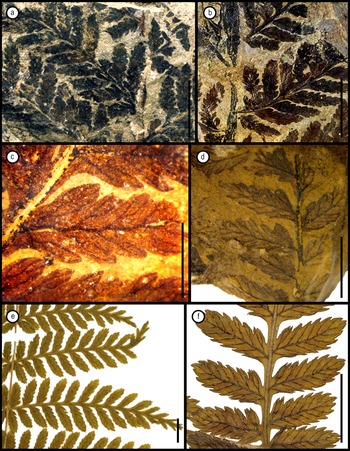
Fern type 1 (a–d) (IGM-PB 104 to IGM-PB 106) and Leptopteris fraseri (e, f). (a) Vegetative fronds showing the number of divisions, and pinnae arrangement. (b) Vegetative fronds showing the number of divisions, and pinnae arrangement with veins. (c) Pinnules of (b) showing the venation pattern. (d) Pinnules showing secondary veins forking. (e) Extant fronds showing pinnae arrangement, University of Michigan Herbarium, 1,177,561 (barcode from the specimen). (f) Pinnules of (d) showing the venation pattern. Scale bars = 1 cm (a, b, e, f); 0.2 cm (c); 0.5 cm (d).

Description. Fragments of vegetative, bipinnate fronds are 4 cm long by 8 cm wide (Fig. 9a, b). Rachis glabrous, 0.3 cm wide, tapering towards the apex. Pinnae alternate, inserted in intervals of about 1 cm along the main rachis, arising at acute angles (50–75°), slightly falcate, contiguous, tapering towards the apex, 2–3.5 cm long, 1.3 cm wide (Fig. 9b). Pinnules alternate, decurrent, pinnatifid, with acute apex, 0.8–1 cm long, 0.3 cm wide. Each pinnule with a persistent primary vein running into the apex, then secondary veins forking two to three times in the first lobule (Fig. 9c), and then twice (Fig. 8d).
Discussion. Our material is similar to a single specimen of Cladophlebis browniana (Dunker) Seward from the Middle Jurassic of Oaxaca (Person & Delevoryas Reference Person and Delevoryas1982), which is deposited in the ‘Colección Paleobotánica del Museo de Paleontología’ under the prefix IGM-PB 406 (Fig. 6g, h). Both have alternate, pinnatifid pinnules with decurrent bases and pinnules with a persistent primary vein with dichotomising secondary veins (Figs 6g–h, 9c–d). In the generic diagnosis of Cladophlebis Brongniart (Reference Brongniart1849), the pinnules are not decurrent, in contrast to the decurrent base of the pinnules from our material (Fig. 9c, d). In considering the venation, Cladophlebis, Todites Seward emend. Harris, and Osmundopsis Harris emend. Harris are all similar in having a thickened midvein and many bifurcating lateral veins (Harris Reference Harris1961), which also differs from our material that may have trifurcations and bifurcations matching up the teeth of the margin (Fig. 9c, d). Thus, only with fertile structures could this material be assigned confidently to any of these genera.
Raphaelia Debey & Ettingshausen is a genus represented by sterile and fertile foliage (Tidwell & Ash Reference Tidwell and Ash1994) and it is extensively recorded from the Far-East region in Russia and Mesozoic deposits of China, where Raphaelia diamensis is the most significant representative (Tian et al. Reference Tian, Wang, Dong, Li and Jiang2016). The sterile fronds of R. diamensis have pinnules with a primary vein and diverging lateral veins and the pinnules have a cuneate base with entire margins. Even though the pinnule venation of R. diamensis and our material are similar, the gross morphology of the pinnules differ. Phyllopteroides Medwell is a Cretaceous genus reported in Australia (Cantrill & Webb Reference Cantrill and Webb1987) and India (Banerji Reference Banerji1987). The pinnules from Phyllopteroides are simple, linear-lanceolate with a prominent midrib, and the base tapers sharply (Cantrill & Webb Reference Cantrill and Webb1987), in contrast to the morphology from the pinnules presented here.
Though the specimens have characters in common with extant Osmundaceae, they can be distinguished from the sterile leaves of Osmunda L. due to its articulate pinnae (Kramer Reference Kramer, Kramer and Green1990a), which are unlike the decurrent pinnules from our material. Todea Willd. ex Bernh. has ultimate tongue-shaped pinnules (ultimate segments) (Kramer Reference Kramer, Kramer and Green1990a) that are different from the ultimate falcate segments from the Fern type 1 material. Leptopteris C. Presl, like the new material, is characterised by bipinnate lamina with dentate to deeply pinnatifid pinnules (Kramer Reference Kramer, Kramer and Green1990a). Kramer (Reference Kramer, Kramer and Green1990a) does not describe the venation pattern, but it resembles that of Leptopteris fraseri (Hook. & Grev.) C. Presl., which bears a middle vein in the ultimate segment from where secondary bifurcated veins run towards the teeth (Fig. 9e, f). This venation pattern is also found in Fern type 1 material. However, sterile foliage alone is not very informative, and without the sporangia it is difficult to confidently assign the material to a species or genus. The gross morphology and the venation patterns of the pinnules suggest that the material can be a member within Osmundaceae, but fertile structures are needed to confirm this hypothesis.
3. Discussion
Leaf venation patterns have been widely used to identify fossil plant leaves, principally in the angiosperm group (Hickey & Wolfe Reference Hickey and Wolfe1975; Leaf Architecture Working Group 1999). In other groups such as the ferns it can be a challenging endeavour to use leaf architecture to identify the plants. To identify fossil ferns, reproductive structures that bear unambiguous diagnostic characters for identification are preferred. However, these materials are not always present in the collections, and vein patterns in fern taxonomy have proven to be an important alternative to discriminate between species, genera, and families (Wagner Reference Wagner1979). Recently, fern venation patterns have been discussed and used with confidence as an important taxonomic tool where reproductive organs are lacking (Simpson Reference Simpson2010).
Tuomisto & Groot (Reference Tuomisto and Groot1995) pointed out that fern flora and monographic treatments typically describe adult plants and, thus, all identification pteridophytes keys are skewed towards fertile material. This can be seen in important works, such as that of Mexico (Mickel & Smith Reference Mickel and Smith2004), where the description of the venation patterns of ultimate segments of fronds is somewhat superficial, thus hindering character comparison. The description and identification of both extant and fossil ferns is biased towards the fertile material leaving out a lot of valuable information that venation patterns can provide. Here, we have paid special attention to the venation patterns, and their interactions, specifically with their development near the margin in the ultimate segments of the pinnae.
Venation patterns are also important to understand previous records for the Middle Jurassic of Mexico. The case of the specimens described and identified as Cladophlebis browniana by Person & Delevoryas (Reference Person and Delevoryas1982) shows that the sterile fronds are actually fronds from Paralophosoria jurassica and the fertile fronds are a different unknown species. The venation pattern of the ultimate segments of their material does not correspond to the pattern of Cladophlebis, but is clearly similar to the one described for Paralophosoria.
In addition, the venation patterns in the ultimate segments of both our material and Leptopteris fraseri correspond to comparable morphologies. We suggest that even though fertile material bears key characters that help to identify groups, foliar characters can be useful to identify non-fertile fossil material when more specific descriptions of vein patterns of the ultimate segment(s) are available, and it would be valuable for future researchers to further document pinnule venation.
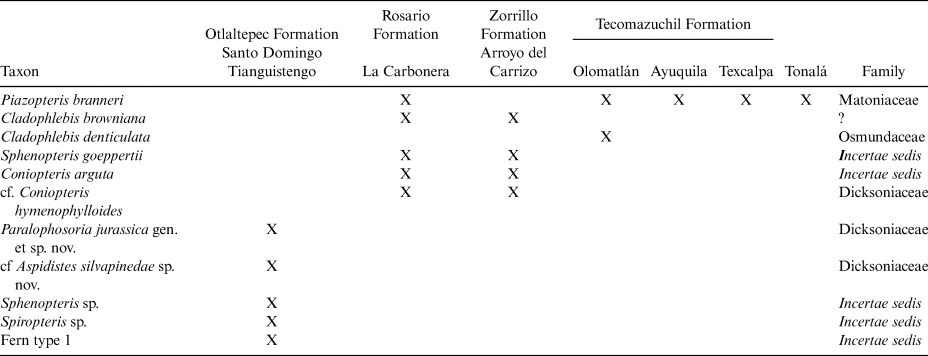
This study has greatly expanded the diversity of ferns known from the Middle Jurassic of Mexico (Table 3). Previously, six species were identified (Silva-Pïneda Reference Silva-Pineda1969, Reference Silva-Pineda1978; Person & Delevoryas Reference Person and Delevoryas1982), representing at least three different families (Matoniaceae, Osmundaceae, Dicksoniaceae). The Otlaltepec Formation material shows that the ferns here were more diverse than previously thought by adding new occurrences of five species not found previously in this region. In particular, we expanded the known diversity of Dicksoniaceae, by recognising a new genus for the family and two new species. Overall fern biodiversity during the Middle Jurassic in Mexico is far from understood, but by studying new localities, such as the Santo Domingo Tianguistengo locality, we can provide more evidence to understand fern evolution and taxonomy.
The comparison of Otlaltepec Formation fern diversity with other published works from the Middle Jurassic of Mexico (information from: Silva-Pïneda Reference Silva-Pineda1969, Reference Silva-Pineda1978; Person & Delevoryas Reference Person and Delevoryas1982).

4. Conclusions
This study provides the description and identification of different ferns from a new locality from the Middle Jurassic of Mexico. These new records encompass two new genera (Paralophosoria gen. nov., Dicksoniaceae, and Spiropteris), two new species (P. jurassica sp. nov. and Aspidistes silvapinedae), and one previously reported genus (Sphenopteris). In addition, a new type of fern with uncertain affinities was also described (Fern type 1). The systematics of previous records from the area were discussed on the basis of new evidence from a bigger sample of specimens, putting an important emphasis on the venation patterns of sterile foliage. Our work contributes to the understanding of fern diversity during the Middle Jurassic in Mexico.
5. Acknowledgements
We want to thank all the peer reviewers that made useful observations of this work. We acknowledge financial support from the Consejo Nacional de Ciencia tecnología (CONACYT 221129 and CF61501) and Programa de Apoyo a Proyectos de Investigación e Innovación Tecnológica (PAPIIT210416). CONACYT is also recognised for a Postgraduate scholarship to the first author (CONACYT 766646). We thank Dr María Susana Sosa Najera, Instituto de Geología, UNAM, for helping in the process of spore isolation, the ‘Colección Nacional de Paleontología’ Curator, Violeta Amparo Romero Mayen, and Dr Jesús Alvarado Ortega, for allowing access to viewing fossil specimens in the national collection, Dr Jordan K. Teisher, Curator and Director of the Missouri Botanical Garden Herbarium, and Brad R. Ruhfel, Research Collection Manager, Division of Vascular Plants, University of Michigan Herbarium for access to viewing extant specimens, and Paleobotany Lab members Cesar Ríos Santos, Marco Antonio Ruvalcaba Knoth, Alma Rosa Vásquez Loranca, Angélica Quintanar Castillo, and Enoch Ortiz Montejo for their valuable field work. We thank Dr Selena Y. Smith and the PEPPR Laboratory from the University of Michigan for their valuable feedback for improving our use of English.
6. Author contributions
J.M.-T.: investigation, writing – original draft; A.C.M.-R.: supervision, writing – review and editing; S.R.S.C.-F.: resources, writing – review and editing, supervision, project administration, funding acquisition.