INTRODUCTION
The invasion of alien Mnemiopsis leidyi Agassiz, 1865 (Ctenophora: Lobata, endemic to the east coast of North and South America) into the Caspian Sea during the end of the 1990s drew the issue of zoo- and phytoplankton community changes to the public interest (Esmaeili et al., Reference Esmaeili, Abtahi, Khodabandeh, Talaeizadeh, Darvishi and Eerershad1999; Ivanov et al., Reference Ivanov, Kamakima, Ushivtzev, Shiganova, Zhukova, Aladin, Wilson, Harbison and Dumont2000; Shiganova et al., Reference Shiganova, Kamakin, Zhukova, Ushitsev, Dulimov and Musaeva2001; Kideys et al., Reference Kideys, Roohi, Bagheri, Finenko and Kamburska2005; Roohi & Sajjadi, Reference Roohi, Sajjadi, Grillo and Venora2011).
Striking changes in the biodiversity of phytoplankton, zooplankton, macrobenthos and fish were attributed mainly to the voracious feeding impact on zooplankton of Mnemiopsis leidyi (Shiganova et al., Reference Shiganova, Dumont, Sokolsky, Kamakin, Tinenkova, Kurasheva and Niermann2004; Kideys et al., Reference Kideys, Roohi, Bagheri, Finenko and Kamburska2005, Reference Kideys, Roohi, Develi, Melin and Beare2008; Costello et al., Reference Costello, Sullivan, Gifford, Van and Sullivan2006; Finenko et al., Reference Finenko, Kideys, Anninsky, Shiganova, Roohi, Tabari, Rostami and Bagheri2006; Roohi et al., Reference Roohi, Kideys, Sajjadi, Hashemian, Pourgholam, Fazli, Khanari and Eker-Develi2010) because ‘possible effects of environmental factors on the ecosystem such as the climate and eutrophication could not be clearly detected’ (Roohi et al., Reference Roohi, Yasin, Kideys, Hwai, Khanari and Eker-Develi2008).
However, the serious environmental degradation which started at the beginning of 1990s (Dumont, Reference Dumont1995; Salmanov, Reference Salmanov1999; CEP, 2006; Khodaparast, Reference Khodaparast2006; Sharifi, Reference Sharifi2006; Stolberg et al., Reference Stolberg, Borysova, Mitrofanov, Barannik and Eghtesadi2006; Kideys et al., Reference Kideys, Roohi, Develi, Melin and Beare2008) and previous introductions of alien species (Grigorovich et al., Reference Grigorovich, Therriault and MacIsaac2003) such as Balanus improvisius, B. eburneus (1954), Acartia tonsa, A. clausi (1981), Pleopis polyphemoides (1957) and Hediste diversicolor (1939–1940) would have had an impact on the plankton community as well, based on studies in other seas (Purcell et al., Reference Purcell, Uye and Lo2007; Richardson, Reference Richardson2008; Occhipinti-Ambrogi & Ambrogi, Reference Occhipinti-Ambrogi and Ambrogi2009).
The environmental degradation of the southern Caspian Sea was caused by the heavy agricultural use and deforestation of woodlands. The nutrient load of river flow has increased since the early 1980s (Salmanov, Reference Salmanov1999; Sharifi, Reference Sharifi2006; CEP, 2006; Stolberg et al., Reference Stolberg, Borysova, Mitrofanov, Barannik and Eghtesadi2006; Bagheri, Reference Bagheri2012) and in the south-western Caspian Sea has caused a hike in primary productivity reflected by high chlorophyll-a levels, which were 5–26 times higher in 2006 and 2009–2010 (2.71–35.25 µg dm−3) than in 1994 (0.56–1.34 µg dm−3 (Fallahi, Reference Fallahi1993; CEP, 2006; Khodaparast, Reference Khodaparast2006; Kideys et al., Reference Kideys, Roohi, Develi, Melin and Beare2008; Bagheri et al., Reference Bagheri, Mansor, Turkoglu, Makaremi and Babaei2012a, Reference Bagheri, Mansor, Turkoglu, Marzieh, Wan Maznah and Negaresatanb)).
Studies by Bagheri et al. (Reference Bagheri, Mashhor, Makaremi, Mirzajani, Babaei, Negarestan and Wan-Maznah2010) displayed further that the striking reduction in outflow from the Sefidrood River during the drought period of 2001–2002 caused drastic changes in nutrient concentrations as compared to 1996–1997, coinciding with changes in the phytoplankton community from diatoms to dinoflagellates in the southern Caspian Sea. The authors concluded that the depletion of silicate levels coupled with an increase in water temperature and salinity were the main factors for the decrease of diatoms and for the bloom of dinoflagellates and cyanophytes, not the feeding impact of Mnemiopsis leidyi on mesozooplankton.
Surveys in the south-western Caspian Sea carried out during 2001–2008 by Bagheri et al. (Reference Bagheri, Niermann, Sabkara, Mirzajani and Babaei2012c) demonstrated that the changes of the mesozooplankton community after 2001 were not as drastic as described by Roohi et al. (Reference Roohi, Yasin, Kideys, Hwai, Khanari and Eker-Develi2008, Reference Roohi, Kideys, Sajjadi, Hashemian, Pourgholam, Fazli, Khanari and Eker-Develi2010) based on their survey for the whole southern Caspian Sea during 2001–2006.
In order to trace the development of the Mnemiopsis leidyi stock and to verify the changes in the mesozooplankton community we performed further surveys in the years 2009 and 2010. In contrast to previous cruises, we concentrated on only one transect off Anzali, for the following reason: during the previous surveys of Roohi et al. (Reference Roohi, Yasin, Kideys, Hwai, Khanari and Eker-Develi2008) during 2001–2006 and Bagheri et al. (Reference Bagheri, Niermann, Sabkara, Mirzajani and Babaei2012c) between 2001 and 2008, large areas in the southern Caspian Sea were sampled. Unfortunately not all stations could be sampled continuously during all seasons. Thus, stations were under-represented or missing in some seasons during the period of investigation, which could have led to misinterpretation of the annual abundance of species which occur mainly in spring or summer. To overcome this uncertainty we selected in the present study only the one transect off Anzali which consisted of three stations that were sampled more regularly than the other stations from 1996 to 2010. In addition to Roohi et al. (Reference Roohi, Kideys, Sajjadi, Hashemian, Pourgholam, Fazli, Khanari and Eker-Develi2010) other dominant groups such as Rotifera and Protozoa where assessed as well.
In this study, we intended to investigate to what extent changes in the zooplankton community from endemic to alien species could be caused or triggered by environmental changes. In doing so, the impact of Mnemiopsis leidyi on the mesozooplankton should not be overlooked.
MATERIALS AND METHODS
Area under investigation
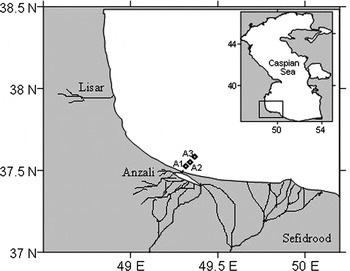
The area under investigation is located at the south-western corner of the Caspian Sea (Figure 1) and is considerably influenced by freshwater input from the Anzali wetlands and the Sefidrood delta. The surface water temperature varies between 26–32°C in summer and 8–12°C in winter (Roohi et al., Reference Roohi, Yasin, Kideys, Hwai, Khanari and Eker-Develi2008). Related to the strength of river inflow, the salinity is highly variable, especially during spring, when the rivers carry winter melt waters, and it can drop locally to 5.6–8.3 psu. On average the surface salinity varies around 11.9 ± 1.2 psu, increasing with depth to values of 12.4 ± 1.6 psu (Roohi et al., Reference Roohi, Yasin, Kideys, Hwai, Khanari and Eker-Develi2008). Due to deforestation and accelerating agricultural use, the nutrient load of river flow has increased since the early 1980s (Salmanov, Reference Salmanov1999; CEP, 2006; Sharifi, Reference Sharifi2006; Stolberg et al., Reference Stolberg, Borysova, Mitrofanov, Barannik and Eghtesadi2006). A detailed description of the area under investigation and ongoing environmental changes is given by Bagheri et al. (Reference Bagheri, Niermann, Sabkara, Mirzajani and Babaei2012c).
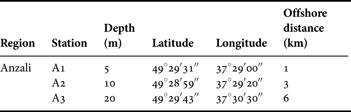
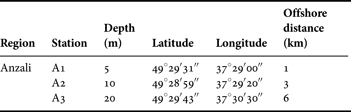
Area of investigation 1996–2010; south-western Caspian Sea; Anzali transect consisting of three stations, with station total depth of A1 = 5 m, A2 = 10 m, and A3 – 20 m.

Sampling strategies and methods
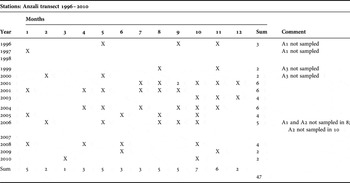
Distribution of Mnemiopsis leidyi and mesozooplankton populations were studied along a transect off Anzali in the south-western Iranian coast of the Caspian Sea in different months during 1996–2010 (Figure 1; Tables 1 & 2). Three stations were chosen along this transect with depth at 5 m (A1), 10 m (A2) and 20 m (A3). Water samples were collected on a speedboat from 10 am to 2 pm on the sampling day.
Station information.
Stations sampled during 1996–2010. X, sampled — at Stations A1, A2 and A3 one haul each was taken; 2, replicate samples.

Individuals of Mnemiopsis leidyi were sampled in vertical hauls using a METU plankton net (mesh size: 500 µm; opening diameter: 50 cm; net bucket volume: 1000 ml; Kideys et al., Reference Kideys, Roohi and Bagheri2001). Mesozooplankton was collected with a Juday net (opening diameter: 36 cm, mesh size: 100 µm; Vinogradov et al., Reference Vinogradov, Shushkina, Musaeva and Sorokin1989) at the same stations and same depth as M. leidyi. The further treatment of the samples and the statistical evaluation were the same as described by Bagheri et al. (Reference Bagheri, Niermann, Sabkara, Mirzajani and Babaei2012c). Cluster analysis (Bray–Curtis similarity index; UPGMA; log10 transformed) was used to detect annual and seasonal changes in the mesozooplankton community.
RESULTS
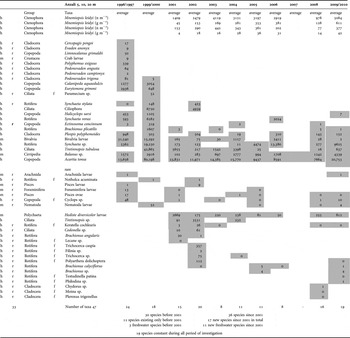
A total of 47 mesozooplankton species were found during the whole sampling period (1996–2010), 38 of them were holoplanktic and nine were meroplanktic species (Table 3). Only 19 species occurred constantly during the whole period of investigation; some of them decreased in number or were found only sporadically after 2000. Eleven species occurred only till 2000; 17 new species were collected after 2000 (Table 3).
Average abundance of mesozooplankton species (number m−3) per month collected in the south-western Caspian Sea during 1996–2010 (no sampling in 2007). The species are ranged in order of their appearance. h, holoplankton; m, meroplankton; r, rare species; f, freshwater species; 0, individual number < 0.5.

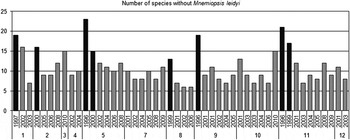
Most of the collected species (N = 33) could be described as rare species (definition: average individual number of the whole period of investigation below 50 ind. m−3 or present only during five or fewer years of the whole 10-y investigation period). The impact of freshwater to the Anzali area was obvious by the occurrence of 14 freshwater species; two of them (Notholca acuminate, Rotifera and Cyclops sp., Copepoda) occurred during the whole period of investigation, one species, Paramecium sp., occurred only till 2000, while 11 new freshwater species were found after 2000. The total number of species for all corresponding months decreased after 2000 (Figure 2).
Number of mesozooplankton species in the Caspian Sea off Anzali (excluding Mnemiopsis leidyi) from 1996 to 2010. Data are grouped according to month for comparing purposes (x-axis: the numbers 1–12 represent month of the year). The black bars represent monthly data collected before 2001.

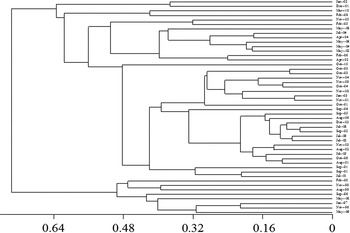
Cluster analysis confirmed these changes in the mesozooplankton community after 2000. It separated the period 1996–2000 and the period 2001–2010 distinctively (Figure 3). Both clusters could be further divided into two subgroups: one containing mainly the samples from January to May and the other one the samples from July to December, reflecting the blooming time of dominant species. Spring species were Balanus sp., Bivalvia larvae, Pleopis polyphemoides (February–May), and Synchaeta sp., plus Synchaeta vorax (February–March). Dominant species during summer–autumn were Acartia tonsa (August–December), Hediste diversicolor larvae and Tintinnopsis tubulosa (August–November).
Bray–Curtis similarity index (UPGMA; log10 transformed) results of all species (excluding Mnemiopsis leidyi) in the Caspian Sea off Anzali during 1996–2010.

The changes in the mesozooplankton community can be described as follows. The 11 species that had vanished after 2000 mainly consisted of native Cladocera (N = 6) and Copepoda (N = 3) species. Two of these Copepoda species belonged to the dominant species group before 2001, Calanipeda aquaedulcis and Eurytemora grimmi. Other species (Halicyclops sarsi, Synchaeta vorax, Ectinosoma consimum) those that were frequent before 2000 appeared only occasionally in subsequent years (Table 3).
Most of the 17 species that appeared after 2000 were rare species. Only two of them displayed considerable numbers, Tintinnopsis sp. (Ciliata) which was found from 2001 to 2004 (Table 3), and the larvae of Hediste diversicolor (Polychaeta).
Of the 19 species that were present throughout the investigation period, only six species occurred quite constantly from year to year: Pleopis polyphemoides; Bivalvia larvae; Synchaeta sp.; Tintinnopsis tubulosa; Balanus sp.; and Acartia tonsa. Only two of them, A. tonsa and the nauplius and cypris larvae of Balanus sp., were found every year from 1996 to 2010 (Table 3). Beside these two species, the larvae of the polychaete H. diversicolor, which appeared after 2000, has become a dominant species which has occurred every year since then.
Acartia tonsa
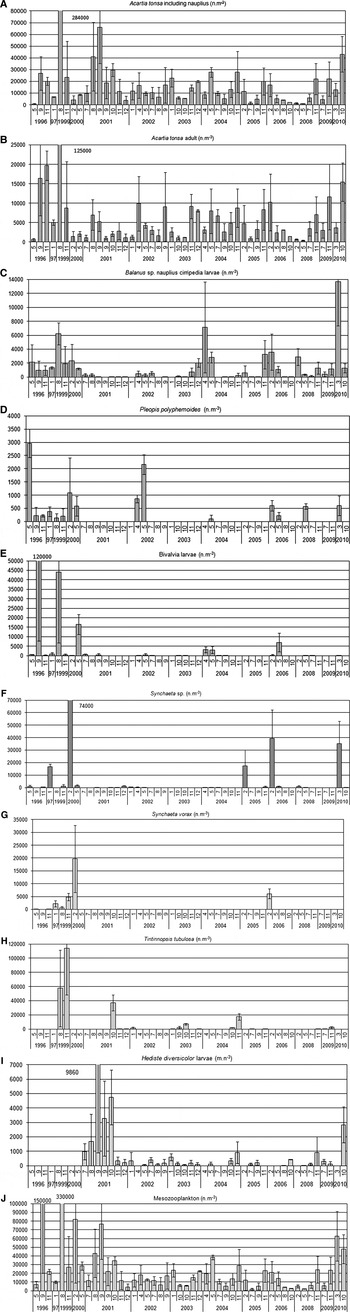
With 52% of the total individual numbers, Acartia tonsa dominated the mesozooplankton community throughout the sampling period (Table 3). The annual numbers of A. tonsa (including larvae) were in the same range during the whole period of investigation (no significant difference between the numbers during 1996–1997 and 2001–2010; P > 0.05; Figure 4A). Exceptional high individual numbers were recorded in August 1999 (remarkably 284,000 ind. m−3), in September 2001 and October 2010 (Figure 4A). If only the adult A. tonsa stock is taken into consideration, it becomes obvious that the individual numbers during summer–autumn were reduced in 2000 as compared to 1996 and 1999 (Figure 4B). However, ten years later, in October and November 2009–2010, the numbers reoccurred in the same range as before 2000 (except August 1999, a year with an extraordinary bloom of A. tonsa; Figure 4A, B).
Annual and monthly fluctuations of dominant zooplankton species in the Caspian Sea off Anzali during 1996–2010. Vertical numbers indicate the sampled month.

Balanus sp.
The nauplius and Cirripedia larvae of Balanus sp. peaked in early spring and autumn. The abundance of this species has increased since 2000. Its abundance was highest in August 1999, April 2004, and March 2010 (P < 0.05; Figure 4C).
Pleopis polyphemoides
Pleopis polyphemoides (Cladocera) bloomed in spring and was present as well in all other seasons until 2000. After 2001, P. polyphemoides was found only from February to May and was absent during the second half of the year (P < 0.01; Figure 4D).
Bivalvia larvae
A bloom of Bivalvia larvae occurred usually during April–May. High numbers of Bivalvia larvae were found also during late summer until 1999, while in subsequent years hardly any larvae were detected during summer and autumn (P < 0.01; Figure 4E).
Synchaeta species
Synchaeta species occurred from time to time in mass quantities during winter–spring, as in 1997, 2000, 2005, 2006 and 2010 (Figure 4F). Synchaeta stylata and Synchaeta vorax (Figure 4G) occurred until February 2000; afterwards these species were found only in 2002 and 2006 (Table 3).
Tintinnopsis tubulosa
Tintinnopsis tubulosa, which blooms during August–November, displayed high abundances during 1999 and 2001 but did not occur in 1996. After 2001, it was present only in severely reduced numbers (P < 0.01; Figure 4H).
Hediste diversicolor larvae
The blooming period of H. diversicolor larvae is September–October. Hediste diversicolor larvae had not been found before 2001, which was an exceptional year with high abundances of larvae during the summer (about N = 10,000 ind. m−3). In subsequent years it occurred in moderate numbers, below 1000 ind. m−3, until it was found again in higher numbers in October 2010 (about N = 3000 ind. m−3) (P < 0.05; Figure 4I).
Total mesozooplankton
The high total mesozooplankton numbers originate from the abundances of Acartia tonsa in summer–autumn and Synchaeta species in February (Figure 4J). This was obvious during September 1996, August 1999 and February 2000 when extraordinarily high mesozooplankton numbers were recorded, caused by blooms of A. tonsa and Synchaeta species. During other months the numbers of total mesozooplankton were in the same range throughout the period of investigation.
Mnemiopsis leidyi
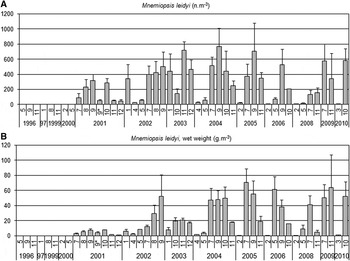
Number and biomass increased from the beginning of the sampling year 2001 to about 600 ind. m−3 and 40–60 g wet weight m−3 until 2003. Since then the abundance has fluctuated within this range until 2010 (Figure 5A, B).
Annual and monthly fluctuations of the number and biomass of Mnemiopsis leidyi in the Caspian Sea off Anzali during 2001–2010. Vertical numbers indicate the sampled month.

DISCUSSION
The drastic changes in the mesozooplankton community after the year 2000 were mainly attributed to a serious impact of the introduced species Mnemiopsis leidyi (Shiganova et al., Reference Shiganova, Dumont, Sokolsky, Kamakin, Tinenkova, Kurasheva and Niermann2004; Kideys et al., Reference Kideys, Roohi, Bagheri, Finenko and Kamburska2005; Rowshantabari et al., Reference Rowshantabari, Nejatkhah, Hosseini, Khodaparast and Rostamian2007; Roohi et al., Reference Roohi, Yasin, Kideys, Hwai, Khanari and Eker-Develi2008), which is well known as a voracious feeder on zooplankton (Burrell & Van-Engel, Reference Burrell and Van-Engel1976; Kremer, Reference Kremer1994; Mutlu, Reference Mutlu1999; Finenko & Romanova, Reference Finenko and Romanova2000; Shiganova et al., Reference Shiganova, Kamakin, Zhukova, Ushitsev, Dulimov and Musaeva2001; Kideys, Reference Kideys2002; Kideys & Moghim, Reference Kideys and Moghim2003; Costello et al., Reference Costello, Sullivan, Gifford, Van and Sullivan2006). Roohi et al. (Reference Roohi, Yasin, Kideys, Hwai, Khanari and Eker-Develi2008, Reference Roohi, Kideys, Sajjadi, Hashemian, Pourgholam, Fazli, Khanari and Eker-Develi2010) supposed in their study that besides the impact of M. leidyi, environmental changes coinciding with the invasion could have played a significant role. Our findings verified that, besides M. leidyi, the increasing eutrophication and weather impacts, such as floods and drought, had played a role in restructuring the mesozooplankton community in the south-western part of the Caspian Sea.
When these environmental changes were taken into account, it became obvious that M. leidyi could not solely account for the drastic changes happening in the mesozooplankton community. Below we discuss the factors that led to the changes in mesozooplankton: the impact of M. leidyi, environmental changes or both.
Our findings showed that the zooplankton community changed after 2000: native species vanished or decreased in numbers and invasive species such as Hediste diversicolor (introduced by Russian scientists 1939–1940), Balanus improvisius, B. eburneus, (appeared 1954), Pleopis polyphemoides (1957), Acartia tonsa (1981) and M. leidyi (end of the 1990s) dominated the zooplankton community after 2000 (Grigorovich et al., Reference Grigorovich, Therriault and MacIsaac2003).
Hosseini et al. (Reference Hosseini, Roohi, Ganjian, Roshantabari, Hashemian, Solimanroudi, Nasrollazadeh, Najafpour, Varedi and Vahedi1996) and Roohi et al. (Reference Roohi, Yasin, Kideys, Hwai, Khanari and Eker-Develi2008, table 4c) stated that about 24 endemic Cladocera species could not be found during 2001–2006. Our studies showed that most of these species were already absent during the surveys in 1996–1999 (Table 3), leading to the conclusion that the endemic zooplankton fauna of the south-western Caspian Sea was already reduced before M. leidyi appeared in the system.
When the grazing activity of M. leidyi in the south-western Caspian Sea during summer–autumn is considered, it becomes obvious that this could lead to the changes of the seasonal fluctuations of dominant species after 2001 when the first M. leidyi bloom was observed. Until the end of the 1990s, the Bivalvia larvae, Tintinnopsis tubulosa and Pleopis polyphemoides occurred in every sampled month throughout the year. After 2000, Bivalvia larvae and the Cladocera P. polyphemoides could only be found in very low numbers or were completely absent during the blooming time of M. leidyi from summer to autumn (Table 3; Figure 4D, E, H; Bagheri, Reference Bagheri2012). Although P. polyphemoides occurred in higher numbers in spring after 2000 compared with the end of the 1990s, it was always absent during the second half of all years till 2010, coinciding with the active grazing period of M. leidyi.
The impact of M. leidyi on the total Acartia tonsa stock (including adults and nauplius larvae) is difficult to estimate. The analysis displayed that there was no significant difference in the numbers before and after the M. leidyi invasion (Figure 4A). However, if only the adults of A. tonsa are taken into consideration, a minor impact of M. leidyi can be seen. While the numbers of A. tonsa in winter and spring were into the same range throughout the study period, they were reduced during summer and autumn compared to the period before the invasion of M. leidyi (September–November 1996 and August 1999; Figure 4B). However, an extradordinarely high number were recorded in August 1999, significantly different from subsequent years.
Mnemiopsis leidyi in the southern Caspian Sea consists of mainly (more than 90%) individuals <5 mm in size (Finenko et al., Reference Finenko, Kideys, Anninsky, Shiganova, Roohi, Tabari, Rostami and Bagheri2006; Roohi et al., Reference Roohi, Yasin, Kideys, Hwai, Khanari and Eker-Develi2008; Bagheri et al., Reference Bagheri, Niermann, Sabkara, Mirzajani and Babaei2012c). Individuals of this size consumed only nanoplankton and microplankton, such as Protozoa, Ciliata, small diatoms, and dinoflagellates (Sullivan & Gifford, Reference Sullivan and Gifford2004; Fiupnko et al., 2006; Sullivan, Reference Sullivan2010). Therefore, the impact of M. leidyi to mesozooplankton such as Copepoda and Cladocera should be much lower, as stipulated by previous authors (Shiganova et al., Reference Shiganova, Dumont, Sokolsky, Kamakin, Tinenkova, Kurasheva and Niermann2004; Kideys et al., Reference Kideys, Roohi, Bagheri, Finenko and Kamburska2005; Roohi et al., Reference Roohi, Kideys, Sajjadi, Hashemian, Pourgholam, Fazli, Khanari and Eker-Develi2010; Rowshantabari et al., Reference Rowshantabari, Finenko, Kideys and Kiabi2012). Therefore, besides the impact of M. leidyi, anthropogenic and climatic factors should be taken into account for the drastic change of the zooplankton community. Urban and industrial effluents, oil and gas exploration and agricultural use increased during the last two decades, and about 140,000 t of nutrients, 4600 t of oil, and 8 t of phenol reach the Iranian area (Guilan district) of the Caspian Sea per year (CEP, 2007). Experimental work on the effects of oil pollution on endemic species of the Caspian Sea is still outstanding.
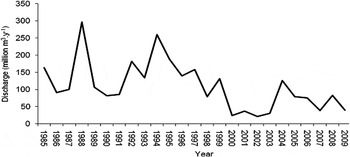
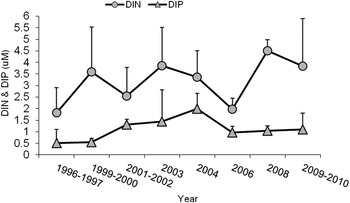
The oil pollution in the area of investigation is minor compared to the impact of the intensive agricultural usage, which has caused two major long-term changes in the catchment area of the south-western Caspian Sea. First, the Sefidrood River was siphoned for agricultural purposes, leading to a great decrease in outflow (Figure 6; GWRO, 2010). Second, the nutrient load of the river has increased since the beginning of the 1990s (Figure 7; Bagheri, Reference Bagheri2012). Because the ecology of south-western Caspian Sea is influenced to a wide extent by the inflow of freshwater, its communities are dependent on the quantity and quality of the river input. Thus, the situation in the south-western Caspian Sea is different when compared to other areas of the Caspian Sea.
Long-term fluctuation of the Sefidrood River discharge in the Caspian Sea during 1985–2009. Data from Bagheri (2012).

Dissolved inorganic nitrogen (DIN) and dissolved inorganic phosphorus (DIP) concentration (± SD) in the Caspian Sea off Anzali during 1996–2010. Data from Bagheri (2012).

Beside the above mentioned environmental degradation, the different weather patterns observed during the period of investigation could have triggered the changes in the zooplankton community.
- 1996–1997:
Increase of river discharge during the heavy rainfall in winter–spring (GWRO, 2010).
- 2001–2002:
Decrease of river discharge caused by draught, coincided with the first bloom of M. leidyi (Bagheri et al., Reference Bagheri, Mashhor, Makaremi, Mirzajani, Babaei, Negarestan and Wan-Maznah2010).
- 2003–2004:
High freshwater input (Bagheri, Reference Bagheri2012).
- 2005–2006:
Increase in river discharge during the heavy rainfall in winter–spring, but dry summer (Bagheri, Reference Bagheri2012).
- 2007–2008:
Harsh winter (CNN, 2008).
- 2009–2010:
Increase of river discharge during the heavy rainfall in winter–spring (GWRO, 2010).
The drought in 2001–2002 caused a rise of seawater temperature and salinity and a decrease of freshwater river discharge, leading to a decrease of silicate levels (Bagheri et al., Reference Bagheri, Mashhor, Makaremi, Mirzajani, Babaei, Negarestan and Wan-Maznah2010). These environmental changes had consequences for the composition of the species community, which changed according to their environmental requirements. Bagheri (Reference Bagheri2012) classified two main groups of species which were suppressed or supported by the changing environmental parameters in the south-western Caspian Sea. Acartia tonsa, Hediste diversicolor larvae, Tintinnopsis sp. and Mnemiopsis leidyi abundances were associated with higher levels of dissolved nitrate (DIN), dissolved phosphate (DIP) and warm water, while Synchaeta sp., Pleopis polyphemoides, and Bivalvia larvae had positive relationships to the discharge of freshwater and dissolved silicate (DSi).
According to the above, and examples from previous investigations done in other seas (Purcell et al., Reference Purcell, Uye and Lo2007; Resends et al., Reference Resende, Azeiteiro, Goncalves and Pereira2007; Sommer, Reference Sommer2009; Okogwu, Reference Okogwu2010; Purcell, Reference Purcell2012), we conclude that high river discharge and seasonal precipitation during 1996–1997 coincided with a high number of species (Figure 2; Moncheva et al., Reference Moncheva, Gotsis-Skretas, Pagou and Krastev2001). The 2001–2002 drought, along with high water temperatures, strong stratification and lowered nutrient levels in the surface water, resulted in low mesozooplankton species numbers. These changes were caused mainly by increased temperature and the depletion of silicate levels that led to a decrease of diatoms and enhanced a strong bloom of dinoflagellates and cyanophytes (3–4 fold higher than before 2000). The changes in the nutrient and phytoplankton composition were the reason for the decrease of mesozooplankton during these years, not the feeding impact of M. leidyi (Bagheri, Reference Bagheri2012). The larvae of Balanus sp. and the numbers of Acartia tonsa were extremely low during the 2001–2002 drought (Figure 4B, C) and recovered in subsequent years to levels higher than before 2000, despite a high number of M. leidyi (Figure 5A, B).
The deposit feeding polychaete Hediste diversicolor was favoured by the drought. It appeared during summer 2001 in high numbers (Figure 4I; N = 1000–10,000) coinciding with blooms of non-diatoms such as Prorocentrum cordatum and Oscillatoria sp. (Bagheri et al., Reference Bagheri, Mashhor, Makaremi, Mirzajani, Babaei, Negarestan and Wan-Maznah2010), which provided an increased food flux to the bottom. Moderate phytoplankton blooms in subsequent years (Bagheri et al., Reference Bagheri, Mansor, Turkoglu, Makaremi and Babaei2012a, Reference Bagheri, Mansor, Turkoglu, Marzieh, Wan Maznah and Negaresatanb) led to lowered abundances of H. diversicolor until 2010.
The decrease of zooplankton abundance during 2008 could be related to a harsh winter which lowered the water temperatures (<6.5°C; CNN, 2008; Bagheri et al., Reference Bagheri, Niermann, Sabkara, Mirzajani and Babaei2012c) delaying the bloom of zooplankton in the south-western Caspian Sea (Figure 4J).
An overall view shows that the mean annual abundance of A. tonsa has increased in the southern Caspian Sea since its introduction in 1986 (Kurashova, Reference Kurashova2009) till 2010. High numbers of A. tonsa were sampled during the flood period at the end of the 1990s (Figure 4A; up to 280,000 ind. m−3). The decrease of A. tonsa during 2001–2002, and the moderate numbers during 2005, 2006 and 2008 (same range as in 1986–1995 – about 5000 ind. m−3; Table 3) could be related to low silicate levels and low temperature (CNN, 2008; GWRO, 2010; Bagheri et al., Reference Bagheri, Niermann, Sabkara, Mirzajani and Babaei2012c). The low temperature delayed the hatching of larvae; the low silicate levels again led to a decrease of diatoms, which are the main food resource for A. tonsa (Bagheri et al., Reference Bagheri, Mashhor, Makaremi, Mirzajani, Babaei, Negarestan and Wan-Maznah2010; Bagheri, Reference Bagheri2012). With increasing diatom numbers during 2009–2010, the A. tonsa stock increased again (average annual value ~20,000 ind. m−3; Table 3).
CONCLUSION
The major changes in the zooplankton community and possibly the blooming of Mnemiopsis leidyi during 2001–2002 were triggered by changing weather patterns, when a period with heavy rain at the end of the 1990s was displaced by a drought period (2001–2002). In contrast to other areas of the Caspian Sea, where tremendous blooms of M. leidyi were observed during 2001–2002, the development of the M. leidyi stock was moderate in the south-western Caspian Sea, leading to a smaller impact on zooplankton than noted in other areas of the Caspian Sea (Shiganova et al., Reference Shiganova, Dumont, Sokolsky, Kamakin, Tinenkova, Kurasheva and Niermann2004; Kideys et al., Reference Kideys, Roohi, Develi, Melin and Beare2008).
The grazing effect of M. leidyi was obvious because species which were dominant during all seasons before 2000 were absent or found only in very low numbers during the bloom time of M. leidyi in summer–autumn. It is not clear to what extent M. leidyi is responsible for the disappearance of endemic Copepoda and Cladocera species such as Eurytemora grimmi, Limnocalanus grimaldii, Cercopagis pengoi and Polyphemus exiguous because other invader species, such as Acartia tonsa and Pleopis polyphemoides were more successful competitors compared with the endemic Caspian Sea fauna, which is very sensitive to disruption by invader species (Dumont, Reference Dumont2000; Ivanov et al., Reference Ivanov, Kamakima, Ushivtzev, Shiganova, Zhukova, Aladin, Wilson, Harbison and Dumont2000; Shiganova et al., Reference Shiganova, Musaeva, Pautova and Bulgakova2005). In fact M. leidyi is not responsible for the disappearance of a multiplicity of endemic Copepoda and Cladocera species, as listed in Roohi et al. (Reference Roohi, Yasin, Kideys, Hwai, Khanari and Eker-Develi2008), because they were already absent in the south-western Caspian Sea during 1996 before the invasion of the ctenophore to the Caspian Sea.
It could be said that the increasing amount of nutrients and presumably chemical pollution, including oil and gas, during the last two decades has led to a decrease in endemic species and smoothed the way for opportunistic invader species such as A. tonsa and M. leidyi, which depleted the endemic species in their turn.
The south-western Caspian Sea reflects the same trend that is observed in other marine environments: a declining biodiversity accompanied by a spreading of invader species such as Acartia sp. and gelatinous zooplankton (comb jellyfish), caused mainly by anthropogenic activities such as modifications of river flows and eutrophication (Purcell et al., Reference Purcell, Uye and Lo2007; Richardson, Reference Richardson2008; Occhipinti-Ambrogi & Ambrogi, Reference Occhipinti-Ambrogi and Ambrogi2009).
ACKNOWLEDGEMENTS
The authors are grateful to Foong Yeok for improving the English of the manuscript. We greatly appreciate the assistance received from J. Sabkara, A. Mirzajani, H. Khodaparast, E. Yosefzad, M. Sayadrahim, Y. Zahmatkesh and S. Rouhbani in this study.
FINANCIAL SUPPORT
We would like to thank the Inland Waters Aquaculture Institute and Iranian Fisheries Research Organization (IFRO) for financial support of this project. The Universiti Sains Malaysia (USM) is also gratefully acknowledged.