Introduction
In modern pig production, pigs are often kept in small, poorly structured pens and the amount of space that is provided for each piglet frequently meets only the minimum legal requirements. However, adequate space allowance is a factor which contributes exceedingly to animal welfare (Hurnik & Lewis Reference Hurnik and Lewis1991). Thus, it is known that restricted space allowance can increase plasma cortisol concentrations as well as aggressive behaviour in pigs and can contribute to tail biting outbreaks (Hemsworth et al. Reference Hemsworth, Rice, Nash, Giri, Butler, Tilbrook and Morrison2013; Kim et al. Reference Kim, Kim, Kim, Kim, Seol, Lee, Chae and Kim2017). Furthermore, exploratory and playing behaviour can be reduced when pigs are kept at low space allowances (Nakamura et al. Reference Nakamura, Tanaka, Nishida and Uetake2011). In most countries, specific guidelines for pig production currently exist and the minimum spatial requirements are usually tailored to the weight of the individual animal. Usually, these minimum requirements are given in m2 per pig for a certain body weight or a body weight range. However, spatial requirements differ between countries around the world and a uniform method for calculating the adequate space allocation for pigs is lacking. The guidelines for space allocation result, in the majority of cases, from the equation: Space =k × body weight0.667 which was proposed by Petherick (Reference Petherick, Baxter, Baxter and MacCormack1983) and confirmed in several later studies (Gonyou et al. Reference Gonyou, Brumm, Bush, Deen, Edwards, Fangman, McGlone, Meunier-Salaun, Morrison, Spoolder, Sundberg and Johnson2006; Petherick & Phillips Reference Petherick and Phillips2009; Spoolder et al. Reference Spoolder, Aarnink, Vermeer, van Riel and Edwards2012). In this formula, k represents a space allowance coefficient and body weight is converted from a three-dimensional (3D) into a two-dimensional (2D) concept. However, the results of different studies revealed different k values even for the same body weight class, which was most probably caused by different study designs. Consequently, different recommendations for appropriate space allowance were given (Gonyou et al. Reference Gonyou, Brumm, Bush, Deen, Edwards, Fangman, McGlone, Meunier-Salaun, Morrison, Spoolder, Sundberg and Johnson2006).
Indeed, it is not a simple matter to determine how much space an individual animal needs. In the past, different scientific approaches were developed to gain a deeper knowledge of the space required by pigs for maintaining their welfare and biological performance. According to McGlone & Pond (Reference McGlone and Pond2003), the floor space in a conventional pig pen consists of two components: used space and free space. While used space was defined as the space occupied by the pigs’ bodies, free space was specified as the remaining, unoccupied space which can be used for different behavioural activities. Petherick (Reference Petherick, Baxter, Baxter and MacCormack1983) suggested three different kinds of space: the area that an animal requires due to its body dimensions (static space), which corresponds to the ‘used space’ defined by McGlone & Pond (Reference McGlone and Pond2003), in addition to the space needed for behavioural activities (dynamic space) and the space that is necessary for interactions between the animals (social-interaction space). The dynamic space was defined in more detail as the space needed for non-locomotor body movements and to make normal postural adjustments (McGlone et al. Reference McGlone, Vines, Rudine and DuBois2004; Pastorelli et al. Reference Pastorelli, Musella, Zaninelli, Tangorra and Corino2006). In contrast to the dynamic or social interaction space, the static space of pigs in a pen can be measured for each individual by means of its body dimensions and consequently the amount of free space can be quantified. This can be an important approach to evaluate current spatial requirements in pig farming (Hurnik & Lewis Reference Hurnik and Lewis1991; Anil et al. Reference Anil, Anil and Deen2007). Published data about the exact body dimensions of pigs in different age and weight categories are sparse (Moustsen et al. Reference Moustsen, Lahrmann and D'Eath2011; Meyer et al. Reference Meyer, Vogel and Wähner2012; Fels et al. Reference Fels, Sange and Kemper2016) and where these data are available they have often involved labour intensive weighing and measuring of many animals (Moustsen et al. Reference Moustsen, Lahrmann and D'Eath2011; Meyer et al. Reference Meyer, Vogel and Wähner2012). A standardized, precise method which can be applied easily on farms has not been available so far.
Hence, for the present study, a novel image-based monitoring system was used in order to measure static space occupied by individual weaner and growing pigs showing different body positions in their familiar environment. Individuals were monitored by cameras from above in their home pen without the necessity for any human handling. Thus, the aim of the present study was to measure the static space of individual group-housed pigs up to a body weight of 25 kg in their familiar surroundings, in order to determine the static space requirements of pigs during rearing.
Materials and methods
Animals and housing
The present study was carried out on the research farm of the University of Veterinary Medicine Hannover, Foundation, Germany. On the farm, a total of 80 sows and their piglets up to 11 weeks old were kept in a conventional housing system. Piglets were hybrids (Genetics: German National Breeding Program – BHZP, db Victoria × db 77 Pietrain) and were kept in farrowing pens with crates for the sow until weaning at 35 days old. Male piglets were castrated within the 1st week of life and male and female piglets were tail docked and marked with an individual ear tag at the same time. After weaning, piglets were mixed into groups of eight and reared in these groups up to the age of about 11 weeks, before being sold for fattening. All weaned piglets were kept in conventional rearing pens with a fully slatted plastic floor providing a space allowance of 0.35 m2 per animal (pen dimensions: 1.73 × 1.60 m2). For each animal, a feeding place was available where the dry feed was given ad libitum. Water was also offered ad libitum in one nipple drinker per pen. The light was turned on at 06.00 h and off at 16.00 h. Additionally, there was one window in the compartment; thus, there was a daylight incidence as well.
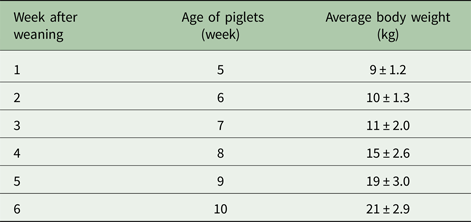
For the present study, in a total of three batches, all suckling piglets were weighed individually 1 day before weaning. Per batch, 16 piglets were selected for the study according to their weight and sex and two groups of eight animals each were formed on the day of weaning. Thus, a total of 48 piglets were used, kept in groups of eight, each group balanced by weight and sex. The initial body weight of all piglets was 9 ± 1.2 kg (mean ± standard deviation (sd)), the average final weight at the end of the study was 21 ± 2.9 kg (Table 1). In each group, the piglets were marked individually on their backs with numbers 1–8, using blue stock marking spray before being moved to the rearing pens. Per batch, the two newly formed groups were kept in two adjacent pens in the same rearing compartment for a period of 6 weeks. Once a week, the piglets were weighed again and the numbers on their backs renewed.
Average body weights (±sd) of individuals depending on the week after weaning and age

Technical equipment and image analysis
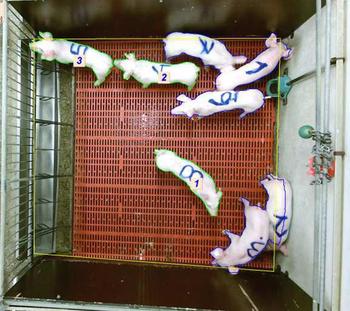
On the ceiling of each experimental pen, at a height of 2.5 m, a camera (Kinect V2 M for Xbox One, Microsoft Corporation, Redmond, Washington, USA) was fixed and connected to one personal computer each. Pictures of the piglets’ pen were taken from above and sent via USB 3 (universal serial bus 3-cables) to the two personal computers, which were located in another room outside the piglets’ compartment. Image analysis software was installed on each of the two personal computers, which was developed by a company for image analysis and robotics (CLK GmbH, Altenberge, Germany http://www.clkgmbh.de/index.php/en/bildverarbeitung-en/). Pictures from the cameras were stored by the software at 10-s intervals and the floor space covered by each individual piglet within a group was calculated in each image by a specific algorithm (CLK GmbH, Altenberge, Germany). This algorithm processed the information of 2D images to identify the pigs based on the contrast between the bright pig and the darker floor. In addition, 3D images were used for distinguishing the pigs from the ground level based on body height information. When the pig's body was recognized, the covered floor space was calculated automatically. Piglets recognized by the program as individuals had a green line drawn around them and were marked with a number (Fig. 1). A blue line was drawn around piglets that could not be identified correctly by the program as individuals, and they were not used for the present study. The floor space covered by a correctly identified and numbered piglet was specified by the program in cm2. The calculated results for space covered by individual piglets were initially saved in CSV (comma-separated values) file format and could be opened subsequently with Microsoft Excel (Microsoft Office 2010, Microsoft Corporation, Redmond, Washington, USA).
Image of a piglet group generated by the program for image analysis. Animals identified as individuals have a green line drawn around them and are numbered 1–3. Picture: CLK GmbH (Altenberge, Germany).

Correct function of the software was verified by measuring a plastic pig model, using a laser triangulation method under laboratory conditions. A deviation of 0.03 when measuring the plastic pig model using the new software under farming conditions compared to the highly accurate laser triangulation method indicated the high specificity of the software for measuring individual body spaces. Data were collected once a week for 1 h in the morning (between 10.00 and 12.00 h) for a total period of 6 weeks per batch. All images analysed by the software were checked by a human observer, in each case verifying whether individual piglets in a group had been identified correctly by the program, marked with a number and subsequently analysed. When the images were checked by an observer, the body posture of each piglet was described and assigned manually to the space coverage data given by the software for the respective individual on the respective image. For analysis, five different body positions were distinguished. The different body positions were defined in accordance with Anil et al. (Reference Anil, Anil and Deen2007) as follows:
1. Standing: The pig was upright on all four legs.
2. Sitting: The piglet's body was supported by the two front legs.
3. Lying in ventral position: The pig lay on its belly with no, one or two front legs tucked under the body.
4. Lying in ventrolateral position: The pig lay on its belly with hind legs extended sideways.
5. Lying in lateral position: The pig lay on one side of its body, not supported by legs.
The results of covered floor spaces were assigned to the collected body weights (kg) of individual piglets. Subsequently, in a body weight range between 7 and 25 kg, different weight classes of piglets were defined containing animals of similar body weights which differed by <0.2 kg. Consequently, the mean space covered by piglets of each weight class was calculated. In total, 8818 images of individual piglets were analysed.
Statistics
Statistical analysis was carried out using IBM SPSS Statistics (Version 23, IBM, New York, USA) and SAS (Version 9.4, SAS Institute Inc., Cary, USA). First, the Shapiro–Wilk test was performed to assess data for normal distribution. The data were normally distributed, and data for different weeks and weight classes were treated as independent samples since not every individual was measured repeatedly in all weight classes and weeks. One-way analysis of variance (ANOVA) was carried out followed by post hoc Student Newman–Keuls tests to detect any significant differences between the mean floor spaces covered by piglets of different body weight classes in different body postures (standing, lying, sitting). For statistical analysis of static space occupied in different recumbent positions in different weeks of the experiment, a two-factorial analysis of variance was carried out according to the following model:
 $$y = \mu + {\rm positio}{\rm n}_i + {\rm wee}{\rm k}_j + \left( {{\rm position \times week}} \right)_{ij} \,+\, e_{ij}$$
where y is the covered floor space (static space), μ is the overall mean, position is effect of recumbent position (i = ventral, ventrolateral or lateral), week is effect of week of experiment (j = weeks 1–6), position × week is interaction between recumbent position and week and e is random residual error.
Linear and quadratic effects of time (weeks) were determined for each recumbent posture (ventral, ventrolateral and lateral) using analysis of contrasts (orthogonal polynomial model).
Pearson's correlation test followed by calculation of R 2 was carried out in order to find any linear relationships between the body weight classes of piglets and the respective space covered by individuals in different body postures.
Results
Space coverage of individual piglets in different weight classes and weeks
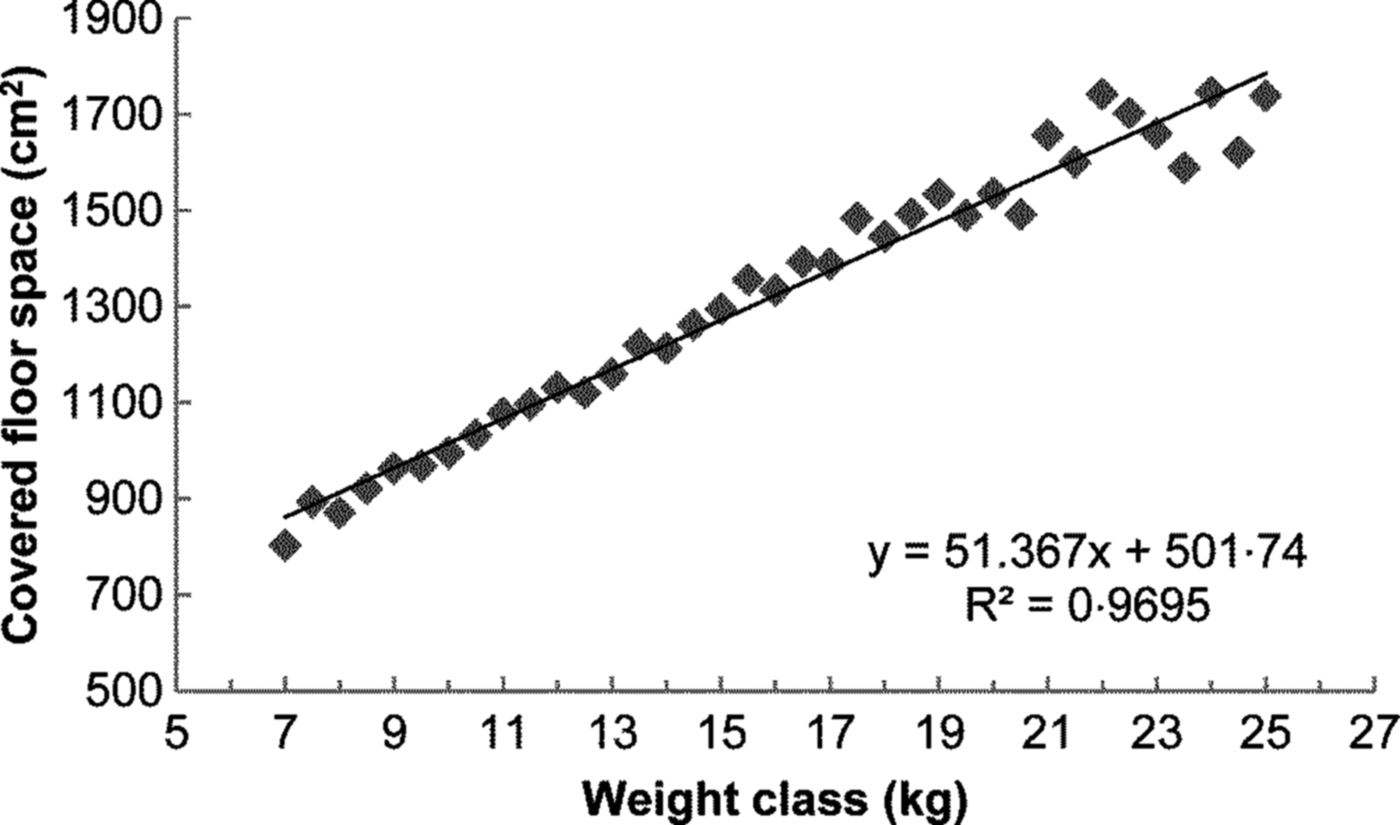
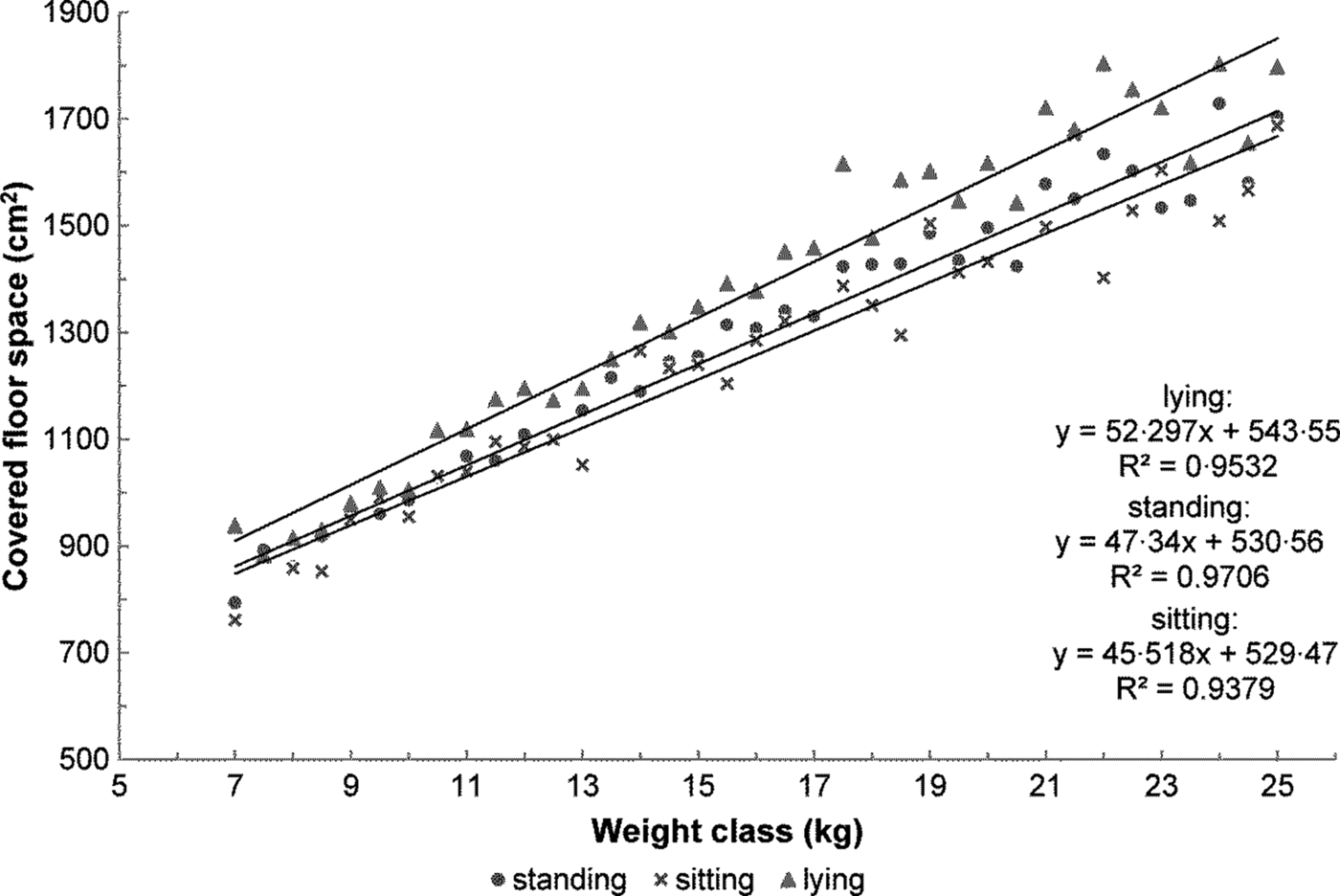
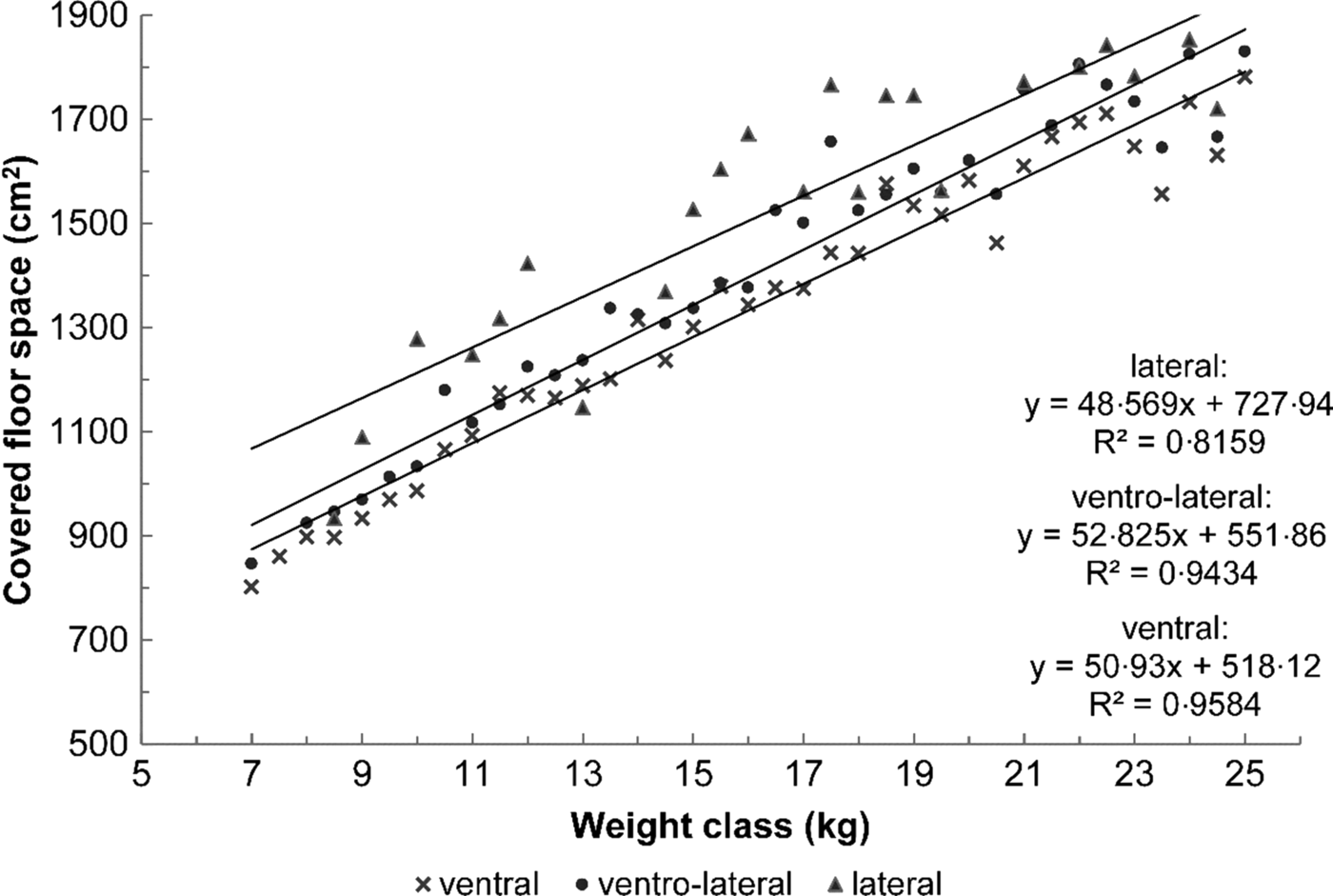
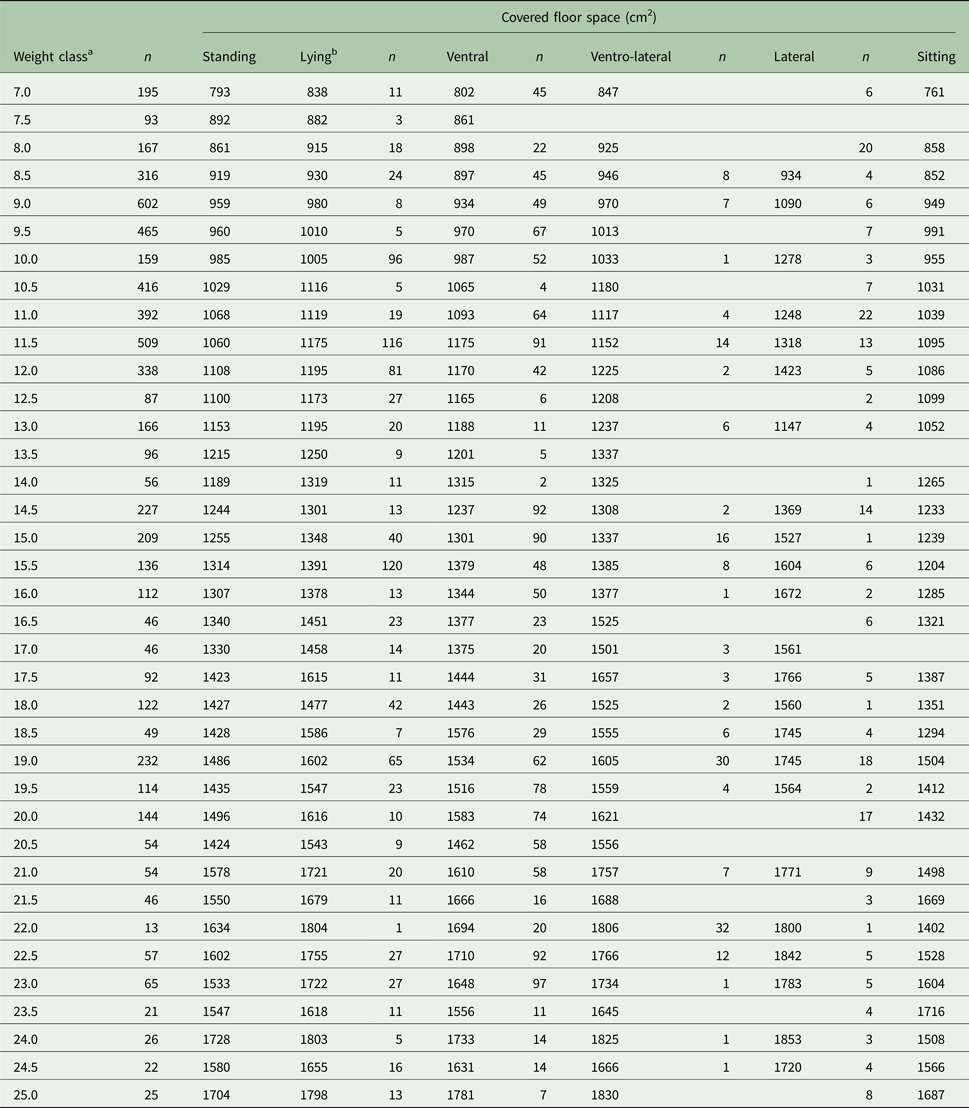
In order to analyse the static space covered by individual piglets, 37 weight classes from 7.0 up to 25.0 kg body weight were formed in 0.5 kg-steps (Table 2). The analysis of all different body weight classes and the corresponding mean covered floor spaces revealed that there was a linear increase in the floor space covered by individual piglets with increasing body weight (R 2 = 0.97, Fig. 2). A similar correlation between the floor space covered by an individual piglet's body and its body weight class was also found when analysing each body position separately. In Fig. 3, the relationships between body space coverage and weight classes are shown for standing (R 2 = 0.95), sitting (R 2 = 0.94) and lying (R 2 = 0.97) piglets. In Fig. 4, the relationships between covered floor spaces per pig and body weight classes for three different recumbent postures are presented (lateral: R 2 = 0.82; ventrolateral: R 2 = 0.94; ventral: R 2 = 0.96).
Mean floor space (cm2) covered by individuals depending on their body weight class. The mean covered floor space relates to all body postures (standing, lying in different positions and sitting). n = 8818 measurements.

Mean floor space (cm2) covered by standing, lying (average of ventral, ventrolateral and lateral position) and sitting piglets, standing: n = 5969 measurements, lying: n = 2633 measurements and sitting: n = 216 measurements.

Mean floor space (cm2) covered by piglets in ventral, ventrolateral and lateral recumbency, ventral: n = 974 measurements, ventrolateral: n = 1515 measurements and lateral: n = 143 measurements.

Mean covered floor spaces in standing, lying and sitting position for different weight classes

a Body weight ± 0.02 kg.
b Average of all measurements taken in ventral, ventrolateral and lateral position.
In many weight classes (8.0, 11.5, 17.0, 17.5, 19, 20.0–21.0 and 22.0–23.0 kg), piglets covered significantly more space in a recumbent position than in a standing posture (P < 0.001, Table 2). In weight classes where no significant difference between standing and lying was detected, at least the same tendency was found (Table 2). Sitting pigs took up significantly less space than lying pigs (P < 0.001) in weight classes of 7.0, 8.0, 11.0, 11.5, 15.5, 17.5, 18.5, 19.0, 20.0, 21.0, 22.5, 23.0 and 24.0 kg (Table 2).
At the end of the rearing period (body weight class: 25 kg), individual piglets covered 1704 cm2 in a standing position, 1687 cm2 when they were sitting and 1798 cm2 in a recumbent posture, on average. For ventral recumbent position, 1781 cm2 were needed whereas 1830 cm2 were measured for ventrolateral position. For lateral recumbent position, no image was available for the 25 kg-weight class. The highest value for static space of a piglet in lateral recumbent position was detected in the 24 kg weight class (1853 cm2).
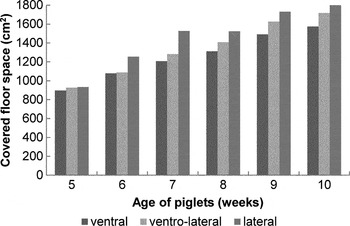
Pigs lying in the lateral recumbent position occupied more space (overall mean: 1555 cm2, sem: 150.6 cm2) than pigs lying in the ventrolateral position (overall mean: 1357 cm2, sem: 130.7 cm2, P < 0.001) which in turn occupied more space than pigs in the ventral position (overall mean: 1325 cm2, sem: 152.4 cm2, P = 0.002). As the age of the pigs increased, the space occupied in all lying positions increased linearly (P < 0.001) and there was no evidence for any quadratic response in space occupation with time (Fig. 5).
Covered floor space (cm2) in ventral, ventrolateral and lateral recumbency during six weeks, n = 2632 measurements.

Calculation of k values
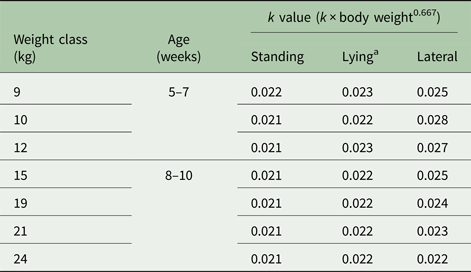
From the results of static space of piglets in different body positions obtained in the present study, k values were calculated, enabling a direct comparison to earlier estimated k values for the equation: Space = k × body weight0.667 (Table 3). It became evident that k values for pigs in a standing position were no different in a weight range between 10 and 24 kg (k = 0.021). For lying piglets in general, k = 0.022 was calculated in a weight range from 15 to 24 kg, while for lighter recumbent piglets a slightly higher k value was determined (k = 0.023). The k value calculated for lateral recumbent position decreased slightly with increasing body weight. While for piglets weighing 10 kg on average, k = 0.028 was calculated, this value reduced continuously with increasing body weight to k = 0.022 for pigs weighing 24 kg, on average.
K values for different body weight classes according to the age of piglets

K values were calculated from the static space requirements assessed in the present study.
a Average of all measurements taken in ventral, ventrolateral and lateral position.
Static space determined in the present study compared to legal spatial requirements
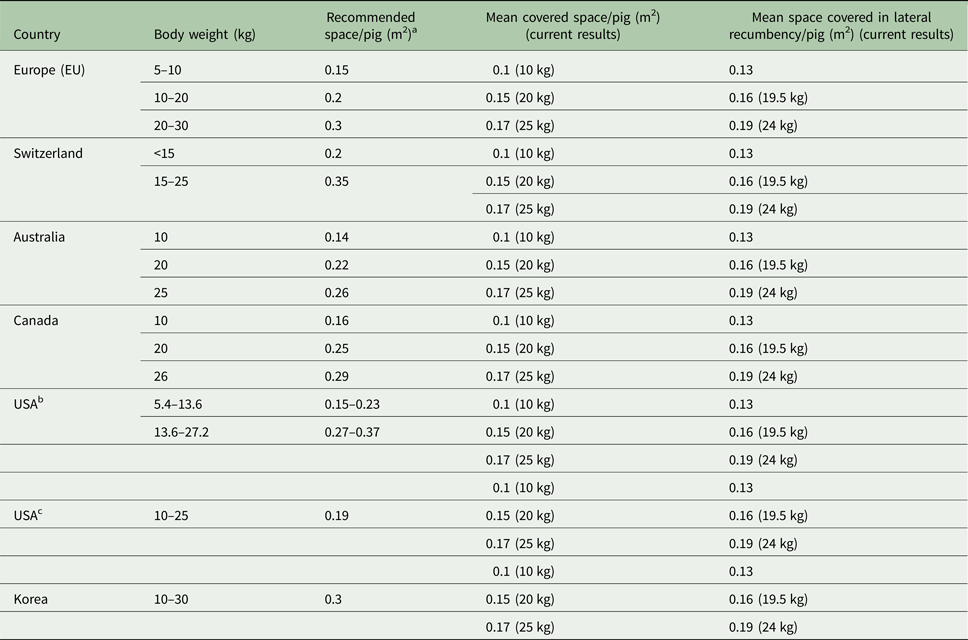
Legal space requirements or non-legal space recommendations in different countries around the world are presented in Table 4. Requirements for weaner and growing pigs differ slightly between countries. Table 4 also shows the amount of space that – according to the biometric data obtained in the present study – would be covered by an individual piglet of a certain body weight (m2/pig). It is important to emphasize that in the present study, fundamental biometric data on the body space are presented, which do not necessarily correspond to the real space requirements of pigs kept in groups. Nevertheless, it may be interesting to compare the results with common spatial requirements.
Mean covered floor spaces (static spaces) obtained in the present study in relation to spatial requirements in different countries

a Spatial requirements in different countries refer to:
Europe (European Union): Anonymous (2008a) (legal requirement).
Switzerland: Anonymous (2008b) (legal requirement); 0.35 m2/pig corresponds to space requirement in Germany (20–30 kg, Anonymous 2016) (legal requirement).
Australia: Anonymous (2008c) (non-legal recommendation).
Canada: Anonymous (2014) (non-legal recommendation).
b USA: Fritschen & Muehling (1987) and Anonymous (2003) (non-legal recommendation).
c USA: Walker (2015) (non-legal recommendation).
Korea: Cho & Kim (Reference Cho and Kim2011) (legal requirement).
Discussion
Measurement of static space by image analysis
The aim of the present study was to measure the floor space that an individual pig took up from the day of weaning at 5 weeks old until the end of the rearing period at 10 weeks old. Therefore, a computer-assisted method was used, allowing precise calculation of the static space of an individual in its familiar environment. The importance of measuring the static space in farm animals as a basis for discussing existing space requirements has already been demonstrated in several studies (Briese & Hartung Reference Briese and Hartung2009; Giersberg et al. Reference Giersberg, Kemper and Fels2015, Reference Giersberg, Hartung, Kemper and Spindler2016; Fels et al. Reference Fels, Sange and Kemper2016; Spindler et al. Reference Spindler, Giersberg, Briese, Kemper and Hartung2016). In the present study, an innovative method based on automatic image analysis was used to measure the static space occupied by pigs in their home pen without requiring handling. The software was able to measure precisely the areas taken up by the animals in different body positions, whereby the individuals remained in their familiar environment without human presence.
Hardly any data on the static spatial requirements are available for pigs of ages and weight ranges between weaning and the beginning of the fattening period. Space recommendations for these age categories are based mainly on theoretical calculations or on experiments analysing the effects of space restriction on daily weight gain (Gonyou et al. Reference Gonyou, Brumm, Bush, Deen, Edwards, Fangman, McGlone, Meunier-Salaun, Morrison, Spoolder, Sundberg and Johnson2006). In the present study, the hypothesis of a linear increase of static space requirements with increasing body weight was verified – namely for five different body positions separately. It was also demonstrated by precise measurements that lying pigs cover more space than standing pigs and that most space is taken up in lateral recumbency.
Space requirements based on allometric equations
Mathematical formulae presented in earlier studies for calculating adequate space allowance were based mostly on body weights of individual pigs and included a constant factor, k, which differed between the recommendations given by various researchers. In general, the allometric equation k × body weight0.667 was used, converting the body weight into a 2D concept, i.e. floor area (Gonyou et al. Reference Gonyou, Brumm, Bush, Deen, Edwards, Fangman, McGlone, Meunier-Salaun, Morrison, Spoolder, Sundberg and Johnson2006). According to Gonyou et al. (Reference Gonyou, Brumm, Bush, Deen, Edwards, Fangman, McGlone, Meunier-Salaun, Morrison, Spoolder, Sundberg and Johnson2006), who analysed a variety of data obtained by several published studies using broken-line and linear analysis, the critical k value at which growth performance decreases is similar in nursery and grower-finisher pigs: they identified k = 0.034 as the critical value below which the available space should not fall. Nevertheless, a multiplicity of different k values does currently exist to calculate optimal space allocation for pigs. Petherick (Reference Petherick, Baxter, Baxter and MacCormack1983) defined k = 0.047 for pigs in lateral recumbency with legs extended and k = 0.025 for pigs in semi-lateral recumbent posture. For sternal recumbent position, k = 0.019 was defined. Pastorelli et al. (Reference Pastorelli, Musella, Zaninelli, Tangorra and Corino2006) suggested k = 0.041 for growing pigs in lateral recumbency and Ekkel et al. (Reference Ekkel, Spoolder, Hulsegge and Hopster2003) described k = 0.033 for an area between fully recumbent and sternum posture. This formula was confirmed by Petherick & Phillips (Reference Petherick and Phillips2009).
Thus, it became evident that there is a lack of knowledge concerning the space requirements of weaned and growing pigs. The present study was intended to provide a basis to evaluate earlier recommendations by determining accurate animal-based data concerning static space requirements of weaned piglets during a period of 6 weeks. It must be emphasized that it was not the intention of the present study to give final recommendations for optimal stocking densities for piglet rearing but to present precise biometric data concerning body space coverage of pigs that could also be helpful when establishing new regulations.
Calculation of k values for static space and their relevance for pig husbandry and transport
From the results of the present study, k values were calculated which can be used for allometric equations. According to Gonyou et al. (Reference Gonyou, Brumm, Bush, Deen, Edwards, Fangman, McGlone, Meunier-Salaun, Morrison, Spoolder, Sundberg and Johnson2006), allometric relationships should remain constant over a range of body weights since the shape of the pig remains largely the same. This hypothesis was confirmed in the present study since the k values calculated from the results of space coverage were almost the same for a weight range between 9 and 24 kg for the standing position (k = 0.021) and for lying position in general (k = 0.022). The k value decreased slightly with increasing body weight for the lateral recumbent position only, i.e. from k = 0.028 (10 kg) to k = 0.022 (24 kg). In addition, results for lateral recumbency showed the lowest correlation between body weight and space coverage compared with the other body postures (R 2 = 0.82). A possible reason could be a change in body proportions with increasing age of pigs that became more evident in the lateral position when the legs were measured as well. Nonetheless, suitability of the allometric principle and the previously developed allometric equation was confirmed by the precise animal-based data obtained in the present study.
When comparing k values calculated in the present study to earlier suggestions for static space requirements, it became evident that lower values were determined by the exact measurement of body dimensions by image analysis. For piglets in lateral recumbent positions, k values of 0.041 (Pastorelli et al. Reference Pastorelli, Musella, Zaninelli, Tangorra and Corino2006), 0.047 (Petherick Reference Petherick, Baxter, Baxter and MacCormack1983) or 0.033 (Ekkel et al. Reference Ekkel, Spoolder, Hulsegge and Hopster2003) were recommended previously. Even the highest measured k value in the present study (k = 0.028 for lateral recumbent posture) was far below these earlier recommendations. However, it must be emphasized that space requirements determined in the present study do not consider empty spaces between individual pigs or huddling behaviour. The space between the pig's front and hind legs was also not taken into account for biometric measurement. However, this ‘personal’ space cannot always be shared with other pigs and may not be classified as actual free space. Thus, it can be assumed that the real space requirement for a group of piglets may often be greater or – in case of huddling – sometimes even lower than the measured static values for individuals. This is, of course, also given by the fact that dynamic and social space could not be considered in the present study and piglets have to be offered some additional space to the static space. In particular, as pigs get older they presumably need more space, mainly in lateral recumbency, because huddling behaviour decreases with increasing age. Furthermore, there are environmental effects on the space requirement of pigs, for instance, the ambient temperature or the pen design. Considering this, data on static space should not be used solely for space recommendations. In this context, it must be noted that there will always be a discrepancy between allometric and biometric data on space requirements since biometric data fail to take into account empty spaces, for instance between hind and front legs or due to individual distance caused by thermoregulatory behaviour or social hierarchy.
Spatial requirements of animals also depend on the duration of stay in the respective environment. Thus, during animal transport, the available space can be reduced but must allow pigs to perform some essential behaviours such as drinking and resting. In contrast, in stables pigs have to carry out locomotor and social behaviours and need sufficient space for creating dunging areas (Petherick & Phillips Reference Petherick and Phillips2009). Consequently, different k values can be suggested for pigs during transport or in their long-term environment. According to Petherick & Phillips (Reference Petherick and Phillips2009), for animal transport, k = 0.027 can be recommended in order to offer sufficient space for all pigs to lie simultaneously. This agrees well with the results for k values in lateral recumbent posture found in the present study. For the 12 kg body weight class, k = 0.027 was found and even lower k values were calculated up to the 24 kg weight class (k = 0.022). When weaner and grower pigs are transported, they usually weigh up to 12 kg (transportation of weaned piglets for further rearing at different locations) or 24 kg and more (transportation of growing pigs for fattening at different locations). Thus, the determined k values could be used directly for evaluating recommendations for animal transport in these bodyweight categories.
However, there are currently no specific regulations concerning space allowance for pigs of different body weights, apart from the requirement that 235 kg/m2 must not be exceeded for pigs around 100 kg body weight in the European Union (EU). According to recommendations of the European Farm Animal Welfare Council (FAWC 1991), k = 0.021 is recommended to calculate the adequate space allowance during animal transportation which corresponds to the result of k = 0.021 for static space of pigs up to 24 kg body weight in a standing position. Nevertheless, according to the results of the present study, there would be insufficient space for all pigs to lie simultaneously if the recommendations of FAWC (1991) were implemented. However, it must be pointed out that the recommendations of FAWC (1991) were given independent of animal species and thus not especially for pigs. In 2013, the European Farm Animal Welfare Council published an advice on space and headroom allowances for transport of farm animals and defined k = 0.022 as appropriate for standing animals while k = 0.027 was suggested for all animals lying simultaneously (FAWC 2013). According to the results of the present study, k = 0.022 enables all pigs to lie simultaneously in different recumbent positions and k = 0.027 would be sufficient for simultaneous lying in lateral recumbency in all weight classes up to 24 kg. Thus, the recommendations of FAWC (2013) can be confirmed by the results of the present study, even if only the static space requirements were fulfilled using the presented k values. It should be borne in mind that using the k values of the present study, there would be no gaps between the animals if all pigs lie down simultaneously. However, since in weight classes of >12 kg k values <0.027 were calculated, k = 0.027 is still considered suitable for pigs up to 24 kg. According to FAWC (2013) it should also be kept in mind that providing too much space during transport can cause welfare problems and injuries, for instance by increasing the risk of pigs falling down.
Static space requirements of piglets compared to (legal) spatial requirements in different countries
A further interesting aspect that the current results revealed was that in cases of space allowances recommended in previous studies for housing pigs, the animals always have some extra space in addition to their static space requirement, for performing different behaviours or social interactions. The k value for sternal recumbent position recommended by Petherick (Reference Petherick, Baxter, Baxter and MacCormack1983) on its own seems too low (k = 0.019) compared to the value required by lying piglets obtained in the current investigation (k = 0.022). Regarding the space requirements for pig housing in different countries around the world, it was also found that in each country considered in the present study, the piglets were provided with some extra space in addition to their static space requirements in order to perform different behavioural activities.
Of particular note are the countries Korea and Switzerland, where legal spatial requirements are relatively high and the free space per pig is up to 0.2 m2. In Germany, a similarly high amount of free space for piglets weighing 20–30 kg was found; however, for lighter piglets, the space provided in Germany is lower and corresponds to EU regulations. In the EU, for piglets weighing 10 kg, only 0.02 m2 free space remains when a piglet lies in lateral recumbency and for lying pigs weighing 19.5 kg, a mean free space of 0.04 m2 was detected. The lowest amount of free space was found for the USA according to recommendations of Walker (Reference Walker2015). In the USA, no legal spatial requirements exist. When following the space allowance recommended by Walker (Reference Walker2015), for pigs weighing 25 kg a mean free space of 0.02 m2 was determined and pigs in lateral recumbent position need the entire space recommended per pig for their static space. Nonetheless, when considering the recommendations given by Fritschen & Muehling (Reference Fritschen and Muehling1987) and by the Swine Care Handbook (Anonymous 2003), a similarly high amount of free space as in Korea and Switzerland was calculated for the USA. Australia and Canada occupy a middle position compared to other countries with 0.09 and 0.12 m2 free space per pig (25 kg body weight).
EFSA (2005) suggested that a group of ten pigs requires an extra k = 0.002 per animal to separate a dunging area from a lying and activity area. Pigs prefer to divide their home pen into areas for different activities such as feeding, drinking, lying and dunging (Geers Reference Geers, Verlarde and Geers2007). Thus, the home pen must provide sufficient space to create such functional areas. When only the static space requirements of pigs are fulfilled, there is no space left for pigs to separate their pens into different areas. In countries where space requirements allow only a low amount of free space in the pen, the welfare of the animals might be reduced. However, when evaluating space recommendations it must be considered that it is not feasible for farmers to change pen size or group size at frequent intervals (Anil et al. Reference Anil, Anil and Deen2007). Therefore, space recommendations especially for piglets at the end of the rearing period should be taken into account when evaluating current regulations. At the end of the rearing period (24–25 kg body weight), in most countries almost half of the required space per pig can be used as free space since it is not taken up by the pigs’ bodies. Especially in small groups of pigs, a small amount of free space can prevent the animals from showing natural behaviours and from dividing their environment into functional areas. In large groups, this problem can be less severe as the space available for activity can be shared with pen mates and if some animals are resting, more space is available for other active pigs (Anil et al. Reference Anil, Anil and Deen2007).
In the present study, detailed biometric data on static space requirements of weaner and growing pigs in different body positions were presented, resulting from a precise animal-based measurement. The study was not intended to enhance space recommendations for pig production, but to demonstrate the amount of free space which remains per pig after deducting the space needed by the pig's body. This free space is necessary for the pigs to carry out natural behaviours and to separate the pen into different functional areas. It became evident when considering the spatial requirements in different countries that an individual pig at the end of the rearing period can use nearly half of the space provided per animal as free space. However, in lower weight classes up to 20 kg, the space is often further restricted. The results of the present study could be useful, particularly when drawing up space recommendations for pigs during transportation since in this case spatial requirements should be based largely on static space data. In the present study, it was also shown that innovative technologies using image analysis offer completely new possibilities for assessing spatial requirements for pigs. Nevertheless, the suitability of the earlier suggested allometric equation could also be confirmed since it was possible to identify valuable k factors for calculating static space requirements for pigs up to 25 kg body weight.
Acknowledgements
The authors would like to thank Dr Carsten Cruse and Christoph Bonk (CLK GmbH, Altenberge, Germany) for software development and support on all technical issues. Furthermore, thanks go to Dr Andreas Briese (eduToolbox@Bri-C GmbH, Sarstedt, Germany), for giving some initial ideas regarding the potential of 3D-cameras for area assessment.