Introduction
In infants with single ventricle physiology undergoing staged palliation, with stage II involving anastomosing the superior vena cava directly into the pulmonary artery resulting in passive pulmonary blood flow. Reference Herrmann and Brown1 Pain control is a necessary part of postoperative care for these patients, but, at times, contributes to increased morbidity. Reference Curley, Harris, Fraser, %Johnson and Arnold2,Reference Neunhoeffer, Kumpf and Renk3 In the paediatric cardiac ICU, opioids are frequently the medication of choice for postoperative pain. Recently, there has been a push to reduce opiate use in patients in the ICU due to the risk of adverse events like respiratory depression, sedation, nausea, vomiting, and ICU delirium, which can lead to an increased length of stay. Reference Martyn, Mao and Bittner4 Furthermore, in patients undergoing stage II palliation, both agitation/untreated pain and hypoventilation from opioids can cause an increase in pulmonary vascular resistance, compromising flow through the anastomosed superior caval vein resulting in hypoxia and decreased cardiac output. Reference Salik, Mehta and Ambati5 Gabapentin, a gamma-aminobutyric acid analogue, has demonstrated utility for a variety of pain indications in adults, including as an adjunct post-procedural analgesic. Reference Simpson, Bao and Agarwala6,Reference Branstetter, Mantione, Deangelo and Branstetter7 It is an attractive option for the management of refractory pain and agitation in paediatrics as it is highly lipophilic, penetrates well through the blood–brain barrier, and has a relatively low adverse event profile.
Gabapentin has a unique mechanism of action, inhibiting neurotransmitters and blocking voltage-gated calcium channels, which are thought to contribute to dampened neuropathic pain signalling and inhibition of inflammatory mediators. Reference Chincholkar8,Reference Cincholkar9 Given the unique multifactorial cause of pain and discomfort after stage II palliation, our centre started routinely using multimodal pain control, including gabapentin, in the postoperative period. This study aimed to evaluate the if routine postoperative multimodal pain control with gabapentin would reduce opioid and benzodiazepine exposure in infants undergoing stage II palliation.
Materials and methods
This was a single centre, retrospective cohort study evaluating the impact of gabapentin on opioid exposure and clinical outcomes in infants undergoing stage II palliation between January 2018 and December 2022. Inclusion criteria included infants who underwent superior cavopulmonary anastomosis (bidirectional Glenn or Kawashima) and were admitted to the cardiac ICU for recovery. Exclusion criteria included inability to tolerate enteral medications, creatinine clearance <15 ml/min/m2, required mechanical ventilation >48 hours after surgery, or were exposed to gabapentin prior to their stage II repair. Gabapentin was prescribed at provider discretion; however, postoperative gabapentin use became routine at our institution in 2020.
The primary objective was to determine whether infants undergoing stage II palliation who received gabapentin experienced less opioid exposure in morphine milligram equivalents per kilogram compared to infants who did not receive gabapentin. Secondary objectives included comparisons of benzodiazepine use converted to midazolam equivalents per kilogram, ICU and hospital length of stay, and the incidence of adverse effects such as transaminitis and oversedation. Both morphine milligram equivalents and benzodiazepine equivalents are reported for each POD (24-hour period) and cumulative for the entire 5 POD’s. When calculating opioid exposure to morphine milligram equivalents, the following ratios were utilised: morphine IV 0.3:1, morphine enteral 1:1, oxycodone 0.5:1, hydrocodone 1:1, hydromorphone IV 0.05:1, and fentanyl 0.03:1. When calculating benzodiazepine exposure to midazolam equivalents reported in mg, the following ratios were used: midazolam 1:1, lorazepam 2:1, and diazepam 5:1.
Primary variables of interest were opioid use, benzodiazepine exposure, gabapentin dosage, and other relevant medications such as dexmedetomidine and ketorolac. Data on clinical outcomes, such as the length of mechanical ventilation, liver function test (LFT) elevation, ICU and hospital length of stay, and pain scores (measured using the Face, Legs, Activity, Cry, and Consolability (FLACC) scale), were also collected.
Analgosedation strategy
A standardised postoperative analgosedation protocol was utilised throughout the study period (supplemental material). All included patients were placed on the expedited recovery pathway and received continuous dexmedetomidine, scheduled enteral acetaminophen for 24 hours, ketorolac 0.5 mg/k/dose every 6 hours for 48 hours, and as needed intermittent intravenous morphine with nursing parameters to maintain FLACC score <4 and/or state behavioural scale score 0 to − 1. Continuous infusion opioids were given at the bedside provider’s discretion but were not a standard part of the protocol. Oral non-steroidal anti-inflammatory drugs, anxiolytics, and additional multimodal agents were not routinely used in either group. Gabapentin use was not protocolised during the study period, and dosing ranged from 5-10 mg/kg/dose every 8 hours for 5-days postoperatively. There was no change in intraoperative analgesic or sedation medication administration during the entirety of the study period.
Statistical analysis
Descriptive statistics were used to summarise patient demographics, clinical characteristics, and outcomes. Continuous variables, such as age and weight, were reported as medians with interquartile ranges, differences between the gabapentin and no gabapentin groups were assessed using Pearson’s chi-squared test, Fisher’s exact test, and the Wilcoxon rank-sum test, as appropriate. Dose of gabapentin and its association with opioid exposure was evaluated for correlation utilising beta and a linear regression. No regression analysis was performed to account for confounding variables.
Results
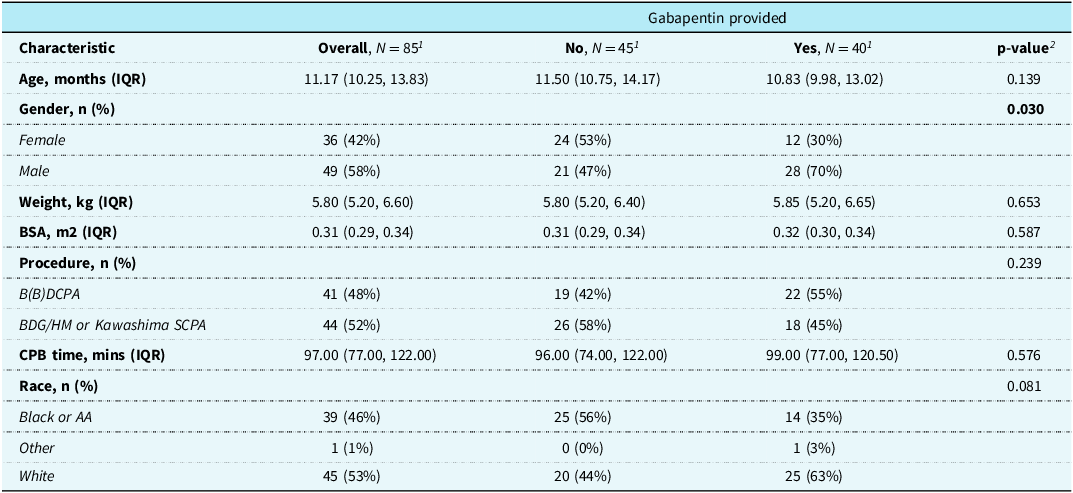
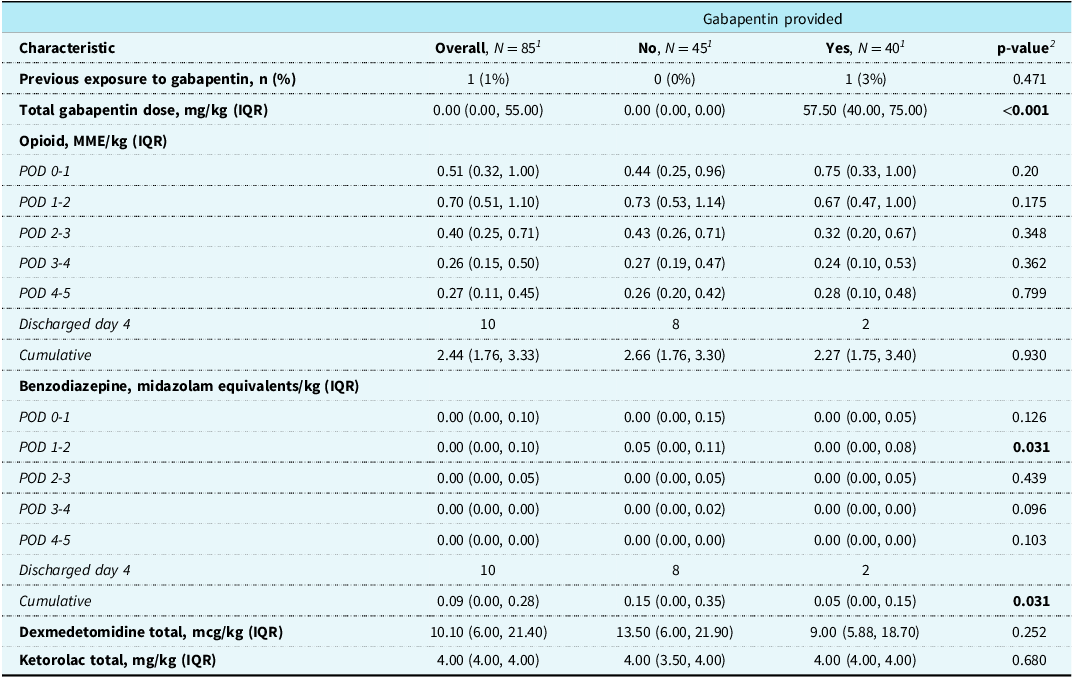
The study analysed 85 infants who underwent stage II palliation, with 40 receiving peri-operative gabapentin and 45 not receiving gabapentin. Other than there being more males in the gabapentin group (70% versus 47%; p = 0.03), there was no difference in baseline characteristics (Table 1.). The median gabapentin dose in the treatment group was 57.5 (interquartile ra40, 75) mg/kg over the 5-day study period. Opioid use, measured in morphine milligram equivalents per kilogram, was similar in the no gabapentin group compared to the gabapentin group during the 5 days postoperatively, respectively (2.66 (1.76, 3.30) versus 2.27 (1.75, 3.40); p = 0.93 (Table 2, Fig 1). However, there was a lower benzodiazepine exposure in the gabapentin group both on POD 2 (0.05 (interquartile ranges 0.00, 0.11) versus 0 (interquartile ranges 0.00, 0.08); p = 0.031) and cumulative (0.15 (interquartile ranges 0.00, 0.35) versus 0.05 (interquartile ranges 0.00, 0.15); p = 0.031) (Table 2, Fig 2). Benzodiazepine use varied between groups and POD. There were less patients who received gabapentin exposed to a benzodiazepine compared to those who did not receive gabapentin on POD 2 (14/40 (35%) versus 26/45 (58%); p = 0.05) and POD 5 (4/38 (11%) versus 11/37 (30%); p = 0.04); however, there was no difference on POD 1 (13/40 (30%) versus 21/45 (47%); p = 0.27) or POD 3 (14/40 (35%) versus 18/45 (40%); p = 0.66) or POD 4 (5/40 (13%) versus 12/45 (27%); p = 0.17). FLACC scores were similar between groups throughout the study period.
Comparing the use of opiates in morphine milligram equivalents per kilogram in the first 5 days post-operatively in patients receiving and not receiving gabapentin.

Comparing the use of benzodiazepines in midazolam equivalents per kilogram in the first 5 days post-operatively in patients receiving and not receiving gabapentin.

Baseline demographics by gabapentin provided

1 Median (IQR); n (%).
2 Wilcoxon rank sum test; Pearson’s Chi-squared test; Fisher’s exact test.
AA: African American; BDG: bi-directional Glenn; CPB: cardiopulmonary bypass; BDCPA: b-directional cavopulmonary anastomosis; HM: hemi-Mustard; SCPA: superior cavopulmonary anastomosis; IQR: interquartile range.
Opioid, benzodiazepine, Dexmedetomidine, and ketorolac exposure by gabapentin provided

1 n (%); Median (IQR).
2 Fisher’s exact test; Wilcoxon rank sum test.
MME: Morphine Milligram Equivalents; POD: post-operative day; IQR: interquartile range.
There was no difference in secondary endpoints between the no gabapentin and gabapentin groups to include patients requiring mechanical ventilation >24 hours (4 (9%) versus 5 (13%); p = 0.73), transaminitis (13 (29%) versus 16 (40%); p = 0.28), ICU length of stay (72 hrs (interquartile range 48, 96) versus 72 hrs (interquartile range 48, 96); p = 0.39) or hospital length of stay (8 days (interquartile range 5, 15) versus 11 days (interquartile range 6, 30); p = 0.09). A linear regression was completed to evaluate if gabapentin dose and total opioid exposure correlated, which showed a lack of correlation [beta = 0.03 (95% confidence interval: −0.09 to 0.16)); p = 0.6]. A linear regression between MME and gabapentin was performed, the beta = 0.03 (95% confidence interval: −0.09 to 0.16) and the p-value = 0.607.
Discussion
Based on our findings, the use of gabapentin is safe in infants undergoing stage II palliation and may reduce exposure to benzodiazepines. In our study, we found that there was no difference in opioid exposure; however, there was a slight reduction in overall benzodiazepine exposure in the group receiving gabapentin compared to the group receiving standard of care. There was no difference in adverse events or hospital outcomes to include mechanical ventilation time, ICU length of stay, or hospital length of stay.
To our knowledge, this is the first study to evaluate opioid and benzodiazepine exposure in paediatric cardiac patients undergoing superior cavopulmonary anastomosis receiving gabapentin. During the study period, gabapentin was not a standard component of the postoperative analgosedation protocol but was rather used at physician discretion. During the study period, due to anecdotal results, there was a culture shift into common post-operative use of gabapentin in patients undergoing superior cavopulmonary anastomosis. We did not see a difference in opioid exposure in morphine milligram equivalents per kilogram in patients who received gabapentin compared to those who received standard of care. The source of post-operative pain, especially given the surgical need for a sternotomy, is likely multifactorial. Apart from the neuropathic component, gabapentin works on N-methyl-D-aspartate receptors in the central nervous system, effectively creating block for neurotransmitters releasing pain signals. Reference Uchitel, Di Guilmi, Urbano and Gonzalez-Inchauspe10 Previous publications assessing gabapentin use in paediatric surgical patients largely encompassed spinal and limb surgery and primarily evaluated pain intensity with variable results. Reference Rose and Kam11–Reference Fenikowski, Tomaszek and Mazurek18 The median gabapentin dose utilised in our study 11.5 mg/kg/day was lower than the dosing strategies previously found to reduce opioid exposure. Reference Anghelescu, Steen and Wu12,Reference Mayell, Srinivasan, Campbell and Peliowski14 As we found gabapentin to be relatively safe, it may be prudent to explore if there is a dose-dependent effect on gabapentin and opioid exposure.
Infants receiving gabapentin compared to our standard postoperative analgosedation protocol had a modest reduction in benzodiazepine exposure reported as midazolam equivalents per kilogram. This was seen both cumulatively during the 5-days postoperatively, and specifically on POD 2. Agitation after superior cavopulmonary anastomosis is common given the significant changes in physiology and haemodynamics, resulting in inhibited cerebral venous drainage due to elevated central venous pressures. Reference Salik, Mehta and Ambati19,Reference Simsic, Bradley and Mulvihill20 In patients with refractory agitation, pharmacologic agents are limited. Benzodiazepines were not a standard component of our anaglosedation protocol but rather used at provider discretion as an additional agent for patients experiencing significant agitation and discomfort (FLACC scoring) despite administration of multimodal analgesic agents. Use of benzodiazepines in the paediatric cardiac ICU has been associated with adverse effects including delirium, withdrawal, and potential neurodevelopmental abnormalities. Reference Da Silva, Reis and Fonseca21–Reference Istaphanous, Ward and Loepke23 Gabapentin, a non-habit-forming agent with a steep concentration–response relationship for toxicity, remains an attractive adjunctive agent for these scenarios. The overall benzodiazepine exposure amongst both groups was low with <50% of patients receiving a benzodiazepine dose on any given POD; therefore, the reduction in benzodiazepine use must be evaluated further.
The use of gabapentin was not associated with any adverse outcomes or changes in hospital outcome measures to include length of mechanical ventilation, ICU or hospital length of stay, or incidence of transaminitis. While increased opioid and benzodiazepine exposure has been shown to prolong hospital length of stay, patients undergoing superior cavopulmonary anastomosis often have a quick recovery and short hospital and ICU length of stay, thus these findings are expected. Reference Da Silva, Reis and Fonseca21–Reference Weinerman, Cheung and Park24 Post-marketing surveillance has shown gabapentin can cause transaminitis; however, we did no see this adverse effect in either the gabapentin group or the no gabapentin group. Reference Kamitaki, Minacapelli and Zhang25 The relative safety of gabapentin for short-term multimodal pain control makes it an attractive option for consideration in other types of cardiothoracic surgery. Multiple paediatric institutions, including ours, have started utilising gabapentin as a standard component of early enhanced recovery after surgery protocols after less surgically complex procedures to include atrial septal defects and ventricular septal defects. Reference Roy, Parra and Brown26 Further studies are warranted to elucidate the benefit of gabapentin broadly as it relates to postoperative pain management in paediatric cardiothoracic surgery.
Study limitations
Our findings are subject to all limitations inherent to single-centre retrospective cohort studies. Pain and sedation are difficult to effectively evaluate in the paediatric population due to limited language, inability to comprehend pain perception, and need for specialised pain assessment tools. Utilisation of our institution’s analgosedation protocol which included scheduled ketorolac may have affected the overall opioid use in our cohort. Additionally, strict adherence to the analgosedation protocol was not evaluated; however, infrequent deviations are typically seen in this patient population. Prescribing and dosing of gabapentin was not standardised and was dictated by the bedside provider and/or clinical pharmacist. There were significantly more males compared to females in the gabapentin cohort and potential differences to pharmacologic agents based on sex were not evaluated. Increased awareness over recent years of the negative effects of benzodiazepine exposure in critically ill patients, including the risk of delirium, may have created an era effect increasing our risk for Type I error. Additionally, the reduction in benzodiazepine use in the gabapentin group may be attributable to the sedative effect of the medication and not improved pain control.
Conclusion
Our findings suggest that gabapentin did not significantly reduce opioid exposure; however, it was associated with modest reduction in benzodiazepine use. Additionally, there was no overall difference in adverse events or length of stay. Based on our findings, we believe gabapentin to be a safe multimodal pain medication in postoperative patients undergoing superior cavopulmonary anastomosis. Additional studies should be conducted to further evaluate gabapentin efficacy, dosing strategies, and utilisation after paediatric cardiac surgery.
Adverse outcomes and hospital data by gabapentin provided

1 n (%); Median (IQR).
2 Fisher’s exact test; Pearson’s Chi-squared test; Wilcoxon rank sum test.
LFT: liver function tests; LOS: length of stay; IQR: interquartile range.
Supplementary material
The supplementary material for this article can be found at https://doi.org/10.1017/S1047951125001647.
Acknowledgement
None.
Ethical standard
The authors assert that all procedures contributing to this work comply with the ethical standards of the relevant national guidelines on human experimentation and have been approved by the appropriate committees at our institution.
Competing interests
No authors have any disclosures, conflicts of interest, and sources of funding to report.