Introduction
Unlike their canine counterparts, feline parasites, particularly helminths, have received less attention as potential sources of zoonotic infections (Fisher, Reference Fisher2003). The ecology and particularly the component community structure of helminth parasites in cats are based on data collected from the UK (Lewis, Reference Lewis1927; Hutchison, Reference Hutchison1956; Woodruff et al., Reference Woodruff, Thacker and Shah1964; Oldham, Reference Oldham1965; McColm & Hutchison, Reference McColm and Hutchison1980; Nichol et al., Reference Nichol, Ball and Snow1981) and Australia (Coman, Reference Coman1972; Wilson-Hanson & Prescott, Reference Wilson-Hanson and Prescott1982; Shaw et al., Reference Shaw, Dunsmore and Jakob-Hoff1983; Thompson et al., Reference Thompson, Meloni, Hopkins, Deplazes and Reynoldson1993; McGlade et al., Reference McGlade, Robertson, Elliot, Read and Thompson2003). Knowledge of the intestinal parasites of cats in arid regions worldwide is remarkably limited and, despite extensive species lists and taxonomic studies undertaken in the Middle East regions (in Jordan, Morsy et al., Reference Morsy, Michael and El-Disi1980; in Egypt, El-Shabrawy & Imam, Reference El-Shabrawy and Imam1978; Hasslinger et al., Reference Hasslinger, Omar and Selim1988), there is relatively little comparable data on the ecology of parasite fauna of cats apart from Arafa et al. (Reference Arafa, Nasr, Khalifa, Mahdi, Wafiya and Khalil1978) in Egypt.
In the State of Qatar, uncontrolled populations of stray and semi-domesticated cats exist in close proximity to human populations. Some less fortunate communities suffer from poor levels of hygiene, and a lack of veterinary care and, to a greater extent, zoonotic awareness, enhancing the risk of disease transmission. Cats, which were introduced to Qatar by explorers in the early 1960s for the biological control of rodent populations, have multiplied and colonized rapidly around food and water resources, mainly in urban but also in rural areas. The objective of the present paper, therefore, was to investigate for the first time the diversity and infection levels of intestinal parasites in faecal samples deposited by stray cat populations in urban sites of Doha and its outskirts in the State of Qatar.
Materials and methods
Study sites
Sampling of cat faeces was undertaken in three sites, namely Corniche, Al-Matar and Al-Sadd located in the capital city, Doha (longitude 51°31′60″E, latitude 25°17′12″N), and three sites on the outskirts of Doha, Abu-Hamour, Al-Rayyan and Al-Wakra. Corniche is a grassed public area lying on Doha Bay stretching over 7 km. Al-Matar and Al-Sadd are characterized by much socio-economic development contributing to a high population density. Al-Rayyan, which lies 10 km north of Doha (longitude 51°25′28″E, latitude 25°7′31″N), is considered to be the second most populated area, although there are still large uninhabited localities. Al-Wakra is a coastal small town, situated 15 km to the east of Doha (longitude 51°30′15″E, latitude 25°17′10″N), whereas Abu-Hamour lies to the south (longitude 51°29′44″E, latitude 25°14′8″N), as described previously by Abu-Madi et al. (Reference Abu-Madi, Behnke, Mickail, Lewis and Al-Kaabi2005).
Faecal sampling
Sampling was conducted in the vicinity of public and private areas in the study sites during the winter (January–April) and the summer (May–October) seasons of 2005. The semi-dry winter endures scant and infrequent rainfall, ranging from 0.8 to 32.1 mm with mean temperatures of 17.1–27.1°C. The summer is hot, humid with no rainfall, and mean temperatures ranging from 29.5 to 36.1°C. Faecal samples were collected at 10 m intervals and the number of samples varied according to the size of the site and the abundance of cat droppings. Two grams of homogenized faeces were preserved in 10% formalin fixative vial (Para-Pak 10% formalin fixative) for at least 30 min at room temperature to ensure adequate fixation. The preserved sample was mixed vigorously by vortex and filtered through a macro-confiltration unit to remove bulky debris (Meridian Bioscience, Inc., Ohio, USA). After filtration, 10% formalin and ethyl acetate were added, the sample centrifuged for 10 min at 3000 rpm, and suspended into 1 ml. From each sample, three aliquots of 50 μl were examined microscopically for the identification and counting of eggs/larvae. The latter were expressed as either eggs/g faeces (EPG) or larvae/g faeces (LPG) and the means of EPG and LPG were calculated from all samples to represent the intensity of infection.
Statistical analysis
Statistical tests were performed using the SPSS 13.0 (Statistical Package for Social Sciences, SPSS Inc., Chicago, Illinois, USA). Chi-square and non-parametric tests (Kruskal–Wallis, Mann–Whitney), respectively, were performed to study the prevalence of infection and mean EPG or LPG relative to site and season. The frequency distribution of parasite eggs/larval stages from each site was tested for goodness of fit to the negative binomial distribution using a reformulated method of measuring the k parameter, as described previously by Pal & Lewis (Reference Pal and Lewis2004).
Results
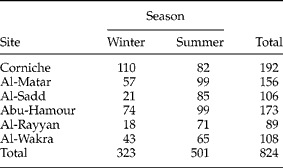
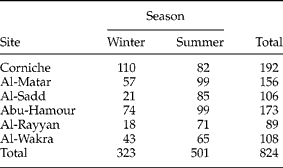
A total of 824 faecal samples were collected from six study sites from January to October, 2005 (table 1). The highest proportion of samples was collected from Corniche (23.3%) followed by Abu-Hamour (21%), Al-Matar (18.9%), Al-Wakra (13.1%), Al-Sadd (12.9%) and Al-Rayyan (10.8%). Apart from the Corniche, fewer samples were collected in the winter (39.2%) compared with the summer (60.8%).
Number of faecal samples from six sites in Qatar during the winter and summer months of 2005.
Parasite species richness and dispersion
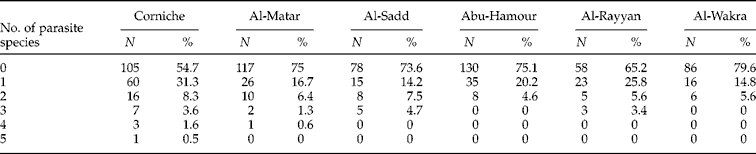
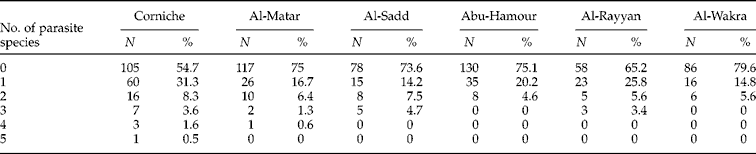
Six species of nematodes were recovered and 250 samples (30.3%) were found to be infected with at least one of these species. Of the nematode species found, Strongyloides stercoralis (18.4%) was the most prevalent, followed by Aelurostrongylus abstrusus (7.5%), Toxocara cati (6.1%), Ancylostoma tubaeforme (5.9%) and Physaloptera species (4.9%). In addition, six samples (three from Al-Sadd, two from Al-Rayyan and one from Al-Matar) were infected with Toxoascaris leonina, two samples (one from Al-Sadd and the other from Abu-Hamour) with the protozoan Isospora felis, and unidentified hexacanth eggs of cestodes likely to be the species of Taenia, Dipylidium and/or Diplopylidium were found in 10.7%. Hence, the latter species were not included in the statistical analysis. Faecal samples mainly comprised single infections (70%) with multiple infections being far less common (table 2). The highest proportion of multiple infections was recorded in Corniche (36%), followed by 17.3% in both Al-Sadd and Al-Matar, 10.6% in both Al-Rayyan and Abu-Hamour and 8% in Al-Wakra. Multiple infections of up to five species were found only in one sample from Corniche, whereas four samples, three from Corniche and one from Al-Matar harboured four species. In Abu-Hamour and Al-Wakra, no more than two parasite species were found in the samples examined.
Frequency distribution of nematode species occurring in faecal samples from six sites in Qatar during 2005; N, number of samples examined; %, proportion of samples infected.
All egg/larval stages of nematodes recovered from faecal samples in all sites were highly overdispersed, with k values ranging from 0.003–0.042 in Physaloptera sp., 0.005–0.023 in A. abstrusus, 0.005–0.029 in A. tubaeforme, 0.008–0.195 in T. cati and 0.02–0.04 in S. stercoralis.
Prevalence and intensity of infections
Strongyloides stercoralis
This rhabditoid nematode is a common human intestinal parasite worldwide, especially in tropical and subtropical countries (Gotuzzo et al., Reference Gotuzzo, Terashima, Alvarez, Tello, Infante, Watts and Freeman1999). Infection in humans is acquired by skin penetration of soil-transmitted larvae. However, dogs and cats can harbour strains of S. stercoralis (Robertson & Thompson, Reference Robertson and Thompson2002) with zoonotic potential leading to chronic infections in immunocompromised individuals (Siddiqui & Brek, Reference Siddiqui and Brek2001). Eggs of S. stercoralis and S. felis are morphologically similar, but the identification of S. stercoralis was confirmed from the recovery of adult worms in cats following post-mortem examination.
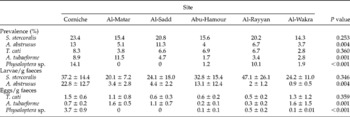
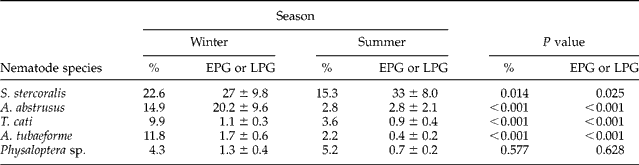
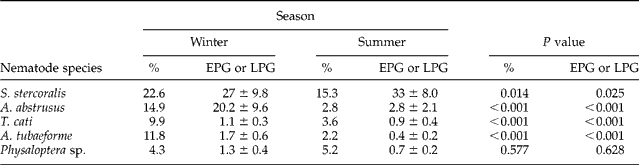
Strongyloides stercoralis was the most dominant nematode recovered from all sites (table 3), with prevalence values of 23.4% in Corniche, 20.8% in Al-Sadd, 20.2% in Al-Rayyan, 15.6% in Abu-Hamour, 15.4% in Al-Matar and 14.3% in Al-Wakra, and no overall effect of site on prevalence (P = 0.253). The mean LPG ranged from 20.1 in Al-Matar to 37.2 in Corniche, but analysis of these intensities between sites (table 3) were not significant (P = 0.346). Relative to season, faeces infected with S. stercoralis showed higher prevalences in winter (P = 0.014) compared with the summer (table 4), especially in Al-Matar (P = 0.001) and Al-Sadd (P = 0.001). However, prevalences did vary significantly between sites in winter (P = 0.02), with a low value of 10.8% in Abu-Hamour and a high value of 47.6% in Al-Sadd. On the other hand, no site effects on prevalence values were observed in the summer (P = 0.24). In the case of intensity of infection, higher LPG were recorded in summer (P = 0.025) compared with winter (table 4).
The prevalence (%) and mean eggs/g faeces or larvae/g faeces ± SEM of nematode species in faecal samples from six sites in Qatar during 2005.

The prevalence (%) and mean eggs/g faeces (EPG) or larvae/g faeces (LPG)±SEM of nematode species in faecal samples from six sites in Qatar during the winter and summer of 2005.
Aelurostrongylus abstrusus
This metastrongylid nematode is a common feline lungworm occurring worldwide, for example in Europe (in Bulgaria, Stoichev et al., Reference Stoichev, Hanchev and Svilenov1982; in Germany, Barutzki & Schaper, Reference Barutzki and Schaper2003) and Australia (Wilson-Hanson & Prescott, Reference Wilson-Hanson and Prescott1982; McGlade et al., Reference McGlade, Robertson, Elliot, Read and Thompson2003). First-stage larvae (L1) are coughed up the trachea of feline hosts, swallowed and passed through the alimentary tract ending up in soil via the faeces. L1 develop into third-stage larvae (L3) in slugs and snails which may be ingested by small rodents as paratenic hosts. The latter, on predation, are likely to be the route of transmission to cats, resulting in lungworm disease or aelurostrongyliasis in heavy infections.
The prevalence of A. abstrusus varied significantly across sites (P = 0.004), with the highest value of 13% being recorded in Corniche (table 3). This site effect clearly emerged in winter samples (P < 0.001), with the prevalence in Al-Sadd more than twice the values in other sites. There was also a significant seasonal effect (P < 0.001), with the prevalence of A. abstrusus ranging from 14.9% in winter compared with 2.8% in summer (table 4). This significant effect was particularly observed in Al-Sadd (P < 0.001), Corniche (P = 0.001) and Al-Matar (P = 0.02), with up to 52.4% of faecal samples from Al-Sadd infected during the winter. With reference to the intensity of infection, significantly higher LPG were recorded in Corniche and Abu-Hamour (P = 0.004) compared with the remaining sites (table 3) and a significantly higher number of LPG were found in winter (P < 0.001) than in summer (table 4).
Toxocara cati
This ascarid species is one of the largest intestinal nematodes occurring in feline hosts, which become infected through transmammary routes. Transmission also occurs via ingestion of eggs which are deposited by female T. cati into the soil via faeces (Dubey, Reference Dubey1966; Fisher, Reference Fisher2003). As in the case of T. canis in dogs, T. cati is capable of causing disease to humans by larval migration, following ingestion of the eggs, resulting in human toxocariasis which is a commonly reported zoonotic helminthiasis (Lewis & Maizels, Reference Lewis and Maizels1993; Holland & Smith, Reference Holland and Smith2006).
The prevalence of T. cati infection varied significantly with season (P < 0.001), increasing from 3.6% in summer to 9.9% in winter (table 4) but with no indication of site effect (P = 0.36). However, there was a significant difference in the prevalence of T. cati across sites during winter (P = 0.005), especially in Al-Sadd where 33.3% of faecal samples harboured T. cati in winter, compared with no infection in summer (P < 0.001). Analysis of EPG varied significantly with season (P < 0.001) with higher EPG in winter than summer (table 4) but intensities between sites (table 3) were not significant (P = 0.359).
Ancylostoma tubaeforme
Ancylostoma tubaeforme together with Ancylostoma braziliense and Uncinaria stenocephala are blood-feeding feline intestinal hookworms with a wide geographical distribution (Barutzki & Schaper, Reference Barutzki and Schaper2003; Coatin et al., Reference Coatin, Hellmann, Mencke and Epe2003; McGlade et al., Reference McGlade, Robertson, Elliot, Read and Thompson2003). Adult worms pass eggs out with feline faeces then on to soil/vegetation where eggs ultimately produce L3 larvae. Human populations who have contact with L3-contaminated soil can acquire infection through skin penetration by L3, leading to pulmonary or intestinal symptoms of hookworm disease (Robertson & Thompson, Reference Robertson and Thompson2002).
Up to 11.5 and 8.9% of faeces were infected with A. tubaeforme in Al-Matar and Corniche, respectively (table 3) with significantly more infected samples occurring in winter (P = 0.001) than in summer (table 4). The prevalence in winter was also significantly higher in Corniche and Al-Matar compared with other sites. Analysis of the EPG showed a significant site effect (P = 0.001) and seasonal effect (P < 0.001), higher values in winter (tables 3 and 4).
Physaloptera sp
Species of Physaloptera, for example P. praeputialis and P. rara, are commonly reported stomach nematodes of cats worldwide (Labarthe et al., Reference Labarthe, Serrão, Ferreira, Almeida and Guerrero2004). Embryonated eggs are passed out in faeces and when ingested by insect intermediate hosts, including cockroaches, beetles and crickets, develop into L3 larvae. Small rodents can act as paratenic hosts and, as in the case of A. abstrusus, the route of infection is likely to be predation by cats on mice. Occasionally human infection with Physaloptera species results from accidental ingestion of infected insects.
Physaloptera sp. was found in only four sites, with highest prevalences of 14.1% and 10.1% in Corniche and Al-Rayyan respectively (table 3). Differences in the prevalence of infection (P < 0.001) and EPG (P < 0.001) were highly significant between sites but there were no significant differences relative to season (tables 3 and 4).
Discussion
Previous studies on the helminth parasites of cats from the Middle East and north Africa by Morsy et al. (Reference Morsy, Michael and El-Disi1980) in Jordan, El-Shabrawy & Imam (Reference El-Shabrawy and Imam1978) and Hasslinger et al. (Reference Hasslinger, Omar and Selim1988) in Egypt have been largely taxonomic, but Arafa et al. (Reference Arafa, Nasr, Khalifa, Mahdi, Wafiya and Khalil1978) in Egypt reported site-specific, host age and gender effects on the prevalence of cat intestinal parasites. These studies, including those of Khalil et al. (Reference Khalil, Khaled, Arafa and Sadek1976), El-Shabrawy & Imam (Reference El-Shabrawy and Imam1978) and Abo-Shady et al. (Reference Abo-Shady, Ali and Abdel-Magied1983), have demonstrated the presence of a wide species diversity, primarily dominated by nematodes, cestodes and, to a lesser extent, trematodes. The present study is the first in the Arabian Gulf area, as a part of the Middle East, to provide an understanding of the ecology of stray cats inhabiting the harsh and arid environment in Qatar, where the trend, compared with previous studies, is somewhat different as no trematode and low levels of cestode infections were found. This is in contrast to the high level of infection of rats with the cestode Hymenolepis diminuta recorded by Abu-Madi et al. (Reference Abu-Madi, Lewis, Mickail, El-Nagger and Behnke2001, Reference Abu-Madi, Behnke, Mickail, Lewis and Al-Kaabi2005) from similar sites in Qatar. The occurrence of the protozoan I. felis in only two faecal samples from all six sites in the present case suggests that desiccation inhibits oocyst development, especially as Morsy et al. (Reference Morsy, Michael and El-Disi1980), following rectal examinations of cats, reported that up to 25.6% were infected with I. felis. Worldwide, more sensitive serological and molecular diagnostic tests (Morsy et al., Reference Morsy, Michael and El-Disi1980; Bennett et al., Reference Bennett, Lloyd and Jones1990; Yamagushi et al., 1996; McGlade et al., Reference McGlade, Robertson, Elliot, Read and Thompson2003) have been used to identify protozoan infections including I. felis in cats.
Consistent with the present findings, the nematode species A. tubaeforme, A. abstrusus, Physaloptera sp. and T. cati have generally been found to be dominant members of the endoparasite communities of cats (Barutzki & Schaper, Reference Barutzki and Schaper2003; Coatin et al., Reference Coatin, Hellmann, Mencke and Epe2003; Labarthe et al., Reference Labarthe, Serrão, Ferreira, Almeida and Guerrero2004), although in the present study A. abstrusus has been recorded for the first time in the Middle East. The occurrence of S. stercoralis with a relatively high prevalence of 18.5% is also the first record of a feline Strongyloides species emerging in the Middle East. Other species of Strongyloides, such as S. felis, have been reported exclusively from Australian cats (Speare & Tinsley, Reference Speare and Tinsley1987) with a level of infection up to 33.5%, but the limited reporting of Strongyloides sp. worldwide is likely to be due to low levels of infections in the definitive host, together with misdiagnoses (Speare & Tinsley, Reference Speare and Tinsley1987). The identification of cestode species in faecal samples also poses difficulties, especially in a harsh and arid environment where proglottids rapidly disintegrate in the faecal material to liberate eggs with hexacanth embryos. In the present study up to 10.7% of faecal samples were positive for unidentified cestode eggs, which are likely to belong to species of Taenia, Diplopylidium, Dipylidium and/or Mesocestoides (El-Shabrawy & Imam, Reference El-Shabrawy and Imam1978; Calvete et al., Reference Calvete, Lucientes, Castillo, Estrada, Garcia, Peribàňez and Ferrer1998).
The frequency distribution of nematode species recovered in this study was typically overdispersed, consistent with previous studies (Engbaek et al., Reference Engbaek, Madsen and Larsen1984; Delahay et al., Reference Delahay, Daniels, McDonald, McGuire and Balharry1998). Such aggregation is likely to be correlated with heterogeneity in host behaviour, immunity and the clumped distribution of infective stages in the faeces (Anderson & Gordon, Reference Anderson and Gordon1982; Wakelin, Reference Wakelin1987).
Extrinsic factors such as variation in site and season have been shown to be significant in determining prevalence and intensity levels. Climatic conditions encountered during the winter months in Qatar, with comparatively low temperatures and higher degrees of humidity compared with the summer period (personal communication with the Department of Meteorology), may be responsible for the maintenance and enhancement of parasite infectivity (Calvete et al., Reference Calvete, Lucientes, Castillo, Estrada, Garcia, Peribàňez and Ferrer1998). Seasonal fluctuations in the prevalence of infections were compounded by differences between sites, especially with higher prevalences in the case of Physaloptera sp., A. tubaeforme and A. abstrusus. Significant differences between sites were also shown by Physaloptera sp. and A. abstrusus in EPG/LPG levels, with Corniche being a focus of infection for the majority of parasites recovered, suggesting a higher density of stray cats in this urban site. In addition, unlike other habitats examined, Corniche is an irrigation site comprising many grassed areas, which would tend to retain moisture levels thereby enhancing the survival and development of eggs and larval stages of nematodes.
Site-specific variations in prevalences and intensities can be influenced by a combination of factors, including the distribution of the host population, variation in the ingestion and/or penetration rates of infective stages. Exceptionally, T. cati infection seems to be independent of habitat type, where no significant differences in the prevalence and intensity were registered between sites. This is similar to other studies on T. cati infection (Arafa et al., Reference Arafa, Nasr, Khalifa, Mahdi, Wafiya and Khalil1978; Engbaek et al., Reference Engbaek, Madsen and Larsen1984; Hasslinger et al., Reference Hasslinger, Omar and Selim1988) and is likely to be related to the transmammary transmission of T. cati (Engbaek et al., Reference Engbaek, Madsen and Larsen1984). However, the effects of seasonal changes are far more striking in determining the compositions and levels of infection of parasite species in the faecal samples from most sites examined. Prevalence and LPG/EPG values of S. stercoralis, A. abstrusus, T. cati and A. tubaeforme were significantly higher in the winter than in the summer. This suggests that higher temperatures with no humidity in the hot and dry summer months reduce the survival and viability of free-living infective stages in the soil and faecal material, together with the availability of intermediate hosts (snails and rodents in the case of A. abstrusus), thereby reducing parasite transmission.
In conclusion, the composition and infection levels of the intestinal parasites of cats are clearly influenced by the extrinsic factors of site and season in such a hot and arid country such as Qatar. Faecal examination has been shown to be a non-invasive method for quantifying the prevalence and intensity of infection, but further studies using necropsy of stray cat populations are needed for more accurate identification to be made of infective stages, especially the cestodes. In addition, the role of intrinsic factors, including host age and gender, needs to be assessed in structuring these parasite communities. The zoonotic potential of parasites such as T. cati, S. stercoralis, A. tubaeforme and I. felis, underscores the role of stray cats in Qatar as reservoir hosts for zoonotic diseases. Infective stages are disseminated with faecal material and are likely to contaminate the soil of public and private areas in urban, suburban and rural sites, hence an improvement in the awareness of the potential health risk to the human population needs to be addressed.
Acknowledgements
We wish to express our sincere and grateful thanks to the Research Committee of the College of Arts and Sciences, Qatar University for generous financial support under grant no. 3/2006 and to the Department of Pest Control, Municipality of Doha for assistance in sampling.