INTRODUCTION
Almost a century has passed since the Permanent Court of International Justice was established as the first world court, but the factors that shape decision-making by international judges remain less well understood than those that influence their domestic counterparts. The relative paucity of knowledge about international judicial decision-making has resulted from two key challenges. First, systematic analysis is only possible for courts that have revealed the votes of individual judges in enough judgments to allow meaningful large-scale studies. Second, it has proven difficult to build empirically testable theories identifying explanatory variables that are relevant across courts with a wide variety of jurisdictions and institutional designs. To address these challenges, we conduct an in-depth analysis of a body of case law from one international court in order to identify and test hypotheses that can later be applied to international judicial behavior more broadly.
We focus here on the European Court of Human Rights (ECtHR) because it has produced thousands of judgments since its inception in 1959, including a substantial number of signed dissents that convey detailed information about individual judges’ decision-making rationales. Existing research on the ECtHR indicates that its judges are ideologically motivated actors that are akin to domestic constitutional court judges in many respects, but also that the Court’s international character shapes judicial behavior in some contexts. For example, Erik Voeten (Reference Voeten2008) finds some evidence of home-state bias on the part of ECtHR judges, but this bias does not extend to states that are allied with or similar to the judges’ home states on a variety of dimensions. Ultimately, Voeten concludes that “ECtHR judges are politically motivated actors in the sense that they have policy preferences on how to best apply abstract human rights in concrete cases, not in the sense that they are using their judicial power to settle geopolitical scores” (Reference Voeten2008, 432). Likewise, Martin Shapiro (Reference Shapiro, Shapiro and Sweet2002, 154–55) argues that the ECtHR can in most respects be analyzed as if it were a domestic constitutional court, albeit one that hears cases from forty-seven states. As such, the domestic judicial decision-making literature would lead us to expect ECtHR judges’ votes to vary on the basis of their policy preferences and/or jurisprudential commitments regarding the legitimate scope of judicially enforceable human rights guarantees.
In this article, we build on existing research that uses judges’ career background as a proxy for these motivations on the European Court of Human Rights. In particular, we deploy a new measure of judicial career backgrounds to explain ECtHR decision-making in a single area of law (freedom of expression). Focusing on this one issue area enables us to combine quantitative analysis of more than 1,800 individual judicial votes with in-depth qualitative analysis of signed opinions in dozens of cases involving divided judgments. And focusing on judicial career backgrounds, a factor that is broadly comparable across jurisdictions, allows us to further develop an empirically testable theory that has implications for a wide array of international courts.
Our findings show that former judicial career is related to voting patterns in free speech cases. This relationship is clearest for former diplomats, who stand out both for their willingness to vote against freedom-of-expression claims and for their inclination to author dissents against holdings supporting such claims. We compare the dissenting opinions of former-diplomat judges to those of judges with no prior career in diplomatic service. Former diplomats are more likely to voice concerns about the objectionable nature of particular speech acts and to call for broad deference to member states’ decisions as to which such speech acts are beyond the pale. By contrast, the dissents of judges with no background as diplomats reveal a greater tolerance of objectionable speech, a greater willingness to impose European-wide standards within individual countries, and even invocations of extra-European legal standards of free expression, such as references to US Supreme Court decisions. These findings offer new insights into free speech decision-making in one international court, while advancing existing scholarship that focuses on the career background of judges to build understanding of judicial behavior across international courts.
THE EUROPEAN COURT OF HUMAN RIGHTS AND FREE SPEECH DECISION-MAKING
The European Court of Human Rights (here, also, the Court) is frequently called on to rule on claims that one of the forty-seven member states of the Council of Europe has violated the freedom of expression guaranteed by Article 10 of the European Convention on Human Rights (ECHR). In a substantial majority of these cases, the Court issues a unanimous ruling, suggesting that the outcome is shaped more by the characteristics of the case than the composition of the judicial panel. But in more than 20 percent of Article 10 cases, judges are divided over how to apply the black letter of the Convention. For example, in Grigoriades v. Greece (1997), the Court voted twelve to eight in favor of protecting the expression of a Greek lieutenant convicted of insult for writing that “the army is an apparatus opposed to man and society and, by its nature, contrary to peace.” In Féret v. Belgium (2009), by contrast, the Court voted four to three to support the state’s criminal sanction of a far-right Front National candidate who had distributed campaign leaflets inciting racial hatred.
What factors influence judges’ support for freedom-of-expression claims in cases where the outcome is in dispute? To identify the range of motivations underlying judicial behavior, scholars of judicial decision-making have focused mostly on domestic constitutional courts, especially the US Supreme Court, and have primarily emphasized the ideological motivations of judges. With regard to the US Supreme Court, most such studies rely on either Segal-Cover scores, which are based on ideological characterizations of justices by national newspaper editorials at the time of their nomination to the Court, or Martin-Quinn scores, which are based on ideal point estimates drawn from judicial voting patterns (Segal and Spaeth Reference Segal and Spaeth2002; Martin and Quinn Reference Martin2002). Although frequently used, both measures of judicial ideology have significant limitations (Shapiro Reference Shapiro2009, Reference Shapiro2010; Pettys Reference Pettys2015). One source of disagreement is that much of what appears to political scientists as ideological or policy attitudes sometimes appears to legal scholars as competing jurisprudential commitments. Nonetheless, and regardless of one’s preferred labels for judicial motivations, it seems clear that when interpreting abstract rights-protecting provisions of the US Constitution in cases with clear political valence, liberal justices are likely to issue relatively more liberal decisions and conservative justices more conservative ones. Evidence of such a relationship has also been identified in constitutional courts beyond the United States. For example, David Weiden (Reference Weiden2011) used Segal-Cover scores and equivalent measures to compare the influence of ideology on judicial votes across the Australian High Court, Canadian Supreme Court, and US Supreme Court. The relationship was present for all three institutions, but less pronounced in Australia and Canada than in the United States, supporting Weiden’s thesis that judges on highly politicized courts are more likely to decide cases ideologically.
While there are grounds to expect that ideology will play a similar role (perhaps also to varying degrees) on international courts, the theories and techniques developed for domestic courts cannot simply be extended to investigate international judicial behavior. It is impractical to develop measures equivalent to Segal-Cover scores for international judges, since doing so would involve collecting and analyzing media coverage of judges at the point of nomination—if such coverage exists—across multiple countries where the substantive content of conservative and liberal ideology may vary. So far as we are aware, no scholar has attempted to do so. Analysis using ideal points is feasible, since it involves measuring judicial behavior after appointment and relative to other judges. Voeten used this technique to identify ECtHR judges’ ideal points on a scale of judicial activism versus restraint, which he describes as “the main dimension of contestation among judges” on that court (Reference Voeten2007, 669; see also Stiansen and Voeten Reference Stiansen and Erik2020). Activist judges are more likely to decide that a respondent state has violated a person’s human rights, and so adopt an expansive view of the Court’s power with respect to states. Restrained judges are less likely to rule in favor of rights claimants, showing more deference to autonomous policymaking on the part of individual states.
Reliable measures of judicial commitments to activism/restraint promise to enhance our understanding of the ECtHR’s decision-making, but such measures cannot fully stand in for the measures of ideology developed on domestic courts. Domestic constitutional court judges exhibit variation in levels of activism, but also in the substantive policy goals toward which such activism is directed (Keck Reference Keck2004, Reference Keck2014). If ECtHR judges are also substantive policy-seekers, there is no necessary connection between the outcomes that substantive policy preferences would produce and the extent of ECtHR authority over states.Footnote 1 Without any direct measure of its judges’ substantive ideology, scholarship on the ECtHR has yet to fully address the extent to which policy preferences influence the behavior of its judges.
Judicial Behavior and Career Background
We build on a promising strand within earlier research on the European Court of Human Rights that focuses on the prior career path of judges as a tool to explain judicial decision-making (Bruinsma Reference Bruinsma, van Hoek, Hol, Jansen, Rijpkema and Widershoven2006; Arold Reference Arold2007; Voeten Reference Voeten2007, Reference Voeten2008; Dzehtsiarou and Schwartz Reference Dzehtsiarou and Alex2020). We do not have independent measures of judicial ideology for ECtHR judges, but Bruinsma (Reference Bruinsma, van Hoek, Hol, Jansen, Rijpkema and Widershoven2006) identified career background as an important factor shaping judicial role conceptions and attitudes, and Voeten (Reference Voeten2008) has used the judges’ professional backgrounds as a predictor of their commitment to judicial activism or restraint. A number of scholars have reported that ECtHR judges themselves acknowledge that different career backgrounds are associated with distinctive approaches to deciding human rights cases (Bruinsma Reference Bruinsma, van Hoek, Hol, Jansen, Rijpkema and Widershoven2006; Arold Reference Arold2007; Dzehtsiarou and Schwartz Reference Dzehtsiarou and Alex2020). Bruinsma (Reference Bruinsma, van Hoek, Hol, Jansen, Rijpkema and Widershoven2006) and Voeten (Reference Voeten2007, Reference Voeten2008) hypothesize several dimensions along which prior career experiences might lead to varying patterns of judicial behavior in the European Court of Human Rights, in ways that parallel studies of judicial ideology in the US Supreme Court.
In particular, Voeten suggests that “judges who have spent their careers as diplomats or in some other government function can be expected to be much more likely to defer to stated national interests than judges who have made their careers as human rights activists” (Voeten Reference Voeten2008, 422). Bruinsma identifies similar expectations for former diplomats and civil servants, indicating that they “introduce the outlook of the raison d’état” and are inclined to serve the interests of the state (Bruinsma Reference Bruinsma, van Hoek, Hol, Jansen, Rijpkema and Widershoven2006, 215). In other words, judges with these types of prior service in government are presumed to be less likely than their colleagues without such service to hold that a signatory state had violated one of the rights guaranteed by the European Convention on Human Rights. Bruinsma confirmed this hypothesis via a careful qualitative and descriptive statistical analysis of eighty-five Grand Chamber judgments over a six-year period and twenty-two Chamber judgments over an overlapping three-year period. Voeten confirmed it via a large-N statistical analysis of a much wider range of decisions, finding that former diplomats and civil servants are more likely to exhibit bias toward their own home states (2008, 428) and that they are significantly less activist in protecting human rights against all states, even excluding their own (Reference Voeten2007, 696).
The existing literature, then, gives us good reason to believe that the career backgrounds of ECtHR judges shape their decision-making. Still, several lines of ambiguity or uncertainty persist. Bruinsma’s and Voeten’s judicial career data combine prior service as diplomats or domestic civil servants into a single category (which Bruinsma labels “administration” and Voeten labels “diplomat”), but it is not clear to us that the same theoretical expectations should apply to both sets of career experiences. Beyond diplomats and civil servants, expectations for other career paths remain undertheorized.Footnote 2 There are also unresolved questions regarding the way in which career backgrounds influence judicial behavior. Is it the case, for example, that former-diplomat judges are more restrained because their career experiences socialized them into that role (as Bruinsma suggests)? Or is it that countries seeking to appoint compliant judges are prone to appoint diplomats (per Voeten), such that the true explanation has less to do with career background and more with country preferences? Finally, are expectations the same for judges who had a single former career compared to those whose professional commitments evolved over time?
Our view is that all ECtHR judges have an interest in balancing their rights commitments against deference to state interests, but that judges with prior diplomatic service are likely to weigh the latter concern more heavily than others. As Mikael Madsen (Reference Madsen2007; 2011a; 2011b) has shown, a number of early ECtHR judges with extensive diplomatic experience took careful efforts to exercise a highly constrained approach to international human rights enforcement, thereby gradually gaining the state confidence necessary for the Court to engage in more activist decision-making over time. In a similar vein, Kanstantsin Dzehtsiarou and Alex Schwartz (Reference Dzehtsiarou and Alex2020, 631) have posited the diplomatic judge as one of three ideal types of international judges: “The Diplomat knows the political context surrounding the disputes that come before the ECtHR. She has a rough but reliable sense of how far the Court can assert itself against the preferences of the member state governments before defiance becomes probable.” Following these scholars, we expect judges previously employed in government roles directed toward foreign relations to be highly attuned to the connection between international law and diplomacy, and thus to be more likely than judges from other backgrounds to defer to state interests when deciding cases.
For judges with prior government service in domestic as opposed to foreign policy roles, we also expect this commitment to the raison d’état to exist, but to be weaker. In other words, if attention to the preferences of states is a significant factor shaping judicial behavior on the ECtHR, we expect it to have weaker influence on judges who previously worked in domestically focused government service (e.g., as a career prosecutor or education department legal advisor) than on judges who worked in foreign affairs. Domestic civil servants work for and within a single state. Such a background may well make them more sympathetic to their own state’s arguments than judges never employed in government, but we do not expect such experience to generate either automatic support for the autonomy of other states or the full appreciation of international political consequences of adverse judicial decisions that we see with former diplomats.
For ECtHR judges with prior service as domestic judges, private attorneys, or academics, we expect this relationship to be weaker still. Our expectations here are rooted in Lawrence Baum’s account of judges and their audiences (Reference Baum2008). On Baum’s view, judicial behavior turns in part on judges’ efforts to win the approval of a variety of audiences that matter to them. Some relevant audiences overlap across judges (e.g., the parties to a case, the wider legal community), but they also diverge depending on a judge’s personal commitments and socialization. While diplomats spend their careers serving as agents of their state, with professional success and the respect of their international peers following from carefully representing and defending its views to other states, judges whose careers are focused primarily on a domestic context might be expected to seek approval from very different audiences, in some cases including civil society networks that are expressly critical of state power.
For freedom of expression in particular, we have good reason to expect that prior service as domestic court judges, private attorneys, or academics will enhance the willingness of ECtHR judges to enforce free speech rights against state interests. In at least some contexts, constitutional rights like freedom of expression operate as distinctive judicial commitments—in other words, values that, all else equal, are weighted more heavily by judges than by legislators or executives (Keck Reference Keck2007). If this relationship holds for the ECtHR, then judges with substantial prior judicial experience might have more deep-rooted commitments to certain human rights than do judges whose prior careers consisted primarily of government service. Our expectation is that experience as private attorneys would have an effect similar to experience on the bench, in that lawyers often identify with independent judicial institutions and in some legal traditions are even considered officers of the court. (As Voeten (Reference Voeten2009, 390) notes, many ECtHR judges with experience as private attorneys are former human rights advocates, which would make this expectation even stronger.) Likewise for former academics. Judges who identify with their own former scholarly communities are more likely than former agents of the state to have independent-minded conceptions of human rights. Academic scholars also have a professional interest in a key component of free expression rights (i.e., academic freedom). As such, we expect ECtHR judges who served previously as national court judges, private attorneys, or academics to be more likely to support free expression claims than colleagues with past service as agents of the state.
For judges with prior service as elected politicians, existing literature provides no clear expectations as to their distinctive behavior on international courts—neither regarding human rights enforcement in general nor free expression in particular. Our view is that former-politician judges are likely to continue acting on whatever commitments regarding the proper scope of international judicial power they held prior to joining the bench. In other words, politicians who were critical of rights enforcement by international courts are likely to act as restrained judges themselves, but politicians with more favorable views toward international human rights enforcement are likely to act as activist judges. As such, we have no expectations regarding the impact of prior service as politicians per se.
To advance our understanding of these posited relationships between judicial career backgrounds and the decision-making of international courts, we make two key departures from prior studies. First, we conduct our own original data collection of career backgrounds for all ECtHR judges, implementing several improvements on existing efforts. Second, we focus our analysis on a single area of European human rights law—freedom of expression—with a caseload large enough to enable statistical hypothesis testing but small enough to also conduct qualitative analysis of signed judicial opinions.
New ECtHR Judicial Career Data
Our judicial career dataset developed from an effort to build on Bruinsma’s (Reference Bruinsma, van Hoek, Hol, Jansen, Rijpkema and Widershoven2006) and Voeten’s (Reference Voeten2007, Reference Voeten2008) insights that a judge’s career path will shape judicial ideology, policy preferences, and/or role conceptions, and hence influence judicial votes and opinions. The main difference between our coding strategy and theirs is that their work assigned each judge to a single career category—focusing on their “formative years” (Bruinsma Reference Bruinsma, van Hoek, Hol, Jansen, Rijpkema and Widershoven2006) or “the date and prominence of the former position” (Voeten Reference Voeten2008, 423)—while ours allowed assignment of judges to more than one career category.Footnote 3 The principal source of data for our coding (as for Bruinsma and Voeten) was the biographies provided to the Council of Europe within the judicial appointment process. Review of these documents reveals that many judges served in multiple roles over the course of a long career before their election to the Court.
For example, compare Snejana Botoucharova and Sir Vincent Evans. Judge Botoucharova was nominated by Bulgaria and appointed to the ECtHR in 1998. Her final position prior to election was as Bulgarian Ambassador to the United States. Her career began with a brief period as a trainee judge, followed by time as an attorney, an academic, and then a Member of Parliament before her appointment as ambassador. Evans was nominated by the United Kingdom and elected to the Court in 1980. He spent his entire career in foreign policy–related roles, beginning with wartime service in the armed forces, and subsequently as a legal advisor in the Foreign Office and Counsellor to the United Kingdom’s permanent mission to the United Nations.
Voeten codes both Evans and Botoucharova as diplomats, while Bruinsma places Botoucharova in an “omni” category used for certain judges with multiple prior careers (Reference Bruinsma, van Hoek, Hol, Jansen, Rijpkema and Widershoven2006, 231).Footnote 4 Both of these classifications are problematic. The use of a “mixed career” label recognizes the diversity of Botoucharova’s experience, but offers no substantive description of her professional background. Assigning her to a single category requires deciding which of several potentially relevant career experiences and professional communities are most important for shaping judicial outlook. If the most recently held profession is assumed to have the greatest significance for judicial decision-making, Botoucharova would rightly be coded as a diplomat. If we assume that early career experience is most important in shaping preferences, or that the longest-held role is most important, she might alternatively be classified as a judge or an academic. Without further understanding of how career path contributes to the formation of judicial preferences over time, the arbitrary choice of any of these decision rules risks wrongly emphasizing one part of a complex career path over others.
Our approach avoids these pitfalls by assigning judges with complex career histories to multiple career categories. We created a dummy variable for each of six professional categories (POLITICIAN, ATTORNEY, ACADEMIC, ADMINISTRATOR, JUDGE, and DIPLOMAT) and coded 1 for all judges who were employed in each category during at least five years across their pre-ECtHR career.Footnote 5 We selected the five-year threshold in an effort to capture all careers substantial enough for the judge to have been integrated into the community and norms of that profession. In Judge Botoucharova’s case, her early career experience as a judge spanned only two years, and so she was coded 0 in the JUDGE category. Her later experience included periods spanning at least five years as an ACADEMIC, DIPLOMAT, nongovernment lawyer (ATTORNEY), and POLITICIAN and so she is coded 1 for each of these four categories. In contrast, Judge Evans is coded solely as DIPLOMAT.
This approach has several analytical benefits. Without making an arbitrary choice about which part of Botoucharova’s career history is most important, we can recognize that she and Evans share in common substantial diplomatic experience prior to being appointed to the Court, allowing them to be grouped together for our qualitative analysis of former diplomats below. But our data also enable testing of relationships between decision-making and professional experience gained across the whole course of a judge’s career, and comparison of judges with careers in a single profession to those who have gained a more varied set of experiences.
A second way in which our judicial career coding diverges from that of Bruinsma and Voeten is by expanding the number of substantive professional categories from five to six. Our analysis builds on Voeten’s categories for judicial, academic, political, and private legal careers, but we split his “diplomat” variable to provide separate indications for employment by the state in roles relating to foreign and domestic policy.Footnote 6 In other words, Voeten used a single variable to code all judges whose principal prior careers consisted of nonelected and nonjudicial employment by the state. We have adopted separate codes for (a) diplomats, encompassing ambassadors, state appointees to international organizations, or civil servants or lawyers working in a department of foreign affairs, and (b) administrators, including ministers, civil servants and lawyers working in home affairs, justice, or education ministries, parliamentary officials, court administrators, and prosecutors. This change enables us to assess whether former diplomats are more likely than former administrators to accept the raison d’état. As noted above, our expectation is that judicial deference to state interests will be stronger for former government officials whose outlook and key professional audiences are focused on relations among states than for those focused on matters within the state.
Our judicial career dataset includes every elected judge (save one) who participated in at least one divided Article 10 judgment (N = 160).Footnote 7 Table 1 indicates the distribution of these judges across career categories. Fifty-four of the 160 judges served in a single prior career category before joining the European Court of Human Rights; these judges are indicated in the middle column of the table. Seventy-two judges are coded with two career categories, and thirty-four with three or more. The right-hand column indicates the total number of judges in each category.
Prior Careers of ECtHR Judges Involved in Divided Article 10 Cases (N = 160)

New Article 10 Divided Judgments Data
Bruinsma and Voeten examined the effect of professional background on European Court of Human Rights voting behavior across all rights protected by the European Convention on Human Rights. We focus instead on a single area of human rights law in an effort to combine quantitative and qualitative modes of inquiry. In particular, we want to assess whether any relationships between career background and judicial voting identified in our statistical analysis are visible in the signed opinions authored by judges with varied career backgrounds. Free expression law is a useful testing ground in part because it raises famously difficult questions of balancing. On any plausible account of democratic theory, free expression must be adequately protected, but should not be absolute. But no consensus exists as to when and how it should be balanced against competing democratic and constitutional values. ECtHR case law includes hundreds of free expression cases, across a wide range of fact patterns, providing a diverse base from which to assess the competing efforts of real-world judges to strike this balance.
Article 10 of the European Convention provides that “[e]veryone has the right to freedom of expression,” including the “freedom to hold opinions and to receive and impart information and ideas without interference by public authority and regardless of frontiers.” It then recognizes the need for balancing by providing that this freedom “carries with it duties and responsibilities.” As such, it authorizes restrictions that are “prescribed by law and are necessary in a democratic society, in the interests of national security, territorial integrity or public safety, for the prevention of disorder or crime, for the protection of health or morals, for the protection of the reputation or rights of others, for preventing the disclosure of information received in confidence, or for maintaining the authority and impartiality of the judiciary.” This text makes clear that the scope of judicially enforceable free expression should not be absolute. But while it specifies other important values that courts may take into account, the text provides limited guidance as to how to balance these values. At what point, for example, does “the protection of … morals” render state regulation of obscene books and movies “necessary in a democratic society”? Conversely, at what point do such regulations amount to illegitimate interference with artistic freedom and self-expression?
Given such competing values, it should not be surprising that a substantial portion of the Court’s Article 10 (A10) holdings have been nonunanimous. From its inception through the end of 2016, the ECtHR issued 833 final A10 judgments.Footnote 8 Of these, 179 featured at least one dissenting vote, representing 21 percent of the total.
We focus on these divided judgments for two reasons. First, divided cases are commonly the focus of judicial decision-making studies because they are those where the influence of black-letter law is least determinative and thus where nonlegal influences on judging may be most likely to play a role (Voeten Reference Voeten2007, 684). Second, the ECtHR does not identify authorship for majority/unanimous opinions. In interviews with Bruinsma (Reference Bruinsma, van Hoek, Hol, Jansen, Rijpkema and Widershoven2006, 217–21), several ECtHR judges noted that majority judgments are generally written by clerks and involve careful drafting to produce a text acceptable to multiple judges. These texts therefore tell us little about individual judges’ preferences. Judges who dissent either write or join separate, signed opinions that outline their reasoning. The content of dissenting opinions therefore provides valuable evidence of judicial attitudes since they can be connected with one or more specific judges, who often speak in a distinctive voice.
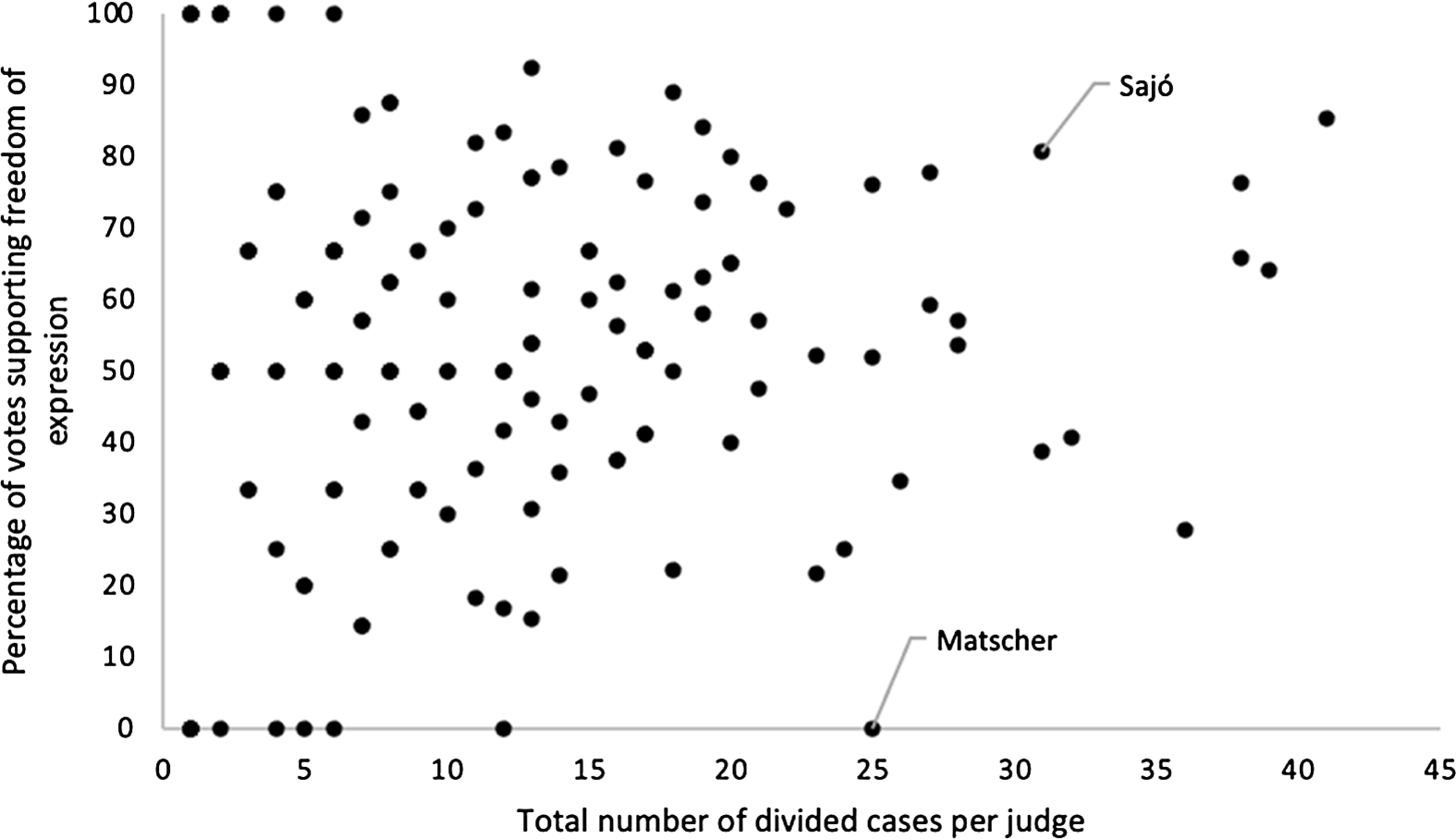
We draw on data from the Global Free Speech Repository (GFSR) to identify all divided Article 10 judgments. The GFSR dataset provides comprehensive information on every final Article 10 judgment from the Court’s inception through the end of 2016, allowing us to analyze the universe of ECtHR freedom-of-expression cases during that extensive time period. The dataset captures key characteristics of each case, including whether the free expression holding was unanimous or divided and whether it protected or restricted speech (i.e., whether it ruled in favor of or against an A10 claim). Our own dataset supplements the GFSR data by recording the individual judges’ votes in each divided decision, allowing analysis of how frequently each judge voted (whether in the majority or minority) to support or restrict free expression. The dataset includes 182 holdings, featuring 1,851 judge-vote observations.Footnote 9 Figure 1 plots the percentage of votes supporting free expression for each judge in our dataset.
Judicial Support for Article 10 Claims in Divided Cases (N=160).

JUDICIAL SUPPORT FOR FREE EXPRESSION CLAIMS
As Figure 1 indicates, substantial variation exists in how often European Court of Human Rights judges are willing to rule in favor of contested Article 10 claims, with judicial support for such claims ranging from 0 to 100 percent. Compare, for example, Austrian judge Franz Matscher, who participated in twenty-five divided A10 judgments and never voted in favor of the free expression claim, with Hungarian judge András Sajó, who participated in thirty-one such cases and voted for free expression in twenty-five of them.
Our principal question is whether ECtHR judges’ relative willingness to support free expression claims is associated with their prior career backgrounds. As Table 2 shows, the answer appears to be yes, in part. For most career backgrounds, judges support free expression claims at rates near the overall mean, but two categories of judges stand out. Judges who previously served as diplomats appear markedly less likely to support Article 10 claims, and those who previously served as politicians seem marginally more likely to do so.
Percent Support for Article 10 Claims in Divided Judgments, by Prior Career

Note: N = 160, including all judges for whom we have prior career data; as some judges have multiple prior careers, they are counted in multiple categories.
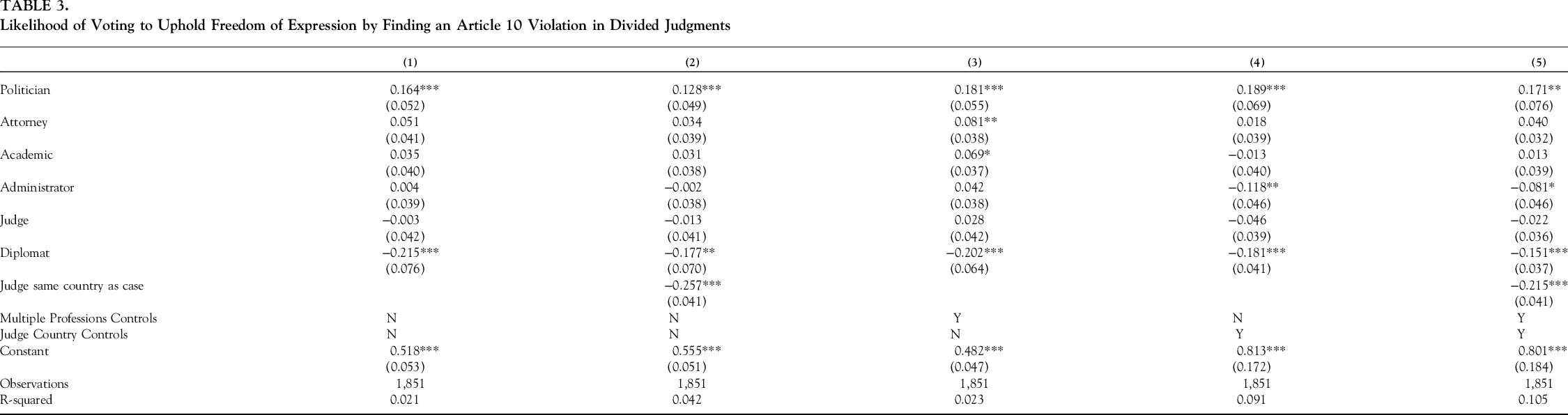
To investigate the association between career background and voting patterns, Table 3 reports the results of a series of linear regressions.Footnote 10 Regression (1) includes all career backgrounds, estimating the relative association between each background and propensity to find an Article 10 violation. Consistent with the data presented in Table 2, former diplomats are less likely to support freedom of expression than judges who were never diplomats and former politicians are more likely to support freedom of speech than judges who were never politicians. (Both results are statistically significant at the p < 0.01 level.) In this comparison, former administrators were no less likely and former judges, attorneys, and academics no more likely to support freedom of expression than ECtHR judges not having those career backgrounds.
Likelihood of Voting to Uphold Freedom of Expression by Finding an Article 10 Violation in Divided Judgments

Note: OLS regression with robust standard errors in parentheses; *** p < 0.01, ** p < 0.05, * p < 0.1
Regressions (2) through (5) introduce key control variables. As noted above, a wide number of studies find that when international court judges rule on cases involving their home country they are more likely to side with their state. Regression (2) demonstrates that this relationship holds in divided Article 10 cases in the European Court of Human Rights, where judges are less likely to cast votes finding an Article 10 violation by their own country. Including this control variable does not, however, change the statistical significance of the former career path coefficients from regression (1).
Regression (3) explores the possibility that controlling for the number of prior careers influences the association between professional background and voting patterns. We introduce a set of individual controls for judges having two, three, or four former careers.Footnote 11 The results show that the pattern for diplomats and politicians still holds. In this analysis, former attorneys with only a single prior career are also statistically significantly associated with a greater likelihood of voting to uphold freedom of speech (p < 0.05), and former academics with only one prior career approach conventional levels of statistical significance in the same direction.Footnote 12
Regression (4) includes controls for each individual country.Footnote 13 This allows us to explore the proposition that particular countries may prefer to nominate judges who are restrained or activist, and that nominating former diplomats or politicians may simply serve as a proxy for that state-level preference. Introducing this set of controls does not, however, affect the statistical significance of either the diplomat or politician variables. In this regression, former administrators are also associated with a statistically significant propensity to vote against freedom-of-expression claims (p < 0.05). On the whole, while the expanded results of this regression (reported in Appendix, Table A3) show that some countries are indeed statistically more likely to nominate judges that differ on the activist-restraint continuum, the career background of judges remains a significant independent correlate of voting patterns.
Finally, regression (5) includes all three sets of controls. It reveals that votes by former-diplomat judges remain associated with greater restraint, and those by former politicians with a greater likelihood of finding an Article 10 violation. In this analysis, the coefficient for former administrators approaches but does not attain conventional statistical significance.
In sum, the effects of career background for diplomats and for politicians are robust to multiple specifications.Footnote 14 They are not simply a function of judges voting in favor of their home country; they do not depend on the number of prior careers held by individual judges; and they are not a product of country-level characteristics. While in some analyses, other career background variables approach or attain statistical significance, only former diplomats are consistently associated with a greater likelihood of voting against Article 10 claims, and only former politicians with a greater likelihood of voting in favor.
Our finding with respect to politicians is unexpected. Since earlier research that addressed career background across ECHR rights did not identify any distinctive roles for former-politician judges, this result merits further investigation. However, our existing data do not provide much analytical leverage for doing so. We have only nine former politicians in our sample, who collectively cast only eighty-two votes in divided Article 10 judgments, only ten of which were in dissent. Given the lack of a strong theoretical motivation accounting for this pattern and our data limitations, we focus for the remainder of our study on the distinctive judicial behavior of former diplomats.
Diplomats and Their Dissents
Our analysis of all judicial votes cast in divided Article 10 judgments shows that former diplomats are less likely than their colleagues to support contested free expression claims. If we narrow our lens to dissenting behavior only, it seems clear that former diplomats are also less likely than their colleagues to cast dissenting votes in favor of free expression claims. As indicated in Table 4, only 7 percent of former diplomats’ dissenting votes in A10 cases were cast in support of freedom of expression. The remaining 93 percent were cast in opposition to judgments finding a violation of Article 10. For all other career categories, the distribution of pro– and anti–free expression dissents is much closer to fifty-fifty.Footnote 15
Percentage of Dissenting Votes Cast in Support of A10 Claims, by Prior Judicial Career

Note: Because some judges have multiple prior careers, they are counted in multiple categories. Percentage of dissenting votes cast in favor of free speech claims is calculated as the number of dissents in favor of free speech divided by the total number of dissents.
In this section, we examine the dissenting votes and opinions of the fifteen European Court of Human Rights judges in our sample who spent all (N = 3) or part (N = 12) of their career as diplomats. As indicated above, these dissenting opinions not only signal the strength of their disagreement with the majority, but also reveal the logic behind their disagreement. As Bruinsma (Reference Bruinsma, van Hoek, Hol, Jansen, Rijpkema and Widershoven2006, 224) notes, “Compared to majority judgments, which are to some extent disembodied and soulless, separate opinions are individual statements. The very fact that separate opinions lack legal validity inspires the authors … to highly individual expressions of judicial identity.” Social scientific accounts of judicial decision-making sometimes treat written judicial opinions as public justifications of judicial votes that are unreliable guides to the actual motivations for those votes. In our view, however, signed dissenting opinions are often good windows onto sincere judicial preferences as to the direction of the law. If some judges vote less often than others in support of a particular kind of rights claim, we take those patterns as evidence that the former judges have a stronger commitment to state power to restrict those rights. If these judges are also more likely to advance a particular set of dissenting arguments against such rights claims, we take those published opinions as further evidence that they want to move the law in the direction of state power to restrict the relevant rights.
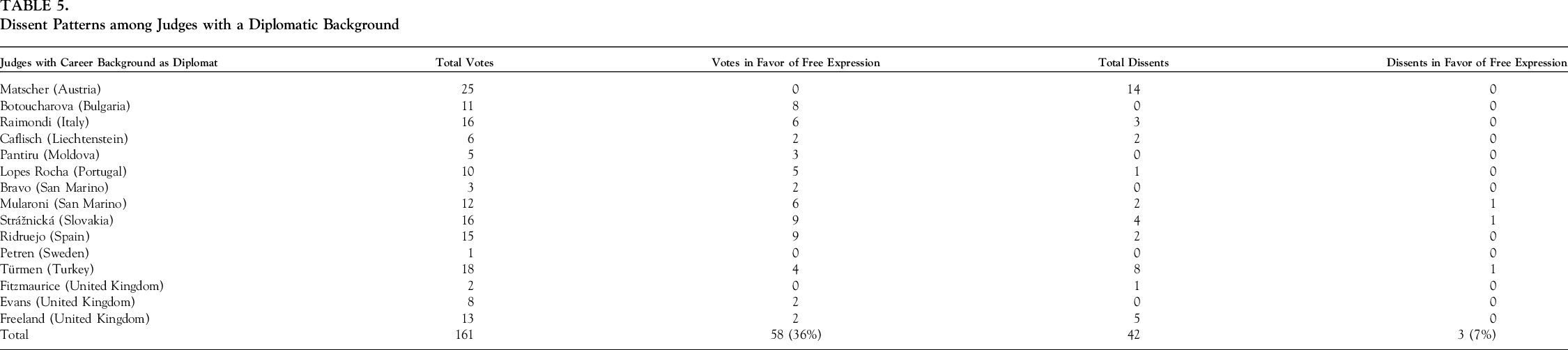
Among all judges with a diplomatic background, Table 5 shows that five did not cast any dissenting votes, seven dissented between one and four times, and three were involved in five or more dissents. Altogether, ten judges authored or joined dissents forty-two total times, thirty-nine of which were in opposition to findings of an A10 violation. In other words, when moved to write or join a dissent, former diplomats almost always did so to urge the Court to provide less protection for free expression.
Dissent Patterns among Judges with a Diplomatic Background

Examining the texts of the written dissents reveals common threads in these judges’ analyses. Most of the former diplomats’ dissents opposing speech-protective rulings center around two key themes. First, these judges often disagree with their colleagues regarding the gravity or egregiousness of the speech in question. In these instances, dissenters characterize the expression at issue as more outrageous, harmful, or offensive than do their colleagues in the majority. Second, former-diplomat dissenters advocate greater latitude for member states to enforce their domestic laws as they see fit. These dissenting opinions do not explicitly articulate concerns that enforcing European-wide norms would generate state-level resistance, but they often invoke the Court’s “margin of appreciation” doctrine to signal that the ECtHR should be more deferential to domestic courts. This doctrine stresses that the ECHR’s protections are “subsidiary to the national systems safeguarding human rights” and that “[t]he Convention leaves to each Contracting State, in the first place, the task of securing the rights and liberties it enshrines.”Footnote 16 As such, Article 10 leaves domestic legislators and judges with a certain margin of appreciation in deciding what restrictions on expression are necessary in a democratic society.
In some cases of the first type, judges weighed in on claims filed against their home countries. In Oberschlick v. Austria (1991), for example, an Austrian journalist published a call for indictment of Walter Grabher-Meyer, then Secretary General of the Austrian Liberal Party, for incitement to hatred. Mr. Grabher-Meyer had publicly called for family allowances to be simultaneously increased for Austrian mothers and decreased for immigrant mothers, a stance the journalist described as an effort to promote the aims of the National Socialist (Nazi) Party. The journalist was convicted of defamation, but the ECtHR found a violation of Article 10 by a vote of sixteen to three. In dissent, Austrian judge Franz Matscher argued that “the applicant did not confine himself to permissible criticism, but perpetrated a treacherous attack on the reputation of a politician.”Footnote 17 Coded DIPLOMAT + ACADEMIC in our data, Matscher served seventeen years in the Austrian foreign service before joining the faculty at University of Salzburg. As noted above, he participated in twenty-five divided Article 10 judgments on the ECtHR and never supported the A10 claim. Here, emphasizing the “duties and responsibilities” language from Article 10.2, he would have held that the Austrian courts’ judgment was both necessary and proportionate to protecting the rights of others.Footnote 18
Similarly, in a number of Turkish cases, former diplomat Riza Türmen argued that statements made in favor of the Kurdish separatist PKK group were far more inflammatory than acknowledged by his judicial colleagues. For example, in Aslı Güneş v. Turkey (2005), Judge Türmen asserted that referring to the Kurdish situation as a “war” was an implicit call for violence. In Yağmurdereli v. Turkey (2002), he argued that mentions of dissidents in “the mountains” invoked images of armed insurrection, and constituted oblique references to the PKK, who are organized and fighting from the mountains. In addition, in Ali Erol v. Turkey (No. 2) (2005), the Court’s protection of a whistleblower’s description of army atrocities against its adversaries elicited a lone dissent by Türmen on the grounds that it amounted to an incitement of hostility against the Turkish army. One of three single-career DIPLOMATS in our sample, Türmen served more than thirty years in Turkey’s diplomatic corps, including stints as Ambassador to Singapore and Switzerland and Permanent Representative to the Council of Europe. During his time on the ECtHR, he supported Article 10 claims in just four of eighteen divided judgments (22 percent).
Former diplomats did not limit their objections to free speech holdings directed against their own home countries. De Haes and Gijsels v. Belgium (1997) involved a series of newspaper articles criticizing the Belgian judges who had awarded child custody to a politically well-connected father who had been accused of incest and child abuse. The journalists responsible for the articles were convicted of defamation, but the European Court of Human Rights found a violation of Article 10 by a vote of seven to two. In a brief dissent, Judge Matscher agreed that free expression is an important value, but insisted that his colleagues in the majority had “failed to recognise the limits that this freedom entails, which are also of importance in a civilised democratic society.” In particular, Matscher again complained that the “duties and responsibilities” language from Article 10.2 “seems to carry little weight in the Court’s case-law.”Footnote 19 On his account, the journalists were entitled to criticize the court decisions in the divorce proceeding, but not to question the judges’ motives. This notion that protecting the integrity of the judiciary requires preventing public accusations of biased or corrupt judging has a long history in contempt of court and judicial defamation cases, but it is a concern that sits in significant tension with core free expression values as advocated by a number of Matscher’s colleagues (Keck, Metroka, and Price Reference Keck, Metroka and Price2018).
Likewise, consider the joint dissent authored by UK judge Sir John Freeland in Grigoriades v. Greece (1997). Like Türmen, Judge Freeland is coded as a single-career DIPLOMAT, having served a long tenure in the Legal Service of the Foreign Office, including postings at the British Embassy in Bonn and at the UK Mission to the United Nations in New York. During his time on the Court, he supported Article 10 claims in just two of thirteen divided judgments (15 percent), regularly dissenting when his colleagues found a violation of Article 10. In Grigoriades, an ECtHR Grand Chamber found an A10 violation by a vote of twelve to eight, in a case involving a second lieutenant who had been disciplined for complaining about abuses committed against conscripts in the Greek army. The soldier’s penalty for this initial infraction included additional mandatory service. The conscript then went absent without leave and was charged with desertion, after which he wrote to his commanding officer, declaring his view that “the army is an apparatus opposed to man and society and, by its nature, contrary to peace” (¶ 14). The commanding officer instituted further criminal proceedings for insulting the army. In dissent, Judge Freeland asserted that the restriction on freedom of expression was necessary to pursue the legitimate aim of maintaining order and discipline in the armed forces. According to Freeland and the other dissenters, the conscript’s letter adopted “the language of insubordination rather than that of permissible criticism” and “could reasonably be regarded as being, if left unpunished, a possible encouragement to other soldiers to waver in their duty of obedience” (¶ 7).
In addition to disagreements about the substantive harm of particular forms of expression, former diplomats are prone to argue for a greater margin of appreciation for member states. Judge Freeland’s opinion in Bowman v. United Kingdom (1998) illustrates this point. This case involved an antiabortion activist in London who was charged with illegal campaign spending for distributing 1.5 million leaflets detailing parliamentary candidates’ positions on abortion. The Court ruled fourteen to six that there had been a violation of Article 10. In a partial dissent joined by Latvian judge Egils Levits, Freeland wrote that “the interference with the right to freedom of expression … is narrow in scope. It falls … within the margin of appreciation which is left to a Contracting State in deciding what is necessary, in the light of its own historical experience and current circumstances, for the proper regulation of a process so central to democracy as the conduct of parliamentary elections (and I would add that I consider there to be a clear need for a particularly cautious approach to be adopted in adjudicating internationally on rules prescribed by long-established democratic parliaments on matters so intimately involved with their own composition and operation).”Footnote 20
Judge Türmen was similarly inclined to invoke the margin of appreciation in cases involving his home country of Turkey. In his solo dissent in Yağmurdereli v. Turkey (2002), not only did Türmen object to the references to dissidents in “the mountains” (as noted above), he also appealed to the “margin of appreciation benefitting national authorities in similar cases” to conclude that the speech restriction was proportionate to the legitimate aims of the state. Çapan v. Turkey (2006) involved statements penalized by the Turkish state because they allegedly gave credibility to the leader of the Kurdish separatist PKK and implicitly called for a return to an armed struggle. Judge Türmen joined one colleague in partially dissenting, using language similar to that found in Yağmurdereli to indicate that the facts of the case, coupled with the “margin of appreciation benefitting national authorities” in similar cases, meant that the penalty was proportionate to the legitimate aims pursued by the state.Footnote 21
Former diplomats also support the margin of appreciation doctrine in cases involving countries other than their own. In Piermont v. France (1995), both Judges Matscher and Freeland signed a partial dissent from the five to four finding of an Article 10 violation. The case involved a German environmental activist and Member of the European Parliament who traveled to French Polynesia during a territorial election campaign. At a public march and demonstration, she denounced nuclear testing and the continued French presence in the Pacific, whereupon she was detained and expelled from the territory. In a long joint dissent with Norwegian judge Rolv Ryssdal and Czech judge Karel Jungwiert, Matscher and Freeland indicated that they were “satisfied that the interference can, allowing for the margin of appreciation to be afforded to the authorities, reasonably be accepted as being proportionate to the aim pursued. We therefore conclude that the treatment of Mrs. Piermont in French Polynesia involved no violation of Article 10.”Footnote 22
Judge Matscher also extended deference to speech-suppressive state actions in Open Door and Dublin Well Woman v. Ireland (1992). The Court considered an injunction issued by the Irish courts that “imposed a ‘perpetual’ restraint on the provision of information to pregnant women concerning abortion facilities abroad, regardless of … their reasons for seeking counseling on the termination of pregnancy.”Footnote 23 By a vote of fifteen to eight, the Court found a violation of Article 10. In dissent, Matscher objected to his colleagues’ treatment of the word “necessary” from Article 10.2. In this and a number of similar cases, the Court had defined “necessary in a democratic society” to mean “corresponding to a pressing social need.” Matscher argued that in so doing, the Court had authorized itself “to assess … whether it is ‘necessary’ for a national legislature or a national court to seek to attain an aim which the Convention recognizes as legitimate.” For Matscher, if Irish authorities are limiting information about abortion in an effort to prevent disorder, protect morals, or protect the rights of others—all aims expressly contemplated in Article 10.2—“it is not for the European Court to call in question that aim simply because it may have different ideas in this regard” (¶ 3(d)). Matscher’s stance here is highly deferential toward member states. In a separate coauthored dissent, former Portuguese diplomat Manuel Antonio Lopes Rocha and colleagues likewise argued that “more account should have been taken of the basis and object of the Irish legislation on the protection of life,” and asserted that Irish legal principles “cannot be criticised on the basis of different principles applied in other legal systems.”Footnote 24
Judge Freeland coauthored a dissent in Lehideux and Isorni v. France (1998), which involved the publication of an advertisement praising the memory of Marshal Philippe Pétain, the Head of State in Vichy France during World War II. The French courts convicted the advertisement’s authors of publicly defending the crimes of collaboration with the enemy, but the ECtHR found a violation of Article 10, by a vote of fifteen to six. Freeland’s dissent asserted that the French state should have a wider margin of appreciation “where the aim pursued arose out of historical circumstances peculiar to France and where the French authorities were uniquely well placed, by virtue of their direct and continuous contact with the vital forces of their country, to assess the consequences for the protection of the rights of other groups.”Footnote 25 In these circumstances, in other words, states should have the latitude to determine what is appropriate within their domestic context. In this case, as in so many others, former diplomat Freeland was prone to defer to local contexts in arguing for a wide margin of appreciation for domestic authorities enforcing restrictions on harmful speech.
In sum, ECtHR judges with prior service as diplomats regularly depart from their colleagues to urge less protection for freedom of expression, and their dissenting opinions typically refer to substantive harm, the margin of appreciation, or both. We do not mean to suggest that diplomats and nondiplomats make different arguments when rejecting A10 claims. In Open Door and Dublin Well Woman, Matscher and Lopes Rocha were joined by four colleagues without diplomatic experience in calling for a wide margin of appreciation.Footnote 26 But the likelihood of evoking these themes differs substantially by former career category. Our data show a large gap between the probabilities that diplomats and nondiplomats vote to reject an A10 claim, a gap that is even larger when looking just at dissenting votes. The former diplomats’ dissenting opinions help us understand why they so often oppose such claims—both because they agree with the judgment of state authorities that a particular speech act was beyond the pale and because they believe such judgments are for state authorities rather than international judges to make.
Importantly, our findings regarding the distinctive behavior of former diplomats do not extend to judges with prior government service in domestic roles. As reported in Table 2, former administrators in our judicial careers dataset (N = 55) cast 56 percent of their votes in divided cases in support of A10 claims, compared to 36 percent for former diplomats. As reported in Table 4, the corresponding figures among dissenting votes are 50 percent for ADMINISTRATORS and 7 percent for DIPLOMATS.
Nondiplomats and Their Dissents
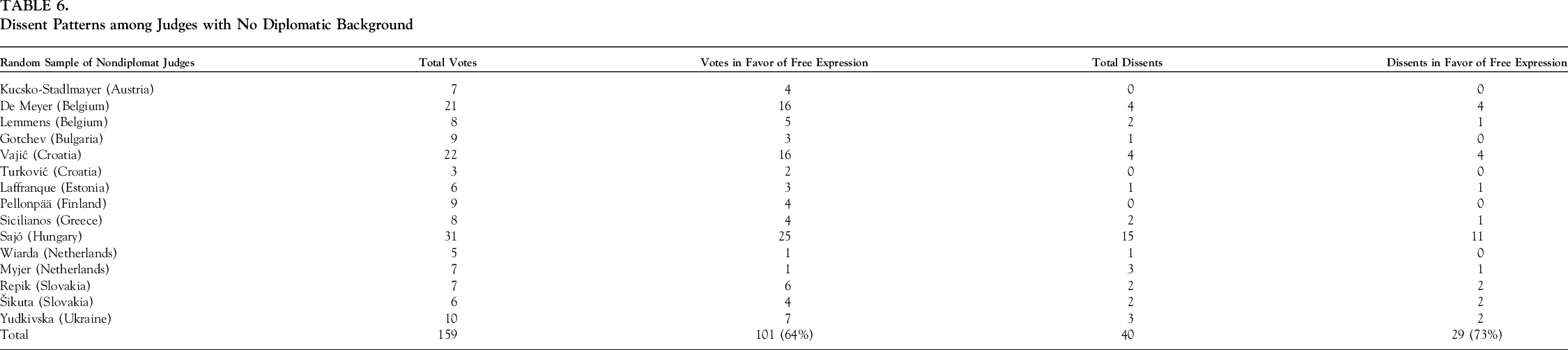
To sharpen our understanding of former diplomats’ approach to contested A10 claims, we drew a random sample of fifteen judges without prior career experience as diplomats and compared their dissenting votes and opinions to those of the fifteen judges with diplomatic backgrounds. Among all nondiplomats, 53 percent of their dissenting votes were cast in favor of Article 10 free expression claims, substantially higher than the 7 percent rate among diplomats. For our random sample of fifteen nondiplomats, the gap is even wider, with 73 percent of dissenting votes cast in favor of free expression. These judges are listed in Table 6.
Dissent Patterns among Judges with No Diplomatic Background

The dissenting opinions of these fifteen nondiplomats are strikingly different from those of their former-diplomat colleagues. In particular, they exhibit greater tolerance for outrageous and offensive speech acts, and they regularly contend that the margin of appreciation is trumped by the need for European supervision of fundamental human rights norms. Moreover, at times they even invoke extra-European free expression norms, appearing to press for enforcement of a global constitutional law of free expression that leaves much less leeway for diverse national practices than the stance favored by their former-diplomat colleagues.
Consider Hungarian judge András Sajó. Coded as a single-career ACADEMIC, having served for thirty-five years in various university positions, including chair of comparative constitutional law at Central European University in Budapest, Sajó participated in thirty-one divided Article 10 judgments, supporting the A10 claim in twenty-five of them (81 percent). He dissented fifteen times, with eleven of those fifteen dissents in support of an A10 claim. The case of Féret v. Belgium (2009) provides particularly clear evidence of the breadth of Sajó’s commitment to free expression. An MP from Belgium’s far-right Front National had distributed racist campaign leaflets and was convicted of inciting racial hatred. By a vote of four to three, the Court found no violation of Article 10. In a dissent joined by Georgian judge Nona Tsotsoria and Italian judge Vladimiro Zagrebelsky, Sajó objected that “a notion of hate speech that does not directly refer to provoking acts of violence or intolerance is too broad to be compatible with serious protection of political discourse.”Footnote 27 These three dissenting judges are among the Court’s most consistent supporters of free expression, each favoring Article 10 claims in more than three-quarters of divided cases, and in Féret, they extended that support even to the context of racist hate speech, on which the broadest European consensus exists in favor of speech restrictions (Bleich and Al-Mateen, 2021). By contrast, Belgian judge Françoise Tulkens and Serbian judge Dragoljub Popović—also among the Court’s most consistent supporters of free expression—joined the majority judgment in Féret.
Another illuminating example is the case of Delfi AS v. Estonia (2015), which concerned an Internet news portal that published hundreds of articles daily, on a Web site that enabled online comments from readers. An article alleging that a privately operated ferry service had destroyed a planned ice road (connecting mainland and island communities over the frozen sea) prompted multiple comments containing threats and offensive language directed against a member of the ferry company’s supervisory board. Some of the comments at issue were racist and anti-Semitic. The board member filed a successful civil defamation claim in the domestic courts. An ECtHR Grand Chamber balanced Article 10 freedom-of-expression considerations against Article 8 right-to-privacy principles and found no violation of A10 by a vote of fifteen to two.
In an unusually long and detailed joint dissent, Judges Sajó and Tsotsoria indicated that the key issue in the case was whether Web site hosts could legitimately be held responsible for the defamatory content of online comments posted by readers. Sajó and Tsotsoria objected that the Court was allowing the state to encourage private-party censorship by incentivizing hosts to disable public comment features. They noted that the Internet “is a sphere of robust public discourse with novel opportunities for enhanced democracy. Comments are a crucial part of this new enhanced exchange of ideas among citizens.”Footnote 28 And they characterized the likely consequence of the Court’s judgment as a form of “prior restraint” (¶ 8). While most member states had adopted policies of “notice and take down,” under which Internet hosts are obligated to remove illegal comments once called to their attention, the Estonian courts had here imposed a policy of strict liability for removing illegal comments as soon as they are posted. The ECtHR approved this policy at least in part because of the racist and anti-Semitic content, but, recalling their dissent in Féret, Sajó and Tsotsoria objected that in the absence of a domestic prosecution for hate speech, no assessment had been made as to whether the comments amounted to incitement to racist violence (¶¶ 13–15). They concluded by noting that the Court’s balancing approach had failed to attend to key considerations on the freedom-of-expression side of the scale (¶¶ 39–43).
Sajó’s dissenting opinions make clear that he is more tolerant of offensive speech than are his former-diplomat colleagues, and also that he is less willing to defer to diverse national traditions regarding speech restriction.Footnote 29 In this regard, consider also Belgian judge Jan De Meyer, whose principal prior career consisted of 35 years in various academic positions. Coded in our dataset as ACADEMIC + ATTORNEY + ADMINISTRATOR, he supported Article 10 claims in sixteen of twenty-one divided judgments (76 percent). He dissented four times, each time in favor of an A10 claim. For example, in markt intern Verlag GmbH and Klaus Beermann v. Germany (1989), a narrowly divided ECtHR found no violation of Article 10 when the German courts enjoined a publishing firm, founded by journalists to defend the interests of small businesses against large corporations, from repeating critical statements about a mail-order cosmetics company. In a jointly authored dissent, De Meyer and six colleagues objected that the Court was carrying the margin of appreciation so far as to threaten important free expression values, which apply in the context of commercial speech, as elsewhere. They opened this dissent by noting that “[i]n the field of human rights, it is the exceptions, and not the principles, which ‘[are] to be interpreted narrowly.’ This proposition is especially true in relation to the freedom of expression.”Footnote 30
If free expression cases inevitably require striking a balance between a fundamental human right and a variety of legitimate state interests in restricting that right, ECtHR judges who lack prior experience as diplomats appear to give more weight to the human rights side of the scale. For example, some of our nondiplomat judges have suggested that criminal prosecutions for defamation are never compatible with democratic governance. Consider Slovak judge Ján Šikuta, coded as JUDGE + ATTORNEY, having served for more than twenty years as a first-instance and later appellate judge in Slovakia. He supported Article 10 claims in four of six divided judgments. He dissented twice, each time in favor of the Article 10 claim. One of these dissents came in Lindon, Otchakovsky-Laurens and July v. France (2007), a dispute that began with publication of a novel entitled Jean-Marie Le Pen on Trial. The novel was based in part on two real-life 1995 murders committed by skinheads associated with Front National, Mr. Le Pen’s extreme right-wing party. Both Le Pen and the party initiated criminal defamation proceedings, and the Paris Criminal Court ruled in their favor. This judgment prompted a petition signed by ninety-seven writers and published in the daily newspaper Libération, reprinting relevant passages from the novel and contending that they should not be read as defamatory. Le Pen then initiated a second set of criminal defamation proceedings against Libération’s publication director, and the French courts ruled in his favor again. The French Court of Cassation upheld the judgments in both cases, and the ECtHR held that the domestic courts had reasonably found “that the interference with … freedom of expression was necessary in a democratic society … in order to protect the reputation and rights of Mr Le Pen and the Front National.”Footnote 31
In a joint dissenting opinion, Šikuta and three others objected that the French courts had fallen significantly short of key free expression standards. In the first place, those courts had drawn no distinction between the publication of statements spoken by fictional characters in a novel and the publication of asserted statements of fact, a stance that appeared inconsistent with several prior ECtHR judgments extending Article 10 protection to prose fiction, poetry, and visual art (¶¶ 2–4). Moreover, the dissenters noted that public figures and politicians “are exposed to criticism as a matter of course and are therefore required to show greater tolerance [than private individuals] towards polemical discourse or even insults directed against” them (¶ 4). With regard to Mr. Le Pen himself, they observed that he should perhaps “accept an even higher degree of tolerance precisely because he is a politician who is known for the virulence of his discourse and for his extremist views,” noting his various convictions in French courts for trivialization of crimes against humanity, apologia for war crimes, incitement to racial hatred, and the like (¶¶ 4–5). Most fundamentally, the dissenters “questioned whether it is still justified, in the twenty-first century, for damage to reputation through the press, media or other forms of communication to entail punishment in the criminal courts” (¶ 7). In an Austrian case that same year that was similar in some respects, another nondiplomat judge likewise emphasized the narrow scope of defamation claims that can legitimately be pursued by public officials in a democratic society.Footnote 32
The dissents in these two cases relied solely on European legal sources (principally the ECtHR’s own case law), but nondiplomat dissenters have sometimes gone further. In addition to emphasizing European supervision over and against the Court’s margin of appreciation for the diverse practices of member states, judges who lack diplomatic experience regularly draw on extra-European legal sources in support of robust free expression principles.
In Observer & Guardian v. United Kingdom (1991), two leading national newspapers had published articles regarding Spycatcher, a memoir authored by ex–MI5 agent Peter Wright. The English courts issued multiple injunctions against further publication, initially on the basis of breach of confidence and subsequently as contempt of court (on the grounds that confidentiality of the Spycatcher material was necessary to the fair conclusion of the ongoing proceedings). The ECtHR held unanimously that once Spycatcher had been published in the United States, the injunctions were no longer “necessary in a democratic society” and hence constituted a violation of Article 10.Footnote 33 But it also held that prior to US publication, the injunctions had represented legitimate state efforts to protect national security and maintain the authority of the judiciary. Dissenting from this latter holding, which was issued by a vote of fourteen to ten, De Meyer quoted Justice Hugo Black’s and William O. Douglas’s opinions in the Pentagon Papers case: “I firmly believe that ‘the press must be left free to publish news, whatever the source, without censorship, injunctions, or prior restraint’: in a free and democratic society there can be no room, in time of peace, for restrictions of that kind, and particularly not if these are resorted to, as they were in the present case, for ‘governmental suppression of embarrassing information’ or ideas.”Footnote 34 In another case five years later, De Meyer elaborated his view that prior restraints on free expression were virtually never compatible with Article 10.Footnote 35
Regarding extra-European constitutional support for the fundamental role of the press as a “watchdog in a democratic society,” consider also the dissenting opinion from Ukrainian judge Ganna Yudkivska in Bédat v. Switzerland (2016). Coded with the single profession ATTORNEY, Yudkivska served for more than fifteen years as a human rights advocate before joining the ECtHR in 2010. She supported Article 10 claims in seven of ten divided judgments in our sample, dissenting twice in favor of A10 claims and once against. In her Bédat dissent, she opened with an epigraph from Justice Black’s opinion in Bridges v. California: “[F]ree speech and fair trials are two of the most cherished policies of our civilisation [sic], and it would be a trying task to choose between them.”Footnote 36 The Bédat case concerned the criminal prosecution of a journalist who had published a magazine article detailing the actions and mindset of a defendant in an ongoing murder trial. Quoting also from the US Supreme Court’s decisions in Sheppard v. Maxwell (1966) and Nebraska Press Association v. Stuart (1976), Yudkivska endorsed Justice William Brennan’s view that “free and robust reporting, criticism, and debate can contribute to public understanding of the rule of law and to comprehension of the functioning of the entire criminal justice system, as well as improve the quality of that system by subjecting it to the cleansing effects of exposure and public accountability.”Footnote 37
Sajó has likewise drawn on global constitutional sources in support of free expression claims. In his Delfi AS dissent, he cited US constitutional scholar Jack Balkin, and in his dissenting opinion in Mouvement raëlien suisse v. Switzerland (2012), he cited domestic case law from states both within and outside of Europe.Footnote 38 In the latter case, a Swiss association dedicated to establishing first contact with extraterrestrials had requested police permission to hang posters declaring “Science at last replaces religion” (¶ 14). The posters also listed the URL for the association’s Web site. The police denied permission, and the Swiss courts upheld this decision on the grounds that the association advocated human cloning (which was illegal under Swiss law), that “[n]umerous members of the movement had … been investigated by the police because of their sexual practices” (possibly including pedophilia), and that the movement’s “criticism … directed at contemporary democracies, was likely to undermine the maintaining of public order, safety and morality” (¶ 21, quoting judgment of Swiss Federal Court). By a vote of nine to eight, the ECtHR’s Grand Chamber found that the restrictions on expression represented legitimate state efforts to protect health or morals, prevent crime, and protect the rights of others (¶¶ 54–55). The holding relied explicitly on the Court’s margin of appreciation doctrine (¶ 48).
In a joint dissent, seven judges made a straightforward case that the facts here fell well within the ambit of expression protected under the Court’s A10 precedents, particularly Handyside v. United Kingdom (1976) and Sunday Times v. United Kingdom (1979). But three of them also authored an additional opinion elaborating on their regret that the Court’s holding “diminished [the protection of free expression] in respect of the world view of a minority” (¶ 3). In this latter opinion, Sajó and two colleagues included strong language regarding the need for the ECtHR to exercise a continent-wide “supervisory function” as a counterbalance to the margin of appreciation: “The undeniably better knowledge of local circumstances and sensitivities that militate in favour of the choices of national authorities must not become a fig-leaf for acquiescence in bigotry…. The doctrine of margin of appreciation is a valuable tool for the interaction between national authorities and the Convention enforcement mechanism; it was never intended to be a vehicle of unprincipled deferentialism” (sec. V, ¶¶ 1–2). In support, Sajó and his colleagues also referenced US, Canadian, and German constitutional law for the proposition that public fora should be made equally available to all speakers (appendix to dissenting opinion).
***
The patterns we have documented do not, of course, apply in every case. Judges who lack prior experience as diplomats do not always support Article 10 claims, and judges who have such experience do not always reject them. In the former category, nondiplomat judges sometimes dissent from judgments finding an A10 violation, and their dissenting opinions in these cases exhibit themes similar to those of their former-diplomat colleagues. In Gül and Others v. Turkey (2010), for example, Sajó dissented from a holding in favor of applicants who had been sentenced to three years in prison for shouting slogans supporting an armed illegal organization while participating in a lawful demonstration. On Sajó’s reading, the slogans amounted to apology for terrorism and hence could legitimately be sanctioned by the Turkish state. Like their former-diplomat colleagues, Bulgarian judge Dimitar Gotchev, Greek judge Linos-Alexandre Sicilianos, and Dutch judge Gérard J. Wiarda have all referenced the margin of appreciation doctrine in dissents from judgments finding a violation of A10.Footnote 39 But in contrast to former diplomat Matscher, who did so in at least eight different dissenting opinions, each of these nondiplomat judges has done so only once. In the aggregate, our fifteen nondiplomat judges cast only eleven dissenting votes against A10 claims, so these opinions represent the exception rather than the rule.
Likewise, when former diplomats dissent in favor of free speech, their dissents are likely to resemble those of their nondiplomat colleagues in some key respects. In particular, we expect pro-speech dissents from former diplomats to exhibit some degree of tolerance for the allegedly harmful speech acts at issue and to appeal to continent-wide free expression standards over and against diverse national practices of speech suppression. After all, for an international court such as the ECtHR, doing so is essentially the only way to rule in favor of a human rights claim filed against a state party. However, we do not expect former diplomats to echo their nondiplomat colleagues by invoking extra-European free expression norms, which they may view as greater threats to the raison d’état. Unfortunately, dissents on the part of former diplomats in favor of free expression are so rare that we do not have enough information to adequately assess these expectations. Turkish judge Türmen, Sanmarinese judge Antonella Mularoni, and Slovakian judge Viera Strážnická have each cast a single dissenting vote in support of an A10 claim. The other twelve former diplomats in our sample have never done so. Türmen and Strážnická each signed a joint dissent in Pedersen and Baadsgaard v. Denmark (2004), and Mularoni dissented in Stângu and Scutelnicu v. Romania (2006). Both of these dissenting opinions emphasize the important role of the press in informing the public regarding corrupt exercises of state law enforcement powers. The Mularoni dissent made brief reference to European standards of free expression in doing so, with a handful of citations to the ECtHR’s own case law. Neither opinion made any reference to extra-European standards of free expression. It may be that former diplomats on the ECtHR are so attached to the margin of appreciation for member states that they are unwilling to appeal to global norms even when calling on their colleagues to provide greater speech protection. But the rarity of dissents in which former diplomats have advocated for greater speech protections limits our ability to assess this hypothesis.
Finally, we again note that the distinctive behavior of former diplomats on the bench does not characterize their colleagues with prior service in domestically focused government roles. In other words, in addition to their aggregate voting patterns, the dissenting opinions of former administrators look more like those of nondiplomats than of diplomats. Consider Portuguese judge Ireneu Cabral Barreto, one of four pure ADMINISTRATORS in our data, and the one who issued the most dissents. In İ.A. v. Turkey (2005), Cabral Barreto and two colleagues dissented from the Court’s failure to find an A10 violation when a Turkish publisher was convicted of blasphemy for publishing a novel offering an atheist critique of Islam. The ECtHR majority relied on existing case law extending states “a wider margin of appreciation when regulating freedom of expression in connection with matters liable to offend intimate personal convictions within the sphere of morals or religion.”Footnote 40 Drawing on a key concept from US First Amendment law, the dissenting judges objected that this line of doctrine was insufficiently sensitive to the “‘chilling effect’ liable to discourage publishers from producing books that are not strictly conformist or ‘politically (or religiously) correct’. Such a risk of self-censorship is very dangerous for this freedom, which is essential in a democracy, to say nothing of the implicit encouragement of blacklisting or ‘fatwas’” (dissent ¶ 6). This dissenting opinion, issued jointly by one judge coded ADMINISTRATOR, a second coded ACADEMIC, JUDGE, and ADMINISTRATOR, and a third coded ATTORNEY, reads far more like those from our nondiplomat judges than those from their former-diplomat colleagues.
CONCLUSIONS
The decisions and opinions of European Court of Human Rights judges in free expression cases appear to be rooted at least in part in their varied professional backgrounds. Our analysis shows that a number of prior career paths correspond to expected voting patterns in various statistical models, but the findings are most robust and consistent with regard to former diplomats and politicians. Lacking sufficient data to explore the behavior of former-politician judges, we focus here on the distinctive behavior of former diplomats.
Our comprehensive data show that judges with prior career experience as diplomats are less likely to support Article 10 free speech claims in divided cases than judges without a diplomatic background. This finding is consistent with existing literature on ECtHR decision-making, but our confidence in its validity is enhanced by our focused analysis of dissent patterns. In particular, we have shown that former diplomats are far more likely than their colleagues to dissent against free speech holdings—that is, to urge their colleagues to provide less protection for freedom of expression. Conversely, judges with no career history as diplomats are more likely both to vote in favor of protecting free speech and to dissent against findings that uphold states’ authority to restrict freedom of expression. In addition to these judicial voting patterns, the content of the judges’ dissenting opinions indicates that former diplomats characterize speech acts as relatively more egregious than their nondiplomat colleagues and invoke the margin of appreciation doctrine more frequently. Nondiplomat dissents demonstrate a greater tolerance for potentially harmful speech and give greater power to European or even extra-European ideas about the protection of freedom of expression.
Existing research suggests that individual preferences matter for judicial behavior across multiple contexts. We have followed earlier scholars of international courts who have shown that a judge’s career background—a factor that can be measured consistently across countries—shapes judicial behavior on the European Court of Human Rights. We have refined and deepened this analysis by theorizing more fully the links between former career and judicial motivations. We argue that former diplomats defined by their foreign service orientations are most likely to be motivated by concerns related to the raison d’état, and that they should be distinguished from domestically oriented administrators who have commonly been amalgamated into the same category in prior studies. We show through statistical analyses and through a close reading of dissents that former diplomats are indeed uniquely likely to oppose Article 10 claims for greater free expression protections.
Having established this finding with greater confidence and specificity, future research can extend this line of analysis to undertake a closer study of additional human rights claims and additional international courts. There are now approximately two dozen permanent international courts and tribunals, the majority of which were established since the end of the Cold War (Alter Reference Alter2014). These institutions increasingly hold compulsory jurisdiction over areas of law ranging from regional human rights to economic integration, and from international trade disputes to international criminal law. Moreover, they often empower nonstate actors to initiate cases on both domestic and international governance. While these courts have diverse institutional arrangements and substantive legal foci, their benches tend to be filled by judges drawn from a limited set of professional categories (Terris, Romano, and Swigart Reference Terris, Romano and Swigart2007, 19–21). As such, the approach we have developed here can sharpen our understanding of the behavior of international judges across these wide and varied contexts.
ACKNOWLEDGMENTS
The authors are listed in alphabetical order. All authors contributed equally to the production of this article. We would like to thank Sylvia Al-Mateen, Damyre Benjamin, Parker Ferguson, and Caroline Snell for outstanding research assistance in the preparation of this manuscript. We also thank four anonymous reviewers for their helpful feedback and suggestions. This article draws on research that has been supported by the National Science Foundation (Award No. 1535250), the Carnegie Corporation of New York (Award No. G-F-56896), the Peter and Sharon Murphy Kissel Fund for the Study of Civil Liberties (based at Syracuse University’s Maxwell School), the Michael O. Sawyer Chair of Constitutional Law & Politics (also at the Maxwell School), and research funds provided by the Dean for Faculty Development & Research at Middlebury College.
SUPPLEMENTARY MATERIAL
To view the appendix for this article, please visit https://doi.org/10.1017/lsi.2021.9
CASES CITED
Ali Erol v. Turkey (No. 2), App. No. 47796/99, Eur. Ct. H.R. (2005).
Animal Defenders International v. United Kingdom, App. No. 48876/08, Eur. Ct. H.R. (2013).
Aslı Güneş v. Turkey, App. No. 53916/00, Eur. Ct. H.R. (2005).
Bédat v. Switzerland, App. No. 56925/08, 2016-IV Eur. Ct. H.R. 730.
Bowman v. United Kingdom, App. No. 24839/94, Eur. Ct. H.R. (1998).
Bridges v. California, 314 U.S. 252 (1941).
Çapan v. Turkey, App. No. 71978/01, Eur. Ct. H.R. (2006).
De Haes and Gijsels v. Belgium, App. No. 19983/92, Eur. Ct. H.R. (1997).
Delfi AS v. Estonia, App. No. 64569/09, 2015-II Eur. Ct. H.R. 319.
Féret v. Belgium, App. No. 15615/07, Eur. Ct. H.R. (2009).
Goodwin v. United Kingdom, App. No. 17488/90, 1996-II Eur. Ct. H.R. 483.
Grigoriades v. Greece, App. No. 24348/94, 1997-VII Eur. Ct. H.R. 2575.
Gül and Others v. Turkey, App. No. 4870/02, Eur. Ct. H.R. (2010).
Handyside v. United Kingdom, App. No. 5493/72, 24 Eur. Ct. H.R. (ser. A.) (1976).
İ.A. v. Turkey, App. No. 42571/98, 2005-VIII Eur. Ct. H.R. 249.
Lehideux and Isorni v. France, App. No. 24662/94, 1998-VII Eur. Ct. H.R. 92.
Lindon, Otchakovsky-Laurens and July v. France, App. Nos. 21279/02 & 36448/02, Eur. Ct. H.R. (2007).
Markt intern Verlag GmbH and Klaus Beermann v. Germany, App. No. 10572/83, 165 Eur. Ct. H.R. (ser. A) (1989).
Mouvement raëlien suisse v. Switzerland, App. No. 16354/06, Eur. Ct. H.R. (2012).
Nebraska Press Association v. Stuart, 427 U.S. 539 (1976).
New York Times Co. v. United States, 403 U.S. 713 (1971).
Oberschlick v. Austria, App. No. 11662/85, 204 Eur. Ct. H.R. (ser. A) (1991).
Oberschlick v. Austria (No. 2), App. No. 20834/92, 1997-IV Eur. Ct. H.R. 1266.
Observer and Guardian v. United Kingdom, App. No. 13585/88, 216 Eur. Ct. H.R. 3 (ser. A) (1991).
Open Door and Dublin Well Woman v. Ireland, App. Nos. 14234/88 & 14235/88, 246 Eur. Ct. H.R. (ser. A) (1992).
Pedersen and Baadsgaard v. Denmark, App. No. 49017/99, Eur. Ct. H.R. (2004).
Perinçek v. Switzerland, App. No. 27510/08, 2015-VI Eur. Ct. H.R. 181.
Piermont v. France, App. Nos. 15773/89 & 15774/89, 314 Eur. Ct. H.R. (ser. A) (1995).
Sheppard v. Maxwell, 384 U.S. 333 (1966).
Standard Verlagsgesellschaft mbH (No. 2) v. Austria, App. No. 37464/02, Eur. Ct. H.R. (2007).
Stângu and Scutelnicu v. Romania, App. No. 53899/00, Eur. Ct. H.R. (2006).
Sunday Times v. United Kingdom (No. 1), App. No. 6538/74, 30 Eur. Ct. H.R. (ser. A) (1979).
Vogt v. Germany, App. No. 17851/91, 323 Eur. Ct. H.R. (ser. A) (1995).
Wingrove v. United Kingdom, App. No. 17419/90, 1996-V Eur. Ct. H.R. 1937.
Yağmurdereli v. Turkey, App. No. 29590/96, Eur. Ct. H.R. (2002).