High levels of physical and indirect forms of aggression are associated with psychosocial maladjustment among both perpetrators and victims (Crick, Casas, & Mosher, 1997; Crick & Nelson, 2002; Krug, Dahlberg, Mercy, Zwi, & Lozano, 2002). Yet, the use of aggression is common during childhood. A better understanding of the developmental patterns that represent normative versus atypical levels of aggression, and a better understanding of the predictors of atypical development is necessary for identifying the children at risk of future maladjustment, and is essential for designing appropriate prevention and intervention programs.
Several longitudinal studies have examined the development of children's use of physical aggression (PA; Broidy et al., 2003; Côté, Vaillancourt, LeBlanc, Nagin, & Tremblay, 2006; Tremblay et al., 2004), whereas children's use of indirect aggression (IA) was studied mainly with cross-sectional studies (Björkqvist, Lagerspetz, & Kaukiainen, 1992; Björkqvist, Österman, & Kaukiainen, 1992; Björkqvist, Österman, Kaukiainen, & Lagerspetz, 1998; Tremblay et al., 1996; see also Underwood, 2003). The only published longitudinal study examining how both forms of aggression are used by the same children over the course of development (Vaillancourt, Brendgen, Boivin, & Tremblay, 2003) focused on the stability of indirect aggression in children aged 4 to 7 years, rather than on age-related changes.
Thus, most studies have typically examined the development of PA independently of the development of IA. Findings from these studies raise several important questions about the joint development of PA and IA. First, the normative developmental patterns for PA and IA appear to be opposite: decreasing for PA and increasing for IA (Björkqvist, Lagerspetz, et al., 1992; Björkqvist, Österman, et al., 1992; Cairns, Cairns, Neckerman, Ferguson, & Gariepy, 1989; Österman et al., 1998; Tremblay et al., 1996). We do not know, however, how these patterns are reflected at the intraindividual level. That is, the possibility that the children who are declining on one type of aggression are the same as those who are increasing in indirect aggression has not been examined. Second, some children appear to exhibit atypically high levels of PA, others atypical high levels of IA (Brame, Nagin, & Tremblay, 2001; Crick et al., 1997; Nagin & Tremblay, 1999; Rys & Bear, 1997), but we do not know whether these children use a single type of aggression or whether they use both types. Third, PA has been conceptualized as more typical of boys, whereas IA has been conceptualized as more typical of girls (Crick & Grotpeter, 1995; Lagerspetz, Björkqvist, & Peltonen, 1988), but gender differences in the joint use of IA and PA overtime has not been described. Fourth, several studies have examined the predictors of PA trajectories (Côté et al., 2006; Nagin & Tremblay, 2001; NICHD Early Child Care Research Network, 2004; Tremblay et al., 2004) and a few studies have examined the correlates of IA (see Vaillancourt, 2005), but no studies have examined the predictors of both forms of aggression simultaneously.
The objectives of the present study are to describe children's use, and joint use, of PA and IA during the preschool and elementary school years, and to identify early child and family predictors of IA–PA joint development. We use the term PA to refer to physical acts that are directed at another person and that can be physically harmful (e.g., kicking, pushing, hitting; e.g., Cairns et al., 1989; Straus & Gelles, 1990; Tremblay, 2000). We use the term IA to refer to social manipulations (such as rumor spreading, peer group exclusion, or breaking confidence) that are circuitous in their nature and that can be socially harmful (Crick, 1995; Crick & Grotpeter, 1995; Lagerspetz et al. 1988). Our definition of indirect aggression has common aspects with relational aggression (e.g., Crick & Grotpeter, 1995) and with social aggression (e.g., Cairns et al., 1989; Galen & Underwood, 1997).
Normative Development of Physical and Indirect Aggression
Björkqvist and colleagues (Björkqvist, Lagerspetz, et al. 1992; Björkqvist, Österman, et al. 1992) elaborated a model of the development of PA and IA during childhood and adolescence. The authors proposed that children's use of aggression is normative, and that different types of aggression will be used depending on a person's developmental stage. For instance, children's first manifestations of aggression should be reflected in PA. It is predicted that toddlers will use PA to fulfill their needs, as they are limited in their capacity to express themselves verbally. As children mature cognitively, they are expected to reduce their use of direct (physical or verbal) forms of aggression and to increase their use of indirect forms of aggression. It has been suggested that IA represents a more sophisticated form of aggression, one that is used more often by older rather than younger children (Björkqvist, 1994; Björkqvist, Lagerspetz, et al., 1992; Björkqvist, Österman, et al., 1992; Lagerspetz et al., 1988). Thus, the model predicts that physical (and direct) forms of aggression will become less prevalent during the course of childhood, whereas indirect and relational forms of aggression will become increasingly more common during middle childhood.
In support for Björkqvist et al.'s (Björkqvist, Lagerspetz, et al., 1992; Björkqvist, Österman, et al., 1992) developmental hypothesis, there is evidence that PA is the first type of aggressive behavior that children manifest. Occasional use of PA is frequent during the preschool years, but the majority of school-age children resort less to PA as they grow older (Broidy et al., 2003; Côté et al., 2006; Nagin & Tremblay, 1999; NICHD, 2004; Tremblay et al., 2004).
The empirical evidence on the development of IA also provides some indirect support for Björkqvist et al.'s (Björkqvist, Lagerspetz, et al., 1992; Björkqvist, Österman, et al., 1992) hypothesis. Specifically, cross-sectional (Björkqvist, Lagerspetz, et al., 1992; Björkqvist, Österman, et al., 1992; Björkqvist et al., 1998; Tremblay et al., 1996) and longitudinal studies (Cairns et al., 1989; Vaillancourt, Miller, Fagbemi, Cote, & Tremblay, in press) suggest that children's use of indirect and social forms of aggression increases from early to middle childhood. Indirect forms of aggression appear quite normative during childhood and preadolescence (Underwood, 2003). As well, the use of indirect aggression by preschool age children has been established in several recent studies (e.g., Bonica, Arnold, Fisher, Zeljo, & Yershova, 2003; Crick, Casas, & Ku, 1999; Crick et al., 1997; Hawley, 2003; McNeilly-Choque, Hart, Robinson, Nelson, & Olsen, 1996; Monks, Smith, & Swettenham, 2003; Ostrov & Keating, 2004; Vaillancourt et al., 2003). One aim of the present study is to model the joint development of PA and IA to test the possibility that children normatively learn to replace PA with IA.
Atypical Levels of Physical and Indirect Aggression
Some studies have shown that there is heterogeneity in the development of physical and indirect aggression. In the case of PA, a small group of children (approximately 5–10% of samples) with atypically high and stable levels of aggression has been identified in several studies (Broidy et al., 2003; Côté et al., 2006; Nagin & Tremblay, 1999; NICHD, 2004). Unlike most of their peers, these children continue to exhibit high levels of aggression during middle childhood. There is solid evidence showing a link between atypical childhood developmental patterns of PA and future psychopathology. For instance, highly aggressive children are at increased risk for violent delinquency, property offenses (Brame et al. 2001; Lacourse et al., 2002) and conduct disorder in adolescence (Broidy et al., 2003).
Like for PA, there appears to be heterogeneity in the development of IA. In a study using group-based trajectory analyses, four groups of children with distinct developmental patterns were identified. Although most children exhibited low or moderately increasing levels of IA, one group of children (5%) exhibited atypically high levels between the ages of 4 and 10 years (Vaillancourt et al., in press). Children with high levels of IA were shown to be at increased risk for internalizing and externalizing problems (Crick et al., 1997; Crick, Ostrov, Appleyard, Jansen, & Casas, 2004) and for psychosocial adjustment problems such as peer rejection (see Crick et al., 1999; Underwood, 2003, for reviews). However, the link between IA and psychopathology is not so straightforward insofar as it has also been linked to positive characteristics such as higher social intelligence (Kaukiainen et al., 1999).
These studies suggest that groups of children with normative developmental patterns of PA and IA can be distinguished from groups of children with atypically elevated levels, and that children with atypical levels may be at higher risk for psychosocial maladjustment. What remains to be examined are the behavioral profiles that could be obtained by combining the developmental trajectories of both types of aggression. Presumably, groups of children who follow different combinations of the PA and IA trajectories could be identified. For instance, some children may follow trajectories of declining PA and rising IA; some may exhibit high levels of PA but low levels of IA; whereas others may follow high level trajectories for both PA and IA. In the present study, we map the joint development of PA and IA with a group-based trajectory methodology that allows distinguishing between typical and atypical developmental patterns.
Gender Differences in IA and PA
Physical aggression is often seen as more typical of boys, whereas indirect aggression is seen as more typical of girls (Crick & Grotpeter, 1995; Feshbach, 1969, 1971; Lagerspetz et al., 1988). However, both genders use both forms of aggression. Studies have shown that some girls manifest equally elevated levels of physically aggressive behaviors as those of boys (Broidy et al., 2003; Côté et al., 2006; Tremblay et al., 2004), and that some boys manifest equally elevated levels of IA as those of girls (Vaillancourt et al., in press). The gender differences appear to reside in the proportion of boys and girls with atypically high levels of aggression, with more boys identified as highly physically aggressive (Broidy et al., 2003; Côté et al., 2006; Tremblay et al., 2004), and more girls identified as highly indirectly aggressive (e.g., Crick, 1995, 1996; Crick & Grotpeter, 1995; Lagerspetz et al., 1988; McNeilly-Choque et al., 1996).
A potentially important source of variation in the magnitude of gender differences pertains to the developmental period under study. For instance, boys are already more physically aggressive than girls as infants (NICHD, 2004; Tremblay et al., 2004), but the gender differences in PA appear less pronounced among toddlers (e.g., Hay, Castel, & Davies, 2000; Loeber & Hay, 1997) and preschoolers (Keenan & Shaw, 1997; Underwood, 2003) than among elementary-school children (e.g., Broidy et al., 2003).
In the case of IA, girls already exhibit more indirect aggression than boys during the preschool years (Crick, Ostrov, Cullerton-Sen, Appleyard, & Jansen, 2003; Ostrov & Keating, 2004; Tremblay et al., 1996), but studies with preadolescents and adolescents tend to find larger gender differences than those with elementary-school age children (Björkqvist, 1994; Björkqvist, Lagerspetz, et al., 1992; Björkqvist, Österman, et al., 1992). In addition, girls appear more likely than boys to follow rising trajectories of IA during middle childhood (Vaillancourt et al., in press). Thus, the magnitude of the initial gender differences in PA and IA may become larger during the course of childhood (Côté et al., 2006; Keenan & Shaw, 1997; Maccoby, 1998). One objective of the present study is to examine this possibility by examining gender differences in the joint development of PA and IA.
Correlates of the Joint Trajectory Group Membership
Family-related correlates
Another aim of the present study was to identify early predictors of the joint IA and PA trajectory group membership. Although PA has been consistently linked to adverse family conditions such as low income, poor maternal education, early childbearing, marital conflict, poor family functioning, and coercive and punitive parenting styles (e.g., Campbell, Shaw, & Gilliam, 2000; Cummings, Goeke-Morey, & Papp, 2004; Garcia, Shaw, Winslow, & Yaggi, 2000; NICHD, 2004; Stormont-Spurgin & Zentall, 1995; Tremblay et al., 2004), few studies examined IA in relation to these types of family variables. Recently, Vaillancourt et al. (in press) showed that children who use high levels of IA tend to come from larger families characterized by negative interactions and more inconsistent parenting practices. In addition, in a study of 207 Russian families with preschool-aged children, IA was found to be related to maternal coercion, parental unresponsiveness, and marital discord (Hart, Nelson, Robinson, Olsen, & McNeilly-Choque, 1998). What's more, studies that have examined socioeconomic status (SES) in relation to IA have yielded mixed results. For example, some have reported a negative association among school-aged children (Craig, Peters, & Willms, 2002; Tremblay, 1999), whereas others have shown a positive association among preschool-aged children (Bonica et al., 2003; McNeilly-Choque et al., 1996). In the present study, we examined whether the risk factors typically associated with childhood aggression predicted the joint development of IA and PA. Specifically, we predicted joint trajectories with family characteristics (i.e., early childbearing, age and education of the mother, low family income, and family status), as well as family process variables such as family functioning, and parenting practices.
Verbal abilities
There are conceptual and empirical reasons to expect associations between verbal abilities and both PA and IA. On the one hand, there is evidence that children with high levels of PA have lower verbal abilities (Dionne, 2005; Dionne, Tremblay, Boivin, Laplante, & Pérusse, 2003). Such findings suggest that physically aggressive children, being less competent at using language in their interactions with others, are more likely to resort to other strategies (such as physical aggression) for fulfilling their needs. On the other hand, the development of IA was proposed to correspond to the development of language (Björkqvist, 1994; Björkqvist, Lagerspetz, et al., 1992; Björkqvist, Österman, et al., 1992; Lagerspetz et al., 1988), and more verbally competent children would be expected to use more IA as a strategy. According to Björkvist et al.'s (Björkqvist, Lagerspetz, et al., 1992; Björkqvist, Österman, et al., 1992) developmental model, children with better verbal skills would be especially likely to replace PA with IA. However, because verbal abilities are expected to be negatively correlated with PA and positively correlated with IA, it is unclear whether children who use both forms of aggression would have lower or higher verbal skills.
Hypotheses
The reviewed empirical evidence suggests that (a) PA and IA generally have opposite developmental patterns, (b) groups of children with atypically high levels of aggression can be identified, (c) there are gender differences in the levels and potentially in the developmental patterns of PA and IA, (d) early childhood factors allow to distinguish typical from atypical developmental patterns of PA, but we know much less about the predictors of IA, and no study has examined the correlates of the joint development of PA and IA. Therefore, the present study examines (a) how children's use of both PA and IA varies over the course of the preschool and early elementary school years and (b) the early predictors of the joint development of PA and IA.
Six main hypotheses were generated from previous empirical work. First, considering studies by Björkqvist and colleagues (Björkqvist, 1994; Björkqvist, Lagerspetz, et al., 1992; Björkqvist, Österman, et al., 1992), we expected that a large proportion of children in our sample would reduce their levels of PA during the preschool years and increase their levels of IA during the early elementary school years. We expected this pattern to be more typical of girls than boys. Second, we expected a minority of children, especially boys, to exhibit trajectories of high levels of PA without high levels of IA. Third, we expected a minority of children, especially girls, to exhibit trajectories of high levels of IA, without high levels of PA. Fourth, we expected a minority of children to exhibit trajectories with high levels of both PA and IA. Fifth, we hypothesized that children who engaged in high levels of both PA and IA would come from families with more adverse conditions, as reflected in lower education and income of the parents, younger mothers, separated families, more hostile, negative, and inconsistent parenting, and higher levels of family conflicts. Sixth and finally, given that increasing IA and decreasing PA was proposed to reflect a normative change in the use of aggression (Björkqvist, 1994; Björkqvist, Lagerspetz, et al., 1992; Björkqvist, Österman, et al., 1992), we expected children with better verbal abilities and less family risks to be more likely to replace PA with IA than to exhibit high levels on both forms of aggression.
Method
Sample
In 1994, a random sample of 15,579 Canadian households with at least one child aged 0 to 11 years was selected by Statistics Canada for a longitudinal study of children's development, the National Longitudinal Survey of Children and Youth (NLSCY; Statistics Canada, 2004). Response was obtained for 13,439 of these selected households, an overall response rate of 86.3%. Data collection was undertaken every 2 years (1994: Cycle 1; 1996: Cycle 2; 1998: Cycle 3; 2000: Cycle 4) through home interviews with the person most knowledgeable about the child (PMK): the mother in 89.9% of cases. Other details about the study can be found in Statistics Canada (2004).
The 13,439 children aged 0–11 years of age at Cycle 1 represent 11 cohorts of children (approximately 1000 children per cohort). For instance, Cohort 1 includes newborns at Cycle 1; Cohort 2 includes children aged 1 year at Cycle 1; Cohort 3 includes children aged 2 years at Cycle 1, and so forth. We selected one cohort of participants: the 1183 children aged 2 years at Cycle 1 (age at which physical aggression was first assessed). Only one child per family is included in the present sample. The mean ages of participants were 2.44 years at Cycle 1 (SD = 0.3); 4.45 years at Cycle 2 (SD = 0.3); 6.35 at Cycle 3 (SD = 0.28), and 8.53 years at Cycle 4 (SD = 0.37). Some children (87.5%) had valid PA scores at the four time points, and 12.5% had one missing assessment. Some children (81.3%) had valid IA scores at the four time points, 18.2% had one missing, and 0.5% had two missing assessments.
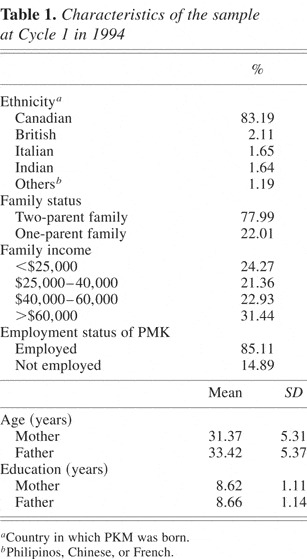
The longitudinal data were weighted to take into account nonrespondents and the stratification design of the NLSCY. These weighted data also correspond to the ethnic and cultural composition of Canadian citizens. Table 1 presents the characteristics of the participating families.
Characteristics of the sample at Cycle 1 in 1994

Instruments and procedures
Trained interviewers visited the participants in their homes. The frequency of physical aggression was assessed every 2 years between the ages of 2 and 8 years. The PMK rated the frequency at which the child was physically aggressive along a 3-point scale ranging from 0 = never to 2 = often. The physical aggression items were “kicks, bites, hits other children,” “gets into many fights,” and “reacts with anger and fighting.” The items were summed into a physical aggression scale that had a minimum of 0 and a maximum of 6.
Indirect aggression was measured with five items (Lagerspetz et al., 1988): “becomes friends with another as revenge,” “says bad things behind the other's back,” “when mad at someone, gets others to dislike him/her,” “says to others: ‘let's not be with him/her,’” “tells the other one's secrets to a third person.” The items were summed into an indirect aggression scale that had a minimum of 0 and a maximum of 10. The reliability coefficients for the PA scales were .66 at 2 years, .65 at 4 years, .61 at 6 years, and .67 at 8 years. The reliability coefficients for the IA scales were .68 at 4 years and .77 at 6 and 8 years.
Predictors of joint trajectories.
Verbal abilities. Scores on the Peabody Picture Vocabulary Test—Revised (PPVT-R) were used to reflect verbal abilities. The PPVT-R was designed as a measure of receptive language. It is individually administered and untimed, although administration time typically requires 15–20 min (Dunn & Dunn, 1981). In the NLSCY, the PPVT was administered during the home visit when the children were 4 years old. Therefore, in the present sample, the PPVT was administered at Cycle 2.
Family characteristics. We selected Cycle 1 (age 2 years) family and child variables that were conceptually or empirically related to the development of aggressive behaviors (e.g., Jaffee, Caspi, Moffitt, Belsky, & Silva, 2001; Nagin & Tremblay, 2001; Tremblay, 2000; Tremblay et al., 2004). The predictors were dichotomized and coded to represent risk. First, early childbearing was coded according to whether the mother was 21 years or less at the birth of the first child (1) or more than 21 years (0). Second, a young mother at Cycle 1 was coded as being 21 years or less (1) or more than 21 years (0). These two variables concerning the age of the mother were used because there is evidence that both represent independent risk factor for the child (Jaffee et al., 2001). Furthermore, being younger than 21 years old at the time of the birth of the first child was shown to be a valid indicator of risk in several Canadian studies (Nagin & Tremblay, 2001; Tremblay et al., 2004) Third, low maternal education was coded according to whether the mother had a high-school diploma (0) or not (1). Fourth, single-parent family was coded according to whether both parents were living with the child (0) or not (1). Fifth, low household income was coded according to whether the family income was at or below the 25th percentile of the income distribution (1) or above the 25th percentile (0). Not having graduated from high school, single-parent families, and low income have been commonly used as indicators of risk, and have been shown to predict children's maladjustment (e.g., Nagin & Tremblay, 2001; NICHD, 2004; Tremblay et al., 2004). We selected predictors that were related to the mother or to the family and not to the father specifically because of missing values on variables concerning the father.
Family processes variables. We first used a scale composed of 12 items measuring the quality of family functioning (communication, problem resolution, control of disruptive behavior, showing and receiving affection; Boyle et al., 1987). The scores ranged from 0 to 36 on the scale (Cronbach α = .88).
Three parenting scales were used to predict membership in the joint trajectory groups: positive parenting, hostile/inefficient parenting, and consistent parenting. Mothers rated the frequency of specific parenting behaviors on a scales ranging from never to many times each day. The positive parenting scale included four items reflecting the frequency with which the parent plays, laughs, or does enjoyable things with his/her child (Cronbach α = .81). Scores ranged between 0 and 20. High scores indicated more positive interactions. The hostile/ineffective scale included seven items reflecting the frequency with which the parent becomes annoyed with the child, praises the child (scored negatively); disapproves of the child's behavior; gets angry and punishes the child; or feels ineffective at managing the child (Cronbach α = .66). Scores ranged between 0 and 25. High scores indicated more hostile/ineffective interactions. The consistent parenting scale includes five items reflecting the frequency at which the parent makes sure that the child does what he/she was asked to do, or the frequency with which the child gets away with things for which he/she should have been punished (Cronbach α = .71). Scores ranged between 0 and 20. A high score indicates consistent parenting.
Analyses
Joint developmental trajectories of PA and IA
The analyses proceeded in three steps. Models for the developmental trajectories of IA and PA were estimated with a semiparametric mixture model (Jones, Nagin, & Roeder, 2001; Nagin 1999, 2005; Nagin & Tremblay, 2001). A developmental trajectory describes the progression of a given behavior over time. The semiparametric group-based method allows for the identification of population heterogeneity in both the mean of the behavior at a given age, and in the development of the behavior over time (Jones et al., 2001; Nagin, 1999).
For each trajectory group, the model defined the shape of the trajectory (i.e., stable, increasing, desisting) and the proportion of children belonging to each group. An important step in the model selection is determination of the number of trajectory groups to include in the final model. Following the lead of D'Unger, Land, McCall, and Nagin (1998), selection of the number of groups to include in the preferred model was based on maximization of the Bayesian information criteria (BIC).1
The BIC is calculated as −2log(L) + log(n) × k, where L is the model's maximized likelihood, n is the sample size, and k is the number of parameters in the group (Nagin, 1999).
A joint trajectory model of PA and IA was then estimated. The joint procedure allows to describe the overlap between two types of distinct but related behavioral phenomena. The key outputs of a joint model are the joint probabilities and the conditional probabilities. The joint probabilities reflect the proportion of children estimated to belong simultaneously to trajectories of PA and IA (e.g., the probability of following both high PA and high IA). In addition, two sets of conditional probabilities are obtained: the probability of PA conditional on membership in a given IA trajectory, and the converse conditional probability of IA given a PA trajectory (Nagin, 2005). The modeling of the trajectories included weights that appropriately reflected the sampling strategy of this probability survey and accounted for nonresponse, attrition, interprovincial migration, and poststratification.
Testing gender differences
Gender differences in joint trajectory group membership were tested by comparing the proportions of boys and girls in a given trajectory group (vs. all others). For instance, the gender difference in the proportion of boys and girls in the high PA–high IA trajectory group was compared to the proportion of boys and girls in all the other groups combined. Logistic regressions predicting group membership with gender were conducted. Furthermore, the gender of the child was used as a risk factor in the prediction analyses to examine the effect of gender while taking into account other risk.
Predicting joint trajectory group membership
A hierarchical multinomial logit regression was used to examine the capacity of the risk factors to distinguish membership in the PA–IA groups, while controlling for the levels of the other risk factors. We tested four specific contrasts between the groups. The Result section provides a detailed description and justification of the contrasts. Note that a single model was estimated. Specifically, the tests were conducted on the total sample and the four specific contrasts between the groups were tested within the context of the multinomial regression. Therefore, the number of tests conducted was taken into account in these analyses.
For each contrast between the groups, three models were tested. In the first series of model, only the child variables (i.e., gender and verbal skills) were entered. In the second series, we added to the family characteristics variables (i.e., early childbearing, young mother, low maternal education, single-parent family, and low income). In the third model, we added the family process variables (i.e., parenting and family conflicts).
Results
The results are presented in four sections. The first section presents descriptive statistics for the PA and IA scores at the different assessment points; the second presents the results of the joint model for PA and IA; the third presents the gender differences in the joint development of PA and IA; and the fourth presents results of the prediction analyses.
Descriptive statistics
Correlations
The correlations between the PA assessments at the different cycles varied between .2 and .42, and were all statistically significant. The correlations between the IA assessments at the different cycles varied between 0.19 and 0.39 and were statistically significant. The correlations between PA and IA were 0.27 at Cycle 2 (the first point at which they were both measured), .34 at Cycle 3, and .42 at Cycle 4. Thus, the magnitude of the correlations between PA and IA increased over time. This pattern was somewhat more accentuated among boys (Cycle 2, r = .27; Cycle 3, r = .42; Cycle 4, r = .5) than girls (Cycle 2, r = .29; Cycle 3, r = .3; Cycle 4, r = .38).
Mean levels
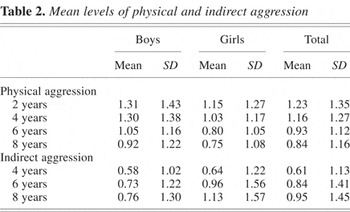
Table 2 presents the mean levels of PA and IA over time separately for boys and girls. As expected, the mean levels of PA decreased over the four assessments. The mean levels of IA increased over the three assessments.
Mean levels of physical and indirect aggression

Joint trajectories of physical and indirect aggression
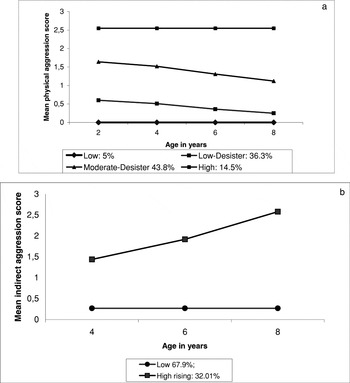
The joint model included a four-group model for physical aggression and a two group model for indirect aggression. Figure 1 presents the trajectories of the best fitting models. We first describe the trajectory models for PA and IA separately, and then describe the results for the joint model.

Developmental trajectories of (a) physical aggression between 2 and 8 years (n = 1183) and (b) indirect aggression between 4 and 8 years (n = 1183).
Physical aggression
Four groups with distinct trajectories of PA between 2 and 8 years were identified: 5.2% of children followed a low and stable trajectory; 36.4% followed a low-desister trajectory; 43.9% a moderate-desister trajectory; and 14.6% a high and mostly stable trajectory. A higher proportion of boys were estimated to follow the high trajectory of PA (53.6% boys, 46.4% girls). There was also slightly more boys (52.4%) than girls (47.5%) in the moderate-desister PA group. More girls were on the low-desister PA group (46.9% boys, 53.1% girls) or in the low PA group (42.8% boys, 57.2% girls).
Indirect aggression
Two groups with distinct developmental trajectories of IA between 4 and 8 years were identified: 68% of children followed a low and stable trajectory of IA; and 32% followed a trajectory reflecting elevated levels of IA at 4 years, with further increase between 4 and 8 years. This group was labeled “high rising.” As expected, a larger proportion of girls (57.6%) than boys (42.3%) followed a high and rising trajectory of IA.
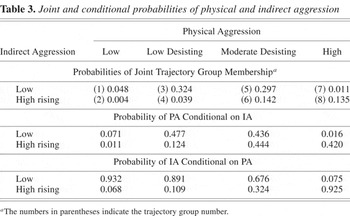
Thus far, the analysis indicates that, consistent with expectations, most children exhibit declining levels of PA during the course of childhood, and that some children exhibit increasing levels of IA. The remaining part of the section presents the results for the joint probabilities of PA and IA trajectories. Table 3 report the conditional and joint probabilities of group membership across the two aggressive behaviors.
Joint and conditional probabilities of physical and indirect aggression

Probabilities of joint trajectory membership
Eight groups of children with distinct developmental patterns of PA–IA were identified. The first part of Table 3 shows the proportion of children in each group. The columns represent the four physical aggression trajectory groups and the rows represent the two indirect aggression groups. The 2 × 4 combination of cells presents the proportion of children in the eight joint trajectory groups. The groups are as follows: Group 1: children with low levels on both IA and PA; Group 2: low PA and rising IA; Group 3: low desisting PA and low IA; Group 4: low desisting PA and rising IA; Group 5: moderate desisting PA and low IA; Group 6: moderate desisting PA and rising IA; Group 7: high PA and low IA; Group 8: high on both PA and IA.
The largest group comprised children with low desisting PA and low IA levels (Group 3 = 32.4%), the second largest group included children with moderate desisting PA and a low IA levels (Group 5 = 29.7%), and the third comprised children with moderately desisting PA and rising IA levels (Group 6 = 14.2%). Only 5% of children were low on both forms of aggression (Group 1), and 13.5% were high on both (Group 8). Finally, virtually no children were either low on PA and high rising on IA (Group 2 = 0.4%), or high rising on IA and low on PA (Group 7 = 1%).
Probabilities of PA conditional on IA
The second part of Table 3 presents children's conditional probabilities of PA given their IA trajectory group. Children low on IA were most likely to follow a low desisting (p = .48) or moderate desisting trajectory of PA (p = .44). The probability that they followed a high PA trajectory was almost null. Children on a high rising trajectory of IA were most likely to follow a moderate desister PA (p = .44) or a high PA (p = .42) trajectory.
Probabilities of IA conditional on PA
The third part of Table 3 presents children's conditional probabilities of IA given their PA trajectory group. Children in the two lowest PA trajectories were most likely to follow a low IA trajectory (p = .93 for the low and p = .89 for the low-desister group). The trajectory with the most diversity (or heterogeneity) in development was the moderate-desister PA trajectory. Children estimated to have this PA developmental pattern had 67.6% probability of following the low IA trajectory and 32.4% probabilities of following the high rising trajectory of IA. The probability that children high on PA were on a high rising trajectory of IA was .93.
Together, the conditional probability results indicate that the chances of following a high rising IA trajectory were very high for children on the high PA trajectory (p = .93), but the converse probabilities, of belonging to a high PA group conditional on high IA, was much lower (p = .42). Thus, the risk for highly physically aggressive children to also be highly indirectly aggressive is higher than the risk of high PA given high levels of IA.
Gender differences in the joint trajectory group membership
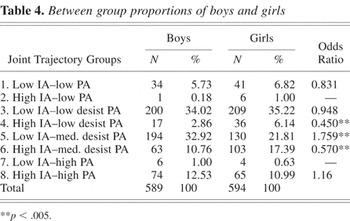
Table 4 presents the proportion of boys and girls in the trajectory groups as well as the results of the logistic regressions analyses predicting group membership with gender. There were no significant differences in the proportion of boys and girls following Group 1 (low IA–low PA), Group 3 (low IA–low desisting PA), or Group 8 (high IA and PA). Boys were more likely than girls to be in Group 5 (low IA–moderate desisting PA). Conversely, boys were significantly less likely to be in Group 4 (rising IA and low desisting PA) or Group 6 (rising IA and moderately desisting PA). Thus, as hypothesized, girls were more likely to be desisting on PA and rising on IA than boys. Descriptive statistics regarding groups 2 and 7 are presented, but logistic regression could not be conducted because of the small number of children (n < 5) in these groups (high on one type of aggression and low on the other).
Between group proportions of boys and girls

Family predictors of the joint development of PA and IA
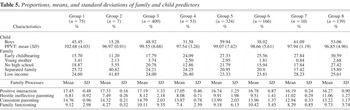
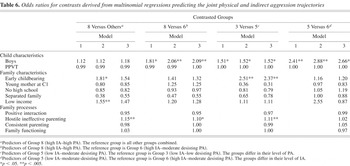
Table 5 present the proportions, means, and standard deviations (SD) by joint trajectory group on the family and child predictors. With reference to our hypotheses, we specified four contrasts between the PA–IA groups. The first contrast concerned the capacity of risk factors to distinguish between children who exhibit high levels of both form of aggression (high PA–high IA group) from all the other children. The second contrast concerned the capacity of risk factors to distinguish between children who exhibit high levels of both form of aggression (high PA–high IA group) from children with decreasing PA and increasing IA. We conducted two other contrasts to compare children with low levels of IA and either low desisting or moderate desisting levels of PA and moderate desisting levels of PA and either low or high levels of IA. Therefore, the third contrast concerned the capacity of risk factors to distinguish between children who exhibited low levels of IA and moderate desisting levels of PA from those with equally low levels of IA but low desisting levels of IA. In this contrast, the groups differed on their level of PA (but not IA). We expected children with higher levels of PA to exhibit more of the risk factors typically associated with PA (young motherhood, low education, low income, single-parent families, negative parenting). The fourth contrast concerned the capacity of risk factors to distinguish between children who exhibited low levels of IA and moderate desisting levels of PA from those also moderately desisting on PA but who have high levels of IA. In this contrast, the groups differed on their level of IA (but not PA). We expected a lower proportion of boys and children with lower verbal abilities to be in the low IA–moderately desisting PA group. We also expected negative parenting and family conflicts to distinguish between the groups. Table 6 presents the results of the multinomial logistic regression analyses.
Proportions, means, and standard deviations of family and child predictors

Odds ratios for contrasts derived from multinomial regressions predicting the joint physical and indirect aggression trajectories

Contrast 1: Predictors of Group 8 (high PA–high IA) versus all other groups combined
None of the child predictors of Model 1 distinguished between Group 8 and the other groups. The results of Model 2 showed that children whose mother began childbearing before age 21 and who were from a low-income family were more likely to be high on both types of aggression. However, in Block 3, after entering parenting practices and family functioning, only hostile parenting remained a significant predictor.
Contrast 2: Predictors of Group 8 (high IA–high PA) versus Group 6 (high IA–moderate desisting PA)
The results of Models 1 and 2 indicated that boys were more likely to be in Group 8 than in Group 6. The results of Model 3 showed that being a boy and hostile parenting were both risk factors that predicted membership in Group 8 compared to Group 6.
Contrast 3: Predictors of Group 5 (low IA–moderate desisting PA) versus Group 3 (low IA–low desisting PA)
Model 3 indicated that being a boy, early childbearing, and hostile parenting all independently contributed to predicting membership in Group 5 compared to Group 3.
Contrast 4: Predictors of Group 5 (low IA–moderate desisting PA) versus Group 6 (high IA–moderate desisting PA)
Results for this contrast showed that the only variable that distinguished moderately PA children with high or low PA was the gender of the child. That is, boys were more likely to be in Group 5 than in Group 6.
Discussion
The aim of the present study was to describe the joint development of two forms of aggression, physical and indirect, and to identify predictors of the identified joint trajectories. We used data on 1183 children from a representative sample of Canadian children followed longitudinally between 2 and 8 years of age. Overall, the results showed that most children exhibit declining levels of PA and that one third of the sample exhibited rising levels of IA between early and middle childhood. Family risk characteristics and hostile parenting measured at the beginning of the trajectories (age 2 years) predicted membership in groups characterized by high levels of both PA and IA or by moderate desisting PA and low IA.
We identified four groups of children with distinct physical aggression trajectories: a low and stable group (5.2%); a high and stable group (14.6%); and two groups of children with intermediate levels and declining trends (together representing 80.1% of the sample) between 2 and 8 years. Most children followed a low trajectory of IA (68% of the sample), whereas 32% of children followed a rising trajectory between the ages of 4 and 8 years.
The developmental patterns are similar to those previously identified with a similar sample of US children (NICHD, 2004), and among school-aged children in Canada, New Zealand, and the United States (Broidy et al., 2003; Nagin & Tremblay, 1999; Vaillancourt et al., in press). Note, however, that the development of PA and IA were estimated in a joint developmental trajectory model. That is, the degree to which IA and PA are related is accounted for in the model, which differs from estimating developmental patterns for each of the aggressive behaviors separately. Thus, the proportion of children in the groups, and the specific number of trajectories, were not expected to be entirely similar to univariate developmental trajectories.
Six hypotheses were tested. According to Björkqvist and colleagues' (Björkqvist, Lagerspetz, et al., 1992; Björkqvist, Österman, et al., 1992) prediction, we expected that a large proportion of children would reduce their use of PA during the preschool years and increase their use of IA during the elementary school years. The results showed that most children did not correspond to that prediction, because almost two out of three exhibited low desisting levels of PA and low levels of IA (32.4% of the sample) or moderate desisting levels of PA and low levels of IA (29.6%). However, several findings provide some support for the Björkqvist et al. prediction. First, the results of the joint trajectory group membership indicated that a substantial proportion of children: 14.2% simultaneously followed a moderately desisting trajectory of PA and a rising trajectory of IA. Second, the results from the conditional probabilities indicated that children on the high and rising IA trajectory were most likely to follow a moderately desisting PA trajectory. Third, children on the moderate desisting PA trajectory had 32% chance of following a high IA trajectory.
Thus, we identified a group of children with declining rates of PA between the ages of 2 and 8 years and increasing rates of IA between the ages of 4 and 8 years. Potentially, this pattern could reflect heterotypic continuity in the development of aggression, a general propensity to exhibit moderate levels of aggression, and to use the form that is most developmentally adaptive. We note that this pattern was not observed among children following the low desisting PA trajectory. Low desister children, like low PA children, had very high probabilities of being also low on IA. Hence, preschool children with a low propensity to use physical aggression have a low propensity to use indirect aggression during the transition from preschool to school.
We further predicted, on the basis of studies examining gender differences in PA and IA separately, that a pattern of diminishing use of PA and increasing use of IA would be more typical of girls than boys. This hypothesis was confirmed: there were approximately half as many boys as girls following a low desisting trajectory of PA and a risings trajectory of IA (odds ratio [OR] boys vs. girls = .45) or a moderate desisting trajectory of PA and a rising trajectory of IA (OR boys vs. girls = .57). These findings suggest that boys and girls become increasingly different in their levels of PA and IA during the course of middle childhood. Peer group socialization (e.g., Maccoby, 1998), specific socialization by parents and educators (e.g., Keenan & Shaw, 1997) and physical size and strength (Archer & Côté, 2005; Darwin, 1871) probably play an important role in this process.
Our second hypothesis pertained to the possibility that a minority of children exhibits high levels of PA between without resorting to IA, and that a larger proportion of boys than girls follow this pathway. In light of the trajectory findings, children simultaneously high on PA and low on IA trajectory should constitute this group. In the present study, this group was virtually nonexistent (0.1%), and the probabilities of exhibiting such a developmental pattern were almost null for either boys or girls. These results lead to the conclusion that children with substantially high levels of physical aggression during the preschool years will also be on a high rising trajectory of indirect aggression during the transition from preschool to elementary school.
Third, we expected a minority of children to exhibit homotypic continuity in IA. Specifically, we hypothesized that some children would rely on IA without resorting to PA. Furthermore, we expected a larger proportion of girls than boys to follow this pathway. In light of the trajectory findings, children simultaneously high on the IA and low on the PA trajectories should represent this group. Only 1.1% of children were estimated to belong to the high IA and low PA group. The probabilities of belonging to such a group were very small for either boys or girls. Thus, it appears that very few children “specialize” in the use of indirect aggression. Coupled with the finding that virtually no children high on PA were low on IA, we can conclude that, from 4 to 8 years of age, children with high levels of aggression do not specialize in PA or IA.
Fourth, we found, as expected, a proportion of children (13.5%) exhibiting high levels of both PA and IA. If children belonged to the high PA trajectory, they were highly likely to also be in the high IA trajectory (p = .93), and this was true for both genders. In fact, the results indicate that boys are more likely to exhibit high levels of PA, and girls high levels of IA, but, when the joint development of PA and IA is considered, both genders are equally likely to use both forms of aggression.
Fifth, we hypothesized that children with high levels of both PA and IA would have a more adverse family background compared to all other children. We found that children high on both forms of aggression presented some of the risk factors typically associated with high levels of PA: a young mother at the birth of the first child and low income family. However, only hostile parenting remained a significant predictor after the effect of family process variables were taken into account. These results suggest that mothers' adverse characteristics were being mediated by hostile parenting. Early childbearing and hostile parenting also characterized children with moderate desisting PA and low IA more than children with low IA and low desisting IA. Again, this is consistent with findings showing the relations between family risks and the tendency to exhibit higher levels of PA.
Finally, we expected children with lower verbal abilities and more family risks to be more likely to exhibit high levels of both PA and IA than to replace PA by IA. With reference to family risk, we found that, compared to children who replace PA by IA, those high on both types of aggression were more likely to be boys whose parents use an hostile/ineffective parenting style. This suggests that hostile parenting may interfere with children's socialization of aggression as reflected in a change from physical and direct to indirect and social forms of aggression. Note that the design of the study was not genetically informative, and that change in parenting was not assessed. Therefore, caution is required in interpreting this finding: it may reflect gene environment correlations, or the reciprocal influence of children and parents.
Verbal abilities, as measured by the PPVT at 4 years, did not distinguish any of the PA–IA groups. Thus, although the development of IA coincides with the development of verbal abilities, we did not find that higher verbal abilities were related to higher levels of IA use. There remains the (untested) possibility that change in verbal abilities is associated with a pattern of reducing PA and rising IA.
Several studies have shown that trajectories of high PA are predictive of serious antisocial behaviors in adolescence and young adulthood (Broidy et al., 2003; Brame et al., 2001; Lacourse et al., 2002). There is also some evidence that high levels of IA are associated with internalizing and externalizing problems (Crick et al., 1997, 2004). Thus, children with both high levels of PA and IA could be at risk for serious maladjustment. The present study indicates that the risk factors for children on high trajectories for both IA and PA are similar to risk factors for serious antisocial behaviors. From an early preventive perspective, it is important to note that the children on high trajectories of PA or IA were already showing relatively high levels at the first time of measurement (age 2 years for PA and 4 years for IA), and that the factors predictive of atypically elevated trajectories could be measured at 2 years. This suggests that interventions to prevent the maintenance of high level trajectories need to start in infancy. It also suggests that the present study did not start early enough to capture the initial onset of PA and IA. Studies have indeed shown that relational forms of aggression can be identified through observations as early as 2.5 years (Crick et al., 2003, 2004), and that physical aggression can be measured in infancy (Bridges, 1933; Goodenough, 1931; Tremblay, 2004; Tremblay et al., 2004).
Although the present study is innovative in that PA and IA of a large nationally representative sample of Canadian children have been followed over a 6-year period, some limitations should be noted. The ratings of aggression were based exclusively on maternal reports. Relying on one source for information can be problematic because of biases in reporting. In addition, in the case of IA it is quite possible that mothers are underreporting the use of indirect aggression among their children simply because they are not privy to their displays (Crick & Grotpeter, 1995; Vaillancourt, 2005). Still, in the present study, we identified heterogeneous pattern of IA development, with mothers rating a substantial proportion of children as increasing their use of IA. Parental reports offer a different yet important source of information about a child's social competence (McEvoy, Estrem, Rodriguez, & Olson, 2003). In addition, studies have shown that similar results are obtained when only parent reports are used compared to when parent reports are combined with peer, teacher, and self-reports (e.g., Arseneault et al., 2003).
In sum, this study is the first to examine the joint development of PA and IA using a person-oriented approach and a representative population sample followed from the preschool to the elementary school years. The results show that the most aggressive children use both form of aggression; that boys and girls become increasingly differentiated in their use of aggression during the preschool years, and that family factors such as hostile ineffective parenting interfere with the socialization of aggression.