


Mandæans
The Mandæan community, formerly of Iraq and Iran, is the custodian of several cultural institutions not shared by any other ethnic or religious community. The first of these is their system of beliefs and religious observances, which compose the heart of their faith.Footnote 1 The second of these is the Mandaic language, its vehicle, which is still spoken as a living language by a small number of Mandæans in Iran and in a global diaspora.Footnote 2 The third is the script in which it is written, and their sacred literature in which these observances and beliefs appear in a fixed form.Footnote 3 The fourth is their calendar, according to which these observances are structured within a chronological framework, and their perception of the continuity of their history is made manifest.
As elaborated in their sacred texts, the core of their faith is a doctrine known as Nāṣerutā or ‘Nazarenism’, the adherents of which are most frequently called ‘Nazorenes’ (nāṣorāyi).Footnote 4 Within this group of people, these texts occasionally distinguish between a clergy, tarmidutā, and a laity, mandāyutā. The latter word, which comes from their word for knowledge (mandā), furnishes us with a useful term for the entire complex of beliefs, culture, faith, and practices associated with this doctrine, namely ‘Mandæism’. Thus its followers are often called Mandæans, although we could just as easily refer to them as ‘Nazorenes’ or even ‘Gnostics’, using the Greek word for knowledge (gnōsis) in place of an Aramaic one. To their non-Mandæan neighbours in the region, they are most commonly known as al-Ṣābiʾūna or Sabians, employing a term lifted from the religious vocabulary of the Qur’ān, but this last designation is conspicuous by its absence from their classical literature.
They do not recognise intermarriage or conversion, and consequently each of the four institutions associated with their faith serves as much to define their own separate identity as to distinguish them from these neighbours. While their religious practices, their language, and their literature have been the subject of sustained scholarly interest over the past few centuries, their calendar has received considerably less attention. This article will therefore serve as an initial offering to further research in this area, and establish how the present-day calendar corresponds to that referenced in the Mandæan scriptures by correlating certain astronomical events contained within them.
Days
The Mandæan day begins not at sunrise (literary MandaicFootnote 5 peršā (d-ṣeprā) ‘break (of morning)’ or nehgā ‘dawn’) but rather at sunset (spoken Mandaic bekwɔšɔ; the lm form is unattested)Footnote 6 and continues through the night and the day until the following sunset. It is therefore not equivalent to the civil day of Coordinated Universal Time (UTC). It comprises four distinct parts, which correspond to our night (lm lilyā, sm lilyɔ), morning (lm ṣeprā, sm ṣobaḥ), midday (sm qamieṯɔ), and evening (lm paynā, sm pienɔ). Noon and midnight are designated simply as palgā d-yawmā ‘middle of the day’ or palgā d-lilyā ‘middle of the night’ in the scriptures; a reflex of the latter survives as falge-lilyɔ in the spoken language, and qamieṯɔ ‘midday’ has assumed the former's role, with the neologisms qamɔ qamieṯɔ ‘before midday’ and bɔṯar qamieṯɔ ‘after midday’ corresponding to the civil day's am and pm. Each day is further divided into twenty-four seasonal hours (lm šitā, sm šɔyɔ, back-formed from the lm pl. šāyi), which vary according to the length of the day and the night, and are themselves sub-divided into parts of twelve (lm šušā ‘five minutes’, evidently from Akkadian šuššu ‘one sixth’), and sixty (lm pegyā, sm daqiqe ‘minute’).Footnote 7 The literary Mandaic word for ‘hour’ has survived as the spoken Mandaic word for a ‘moment’ of time, šiṯɔ.Footnote 8
Weeks
Mandæans observe a five-day ‘floating week’ anchored to ‘today’ (lm yawmay, literally ‘my day;’ sm ɔmɔ or ɔh yumɔ ‘this day’). ‘Today’ is always preceded by ‘yesterday’ (lm etmāl, sm eṯmɔl) and ‘the day before yesterday’ (sm lahmal, the lm word is unattested). Similarly, it is always followed by ‘tomorrow’ (sm peršɔ, a reflex of the lm word for ‘dawn’; the lm word for ‘tomorrow’ is unattested)Footnote 9 and ‘the day after tomorrow’ (sm rəmahrɔ, part of which, mahrɔ, is possibly a reflex of an earlier word for ‘tomorrow’).
In addition to the ‘floating week’, Mandæans also observe a fixed seven-day week that begins with on the day corresponding to our Sunday (lm habšabbā, sm hawšabbɔ). It is followed in turn by Monday (lm trayn habšabbɔ, sm trawšabbɔ), Tuesday (lm tlātā habšabbā, sm klɔṯawšabbɔ), Wednesday (lm arbɔ habšabbā, sm arawšabbɔ), Thursday (lm hamšā habšabbā, sm hamšawšabbɔ),Footnote 10 Friday (lm orobtā, sm oroftɔ), and Saturday (lm šabtā, sm šaftɔ).
Months
The months of the year are conventionally known by names ultimately derived from the Babylonian calendar, but over time they have also acquired two more sets of monikers with ‘Mesenæan’ or zodiacal (e.g. qam Dawlā ‘for Aquarius’) and seasonal (e.g. Awwal Setwā ‘first of winter’) associations:
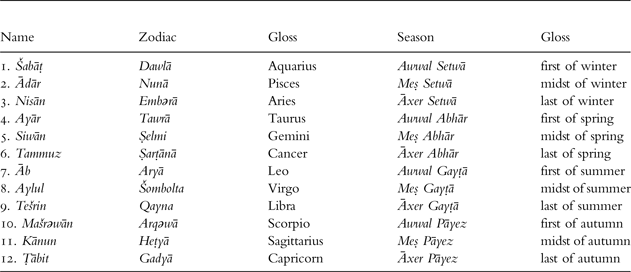
Each of these twelve months consists of 30 days. In addition to these 30-day months, there is also a period of five epagomenal days called Parwānāyā, during which Mandæans commemorate the souls of the departed.Footnote 11 The w of this name is written but omitted outside of learned pronunciations; among Iraqi Mandæans, these same epagomenal days are colloquially known either as (ʿīd) al-Brōnāya or as Benjeh, which seemingly derives from the Middle Persian panjag ‘pentad’. They fall between the 8th month, Aylul, and the 9th month, Tešrin.
Taqizadeh observes that the Mandæan calendar corresponds exactly to the Sasanian civil calendar, and constitutes the “only true continuance of that once very widely used calendar”.Footnote 12 Stern concurs: “This is identical with the late Sasanian, Persian Zoroastrian calendar […] and in direct continuity with it, as in fact their months are exactly coterminous”.Footnote 13 Much like this calendar, and the Babylonian calendar from which it took the names of its months, the New Year (1 Šabāṭ / Dawlā, which is known as Dehbā Rabbā ‘the great feast’) must have been tied to the vernal equinox, at least notionally. Because the Mandæan year is presently shorter than the tropical year, its New Year falls earlier and earlier against the passage of the seasons with every year. For this reason, it last coincided with the vernal equinox during the years between 1004 and 1007 ce; it will coincide with the equinox again only in 2508 ce.
According to the astronomer Abū’l-Ḥasan Kūšyār b. Labbān al-Jīlī (ca. 971–1029 ce), ‘When the Persian dynasty came to an end, and the rule of the Arabs began, no one cared to continue observing the fixed rule, and the five (Gatha days) remained at the end of Ābān-māh up until the year 375 of Yazdgird and the sun took up residence in Aries on the first day of Farwardīn-māh and the five (days) were moved to the end of Isfandārmuδ-māh’, which is the twelfth month of the Zoroastrian calendar.Footnote 14 Kūšyār is speaking not only as an astronomer but also as a witness to a contemporary event, which de Blois identifies with the wihēzag ‘intercalation’ of the mōbaδ Farroh-sroš referenced in a personal letter dated only two years after this reform.Footnote 15 Farwardīn is the first month of the Sasanian calendar, corresponding to the Mandæan Šabāṭ / Dawlā, and the year 375 of Yazdgird corresponds to 1006 ce. In that year, as noted above, 1 Šabāṭ / Dawlā corresponded to Friday, 15 March, the vernal equinox, and the precise day on which the sun transits from Pisces to Aries, recommencing its cycle through the houses of the zodiac.Footnote 16 That is to say, both Mandæans and Zoroastrians observed their new year on the same date in 1006 ce, indicating that the two calendars were synchronized as recently as that date.
Additional proof of the essential identity of the Mandæan calendar with the Zoroastrian one comes in the form of the Sogdian, Chorasmian, and Armenian variants of this same calendar, according to which the five epagomenal days appear after the twelfth month, as in the Egyptian calendar, and the New Year (Nawrōz) therefore falls on 6 Frawardīn, or 6 Šabāṭ / Dawlā according to the Mandæan calendar. It is on this day that Mandæans celebrate Nawruz Zuṭā ‘little Nawrōz’.Footnote 17 This was also the Zoroastrian practice, prior to a reform that shifted the epagomenal days to the end of the eighth month (the Mandæan Aylul / Šombolṯa, and the Zoroastrian Ābān), in order to make them coincide with the vernal equinox, which de Blois dates to the first decade of the sixth century,Footnote 18 and then once again after the reform described by Kūšyār, which shifted them back to the end of the twelfth month (the Mandæan Ṭābiṯ / Gadyā, and the Zoroastrian Isfandārmuδ), although he notes that neither reform was universally adopted, at least not initially.Footnote 19
Even though the first set of names transparently derives from the Babylonian calendar, the sequence of the Mesenæan months (which presumably coincided with the passage of the sun through the houses of the zodiac, from Aries to Pisces) is offset by two. The name of the first Babylonian month, Nisān, is applied to the third Mesenæan month, and so forth. In discussing the Sogdian calendar, which is identically offset, Stern explains this phenomenon “by assuming that the name nisan was adopted in a period when the Sogdian, i.e. Persian Zoroastrian, third month coincided with the Babylonian Nisan. This occurred in the late fourth—early third centuries bce, i.e. around the end of the Achæmenid and beginning of the Hellenistic periods”.Footnote 20 Thus the identification of the Mesenæan names with their Babylonian equivalents by way of their Zoroastrian equivalents must have occurred roughly 23 centuries ago, give or take a few decades, although we need not conclude that other features of this calendar, such as the position of the new year, the epagomenal days and their position within the calendar, and even the lengths of each month, also date to this period.Footnote 21
Years
As noted above, due to the discrepancy between the solar or tropical year of 365 days, 5 hours, 48 minutes, and 45 seconds and the Mandæan year of precisely 365 days, the new year currently falls in the summer, on 18 July from 2016 to 2019 ce and 17 July from 2020 to 2023 ce. Because the Mandæan year is presently shorter than the tropical year, its New Year falls earlier and earlier against the passage of the seasons with every year. The Gregorian year and the Julian year it superseded are similarly oriented to the passage of the sun through the heavens and the seasons on Earth, and maintain their correspondence with the seasons by adding an additional day every leap year. The Mandæan calendar does not, and therefore slips against the Gregorian and Julian years (and similarly the passage of the seasons) precisely one day with every leap year.Footnote 22 Thus, synchronizing the two calendars is simply a matter of calculating the number of leap years between two dates, and adding or subtracting the resulting number of leap days as needed. A given Gregorian date and its Mandæan equivalent will therefore coincide for four years only once after every 1,504 Gregorian years or 1,505 Mandæan years.
Mandæan years are presently reckoned according to the day of the week on which the New Year occurs. For example, the year that began Wednesday, 18 July 2018 ce according to the Gregorian calendar is a ‘Year of Wednesday’, and the following year is a ‘Year of Thursday’, since it began on Thursday, 18 July 2019 ce. The manuscript colophons generally also include a Hijrī date, allowing the reader to triangulate the calendars to derive the corresponding Mandæan, Gregorian, and Islamic dates. Two examples suffice to illustrate this process:
• The earliest manuscript copy of the Great Treasure in any European collection is Paris ms Sabéen 1. Its copyist, Rām Baxtiyār, reports that he finished his copy on a Saturday, 14 [sic] Parwānāyā, in the ‘Year of Sunday’, which coincides with ah 968 (1560/61 ce).Footnote 23 Parwānāyā comprises only 5 days, so 14 must be a mistake for 4. This year was indeed a ‘Year of Sunday’, as it began on Sunday, 27 October 1560 ce, so according to the present reckoning 4 Parwānāyā fell 244 days later on Saturday, 28 June 1561 ce / 14 Šawwāl ah 968.
• Similarly, the earliest manuscript copy of the Book of John is Paris ms Sabéen 10, which was completed by Zehrun bar Ādam in al-Mīnā’, Basra, on Thursday, 21 Āxer Pāyez in the ‘Year of Saturday’, which he equates to ah 1026 (1617 ce). That year began on Saturday, 24 October 1615 ce; Āxer Pāyez corresponds to Ṭābit / Gadyā, which means he was writing exactly 355 days later, on Thursday, 13 October 1616 ce / 2 Šawwāl ah 1025 (pace Zehrun bar Ādam).Footnote 24
The present calendar must therefore have been followed faithfully since our earliest manuscript colophons, and likely even earlier, though no colophons survive to attest to this fact. An exception may be made for the ‘seasonal’ months, which do not actually correspond to the seasons of the tropical year. The first month of the calendar coincides with Awwal Setwā, literally ‘the first of winter’, which presently falls less than a month after the summer solstice, during the dog days of summer; the last time that 1 Awwal Setwā coincided with the winter solstice was Sunday, 12 December 1415 ce, on which date or during the previous three solstices these names must have been adopted. The ‘first of winter’ will coincide once again with the winter solstice only on Monday, 21 December 2916 ce. Unlike the Babylonian and Mesenæan names, these seasonal month names do not appear outside of the colophons in the Mandæan scriptures, a further indication that they must have been adopted in medieval times.
One might reasonably ask when Mandæans adopted these other names, and whether the calendar of the scriptures is the same as their present calendar. The final tractate of the right-hand volume of the Great Treasure contains several more or less precise calendar references, including the following:
When the world comes to 795 years [in Pisces], it is indicated: a demon (dibā) comes out of the ground. He unleashes chaos (āwār) among people, and king after king dies. In the year of this demon, Arabs (arbāyi) become lords of the entire world, and fraud (zipā) cuts off righteousness (torṣā). In the month of Šabāṭ—Dawlā of the Meseneans—on the fourth Sunday (arbā habšabbā), fraud cuts off the sun. […]
When it is in 850 years in Pisces, there will be a great plague, and then after Persian kings (malki parsāyi) there are Arab kings (malki arbāyi) who last 71 years.Footnote 25
Taqizadeh considers the solar event in the year 795 of Pisces (henceforth ap 795) to be an eclipse, and follows Lidzbarski in identifying the “Arab kings who last 71 years” with the early Islamic state.Footnote 26 This would situate all of these dates in the seventh century, even though the time frame and the anachronistic title are both problematic when applied to these rulers.Footnote 27 On this basis, he attempted to identify the eclipse with one of two, those of Wednesday, 14 July 622 ce (22 Šabāṭ / Dawlā) and Thursday, 21 June 624 ce (1 Šabāṭ / Dawlā) but the first was visible only from Antarctica and the area around Perth, Australia at 2:27 pm awst (utc +8), and the second, while theoretically visible from the Middle East, only began just as the sun began to dip below the horizon at 8:40 pm ast (utc +3), and achieved maximum eclipse only at 9:31 pm ast—23 minutes after sunset.Footnote 28 Both eclipses occurred in Šabāṭ / Dawlā according to the present reckoning of the Mandæan calendar, but neither on the fourth Sunday, and in the final analysis neither is a plausible candidate.
In lieu of a plausible seventh-century date for this eclipse or any of the other associated events, I would like to propose here that the phrase “Arab kings who last 71 years” refers to the dynasty of al-Mundhir iii, whom the famous Sasanian king Xusraw Anōšag-ruwān (531–579 ce) restored to the throne of al-Ḥīrah in 531 ce, and whose family reigned there until 602 ce, whereupon Lakhmid rule came to an end, for precisely 71 years.Footnote 29 Since the era of Pisces comprises one thousand years, as indicated below, we can infer that the reign of the ‘Arab kings’ must have commenced no earlier than ap 850 and no later than ap 929, which is to say as few as 55 years and as many as 134 years after the eclipse of ap 795. In other words, ap 795 could fall as early as 397 ce and as late as 476 ce, working backwards from 531 ce. Within this 79-year period, a single candidate emerges: the total eclipse of Sunday, 20 August 472 ce, which reached its maximum eclipse at 12:48 pm ast, when the sun was at its apex in the sky and clearly visible throughout Mesopotamia and western Iran.Footnote 30 That year began on Thursday, 27 July 472 ce, and therefore the date of the eclipse would be the fourth Sunday of the month, 25 Šabāṭ / Dawlā ap 795.
If these hypotheses are correct—that the Lakhmids are the “Arab kings who last 71 years”, and that the solar event of the fourth Sunday, 25 Šabāṭ / Dawlā ap 795 can be identified with the total eclipse of Sunday, 20 August 472 ce—then the Mandæan calendar serves as a unique witness not only to the final years of the Sasanian empire, but also the regulation of time under that state. The position of the epagomena after the eighth month reflects the status quo ante 1006 ce / 375 of Yazdgird, and the fact that the Mandæan calendar was evidently synchronized with the Yazdgirdi one until 15 March 1006 ce speaks to the essential identity of the two. Had that calendar been realigned with the seasons at any time between the late 5th and early 7th centuries, either by inserting an additional intercalary month every 120 years, as the medieval sources relate, or by some other means, it would have been impossible to arrive at this date, indicating that de Blois's scepticism concerning this practice is justified by evidence of the calendars that succeeded it.Footnote 31
Eras, Ages, and Epoch
As noted above, the Great Treasure reports its dates according to the ‘Year of Pisces’, of which ap 795 corresponds to 472/473 ce. ap 1 would therefore be equivalent to 323/322 bce, roughly around the end of the Achæmenid and beginning of the Hellenistic periods, when Stern posits that the Babylonian months were identified with their Zoroastrian equivalents, resulting in the familiar order of the Sogdian and Mandæan calendars.Footnote 32 This is as good a date as any for the adoption of the prototypical Mandæan calendar, but according to the Great Treasure, these years of Pisces compose just a small subset of a much larger epoch, spanning fully 480,000 Mandæan years after the creation of Adam (aa), which are equivalent to 479,681 years and 112 days in the Gregorian calendar, or 479,671 years and 167 days in the Julian calendar.
This vast epoch is divided into seven equal ages (dāri) of 68,571 years, 5 months, 4 days, 6½ hours, 4 twelfths (šuši), and 1½ sixtieths of an hour.Footnote 33 Each of these ages is governed by one of the seven visible planets, starting with the Sun, Venus, Mercury, the Moon, Saturn, Jupiter, and Mars.Footnote 34 These ages are used to measure the three global cataclysms of Mandæan legend: one by destruction and pestilence in aa 216,000, roughly 10,000 years into the age of the Moon; one by flame and fire in aa 372,000, roughly 29,000 years into the age of Jupiter; and then finally the flood of Noah, in 472,000, when only 8,000 years remained out of the age of Mars.Footnote 35
Pisces and the other eleven signs of the zodiac occupy a completely different cycle of 78,000 years, comprising twelve unequal portions at the tail end of this cycle:
The twelve signs of the zodiac coincide with the seven planets, and the seven planets coincide with the twelve signs of the zodiac. The twelve signs of the zodiac are taken from Jupiter, while 9,000 years remain in Jupiter. The twelve signs of the zodiac receive these from him, coinciding 9,000 years with Jupiter and 69,000 years with Mars. Out of these 78,000 years that the twelve signs of the zodiac occupy, they gave 12,000 years as a portion to Aries, 11,000 years to Taurus, 10,000 years to Gemini, 9,000 years to Cancer, 8,000 years to Leo, 7,000 years to Virgo, 6,000 years to Libra, 5,000 years to Scorpio, 4,000 years to Sagittarius, 3,000 years to Capricorn, 2,000 years to Aquarius, and 1,000 years to Pisces.Footnote 36
Since the age of Mars concludes the epoch of 480,000 years from the creation of Adam, the 1,000 years of Pisces therefore correspond to the final millennium of both this age and the entire epoch.Footnote 37 According to the present reckoning, this millennium ran from 1 Šabāṭ / Dawlā ap 1 to 30 Ṭābit / Gadyā ap 1001, which is to say from Sunday, February 10, 322 bce to Friday, 4 June 678 ce. As an exercise, we might also apply the same approach to arrive at the date of the creation of Adam, 1 Šabāṭ / Dawlā aa 1, and the present date according to the years of Adam. The former is equivalent to 19 December 478,995 bce, or 15 February 479,004 bce according to the Gregorian calendar, and the most recent new year, that of 18 July 2019 ce, corresponded to 1 Šabāṭ / Dawlā aa 481,343.
Conclusions
Unlike secular calendars, “which mar the sweet simplicity of our lives by reminding us that each day that passes is the anniversary of some perfectly uninteresting event” in the words of Oscar Wilde,Footnote 38 the Mandæan calendar serves as the charter for the religious life of clergy and laity alike, marking the passage of their numerous feast and fast days, including those that are inauspicious or embaṭṭal for any enterprise, up to and including death. Though he cautions us that “it would be dangerous to make calendars the basis of Culture”, perhaps even the famed Irish wit could be convinced to make an exception for the Mandæan calendar. Remarkably few communities have faithfully preserved their calendars for any span of time approaching its recorded history.
As Taqizadeh observes, only the Zoroastrian communities of Iran and India have continued to use the same calendar to the present day, albeit with some minor changes that are not universally observed even within these communities.Footnote 39 It is a historical irony that these two communities, the former a perennial subaltern and the latter an imperial hegemon now reduced to the subaltern status of their former subjects, are not only witnesses to this ancient institution, but also the only surviving communities that employ modern reflexes of it in their daily lives to structure the regular observances of their religions. Their calendars are a palpable reminder of the antiquity of these communities, and one of many visible institutions that attest to aspects of their shared history that would otherwise remain invisible and perhaps even irretrievable.Footnote 40


