Introduction
There is growing interest in the role played by the relationship between the person with dementia and their family carers in determining how they react to the dementia. For example, Steadman et al. (Reference Steadman, Tremont and Davis2007) reported that carer's satisfaction with the relationship was associated with less burden, fewer negative emotional reactions to memory and behavior difficulties, and more effective problem-solving and communication. Ablitt et al. (Reference Ablitt, Jones and Muers2009) recently reviewed research on this topic, and identified 15 papers that had used a quantitative approach to address the issue. Notably, 13 of these papers used measures to assess the relationship that were developed for use with the general population, and even the two papers that used measures developed specifically for use with carers asked questions that could apply to any family relationship (e.g. Burgener and Twigg, Reference Burgener and Twigg2002). None of the measures was developed with reference to the research literature about what happens to family relationships in dementia. Indeed, there does not appear to be a measure that has been developed specifically on the basis of this literature. This is a significant omission. There is a growing body of research, most of it qualitative, that has investigated the pressures that dementia places on family relationships and how those relationships subsequently respond and change (Ablitt et al., Reference Ablitt, Jones and Muers2009; Martin et al., Reference Martin, Peter-Wight, Braun, Hornung and Scholz2009). Quantitative measures of these responses and changes would offer new opportunities for investigating how family relationships influence how those involved react to the dementia.
The aim of the current research was to define one of the main themes occurring in these qualitative studies, and then to develop and evaluate a quantitative measure of it. Specifically, the aim was to develop a questionnaire relating to a spouse's sense of continuity in their relationship with the person with dementia. (The term “spouse” is used loosely here to refer to both those formally married and those living as partners.) Differences between those who perceive continuity and those who perceive discontinuity have appeared as a central theme in several qualitative studies (Chesla et al., Reference Chesla, Martinson and Muwaswes1994; Gladstone, Reference Gladstone1995; Kaplan, Reference Kaplan2001; Walters et al., Reference Walters, Oyebode and Riley2010). In essence, it refers to whether the spouse experiences the relationship as a continuation of the premorbid relationship, or as an essentially changed and radically different relationship. Within the thematic frameworks developed in these studies, the premorbid relationship is something that was positively valued, and so continuity is associated with the continuation of a valued relationship, whereas discontinuity is associated with regret for what has been lost. A quantitative measure of relationship continuity might make a valuable contribution to research in this area because it would allow the quantitative testing of ideas that have arisen within the qualitative literature about its implications for how spouses respond emotionally to the caring role and for the general quality of the care they provide. For example, continuity has been linked with the derivation of positive meaning from the caring role and a more person-centered approach to the provision of care (Chesla et al., Reference Chesla, Martinson and Muwaswes1994; Walters et al., Reference Walters, Oyebode and Riley2010), whereas discontinuity has been linked with feelings of resentment and entrapment, and a more depersonalized and controlling approach (Lewis, Reference Lewis1998; Walters et al., Reference Walters, Oyebode and Riley2010).
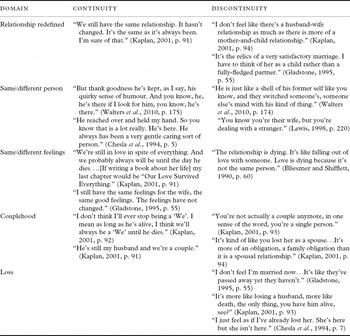
In order to develop the conceptual and theoretical basis for the questionnaire, a review was conducted of the studies in which continuity has featured as a central theme (Chesla et al., Reference Chesla, Martinson and Muwaswes1994; Gladstone, Reference Gladstone1995; Kaplan, Reference Kaplan2001; Walters et al., Reference Walters, Oyebode and Riley2010) alongside others that have dealt with themes of continuity and change in the relationship (Blieszner and Shifflett, Reference Blieszner and Shifflett1990; Lewis, Reference Lewis1998; Murray and Livingston, Reference Murray and Livingston1998; Keady and Nolan, Reference Keady, Nolan, Nolan, Lundh, Grant and Keady2003; Hellstrom et al., Reference Hellstrom, Nolan and Lundh2005; Reference Hellstrom, Nolan and Lundh2007; Sandberg and Eriksson, Reference Sandberg and Eriksson2007). On the basis of this review, five domains of the relationship continuity construct were proposed. These are described below, and Table 1 contains quotes from participants in the studies that illustrate the two poles of each domain.
Excerpts from qualitative transcripts illustrating the five domains of the continuity/discontinuity construct

Relationship redefined
Participants in the studies sometimes reflected explicitly on how they viewed the relationship. Some clearly viewed the relationship as a continuation of the premorbid relationship (Chesla et al., Reference Chesla, Martinson and Muwaswes1994; Gladstone, Reference Gladstone1995; Kaplan, Reference Kaplan2001; Walters et al., Reference Walters, Oyebode and Riley2010), whereas, for others, the marriage was viewed as finished (Gladstone, Reference Gladstone1995; Kaplan, Reference Kaplan2001) and the relationship had been redefined in some other way (e.g. carer and care-recipient) (Kaplan, Reference Kaplan2001; Walters et al., Reference Walters, Oyebode and Riley2010).
Same/different person
The perception of a changed relationship was inextricably linked with a perception that the person with dementia had changed in some essential way and that they were no longer the same person (Chesla et al., Reference Chesla, Martinson and Muwaswes1994; Walters et al., Reference Walters, Oyebode and Riley2010). A perception of the other as a different person perhaps inevitably translates into perceived discontinuity in the relationship (Walters et al., Reference Walters, Oyebode and Riley2010). By contrast, those who perceived continuity in the relationship talked about the person still being the same, despite all the changes wrought by the dementia. They actively looked for signs of this and interpreted ambiguous signs as confirmation, taking comfort from their occurrence (Chesla et al., Reference Chesla, Martinson and Muwaswes1994; Walters et al., Reference Walters, Oyebode and Riley2010).
Same/different feelings
Changed perceptions of personal and relational identity were also associated with a change in feelings toward the person with dementia (Chesla et al., Reference Chesla, Martinson and Muwaswes1994; Gladstone, Reference Gladstone1995). In some cases, feelings were described in terms of care and protection rather than of love and affection (Chesla et al., Reference Chesla, Martinson and Muwaswes1994; Walters et al., Reference Walters, Oyebode and Riley2010). In other cases, the spouse had become emotionally detached (Chesla et al., Reference Chesla, Martinson and Muwaswes1994; Kaplan, Reference Kaplan2001). Displays of affection from the person with dementia were actively avoided by some of those perceiving discontinuity (Walters et al., Reference Walters, Oyebode and Riley2010). By contrast, those who viewed the relationship as unchanging often expressed their love for the spouse (Gladstone, Reference Gladstone1995), and signs of affection from the person with dementia were cherished and reciprocated (Chesla et al., Reference Chesla, Martinson and Muwaswes1994; Hellstrom et al., Reference Hellstrom, Nolan and Lundh2007).
Couplehood
Those who perceived continuity in the relationship retained a strong sense of being part of a couple, whereas those who perceived discontinuity had lost this and viewed themselves in an individualistic way (Gladstone, Reference Gladstone1995; Kaplan, Reference Kaplan2001). The ways in which spouses sustain the sense of being a couple have been studied in some detail and include maintaining the involvement of the person with dementia in decision-making and in valued roles (Keady and Nolan, Reference Keady, Nolan, Nolan, Lundh, Grant and Keady2003; Hellstrom et al., Reference Hellstrom, Nolan and Lundh2007), continuing with established patterns of communication and interaction (Chesla et al., Reference Chesla, Martinson and Muwaswes1994; Hellstrom et al., Reference Hellstrom, Nolan and Lundh2005; Sandberg and Eriksson, Reference Sandberg and Eriksson2007), and carrying out meaningful and enjoyable activities together (Hellstrom et al., Reference Hellstrom, Nolan and Lundh2005; Reference Hellstrom, Nolan and Lundh2007).
Loss
Those who experienced discontinuity in the person and the relationship also experienced a sense of loss for the premorbid person and relationship (Chesla et al., Reference Chesla, Martinson and Muwaswes1994; Gladstone, Reference Gladstone1995; Kaplan, Reference Kaplan2001). Feelings of loss and grief that occur prior to the death of the person with dementia have been widely studied. Although common, it is clear that some spouses experience them to a more limited degree or not at all (e.g. Collins et al., Reference Collins, Liken and Kokinakis1993; Betts-Adams and Sanders, Reference Betts-Adams and Sanders2004). The narrative of loss did not appear in the interviews of those who perceived continuity in the relationship.
The current study aimed, then, to develop and evaluate a questionnaire, based around these five domains, to measure the spousal carer's sense of relationship continuity. Study 1 describes the generation and evaluation of the initial pool of items, and the subsequent selection of items for the final version of the questionnaire. Study 2 describes an evaluation of the reliability, validity, and discriminative power of the final version.
Study 1
Methods
Drawing on the qualitative literature described earlier, an initial pool of items was generated to cover each of the five domains of relationship continuity, with at least five items per domain. Forty-two items were generated in total. Each item contained a statement and the response scale provided five options: “agree a lot,” “agree a little,” “neither,” “disagree a little,” and “disagree a lot.” One version of the questionnaire was developed for use in the case that the care recipient was female, and, with appropriate changes in gender-related pronouns and nouns, one for use when the care recipient was male. Items were scored from “agree a lot” (= 1) through to “disagree a lot” (= 5), with reverse scoring on 14 items that involved a positive statement of continuity. Thus, higher scores indicated greater continuity in the relationship.
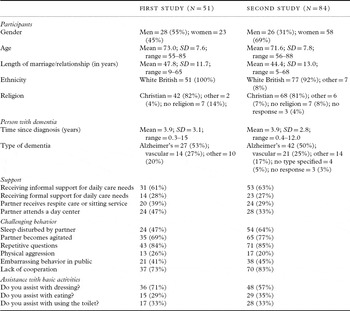
This initial pool of items was then completed by a sample of 51 spousal carers of people with dementia. Inclusion criteria were that the person was living at home with the person with dementia, that they were married or lived together as partners and had been so for at least 5 years prior to the diagnosis of dementia, and that they had sufficient command of English to complete a questionnaire. The sample was recruited through various agencies providing support for people with dementia and their families in urban areas of the UK. Potential participants were identified by staff working for the agency or made themselves known to a researcher following an oral presentation about the research. Participants either completed the questionnaire at home and returned it by post, or completed it in private on agency premises and handed it to a researcher. In addition to the relationship continuity items, participants completed a brief questionnaire asking about demographic variables, support received, and the care requirements of the person with dementia. The latter included questions about the presence of various challenging behaviors and the need for assistance with basic activities of daily life, and were answered yes or no. Information obtained from this brief questionnaire is summarized in Table 2.
Demographic information for Studies 1 and 2

Support, challenging behavior and assistance questions were answered yes or no. Figures in table show number of participants (percentage) answering yes.
The item analysis approach to questionnaire construction (Kline, Reference Kline2000) was used. Although the question pool drew from each of the five domains of the construct, the primary aim was to produce a reasonably short questionnaire (25 items or fewer) in order to ensure its acceptability to respondents. Consequently, the focus was on producing a unidimensional scale (i.e. one in which all items provide a reasonably good measure of a single underlying construct), rather than on five related subscales (which would have required a lengthier questionnaire). At the same time, steps were taken to ensure that each domain was adequately represented in the scale by including at least three items from each domain. This was done to avoid overspecificity in the construct being measured (Kline, Reference Kline2000). To enable the elimination of items that weakened the psychometric properties of the questionnaire and to reduce the number of items to 25 or fewer, two indices were calculated; the correlation of the item score with the total score, and the percentage of participants endorsing and rejecting the statement. The removal of items with low item-total correlations increases the internal reliability of the measure and the removal of items with low rates of endorsement or rejection increases the discriminative power of the measure. The item-total score correlation was used in preference to the item-subscale score because the aim was to produce a unidimensional scale. Items with an item-total correlation below 0.4 were eliminated, as were items for which fewer than 20% of participants endorsed the statement (i.e. indicated “agree a little” or “agree a lot”) or rejected it (i.e. indicated “disagree a little” or “disagree a lot”). Once these items were eliminated, Cronbach's α was used to assess the internal reliability of the total and subscale scores for the remaining items. Ferguson's δ was calculated to assess the discriminative power of the remaining items, using the formula provided by Hankins (Reference Hankins2007) for scales with multiple response options. An indication of discriminative power was also obtained by comparing the range of obtained scores with the range of possible scores.
Results
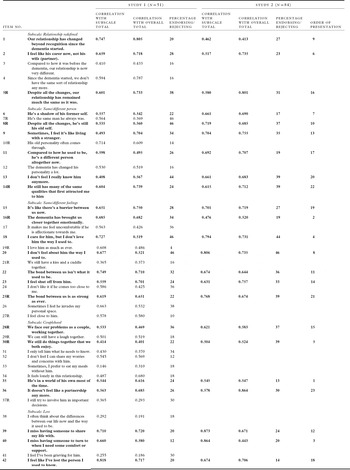
Item-total correlations and the percentage of participants endorsing or rejecting the statement (whichever was the smaller) are shown in Table 3. Six items that had a correlation with the total below 0.4 were eliminated (items 7, 31, 33, 37, 38, and 41), as were 10 items where fewer than 20% had endorsed (or rejected) the statement (items 3, 4, 10, 12, 16, 19, 21, 27, 29, 32, and 34). An exception to this latter exclusion criterion was made for item 40 from the loss subscale. This was retained, despite the relatively low number rejecting it, to ensure that each subscale was represented by at least three items. Also removed were three items (17, 24, and 26) relating to the participant's response to physical approaches from the person with dementia. They were removed because of feedback from some participants who reported that their spouse did not make physical approaches and so they were unsure on what basis they should answer these items. In total, 19 items were excluded. The 23 retained items are shown in bold in Table 3.
Item statistics for Studies 1 and 2

Items in the table are from the version where the recipient of care is male. Items in bold were retained for the final version of the questionnaire. R = item is reverse scored. Figures in the “percentage endorsing/rejecting” column show the percentage of participants who endorsed (“agree a lot” or “agree a little”) or rejected (“disagree a lot” or “disagree a little”) the statement, whichever was the smaller value.
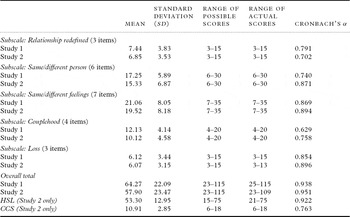
Cronbach's α for the subscale and overall totals for the 23 retained items is shown in Table 4. With the exception of the couplehood subscale, the Cronbach's α for all subscales was higher than 0.7, which is usually considered the benchmark for satisfactory internal reliability (Kline, Reference Kline2000). The internal reliability for the overall scale was high (0.934; 95% confidence interval (CI) = 0.905–0.958). Descriptive statistics for the subscale and overall totals are also provided in Table 4. All showed a good spread of scores, with the obtained ranges being a close match for the possible ranges. Ferguson's δ was 0.975 (95% CI = 0.956–0.986), which is above the 0.9 recommended for satisfactory discriminative power (Kline, Reference Kline2000). This result should be considered in the light of recent discussion about Ferguson's δ, which suggests that it is only a useful statistic if the measure is also reliable and valid (Terluin et al., Reference Terluin, Knol, Terwee and de Vet2009).
Descriptive statistics for subscale and overall totals for retained items in Studies 1 and 2, and for HSL and CCS in Study 2

For Study 1, N = 51. For Study 2, N = 84 for all BRCM statistics and N = 54 for the HSL and CCS.
The relationship of the overall total score with the demographic variables was examined. Men scored significantly higher on the total (mean for men = 70.36, women = 56.26, t = 2.19, p = 0.034). The total was not significantly related to the age of the participant, the length of the spousal relationship, the time since diagnosis, or the type of dementia (although only Alzheimer's and vascular dementia were entered into the analysis because of inadequate numbers in the other diagnostic categories). There were insufficient numbers of non-White British or non-Christian participants to allow an analysis of ethnicity or religion.
Study 2
The 23 retained items (which constitute the Birmingham Relationship Continuity Measure – BRCM) were then subjected to a number of further assessments of their psychometric properties using a second sample. Scores from this sample were used to re-assess the internal reliability and discriminative power of the questionnaire. In addition, a subsample completed the measure again after an interval in order to provide an evaluation of the questionnaire's test–retest reliability. A subsample also completed two existing standardized measures to establish construct validity. In the absence of another scale that measures relationship continuity, two measures were chosen that were expected to have substantial overlap with one of the BRCM subscales. These were the heartfelt sadness and longing subscale (HSL) of the Marwit–Meuser Caregiver Grief Inventory (Marwit and Meuser, Reference Marwit and Meuser2002) and the Closeness and Conflict Scale (CCS) (Schofield et al., Reference Schofield, Murphy, Herrman, Bloch and Singh1997). Although the structure of the Marwit–Meuser measure appears somewhat complex, most of the 15 items of the HSL subscale address the feelings of loss and sadness that can accompany caring for someone with dementia. It was thus expected that it would overlap particularly with the loss subscale of the BRCM. Because of the high internal reliability of the BRCM, correlations with the other subscales and with the overall score were also expected, but it was predicted that the HSL would show the highest correlation with the loss subscale. Higher scores on the HSL indicate higher levels of sadness and loss. The CCS contains six items measuring positive and negative feelings about one's partner. Participants are asked to rate whether each feeling has occurred less, the same, or more, since assuming a caring role. In this study, the scoring for the CCS was, for positive feelings, 1 = less, 2 = the same, and 3 = more; and, for negative feelings, 1 = more, 2 = the same, and 3 = less. Thus, low scores indicated an increase in negative feelings and a decrease in positive feelings. On the assumption that the majority of premorbid relationships in the sample were characterized by positive feelings, it was predicted that those scoring low on the same/different feelings subscale of the BRCM would also obtain low scores on the CCS. Again, because of the high internal reliability of the BRCM, correlations with the other subscales and with the overall score were also expected, but it was predicted that the CCS would show the highest correlation with the same/different feelings subscale.
Methods
Eighty-four spousal carers took part, none of whom had participated in the first study. Demographic and care-related information about the sample is contained in Table 2. The second sample was similar in composition to the sample in the first study, with the exception that it included a higher proportion of women. Inclusion criteria, methods, and sources of recruitment, and procedures for data collection were the same as in the first study. All participants completed the BRCM and the demographic and care-related questionnaire used in the first study. A subsample of 54 participants also completed the HSL and the CCS, and 34 of these 54 also completed the BRCM on a second occasion for the purposes of assessing test–retest reliability. The retest BRCM was returned by post and so precise information about the test–retest interval was not gathered. However, the interval was at least one week and no more than three weeks.
The internal reliability and discriminative power of the BRCM were evaluated in the same way as for the first study. To assess test–retest reliability, an intraclass correlation was calculated, using a two-way random model focused on single measures and absolute agreement (McGraw and Wong, Reference McGraw and Wong1996). Relationships between the BRCM, the HSL, and the CCS were assessed using Pearson's correlation coefficient. A test of the significance of the difference between non-independent correlations was used to determine whether the correlation between the HSL and the loss subscale was significantly larger than the correlations between the HSL and the other subscales; and whether the correlation between the CCS and the same/different feelings subscale was significantly larger than the correlations between the CCS and the other subscales.
Results
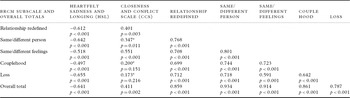
Evaluation of the internal reliability of the measure was favorable (Table 4). Cronbach's α for all the subscale totals was above the 0.7 criterion and the α for the full scale was high (0.947; 95% CI = 0.929–0.962). Individual items also showed acceptable correlations with the overall total, ranging from 0.413 to 0.864 (Table 3). Further evidence of good internal reliability was shown by the high correlations amongst the subscale totals and overall total (Table 5). The intraclass correlation used to evaluate test–retest reliability was 0.932 (95% CI = 0.868–0.966; p < 0.001; N = 34). No difference between the means of the two administrations was obtained (F = 0.004; p = 0.950). Participants’ responses to the test items thus showed good stability over time. The discriminative power of the questionnaire was also good: Ferguson's δ was 0.987 (95% CI = 0.982–0.991); and the subscale and overall totals showed a generally good spread of scores (Table 4), although three items were rejected by less than 20% of the sample (Table 3).
Study 2 – correlations between the BRCM, the HSL, and the CCS

When correlation involves the HSL or CCS, N = 54 and for all other correlations, N = 84.
*Indicates that the correlation was significantly smaller (p < 0.05, two-tailed) than the correlation between the CCS and the same/different feelings subscale.
Some evidence was also provided for the construct validity of the questionnaire. Correlations between the BRCM, the HSL, and CCS are shown in Table 5. As predicted, the HSL showed the strongest correlation with the loss subscale of the BCRM, and the CCS had the strongest correlation with the same/different feelings subscale. Tests of the significance of the difference between correlations indicated that the correlation between the CCS and same/different feelings was significantly larger (p < 0.05, two-tailed) than those between the CCS and all the other subscales except relationship redefined (see Table 5). However, the correlation between the HSL and loss was not significantly larger than any of those between the HSL and other subscales. This may be because the differences were smaller for the HSL scale and a sample of only 54 participants may not have provided an adequately powered test to detect small differences.
The total BRCM score was not significantly related to age, length of spousal relationship, or type of dementia. In contrast to the first study, the total score was not significantly related to gender, but it was to time since diagnosis: A longer time since diagnosis was moderately associated with perceptions of discontinuity in the relationship (r = −0.344, p = 0.002). There were insufficient numbers of non-White British or non-Christian participants to allow an analysis of ethnicity or religion.
The aim of the study was to design a unidimensional scale. To assess whether this had been achieved, an exploratory factor analysis was carried out on the combined data from Studies 1 and 2 (N = 135) on the 23 items of the BRCM to determine how many reliable factors could be extracted from the data. The Kaiser-Meyer-Olkin (KMO) measure of sampling adequacy was 0.922 indicating a high degree of factorability in the data set. Following the recommendations of Costello and Osborne (Reference Costello and Osborne2005), principal axis factoring was used for factor extraction because of the non-normal distribution of scores on eight items, direct oblimin for the method of rotation, and the Scree test for deciding which factors were reliable. Only one reliable factor was extracted, which explained 46% of the variance in scores (initial eigenvalues: factor 1 = 10.52; factor 2 = 1.82; factor 3 = 1.43; factor 4 = 1.05). The analysis was thus consistent with the suggestion that the scale is unidimensional. The results should be treated with some caution because of the relatively small sample size (ratio of participants to items was 5.87:1) (Costello and Osborne, Reference Costello and Osborne2005). However, the solution is more reliable when, as in the present analysis, fewer factors are extracted and the communalities are not too low (Preacher and MacCallum, Reference Preacher and MacCallum2002) (communalities ranged from 0.398 to 0.733, mean = 0.604).
Discussion
This paper described the development and preliminary psychometric evaluation of a measure of the spouse's sense of relationship continuity. Good levels of internal reliability for the subscales were observed, with the exception of the couplehood subscale in the first study. The internal reliability of the full scale was high, as was the test–retest reliability. Discriminative power was high in both studies. Some evidence of construct validity was provided by the fact that, as predicted, the HSL correlated most highly with the loss subscale, and the CCS most highly with the same/different feelings subscale; and the correlation between the CCS and same/different feelings was significantly larger than those between the CCS and all the other subscales except relationship redefined. Exploratory factor analysis provided tentative evidence that the measure is unidimensional.
Some limitations of the evaluation should be noted. The samples were self-selected and so it is difficult to know how representative they were of the population of spousal carers. Ethnic and religious minorities were certainly under-represented, and women were under-represented in the first sample. Evidence that carers from different cultural backgrounds may interpret and experience dementia in different ways (e.g. Mausbach et al., Reference Mausbach2004) suggests that this may be a significant omission and that separate psychometric evaluations may be required for different cultures. Another limitation was sample size. A larger sample would have permitted firmer conclusions to be drawn from the factor analysis.
Some potential limitations of the measure itself should also be noted. The qualitative research on which it is based describes the partner's experience of what happens to a valued premorbid relationship. This is reflected in the content of some of the items, which assume that the premorbid relationship was valued. For example, “It doesn't feel like a partnership any more” assumes that there was a time when it did feel like a partnership, and “I miss having someone to turn to when I need some comfort or support” assumes that there was a time when the partner provided comfort and support. The measure should therefore be used with caution if it is the case that the respondent had a poor premorbid relationship with the person with dementia. It may be useful to administer a measure of the quality of the premorbid relationship alongside the BRCM in order to allow this variable to be taken into account. However, within research contexts, the impact on the validity of the overall score may be negligible: The great majority of items within the BRCM do not make this assumption, and it seems reasonable to assume that the great majority of any research sample will have enjoyed a premorbid relationship that was at least adequate.
Another limitation concerns the usefulness of the subscale totals. The internal reliability of the couplehood subscale did not reach the benchmark of 0.7 in the first study (though it did in the second); and some of the subscale totals are based on a relatively small number of items (e.g. only three items each in the case of the relationship redefined and loss subscales). In addition, the very high internal consistency of the measure (0.947) and the exploratory factor analysis suggested that the measure is unidimensional and so consideration of the subscale totals may be of limited usefulness. However, the main aim of the study was to provide a relatively short unidimensional questionnaire. If the focus of interest is on the different domains of the relationship continuity construct, then it would be preferable to evaluate and use a longer version of the BRCM. The initial pool of items (Table 3) may provide the basis for the development of such a measure. Only four items (33, 37, 38, and 41) performed poorly in terms of their correlation with the rest of the scale, and only one (19) showed a particularly poor distribution of responses.
In relation to limitations of the measure, a final issue is its very high internal consistency. It has been recommended that excessively high internal consistency is avoided because it suggests that the construct being measured is too narrow and/or that items are just asking the same few questions repeatedly, albeit in a different form (Kline, Reference Kline2000). However, this is an unlikely explanation of the high consistency of the BRCM: As noted in the “Methods” section for Study 1, at least three items were drawn from each of the five domains in order to sample from a broad range of relationship characteristics and to avoid overspecificity in the construct being measured.
Provided that these limitations are borne in mind, the BRCM appeared to perform well as a measure of the construct of relationship continuity. The value of having such a quantitative measure is that it opens up new avenues for investigating suggestions made within qualitative research about how relationship continuity might influence the reaction of couples to dementia. Although some of these suggestions are grounded in the qualitative data, many of them are more speculative. Moreover, given the nature of qualitative research, the generalizability of the suggestions is unclear. The BRCM provides an opportunity to test these ideas in a quantitative way. For example, various suggestions have been made about how relationship continuity might influence the emotional impact of dementia on the spouse. It has been suggested that continuity is associated with the derivation of more positive meaning and gratification from the caring role (Chesla et al., Reference Chesla, Martinson and Muwaswes1994), whereas discontinuity is more often accompanied by the negative emotions associated with the caring role such as feelings of entrapment (Walters et al., Reference Walters, Oyebode and Riley2010) and a more emotional reaction to challenging behavior (Murray and Livingstone, Reference Murray and Livingston1998; Walters et al., Reference Walters, Oyebode and Riley2010).
Another avenue of investigation would be to explore the links between relationship continuity and differences in the general quality of care provided by the spouse. Both Lewis (Reference Lewis1998) and Walters et al. (Reference Walters, Oyebode and Riley2010) noted that those who perceived discontinuity were more likely to refer to their spouse in objectifying and depersonalized terms, and both suggested they were more likely to be controlling and restrictive in their approach to care. Chesla et al. (Reference Chesla, Martinson and Muwaswes1994) noted that the care of those who perceived discontinuity was generally less tailored to the needs of the individual; and Walters et al. (Reference Walters, Oyebode and Riley2010) suggested that continuity may be associated with a more empathic approach. If confirmed, these ideas from the qualitative literature about the impact of relationship continuity on carer's emotions and behavior could have significant implications for helping spousal couples deal with the challenges of dementia.
Conflict of interest
None.
Description of authors’ roles
G. A. Riley analyzed the data, wrote the paper, and was involved in the supervision of all aspects of the doctoral research on which the study is based and of subsequent data collection. G. Fisher was involved in the study design, and carried out the data collection, analysis, and write-up of the doctoral research on which the paper is based. B. F. Hagger, A. Elliott, and H. Le Serve were all involved in data collection. J. R. Oyebode was involved in the supervision of all aspects of the doctoral research on which the study is based.