Introduction
Although delirium has been recognized in the medical literature for nearly 2,500 years (Lipowski, Reference Lipowski1991) and is commonly encountered across healthcare populations (Trzepacz and Meagher, Reference Trzepacz, Meagher, Yudofsky and Hales2007), many fundamental aspects of its phenomenological presentation remain unclear. In particular, differences in symptom profile across populations and the impact of comorbid pathologies such as dementia are poorly understood (Gupta et al., Reference Gupta, Jonghe, Schieveld, Leonard and Meagher2008). This is reflected in underdetection, continued uncertainties regarding key aspects of treatment (Meagher, Reference Meagher2010), and a paucity of research in relation to clinical subtypes, psychopathology and neurobiological underpinnings (Meagher, Reference Meagher2009).
In the elderly, delirium is associated with more prolonged hospitalizations, poor functional outcomes and elevated mortality (Levkoff et al., Reference Levkoff1992; Inouye et al., Reference Inouye, Rushing, Foreman, Palmer and Pompei1998; Rockwood et al., Reference Rockwood, Cosway, Carver, Jarrett, Stadnyk and Fisk1999; McCusker et al., Reference McCusker, Cole, Abrahamowicz, Primeau and Belzile2002). Moreover, patients with delirium are almost three times more likely to be discharged to long-term supported placement compared to non-delirious elderly patients after an inpatient admission (Rockwood, Reference Rockwood1993). Significantly, these outcomes are relatively independent of clinical and sociodemographic variables (Levkoff et al., Reference Levkoff1992; Francis et al., Reference Francis, Martin and Kapoor1996; O'Keeffe and Lavan, Reference O'Keeffe and Lavan1997). Furthermore, more recent studies have indicated that in elderly patients with or without prior cognitive difficulties, experiencing an episode of delirium is an independent predictor of persistent poor cognitive and functional status, including long-term cognitive impairment (MacLullich et al., Reference MacLullich, Beaglehole, Hall and Meagher2009).
This study aims (1) to explore the phenomenological profile of delirium occurring in patients referred to old age psychiatry consultation-liaison services using detailed validated tools; (2) to compare this group with similar assessment of delirium symptoms in palliative care patients and thus to compare the generalizability of findings across these study groups; and (3) to explore how the neuropsychiatric and cognitive profile of delirium is impacted upon by the presence of comorbid dementia.
Methods
Subjects and design
This is a prospective cross-sectional study of delirium symptoms and cognitive performance in 80 consecutive inpatient referrals to old age psychiatry consultation-liaison services at three university teaching hospitals (University College Hospital, Galway, Midwestern Regional Hospital and St John's Hospital, Limerick). All referrals with altered mental state were assessed for the presence of DSM-IV criteria for delirium (American Psychiatric Association, 1994). All delirium cases were then assessed by trained raters (FJ or ML) in the use of the revised Delirium Rating Scale (DRS-R98) (Trzepacz et al., Reference Trzepacz, Mittal, Torres, Kanary, Norton and Jimerson2001) and Cognitive Test for Delirium (CTD) (Hart et al., Reference Hart, Levenson, Sessler, Best, Schwartz and Rutherford1996). Furthermore, to enhance inter-rater reliability, difficult ratings were discussed and rated by consensus between both raters along with a third rater (DM). Dementia was defined as the presence of persistent cognitive impairment for at least six months prior to the assessment and/or DSM-IV criteria based on all available information at the time of assessment including clinical case notes and collateral history from family and/or carers. Comorbid delirium-dementia was defined as the presence of both disorders. Account was also taken of the demographic profile, recognized duration of delirium symptoms at referral (using all available information from staff and carers/family), etiologies and psychotropic drug exposure at the time of assessment.
Each patient was assessed by first completing the DRS-R98 followed by administration of the CTD. The DRS-R98 rates the preceding 24 hour period whereas the CTD measures cognition at the time of its administration. CTD responses were not used to rate DRS-R98 items. Both the DRS-R98 and the CTD are well-validated instruments, highly structured and anchored for rating and scoring.
Consent
The procedures and rationale for the study were explained to all patients but because many patients had cognitive impairment at entry to the study, it was presumed that most were not capable of giving informed written consent. Because of the non-invasive nature of the study, ethics committee approval was given to augment patient assent with proxy consent from next of kin (where possible) or a responsible caregiver in accordance with the Helsinki Guidelines for Medical Research involving human subjects (World Medical Association, 2004).
Assessments
Delirium Rating Scale
The DRS-R98 (Trzepacz et al., Reference Trzepacz, Mittal, Torres, Kanary, Norton and Jimerson2001) is designed for broad phenomenological assessment of delirium. It is a 16-item scale with 13 severity and three diagnostic items with high inter-rater reliability, sensitivity and specificity for detecting delirium in mixed neuropsychiatric and other hospital populations. Each item is rated 0 (absent/normal) to 3 (severe impairment) with descriptions anchoring each severity level. Severity scale scores range from 0 to 39 with higher scores indicating more severe delirium. Delirium typically involves scores above 15 points (Severity scale) or 18 points (Total scale) when dementia is in the differential diagnosis. For determination of item frequencies in this study, any item score ≥ 1 was considered as being “present”. DRS-R98 items can be divided into cognitive (items 9–13) and non-cognitive (items 1–8) subscales based on construct validity.
Cognitive Test for Delirium
The CTD (Hart et al., Reference Hart, Levenson, Sessler, Best, Schwartz and Rutherford1996) is a brief (10–15 minute) test of neuropsychological function that was specifically designed to assess hospitalized delirium patients, in particular those who are intubated or unable to speak or write. It assesses five neuropsychological domains (orientation, attention, memory, comprehension, and vigilance) emphasizing nonverbal (visual and auditory) modalities. Tests are components of standardized and widely used neuropsychological tests. Each individual domain is scored from 0 to 6 by two-point increments, except for comprehension (single point increments). Total scores range between 0 and 30 with higher scores indicating better cognitive function and scores of less than 19 consistent with delirium. It reliably differentiates delirium from other neuropsychiatric conditions including dementia, schizophrenia and depression (Hart et al., Reference Hart, Levenson, Sessler, Best, Schwartz and Rutherford1996).
Assessment of etiology
Attribution of etiology based on all available clinical information was made according to a standardized Delirium Etiology Checklist (DEC; Trzepacz and Meagher, Reference Trzepacz, Meagher, Yudofsky and Hales2007) with 12 categories of etiological causation, each rated on a five-point scale for degree of attribution to the delirium episode, ranging from ruled out/not present/not relevant (0) to definite cause (4): drug intoxication, drug withdrawal, metabolic/endocrine disturbance, traumatic brain injury, seizures, infection (intracranial), infection (systemic), neoplasm (intracranial), neoplasm (systemic), cerebrovascular, organ insufficiency, other CNS, and other systemic causes. This allows for the documentation of the presence and suspected role for multiple potential causes.
Statistical analysis
Statistical analysis was conducted using the SPSS-16.0 package. Demographic and rating scale data were expressed as means plus standard deviation. Delirium vs comorbid delirium-dementia groups and the elderly medical referral group vs. palliative care study group were compared regarding mean age and total scale scores for the DRS-R98 and CTD using independent t-tests, while subscale scores and frequency of etiologies and medication use were compared with Mann-Whitney U-tests. Patient subgroups defined according to severity of inattention were compared using χ2 and Kruskal-Wallis tests. Frequency of dementia in palliative care vs. elderly medical study group was compared with χ2 analysis. The severity of categorical and/or quasi-continuous variables such as the individual items of the DRS-R98 and CTD were compared with χ2 analyses. Level of significance was determined with a cut-off of p < 0.05, except where multiple comparisons were made, when a Bonferroni correction (p < 0.001) was applied.
Results
A total of 80 patients were assessed of whom 39 (49%) were males. Mean age was 79.3±7.7 years. Patients had a mean DRS-R98 total score of 21.7±4.9 (range 16–41) and total CTD score of 10.2±6.3 (range 0–24). Patients had a mean 3.1±1.3 (range 1–8) contributing etiologies as measured on the DEC. Forty patients (50%) had comorbid dementia associated with the delirium. On average, patients were receiving 8.2±3.4 medications and the mean number of psychotropic medications was 2.3±1.3.
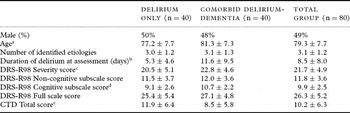
Table 1 compares demographic and clinical characteristics for delirium only versus comorbid delirium-dementia. Both groups had similar levels of etiological burden. Mean age was higher in the comorbid group. The duration of delirium symptoms was significantly longer in comorbid cases. Delirium severity was greater in those with comorbid delirium-dementia vs. those with delirium alone as evidenced by higher DRS-R98 severity scores and lower CTD scores. These two groups differed significantly in relation to the DRS-R98 cognitive subscale but not the non-cognitive subscale. Only four patients scored below the DRS-R98 diagnostic cut-off score for delirium (total scale score of 16 for two cases and 18 for two cases) involving two cases with and without comorbid dementia respectively.
Demographic and clinical characteristics for patients with delirium only, comorbid delirium-dementia and the complete study group

Note: more severe disturbance equates with higher scores on the DRS-R98 and lower scores on the CTD.
a p = 0.01 (t = -2.5; df = 78); b p < 0.001 (t = -3.8; df = 78); cp = 0.04 (t = -2.0; df = 78); d p = 0.004 (U = 503.5); ep = 0.01 (t = -2.5; df = 77).
CTD = Cognitive Test for Delirium; DRS-R98 = Delirium Rating scale Revised-98.
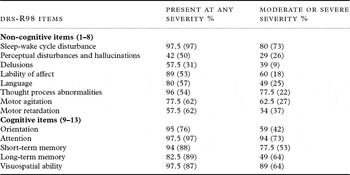
Table 2 depicts cognitive and non-cognitive disturbances assessed with the DRS-R98 for the complete study group. Inattention, diagnostic criterion A of DSM-IV, was present in all cases (98% on the DRS-R98 while the other two patients did not score for inattention on the DRS-R98 but did on the CTD). Other cognitive items were also common ranging from 97% of patients for visuospatial impairments to 82% of patients with long-term memory deficits. When these frequencies were restricted to cognitive disturbance of at least moderate severity (score of 2 or more), long-term memory and disorientation were the least frequent. Especially frequent among the DRS-R98 non-cognitive items were sleep disturbance (96%) and motoric disturbance (91% scored at least 1 or more on either agitation (item 7) or retardation (item 8) and 78% scored 2 or more on either motor item). The vast majority (95%; n = 76) had at least moderate disturbance (score ≥ 2) on at least one of DRS-R98 item 1 (sleep-wake cycle disturbance), item 7 (motor agitation) or item 8 (motor retardation) highlighting the frequency in delirium of disruption to bodily functions that are subject to circadian regulation.
DRS-R98 items scores for the complete group (n = 80)

Note: more severe disturbance equates with higher scores on the DRS-R98 and lower scores on the CTD.
Figures in brackets denote findings in palliative care study using same methods.
CTD = Cognitive Test for Delirium; DRS-R98 = Delirium Rating scale Revised-98.
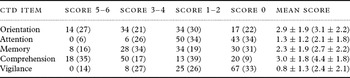
Table 3 depicts CTD scores for the complete study group. Seventy-six (95%) scored 20 or less on the total CTD which is consistent with previously defined cut-off scores (Hart et al., Reference Hart, Levenson, Sessler, Best, Schwartz and Rutherford1996; Kennedy et al., Reference Kennedy, Nakase-Thompson, Nick and Shere2003). Table 3 also shows the frequency of different severity levels of cognitive dysfunction and mean item scores assessed where the lower scores indicate poorer performance. Impaired performance was most apparent for attention and vigilance.
CTD item scores for the complete study group (n = 80)

Note: more severe disturbance equates with lower scores on the CTD.
Brackets denote findings in previous study in palliative care group.
CTD = Cognitive Test for Delirium.
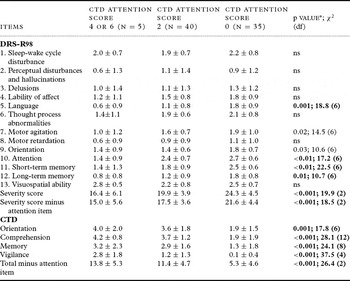
Table 4 shows a more detailed analysis of the relationship between disturbances of attention and other elements of delirium conducted by comparing DRS-R98 and CTD item scores for patients with mild, moderate and severe inattention (as defined by CTD attention item scores of 0, 2, 4–6 respectively) thus exploring the extent to which other features of delirium worsen as inattention becomes more marked. These groups differed significantly in relation to DRS-R98 total severity scores and total CTD scores even after the contribution of scores from ratings for attention on each of these scales were subtracted (i.e. DRS-R98 severity score minus item 10; CTD total minus attention item). They also differed for many individual items; however, when significance levels were corrected for multiple comparisons, the degree of inattention was associated with the level of impairment of other cognitive disturbances rated on the CTD and for long- and short-term memory on the DRS-R98. The only significant difference among the non-cognitive items was for language, thus emphasizing that inattention is much more closely related to other elements of cognition rather than to non-cognitive features of delirium.
Item scores for DRS-R98 and CTD according to degree of inattention on CTD

Note: more severe disturbance equates with higher scores on the DRS-R98 and lower scores on the CTD.
χ2 test for item comparisons and Kruskal-Wallis tests for total scale and subscale scores. Values shown in bold are after Bonferonni correction.
CTD = Cognitive Test for Delirium; DRS-R98 = Delirium Rating scale Revised-98.
Comparisons with previously described findings in a palliative care group revealed that the frequency of comorbid dementia was higher in this elderly medical group (50% vs. 17%; χ2 = 22.3; df = 1; p < 0.001). Mean age was also higher compared with the previously described palliative care group (79.3 ± 7.7 vs. 70.1 ± 11.5; t = −6.1; p < 0.001; CI −12.1 to −6.2) with lower mean number of etiologies (3.5 ± 1.3 vs. 3.1 ± 1.3; p = 0.007) and lower mean number of medications received (8.2 ± 3.4 vs. 6.5 ± 3.3; p < 0.001). The overall severity of delirium was greater in this study group, as reflected in more impaired scores for both cognitive (9.9 ± 2.5 vs. 8.5 ± 3.4; p = 0.004) and non-cognitive subscales (11.8 ± 3.7 vs. 7.4 ± 3.3; p < 0.001) of the DRS-R98 and total CTD (10.2 ± 6.3 vs. 14.5 ± 8.1; p < 0.001, t = 3.8, C.I. = 2.1 to 6.5).
Discussion
This study assessed 80 consecutive cases of DSM-IV delirium referred from a general hospital to old age psychiatry consultation-liaison services using valid, sensitive and standardized instruments. The DRS-R98 and CTD allow for measurement of a broad range of neuropsychiatric symptoms and multiple cognitive domains that are not measured by other delirium instruments. This study addresses key questions regarding delirium phenomenology that have previously been explored in a palliative care group and thus allows for a comparison to assess generalizabilty across delirious populations. The high frequency of dementia in this group permitted examination of the extent to which delirium phenomenology is impacted upon by comorbid dementia.
Cognitive dysfunction
These results support the concept of delirium as primarily a disorder of cognition characterized by disproportionate disturbance of attention and vigilance which is consistent with current ICD and DSM diagnostic criteria (Meagher et al., Reference Meagher, MacLullich and Laurila2008) and previous studies (Meagher et al., Reference Meagher2007; Franco et al., Reference Franco, Trzepacz, Mejia and Ochoa2009). In this study, attention was assessed by two different methods: Cognitive Test for Delirium (CTD) and Delirium Rating scale R-98 (DRS-R98), both of which indicated disproportionate impairment of attention. Moreover, the central role of inattention is emphasized by the pattern of cognitive dysfunction such that inattention was closely related to all other elements of cognition but with more limited relationships to non-cognitive items (with the exception of language disturbances which may be a proxy for impaired cognition). These findings highlight the importance of cognitive testing and especially assessment of attention in efforts to detect delirium.
Patients with comorbid dementia had significantly greater impairment of CTD and DRS-R98 cognitive items, but not DRS-R98 non-cognitive features. This is in keeping with previous studies that suggest that cognitive problems are cumulative; patients with comorbid dementia have similar overall symptom profiles but with relatively more severe cognitive impairment (Trzepacz et al., Reference Trzepacz, Mulsant, Dew, Pasternak, Sweet and Zubenko1998). The clinical implication of this observation is that the neuropsychiatric presentation of delirium is not greatly altered by the presence of dementia and that detection in both cases is predicated upon assessing for the presence of delirium symptoms. The need for more consistent detection of delirium in the context of comorbid dementia is highlighted by the longer duration of delirium symptoms at referral for comorbid cases, reflecting factors such as misattributing cognitive and neuropsychiatric disturbances to existing dementia.
Testing of visuospatial functioning is not a component of most delirium rating scales but the frequency and severity of visuospatial abnormalities in this study group is in keeping with the observation that many patients with delirium pose problems in clinical settings due to wandering and disrupted environmental interactions. While some work has focused on the use of tests of visuospatial function (e.g. clock drawing) in delirium assessment (Adamis et al., Reference Adamis, Morrison, Treloar, MacDonald and Martin2005), this is an aspect of delirium phenomenology that warrants closer examination and which may provide a means of assessment that can improve the consistency of delirium detection.
This study confirms delirium as a disorder of global cognition characterized by prominent disturbance of attention and vigilance and further supports the role of attentional disturbances as core features of delirium. Attentional processes are key to assessment of other cognitive function such that poor performance on tests of other cognitive domains (e.g. short term memory) can be related to inability to cooperate with testing due to poor concentration and attention. However, the frequency of non-cognitive symptoms and their lack of association with the severity of objectively measured attentional impairment indicate that delirium is a broad neuropsychiatric disorder that cannot be explained in terms of inattention alone. This is relevant to studies of pathophysiology and treatment in that cognitive and non-cognitive symptoms of delirium need to be considered as discrete elements.
The CTD ratings indicated relatively less marked disturbance of comprehension and orientation. The finding that almost one half of the delirious group were either fully orientated or had mild (temporal) disorientation is similar to that observed in palliative care patients (Meagher et al., Reference Meagher2007) and raises concerns about the importance that many clinicians attribute to tests of orientation for detecting delirium in everyday clinical settings. Tests of neuropsychological domains that are more consistently disturbed in delirium can allow for more reliable detection and monitoring of delirium. This study also highlights the sensitivity of both the CTD and DRS-R98 to the presence of delirium in mixed populations, many of whom have pre-existing cognitive problems, and suggests that current cut-off scores accurately identify most cases of delirium in this referral study group for consultation by old age psychiatry services.
Non-cognitive disturbances
Thought process abnormalities and non-cognitive disturbances were also highly prevalent, with sleep-wake cycle disturbances and alterations in motor activity levels especially prominent in frequency and severity. This work supports the notion of these symptoms as core elements that are crucial to understanding the syndrome of delirium. In keeping with this conceptualization of delirium, Meagher and Trzepacz (Reference Meagher, Trzepacz, Geddes, Lopez-Ibor and Andreasen2009) propose three core phenomenological domains in delirium: “Cognition” comprised of inattention and other cognitive deficits; “Higher Level Thinking Processes” including impaired executive function, semantic expression, disorganized thinking and comprehension; and “Circadian Rhythm” including sleep-wake cycle and motor disturbances. These results support such a hypothesis by emphasizing the frequency and severity of these features during delirium episodes. Future diagnostic criteria for delirium will be more representative of the complete syndrome of delirium if disturbances of thought processes and sleep/motor patterns are included as key elements (Meagher et al., Reference Meagher, MacLullich and Laurila2008).
Comparison with palliative care settings
This work applies methods of delirium assessment that are almost identical to a recent phenomenological study of delirium in a palliative care group, including the significant strengths of detailed systematic assessment using structured and validated tools. We confirm that delirium is a complex neuropsychiatric syndrome characterized by disproportionate inattention with greater variability in non-cognitive rather than cognitive symptoms. The frequency of comorbid dementia was higher while the frequency of identified underlying etiologies and exposure to medications was lower in this group referred to old age psychiatry. Our findings indicate that the pattern of cognitive impairment is similar in old age psychiatry consultation-liaison referrals and palliative care patients, with disproportionate inattention, but with more severe overall cognitive impairment. In addition, there were interesting differences compared to the palliative care group in terms of much greater motor agitation, lability of affect, disturbances of language and thought process and content (including delusions). These differences are likely to reflect features that are associated with recognition and referral versus delirium that is identified by proactive screening for cases, as was conducted in the palliative care group, where the Confusion Assessment Method (CAM; Inouye et al., Reference Inouye, van Dyck, Alessi, Balkin, Siegal and Horwitz1990) was used to screen all patients for possible delirium (Meagher et al., Reference Meagher2007). A recent review of motor presentations of delirium highlighted the higher reported frequency of hypoactive presentations in palliative care compared to cases identified in consultation-liaison referral and elderly medical samples where hyperactive and mixed presentations are more common (Meagher, Reference Meagher2009). The relatively older age of this study group, greater frequency of co morbid dementia, differing frequency of sedative medication exposure, and irreversibility of illness in palliative care are other factors that may relate to this finding.
Study limitations
The cross-sectional design of this study means that the fluctuating phenomenological profile of delirium may not be fully captured, even though the DRS-R98 captures the most severe level of disturbance noted in the previous 24-hour period. The study group is relatively small in size, especially when subdivided according to comorbid dementia status. The diagnostic approach to dementia according to either an established clinical diagnosis of dementia or presence of prior cognitive impairment of at least six months’ duration could be enhanced by additional use of a standardized instrument such as the IQCODE (Jorm et al., Reference Jorm2004). The role of medication use is not accounted for in this naturalistic study and may have impacted upon the phenomenological profile, especially given the high rate of psychotic symptoms identified. Finally, while this work confirms the generalizabilty of many observations regarding the delirium phenomenological profile identified in palliative care patients to those referred to old age psychiatry consultation-liaison services, further studies are needed to explore this issue in intensive care settings and within more general elderly medical and surgical populations.
Conflict of interest declaration
David Meagher is Vice-President of the European Delirium Association (www.europeandelirium-association.com).
Description of authors’ roles
Professor David Meagher, Dr. Faiza Jabbar and Dr. Maeve Leonard were involved in formulating the research question, designing the study and carrying it out, analyzing the data and writing the paper. Dr. Karena Meehan, Dr. Margaret O'Connor, Dr. Con Cronin, Dr. Paul Reynolds and Dr. Anna Maria Meaney were involved in patient identification and data collection, and writing the paper.
Acknowledgments
The authors wish to express their gratitude for the important assistance of the nursing staff of University College Hospital Galway, St John's Hospital, Limerick and the Midwestern Regional Hospital, Limerick.