Why and how do international courts justify their rulings with citations to their own case law? Formally, the legal effect of an international court ruling is limited to the specific dispute it resolves. Yet, international courts frequently treat their past decisions as if they set precedents for new ones. A straightforward explanation for this divergence between formal rule and judicial practice is that relying on past decisions improves efficiency in the internal workings of the court. While this is undoubtedly part of the story, we argue that international courts also strategically use case citations to enhance the degree to which their decisions are perceived as legitimate by external audiences. International courts depend on domestic actors for compliance. While political actors are unlikely to be persuaded by legal justifications, domestic judges may well be more inclined to implement decisions that demonstrate legal consistency across time and place. We suggest that an international court adjusts the choice of case citations to the demands of domestic legal audiences and exerts more effort on embedding decisions in case law when the expected impact of persuading these audiences is highest. Importantly, this implies that an international court maximizes its legitimacy by avoiding fragmentation in its case law along lines of legal culture or other country-specific factors.
This article examines whether case citation patterns in the most prolific international court, the European Court of Human Rights (ECtHR), fit these theoretical expectations. Following recent analyses of citation patterns by the US Supreme Court (USSC), we apply network analysis to study the use of precedent.Footnote 1 We have three core findings. First, the ECtHR embeds its judgements more strongly with citations to precedent in those cases where domestic courts can expect the most resistance from the executive branch (and thus need more persuading). Second, ECtHR judgements are more embedded in precedent when the Court decides cases from common law countries where domestic courts rely more strongly on precedent and thus the potential persuasive value of case law citation is highest. Thirdly, broad patterns of citations to precedent, including communities of case-law, are significantly determined by case-specific characteristics rather than by legal culture or other country-specific factors.
Our article contributes to three strands of research. First, our theory and evidence speak directly to core debates in the literature on international judicial behaviour. Some argue that international judges tend to be insulated and behave like trustees who act according to professional legal norms rather than political prerogatives.Footnote 2 Others claim that the uncertain compliance environment makes international judges highly susceptible to political pressures.Footnote 3 This literature has not yet investigated precedent or citations, despite the growing interest in this topic in the broader international law literature.Footnote 4 Our theory stresses the uncertain compliance environment but suggests that this actually provides incentives for international judges to heed professional legal norms. Thus, our argument rejects the notion that international judges are well insulated from external pressures but highlights that the relevant external audiences are not just political actors but also domestic legal actors. This provides new insight into the incentive structure for international judges building on strategic models that have been proposed to analyse domestic judicial behaviour.Footnote 5
Second, the application of network analysis to judicial citations is a relatively novel area of research. Just as scholars learnt a great deal from applying empirical spatial models of legislative voting to alternative institutional settings,Footnote 6 we can learn from extending the application of network analysis to a new institutional environment. We follow network analyses of USSC citations by focusing on the hub scores of cases. Hub scores measure not just whether judgements cite greater numbers of precedents but also the extent to which they cite cases that have significantly influenced the Court's corpus of jurisprudence. Hub scores can then be used to evaluate hypotheses about the characteristics of cases that spur the judges to be more exhaustive in their justifications. A recent analysis of hub scores in the USSC context has demonstrated that citation patterns in that court fit the logic of a strategic model.Footnote 7 Our analysis demonstrates the ways in which the citation practices in the ECtHR both resemble and differ from those in the USSC, based on the strategic incentives of international judges. We add to this an analysis of communities in case law citations which is designed to detect whether distinct clusters of case law citations exist that correspond to characteristics of respondent governments or cases.
Third, our article contributes to the debate regarding the degree to which the ECtHR has become a de facto constitutional court,Footnote 8 and more generally it contributes to a growing literature that questions the long-standing assumption that domestic and international courts construct their authority in fundamentally different ways.Footnote 9 The ECtHR and USSC have important similarities that make the comparison meaningful and allow us to apply insights from the domestic judicial politics literature in the international context. Like the USSC, the ECtHR allows individuals to challenge a government act, practice or law in that it is inconsistent with a supreme body of law that endows them with certain fundamental rights: the 1950 European Convention for the Protection of Human Rights and Fundamental Freedoms (hereafter: the Convention). The ECtHR has issued more than 10,000 judgements that are binding on its forty-seven member states, including twenty states outside the European Union, such as Russia and Turkey.Footnote 10 We find that the manner by which citations to precedent have developed over time is quite similar between the courts. We also analyse whether ECtHR judges generally cite precedents based on characteristics of the country of origin, as a relativist approach suggests, or based on the legal issues, as our strategic approach suggests and as would be consistent with our expectations in a domestic review court. We do this by identifying the communities (or clusters) of jurisprudence within the overall network of ECtHR citations. Our finding that these communities are defined by legal issues rather than by country characteristics suggests that citations are applied consistently across countries and further strengthens earlier evidence that ECtHR judicial decision making is similar to decision making in domestic review courts.Footnote 11 We proceed by first discussing theoretical expectations regarding the role that citations to precedent play in international courts. We then analyse the properties of the network of ECtHR citations, comparing them to those of the USSC before turning to an analysis of reliance on precedent and communities within the ECtHR network.
Theoretical Perspectives on the Use of Precedent by International Courts
The role and usage of precedent in international courts is unclear. Most international tribunals are explicitly asked to limit their focus to the dispute at hand. For example, in the International Court of Justice (ICJ)'s Statute, Article 59 proclaims that ‘The decision of the Court has no binding force except between the parties and in respect of that particular case.’Footnote 12 Yet, the ICJ justifies its resolution of disputes with extensive references to its past opinions and considers these precedential.Footnote 13De facto norms of stare decisis also operate at the World Trade Organization (WTO).Footnote 14 Similarly, although the ECtHR has to ‘confine its attention as far as possible to the issues raised by the concrete case before it’,Footnote 15 it relies heavily on its past decisions, has no trepidations in referring to these decisions as ‘precedents’ and has developed an elaborate system to keep track of its case law.Footnote 16
This usage of precedent implies that rulings against one state may carry consequences for subsequent cases against other states. This point is understood by both governments and scholars. For example, Marc Busch has argued that governments strategically bring trade disputes to the forum where they think the precedent may serve them best.Footnote 17 Carrubba et al. find that third-party government observations influence European Court of Justice (ECJ) behaviour.Footnote 18 Important ECtHR cases attract active interventions from third-party governments concerned with precedent.Footnote 19
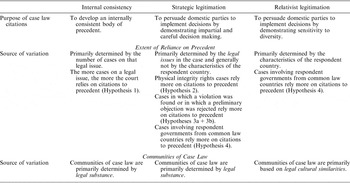
Little is known, however, about why and how international courts develop precedent. The most intuitive purpose of citations is to develop an internally consistent body of law. Given the enormous backlog at the ECtHR (over 125,000 cases as of early 2010), it may be efficient to avoid revisiting previously resolved legal issues. The persuasive force of precedent may also help a collegial panel of judges reach consensus.Footnote 20 Behaviourally, this approach is consistent with ‘legalism’, which assumes that judges maximize utility by faithfully adhering to internal rules regardless of the external result. This internal perspective implies that case law citations should be chosen based on similarities in the legal issues involved rather than on characteristics of external audiences. Variation in the extent to which a decision references past cases should be a function of how many cases with similar legal issues have previously been resolved (see Hypothesis 1 in Table 1).
Three Theoretical Perspectives on the ECtHR's Use of Case Law

Yet, the domestic judicial politics literature suggests that judges also cite past cases to help legitimize their decisions to external audiences.Footnote 21 Similarly, international court judgements are often thought to be influenced by the demands of a diverse set of external audiences, including governments, nongovernmental organizations (NGOs) and domestic judiciaries.Footnote 22 We thus suggest that international courts use citations also to legitimize their judgements with external audiences. If the purpose of citations is at least partially to persuade external actors, then there is much more to judges’ choices of citations than a mechanical reliance on the most relevant precedents. To start with, the choice of which precedent to cite should depend on the characteristics of the audience at whom the decision is targeted.Footnote 23 We distinguish two models. First: we propose a strategic legitimation model, which stresses similarities between domestic and international review courts. Second we compare our approach to a relativist model, which stresses that international courts have to uniquely legitimize their decisions to many audiences with potentially different conceptions of legitimacy.
The Strategic Legitimation Model
Our approach starts with four basic assumptions. First, ECtHR judges are policy orientated in that they care about compliance with their decisions. This assumption is shared in most of the political science literature on judicial behaviour and is often contrasted with the behaviour of the legalist judge. However, this division need not be absolute as even policy-oriented judges are generally influenced by legal doctrine.Footnote 24 Second, ECtHR judges believe the domestic judges reading their opinions are more likely to find them persuasive if legal consistency can be demonstrated across time and place. Third, domestic judges affect the implementation of the ECtHR's judgements. Both of these assumptions are also frequently made in the literature on communication between domestic review courts and lower courts.Footnote 25 Fourth, embedding decisions in relevant case law is costly as it requires effort on the part of ECtHR judges, an assumption shared by the literature on US courts.Footnote 26 The ECtHR has a large caseload, in part because it must accept all cases that meet its admissibility criteria (as opposed to a certiorari system). ECtHR judges are, therefore, responsible for writing many opinions and must decide on which of those opinions to devote greater amounts of their limited time.
There are two important conjectures that underlie these assumptions. First, there is something universal underlying the task of courts in which precedent plays a key role. What Slaughter calls the ‘global community of courts’ is ‘forged more by their common function of resolving disputes under rules of law than by the differences in the law they apply and the parties before them’.Footnote 27 Any court that resolves a dispute between parties must tell the losing parties why they lost. In all modern societies, judges tell the loser: ‘You did not lose because we the judges chose that you should lose. You lost because the law required that you should lose.’Footnote 28 Demonstrating the consistency of a decision with past decisions may alleviate the losing party's potential to claim that a decision was whimsical or motivated by non-legal considerations. Such considerations are no less relevant in the ECtHR. For example, Alec Stone Sweet points out that:
judges in Strasbourg confront the same kinds of problems that their counterparts on national constitutional courts do; and they use similar techniques and methodologies to address these problems … [T]he Court performs its most important governance functions through the building of a precedent-based jurisprudence. Through precedent, the Court seeks to legitimize its lawmaking, to structure the argumentation of applicants and defendant States, and to persuade States to comply with findings of violation.Footnote 29
Our second conjecture is that the ECtHR has good reason to be concerned about compliance and that domestic judges are useful potential allies.Footnote 30 Whereas earlier studies presumed that compliance was a minor issue for the ECtHR,Footnote 31 recent empirical work shows that compliance is problematic even in established democracies.Footnote 32 For example, the 2009 annual report from the Council of Europe's Committee of Ministers, which supervises the execution of ECtHR judgements, highlights that in only 36 per cent of cases were payments of just satisfaction made on time.Footnote 33 Moreover, there were over 7,000 pending ‘clone cases’ whose legal issues had been resolved in a ‘leading case’ but where insufficient domestic measures were taken to prevent renewed findings of violations. In addition, almost half of the ‘leading cases’ had been awaiting a final resolution for more than two years.Footnote 34
The Committee has no credible coercive means to enforce implementation and recognizes that improvements depend on ‘the principle of subsidiarity and the need to ensure that domestic remedies become truly effective’.Footnote 35 The centrality of domestic legal actors is also emphasized in the qualitative literature on implementation of ECtHR rulings.Footnote 36 All Council of Europe member states either give the Convention direct effect or have adopted the Convention into national law. This means that domestic judges can interpret the Convention and could, if they so choose, use ECtHR interpretations as a guideline. This is important not only to ensure implementation of its immediate judgements but also to ensure that the legal principles it establishes have a broader effect. As the Court put it in 2003:
Although the primary purpose of the Convention system is to provide individual relief, its mission is also to determine issues on public-policy grounds in the common interest, thereby raising the general standards of protection of human rights and extending human rights jurisprudence throughout the community of Convention States.Footnote 37
Domestic courts could see the ECtHR as an ally but may also regard a supranational court with semi-constitutional status (or aspirations) as a rival and thus resist debatable judgements handed down by the newcomer.Footnote 38 For example, the British Court of Appeal rejected applying the legal reasoning of an ECtHR judgement giving prisoners the right to vote, essentially claiming that it was up to the political branches of government to implement ECtHR judgements.Footnote 39 At other times, however, domestic review courts have shown more deference to the ECtHR.Footnote 40 Embedding decisions with reference to past cases is one way for the ECtHR to persuade domestic review courts to implement its judgements.
If all four assumptions hold, then the ECtHR should exert more effort on embedding decisions in previous case law when it believes citations to precedent will be more persuasive – and thus improve the probability of compliance. First, stronger legal justification is needed when domestic courts and legal professionals are more likely to experience resistance from politicians. As Harris puts it, ‘legitimacy is always an intrinsically difficult achievement for courts, but some decisions require more legitimation, and thus more display of information, than others’.Footnote 41 We suggest three signifiers of cases where domestic legal actors are likely to face political pressure to interpret the legal facts in a light more favourable to an executive. First, cases that invoke physical integrity rights, such as the right to life and a prohibition on torture, go to the heart of executive control over a society. In such cases, the Court may be more diligent in justifying its judgement with citations to precedents that demonstrate that similar norms have been applied elsewhere than, for example, in a case that involves procedural or civil violations (Hypothesis 2). We are not suggesting that only physical integrity rights cases are politically sensitive. Many cases concerning gay rights, religious freedom, property rights or freedom of speech also meet with considerable opposition from the executive. The distinctive feature of physical integrity rights violations (especially those of Articles 2 and 3 of the Convention) is that they do so almost by definition. Such violations almost always address executive actions. Very frequently, they involve judgements that executive branches have violated domestic laws. It is on such issues that domestic courts are both obvious potential allies and need persuasion to stand tall against the executive branch.
Second, the Court should embed its decisions in case law more thoroughly when it finds a violation against a government (Hypothesis 3a). Findings of no violation communicate meaningful information to domestic courts about the proper interpretation of the Convention. Yet, on such judgements domestic courts do not face pressure to go against the ECtHR's finding and thus need less persuading to implement judgements. Third, the ECtHR should exert more effort when it rejects a preliminary objection (Hypothesis 3b). Preliminary objections are arguments filed by governments that a case should not be evaluated on its merit. These are cases in which a respondent government explicitly claims the Convention does not apply, but the ECtHR finds otherwise. Although some governments may file such objections speculatively, on average these objections may still signal to domestic courts that a government is willing to argue that the ECtHR has no jurisdiction. In such cases, the ECtHR may exert more effort to persuade domestic courts that the precedent should be applied.
In addition, extensively justifying decisions with reference to precedent may be a more important tool of persuasion when communicating with certain types of judges. Precedent-based jurisprudence is relatively more important in common law courts than in civil law and other systems.Footnote 42 Citations to relevant precedents are, therefore, more likely to persuade common law judges. Thus, we argue that ECtHR judges have additional incentives to justify their decisions with references to past case law when hearing cases from common law countries (Hypothesis 4). These observable implications all diverge from a purely internal perspective in the sense that the latter perspective does not provide any reason to expect that the strength of justification should vary according to how politically sensitive the implementation of a judgement is or how receptive an outside audience is likely to be.
Turning to the types of precedents the ECtHR will tend to cite, the strategic legitimation perspective implies that domestic judges reading ECtHR decisions will seek to determine the extent to which the Court has applied the law in similar ways to other countries. Thus, in order to be persuasive, ECtHR judges should choose the precedents they cite based on the legal issues in the case, not based on the characteristics of the country in question. While this behaviour should be observable at a case-by-case level, it should also have more far-reaching implications we can observe by analysing the citations network. If the Court generally cites precedent in individual decisions based on the legal issue, then decisions on a particular issue will tend to cite each other more often than they cite decisions on other issues. Thus, as the citation network develops over time, communities (or clusters) of decisions on similar legal issues will form within the network.Footnote 43
The Relativist Perspective
While the strategic legitimation perspective stresses the similarities between the tasks of international and domestic review courts (as well as across domestic courts), the relativist perspective highlights international courts when they face the fundamentally different challenge of merging different legal cultures and traditions. This perspective does not expect that the Court is blind to national differences in its choice of what case law to cite when it justifies decisions. For example, Lasser has argued that the perceived legitimacy of specific forms of legal reasoning depends crucially on cultural context. What he calls the ‘particular problematic’ of legal justification ‘shapes (and is shaped by) the judicial system that addresses it, thereby conceptually creating and recreating that system's particular argumentative, conceptual, and institutional universe.’Footnote 44 A legal system or tradition is:
a set of deeply rooted, historically conditioned attitudes about the nature of law, about the role of law in society and the polity, about the proper organization and operation of a legal system, and about the way law is or should be made, applied, studied, perfected, and taught.Footnote 45
Several scholars have argued that congruence between domestic legal tradition and the structure of international courts matters. For example, McLaughlin-Mitchell and Powell show that states are more likely to accept the jurisdiction of an international court when the structure of that court more closely approximates the features of the state's domestic legal tradition.Footnote 46 These arguments have not yet been applied to citation behaviour.
A practical reason why deference to variation in legal systems may occur in legal justifications is that the ECtHR generally reviews cases for which the facts and the relevant legal arguments have already been exchanged at the national level.Footnote 47 The question of what case law is relevant may well have a less universal character when it is shaped by national judges or lawyers as opposed to a panel of supranational judges. The ECtHR may defer to these legal arguments for two reasons. First, time pressure may not allow ECtHR judges to revisit the legal justification for the parties’ arguments.Footnote 48 Second, relativist methods of legal interpretation may have entered the ECtHR's jurisprudence via the ‘margin of appreciation’ doctrine,Footnote 49 which holds that each country has some latitude to resolve conflicts that arise between individual rights and the perceived national interests or values of that country.Footnote 50 This doctrine was first explicitly stated in the 1976 Handyside v. The United Kingdom judgement in which the Court reasoned:
It is not possible to find in the domestic law of the various Contracting States a uniform European conception of morals. The view taken by their respective laws of the requirement of morals varies from time to time and from place to place … [This] leaves to the Contracting States a margin of appreciation.
This may lead the Court to defer not only to state policies but also to particular legal justifications that seem persuasive at the national level. The resulting fragmentation of ECtHR case law has been lamented by legal scholars. For example, Gerards concludes that:
these ambiguities in the Court's approach entail considerable risks for its position as an influential and authoritative supranational court. Since voluntary acceptance of the Court's case law is the main avenue for the Court to work changes in national law and practice, it is of great importance that it makes clear and acceptable choices and applies a coherent and well-reasoned set of interpretive principles. If the Court's case-law would continue to show inexplicable differences in approach, this poses a danger indeed for the effectiveness of the Court's efforts.Footnote 51
The relativist approach, then, is important not just as an alternative behavioural model but especially for its normative implications. Thus far, legal scholars have focused on identifying individual cases in which jurisprudence or legal argumentation is inconsistent. We ask whether the entire network of case-law citations consists of clusters (communities) of cases that are characterized by similarities in legal issues or by similarities in the characteristics of the respondent governments. Since relativist approaches give pride of place to legal culture, we focus principally on the primary legal systems recognized in the Convention system: common law, Germanic, Scandinavian and French civil law, and that of the former Socialist countries.
The relativist approach is much less clear in its observable implications about variation in the strength of precedent cited in judgements. One could argue that, similar to the predictions of the strategic legitimation model, embedding judgements into case law may be more important when communicating with common law courts that operate in a legal culture where case law is more important (Hypothesis 4).
Table 1 summarizes the observable implications of these three theoretical perspectives. The theoretical perspectives are not mutually exclusive in all their implications. For example, we do not doubt that improving efficiency is among the reasons why the ECtHR cites case law. Yet, we are particularly interested in uncovering patterns of citations that suggest if and how ECtHR judges also anticipate responses from external actors.
The European Court Of Human Rights’ Citations Network
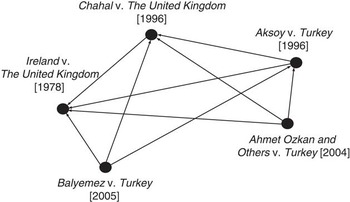
To illustrate how citations can be analysed as a network, consider a series of landmark judgements in the ECtHR's case law on torture and national security. The ECtHR's judgement in Ireland v. The United Kingdom [1978] established that no derogation is permissible from state obligations to refrain from torture even in the event of a security emergency, such as the IRA's terrorist attacks. This principle is referred to in Chahal v. The United Kingdom [1996], which established a prohibition on extradition of individuals to countries where they may be tortured, even if the individuals are suspected terrorists. Both of these cases were cited in Aksoy v. Turkey [1996], in which the Court established that when an individual (in this case a suspected Kurdish terrorist) is taken into police custody in good health but is found injured on release, the burden is on the state to provide a plausible explanation that no torture took place. All three of these cases were cited in the more recent cases of Balyemez v. Turkey [2005] and Ahmet Ozkan and Others v. Turkey [2004], both of which addressed cases of Turkish security forces destroying Kurdish villages. The relationships between these cases in the network are shown in Figure 1.
The citations network of five landmark torture judgements

We have data on all 7,319 cases the Court decided up to and including 2006. These judgements include 35,963 citations to previous Court decisions.Footnote 52 Like the citation networks studied by other scholars,Footnote 53 the Court's citation network has one main cluster and a large number of isolated cases, almost all of which neither cite precedent nor are cited by other cases.Footnote 54 Following the work of prior citation studies, we exclude these isolated cases from our analysis because they are effectively not part of the citation network. Thus, we are left with a main cluster of 6,172 cases and 35,962 citations. An important institutional difference between the ECtHR and the USSC is case selection. The certiorari system allows the USSC to focus its activities on resolving fundamental questions about how the Constitution should be interpreted. Instead, the ECtHR must accept all cases that meet admissibility criteria. This leads to large groups of identical cases that derive from the same underlying problem. For example, there have been thousands of cases concerning the inefficiency of the Italian court system and these are often dealt with using expedited procedures, sometimes leading to hundreds of identical decisions on a day. Since 2004, the ECtHR has adopted a pilot procedure to deal more efficiently with such duplicate cases. On such cases, the Court is not acting as an international review court but as a lower court that engages in straightforward applications of case law. We exclude such judgements from our database as they provide no information about our questions of interest.Footnote 55 Having done so, we are left with a network of 2,222 cases and 16,863 citations.
Judgements can invoke many articles of the Convention. The article most frequently invoked in judgements is Article 6, with which about half of the decisions in the network are concerned. This article provides for the right of access to fair, speedy and independent courts. Most Article 6 cases involve clause 6.1, which grants a set of trial rights and is most often invoked by individuals arguing they were given unreasonably slow trials. Article 6.1 cases represent 46 per cent of all the cases in the network, so we analyse them separately from other Article 6 cases in the remainder of this article. Article 8 (19 per cent) provides for a broad right to privacy from government authority, subject to exceptions such as national security and public safety. Article 13 (19 per cent) states that national authorities must provide an effective remedy to persons whose rights under the Convention have been violated, including in cases where those violations were committed by persons acting in an official capacity. Article 5 (17 per cent) guarantees a right to liberty, subject to exceptions such as lawful detention. The first Article of Protocol 1 (16 per cent) provides a right to the enjoyment of one's possessions. Article 3 (15 per cent) prohibits torture and other inhuman treatment. Article 14 (11 per cent) prohibits discrimination in the enjoyment of Convention rights on bases such as gender, race, religion and political affiliation.Footnote 56 Article 10 (11 per cent) provides for the freedom of expression, subject to exceptions such as national security and public safety. Finally, Article 2 (7 per cent) provides for a general right to life, subject to limited exceptions such as the killer claiming self-defence or lawful execution. Turkey has the plurality of cases in the data (14 per cent), followed by France (12 per cent), the United Kingdom (11 per cent) and Italy (8 per cent).
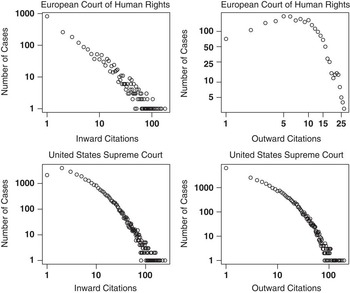
A useful way of summarizing the properties of a citation network is by examining the distributions of inward citations (i.e., citations to a case) and outward citations (i.e., citations from a case). Other studies have shown that most USSC decisions are cited by relatively few other cases, while a small number of decisions are cited very often.Footnote 57 Similarly, most USSC decisions cite relatively few other precedents, while a minority of decisions cite many precedents. As the log-log plots in Figure 2 show, the ECtHR resembles the USSC in this respect.Footnote 58
Log-log distributions of inward and outward citations in the European Court of Human Rights and the United States Supreme Court

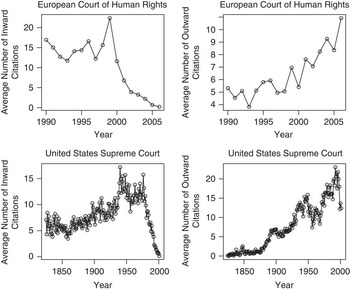
The extent to which judges in any court cite precedent is subject to changes over time as the number of relevant precedents grows and behavioural norms change. Studies of the USSC have shown that, while the average USSC decision cited fewer than five of the Court's precedents (outward citations) during the nineteenth century, by the beginning of the twenty-first century that number had grown to over twenty.Footnote 59 The ECtHR has experienced a similar growth in the number of outward citations, as shown in Figure 3. There is a particular increase in the number of outward citations after 1999, the first year of the post-Protocol XI Court.Footnote 60 Before the adoption of this protocol, states were allowed to exempt themselves from compulsory jurisdiction and direct access for private litigants. Protocol XI made both private access and compulsory jurisdiction mandatory. Moreover, the Protocol implemented further institutional reforms that made the ECtHR a full-time court and insulated the judges more securely. In both courts, the decline in the number of inward citations in recent years is due to the fact that these cases have been in the network for a relatively short time.
The average numbers of inward and outward citations in the European Court of Human Rights and the United States Supreme Court

Which Judgements Are More or Less Strongly Embedded in Case Law?
In order to test the hypotheses provided by the alternative models of citation behaviour, we analyse the extent to which ECtHR decisions cite important precedents by relying on the network concept of centrality. Decisions that are more central are those that are deeply embedded in the network, either because of the extent to which they cite other decisions or because they have been cited by other central decisions, and most often for both reasons. By contrast, decisions that are peripheral are not well connected to other precedents in the network. Scholars of US courts have developed measures of centrality that carry considerable face validity as measures of the importance of precedent.Footnote 61 The measurement procedure identifies the extent to which judgements serve as hubs and authorities within the citation network, based on a method developed by Kleinberg.Footnote 62 A hub is a judgement that cites many other judgements, helping to define which legally relevant decisions are pertinent to a given precedent. An authority is a judgement that is widely cited by other judgements.
Most judgements act as both hubs and authorities, and the degree to which they fulfil these roles is mutually reinforcing within the network of cases. An opinion that is a good hub cites many good authorities, and an opinion that is a good authority is cited by many good hubs. Two factors directly affect the hub score of a case: (1) the number of other cases it cites; and (2) the authority scores of the cases it cites. Thus, while it is possible for a case to have a large hub score by simply citing many unimportant cases, the cases with the largest hub scores are ones that cite many important precedents. Thus, the hub score is a good measure of the extent to which an opinion relies on citations to precedent to justify the Court's decision. It should be noted that these scores are dynamic. For example, the hub score of a given opinion may change over time as the cases it cites are cited (or not cited) by other cases because that activity causes their authority scores to change. Similarly, the authority score of a case may change as it is cited by more cases, especially if those cases have large hub scores.
Fowler and Jeon calculated hub scores and authority scores for all USSC majority opinions through 2002.Footnote 63 They showed that the scores are consistent with expert opinions of the most influential cases and can be used to predict which cases will be identified as important in the future. Unfortunately, we have no similar external data to validate the ECtHR authority scores, but the scores do have face validity. The judgement with the largest authority score is the 1978 landmark Ireland v. The United Kingdom case, one of the Court's rare inter-state cases. The Court's own ranking of the importance of cases can also be used to assess validity. The mean authority score for Level 1 cases is 24.6, while the mean authority score for Level 2 cases is 6.7, a significant difference at the 99 per cent level. In addition, cases that come to the Court from the Grand Chamber, which are generally more important,Footnote 64 have a mean authority score of 33.4, while other cases have a mean authority score of 6.4, a significant difference at the 99 per cent level.
We can use the hub scores of the ECtHR to test Hypotheses 1–4. Hypothesis 1 states that cases addressing the legal issues that appear most often before the Court should have larger hub scores. Hypothesis 2 asserts that Articles 2 and 3 cases have larger hub scores. Hypothesis 3 maintains that decisions against governments and where the Court overturns a preliminary objection have larger hub scores. Finally, Hypothesis 4 states that cases from common law countries should have larger hub scores than those from other legal traditions.
We focus on the hub scores of opinions when they were published (Initial Hub Score) because we want to know the extent to which each opinion was embedded in the precedent network at that time.Footnote 65 To determine the extent to which the legal substance of a case affects the Initial Hub Score, we include several dummy variables that indicate whether the decision addressed the provisions of the Convention that are invoked most frequently in the network (coded 1 if ‘yes’ and 0 if ‘no’). While we have only made ex ante predictions with respect to Articles 2 and 3, it may be the case that other legal issues have significant relationships with the extent to which ECtHR judgements are embedded in precedent.
Several other characteristics of decisions may also affect the extent to which the Court relies on citations to precedent in its judgements. To test Hypothesis 3, we include dummy variables indicating cases in which the Court finds that a government has violated the Convention (Violation Found) and those in which it rules against a country's preliminary objection (Preliminary Objection Rejected). To test Hypothesis 1, we include a count of the number of previous cases that had addressed one or more of the articles addressed in the present case (Prior Cases on Article). Because the Grand Chamber tends to take on more salient cases, it may be the case that its decisions will exhibit a greater reliance on precedent, so we include an indicator for these cases (Grand Chamber). As noted above, the Court began relying more heavily on citations to precedent after the implementation of Protocol XI, so we control for whether the case was decided before or after this event (Post-Protocol XI).
In order to correct for country-specific variation we first estimate a model with country fixed effects. In Models 2–4, we replace country fixed effects with several measures of country-level attributes.Footnote 66 Most importantly, we include several dummy variables indicating the type of legal system used in each case's country of origin (Legal Origin), using data from La Porta et al.Footnote 67 The base category is the common law system. Because countries tend to violate (or allegedly violate) the same provisions of the Convention on many occasions, there is some correlation between the country of origin of the cases in the network and the legal substance of those cases. For example, 148 of the 265 French cases in the network involve Article 6.1. Including the dummy variables for both legal origin type and legal substance is intended to untangle this correlation in order to determine whether country characteristics or legal substance is more important to the ECtHR judges’ choices of precedents.
Other country-specific factors may affect the extent to which the Court cites precedent. First, the income level of a respondent country may be related to the severity of the alleged violation, so we also include a measure of the natural log of per capita gross domestic product (GDP) of the country of origin during the year in which the case was decided, using data from the Penn World Tables (Log Per Capita GDP).Footnote 68 Second, violations may likewise be more severe in less democratic countries, so we include a control for democracy using the Polity IV data (Democracy).Footnote 69 Third, the level of human rights observance in a country may also influence the extent to which ECtHR judges are able to persuade domestic judges, so we control for this using the measures of respect for physical integrity rights (Physical Integrity) provided by the Cingranelli–Richards (CIRI) Human Rights Dataset (2009).Footnote 70 With respect to both Democracy and Physical Integrity, Russia and Turkey are outliers from which there are significant numbers of cases in the network. Therefore, we include dummy variables for these countries to verify that our results are not driven by these outliers. To the extent the Court cites precedent in order to persuade domestic judges, the strength of this justification may vary depending on the effectiveness and independence of domestic courts. In Model 3, therefore, we add a control for judicial independence as measured by CIRI (Judicial Independence). Finally, the extent to which countries respect other fundamental rights may affect the extent to which the Court cites precedent, and we account for this by including in Model 4 the CIRI measure of respect for several empowerment rights, including freedoms of speech, movement and religion (coded to increase with greater respect for these rights) (Empowerment).
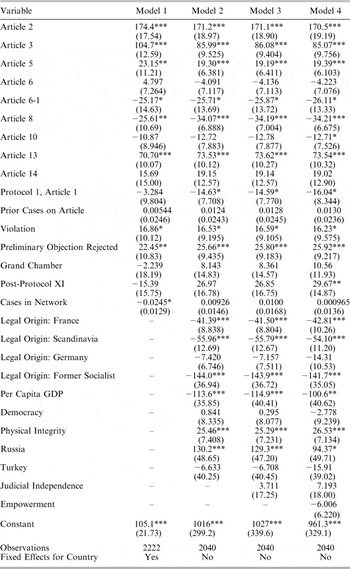
Finally, we note that, by virtue of the algorithm used to calculate them, Initial Hub Scores decline over time as more cases enter the network. Because this decline reflects the construction of the network measures rather than a substantive change in the extent to which decisions are grounded in precedent, we control for the number of prior cases in the network (Network Cases). Finally, because our dependent variable is bound to be non-zero and has a large number of values clustered at zero (i.e., opinions that cite no case precedent), we use Tobit regression.Footnote 71Table 2 reports our results.Footnote 72
Tobit Models of ECtHR Initial Hub Scores

Note: Robust standard errors are listed below the coefficients, in parentheses. ***p < 0.01, **p < 0.05, *p < 0.1.
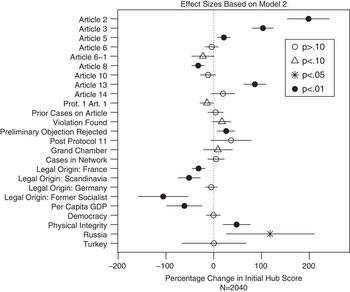
To facilitate interpretation of the substantive effects of these results, we re-estimated Model 2 using the Zelig package in the R programming language.Footnote 73 We then calculated the effect sizes of the explanatory variables on Initial Hub Score, which we report in Figure 4.
Effect sizes based on Model 2 Note: For continuous variables, effect sizes are the percentage changes in the dependent variable of a one-standard-deviation increase in the explanatory variable. For dummy variables, effect sizes are the percentage changes in the dependent variable of an observation of ‘1’ versus an observation of ‘0’. Effect sizes are shown with 95 per cent confidence intervals.

A first key finding is that those decisions dealing with the most sensitive physical integrity rights (Articles 2 and 3) have significantly larger Initial Hub Scores, which supports Hypothesis 2. As we argued above, these difficult cases are the ones in which the Court is likely to have the greatest need to justify its decisions. In addition, several other areas of law appear to affect the Initial Hub Score. Cases involving Articles 5 (right to liberty) or 13 (effective remedy) also result in larger Initial Hub Scores, suggesting these are also areas where legitimacy is of great concern to the Court. These findings are not surprising because Article 5 cases also often involve physical integrity rights, whereas Article 13 is always invoked in conjunction with other Convention articles and often accompanies controversial Articles 2 and 3 cases. Article 13 ensures that victims have a right to an effective remedy ‘notwithstanding that the violation has been committed by persons acting in an official capacity’. Since domestic courts are often involved in ensuring that such an effective remedy is achieved, more authoritative precedent may help persuade them to take action.
Article 6.1 (trial rights) and 8 (privacy) cases generally result in smaller Initial Hub Scores, although these effects are relatively small. A possible reason for this is that these cases lend themselves better to a more contextual interpretation that may rely on precedent to a lesser extent. Another possibility is that these areas of law remain in flux and, therefore, the Court does not have a consistent set of precedents to follow. Interestingly, these two articles have the largest numbers of cases in the sample. Thus, this result indicates that the Court does not simply cite more precedents in areas in which it has decided the most cases, as Hypothesis 1 predicts. In addition, we find that there is no significant relationship between Prior Cases on Article and Initial Hub Scores, which further suggests that the internal model-based prediction made in Hypothesis 1 does not hold.
Our findings also provide support for Hypotheses 3a and 3b. First, when the Court finds that a government has violated the Convention, it is more careful to justify its finding with reference to prior precedent. The Court also does so when it rules against the preliminary objection of a member state. The coefficients are of more modest size than those on the Articles 2 and 3 dummies, and the coefficient on Violation Found is only significant at the 0.072 level (two-tailed) in Model 2.
We next examine the relationship between legal origins and Initial Hub Scores. Because the common law system is the base category, we expected to find negative and significant coefficients. The coefficients on all of the categories are negative, although we cannot reject the null hypothesis that the Initial Hub Scores for cases from countries with German legal origins are not significantly different from those from countries with common law legal origin. Nonetheless, the coefficients for legal origin dummy variables are jointly significant, which supports Hypothesis 4. In an alternative specification that includes a dummy variable for cases from countries with common law legal origin, the coefficient is positive and significant (p < 0.001), which also supports Hypothesis 4. In that model, the substantive effect of common law legal origin is a 43.8 per cent increase in the Initial Hub Score.
Finally, the positive and significant coefficient on Physical Integrity suggests that the ECtHR is more careful to embed citations to precedent in cases from countries in which the government provides greater respect for these rights. More thorough justification may be needed in these countries because their domestic courts will need more persuading, especially because they can anticipate resistance from governments that regard themselves as generally compliant with the applicable legal standards.
Our results are robust to the inclusion of alternative measures of key control variables. Judicial effectiveness is a particularly difficult concept to measure, and no single dataset has gained universal acceptance.Footnote 74 In alternative specifications, we replaced the CIRI measure with the judicial independence measure developed by Tate and Keith and the International Country Risk Guide (ICRG) measure of Law and Order CIRI.Footnote 75 Likewise, human rights violations are the subject of several competing measures. We estimated additional models in which we replaced the CIRI index of physical integrity rights with the CIRI measures of state-sponsored torture and unlawful killings, the violations most closely associated with Articles 2 and 3, and with the political terror scale measures based on Amnesty International reports and US State Department reports.Footnote 76
Thus far, our analysis supports the strategic legitimation model in four ways. First, the Court embeds its opinions with precedent more thoroughly in the most politically sensitive decisions (Articles 2 and 3). Second, the Court is most careful to ground its decisions in authoritative precedent when domestic courts need the most convincing, i.e., in cases in which the Court rules against the respondent country. Third, the number of prior decisions covering similar issues does not affect the extent to which the Court relies on citations to precedent, as the internal model suggests. In fact, the areas of law with the most cases appear to have significantly smaller Initial Hub Scores. Finally, national characteristics of respondent governments do not explain why some decisions rely more on citations to precedent than others. This is a key indication that the Court chooses the precedents it cites based on the legal issues in the case, regardless of where those cases originated. The one exception to this is that cases against respondent governments with common law origins appear to be more embedded in case precedent than cases originating in states with certain other legal traditions, perhaps because common law courts are more used to this practice.
Communities in the Precedent Network Of The European Court Of Human Rights
To examine more carefully whether national factors or legal issues influence the types of cases ECtHR judges cite, we further analyse the network structure by applying community analysis. As discussed above, our strategic approach makes different predictions from the relativist approach regarding how communities should form within the citation network. This analysis is therefore crucial in distinguishing between these models. Both the internal and the strategic legitimation models predict that these communities are defined along areas of legal doctrine. By contrast, the relativist legitimation model predicts that the communities would be defined on the basis country characteristics, such as legal culture.
Consistent with the network analysis literature, we define a community as a group of cases that cite each other more often than they cite cases outside the community.Footnote 77 The method we used to detect the community structure of the network is designed to maximize the extent to which cases placed in a given community cite each other and minimize citations between cases in different communities. In network analysis, this is often referred to as the modularity of a network partition, which is an indication of how well it separates the communities from each other.Footnote 78 Community analysis has been applied in legislative studies of committee membership,Footnote 79 roll-call votingFootnote 80 and bill co-sponsorshipFootnote 81 in the US House of Representatives.
The method we use was described by Newman. It starts with a state in which each decision is a member of n communities.Footnote 82 It then pairs these communities, choosing the pairs so that each pair results in the greatest increase or smallest decrease in modularity. The algorithm continues to join communities into pairs until it finds the combination with the highest modularity. At this point, the algorithm assigns an arbitrary community identifier to each case.Footnote 83 The Newman method detects seven communities in the network of ECtHR citations. Each case is a member of only one community, and the naming of the communities is arbitrary. The first four communities contain 226, 792, 860 and 313 cases, respectively. Because Communities 5 (twenty-one cases), 6 (five cases) and 7 (five cases) contain so few cases, it is unlikely that we could gain from them any meaningful insight into the structure of the citations network, so we exclude them from the remainder of our analysis, leaving us with four main communities.
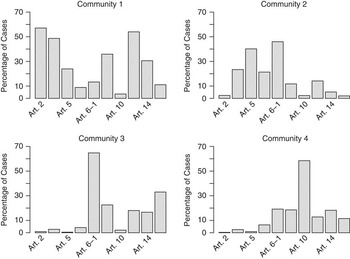
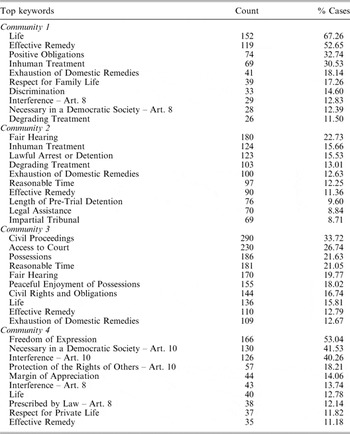
Figure 5 and Table 3 help to clarify the substantive interpretation of these communities by respectively showing the percentage of cases within each community that refer to a specific article and the most common keywords for cases within that community. Community 1 is composed primarily of cases that address the most serious personal integrity rights violations, including government actions or negligence that results in loss of life (Article 2) or inhumane treatment (Article 3). Article 8 (privacy) and 13 (effective remedy) violations are often invoked in conjunction with those violations. Article 6 (right to a free and fair trial) is the most commonly invoked provision in both Communities 2 and 3, although Community 3 generally includes Article 6.1 cases and not those dealing with other portions of Article 6. The cases in Community 2 primarily concern rights of criminal defendants and prisoner rights (e.g., Article 5). By contrast, the cases in Community 3 primarily concern civil proceedings, such as Article 6.1 and Article 1 of Protocol 1 (property rights). Finally, Community 4 mostly contains cases that address freedom of expression and possible exceptions to that – strikingly, the top four keywords in this community all pertain to Article 10 issues. These are civil and political rights issues that do not directly relate to the functioning of the judicial systems but rather to the limits of government interference into social and political life.
European Convention Articles addressed by cases, by community

Top Keywords by Community

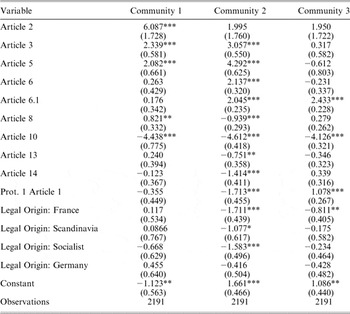
These findings suggest that membership in communities is determined by the legal substance of cases. Of course, because of the correlation between countries of origin and the legal substance of cases, we must perform additional analysis to understand the community structure. We do so by estimating a regression model that includes both the legal culture variables and the legal substance variables. Because the Newman algorithm returns the communities with exclusive categorical indicators, we used multinomial logistic regression to estimate a model using similar variables to our analysis of Initial Hub Scores. This is an appropriate model for these data because the community identifiers are categorically distributed by construction. In addition, a Small-Hsiao test shows that this model satisfies the independence of irrelevant alternatives assumption, and the model satisfies both the Wald and likelihood ratio tests for combining alternatives for all pairs of outcomes. Table 4 reports our results. Community 4 is the baseline category.
Multinomial Logit Model of ECtHR Network Communities

Notes: Robust standard errors are listed below the coefficients, in parentheses. ***p < 0.01, **p < 0.05, *p < 0.1.
These results demonstrate that legal substance is more important than legal system origins in terms of determining the community structure. Furthermore, the pseudo-R 2 of a model that includes only the legal substance variables is 0.4724, while the pseudo-R 2 of a model that includes only the legal system origin is 0.0176, a significant difference at the p = 0.001 level. One area where legal system origin seems to be important is that cases from countries with French or former-Socialist origins are less likely to be in Community 2 than in Community 4. A plausible explanation for this is that civil courts in common law systems tend to be less formalist and more efficient than those in systems of other legal origins, thus leading to fewer complaints about civil proceedings.Footnote 84
Because the community detection algorithm is designed to group together decisions that cite each other more often, these results mean that decisions on similar legal issues cite each other relatively more so than do decisions from countries with similar legal cultures. This provides strong support for our argument that ECtHR judges do not apply a relativist logic to their choice of precedent citations. The regression results also confirm the analysis above regarding the meanings of these communities. Cases involving Articles 2, 3 and 5, all of which concern physical integrity rights, tend to be in Community 1. While Articles 3 and 5 cases are also often in Community 2, we know from the keyword analysis above that these tend to be cases where procedural rights were violated, rather than cases where a life was taken unlawfully, as is the case for Community 1. Community 3 contains cases addressing various areas of civil proceedings, especially those involving Article 6.1 or Article 1 of Protocol 1. Finally, Community 4 appears to include primarily freedom-of-expression cases (Article 10), which we know from the negative, significant coefficients for Article 10 in all the other communities.
Conclusions
Our analysis strongly supports the argument that ECtHR judges cite precedent at least in part to provide strategic legitimation for their decisions. Judgements on politically sensitive issues are justified more fully with reference to past case law. The same holds for judgements in which the ECtHR rules against member state governments. This is consistent with a view that ECtHR judges believe domestic courts require more persuasion to push for implementation on judgements that the government is likely to resist. Further support for this thesis comes from the findings that the use of precedent increases when communicating with common law countries, in which legal professionals place particularly high value on justifying decisions with precedent. Moreover, the community analysis shows that ECtHR judges choose their precedent based on the legal issues in a case, not on the characteristics of respondent governments. This suggests that it is indeed legal professionals rather than politicians that are the prime target for legal justifications.
Our findings certainly do not imply that citations are not used to enhance internal communication and to improve efficiency. They do, however, imply that these are not the only purposes of citations. Citations also serve the purpose of legitimating decisions to an external audience. This finding is similar to that which studies of citation practices in domestic constitutional courts have found. Even domestic judges in well-established democracies do not operate in splendid isolation. In this sense, our findings are consistent with Voeten's finding that ECtHR judges are political actors in similar ways to domestic review judges: they wish to see the law reflect their policy preferences (as do domestic judges), but they do not necessarily use judgements to settle geopolitical scores or otherwise reflect national interests or culture.Footnote 85
This analysis contributes to the debate on whether supranational adjudication is becoming comparably effective to domestic adjudication, although we must be cautious about generalizing from our findings. The ECtHR is among the more advanced international courts hence, these conclusions may not apply elsewhere. Moreover, even if ECtHR judges use similar methodologies and techniques to those used by domestic review judges, it may well be that their decisions do not have similar effects. That aspect is beyond the scope of this article. Finally, we have only investigated whether the inclusion of case law is consistent across cases, not whether case law principles are applied consistently. Such a study would require more legal interpretation than we are equipped to provide. Yet, the absence of any systematic influence of country-specific factors on the citations of case law in an international court as heterogeneous as the ECtHR is telling about the potential of international law to supersede national divides.
As far as we know, this is the first social-scientific empirical analysis of the use and development of precedent in any international court. There is an increasing recognition among legal scholars and political scientists that the ability of international courts to develop legal norms is important not just because it creates de facto new legal obligationsFootnote 86 but also because it shapes strategic choices of states, such as decisions about where to file disputes.Footnote 87 In order to advance this study, we need a better understanding not just of how courts develop precedent but also how to measure attributes of precedent, such as its relative importance or centrality. In accordance with recent developments in the study of domestic courts, we argue that network analysis is the most appropriate tool for providing such measures.
In addition, ours is among the most comprehensive analyses of judicial citation networks. As a result, we have produced both methodological and substantive findings that should be of interest to a range of scholars. First, we have learned that, despite its short history, the changes in citation patterns in the ECtHR are similar to those at the USSC, which suggests the ECtHR develops precedent in a way that parallels certain domestic courts. Second, by conducting the first analysis of the substantive meanings of case communities within a network of judicial citations, we have provided a framework for scholars interested in doing so with respect to other courts. Finally, by applying the study of judicial citation networks to an international court, we demonstrate the utility of network analysis for studying international relations in a manner that goes beyond the applications used in the existing literature.Footnote 88
Our analysis opens up several fruitful avenues of future research. First, there are further possibilities for studying the development of precedent within the ECtHR, such as how the introduction of East European countries affected the structure of the citations network. Second, our study opens up opportunities to study the link between the ECtHR and other courts, including domestic courts within the Council of Europe, other international courts that regularly cite the ECtHR (especially the Inter-American Court of Human Rights), and even US courts, which cite the ECtHR more frequently than any other foreign court in cases where they use foreign decisions to interpret US law.Footnote 89 Finally, given its uncertain compliance environment, the ECtHR provides an ideal setting for testing whether the thoroughness of legal justification affects compliance with court decisions.