INTRODUCTION
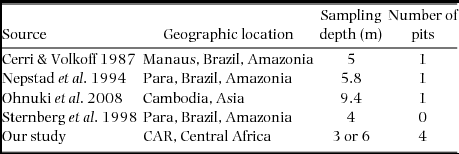
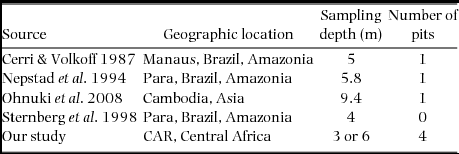
Tropical forests strongly influence regional climate by acting as a biotic pump (Makarieva & Gorshkov Reference MAKARIEVA and GORSHKOV2007, Spracklen et al. Reference SPRACKLEN, ARNOLD and TAYLOR2012). The considerable amount of water pumped from the soil to the atmosphere is of particular importance in the dry season in Amazonia, when most transpiration by trees comes from water withdrawn from deep soil layers or from the water table (Bruno et al. Reference BRUNO, DA ROCHA, DE FREITAS, GOULDEN and MILLER2006, Fan & Miguez-Macho Reference FAN and MIGUEZ-MACHO2010, Kleidon & Heimann Reference KLEIDON and HEIMANN2000, Nepstad et al. Reference NEPSTAD, DE CARVALHO, DAVIDSON, JIPP, LEFEBVRE, NEGREIROS, DA SILVA, STONE, TRUMBORE and VIEIRA1994). Soil-vegetation-climate models are thus sensitive to the distribution of tree roots in deep soil layers in tropical regions (Akkermans et al. Reference AKKERMANS, LAUWAET, DEMUZERE, VOGEL, NOUVELLON, ARDO, CAQUET, DE GRANDCOURT, MERBOLD, KUTSCH and LIPZIG2012, Nepstad et al. Reference NEPSTAD, LEFEBVRE, DA SILVA, TOMASELLA, SCHLESINGER, SOLORZANO, MOUTINHO, RAY and BENITO2004). Root distribution can be measured directly in the field, or estimated indirectly using primary production data and soil-vegetation-climate models (Ichii et al. Reference ICHII, HASHIMOTO, WHITE, POTTERS, HUTYRA, HUETE, MYNENI and NEMANIS2007, Kleidon & Heimann Reference KLEIDON and HEIMANN2000, Schenk & Jackson Reference SCHENK and JACKSON2005). Direct measurements of deep roots are still rare in natural tropical forests. Only in three studies out of the 26 listed by Schenk & Jackson (Reference SCHENK and JACKSON2002) were roots sampled a depth of at least 3 m (Cerri & Volkoff Reference CERRI and VOLKOFF1987, Nepstad et al. Reference NEPSTAD, DE CARVALHO, DAVIDSON, JIPP, LEFEBVRE, NEGREIROS, DA SILVA, STONE, TRUMBORE and VIEIRA1994, Sternberg et al. Reference STERNBERG, GREEN, MOREIRA, NEPSTAD, MARTINELLI and VICTORIA1998). To our knowledge, only one additional measurement of deep rooting (Ohnuki et al. Reference OHNUKI, SHIMIZU, CHANN, TORIYAMA, KIMHEAN and ARAKI2008) has been made since then (Table 1). Many tropical root profiles are thus sampled too shallowly to enable accurate estimation of the 95% rooting depth, D95 (Schenk & Jackson Reference SCHENK and JACKSON2002). The values of rooting depth and maximum rooting depth in tropical forests are still the subject of debate. Schenk & Jackson (Reference SCHENK and JACKSON2002) reported that 50% and 95% of the roots of trees in tropical semi-deciduous, deciduous and evergreen forests are generally found in the upper 16 cm and 95 cm of the soil, respectively. However, Ohnuki et al. (Reference OHNUKI, SHIMIZU, CHANN, TORIYAMA, KIMHEAN and ARAKI2008) showed that roots can penetrate much deeper. The maximum rooting depth of trees in tropical semi-deciduous forests, which was deduced from a single study in China, was 3.7 ± 0.5 m (Canadell et al. Reference CANADELL, JACKSON, EHLERINGER, MOONEY, SALA and SCHULZE1996), but Nepstad et al. (Reference NEPSTAD, DE CARVALHO, DAVIDSON, JIPP, LEFEBVRE, NEGREIROS, DA SILVA, STONE, TRUMBORE and VIEIRA1994) reported a maximum rooting depth of more than 10 m in an Amazonian rain forest.
Quantitative studies of vertical root distribution in tropical forests with sampling soil depths ≥ 3 m. Sternberg et al. (Reference STERNBERG, GREEN, MOREIRA, NEPSTAD, MARTINELLI and VICTORIA1998) studied root distribution with a root auger.
Meta-analysis and global models predict that root distribution and maximum rooting depth are mainly affected by climate variables and soil characteristics (Ichii et al. Reference ICHII, HASHIMOTO, WHITE, POTTERS, HUTYRA, HUETE, MYNENI and NEMANIS2007, Schenk & Jackson Reference SCHENK and JACKSON2002, Reference SCHENK and JACKSON2005). Firstly, Schenk & Jackson (Reference SCHENK and JACKSON2005) predicted that tropical forests are most likely to be deep-rooted in strongly seasonal semi-deciduous or in evergreen forests. A soil water balance model confirmed that root distributions tend to be as shallow as possible and as deep as needed to fulfil evapotranspiration demands (Schenk Reference SCHENK2008). Ichii et al. (Reference ICHII, HASHIMOTO, WHITE, POTTERS, HUTYRA, HUETE, MYNENI and NEMANIS2007) estimated maximum rooting depth to be 1–3, 3–5 and 5–10 m in Amazonian regions with a 0–2-mo, 3–4-mo and 5–6-mo dry season, respectively. Secondly, Schenk & Jackson (Reference SCHENK and JACKSON2002) showed that root distribution in tropical evergreen forests was shallower in sandy soils than in soils with a finer texture. Canadell et al. (Reference CANADELL, JACKSON, EHLERINGER, MOONEY, SALA and SCHULZE1996) cited some examples in which roots reached great depths even in rocky soils, and by penetrating through hard pans. However, overall, global models have been validated using only very few deep field measurements, none of which were made in Central Africa which is home to large areas of semi-deciduous tropical forests.
Given the scarcity of data, some of which are biased and controversial, the aim of our study was to investigate root distributions of a common tree species Entandrophragma cylindricum Sprague (Meliaceae), in two common soil types, Ferralsols and Arenosols, in a semi-deciduous rain forest with a dry season in Central Africa. We hypothesized that (1) root distribution is deeper than that frequently reported in the literature from field measurements, i.e. 50% rooting depth > 16 cm, 95% rooting depth > 95 cm, and the maximum rooting depth > 3.7 m; (2) rooting depth is shallower in Arenosols than in Ferrasols. Our study, which provides data from field measurements made in an understudied part of the world, can be used to validate global models which predict root distribution and maximum rooting depth.
METHODS
Study sites
The study was carried out in the Central African Republic (CAR), at two sites located 80 km apart, one close to the town of Mbaiki (3°52′30″N, 17°59′00″E) and the other close to Ngotto (4°01′30″N, 17°20′00″E) (Figure 1). Mbaiki and Ngotto have a similar topographical position, top of a plateau, at an altitude of 560 m and 630 m asl, respectively. In CAR, this topographic position accounts for a large part of the semi-deciduous rain forest (Boulvert Reference BOULVERT1996). The climate at both sites is humid-tropical with an average annual rainfall of 1740 mm (1982–2007), a dry season lasting 3–5 mo (November/December–February/March, with less than 100 mm precipitation) and a mean temperature of 24.9°C (1981–1989) (Boukoko meteorological station, A. Ougou, pers. comm.). The vegetation at both sites is semi-deciduous rain forest of the Guineo-Congolian region which covers about 43000 km2 in CAR. The floristic composition differed slightly between the two study sites: the number of evergreen taxa was higher in the Ngotto forest than in the Mbaiki forest (Gond et al. Reference GOND, FAYOLLE, PENNEC, CORNU, MAYAUX, CAMBERLIN, DOUMENGE, FAUVET and GOURLET-FLEURY2013, Rejou-Mechain et al. Reference REJOU-MECHAIN, PELISSIER, GOURLET-FLEURY, COUTERON, NASI and THOMPSON2008). At Mbaiki, the canopy was dominated by species from the Malvaceae, Meliaceae, Ulmaceae and Sapotaceae (Boulvert Reference BOULVERT1986), whereas at Ngotto, the canopy was dominated by species from the Caesalpiniaceae, Sapotaceae, Meliaceae and Moraceae (Yongo Reference YONGO2003). Finally, at a global scale, the climate and the vegetation at both sites belongs to the bioclimatic type that Blasco et al. (Reference BLASCO, WHITMORE and GERS2000) called warm humid lowland forests, i.e. 1000–2000 mm mean annual rainfall, 1–4 dry months and a mean temperature in the coldest month > 20°C. This bioclimatic type is found in a large part of Central Africa, the south-eastern and the southern part of Amazonia, and a small part of Asia. The soils and the geology also differed at the two sites (Table 2). At Mbaiki, the soils are Ferralsols developed on Precambrian quartzite-sandstone, whereas at Ngotto the soils are Arenosols developed on Cretaceous sandstone (Boulvert Reference BOULVERT1996; Figure 1). At Mbaiki, the Ferralsols may contain a gravel horizon at a depth of between 1 m and 3 m, followed by an iron duricrust and/or weathered rocks, whereas such horizons are not present in the Arenosols of Ngotto down to a depth of at least 3 m (Boulvert Reference BOULVERT1983). Ferralsols are very common in rain forests in Central Africa and Amazonia, whereas Arenosols are only common in rain forests in Central Africa (Driessen et al. Reference DRIESSEN, DECKERS, SPAARGAREN and NACHTERGAELE2001).
Characteristics of the study sites. Dry-season length was defined by the number of months with rainfall ≤ 100 mm mo−1. The monthly rainfall data were taken from MeteoSat 2000–2008 and from Boukoko Meteorological Station (1982–2007). Soil type WRB classification was determined according to Boulvert (Reference BOULVERT1983) and the Harmonized World Soil Database Viewer, version 1.2 (http://webarchive.iiasa.ac.at/Research/LUC/External-World-soil-database/HTML/).

Location of the two study sites, Mbaiki and Ngotto, in Central African Republic (CAR). The colours correspond to the soil mapping units of the Harmonized World Soil Database Viewer, version 1.2 (http://webarchive.iiasa.ac.at/Research/LUC/External-World-soil-database/HTML/): dark pink, Ferralsol; light pink, Arenosol.
Root sampling
We dug four pits (130–240 cm in length, 150 cm in width, 300–600 cm in depth), two per site, between April and June 2011. At each site, the two pits were located 1–1.5 km apart, on top of a plateau. We studied one side of each pit. The centre of this side was 50 cm away from an Entandrophragma cylindricum tree, a species of high commercial value commonly found in the tropical semi-deciduous forest in the Guineo-Congolian zone, which includes the Central African rain forest. It is distributed from Ivory Coast to Uganda (Gerdat 1974, Lebrun & Stork Reference LEBRUN and STORK2011). The location of each pit was carefully chosen to make sure that, on the one hand, the selected E. cylindricum specimens had similar diameters at breast height (44 ± 6 cm) and, on the other hand, that the size of neighbouring trees was similar (i.e. the basal area within 3 m of the specimen selected was 7 ± 4 m2 ha−1). The two pits in the Ferralsols (Mbaiki 1, Mbaiki 2) were dug to a depth of 6 m. Athough we planned to dig the two pits in the Arenosols (Ngotto 1, Ngotto 2) down to the same depth, we were obliged to stop digging at a depth of 3 m, due to technical difficulties caused by the sandy soils (the pit collapsed). We determined the root distribution profile inside each trench using the root intersect counting method (Laclau et al. Reference LACLAU, SILVA, LAMBAIS, BERNOUX, LE MAIRE, STAPE, BOUILLET, GONÇALVES, JOURDAN and NOUVELLON2013, Tardieu Reference TARDIEU1988). A 1.50 × 1-m grid subdivided into grid cells measuring 10 × 10 cm was placed vertically against the pit wall and the root intersects were counted individually. Roots with a diameter greater than 1 mm were measured with callipers. Root intersects were counted at 1-m intervals as the pits was dug, so that the roots would not dry out. Roots of E. cylindricum trees can be identified by their particular scent (they smell like roses). Although we did not distinguish each individual E. cylindricum root from the roots of neighbouring tree species, observations showed that the majority of roots counted belonged to E. cylindricum trees.
At Mbaiki 2 (Ferralsol) and Ngotto 2 (Arenosol), soil cores were sampled from the bottom of each pit using a root auger. The soil layers sampled were 600–620 cm, 630–650 cm, 680–700 cm, 700–720 cm, 730–750 cm, 780–800 cm at Mbaiki 2, and 300–320 cm, 330–350 cm, 380–400 cm, 400–420 cm, 430–450 cm, 480–500 cm, 500–520 cm at Ngotto 2. All the roots were placed in a 550-μm-mesh sieve and washed free of soil with tap water. The volume of soil sampled in each layer was 4710 cm3. Rooting depth was observed down to a depth of 8 m in the Ferralsol at Mbaiki 2 and to a depth of 5.20 m in the Arenosol at Ngotto 2.
Each soil profile was characterized. Soil samples collected in the topsoil, at depths of 0–20 cm or 10–20 cm, and samples collected in deep layers, at depths of 100 and 300 cm were the subject of standard physical and chemical analyses at Cirad laboratories in Montpellier, France.
Data analysis
We classified the roots according to their diameter (d): fine roots (d < 2 mm); medium roots (2 ≤ d < 10 mm); and coarse roots (d ≥ 10 mm). In the coarse-root class, we did not distinguish subclasses (e.g. structural roots) because only one to three roots > 50 mm in diameter were counted in each soil profile.
In the two topsoil profile at the Ngotto site, we observed a dense root mat, whose thickness ranged from 1 to 8.5 cm. Since it was impossible to count these roots individually, for each grid cell of 10 × 10 cm, from the soil surface to the depth of 10 cm, we estimated the number of root intersects in the root mat, N mat, using the equation:
 \begin{equation*}
N_{{\rm mat}} = N_{{\rm below\_mat}} \times T_{{\rm mat}} /(10 - T_{{\rm mat}} )
\end{equation*}
where N below_mat is the number of root intersects below the root mat and T mat is the thickness of the root mat (cm).
We counted the number of fine, medium and coarse roots in each layer of the soil profiles we sampled (150 cm wide and 10 cm deep). We calculated the absolute root intersect density (RID, expressed in roots m−2), the relative RID, which represents the percentage of roots at the depth considered relative to the total number of roots counted in the soil profile, and the cumulative root fraction, which represents the percentage of roots from the soil surface to the depth considered relative to the total number of roots counted in the soil profile. RIDs were calculated to the maximum depth of the soil profile (6 m for the Ferralsol and 3 m for the Arenosol) and relative densities were calculated down to a depth of 3 m, so that we were able to compare our two study sites with each other, as well as with the meta-analysis as per Schenk & Jackson (Reference SCHENK and JACKSON2002).
For each profile, we estimated the two parameters, D 50 and c, of a logistic model proposed by Schenk & Jackson (Reference SCHENK and JACKSON2002):
 \begin{equation}
{\rm Y} = 1/(1 + ({\rm D}/{\rm D}_{50} )^{\rm c} )\end{equation}
where Y is the cumulative root fraction, D is depth, D 50 is the depth above which 50% of the roots were present and c is a shape parameter. The value of D 95, the depth above which 95% of roots are present, was predicted a posteriori, after estimating the two parameters of the model, D 50 and c, using the formula:
 \begin{equation}
{\rm D}_{95} = {\rm D}_{50} \times (0.05/0.95)^{{\rm 1/c}}\end{equation}
We also estimated the parameters of the model produced by Schenk & Jackson (Reference SCHENK and JACKSON2002) for the dataset published in previous studies carried out at least to 3 m in depth in evergreen tropical forests (Cerri & Volkov Reference CERRI and VOLKOFF1987, Nepstad et al. Reference NEPSTAD, DE CARVALHO, DAVIDSON, JIPP, LEFEBVRE, NEGREIROS, DA SILVA, STONE, TRUMBORE and VIEIRA1994, Ohnuki et al. Reference OHNUKI, SHIMIZU, CHANN, TORIYAMA, KIMHEAN and ARAKI2008) or in a tropical Eucalyptus plantation (Christina et al. Reference CHRISTINA, LACLAU, GONCALVES, JOURDAN, NOUVELLON and BOUILLET2011).
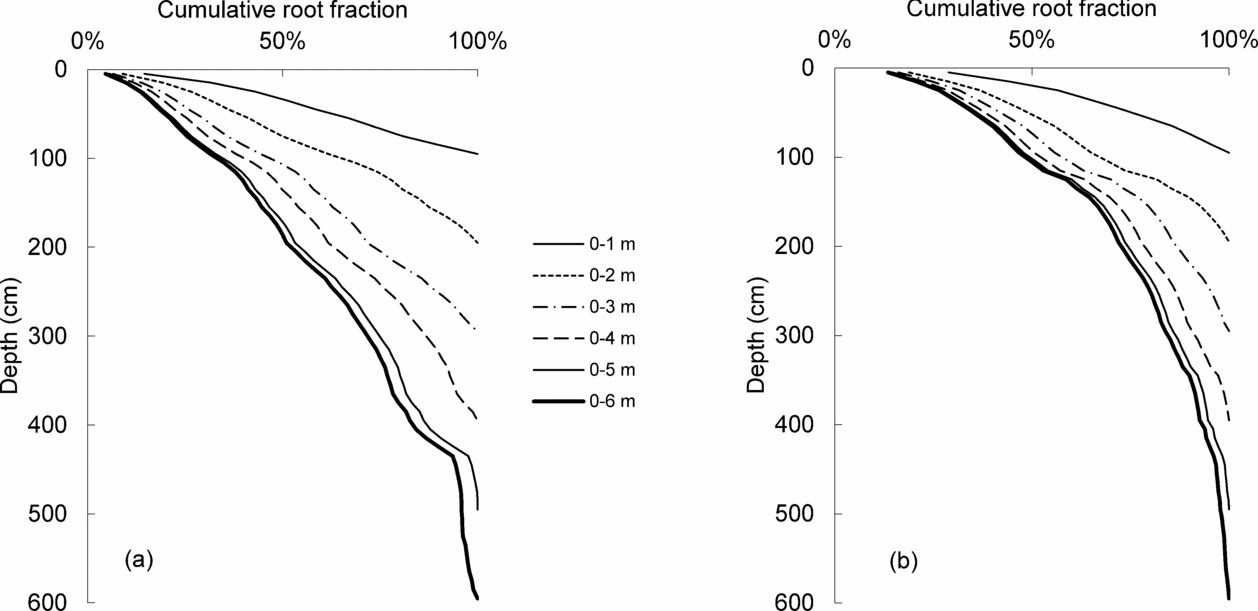
The consequences of sampling depth for the estimations of the parameters in Eq. (1) and Eq. (2) for fine roots were assessed in the two Ferralsols, which were sampled down to a depth of 6 m. The complete dataset in each soil profile (i.e. down to 6 m) was compared with five datasets simulating the observation of pit walls down to depths of 1, 2, 3, 4 or 5 m.
RESULTS
Soil properties
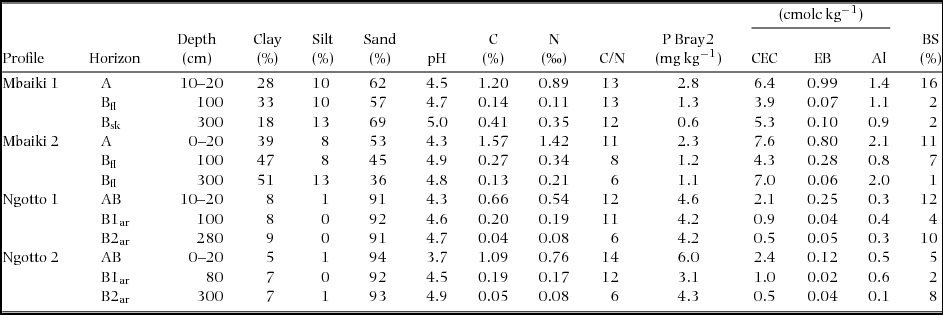
The description of the four soil profiles and the physical and chemical analyses confirmed that the two soil types were typical of Ferralsols and Arenosols. Both Ferralsol profiles had a ferralic horizon below a depth of 40 cm, with a micro-aggregated structure, and a weathered rock layer at a depth of 4 m (Figure 2). A Bsk skeletic horizon (i.e. 40% or more of the volume occupied by gravels) then a Bpp petroplinthic horizon (i.e. iron duricrust) were encountered between the depths of 2 m and 4 m in the Mbaiki 1 profile. The texture differed slightly between the two Ferralsol profiles. Mbaiki 1 had a sandy clay loam to very gravelly sandy loam texture whereas Mbaiki 2 had a sandy clay to clay texture (Table 3). No root mats were found in the two Ferralsols.
Physical and chemical properties of the four profiles. CEC, cation exchange capacity; EB, exchangeable bases ( = Ca2+ + Mg2+ + K+ + Na+); BS, base saturation ( = EB/CEC × 100). Designation for horizons: A, mineral topsoil horizon; B, mineral deep soil horizon; ar, arenic (i.e. having a texture class of sand); fl, ferralic; sk, skeletic (i.e. 40% or more of the volume occupied by gravels).
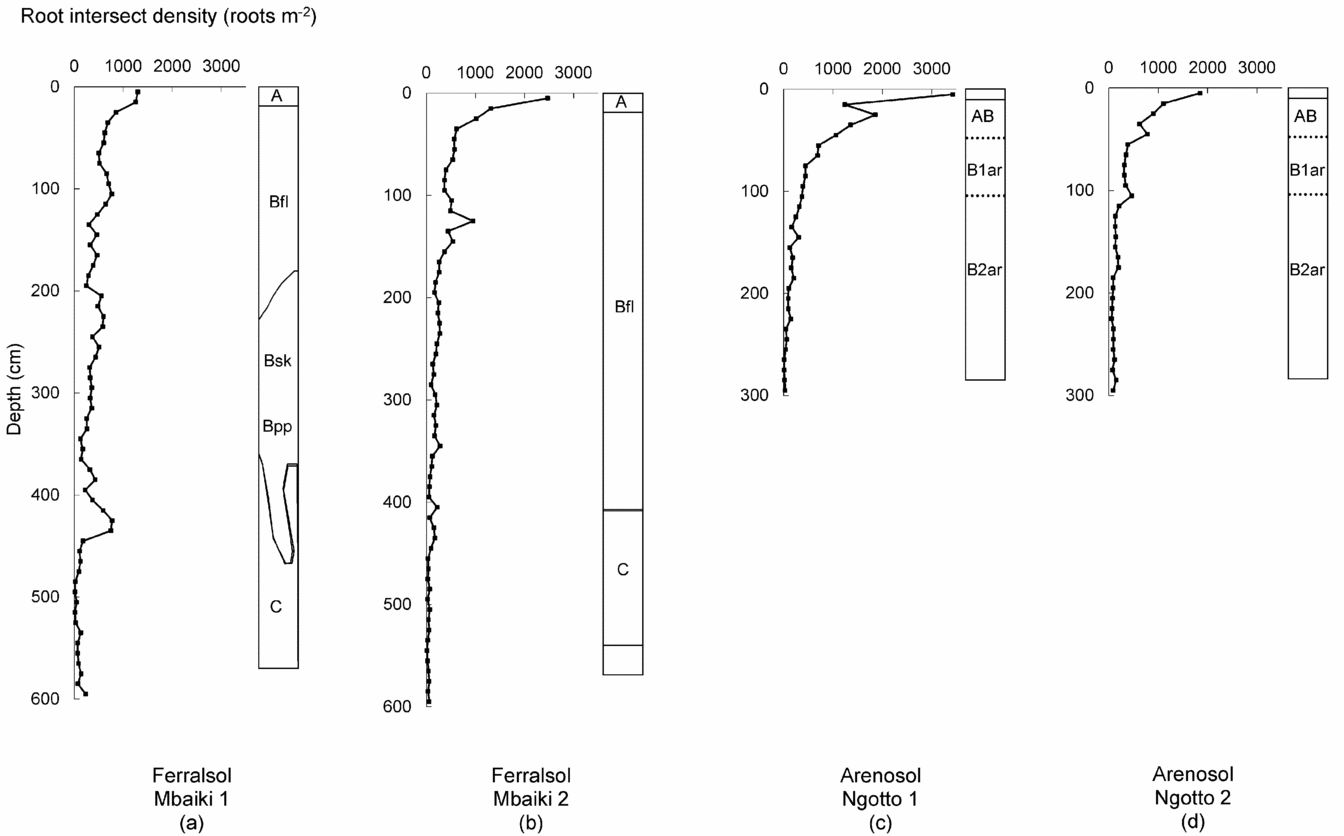
Total root intersect density and diagram of four soil profiles in CAR, two Ferralsols, Mbaiki 1 and Mbaiki 2, and two Arenosols, Ngotto 1 and Ngotto 2. The majority of roots belonged to Entandrophragma cylindricum. Designations for horizons: A, mineral topsoil horizon; B, mineral deep soil horizon; C, weathered rock (i.e. saprolite); ar, arenic (i.e. having a texture class of sand); fl, ferralic; pp, petroplinthic (i.e. iron duricrust); sk, skeletic (i.e. 40% or more of the volume occupied by gravels).
Both Arenosol profiles had a root mat made of high-density fine and medium roots in their topsoil layer. The mat was between 3 and 8.5 cm thick at Ngotto 1 and between 1 and 6 cm thick at Ngotto 2. Beneath this root mat, the soil horizons were characterized by a sandy texture and a weakly developed structure down to a depth of 50 cm and absent below this depth.
The two soil types also differed in their chemical properties (Table 3). The Ferralsols had higher CEC, sum of exchangeable bases and exchangeable aluminium concentrations than the Arenosols. The Ferralsols also had a higher total N concentration at a depth of 300 cm than the Arenosols – 0.29‰ on average versus 0.08‰. Conversely, the Ferralsols had lower available P concentrations than the Arenosols, regardless of depths – e.g. 0.9 mg kg−1 on average versus 4.3 mg kg−1 at a depth of 300 cm.
Vertical root distribution
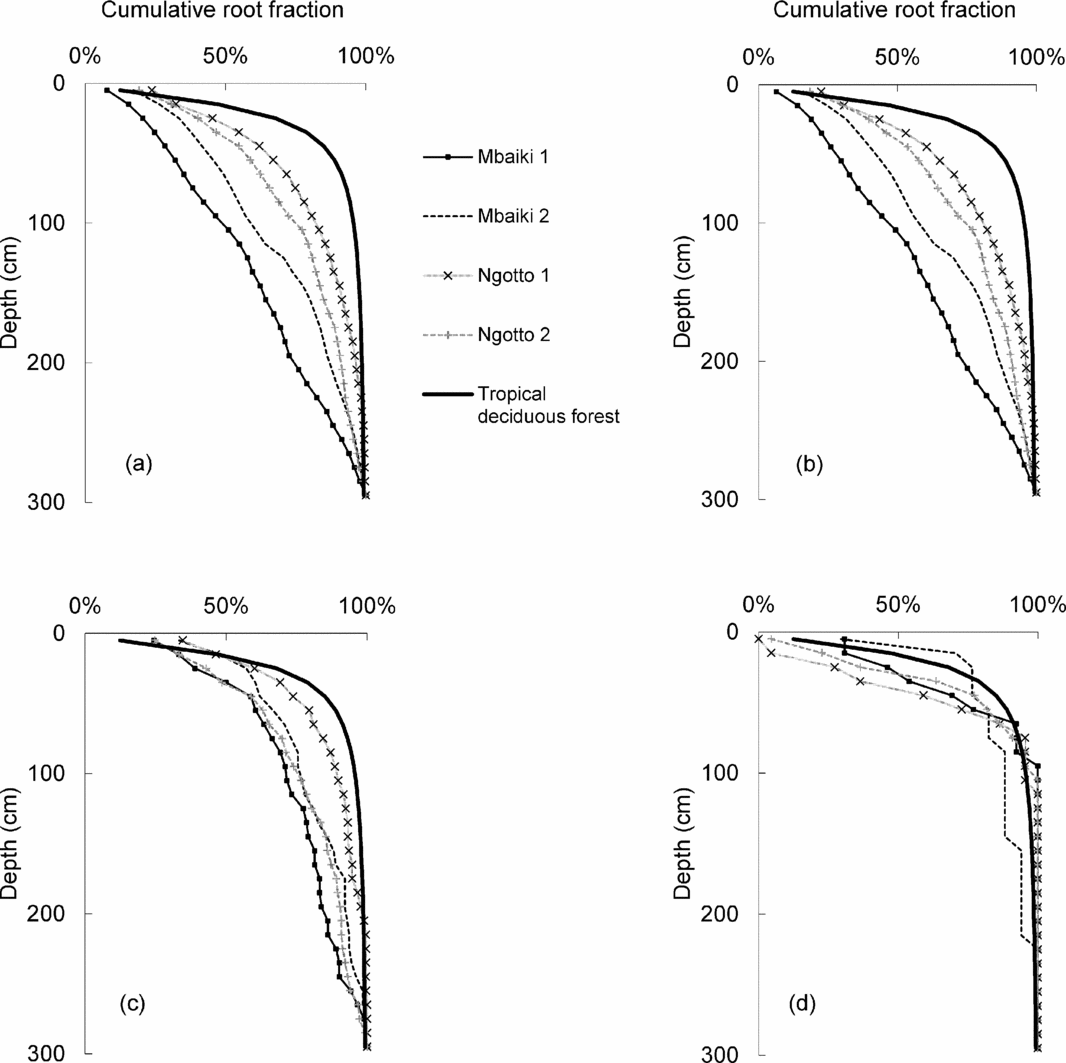
In all the soil profiles, RIDs, including all root intersects, decreased with depth (Figure 2). The sharpest decrease was found in the Ngotto 1 Arenosol, where root density decreased from 3427 roots m−2 in the 0–10 cm soil layer to 33 roots m−2 in the 290–300-cm soil layer. The decrease was smoother in the Mbaiki 1 Ferralsol, with a decrease from 1293 roots in the upper soil layer down to 353 roots m−2 in the 290–300-cm soil layer. In this soil profile, the RID remained high between the depths of 2 m and 4 m, which corresponded to the Bsk skeletic horizon.
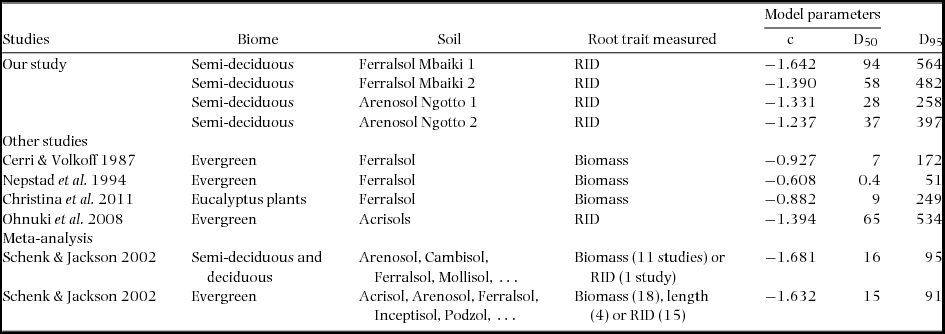
We estimated D50 between a depth of 28 and 94 cm, and predicted D95 between a depth of 258 and 564 cm, depending on the soil profiles. The Ferralsols had higher D50 and D95 values than the Arenosols – on average 76 cm versus 33 cm for D50, and 523 cm versus 328 cm for D95 (Table 4).
Estimated values of c, D50 (Equation 1) and predicted values of D95 (Equation 2) in the Schenk & Jackson (Reference SCHENK and JACKSON2002) model for root distributions in our study, compared with those computed from other studies, with a sampling depth fixed at 3 m. RID, root intersect density (unit: number of roots per unit surface area).
The vertical distribution of total roots was similar to that of the fine roots since the latter represented the majority of the roots we counted (Figure 3). Fine roots penetrated deep layers whereas coarse roots were mainly superficial. We found no coarse roots at a depth below 430 cm, 230 cm, 120 cm and 110 cm in Mbaiki 1, Mbaiki 2, Ngotto 1 and Ngotto 2, respectively.
Cumulative root fraction based on depth for total roots (a); fine roots, diameter < 2 mm (b); medium roots, 2 ≤ diameter < 10 mm (c); and coarse roots, diameter ≥ 10 mm (d) of four profile soils in CAR, two Ferralsols, Mbaiki 1 and Mbaiki 2, and two Arenosols, Ngotto 1 and Ngotto 2. The majority of roots belonged to Entandrophragma cylindricum. The tropical deciduous forest curve is derived from the Schenk & Jackson (Reference SCHENK and JACKSON2002) model of semi-deciduous and deciduous forests.
In the Ferralsols, E. cylindricum roots were still found in sizeable quantities (6, 7 and 35 roots in a volume of 1570 cm3) at a depth of 8 m, and at a depth of 5.2 m in the Arenosols, but in very small quantities (0, 0 and 1 root). In the Ferralsols, we found roots in both the weathered rock and in the iron duricrust (Figure 4).
Fine roots observed in the Mbaiki 1 Ferralsol in CAR at a depth of 5.9 m, around the iron duricrust (a), and in the gaps in the weathered rock – sandstone (b). The majority of roots belonged to Entandrophragma cylindricum.
Methodological bias due to sampling depth
The sampling depth strongly affected the shape of curves of the cumulative root fraction for fine roots and the associated estimated D50 and predicted D95 values (Figure 5). In Mbaiki 1 for example, the predicted D95 values were 30 cm, 100 cm or 163 cm depending on whether a sampling depth of 1 m, 3 m or 6 m was considered. This effect was weaker at depths below 5 m. For each soil profile, sampling depth explained a very high proportion of the variance in D50 and D95, between 95% and 99% (non-linear regression, n = 6, P < 0001; Figure 5).
Cumulative root fraction based on sampling depth for the Ferralsols Mbaiki 1 (a), and Mbaiki 2 (b) in CAR. The majority of roots belonged to Entandrophragma cylindricum.
DISCUSSION
The aim of this study was to investigate the root distribution of E. cylindricum in two common soil types, Ferralsols and Arenosols, in a Central African semi-deciduous rain forest with a dry season. We showed that the distribution of roots was twice to five times deeper than expected and cited in the literature, especially by Schenk & Jackson (Reference SCHENK and JACKSON2002). For example, we predicted that 95% of all roots were distributed to depths of between 258 and 564 cm from the soil surface. This range is much deeper than the 95 cm depth predicted by Schenk & Jackson (Reference SCHENK and JACKSON2002) in semi-deciduous and deciduous tropical forests. On the other hand, this range of D95 is consistent with the value of 534 cm deduced from the study performed by Ohnuki et al. (Reference OHNUKI, SHIMIZU, CHANN, TORIYAMA, KIMHEAN and ARAKI2008) in a dry tropical forest in Cambodia (Table 4). For the four pits in our study we always found that the predicted D95 values were greater than 2 m, which is the definition of deep rooting in Schenk & Jackson (Reference SCHENK and JACKSON2005). Our result differs from that of Schenk & Jackson (Reference SCHENK and JACKSON2005), who predicted that the probability of deep rooting in our study area was only 0.27 in Ferralsols, and 0.18 in Arenosols.
A methodological bias and the choice of the root traits considered could explain these differences between observed and expected root distribution by Schenk & Jackson (Reference SCHENK and JACKSON2002, Reference SCHENK and JACKSON2005). Firstly, the differences could have been the result of a methodological bias due to the sampling depth. Indeed, we showed that the values of D50 and D95 strongly depended on sampling depth (Figure 5). Our results confirmed in semi-deciduous tropical forests a methodological bias suggested by Schenk & Jackson (Reference SCHENK and JACKSON2002) in the estimates of rooting depths in all types of tropical forest because of too shallow sampling depth. Indeed, our results suggest that the values of D50 and D95 proposed by Schenk & Jackson (Reference SCHENK and JACKSON2002, Reference SCHENK and JACKSON2005) for tropical forests are greatly underestimated: their meta-analysis and empirical model was based on studies in which the sampling depth was generally less than 1 m and a maximum depth of 3 m. We recommend a sampling depth of at least 5 m and 3 m to enable more reliable estimates and prediction of D50 and D95 for semi-deciduous tropical forests with 3–5-mo dry season, and other rain forests with a less marked dry season, respectively.
Secondly, these differences could also be the result of the variable we chose to quantify root distribution, i.e. root intersect density. Our results are in fact similar to those deduced in the study by Ohnuki et al. (Reference OHNUKI, SHIMIZU, CHANN, TORIYAMA, KIMHEAN and ARAKI2008) who also measured root intersect density. This variable is mainly affected by fine roots, the relative proportion of which increases with depth (Schenk & Jackson Reference SCHENK and JACKSON2002). By contrast, our results differ from those of Christina et al. (Reference CHRISTINA, LACLAU, GONCALVES, JOURDAN, NOUVELLON and BOUILLET2011), Cerri & Volkoff (Reference CERRI and VOLKOFF1987) and Nepstad et al. (Reference NEPSTAD, DE CARVALHO, DAVIDSON, JIPP, LEFEBVRE, NEGREIROS, DA SILVA, STONE, TRUMBORE and VIEIRA1994), who measured root biomass. This variable is mainly affected by coarse roots, which are generally superficial, leading to lower estimated and predicted D50 and D95 values. As in their meta-analysis Schenk & Jackson (Reference SCHENK and JACKSON2002) used many root biomass studies to estimate root distribution of tropical forests (Table 4), we suggest that their method led them to underestimate D50 and D95 values. Further study is required to check if the choice of variable has a significant effect on rooting depth in tropical forests.
We found roots at a depth of 8 m and 5.20 m, in a Ferralsol and an Arenosol respectively. The results we obtained in an African semi-deciduous rain forest with a 3–5-mo dry season, are consistent with those of Ichii et al. (Reference ICHII, HASHIMOTO, WHITE, POTTERS, HUTYRA, HUETE, MYNENI and NEMANIS2007), who estimated maximum rooting depth to be 3–5 m and 5–10 m in Amazonian regions with a 3–4-mo and a 5–6-mo dry season, respectively. In the present study, we were unable to reach the maximum rooting depth and, given the number of fine roots still found in our deepest samples, we suggest that, in Ferralsols, roots extend down to at least 10 m. Similar rooting depths were found by Ohnuki et al. (Reference OHNUKI, SHIMIZU, CHANN, TORIYAMA, KIMHEAN and ARAKI2008) in a dry tropical evergreen forest on Acrisols in Cambodia, and in eucalypt plantations, by Laclau et al. (Reference LACLAU, ARNAUD, BOUILLET and RANGER2001) on Arenosols in the Congo Republic. As all these results were obtained in the same bioclimatic type, i.e. warm humid lowland forests (Blasco et al. Reference BLASCO, WHITMORE and GERS2000), taken together, these results suggest that a maximum rooting depth around 10 m might be shared by tropical forest trees of this bioclimatic type that cover a large part of Central Africa, part of Amazonia, and a small part of Asia. At a local scale, it is likely that these results will need to be adjusted depending on the topographical position.
A rooting depth of 10 m could provide trees with a large enough soil water reserve to survive the dry season, as already shown in Amazonia (Nepstad et al. Reference NEPSTAD, DE CARVALHO, DAVIDSON, JIPP, LEFEBVRE, NEGREIROS, DA SILVA, STONE, TRUMBORE and VIEIRA1994, Reference NEPSTAD, LEFEBVRE, DA SILVA, TOMASELLA, SCHLESINGER, SOLORZANO, MOUTINHO, RAY and BENITO2004). In the Ferralsols at Mbaiki, the roots could reach the weathered rocks, giving them access to an additional reserve of water stored in the pores of the rocks (Ohnuki et al. Reference OHNUKI, SHIMIZU, CHANN, TORIYAMA, KIMHEAN and ARAKI2008, Ruiz et al. Reference RUIZ, VARMA, KUMAR, SEKHAR, MARÉCHAL, DESCLOITRES, RIOTTE, KUMAR, KUMAR and BRAUN2010). Deep rooting could also enable the roots to reach the water table, whose depth is estimated to range from 8 to 25 m (Bonsor & McDonald Reference BONSOR and MCDONALD2011) in this region of the Central African Republic. Christina et al. (Reference CHRISTINA, LACLAU, GONCALVES, JOURDAN, NOUVELLON and BOUILLET2011) showed in Brazil that eucalypt roots reached the water table at a depth of about 16 m as early as 3.5 y after planting. Such rooting depths suggest that forests growing on Ferralsols and Arenosols in Central Africa could be resilient to periods of drought.
We found that the vertical root distribution was shallower in Arenosols than in Ferralsols. This is consistent with the results of Schenk & Jackson (Reference SCHENK and JACKSON2002) in evergreen tropical forests, implying that their results can be extrapolated to semi-deciduous forests. This is also consistent with the results of Schenk & Jackson (Reference SCHENK and JACKSON2005) who predicted that the probability of deep rooting is lower in coarse-textured soils (e.g. Arenosols) than in fine-textured soils (e.g. the Ferralsols in our study). This can be partly explained by the presence of a root mat in the topsoil of the Arenosols, which was not present in the Ferralsols. This type of root mat has also been observed in sandy soils elsewhere in the tropics, in Venezuela, Congo and Malaysia (Baillie et al. Reference BAILLIE, ASHTON, CHIN, DAVIES, PALMIOTTO, RUSSO and TAN2006, Kingsbury & Kellman Reference KINGSBURY and KELLMAN1997, Laclau et al. Reference LACLAU, TOUTAIN, M’BOU, ARNAUD, JOFFRE and RANGER2004). It has been hypothesized that the root mat favours direct recycling of nutrients from organic matter in chemically poor soils (Laclau et al. Reference LACLAU, TOUTAIN, M’BOU, ARNAUD, JOFFRE and RANGER2004, Sayer et al. Reference SAYER, TANNER and CHEESMAN2006, Vitousek & Sanford Reference VITOUSEK and SANFORD1986). However, this result was also partially derived from the large number of roots found between depths of 2 m and 4 m in one of the two Ferralsols, in a skeletic horizon, rich in gravels. This abundance of roots could be associated with the presence of gravels, in agreement with the results of Magier & Ravina (Reference MAGIER, RAVINA, Nichols, Brown and Grant1984), who observed the same patterns in peach trees. This is also consistent with the results of Ohnuki et al. (Reference OHNUKI, SHIMIZU, CHANN, TORIYAMA, KIMHEAN and ARAKI2008) who observed a peak in the number of roots at a depth of 8 m in a horizon rich in iron nodules. The underlying mechanism could be that root contact with an obstacle, such as a gravel or an iron nodule, favours the production of secondary lateral roots more frequently than when no obstacles are encountered (Lucot Reference LUCOT1994, Riedacker Reference RIEDACKER1978). The phenomenon is probably fairly common in the forests of the flat tropical areas of Central Africa and Amazonia since their soils often contain one or more horizons that are rich in gravels and stones, sometimes known as stone-lines (Lucas et al. Reference LUCAS, BOULET and CHAUVEL1990, Segalen Reference SEGALEN1969).
Finally, we found that the roots were not stopped by the gravelly or stony horizons present in the Ferralsol. We found roots even inside the weathered rock, after they had penetrated a horizon rich in gravel followed by an iron duricrust. These observations are consistent with those of Canadell et al. (Reference CANADELL, JACKSON, EHLERINGER, MOONEY, SALA and SCHULZE1996) showing that roots reached great depths, even in rocky soils, and penetrated hard pans. In a study conducted at the forest-savanna boundary in the Central African Republic, Beauvais (Reference BEAUVAIS2009) suggested that tree roots play a role in the disaggregation of the iron duricrust to create horizons rich in gravel.
Concluding remarks
This study showed that the distribution of Entandrophragma cylindricum roots, a common tree in the semi-deciduous rain forest of Central Africa with 3–5-mo dry season, penetrates deeper than previously thought, whatever the soil type. Our results suggest that root distribution has been underestimated up to now, due to both a sampling bias – the pits were not deep enough – and to a measurement bias – total biomass of the roots was measured rather than fine-root density. We recommend that in future rooting studies dealing with root distribution in rain forests, soils should be sampled down to depths of at least 3–5 m for accurate prediction of D95. The drier the dry season, the deeper the sampling depth should be. We also recommend that the climate-soil-vegetation models and models of soil water reserve use D95 values of 2–5 m and maximum rooting depths of 10 m for semi-deciduous tropical forests in Central Africa. Our results suggest that Central African forests may be resilient to current dry seasons partly because they have access to water reserves in the very deep layers of the soil. As our results are consistent with global models of root distribution in forest ecosystems driven by climate variables and especially the length of the dry season, we suggest that deep rooting could be common in rain forests with a marked dry season. At a local scale, other factors, like topographic position and soil properties impeding root growth (e.g. superficial bedrock, water table) need to be taken into consideration. This study, which was performed on a common species in the rain forest of Central Africa, now needs to be extended to other species because tree species in the same biome can differ in rooting depth (Holdo & Timberlake Reference HOLDO and TIMBERLAKE2008). Simultaneous monitoring of soil water content up to the edge of the rooting system and tree transpiration would be particularly relevant for assessing the role of deep soil horizons in providing water to trees throughout the year.
ACKNOWLEDGEMENTS
This research is part of the CoForChange project (www.coforchange.eu). It was funded by the ERA-Net BiodivERsA, with the national funders ANR (France) and NERC (UK), part of the 2008 BiodivERsA call for research proposals. We thank the ARF Project (Appui à la Recherche Forestière) and its seven partners: AFD (Agence Française de Développement), CIRAD (Centre de Coopération Internationale en Recherche Agronomique pour le Développement), ICRA (Institut Centrafricain de Recherche Agronomique), MEFCP (Ministère centrafricain des Eaux, Forêts, Chasse and Pêche), SCAC/MAE (Service de Coopération and d’Actions Culturelles), University of Bangui and SCAD (Société Centrafricaine de Déroulage) for providing access to the M’Baïki. We thank IFB (Industrie Forestière de Batalimo) for providing access to the Ngotto site. Christelle Wonkam was funded by AFD. We thank the two teams in the field who dug the pits at Mbaiki and Ngotto. We thank S. Guitet, J. Schenk and another anonymous reviewer for their insightful comments on a former version of the manuscript.