Introduction
Parasites are representative components of global biodiversity (Mouritsen & Poulin, Reference Mouritsen and Poulin2005). However, the determination of overall patterns in parasite ecology is hindered by the scarcity of basic data on the parasite communities of a large number of host species (Poulin, Reference Poulin2007; Kennedy, Reference Kennedy2009). This is particularly evident in Neotropical ichthyofauna, for which parasite communities have been studied in less than 10% of potential host species (Luque & Poulin, Reference Luque and Poulin2007). The number of studies taking an ecological approach is even more limited.
The interaction between biotic and abiotic factors is essential to the composition and structure of parasite communities (Poulin, Reference Poulin2007). Variations in parasite communities on the temporal scale are usually related to environmental changes over time (Kennedy, Reference Kennedy2009). However, the few eco-parasitological studies that have addressed temporal variations have produced contrasting results. In a parasite community, some species undergo substantial changes associated with the season, while others do not. This has been explained primarily by parasite life cycles, environmental dynamics and host-specific immune responses (Fallon et al., Reference Fallon, Bermingham and Ricklefs2003; Violante-González et al., Reference Violante-González, Aguirre-Macedo and Vidal-Martinez2008; Nagel et al., Reference Nagel, Robb and Forbes2009; Carvalho et al., Reference Carvalho, Tavares and Luque2010; Li et al., Reference Li, Wang, Yao and Nie2010; Pech et al., Reference Pech, Aguirre-Macedo, Lewis and Vidal-Martínez2010; Vital et al., Reference Vital, Varella, Porto and Malta2011).
Wetlands are propitious to the study of the dynamics of parasite communities, as the well-defined seasonal variations in these systems act on both environmental characteristics and biotic relationships (Thomas et al., Reference Thomas, Crivella, Cezilly, Renaud and De Meeus1997). However, the taxonomic and ecological knowledge of parasites in these environments is limited (Junk et al., Reference Junk, Brown, Campbell, Finlayson, Gopal, Ramberg and Warner2006).
The genus Triportheus (Actinopterygii: Characidae) includes small fish species that reach 200 mm in length, and is widely distributed in South America. The sardine fish Triportheus nematurus is abundant in the Paraguay River basin. In oxygen-poor floodplain water, this species develops barbels on its lower lips to direct the oxygenated surface water to its mouth (Malabarba, Reference Malabarba2004). The small, upwardly turned mouth is associated with an omnivorous diet, primarily including allochthonous food items such as insects, fruits and seeds. However, this species also feeds on other items, such as algae, plankton and microcrustaceans (Resende & Pereira, Reference Resende and Pereira2000; Galina & Hahn, Reference Galina and Hahn2003), some of which (Cladocera, Copepoda, Ostracoda and Conchostraca) are recognized as potential hosts of many fish parasites (Eiras, Reference Eiras1994).
Studies that have recorded the occurrence of metazoan parasites in T. nematurus are summarized by Machado-Filho (Reference Machado-Filho1959), Pinto & Noronha (1976), Thatcher (Reference Thatcher1991, Reference Thatcher2006), Moravec (Reference Moravec1998), Kohn & Paiva (Reference Kohn, Paiva, Salgado-Maldonado, Aldrete and Vidal-Martínez2000), Kohn et al. (Reference Kohn, Fernandes and Cohen2007), Santos et al. (Reference Santos, Gibson, Tavares and Luque2008), Eiras et al. (Reference Eiras, Takemoto and Pavanelli2010) and Luque et al. (Reference Luque, Aguiar, Vieira, Gibson and Santos2011). Some of these studies reported the host species to be T. paranensis, which is now considered to be a junior synonym of T. nematurus (Malabarba, Reference Malabarba2004). Domingues & Boeger (Reference Domingues and Boeger2005) described Rhinoxenus anaclaudiae as parasitizing the nasal cavities of T. cf. nematurus, Triportheus sp. and Brycon sp. from the Pantanal wetland, including fish specimens collected from the Medalha lagoon. However, these studies were focused on taxonomic surveys, and ecological approaches have not yet been explored.
The aim of the present study was evaluate and compare the parasite communities of T. nematurus in two dry periods separated by an atypically large flood in the Pantanal wetland, Brazil.
Materials and methods
Collection and examination of fish
The Medalha lagoon (locally known as ‘Baía da Medalha’) is a perennial lagoon with an approximate area of 6 ha in the dry season, located near the Pantanal Study Base (19°34′36″S; 57°01′06″W) of the Universidade Federal de Mato Grosso do Sul in the Miranda-Abobral sub-region, municipality of Corumbá, state of Mato Grosso do Sul, Brazil. This lagoon is subject to fluctuations in water level depending on the annual hydrological cycle in the southern Pantanal wetland. In the dry period (May to September), the lagoon remains isolated from the Miranda River. From October to March, local rainfall and, secondarily, rainfall on the northern Pantanal wetland cause a significant increase in water level in the Miranda River, with flooding to adjacent areas, which creates a connection between the Medalha lagoon and the Miranda River and floodplain. After reaching its maximum, the water level begins to drop until the lagoon is isolated again, which generally occurs from March to May. This seasonal environment with its annual hydrological cycle is propitious to the study of the temporal dynamics of biological populations and communities.
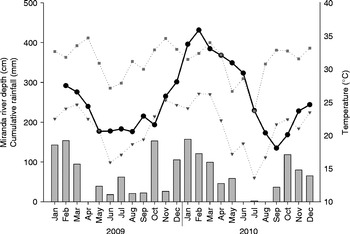
Two field collection campaigns were carried out in consecutive dry seasons (July 2009 and July 2010). The amount of rainfall between November 2009 and March 2010 was the largest in the previous 15-year period, flooding a wide plain area in the Pantanal wetland. Local data on the monthly cumulative rainfall and maximum and minimum temperatures between January 2009 and December 2010 were obtained from the meteorological station at São Bento Farm, located in the same municipality and sub-region. In the same period, the depth of the Miranda River was determined twice a day using a rigid meter rule immersed in the river in front of the Pantanal Study Base.
A total of 67 specimens of T. nematurus (34 in 2009 and 33 in 2010) were captured with cast nets with mesh sizes of 150 and 200 mm between opposing knots. The standard length was measured with a digital calliper (precision: 0.02 mm) and body mass was determined on a digital scale (precision: 0.1 g). All fish underwent necropsy under a stereomicroscope, in which the body surface and all organs and body cavities were examined for metazoan parasites. Licence number SISBIO 22 119-1/Instituto Chico Mendes de Conservação da Biodiversidade (ICMBio) was issued for collection of biological material.
Data analysis
Morphometric data on the hosts and the indices of parasite infrapopulations and infracommunities did not exhibit normal distribution (Shapiro–Wilk) and were therefore log-transformed to enable parametric analysis. Student's t-test was used to determine possible significant differences in standard length and body mass among hosts captured in the two different samples (July 2009 and July 2010). Pearson's correlation coefficient was calculated to determine possible correlations between the standard length and body mass of the hosts.
The following ecological descriptors of parasitism were calculated: prevalence, mean parasite abundance and mean parasite intensity (Bush et al., Reference Bush, Lafferty, Lotz and Shostak1997). Other infrapopulation analyses were only performed for parasite species with prevalence values greater than 10% (Bush et al., Reference Bush, Aho and Kennedy1990). The index of discrepancy (D) was calculated for each parasite species (Poulin, Reference Poulin1993). Pearson's correlation coefficient was calculated and used to determine possible correlations between the standard length of hosts and parasite abundance. Differences in abundance and prevalence values between the two samples were determined using Student's t-test and the chi-square (χ2) test, respectively (Zar, Reference Zar1999).The mean total parasite abundance and mean parasite species richness were calculated, and differences between the two samples were determined using Student's t-test (Zar, Reference Zar1999). Pearson's correlation coefficient was calculated to determine whether the standard length of the hosts was correlated with the mean total parasite abundance and the mean species richness (Zar, Reference Zar1999). A discriminant analysis based on the Mahalanobis distance in square root-transformed data was used to detect possible differences in infracommunities between the two sample periods and to determine which metazoan species were responsible for these differences (Ludwig & Reynolds, Reference Ludwig and Reynolds1988; Valentin, Reference Valentin2000).
Results
Figure 1 displays the data on cumulative rainfall, maximum and minimum temperature and the depth of the Miranda River between January 2009 and December 2010.
Cumulative rainfall, temperature and depth of the Miranda River between January 2009 and December 2010 in the Miranda-Abobral sub-region, municipality of Corumbá, state of Mato Grosso do Sul, Brazil. Bars = cumulative rainfall; black line = river depth; grey dotted lines = maximum and minimum temperatures.

Specimens collected in 2009 measured 7.7 ± 1.8 cm (range: 5.1–11 cm) in standard length and weighed 10.8 ± 7.3 g (3–22 g). The specimens collected in 2010 measured 7.1 ± 0.9 cm (6–9.3 cm) in standard length and weighed 11.9 ± 4.9 g (5–24 g). The standard length and body mass values did not differ significantly between the two samples (t= 1.5, P= 0.07; t= 1.7, P= 0.05, respectively). As standard length and body mass values were positively correlated in the two samples (r= 0.93, P< 0.01; r= 0.94, P< 0.01, respectively), only the data on standard length were used to determine possible correlations with infrapopulation and infracommunity indices.
Sixty-one metazoan parasites were collected from the host specimens (mean: 0.91 ± 1.18 parasites/fish). A total of 53.7% of the host specimens were parasitized by at least one metazoan parasite species. Anacanthorus sp. was the most prevalent and abundant species, occurring in 34.3% of the hosts and accounting for 70.5% of the total number of parasite specimens collected.
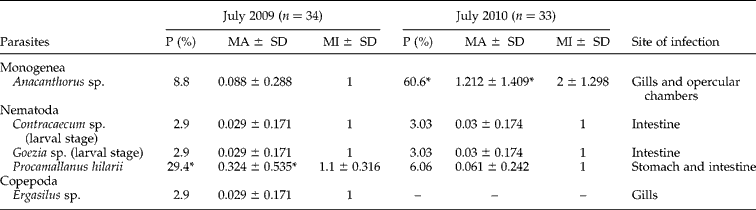
In the first sample (2009), 41.2% of the fish were parasitized, from which 17 specimens of metazoan parasites were collected (mean: 0.5 ± 0.66 parasites/fish). The nematode Procamallanus hilarii was the most prevalent and abundant species in this sample (table 1). In the second sample (2010), 67% of the fish were parasitized, from which 44 metazoan parasites were collected (mean: 1.33 ± 1.41 parasites/fish). The monogenean Anacanthorus sp. was the most prevalent and abundant species in the second sample. All the other species had prevalence values of less than 10% (table 1). The prevalence and mean abundance values for P. hilarii were significantly higher in the first sample (χ2= 6.2; P= 0.01; t= 2.6, P< 0.01), whereas the prevalence and mean abundance values for Anacanthorus sp. were significantly higher in the second sample (χ2= 19.9; P< 0.01; t= –5.2, P< 0.01). No correlations were found between the standard length of the hosts and the mean parasite abundance.
Site of infection, prevalence (P), mean abundance (MA) and mean intensity (MI) of metazoan parasites of Triportheus nematurus from the Pantanal wetland, state of Mato Grosso do Sul, Brazil; SD= standard deviation.

* Significant difference between parasite abundance (t) and prevalence (χ2); P< 0.05.
Anacanthorus sp. and P. hilarii exhibited typical aggregated distribution within the hosts (Anacanthorus sp.: D= 0.886 in the first sample and D= 0.565 in the second sample; P. hilarii: D= 0.709 in the first sample and D= 0.969 in the second sample).
In the first sample, mean total abundance and mean species richness were 0.5 ± 0.66 and 0.47 ± 0.62, respectively. In the second sample, these values were 1.33 ± 1.43 and 0.73 ± 0.57, respectively. Significant differences were found in the mean total abundance (t= − 2.97, P< 0.01) and mean species richness (t= − 1.94, P= 0.03) between the two samples. Standard length of the hosts was not significantly correlated with the mean total parasite abundance or the mean species richness in either sample.
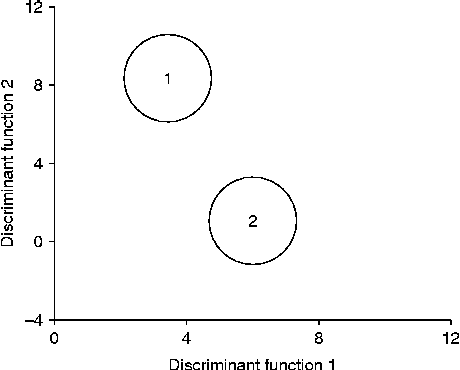
The first discriminant variable explained 100% of the variance (eigenvalue = 0.547). The difference between the centroids of the groups was significant (Wilk's lambda = 0.65, F 5,61= 6.68, P< 0.01), and infracommunities constituted two distinct groups (χ2= 27.3, P< 0.01) (fig. 2). A 76.12% rate of correct classification in the two host samples was achieved for the parasite infracommunities (94.12% in the first sample and 57.58% in the second sample). Anacanthorus sp. and P. hilarii contributed the most to the determination of the position of infracommunities on the first two discriminant axes, accounting for 90% and 51.6% of the values, respectively.
Sample scores of the first two discriminant axes for parasite infracommunities of Triportheus nematurus from the Medalha lagoon, Miranda-Abobral sub-region, municipality of Corumbá, state of Mato Grosso do Sul, Brazil. Numbers represent groups of respective samples: 1, July 2009; 2, July 2010. Circles around groups represent 95% tolerance region, e.g. 95% of observations in a group are expected to lie within this region.

Discussion
The parasite communities of T. nematurus from the two samples (July 2009 and July 2010) were both characterized by the presence of species with low prevalence (without core species sensu Bush & Holmes, Reference Bush and Holmes1986), abundance and species richness, thereby indicating low parasite diversity. Moreover, the standard length of the hosts was not correlated with ecological or community descriptors. Four species were common to both samples, and T. nematurus constitutes a new host record for the nematode P. hilarii as well as for the larval stages of the nematodes Contracaecum sp. and Goezia sp. To date, 21 nominal species from the genus Anacanthorus have been reported as parasitizing species of Triportheus: six species in T. albus, 12 species in T. angulatus (9 of which have only been reported in T. angulatus) and 11 species in T. elongatus (4 of which have only been reported in T. elongatus) (Thatcher, Reference Thatcher2006; Eiras et al., Reference Eiras, Takemoto and Pavanelli2010). However, reports of species of Anacanthorus parasitizing T. nematurus were previously unknown. Reports on crustacean species parasitizing Triphortheus spp. are scarce and restricted to the isopod Amphira junki in T. albus, the brachyuran Dolops sp. and the copepod Ergasilus sp., both parasitic to T. elongatus (Thatcher & Boeger, Reference Thatcher and Boeger1983; Thatcher, Reference Thatcher2006; Eiras et al., Reference Eiras, Takemoto and Pavanelli2010).
Despite the common characteristics in both samples, such as similar species composition, and the low values of ecological and community descriptors, with no significant correlations to the standard length of the hosts, significant differences were found between samples with respect to the mean total abundance and the mean species richness as well as the alteration of the dominant species: P. hilarii was the most prevalent and abundant species in 2009, whereas Anacanthorus sp. was the most prevalent and abundant species in 2010. The significant differences in the prevalence and abundance of these species allowed the discrimination of infracommunities, which formed two distinct groups.
Studies on seasonal variation in the composition and structure of parasite communities have employed different time scales and have explained this variation in different ways (Kennedy, Reference Kennedy1997, Reference Kennedy2009; Li et al., Reference Li, Wang, Yao and Nie2010). For example, Olson et al. (Reference Olson, Pierce, Jacobson and Burreson2004) observed a substantial change in the prevalence of metazoan parasites in two estuarine fish species between two temporally separated sampling periods in Yaquina Bay, Oregon, USA, in the early 1970 s and at the end of the 1990 s. These authors suggested that the climate-associated phenomenon known as El Niño, as well as the increase in populations of marine mammals and implications from the change in local ichthyofauna, are associated with the changes observed in host–parasite ecology. On a refined seasonal scale, Carvalho et al. (Reference Carvalho, Tavares and Luque2010) studied the variation in communities of the metazoan parasites of Geophagus brasiliensis in the Guandu River, state of Rio de Janeiro, Brazil, between seasons of the year, and related this variation to climate changes throughout the year. The present study had a short temporal range, with the same climate conditions in both sampling campaigns. It is therefore suggested that the primary reason for the discrimination of the two groups was the large flood that occurred between the sampling campaigns, and its biotic and environmental consequences.
Host body size is considered to be a representation of the amount of available resources (i.e. habitat area and nutrients or energy) for parasite exploitation (Luque et al., Reference Luque, Mouillot and Poulin2004; Poulin et al., Reference Poulin, Guilhaumon, Randhawa, Luque and Mouillot2011) and has therefore been widely used to determine possible correlations with parasite ecological and community descriptors. Some studies have been carried out to determine whether host body size may be a predictor of parasite species richness. However, there is as yet no consensus on this issue. Luque et al. (Reference Luque, Mouillot and Poulin2004) and Luque & Poulin (Reference Luque and Poulin2007) found that fish size was strongly and positively correlated with parasite species richness, while Takemoto et al. (Reference Takemoto, Pavanelli, Lizama, Luque and Poulin2005) and Poulin et al. (Reference Poulin, Guilhaumon, Randhawa, Luque and Mouillot2011) did not find such a correlation. The lack of difference in host body size between the two samples and the lack of correlation between host standard length and ecological and community descriptors in the present study may be an indication that this intrinsic host factor (i.e. standard length and body mass) does not exert a fundamental influence over the variation in these parasite infracommunities between years, which may be explained by the action of environmental dynamics on shifts in parasite communities.
Features of the habitat (i.e. local abiotic factors such as water temperature, pH and lake size) and certain traits of the host population (size and density) could facilitate the transmission and establishment of fish parasites (Bagge et al., Reference Bagge, Poulin and Valtonen2004; Takemoto et al., Reference Takemoto, Pavanelli, Lizama, Luque and Poulin2005; Poulin, Reference Poulin2006). Monogeneans have a direct life cycle and their transmission could be facilitated by proximity between hosts (Bagge et al., Reference Bagge, Poulin and Valtonen2004). Studying the seasonality of metazoan parasites of Pygocentrus nattereri in Piranha Lake, state of Amazonas, Brazil, Vital et al. (Reference Vital, Varella, Porto and Malta2011) found a significant increase in the mean intensity of monogeneans in the dry season. The Medalha lagoon becomes reduced in area in the dry period, which may favour the proximity between hosts and, consequently, favour monogenean transmission between hosts. In 2009, the cumulative rainfall and depth of the Miranda River were lower than in 2010. Thus, the area of the Medalha lagoon was smaller in 2009 than in 2010. However, the prevalence and mean intensity of Anacanthorus sp. were significantly higher in 2010, as were the mean total abundance and mean species richness.
Flooding in the Pantanal wetland connects a large number of habitats, such as perennial and ephemeral lagoons on the floodplain, enabling individuals to flow between different fish populations that are usually exposed to different environmental and ecological pressures. A great number of fish species, including T. nematurus, move to the floodplain to feed and breed (Lowe-McConnell, Reference Lowe-McConnell1991). This seasonal flow of fish between habitats may be an important mechanism associated with seasonal alterations in the dynamics of parasite communities in the Pantanal wetland.
This seems to be the first evidence that the peculiar hydrological dynamics in the southern Pantanal wetland exert an important influence over the structure of parasite communities, with seasonal floods serving as the major event that is associated with the discrimination of parasite infracommunities. However, further data are needed to confirm this on temporal, phylogenetic and spatial scales. Future studies should focus on variations in the parasite communities of fish communities or address a target fish species on a refined scale and over a long time period in the Pantanal wetland, Brazil.
Acknowledgements
This study was supported by Fundação de Apoio ao Desenvolvimento do Ensino, Ciência e Tecnologia do estado de Mato Grosso do Sul (FUNDECT No. 23/200.178/2009). R.C.P. was supported by a student fellowship from Conselho Nacional de Desenvolvimento Científico e Tecnológico (CNPq).