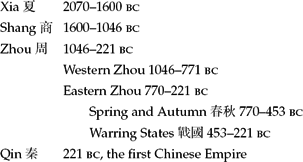
The period of the Western Zhou 西周 (1046–771 bc: Table 1)Footnote 1 is often considered the genesis of Chinese civilization; many of the archetypal Chinese political and social institutions, as well as key concepts and ideas, are believed to have originated and developed during this time. Following their conquest of the Shang 商 state (1250–1046 bc), the Zhou began a campaign of colonization during which members of the royal family were sent to defend and expand strategic zones around the new realm (Shaughnessy Reference Shaughnessy, Loewe and Shaughnessy1999). The traditional narrative has seen the Western Zhou and the colonies they set up as the start of the development of the greater Chinese empire (Creel Reference Creel1970) and the foundation of Chinese common self-identification—the Huaxia 华夏. Great developments have been made in the reconstruction of Western Zhou history that have advanced our understandings of historical events over the dynasties’ almost 300-year rule (Shaughnessy Reference Shaughnessy1991) and presented the sophistication of the Western Zhou administration system (Li Reference Li2008).
Traditional chronology of pre-imperial China.

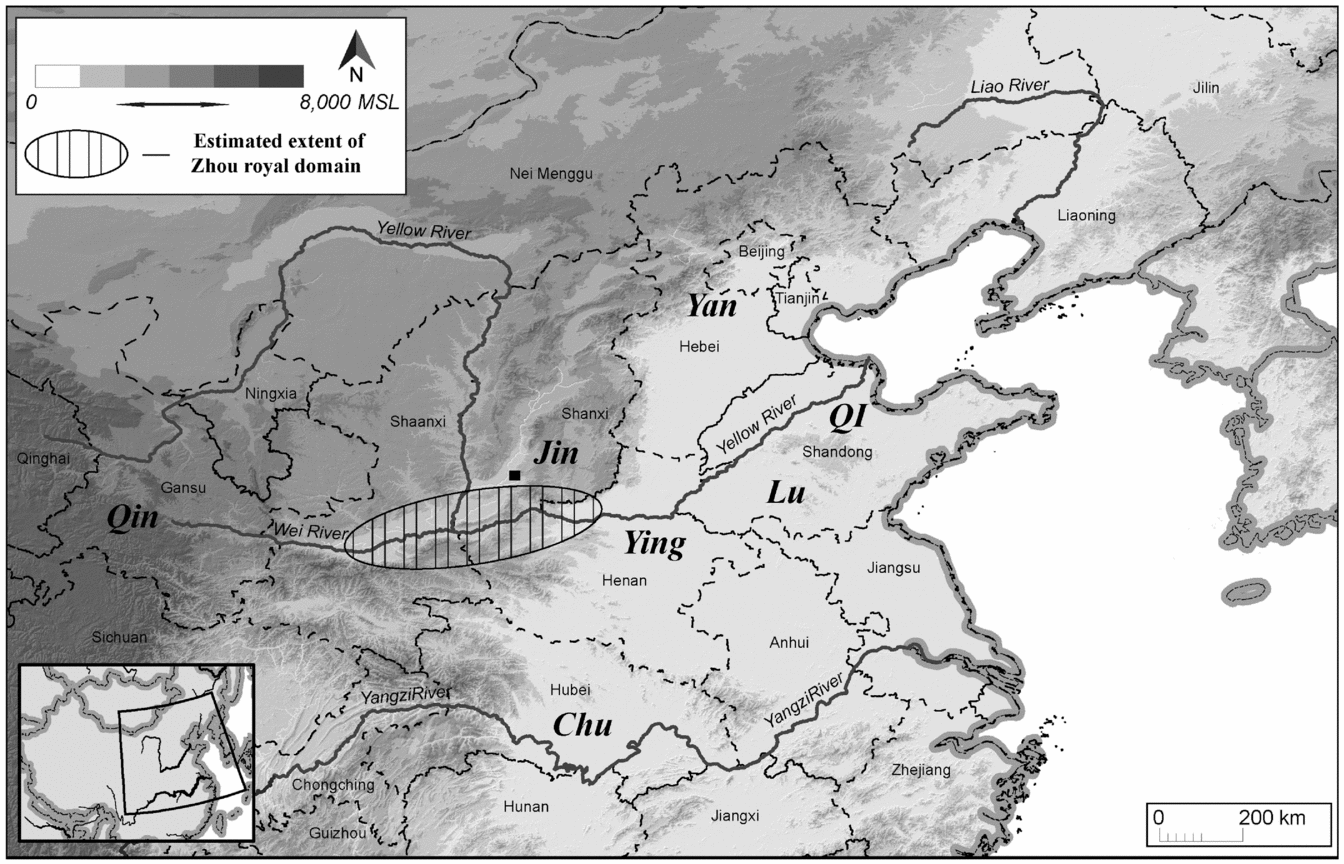
Western Zhou archaeology, however, has remained almost solely the domain of cemetery- and mortuary-related data. Most of the work revolves around the excavation of large aristocratic lineage cemeteries, both in the royal domain and the areas outside it, to where the Zhou expanded and set up new polities (see Figure 1). The ways in which scholars have approached and studied Zhou mortuary practices, and in turn this period as a whole, have been heavily influenced not only by broader practices of Chinese archaeology—its historical orientation (Falkenhausen Reference Falkenhausen1993) and culture-historical framework of analysis (Liu & Chen Reference Liu and Chen2012; Shelach Reference Shelach2015)—but also by the special place held by the Western Zhou dynasty in the traditional views of the development of Chinese civilization. The Western Zhou period is prominently featured in later Chinese historiographies where numerous accounts of Western Zhou kings and historical events provide a detailed narrative of the Zhou dynasty's rise and fall. Most importantly, Confucius himself—whose philosophy was aimed at providing instruction to the rulers of the independent states that inhabited the Chinese landscape after the demise of the Western Zhou polity—thought that being a moral and righteous ruler could only be achieved by emulating the ways of the Zhou kings.
Main states of the Western Zhou world and location of the TMQC site.

Thus, even while relatively few historical documents exist from this period, many archaeologists turn to later Eastern Zhou (770–221 bc) texts such as the Zhouli 周禮, Liji 禮記 and Yili 儀禮 for insight into Western Zhou burial rituals. Yet, as Falkenhausen (Reference Falkenhausen2006, 75–6) notes, these texts provide information on mourning rituals, rather than on the burial practices themselves. Consequently, linking them to earlier practices is not without its problems.
By turning to these later historical texts, scholars have in effect fostered an approach to the study of Western Zhou graveyards that focuses on the investigation of elites and their mortuary practices. A Western Zhou cemetery is often taken to reflect lineage society as a whole, as well as its place in the broader Zhou aristocratic world: the noble families of the Zhou world, who were bequeathed land and administrative titles by the kings, each held their own separate, designated burial ground where their members were buried. Numerous seasons of careful excavation have produced massive volumes documenting excavated data from the many graves that comprised these cemeteries, their exquisite artefacts, elaborate furnishings and the labour that went into their construction. Yet commoners and lower-level members of society are rarely addressed in these cemetery studies, nor is their place in the larger Zhou society.
This paper sets out to provide a renewed approach to the study of Western Zhou cemeteries by looking at the graveyard as a whole and with it the relationship between the commoners and nobles who were buried in them in a community-specific manner. Our case study is the important site of Tianma-Qucun 天马- 曲村 (hereafter TMQC) found in modern-day Shanxi province, the residential site and burial ground of the Jin 晉 state during the Western Zhou period.
Western Zhou lineage cemeteries
To date, little residential evidence has been excavated and studied for the Western Zhou period. Yet the wealth of mortuary data that has been unearthed could be said (almost) to make up for this. Over the past few decades, a number of important cemeteries have been systematically excavated and published, enabling the renewed study of areas associated with important lineages and states (Falkenhausen Reference Falkenhausen2006; Rawson Reference Rawson and McDermott1999a; Yu & Yan Reference Yu, Yan, Chang, Allan and Xu2005).
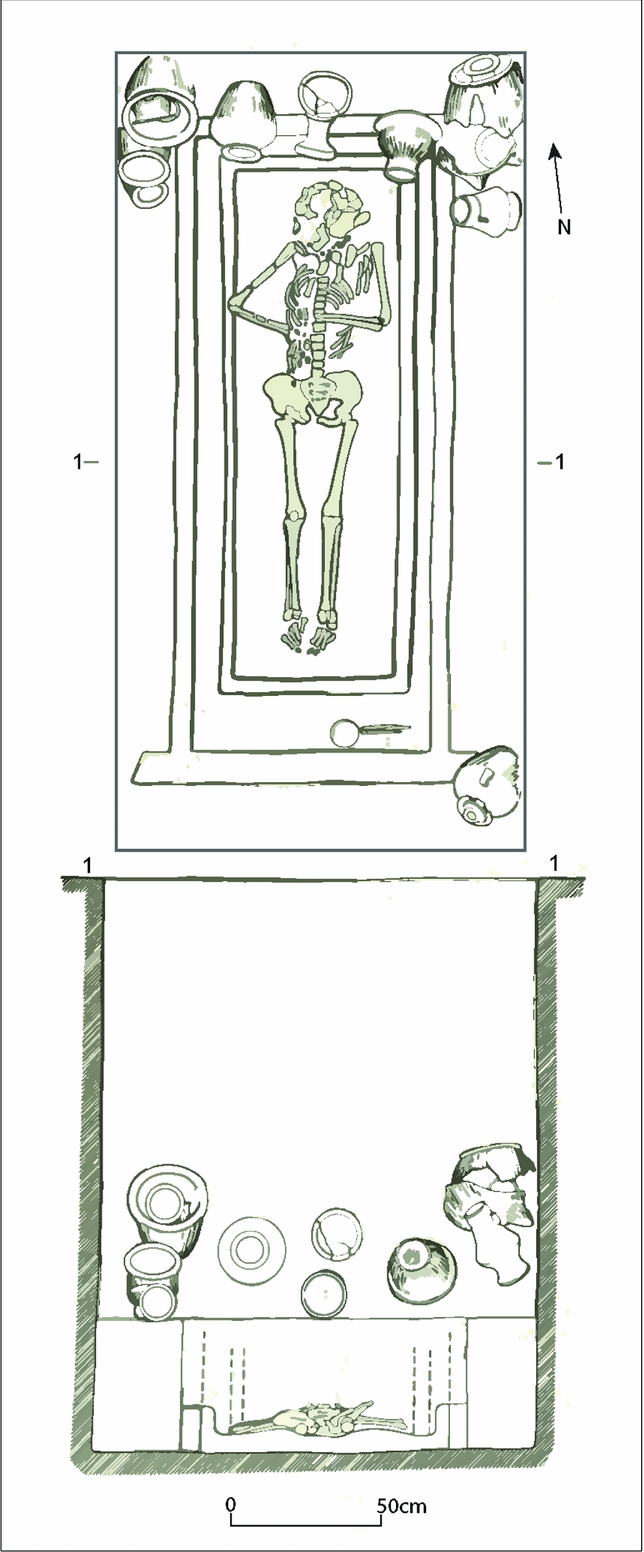
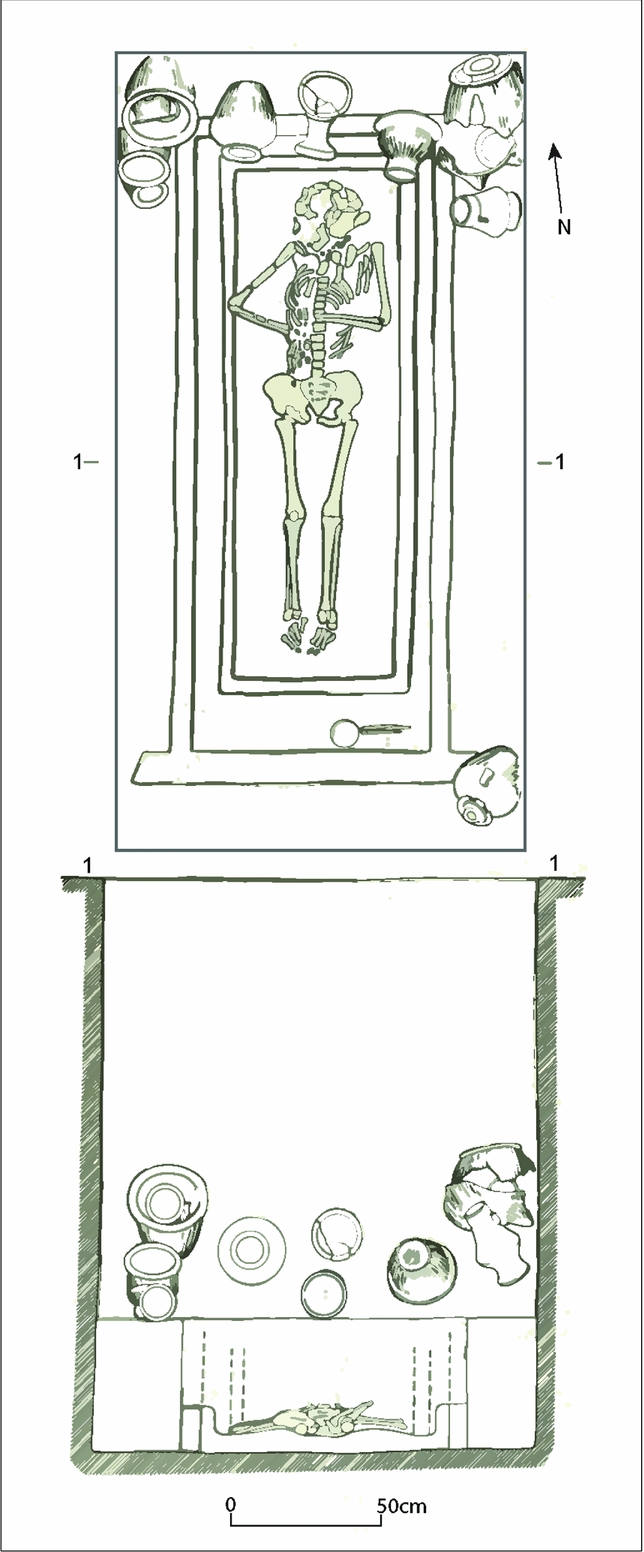
The Western Zhou tomb, like the Shang period grave before it, was typically a rectangular pit with a shaft (of varying depth) leading down to it. The chamber served as the main room where the deceased was laid to rest inside a coffin guan 棺, often surrounded by a stepped ledge ercengtai 二层台, where grave goods could be placed. Many graves contained a second coffin, a guo 椁, which was built as a wooden chamber creating a protective room, but the most important vessels are thought to have been placed inside the inner coffin with the deceased, and ritual vessels, mostly bronzes, on the raised platform (Rawson Reference Rawson, Loewe and Shaughnessy1999b, 30; Thote Reference Thote, Lagerwey and Kalinowski2009, 121; and see Figure 2, a grave from the TMQC cemetery).
Tomb M6136 from TMQC (redrawn from Beijing & Shanxi 2000, 562).
The amount of grave goods accompanying the interred, as well their types, are taken to reflect the status the grave occupier held in life. Regional variability existed among the Western Zhou cemeteries, but Falkenhausen (Reference Falkenhausen2013, 123–7) finds a number of communalities that can be taken as the general forms of rank display. These include: grave size, the number of sloped passages leading down into a grave, number of coffins, number of sacrificed humans and animals, chariots, the number of music and ritual artefacts, as well as the material they were made of (such as bronze, jade, bone, stone, etc.), and overall number of furnishings. In the Zhou patrilineal descent system women held lower status than males and their graves were often not nearly as impressive. While a number of artefact types have been correlated with gender differences, mainly weapons for men and ornaments for women, these distinctions are not, however, always strictly adhered to, with ge 戈 axes, for example, found in a number of female graves as well as the finding of various ornaments in many a male grave (Thote Reference Thote, Lagerwey and Kalinowski2009, 123).
The Western Zhou cemetery arrangement itself is believed to have reflected the social hierarchy of the lineage; large tombs were reserved for lineage heads and their wives, which contained the most impressive artefacts. That said, the rulers and elites were not entirely disconnected from the rest of society. A ruler was not
categorically different from the rest of the ranked elite; he was, instead, its highest representative. Political power, and the social prestige that came with it, were thus not concentrated in single individuals, but inhered in the lineage a collective unit, in which every member had a stake proportional to his or her position in the genealogy. (Falkenhausen Reference Falkenhausen2006, 326)
When studying Western Zhou cemeteries it is not uncommon for archaeologists to find a four-tier hierarchy where tomb size and grave-good quality and quantity are taken to have been correlated to the rank the deceased held in his or her lifetime (though others find three or even five tiers, as discussed in Xie Reference Xie2010). The heads of lineages were buried in the largest tombs, often separated from the rest of the lineage members, sometimes with ramps leading down to the grave. The largest number of ritual vessels would be placed in their tombs, and a separate pit would be constructed nearby with teams of chariots and horses placed in it. The second tier, consisting of relatives of the royal family, high-ranking officials, and even rulers of petty states, would be buried in smaller tombs with fewer objects, but still including bronze ritual vessels, weapons, chariot fittings and other prestigious goods. The third tier comprised the lower elites of the Zhou world, who were buried in smaller graves accompanied by fewer burial artefacts, though they could still contain bronze ritual vessels alongside horse and chariot fittings. The fourth tier, comprised of the commoners of the Zhou world, had the smallest graves, contained no bronze vessels, and their burial offerings were simple, often limited to a few simple pottery vessels. These four-tier hierarchies are reconstructed both in the royal domain and the many states outside of it (e.g. Hsu & Linduff Reference Hsu and Linduff1988, 163–71; Sun Reference Sun2001).
Bronze ritual vessels, used in sacrifice and to communicate with the ancestors, also play a prominent role in these types of reconstructions. Both the number and type of vessels are considered important. The number of ding 鼎 (cauldron-type tripod vessels) is commonly used to distinguish rank among the lineage system. The lieding 列鼎 sumptuary system exhibits a graded uneven number of ding bronze vessels and even numbers of gui 簋 (large serving vessels), which correspond to aristocratic rank in the nobility system of the Zhou world. Nobles of the highest status could be interred with nine ding and eight gui, lower nobles with seven and six, and so on, the lowest aristocratic members accompanied by only one ding and one gui (Yu & Yan Reference Yu, Yan, Chang, Allan and Xu2005, 197).
These ranks are also taken to reflect the relative position held by specific families and lineages in the Western Zhou world. For example, at Locus III of the TMQC cemetery, the rulers of the Jin lineage were found interred with only five ding vessels, reflecting a situation where the heads of this lineage were nobles of mid-rank status. It is important to note that ritual bronze vessels were not everyday items and were reserved for the Zhou nobility, thus making their study poorer reflections of larger community-wide mortuary practices. In fact, this tradition was not always followed, and the lieding system, while appearing as early as the Middle Western Zhou period in some contexts, became popular only after the Western Zhou period itself (Li Reference Li1985, 490–95).
The emphasis on lineage prominence, manifested in differences between commoners and nobles, provides, somewhat paradoxically, for an in-depth understanding of the upper levels of Zhou society rather than the Zhou lineages as a whole. The study of Western Zhou cemeteries is concerned with the lineage as the overarching structure of society and is one where cemeteries are internally segmented along socially structured hierarchical lines. That said, the manner in which these levels are understood, when they are addressed, is mostly in relation to prefixed aristocratic understandings of the Zhou world as a whole. In other words, scholars have provided a fair understanding of the ways in which aristocrats displayed their wealth and status, and from it the differences between different lineages and their aristocrat members. Yet these practices have far less to say about the rest of Zhou society, other than that they were not included in the sumptuary rituals of the Zhou nobility. Put plainly, commoners are identified by not being Zhou elite.
What we must return to is the study of lineage cemeteries as a whole. Single artefacts, such as bronze ritual vessels, important as they may be, are not the best unit of analysis when determining identity, social or ethnic, in mortuary contexts, or any other single artefact category for that matter (Härke Reference Härke2014). To date, most studies have subscribed to a view where the overarching framework of the entire Zhou society was its aristocratic culture and, as such, the propagative structuring mechanism of social standing was one that emanated downwards from the noble classes in a system conceived to be dictated by the Zhou elite worldview. In contrast, the structure of the Zhou lineage cemetery, as a discrete social unit reflecting a community defined by its distinct mortuary practices, has yet to be investigated in Zhou archaeology. Accordingly, the social structure of a Zhou community as a whole, how it was organized and internally stratified, requires further research.
Foraging a middle ground: communities of mortuary practices
Mortuary practices were understood by many early twentieth-century sociologists and anthropologists to reflect the beliefs and world-views of their communities (see Carr Reference Carr1995, 108–10). Archaeologists also widely acknowledged the value of studying burial rites as practices that reflect social organization in terms of hierarchy, and that graves, their furnishing and relative wealth, could thus reflect the status and place of the individual interred in them (Binford Reference Binford and Brown1971; Peebles & Kus Reference Peebles and Kus1977; Tainter Reference Tainter1978). Over time, however, scholars pointed out that burials, as they are found in the archaeological record, more faithfully reflect attempts by the still-living members of the community to represent and recreate social realties (Cannon Reference Cannon1989; Hodder Reference Hodder1982; Parker Pearson Reference Parker Pearson and Hodder1982).
It is best not to think of these two approaches—burial as reflecting 1) social organization and the status the dead held in life, and 2) the deliberate manipulation of the dead by the living—as mutually exclusive. Instead, archaeologists investigating mortuary contexts should remain mindful of both (Chapman Reference Chapman, Tarlow and Nilsson-Stutz2013; Rakita & Buikstra Reference Rakita, Buikstra, Rakita, Buikstra, Beck and Williams2005). Indeed, O'Shea (Reference O'Shea1984) has suggested that continued treatment of the dead by the living can be seen to indicate a certain degree of predictable correlation to the deceased's status in life. Similarly, Morris (Reference Morris1991) differentiated between funerary rites and ancestor worship in order to reconfigure Saxe's proposition 8, which saw a correlation between a society's formal disposal areas and claims it made with it to specific resources. Carr (Reference Carr1995), too, remains optimistic in respect of the ability to determine, archaeologically, status and rank from burial assemblages, but cautions that this requires contextual interpretation. Kamp (Reference Kamp1998) points out that the degree of variability that is attained when inferring social status is much greater than that assumed by archaeologists. In fact social competition, rather than hierarchy, is the variable most directly measured.
Here, too, we adopt what can be seen as a middle-ground approach, and in doing so concur with Brown (Reference Brown and Beck1995, 25) who finds that:
The controversy over the use of burials as symbolic representations of the social order or as an object symbolizing political manipulation is not a problem of the exclusive legitimacy of one or the other perspective in mortuary analysis. Instead, they are two perspectives to symbolic representations that are potentially co-extensive.
In short, mortuary practices should be seen to reflect an intricate blend of social norms, religious beliefs and social identity, combined with idiosyncratic reflections of individuals and their manipulation by their relatives. Thus, while we must realize that the dead have limited control over actions and often become tools to be used in the power games of others (Fowler Reference Fowler2004; McGuire Reference McGuire1992), we should also acknowledge that mortuary practices mirror specific beliefs about death and the afterlife, which may or may not relate to the status an individual held in life (Meskell & Joyce Reference Meskell and Joyce2003).
Therefore both the place the dead held in life as well as their role in death should be taken into consideration in mortuary studies. For Zhou people, grave size must have been an important factor, since creating large tombs required highly labour-intensive work and seems to correlate, as discussed above, to richness and quantity of offerings found in those same graves as well. Even while these burials were subterranean and would not be seen after the burial ceremony, mobilizing the labour to construct these tombs would have had a noteworthy effect on any community (Flad Reference Flad2001). In fact, constructing these tombs would have taken quite some time, reflecting the filial piety of family members or even concentrated efforts on the part of the soon-to-be-interred themselves. Thus their construction provided for longer periods when others could be readily impressed by the care and effort exerted (Rawson Reference Rawson and McDermott1999a, 28–9).
The ways in which bronze vessels placed in tombs were used during the Western Zhou period are perhaps better understood. In contrast to bronzes placed and used in temples—employed to display the devotion of the living to the ancestors in order to secure their blessing (as well as, again, to impress the living attending these ceremonies)—bronzes placed in graves could be continually used by the deceased in the spirit realm to display their status and even perform sacrifices (Falkenhausen Reference Falkenhausen, Kuhn and Stahl2008). Other grave goods were most certainly reserved for use in the afterlife, as well as presenting the social status the bearer maintained in life. Correspondingly, here we follow Jessica Rawson, who astutely finds that:
the tomb presented the essential and the best features of life: how it should be, not necessarily how it actually was in all respects. Idealized though the life might be, however, it would be misleading to treat the presentation of the individual achieved in the tomb as fictional in any way. Rather, we should view the objects in tombs and the activities that they enabled as the best possible range of material to provide the best possible apparatus for future life. (Rawson Reference Rawson, Renfrew and Scarre1998, 120)
In other words, grave furnishings placed inside Western Zhou burials provided the deceased with the best afterlife he or she could hope for (following instructions by the soon-to-be-dead themselves or by their remaining kin), as well as provisioning the deceased with the tools needed to give continual aid to their living descendants. This was not, however, uncoupled from the position the interred held during their lifetime, and in fact the ancestral system of sacrifice, as a whole, could only work if the living descendants saw the rank of their ancestors as a continuation of the status they had gained in life. Thus, even while the social status implied by grave-construction efforts and the goods placed in them reflected the social rank of the interred, they were also geared towards securing ancestral blessing and influence.
Following the above discussion, it becomes imperative to study a cemetery in its entirety as a unit of analysis. Furthermore, by looking at site-specific practices as a way to uncover the socio-political context in which they were created, a more complete and holistic reconstruction of societies and their burial practices can be achieved (Rakita & Buikstra Reference Rakita, Buikstra, Rakita, Buikstra, Beck and Williams2005). To do so, we extend here the traditional definition of communities of practice, ‘shared ways of doing things’ (Lave & Wenger Reference Lave and Wenger1991), to include the local-specific mortuary rites that individual communities practised. There is, of course, more than one way of defining a community. Following observations made by social anthropologists that rejected essentialist notions of communities (after Cohen Reference Cohen1985), a growing number of archaeologists have begun to think of communities not as natural occurrences in time and space, but instead as imagined constructs. Imagined communities are no less real to their members, but instead of being defined by a delimited territory they hold or the proximity of the group-member domiciles, they are seen to be a collection of people who maintain shared ways of doing things or social practices (Birch Reference Birch2013; Canuto & Yaeger Reference Canuto and Yaeger2000; Harris Reference Harris2012; Kolb & Snead Reference Kolb and Snead1997). The community becomes precisely what provides the physical space and social framework for the aggregation of artefacts and people continually shaping and reshaping local-specific practices. Consequently, archaeological material-culture assemblages are in a sense reflections of the local-specific ways in which artefacts were used, structures built, food cooked and consumed and how the dead were laid to rest.
Indeed, the contextual analysis of communities in time and place allows for a local-specific reconstruction of beliefs, social structures, rank and role of the dead in a given society. Aranda et al. (Reference Aranda, Montón-Subías, Sánchez-Romero and Alarcón2009), for example, evaluate the connection between gender roles and artefact types by observing specific objects used as grave goods and the traces of their use, as can be observed on skeletons in Argaric societies of southern Spain. Similarly, contributions in Heilen (Reference Heilen2012) utilize a host of approaches to uncover community-based social identity among more than 1000 graves of the late nineteenth- century cemetery of Tucson, Arizona (USA) in their reconstruction of groups and individuals among this community.
Building on these approaches, a community-focused study of mortuary practices as local-specific shared ways of doings things not only affords a refined vision of Western Zhou mortuary ritual and practice, but also one where local variation and appropriations, practised at the various lineage cemeteries, can be appreciated as well. Thus, while common Zhou mortuary traditions should be understood to have been of greater import to the Zhou elites, their impact on the lower echelons of society remains less clear; indeed, how such practices were installed and followed requires further study. By examining the mortuary practices of individual communities, we aim to uncover these site-specific manifestations in their larger contexts.
The history and archaeological significance of the TMQC site
The TMQC area was initially a training-ground for Peking University archaeologists in the 1960s and ’70s who conducted interment work at the site (Xu Reference Xu1996, 193). Beginning in 1979, the site was jointly excavated by Peking University and the Shanxi provincial institute of archaeology for the next decade. Their work uncovered over 10 sq. km of residential area and thousands of tombs dating from the Western Zhou through the Warring States periods (453–221 bc). The graves were small and were not taken to reflect the tombs of high aristocrats of the Western Zhou world, but in the early 1980s the lead archaeologist at the time, Zou Heng, suggested that this was in fact the site of the Western Zhou period capital of the Jin state, an important polity of the Zhou period (Beijing et al. Reference Zu, Yanjiusuo, Anbu, Wenhuaju and Bowuguan1982).
At the time, this was a bold statement, as the location of the Jin state was still unclear. Textual sources noted that during the Western Zhou period King Cheng 成 (r. 1042/35–1006 bc) had enfeoffed the territory of the vanquished Tang 唐 state to his younger brother Shuyu 叔虞, both as a means of rewarding his service and with the request of creating a stronghold guarding the northern pass leading to the royal domain (Shaughnessy Reference Shaughnessy, Loewe and Shaughnessy1999, 312). Shuyu's son, the Marquis Xie 燮,Footnote 2 would change the name of the territory to that of the state of Jin (Liu Reference Liu2007). Much more is known of the Jin state historically for the later Eastern Zhou period, when the capital is believed to have been moved in the early part of the Spring and Autumn period. Duke Jing 靖 is reported in the Gongyang commentary 公羊傳 to have relocated the capital to the site of Xintian 新田 (Miller Reference Miller2015, 174). The importance of the Jin state was such that its dissolution into three separate states, traditionally dated to 453 bc, also marks for historians the end of the Spring and Autumn and the beginning of the Warring States period (and see Pines Reference Pines2002 and Hsu Reference Hsu, Loewe and Shaughnessy1999, for the role of the Jin state during this period).
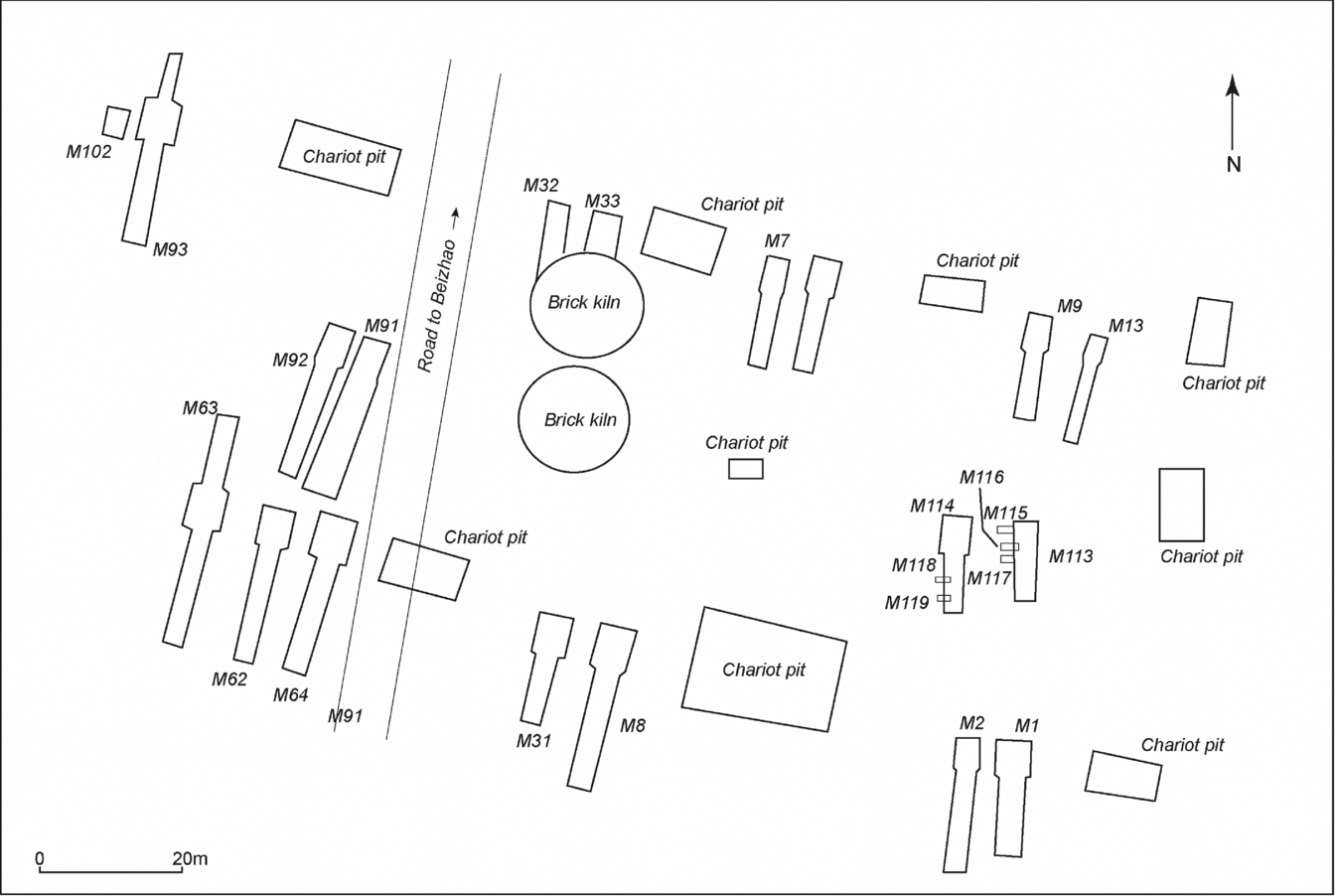
Excavations had unearthed impressive remains of a large site near present-day Houma 侯马 in Shanxi as early as the 1950s, which was quickly identified as the Jin capital Xintian of the Eastern Zhou period (Shanxi 1996). The adjacent Shangma 上马 cemetery is one of the most complete and undisturbed cemeteries of the entire Zhou period and has garnered a great deal of work as well (see Falkenhausen Reference Falkenhausen2001). As the TMQC site is located roughly 25 km north of Houma, the suggestion that this would have been the site of the earlier Western Zhou period capital seemed quite plausible. With the discovery of the rich aristocratic cemetery in 1992 at Locus III of TMQC, all but a small minority accepted that this was in fact the final resting place of the Jin marquises who ruled the Jin polity (Falkenhausen Reference Falkenhausen2006, 109–19). These findings prompted a second series of excavations that took place mostly at the site of the Locus III cemetery over the course of six seasons (Fig. 3), the results of which, however, have not yet been fully published, apart from six preliminary reports.
Layout of TMQC Locus III (redrawn from Beijing & Shanxi 2001, 4).

Overall, 19 graves in nine groups have been unearthed in Locus III, belonging to the marquises and their wives, arranged in rows facing the same cardinal direction. Each of the groups yielded an adjacent chariot pit with dozens of horses, and 14 of the 19 graves were also furnished with elongated ramps leading down into them. Based on chronological dating of the grave goods, the excavators deduced that the tombs spanned the late Early, but mostly Middle Western Zhou to the Early Spring and Autumn period (c. ninth to seventh centuries bc). An inscription in one of the bells found in tomb M8 commemorates Marquis Su's 蘇 successful expedition to the territory of the Su Yi 夙夷 during the 33rd year of the Zhou king Li 厲. Five additional, until then unknown, Jin rulers were also identified from these graves based on the reading of bronze vessel inscriptions found in their graves (Nivison & Shaughnessy Reference Nivison and Shaughnessy2000; Shim Reference Shim1997).
The discovery of the Jin Marquis cemetery has been heralded as one the most important archaeological discoveries of the Zhou dynasty. While many of the tombs were badly looted, what remained was spectacular nevertheless. Hundreds of ritual bronze vessels spanning the known spectrum of vessel types have been found along with gold, lacquer, pottery, bone and stone items, as well as large quantities of jade artefacts, the most impressive of which were made by sewing together pieces of jade (high-quality images can be found in Shanxi et al. Reference Wenwuju, Wenboyuan, Yanjiusuo and Bowuguan2002).
Since its discovery, studies have focused on the analysis of these graves and their role in the reconstruction of Zhou nobility's taste and decorum. The understanding of the internal chronology of these graves has been a chief concern as well and involves the assessment of the material remains, the internal layout of the cemetery, inscriptional evidence and comparison with later historical texts. Research has also focused on using these finds to refine the Western Zhou calendar and chronology (Ping Reference Ping1997). Other aspects that have been studied have been the production techniques used to make the Jin bronzes (Yu et al. Reference Yu, Xiaomei, Xianwei and Sixun2001), as well as the elaborate jade pendants and masks found in them (Nan Reference Nan2012; and see overviews in Falkenhausen Reference Falkenhausen2006, 80–91; Xu Reference Xu1996, 194–9).
Additional research has focused on the many unique elements of the Jin marquis cemetery. Yong's (Reference Yong, Linduff and Sun2004) study found that female status was not static during the Western Zhou period and thus was not strongly regulated by an overarching ritual system. A number of scholars have noted the stylistic resemblance of many of the standard bronzes to the established styles of the Central Plains (Xu Reference Xu1996, 218) alongside unique bronze vessel shapes such as birds, rabbits and other animals (Li Reference Li2002). Rawson (Reference Rawson, Loewe and Shaughnessy1999b, 440–46) notes, conversely, that the bronzes interred in the marquis tombs were made in the shape of more ancient-looking vessels. In addition, the importance of jade at the site is evident both in terms of sheer quantity as well as the location preference of ancient jade pieces, placed mainly on the bodies of the deceased.
Quite understandably, the tendency to study the opulent and impressive artefacts of the marquises and their wives provides excellent information on the highest echelons of TMQC society, but have provided far less insight into the nature of lower levels and, as a result, the community as a whole. The fact that the graves found here (Locus III) were separated from the main cemetery area (Locus II) is of note, as it signals not only a departure from what is found at other Western Zhou lineage cemeteries, but also a growing class differentiation between higher aristocrats and their kinfolk, a less than common practice among other graveyards (Falkenhausen Reference Falkenhausen2013, 124–5). Moreover, this separation makes it difficult to discuss the significance of tomb placement in the Locus II cemetery area, at least in relation to the ways in which burial clusters are noted in other Western Zhou cemeteries (Falkenhausen Reference Falkenhausen2006, nn. 96–98).
In the following section we propose a renewed focus on the cemetery remains of Locus II in order to understand Jin community mortuary traditions as a whole. Huang (Reference Huang, Linduff and Sun2004) is an example of the larger investigation of the cemetery in its entirety, but one that focuses on a single material, jade, and its relationship to gender inequality in a very broad way. Xie Yaoting's (Reference Xie2010) work is another rare attempt of looking at all of the graves at the site. While important conclusions are drawn in respect of possible Zhou external influences at the site and burial clusters, Xie's work begins with an emphasis on ritual bronze vessels and tomb size as markers of rank and then proceeds to explore further status manifestations and differences among this category. When further parameters are engaged, they are presented in disjuncture from each other rather than combined together. What will be conducted below, instead, is a study of all available variables and graves of the graveyard from the published report (Beijing & Shanxi 2000). We begin the analysis with an overview of the basic data of the TMQC cemetery, i.e. age, sex, ceramic assemblage, and so forth. The second stage of the analysis, the submission of the data to a multivariate emanation, will present the overall trends in mortuary practices of the community.
TMQC Locus II cemetery analysis
In total 611 graves from the Western Zhou period have been unearthed and published. Only those graves that were found in the Locus II cemetery were utilized in the analysis here (as opposed to those found among the residential area). Over 160 graves could not be dated, either because they were looted, damaged, or did not contain chronologically relevant artefacts: shell or bone fragments, or nothing at all.
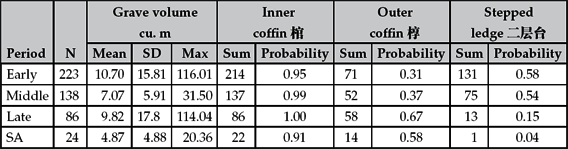
The TMQC Locus II graves are mostly shallow rectangular pits, but of irregular size and shape: in many cases the opening of the grave is larger than its bottom, or vice versa. Grave volume was found via a formula for a pyramidal frustum. Overall, mean grave volume was roughly the same for all periods with a drop to fairly small sized graves during the Spring and Autumn period. The variation in grave size, however, is much higher during the Early and Late Western Zhou period, with the largest graves reaching over 110 cu. m (yet still considerably smaller than the tombs of the marquises and their wives in Locus III, which reached almost 300 cu. m in volume). Most graves, for all periods, contained inner coffins of wood, but only about a third of all graves during the Early and Middle periods contained outer guo coffins. This seems to have become more popular in the later periods as two-thirds of graves contained them. In contrast, ercengtai stepped ledges decline considerably during those same periods (Table 2).
Grave volume, number of coffins and presence of stepped ledges.

Human sacrifices were found in only two graves during the Early Western Zhou period: an infant found in M6080 accompanying a 15-year-old female (perhaps her child who died at birth). In addition only six burials had dog sacrifices in them. These low numbers seem to indicate the lesser importance of these customs among this community. The age and sex of the interred at TMQC Locus II reveal that, while the paired bonds of males and females was of importance for the rulers at Locus III this was not the case for the lower levels of society.
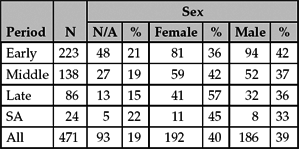
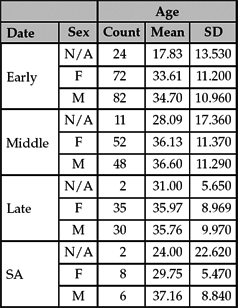
A slightly higher percentage of females is seen for all periods except for the Early Western Zhou (Table 3). Those graves that could be sexed (80 per cent) revealed a very similar overall pattern of similar age at death for both males and females (roughly 30–35), except for the early Spring and Autumn period, where the average male age was 37 with 29 for females (though the sample for this period is significantly smaller). Most of the non-sexed individuals were on average under 12 years old (Table 4).
Sex distribution by period.

Age distribution by period.

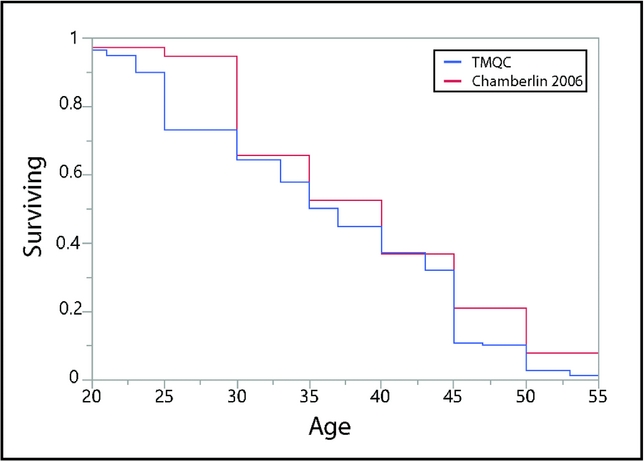
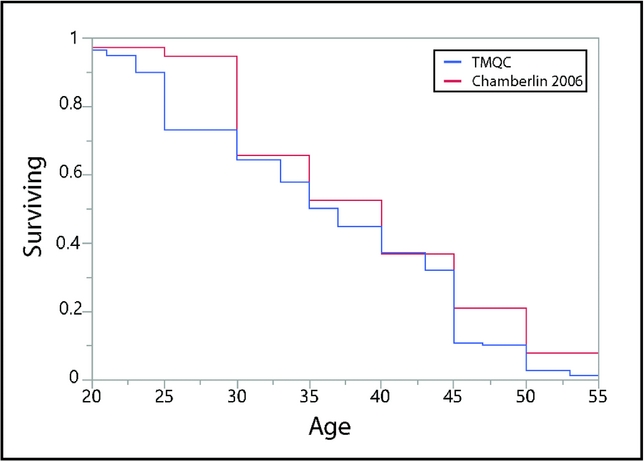
These data also shed light on the issue of this sample's representativeness: as noted by Falkenhausen (Reference Falkenhausen2006, 91), while this is a fairly large data set, it still represents only 1/35 of the Locus II cemetery as reported by the excavators surveying the site. When the survivorship curve of the TMQC cemetery population is compared to other studies for ancient agricultural populations, it differs quite a bit. However this is the result of very low numbers of young community members (under 5 years of age) in the TMQC data, as well as having no cases of individuals living beyond the age of 55, while other studies of ancient agricultural societies record death in ages nearing 90 (in fact up to 30 per cent of the population can survive past 55 in some societies (Chamberlain Reference Chamberlain2006, 67). Indeed, when survivorship curves of ages 20–55 are compared via a simple log-rank test, the assumption that the curves are not identical is rejected (p=0.0697). In other words, the TMQC excavated and published data sample used in this work can be taken to be a good representative of this age group (Figure 4) and thus we are confident in the utility of exploring it to infer community-wide mortuary practices.
Survival curves from TMQC and Chamberlain (Reference Chamberlain2006).
Grave goods contained a wide variation of materials and artefact types including ceramic, bronze, jade, lacquerware, bone and shell. When possible, these artefact types were divided into subgroups, following identifications made by the excavators: for example, bronze artefacts were further classified as weapons, vessels, ornaments, tools and items associated with chariot use (Table 5).
Categories of bronze artefacts by period.

Stone artefacts were divided into three categories: 1) ritual artefacts associated with the burial ritual and the afterlife (such as tablets and pendants); 2) ornaments; and 3) tools. Objects made of jade were separated into categories: 1) ornaments and 2) artefacts associated with burial rituals and belief in the afterlife. Bone items mainly included arrowheads, rings, beads and some pendants. Almost 10,000 clams and shells were interred in the graves of TMQC Locus II. They include artefacts fashioned out of shell, mainly ornaments, pendants and shells that were not local to the site, but brought in from the ocean, many kilometres away.
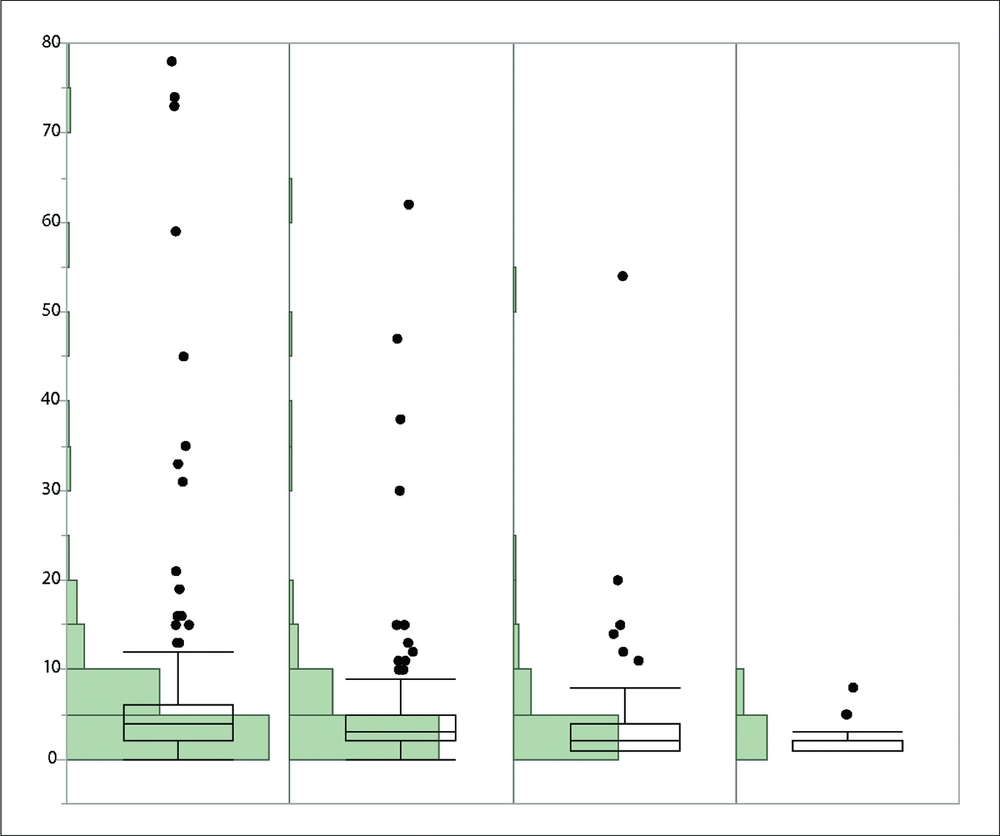
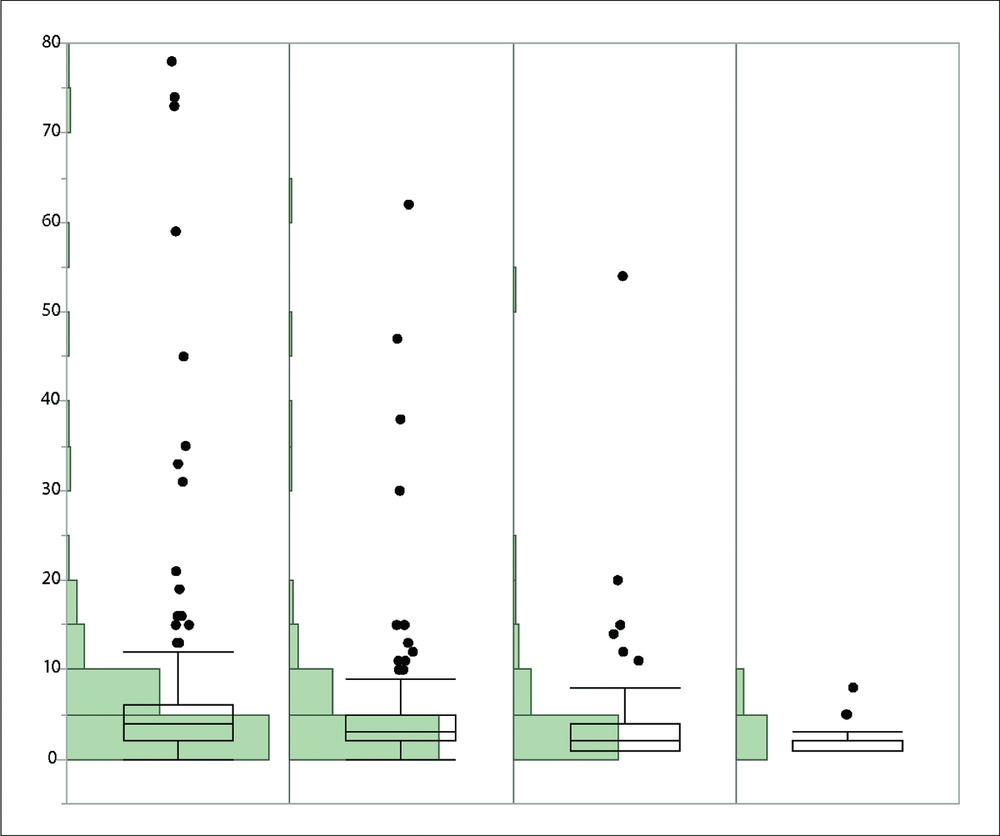
The maximum number of artefacts found per grave changed over time and a closer look at the number of rich graves, i.e. those graves that contained hundreds and even thousands of artefacts, affords a view of these unique graves as well as the overall trends that existed at the site. A distribution plot (box and dot) for all graves by number of artefacts found in them reveals that the vast majority of the graves contained between one and ten artefacts (75 per cent), while a smaller, but not insignificant, portion of the graves were accompanied by several dozens of artefacts. Whereas the average number of artefacts placed in a single grave changes only slightly from four to three after the Early period, the number of outlier graves, i.e. those graves that contained far more artefacts than the average, drops considerably (Figure 5).
Box and dot plot for total number of artefacts by period. (Left to right: Early Western Zhou to Spring and Autumn period.)
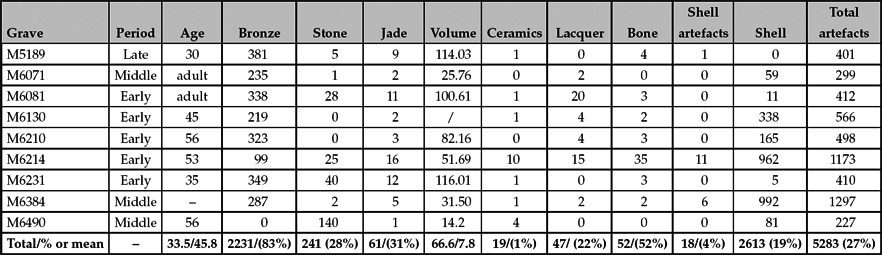
By looking at the richest graves (containing over 100 artefacts: Table 6), the age of the deceased (for those individuals that could be aged) is seen to have been somewhat older than the average age of 30 years found for all periods; in fact some individuals were well in their 50s. The volume of these graves is also higher than the average for all periods at the graveyard (an average of 8.3 and 4.9 median cubic metres), although the largest graves (M5189 and M6231) did not contain the most artefacts. This group, i.e. the richest graves, did contain 83 per cent of all bronze artefacts found at the site, as well as the highest amount of bronze artefacts found in a single grave (the exception being M6490 with no bronze artefacts at all, but 140 of stone, which is the largest amount of stone items found in a single grave).
TMQC rich graves with 100+ artefacts.

In contrast, these graves contain only 1 per cent of all ceramic vessels found in the cemetery; only M6214 contained the relatively large amount of 10 ceramic vessels. Shell artefacts are also not popular with this group, though imported shell numbers are not insignificant, with several hundred placed in each grave. The shell artefacts and ornaments only accounted for 19 per cent of the total shells found at the site.
Multivariate analysis
In order to gain a better understanding of community-wide mortuary practices beyond elite-focused approaches, the dataset was further explored with factor analysis. Factor analysis allows for a small number of factors to be extracted via the correlations present among all variables (in our cemetery this would be grave size, total number of artefacts, bronze weapons, jade ornaments, etc.) as a smaller collection of interconnected variables or factors. In other words, this approach allows researchers to identify which variables are strongly related and how they aggregate into larger groups of connected factors, as well as how much of the variability these factors explain in a given dataset (i.e. how much of the variability in the cemetery they explain). Underlying dimensions of variability can then be examined in terms of potential meaning in cultural and social terms (see Shennan Reference Shennan1997, 245). In simpler terms, factor analysis allows a researcher to identify which variables are strongly related by assigning a numerical value between 1 and –1 to the variables grouped in each factor: 1 indicates that 100 per cent of each variable's variance is shared with the other variables in that factor grouping, while –1 indicates the exact opposite, i.e. that none of the variance is shared; 0 specifies a random non-related connection between them.
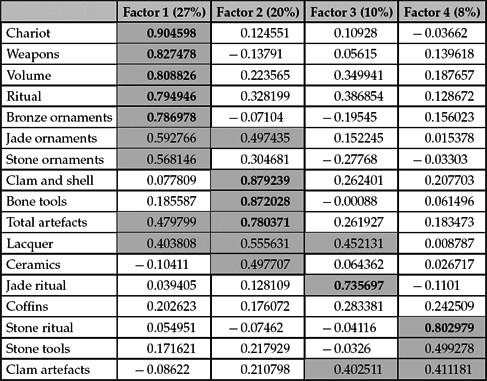
As it takes society-wide behaviour rather than individual graves or artefact types as its unit of analysis, this method provides a way to explore a community as a whole and reconstruct its local-specific mortuary practices. Indeed, focusing on single artefact types, mostly ritual bronzes, is precisely what has led to a focus on the upper echelons of Zhou society in mortuary research. In contrast, community-wide mortuary practices can be identified first and then further explored in their relationship to other cemeteries (Jaffe Reference Jaffe2012; Shelach Reference Shelach2001). After the presentation of these findings for each period, we move into evaluating these results with respect to those trends found in TMQC Locus III. We provide the results of the Early Western Zhou period first in order to illustrate these methods, and then the Middle and Later Western Zhou period analysis in tandem. The Spring and Autumn period data set was too small to allow for this type of analysis and was not submitted to the same test. The results of factor analysis performed on Early period graves can be seen in Table 7.
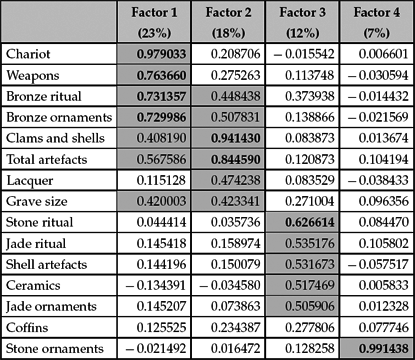
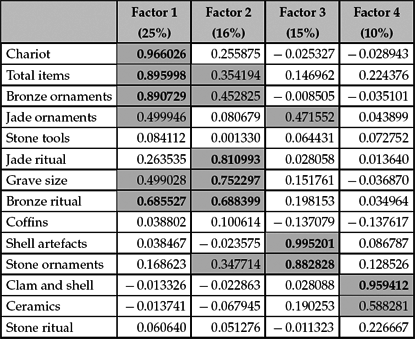
Common factor analysis with percentage of variance explained by each factor for Early period graves. Correlations are highlighted and strong or dominant correlations are in bold.

Several correlations can be readily observed, such as the strong connection between the number of bone, shell and the total number of artefacts in Factor 2, as well as the moderate connection with the quantities of ceramic vessels and ornaments made of jade. Factor 1 is dominated by the chariot-use bronze artefacts, along with weapons, grave size and ritual bronze vessels, as well as with bronze and stone ornaments. Jade ritual artefacts represent the majority of Factor 3, along with shell artefacts. Lacquer seems to not be as important to any of the factors and may not have been a restricted or particularly prized material at TMQC. Factor 4 is dominated by stone ritual vessels and connected with stone tools and shell artefacts. It is important to point out that very few categories are mutually exclusive and they do in fact integrate with many co-occurring elements—although weapons and bronze artefacts associated with chariot use are very strongly correlated and seem to be an exclusive object reserved for a select few individuals.
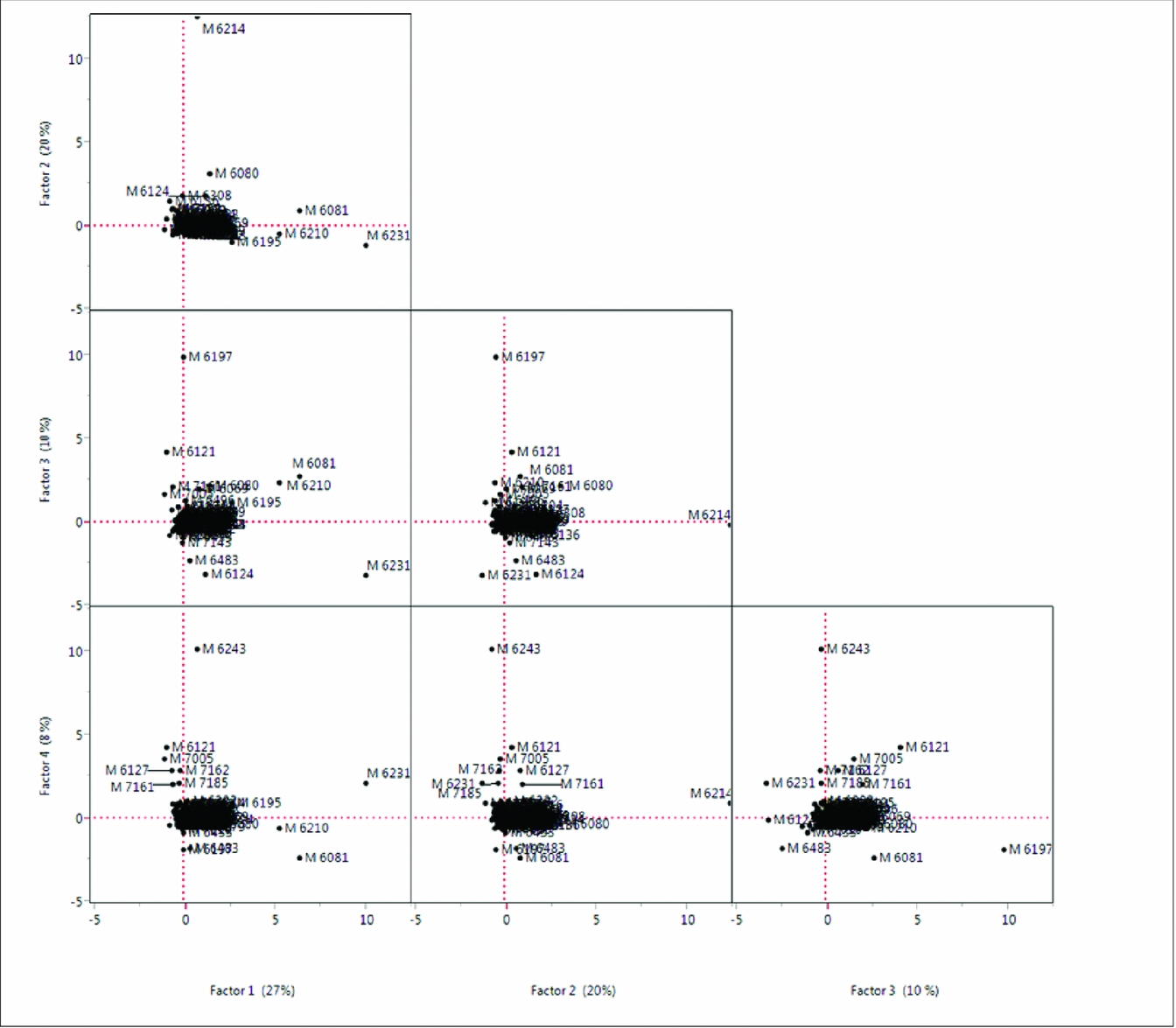
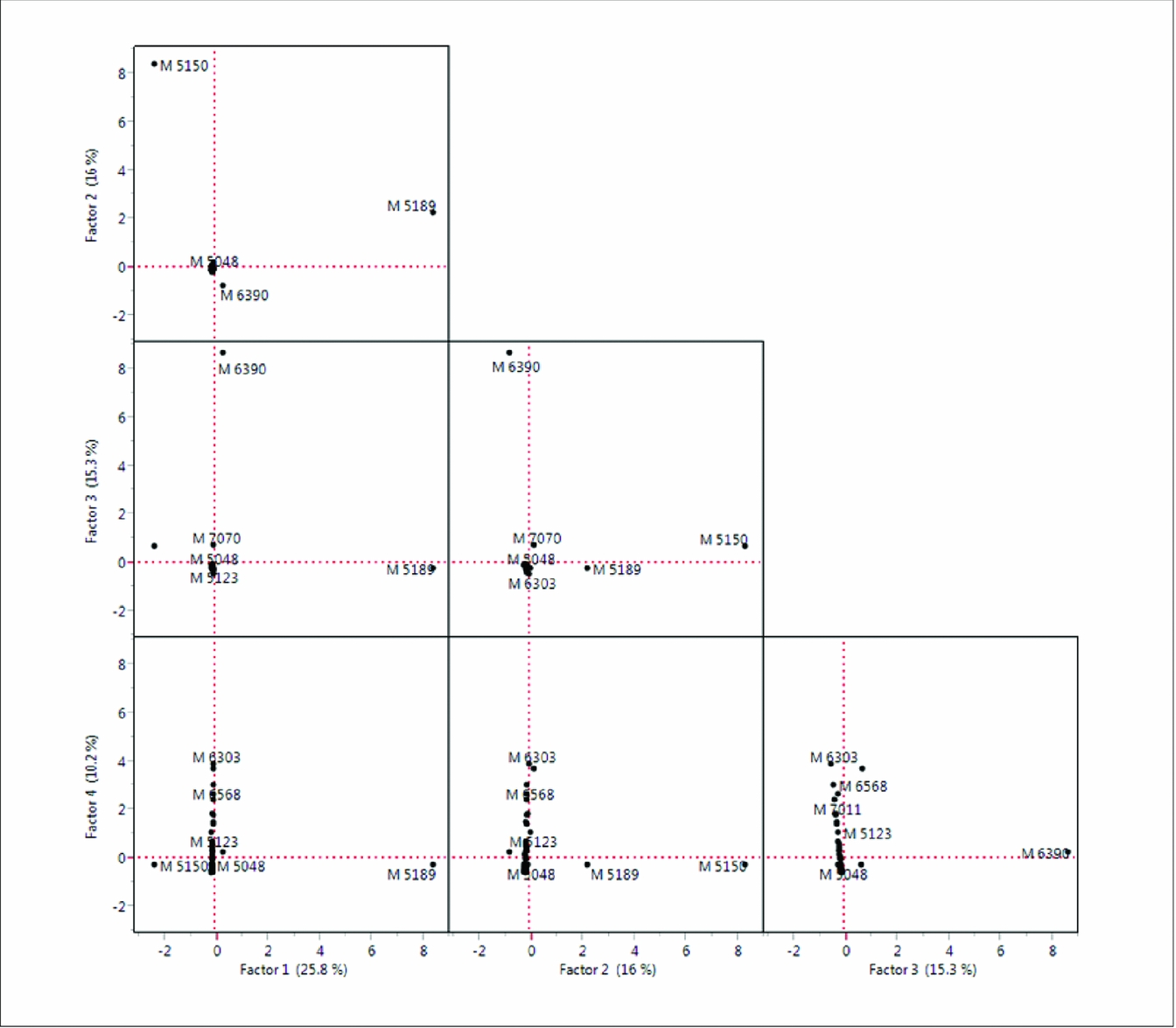
By saving the score of each factor per individual grave, these results can then be plotted to examine the overall distribution of graves visually by factor, as well as reify the highest-scoring graves for each factor (Fig. 6). The six matrixes in Figure 6 are two-dimensional representations of the pairs of the four factors discussed above, where each grave is represented by a single black dot and is located in the matrix in respect to the score it achieved on the individual factors. While most graves scored quite low on Factor 1, many graves scored modestly on Factors 2, 3 and 4.
Score plot for Early period graves against the four factors. Numbers represent the score each grave achived on each of the factors.
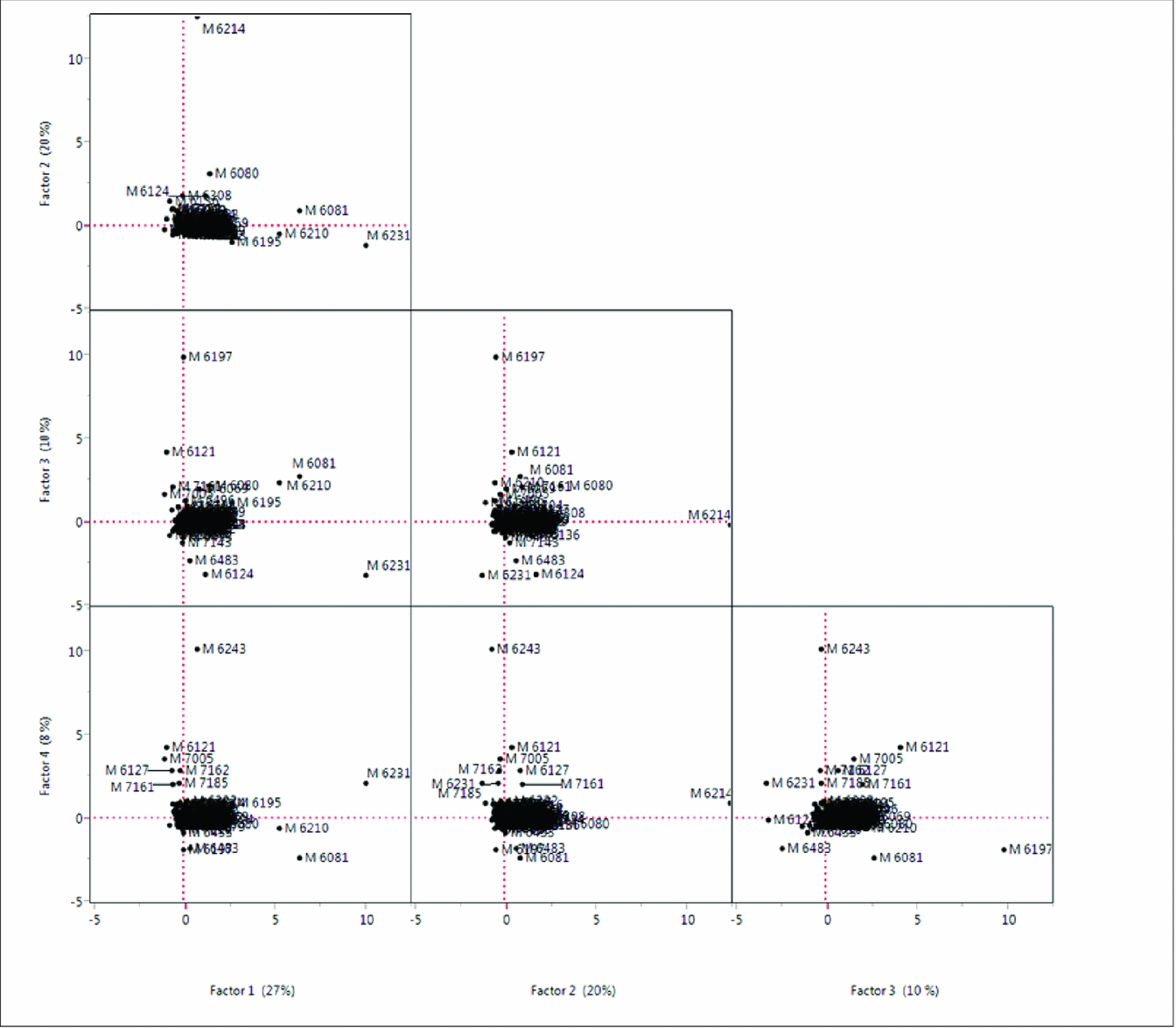
The combination of factors and the artefacts representing them reveals how mutually exclusive each artefact type was as well. While some factors showed connections, notably, 3&4 and to a lesser extent 1&3, exemplified by a number of graves scoring highly on both, other factors were almost prohibitive of each other, as was the case with Factors 2&4 and 1&4.
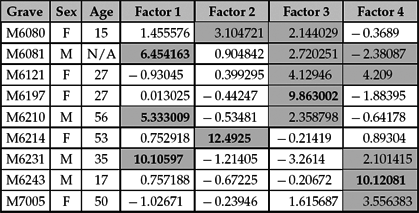
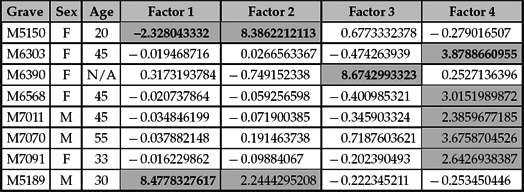
What is gained from this analysis is a better understanding of the categories that were more or less restricted to lower levels of society, most notably horse and chariot fittings as well as weapons, the strongest variables of factor 1. Of note is the finding that ritual bronze vessels were not reserved for a single elite group (found in Factor 2) in the way that weapons and bronze artefacts associated with chariot use were. This hints at a situation where much of the wealth at the cemetery was aggregated in the graves of certain individuals and one where certain components were off limits for certain elements of society. When the high-scoring graves for each of the four factors are observed (Table 8), it becomes clear that only M6080, belonging to a young female of 15, scored highly on Factors 3 and 2, while other graves minimized these two factors while scoring highly on Factors 1 or 2.
High-scoring Early period graves. Numbers represent the score each grave achieved on each of the factors. Correlations are highlighted and strong or dominant correlations are in bold.

Changes in the Middle and Late periods
When the Middle period graves were submitted to the factor analysis test, the following results emerged (Table 9).
Common factor analysis with percentage of variance explained by each factor for Middle period. Correlations are highlighted and strong or dominant correlations are in bold.

Factor 1 finds the continued strong connection between weapons and chariot gear, as well as their exclusiveness. Grave size is no longer as important to this category, but shells do seem to be somewhat correlated with this category. Factor 2 finds strong correlations between shells and total artefacts as well as bronze ritual vessels, but lacquerware is no longer seen connected to this grouping, as was the case for the Early period. A new factor, Factor 3, finds correlations between jade ornaments and jade ritual artefacts, along with stone ritual items, shell artefacts, ceramic vessels and even bronze ritual vessels. Stone ornaments, comprising Factor 4, are now not as strongly correlated with other factors. These categories continue to indicate community-wide trends such as the fact that bronze, in all forms, was an exclusive material restricted from most members of society (even more so than during the Early period), while jade and stone ritual artefacts were less regulated. When the individual graves are plotted on an overly plots by factor score, a pattern emerges where Factors 1 and 2 are still quite exclusive while Factors 3 and 4 were open to the rest of society (Table 10 & Figure 7).
High-scoring Middle period graves. Correlations are highlighted and strong or dominant correlations are in bold.

Score plot for Middle period graves against the four factors.
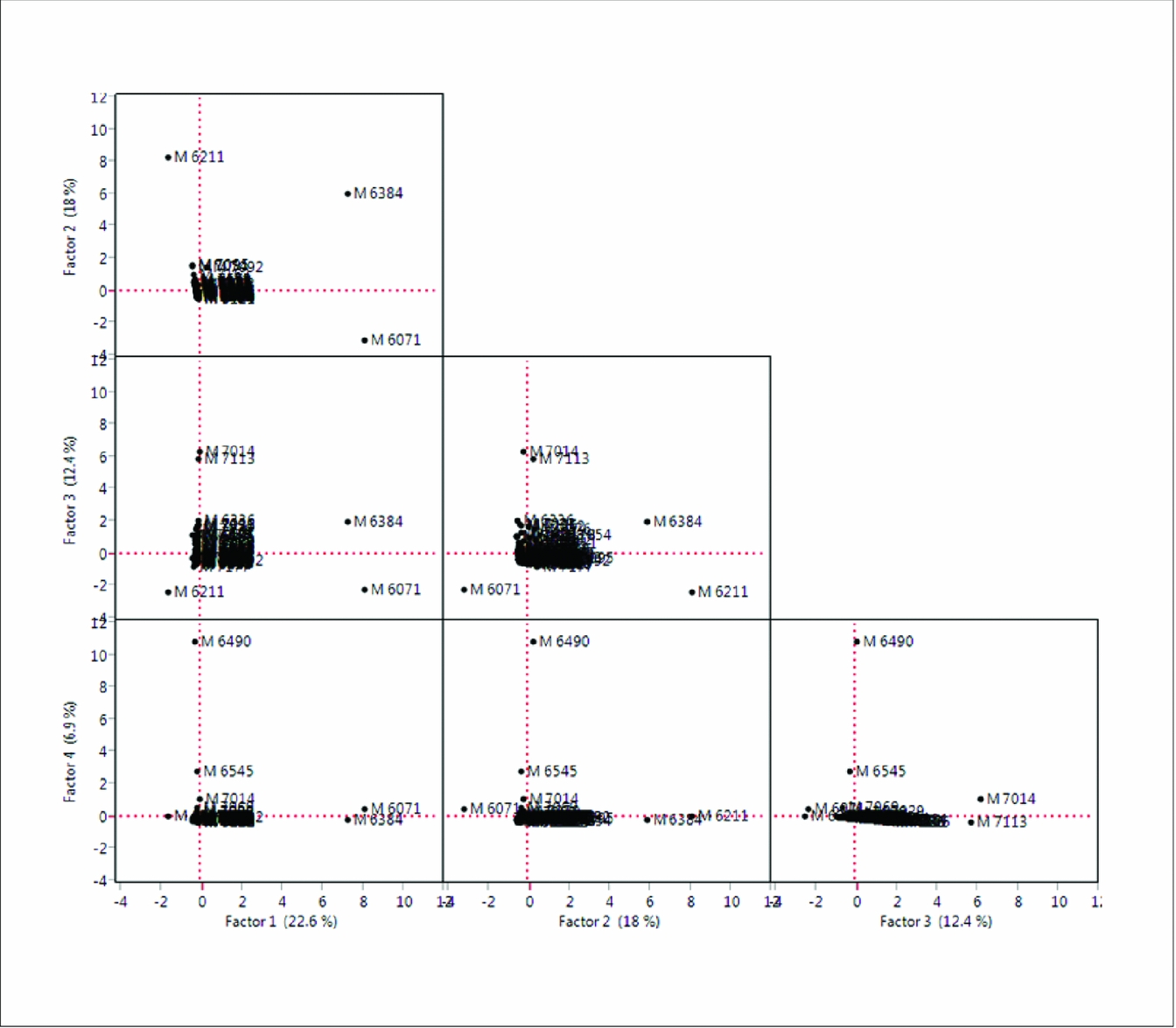
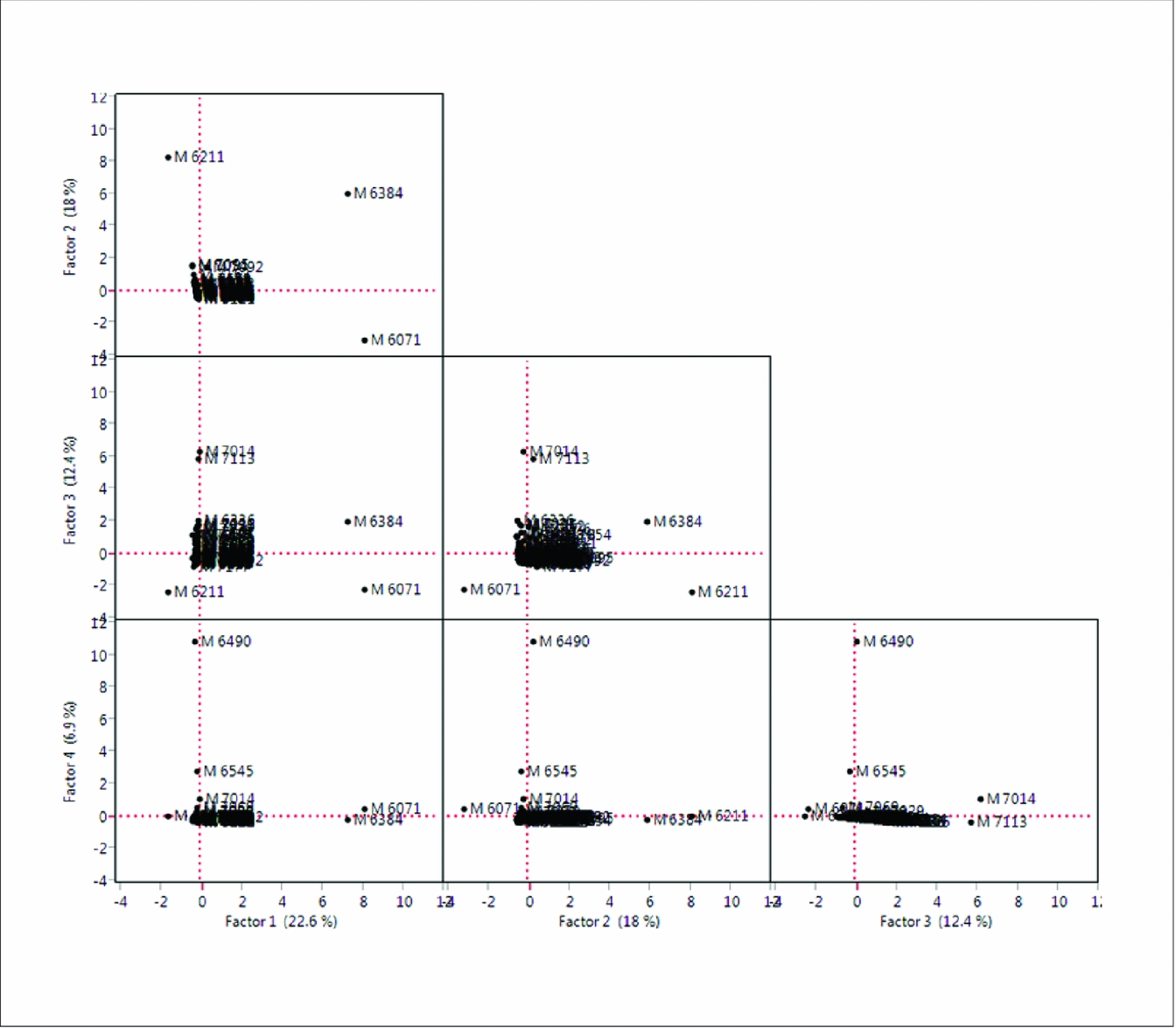
Factor analysis of the Late period graves produced the following results (Table 11): Factor 1 is dominated by total number of bronze ornaments and artefacts associated with chariot use. These are also moderately correlated with jade ornaments and grave size, as well as strongly correlated with ritual vessels. Ritual vessels are also important in Factor 2, where they are strongly correlated with grave size and jade ritual vessels. They are also moderately associated with stone and bronze ornaments and total vessel numbers. Factor 3 finds strong correlations between shell artefacts and stone ornaments, and to some extent with jade ornaments. Factor 4 is dominated by the total number of imported shells and is also somewhat strongly correlated with ceramic vessels. When graves are plotted by their factor score, an interesting pattern emerges where only a small number of graves score highly for Factors 1, 2 and 3, while Factor 4 is the one where the overwhelming majority of all graves score, comprised of only imported clams, shells and ceramic vessels (Figure 8).
Common factor analysis with percentage of variance explained by each factor for Late period graves. Correlations are highlighted and strong or dominant correlations are in bold.

Score plot for Late period graves against the four factors.
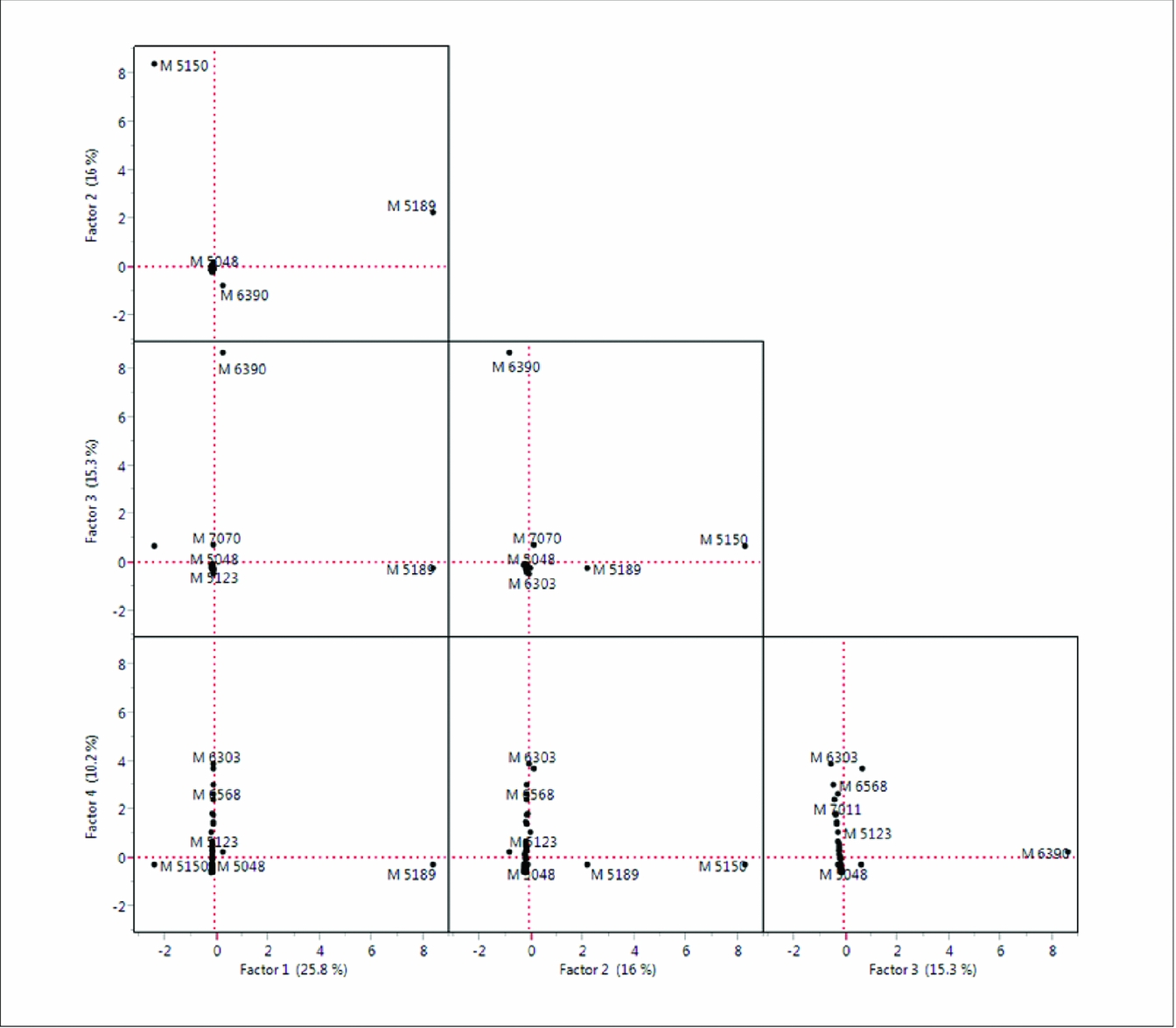
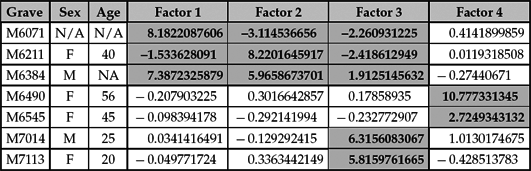
When observing the highest -scoring graves, internal wealth discrepancies become even more apparent (Table 12): only one grave scored somewhat highly on Factor 1 (M5189), which also scored quite highly on Factor 2. In addition, only one other grave scored highly on Factor 2, noting an extreme case where bronze and, for the first time, jade artefacts become an exclusive category not open to other levels of society (an observation that is in tandem with the importance accorded to jade artefacts at the Locus III cemetery).
High-scoring Late period graves. Correlations are highlighted and strong or dominant correlations are in bold.

Discussion: the TMQC community of mortuary practices
Rudimentary statistical analyses revealed several overarching trends at Locus II of the TMQC cemetery. The average age of the interred remained more or less constant over time, as did the propensity to include ceramic vessels, stone or shell artefacts. Other elements changed, such as the average size of graves, which dropped in the Middle Western Zhou and returned to be an important element only during the Late Western Zhou period. The number of graves with a relatively high level of wealth, reflected in total material goods found in them, decreased over time at the cemetery, as did the graded differences among TMQC society members. This change takes place when the TMQC Locus III cemetery is established—during the Middle Western Zhou period (or terminal Early Western Zhou)—implying a connection between the physical separation of the Jin leaders from the rest of society, at least in death, and the growing social differentiation seen among this society as a whole (which, as noted above, was uncommon at other Western Zhou cemeteries).
The use of factor analysis provided further in-depth community-specific insights into the connections between artefact category types, mortuary ritual and elite preferences. During the Early Western Zhou period, weapons and bronze artefacts associated with charioteering were very strongly correlated and were, in fact, an exclusive type of artefact reserved for select individuals. In contrast, bronze ritual vessels were found in lower-status graves, perhaps indicating their inclusion into certain rituals of ancestor worship at this site. Stone tools, ceramic vessels and items made of shell and clam were not restricted to the rest of society, but neither were jade ritual artefacts or lacquerwares; in fact, both categories were prevalent among many graves, indicating again the ability to partake in similar ancestor-worship practices. In contrast, both jade and stone ornaments were found only in the richest graves, while imported clams and shells were items sought after by all levels of society.
During the Middle Western Zhou period, the continued importance of bronze ritual vessels is seen alongside the exclusiveness of both weapons and chariot gear. As bronze became an exclusive material during this period, imported clams and shells were prevalent and still favoured by the upper and lower classes alike. Grave size, in contrast, was no longer as important in the display of wealth or higher social status, and lacquerware becomes even less restricted. While ritual bronze vessels become increasingly exclusive during this period, indicating a ritual facet of ancestor worship controlled by upper levels of society, jade ornaments and jade ritual artefacts are now two types of artefact groups found in the graves of many levels of society. That said, as ritual bronze vessels were connected to total number of artefacts during this period, a beginning of the consolidation of economic wealth with ritual aspects of mortuary practices is suggested. Shell artefacts and ceramic vessels are still found in almost all graves, though stone ornaments are not found in many graves and seem to be of little interest (or perhaps accessible) to most groups during this time.
In the Late Western Zhou period, a strong connection is found between grave size and the total number of bronze, jade and lacquer artefacts. Other connections are seen between stone and jade ornaments, and for the first time jade, as a material, became exclusive to the upper levels of society—an observation that is in tandem with the importance associated with this material at the TMQC Locus III burials of the Jin lords. In other words, jade was an important material, not only for ritual performance, but also as an ornate artefact adorning the body of the deceased, and one that the highest elites, buried in Locus II, sought, but only few could afford. Thus, Late Western Zhou period graves reflect a far less open society, where fewer people enjoyed wealth to the extent that it had existed in the two earlier periods.
It is important to note that the finding that bronze was largely a restricted material category at TMQC is not an obvious result, or one necessarily to be expected from this analysis. When compared to other known graves from the Western Zhou world, bronze is utilized in a number of different ways. At Liulihe 琉璃河, the main site of the Yan colony to the northeast, bronze ritual vessels and ornaments were found in elite graves, whereas weapons constituted a separate category reserved for a lower military social component and one signifying the lower status of warriors among this community (Jaffe Reference Jaffe2012, 58–62). At Beiyao 北窑, or Chengzhou 成周, the eastern capital of the Zhou polity situated in the eastern part of the royal domain near modern-day Luoyang, in contrast, weapons were found in many graves of both the rich and the poor. In addition, the prevalence of bronzes associated with the chariot-use category at Beiyao is astounding, as almost all graves contained at least a few bronze items from this category (Jaffe Reference Jaffe2011, 66–9). This finding is also dissimilar from the situation at TMQC where bronze weapons were a restricted artefact type.
In fact, a number of other differences existed between these cemeteries as well, and further stress the tension between the overarching Zhou-style burial framework and the community-specific manifestation of local agendas and preferences. The prominent human and dog sacrifices found at the Liulihe cemetery are not known from the Beiyao cemetery and are almost non-existent at TMQC. Overall, grave size appears to be an important difference between these cemeteries, with a larger average grave size seen at both Beiyao and TMQC than that found at Liulihe. Additionally, ornaments do appear in a number of graves at Beiyao and TMQC, yet their average number per containing grave is considerably less than that found at Liulihe graves (Jaffe Reference Jaffe2012, 68–9).
Conclusions
Mortuary customs contain an extensive amount of information on social organization, religious systems and political power of ancient societies, and their study should be engaged to reveal them all whenever possible. These facets should not be seen as mutually exclusive, but as inherently intertwined, reproduced and reinforced in the local specific ways in which human groups interact with artefacts through their social practices. A community-based approach to mortuary customs contextually observes how components of mortuary practices relate to both the position the deceased held in life, as well as ritual customs related to belief in the afterlife and the incentives community members followed when burying their dead.
Indeed, the contribution of the above study is to present the community-specific manifestation of burial practices among Western Zhou cemeteries, and with them new insights into social differentiation and rank—ones not predicated on the existence of a single artefact type or category. Factor analysis is but one approach researchers can use in uncovering underlying relationships and patterns difficult to observe in large data sets. The above analysis found that ritual vessels, the artefact category receiving the most attention in studies of the Western Zhou (and which at TMQC provided the main indicator for individual rank and status) were actually not restricted, or even as important as other categories, such as weapons and charioting items. In contrast, other ritual items that relate to the mortuary ceremony itself, made of jade and stone, were less restricted earlier on and then suddenly were limited to only a select few among the community. Thus, when untied from larger, seemingly absolute social constellations of Western Zhou society, the TMQC cemetery with its rich diachronic dataset allows for the observation of deepening social differentiation and the changing importance of artefacts and materials among it: tighter control over ritual-related objects of bronze, jade and stone, as well as those that would have been associated with wealth, such as ornaments and overall investment in grave construction. Additionally, some objects changed in importance, highlighting the increasing wealth gap between the very rich and the rest of society. These alterations were contemporaneous with the establishment of the Locus III cemetery and suggest a possible important reason for their change.
The results of this study provide a bottom-up reconstruction of mortuary practices of the Western Zhou Tianma-Qucun community. Future work should be done to contrast these finds with other studies engaged in examining burial clusters among Zhou cemeteries, the tension between Zhou-style burial framework and preferences, including the differences between regional states which often consisted of multiple lineages with the cemeteries of a small polity dominated by a single lineage (in Falkenhausen Reference Falkenhausen2006). Following the arguments presented here, the community-specific manifestation of local agendas should guide these studies where their interpretations derive, not from larger overarching patterns believed to be held by both aristocrat and commoner of the Western Zhou world, but instead from an observation of the specific community itself and the manner in which it changed over time.
Acknowledgements
We are most grateful for the comments provided by Augusta McMahon and the anonymous reviewers of this paper. They have truly helped us make this paper clearer and better argued. Noa Corcoran-Tadd and Emily Cole also provided invaluable input on how to make this paper stronger, tighter and more approachable. Support for this paper was given in part by the Fundamental Research Funds for the Central Universities, and the Research Funds of Renmin University of China (grant # 17XNI010).