Introduction
The Mississippian was the ‘Age of Crinoids’ (Kammer and Ausich, Reference Kammer and Ausich2006), and the Fort Payne Formation has been a model setting for understanding the composition, facies distribution, taphonomy, and paleoecology of Mississippian crinoid faunas (early Viséan; late Osagean). The first descriptions of Fort Payne Formation crinoids were in the pioneering works of Gerard Troost (Reference Troost1849, Reference Troost1850a, Reference Troost1850b; see Ausich, Reference Ausich2009) and James Hall (Reference Hall1858, Reference Hall1859). With the exception of Ehlers and Kesling (Reference Ehlers and Kesling1963), little further research was completed on crinoids from the Fort Payne Formation until the 1980s when two of the present authors began a long-term study of the Fort Payne Formation. Ausich and Meyer (Reference Ausich and Meyer1990) delineated sedimentary facies in the Fort Payne Formation and recognized autochthonous and allochthonous facies in this mixed carbonate-siliciclastic, toe-of-slope setting. Fort Payne Formation background sedimentation was siltstone punctuated by carbonate turbidites, which eventually buried autochthonous carbonate buildups.
Well-preserved crinoid fossils are especially abundant in autochthonous facies, including packstone buildups, wackestone buildups, and green shale facies (Ausich and Meyer, Reference Ausich and Meyer1990). As demonstrated by Krivicich et al. (Reference Krivicich, Ausich and Meyer2014) and despite close spatial proximity, each autochthonous facies supported a distinct crinoid-blastoid assemblage. Further, despite the allochthonous sedimentary fill of incised channels, this channel-form packstone facies also contained a separate, distinct crinoid assemblage. These contemporaneous depositional settings also provided contrasting conditions that allowed for an understanding of the comparative taphonomy of different echinoderm clades (Meyer et al., Reference Meyer, Ausich and Terry1989). In addition, Thompson and Ausich (Reference Thompson and Ausich2016) recently examined the distribution of echinoids in the Fort Payne Formation, which like many crinoids were concentrated in the two autochthonous buildup facies.
To date, comprehensive systematic treatment of Fort Payne Formation blastoids (Ausich and Meyer, Reference Ausich and Meyer1988), flexible crinoids (Ausich and Meyer, Reference Ausich and Meyer1992), disparid crinoids (Ausich et al., Reference Ausich, Kammer and Meyer1997), and the camerate Agaricocrinus (Meyer and Ausich, Reference Meyer and Ausich1997) have been published. In this contribution, the systematics of Fort Payne Formation Actinocrinitidae is presented, which is now possible because of a revised understanding of actinocrinitids (Ausich and Sevastopulo, Reference Ausich and Sevastopulo2001) and a comprehensive review of the North American Actinocrinitidae by Rhenberg et al. (Reference Rhenberg, Ausich and Kammer2015). Actinocrinitids are especially important elements of the carbonate buildup facies in the Fort Payne Formation. Thinocrinus, with its exaggerated arm lobes, is a characteristic taxon of the wackestone buildups (Krivicich et al., Reference Krivicich, Ausich and Meyer2014). Herein, five nominal species assigned to two genera (and five additional taxa left in open nomenclature) of actinocrinitids are recognized from the Fort Payne Formation, including Actinocrinites jugosus (Hall, Reference Hall1859), Actinocrinites spp. indeterminate, Thinocrinus gibsoni (Miller and Gurley, Reference Miller and Gurley1893), Thinocrinus lowei (Hall, Reference Hall1858), Thinocrinus probolos (Ausich and Kammer, Reference Ausich and Kammer1991), Thinocrinus akanthos n. sp., Thinocrinus sp. aff. T. gibsoni, and Thinocrinus spp. indeterminate. Two taxa only identified as Actinocrinitidae genus and species indeterminate are also discussed, and Actinocrinites tripus Ehlers and Kesling, Reference Ehlers and Kesling1963, is designated as a junior synonym of Thinocrinus gibsoni.
Geographic and stratigraphic occurrences and depositional settings
The crinoids described here are from the lower portion of the Fort Payne Formation in south-central Kentucky and Alabama (Appendix 1). The Fort Payne Formation in south-central Kentucky, north-central Tennessee, and northern Alabama is early Viséan (late Osagean) in age based on conodont (Leslie et al., Reference Leslie, Ausich and Meyer1996) and crinoid (Ausich and Meyer, Reference Ausich and Meyer1990; Krivicich et al., Reference Krivicich, Ausich and Keyes2013) biostratigraphy. Fort Payne Formation faunas are age-equivalent with the well-documented faunas of the Edwardsville Formation in central and southern Indiana (Van Sant, Reference Van Sant1964; Lane, Reference Lane1973; Ausich and Lane, Reference Ausich and Lane1982) and the Keokuk Limestone and lower Warsaw Formation in the type Mississippian region of Illinois, Iowa, and Missouri (Ausich and Meyer, Reference Ausich and Meyer1990; Kammer et al., Reference Kammer, Brenckle, Carter and Ausich1990).
The Fort Payne Formation in south-central Kentucky and north-central Tennessee was deposited near the toe of the slope of a clinoform that prograded through this region during the middle Mississippian (Lewis and Potter, Reference Lewis and Potter1978; Ausich and Meyer, Reference Ausich and Meyer1990; Khetani and Read, Reference Khetani and Read2002; Krause et al., Reference Krause, Meyer and Ausich2002; Krause and Meyer, Reference Krause and Meyer2004; Greb et al., Reference Greb, Potter, Meyer and Ausich2008). Presumably, the carbonate facies were deposited in this otherwise siliciclastic setting during a short-duration rise in sea level. Then during the subsequent sea-level fall, the clinoform prograded westward, infilling the basin in this region.
Lewis and Potter (Reference Lewis and Potter1978, p. 7) referred to the Fort Payne Formation of south-central Kentucky as “… vast, heterogeneous, and puzzling.” The Fort Payne Formation is a mixed carbonate-siliciclastic sequence with laterally adjacent faunas that are from autochthonous (fossiliferous green shales, wackestone carbonate buildups, and crinoid packstone carbonate buildups) and allochthonous facies (the siltstone background sedimentation, sheetlike packstones, and the Jabez Sandstone). Further, the channel-form packstone facies is an allochthonous sedimentologic deposit with an autochthonous fauna (Krivicich et al., Reference Krivicich, Ausich and Meyer2014). The relative distribution of these facies is well illustrated in Lewis and Potter (Reference Lewis and Potter1978), Ausich and Meyer (Reference Ausich and Meyer1990), Meyer et al. (Reference Meyer, Ausich, Bohl, Norris and Potter1995), Greb et al. (Reference Greb, Potter, Meyer and Ausich2008), and Thompson and Ausich (Reference Thompson and Ausich2016). Actinocrinitids are most common from the carbonate buildups. Both wackestone buildups and crinoid packstone buildups were laterally isolated facies with a positive topographic relief during deposition (see Ausich and Meyer, Reference Ausich and Meyer1990; Greb et al., Reference Greb, Potter, Meyer and Ausich2008). Both buildup types include central core and flank bed facies. Individual buildup stratigraphic thickness could exceed 15 m, and the lateral diameter of individual buildups was variable but could extend to greater than 400 m. The presence of a distinctive crinoid assemblage on each of these carbonate buildup types as well as in the autochthonous green shale facies and channel-form packstone facies attests to the autochthonous nature of these facies (Krivicich et al., Reference Krivicich, Ausich and Meyer2014). The autochthonous nature of these facies is demonstrated further by the restriction of semi-articulated echinoids to these facies (Thompson and Ausich, Reference Thompson and Ausich2016).
Material and distribution of Fort Payne Formation Actinocrinitidae
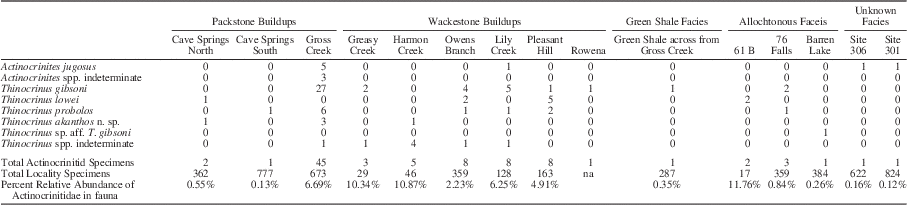
As outlined in Table 1, Actinocrinitidae occur in most Fort Payne Formation facies, although they are typically most abundant in the autochthonous facies, especially the carbonate buildups. A preference for the carbonate buildup facies is even more evident when relative crinoid abundance of each facies is considered (Table 1). The Gross Creek packstone buildup is a notable exception; however, in general, actinocrinitids are typically a more significant percentage of crinoid relative abundance on wackestone buildups than in other facies (Table 1). As noted in Krivicich et al. (Reference Krivicich, Ausich and Meyer2014), Actinocrinites gibsoni (reassigned herein to Thinocrinus gibsoni) is one of five most characteristic crinoids for the crinoid packstone buildup facies. In contrast, Thinocrinus (herein representing the three species of Thinocrinus with greatly exaggerated arm lobes, T. lowei, T. probolos, and T. akanthos n. sp.) are among the six most dominant species on wackestone buildups. Thus, the taxonomic revisions presented here demonstrate Thinocrinus is the only dominant actinocrinitid on Fort Payne Formation carbonate facies and that different species of Thinocrinus occur preferentially on different buildup facies. Actinocrinites sensu stricto does occur in Fort Payne Formation facies, but except for a single specimen (A. jugosus), its occurrence is apparently restricted to crinoidal packstone facies. In Europe, Thinocrinus occurs in a wider array of facies, including the classical Tournaisian Waulsortian mound facies (Ausich and Sevastopulo, Reference Ausich and Sevastopulo2001; Ausich and Kammer, Reference Ausich and Kammer2006).
Distribution and relative abundance of Actinocrinitidae among facies and localities; total number of species per locality based on Krivicich et al. (Reference Krivicich, Ausich and Meyer2014).

Repositories and institutional abbreviations
CMC IP, Cincinnati Museum Center, Geier Center; OSU, Orton Geological Museum, Ohio State University; USNM, U.S. National Museum of Natural History, Smithsonian Institution, Washington, D.C.
Systematic paleontology
Terminology follows Ubaghs (Reference Ubaghs1978a) and Ausich et al. (Reference Ausich, Brett, Hess and Simms1999). All measurements are in mm.
Class Crinoidea Miller, Reference Miller1821
Subclass Camerata Wachsmuth and Springer, Reference Wachsmuth and Springer1885
Order Monobathrida Moore and Laudon, Reference Moore and Laudon1943
Suborder Compsocrinina Ubaghs, Reference Ubaghs1978b
Superfamily Periechocrinoidea Bronn, Reference Bronn1849
Family Actinocrinitidae Austin and Austin, Reference Austin and Austin1842
Remarks
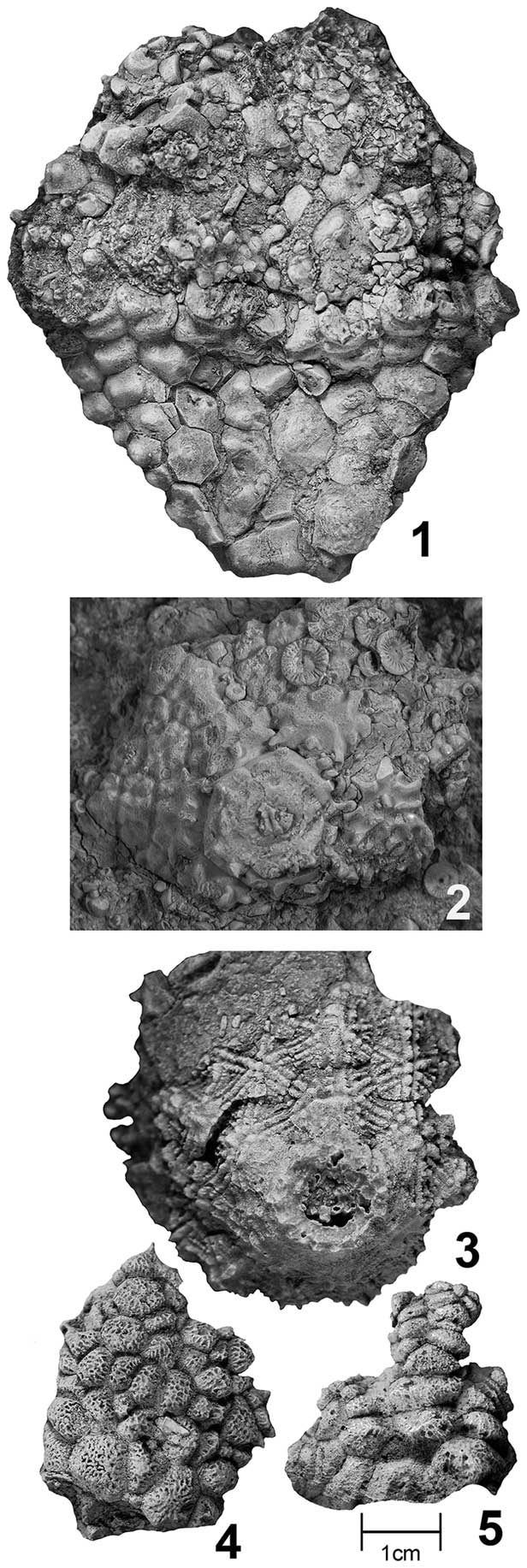
The Actinocrinitidae were important faunal elements in Early Mississippian faunas, but their taxonomy and occurrence data have been hampered by their overall poor preservational potential in many settings. In sedimentary settings punctuated by periodic obrution deposits (e.g., tempestites), such as the Edwardsville Formation of Crawfordsville, Indiana (Van Sant, Reference Van Sant1964; Lane, Reference Lane1973), actinocrinitid preservation potential is very high. However, because actinocrinitids typically have a large calyx with relatively very thin calyx plates, these crinoids are more susceptible to disarticulation and compaction than typical camerate crinoids (Fig. 1.1). Meyer et al. (Reference Meyer, Ausich and Terry1989) regarded Fort Payne Formation Actinocrinites (now Thinocrinus) as having anomalously poor preservation potential for a camerate crinoid and regarded it to be more similar to cladid crinoids taphonomically. This is especially true for the Fort Payne Formation, which formed in a toe-of-slope clinoform setting interpreted to have been in the relatively deep water near storm wave base (Ausich and Meyer, Reference Ausich and Meyer1990). Hence, in our collections, only four calyxes are present that are articulated and not compacted (none of these have arms attached) (Fig. 2.1). The remainder of the specimens are compacted calyxes, partially disarticulated calyxes, or isolated plates. No Fort Payne actinocrinitids are known with attached arms or columnals, which indicates the relatively low frequency of obrution events in this Lower Mississippian depositional setting.
Fort Payne Formation Actinocrinites and Actinocrinitidae indeterminate: (1) lateral view of compressed calyx of Actinocrinites jugosus (USNM 618401); (2) basal view of the type of Actinocrinitidae genus and species indeterminate with coarse irregular nodose plate sculpturing (USNM 618421); (3) basal view of the type of Actinocrinitidae genus and species indeterminate with multiple stellate ridged plate sculpturing (USNM 618422); (4, 5) one articulated ray of Thinocrinus sp. aff. T. gibsoni (USNM 618420); (4) oral view, note pitted surface on tegmen plates; (5) aboral side of arm lobe, note elongate, nodosity to plates.

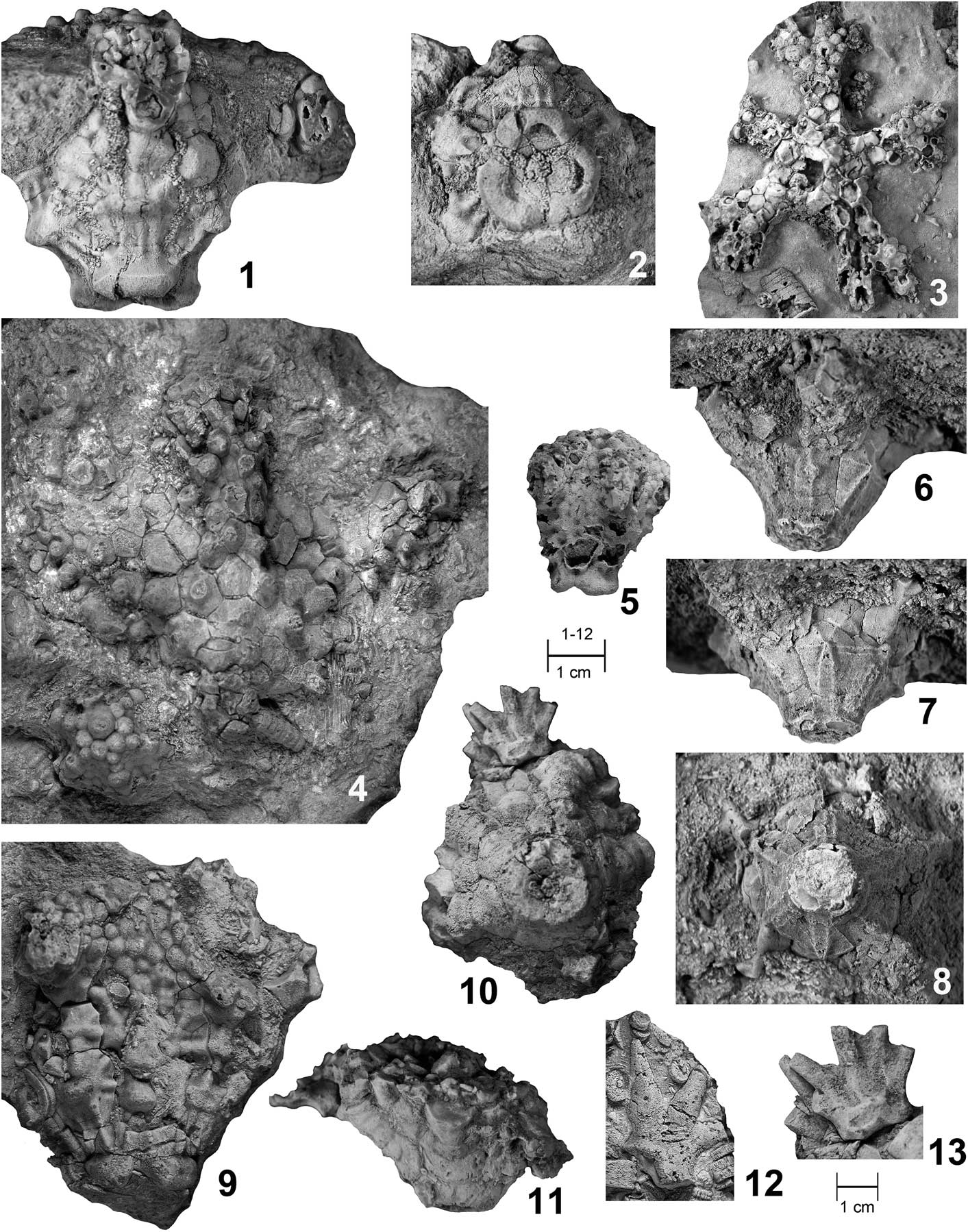
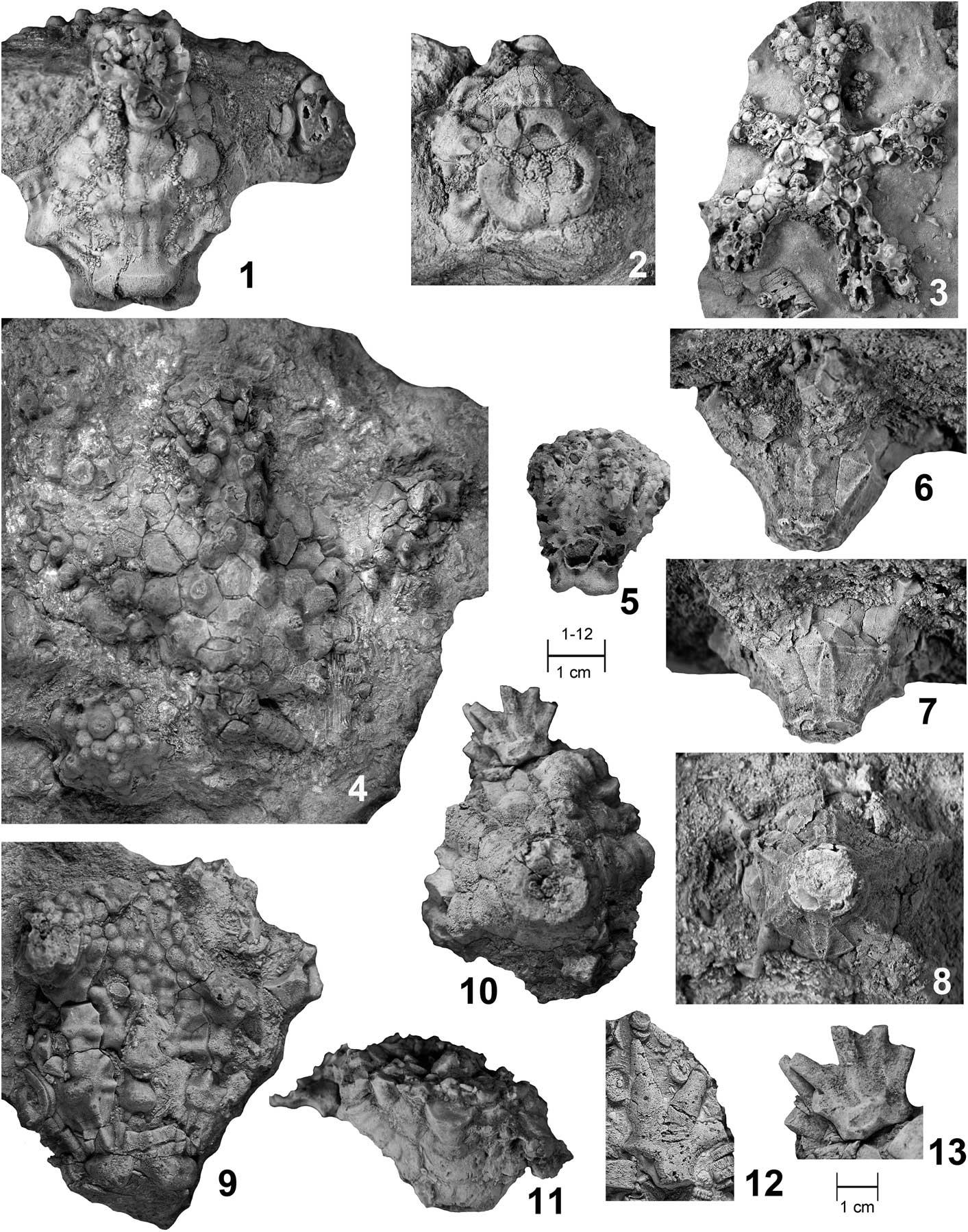
Fort Payne Formation Thinocrinus: (1, 2, 4) Thinocrinus lowei; (1) lateral view; (2) basal view (USNM 618410); (4) oral view of tegmen (USNM 618408); (3, 6–8) Thinocrinus probolos; (3) oral view, note long arm lobes and nodose tegmen plates (USNM 618412); (6) lateral view (USNM 618413); (7) lateral view of CD interray (USNM 618413); (8) basal view of calyx; (USNM 618413); (5, 9) Thinocrinus gibsoni; (5) juvenile specimen in lateral view of CD interray, note a silicified specimen with a very thin outer layer of silica and primanal and C radial surfaces broken, (USNM 618407); (9) lateral view of a partially crushed theca (USNM 618408); (10–13) Thinocrinus akanthos n. sp.; (10) basal view of calyx, note tegmen spine at top (USNM 618415, holotype); (11) lateral view of calyx (USNM 618415, holotype); (12) isolated tegmen spine (USNM 618416, paratype); (13) enlargement of tegmen spine on Fig. 2.9 (USNM 618415, holotype).
The general poor quality of actinocrinitid preservation in the Fort Payne Formation has previously hampered our understanding of these crinoids, because features such as the extent of the calyx arm lobes is a diagnostic character for both genera and species. This study is now possible because of the present relatively large collection of actinocrinitid specimens allows reconstruction of morphology from specimens recognized from various states of preservation. Both Actinocrinites and Thinocrinus are recognized in the Fort Payne Formation. These two genera are distinguished by Actinocrinites having fixed secundibrachials or tertibrachials (Fig. 1.1), whereas Thinocrinus only has fixed primibrachials (Fig. 2.1). Actinocrinites also has more ranges in the regular interray than Thinocrinus.
Genus Actinocrinites Miller, Reference Miller1821
Type species
Actinocrinites triacontadactylus Miller, Reference Miller1821; by subsequent designation (Wachsmuth and Springer, Reference Wachsmuth and Springer1881).
Diagnosis
Calyx medium to high bowl shape, basal and radial circlets high, one fixed secundibrachial, highest brachial in vertical wall of calyx before arm lobes in secundibrachitaxis or higher, arms grouped, arm lobes present, 1–2 or 1–3 plating in proximal regular interrays, three or more ranges of plates in regular interrays, regular interrays in contact with tegmen, three or more ranges of plates in CD interray, CD interray in contact with tegmen, fixed intrabrachial present between half-rays, free arms 20 or more, free arm facets not horizontal, tegmen not as high as calyx, anal tube long and central, free arms branch (from Ausich and Sevastopulo, Reference Ausich and Sevastopulo2001, p. 31).
Remarks
Actinocrinites was one of the original crinoid genera described by Miller in his monograph on British crinoids in 1821. Subsequently, this genus concept was applied globally for many camerate crinoids with a large, multiplated, conical calyx. Ausich and Sevastopulo (Reference Ausich and Sevastopulo2001) recognized that generic and specific concepts were applied differently between Western Europe and North America, which led to generic assignment revisions in Western Europe (Ausich and Sevastopulo, Reference Ausich and Sevastopulo2001; Ausich and Kammer, Reference Ausich and Kammer2006) and in North America (Rhenberg et al., Reference Rhenberg, Ausich and Kammer2015). The result of these revisions is that Thinocrinus is now recognized as the dominant actinocrinitid in many faunas rather than Actinocrinites. An example is the Fort Payne Formation described here. Actinocrinites jugosus is now the only nominal Actinocrinites species recognized in this fauna, and it is a relatively minor element of the Fort Payne Formation crinoid fauna.
Diagnoses for species of Actinocrinites are modified from Ausich and Sevastopulo (Reference Ausich and Sevastopulo2001).
Actinocrinites jugosus (Hall, Reference Hall1859)
Figure 1.1
1859 Actinocrinus jugosus Reference HallHall, p. 49.
1865 Actinocrinus jugosus Hall; Reference ShumardShumard, p. 345.
1868 Actinocrinus jugosus Hall; Reference ShumardShumard, p. 345.
1889 Actinocrinus jugosus Hall; Reference MillerMiller, p. 218.
1890 Actinocrinites lobatus (Hall); Reference WorthenWorthen, p. 97, pl. 12, fig. 8, 8a.
1893 Actinocrinus augustatus Reference Miller and GurleyMiller and Gurley, p. 11.
1894 Actinocrinus jugosus Hall; Reference KeyesKeyes, p. 190.
1897 Actinocrinus jugosus Hall; Reference Wachsmuth and SpringerWachsmuth and Springer, p. 563, pl. 54, fig. 1.
1897 Actinocrinus magnificus Reference Wachsmuth and SpringerWachsmuth and Springer [in part], p. 558.
1897 Actinocrinus augustatus Miller and Gurley; Reference MillerMiller, p. 731.
1898 Actinocrinus jugosus Hall; Reference WellerWeller, p. 59.
1898 Actinocrinus angustatus Miller and Gurley [sic.]; Reference WellerWeller, p. 55.
1943 Actinocrinites jugosus (Hall); Reference Bassler and MoodeyBassler and Moodey, p. 270.
1943 Actinocrinites augustatus (Miller and Gurley); Reference Bassler and MoodeyBassler and Moodey, p. 267.
1973 Actinocrinites jugosus (Hall); Reference LaudonLaudon, fig. 5.
1977 Actinocrinites jugosus (Hall); Reference WebsterWebster, p. 28.
1991 Actinocrinites jugosus (Hall); Reference Ausich and KammerAusich and Kammer, p. 495, figs. 3, 7.1–7.7.
2009 Actinocrinites jugosus (Hall); Reference Meyer and AusichMeyer and Ausich, fig. 5D.
2014 Actinocrinites jugosus (Hall); Reference Webster and WebsterWebster and Webster, p. 711.
2015 Actinocrinites jugosus (Hall); Reference Rhenberg, Ausich and KammerRhenberg, Ausich, and Kammer, p. 7.
Holotype
The holotype, UI X–738, is from the Keokuk Limestone at Warsaw, Illinois.
Diagnosis
Calyx medium cone, plates with single, central node; basals high; radials high; primibrachials two, together equal height of radial; secundibrachials, two, wider than primibrachials; two tertibrachials fixed in calyx; arm lobes short; tegmen medium cone, plates with single, central node; anal tube present, central.
Occurrence
In the Fort Payne Formation, A. jugosus is recognized from the Gross Creek wackestone buildup and Lily Creek wackestone buildup along Lake Cumberland in south–central Kentucky, and at Site 301 Lawrence County, Tennessee and Site 306 in Madison County, Alabama. Elsewhere, A. jugosus has been described from the Keokuk Limestone of Illinois and Iowa.
Materials
Actinocrinites jugosus is represented in the Fort Payne Formation by USNM 618401–618404 and OSU 54340.
Actinocrinites spp. indeterminate
Occurrence
Actinocrinites spp. indeterminate is recognized from the Gross Creek packstone buildup along Lake Cumberland in south-central Kentucky.
Remarks
Numerous specimens that belong to Actinocrinites (based on the number of brachitaxes present in the calyx wall) are too poorly preserved to confidently assign to A. jugosus because they lack a tegmen. The sculpturing of the calyx plates is either stellate, coarsely nodose, or coarsely pustulose; therefore, it is unlikely that they all belong to the same species. However, all are too incomplete to allow any species determination.
Thinocrinus Ausich and Sevastopulo, Reference Ausich and Sevastopulo2001
Type species
Steganocrinus westheadi Wright, Reference Wright1947; by original designation.
Diagnosis
Calyx medium cone to medium bowl shape, basal and radial circlets high, one or two fixed secundibrachials, highest brachial in vertical wall of calyx before arm lobes in primibrachitaxis or higher, arms grouped, arm lobes present, 1–2 or 1–3 plating in proximal regular interrays, three or four ranges of plates in regular interrays, regular interrays in contact with tegmen, three or four ranges of plates in CD interray, CD interray in contact with tegmen, fixed intrabrachial present or absent between half-rays, free arms 15–20 or more, free arm facets not horizontal, tegmen not as high as calyx, anal tube present and central, free arms branch (from Ausich and Sevastopulo, Reference Ausich and Sevastopulo2001, p. 37).
Remarks
Five species, including one left in open nomenclature, of Thinocrinus are recognized from the Fort Payne Formation. Characters necessary to distinguish among these species are outlined in Table 2.
Species diagnosis characters for Fort Payne Formation species of Thinocrinus.

Diagnoses for species of Thinocrinus are modified from Ausich and Sevastopulo (Reference Ausich and Sevastopulo2001).
Thinocrinus gibsoni (Miller and Gurley, Reference Miller and Gurley1893)
1893 Actinocrinus gibsoni Reference Miller and GurleyMiller and Gurley, p. 10, pl. 2, fig. 1.
1897 Actinocrinus gibsoni Miller and Gurley; Reference MillerMiller, p. 731.
1897 Actinocrinus multiramosus Reference Wachsmuth and SpringerWachsmuth and Springer; Reference MillerMiller, p. 731.
1897 Actinocrinus multiramosus Reference Wachsmuth and SpringerWachsmuth and Springer, p. 564, pl. 53, fig. 1; pl. 55, fig. 3.
1898 Actinocrinus gibsoni Miller and Gurley; Reference WellerWeller, p. 58.
1898 Actinocrinus multiramosus Wachsmuth and Springer; Reference WellerWeller, p. 61.
1906 Actinocrinus multiramosus Wachsmuth and Springer; Reference RowleyRowley, p. 31, pl. 6, fig. 15.
1909 Actinocrinus multiramosus Wachsmuth and Springer; Reference ClarkeClarke, p. 165, pl. 6, fig. 8.
1921 Actinocrinus multiramosus Wachsmuth and Springer; Reference ClarkeClarke, p. 78, fig. 65.
1921 Actinocrinus multiramosus Wachsmuth and Springer; Reference DacquéDacqué, p. 468, fig. 223.
1943 Actinocrinites gibsoni (Miller and Gurley); Reference Bassler and MoodeyBassler and Moodey, p. 269.
1943 Actinocrinites multiramosus (Wachsmuth and Springer, Reference Wachsmuth and Springer1897); Reference Bassler and MoodeyBassler and Moodey, p. 272.
1963 Actinocrinites tripus Reference Ehlers and KeslingEhlers and Kesling, p. 1038, pl. 134.1–134.6, fig. 3.
1964 Actinocrinites gibsoni (Miller and Gurley); Reference Van SantVan Sant, p. 106.
1973 Actinocrinites gibsoni (Miller and Gurley); Reference WebsterWebster, p. 35.
1973 Actinocrinites tripus Ehlers and Kesling; Reference WebsterWebster, p. 37.
1973 Actinocrinites multiramous (Wachsmuth and Springer, Reference Wachsmuth and Springer1897) [sic.]; Reference LaudonLaudon, fig. 5.
1977 Actinocrinites multiramosus (Wachsmuth and Springer, Reference Wachsmuth and Springer1897); Reference WebsterWebster, p. 29.
1978 Actinocrinites multiramosus (Wachsmuth and Springer, Reference Wachsmuth and Springer1897); Reference LaneLane, fig. 217.3.
1980 Actinocrinites gibsoni (Miller and Gurley); Reference Ausich and LaneAusich and Lane, p. 61.
1980 Actinocrinites gibsoni (Miller and Gurley); Reference AusichAusich, p. 278.
1983 Actinocrinites gibsoni (Miller and Gurley); Reference AusichAusich, p. 257, 277.
1983 Actinocrinites gibsoni (Miller and Gurley); Reference Kammer, Ausich and LaneKammer et al., p. 57, 67.
1985 Actinocrinites gibsoni (Miller and Gurley); Reference Ausich and LaneAusich and Lane, p. 222, 224.
1986 Actinocrinites multiramosus (Wachsmuth and Springer, Reference Wachsmuth and Springer1897); Reference WebsterWebster, p. 44.
1989 Actinocrinites gibsoni (Miller and Gurley); Reference Meyer, Ausich and TerryMeyer, Ausich, and Terry, p. 545, fig. 11E.
1991 Actinocrinites gibsoni (Miller and Gurley); Reference Ausich and KammerAusich and Kammer, p. 497, figs. 3, 8.4.
1993 Actinocrinites gibsoni (Miller and Gurley); Reference WebsterWebster, p. 20.
1999 Actinocrinites gibsoni (Miller and Gurley); Reference AusichAusich, p. 147, fig. 157.
1999 Actinocrinus multiramosus Wachsmuth and Springer; Reference Ausich and SimmsAusich and Simms, p. 56, fig. 64.
2001 Actinocrinites gibsoni (Miller and Gurley); Oji, Reference Oji2001, fig. 1A.
2006 Actinocrinites gibsoni (Miller and Gurley); Reference Gahn and BaumillerGahn and Baumiller, p. 400, figs. 3–4.
2014 Actinocrinites gibsoni (Miller and Gurley); Reference Webster and WebsterWebster and Webster, p. 709.
2014 Actinocrinites tripus Ehlers and Kesling; Reference Webster and WebsterWebster and Webster, p. 722.
2014 Actinocrinites gibsoni (Miller and Gurley); Reference Krivicich, Ausich and MeyerKrivicich et al., p. 1155, 1158, 1160.
2015 Thinocrinus gibsoni (Miller and Gurley); Reference Rhenberg, Ausich and KammerRhenberg et al., p. 13.
2015 Thinocrinus tripus Ehlers and Kesling; Reference Rhenberg, Ausich and KammerRhenberg et al., p. 13.
2016 Thinocrinus gibsoni (Miller and Gurley); Reference Thompson and AusichThompson and Ausich, p. 240.
Holotype
The holotype is FMNH UC 6631, which was first described from Keokuk Limestone in Iowa.
Diagnosis
Calyx medium cone, plates with single, central node and stellate ridges; basals high with discontinuous ridge at base; radials as high as or higher than wide, stellate ridges connecting with basal; primibrachials two, first a little more than half the height of radial; no fixed secundibrachials; arm lobes short; tegmen low bowl, plates nodose; anal tube present, eccentric.
Occurrence
In the Fort Payne Formation T. gibsoni is recognized from the Owens Branch wackestone buildup, autochthonous green shale across Gross Creek from the Owens Branch wackestone buildup, Lily Creek wackestone buildup, Greasy Creek wackestone buildup, Pleasant Hill wackestone buildup, Rowena wackestone buildup, Gross Creek packstone buildup, and 76 Falls (sheet-like packstones), all of which are from along Lake Cumberland in south-central Kentucky. Elsewhere, T. gibsoni has been described from the Edwardsville Formation and Harrodsburg Limestone in Indiana (Ausich and Kammer, Reference Ausich and Kammer1991).
Materials
Deposited Fort Payne Formation specimens include USNM 618405–618407, OSU 54341–54345, and CMC IP73468–IP73469.
Remarks
All plates in the calyx of Thinocrinus gibsoni have a central node, except for the basals (Fig. 2.9); other species only have a central node on the radials. The medium cone calyx separates T. gibsoni from T. lowei and the relatively short arm lobes distinguish it from T. probolos. This is the most common species of Thinocrinus in the Fort Payne Formation.
Ehlers and Kesling (Reference Ehlers and Kesling1963) described Actinocrinites tripus from the Fort Payne Formation. This species was later determined to be in the genus Thinocrinus (Rhenberg et al., Reference Rhenberg, Ausich and Kammer2015). The differences between T. tripus and T. gibsoni described by Ehlers and Kesling follow neither the specimen photographed nor the line drawing included in the paper. They said that there are no radiating ridges or central nodes on the primibrachials or the first interbrachials (= first interradials), but both are there. They recognized a ‘stellate appearance’ due to depressions at each corner but failed to acknowledge the possibility the ridges are either poorly developed or subjected to erosion. Because there is only a single specimen known of T. tripus, it seems more likely that this is a juvenile T. gibsoni than a separate species. Therefore, we recommend designating T. tripus a junior synonym of T. gibsoni.
Thinocrinus lowei (Hall, Reference Hall1858)
1858 Actinocrinus lowei Reference HallHall, p. 611, pl. 15, figs. 5a–5b; fig. 93.
1859 Actinocrinus brontes Reference HallHall, p. 47.
1859 Actinocrinus lobatus Reference HallHall, p. 51.
1859 Actinocrinus unicarinatus Reference HallHall, p. 48.
1865 Actinocrinus brontes Hall; Reference ShumardShumard, p. 342.
1868 Actinocrinus lobatus Hall; Reference ShumardShumard, p. 345.
1865 Actinocrinus lowei Hall; Reference ShumardShumard, p. 345.
1865 Actinocrinus lobatus Hall; Reference ShumardShumard, p. 345.
1865 Actinocrinus unicarinatus Hall; Reference ShumardShumard, p. 349.
1868 Actinocrinus brontes Hall; Reference ShumardShumard, p. 342.
1868 Actinocrinus brontes Hall; Reference ShumardShumard, p. 342.
1868 Actinocrinus lobatus Hall; Reference ShumardShumard, p. 345.
1868 Actinocrinus unicarinatus Hall; Reference ShumardShumard, p. 349.
1868 Actinocrinus lowei Hall; Reference ShumardShumard, p. 345.
1889 Actinocrinus brontes Hall; Reference MillerMiller, p. 217.
1889 Actinocrinus unicarinatus Hall; Miller, Reference Miller1889, p. 220.
1889 Actinocrinus lobatus Hall; Reference MillerMiller, p. 218.
1889 Actinocrinus lowii Hall [sic.]; Reference MillerMiller, p. 218.
non 1890 Actinocrinus lobatus Hall; Reference WorthenWorthen, p. 97, pl. 12, figs. 8–8a.
1893 Actinocrinus lowei Hall; Reference Miller and GurleyMiller and Gurley, p. 13.
1893 Actinocrinus lobatus Hall; Reference Miller and GurleyMiller and Gurley, p. 13.
1894 Actinocrinus lowei Hall; Reference KeyesKeyes, p. 189.
1894 Actinocrinus lobatus Hall; Reference KeyesKeyes, p. 190.
1897 Actinocrinus lobatus Hall; Reference MillerMiller, p. 731.
1897 Actinocrinus lowei Hall; Reference Wachsmuth and SpringerWachsmuth and Springer, p. 562, pl. 54, fig. 2.
1897 Actinocrinus lobatus Worthen [in part]; Reference Wachsmuth and SpringerWachsmuth and Springer, p. 557, pl. 55, fig 1a, b.
1897 Actinocrinus unicarinatus Hall; Reference Wachsmuth and SpringerWachsmuth and Springer, p. 557.
1898 Actinocrinus lobatus Hall [in part]; Reference WellerWeller, p. 56.
1898 Actinocrinus lowei Hall; Reference WellerWeller, p. 60.
1898 Actinocrinus unicarinatus Hall; Reference WellerWeller, p. 65.
1910 Actinocrinus lowei Hall; Reference Grabau and ShimerGrabau and Shimer, p. 525, fig. 1850.
1925 Actinocrinus lowei Hall; Reference Van TuylVan Tuyl, p. 148, 152, 165.
1925 Actinocrinus lowei Hall?; Reference Van TuylVan Tuyl, p. 147, 159.
1943 Actinocrinites lowei (Hall) [in part]; Reference Bassler and MoodeyBassler and Moodey, p. 271.
1943 Actinocrinites unicarinatus (Hall); Reference Bassler and MoodeyBassler and Moodey, p. 276.
1943 Actinocrinus lobatus Worthen [in part]; Reference Bassler and MoodeyBassler and Moodey, p. 271.
1944 Actinocrinites lowei (Hall); Reference Moore and LaudonMoore and Laudon, p. 193, pl. 76, fig. 4.
1948 Actinocrinites lowei (Hall); Reference LaudonLaudon, pl. 3.
1964 Actinocrinites lobatus (Hall); Reference Van SantVan Sant, p. 107.
1973 Actinocrinites lowei (Hall); Reference HaughHaugh, pl. 1, fig. 9.
1973 ?Actinocrinites “lowei” (Hall); Reference HaughHaugh, text-fig. 6, pl. 1, fig. 9; pl. 2, fig. 2.
1973 Actinocrinites lowei (Hall); Reference WebsterWebster, p. 36.
1973 Actinocrinites lobatus (Hall) [in part]; Reference WebsterWebster, p. 36.
1973 Actinocrinites lobatus (Hall) [in part]; Reference LaudonLaudon, fig. 5.
1977 Actinocrinites lowei (Hall); Reference WebsterWebster, p. 28.
1977 Actinocrinites lobatus (Hall) [in part]; Reference WebsterWebster, p. 28.
1978a Actinocrinites lowei (Hall); Reference UbaghsUbaghs, fig. 166.4.
1983 Actinocrinites lowei (Hall); Reference AusichAusich, p. 277.
1985 Actinocrinites lowei (Hall); Reference Ausich and LaneAusich and Lane, p. 224
1986 Actinocrinites lowei (Hall); Reference WebsterWebster, p. 44.
1989 Actinocrinites sp. Reference Meyer, Ausich and TerryMeyer et al., figs. 2J, 11A.
1991 Actinocrinites lowei (Hall); Reference Ausich and KammerAusich and Kammer, p. 490, figs. 3, 5.1–5.11, 6.1–6.9.
2014 Actinocrinites lowei (Hall); Reference Webster and WebsterWebster and Webster, p. 713.
2015 Thinocrinus lowei (Hall); Reference Rhenberg, Ausich and KammerRhenberg et al., p. 13.
Holotype
The UI X741 holotype was described from Keokuk Limestone of Warsaw, Illinois.
Diagnosis
Calyx medium bowl, plates with stellate ridges; basals wider than high with discontinuous ridge at base; radials wider than high, central node with stellate ridges connecting with basal; primibrachials two, first half the height of radial; no fixed secundibrachials; arm lobes medium; tegmen flat bowl, plates nodose to smooth; anal tube present, eccentric.
Occurrence
In the Fort Payne Formation, T. lowei is recognized from the Owens Branch wackestone buildup, Pleasant Hill wackestone buildup, Cave Springs North buildup, Cave Springs South packstone buildup, all from along the shores of Lake Cumberland; and from Highway 61 Roadcut (locality 61B) in Cumberland County, Kentucky. Elsewhere, T. lowei has been described from the Keokuk Limestone in Illinois, Iowa, and Missouri; Montrose Chert Member of the Keokuk Limestone in Iowa and Illinois; Lower Warsaw Formation in Missouri; and the Harrodsburg Limestone in Indiana (Ausich and Kammer, Reference Ausich and Kammer1991). All these localities are early Viséan in age.
Materials
New Fort Payne Formation specimens are USNM 618408–618411.
Remarks
Thinocrinus lowei is easy to distinguish from T. gibsoni and T. probolos due to its bowl-shaped calyx (Fig. 2.1). Other features that make it distinguishable are the smooth plates in the interambulacral area of the tegmen and the medium length arm lobes that extend from the calyx (Fig. 2.4).
Thinocrinus probolos (Ausich and Kammer, Reference Ausich and Kammer1991)
1859 Actinocrinus lobatus Reference HallHall [in part]; p. 51.
1897 Actinocrinus lobatus Hall [in part]; Reference Wachsmuth and SpringerWachsmuth and Springer, pl. 52, figs. 1A–1B; pl. 54, fig. 3.
1898 Actinocrinus lobatus Hall [in part]; Reference WellerWeller, p. 59.
1943 Actinocrinites lobatus (Hall, Reference Hall1859) [in part]; Reference Bassler and MoodeyBassler and Moodey, p. 271.
1964 Actinocrinites lobatus (Hall) [in part]; Reference Van SantVan Sant, p. 107.
1973 Actinocrinites lobatus (Hall) [in part]; Reference WebsterWebster, p. 36.
1973 Actinocrinites lobatus (Hall) [in part]; Reference LaudonLaudon, fig. 5.
1977 Actinocrinites lobatus (Hall) [in part]; Webster, Reference Webster1977, p. 28.
1983 Actinocrinites lobatus? (Hall) [in part]; Reference AusichAusich, p. 277.
1985 ?Actinocrinites lobatus (Hall); Reference Ausich and LaneAusich and Lane, p. 224.
1989 Actinocrinites sp. Reference Meyer, Ausich and TerryMeyer et al., fig. 11B.
1991 Actinocrinites probolos Reference Ausich and KammerAusich and Kammer, p. 496, figs. 3, 8.1–8.3.
2014 Actinocrinites probolos Ausich and Kammer; Reference Webster and WebsterWebster and Webster, p. 717.
2015 Thinocrinus probolos (Hall); Reference Rhenberg, Ausich and KammerRhenberg et al., p. 13.
Holotype
The holotype, USNM S1166, was first described from Montrose Chert Member of the Keokuk Limestone in Iowa.
Diagnosis
Calyx high cone, plates smooth or with faint stellate ridges; basals low with discontinuous ridge at base; radials higher than wide, may have central node; primibrachials, two, first half the height of radial; no fixed secundibrachials; arm lobes long; tegmen flat to low bowl, plates nodose to smooth; anal tube present, eccentric.
Occurrence
In the Fort Payne Formation, T. probolos is known from the Bugwood wackestone buildup, Pleasant Hill wackestone buildup, Owens Branch wackestone buildup, Lily Creek wackestone buildup, Cave Springs South packstone buildup, Gross Creek packstone buildup, and 76 Falls (sheet-like packstone facies) from along the shores of Lake Cumberland in south-central Kentucky. Elsewhere, T. probolos has been described from upper part of the Burlington Limestone and Montrose Chert Member of the Keokuk Limestone in Iowa (Ausich and Kammer, Reference Ausich and Kammer1991). Thus, the Fort Payne Formation occurrences extend the upper range of this species from crinoid zone 5 to crinoid zone 6 of Ausich and Kammer (Reference Ausich and Kammer2006) (both lower Viséan).
Materials
New specimens of T. probolos include USNM 618412–618414 and CMC IP73470–IP73473.
Remarks
Thinocrinus probolos has extremely long arm lobes that come off the calyx (Fig. 2.3), making it distinct from the other Thinocrinus species in the Fort Payne Formation. Unlike T. lowei, the tegmen plates may be smooth on the ambulacral area as well as the interambulacral area (Fig. 2.6–2.8).
Thinocrinus akanthos new species
Holotype
Holotype: USNM 618415, paratypes: USNM 618416 to 618419.
Diagnosis
Calyx low cone, plates smooth; basals low without discontinuous ridge at base; radials high with slight thickening at the edges; primibrachials two, together equal height of radial; plates with three to five spines located above regular interrays; spines above posterior interray unknown; arm lobe length unknown; tegmen unknown.
Occurrence
Thinocrinus akanthos n. sp. is recognized from only the Fort Payne Formation along the shores of Lake Cumberland at the Harmon Creek wackestone buildup, Gross Creek packstone buildup, and Cave Springs North packstone buildup. The holotype is from the Gross Creek packstone buildup.
Description
The calyx is a low cone with smooth plates (Fig. 2.11). The basals are low, wider than high without a discontinuous ridge at the base (Fig. 2.10). The basals thicken at the edges, leaving a suture that is impressed within a groove between themselves and the radials above. The radials, which are higher than wide, also thicken toward the edges. There are two primibrachials which are together equal in height of the radial. The first is hexagonal and the second axillary. The primibrachials do not thicken toward the edges, leaving a smooth suture between the surrounding plates, except when the connecting plate has a thickened edge. The interrays consist of one plate in the first row followed by two plates. The plates in the interrays vary on whether or not they are thickened at the edges.
A unique plate appears to be articulated, though slightly askew, above the AB interray on one specimen. This plate appears to project five spines outward, away from the center of the body (Fig. 2.10, 2.13). Although only one specimen has the plate attached, it is presumed this type of plate was present over all of the regular interrays, with the posterior interray unknown. Nine spinose plates (e.g., Fig. 2.12), indicating that the number of spines per plate can vary between three and five.
Arm lobe length unknown; tegmen unknown.
Etymology
This species name, akanthos (Gr., m., a prickly plant), recognizes the diagnostic tegmen spines on this species.
Remarks
The spinous tegmen plates that extend from the interrays of this species are unlike any known in Thinocrinus. Although a complete specimen is not known, the spiny plates are associated only with the smooth plated Thinocrinus that has radials with thickened edges and, therefore, is not associated with T. probolos. The low cone shape of the calyx, smooth plates, and lack of a discontinuous ridge at the base distinguish this new species of Thinocrinus even when the unique spiny plates are not articulated.
Measurements
Holotype (USNM 618415): calyx height, 12.2 mm; proximal calyx width, 12.8 mm; distal calyx width, 35.0 mm; basal circlet height, 4.7 mm; radial plate height, 8.1 mm; radial plate width, 10.8 mm.
Thinocrinus sp. aff. T. gibsoni (Miller and Gurley, 1893)
Occurrence
Thinocrinus sp. aff. T. gibsoni is from Barren Lake in south-central Kentucky.
Materials
The single distinctive specimen assigned to this taxon is USNM 618420.
Remarks
This taxon is most similar to Thinocrinus gibsoni but has more pronounced nodosity on both fixed ray and tegmen plates (Fig. 1.5, 1.4); the arm lobes are more extended; and a distinct, pitted plate sculpturing is present on tegmen nodes (Fig. 1.4).
Thinocrinus spp. indeterminate
Occurrence
Specimens assigned to Thinocrinus spp. indeterminate are from the Owens Branch wackestone buildup, Lily Creek wackestone buildup, Harmon Creek wackestone buildup, Greasy Creek wackestone buildup, and Gross Creek packstone buildup from the shores of Lake Cumberland in south-central Kentucky.
Remarks
Several specimens are known to be Thinocrinus due to the number of brachitaxes in the calyx, but they are too poorly preserved to confidently assign to individual species. Regardless, their identification as Thinocrinus is important to more fully understand the distribution of actinocrinitids among facies of the Fort Payne Formation.
Actinocrinitidae genus and species indeterminate
Occurrence
One specimen with coarse nodes is from the southwestern flank of Owens Branch wackestone buildup. Three specimens with the multiple, fine, stellate ridges are from Gross Creek packstone buildup and Gross Creek West packstone buildup.
Materials
USNM 618421–618424.
Remarks
Specimens of two very poorly preserved taxa are assigned here to Actinocrinitidae genus and species indeterminate. These taxa are both known from only the proximal portion of calyxes. These are recognized as actinocrinitids because both types have a hexagonal first primibrachial. However, each has a distinctive calyx plate sculpturing that is unrecognized in other Fort Payne Formation crinoids. The first (Fig. 1.3) has multiple fine, stellate ridges on calyx plates, and the other (Fig. 1.2) has very coarse, irregularly arranged nodes. Neither batocrinids, platycrinitids, coelocrinids, nor other actinocrinitids have calyx plate sculpturing similar to these two unknown crinoids.
Acknowledgments
We thank the following (in alphabetical order) for assistance with curated specimens: D. Gnidovec, Orton Geological Museum, The Ohio State University; K. Hollis, U.S. National Museum of Natural History; P. Mayer, Field Museum of Natural History. S.K. Donovan and J. Botting improved an earlier version of this manuscript. The Ohio State University and the University of Cincinnati provided partial support for Fort Payne Formation research. This research was also supported by the National Science Foundation (WIA: EAR-8407516, EAR-8706930, EAR-8903486, and DEB 1036416 and DLM: EAR-8407744 and EAR-8705531).
Appendix 1
Locality information for Fort Payne Formation actinocrinitids. Specimens reported from northern Alabama are deposited in the U.S. National Museum (Smithsonian) and the Orton Geological Museum. Detailed locality information is present on the labels of those specimens and not listed here.
LAKE CUMBERLAND
Bugwood Wackestone Buildup, on shores of west side of Lake Cumberland at Bugwood Narrows opposite Lake Cumberland State Resort Park, Jamestown 7.5' Quadrangle, Russell County, Kentucky; (36°55'0''N; 85°0'18''W).
Cave Springs North Packstone Buildup, on shores of Lake Cumberland at the confluence of Wolf Creek-Caney Fork with the main body of the Lake; Jamestown 7.5' Quadrangle, Russell County, Kentucky; (36°56'31''N; 85'0'28''W).
Cave Springs South Packstone Buildup, on shores of Lake Cumberland at the confluence of Wolf Creek-Caney Fork with the main body of the Lake; Jamestown 7.5' Quadrangle, Russell County, Kentucky; (36°56'22''N; 85°0'20''W).
Greasy Creek Wackestone Buildup, along Greasy Creek arm of Lake Cumberland, Jamestown 7.5' Quadrangle, Russell County, Kentucky; (36°57'51''N; 85°3'50''W).
Gross Creek Packstone Buildup, on shores of Lake Cumberland; Cumberland City 7.5' Quadrangle, Clinton County, Kentucky; (36°46'55''N; 85°6'18''W).
Gross Creek West, buildup flank beds immediately across Gross Creek from Gross Creek Packstone Buildup, on shores of Lake Cumberland; Cumberland City 7.5' Quadrangle, Clinton County, Kentucky; (36°46'55''N; 85°6'18''W).
Harmon Creek Wackestone Buildup, east side of the mouth of Harmon Creek where it intersects the main body of Lake Cumberland; Jabez 7.5' Quadrangle, Wayne County, Kentucky; (36°55'37''N; 84°57'0''W).
Lily Creek Wackestone Buildup, Lily Creek Boat Dock along Lily Creek Branch of Lake Cumberland; Jamestown 7.5' Quadrangle, Russell County, Kentucky; (36°57'32''N; 85°14'20''W).
Owens Branch Wackestone Buildup, at intersection of Owens Branch and Indian Creek arm of Lake Cumberland; Cumberland City 7.5' Quadrangle, Clinton County, Kentucky; (36°47'33''N; 85°6'39''W).
Pleasant Hill Wackestone Buildup at Pleasant Hill Dock along shores of Lake Cumberland, Jamestown 7.5' Quadrangle, Russell County, Kentucky; (36°57'15''N; 85°0'23''W).
Rowena Wackestone Buildup, east of Lake Cumberland Dam and south of Rowena, inlet on shore of main body of Lake Cumberland; (36°52'10''N; 85°6'29''W).
76 Falls, weathered flats on bend in lake across from 76 Falls, Cumberland City 7.5' Quadrangle, Clinton County, Kentucky; (36°46'58''N; 85° 7'21''W).
CUMBERLAND COUNTY SOUTH OF BURKESVILLE, KENTUCKY
Highway 61, 61B Kentucky, south of Burkesville Frogue 7.5' Quadrangle, Cumberland County, Kentucky; (36°42'56''N; 85°21'51''W).
Highway 61, 61DW Kentucky, south of Burkesville Frogue 7.5' Quadrangle, Cumberland County, Kentucky; (36°42'55''N; 85°21'52''W).
NORTHERN ALABAMA AND TENNESSEE (note: detailed locality information for Northern Alabama specimens is present on the labels of those specimens. These localities are deeply-weathered terra rosa occurrences, so it is not possible to determine the sedimentary facies.)
Site 301, glade in southeastern Lawrence County, Tennessee.
Site 306, creek exposure northwest of Huntsville, Madison County, Alabama.
BARREN LAKE
Barren Lake, exposures across lake from Barren Lake State Dock, (36°52'40''N; 86°4'14''W).