INTRODUCTION
In the late 1980s three pieces of obsidian from Upper Palaeolithic strata at the Franchthi Cave were chemically characterised as coming from the source of Sta Nychia on Melos (Renfrew and Aspinall Reference Renfrew, Aspinall and Jacobsen1990). The material's importance was twofold, with these artefacts representing the earliest exploitation of Melian obsidian, and by implication the earliest maritime activity in the northern hemisphere; even allowing for lower sea-levels, a journey from the Argolid to Melos would have necessitated crossing open-water stretches of at least 20–35 km (Andel and Shackleton Reference Andel and Shackleton1982, 453; see also Lambeck Reference Lambeck1996, 610; Sakellariou and Galanidou Reference Sakellariou and Galanidou2015). While a significant discovery, the data existed in a contextual vacuum, being the only example of Late Pleistocene obsidian use in the Aegean, in contrast to the large Neolithic – Bronze Age datasets that enabled later prehistoric obsidian procurement to be discussed in terms of ‘direct access’, intermediary exchange, and/or itinerant traders (Perlès Reference Perlès1990a; Renfrew Reference Renfrew, Sabloff and Lamberg-Karlovsky1975; Torrence Reference Torrence1986). With no potential exchange intermediaries it was concluded that the Argive hunter-gatherers had themselves travelled to Melos, conceivably as part of a broader suite of fisher-forager subsistence activities in the Cyclades (Bintliff Reference Bintliff1977, 117). This ‘direct access’ hypothesis was also partly based on the belief that no-one was living in the Cyclades until the Late Neolithic some 5000 years later, i.e. there were no local or intermediary populations through which the mainlanders could have procured their obsidian (Cherry Reference Cherry1981).
Subsequent archaeological work over the past two decades has served to reconfigure this image along two axes. Firstly, there are now a number of Late Pleistocene – Early Holocene sites in the Aegean whose lithic assemblages include obsidian (Kaczanowksa and Kozlowski Reference Kaczanowksa, Kozlowski and Starnini2013). Secondly, some of these sites are insular – including Cycladic – villages and/or campsites that date back to at least the Lower Mesolithic of the ninth millennium cal bc (Sampson Reference Sampson2014).Footnote 1
This paper has two aims. Firstly it further contributes to this dataset of early obsidian use, through an ‘integrated’ characterisation study of four artefacts from a recently investigated site of alleged Mesolithic date at Livari Skiadi in south-eastern Crete (Fig. 1). It then provides a broader review of Aegean Late Pleistocene – Early Holocene obsidian assemblages, before offering some thoughts on the nature and significance of obsidian circulation and consumption to hunter-gatherer populations of the region.
Map showing major sites mentioned in the text (K. Freund).

MESOLITHIC CRETE AND LIVARI SKIADI
Until quite recently, Crete – the fifth largest island of the Mediterranean – was thought to have remained unoccupied until the foundation of an Initial Neolithic (IN) village at Knossos by migrant Anatolian farmers around 7000 cal bc (Broodbank and Strasser Reference Broodbank and Strasser1991; Cherry Reference Cherry1981, 43; Evans Reference Evans, Evely, Hughes-Brock and Momigliano1994). This late colonisation model was challenged in 2008 with the purported discovery of Mesolithic sites on the island's southern coast at Moni Kapsa and Plakias, an argument based on their stone tool assemblages closely resembling those from well-dated stratigraphic contexts on the Greek mainland (Galanidou Reference Galanidou2011, 224; Strasser et al. Reference Strasser, Panagopoulou, Runnels, Murray, Thompson, Karkanes, McCoy and Wegmann2010). One of these Plakias region sites – Damnoni – has since been excavated (Strasser Reference Strasser2012). The material discussed in this paper comes from Livari Skiadi (hereafter Livari) on Crete's south-eastern coast (Figs 1–2).
Map of the Livari area and eastern Crete with reconstructed Early Holocene coastline (D. Mihailović and Y. Papadatos).

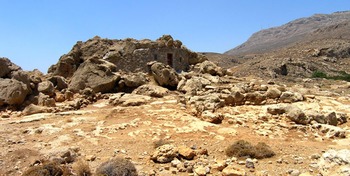
Today the site is located on a small and relatively flat plain enclosed by low steep hills to the north (Fig. 2). It is cut by several streams, two in quite deep gorges, while a small spring provides a perennial water supply. Aeolian and sea erosion has largely removed the Holocene soil deposits, exposing large areas of the natural bedrock: a Miocene conglomerate consisting of limestone, dolomite and chert (Brandl Reference Brandl2010). In 2008–10 the Greek Archaeological Service undertook a rescue excavation of a small Early–Late Bronze Age cemetery at Skiadi, 50 m from the modern seashore (Fig. 3), the site being threatened by coastal erosion and looting (Papadatos and Sofianou Reference Papadatos and Sofianou2015). While the project's focus was the third to second millennia cal bc burials (in a tholos, rockshelter and ‘house tomb’), it subsequently became apparent that there were also artefacts of an earlier date that we believe to be Mesolithic (see also Carter et al. Reference Carter, Mihailović, Papadatos and Sofianouin preparation).
View of Livari rockshelter from south-west; tholos tomb to right, ‘house tomb’ to left (Y. Papadatos).

The claim that Livari was a site of Early Holocene occupation is based primarily on a distinctive component of its chipped-stone assemblage (Figs 4–6). Unfortunately these finds all come from secondary contexts intermixed with Bronze Age burial material, derived from thin remnant Holocene soil deposits that were protected from erosion by the rockshelter and tombs. The entire lithic assemblage from the excavation totals 469 pieces, 251 of which are claimed to be Mesolithic based on their techno-typological characteristics, raw materials, nature of retouch and site-distribution. In 2014 another 20 artefacts of Mesolithic type were collected from within a 20 m radius of the excavation area.
Selection of Livari Mesolithic artefacts made of local cherts (D. Aubert).

The Bronze Age lithics are easy to distinguish, comprising fine obsidian pressure blades, typical of Cretan burial assemblages of the period (Carter Reference Carter, Papadatos and Sofianou2015). The rest of the Livari assemblage is microlithic, flake-based, percussion-knapped, and dominated by chert and radiolarite (Figs 4–5). Artefacts of this form and manufacture are completely unknown from the numerous Cretan Bronze Age assemblages we have studied (Carter Reference Carter, Vasilakis and Branigan2010, Reference Carter and Poursat2013, Reference Carter, Papadatos and Sofianou2015 and references therein). Nor are they believed to be Neolithic, as Cretan assemblages of this period are almost exclusively obsidian- and blade-based (e.g. Christopoulou Reference Christopoulou, Vagnetti, Christopoulou and Tzedakis1989); only at IN Knossos is there a significant component of flake tools, though here too obsidian prevails, at 70% of the dataset (Conolly Reference Conolly, Isaakidou and Tomkins2008).
Selection of Livari Mesolithic artefacts: 1: multidirectional flake core/micro chopper with spine; 2: bladelet core/pièce esquillèe; 3: core rejuvenation flake; 4–5: unidirectional retouched bladelets; 6–7: flakes with convergent retouch; 8–11: ‘spines’; 12–16: retouched flakes; 17: flake; 18–20: geometrics with backed elements; 21–22: short scrapers on flakes; 14–17: obsidian; 18–22: survey material (D. Mihailović).

While the chipped stone all comes from mixed contexts, we highlight the fact that the distribution of the chert percussion flake/bladelet material does not mirror that of the obsidian pressure blades (Table 1). This contextual distinction we strongly believe to be due to their chronological differences. For instance, the deposition of burials and grave goods (28% of the obsidian blades) deep in the rockshelter is a well-attested practice in Bronze Age Crete (Branigan Reference Branigan1988, 153–4), yet such a dark and cramped space makes little sense for Mesolithic activity, thus helping to explain why only 3% of the chert artefacts came from here. Indeed, most of the early material came from in front of the rockshelter; this includes the four obsidian artefacts that we believe to be of Mesolithic date (see below).
Distribution of chipped stone at Livari by context and technology.

While the claim for Early Holocene activity is based mainly on the character of its chipped-stone assemblage, it is also important to note that Livari fits the Aegean Mesolithic site-location model forwarded by Runnels (Reference Runnels2009, 60–2) at the ‘intersection of woodland and aquatic habitats’. The rockshelter offered protection from the strong north winds, with a nearby spring and small caves in the gorge, while the Early Holocene coastline was only c.1.5 km to the south (Fig. 2). This coastal wetland plain would have provided a perennial water supply and a rich array of animals, plants, and marine resources for hunter-fisher-gatherer subsistence, a setting directly comparable to the ‘foraging coastscapes’ (Broodbank Reference Broodbank2006, 211) enjoyed by the well-documented Mesolithic populations of the southern Argolid (Runnels Reference Runnels2009).
THE MESOLITHIC CHIPPED STONE FROM LIVARI
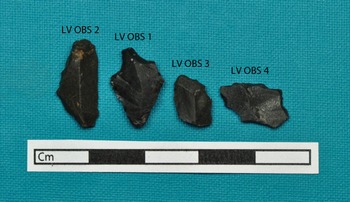
The Mesolithic component of the Livari chipped-stone assemblage from the excavation comprises 251 artefacts, a representative sample of which are illustrated in Figs 4–5. While most artefacts were made of chert and radiolarite that would have been collected from within a 20 km radius of the site (Brandl Reference Brandl2010), there were also a few made from non-local resources, including four of obsidian (Fig. 6). The latter raw material is foreign to Crete, with the nearest sources located 200–235 km to the north in the Cycladic and Dodecanesian islands (Fig. 1).
The four Mesolithic obsidian artefacts from Livari (S. Doyle).

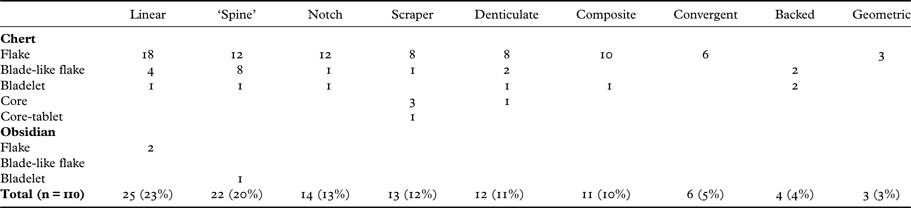
The local materials were procured in pebble and small-cobble form and worked on site, the knappers using a percussive technique to produce flakes (n = 220, 88%) from multidirectional cores, together with a smaller number of bladelets (n = 31, 12%). With only a few artefacts over 2.5 cm long, the assemblage can be characterised as microlithic, although it only included a few classic retouched geometric microliths (Fig. 5:18–20). A high proportion of this material was modified (n = 110, 44%) – yet another distinction from Cretan Bronze Age assemblages, which typically have <10% retouched pieces (Carter Reference Carter, Papadatos and Sofianou2015, 116). Most of these tools have simple linear modification (Table 2), followed by ‘spines’, i.e. pointed tools used as borers/perforators or drills (Fig. 5:8–11), notches, scrapers (Fig. 5:21–22), denticulates, composite tools, those with convergent retouch (broader tips than ‘spines’ [Fig. 5:6–7]), backed pieces, and geometrics (Fig. 5:18–20). There were two burin spalls, but no actual burins. Inverse retouch is common, noted on a third of the modified pieces (n = 34, 33%); this is a characteristically Mesolithic mode of modification (cf. Perlès Reference Perlès1990b, doc. II.11), quite distinct from Neolithic or Bronze Age tool-making traditions. Many of the artefacts also display macroscopic use-wear, whether retouched or otherwise.
Livari percussion flake and bladelet assemblage by raw material and modification type.

The four pieces of obsidian constitute 1.6% of the Mesolithic assemblage (Fig. 6). They include LV OBS 1 – a ‘spine’ made on a truncated bladelet (Fig. 5:10), LV OBS 2 – a blade-like flake (or remnant bladelet core) with possible burination from both ends, initiated from the ventral surface (Fig. 5:17), LV OBS 3 – a retouched flake (Fig. 5:15), and LV OBS 4 – a denticulated flake (Fig. 5:16). On a techno-typological basis this material is distinct from the fine Bronze Age pressure-blade products. Furthermore, in keeping with Mesolithic tool-making practices, the three modified pieces all have inverse retouch. While they form part of the same knapping tradition as the Mesolithic chert component, there is no evidence for the obsidian having been worked on site.
Given the mixed nature of the Livari deposits, the microlithic- /flake- based assemblage can be dated only by reference to comparanda from elsewhere. The closest parallels come from nearby Moni Kapsa (Galanidou Reference Galanidou2011, 224), and the Plakias region sites c.180 km to the west (following the coast [Fig. 1]), assemblages that are similarly flake-based and microlithic, with ‘spines’, denticulates, notched and backed pieces well represented (Strasser et al. Reference Strasser, Panagopoulou, Runnels, Murray, Thompson, Karkanes, McCoy and Wegmann2010, 163–71, table 2; Strasser Reference Strasser2012). Given that none of these sites have produced absolute dates (we await radiometric determinations for Damnoni), we need to consider parallels from overseas excavated assemblages, with those from the mainland Franchthi Cave being particularly informative (Fig. 1).
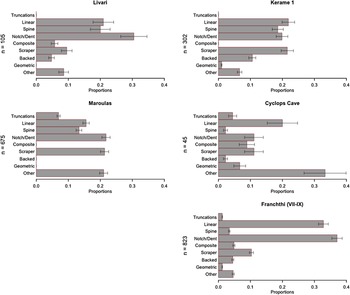
The Livari material has much to compare with Franchthi's Lower–Final Mesolithic assemblages from lithic Phases VII–IX (Fig. 7, Table 3), strata that span 8500–7000 cal bc (Perlès Reference Perlès2001, table 2.1). These assemblages are similarly microlithic and dominated by flakes (95%) struck from small pebble cores, with notches/denticulates the most common tools, followed by flakes with simple linear retouch, scrapers, backed pieces, and geometrics inter alia (Perlès Reference Perlès1990b, 23–93, figs. 5–8, 13–19, 21–2). The Livari material also includes proportionally more bladelets than at Franchthi VII–IX (12% v. 4–5%), and instances of inverse retouch (33% v. 17%); these are both features more characteristic of Final Palaeolithic assemblages (Perlès Reference Perlès1987), i.e. the Livari material is potentially of earlier Mesolithic date (Phase VII in Franchthi terms).
Composition of lithic assemblages at the major southern Aegean Mesolithic sites discussed in the text (D. Contreras).

Comparing relative proportions of flakes and blades/bladelets, and their retouched tool-types, from Mesolithic Livari and Late Pleistocene – Early Holocene material from the mainland and insular Aegean.

While strong links can be established with the Franchthi lithics, Livari is ultimately better viewed as part of the ‘early Holocene Aegean island lithic tradition’ (Figs 1 and 7, Table 3) as defined by Sampson, Kaczanowksa and Kozlowski (Reference Sampson, Kaczanowksa and Kozlowski2010, 68–9) through reference to excavated material from Maroulas on Kythnos in the Cyclades (early–mid ninth millennium bc), the Cave of the Cyclops on Youra in the Sporades (c.8600–7800 bc), and Kerame 1 on Ikaria in the northern Aegean (Sampson Reference Sampson2008; Sampson, Kaczanowksa and Kozlowski Reference Sampson, Kaczanowksa and Kozlowski2010, Reference Sampson, Kaczanowksa and Kozlowski2012). These assemblages are again flake-dominated, with denticulates, notches, perforators, scrapers and backed pieces, but have few opposed platform cores compared with mainland sites (n = 3/11 at Livari). The Cyclops Cave aside, these insular assemblages also have notable quantities of ‘spines’, which is a further distinction from the Franchthi material (Fig. 7).
ELEMENTAL CHARACTERISATION OF THE LIVARI OBSIDIAN BY EDXRF
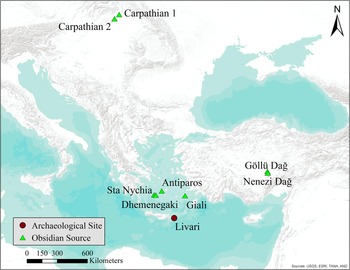
In order to know where the Livari obsidian originated it was necessary to undertake a chemical characterisation study of the four artefacts’ raw materials. The aim of such an analysis is to generate an elemental profile that could be matched exclusively with the chemical signature produced under the same analytical conditions from geological samples of known origin (cf. Pollard and Heron Reference Pollard and Heron2008, 75–87). The raw materials under consideration come from the three Aegean islands where obsidian occurs naturally (Fig. 8), namely Melos and Antiparos in the Cyclades, and Giali in the Dodecanese (Renfrew, Cann and Dixon Reference Renfrew, Cann and Dixon1965). The two Melian sources of Sta Nychia (Adhamas) and Dhemenegaki provided the most important raw materials for prehistoric tool production, first exploited by Upper Palaeolithic populations of the Greek mainland, thereafter circulating throughout the Aegean, and well represented on Cretan sites from the earliest Neolithic (Carter Reference Carter, Moncel and Fröhlich2009, 202–4).
Livari and the major obsidian sources of the region (K. Freund).

Obsidian from Giali was used from the Mesolithic (Sampson, Kaczanowksa and Kozlowski Reference Sampson, Kaczanowksa and Kozlowski2012, 19), though its spherulitic character seems to have largely restricted its use for tool-making to local Dodecanesian populations (Carter Reference Carter, Moncel and Fröhlich2009, 201–2; Georgiadis Reference Georgiadis2008). On Crete, small quantities of Giali obsidian are attested from Early Neolithic Knossos (Evans Reference Evans, Evely, Hughes-Brock and Momigliano1994, 5), but thereafter the raw material was largely ignored until the Bronze Age, at which point it was employed for the manufacture of prestige groundstone items (Carter et al. Reference Carter, Contreras, Campeau and Freund2016). While the obsidian from the Soros Hill source on Antiparos has an excellent knapping quality, it is only available in pebbles and small cobbles, thus restricting its tool-making utility; it seems to have only ever been used by local communities from the Late Neolithic and has never been documented on Crete (Carter and Contreras Reference Carter and Contreras2012).
The study also included geological samples from the central Anatolian sources of Göllü Dağ and nearby Nenezi Dağ (Fig. 8), as small amounts of these materials are known from Crete, albeit thus far exclusively from Bronze Age contexts (Bellot-Gurlet, Pelon and Séfériadès Reference Bellot-Gurlet, Pelon and Séfériadès2008; Carter and Kilikoglou Reference Carter and Kilikoglou2007). We also considered obsidian from Slovakia and Hungary (the Carpathian 1 and 2 sources), which has been documented from later Neolithic sites in the Aegean, though none from Crete as yet (Kilikoglou et al. Reference Kilikoglou, Bassiakos, Grimanis, Souvatzis, Pilali-Papasteriou and Papanthimou-Papaefthimiou1996; Milić Reference Milić2014).
The elemental data pertaining to Aegean, central Anatolian and Carpathian obsidian source samples used in this study were also run by the McMaster Archaeological XRF Lab (MAX Lab) under the same analytical conditions as the Livari artefacts.
Analytical procedures
The four artefacts were analysed whole and non-destructively at the MAX Lab by a Thermo Scientific ARL Quant'X EDXRF spectrometer. XRF techniques are well established in Aegean obsidian characterisation studies, and are capable of discriminating the products of all sources known to have been used by the region's prehistoric populations (De Francesco, Crisci and Bocci Reference De Francesco, Crisci and Bocci2008; Frahm, Doonan and Kilikoglou Reference Frahm, Doonan and Kilikoglou2014; Milić Reference Milić2014). The artefacts were first cleaned in an ultrasonic tank with distilled water for ten minutes, then mounted on a sample tray with the flattest surface possible positioned as the X-ray target. The analytical protocols and methods followed those devised by Shackley (Reference Shackley2005, appendix; Poupeau et al. Reference Poupeau, Le Bourdonnec, Carter, Delerue, Shackley, Barrat, Dubernet, Moretto, Calligaro, Milić and Kobayashi2010, 2711).
The spectrometer is equipped with an end window Bremsstrahlung, air-cooled, Rh target, 50 watt, X-ray tube with a ≤7.6 micron (0.3 mil) beryllium (Be) window, an X-ray generator that operates from 4 to 50 kV in 1 kV increments (current range, 0–1.98 mA in 0.02 mA increments), and an Edwards RV8 vacuum pump for the analysis of elements below titanium (Ti). Data is acquired with a pulse processor and analogue to digital converter.
In the study we ran the artefacts under two analytical conditions. The pieces are first run under a Mid Zb analysis condition with the X-ray tube operated at 30 kV using a 0.05 mm (medium) Pd filter in an air path for 200 seconds livetime to generate X-ray intensity Kα-line data for elements titanium (Ti), manganese (Mn) and iron (Fe), zinc (Zn), gallium (Ga), rubidium (Rb), strontium (Sr), yttrium (Y), zirconium (Zr), niobium (Nb), lead (Pb) and thorium (Th). The second is a High Zb analysis condition with the X-ray tube operated at 50 kV using a 0.63 mm (thick) Cu filter in an air path to detect the element barium (Ba).
Trace element intensities were converted to concentration estimates by employing a least-squares calibration line ratioed to the Compton scatter established for each element from the analysis of international rock standards. These comprise AGV-2 (andesite), BCR-2 (basalt), BHVO-2 (hawaiite), BIR-1a (basalt), GSP-2 (granodiorite), QLO-1 (quartz latite), RGM-2 (rhyolite), SDC-1 (mica schist), STM-2 (syenite), TLM-1 (tonalite), and W-2a (diabase) from the US Geological Service [USGS], plus JR-1 and JR-2 (both obsidian) from the Geological Survey of Japan. In turn, the USGS standard RGM-2 is analysed during each sample run to check machine calibration and accuracy, with a maximum of 19 artefacts, plus standard, per analysis. The data is then translated directly into Excel for Windows software for manipulation and analysis.
In Excel form, data is normalised to the standard reference sample – RGM-2 – prior to further analysis and plotting. This process consists of determining the relative error in the standard sample's concentration measurements and applying this difference to the individual artefacts analysed for each tray processed by the instrument. This procedure ensures source and artefact data results are consistent based on the reference, thus providing a more accurate match between chemical fingerprints.
Results: raw material sources
The elemental concentrations of the Livari artefacts and RGM-2 standard, analysed together in a single run, are presented in Table 4. Provenance was assigned through comparing the artefacts’ chemical signatures with those of the Aegean, central Anatolian and Carpathian source samples.
Elemental compositions of Livari obsidian artefacts as determined by EDXRF (values expressed in ppm [parts per million]).

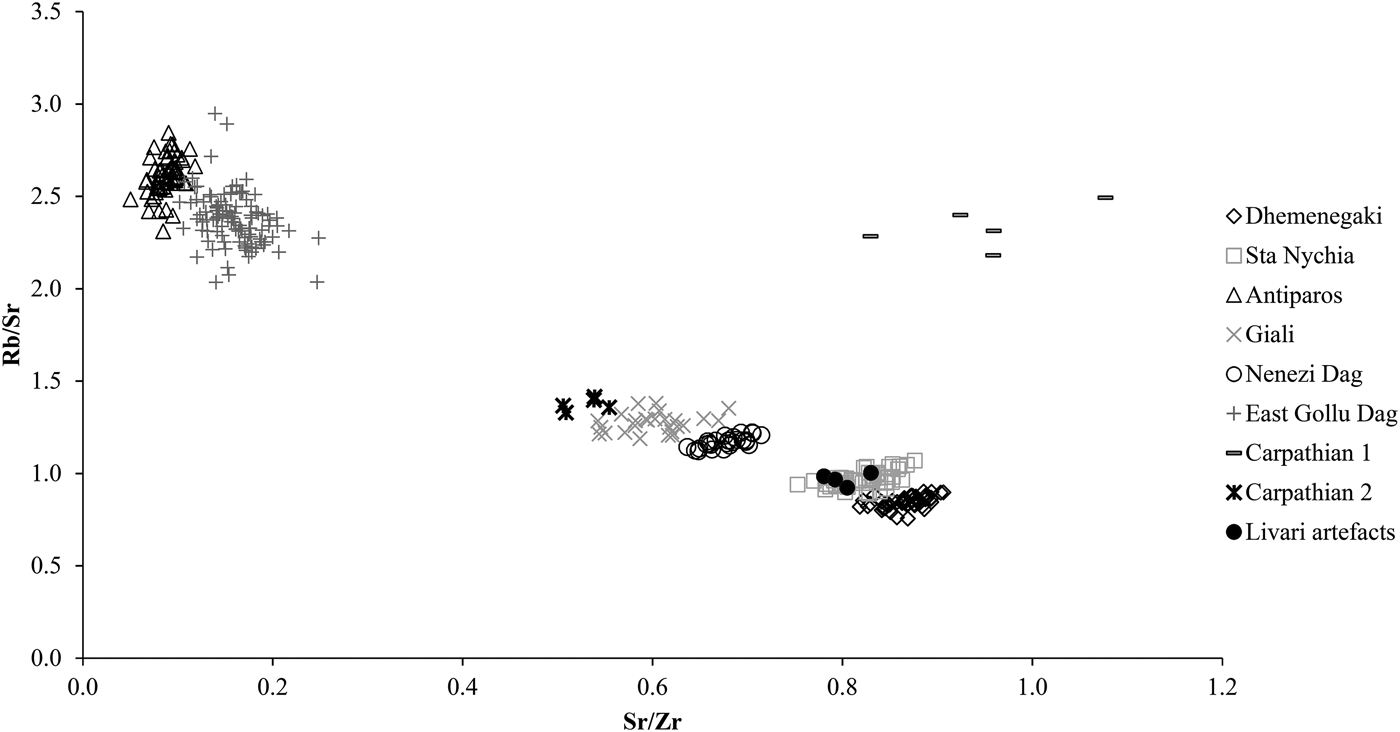
Using a Sr/Zr v. Rb/Sr ratio plot, the artefacts’ elemental profile can be clearly matched with that of obsidian from the Sta Nychia source on Melos (Fig. 9). The data is expressed in ratio form not only as a means of distinguishing the source materials in a binary format, rather than the ternary discriminant plots that have previously been employed in Aegean studies (Carter and Kilikoglou Reference Carter and Kilikoglou2007, fig. 3; Frahm, Doonan, and Kilikoglou Reference Frahm, Doonan and Kilikoglou2014, fig. 7; Milić Reference Milić2014, figs. 3–4), but also because of concerns surrounding the elemental data. Experimentally it has been demonstrated that small samples can be problematic for EDXRF because if the detector's field of view extends beyond the artefact's margins, then the relative deficit in X-rays from the object will result in lower-than-expected elemental concentration values (Davis et al. Reference Davis, Jackson, Shackley, Teague, Hampel and Shackley1998, 169). The Livari microliths, all under 1.5 cm long/wide and ≤0.4 cm thick (Fig. 6), presented just such a problem for us, as evidenced by lower counts for many of the targeted elements compared with what one should expect from source samples, not least Ti, Mn, Fe, plus Sr, Zr, Ba and Th (Table 5). Conversely, the Zn values were anomalously high. In this case the issue is probably instrumental, as this element recurrently trends high compared with expected values, on both the MAX Lab's Quant'X and that from our collaborator's UC Berkeley instrument (Hancock and Carter Reference Hancock and Carter2010; Poupeau et al. Reference Poupeau, Le Bourdonnec, Carter, Delerue, Shackley, Barrat, Dubernet, Moretto, Calligaro, Milić and Kobayashi2010). It was possible to resolve all of these problems, and to successfully source the Livari artefacts’ raw materials, by working with elemental ratios rather than absolute values.
Bivariate ratio plot of Sr/Zr v. Rb/Sr for Livari artefacts and geological samples from pertinent Aegean, Anatolian and Carpathian obsidian sources.

Mean elemental values with standard deviations for Melos source samples (Dh. = Dhemenegaki; SN = Sta Nychia) and Livari obsidian artefacts as determined by EDXRF (values expressed in ppm [parts per million]).

THE LIVARI DATA IN CONTEXT
To appreciate the significance of the Livari obsidian assemblage we need to consider more generally the consumption of Melian obsidian during the Late Pleistocene to Early Holocene.
Lower–Middle Palaeolithic (Middle Pleistocene)
A major recent development in the field concerns alleged earlier Palaeolithic activity in the Aegean Basin (Runnels Reference Runnels2014). The only claimed use of obsidian during this period comes from Melos itself, namely a biface from a surface assemblage from Triadon Bay, while similar items are also reported from the Sta Nychia source (Runnels Reference Runnels2014, 217; see also Chelidonio Reference Chelidonio2001). Given that this is all surface material, it remains to be proved that Melian obsidian was being exploited in the Middle Pleistocene.
Upper Palaeolithic (Late Pleistocene)
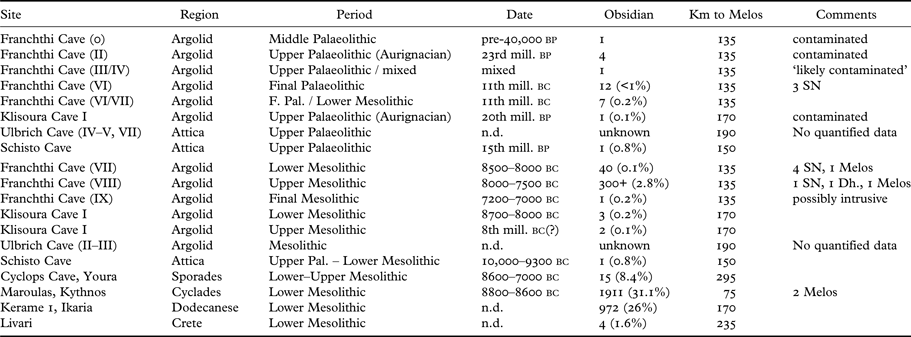
The earliest well-dated evidence for the use of these resources comes from Upper Palaeolithic contexts on the Greek mainland (Fig. 1, Table 6), specifically an artefact from a Late Pleistocene stratum in the Schisto Cave in Attica dated by an obsidian hydration method to 14,539 ± 1280 bp (Laskaris et al. Reference Laskaris, Sampson, Mavridis and Liritzis2011, 2477, table 1; Mavridis et al. Reference Mavridis, Kormazopoulou, Papadea, Apostolikas, Yamaguchi, Tankosic, Kotzamani, Trantalidou, Karkanas, Maniatis, Papagianni, Lambropoulos, Mavridis and Jensen2013, 253). A larger assemblage is published from the Franchthi Cave, whose oldest securely dated material comes from the eleventh millennium cal bc, lithic phase VI (Perlès Reference Perlès1987, 142–3). Obsidian is in fact reported from strata extending back to the Middle Palaeolithic at Franchthi; however, in each of these instances the material was believed to be intrusive from later levels (Table 6). These 12 obsidian artefacts (three retouched), constitute a mere <1% of the total lithic phase VI assemblage (Perlès Reference Perlès1987, 142–3). Three pieces of obsidian were sourced to Sta Nychia, though it should be noted that they were irradiated together, with the resultant data a blended chemical signature of the three (Renfrew and Aspinall Reference Renfrew, Aspinall and Jacobsen1990, 263–4). While an unconventional analytical process (they were too small to analyse individually), the source assignation seems accurate given the high yttrium value (Renfrew and Aspinall Reference Renfrew, Aspinall and Jacobsen1990, table XLI).
Mesolithic Aegean sites with obsidian: date, proportion of assemblage, linear distance from source (Dh. = Dhemenegaki; SN = Sta Nychia).

Tiny quantities of obsidian are also reported from throughout the Early Upper Palaeolithic – Mesolithic sequence of another Argive site, the Ulbrich Cave (Table 6). Unfortunately, the 1920s excavation has never been published fully and there are concerns that obsidian from early strata were intrusive (Galanidou Reference Galanidou, Galanidou and Perlès2003, 108–9). Finally, we might note that preliminary reports of the Klisoura Cave excavations mentioned a piece of obsidian from an Early Upper Palaeolithic stratum of the twentieth millennium bp (Koumouzelis et al. Reference Koumouzelis, Ginter, Kozlowski and Pawlikowski2001, 524–5, tables 1 and 4); this piece is now believed to have come from a deposit with intrusive Mesolithic material (J. Kozlowski, pers. comm.).
Mesolithic (Early Holocene)
Mainland hunter-gatherers continued to procure Melian obsidian into the Mesolithic (ninth–eighth millennia cal bc), as evidenced at the Franchthi, Ulbrich, Klisoura 1 and Schisto caves (Fig. 10). Obsidian remained a tiny proportion of these chipped-stone assemblages (0.1–2.8%), although in absolute terms the Upper Mesolithic assemblage from the Franchthi Cave is relatively large, with over 300 pieces (Table 6). This site also provides us with the most temporally nuanced Early Holocene dataset. In the Lower Mesolithic lithic phase VII assemblage (n = 40, c.0.1%), the presence of a core, cortical flakes (one retouched) and splintered pieces indicates that obsidian was worked locally, having been procured as raw and/or part-decorticated nodules (Perlès Reference Perlès1990b, 30, 36, figs. 4–5). Five artefacts were analysed, the raw materials of four being sourced to Sta Nychia and one ‘to Melos’ (Durrani et al. Reference Durrani, Khan, Taj and Renfrew1971; Renfrew and Aspinall Reference Renfrew, Aspinall and Jacobsen1990).
Aegean Mesolithic sites with Melian obsidian by proportion of chipped-stone assemblage (K. Freund). (The Ulbrich Cave is marked in Fig. 1, but is not included here because of the lack of quantified data.)

The Upper Mesolithic (lithic phase VIII) obsidian assemblage is the proportionally largest of all Early Holocene mainland assemblages (2.8%), the material imported in the form of raw nodules that were then flaked on site (Perlès Reference Perlès1990b, 48, Fig. 10). That blanks longer than 1 cm were retouched at a higher rate than those made from local raw materials suggests that obsidian had for the first time taken on a specific role within the community's lithic tradition (Perlès Reference Perlès1990b, 48). Three pieces were sourced, one to Sta Nychia, one to Dhemenegaki, and one ‘to Melos’ (Durrani et al. Reference Durrani, Khan, Taj and Renfrew1971; Renfrew and Aspinall Reference Renfrew, Aspinall and Jacobsen1990). Only one obsidian artefact, possibly intrusive, came from the Final Mesolithic phase IX (Perlès Reference Perlès1990b, 85).
Staying in the Argolid (Fig. 10), the Klisoura Cave material comprised a flake and chip from Layer 3 (Upper Mesolithic), plus three pieces from Layer 5a (Lower Mesolithic), including a retouched bladelet and a burin spall (Kaczanowksa, Kozlowski and Sobczyk Reference Kaczanowksa, Kozlowski and Sobczyk2010, 188–90, tables 10–11; Koumouzelis, Kozlowski and Ginter Reference Koumouzelis, Kozlowski, Ginter, Galanidou and Perlès2003, 113, 117, figs. 8.4: 30, 8.5: 28, 29). While obsidian is reported throughout the Mesolithic sequence of the Ulbrich Cave, there is unfortunately no quantified data, or descriptions of the artefacts (Galanidou Reference Galanidou, Galanidou and Perlès2003, 107–8). Finally, an obsidian microlith was found at Kandia 5, a Mesolithic survey site in the Argolid (Runnels et al. Reference Runnels, Panagopoulou, Murray, Tsartsidou, Allen, Mullen and Tourloukis2005, 270), while one of the two pieces of obsidian from the Schisto Cave in Attica should date to the Early Holocene at 9,533 ± 1198 bp (Laskaris et al. Reference Laskaris, Sampson, Mavridis and Liritzis2011).
It is when we turn to insular populations of the Cyclades, Sporades and northern Aegean that we find evidence for the procurement and working of significantly larger quantities of obsidian at this time (Fig. 10, Table 6). At the Lower Mesolithic village of Maroulas on Kythnos obsidian represented almost a third (31%) of the chipped-stone assemblage, the material imported as raw or part-decorticated nodules and worked on site (Kaczanowksa and Kozlowski Reference Kaczanowksa, Kozlowski and Starnini2013, 21). At Kerame 1 on Ikaria, Melian obsidian comprised a quarter of the Lower Mesolithic assemblage, while the distinctive white spotted obsidian from Giali constituted a further 15% (Sampson, Kaczanowksa and Kozlowski Reference Sampson, Kaczanowksa and Kozlowski2012, 19–20, fig. 13). In contrast to Maroulas, the inhabitants of Kerame 1 imported largely decorticated nodules, rather than unmodified raw materials. Two obsidian artefacts from this assemblage were sourced to Melos, and hydration dated to 11085 ± 3282 and 10152 ± 1643 bp (Laskaris et al. Reference Laskaris, Sampson, Mavridis and Liritzis2011). To the north, the Cyclops Cave on Youra in the Sporades generated 15 pieces of obsidian from its Lower Mesolithic sequence, some 8% of the chipped stone, a mix of knapping debris and end products (blades), with just over half the artefacts (n = 8) retouched into formal tools (Kaczanowksa and Kozlowski Reference Kaczanowksa, Kozlowski and Sampson2008, 170, tables 8.1–8.2). Obsidian hydration dates from three of the Cyclops Cave artefacts spanned 10968 ± 640–12017 ± 1875 bp (Laskaris et al. Reference Laskaris, Sampson, Mavridis and Liritzis2011).
Finally, we have the Livari data, the first such material from Early Holocene Crete. Here obsidian comprises a tiny proportion of the site's chipped stone, proportionally comparable to that from the mainland assemblages of Franchthi VII and the Klisoura Cave (Table 6).
DISCUSSION AND CONCLUSIONS
So what conclusions can be drawn concerning the circulation and consumption of Melian obsidian by the Late Pleistocene – Early Holocene hunter-gatherers of the Aegean? Firstly, despite the recent claimed discoveries of Lower and Middle Palaeolithic in the Aegean basin (Runnels Reference Runnels2014), it remains the case that the earliest use of Aegean (Melian) obsidian dates to the Late Pleistocene, an era when we also witness the establishment of hunter-gatherer populations on Cyprus (Simmons Reference Simmons1999), maritime ventures that part-represent the ‘birth of Mediterranean seafaring’ (Broodbank Reference Broodbank2006, 208–11).
Secondly, the fact that the Livari artefacts were characterised as being made of Melian obsidian came as no surprise, as these were the primary sources exploited by Cretan communities throughout later prehistory (Carter Reference Carter, Moncel and Fröhlich2009, 202–4). Moreover, at virtually every Upper Palaeolithic and Mesolithic Aegean site where obsidian is reported, the material only ever has the visual appearance and/or chemical composition of Melian raw materials. Only at the northern Aegean Mesolithic community of Kerame 1 (Ikaria) is there evidence for the procurement of both Giali and Melos obsidian (Kaczanowksa and Kozlowski Reference Kaczanowksa, Kozlowski and Starnini2013, 20, 22; Sampson, Kaczanowksa and Kozlowski Reference Sampson, Kaczanowksa and Kozlowski2012, 19).
That the Livari artefacts were all made of Sta Nychia obsidian is suggestive, given that eight of the nine pieces associated with the Late Pleistocene – Early Holocene strata at the Franchthi Cave also came from this source (Table 6). While the sample sizes are too small to make a convincing claim that one Melian source was preferred by these hunter-gatherers, it is important to remind ourselves that Sta Nychia and Dhemenegaki may have been exploited quite differently over time, despite the fact that they are only 12 km apart (cf. Carter Reference Carter, Foster and Laffineur2003). Indeed, the sources of Göllü Dağ and Nenezi Dağ in central Anatolia (Fig. 8) had radically distinct histories, yet lay only 7 km from one another (cf. Carter and Milić Reference Carter, Milić, Borrell, Ibáñez and Molist2013, 496–7, fig. 2). Recent obsidian sourcing projects suggest that – at least from a Cretan prehistoric perspective – there were distinct periods of raw material preference, with a clear bias towards Sta Nychia obsidian during the second millennium cal bc (Carter and Kilikoglou Reference Carter and Kilikoglou2007; Carter and Kilikoglou Reference Carter and Kilikoglouin preparation). As to whether these shifting raw material choices were related to changing transportation technologies (paddled versus sailing craft) and/or the reconfiguration of quarry docking points due to post-glacial sea-level changes (cf. Lambeck Reference Lambeck1996), it is impossible to say at this juncture. To clarify this issue one would ideally undertake detailed bathymetric studies around the Melian coastline in conjunction with the results of a major sourcing study of Upper Palaeolithic to Late Bronze Age assemblages.
The fact that the Livari chipped stone contained only a tiny proportion of obsidian was also quite unsurprising given the site's location. This is not a geographical issue per se, but a period-specific one, given that obsidian was the dominant raw material for the Bronze Age burial assemblage (Carter Reference Carter, Papadatos and Sofianou2015). In short, the Mesolithic sites with obsidian-rich assemblages are island-based populations who could directly access seafaring routes to the Cyclades, with far smaller quantities being accessed by mainland communities and/or those on distant coastlines such as Livari; linear distance from source is on its own an insufficient explanation for these distribution patterns (Fig. 10, Table 6). The locational influence upon raw material consumption patterns is of great interest given previous claims for differences in knapping traditions between insular and continental Mesolithic populations. Here we return to the alleged existence of an ‘early Holocene Aegean island lithic tradition’, as defined by Sampson, Kaczanowksa and Kozlowski (Reference Sampson, Kaczanowksa and Kozlowski2010, 68–9), who juxtaposed the assemblages of the Cyclops Cave, Maroulas and Kerame 1 with that of the Franchthi Cave. While differences certainly exist between these sites’ assemblages, as for example between their respective core technologies and tool-types, the distinction between island-based and mainland assemblages is perhaps not as clear-cut as originally suggested (Fig. 7). Moreover, these may be false dichotomies if the inference is that different traditions represent different populations.
The question here is whether these Mesolithic settlements of the Cyclades, Sporades and northern Aegean constituted perennial communities, or ‘merely’ seasonal occupations inhabited by hunter-gatherers who spent winter on the mainland and/or larger islands such as Crete. Powell's study of the fish remains from the Cyclops Cave led her to claim that the site was probably only seasonally occupied, specifically during those periods ‘when the sailing season allowed sailors to travel to Youra from the nearby mainland’ (Powell Reference Powell and Sampson2011, 175). Similarly, Kerame 1 is viewed as a ‘seasonal base’, while only Maroulas is considered to have been a ‘permanent or semi-permanent’ settlement by the excavator (Sampson Reference Sampson2014, 67). Accordingly, one might view the major distinctions in Mesolithic levels of obsidian consumption, and the subtle differences in knapping traditions between these insular and continental sites, as reflecting seasonal activities and environmental factors rather than more deeply-rooted cultural differences. Indeed, it may have been the case that the inhabitants of Franchthi (or an analogous Argive/Attic site) were spring-/summer-based residents of sites such as Maroulas, returning to the mainland during the autumn with a range of resources they had collected from the islands, such as Melian obsidian, dried fish, shells or andesite (cf. Perlès Reference Perlès2001, 34–7).
While a case can be made for some of these Greek mainland / Aegean island populations being linked by cyclical mobile residency patterns part-driven by the mainlanders’ seasonal exploitation of such high-yield migratory fish as tunny (Perlès Reference Perlès1987, 144–5; Reference Perlès2001, 28), one wonders if Livari's relationship with Aegean resources may have been articulated in a slightly different manner. The small amount of obsidian at Livari, and the fact that the items are in the form of ready-made implements, suggests that in this case the group procured them through intermediary exchange, rather than making their own forays into the Aegean (cf. Renfrew Reference Renfrew, Sabloff and Lamberg-Karlovsky1975, 46–8). If/when Mesolithic camp sites are discovered on Crete's north coast, one wonders if they will have obsidian-rich toolkits (as we see in later prehistory [Carter Reference Carter, Haggis, Mook, Carter and Snyder2007, 691–2]), and by implication their occupants will have been the trade partners of those subsisting along the southern littoral.
Above and beyond where these interactions took place, we might also consider the exchange of obsidian as an avowedly social act, the kind of interaction that underpinned the initiation and maintenance of interpersonal relations, something that may have occurred at specific times and places within the cycles of these hunter-gatherers’ lives. One obvious locus of connectivity would have been the obsidian quarries themselves. Based on ethnohistorical accounts of quarrying by small-scale societies, it is reasonable to suggest that the Melian obsidian sources would have been powerful places in the landscape, imbued with group histories (given their antiquated histories of use by the Early Holocene), and renowned arenas of gathering, exchange, marriage, feasting and the sharing of knowledge (cf. Hampton Reference Hampton1999; Jones and White Reference Jones, White, Meehen and Jones1988; McKenzie Reference McKenzie1983; Taçon Reference Taçon1991 inter alia). The exploitation of Melian obsidian would thus have represented one of the means by which Mesolithic Aegean cultural (lithic) traditions came to be produced and reproduced.
Returning to the artefacts themselves, an interesting aspect of these Late Pleistocene – Early Holocene data is that the obsidian was being flaked and modified in the same way as those artefacts made from local cherts, i.e. there were common tool-making traditions, irrespective of raw material (Kaczanowksa and Kozlowski Reference Kaczanowksa, Kozlowski and Starnini2013, 20–4). With freshly flaked obsidian being significantly sharper than chert, radiolartite inter alia, it might have been reasonable to expect that obsidian was being procured to fulfil a particular function, perhaps as specialised cutting implements. Yet the Livari evidence suggests otherwise, with the tools’ form implying a range of uses, namely a borer/perforator, two small cutting implements and a carving and/or spokeshave-like tool (Fig. 6). Only at Lower Mesolithic Maroulas was obsidian preferred for blade/bladelet manufacture and retouched tools (Sampson, Kaczanowksa and Kozlowski Reference Sampson, Kaczanowksa and Kozlowski2010, 42), while at Upper Mesolithic Franchthi (lithic phase VIII) obsidian blanks longer than 1 cm were retouched at a higher rate than those made from local chert (Perlès Reference Perlès1990b, 48). Dedicated use-wear studies are the only way to clarify the relationship between raw material and tool function (cf. Astruc Reference Astruc2002; Vaughan Reference Vaughan and Perlès1990).
In considering the issue of functionality, one might broaden the question – particularly with regard to the Livari and Greek mainland data – to how we interpret rare objects of distant materials. This is an important and often under-theorised question that recurrently faces archaeologists. Tykot (Reference Tykot and Vianello2011) offers us a useful distinction between ‘exotica’, i.e. something non-local or foreign that is ‘appreciated by the local culture’ (i.e. has some recognised use-value), and ‘eccentric’, namely distant and unusual media whose value might be constructed primarily with reference to its difference, rather than its utility (cf. Helms Reference Helms1988). In the early Aegean, were these obsidian artefacts simply a component of a larger toolkit, stored and used alongside implements of other raw materials, or were they treated differently, consumed in non-utilitarian fashions, and perhaps employed as ritual paraphernalia, or apotropaic tokens (cf. Nakamura Reference Nakamura and Hodder2010)? Alas, the contextual information that might help us comprehend the role of these obsidian artefacts in the lives of these hunter-gatherer communities is largely absent from our Aegean case studies, not least at Livari, where all the material came from mixed deposits.
One final important point to take from this study is that the Livari obsidian provides the first evidence for pre-Neolithic maritime connectivity between the inhabitants of Crete and the Cyclades. In a period prior to the advent of sailing craft such a voyage would probably have involved paddling a counter-clockwise route from eastern Crete via the southern Dodecanese and then into the Cyclades via Amorgos (Agourides Reference Agourides1997, 11, fig. 5). We thus have a situation whereby migrant farmers coming out of south-western Anatolia (or along the Mediterranean coast), on arriving in Rhodes or Karpathos, might thus have learned of the safest routes to Crete through interaction with indigenous hunter-gatherer populations. The modest Livari obsidian assemblage can therefore be viewed as contributing to the evidence to support the hypothesis that the establishment of a Neolithic economy on Crete was a planned affair (Broodbank and Strasser Reference Broodbank and Strasser1991), with Anatolian seafarers drawing on ancient routes and maritime knowledge, rather than launching into waters unknown (Carter et al. Reference Carter, Mihailović, Papadatos and Sofianouin preparation).
ACKOWLEDGEMENTS
Thanks are owed to the excavators Yiannis Papadatos (Athens University) and Chrysa Sofianou (24th Ephorate of Prehistoric and Classical Antiquities), Danica Mihailović my project collaborator, and the INSTAP Study Center for East Crete for part-hosting the study. Sarah Grant ran the analyses, Kyle Freund prepared the maps, Deanna Aubert and Sean Doyle took the photographs and Daniel Contreras made the graph. James Conolly, Kyle Freund, Ron Hancock, Janusz Kozlowski, Fanis Mavridis and Marina Milić provided feedback, data and source samples. The Livari obsidian analysis was funded by a Standard Research Grant of the Social Sciences and Humanities Research Council, Canada: From Neolithisation to state formation: Reconstructing interaction networks & the dynamics of socio-economic change through obsidian sourcing in the Aegean & Anatolia 10th–2nd millennia bce . The MAX Lab (http://maxlab.ca/) was created by a Canada Foundation for Innovation Leader's Opportunity Fund/Ontario Research Fund.