In June 2011, I visited the city of Yogyakarta in Central Java with my research assistant Usman to explore its vibrant public arts scene. Yogyakarta is affectionately known by its abbreviated name Jogja, a name that evokes a more intimate and local sense of place. Jogja had a unique reputation for producing art in its fullest spectrum; from traditional and courtly forms preserving Javanese heritage and refinement, international contemporary art fairs and biennales, to the youthful and urban “new media” of murals and graffiti. I had encountered young artists in Jakarta who expressed boundless enthusiasm for transforming their local urban landscape with the global style of graffiti and street art, and who participated in a digital economy of video uploads and influences (see Lee Reference Lee2013), but Jogja represented a more massive scale of integrated artistic intervention and government support. After years of urban art projects by street artists, muralists, and community art projects, often with the approval and collaboration of the city authorities, Jogja had become “the city of murals” (see figures 1 and 2). Artists from outside Jogja, including international visitors, flocked there to collaborate with locals and partake in the license to leave their mark on the city. While graffiti and street art are often treated instrumentally in other contexts as evidence of sociopolitical conflict or as visual pollution, the ready availability of diverse art forms in Jogja lends credence to artists’ claims that public art has a vernacular depth that rightfully conveys the interests of the rakyat (people) and combats cultural erasure by external forces. To what degree are their claims about art and popular representation credible? What complications arise from assuming the place of art in politics? Before I descend into my main argument, permit me a brief anecdote on the neglected issue of audience reception, which draws our attention to the main issue at hand: the intelligibility and efficacy of new collective art forms.
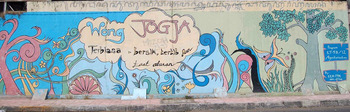
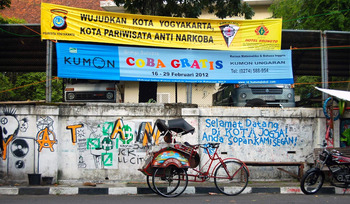
Curbside beautification mural in Yogyakarta reads, “The People of Jogja, Accustomed to Being Clean, Disciplined and Adhering to Rules.” The painted blue plaques on the right give the neighborhood RT number and the group that painted the mural. Faint outlines of graffiti tags are visible through the mural's surface. Photo by author.

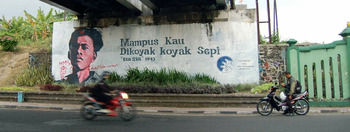
Highly visible mural under a flyover bridge in Yogyakarta. The mural depicts a famous photo and signature of nationalist icon Chairil Anwar, along with a line of his poetry that reads, “[you are] crushed by solitude.” Photo by author.

We planned to visit the institutional source of the city's many trained artists, the Indonesian Institute of the Arts (ISI) campus located in Sewon, just outside Jogja proper. After consulting a map, Usman decided that the best way to travel was by bus, but the pleasant weather compelled us to walk from Malioboro's busy commercial streets to a more distant bus stop. Our map was covered with helpful dots and symbols that indicated the best of Yogyakarta's galleries and cultural attractions, but the city itself was even more bright and colorful than its mapped abstraction. We followed a trail of visual breadcrumbs that had taken over the buildings, walls, and alleyways. There were beautiful goldfish and cartoon characters, huge murals of iconic figures, and word art. I stopped to take pictures of a densely painted “hotspot”—an abandoned corner building off Jl. Katamso. Street artists had saturated the abandoned building with images and words, from the rooftops (which required dexterous climbing) to the pavement stones. Their work bled over the building's gates onto the rolling doors of neighboring shophouses. Lovehatelove, one of Yogyakarta's most active street artists whom I would meet in person later that week, had left his name in several places, and other tags such as “Here Here,” “Free for Art,” and “Fight for Rice” represented locally known street artists and art collectives in Jogja who maintained their physical and digital signatures industriously.Footnote 1
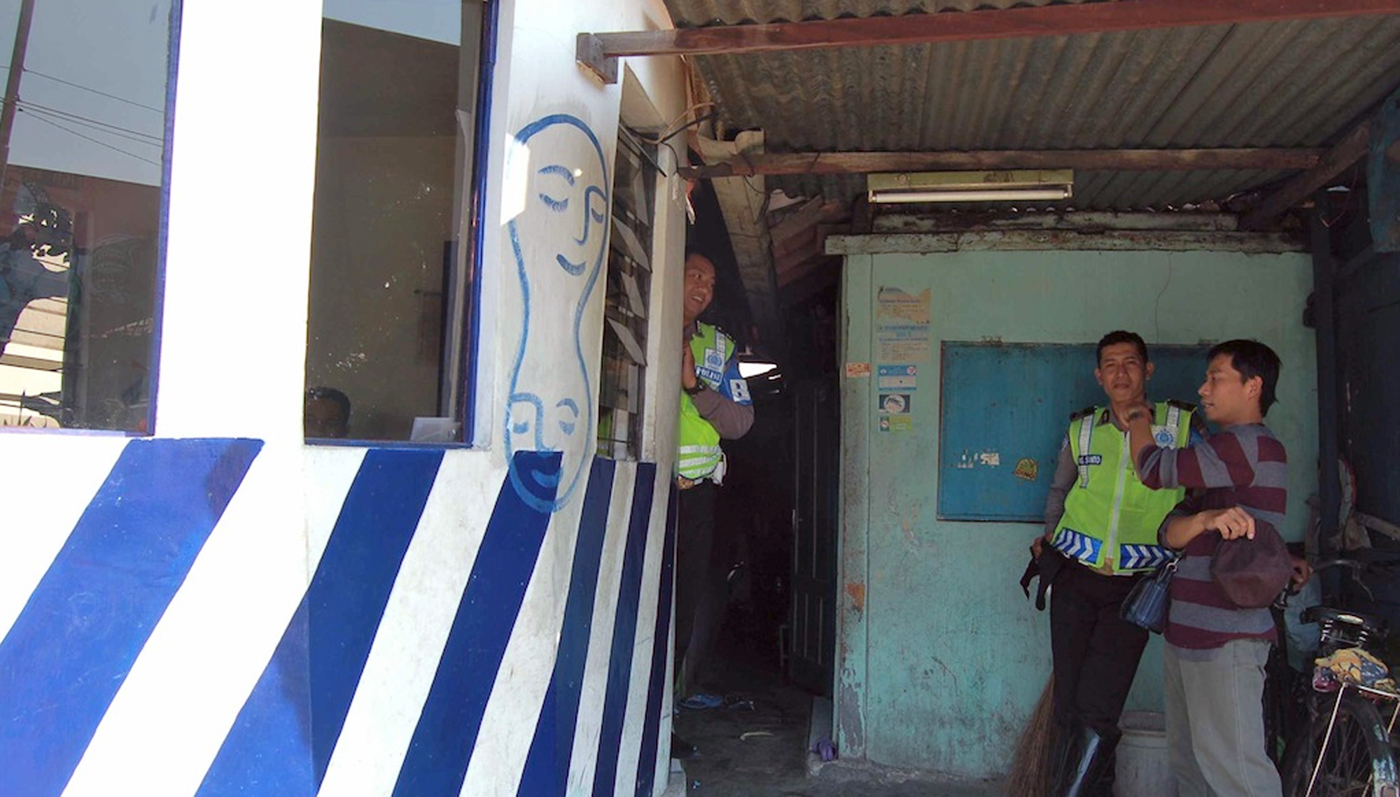
Something across the street caught my eye. Across from the abandoned house stood a police lookout (gardu) with its distinctive blue and white stripes. The police post was anointed with a small image—a double moon face, shaped like a pendulum, that had two smiling faces vertically aligned (see figure 3). Was it a cheeky bit of street art migrated from across the street? I took a picture and decided to speak to the policemen inside about it. When Usman asked them what the image on the gardu was about, they said, “We have no idea. It's just vandalism.” The policeman told us that the police post near the iconic Tugu Jogja (Jogja monument) had also been graffitied with rude words like “Pig Post” (Pos Babi). Of course that graffiti was immediately erased because it was “not good” (tidak baik) to be spectated on (ditonton) by the public. “Why don't you erase this?” I asked. He replied, “This one is still polite (sopan) even if I don't get what it means. But why do so many people take pictures of it? Can you tell us the meaning?” Usman chose a philosophical approach and said, “It's clearly about how human beings are two-faced.” The policeman continued, “Well, they do it late at night. They paint everywhere, all the posts.” “Really? All the posts?” we asked curiously. Neither police seemed perturbed by their admission that the public office of the Yogyakarta police was regularly defaced by anonymous graffiti writers. Instead they talked about the routinized police response. “It's not our turn yet for cleanup. Someone will be sent around by the station to clean this up.” When a sidewalk vendor appeared, they gestured her over in a familiar way to ask her who had done the graffiti. The middle-aged Javanese woman replied wearily, “Who knows? They come late at night or early morning. 1:00 or 2:00 a.m. If I knew who did it, I would stop them. Dasar bocah-bocah kurang kerjaan (Damn kids who have nothing better to do).”Footnote 2 “See, no one knows,” the police chuckled. The woman's curse against the alleged “damn kids” seemed an obligatory show of civic duty for the benefit of the police who had summoned her rather than a genuine upset. Given how widespread Euro-American stereotypes of graffiti vandals have become, “polite vandalism” by juveniles is a strange construct to ponder. Months later I showed an American anthropologist my photograph of the gardu graffiti. He burst out laughing. “It's Mr. Peanut!”
Police guard post in Yogyakarta with “Mr. Peanut” graffiti. Photo by author.
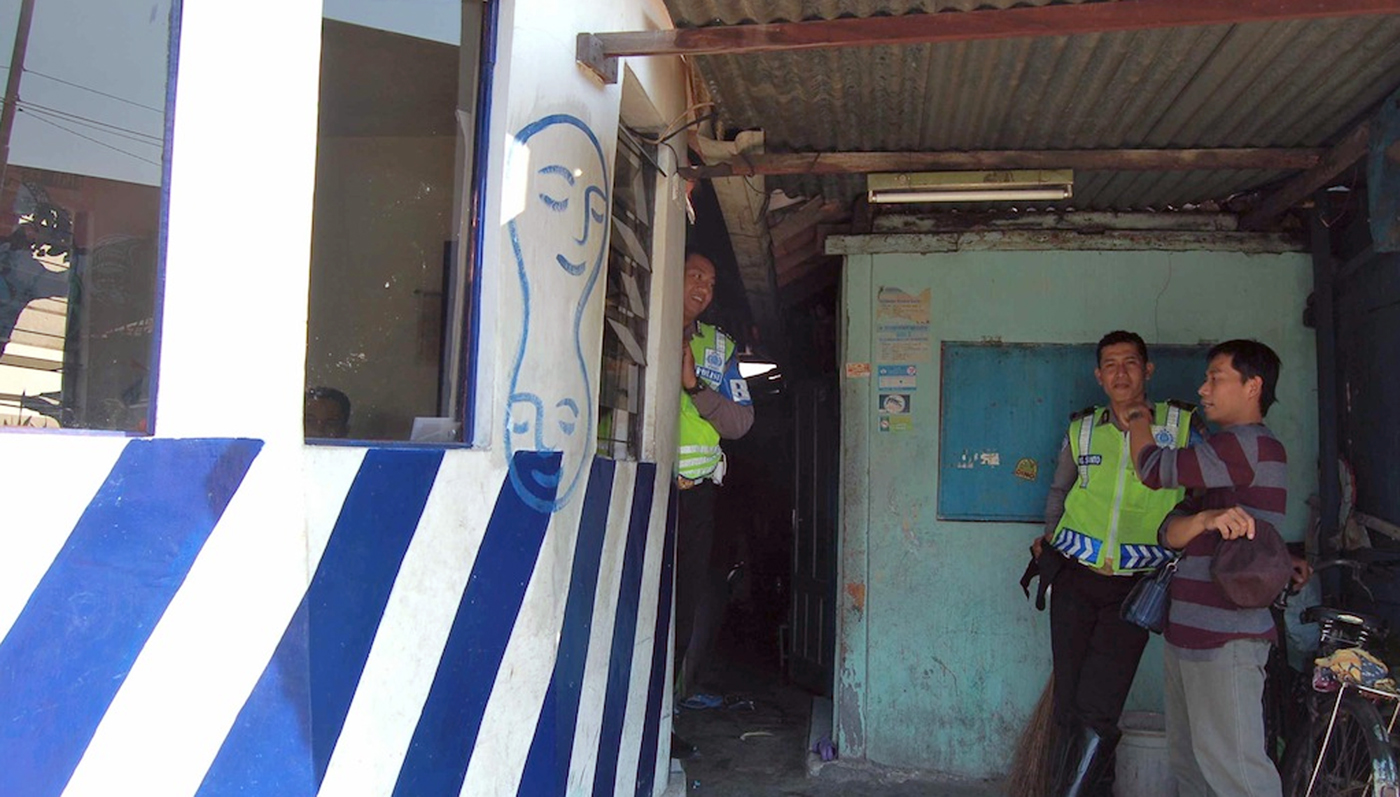
Mr. Peanut of Planters Peanuts, Pennsylvania, had lost his top hat and monocle in Indonesia. He was smiling with his eyes closed. Perhaps it was not him at all (see Richards Reference Richards and Mercer2007). The aphoristic image, being a picture (gambar), did not disturb public order the way the iterable profanity of the graffitied word “Pig!” would have done in Jogja's predominantly Javanese Muslim context. The semiotic chain that linked the anonymity of the artist, the strangers who photographed the image, and its unchecked circulation through mediatized images expressed the arrival of new aesthetic norms that were simultaneously desirable and illegible. Mr. Peanut's appearance on the gardu conformed to an unspoken norm of public decency and aesthetic pleasure inherent in the word that the police used to refer to it—sopan (polite).Footnote 3 The unaffected and even negligent attitudes of the police and the sidewalk vendor toward street art and its anonymous practitioners, along with my research assistant's own serious interpretation of the image, illuminate the open narratives that gather upon public art and public spaces in Yogyakarta. I left the summit of strangers with the impression that image and text were mutually reinforcing a message about still nascent formations of a public “way of seeing” and the consensual nature of public space in Jogja (Berger Reference Berger1972).
The operative question at the scene was “Who did it?” rather than “What was it?”—a question that introduces a parallel circuit of agency alongside a standing assumption about how scopic regimes define knowing, or as Berger (Reference Berger1972, 1) puts it, the immediacy of a “seeing [that] comes before words.” I argue that nontraditional arts and marginal communities have redirected the relationship between art and the public into a relation that emphasizes the (political) agency of the artist and the viewer rather than the legibility of the art itself, thus leaving aside the question that W. J. T. Mitchell famously asked in his book What Do Pictures Want? (Reference Mitchell2005). Answering Mitchell's question in contemporary post-authoritarian Indonesia requires thinking about the visual landscape forged by dispositive shifts toward decentralized and authenticated expressions of social will and public order, as realized in the populist imagery and ideological provocations of anti-state activist art that emerged at the end of the authoritarian New Order regime (1966–98). As Astri Wright (Reference Wright, Kuss, Moon, Jaarsma, Hirota and Wasmuth2000, 49) defines it, activist art is “art with a sociopolitical message, that aims to further heighten and stimulate awareness about important and problematic issues and to increase people's will for active participation in social and political transformation.” It is an aesthetic legacy that has pushed art into the political arena, while simultaneously normalizing the presence of art outside traditional cultural institutions and enclosures. In the wake of activist art, viewers want what pictures want—to belong in public, to act (and vandalize) ethically and responsively.
At this juncture, note that the key features which anchor activist art within political and public domains, and which unify disparate artistic techniques and messages, are in fact a series of ideological positions that codify what Mitchell calls the “state effect” of internally drawn boundaries between state and non-state domains (T. Mitchell Reference Mitchell1991). Briefly, these concern (1) the dichotomy between state and society, such that activist art represents the interests of the oppressed and illuminates the present conditions of state-society relations from a civil society perspective; (2) the existence of anonymous and informed publics (publik) in the physical and virtual worlds that are consistent with and equivalent to the socius; (3) literate publics that engage in reading the built environment, thus confirming art's transparency and vision's primacy; and (4) how a social and spatial marginality becomes an authenticating factor for the naïve quality and truth-telling function of activist art “made by the people.”
This article seeks to broaden our understanding of activist art beyond its role as the “art of resistance” by attending to the cosmopolitics of public art (Cronin and Robertson Reference Cronin, Robertson, Cronin and Robertson2011). I have done so by paying close attention to vernacular art streams that perform community to a high degree, such as the playful and colorful aesthetics of murals and participatory performances in the two field sites of Jogja and Jatiwangi discussed in this paper, which discursively reproduce local idioms and values in nontraditional ways. Vernacularization, following Kajri Jain, describes the agentive terrain that rearticulates hegemonic forms such as capitalism or globalization into locally meaningful and semiotically rich artworks (Jain Reference Jain2007, 15). These bear resemblance to the arts of resistance, yet they speak a broader set of messages about the social good and place greater emphasis on the mediatic and interpellating functions of art.
I compare two field sites in Indonesia, the first in Jogja, the “city of murals,” in Central Java and the second an independent arts community in Jatiwangi district, West Java, to study art's efficacy in instilling civic participation among marginal communities, and as an entry into a complex arena of self-representation, localization, discipline, and order. Both cases present success stories of grassroots attempts to reinforce local identities and improve state-society relations in post-Suharto Indonesia, a narrative that counters more common stories of escalated horizontal conflict, predatory states, and continued disenfranchisement of poor and nonurban populations within Indonesia (Klinken and Barker Reference Klinken and Barker2009). In the first example, I identify the disciplinary effects of beautification and edification that murals have engendered, in contrast to the example I began with which showcased the ambiguous presence of equally public but less determinate images of street art and graffiti. In the second ethnographic example of the Jatiwangi Art Factory, located in the semi-industrial village of Jatisura, I embed the political question of shared governance between state and society in a small community that is fast becoming unbound by a global traffic in images, songs, artists, and ideas. These two locations display community-based visuality as a means of expression and control. At the intersection of the political interests of the state and civil society, at the meeting point of idealized transparency and good governance, activist art mirrors the arts of good governance. The political and public concerns of activist art, in particular its ability to narrate and represent the people, have become a foil for what artists and art-friendly officials regard as the truth-telling mode and accessibility of socially engaged and public art forms. A study of activist art must therefore contend with the possibility that vernacularization can produce messages that accommodate rather than resist power.
Reformasi Branding of Activist Art
Activist art in Indonesia covers a wide range of forms, from performance to painting, woodcuts, posters, puppetry, and street art, among others. It plays with scale, repeating an image or an act many times over, or covering a giant wall to attract the eye from a distance. It is often characterized by its earnest exhortations and its sense of urgency in calling attention to injustice, inequality, and state abuses. The plight of the common people (rakyat) features largely in activist art, easily identified through its symbolic imagery of suffering bodies (poor peasants, laborers, and urban poor), the dehumanizing work conditions of the factory or the city itself, and oftentimes through slogans that directly state the message of the piece. During the open era of Reformasi (1998–2003) following the end of the Suharto military dictatorship, activist art took up the mantle of public art, which is commonly defined as art that is accessible to the public, appears in public space, and enables political participation and democratic dialogue. There is an implicit distinction made between commodity art forms and gallery art (“high art” or mainstream art), which is seen as elite, private, and apolitical, and public art, which promises to make an immediate politicized intervention in public space on behalf of the people (Deustche Reference Deustche1999).
Art's agency lies in its ability to spark encounters imbued with visual and cultural effects, in other words, its transmission rather than its translation. The past two decades of Indonesian politics have been disrupted, shaped, and branded by popular mobilizations across the political spectrum. Most notably, pro-democratic, leftist, and social justice movements led by student activists dominated the Reformasi era that followed the dictator Suharto's resignation in May 1998. Activism's street politics became a familiar sight in Indonesia, broadcast over television news; inspiring numerous documentaries, films, and photography exhibits; and visible on the Internet as activists gained access to personal technology with a range of documentary functions, such as digital cameras, cellphones, and laptop computers. The arts of resistance against the New Order state galvanized young artists, who sought to document and experiment with expressing the political changes of their era. Taring Padi, a leftist artists’ group based in Yogyakarta, began creating socially engaged and collectively produced woodcuts and banners that championed the rights of farmers and workers. In Jakarta, Jakarta Arts Institute students joined protests and drew comics or painted paintings that disseminated the iconography of protest (Lee Reference Lee2011). But even prior to Reformasi, a robust dissident art tradition had already begun in the 1970s in Indonesia (Miklouho-Maklai Reference Miklouho-Maklai1991). Artists who worked on sensitive issues such as labor rights, environmental justice, or the taboo topics known under the acronym SARA (ethnicity, religion, race) risked being censored or worse in the New Order years. The influential work of critical and avant-garde artists of the 1990s, namely Djoko Pekik, Semsar Siahaan, Entang Wiharso, and Arahmaiani, as well as the globally received political pop art from China, gave young artists an explicitly political vocabulary to draw upon throughout the Reformasi era. The aesthetics of Reformasi art were raw and at times self-consciously ugly, in the sense that artists were compelled to expose the brutal truths of the regime and reveal their own deep sense of disjuncture (Rath Reference Rath2005).
The production and purchase of political art became a sign for the political daring and aesthetic experimentation of New Indonesia. A European expatriate who lived in Indonesia through the turbulence of the democratic transition in 1998–99 described the remarkable jump in value of a painting that he bought at the onset of Reformasi. It was a large oil painting depicting New Order terrors by a politicized young artist with connections to the activist movement, and was, according to the children of the painting's owner, extremely dark and ugly. “Papa, why did you buy such a painting?” he recalled his children complaining. He was able to acquire it for an affordable price because of the rupiah's drop in value against the euro, and at the same time could lend his support to a struggling young artist. When a prestigious auction house contacted him a year later to sell it in Indonesia's growing fine art market, he agreed. He was pleasantly surprised that the painting sold for many times what he paid, and planned to use the money for a family vacation, but by then his children had become so accustomed to Reformasi's rhetoric and images that they now decried the loss of the historically significant painting. (“Papa, why did you sell that painting?!”)
By the mid-2000s there was a sense among more politically engaged artists that the activist art of the late 1990s was an outdated aesthetic that no longer reflected current social issues. Some of these overtly political images (the soldier's boot, the blood, the rakyat’s dismembered body) still circulate in art produced for the regional art market, leading artists to cynically remark that marketable paintings exhibited a golden ratio that determined the amount of red (the color key for serious political subjects) artists used. The rise of Indonesia's fine art market in the region, second only to the market for Chinese art, forms another part of the story, and has led to fine-grained distinctions among artists over how and what they authenticate as contemporary, progressive, and public art, as their arbitration of taste translates to material consequences of gain or loss in the marketplace. Yogyakarta's prominent position in Indonesian contemporary art is aided by well-attended international biennials and the presence of many ISI graduates who win art competitions and achieve early fame in Indonesia's volatile art market. Indonesia's art institutes feed two different mills—the mainstream and the subcultural. The mainstream arts remain highly decorative, while the subcultural aesthetic no longer exclusively promotes a political statement of resistance against the state. As the Reformasi narrative of militarized state oppression recedes, current non-market-oriented art confidently takes up more universal and self-regulating concerns, such as environmental awareness, human rights, and the empowerment of citizens. Yogyakarta's street art and murals and Jatiwangi Art Factory's participatory art projects are both exemplary locations to study the aspirations of creating art for the public, as well as the complications that ensue from such endeavors.
Reading and Legibility in Yogyakarta, the City of Murals
Yogyakarta's image as a city of learning (kota pelajar) and a tourist town (kota wisata) has become inseparable from its visual density, its bridges, walls, and curbs lined with graffiti, street art, posters, and large-scale murals (see figures 1, 2, 4, and 5). In the background, giant billboards advertising Muslim clothing, hotels, cigarettes, and television shows rise overhead. At the ground level, small advertisements, posters, and writing crowd the eye. In the month of June 2011, murals were starting to appear within the residential alleyways and outer limits of the Sultan's palace complex, the last sacred and forbidden space. “Hotspots” near train stations or flyovers were colorful with images and text. As I left Yogyakarta by car, I saw two young men painting the outlines of a large mural near a central market in broad daylight. These developments support a vision of Jogja as the city of murals, with a well-defined pact between state and citizens to make Jogja an attractive city for both its residents and its annual throng of visitors. Murals appear to fill the gap of income and literacy by bypassing traditional means of representation in Indonesia. Instead of the capitalized and politically charged conduits of print media, television, or radio, murals achieve the proper and authorized expression of political sentiment. Under assault from rapid changes associated with external forces, whether outsiders from elsewhere in the archipelago or unregulated urbanization, Yogyakarta's residents celebrate the “muralization of Jogja” (muralisasi Jogja) as an ideal mode of self-expression, authenticity, and vernacular modernity.
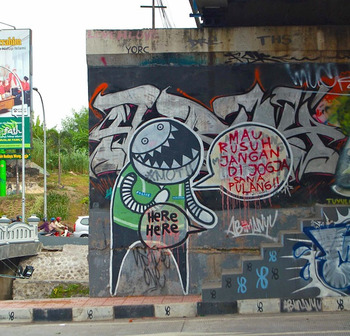
Layers of graffiti and wheatpaste in Yogyakarta. The Here Here character says, “Don't make trouble in Jogja, Go home!!” Photo by author.

A segment of a collaborative mural project in Yogyakarta that stretched about 15 meters long. Text in blue says, “Welcome to Jogja City! If you are polite we are too!” Photo by author.

Seeing an image is not the same thing as learning to gaze at or read Art. How do we learn to pay attention to what we see in public space? Jonathan Crary (Reference Crary1999) posits that the development of attentiveness is a technique intrinsic to the situated and disciplined modern subject. Crary's discussion of “attention” as embodied practice moves the discussion of aesthetics and visuality beyond the narrow confines of “the gaze” as a dyadic relation between an aesthetic object and its empowered and seeing observer. Rather, having attention reveals perception to be a technique that resides in visuality and yet also exceeds it, for perception conveys a sensory awareness of the constitutive and external powers of sociality in giving meaning to the subject-object relation (Crary Reference Crary1999). Christopher Pinney's theory of corpothetics provides yet another slant on rethinking the reception of images through the body by emphasizing the haptic quality of images (Pinney Reference Pinney2004). The work of both authors contests the Kantian notion of an aesthetics that demands contemplation from afar and historicizes the seeing subject as being-in-process, but I wish to emphasize further that the seeing subject cannot be viewed as gaining finitude through perfect vision, nor can the public congeal by consuming more images (Debord Reference Debord[1983] 2010). What my research on nontraditional art suggests is that much public art in Indonesia is met with polite indifference, arising from a deterritorialized public, an attention that is yet unformed, and a mode of perception that accommodates the visual without being necessarily dominated by it. As I stated above, activist art in Indonesia has operated as a consciousness-raising mechanism to “close the gap” between the state and the people by way of the artist's privileged point of view. I argue that the current experiments in Yogyakarta's public art now face the real possibility that without didactic and univocal messages, art is neither sublime nor legible to the public.
Murals, Murals Everywhere
“The discourse of murals has become a discourse of the public,” Yoshi Fajar Kresno Murti (Reference Murti2007, 8) proclaims confidently, linking the growing, leaky, fading, omnipresence of wall art in Yogyakarta's main streets, highways, and urban villages (kampung) to changes afoot in the public sphere. By 2008, according to Samuel Indratma, one of the founding artists of the Jogja mural movement, more than 500 community-based murals had been made in Yogyakarta (cf. Barry Reference Barry2008, 73). These hundreds of murals often addressed social issues such as health, hygiene and education, and were often produced with support from local neighborhood authorities as well as the city government. A bit later in his essay, Murti (Reference Murti2007, 9) provides an illuminating detail: “In a village in the north of Yogya city, just now, a few middle-aged men referred to a mural by the word ‘moral.’” We can imagine that the scene Murti is describing is quite normal in many neighborhoods in greater Yogyakarta, given the city's reputation as the city of murals. Murti suggests that the middle-aged Javanese men are playing at being provincial when they mispronounce the word “mural” as “moral,” but it is also implied that the men find the mural's placement in their midst agreeable, hence their slip into the more value-laden word “moral” to describe the images surrounding them. Murti's story of the felicitous mix-up between “mural” and “moral” (both foreign loan words that have entered Bahasa Indonesia) leads us to a debate that has occupied the media and concerned artists in Jogja for the past decade. The debate can be summarized thus: What is the social and visual impact of murals upon the city of Yogyakarta? What makes murals desirable as a medium of expression? Furthermore, what is at stake and what is obscured in advocating murals as culturally appropriate public art for Jogja? These questions convey the importance of cultural continuity and social cohesion for Jogja's residents as they redefine public space and public art in the post-Reformasi context. Rather than seeing murals as strange (aneh), youthful, or foreign, that is, as commodified signs of the global, visitors and residents of Jogja have embraced murals positively, emphasizing their societal value and holding the art form apart from other equally public but unwanted visual matter, such as the ubiquitous billboards, political propaganda, and graffiti found in the city.
In a series of articles debating the impact and meaning of murals to Jogja's public and urban space that Bernas newspaper ran in 2003, anthropologist Bambang Ertanto makes a case for murals as a positive repository for a vanishing Yogyakarta. In Ertanto's analysis, as a spatial practice murals had the capacity to solicit new urban narratives that reflected the daily lives of the ordinary people, the rakyat. Moreover, murals acted as a reminder of Jogja's formerly verdant landscape, now covered by soot and grime. He writes:
[S]uch drawings can contribute to debate and incite their readers to make decisions to be more aware and more in control of their daily life. That means that murals can provide an alternative power to the visual monopoly of billboards and propaganda. Yet as Mahatmanto reminds us, could it be that that intervention only belongs to certain groups, that is, those who are able to fill the minds of the people that are assumed to be empty? That would mean the people remain excluded, as passive consumers. (Ertanto Reference Ertanto2003)
Ertanto's early warning about the hidden contours of elitist attitudes within the mural movement preceded the height of the mural campaign in Jogja. The original impetus for my research was the well-documented “Forum Mural Jogja,” led by local artist Samuel Indratma, who with his fellow artists tried to bring murals into urban kampung settings to express local messages about education, discipline, community watchfulness, and local identity. Samuel Indratma was one of the founders of Apotik Komik (Comic Clinic), a progressive arts collective of technically proficient and academically trained young artists who shunned the overly serious and stultified art that dominated arts institutes in Indonesia. Apotik Komik began painting murals in Jogja as early as 1997, and by 2002 had approached the city government to launch a large-scale mural project to beautify the city. Syamsul Barry's (Reference Barry2008) study of Yogyakarta's street art scene reveals the act of enclosure that such mural enhancements facilitated. The mural project was explicitly designed to counteract the “wild” scribbles of graffiti (corat-coret liar) that defaced alleyways and lower-class neighborhoods (Barry Reference Barry2008, 70). Graffiti was confusing and unclear (tidak jelas), whereas the Apotik Komik artists were experimenting with form and space and nontraditional materials, inspired partially by their need to exhibit art beyond the confines of the gallery, and partially by their concern (keprihatinan) for the well-being of the city. Chronologically speaking, the aesthetic and social value of murals, even though they were still considered new and unfamiliar in 2002, had arrived before the rude scribbles of “pointless” graffiti became integrated into the discourse of global street art. In some of my conversations with Jogja residents, individuals remembered graffiti as a phenomenon associated with gang culture and underclass masculinity. In sharp contrast, the mural artists who came from fairly privileged backgrounds approached their intervention into public space (ruang publik) with decorum, by writing a proposal to the city government. The mural project was a pacification campaign to rid neighborhoods of conflict, and to add a point of attraction for the tourism industry. Images of community life, wayang (shadow puppet) figures, and Javanese proverbs form the bulk of urban kampung murals (see figure 2). Such was the success of the campaign that the mayor of Jogja, Herry Zudianto, even contributed paint and other materials at the artists’ request. In Samuel's stories, the friendly mayor was converted by the mural project, becoming a powerful personal ally for young artists. Zudianto went so far as to extend an amnesty for all street art in an op-ed piece that celebrated the local creativity and social consciousness of murals. Samuel joked, “Ask X (a famous street artist)—he used to carry around that piece of paper like a talisman, in case he was ever stopped and questioned by anyone.” The approval of Jogja's mayor, publicized in the mass media, became a blanket permit by default. By 2011, as I noted above, artists were actively doing street art in broad daylight.
Other offshoots from the mural movement include collaborative projects between artists and local residents to craft their own hand-painted signposts, traffic signs, and assorted public codes of conduct, written in low Javanese or in phonetically transcribed and grammatically nonstandard Indonesian. In fact, such projects often display a protectionist attitude toward local heritage, as evinced by murals I saw that bore the message for outsiders to follow Jogja's rules or get out (see figures 3 and 4). The common concern for the city's image harkens back to Jogja's reputation as a prize-winning, clean, and cultured city at the end of the New Order. “Jogja Berhati Nyaman” (Yogyakarta has a comfortable heart) was the slogan that captured this local pride in the city, a message the city administration posted on placards, signposts, and mini monuments throughout the city in the 1990s (Barry Reference Barry2008, 66–67). The “Jogja Berhati Nyaman” campaign promoted a clean, healthy, beautiful, and comfortable (bersih, sehat, indah dan nyaman) city worthy of winning the Adipura award for best-kept city three years in a row (1994–96). Embedded in concerns about public art and public space are thus nostalgic ideas about Jogja's “tradition” and reputation for civility and order.
The kampung mural project is a clear example of how a vernacular idiom suffuses and authenticates an art form by returning to ideal notions of what is good (bagus) for the rakyat, and by the rakyat’s standards. Bagus can also indicate something well done, fine, worked, or pleasing, and is apposite as an adjective for planned works where a sense of completion and detail is achieved. Indonesia's recent history as a developmental state and military dictatorship continues to direct the tenor of oppositional messages within politicized art, yet there are also new messages by independent art communities that enter and shape the public sphere in more socially continuous ways, as the kampung mural project proves. The success of the kampung mural project is only one small aspect of Yogyakarta's visual landscape, but it represents a growing consensus over changing local aesthetics in producing a unilateral image of order. Once again, it reinforces the message “Follow Jogja's rules or get out.”Footnote 4 In comparison, the Jatiwangi Art Factory, which I discuss in the next section, explores artistic play as the conduit for political engagement, rather than as the privileged and fixed medium for the popular will.
Sharing Power: Experiments in Art and Integration at Jatiwangi Art Factory
In June 2012, I took the night train from Jakarta toward Jatisura village in the company of Irwan Ahmett, a graphic designer and video artist who had invited me there the previous year. Irwan has traveled widely in Asia and Europe to make his site-specific and participatory urban art videos, and in Jakarta he is well known in the contemporary art and culture circles. When he offered to take me to the unlikely source of his new inspiration out in rural West Java, I was intrigued. We were heading away from cosmopolitan Jakarta toward Jatisura village where residents still grew their own rice for consumption. The only way to get there was by taking the three-and-a-half-hour-long express train from Jakarta to the port city of Cirebon, and from there a series of unscheduled vans. At the traffic intersection of Majalengka district, we engaged a rickshaw for the remainder of the way, passing the main market streets until we reached the narrow residential streets of Jatisura village. Tucked away in the side alleys of this small, semi-industrialized village is a thriving arts collective called Jatiwangi Art Factory (JAF). JAF is perhaps the Indonesian art world's best and worst kept secret. The collective's Warhol-inspired “art factory” name fits the endless stream of creative activity that flows forth, from spontaneous sunset picnics to studio song sessions (see figure 6). Jatiwangi is the name of the subdistrict Jatisura village belongs to, and means “fragrant teak” in Indonesian. The area had once been covered in teak groves, but nowadays Jatiwangi is better known for its main industry—ceramic roof tiles made from locally sourced clay. Jatisura village is also the hometown of JAF founders and return-migrants Arief Yudi and Loranita Theo. Together with their extended family and the help of several young artists who lived and worked in Jatiwangi, the couple has run JAF and its various side projects since 2005. Its projects are purposefully local and noncommercial, focusing on rural identity, children's education, and waste management rather than the cerebral and materially adventurous art that artists aiming at the international art market produce; as a result JAF remains unknown to the national public. In the arts community, however, JAF is an audience favorite at festivals, where they contribute their special twist of conceptual art, large-scale spectacle, and village flavor. Even with its challenging location, JAF has attracted artists from places as far away as Sydney, Berlin, Warsaw, and Barcelona to undertake residencies, as well as some of Indonesia's most famous contemporary artists, such as Titarubi Tita, Agus Suwage, FX Harsono, and Ade Darmawan.
Jatiwangi Art Factory gallery space in Jatisura village. Neighborhood children watch an impromptu music-recording session featuring a JAF artist on guitar while a young boy sings his own spontaneous lyrics to the melody. Photo by author.

JAF's physical building is a sprawling one-story house, with a small school in the back, a warung (food stall) in front, a kitchen, bathrooms, rooms for visiting artists, and a simple gallery and office that had once been a rice-threshing room. Arief's mother, whom we all addressed as Nin, would begin cooking for the household soon after morning prayers. Jatisura's Internet service is unreliable, and even cellular phone reception required memorizing which areas of the house had peak reception. In this village setting, foreign artists wander around without inciting much commentary, living with villagers whose languages they do not speak, going for inspirational walks for their village-themed projects, and stopping by the main house to eat delicious vegetarian Sundanese food. There are sculptors, musicians, performance artists, graphic artists, video artists, urban artists, potters, painters, and anthropologists, who all speak the lingua franca of broken English. The JAF community speaks degrees of this patois, but the best communication tool remains a collective expectation of making cross-cultural art that will resonate with the villagers. The young men and women at JAF run its Web site, cut its videos, perform experimental art and music themselves, and also take care of the visitors who descend upon Jatiwangi for JAF's residencies and festivals. Their prolific Web presence belies the fact that JAF members are not formally trained in graphic or Web design. JAF's attractive Web pages are bilingual in English and Indonesian, with an archive of their past festivals and projects by their foreign and local alumni.Footnote 5 Thus it appears to be a “global village” in Marshall McLuhan's terms, globally networked despite its infrastructural and economic marginality, and disproportionately recognized in some circles while invisible in others (McLuhan and Powers Reference McLuhan and Powers1992).
A pattern began to emerge when on several occasions, different and unconnected individuals as varied as university lecturers, tattoo artists, videographers, musicians, and street artists enthusiastically recommended that I visit Jatiwangi. Despite their urban orientation, my informants in the cultural sector were, like Irwan, charmed and persuaded by the village setting. At first I assumed that these urban subjects were fleeing the city out of a romantic longing for a traditional village straight out of a mooie Indies (beautiful Indies) painting, but they quickly corrected me by saying that the village was very ordinary, and in fact was sort of dirty (jorok) and mosquito-infested.Footnote 6 But the subtext of their glowing endorsement was clear—even without the online or offline literati and superior cultural institutes found in the city, art in Jatisura was more fully immersed in the public sphere and was more accepted as public art than in Jakarta or Jogja.
JAF's extreme sense of autonomy and locality presents a puzzle in post-Reformasi Indonesia, where similar community-based initiatives have become targets for civil society expansion, often from urban centers outward, and to some extent recipients of development funds from the government and foreign cultural agencies. A well-known writer who had overseen decades of arts organizing within Jakarta's civil society expressed surprise when I told him that JAF remained self-sustaining and locally supported. “How is that possible?” he asked. Unfunded, independent, and deeply embedded in local community and power structures, JAF does not resemble other art movements that proclaim a populist outlook.Footnote 7 One of the most striking differences is JAF's willingness to engage those in power. Officials from the civil service, police force, and local army command attend planning meetings and events and conduct more informal visits with regularity. JAF's position—that working with state agencies is desirable and necessary for the creation of socially engaged public art—contrasts with the practices of other progressive artists who understand public art to be confrontational.
How does art engage the state without becoming an instrument of power? What is the broader significance of JAF's relationship to power? To counter the impression that JAF is essentially reproducing power structures in the act of creating new cultural institutions, enabled by local privilege and the passivity of village-folk, it is prudent to recall the old-fashioned but trenchant ideology that defines Indonesian rural life—that of “gotong royong.” The New Order representation of the village as the natural site for gotong royong, a Javanese term that translates as “mutual and reciprocal assistance” for the common good, still resonates today as the defining characteristic of harmonious village life (Bowen Reference Bowen1986). In the past, gotong royong’s narrative of villagers’ selflessness was vulnerable to political coercion—“reciprocal assistance” could well mean corvée labor under military supervision. While JAF members do not use the term, I offer the possibility that gotong royong as a concept underlies how JAF's projects found acceptance in Majalengka from the ground up. By tightly weaving together a series of resonant terms in their project descriptions and proposals, such as masyarakat (society), warga (resident or citizen), and desa (village), JAF has channeled gotong royong toward an extra-institutional media platform that distributes culture and empowers rural citizens with localized information that the center cannot provide.
The JAF artists have built a strong rapport with the village community that enables artists to stage their performances freely in front of an assured audience, without encountering resistance based on public and private spatial divides. A good spot for a performance could thus be a villager's rice fields or even the derelict tomb of the village founder, shaded by an enormous tree in the graveyard. Such permissive and enthusiastic attitudes by villagers toward art interventions by outsiders are the results of JAF's commitment to be a laboratory for the future of Jatiwangi. From its inception in 2005, JAF integrated local families by asking them to host visiting artists and making villagers’ lives the subject of art.Footnote 8 Artists in residence were asked to partake in village life, collaborate with their host families, and produce work in situ, a process that turned Jatiwangi's village characteristics into artistic raw material. I experienced an afternoon of deep play this way, when a spontaneous walk to view the sunset from the rice fields with twenty or so JAF members and their children turned into an impromptu photography session. Arief and a couple other young men disappeared into a small shop and came back with a borrowed red velvet settee. We posed in the half-shorn fields. A villager stopped her harvest to sit in between two exotic figures—Greg, an Australian multimedia artist, and Irwan, the urban artist from Jakarta—while still holding her sickle.
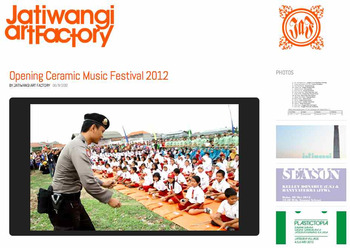
At the evening discussion forum that JAF hosts monthly, attended by residents, out-of-town guests, and members of the civil service, Arief often responds to ideas with a thoughtful smile and an enthusiastic “GASSSS”—meaning “step on it (the gas pedal).” Another JAF member caught on to his signature phrase, adding his own little hand movements to mimic stepping on the accelerator. A brief description of the 2013 Village Video Festival illuminates the scale of Jatiwangi's participatory projects and how “gas” fueled enthusiasm for making public art a part of community life. Building on a previous festival theme, “the people clay” [sic], the centerpiece of the festival was an orchestra of a thousand villagers playing percussion on tile-shaped clay instruments. The orchestra members included elementary school children, teachers, housewives, and even tile workers whom the artists had trained for months in order to achieve their acoustic harmony (see figure 7).
Screenshot of JAF Web site. Schoolchildren playing clay tile instruments in the presence of adults and local policemen. Photo by author.

JAF's ability to turn ordinary villagers into stakeholders in the artistic process is not limited to their participation in mass spectacle alone. Artistic awareness can also be a highly unique experience. Gus, a middle-aged schoolteacher with no art background whatsoever, told me how his first solo work (karya) came to be, and how nervous he had been in making it. JAF had been invited to Bandung for a festival, and they had invited him along as a participant. Gus felt the pressure to make a great work (bikin karya) even though he lacked experience, and spent days thinking of one idea after another before arriving at a multimedia installation piece that the JAF artists helped him build. Even in the retelling, the teacher was once again moved by the ambition of his ideas. The ability to make art had been transformative, for he now understood what it meant to be an artist. It was not a question of artistic talent or education, but rather daring experimentation and collaboration. Now he was one of JAF's staunchest supporters, posting photographs and comments on social media sites about Jatiwangi.
Local Politics and Collaborative Futures
JAF's community-oriented projects have introduced nontraditional and participatory art concepts into a primarily agricultural, mono-industrial, and post-crisis setting. As Arief's brother Ginggi told it, the Asian Economic Crisis in 1997 had forced the district into years of stagnation and underemployment. Nationwide freezes in construction and real estate markets severely impacted the tile factories in Jatiwangi, which stopped production for almost three years. The social repercussions of collective hardship lasted much longer. It was during this time of forced unemployment and crisis that Ginggi's friends and family found an opportunity to spend time together and to play, thus forming the lateral social bonds that manifested in JAF's ability to mobilize villagers for common cause. The social status of Arief Yudi's family explains part of their success, since Arief is a local son and his brother Ginggi holds an elected leadership role in the village as village head (kepala desa). But the decisive factor is the high level of trust between JAF and the local authorities. In particular, the personal close relations between the Majalengka Police Sector chief, the district chief (Pak Camat), and the two brothers Ginggi and Arief have set an example for accountability and accessibility in state-society relations, even if their good relations resemble elite convergence (Slater Reference Slater2010). Such closeness between government and the people, especially the willingness of elected officials such as Pak Camat to collaborate with local artists on social policy, is a significant post-Reformasi move toward humanizing the state and implementing local accountability structures.
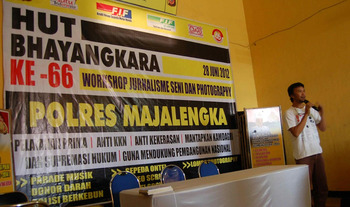
JAF's centrality in shifting the official discourse of society's problems and solutions from a state-centric and top-down perspective is evident in more institutionalized ways. On the night Irwan and I arrived in Jatisura, we were greeted by Arief and immediately ushered into the gallery for a general meeting despite the late hour. Irwan and I, and the few people who were still awake, sat on the gallery floor in a circle. From Arief's brief opening statement and his hopeful glances directed at us, it transpired that we had been conscripted to speak at a photography and journalism workshop the next morning at 8:00 a.m. in the Majalengka district police station. High-ranking district police officers, members of the military, and teachers were expected to attend the workshop, representing all arms of the state's civil service and security apparatus. The next morning, groggy with too little sleep and ill-prepared, we were driven off to the colonial-era building that housed the police headquarters, where an alarming crowd had gathered. The civil service was punctual in Majalengka. The artists were invariably running late. A large spanduk (banner) proclaiming the occasion had been hung facing the audience of uniformed men and women (see figure 8). The JAF artists were dressed in t-shirts and jeans, so that even Arief, our fearless leader, looked particularly youthful and informal in his short-sleeved JAF t-shirt. The event could only begin with the blessing of the highest-ranked official present, who took the podium after her subdistrict subordinates had made their opening speeches. A charismatic middle-aged woman, the district police chief appeared sophisticated and urbane in her high heels and neat brown uniform. Her welcome speech departed from the ritualized speech of Indonesian politics; instead she deployed rather unorthodox metaphors and catchphrases to talk about new modes of public service and societal infrastructure. Extolling the virtues of art, the police chief proposed state-society collaborations as essential to changing the culture of the police to fit a new age. Art was networking Majalengka district to the rest of the world, art was globalizing Jatiwangi subdistrict, and it was through JAF that we were all learning a way to foster the most advanced and ideal social values. In fact, the police chief likened the introduction of arts and culture within the police force as akin to installing a free-access Wi-Fi network in Majalengka, an urban and cosmopolitan image that had not even been realized in Indonesia's biggest cities. When all citizens were connected through the future network, “Art would be the new password!” she proclaimed. The audience applauded loudly. At the close of the event, the JAF participants were driven home in immaculate police cars by two obliging officers, who loaned their hats for props to use in a commemorative photograph.
JAF founder Arief Yudi addressing the civil service and security apparatus of Majalengka district in the district police station at the Art and Photography Journalism Workshop. Photo by author.

The district police chief's enthusiasm for art was in line with the state's problem-solving approach to “underdeveloped” areas outside urban centers. The intangible benefits and circulatory possibilities of mediatized (and yet vernacular) art could be well adapted to the rural community's need to reflect the normative standards of urban modernity by leapfrogging into the digital future with a digital public in tow. At present JAF is the most readily available and productive Web presence to represent Majalengka, drawing international traffic and winning national recognition at festivals. JAF's 2012 Village Video Festival entitled “Sharing Power through the Video Frame” suggests that in fact, such ambitions to completely reorient the village toward the global, and to mediatize the village (the rural), indeed took place. The festival proclaimed that information awareness was central to the future development of village education, and announced the inauguration of the festival under the auspices of Pak Camat and Pak Polisi, who had also created artwork to be showcased in the festival. Despite the burden of state directives that treat art as discipline and technique in the quest for engineering rural development, the JAF community has managed to produce participatory art that leaves space for state involvement without subordinating their artistic vision. Pak Camat and Pak Polisi have themselves become artists according to JAF's rules, creating a stakeholder portfolio of karya (work) as proof of their engagement with the village community.
In both sites that I discussed, the uniformed men and women who fill the frame no longer operate as oppressive reminders of the New Order state's surveillance of its citizens and its monocultural imperative hidden within narratives of consensus. Instead the agents of the state are curious about the infrastructural implications of art's publics. Perhaps the hegemonic unconscious of projects such as those propagated by JAF and the Jogja Mural movement are necessary to situate what is radically democratic in the post-Reformasi expansion of activist art, even if artists and participants seem to inch closer to the state once again. Art as governance presents a new type of diffuse governmentality that emerges from grassroots efforts to harmonize with and aesthetically translate statist objectives into appropriately “polite” vernacular idioms about culture and locality, and that in turn influences statist perspectives by presenting a corporeal public response to issues. The types of public art I have discussed here are “passwords” to a cosmopolitan vision of grassroots politics that can be easily copied, modified, shared, and acquired. Once these new art forms proliferate and circulate through the media of public space and digital sharing, it is evident that the recognized agents of globalization and subsequent vernacularization no longer originate from predictable sources of culture and power, neither solely from the state, the national capital, nor from the mythic West. Public art's lingering activist effects have left the door open for a more diverse populist presence to develop.
Acknowledgments
I would like to thank the anonymous reviewers at JAS for their insightful comments, which helped enormously in improving the organization of this paper. I would also like to thank Elizabeth Drexler and Karin Zitzewitz for organizing the 2013 Association for Asian Studies panel on “Activist Art in Asia,” where I first presented these findings. Any fault or error in this piece remains my own.