




No CrossRef data available.
Comparable “risks” at the socioeconomic status extremes: Preadolescents' perceptions of parenting
Published online by Cambridge University Press: 07 April 2005
Abstract
This study was focused on contextual variations in the parenting dimensions salient for preadolescent adjustment. The sample consisted of 614 sixth graders from two communities, one low and the other high income. Parenting dimensions included those known to be significant in each socioeconomic context: isolation from parents (emotional and physical), and parents' emphasis on achievements (overall expectations and emphasis on integrity over success). Adjustment outcomes included subjective well-being as well as school competence. Contradicting stereotypes, results showed that on average, very affluent children can perceive their parents as emotionally and physically unavailable to the same degree that youth in serious poverty do. The ramifications for adjustment also seem to be largely similar: Closeness to parents was beneficial for all, just as criticism was deleterious. Even after considering the quality of parent–child relationships, parents' physical absence (e.g., at dinner) connoted vulnerability for distress and for poor school performance in both groups. The connotations of a few parenting dimensions varied by context and gender; these variations are discussed as are overall implications for future research and practice.
Preparation of the manuscript was funded in part by grants from the National Institutes of Health (RO1-DA10726, RO1-DA11498, R01-DA14385), the William T. Grant Foundation, and the Spencer Foundation.
Information
- Type
- Research Article
- Information
- Copyright
- © 2005 Cambridge University Press
Poverty is widely believed to confer risks for poor parenting and consequently for children's maladjustment. There is a vast research literature showing that low family income causes distress to parents and thus impairs their parenting in domains ranging from low expressed affection and warmth, to critical and harsh discipline patterns (for a review, see McLoyd, 1998). These disturbances in parenting, in turn, have been linked with psychopathology among children and adolescents, in areas spanning depression and anxiety to conduct problems and poor school grades (Conger, Ebert–Wallace, Sun, Simons, McLoyd, & Brody, in press; Conger, Wallace, Sun, Simons, McLoyd, & Brody, 2002; Elder & Caspi, 1988; McLoyd, 1989; Mistry, Vandewater, Huston, & McLoyd, 2002; Yeung, Linver, & Brooks–Gunn, 2002).
If a lack of income implies poor parenting, the logical corollary would be that ample income will imply generally good parenting; but there is little to no research evidence to inform this speculation. In the decade and a half since Graham's (1992) admonition that “Most of the subjects were White and middle-class,” there has been an appropriate increase in studies of children in poverty. By contrast, there have been almost no studies of children at the other end of the socioeconomic continuum, those in very wealthy families.
Although developmentalists have not studied affluent families, cross-disciplinary evidence on adult populations suggests that they may not be altogether risk free (for a review see Luthar, 2003; Luthar & Latendresse, 2005; Luthar & Sexton, 2004). Epidemiologists, for example, have noted that material wealth can be linked with elevated rates of depression (see Buss, 2000). Economist Juliet Schor (1999) has described how the pressures to work and acquire tend to deplete personal energies, as psychologists Csikszentmihalyi (1999) and Diener (2000) have argued that the high productivity associated with affluence may often involve little leisure time, rendering people increasingly prone to distress. In a series of studies, Kasser, Ryan, and their colleagues established poorer mental health among individuals who disproportionately valued extrinsic rewards such as wealth and fame, over intrinsic ones such as interpersonal relatedness and personal growth (Kasser & Ryan, 1993, 1996; Ryan, Chirkov, Little, Sheldon, Timoshina, & Deci, 1999; Sheldon & Kasser, 1995). Political scientists, evolutionary psychologists, and cross-cultural researchers have all noted that the structures of wealthy market economies can promote distress by inhibiting the formation of supportive relationship networks, where services are bought and not shared, and people have the financial resources to leave or join informal groups as they feel inclined at the moment (see Putnam, 2000; Tooby & Cosmides, 1996).
Even if wealthy adults are, in fact, somewhat vulnerable to distress due to aspects of their lifestyles, one might argue that this distress would not necessarily filter down to their children, given the ability to purchase help of various kinds, such as psychotherapy for themselves, or alternative caregivers who are surrogate parents. At this time, there is no way of knowing whether children of affluence are, in fact, largely insulated against any unhappiness their parents suffer, or whether they like others experience a range of optimal–harmful parenting experiences, the results of which are reflected in variations in their own psychopathology or competence.
It was to address these issues that the present study was conceptualized, with the central goal of ascertaining ramifications of parental influences among students at both socioeconomic status (SES) extremes. In selecting parenting domains to be examined, our choices were guided by two major considerations. At the outset, we sought to include the two broad dimensions of parenting that are widely acknowledged to be important for children across disparate backgrounds, that is, those on the warmth and control dimensions (Baumrind, 1991; Darling & Steinberg, 1993; Fine, Voydanoff, & Donnelly, 1993). The former was operationalized in terms of perceived closeness to mothers and to fathers; there is ample research showing that across various sociodemographic groups, feelings of closeness to parents can serve salutary effects for psychological, social, and academic functioning (see Cowen, Wyman, Work, Kim, Fagen, & Magnus, 1997; Furstenberg & Harris, 1993; Luthar & Becker, 2002; Wyman, Cowen, Work, Hoyt–Meyers, Magnus, & Fagen, 1999; Zimmerman, Salem, & Maton, 1995). The latter dimension was assessed in terms of harshness of discipline or perceived criticism by parents, also a construct shown to have strong effects across diverse demographic groups (see Hodes, Garralda, Rose, & Schwartz, 1999; Le Grange, Eisler, Dare, & Hodes, 1992; Robertson & Simons, 1989; Wamboldt & Wamboldt, 2000).
We also considered two dimensions of adults' physical presence in the children's lives, and in this case, each one was believed to be especially salient in one of the two ecocultural settings. The first of these was after school supervision by adults. Past research suggests that this dimension may be particularly influential among inner-city youth, given the ubiquitous risks of low-income urban neighborhoods (Cauce, Stewart, Rodriguez, Cochran, & Ginzler, 2003; Mahoney & Zigler, 2003; Quinn, 1999). The second was the frequency with which children ate dinner with parents. Social scientists have speculated that this dimension is often compromised in upwardly mobile families, as evenings are packed with after-school activities for children and career commitments of parents (Doherty, 2000; Luthar & Becker, 2002). The possible predictive significance of this indicator is seen in suggestions that the maintenance of family rituals and routines (family mealtime is among the most common) is generally associated with positive outcomes, including children's health, academic achievement, and the quality of their relationships with parents (Fiese, Tomcho, Douglas, Josephs, Poltrock, & Baker, 2002). It is currently unknown whether effects of this relatively simple family “ritual” might surpass those deriving from levels of warmth or lack of criticism in family relations.
Finally, we examined two variants of parents' attitudes toward achievements. One of these, again, was expected to be particularly beneficial for low-income students, and this was perceived high parental expectations for children's performance. In poverty settings where academic achievement is not always highly emphasized (Halle, Kurtz–Costes, & Mahoney, 1997; Hauser–Cram, Sirin, & Stipek, 2003; McLoyd, 1998), children tend to benefit when significant adults expect excellence from them (e.g., Hebert, 2002; Stipek, 1997). There is also possibly a greater range of variability on this dimension in low- than high-income groups where expectations are assumed to be generally high (see Luthar, 2003; Luthar & Becker, 2002; Luthar & D'Avanzo, 1999), with the potential for greater predictive significance among the former.
The second facet, conversely, was expected to benefit affluent youth in particular, and that was the degree to which they felt that their parents' valued character relative to accomplishments. In what Pittman (1985) describes as the “intensely competitive society of the rich” (see also Luthar, 2003; Luthar & Becker, 2002; Luthar & Sexton, 2004), we expected benefits to accrue if children believed their own parents valued their personal integrity and character more so than the splendor of their accomplishments. This suggestion is resonant with previously cited findings with adult populations, showing that people who disproportionately emphasize extrinsic goals such as achievement and money relative to intrinsic ones such as close relationships and personal growth, tend to show poorer mental health and lower well-being than others (Kasser & Ryan, 1993; 1996; Ryan et al., 1999; Sheldon & Kasser, 1995). In a similar vein, research involving 800 college alumni revealed that adults with Yuppie values (preferring affluence, professional success, and prestige over intimacy in marriage and with friends) reported being “fairly” or “very” unhappy twice as often as did their former classmates (Perkins, 1991). Inasmuch as a disproportionate focus on extrinsic relative to intrinsic goals connotes unhappiness among adults, we reasoned that in communities where there tends to be a pervasive emphasis on achievements, children would benefit if their parents clearly emphasized their personal integrity relative to their “getting ahead.”
The Nature of Associations with Adjustment Outcomes
Apart from exploring unique links of particular parenting dimensions in each SES group, a second objective was to examine whether the links found generally reflected vulnerability effects, with unusually high maladjustment at one extreme, protective processes, with unusually positive outcomes at the opposite extreme, or both, with effects on adjustment at both extremes. Addressing the ongoing controversy about whether protection and vulnerability in resilience are just two sides of the same coin, Rutter (2003) has explained, with the help of several examples, why this is not necessarily the case. Some influences have effects only at the vulnerability extreme, as teenage pregnancy, for example, can lead to negative outcomes for children but high maternal age does not necessarily lead to exceptionally high well-being. Other influences have only salutary effects, as great musical talent can bring many success experiences over time, whereas a deficit in this area does not imply risk for unusual unhappiness. Still others can have curvilinear effects. In the relation between parental control and children's disruptive behavior, excessive indulgence and undue restrictiveness could each result in high behavioral deviance (Rutter, 2003).
Accordingly, in this study we sought to go beyond just identifying statistical links between parenting dimensions and child outcomes, to also examine where exactly the “action” might lie, using procedures suggested for resilience researchers (Luthar & Zelazo, 2003; Rutter, 2003). These procedures involve, first, identifying groups at high and low levels of the predictor variable, say, maternal warmth, and then examining plots of data to determine whether (a) children with unusually high levels of warmth reflect adjustment much better than the average (protective effects), (b) those with extremely low levels of warmth display adjustment much more poorer than the average (vulnerability effects), (c) both extremes of warmth reflected equivalent deviations from the average (connoting both protective and vulnerability effects), or (d) if some links were more curvilinear rather than linear. From a practical standpoint, these distinctions can be important in suggesting to parents, for example, whether certain parenting dimensions might make the difference between “average” and decidedly positive profiles among their children, as opposed to adequate versus clearly suboptimal profiles of adjustment.
Assessment of children's adjustment outcomes was based in a multidomain, multiinformant strategy. Subjective feelings of disturbance were assessed in both internalizing and externalizing domains (i.e., depression and anxiety symptoms, as well as delinquency and substance use). In addition, we assessed two aspects of competence in the school setting: teachers' ratings of behavioral competence, and academic grades across major subjects.
In sum, the purpose of this study was to explore the ramifications of different parenting dimensions for preadolescents in inner-city poverty and in affluent suburbia. The dimensions considered encompassed those known to be salient at each SES extreme. These included two affective indices (closeness to parents and perceived criticism); two dimensions of adults' physical presence (after-school supervision and having dinner with parents), and two achievement-oriented indices (parents' high achievement expectations, and their emphasis on children's character relative to personal successes). All predictors were examined simultaneously in relation to children's self-reported symptoms as well as teachers' reports of behaviors and their school grades, and statistically significant links were explored to assess whether they reflected protective effects, vulnerability effects, a combination of the two, or curvilinear patterns.
Method
Sample
Participants in this study were 614 sixth grade middle school students drawn from two different communities in the Northeast. Three hundred of these students (151 girls, 149 boys) were from a middle school serving low-income students in a large city, and 314 (150 girls, 164 boys) were from the two middle schools in one affluent community. Among the inner-city students, 20% were Caucasian and 80% were from ethnic minorities (31% were African American, 48% Hispanic, and less than 1% each were Asian or another ethnicity). Ninety-three percent of students in the high-income sample were Caucasian, less than 2% each were African American and Hispanic, 3% were Asian, and the remainder were of other ethnic backgrounds.
Demographically, the two groups were at the extremes of SES in contemporary American society. Based on data from the United States Census Bureau's 2000 Decennial Census, the median annual family income in the inner-city sample was approximately $27,388. The estimate for our affluent sample was nearly five times that ($125,381). Percentages of students receiving free or reduced lunches in the two cohorts were approximately 79 and 3%, respectively.
Students' inclusion in the sample was based on passive consent procedures, as data collection was done as part of school-based initiatives on positive youth development in both schools. Administrators sent letters to parents of all sixth grade students via US mail, describing the project, indicating that survey results would be presented only in aggregate form (with no information on individual children), and requesting notification from parents who preferred that their children did not participate. A second notice was mailed a few days before data collection, once again offering parents the option to refuse consent by way of notifying school officials. On days of data collection, all students were also informed that their participation was entirely voluntary, and on completion of data collection, questionnaires were stored with only subject numbers as identifiers.
Complete data were obtained for 89.6% of sixth graders attending middle school in the low-income community sampled. Of the 35 students who were not included, parents of four students did not wish for them to participate, three children did not wish to complete the questionnaires, and 28 were absent on both days of data collection.
The 314 students from the high-income cohort, from whom complete data were collected, represented 94.6% of the students who were in the sixth grade in the affluent community. The remaining 18 students included 12 whose parents chose not to have them participate, one who did not wish to participate him/herself, and five who were absent on both days of data collection.
Procedure
During the 1999–2000 academic year, data for each student were collected during two 45-min English class periods on 2 separate days. To guard against biases due to variability in reading proficiencies, a member of the research team read each questionnaire aloud, and students marked their responses accordingly. Questionnaires were administered in the same order in all classrooms, with relatively structured, nonthreatening measures administered at the beginning and end of each session. On completion of data collection, a gift of a mechanical pencil was given to each participating student in the inner-city sample, while funding to support a pizza party was given to all participating classes in the high-income community (administrators decided what would be used as incentives for students in their respective schools). Finally, teachers from all classes were given $1 for each student rating form completed.
Measures: Parenting dimensions
Closeness to parents
Emotional closeness to parents was assessed with the Inventory of Parent and Peer Attachment (Armsden & Greenberg, 1987). This measure consists of 50 items (25 pertaining to each parent) rated on a 5-point Likert-type scale and assesses the degree of Trust, Communication, and Alienation in relationships with parents (e.g., “My mother/father understands me;” “My mother/father can tell when I'm upset about something;” “I feel angry with my mother/father”). Overall attachment scores are derived by summing the trust and communication items with reverse-scored alienation items. Cronbach's alpha coefficients for overall mother and father closeness, respectively, were .91 and .93 in the low-income sample, and .93 and .93 in the high-income group.
Parental criticism
This dimension was assessed via a 4-item subscale of the Multidimensional Perfectionism Scale (MPS; Frost, Marten, Lahart, & Rosenblate, 1990). Illustrative items are “My parents never try to understand my mistakes” and “I am punished for doing things less than perfectly,” and all items are rated on a 5-point Likert scale. Reliability coefficients were .60 among low-income youth and .77 among their affluent counterparts.
After-school supervision
Students indicated the type of supervision typically received after-school, based on three possible choices: (a) supervised by adult family member, (b) supervised by other adult (nonrelative), (c) not supervised by an adult. Following Luthar and Becker (2002), responses were categorized dichotomously (presence vs. absence of an adult) for use in analyses.1
Preliminary analyses confirmed that here, as in the Luthar and Becker (2002) sample, adjustment levels were generally similar among groups supervised by family versus nonfamily adults, and both these groups differed from groups usually without adult supervision.
Dinner with parents
Students were asked about the adults with whom they typically ate dinner, and responses were coded dichotomously: with either one or both parents (or parent figures, e.g., a step-parent), versus with no parent.
Parent expectations
This variable was assessed via the 5-item Parental Expectations subscale of the previously mentioned MPS (Frost et al., 1990). Illustrative items are, “My parents expect excellence from me” and “My parents set very high standards for me.” Alpha coefficients in this sample were .68 and .78 among low- and high-income youth, respectively.
Parents' emphasis on personal character versus achievements
A refined version of the Parental Values scale (Luthar & Becker, 2002) was used in this study, with changes involving reduction from 10 to 6 items as per recommendations following a psychometric study of the original measure (DeCarlo & Luthar, 2000). Students were asked to rank order the top three of the following six items based on what they believed their own parents valued the most: “that you are … a) respectful to others, b) attend a good college, c) try to help others in need, d) excel academically, e) are kind to others, and f) have a successful career in the future.” As can be seen, half of these values are achievement oriented and half are oriented toward personal character and well-being. Scale scores were simply proportions derived by summing the weights of the personal character responses and dividing by the total possible weighted score (6).2
Responses were weighted such that the item ranked in first place carried a weight of 3, the value in the second ranked position was given a weight of 2, and the third ranked value received a weight of 1. To illustrate, if “help others in need” was ranked first, “have a successful career” ranked second, and “kind to others” ranked third, the individual would receive a score of 4 (i.e., 3 + 1 for the first and third ranked items) for character emphasis, and a score of 2 on achievement emphasis (as the second ranked value bears a weight of 2). If all three ranked items were character related, the score would be 6 (i.e., 3 + 2 + 1) for character, and 0 for achievement. As achievement scores are redundant with character scores (always totaling 6), these were not included in the analyses.
Measures: Child adjustment
Internalizing symptoms
Internalizing symptoms were assessed by a composite of depressive and anxiety symptoms, with the former assessed by the Children's Depression Inventory (CDI; Kovacs, 1992) and the latter by the Revised Children's Manifest Anxiety Scale (R-CMAS; Reynolds & Richmond, 1985). The CDI is a widely used 27-item, three-choice scale designed for school-age children and adolescents, with good psychometric properties (Kovacs, 1992; Saylor, Finch, Spirito, & Bennett, 1984); internal consistency coefficients in this study were .89 and .88 for low- and high-income samples respectively. The R-CMAS is a dichotomous choice, 37-item self-report measure that provides scores on three dimensions of anxiety (social anxiety, physiological anxiety, and worry), as well as a total anxiety score based on all of these collectively. Acceptable reliability and validity coefficients have been reported for this scale (Luthar & D'Avanzo, 1999; Reynolds & Richmond, 1985), and Cronbach's alpha coefficients for the current samples were .89 for total anxiety in the low-income cohort and .88 in the high-income cohort. As in past research, the depression and anxiety measures were highly correlated (r = .71 and .72 in the low- and high-income samples, respectively) and the composite variable (internalizing distress) was derived by summing standardized scores on the two measures.
Externalizing behavior
This dimension was assessed by a composite of self-reported delinquency and substance use, with the former assessed by the Self-Report Delinquency Checklist (SRD; Elliot, Dunford, & Huizinga, 1987). The SRD includes 37 items rated on a 4-point scale that ask about the frequency of delinquent acts at home, at school, and in the community. The SRD is a reliable and valid instrument (Huizinga & Elliot, 1986), and in this study, alpha coefficients were .89 and .92 for low- and high-income samples, respectively. Substance use was measured by the frequency of drug use grid used in the Monitoring the Future Study Survey (Johnston, O'Malley, & Bachman, 1984), an instrument that queries about frequency of use of several substances over the preceding year (nicotine, alcohol, marijuana, inhalants, crack, cocaine, and LSD), with ratings obtained on a 7-point scale anchored by never and 40+ times. The reliability and validity of this type of self-report have been amply documented (Henley & Winters, 1989; Johnston, Bachman, & O'Malley, 1989; Wallace & Bachman, 1991; Winters, Weller, & Meland, 1993). Following the approach in previous studies (Luthar & Becker, 2002; Luthar & D'Avanzo, 1999), a composite substance use variable was created by adding scores for cigarettes, alcohol, and marijuana. This substance use score was significantly correlated with total delinquency scores (r = .51 and .75 in the low-income and affluent groups, respectively) so that scores on each were standardized and added together to create the composite variable: externalizing problems.3
Luthar and Becker (2002) had separately examined substance use as an outcome among their sixth and seventh grade cohort, but levels of substance use in this sample of sixth graders was too low to permit meaningful analyses of this as an independent outcome. Developmental considerations provide further reasons for combining this with delinquency in this study; substance use may also be linked with internal distress (i.e., as self-medication) among teenagers, but among children as young as sixth graders, it is conceptually a stronger indicator of behavioral deviance. High levels of internal consistency support our decision to combine the two variables.
Teacher-rated classroom behaviors
The Teacher–Child Rating Scale (T-CRS; Hightower, Work, Cowen, Lotyczewski, Spinell, Guare, & Rohrbeck, 1986) was given to English teachers of all students. A 36-item scale, the T-CRS assesses behaviors within two domains with three scores within each: Problems (Acting Out, Learning Problems, and Shy–Anxious) and Adjustment (Frustration Tolerance, Task Orientation, Assertive Social Skills). Of these six subscales, four clearly represent positive versus negative adaptation, while two, Shy–Anxious and Assertive Social Skills, are more equivocal. For example, Luthar (1995) found that teens whose peers viewed them as being shy and anxious received relatively good grades, while assertiveness was sometimes linked to aggression. Accordingly, we did not include these two subscales in operationalizing teacher-rated classroom adjustment.
The four selected T-CRS subscale scores were standardized to correct for differences in teachers' stringency, after which a principal components factor analysis with varimax rotation was performed on the subscales. Results indicated a single factor accounting for 81 and 77% of the total variance among low- and high-income students, respectively. Thus, a composite score on teacher-rated Classroom Competence was derived by taking a sum of the two positive subscale scores and subtracting from this total a sum of the two negative subscale scores.
School grades
Data on this variable was obtained from student records. A cumulative grade-point average was computed based on students' grades across the previous two full quarters of the school year. This cumulative score was based on averaged grades in social studies, science, math, and English; and letter grades were coded such that an A+ was assigned a score of 13 and an F a score of 1.
Results
Descriptive statistics
Means and standard deviations for all predictor and outcome variables are presented separately by city and gender in Table 1. Values for depression, anxiety, delinquency, and drug use are all displayed individually rather than as the internalizing and externalizing composites, to permit comparison of mean scores on these measures with those in other samples, if desired.
Descriptive data on all variables presented by city and gender

A two-way multivariate analysis of variance (ANOVA; City × Gender) revealed significant main effects for city, Wilks' Λ = .48, F (14, 460) = 35.22, p < .001, and for gender, Wilks' Λ = .86, F (14, 460) = 5.53, p < .001, as well as a significant interaction effect, Wilks' Λ = .93, F (14, 460) = 2.68, p = .001.
Follow-up univariate ANOVAs showed that compared to high-income students, low-income youth had higher scores on depression and anxiety, but not on substance use or delinquency. On parenting dimensions, inner-city students reported higher parental criticism and were less likely to receive after-school supervision (as shown by chi-square analyses, also reported in Table 1). At the same time, however, they reported higher parental expectations than affluent students and were no less likely to eat dinner with their parents, nor were they different on perceived closeness to mothers or to fathers. In addition, three significant gender differences were found, with girls having lower levels of delinquent behaviors, more positive teacher ratings, and higher grades than boys. Finally, six City × Gender interactions were found, on depression, delinquency, substance use, parental criticism, parental emphasis on character, and attachment to mother. The direction of differences was consistent across these instances, with affluent girls invariably faring better than their male classmates, in all cases; whereas in the inner-city sample, girls either fared similar to or more poorly than boys.
Parallel to the strategy used in a previous study on affluent youth (Luthar & Becker, 2002), we computed the proportions of students in each context who were above clinically significant symptom levels on the two adjustment indices with published normative data: the CDI and the R-CMAS. As in that sample, rates were substantially lower than national norms for high-income sixth grade youth in the current study. By contrast, rates of clinically significant depression in our low-income sample were 1.5–2 times as high as national rates (see Table 2).
Self-reported internal distress among students in this study: Incidence of clinically significant depressive and anxiety symptoms compared to national norms

Simple correlations among all variables are depicted in Table 3, with values for the low-income sample in the top-right half of the table and those for the high-income sample displayed in the bottom-left part of the table. In both cases, values for girls are presented in the top row and those for boys underneath. Values in this table suggest several similarities as well as differences in the patterns among the low- versus high-income students. However, interpretations based on these simple correlations are not offered, as these do not consider shared variance; in the interest of avoiding Type I errors, all inferences about salient patterns are reserved for the more stringent multivariate analyses.
Intercorrelations among all variables

Multiple regression analyses: Parental behaviors in relation to child outcomes
For both low- and high-income samples, multiple regression analyses were conducted predicting each of the four outcomes: internalizing symptoms, externalizing problems, teacher-rated behavioral competence, and academic grades. We considered it preferable to conduct separate regressions for each school rather than using interaction terms (Context × Each Predictor) in combined analyses, for at least two reasons. Conceptually, the former approach is resonant with increasingly heard recommendations for research with groups that have not been studied much, that is, that it is most meaningful to illuminate the relative salience of processes within these groups rather than seeking to show exactly how these processes differ from those in other samples (see Garcia Coll, Akerman, & Cicchetti, 2000; Garcia Coll, Lamberty, Jenkins, McAdoo, Crnic, Wasik, & Vasquez Garcia, 1996; Hobfoll, Ritter, Lavin, Hulsizer, & Cameron, 1995; Luthar, 1999; Tucker & Herman, 2002). Statistically, furthermore, the consideration of seven interaction terms was seen as inadvisable because (a) we did not have specific hypotheses on directional differences for many, and (b) the inclusion of these many interaction terms, not well justified conceptually, would have resulted in considerable loss of statistical power to detect the effects of substantive interest.
In all regression analyses, gender, being a fixed factor, was entered at the outset. Additionally, in analyses on the low-income sample, ethnicity was entered with gender in the initial block; this was not done in analyses of the affluent sample, as standard collinearity diagnostics (Belsley, 1991) revealed a lack of variance in ethnicity in this sample. As age showed little variation in both samples, we did not include it in the regression models (although we did confirm, in a separate set of analyses that controlling for age did not alter the results reported here).
Parenting dimensions were entered simultaneously in the second block, which allowed for an exploration of the unique contributions of each one in predicting to outcomes. The stringency of the simultaneous regressions was particularly important to excise artifactual inflation of links due to shared method variance in self-report (as all parenting dimensions, and two child outcomes, involved the children's own perceptions). Thus, in the results presented in Tables 4 and 5, the effects for each parenting variable reflect its overlap with the outcome having removed the variance that it shared with all other self- reported dimensions of parenting behaviors in that regression equation (see Cohen, Cohen, West, & Aiken, 2003; Pedhazur, 1997).
Results of regression analyses for the prediction of low-income students' psychosocial outcomes

Results of regression analyses for the prediction of affluent students' psychosocial outcomes

Results of the regression analyses showed that the full model accounted for as much as a 30% of the total variance in some outcomes, with a range of 5–30% in the low-income sample, and 12–27% in the affluent sample.4
In considering regression results across groups, it should be noted that direct comparisons are limited by the fact that regression models tested in the two groups were not identical (i.e., ethnicity was not included in analyses of the affluent sample due to collinearity problems).
Subsequent analyses involved exploration of whether significant effects of potentially bipolar variables reflected mostly protective patterns (implying the difference between average vs. superior adjustment); vulnerability effects (implying the difference between average vs. poor adjustment), or both. This was done by plotting standardized scores on the dependent variable concerned at high, medium, and low levels of the predictor variable that was involved.5
Deriving these plots involved four steps. The first step was to compute, for each significant predictor (e.g., attachment to mother, which was linked to internalizing symptoms), the amount of variance that was not shared by any others in the regression equations, by saving residual scores on the predictor in question once all others were regressed on it. This was done because all significant effects displayed in Tables 4 and 5 reflect links of each independent variable having considered overlap with all others. Having derived residuals of predictors, the second step was to divide the distribution of these scores into tertiles, to identify high, medium and low categories of predictor variables (shown on X axes of the graphs). Third, we standardized scores on all outcome variables shown on Y axes; this was done to easily determine how much the plotted points deviated from the overall sample means. In the final step, we plotted these derived scores of outcome variables, for groups at high, medium, and low levels of residual predictor scores (outcomes were plotted dichotomously for the categorical predictors; as the logistic regression procedure is unable to derive true residual scores).

Low-income students' maladjustment outcomes plotted by residual tertiles (for continuous predictors) or dichotomous categories. All outcome scores are expressed in terms of deviations from the mean (zero).
Associations for the inner-city students are shown in Figure 1. Findings showed both protective and vulnerability effects (a) for closeness to parents in relation to symptom indices; (b) for parent criticism in relation to internalizing behaviors and teacher-rated competence; and (c) for parents' emphasis on character in relation to teacher-rated competence. Further, (d) the two indices of (lack of) parents' physical presence had primarily vulnerability effects, with both being associated with externalizing problems as well as teacher-rated competence.
Within the affluent sample, a two-tailed pattern indicating both protective and vulnerability effects was seen for (a) attachment to mothers in predicting to both symptom indices (as in the low-income sample), (b) attachment to fathers in association with internalizing symptoms and teacher-rated behaviors, and (c) parental expectations in relation to both school competence outcomes (see Figure 2). By contrast, some indices showed only vulnerability effects, that is, (d) parental criticism, in relation to internalizing symptoms and school competence indices; and (e) the physical presence of adults, after school supervision in predicting to externalizing symptoms, and eating dinner with parent(s) in relation to both symptom types and school grades.

High-income students' maladjustment outcomes plotted by residual tertiles (for continuous predictors) or dichotomous categories. All outcome scores are expressed in terms of deviations from the mean (zero).
Aside from these previously described effects, all linear in nature, we also examined the possibility that effects of some predictors may have been more curvilinear, with the maximum benefits deriving, for example, at moderate rather than very high or very low levels of the parenting dimension. Quadratic terms for all continuous predictors were examined in the hierarchical regressions (e.g., Criticism × Criticism), but none of these reached statistical significance in predicting to any of the four outcomes in either school.
Supplementary analyses: Moderating effects of gender
Identifying gender differences in each economic context was not a primary research goal in this study of preadolescent children; however, to rule out major differences in effects previously described, we conducted exploratory analyses on the block of seven interaction terms (gender by predictor) in each school. Unique effects of individual interaction terms were interpreted only when the block as a whole yielded a significant change in R2 (ΔR2). Results indicated three significant interaction blocks: externalizing problems in both low-income (ΔR2 = .10, p ≤ .001) and high-income cohorts (ΔR2 = .05, p ≤ .01), and grades in the high-income sample (ΔR2 = .05, p ≤ .05). In addition, the block predicting to grades in the low-income sample was of borderline significance (ΔR2 = .06, p ≤ .10).
In most of these cases, the direction of links was not dissimilar among girls and boys but rather, the slopes varied in steepness. Among low-income youth, therefore, girls seemed more vulnerable to symptoms than boys when experiencing low attachment to mothers (β = .33; R2 = .06, p ≤ .001), and with the absence of adult after school supervision (β = .19; R2 = .02, p ≤ .05). On the other hand, boys in the low-income community benefited more than girls from high closeness to fathers in terms of symptom levels (β = −.33; R2 = .05, p ≤ .001), and their grades suffered more with low attachment to mothers (β = .21; R2 = .02, p ≤ .10) and low parental expectations (β = .23; R2 = .03, p ≤ .05). In the affluent group, high closeness to mothers placed boys at greater advantage relative to girls in terms of symptom levels (β = −.37; R2 = .03, p ≤ .001), whereas low parental criticism seemed to affect the grades of girls more than those of boys (β = .23; R2 = .01, p ≤ .10).
Discussion
Findings of this study strongly call into question stereotypes about whether youth in poverty are universally “disadvantaged” compared to those more affluent, or that upper SES youth are necessarily privileged in domains extending beyond material wealth. Children's perceptions of seven parenting dimensions were considered here, and average levels on four of these were found to be similar among low- and high-income students: Closeness to mothers, closeness to fathers, parent values emphasizing integrity, and regularity of eating dinner with parents. Of the remaining three, inner-city students did fare more poorly on two (parent criticism and lack of after school care by adults), but at the same time, they did significantly better than wealthy students on the last, high parent expectations.
Our findings also counter presumptions that there is a restricted range of generally “good” parenting in wealthy communities (or certainly more restricted than in urban ghettos). The data suggested that the range of perceived parenting adequacy is no more constrained among the very wealthy than the very poor; for in both settings, parenting indices explained comparable amounts of variation in children's adjustment outcomes: self-reported, as well as based in teachers' opinions.
Finally, our results showed, unsurprisingly given past research, that across economic contexts, closeness to parents was good as criticism was harmful. Less expected were our findings that even after considering the emotional quality of these relationships, parents' physical presence (e.g., eating dinner together) explained additional variability in outcomes. Each of these results is discussed in turn.
Socioeconomic extremes do not imply commensurate differentials in parenting adequacy
It is widely believed that poverty impairs adults' abilities to maintain optimal parenting behaviors with their children, and our results do present a glimpse into these negative effects. Comparisons of means on children's perceptions indicated that parents in poverty were viewed as being significantly more critical than were their wealthy counterparts. In addition, low-income students were comparatively more often unsupervised by adults after school. At some level, these findings reflect the realities of life in poverty. Chronic lack of money is stressful and distressing for all parents, and negative affect such as depression, in turn, can exacerbate irritability and harsh parenting (Cicchetti, Rogosch, & Toth, 1997; Conger, Patterson, & Ge, 1995; Downey & Coyne, 1990; Hammen, 2003). Similarly, the relative lack of adult after-school supervision in the low- versus high-income group is unsurprising given the lack of resources at the family, school, and community levels, to procure appropriate child care in the after-school hours.
Aside from these two group differences, it is noteworthy that inner-city parents were not seen as being any more emotionally distant than were their affluent counterparts. Students did not differ across contexts in average levels of perceived closeness to mothers or to fathers; in the frequency with which they ate dinner with at least one parent; or the degree to which parents were believed to value personal integrity. Collectively, these findings indicate that the exigencies of urban poverty cannot be assumed to imply that parents are lacking in care or concern for their children or are wanting in morals, ambition, and valuing of academics (see Lott, 2002), even though they may, in fact, precipitate critical parenting behaviors and certainly do imply limited options for quality child care.
Of course, our inferences on these issues are constrained by the nature of the comparison group: it is possible to some degree, our results point to comparable deficits in family dynamics among families at both economic extremes, rather than equally satisfactory levels. In future research, therefore, it will be useful to directly compare the quality of family relations at low, high, and middle levels of SES, and also to use qualitative, ethnographic methods to help further understand patterns such as those suggested by these preliminary quantitative comparisons.
The parent–child dynamic in context
In terms of ramifications of parenting dimensions, our findings showed, as expected, that in wealthy and poor contexts alike, emotional closeness to parents (particularly mothers) was fundamental to students' adjustment across multiple outcome domains. Vulnerability effects for parental criticism were also seen in both samples, as anticipated. Even after considering other dimensions of parenting in the multivariate regression analyses, perceptions of parents as being highly critical connoted vulnerability not only in terms of children's subjective unhappiness but also in academic and behavioral competence as judged by teachers.
From a mental health perspective, our findings are noteworthy in suggesting that in both settings, there is likely to be a subgroup of children who are unhappy, perceive their parents to be emotionally distant and critical, and are unlikely to get the help needed to remedy this. Inner-city schools and communities simply lack the financial resources to be able to provide quality services. Although the appropriate infrastructure exists in wealthy communities, many children cannot access them, for parents in general tend not to seek help for children's emotional problems even when aware of them (Puura, Almqvist, Tamminen, Piha, Kumpulainen, Raesaenen, Moilanen, & Koivisto, 1998), and affluent parents are often particularly reluctant in this regard, given concerns about protecting the family's privacy (Luthar, 2003; Wolfe & Fodor, 1996). Paradoxically, therefore, school psychologists in affluent communities have warned (Pollak & Schaffer, 1985) that children of the wealthy can be deprived of the school-based mental health services that are routinely accessed by those from middle class backgrounds.
Exploratory analyses of gender differences showed that of the parents' affective indicators, closeness to mothers was linked with vulnerability to problem behaviors among affluent boys more so than girls (see Luthar & Becker, 2002, for similar findings), with the reverse pattern among low-income students. To some degree, these links may reflect gender role socialization patterns, wherein closeness with parents becomes particularly critical for youth who have relatively low access to other intimate relationships (see Maccoby, 1998). Research with White, middle- to upper-class early adolescents, has shown that female friendships tend to be based on intimacy and disclosure, while male friendships are more often based on group companionship and affiliation (Baumeister & Sommer, 1997; Gabriel & Gardner, 1999). Consequently, affluent middle school boys could thus be especially hurt by lack of maternal warmth. In urban, working class communities, by contrast, it is often daughters who often have less access to developing relationships outside the family, due in part to their greater responsibilities within the home, and boys' easier access to peer groups with strong mutual support and loyalty (e.g., “homies” or “posses;” L. M. Burton, 2003, personal communication). For some of the inner-city girls in this study, then, the absence of a close relationship with mothers could, again, have implied loss of what might have been among the most intimate of their relationships.
Whereas affluent boys had seemed to be more reactive than girls to maternal closeness, affluent girls showed greater reactivity to parental criticism, supporting theoretical views (e.g., Gilligan, 1982; Maccoby, 1998; Leadbeater, Blatt, & Quinlan, 1995; Zahn–Waxler, 1993) as well as empirical findings of girls' greater sensitivity to disruptions in family relations. Grant and Compas (1995), for example, found that maternal cancer elicited significantly more depression and anxiety in adolescent girls than boys, with this unhappiness mediated by girls' greater tendencies to assume chores such as care for younger siblings. Finding that family discord led to psychological problems more among teenage girls than boys, Davies and Windle (1997) noted that girls may have more often felt “caught” in such conflict, feeling responsible for easing the problems of other family members (see also Cross & Madson, 1997; Kiecolt–Glaser & Newton, 2001; Pomerantz & Ruble, 1998).
For dimensions of parents' physical presence examined in this study, findings were similar among students in the two contexts, showing vulnerability but not protective effects in all cases. Lack of after-school supervision was linked with high self-reported externalizing problems in both settings, and among upper class youth, also with high teacher ratings of negative behaviors at school.
Although our findings on after-school supervision are not very surprising in light of prior evidence, more unexpected were the findings on the absence of parents at dinner. Even after considering levels of perceived trust, communication, and criticism in parent–child relationships and the availability of after-school supervision, dinner with parents was significantly associated with students' self-reported maladjustment, and also showed modest links with performance at school: academic grades in the affluent group and teacher-rated behaviors among low-income students. Whereas some have suggested that it is comforting when families have regular, predictable rituals including dining together (Fiese et al., 2002), our data suggest not so much that eating together is propitious (or serves “protective” or “promotive” functions). Rather the data suggest that failure to observe this simple family ritual seems to be harmful (connoting “vulnerability”), being linked with notable problems in children's subjective well being as well as and poor school performance. Supporting this suggestion are recent reports that children who do not eat dinner with their parent(s) are particularly likely to experiment with cigarettes, alcohol, and other illegal drugs (National Center on Addiction and Substance Abuse, 2002). In terms of underlying mechanisms, findings such as these may reflect either of two patterns: that parents are typically not at home late in the evenings, or that they are present but do not eat with their children. Quite conceivably, both options could lead the average 12-year-old, who is contending with the diverse challenges of approaching adolescence, to feel psychologically adrift and to do things that parents would disallow had they been at home, including experimentation with substances and the blatant neglect of homework.
Our results on parents' expectations were unanticipated in two respects. As noted earlier, children's perceptions of the standards that parents held for them were actually higher in the low- than the high-income setting. Second, the construct of high expectations was neither clearly negative nor positive in valence. In both schools, it was positively correlated with parent criticism, but in the inner-city setting, it was also linked with high school grades, particularly among boys. These findings may partly reflect contextual variations in different facets of motivation. In low-income, urban settings, boys are less engaged in academic pursuits than are girls (Luthar, 1999; Kowaleski–Jones & Duncan, 1999; Posner & Vandell, 1999), so that high support and expectations from their parents could, perhaps, be particularly critical for them to maintain good grades.
Results on parents' perceived values were also unexpected in two respects: students in both contexts reported comparable levels of parents' emphasis on their personal integrity, although again, the connotations of this dimension seemed to vary across settings. The scale utilized here was based on the relative ranking of parents' values that emphasized personal integrity, as opposed to those emphasizing personal success, with the assumption that one tends to come at the cost of the other (as shown in prior reports on wealthy students; see DeCarlo & Luthar, 2000; Luthar & Becker, 2002). In the present study, this assumption was borne out in the affluent cohort as the construct was inversely linked with other indices of parents' emphasis on achievements, that is, criticism and expectations. Among low-income students, however, it was not associated with either of these, but did have modest links with attachment to parents. Overall, then, the data suggest varying connotations of parents' value systems as perceived by children. Among very affluent teens, parents' perceived emphasis on personal character did seem to imply proportionately lower emphasis on personally “getting ahead”, whereas in the inner city, it had nothing to do with achievement but rather, reflected affective tone in the family, connoting closeness and caring in the parent–child relationships.
Group differences in levels of adjustment versus maladjustment
Having considered the findings relevant to our central research questions, we briefly consider evidence on overall maladjustment among students in this study, and our results on this front are somewhat consistent with previous evidence. The data here indicated, as did those in a previous study (Luthar & Becker, 2002), that high SES youth manifest little distress prior to adolescence. In both these studies, sixth graders from wealthy communities were well below national norms on incidence of clinically significant depression and anxiety.
The inner-city preteens in this study, by contrast, were not only more vulnerable to depression and anxiety than their high-income counterparts but also showed higher depression than those in normative samples. At first glance, these findings might seem to contradict those in yet another prior study (Luthar & D'Avanzo, 1999), in which affluent 10th graders were more maladjusted than low-income teens, but they may in fact reflect developmental differences in reactivity to contextually salient stressors. In other words, it is possible that younger children are particularly vulnerable to stressors salient in urban poverty such as community violence, given relatively immature coping strategies and lower access to supportive relationships outside the home (see Luthar, 1999). By the same token, it is possible that contextually salient stressors in the suburbs render older teens particularly vulnerable, for issues such as long-term prospects in academics, careers, or material wealth are of much greater salience during high school than at the start of middle school. Again, further research will be important in establishing whether, in fact, inner-city children may be more anxious or depressed than their affluent counterparts prior to puberty, but that later in adolescence, this difference may be reduced or even reversed.
Limitations, Caveats, and Future Directions
Prominent among the limitations of this work is its cross-sectional nature; this precludes any firm conclusions about the direction of links documented here. It is just as likely, for example, that misbehavior among children leads to parental criticism and emotional withdrawal, as are links in the opposite direction. In the future, the use of longitudinal designs could greatly enhance understanding of the bidirectional links between different parent dimensions and child outcomes in both settings.
Conclusiveness of interpretations is also limited by the small effect sizes for many links identified here. The parenting dimensions we examined share a great deal of overlap, making it difficult for any one to achieve statistical significance having considered the variance shared with the other six. At the very least, however, our findings do suggest that none of the aspects of parenting we considered entirely subsumes the effects of all others or renders all others superfluous; each dimension could be potentially important in relation to preadolescents' adjustment.
The sole use of self-report indices to measure parent–child relationships might be criticized, but this reflected a deliberate choice in research design. Our interest in this study was not so much in others' opinions of parents' effectiveness, but rather in children's own perceptions of their relationships with parents and how these perceptions might play out in different aspects of their adjustment. It should also be noted that researchers have validated the use of self-reports to determine quality of parent–adolescent interactions (De Ross, Marrinan, Schattner, & Gullone, 1999; Dozier, Lindhiem, & Ackerman, in press). Moreover, they have shown that parents typically perceive their own behaviors more positively than do their children (Gaylord, Kitzmann, & Coleman, 2003; Tien, Roosa, & Michaels, 1994). Therefore, in future research, it would be helpful to examine the degree to which findings reported here might vary if family relations were assessed by adults' reports rather than just those of children.
In the case of parental criticism among inner-city youth, the reliability of measurement was low and this could have led to Type II errors, so that we did not identify some links that did exist in reality. Again, it should be noted that low reliability limits the likelihood of finding significant links rather than inflating them, so there is little question about the authenticity of significant associations that were found for this construct.
A final limitation is that family income was confounded with both ethnicity and location in this study, as the wealthy students were from suburban, mostly White families, while the low-income youth were from urban and mostly minority families. In the future, it would be useful to disentangle effects of geographical locations, by comparing, for example, high- and low-income families living in large cities. Disentangling ethnicity and income will be a great deal more difficult given contemporary demographic patterns; a large number of school districts will have to be sampled to recruit a sufficiently large sample of minority youth from extremely wealthy families.
Juxtaposed with these limitations are various strengths of this research. This is among the first studies to not only compare children at the two socioeconomic extremes but at the same time, to explore the potential ramifications of different socializing influences across these very diverse contexts. Results suggest several themes that are contrary to widespread stereotypes: (a) poor families are not unequivocally more troubled than are very wealthy ones, (b) affluent parents can be perceived as emotionally distant, as can parents in poverty, and (c) the effects of parents' emotional and physical absence can affect the well-being of children in inner-city ghettos and in exclusive gated communities alike. In the years ahead, it is incumbent on developmental scientists to continue to define context-specific risk and protective processes, ensuring that no child is casually dismissed as reflecting “foregone conclusions” in terms of displaying largely negative, or invariably positive, profiles of personal adjustment.
References
REFERENCES
Armsden, G. C., &
Greenberg, M. T.
(1987).
The Inventory of Parent and Peer Attachment: Individual differences
and their relationship to psychological well-being in adolescence.
Journal of Youth & Adolescence
16,
427–454.Google Scholar
Baumeister, R. F., &
Sommer, K. L.
(1997).
What do men want? Gender differences and two spheres of
belongingness: Comment on Cross and Madson (1997).
Psychological Bulletin
122,
38–44.Google Scholar
Baumrind, D.
(1991).
The influence of parenting style on adolescent competence and
substance use.
Journal of Early Adolescence
11,
56–95.Google Scholar
Belsley, D. A.
(1991).
Conditioning diagnostics: Collinearity and weak data in
regression.
New York:
Wiley.
Cauce, A. M.,
Stewart, A.,
Rodriguez, M. D.,
Cochran, B., &
Ginzler, J.
(2003).
Overcoming the odds? Adolescent development in the context of urban
poverty.
In
S. S. Luthar (Ed.),
Resilience and vulnerability: Adaptation in the context of childhood
adversities
(pp.
452–481).
New York:
Cambridge University Press.
Cicchetti, D.,
Rogosch, F. A., &
Toth, S. L.
(1997).
Ontogenesis, depressotypic organization, and the depressive
spectrum.
In
S. S. Luthar (Ed.),
Developmental Psychopathology: Perspectives on adjustment, risk, and
disorder
(pp.
273–313).
New York:
Cambridge University Press.
Cohen, J.,
Cohen, P.,
West, S. G., &
Aiken, L. S. (Eds.).
(2003).
Applied multiple regression/correlation analysis for the
behavioral sciences
(3rd ed.).
Mahwah, NJ:
Erlbaum.
Conger, R. D.,
Ebert–Wallace, L.,
Sun, Y.,
Simons, R. L.,
McLoyd, V. C., &
Brody, G. H.
(in press).
Economic pressure in African-American families: A replication and
extension of the Family Stress Model.
Developmental Psychology.
Conger, R. D.,
Patterson, G. R., &
Ge, X.
(1995).
It takes two to replicate: A mediational model for the impact of
parents' stress on adolescent adjustment.
Child Development
66,
80–97.Google Scholar
Conger, R. D.,
Wallace, L. E.,
Sun, Y.,
Simons, R. L.,
McLoyd, V. C., &
Brody, G. H.
(2002).
Economic pressure in African American families: A replication and
extension of the family stress model.
Developmental Psychology
38,
179–193.Google Scholar
Cowen, E. L.,
Wyman, P. A.,
Work, W. C.,
Kim, J. Y.,
Fagen, D. B., &
Magnus, K. B.
(1997).
Follow-up study of young stress-affected and stress-resilient urban
children.
Development and Psychopathology
9,
564–577.Google Scholar
Cross, S. E., &
Madson, L.
(1997).
Elaboration of models of the self: Reply to Baumeister and Sommer
(1997) and Martin and Ruble (1997).
Psychological Bulletin
122,
51–55.Google Scholar
Csikszentmihalyi, M.
(1999).
If we are so rich, why aren't we happy?
American Psychologist
54,
821–827.Google Scholar
Darling, N., &
Steinberg, L.
(1993).
Parenting style as context: An integrative model.
Psychological Bulletin
113,
487–496.Google Scholar
Davies, P. T., &
Windle, M.
(1997).
Gender-specific pathways between maternal depression symptoms,
family discord, and adolescent adjustment.
Developmental Psychology
33,
657–668.Google Scholar
DeCarlo, L. T., &
Luthar, S. S.
(2000).
Analysis of class validation of a measure of parental values
perceived by adolescents: An application of a latent class model for
rankings.
Educational and Psychological Measurement
60,
578–591.Google Scholar
De Ross, R.,
Marrinan, S.,
Schattner, S., &
Gullone, E.
(1999).
The relationship between perceived family environment and
psychological wellbeing: Mother, father, and adolescent reports.
Australian Psychologist
34,
58–63.Google Scholar
Diener, E.
(2000).
Subjective well-being: The science of happiness, and a proposal for
a national index.
American Psychologist
55,
34–43.Google Scholar
Doherty, W.
(2000).
Family science and family citizenship: Toward a model of community
partnership with families.
Family Relations: Journal of Applied Family & Child
Studies
49,
319–325.Google Scholar
Downey, G., &
Coyne, J. C.
(1990).
Children of depressed parents: An integrative review.
Psychological Bulletin
108,
50–76.Google Scholar
Dozier, M.,
Lindhiem, O., &
Ackerman, J.
(in press).
Attachment and biobehavioral catch-up: An intervention targeting
specific needs of young foster children. In
L. Berlin,
M. Greenberg, &
Y. Zaiv (Eds.),
Enhancing early attachments: Theory, research, intervention, and
policy.
New York:
Guilford Press.
Elder, G. H., &
Caspi, A.
(1988).
Economic stress in lives: Developmental perspectives.
Journal of Social Issues
44,
25–45.Google Scholar
Elliot, D. S.,
Dunford, F. W., &
Huizinga, D.
(1987).
The identification and prediction of career offenders utilizing
self-reported and official data.
In
J. Burchard &
S. Burchard (Eds.),
Prevention of delinquent behavior.
Newbury Park, CA:
Sage.
Fine, M. A.,
Voydanoff, P., &
Donnelly, B. W.
(1993).
Relations between parental control and warmth and child well-being
in stepfamilies.
Journal of Family Psychology
7,
222–232.Google Scholar
Fiese, B. H.,
Tomcho, T. J.,
Douglas, M.,
Josephs, K.,
Poltrock, S., &
Baker, T.
(2002).
A review of 50 years of research on naturally occurring routines and
rituals: Cause for celebration?
Journal of Family Psychology
16,
381–390.Google Scholar
Frost, R. O.,
Marten, P.,
Lahart, C. M., &
Rosenblate, R.
(1990).
The dimensions of perfectionism.
Cognitive Therapy and Research
13,
449–468.Google Scholar
Furstenberg, F. F., Jr.,
&
Harris, K. M.
(1993).
When and why fathers matter: Impacts of father involvement on
children of adolescent mothers.
In
R. I. Lerman &
T. J. Ooms (Eds.),
Young unwed fathers (pp.
117–138).
Philadelphia, PA:
Temple University Press.
Gabriel, S., &
Gardner, W. L.
(1999).
Are there “his” and “her” types of
interdependence? The implications of gender differences in collective
versus relational interdependence for affect, behavior, and
cognition.
Journal of Personality and Social Psychology
77,
642–655.Google Scholar
Garcia Coll, C.,
Akerman, A., &
Cicchetti, D.
(2000).
Cultural influences on developmental processes and outcomes:
Implications for the study of development and psychopathology.
Development and Psychopathology
12,
333–356.Google Scholar
Garcia Coll, C.,
Lamberty, G.,
Jenkins, R.,
McAdoo, H. P.,
Crnic, K.,
Wasik, B. H., &
Vasquez Garcia, H.
(1996).
An integrative model for the study of developmental competencies in
minority children.
Child Development
67,
1891–1914.Google Scholar
Gaylord, N. K.,
Kitzmann, K. M., &
Coleman, J. K.
(2003).
Parents' and children's perceptions of parental behavior:
Associations with children's psychosocial adjustment in the
classroom.
Parenting: Science & Practice
3,
23–47.Google Scholar
Gilligan, C.
(1982).
In a different voice: Psychological theory and women's
development.
Cambridge, MA:
Harvard University Press.
Graham, S.
(1992).
“Most of the subjects were White and middle-class”:
Trends in published research on African Americans in selected APA
journals, 1970–1989.
American Psychologist
47,
629–639.Google Scholar
Grant, K. E., &
Compas, B. E.
(1995).
Stress and anxious-depressed symptoms among adolescents: Searching
for mechanisms of risk.
Journal of Consulting and Clinical Psychology
63,
1015–1021.Google Scholar
Halle, T. G.,
Kurtz–Costes, B., &
Mahoney, J. L.
(1997).
Family influences on school achievement in low-income, African
American children.
Journal of Educational Psychology
89,
527–537.Google Scholar
Hammen, C.
(2003).
Interpersonal stress and depression in women.
Journal of Affective Disorders
74,
49–57.Google Scholar
Hauser–Cram, P.,
Sirin, S. R., &
Stipek, D.
(2003).
When teachers' and parents' values differ: Teachers'
ratings of academic competence in children from low-income
families.
Journal of Educational Psychology
95,
813–820.Google Scholar
Hebert, T. P.
(2002).
Educating gifted children from low socioeconomic backgrounds:
Creating visions of a hopeful future.
Exceptionality
10,
127–138.Google Scholar
Henley, G. A., &
Winters, K. C.
(1989).
Development of psychosocial scales for the assessment of adolescents
involved with alcohol and drugs.
The International Journal of the Addictions
24,
973–1001.Google Scholar
Hightower, A. D.,
Work, W. C.,
Cowen, E. L.,
Lotyczewski, B. S.,
Spinell, A. P.,
Guare, J. C., &
Rohrbeck, C. A.
(1986).
The Teacher–Child Rating Scale: An objective measure of
elementary school children's school problem behaviors and
competencies.
School Psychology Review
15,
393–409.Google Scholar
Hobfoll, S. E.,
Ritter, C.,
Lavin, J.,
Hulsizer, M. R., &
Cameron, R.
(1995).
Depression prevalence an incidence among inner-city pregnant and
postpartum women.
Journal of Consulting & Clinical Psychology
63,
445–453.Google Scholar
Hodes, M.,
Garralda, M. E.,
Rose, G., &
Schwartz, R.
(1999).
Maternal expressed emotion and adjustment in children with
epilepsy.
Journal of Child Psychology & Psychiatry & Allied
Disciplines
40,
1083–1093.Google Scholar
Huizinga, D., &
Elliot, D. S.
(1986).
Reassessing the reliability and validity of self-report delinquency
measures.
Journal of Quantitative Criminology
2,
293–327.Google Scholar
Johnston, L. D.,
Bachman, J. G., &
O'Malley, P. M.
(1989).
Monitoring the Future: Questionnaire responses from the
nation's high school seniors, 1988.
Ann Arbor, MI:
Survey Research Center, Institute for Social Research.
Johnston, L. D.,
O'Malley, P. M., &
Bachman, J. G.
(1984).
Drugs and American high school students: 1975–1983
(DHHS [ADM] 85-1374).
Washington, DC:
US Government Printing Office.
Kasser, T., &
Ryan, R. M.
(1993).
A dark side of the American dream: Correlates of financial success
as a central life aspiration.
Journal of Personality & Social Psychology
65,
410–422.Google Scholar
Kasser, T., &
Ryan, R. M.
(1996).
Further examining the American dream: Differential correlates of
intrinsic and extrinsic goals.
Personality & Social Psychology Bulletin
22,
280–287.Google Scholar
Kiecolt–Glaser, J. K., &
Newton, T. L.
(2001).
Marriage and health: His and hers.
Psychological Bulletin
127,
472–503.Google Scholar
Kowaleski–Jones, L., &
Duncan, G. J.
(1999).
The structure of achievement and behavior across middle
childhood.
Child Development
70,
930–943.Google Scholar
Kovacs, M.
(1992).
Children's Depression Inventory Manual.
New York:
Multi-Health Systems.
Leadbeater, B. J.,
Blatt, S. J., &
Quinlan, D. M.
(1995).
Gender-linked vulnerabilities to depressive symptoms, stress, and
problem behaviors in adolescents.
Journal of Research on Adolescence
5,
1–29.Google Scholar
Le Grange, D.,
Eisler, I.,
Dare, C., &
Hodes, M.
(1992).
Family criticism and self-starvation: A study of expressed
emotion.
Journal of Family Therapy
14,
177–192.Google Scholar
Lott, B.
(2002).
Cognitive and behavioral distancing from the poor.
American Psychologist
57,
100–110.Google Scholar
Luthar, S. S.
(1995).
Social competence in the school setting: Prospective cross-domain
associations among inner-city teens.
Child Development
66,
416–429.Google Scholar
Luthar, S. S.
(1999).
Poverty and children's adjustment.
Newbury Park, CA:
Sage.
Luthar, S. S.
(2003).
The culture of affluence: Psychological costs of material
wealth.
Child Development
74,
1581–1593.Google Scholar
Luthar, S. S., &
Becker, B. E.
(2002).
Privileged but pressured: A study of affluent youth.
Child Development
73,
1593–1610.Google Scholar
Luthar, S. S., &
D'Avanzo, K.
(1999).
Contextual factors in substance use: A study of suburban and
inner-city adolescents.
Development and Psychopathology
11,
845–867.Google Scholar
Luthar, S. S., &
Latendresse, S. J.
(2005).
Children of the affluent: Challenges to well-being.
Current Directions in Psychological Science
14,
49–53.Google Scholar
Luthar, S. S., &
Sexton, C.
(2004).
The high price of affluence.
Advances in Child Development
32,
126–162.Google Scholar
Luthar, S. S., &
Zelazo, L. B.
(2003).
Resilience and vulnerability: An integrative review. In
S. S. Luthar (Ed.),
Resilience and vulnerability: Adaptation in the context of childhood
adversities
(pp.
510–549).
New York:
Cambridge University Press.
Maccoby, E. E.
(1998).
The two sexes: Growing up apart, coming together.
Cambridge, MA:
Belknap Press.
Mahoney, J. L., &
Zigler, E. F.
(2003).
The national evaluation of the 21st-century community learning
centers: A critical analysis of first-year findings.
Princeton, NJ:
Mathematica Policy Research, Inc.
McLoyd, V.
(1989).
Socialization and development in a changing economy: The effects of
paternal job and income loss on children.
American Psychologist
44,
293–302.Google Scholar
McLoyd, V. C.
(1998).
Socioeconomic disadvantage and child development.
American Psychologist
53,
185–204.Google Scholar
Mistry, R. S.,
Vandewater, E. A.,
Huston, A. C., &
McLoyd, V. C.
(2002).
Economic well-being ad children's social adjustment: The role
of family process in an ethnically diverse low-income sample.
Child Development
73,
935–951.Google Scholar
National Center on Addiction and Substance Abuse at Columbia
University.
(2002).
CASA Annual Report.
New York:
Author.
Pedhazur, E. J. (Ed.).
(1997).
Multiple regression in behavioral research
(3rd ed.).
Orlando, FL:
Harcourt Brace.
Perkins, H. W.
(1991).
Religious commitment, Yuppie values, and well-being in
post-collegiate life.
Review of Religious Research
32,
244–251.Google Scholar
Pollak, J. M., &
Schaffer, S.
(1985).
The mental health clinician in the affluent public school
setting.
Clinical Social Work Journal
13,
341–355.Google Scholar
Pomerantz, E. M., &
Ruble, D. N.
(1998).
The role of maternal control in the development of sex differences
in child self-evaluative factors.
Child Development
69,
458–478.Google Scholar
Posner, J. K., &
Vandell, D. L.
(1999).
After-school activities and the development of low-income urban
children: A longitudinal study.
Developmental Psychology
35,
868–879.Google Scholar
Putnam, R. D.
(2000).
Bowling alone: The collapse and revival of American
community.
New York:
Simon & Schuster.
Puura, K.,
Almqvist, F.,
Tamminen, T.,
Piha, J.,
Kumpulainen, K.,
Raesaenen, E.,
Moilanen, I., &
Koivisto, A.-M.
(1998).
Children with symptoms of depression—What do adults
see?
Journal of Child Psychology & Psychiatry & Allied
Disciplines
39,
577–585.Google Scholar
Quinn, J.
(1999).
Where need meets opportunity: Youth development programs for early
teens.
Future of Children
9,
96–116.Google Scholar
Reynolds, C. R., &
Richmond, B. O.
(1985).
Revised Children's Manifest Anxiety Scale: Manual.
Los Angeles:
Western Psychological Services.
Robertson, J. F., &
Simons, R. L.
(1989).
Family factors, self-esteem, and adolescent depression.
Journal of Marriage & the Family
51,
125–138.Google Scholar
Rutter, M.
(2003).
Genetic influences on risk and protection: Implications for
understanding resilience.
In
S. S. Luthar (Ed.),
Resilience and vulnerability: Adaptation in the context of childhood
adversities
(pp.
656–679).
New York:
Cambridge University Press.
Ryan, R. M.,
Chirkov, V. I.,
Little, T. D.,
Sheldon, K. M.,
Timoshina, E., &
Deci, E. L.
(1999).
The American dream in Russia: Extrinsic aspirations and well-being
in two cultures.
Personality & Social Psychology Bulletin
25,
1509–1524.Google Scholar
Saylor, C. F.,
Finch, A. J., Jr.,
Spirito, A., &
Bennett, B.
(1984).
The Children's Depression Inventory: A systematic evaluation of
psychometric properties.
Journal of Consulting and Clinical Psychology
52,
955–967.Google Scholar
Schor, J.
(1999).
The overspent American: Why we want what we don't need.
New York:
Harper Collins.
Sheldon, K. M., &
Kasser, T.
(1995).
Coherence and congruence: Two aspects of personality
integration.
Journal of Personality & Social Psychology
68,
531–543.Google Scholar
Stipek, D. J.
(1997).
Success in school—For a head start in life. In
S. S. Luthar,
J. A. Burack,
D. Cicchetti, &
J. R. Weisz (Eds.),
Developmental psychopathology: Perspectives on adjustment, risk, and
disorder
(pp.
75–92).
New York:
Cambridge University Press.
Tien, J. Y.,
Roosa, M. W., &
Michaels, M.
(1994).
Agreement between parent and child reports on parental
behaviors.
Journal of Marriage & the Family
56,
341–355.Google Scholar
Tooby, J., &
Cosmides, L.
(1996).
Friendship and the banker's paradox: Other pathways to the
evolution of adaptations for altruism.
Proceedings of the British Academy
88,
119–143.Google Scholar
Tucker, C. M., &
Herman, K. C.
(2002).
Using culturally sensitive theories and research to meet the
academic needs of low-income African American children.
American Psychologist
57,
762–773.Google Scholar
US Census Bureau.
(2000).
American factfinder.
Retrieved January 6, 2003, from
http://factfinder.census.gov.
Wallace, J. M., &
Bachman, J. G.
(1991).
Explaining racial/ethnic differences in adolescent drug use: The
impact of background lifestyle.
Social Problems
38,
333–357.Google Scholar
Wamboldt, M. Z., &
Wamboldt, F. S.
(2000).
Role of the family in the onset and outcome of childhood disorders:
Selected research findings.
Journal of the American Academy of Child & Adolescent
Psychiatry
39,
1212–1219.Google Scholar
Winters, K. C.,
Weller, C. L., &
Meland, J. A.
(1993).
Extent of drug abuse among juvenile offenders.
Journal of Drug Issues
23,
515–524.Google Scholar
Wolfe, J. L., &
Fodor, I. G.
(1996).
The poverty of privilege: Therapy with women of the “upper
classes.”
Women & Therapy
18,
73–89.Google Scholar
Wyman, P. A.,
Cowen, E. L.,
Work, W. C.,
Hoyt–Meyers, L.,
Magnus, K. B., &
Fagen, D. B.
(1999).
Caregiving and developmental factors differentiating young at-risk
urban children showing resilient versus stress-affected outcomes: A
replication and extension.
Child Development
70,
645–659.Google Scholar
Yeung, W. J.,
Linver, M. R., &
Brooks–Gunn, J.
(2002).
How money matters for young children's development: Parental
investment and family processes.
Child Development
73,
1861–1879.Google Scholar
Zahn–Waxler, C.
(1993).
Warriors and worriers: Gender and psychopathology.
Development and Psychopathology
5,
79–89.Google Scholar
Zimmerman, M. A.,
Salem, D. A., &
Maton, K. I.
(1995).
Family structure and psychosocial correlates among urban
African-American adolescent males.
Child Development
66,
1598–1613.Google Scholar
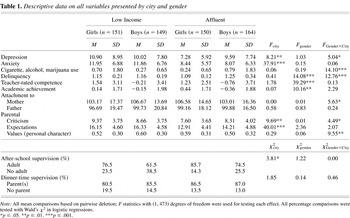
Descriptive data on all variables presented by city and gender
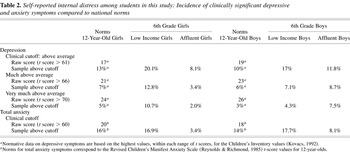
Self-reported internal distress among students in this study: Incidence of clinically significant depressive and anxiety symptoms compared to national norms
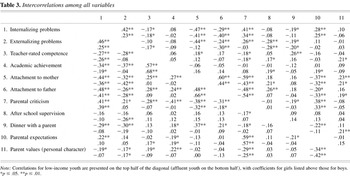
Intercorrelations among all variables
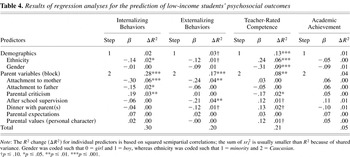
Results of regression analyses for the prediction of low-income students' psychosocial outcomes
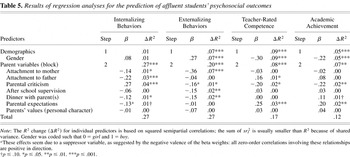
Results of regression analyses for the prediction of affluent students' psychosocial outcomes
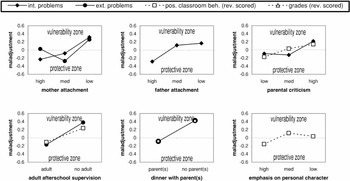
Low-income students' maladjustment outcomes plotted by residual tertiles (for continuous predictors) or dichotomous categories. All outcome scores are expressed in terms of deviations from the mean (zero).
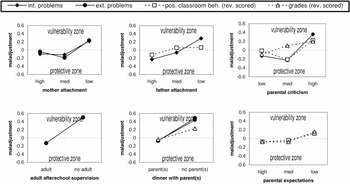
High-income students' maladjustment outcomes plotted by residual tertiles (for continuous predictors) or dichotomous categories. All outcome scores are expressed in terms of deviations from the mean (zero).
 You have
Access
- 44
- Cited by