Introduction
Aerogels are a class of lightweight materials exhibiting high surface area and extremely low thermal conductivity as a result of their open mesoporous structure. They can be formed using a wide array of elements; however, the majority of the reported literature on aerogels focuses on silica or carbon aerogels, but also includes a growing range of polymeric aerogels. Silica aerogels are limited in upper use to nominal temperatures of up to 650–700 °C, at which point they begin to sinter, densify and lose their open pore structure, accompanied by shrinkage and an increase in thermal conductivity. Similarly, polymer aerogels are limited in use temperature by the decomposition temperature of the particular polymer on which they are based. Carbon aerogels, while maintaining an open pore structure to high temperatures, are limited in use to non-oxidizing environments. Many applications require insulation that can be used at higher temperatures, in oxidizing environments and for extended periods of time.
Alumina aerogels are capable of maintaining a mesoporous structure to temperatures well above the upper use temperature of silica. Several studies[Reference Mizushima and Hori1, Reference Kayser, Shter, de Hazan, Cohen and Grader2] have followed the phase transformations in an aluminum sec-butoxide-derived alumina aerogels, reporting a series of transitional aluminas and eventual formation of α-alumina, accompanied by a loss of surface area. The crystalline transformations follow those observed for the thermal decomposition of Boehmite and Bayerite.[Reference Pecharromán, Sobrados, Iglesias, González-Correño and Sanz3] Mizushima and Hori[Reference Mizushima and Hori1] and Horiuchi et al.[Reference Horiuchi, Osaki, Sugiyama, Suzuki and Mori4] have demonstrated that by adding silica to aerogels derived from aluminum sec-butoxide and aluminum tri-isopropoxide respectively, and reacted with tetraethoxyorthosilicate (TEOS), the transformation to α-alumina could be suppressed, enabling mesoporous structures with high specific surface areas to be maintained to temperatures >1300 °C for times of up to 5 h.
Synthesis of aluminosilicates from the reaction of aluminum alkoxides and TEOS incorporates organic groups, which increase shrinkage during heat treatment. The hydrolysis rates for the alumina alkoxides and TEOS also are quite different. Furthermore, alumina gels synthesized using the Yoldas[Reference Yoldas5, Reference Yoldas6] method are extremely weak. These gels typically are considered to form pseudoboehmite, which has a higher proportion of bound water and less long range order than crystalline Boehmite.
Studies by Pierre et al.[Reference Pierre, Elaloui and Pajonk7] have shown that the structure of alumina aerogels depends strongly on the synthesis method and drying conditions, some of which utilize high-temperature supercritical drying. Popa et al.[Reference Popa, Rossignol and Kappenstein8] synthesized pseudoboehmite-silica gels at an Al : Si ratio of 15.6 : 1 using the method of Yoldas[Reference Yoldas6], and dried them by both ambient and supercritical carbon dioxide (CO2) techniques to produce either xerogels or higher surface area aerogels. The authors concluded that there was increased incorporation of silicon into the alumina lattice for the supercritically dried, higher surface area aerogel, and that this silicon incorporation suppressed phase transformation on heating to 1200 °C.
Earlier work in our laboratory[Reference Hurwitz, Gallagher, Olin, Shave, Ittes, Olafson, Fields, Rogers and Guo9, Reference Hurwitz, Guo, Rogers, Sheets, Miller, Newlin, Shave, Palczer and Cox10] has shown that alumina and aluminosilicate aerogels can be prepared from a colloidal dispersion using variety of commercial Boehmite powders, TEOS as the silica source, ethanol as the solvent and supercritical CO2 drying. The Boehmite crystallites are able to assemble into hydrogen-bonded sheet structures.[Reference Brühne, Gottleib, Assmus, Alig and Schmidt11] The pore size distribution, surface area and morphology of the Boehmite-derived aerogels are controlled by the crystallite dimensions of the starting powder, with the smallest crystallite-size powders producing the highest surface area aerogels. We also demonstrated that aluminosilicate aerogels derived from Boehmite can maintain open porosity and high surface areas during short-term exposures to temperatures of at least 1200 °C. The current work focuses on studying the changes in pore size distribution, surface area, and crystal structure with thermal exposure times of up to 96 h at 1100 °C and 48 h at 1200 °C, with the objective of selecting an aerogel capable of maintaining a mesoporous structure and high surface area at those temperatures for moderate to long-term applications. The Boehmite precursor chosen was based on the small crystallite-sized powder, which yields the highest surface area aerogel. An alumina/silica ratio of 3Al : 1Si was chosen as this is close to a mullite composition. Formulations with excess silica or excess alumina would be expected to form cristobalite[Reference Klug, Prochazka and Doremus12] and α-alumina polymorphs, leading to densification and loss of surface area.
Experimental procedure
Synthesis of Boehmite-derived aerogels
Boehmite (AlOOH) powders, designated as P2W, with an average crystallite size of 2.6 ± 0.1 nm, were donated for this study by Sasol North America. Tetraethoxysilane (TEOS) was purchased from Sigma-Aldrich, Inc. Reagent grade nitric acid was purchased from Fisher Scientific.
Alumina and aluminosilicate aerogels were prepared by a method similar to that of Aravind et al.[Reference Aravind, Munkundan, Pillai and Warrier13] at an Al : Si ratio of 3Al : 1Si (25 at.% Si). TEOS was hydrolyzed with a stoichiometric amount of water using a nitric acid catalyst in 200 proof ethanol, and the mixture was vigorously stirred for 60 min. The Boehmite powders were dispersed in water at a ratio of 17.35 mole water per mole (Al + Si), and sonicated using a Misonix 4000 ultrasonic processor with a 419 tip for batch sizes of 15 mL, or a 201 tip for larger batch sizes, for 2 min at 60% amplitude. TEOS was hydrolyzed separately for 60 min in 38 mL of an absolute ethanol solution containing 4 mmol water/mmol TEOS, and 0.625 mL of a 1.2 g nitric acid/100 mL water solution. The TEOS solution was added slowly to the Boehmite dispersion, and stirred for an additional 15 min. The combined sol was poured into polyethylene molds and held at 55 °C for 24 h, following which the hydrogels were extracted into 200 proof ethanol, and then super-critically dried using CO2. An all-alumina aerogel was prepared using the same method for comparison.
Calcining
In initial studies, 19 mm diameter cylindrical monoliths of alumina and aluminosilicate aerogels were placed into high purity alumina boats and heated in a tube furnace under an atmosphere of flowing argon. Temperatures were ramped at a rate of 5 °C/min to final temperatures of 600, 1000, 1100, 1200, or 1300 °C, and held at the temperature for 18 min; samples at each temperature used an as-supercritically dried monolith, so that no sample was heat treated more than once. The furnace was then allowed to cool to room temperature under continued argon flow. Samples of aluminosilicate aerogels underwent heat treatments using the same protocol, but for times up to 96 h at final temperature. A minimum of two samples were calcined for each time/temperature condition.
Characterization
As-supercritically dried and calcined aerogels were characterized by physical measurement to determine shrinkage and physical density. Nitrogen adsorption/desorption was used to determine surface area using the method of Brunauer, Emmett, and Teller (BET). Pore size distribution also was calculated from the desorption data using the method of Barrett, Joyner, and Halenda (BJH). Simultaneous thermogravimetric analysis/differential thermal analysis (DTA) was performed in helium using a Netszch STA 409 instrument at a heating rate of 20 °C/min. Chemical bonding structure of the aerogels was characterized by Fourier transform infrared spectroscopy (FTIR). Aerogel samples were dried overnight in a vacuum oven, then ground with KBr and pressed into pellets for transmission measurements. X-ray diffraction (XRD) was performed using samples crushed with mortar and pestle and mounted in a thin layer with isopropyl alcohol on a low background holder. Data were gathered on a Bruker D8 Advance Diffractometer using Cu Kα radiation. Phase identification was conducted using the Jade 2010 analysis program (Materials Data Inc., v.3.6.5). Crystallite size measurements were performed using the fundamental parameters capability of the TOPAS analysis program (Bruker AXS, v. 5) incorporating Pawley fitting, double-Voight peak shape fitting, and the integral breadth method. Aerogel microstructure was characterized using a Hitachi II Field Emission Scanning Electron Microscope using uncoated samples at accelerating voltages of 1–6 kV.
Results and discussion
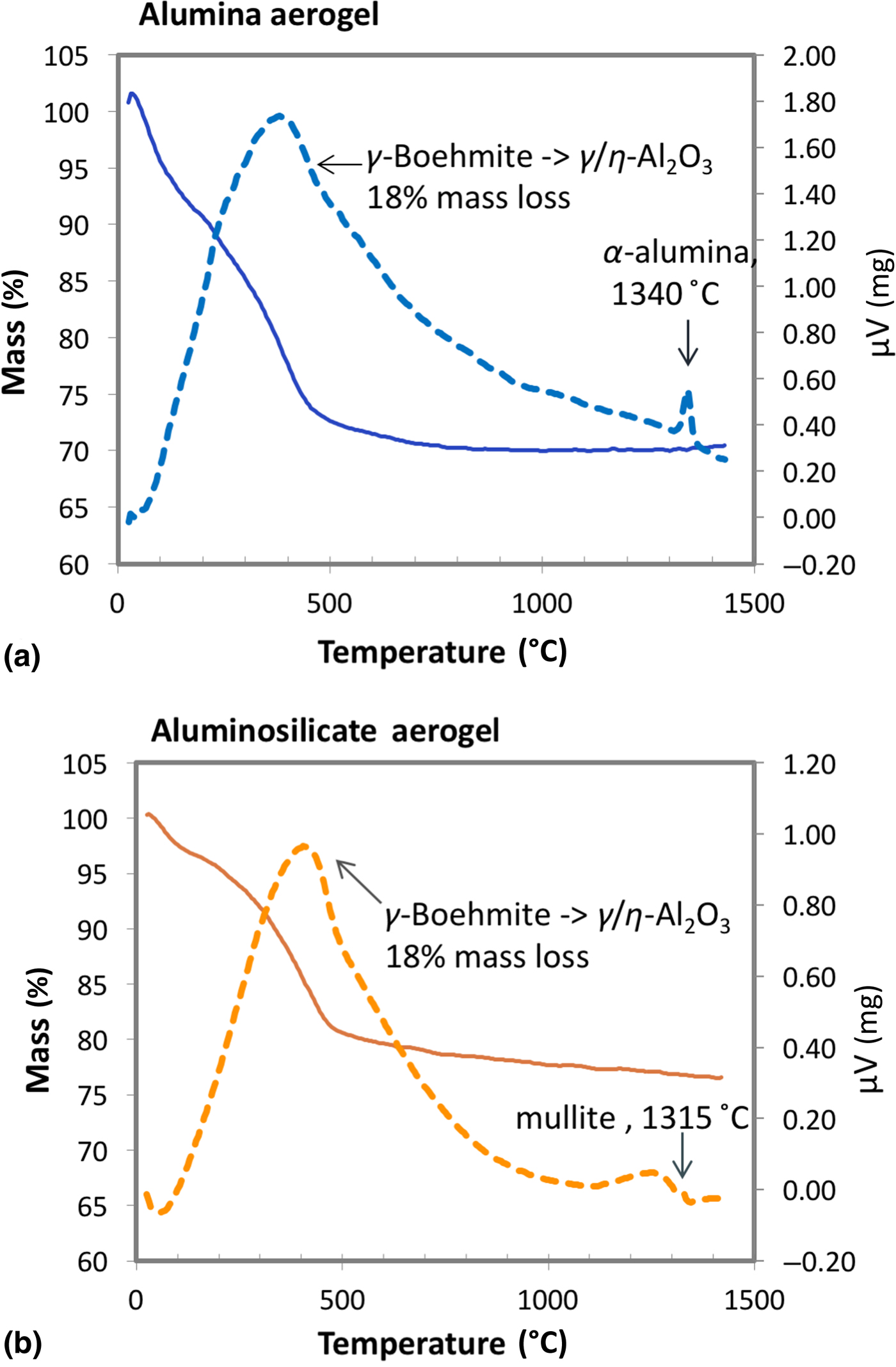
Physical density of the as-dried aerogels ranged from 0.066 to 0.075 g/cm3; surface areas were 424 m2/g for the all-alumina aerogels, and 375 m2/g for the aluminosilicate aerogels. Linear shrinkages on gelation and drying were nominally 6–7%. Both aerogel types exhibited initial mass loss on heating to 150–160 °C (Fig. 1) of nominally 8% in the case of the all alumina aerogel, and 3% for the aluminosilicate aerogel, which is attributed to the loss of alcohol and water accompanying further condensation of –OH and –OCH2CH3 moieties. A second mass loss was observed centered at 400 °C as a result of the loss of water during conversion of γ-AlOOH to γ/η-Al2O3, accounting for an additional 15% mass loss. Above 500 °C there was little additional mass loss in the all-alumina system, and a gradual loss of nominally 3% in the aluminosilicate. The alumina aerogel exhibited a sharp peak in the DTA at 1340 °C, corresponding to the formation of α-alumina. The aluminosilicate aerogel was characterized by a broad hump between 1100 and 1300 °C, followed by a small sharp peak at 1315 °C, which is consistent with the formation of mullite. Phase transformations are discussed in greater detail, below.
TGA/DTA plot for (a) alumina and (b) aluminosilicate aerogels.

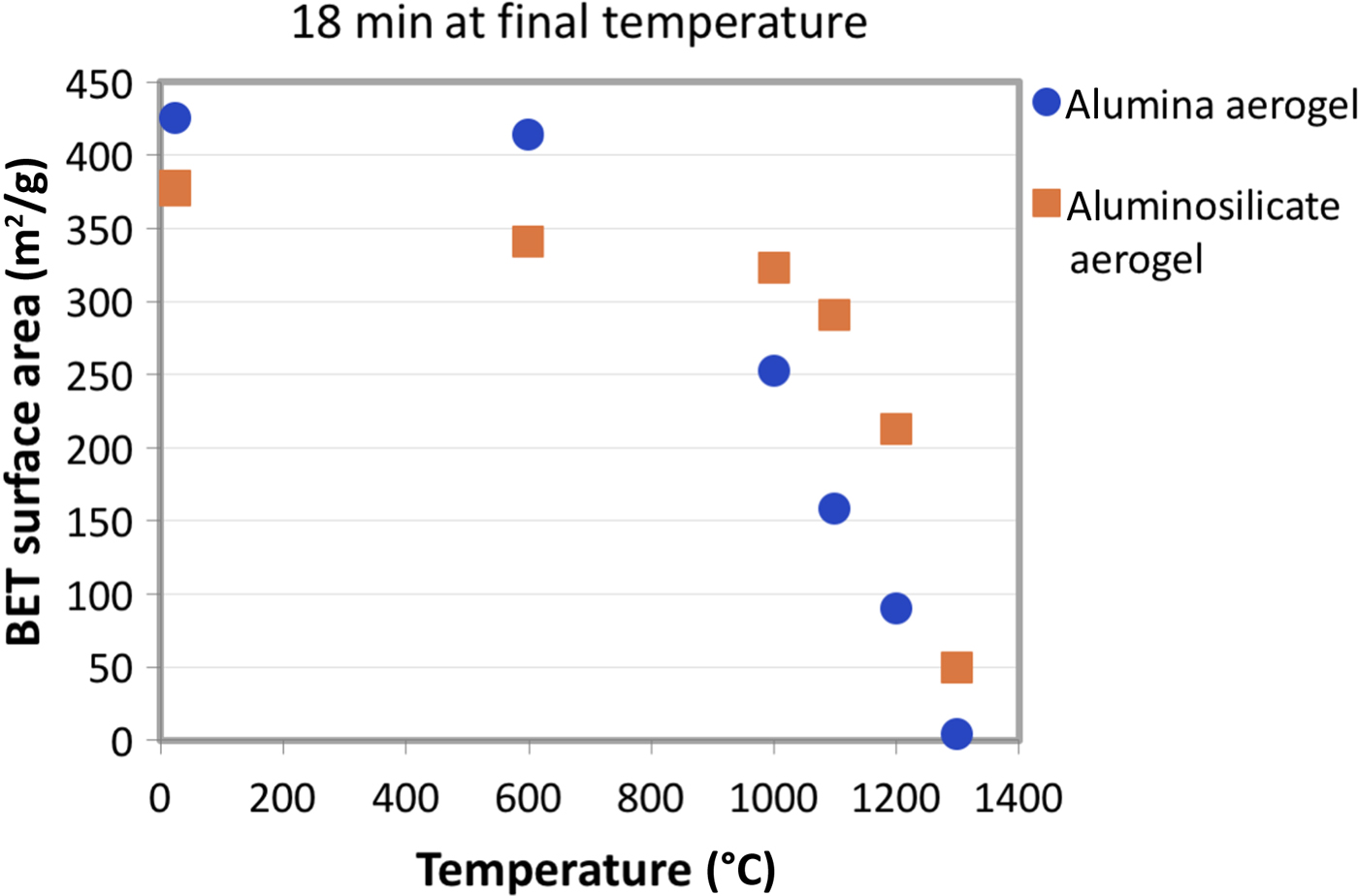
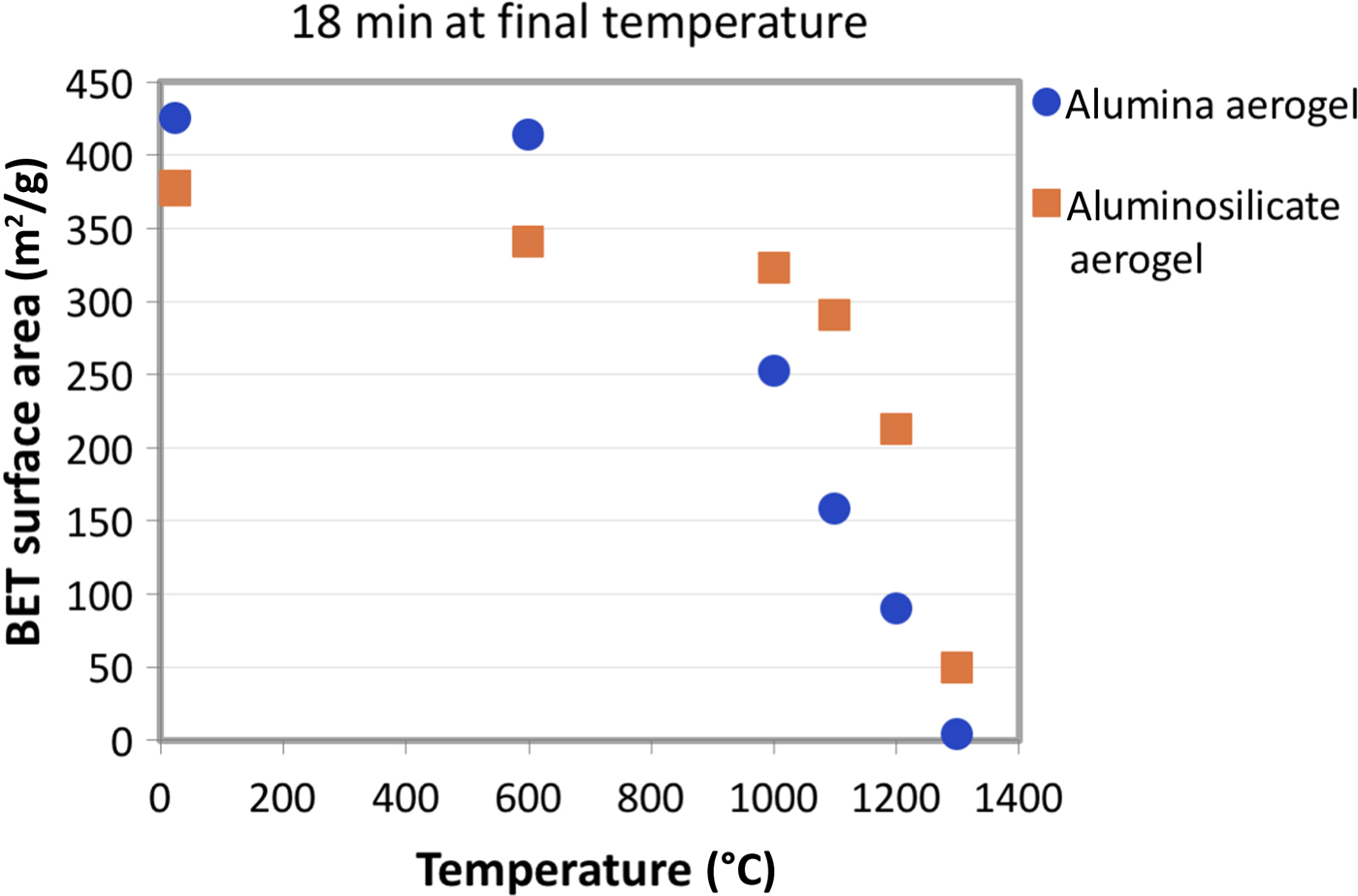
Initial BET surface areas of 425 m2/g were seen for the alumina aerogel, with slightly lower surface area of 379 m2/g for the aluminosilicate aerogel. However, upon calcining for only 18 min at final temperature, the alumina aerogel lost surface area more quickly, with the curves crossing at 1000 °C (Fig. 2).
Change in surface area of alumina and aluminosilicate aerogels with 18 min thermal exposure at final temperature.
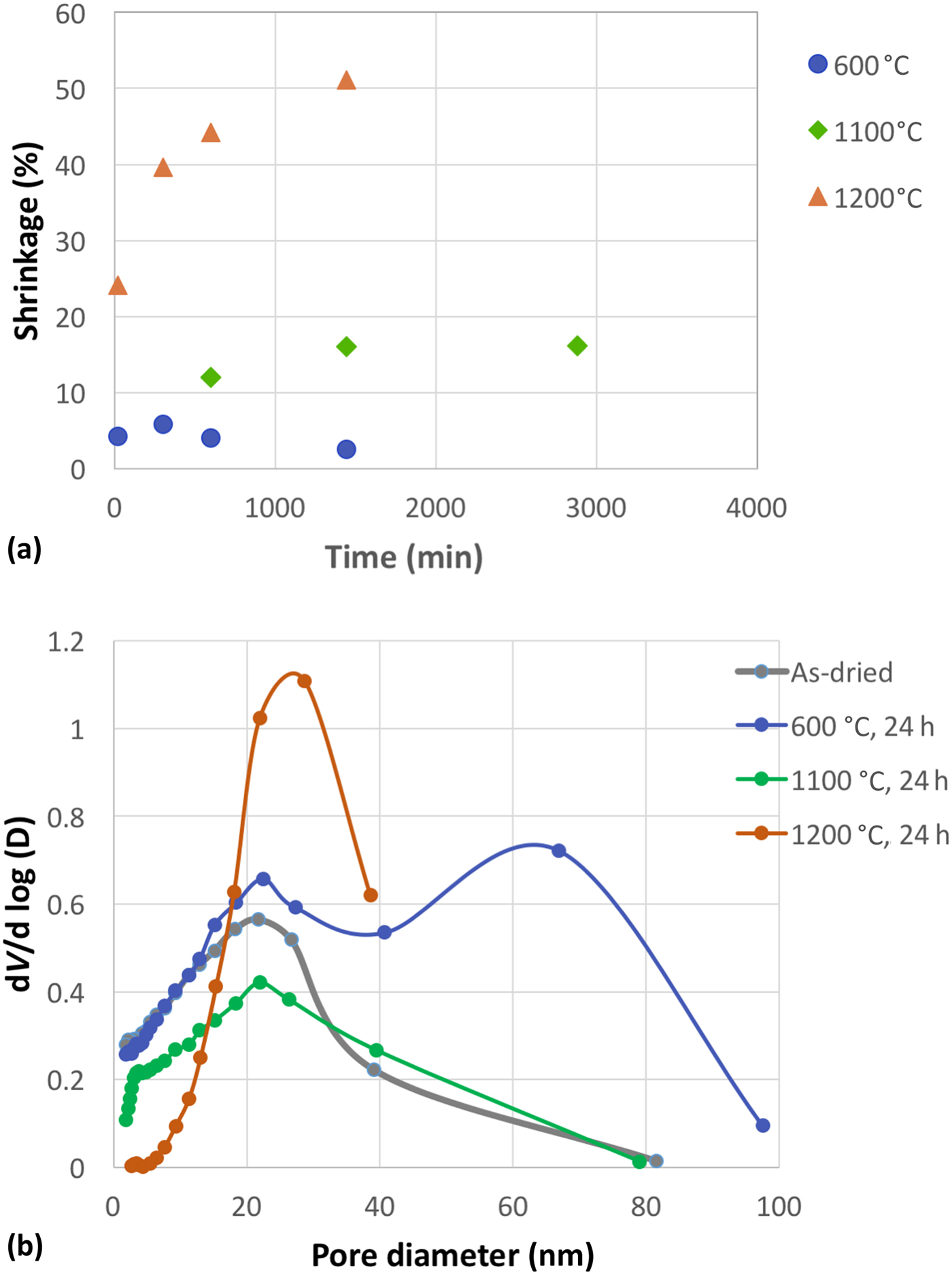
Linear shrinkage was measured by changes in diameter of the cylindrical monoliths with calcining temperature and time [Fig. 3(a)]. Exposure at 600 °C resulted in nominal decreases in gel diameter of 2.5–3.5%, with the trend essentially independent of exposure time. At 1100 °C there was an increase in shrinkage to 24 h, and then a leveling off in the curve at longer exposure times. Significantly greater shrinkages occurred at 1200 °C, with a 50% shrinkage observed after 24 h at that temperature. Increases in density were seen to parallel the shrinkage data.
(a) Linear shrinkage in aluminoslicate aerogel as a function of thermal exposure time and temperature and (b) BJH plots showing pore size distribution variation with thermal exposure.

Changes in physical dimension were accompanied by changes in pore size distribution. The derivative of pore volume with log of pore diameter [Fig. 3(b)] shows a prevalence of pores of 21–22 nm in size in the as-supercritically dried aerogel. On calcining at 600 °C for 24 h, a bimodal pore size distribution is seen, with maxima at 22.5 and 40 nm accompanying the γ-Boehmite to γ/η-alumina transformation. With further shrinkage and phase transformation, the larger pores diminish. However, a substantial pore volume, with the largest pore fraction at 28–29 nm is maintained even after exposure at 1200 °C for 24 h.
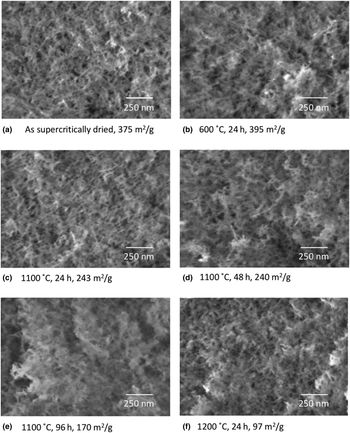
The ability of the aluminosilicate aerogels to maintain a mesoporous microstructure during calcination is confirmed by the images of samples following calcination shown in Fig. 4. There was an increase in surface area after calcining at 600 °C, reflecting the expected conversion of γ-AlOOH to γ-Al2O3. The conversion occurs with the release of water, and creation of some large pores, on the order of 70 nm, as confirmed by analysis of the pore size distribution based on nitrogen desorption. Calcination at 1100 °C was accompanied by a further decrease in surface area to 240 m2/g at 24 and 48 h at final temperature, and further decrease to 170 m2/g at 96 h. Samples calcined at 1200 °C for 24 h still show the presence of small pores. The surface area was just under 100 m2/g, slightly higher than that of 90 m2/g for the all-alumina aerogel exposed for only 18 min at this temperature. A significant decrease in surface area to 4 m2/g is observed after thermal exposure of the alumina aerogel at 1300 °C for 18 min.
Morphology and surface areas of aluminosilicate aerogels as a function of temperature and time.

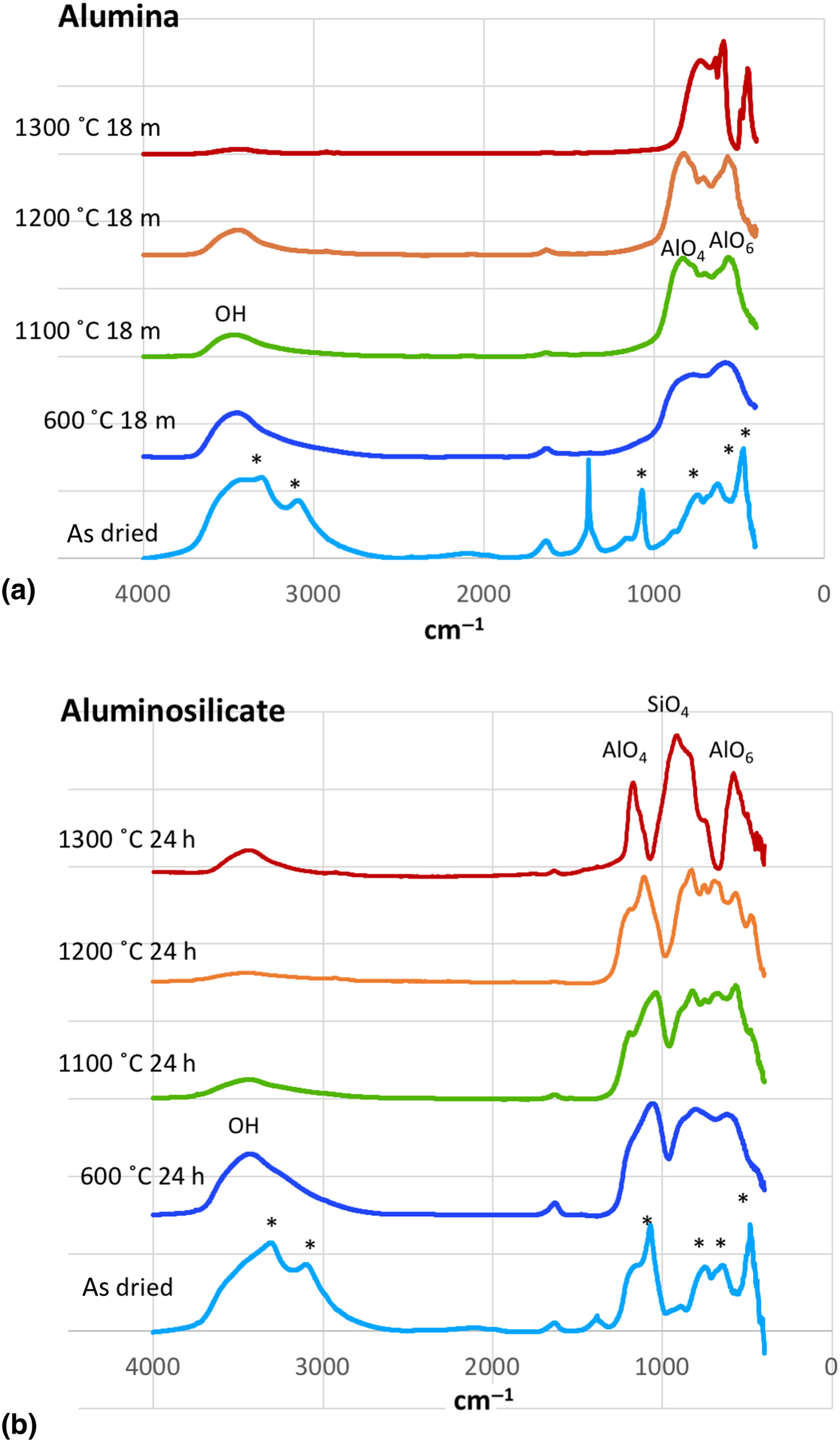
FTIR of the as-dried and calcined samples alumina and aluminosilicate aerogels illustrates the change in the Al–O environment on thermal exposure (Fig. 5). Both as-dried aerogels exhibit peaks at 3296, 3094, 2099, 1641, 1382, 1164, 1074, 757, 632, and 483 cm−1 characteristic of Boehmite,[Reference Chen, Huh and Lee14] and marked by an * in Fig. 5. The first two of these bands are attributed to Al–OH bonds. In spectra of both aerogels there also is broad band at 3430 cm−1 indicating the presence of free –OH. The –OH groups are lost by dehydroxylation as the exposure temperature and time is increased. In the as-dried aluminosilicate aerogel, there is a broad shoulder at 1160 cm−1 due to Si–O moieties, which is absent in the all-alumina aerogel. These sharp peaks are lost in both aerogels on calcining at 600 °C, with the three Boehmite bands below 1000 cm−1 replaced by two very broad peaks at 780 and 563 cm−1.
Infrared spectra of (a) alumina and (b) aluminosilicate aerogels as a function of thermal exposure time. *Indicates Boehmite peaks.

In the alumina aerogel, the spectral changes are observed after very brief (18 min) exposure times at each final temperature. The 780 and 563 cm−1 bands sharpen with exposure at 1100 °C to a peak representative of AlO4 bonding at 823 cm−1 and of AlO6 groups at 528 cm−1[Reference Voll and Beran15–Reference MacKenzie17]; the 823 cm−1 peak shifts to 815 cm−1 at 1200 °C. At 1300 °C AlO6 bands are seen at 723 and 592 cm−1, and an additional AlO6 band appears at 450 cm−1 with transformation to α-alumina, which contains only octahedral alumina.[Reference Boumaza, Favaro, Lédion, Sattonnay, Brubach, Berthet and Huntz18] In the aluminosilicate aerogel, there is also a band at 1110 cm−1 which persists to high temperatures, which could be indicative of the presence of tetrahedral Si–O. There is a shoulder at 1190 cm−1 which may be ascribed to tetrahedral Si–O groups [Reference Sinkó, Mezei, Rohonczy and Fratzl19]; however, the SiO4 and AlO4 frequencies overlap.[Reference MacKenzie17] At 1200 °C there is a splitting and sharpening of the Al–O and Si–O bands between 823 and 470 cm−1, consistent with sharpening of crystalline domains. Peaks are observed at 1200, 1110, 823, 750, 692, 561, and 469 cm−1, with the doublet at 823 and 750, and the band at 561 cm−1 suggestive of the presence of θ-alumina.[Reference Boumaza, Favaro, Lédion, Sattonnay, Brubach, Berthet and Huntz18] At 1300 °C the shoulder at 1190 cm−1 disappears; peaks are observed at 1170 cm−1 (AlO4), 916 cm−1 (SiO4), and 578 cm−1 (AlO6), showing slight shifts from the calculations of these vibrational frequencies by Mackenzie for 3Al2O3·2SiO2 mullite.[Reference MacKenzie17] (The small increase in –OH in the 1300 °C sample is attributed to adsorption after the sample was removed from the furnace.)
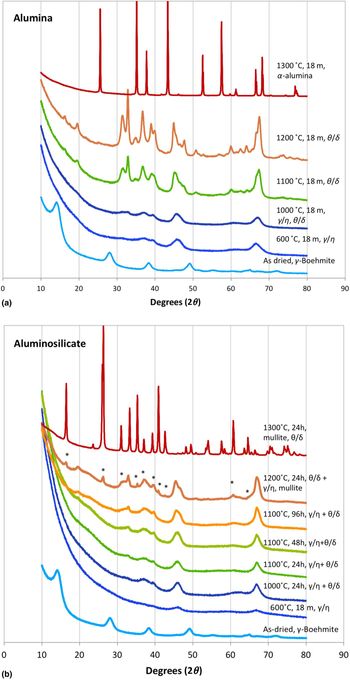
Interpretation of the FTIR spectra is supported by XRD results (Fig. 6). In the alumina aerogel [Fig. 6(a)], the as-dried material shows diffraction peaks characteristic of γ-Boehmite. On heating to 600 °C for 18 min at final temperature, these peaks are lost, and peaks consistent with the formation of γ/η-alumina are observed. Because of the breadth of the peaks, attributable to small crystallite size, the γ and η phases cannot be distinguished from one another. At exposure to 1100 °C, for 18 min, some very small peaks indicative of θ and δ-alumina are evident; these peaks continue to sharpen at 1200 °C. The alumina aerogel transformed to all α-alumina after exposure to 1300 °C for 18 min, explaining the decrease in surface area to 4 m2/g. In the case of the aluminosilicate aerogel [Fig. 6(b)], the as-dried aerogel diffraction pattern again is characteristic of γ-Boehmite only. As in the alumina aerogel, transformation to γ/η-alumina can be seen after 18 min at 600 °C, with sharpening of the pattern after 24 h at 1000 °C. After 24 h at 1100 °C a few small peaks corresponding to the θ/δ phases begin to emerge, but due to the small crystallite size, the two phases are difficult to distinguish from one another. Comparison of the XRD patterns of the aluminosilicate aerogel after exposure at 1100 °C for 24, 48, and 96 h [Fig. 6(b)] with the 1100 °C 18-min pattern for the alumina aerogel [Fig. 6(a)] shows a marked increase in time required for the formation of crystalline peaks with the incorporation of silica. Even at times of 24 and 48 h at 1100 °C the peaks remain broad in comparison with the pattern for the all alumina aerogel, indicative of small crystallite size. The aluminosilicate aerogel begins to transform to mullite on exposure to 1200 °C temperatures for 24 h [Fig. 6(b)], again exhibiting fairly broad x-ray peaks. Crystalline silica peaks are absent. After brief (18 min) thermal exposure at 1300°C the mullite peaks sharpen, but some small peaks corresponding to θ and/or δ alumina still are present. At longer exposures (24 h) the smaller, broader peaks of the transitional aluminas diminish, producing a pattern that is substantially that of mullite. The mean volume-weighted crystallite size for the mullite was 41 nm after the 24-h exposure at 1300 °C in comparison to 82 nm for α-alumina in the alumina aerogel after only 18 min of exposure at the same temperature.
X-ray diffraction pattern showing phase changes in (a) alumina and (b) aluminosilicate aerogel exposed for various times at final temperatures indicated. Mullite peaks are indicated by *.

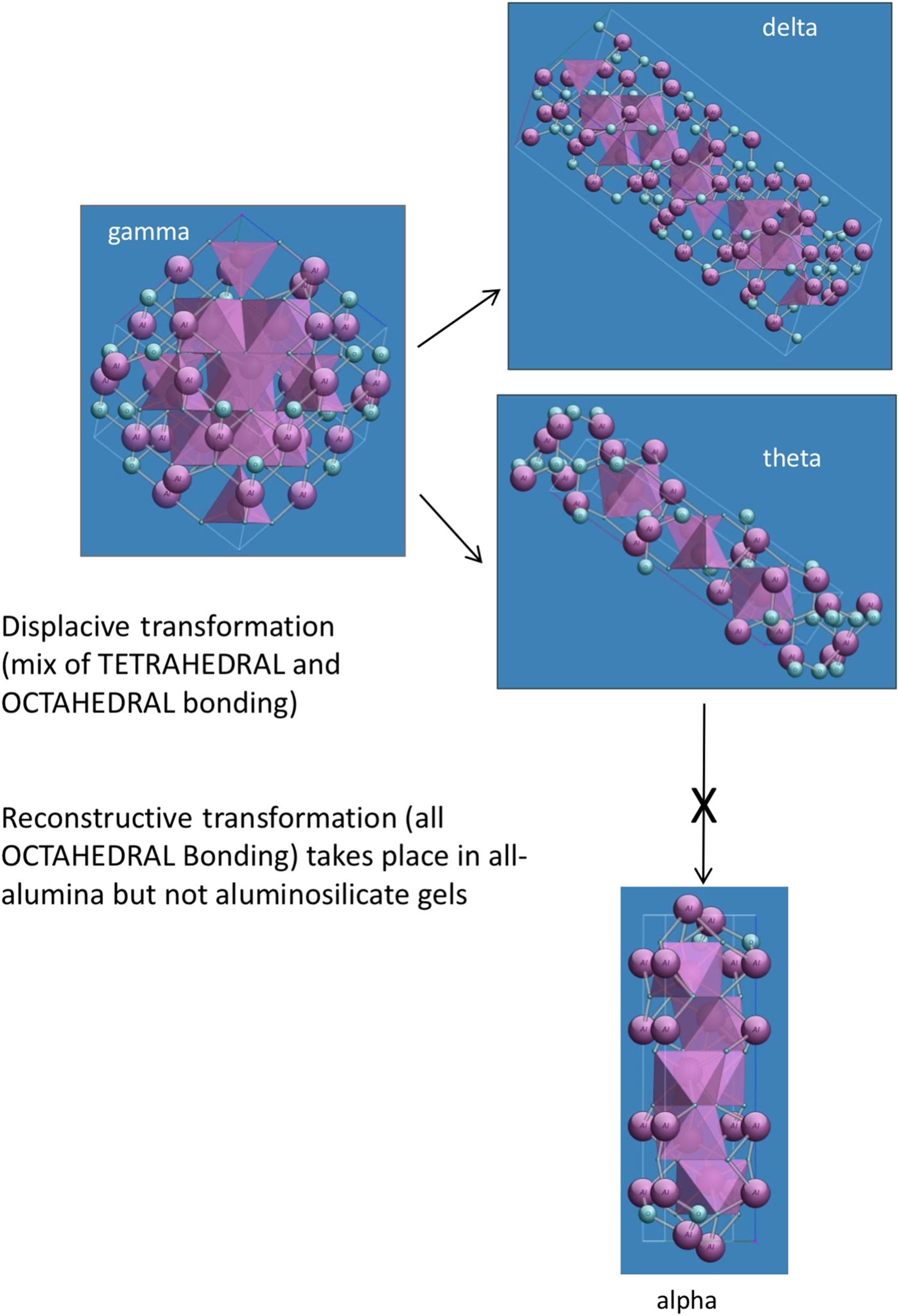
The illustrations of alumina crystalline phases shown in Fig. 7 can be used to explain the observed phase transformations, as well as the accompanying changes in the FTIR and XRD data with thermal treatment. Crystalline Boehmite is comprised predominantly AlO6 units organized into sheet structures.[Reference Brühne, Gottleib, Assmus, Alig and Schmidt11, Reference Krodikis, Raybaud, Gobichon, Rebours, Euzen and Toulhoat20] Conversion of Boehmite to γ-alumina occurs at about 400 °C by condensation, accompanied by loss of about 15 wt% water, disrupting the layered, hydrogen-bonded Boehmite structure to form a crystalline structure containing tetrahedral alumina. Based on nuclear magnetic resonance studies as reported by Krodikis et al.,[Reference Krodikis, Raybaud, Gobichon, Rebours, Euzen and Toulhoat20] the tetrahedral content is estimated at 25–31%. Pecharromán et al.[Reference Pecharromán, Sobrados, Iglesias, González-Correño and Sanz3] have followed the thermal evolution of transitional aluminas from Boehmite using XRD, NMR (nuclear magnetic resonance), and IR spectroscopies. Their work establishes the co-existence of γ, η, and θ aluminas in the 800–1000 °C range, and shows shifts in the ratios of tetrahedral, pentahedral, and octahedral alumina groups over the temperature region of 600–1000 °C, presumably by rearrangements in the crystalline vacancy structure. Similarly, Pakharukova et al.,[Reference Pakharukova, Shalygin, Gerasimov, Tsybulya and Martyanov21] in their study of pseudoboehmite aerogels synthesized from aluminum isopropoxide doped with silicon from TEOS and gelled from base, showed that the incorporation of Si at levels of 10 and 20 at.% inhibited phase transformation and formation of α-alumina due to disruption of plate stacking of the Boehmite crystallites, leading to maintenance of small crystallites sizes even with calcining. These researchers also observed indications of significant crystallite anisotropy, which were not observed in our samples. In the current study which utilizes Boehmite powder as a precursor, the loss of Boehmite and formation of γ-alumina is confirmed by XRD. Formation of δ and θ transitional aluminas through displacement mechanisms preserves of a mix of AlO6 and AlO4 moieties, as seen in Fig. 7, and is consistent with the analysis of the diffraction pattern presented by Krodikis. In the all-alumina aerogel, reconstructive transformation is able to occur to form α-alumina. However, with incorporation of tetrahedral silica groups into the alumina network, which occurs in the aluminosilicate aerogel, the alumina groups adjacent to silica atoms become locked into a tetrahedral structure, effectively blocking the formation of α-alumina and inhibiting both the large shrinkage and densification, which accompany that transformation. The mullite that is formed at 1200 °C is comprised of fairly small crystallites, as evidenced by the breadth of the diffraction peaks.
Schematic representation showing crystalline structures of various alumina phases. Displacive transformation is required for γ to θ or δ transitional aluminas; transformation to stable α-phase requires reconstructive rearrangement, which is blocked by insertion of Si into the alumina lattice.

Summary and conclusions
Aluminosilicate aerogels synthesized from Boehmite powders and TEOS can be produced by an assembly of Boehmite crystallites, with surface area and pore size distribution controlled by the crystallite size of the starting Boehmite powder. Using a small, 2.6 nm crystallite size Boehmite powder, and formulating the Al : Si ratio close to that of mullite (3Al : 1Si), the resulting aerogels can be exposed to temperatures of 1100 and 1200 °C for periods of 24–96 h and still maintain a mesoporous structure. The stability of these aerogels is indicative of their suitability for longer term applications at temperatures exceeding 1000 °C. At this Al : Si ratio no crystalline silica phases are observed in the 1000–1200 °C temperature range. After thermal treatment, the Boehmite-derived aluminosilicate aerogels demonstrate better high surface area retention than the Boehmite-derived aerogels with alumina alone. The aluminoslicate aerogel undergoes successive phase transformations to form γ, η, θ, and δ transition alumina driven by dehydroxylation. Incorporation of tetrahedral silica in the alumina lattice suppresses the rate of transformation to transitional aluminas and to the stable α-alumina phase, instead favoring the formation of small crystallite size mullite at 1200 °C, increasing to predominately mullite at 1300 °C. The reduced rate and extent of phase transformation in the aluminosilicate aerogels lead to decreased shrinkage. Aluminosilicate morphologies with surface areas of 170 m2/g are maintained after exposure times of 96 h at 1100 °C, and 97 m2/g after 24 h at 1200 °C. This represents an improvement in performance as compared with aluminosilicate aerogels doped with 10 wt% silica synthesized from aluminum sec-butoxide,[Reference Horiuchi, Osaki, Sugiyama, Suzuki and Mori4] which maintain surface areas of 120–130 m2/g after exposure at 1100 °C for 5 h and just slightly more than 100 m2/g at 1200 °C for 5 h. Aerogel synthesis of aluminosilicates from Boehmite powders therefore opens a pathway to new high-temperature applications.
Acknowledgment
The authors wish to thank Nathaniel Olson for FTIR spectra.