1. Introduction
A possible outcome of early bilingualism, but by no means the only one, is non-target-like or incomplete acquisition of one of the languages. A given grammar is deemed incomplete when it fails to reach age-appropriate linguistic levels of proficiency as compared with the grammar of monolingual or fluent bilingual speakers of the same age, cognitive development, and social group. Incomplete mastery of a language is typical in adult L2 acquisition, since adult L2 learners frequently do not reach the level of attainment of a native speaker (Bley-Vroman, Reference Bley-Vroman, Gass and Schachter1989; Schachter, Reference Schachter1990; Sorace, Reference Sorace1993; VanPatten, Reference VanPatten2002).Footnote 1 But incomplete acquisition is also possible in L1 acquisition in a dual language environment, especially when exposure to the L1 is reduced in childhood. This situation is very common with child and adult bilingual speakers of ethnic minority languages, also called heritage speakers in the United States and Canada.Footnote 2
Incomplete or interrupted acquisition (Silva-Corvalán, Reference Silva-Corvalán1994, Reference Silva-Corvalán, Montrul and Ordóñez2003; Polinsky, Reference Polinsky1997, Reference Polinsky2006; Montrul, Reference Montrul2002, Reference Montrul, Slabakova, Montrul and Prévost2006) describes an outcome and a process. As an outcome, it is a specific case of language loss that differs from L1 attrition in both the time in life when the language is affected and the extent of the loss. The term attrition implies that a grammatical system had a chance to develop completely (probably into adolescence) and remained stable for a while before some grammatical aspects eroded later on. Incomplete acquisition, on the other hand, is the result of attrition or incomplete acquisition in childhood most likely due to insufficient input to maintain or develop (depending on the specific grammatical area) the full L1 system. Although attrition in childhood and incomplete acquisition are not mutually exclusive, it is difficult, if not impossible, to differentiate one from the other without longitudinal data. Two exemplary studies of Spanish-speaking bilingual children living in the United States documenting these two processes longitudinally are Anderson (Reference Anderson1999) and Silva-Corvalán (Reference Silva-Corvalán, Montrul and Ordóñez2003). For simplicity and lack of a better term, we use the term incomplete acquisition to refer to both incomplete acquisition and attrition in childhood, while we reserve the term attrition for attrition in adulthood. While language attrition in adults appears to affect lexical retrieval (Hulsen, Reference Hulsen2000), phonetics (Major, Reference Major, Hyltenstam and Viberg1993), and some superficial discourse-related aspects of language (Sorace, Reference Sorace2000), the outcome of incomplete acquisition appears to have deeper consequences in adulthood, affecting both core and non-core aspects of grammatical competence depending on age of onset of bilingualism (Montrul, Reference Montrul2008).
Since heritage language acquisition is a case of early bilingualism, it shares features with both child L1 acquisition and adult L2 acquisition. Like child L1 learners, heritage speakers are early bilinguals (simultaneous or sequential) exposed to the family language at home since birth in a naturalistic setting. Unlike in monolingual acquisition but in common with L2 acquisition, input in the family language is variable, at least in quantity. Whether it is also variable in quality in this population has not yet been empirically verified. Depending on the specific family composition, the linguistic and educational background of the members of the family, time of immigration, and other sociolinguistic circumstances, the majority language (the L2) is either introduced together with the L1 or soon thereafter (simultaneous bilingualism), or in the pre-school and school years (sequential bilingualism or child L2 acquisition). In the United States, heritage language children are typically schooled in English, and because immigrant families feel strong pressure to assimilate to the mainstream culture, they gradually begin to use the heritage language less at home, resulting in language shift.
With language shift, patterns of language use within and outside the family gradually change. As a result, input and use of the family language may become severely reduced, eventually affecting the children's command of the family language. Without adequate academic support of the heritage language during the school years, many heritage speakers miss the chance to acquire academic literacy skills in the language. By the time these children reach adolescence and young adulthood, their heritage language resembles a second language, especially in morphosyntax, in the sense that it has not reached the full ultimate attainment of a first language acquired in childhood. In general, many (but by no means all) adult heritage speakers possess good oral comprehension abilities, may speak the language quite fluently and with native-like levels of pronunciation, and are familiar with the cultural norms of the language and culture. What is less clear is which aspects of their syntax and morphology are fully acquired and which remain undeveloped into adulthood.
Recent studies of adult Spanish and Russian heritage speakers have documented incomplete acquisition of inflectional morphology and syntax, including gender agreement in nouns (Polinsky, Reference Polinsky2006; Montrul, Foote and Perpiñán, Reference Montrul2008), tense, aspect and mood (Silva-Corvalán, Reference Silva-Corvalán1994; Polinksy, Reference Polinsky1997, Reference Polinsky2006; Lynch, Reference Lynch1999; Montrul, Reference Montrul2002, Reference Montrul, Potowski and Cameron2007; Pereltsvaig, Reference Pereltsvaig, Slabakova and Kempchinski2005), and null subject pronouns (Silva-Corvalán, Reference Silva-Corvalán1994; Polinsky, Reference Polinsky1997, Reference Polinsky2006; Montrul, Reference Montrul2004a, Reference Montrul, Slabakova, Montrul and Prévost2006). However, just as fossilization in adult L2 acquisition does not affect linguistic competence globally, incomplete L1 acquisition in heritage speakers is also selective and localized. That is, some areas of grammatical knowledge appear to be more susceptible to incomplete development than others. Take object expression, for example. Both Silva-Corvalán (Reference Silva-Corvalán1994) and Montrul (Reference Montrul2004a) have shown that Spanish heritage speakers possess robust control of accusative and dative object clitics. However, Zapata, Sánchez and Toribio (Reference Zapata, Sánchez and Toribio2005) have shown that Spanish heritage speakers have problems with other aspects of object expression, such as semantic constraints on topicalizations or clitic left dislocations, while Montrul (Reference Montrul2004a) found omission of Differential Object Marking (DOM; the marking of animate and specific direct objects with the preposition a) and avoidance of structures with inherent dative case, such as inalienable possession.
Findings such as these raise the following questions: Which specific aspects of the grammar are possibly affected under incomplete acquisition due to reduced input in childhood in some systematic way? What form does incomplete acquisition take? and What language-internal and external factors contribute to the vulnerability of particular grammatical areas? The purpose of this study is to assess the extent of incomplete acquisition of features of object expression in Spanish heritage speakers, with particular emphasis on Differential Object Marking. Results of two experiments will show that while heritage speakers possess solid knowledge of core functional projections for indirect objects, inherent case marking in Differential Object Marking and in psych verbs is affected and prone to erosion under incomplete acquisition.
2. Differential Object Marking
Spanish has structural accusative and dative case, as evident from the pronominal clitic system. Indirect objects are marked with the dative preposition a, and optionally doubled by a dative clitic, as in (1).Footnote 3
(1)

“Roberto gave Patricia a ring.”

Like many languages with overt case markers, such as Hindi and Yiddish, Spanish also marks some direct objects with the preposition a but not others. For Aissen (Reference Aissen2003), it is objects which must be distinguished from subjects on semantic and pragmatic prominence scales that typically get overtly case-marked (see also Weissenreider, Reference Weissenrieder1985, Reference Weissenrieder1990, Reference Weissenrieder1991; Dumitrescu, Reference Dumitrescu1997; and Laca, Reference Laca, Wesch, Weidenbusch, Kailuweit and Laca2002, Reference Laca and Company2006 for Spanish). Example (2) shows that animate and specific direct objects are marked with the dative preposition a, although Leonetti (Reference Leonetti2004) asserts that animacy more than specificity is the dominant trigger for DOM in Spanish.Footnote 4
(2)
“Marina looks for the woman.”
Dative marking of these direct objects is an instance of DOM (Torrego, Reference Torrego1998; Aissen, Reference Aissen2003; Leonetti, Reference Leonetti2004; Lidz, Reference Lidz2006). All other direct objects (animate, non-specific, as in (3); inanimate, specific, as in (4), and inanimate, non-specific, as in (5)) receive no marking.
(3)
“Marina looks for a woman (any woman).”
(4)
“Marina looks for the house.”
(5)
“Marina looks for a house.”
There seems to be a relationship between clitic doubling and the presence of DOM. In general, in Spanish varieties in which clitic doubling is also grammatical with direct objects (e.g., Spanish from Argentina), accusative clitic doubling is typically acceptable with animate, specific direct objects, as in (6), but not with inanimate objects (but see Suñer, Reference Suñer1988, for some examples with specific inanimates), as shown in (7).
(6)
“I saw Juan.”
(7)
“I saw a/that movie yesterday.”
However, there are several counterexamples to the generalization that only specific and animate objects are marked with the preposition a in Spanish. First, nonspecific negative quantifiers like nadie “nobody” always require a (No vi a nadie “I didn't see anybody”). Second, inanimate objects can be marked with the preposition a if the subject is also inanimate (La calma precede a la tormenta “The calm precedes the storm”). Third, with animal direct objects, use of the preposition a is optional (Mató el /al mosquito “He/she killed the mosquito”). Based on a crosslinguistic comparative study, Aissen (Reference Aissen2003) notes that in many languages DOM is characterized by a great deal of apparent fuzziness, and Spanish DOM is no exception to this observation. The exact semantic, syntactic and pragmatic conditions regulating when accusative objects should be marked with the dative preposition a are quite complex and not entirely clear in the linguistics literature (Torrego, Reference Torrego1998; Zagona, Reference Zagona2002; Leonetti, Reference Leonetti2004). According to Torrego (Reference Torrego1998), definiteness, specificity, aspect, topicality, agentivity, and affectedness, in addition to other pragmatic notions, determine when objects are marked in Spanish.
Torrego (Reference Torrego1998) analyzes the dative preposition a in these cases as an instance of marked accusative case, inherent case to be more precise, encoded in a functional category specific to Spanish, and different from the functional category for accusative clitics. Consider the clause structure in (8) for transitive verbs. It is in the specifier of vP (base subject position) where subjects typically originate before moving to TP in the higher functional layer.
(8)
While unmarked objects may be assumed to receive accusative case inside the VP in the direct object position, DOM objects move outside the VP in the overt syntax. Torrego follows Ura (Reference Ura1996) in assuming that a head can have multiple specifiers. In Torrego's analysis, v has a D-feature that can attract the object to raise overtly. Once the object is raised, its case feature is licensed in a specifier position of v (to which V has already adjoined). If only objects that are semantically similar to subjects are marked in Spanish (Aissen, Reference Aissen2003), Torrego's analysis captures this observation, because marked accusative objects check their features in a subject-like position, probably below the specifier position for the agentive subject in these constructions. Torrego further proposes that the dative preposition in DOM contributes its own D-feature and can be analyzed as an additional functional category (Torrego, Reference Torrego1998, p. 25). Thus, while unmarked direct objects have structural accusative case, marked direct objects have inherent case in addition to the structural one. In another account of Spanish, Rodríguez-Mondoñedo (Reference Rodríguez-Mondoñedo2007) proposes that animate specific nominals move through [Spec, vP] to an additional head with Dative Case where the preposition a checks its features. A similar additional, non-core functional category is assumed by Lidz (Reference Lidz2006) for Kannada, a South Asian language that also has DOM. This additional functional projection is not part of the functional projection of the object DP: rather, it is introduced by the DOM marker vannu/yannu in Kannada, so that the case features can be morphologically realized. In attempting to capture the facts of DOM in structural terms, what all these accounts have in common is that marked objects are placed in a structural position higher than the basic position for unmarked objects by means of object raising or some similar formal device.
Torrego (Reference Torrego1998) also claims that Spanish DOM shares structural and semantic properties with the English double object construction.Footnote 5 In both constructions, overt morphophonological features of v attract the object to move overtly to one of its specifiers. A common trigger for movement in the two structures appears to be animacy. In the double object construction, the innermost DP – the intended possessor of the outer DP – must be animate. Animacy, for example, would explain the difference in acceptability between John sent Martha flowers vs. *John sent the desk flowers.Footnote 6 Other common characteristics of the English double object construction and Spanish DOM are the event structure of the verb and the thematic role of the subject. In both cases, the predicates are causatives and the subject bears the role of agent-causer. Finally, the objects of the double object construction and of DOM are semantically “affected”. The structure for the English double object construction proposed by Torrego (Reference Torrego1998) is shown in (9), where p – the head of pP – is null.
(9)
But how does the dative case marking in DOM differ from other instances of dative case in Spanish, such as ditransitive predicates and gustar-type psych verbs with dative experiencers? In Spanish indirect object constructions, the preposition is also obligatory and clitic doubling is optional, regardless of the animacy of the indirect object, as shown in (10).
(10)
“Juan sent money to his mother/to the schol.”
Although v plays a crucial role in checking the inherent case features of marked accusative objects, V is the head that has structural case. But in dative constructions, there is a functional head p headed by the dative preposition (analogous to another v), and the dative clitic in Spanish occupies the specifier of p. In Torrego's (1998) proposal, structural case features of datives can be checked by v or by the dative clitic in p′ when present. Torrego's analysis for Spanish is shown in (11).
(11)
Finally, the preposition a is also obligatory with dative experiencers in gustar-type psych verbs, regardless of animacy of the theme or experiencer, as in (12) and (13).
(12)
“Juan likes ice cream.”
(13)
“The government likes citizens to pay their taxes.”
Since these verbs are unaccusative, they do not project a vP above VP. The dative functional category appears in the specifier of VP, as shown in (14). The two arguments of the verb are within the VP, with the experiencer higher than the theme.
(14)
Thus, indirect objects have structural dative case; experiencers of psych-verbs have inherent dative case checked solely within pP; and DOM objects have both structural and inherent case.
To summarize, the distribution and precise application of DOM presents a certain degree of fuzziness within and across languages, according to Aissen (Reference Aissen2003), and for this reason she claims that principles underlying DOM are not part of the core grammar. Other current analyses within generative grammar (Torrego, Reference Torrego1998; Lidz, Reference Lidz2006; Rodríguez-Mondoñedo, Reference Rodríguez-Mondoñedo2007) also posit additional structure for these constructions, and suggest that object marking is a form of inherent case. Given the semantic complexity and ambiguity with respect to its use, how is Differential Object Marking acquired in Spanish? This certainly presents a poverty of stimulus problem for its acquisition since there is significant variability in this system, and learners need to figure out how to extract the precise syntactic, semantic and pragmatic constraints that regulate DOM. Furthermore, learners have to acquire the structural differences between the dative preposition in DOM and the dative preposition in other contexts, such as in indirect object constructions and dative experiencer constructions.
3. Acquisition of Spanish DOM
There is virtually no research on the L1 acquisition of DOM, with the exception of a recent study by Rodríguez-Mondoñedo (Reference Rodríguez-Mondoñedo2008). Rodríguez-Mondoñedo conducted an analysis of the spontaneous production of four Spanish-speaking children (between the ages of 0;9 and 2;11) from the CHILDES database (López Ornat, Linaza, Montes, and Vila corpora). Three of the children were monolingual and one was Catalan–Spanish bilingual. All sentences containing V(erb)–O(bject) structures were analyzed. From a total of 991 examplars, the children made a total of 17 errors (8 cases of a present but not required, and 9 cases of a omitted when required with animate, specific objects). This amounts to a 98.38% accuracy rate with the unambiguous cases of DOM before age 3. The child who made the most errors (3 out of 4 objects requiring a had no marking) was the bilingual child (Catalan only has DOM with personal pronouns but not with NPs).Footnote 7 Therefore, this case study suggests that monolingually-raised Spanish-speaking children acquire the semantic constraints on the distribution of this preposition with animate and specific direct objects quickly and converge on the adult grammar with these core cases. It is an open question when monolingual children master the optional and semantically fuzzy uses of DOM discussed in the syntax literature. The limited data from the bilingual child suggest that the object marker might not be completely acquired by this early age, at least in production. To the best of our knowledge, no comprehension or experimental data on object marking in child Spanish are available.
The situation for L2 acquisition is strikingly different, however. Since English does not mark animate objects overtly with morphology, DOM is difficult for English-speaking learners of L2 Spanish to acquire despite its frequency in the L2 input (VanPatten and Cadierno, Reference VanPatten and Cadierno1993; Johnston, Reference Johnston1995; Farley and McCollam, Reference Farley and McCollam2004; Guijarro-Fuentes and Marinis, Reference Guijarro-Fuentes and Marinis2007; Bowles and Montrul, Reference Bowles, Montrul, Leow, Campos and Lardiere2009). Perhaps this difficulty is partially due to the polyfunctionality of the dative preposition a, which also appears with ditransitive verbs that take indirect objects (Juan le dio un libro a Pedro “Juan gave a book to Pedro”), and with gustar-type psych verbs (A Juan le gusta este libro “Juan likes this book”).
If core cases of DOM are early acquired in monolingual acquisition and apparently present virtually no difficulties for three-year old children, one would expect early bilinguals to be as successful in acquiring the clear cases of DOM as well. Although to our knowledge there are no available published data from simultaneous bilingual children on this issue (but see footnote 7), research on adult early bilinguals suggests otherwise. Both Luján and Parodi (Reference Luján, Parodi, Gutiérrez-Rexach and Silva Villar1996) and Silva-Corvalán (Reference Silva-Corvalán1994) observed that Spanish–English bilinguals from Los Angeles had robust control of the accusative and dative clitic system, but omitted the dative preposition a with animate, human direct objects in clitic doubling constructions (*Lo veo la niña “him/it I.see the girl”). These findings were further confirmed by Montrul (Reference Montrul2004a), who also found that intermediate and advanced adult Spanish heritage speakers possessed solid knowledge of accusative and dative clitics and their placement with respect to the finiteness of the verb, behaving entirely like a monolingual native speaker control group in this respect. However, unlike the monolingual native speakers, the Spanish heritage speakers omitted dative a-marking on animate direct objects in oral production (advanced Mean = 6%, intermediate Mean = 21.3%). This suggests that DOM in these speakers was either incompletely acquired in childhood or was acquired and subsequently lost some time later due to contact with English.
4. The study
The scant empirical evidence we have to date suggests that DOM is vulnerable to attrition and/or incomplete acquisition in Spanish heritage speakers immersed in an English-speaking environment. The purpose of our study is to investigate further the extent of incomplete acquisition of DOM in heritage speakers as compared to monolingual speakers. All the studies cited above, namely Silva-Corvalán (Reference Silva-Corvalán1994), Luján and Parodi (Reference Luján, Parodi, Gutiérrez-Rexach and Silva Villar1996), and Montrul (Reference Montrul2004a), report omission of DOM in oral production. If loss of DOM affects linguistic competence more deeply, and heritage speakers do not mark these raised objects morphologically, one would expect Spanish heritage speakers to have difficulty with DOM in comprehension and acceptability judgment tasks as well, especially in core, clear cases. And if DOM affects linguistic competence, is the omission of the preposition restricted to just DOM environments or does it extend to other instances of inherent dative case marking such as dative experiencers in gustar-type psych verbs? Since a study by Toribio and Nye (Reference Toribio, Nye, Montreuil and Nishida2006) found that Spanish heritage speakers omitted the dative preposition with these psych verbs, it is important to find out whether these two phenomena are related in the grammars of heritage speakers. These research questions have been addressed in two experiments.
4.1 Experiment 1
The purpose of Experiment 1 was to expand the findings of Montrul (Reference Montrul2004a) by examining instances of DOM with animate objects in both production and in an acceptability judgment task. Furthermore, while Montrul tested intermediate and advanced proficiency speakers, this experiment also included low proficiency speakers, classified on the basis of a written proficiency test which we describe below. The basic questions motivating this experiment were 1) Do heritage speakers mark animate and specific direct objects with the dative preposition a in production like monolingual native speakers do, and 2) do they know that the preposition is obligatory with animate and specific direct objects?
4.1.1 Participants
The results of Experiment 1 are part of a larger research project investigating differences and similarities between L2 learners and heritage speakers in different grammatical areas of Spanish (vocabulary, phonology, syntax, morphology).Footnote 8 A total of 67 Spanish heritage speakers and 22 monolingually-raised native speakers of Spanish completed a linguistic background questionnaire and a short written Spanish proficiency test. Because heritage speakers are such a heterogeneous group, we established a set of criteria to minimize diversity. Specifically, in order to be included in the experiment, all the heritage speakers had to be of Mexican descent because this is the largest Spanish-speaking group represented in the geographical area where the testing took place. At least one of the parents had to be a first-generation immigrant, native speaker of Spanish. Furthermore, all heritage speakers had to be born and schooled in the United States, and had to have been exposed to English before the age of six (pre-school). We specifically excluded heritage speakers who might have immigrated in childhood and might have received schooling in their country of origin. Studies have shown that bilingual individuals with this profile have better command of Spanish than simultaneous or near-simultaneous bilinguals, who in turn are more similar to L2 learners (see Montrul, Reference Montrul2002, and footnote 7). All were undergraduate or graduate students at a major public research university in the United States and either were taking or had taken Spanish language classes at some point, ranging from 3rd semester (low intermediate) to advanced language and literature classes. Their mean age at the time of testing was 21.57, with a range of 18–30.
Half of the heritage speakers reported that Spanish was their mother tongue (i.e., native language or first language learned and spoken at home), 35% reported English, and the remaining 8% reported both languages. As for language used at home in childhood, 56% reported use of both Spanish and English, and 44% reported only Spanish. Eighty-eight percent of the participants reported that both parents were from Mexico; for the other 12% one parent was from Mexico and one was born in the US. Eighty percent of the parents spoke Spanish with the participants at home, 5% used English, and 15% used both languages. However, 66% of the participants spoke Spanish with parents, 16% spoke English when spoken to in Spanish, and the rest spoke both languages. All of the heritage speakers had between one and nine siblings, and 14 of them (20%) lived with a Spanish-speaking grandparent. Only 20% of the participants spoke Spanish with their siblings, 42% spoke only English, and 38% spoke both languages. As for their self-perceived ability in Spanish, 48% felt that Spanish was their first and native language, and 52% considered Spanish their second language.
The native speaker comparison group consisted of native speakers from Spain, Argentina and Mexico (mean age 29.82, range 21–57, with high-school and some university education). Half of the subjects in this group were tested abroad in their countries of origin whereas the rest were tested in the United States (length of residence ranging from six months to two years). All native speakers performed as expected close to ceiling (i.e., above 90% accuracy) on the proficiency measures and on the experimental tasks, and there were no differences between speakers of different regional varieties (Argentina, Spain, Mexico).
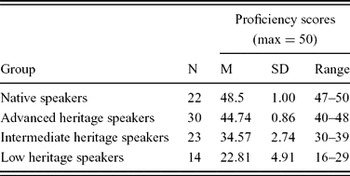
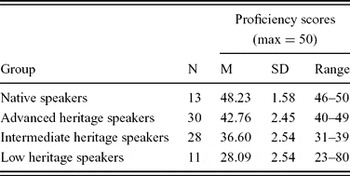
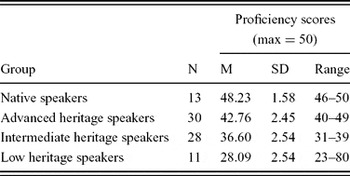
All subjects, including the native speaker comparison group, took a short written Spanish proficiency test (vocabulary and cloze parts of DELE test), the same test used in several other studies of L2 learners and heritage speakers (White, Valenzuela, Kozlowska-Macgregor and Leung, Reference White, Valenzuela, Kozlowska-Macgregor and Leung2004; Montrul, Reference Montrul2004a, Reference Montrul2005), and we used the same procedure for comparability. The maximum score on this test was 50. All the native speakers scored above 90% (M = 48.5), while the heritage speakers combined scored around 70% accuracy (M = 36.88, SD = 8.17, range 16–48). Table 1 presents the scores by proficiency levels. Reliability statistics, computed using Cronbach's alpha, were found to be high (r = .84) for the heritage speakers.
Sample size and mean scores in the Spanish proficiency test for participants in Experiment 1.

4.1.2 Tasks
The first task was a written acceptability judgment task. It included a total of 90 sentences (45 grammatical, 45 ungrammatical), divided into 18 sentence types with five tokens per type. The main goal of this task was to test knowledge of object clitics in general, including position of clitics with respect to finiteness of the verb, clitic doubling, clitic climbing and clitic left dislocations. Complete results for these sentence types, which showed no differences between the heritage speakers and the native speakers, are discussed in detail in Montrul (in press). Among the filler items, the test also included ungrammatical DOM sentences with animate, specific direct objects and no a-marking, as in (15), and double object constructions, also ungrammatical in Spanish, as in (16). Results for these two sentence types were not discussed in Montrul (in press).
(15)
“Patricia knows my sister.”
DOM animate object (no a)(16)
“Marisa gave Pedro a present.”
double object construction
The acceptability judgment task was presented via a web-interface and conducted in the presence of a research assistant. Sentences were randomized and presented with a five-point acceptability scale underneath. Participants were tested individually and asked to rate each sentence on the scale, assigning the following values: 1 = completely unacceptable, 2 = acceptable in rare contexts, 3 = I can't tell, 4 = acceptable in many contexts, 5 = perfectly acceptable. Although the task was untimed, participants were asked to respond as intuitively as possible and not to go back to compare answers. Completion time for this task was between 15 and 20 minutes.
The second elicitation instrument was an oral production task, the same narrative as the one used in Montrul's (Reference Montrul2004a) study of object expression in Spanish heritage speakers. This narrative successfully elicits a variety of verbs, objects and pronouns. Furthermore, using the same narrative allows us to both replicate and expand the results found in Montrul. The procedure was as follows. Participants sat with a research assistant in a quiet room and were told that they would see 14 color pictures narrating a famous children's story presented in a PowerPoint presentation. They were instructed to describe the story of Little Red Riding Hood in the past tense in as much detail as possible, based on the sequence of pictures they saw. Each participant's oral narrative was recorded and subsequently transcribed.
4.1.3 Results
For the acceptability judgment task, numerical scores for DOM and double object constructions were first submitted to one-way ANOVAs.Footnote 9 To see whether potential problems with DOM persist in advanced-level speakers, the heritage speaker group was split into three proficiency levels based on the scores of the proficiency test: 14 low proficiency (scores range 16–29), 25 intermediate (range 30–39) and 30 advanced (range 40–50). Because group sizes were unequal, when the data distribution violated homogeneity of variance, we used an alternative version of the F-ratios (Brown-Forsythe F), and the Games-Howell test for planned contrasts to correct degrees of freedom. Additionally, we ran the nonparametric Kruskal-Wallis test for the group comparisons and the Mann-Whitney test for the post-hoc analyses. Since the patterns of significance were the same, we opted for ANOVAs with corrections throughout because parametric tests are believed to have more power than nonparametric tests. (The same procedure was applied in Experiment 2.)Footnote 10
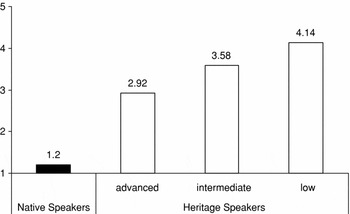
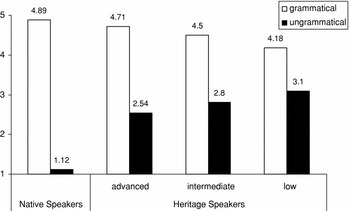
Figure 1 displays the mean acceptability ratings on ungrammatical DOM sentences with specific direct objects (e.g., *Juan conoce María “Juan knows Maria”) and clearly shows that the heritage speakers, unlike the native speaker comparison group, considered these sentences to be grammatical (see Table A in Appendix A for means and standard deviations). A one-way ANOVA showed a main effect for group (F(3,85) = 27.888, p < .0001). Planned comparisons revealed that the native speaker group rated these sentences ungrammatical, differing significantly from the three heritage speaker groups (t(70.307) = 14.901, p < .0001, one-tailed), who accepted unmarked animate and specific direct objects.
Mean acceptability ratings for DOM sentences with unmarked animate direct objects (ungrammatical).

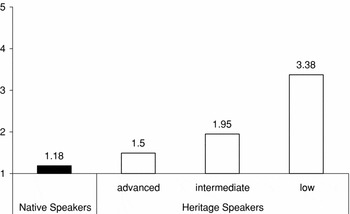
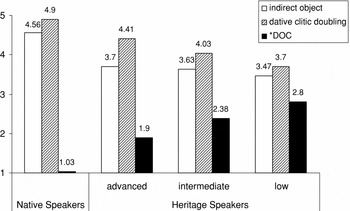
According to Torrego (Reference Torrego1998), Spanish DOM and the English double object constructions share many semantic and syntactic characteristics. Yet double object constructions are ungrammatical in Spanish (*Juan dio María un regalo “Juan gave Maria a present”). Figure 2 shows that many of the heritage speakers who accepted animate, specific direct objects without a-marking also accepted ungrammatical double object constructions in Spanish, especially speakers in the low proficiency group. The difference between the native speakers and the heritage speakers was significant according to the results of an ANOVA (F(3,85) = 25.650, p < .0001) and planned comparisons t(50.696) = 8.861, p < .0001 (one-tailed). However, the native speakers and the advanced heritage speakers did not differ from each other according to Games-Howell post-hoc test (p < .071).
Mean acceptability ratings for double object constructions (ungrammatical).

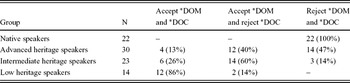
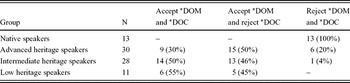
As an anonymous reviewer pointed out, the potential relationship between the results for unmarked objects (Figure 1) and ungrammatical double objects (Figure 2) is not entirely clear from these group results. Therefore, we performed an individual subjects’ analysis by counting how many participants accepted as grammatical more than two sentences out of five (40%), with acceptability ratings of 4 or 5. We then divided the subjects according to three patterns: those who accepted both *DOM and *DOC, those who accepted only *DOM, and those who rejected both like the native speakers. The fourth possible pattern – accept *DOC and reject *DOM – is the opposite of what Torrego's analysis would predict if these two structures were related initially in the learners’ grammars. We found no subjects conforming to this pattern. Results are shown in Table 2.
Number and percentage of individual subjects in each group who accepted/rejected ungrammatical DOM and DOC sentences consistently.
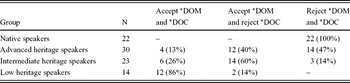
What emerges from Table 2 is what appears to be a developmental pattern, even though this is not a longitudinal sample: while only a handful of advanced and intermediate heritage speakers display the native speaker pattern, 86% of the low proficiency heritage speakers, 26% of intermediate heritage speakers, and 13% of advanced heritage speakers accept both *DOM and *DOC, consistent with Torrego's analysis. However, as proficiency increases, heritage speakers appear to realize that *DOM and *DOC are not related in Spanish. As can be seen in Table 2, most subjects in the intermediate (60%) and advanced groups (40%) correctly reject *DOC but still incorrectly accept *DOM. It seems that for these speakers marking DOM morphologically with inherent case is problematic.
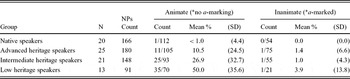
We turn now to discussing the results of the oral narrative task. Twenty native speakers and 59 heritage speakers from the original sample pool were available to participate in this task. Since the main focus of this task was object expression, including production of dative and accusative clitics, all transitive verbs were counted for each participant. The 20 native speakers produced a total of 362 transitive and ditransitive verbs (range 11–28 verbs per narrative per subject), whereas the 59 heritage speakers produced 861 verbs (range 4–27). All raw counts were converted to percentages and submitted to statistical analysis. Results of the clitic analysis showed no differences between the native speakers and the heritage speakers in the production rates of dative and accusative clitics, clitic climbing, and clitic doubling with indirect objects. The analysis of these data is reported in full in Montrul (in press). However, when it came to DOM, significant differences between the heritage speakers and the native speakers emerged. Montrul (Reference Montrul2004a) found 6% omission in advanced heritage speakers and 21.6% omission in intermediate heritage speakers. Using the same task with another group of heritage speakers, we found that, once again, the native speakers made virtually no errors while the heritage speakers showed 29.1% (78/268) omission overall. Table 3 shows counts, mean percentage error rates, and standard deviations for the native speakers and the heritage speakers split into the three proficiency groups. Examples (17) and (18) contain several instances of a-omission with animate direct objects.Footnote 11
(17)
El hombre vio la chica y el lobo y él quería comer ella.
(#705, intermediate HS)“The man saw the girl and the wolf and he wanted to eat her.”
(18)
El hombre del bosque entra y ver y vi el lobo con el estómago lleno. Y cortó el lobo abierto para sacar la niña.
(#604, low HS)“The man of the forest comes in and see and saw the Wolf with the stomach full. And he cut the wolf open to take the girl out.”
(19)
El lobo se come a Caperucita pero un leñador que estaba por allí escuchó gritos y entró a la casa. El cazador muy astuto tenía unas tijeras entonces le cortó la panza al lobo y sacó a la abuela y a la joven Caperucita.
(#201, NS)“The Wolf eats Little Red Riding Hood but a wood cutter that was around heard screams and entered the house. The very shrewd hunter had scissors so he cut the wolf's stomach and took out the grandmother and the young Little Red Riding Hood.”
(20)
Cuando Caperucita se dio cuenta de que la abuelita no era la abuelita ya era demasiado tarde.El lobo saltó de la cama y se comió a la pequeña . . . En eso apareció un cazador con un perro, y al ver al lobo en la cama, se dio cuenta de lo que había pasado. Con unas tijeras muy grandes le cortó la panza y salvó a la abuelita y a Caperucita porque el lobo se las había tragado enteras.
(#202, NS)“When Little Red Riding Hood realized that the granny was not the granny it was already too late. The wolf jumped out of the bed and ate the little one. At that time a hunter appeared with a dog, and upon seeing the wolf in bed, he realized what had happened. With a very big pair of scissors he cut the wolf's stomach and saved the granny and Little Red Riding Hood because the wolf had swallowed them alive in a piece.”
An ANOVA indicated that there was a significant difference in error rates with animate direct objects based on group (F(3,75) = 12.205, p < .0001). Planned comparisons indicated that the three heritage speaker groups made a-omission errors (ranging from 10% to 50%) while the native speakers did not (t(48.004) = −7.664, p < .0001, one-tailed). We also noted a few instances of incorrectly a-marked inanimate objects, but the differences between the groups did not reach significance in this case (F(3,75) = .803, p < .496).
Counts and mean percentage production of a-marking omission errors with animate direct objects and a-marking errors with inanimate direct objects.

4.1.4 Summary
The results of Experiment 1 show that omission of a-marking in DOM sentences is not just a production problem, but it appears to affect tacit linguistic knowledge as well. Heritage speakers of all proficiency levels, including advanced speakers, omitted a-marking with animate and specific direct objects in production and judged sentences without a-marking significantly more acceptable than native speakers (deemed to have full competence in the language).
4.2 Experiment 2
Experiment 1 showed that adult heritage speakers appear to have unstable knowledge of Spanish DOM, as revealed by both production and acceptability judgments. Some speakers also accepted ungrammatical double object constructions, suggesting that these two phenomena might be related at a deeper level in their grammars. But is omission of the object marker a solely restricted to DOM environments, or does this problem generalize to other instances of dative case marking, including indirect objects and psych verbs? Because the main aim of the acceptability judgment task used in Experiment 1 was to assess knowledge of clitics, there was only one condition testing knowledge of DOM. The purpose of Experiment 2, therefore, was to re-examine knowledge of DOM in another group of Spanish heritage speakers by asking participants to judge both grammatical and ungrammatical sentences with DOM, with both animate and inanimate objects, in addition to other dative constructions.
4.2.1 Participants
A group of 13 Spanish native speakers (mean age 24.5, range 26–47) from a variety of Spanish-speaking countries and 69 Spanish heritage speakers from the Chicago metropolitan area (mean age 21.8, range 18–26) participated in this second experiment. All the heritage speakers were enrolled in low, intermediate, and advanced Spanish for heritage speaker classes at a metropolitan university in Chicago. Eighty-two percent of these speakers were of Mexican descent, born in the United States to Mexican-born parents, while the rest came from other Latin American countries (Puerto Rico, El Salvador, Guatemala and Mexico), also born to Spanish-speaking parents. All of them were exposed to Spanish in the home, and 25% to both English and Spanish. All participants were schooled in English in middle and high school, while eight attended elementary schools with some Spanish instruction (including bilingual programs).
These heritage speakers self-rated their proficiency on a scale ranging from 1 to 5, where 5 = native-like and 1 = non-native-like. The mean rating in Spanish for this group was 3.75. As in Experiment 1, all participants also completed the same written Spanish Proficiency test. The combined mean scores for these 69 heritage speakers was 37.92 (SD 5.68, range 23–49). We used the proficiency scores to divide the heritage speakers into advanced (N = 30), intermediate (N = 28) and low proficiency (N = 11) (cut-off ranges for each proficiency group were the same as in Experiment 1). Table 4 presents the mean and standard deviation by proficiency levels. Comparison with participants in Experiment 1 (Table 1) shows that the two groups were quite comparable in proficiency and linguistic background.
Sample sizes and mean scores on the Spanish proficiency test for participants in Experiment 2.
4.2.2 Task
This experiment used an acceptability judgment task similar to the one in Experiment 1. The task consisted of 75 sentences (40 grammatical and 35 ungrammatical) divided into 15 sentence types with five tokens for each type. Four sentence types tested Differential Object Marking, (19)–(22); five types tested indirect objects, (23)–(27); and four types tested gustar-type psych verbs, (28)–(31). A complete list of all tokens and all types is included as Appendix B.
Differential Object Marking
(19)
“Marisa knows my sister.”
(20)
“The boss listened to the secretary.”
(21)
“Juan visited the library.”
(22)
El hombre escuchó el partido de fútbol en la radio.
“The man listened to the soccer game on the radio.”
inanimate (no a)
The sentence types in (19)–(22) tested both animate and inanimate objects, both marked and unmarked with the dative preposition a.
(23)
Ángela envió regalos a su novio.
“Angela sent gifts to her boyfriend.”
indirect object (with a)(24)
Teresa le devolvió el dinero a Pepe.
“Teresa returned the money to Pepe.”
dative clitic doubling (with a)(25)
*Estela dio María el libro.
“Estela gave Maria the book.”
double object construction (no a)(26)
A su jefe le envió chocolates Paula.
“To her boss Paula sent chocolates.”
clitic left dislocation (with a)(27)
*Susana le devolvió el plato Isabel.
“To Susana returned the plate Isabel.”
clitic left dislocation (no a)
Indirect Objects
Sentence types (23) and (24) tested indirect objects (with a) and indirect objects with clitics, to see whether heritage speakers assign the structure in (11) to these sentences. Double object constructions (25) were included to confirm the findings of Experiment 1 and to see whether some heritage speakers adopt the grammar of English instead (tree (9)). Because sentence types (23) and (24) have the dative-marked indirect object in postverbal position, one possibility is that heritage speakers do not perceive this preposition intrasententially. Therefore, sentences (26) and (27) were included to see whether heritage speakers would also omit the preposition when the indirect object is topicalized and moved to the left periphery of the clause.
Gustar-type psych verbsFootnote 12
(28)
A Juan le gusta Patricia.
“Juan likes Patricia.”
Experiencer–V–Theme (with a)(29)
*Mi mamá le gusta Pavarotti.
“My mother likes Pavarotti.”
Experiencer–V–Theme (no a)(30)
Patricia le gusta a Juan.
“Juan likes Patricia.”
Theme–V–Experiencer (with a)(31)
*Pavarotti le gusta mi mamá.
“My mother likes Pavarotti.”
Theme–V–Experiencer (no a)
We also included gustar-type psych verbs with both pre- and postverbal dative experiencers, again manipulating the presence/absence of the dative preposition. We wanted to see whether the position of the dative-marked experiencer in the sentence made a difference in the acceptability ratings of a-marking. The procedure for presentation and administration of this task was the same as in Experiment 1.
4.2.3 Results
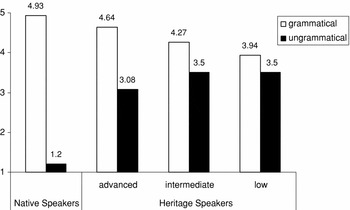
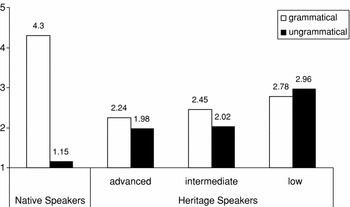
Numerical ratings were submitted to a series of one-way ANOVAs with planned comparisons to investigate differences between the groups, and paired-samples t-tests to compare sentence types. Figure 3 contrasts the results for grammatical and ungrammatical DOM sentences with animate objects (see Table B in Appendix A for means and standard deviations). Results showed that the native speakers rated grammatical sentences (marked with the preposition a) as significantly more acceptable than the three groups of heritage speakers did (F(3,78) = 8.331, p < .0001, planned contrast t(38.559) = −7.904, p < .0001, one-tailed). The heritage speakers also accepted ungrammatical sentences without a-marking significantly more than the native speakers did (F(3,78) = 35.811, p < .0001, planned contrasts t(34.432) = 15.755, p < .0001, one-tailed). While the difference between grammatical and ungrammatical DOM sentences with animate objects was significant for the native speakers (t(12) = 38.502, p < .0001), for the advanced (t(29) = 7.523, p < .0001), and for the intermediate heritage speakers (t(27) = 5.170, p < .0001), the low proficiency heritage speakers rated grammatical and ungrammatical DOM sentences with animate objects similarly (t(10) = 1.265, p < .064). These results replicate the results of Experiment 1 with a different group of heritage speakers.
Mean acceptability ratings on sentences with marked (grammatical) and unmarked animate direct objects (ungrammatical).

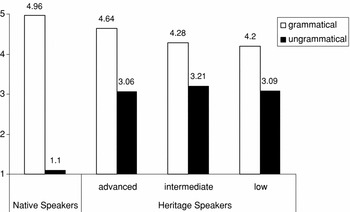
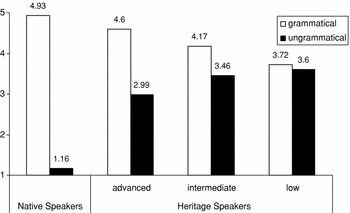
Mean acceptability ratings on sentences with marked (ungrammatical) and unmarked inanimate objects (grammatical).

The acceptability judgment task used in Experiment 1 did not include sentences with inanimate objects, and a-marking errors in production were relatively minor in the oral narrative task. In this experiment, we wanted to see whether the heritage speakers had consistent intuitions on these sentences as well. Even though all groups accepted the grammatical sentences with unmarked, inanimate direct objects, they did so to different degrees according to the statistical analysis which showed significant differences between the native speakers and the three groups of heritage speakers (F(3,78) = 4.958, p < .003, planned comparisons t(44.901) = −6.958, p < .0001, one-tailed). But even more revealing are the results for the ungrammatical sentences with a-marked inanimate direct objects, since the three groups of heritage speakers rated marked, inanimate objects acceptable while the native speakers did not (F(3,78) = 18.841, p < .0001, planned comparisons t(53.926) = 15.023, p < .0001, one-tailed). These results show that heritage speakers do not seem to have determinate intuitions regarding semantic constraints on DOM with animate and inanimate direct objects.
Given this pattern of results with dative case marking, one must ask whether difficulties with a-marking are mainly restricted to direct objects, or whether heritage speakers also have probabilistic judgments on dative marked indirect objects. To answer this question, Figure 5 contrasts ratings on indirect objects with a-marking and no clitics (grammatical), indirect objects with a-marking and clitics (grammatical), and indirect objects with no a-marking (double object constructions), which are ungrammatical. (The fourth possibility, indirect objects with clitic doubling and no “a”, was not included in this experiment.)
Mean acceptability ratings on indirect objects.

Although the native speakers rated indirect objects and clitic doubled indirect objects higher on the acceptability scale than the three groups of heritage speakers (indirect objects F(3,78) = 3.640, p < .016, planned contrasts t(78) = 3.294, p < .001; clitic doubled indirect objects F(3,78) = 7.394, p < .001, t(41.556) = −6.912, p < .0001), it is clear that the heritage speakers know both that indirect objects are marked with the dative preposition and that clitic doubling is optional with indirect objects. Thus, they may posit the structure in (11). All groups rated dative clitic doubling more acceptable than indirect objects with no clitics, according to paired samples t-tests (native speakers t(12) = −2.344, p < .037; advanced heritage speakers t(29) = −3.838, p < .0001; intermediate heritage speakers t(27) = −2.064, p < .049). However, this difference did not reach significance for the low proficiency heritage speakers (t(10) = −.969, p < .355). If these results show that heritage speakers have the correct grammar for Spanish indirect objects, the results for ungrammatical double object constructions show that many heritage speakers also consider these sentences acceptable, when in fact they are not. Once again, the acceptability ratings of the native speakers were significantly different from the acceptability ratings of the three groups of heritage speakers (F(3,78) = 8.967, p < .0001, planned contrasts t(25.307) = 9.235, p < .0001, one-tailed), confirming the findings of Experiment 1.
As in Experiment 1, we also considered individual subjects’ ratings of ungrammatical double objects (*DOC) and *DOM sentences with animate objects and without the object marker. Results in Table 5 show similar patterns to those in Table 2. While a handful of intermediate and advanced speakers show the pattern of rejection of the native speakers, most heritage speakers are split between two patterns: those who may apply the English based analysis of *DOC to *DOM, and those who find the overt marking of inherent case with animate direct objects problematic.
Number and percentage of individual subjects in each group who accepted/rejected ungrammatical DOM and DOC sentences consistently.

Figure 6 shows the results for clitic left dislocations, where the dative marked indirect object is topicalized to the beginning of the sentence (the left periphery). The results show that while the native speakers have a clear and robust grammaticality contrast between dative and non-dative-marked indirect objects in topicalizations (t(12) = 11.892, p < .0001), the three groups of heritage speakers rated the two sentences similarly unacceptable, showing no discrimination between these sentence types (advanced t(29) = 1.711, p < .098; intermediate t(27) = 1.178, p < .198; low t(10) = −1.149, p < .277). The low acceptability of both grammatical and ungrammatical dislocations might imply problems with word order and dislocations in general (Zapata, Sánchez and Toribio, Reference Zapata, Sánchez and Toribio2005), or the adoption of an altogether different analysis for these sentences. For example, hanging topics (as in Juan, María le devolvió un libro “John, Maria gave him a book”) do not require the preposition. However, there is another potential interpretation of the results for the ungrammatical sentences, as noted by an anonymous reviewer. Since these sentences were presented in the absence of context, the participants may have interpreted them as ditransitives with missing a, which are ungrammatical. If this is the case, then these results suggest that heritage speakers do not have problems with structural dative case (indirect objects) but they do have considerable problems marking inherent case with DOM and dative experiencers, as we show next.
Mean acceptability ratings on clitic left dislocations with indirect objects with a (grammatical) and without a (ungrammatical).

Dative experiencers with gustar-type psych verbs are an instance of inherent dative case. Figure 7 shows sentences with preverbal dative experiencers, while Figure 8 shows postverbal dative experiencers. Results for the grammatical sentences (with a-marking) showed differences between the native speakers and the three groups of heritage speakers (F(3,78) = 7.177, p < .0001, planed contrasts t(29.870) = −5.831, p < .0001, one-tailed). The ratings of the ungrammatical sentences (with no a-marking) showed strikingly different patterns for the native speakers and the heritage speakers (F(3,78) = 22.500, p < .0001, planned contrasts t(35.482) = 13.652, p < .0001, one-tailed), and similar to the mean acceptability ratings of DOM sentences (Figure 3 and Figure 4). These ratings show that heritage speakers also have indeterminate judgments regarding the grammaticality of dative marking with dative experiencers in preverbal position. Although the advanced and the intermediate heritage speakers rated grammatical sentences statistically differently from ungrammatical sentences (advanced t(29) = 7.428, p < .0001, intermediate t(27) = 3.571, p < .001), the low proficiency speakers rated grammatical and ungrammatical sentences similarly (t(10) = .449, p < .663).
Mean acceptability ratings on gustar-type psych verbs with dative marked (grammatical) and unmarked (ungrammatical) dative experiencers in preverbal position.

Mean acceptability ratings on gustar-type psych verbs with marked (grammatical) and unmarked (ungrammatical) dative experiencers in postverbal position.

Grammatical sentences with dative-marked experiencers in postverbal position also showed clear differences between the mean ratings of the native speakers and the ratings of the three groups of heritage speakers (F(3,78) = 2.902, p < .040, planned contrasts t(32.598) = −3.344, p < .002, one-tailed). The three groups of heritage speakers accepted these sentences more than the native speakers (F(3,78) = 14.290, p < .0001, planned contrasts t(52.225) = 13.730, p < .0001, one-tailed).
4.2.4 Summary
Results of Experiment 2 showed that the heritage speakers tested, even those of advanced proficiency, do not have clear judgments on DOM with either animate or inanimate direct objects. While they showed robust judgments on indirect objects, they still tend to accept ungrammatical double object constructions. Furthermore, problems with dative marking omission appear to extend to other cases of inherent dative case, such as dative experiencers with gustar-type psych verbs. Finally, heritage speakers considered both grammatical and ungrammatical clitic left dislocations unacceptable.
5. Discussion
Because previous studies have shown that Spanish heritage speakers often omit Differential Object Marking with animate direct objects in oral production while monolingually raised native speakers do not, the purpose of this study was to assess the extent of incomplete knowledge of this grammatical feature of Spanish. Differential Object Marking emerges early in childhood as the available spontaneous production data show (Rodríguez-Mondoñedo, Reference Rodríguez-Mondoñedo2008), and is highly frequent in both written and oral input, since every time a transitive sentence with an animate and specific direct object is uttered, the object must be marked with the preposition a. Even though there is a certain degree of fuzziness in the DOM phenomenon in Spanish (Weissenrieder, Reference Weissenrieder1985, Reference Weissenrieder1990, Reference Weissenrieder1991; Laca Reference Laca, Wesch, Weidenbusch, Kailuweit and Laca2002, Reference Laca and Company2006) and crosslinguistically, we also showed that native speakers with full command of the language have clear, determinate, and consistent judgments on the core cases tested. The combined results from Experiments 1 and 2, which included both written acceptability judgments and oral production data, with different groups of heritage speakers ranging from low to advanced proficiency in the language, showed that these adult early bilinguals have unstable knowledge of this grammatical phenomenon, even in the most prototypical cases. Incomplete knowledge of a-marking suggests that this is not just a production problem in heritage speakers, but that it affects their linguistic competence more deeply. This robust finding suggests that Differential Object Marking has either been incompletely acquired before age 3 – the age at which the basic syntax and morphology of the language are assumed to be largely in place – or was acquired but subsequently lost in these Spanish heritage speakers due to increased use of English in childhood and lack of academic support of the heritage language. Recall that according to Rodríguez-Mondoñedo (Reference Rodríguez-Mondoñedo2008), the Spanish-speaking children he studied already marked animate objects with 98% accuracy at age 2;8.
The results of Experiment 2 and those of another study with some of the participants in Experiment 1 (Montrul, in press) showed that the same heritage speakers have robust control of structural dative and accusative case, as revealed by their solid knowledge and use of object clitics and their acceptance of clitic doubled indirect objects. At the same time, the same speakers showed erratic treatment of a-marking with other instances of inherent dative case, including DOM and gustar-type psych verbs. Furthermore, acceptance of ungrammatical double object constructions in Spanish, a feature of English, was quite high in all the groups of heritage speakers tested, especially at the low and intermediate proficiency levels (see Table 2 and Table 5). If incomplete acquisition in Spanish heritage speakers is mainly due to reduced input and limited use of the language throughout childhood, such reduced input appears to be sufficient to trigger the selection of core functional projections, including the basic transitive and ditransitive structures in (8) and (11). What reduced input seems to affect more negatively are semantically-based non-core categories (or additional functional structure needed for specific morphological elements as explained in section 2 above), which apparently fail to fully develop without the appropriate environmental conditions. Another possibility (but difficult to tease apart at this point) is that the additional functional category is there, but heritage speakers fail to overtly mark the object when it moves to that functional category, in which case the problem is one of missing inflection. With the erosion of a-marking in both DOM and gustar-type verbs, the acceptance of both prepositional datives and double objects, and the rejection of grammatical clitic left dislocations, the syntax of Spanish objects in these speakers appears to be converging with the syntax of English objects, the majority language.
But why is Differential Object Marking, and inherent case marking more generally, a strong candidate for loss or fossilization in early bilinguals, even among advanced proficiency speakers? Let us consider some language-external and language-internal factors. The most significant external factor is input. As an external construct, input consists of samples of speech and other forms of language in the environment. By virtue of being bilinguals raised in a language minority situation, many heritage speakers were exposed to quantitatively less Spanish in general (measured in hours per day) than children reared in a monolingual Spanish-speaking environment. With respect to the specific linguistic phenomenon investigated – dative a marking – the input may also be unreliable, since a-marking is obligatory in some cases but not necessary in many others. As we explained, there is variability in the distribution of DOM itself as a function of semantic factors within the direct object system, while a-marking is obligatory in all instances of dative case. Therefore, variability in input comes from two sources: the amount of input these individuals received, and the inherent variability in the linguistic structure investigated. While for the monolingual child, inherent linguistic variability in the use of a-marking with direct and indirect objects does not affect complete acquisition of this phenomenon, for the bilingual child exposed to less Spanish, it does.
Is it possible that the heritage speakers were exposed to qualitatively different input as well, meaning that the other Spanish speakers around them used different degrees of dative a-marking due to dialectal variation? Except for Dumitrescu's (Reference Dumitrescu1997) study of Buenos Aires and Madrid Spanish, we are not aware of any studies of sociolinguistic variation of a-marking in different Spanish varieties, so it is an open question whether first generation immigrants of different Spanish-speaking countries use different rates of a-marking with animate and specific direct objects.Footnote 13 In our two experiments, we recruited monolingual native speakers from both Peninsular and Latin American varieties of Spanish, and for all of them the use and judgments of a-marking in core cases was categorical with animate and inanimate objects, as it was with gustar-type psych verbs. Therefore, this scenario is not very likely, at least with the sentences tested in these experiments.Footnote 14
Another possibility is to consider that among the Spanish-speaking population in the United States, Differential Object Marking is undergoing a natural process of language change, accelerated by contact with English, as suggested by Silva-Corvalán (Reference Silva-Corvalán1994) for other aspects of Spanish in contact with English. What is interesting in the case of DOM is that, if language change is involved, the change appears to be going in the opposite direction attested in the diachrony of Spanish so far. In the history of the Romance languages, DOM arose as an innovation in Spanish,Footnote 15 although Romanian has a similar DOM marker, the locative marker pe (see also Dumitrescu, Reference Dumitrescu1997 and Aissen, Reference Aissen2003 for discussion). In Latin, direct objects were marked with accusative case but no preposition. Aissen (Reference Aissen2003) analyzed instances of DOM in the Medieval text Poema del Mio Cid. She found that a-marking with direct objects was less widely distributed then than it is in present day Spanish. In Medieval Spanish, common noun phrases referring to humans, both definite and indefinite, were not always marked, as shown in (32), whereas today they must be marked, as shown in (33).
(32)
(33)
. . . cuando dejaron a mis hijas en el robledo de Corpes
Corpus based analysis of the diachronic advance of a-marking with animate and inanimate objects in Spanish (adapted from Company Reference Company2001).

Furthermore, the diachronic studies of Company (Reference Company2001, Reference Company, Bernabé, Berenguer, Cantarero and de Torres2002) show that, if anything, dative a-marking is also advancing with inanimate, direct objects in some Spanish varieties (examples (34) and (35) are from Company, Reference Company2001, p. 147):
(34)
Después de conocer mucho a la vida, ya no me interesa el teatro.
“After knowing life too much, I am no longer interested in theater.”
(Proceso, May 1999)(34)
Para que no nos peleemos puse a la silla en el medio.
“So that we do not fight, I put the chair in the middle.”
(Mexico, spoken Spanish)
Therefore, the diachronic data from Spanish indicate that dative case marking has advanced to mark direct objects as well, which is the function typical of accusative case.
Turning now to potential internal factors for the erosion of DOM in the grammars of heritage speakers, let us start by considering age of acquisition. As we have seen, DOM is acquired early by Spanish-speaking children (Rodríguez-Mondoñedo, Reference Rodríguez-Mondoñedo2008). An early account of L1 attrition is Jakobson's (Reference Jakobson1941) Regression Hypothesis, which attempted to explain the selectivity of L1 attrition by relating it to the processes and developmental stages of L1 acquisition. In essence, structures that are acquired late in L1 acquisition are the first ones to be lost under attrition. Since clitic pronouns, also acquired by Spanish-speaking children by age 3;00 (Montrul, Reference Montrul2004b, chapter 4), are retained but DOM is obviously not, age of acquisition alone cannot be an explanation for DOM erosion in adult heritage speakers.
Two other more likely language-internal factors that may have contributed to the eradication of DOM, and probably working together, we believe, are the linguistic complexity of DOM on the one hand, and the influence of English, on the other. Let us consider first acoustic salience. Could it be the case that heritage speakers do not perceive the preposition in oral comprehension and do not parse it when they read? After all, this preposition consists of just one vowel. When produced after a verb of the first conjugation in the present indicative, for example, Llama a Juan “He calls Juan”, the sequence of two [a] sounds (one from the verbal ending and one for the marker) is reduced to one, possibly somewhat lengthened ([a:]), and thus the preposition is practically inaudible in speech. In the preterite past tense, as in Vio a Juan “He saw Juan”, the vowel is diphthongized with the vowel of the verb ending (/oa/ or /ua/). (Plural verbal forms ending in a consonant, e.g., hablamos “we speak, we spoke”, do not present this problem.) The acceptability judgment task in Experiment 2 included sentences with the preposition in sentence-initial position (as with clitic left dislocations and gustar-type verbs with preverbal experiencers). These sentences had higher acceptance rates of the omitted preposition in sentence-initial than in postverbal position. Furthermore, participants should have also accepted omission of a with indirect objects as in the case of double objects and the ungrammatical sentences used to test clitic left dislocations without a, but the rates of acceptance of these ungrammatical sentences were much lower than for DOM and gustar-type psych verbs. Nonetheless, future research could test this possibility with Spanish heritage learners through an oral comprehension-based experiment, or could test heritage speakers of another language that has a more acoustically salient DOM marker, such as the Hindi dative postposition ko or the Romanian DOM marker pe. We are in the process of developing these studies.
Consider now semantic and syntactic complexity. Sorace (Reference Sorace2004) has proposed that L1 attrition affects some external interfaces, such as the discourse–syntax interface, where both syntactic and pragmatic knowledge need to be integrated. As we have seen, DOM encodes semantic notions such as animacy, definiteness, and specificity, among others, and involves both structural accusative and inherent dative case, according to Torrego's (1998) analysis. Inherent case is handled by the syntax–semantics interface (Montrul, Reference Montrul2004a). Compared to a non-marked object, the DOM object must move outside of the VP to be overtly case marked by the dative preposition in the specifier of the vP. Dative indirect objects, by contrast, receive only structural case in the VP. Argumental accusative and dative clitics are morphological manifestations of accusative and dative structural case. Thus, DOM is both semantically and syntactically more complex, involving more structure than unmarked objects and indirect objects, in addition to movement. While L1 attrition in adults may affect the syntax–discourse interface, attrition and incomplete acquisition due to reduced input in childhood affect the internal interfaces as well.
A move away from linguistic complexity is further reinforced by English, the dominant contact language. With respect to the syntax of objects and case marking, English is, in a sense, a subset of Spanish. That is, English has both prepositional datives, analogous to the Spanish dative construction in (10) (except for the clitic) and double object datives. According to Torrego (Reference Torrego1998), the English double object construction and Spanish DOM are roughly equivalent in their semantic and syntactic characteristics, with the exception that Spanish marks the affected object overtly while English does not. Furthermore, although English has topicalizations, it does not have clitic left dislocations, and English has nominative-marked experiencers with gustar-type psych verbs (e.g., Mary likes John).
At the individual, psycholinguistic level, the cognitive structure of the majority language appears to be imposing itself on the structure of Spanish in these speakers, due to reduced input from and use of Spanish. Significantly more input and use of English than of Spanish has reinforced both the structures that the two languages share and those that are linguistically less complex, such as English-based nominative experiencers for dative experiencers and English-type topicalizations. If there is language change going on in the grammars of heritage speakers, it is likely due to the influence from English, since the change happens to be in the retreat rather than in the advancement of overtly marked dative case. Similar loss of inherent case as a result of language contact and incomplete acquisition in bilinguals is reported by Lightfoot (Reference Lightfoot1991, Reference Lightfoot1999), with the loss of inherent dative case in Middle English, and by Polinsky (Reference Polinsky1997, Reference Polinsky2006), with the loss of the genitive of negation and other semantically-based instrumental case in Russian heritage speakers. Admittedly, direct support for this hypothesis would have to be sought by examining heritage speakers of Spanish in contact with a language that does have DOM: if in this case heritage speakers do not move in the direction of losing DOM, then interlanguage influence gets strong support.
In conclusion, this study suggests that incomplete acquisition due to reduced input in childhood leads to some sort of “fossilization” or linguistic gap in adult Spanish heritage speakers. This type of fossilization is localized and selective, since it does not affect the entire grammar. While core functional structures are retained, non-core projections are likely to be undeveloped under reduced input conditions. In particular, we showed that some specific aspects of the syntax–semantics interface are affected (inherent case), whereas other core syntactic aspects are not (structural case). Just like beginning and intermediate English-speaking L2 learners of Spanish, who have difficulty with DOM due to influence from their native language, erratic use of DOM by heritage speakers is also likely to be reinforced by English. Strong evidence for the role of L2 transfer in DOM erosion is indicated by the fact that if a process of language change is under way in the grammars of heritage speakers, this change has certainly gone in the opposite direction (towards reduction rather than expansion) from the direction attested in the history of the Spanish language. The trend resembles more closely the diachronic path taken by English with the loss of inherent dative case. In this sense, incomplete acquisition is like “going back to basics”: it leads to simplification of the grammar by letting go of the most marked, language specific, non-core options, while retaining the core, universal, functional structure. More generally, incomplete acquisition in this particular case has also taken the form of linguistic convergence, and convergence does not necessarily introduce foreign elements into the weaker language, as Bullock and Toribio (Reference Bullock and Toribio2004) have proposed. Rather, it biases the grammar toward the selection, retention and strengthening of structures shared by the minority and majority languages.