Introduction
Attention-deficit/hyperactivity disorder (ADHD) is a prevalent and impairing disorder characterized by developmentally extreme levels of (a) hyperactivity-impulsivity and/or (b) inattention-disorganization (American Psychiatric Association, 2000). Childhood ADHD portends a range of impairments across multiple outcomes later in life (Babinski et al., Reference Babinski, Pelham, Molina, Gnagy, Waschbusch, Yu and Karch2011; Biederman et al., Reference Biederman, Petty, Monuteaux, Fried, Byrne, Mirto and Faraone2010; Hinshaw et al., Reference Hinshaw, Owens, Zalecki, Perrigue-Huggins, Nevado-Montenegro, Schrodek and Swanson2012). Decision-making impairment has not been widely explored as a long-term outcome of childhood ADHD. Identifying performance differences on simple tasks measuring decision-making is a first step toward understanding cognitive and emotional processes underlying adult outcomes of childhood ADHD.
Individuals with ADHD are more likely than non-ADHD comparison individuals to make risky decisions (Luman, Oosterlaan, Knol, & Sergeant, Reference Luman, Oosterlaan, Knol and Sergeant2008) and to prefer smaller immediate rewards over larger delayed rewards (Antrop et al., Reference Antrop, Stock, Verté, Wiersema, Baeyens and Roeyers2006). Some models have suggested that individuals with ADHD experience an abnormal sensitivity to extrinsic reinforcement. The dual-pathway model suggests that individuals with ADHD may exhibit decreased sensitivity to non-immediate rewards because of their aversion to delays; this motivational pathway is thought to be associated with neural circuits involving the reward system (Sonuga-Barke, Reference Sonuga-Barke2002) and is likely influential in real-world decision-making abilities.
The Iowa Gambling Task (IGT) is a computerized test that simulates real-life decision-making, requiring participants to weigh rewards and penalties by selecting cards from four decks. These decks differ in terms of expected outcomes: Two are “disadvantageous” because of their high gains and high losses, whereas the others are “advantageous” because of their low gains and losses. Patients with ventromedial prefrontal cortex lesions consistently make more selections from disadvantageous decks than advantageous decks (Bechara, Damasio, Damasio, & Anderson, Reference Bechara, Damasio, Damasio and Anderson1994; Bechara, Tranel, & Damasio, Reference Bechara, Tranel and Damasio2000).
Because individuals with ADHD appear to prefer immediate over delayed rewards more than comparison participants and often engage in risky behavior, some have examined IGT performance in ADHD. A key finding is that adolescents with ADHD make fewer advantageous selections on the IGT relative to controls (Garon, Moore, & Waschbusch, Reference Garon, Moore and Waschbusch2006; Hobson, Scott, & Rubia, Reference Hobson, Scott and Rubia2011; Toplak, Jain, & Tannock, Reference Toplak, Jain and Tannock2005). This decision-making style is apparent regardless of externalizing comorbidities but is less apparent in participants with internalizing comorbidities. These studies have consisted of predominantly male samples; IGT performance in females with ADHD is virtually unknown and has not been examined as a later outcome of childhood ADHD.
Although ADHD occurs more often in males, an explicit focus on females is important for several reasons. First, ADHD in females results in considerable impairment (Babinski et al., Reference Babinski, Pelham, Molina, Gnagy, Waschbusch, Yu and Karch2011; Biederman et al., Reference Biederman, Petty, Monuteaux, Fried, Byrne, Mirto and Faraone2010; Hinshaw et al., Reference Hinshaw, Owens, Zalecki, Perrigue-Huggins, Nevado-Montenegro, Schrodek and Swanson2012). Second, a focus on females within any form of psychopathology can help to document processes and mechanisms related to symptomatology, impairment, and competence (Hinshaw, Reference Hinshaw2002). Third, overall sex differences in decision-making abilities have been noted, with typically developing adult females making more disadvantageous decisions than males on the IGT (Reavis & Overman, Reference Reavis and Overman2001).
Because most studies have focused on males with ADHD, it is not known if females with ADHD will exhibit impaired decision-making abilities relative to female control participants. Additionally, no studies to our knowledge have examined decision-making abilities as a young adult outcome of childhood-diagnosed ADHD, instead focusing on IGT performance in childhood and adolescence. We examine decision-making in an all-female sample of adults who were diagnosed with ADHD as children and a matched comparison group who had never been diagnosed. We hypothesize that females with a childhood diagnosis of ADHD will show impairment on the IGT in young adulthood.
Method
Overview of Procedure
We used data from a longitudinal study of behavioral, neuropsychological, social, and family functioning in 228 girls: 140 with rigorously diagnosed childhood ADHD and 88 matched comparison girls. All participated in summer research programs and extensive testing during childhood (ages 6–12 years), adolescence (ages 11–17 years), and young adulthood (ages 17–25 years). During young adulthood, 216 of 228 participants (95%) were retained. Diagnoses of ADHD were made during childhood and the IGT was completed during young adulthood, when all medicated participants were off stimulant medication for at least 24 hr. In the 5-year period before the young adult assessments, 51% of the ADHD group had received ADHD-related medications versus 1% of the comparison sample. All assessments received full approval from the Committee for the Protection of Human Subjects at the University of California, Berkeley.
Participants
A multi-gated procedure was used to recruit children from pediatric practices, school referrals, and community advertisements. In childhood, those with ADHD had to first surpass sex-specific thresholds for the SNAP-IV scale (Swanson, Reference Swanson1992) and then meet full DSM-IV criteria for ADHD based on the DISC-IV – Parent version (Shaffer, Fisher, Dulcan, & Schwab-Stone, Reference Shaffer, Fisher, Lucas, Dulcan and Schwab-Stone2000), all based on unmedicated behavior. Comparison girls could not meet SNAP-IV or DISC-IV criteria for ADHD. At baseline, the complete sample was both socioeconomically and ethnically diverse and consisted of 93 girls with ADHD-Combined type, 47 with ADHD-Inattentive type, and 88 comparisons (see Hinshaw, Reference Hinshaw2002). The comparison sample was matched, at a group level, with the clinical group on age and ethnicity.
During childhood, the 228 girls were 6 to 12 years (M = 9.6 years). During young adulthood, 10 years later, the 216 retained young women were 17 to 25 years (M = 19.6 years). Because some of the follow-up assessments occurred via home visits or telephone, and because of occasional computer failures, a total of 191 participants completed the IGT in young adulthood (77 comparisons, 114 with childhood-diagnosed ADHD); this sample did not differ from the larger sample on any sociodemographic variables. During childhood, WISC-III FSIQ scores were significantly lower in the ADHD group (M = 100.18; SD = 13.46) than the comparison group (M = 112.66; SD = 12.28).
Measures
Iowa Gambling Task (IGT; Bechara et al., Reference Bechara, Damasio, Damasio and Anderson1994, Reference Bechara, Tranel and Damasio2000)
We used a computerized version of the IGT. In this version, four decks of cards are displayed labeled A’, B’, C’, and D’. Participants are told that they will play a card game in which they are to attempt to maximize the amount of simulated money they can win. Participants can click on any of the four decks to select cards while the computer tracks the sequence of their selections. Upon making a selection, the face of the selected card appears and a message is displayed indicating that the participant won or lost money and how much. A status bar on the top of the screen indicates how much simulated money is won or lost after each selection; this bar grows proportionally longer when money is won and gets smaller when money is lost. Decks A’ and B’ pay an average of $100 but have greater penalties, while Decks C’ and D’ pay an average of $50 but have lower penalties. Based on these gains and penalties, decks A’ and B’ are considered “disadvantageous” and decks C’ and D’ are considered “advantageous”.
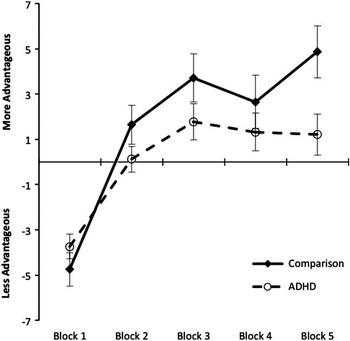
Resulting data are grouped in blocks of 20 trials, with a total of 100 trials (Block 1: cards 1–20, Block 2: cards 21–40, Block 3: cards 41–60, Block 4: cards 61–80, and Block 5: cards 81–100). Performance on this task was measured by calculating the difference between the number of cards selected from (1) the A’ and B’ decks (disadvantageous) and (2) the C’ and D’ decks (advantageous) for each block. This difference between advantageous and disadvantageous selections can be evaluated across blocks to assess learning over the course of the IGT.
Data Analytic Plan
A repeated-measures ANOVA was used to evaluate the effect of childhood-defined group (ADHD versus comparison), block (Blocks 1–5), and the interaction between group and block on IGT performance. Analyses were performed with and without childhood IQ as a covariate given the extensive debate over whether IQ scores should be covaried in studies of cognitive abilities in neurodevelopmental disorders like ADHD (Barkley, Reference Barkley1997; Dennis et al., Reference Dennis, Francis, Cirino, Schachar, Barnes and Fletcher2009). It may be that controlling for IQ constitutes overcontrol, given that deficits in IQ are inherent to the ADHD construct. Thus, even though we performed our analyses with and without covarying IQ, we emphasize the findings without IQ as a covariate.
Results
Mean and SD card selection patterns by group are presented in Table 1. Using a repeated-measures ANOVA with childhood diagnostic status (ADHD vs. comparison) as the independent variable, Mauchly's test indicated that the assumption of sphericity had been violated, χ2(9) = 58.11, p < .001. Therefore, degrees of freedom were corrected via Greenhouse-Geisser estimates of sphericity (ε = .87). Results showed a significant main effect of block, F(3,658) = 33.72, p < .001, ηp2 = .15; a marginally significant effect of group, F(1,189) = 3.29, p = .071, ηp2 = .02; and a significant interaction between group and block, F(3,658) = 2.64, p = .040, ηp2 = .01. More cards from advantageous decks were selected in later blocks than earlier blocks. Although not reaching traditional levels of statistical significance, the marginally significant effect of group is suggestive of a greater number of disadvantageous selections being made by the ADHD group than the comparison group.
Mean number of cards selected from each deck by group.

Note. ADHD = Attention-deficit/hyperactivity disorder.
We next conducted tests of simple main effects to decompose the significant group × block interaction, which yielded a significant group difference on Block 5, with comparisons making significantly more selections from advantageous decks than the ADHD group, F(1,189) = 6.24, p = .013. The comparison group increased their preference for advantageous cards between Blocks 1 and 2 (p < .001), Blocks 2 and 3 (p = .033), and Blocks 4 and 5 (p = .047). In contrast, the ADHD group increased their preference for advantageous cards only between Blocks 1 and 2 (p < .001) and Blocks 2 and 3 (p = .040) (Figure 1).
Mean number of advantageous (C+D) minus disadvantageous (A+B) card selections for Blocks 1–5 by childhood diagnostic status. ADHD = attention-deficit/hyperactivity disorder.

When analyses were repeated with childhood FSIQ as a covariate, we again corrected degrees of freedom via Greenhouse-Geisser estimates of sphericity (ε = .89). Results showed a significant main effect of block, F(4,666) = 5.03, p = .001, ηp2 = .03, with more cards from advantageous decks being selected in later blocks than earlier blocks. There was no effect of group, F(1,187) = .10, p = .759, ηp2 = .001 or the interaction between group and block, F(4,666) = .61, p = .64, ηp2 = .003.
Discussion
Overall, we aimed to examine performance on a decision-making task as a young adult outcome of female participants with and without a history of childhood ADHD. Participants’ card selections differed by childhood-defined group status (ADHD vs. comparison), with a significant group × block interaction indicating that those in the comparison group increased their preference for advantageous decks across blocks compared to those in the childhood-diagnosed ADHD group, who did not make a significant shift in the advantageous direction. When childhood IQ was included as a covariate, the effect of block remained significant, but group and the interaction between group and block did not. However, because IQ deficits are inherent to ADHD, including IQ as a covariate may constitute overcontrol. Indeed, it has been suggested that IQ scores should not be included as covariates in studies of cognitive abilities in ADHD (Barkley, Reference Barkley1997; Dennis et al., Reference Dennis, Francis, Cirino, Schachar, Barnes and Fletcher2009). A recent review of the literature also determined that IQ and decision-making performance on the IGT are separable (Toplak, Sorge, Benoit, West, & Stanovich, Reference Toplak, Sorge, Benoit, West and Stanovich2010). Thus, we emphasize findings without IQ as a covariate.
Our finding of a lack of improvement in card selections over time in those with a history of ADHD is in line with previous work revealing deficits in decision-making in children and adolescents with ADHD (Garon et al., Reference Garon, Moore and Waschbusch2006; Hobson et al., Reference Hobson, Scott and Rubia2011; Toplak et al., Reference Toplak, Jain and Tannock2005) and extends this work by finding such deficits in young adult females with a history of childhood ADHD. In the present investigation, females with childhood-diagnosed ADHD did not appear to exhibit an overall impairment on card selections, as evidenced by a lack of a significant effect of diagnostic group on card selections. Rather, the significant interaction between group and block indicates that the females with childhood diagnoses of ADHD were specifically impaired in learning to change their behavior over the course of the IGT relative to those without childhood ADHD. That is, young adult females with a history of childhood ADHD do not appear to be particularly skilled at using feedback in learning and adjusting behavior accordingly, instead consistently making risky or impulsive decisions. Conversely, the comparison participants successfully adjusted their behavior, implicitly learning the rules of the IGT and becoming more cautious about making selections from disadvantageous decks. Such findings suggest that females with a history of ADHD are not able to learn from punishment/response cost and reinforcement as well as those without childhood ADHD. Indeed, studies have found that individuals with ADHD display deficits in reinforcement learning (e.g., van Meel, Heslenfeld, Oosterlaan, Luman, & Sergeant, Reference van Meel, Heslenfeld, Oosterlaan, Luman and Sergeant2011). Previous findings regarding sensitivity to punishment/response cost in ADHD are more mixed.
Although we could not address the issue of sex differences in IGT performance given our all-female sample, there is some evidence that there are sex differences in brain regions involved in sensitivity to punishment (Santesso, Dzyundzyak, & Segalowitz, Reference Santesso, Dzyundzyak and Segalowitz2011). Previous studies have shown that, in adulthood, typically developing females tend to perform worse on the IGT than typically developing males (Reavis & Overman, Reference Reavis and Overman2001). Thus, there may be sex differences in brain regions involved in decision-making as well as in the cognitive strategies used during decision-making tasks. Although we cannot compare our sample of females directly to a sample of males, we do provide the first data specifically examining IGT performance as an outcome of childhood ADHD in females, making future comparisons with males with ADHD possible.
Limitations include our inability to make comparisons between sexes given our all-female sample, but we note the importance of doing so in the ADHD population in future studies. Additionally, whereas the retention rate of 95% for the larger follow-up was very high, home visits, equipment failure, and missed tests for some participants reduced the amount of IGT data available. Finally, the sample was clinically ascertained, and it is not clear whether our results would be similar in a community sample of females with ADHD.
Females with a history of childhood ADHD are now known to exhibit negative outcomes across a range of domains through young adulthood. The pathways by which difficulties in decision-making might be related to such impairments are not well characterized. Future research should examine associations between performance on decision-making tasks and functional impairments and should explore neural differences in decision-making abilities between males and females with ADHD, given potential sex differences in VMPFC anatomy and decision-making strategies. Additionally, future work should focus on how adult ADHD status and comorbidities contribute to decision-making abilities. Overall, our findings indicate that a diagnosis of ADHD in childhood gives rise to decision-making deficits in young adulthood relative to those who did not have ADHD in childhood, at least in females. A clearer understanding of the longitudinal development of such abilities is of high priority with potential implications for the development of intervention efforts. Further understanding of decision-making processes in females and males with ADHD, particularly the role of reinforcement, could have important implications for the use of rewards and negative consequences in clinical settings.
Acknowledgments
This project was supported by NIMH R01 45064. We gratefully acknowledge the girls—now young women—who have participated in our ongoing investigation, along with their caregivers and our large numbers of graduate students and research assistants. Their remarkable dedication has made this research possible. The authors report no conflicts of interest.