

Introduction
Approximately 12% of worldwide cancers are attributable to viral infection, with the vast majority occurring in the developing world (Refs Reference Zur Hausen1, Reference de Martel2). Epstein–Barr virus (EBV), which was first discovered 50 years ago as an oncogenic gamma-1 herpesvirus, infects more than 90% of the global adult population. Furthermore, this virus has powerful transforming potential for B lymphocytes in vitro. EBV thus contributes to several lymphoid malignancies, including several B, T and natural killer (NK) cell lymphomas. EBV has also been linked with several epithelial carcinomas such as nasopharyngeal carcinoma (NPC) and 10% of gastric carcinomas, while the highest incidence of NPC is in Southeast China (Refs Reference Kutok and Wang3, Reference Dolcetti4, Reference Mesri, Feitelson and Munger5, Reference Brooks6, Reference Plottel and Blaser7, Reference Lieberman8, Reference Seto9).
Most NPCs have minimal epithelial maturation and are classified as poorly differentiated (WHO type II) and undifferentiated (WHO type III) non-keratinising types of NPC. A few cases are differentiated (WHO type I). EBV has been confirmed to be associated with NPC types II and III of the WHO classification. EBV infects NPC cells and sporadically begins a productive viral lytic infection. Type II latency is maintained, restricting EBV gene expression to Epstein-Barr nuclear antigen 1 (EBNA1), latent membrane protein 1 (LMP1), LMP2A, LMP2B, EBERs, BARF1 and BART-encoded microRNAs (Ref. Reference Lung10). Of these genes, LMP1 is a primary oncoprotein encoded by EBV. It alters several functional and oncogenic properties, including transformation in epithelial cells (ECs) (Refs Reference Young and Rickinson11, Reference Yoshizaki12, Reference Dawson, Port and Young13). Preinvasive lesions of the nasopharynx contain EBV RNAs but not the viral proteins including LMP1. The detection of LMP1 in all the neoplastic cells (Ref. Reference Pathmanathan14), indicating that LMP1 is essential for preinvasive epithelial proliferations associated with NPC; however, how EBV enters or infects nasopharynx ECs still remains poorly known. Until recently, one group reports that cell-in-cell structure formation mediates the efficient transmission of EBV from the infected B cells to uninfected non-susceptible ECs (Ref. Reference Ni15), but the role of LMP1 in this process still remains unknown.
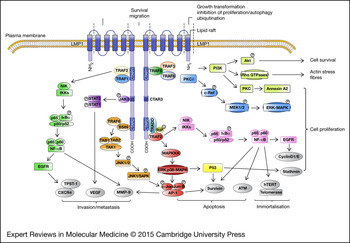
LMP1 is a 66 kDa integral membrane protein comprising a short amino acid cytoplasmic N-terminus (amino acids 1–23), six transmembrane (6TM) spanning regions (amino acids 24–186) and a large 200 amino acid cytoplasmic C-terminal tail (amino acid 187–386). Three distinct functional domains have been identified within the C-terminal regions: C-terminal activating regions 1, 2 and 3 (CTAR1, CTAR2 and CTAR3). These regions trigger different signalling pathways (Fig. 1). Recently, two reviews summarise the contribution of EBV gene products to NPC pathogenesis in relation with LMP1 (Refs Reference Yoshizaki12, Reference Dawson, Port and Young13). Here we review the general novel features of different domains of LMP1 and signalling pathways in NPC. We then focus on the potential roles of LMP1 in stem cells, metabolism reprogramming and therapeutic strategies in NPC.
Activation of cell signalling pathways by LMP1 in NPC impacts a variety of cellular processes such as invasion, metastasis, apoptosis, and cell proliferation. The LMP1 protein can be subdivided into three domains: 1) a short N-terminal cytoplasmic tail, 2) six hydrophobic transmembrane loops, and 3) a long C-terminal cytoplasmic region, which possesses most of LMP1’s signalling activity in its three C-terminal regions (C-terminal activation regions 1, 2 and 3 (CTAR1, CTAR2 and CTAR3)). LMP1 associates with tumour necrosis factor receptor-associated factors (TRAFs), tumour necrosis factor receptor-associated death domain protein (TRADD), and receptor-interacting protein (RIP). LMP1 activates different signal transduction pathways, which include nuclear factor kappa B (NF-κB), protein kinase C (PKC), c-jun N-terminal kinases (JNK)/c-Jun/activator protein 1 (AP-1), mitogen-activated protein kinases (p38-MAPK)/activating transcriptional factor (ATF), and Janus kinase (JAK)/ signal transducers and activators of transcription protein (STAT), and causes various downstream pathological changes in cell proliferation, anti-apoptosis and metastasis.

Different domains of LMP1 trigger apoptosis, autophagy and signalling pathways
While the cytosolic N-terminus of LMP1 plays a role in the orientation and processing of LMP1, six TM domains self-aggregate and are involved in intermolecular oligomerisation. The TM 1-2 FWLY of LMP1 mediates intermolecular interaction, raft localisation and constitute NF-κB activation (Refs Reference Soni16, Reference Yasui17). Besides, the TM domains of LMP1 are recruited to membrane microdomain lipid rafts, inducing the localisation of signalling components, such as PI3K, to the lipid rafts. Through the interaction of LMP1 with vimentin and the cytoskeleton, signalling pathways are then activated to induce transformation (Refs Reference Meckes, Menaker and Raab-Traub18, Reference Lingwood and Simons19). These lipid rafts control the sorting of LMP1 into exosomes through the intact complex of LMP1 with tetraspanin family member, CD63, in turn, limits constitutive NF-κB activation. Knockdown of CD63 leads to sequestering of LMP1 protein in intracellular compartments and reduces LMP1 release NF-κB activation (Refs Reference Verweij20, Reference Verweij, Middeldorp and Pegtel21). Additionally, LMP1 in the NPC cells significantly increases the levels of hypoxia-inducible factor-1α (HIF1α) in the exosomes, indicating that the exosome-mediated transfer of functional pro-metastatic factors by LMP1-positive NPC cells to surrounding tumour cells promotes cancer progression (Refs Reference Verweij20, Reference Aga22). Interestingly, TM domains 3–6 of LMP1 in B cells are sufficient to induce autophagy (Ref. Reference Lee and Sugden23), an evolutionarily conserved and important homeostatic process for the degradation of cytoplasmic materials (Ref. Reference Silva and Jung24). LMP1-initiated autophagic degradation may serve as a mechanism to limit LMP1 accumulation in EBV-infected cells. However, the precise mechanisms of how viruses modulate the autophagic response during infection remain unknown, especially in NPCs.
Most LMP1-mediated signal transduction events are mediated via the extensively characterised CTAR1 and CTAR2. CTAR1 contains a PXQXT motif that interacts with TNF receptor-associated factors (TRAFs) 1, 2, 3 and 5. TRAF1 coordinates polyubiquitin signalling to enhance LMP1-Mediated growth and survival pathway activation. TRAF2 acts as a linker between CTAR1 and TRAF6. CTAR2 contains a YYD motif that binds the TNF receptor-interacting protein (RIP) and the TNF-associated death domains (TRADDs), which enables an indirect interaction between LMP1, TRAF2 and TRAF6. These adapters in turn recruit FADD and caspase 8 to the apoptotic complex. As a result of the protein–protein interactions involving CTAR1 and CTAR2, multiple signal transduction events are initiated (Refs Reference Zheng25, Reference Li and Chang26, Reference Ndour27, Reference Greenfeld28, Reference Tworkoski and Raab-Traub29). Not much is known about the role of CTAR3, which lies between CTAR1 and CTAR2, in LMP1-induced signalling. CTAT3 has been shown to bind JAK3 to activate the DNA binding of STAT signalling, but not in B-lymphoma or lymphoblastoid cell lines (LCLs) (Refs Reference Gires30, Reference Liu31, Reference Higuchi, Kieff and Izumi32). Interestingly, Ubc9, a single reported SUMO-conjugating enzyme, interacts with CTAR3 of LMP1 in the cytoplasm. This interaction in turn mediates the sumoylation of interferon regulatory factor 7, and the sumoylation contributes to LMP1-mediated cellular migration and the maintenance of EBV latency (Refs Reference Bentz, Whitehurst and Pagano33, Reference Bentz, Shackelford and Pagano34, Reference Bentz35) (Fig. 1). Interestingly, both RIP and caspase 8 are the key components of necroptosis, an alternative form of cell death (Ref. Reference Vanden Berghe36). Whether there is interplay between the signalling pathways triggered by LMP1 and necroptosis requires further study. Such an interaction could feasibly contribute to the novel balance between cell survival and cell death after viral infection.
Interestingly, low levels of LMP1 can induce cell growth and promote cell survival; however, high levels of LMP1 expression are associated with growth inhibition and sensitisation to apoptosis in response to different stimuli (Refs Reference Liu37, Reference Zhang38). These findings are similar to our studies using an inducible system for LMP1 expression in NPC cells (Ref. Reference Faqing39). These paradoxical effects may be associated with the ability of LMP1 to upregulate both pro- and anti-apoptotic genes and disrupt cellular DNA repair programmes (Refs Reference Liu40, Reference Dirmeier41, Reference Brocqueville42). The 6TM of LMP1 activates the unfolded protein response (UPR) constitutively in the absence of a ligand, which also induces apoptosis. Constitutive signalling from the CTARs of LMP1 inhibits the apoptosis induced by the UPR. Bcl2a1, which is activated by LMP1, inhibits the UPR-induced apoptosis activated by LMP1 (Ref. Reference Pratt, Zhang and Sugden43).
Recently, cells expressing low levels of LMP1 have been found to display early stages of autophagy (autophagosomes), while those expressing high levels of this oncogene been found to display the late stages of autophagy (autolysosomes) (Ref. Reference Lee and Sugden23). However, the amount of LMP1 in NPC biopsies is not correlated with the presence of lymph node and metastasis, but is instead correlated with patient age, with higher amounts of the viral protein detected in juvenile subjects (Ref. Reference Khabir44). LMP1 triggers several important signalling pathways, such as AP-1, NF-κB and STAT3, in NPC (Refs Reference Zheng25, Reference Wang45, Reference Chen46), in turn, upregulating programmed cell death protein 1 ligand (PD-L1) under activation of these three pathways (Ref. Reference Fang47). It also hints that different levels of LMP1 may trigger these different pathways. The results of in inducible system experiments have been unclear as to how much LMP1 expression is sufficient to induce tumourigenic, invasive and metastatic factors.
LMP1 modulates the expression and phosphorylation of transcription factor p53
The tumour suppressor gene p53 is a critical mediator of the cell cycle, DNA repair, cell differentiation and apoptosis. Many human tumours are associated with p53 mutations, supporting its pivotal role as a key tumour suppressor in tumourigenesis (Refs Reference Li48, Reference Lujambio49). Unlike in most human tumours, wild-type p53 accumulates in NPC, and the mutation rate of p53 is <10% (Refs Reference Spruck50, Reference Sun51). Mitogen-activated protein kinases (MAPKs) have a direct role in the LMP1-induced phosphorylation of p53 at multiple sites, which provides a novel view to understand the mechanism of the activation of p53 in NPC. LMP1 modulates multiple p53 phosphorylation sites, such as Ser15, Ser20, Ser392 and Thr81. Furthermore, the LMP1-induced phosphorylation of p53 at Ser15 is directly accomplished by extracellular signal-regulated kinase (ERK). Similarly, the LMP1-induced p53 phosphorylation of Ser20 and Thr81 is completed by JNK, while that of Ser 15 and Ser392 is instead completed by p38 kinase (Ref. Reference Li52). Moreover, the phosphorylation of p53 is associated with its transcriptional activity, and its stability is modulated by LMP1. In addition, EBNA1 protein could sequester ubiquitin-specific protease (USP7), a key regulator of p53, from p53 in vivo, thereby destabilising p53 (Ref. Reference Saridakis53). Meanwhile PML (promyelocytic leukemia) disruption by EBNA1 requires binding to USP7, but is independent of p53 (Ref. Reference Sivachandran, Sarkari and Frappier54).
Mouse double minute 2 homologue (MDM2), an important negative regulator of p53, might function as both an E3 ubiquitin ligase that recognises the N-terminal trans-activation domain (TAD) of p53 and an inhibitor of p53 transcriptional activation. Recent findings have shown that LMP1 augments MDM2 protein expression in a dose-dependent manner, leading to a drastic accumulation of ubiquitinated MDM2 species. This effect is associated with the stability of MDM2 modulated by LMP1 (Ref. Reference Li55). The CTAR1 of LMP1 also inhibits K48-linked ubiquitination of p53 by decreasing the interaction between p53 and MDM2. Meanwhile, LMP1 promotes the K63-linked ubiquitination of p53 by increasing the interaction of p53 and TRAF2. Furthermore, LMP1-rescued cell cycle arrest and the apoptosis of tumour cells induced by K63-linked ubiquitination of p53 are also believed to contribute to EBV-associated tumourigenesis (Ref. Reference Li56).
Survivin, a member of the inhibitor of apoptosis family, is widely expressed in foetal tissues and in most tumour tissues. LMP1 increases the activity of survivin through the NF-κB and AP-1 signalling pathways in NPC (Ref. Reference Faqing39). Moreover, LMP1 upregulates survivin protein expression because of the transactivation of the survivin promoter and survivin phosphorylation by p53. LMP1 causes the translocation of p53 into the nucleus with survivin, suggesting that survivin is the key downstream target of p53. Our research has shown that accumulated p53 following LMP1 exposure promoted G1/S cell cycle progression, but did not induce apoptosis in NPC pathogenesis (Ref. Reference Guo57). Although these findings are incomplete, they suggest that multiple parameters, such as the distinct cancer type, can co-ordinately determine whether p53 activation leads to cell cycle arrest or apoptosis in NPC compared with other tumours.
LMP1 modulates the intact complex of transcription factors epidermal growth factor receptor (EGFR) and STAT3
The EGFR, a commonly expressed receptor tyrosine kinase, plays a critical role in carcinogenesis. Evidence indicates that EGFR translocates into the nucleus in various tumour types, including NPC (Refs Reference Dittmann58, Reference Wang59, Reference Linggi and Carpenter60, Reference Kim61, Reference Wanner62, Reference Li63, Reference Tao64, Reference Wang65), indicating a critical role for nuclear EGFR in carcinogenesis. Nuclear localised EGFR is highly associated with disease progression, a worse overall survival in numerous cancers, and an enhanced resistance to radiation, chemotherapy, and the anti-EGFR therapies gefitinib and cetuximab (Ref. Reference Brand66).
Nuclear EGFR directly binds to the cyclin D1 promoter under the regulation of LMP1, but it has also been indicated that other factors are involved in the activation of target genes (Ref. Reference Tao64). Many factors, such the EGF, DNA damage factor ultraviolet irradiation, radiation and cetuximab exposure, may increase EGFR translocation into the nucleus (Refs Reference Dittmann58, Reference Wang59, Reference Linggi and Carpenter60, Reference Li63, Reference Wang65). These findings clearly indicate that EGFR acts as a transcriptional factor that affects target genes involved in cellular transformation, cell cycle regulation, DNA damage repair and replication. Transcriptional intermediary factor 2 (TIF2), a member of the p160 nuclear receptor co-activator gene family, is linked to the proliferation of cancer cells. LMP1 upregulates the expression of TIF2 and promotes the interaction of EGFR with TIF2 in NPC. Furthermore, the intact complex is linked with cyclin D1 promoter activity in an LMP1-dependent manner. The physiological functions of the intact complex are associated with cell proliferation and cell cycle progression (Ref. Reference Shi67). These findings suggest that TIF2 is a novel binding partner for nuclear EGFR and is involved in regulating its target gene expression.
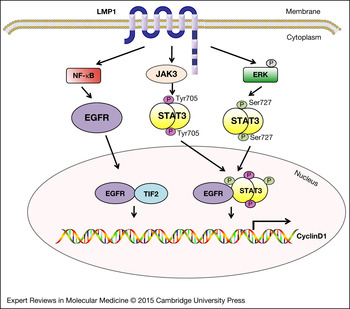
Signal transducer and activator of transcription 3 (STAT3) is a member of the STAT family of cytoplasmic proteins that is constitutively active in many human cancers (Refs Reference Santarius68, Reference Lo69). Upon stimulation by cytokines or growth factors, STAT3 translocates into the nucleus to upregulate numerous target genes, such as cyclin D1, c-fos, c-Myc, Bcl-XL and VEGF, stimulating cell proliferation and preventing apoptosis. Overexpression and activation of STAT3 is strongly associated with NPC (Refs Reference Wang45, Reference Hsiao70, Reference Ting71). LMP1 stimulates the phosphorylation of STAT3 at both tyrosine 705 (Tyr705) and serine 727 (Ser727) (Ref. Reference Liu31). Nuclear STAT3 Tyr705 phosphorylation increases in LMP1-positive NPC tissues, and STAT3 Tyr705 phosphorylation is related to clinical stages III and IV in NPC patients. Furthermore, LMP1 signals are mediated through the JAK3 and ERK1/2 pathways upon the activation of STAT3. LMP1 induces vascular endothelial growth factor (VEGF) expression via the JAK/STAT and MAPK/ERK signalling pathways (Ref. Reference Wang45). LMP1 promotes the interaction of EGFR and STAT3 in the nucleus. Nuclear EGFR and STAT3 can target the cyclin D1 promoter directly, thereby upregulating the cyclin D1 promoter activity and mRNA levels and providing a novel linkage between the deregulated EGFR signalling and the activation of cyclin D1 gene expression induced by LMP1 in NPC tumourigenesis (Ref. Reference Xu72) (Fig. 2). It is unclear what the other targets of these transcription factors beyond cyclin D1 are involved in NPC, and it is necessary to identify them in a future genome-wide assay in EGFR and/or STAT3.
LMP1 modulates the intact complex of EGFR and STAT3 in NPC. Epstein-Barr virus latent membrane protein 1 (LMP1) regulates EGFR promoter activity in a NF-κB dependent manner and regulates the nuclear accumulation of EGFR in nasopharyngeal carcinoma (NPC). Furthermore, LMP1 is also found to stimulate the phosphorylation of STAT3 at both Tyr 705 and Ser 727, and the different phosphorylation of STAT3 is found to be a result of the activation of either JAK3 or ERK. Accordingly, nuclear EGFR interacted with both STAT3 and TIF2 in the presence of LMP1 in a dependent manner. The intact complex of both EGFR/STAT3 and EGFR/TIF2 was recruited to the promoter region of cyclin D1. The physiological functions of the intact complex were associated with cell proliferation and cell cycle progression.

LMP1 triggers regulation of the ERK-mediated Op18/stathmin and PKC-medicated Annexin A2 phosphorylation signalling pathways
Using combined phosphorylation enrichment with proteomics technology, we identified phosphorylation sites on 25 new components of the LMP1 signalling pathway, including oncoprotein 18 (Op18)/stathmin, annexin A2, heat shock protein 27 (HSP27) and several kinases (Ref. Reference Yan73).
Op18/stathmin, a highly conserved small cytosolic phosphoprotein, is overexpressed in tumours (Ref. Reference Curmi74) and regulates microtubule (MT) dynamics. During the cell cycle, Op18/stathmin integrates different signals to regulate MT polymerisation and depolymerisation, and its activation adapts to the phase of the cell cycle (Ref. Reference Mistry and Atweh75). Recently, LMP1 has been shown to accelerate cell cycle progression through cdc2-mediated Op18/stathmin phosphorylation during the G2/M phase (Ref. Reference Lin76). Dynamic MT equilibrium is crucial for a series of biological features, including cell morphology stabilisation, substance transportation, and cell division, proliferation, migration and invasion (Ref. Reference Belletti77). The level of Op18/stathmin expression is also correlated with the pathologic features and clinical outcomes (Ref. Reference Cheng78). Interestingly, paclitaxel reduces the expression of Op18/stathmin, and combining Op18/stathmin silencing with paclitaxel treatment enhances MT polymerisation, providing a new approach for clinical NPC treatment (Ref. Reference Wu79). LMP1 promotes the phosphorylation, but not the expression, of Op18/stathmin. The LMP1-induced MAPK activity is not constant but instead varies with the cell cycle progression. LMP1 upregulates the phosphorylation of MAPK mainly during the G1/S phase, but the activity of MAPK is negatively regulated by LMP1 during the G2/M phase. The main pathway regulated by LMP1 is the ERK/MAPK pathway (Ref. Reference Lin80).
Annexin A2, a calcium-dependent phospholipid-binding protein, plays a role in the regulation of cellular growth and in signal transduction pathways. LMP1 can increase the serine phosphorylation level of annexin A2 by activating the protein kinase C (PKC) signalling pathway, which was confirmed by another group (Ref. Reference Endo81). Furthermore, LMP1 induces the nuclear entry of annexin A2 in an energy- and temperature-dependent manner (Refs Reference Yan73, Reference Yan82). LMP1 increases the phosphorylation level of annexin A2 at serine 25 by activating the phosphoinositide-specific phospholipase C (PI-PLC)–PKCα/PKCβ pathway, mainly through the activation of the PKCβ pathway (Ref. Reference Luo83). Additionally, active recombinant PKCα, PKCβ I, and PKCβ II kinases are able to phosphorylate annexin A2 at serine 25. In the nucleus, Annexin A2 plays an important role in DNA synthesis and cell proliferation (Ref. Reference Luo83).
TPST-1 and tyrosine sulfation of CXCR4 are induced by LMP1 and associated with the metastatic potential of NPC
The CXCR4 receptor and its chemokine ligand SDF-1α (CXCL12) are crucial for embryonic development, but have also been implicated in various pathologic conditions, including cancer metastasis (Refs Reference Muller84, Reference Kucia85). Cancer progression appears to be dependent on SDF-1α/CXCR4 signalling (Ref. Reference Kucia86). The expression of functional CXCR4 is associated with the metastatic potential of human NPC (Ref. Reference Hu87). Accumulating evidence has revealed that EBV is closely associated with expression of chemokines and their receptors, especially SDF-1/CXCR4. LMP1 induces HIF expression (Ref. Reference Kondo88), which can upregulate CXCR4 and SDF-1 expression in NPC. LMP1 regulates the expression of CXCR4, which is dependent on both IKKα and IKKβ in murine embryo fibroblasts (MEFs) (Ref. Reference Luftig89). LMP1 also downregulates the expression of CXCR4 in B cells (Ref. Reference Nakayama90) and upregulates the expression of CXCR4 in NPC C666-1 cells (Ref. Reference Li91). Tyrosine sulfation, an important posttranslational modification, is required for the biological function of chemokine receptors, including CXCR4 (Refs Reference Farzan92, Reference Farzan93, Reference Seibert94, Reference Xu95, Reference Liu96, Reference Seibert97). Tyrosylprotein sulfotransferase 1 and 2 (TPST-1 and TPST-2) are responsible for the catalysis of tyrosine sulfation of chemokine receptors, such CXCR4 (Refs Reference Farzan93, Reference Xu95, Reference Liu96, Reference Seibert97, Reference Beisswanger98, Reference Moore99). LMP1 upregulates the expression of TPST-1 through the nuclear EGFR-binding site in the TPST-1 promoter. Meanwhile, the correlation between LMP1 and TPST-1 is linked with metastasis in NPC. TPST-1 contributes to the sulfation of CXCR4 in the N-terminal region of tyrosine 21. Moreover, tyrosine sulfation of CXCR4 is associated with cancer metastasis and invasion (Ref. Reference Xu100). Clearly, both TPST-1 and CXCR4 sulfation provide a novel contribution in tumour metastasis.
LMP1 upregulates immunoglobulin kappa (Igκ) expression and immune escape
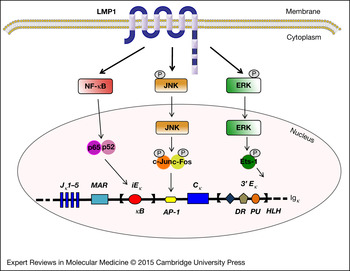
The restriction of Ig expression to cells of the B-cell lineage is well established. However, the Igκ light chain is expressed in epithelial cancer cell lines and epithelial tissues (Refs Reference Chen, Qiu and Gu101, Reference Geng102, Reference Hu103, Reference Hu104, Reference Li105, Reference Li106, Reference Li107, Reference Qiu108, Reference Zheng109, Reference Zheng110), promoting growth and inhibiting immunity (Ref. Reference Li107). The Igκ light chain gene expression is under the control of distinct cis-regulatory elements, including promoters and enhancers. Two important κ enhancers, the intronic enhancer (iEκ), which lies between the Jκ–Cκ region, and the 3′ enhancer (3′Eκ), which is located downstream of the Cκ region, have been identified (Refs Reference Bergman111, Reference Meyer and Neuberger112, Reference Judde and Max113). On the basis of the finding that the levels of the κ light chain are substantially higher in LMP1-positive cells compared to LMP1-negative cells (Refs Reference Liao114, Reference Liu115), LMP1 is believed to upregulate 3′Eκ activity and κ light chain gene expression by activating the Ets-1 transcription factor through the ERKs signalling pathway (Ref. Reference Liu116). The Ig Iα1 promoter, which is essential for initiating Ig Iα1–Cα1 GL transcription, is highly activated in cancer cells. In further investigations, Ets-1 was found to bind to the PU.1 motif and transactivate the Ig Iα1 promoter. These results indicate that Ets-1 activates the expression of the Ig Iα1–Cα1 GL transcript, which is critical for class switch recombination (Ref. Reference Duan117) (Fig. 3). LMP1 could also regulate the activity of the Ig Iα1 promoter by activating Ets-1. This evidence hints at a novel regulatory mechanism of κ expression in which virus-encoded proteins activate the two important κ enhancers by activating transcription factors in non-B epithelial cancer cells.
LMP1 upregulates the 3′ enhancer activity and expression of Ig kappa. The expression of the kappa light chain gene is under the control of distinct cis-regulatory elements, including the kappa intron enhancer (iEκ) and the kappa 3′ enhancer (3′Eκ). DNA binding proteins that recruit the enhancer mediate the function of enhancers. The indicated protein binding sites have been identified and characterised in each of the kappa enhancers. Human iEκ is active in Igκ-expressing NPC cells. The LMP1- stimulated NF-κB and AP-1 activation results in augmenting the activation of the iEκ. LMP1 promotes the interactions of the heterodimeric NF-κB (p52/p65) and heterodimeric AP-1 (c-Jun/c- Fos) transcription factors with the human iEκ enhancer region. These interactions are important for the upregulation of the kappa light chain in LMP1-positive nasopharyngeal carcinoma cells. LMP1 upregulates 3′Eκ activity by activating the ERK/Ets-1 signalling pathway.

Tumour immune evasion is emerging as a hallmark of cancer while immune escape that is mediated by LMP1 is an important feature of NPC (Refs Reference Li91, Reference Li118, Reference Middeldorp and Pegtel119). Several target genes of LMP1 involve in the process. Programmed cell death protein 1 ligand (PD-L1) is a well-known immune suppressive factor in a variety of cancer types. LMP1 and IFN-γ pathways cooperate to regulate PD-L1 expression independent of inflammatory signals in the tumour microenvironment (Ref. Reference Fang47). Interestingly, LMP1 is actively secreted from EBV-positive tumour cells to mediate immunosuppressive effects on tumour-infiltrating lymphocytes surrounding the neoplasmtic cells (Ref. Reference Middeldorp and Pegtel119). The mechanism for this is that the first transmembrane region directly inhibits T cell activation and NK cytotoxicity in vitro, indicating that direct immunosuppression, previously thought to be restricted to RNA viruses, has been described in a DNA virus (Ref. Reference Dukers120). These findings further support that LMP1 plays a critical role in immune regulation.
In addition, LMP1 or associated protein-direct immunodulatory effects. LMP1 colocalises in part with MHC-II and is present on exosomes derived from a LCL. As LMP1 containing exosomes is shown to inhibit the proliferation of peripheral blood mononuclear cells, indicating that LMP1 is involved in immune regulation (Ref. Reference Flanagan, Middeldorp and Sculley121), it further confirms that NPC cells could release HLA class II positive exosomes containing galectin 9 and/or LMP1 (Ref. Reference Keryer-Bibens122). The different strains of LMP1 involve in different immune response: the ability of B cell-associated LMP1 (B-LMP1) and a nasopharyngeal carcinoma-associated LMP1 (NPC-LMP1) to modulate B cell antigen-presenting cell (APC) function and T-cell responses. B lymphoma cells transfected with NPC–LMP1 stimulated resting T cells in mixed lymphocyte reaction less efficiently than B-LMP1 transfectants (Ref. Reference Pai123).
LMP1 gives rise to cancer stem cells (CSCs) and metabolism reprogramming
CSCs are cells within a tumour that possess stem cell properties, namely the ability to self-renew and give rise to progeny destined for differentiation to regenerate the tumour cell diversity. Cellular reprogramming mediated by an oncogenic virus might promote the formation of tumour-initiating cells or CSCs. LMP1 induces a CSC-like phenotype and was found to enhance the self-renewal potential of nasopharyngeal EC lines and NPC cells, further supporting the involvement of EBV in modulating cellular plasticity and inducting CSC cellular phenotypes (Refs Reference Kondo124, Reference Yang125). This notion has also been highlighted in a more recent study (Ref. Reference Lun126), which has demonstrated the upregulation of multiple stem cell markers in an EBV-positive NPC cell line with increases tumourigenic potential and a high level of resistance to chemotherapy. Finally, NPC is frequently associated with the deregulation of the Hedgehog (HH) pathway, a pathway that is associated with stem cell maintenance. EBV (EBNA1, LMP1 and LMP2A) activates the HH pathway through the induction of the SHH ligand, which leads to the increased expression of stemness-associated genes and the induction of stem cell phenotypes in these cells (Ref. Reference Port127). LMP1 and LMP2A co-operates in the modulation of DNA damage response and apoptotic signalling pathways in NPC (Ref. Reference Wasil128), it is unclear whether EBV products cooperatively regulate stemmess in NPC cells. These studies have suggested the possibility that LMP1 might exert its tumourigenic properties at least in part by giving rise to CSCs within the infected tissues.
In cancer cells, the main hallmark of the Warburg effect is aerobic glycolysis. In this process, glucose consumption and lactate production are both increased even in the presence of oxygen (Ref. Reference Vander Heiden, Cantley and Thompson129). Several other metabolic pathways are also enhanced, including the pentose phosphate pathway (PPP), amino acid metabolism and lipid homeostasis. The Warburg effect can also be induced in vitro by some vertebrate viruses, including human papillomavirus (HPV) (Ref. Reference Zwerschke130), human cytomegalovirus (Ref. Reference Munger131), Kaposi's sarcoma herpesvirus (Ref. Reference Delgado132), hepatitis C virus (Ref. Reference Diamond133) and EBV (Ref. Reference Xiao134). Hexokinase 2 (HK2) catalyses the first step in the glycolytic pathway, in which glucose is phosphorylated into glucose-6-phosphate in the glycolytic pathway, and is frequently overexpressed in cancers (Ref. Reference Mathupala, Ko and Pedersen135). LMP1 reprograms glycolysis by upregulating HK2 expression in NPC and human nasopharyngeal ECs, and the transcription factor c-Myc is required for the LMP1-induced upregulation of HK2 (Refs Reference Xiao134, Reference Lo136). It functions by attenuating the PI3K/Akt–GSK3beta–FBW7 signalling axis (Ref. Reference Xiao134). Interestingly, the PI3K–Akt–mammalian target of rapamycin (mTOR) pathway is of central importance in triggering the WSSV (white spot syndrome virus)-induced Warburg effect (Ref. Reference Su137), indicating that the same molecular mechanism occurs after different types of virus infection. Under normal conditions, aerobic glycolysis is active in LCLs, which express six nuclear proteins (EBNA1-6) and three latent membrane proteins (LMP-1, LMP-2A and -2B) referred to as Latency III, and in freshly EBV-infected B-cells. However, it is not active in mitogen-activated B-cells. Both EBNA3 and EBNA 5 bind to prolyhydorxylases 1 and 2, respectively, thus trans-activating several genes involved in aerobic glycolysis by stabilising hypoxia-induced factor 1 alpha (Ref. Reference Darekar138).
LMP1 impacts its targeted genes through chromatin modification
Acquired epigenetic abnormalities, such as DNA methylation, histone modification and chromatin remodelling, participate together with other chromatin alterations in the early stages of carcinogenesis. Because no differences in the EBV methylome exist when comparing the NPC cells line from southern China and the primary NPCs from southern Europe (Ref. Reference Fernandez139), larger studies are necessary to address the role of EBV and its products in epigenetics. The aberrant hypermethylation of several genes has been found in NPC. These genes include RASSF1A/2A, DAP-kinase, p15, p16, p14, RAR-ß2, R1Z1, CDH1, 14-3-3 sigma and BRD7 (Refs Reference Tong140, Reference Yi141, Reference Yanatatsaneejit142, Reference Liu143, Reference Lee144, Reference Cui145, Reference Zhang146, Reference Shao147, Reference Chow148, Reference Tao and Chan149), suggesting that epigenetic factors are involved in the early stages of NPC carcinogenesis. Interestingly, the interaction of the host with EBV also alters the promoter hypermethylation of the tumour suppressor gene PTEN and increases DNA methyltransferase 1 (Dnmt1) protein levels (Refs Reference Hino150). The high titre of EBV is consistent with the hypermethylation of E-cadherin, RASSF1A and TSLC1 (Refs Reference Niemhom151, Reference Zhou152). In addition, LMP1 induces the DNA methylation of RAR-ß2 via activation of DNA methyltransferases (DNMTs) (Refs Reference Tsai153, Reference Tsai154, Reference Seo, Kim and Jang155). LMP1 downregulates the expression of E-cadherin through the mechanisms that involve either promoter methylation by DNMTs or transcriptional repression by Twist and Snail (Refs Reference Aga22, Reference Fang47, Reference Kondo124, Reference Horikawa156, Reference Sides157, Reference Horikawa158, Reference Luo and Yao159, Reference Li160). Recently, we demonstrate that LMP1 might trigger RNA polymerase II stalling at Hox genes, a new format of transcription, and that irradiation may reactivate the Hox genes by DNA demethylation (Ref. Reference Jiang161). Evidence suggests that LMP1 plays a critical role by increasing DNA methylation at some target genes, contributing to carcinogenesis, especially of NPC. Furthermore, this finding hints at the existence of a novel pathway that reactivates these tumour suppressor genes by epigenetic approaches. However, whether the epigenetic processes act at the level of DNA methylation, chromatin-remodelling or non-coding RNA and their potential role in different stages of cancer remain unclear. It also remains unknown if LMP1 takes part in these epigenetic changes. The development of high-throughput sequencing has made it more convenient to explore the interplay of LMP1 in the host epigenome and transcriptome.
Interference therapy strategies targeting LMP1
Several interference strategies such as vaccines, therapeutic antibodies, and DNAzymes have been developed to target LMP1. Vaccines are the most effective and economic preventive approach against viral infections and thus may be excellent tools for reducing the cancer rate. Although the HPV vaccine has been available on the market for several years (Ref. Reference Schiller and Davies162), there is still no vaccine for EBV fifty years after its discovery. While the EBV gp350 vaccine was first used to protect animals from EBV lymphomas in 1985, there has been relatively little interest in developing this vaccine for human protection. Only one stage 2 EBV vaccine trial has been developed, and no vaccine has been taken into advanced-stage trials. Importantly, the tested vaccine reduced the incidence of infectious mononucleosis that occurs mainly in developed countries by 78%, but did not block viral infection (Refs Reference Epstein163, Reference Sokal164, Reference Cohen165). Interestingly, a vaccine targeting EBNA-1 and LMP-2 has been found to be safe and immunogenic in NPC patients, although its therapeutic efficacy has not yet been assessed (Refs Reference Balfour166, Reference Hui167). Although vaccines against EBV are currently in development, the development and approval of a vaccine or another strategy to prevent EBV-associated diseases should surely be hastened.
The therapeutic strategy of different domains of the LMP1 sequence has also been developed. Therapeutic antibodies that target both the C-terminal region and the extracellular region of LMP1 have been shown to inhibit the efficiency of LMP1 functions in ECs and nude mice xenografted with human EBV-positive lymphoma cells (Refs Reference Fang168, Reference Delbende169, Reference Paramita170). A novel human antibody against LMP1 extracellular domain is subsequently conjugated with mitomycin C, a chemotherapeutic drug, to generate a potential immunoconjugate agent, kills LMP1-positive NPC cell lines in vitro and supresses NPC growth in nude mice transplantation model (Ref. Reference Chen171).
The use of antibodies as discovery tools and gene therapeutic agents has been greatly extended through their intracellular expression as intrabodies that has provided a powerful tool to manipulate cellular signalling pathways in a highly precise manner. Intrabodies are among the most robust molecular techniques by incorporation of short polypeptide sub-cellular trafficking signals to the N- or C-terminus of the intrabodies, which allow them to be expressed at high concentrations in the very sub-cellular compartments where a target protein is located. The cytosolic intrabodies against the CTAR1 site of LMP1 block NF-κB activation in cells by forming an intact complex, in turn, the intrabody could inhibit LMP1 functions in ECs (Refs Reference Fang168, Reference Gennari172).
In addition, the use of shRNA to knockdown LMP1 can induce apoptosis in EBV-positive lymphoma cells and is associated with the inhibition of telomerase activity and expression (Refs Reference Mei173, Reference Mei174). On the basis of that adenoviral vector (AdV)-transduced dentritic cells (DCs) and EBV-transformed B- LCLs as antigen-presenting cells to activate and expand LMP1 specific T cells, autologous T cells targeting LMP1 and/or LMP2 could sustain complete response in patients with Hodgkin, non-Hodgkin lymphoma and extranodal NK/T-cell lymphoma (Refs Reference Bollard175, Reference Bollard176, Reference Cho177). In addition, LMP1 is not essential for EBV-induced lymphomas in vivo, but trigger substantial signal to T cells in EBV-positive B cell lymphomas (Ref. Reference Ma178). Interestingly, T cells modified with a LMP1-specific chimeric antigen receptor are an alternative and attractive strategy to treat LMP1-positive NPC cells in vitro and in vivo (Ref. Reference Tang179). The novel adenoviral expression system AdE1–LMPpoly encodes multiple CD8+ T-cell epitopes from LMP1, LMP2 and the EBNA1 protein (Ref. Reference Smith180). This system is highly efficient, safe and well tolerated and may offer clinical benefits to patients with NPC.
DNAzymes are synthetic, single-stranded DNA catalysts that can be engineered to bind and cleave the target mRNA of a disease-causing gene. By targeting LMP1 mRNA, we successfully obtained a phosphorothioate-modified ‘10–23’ DNAzyme (DZ1) by screening a series of DNAzymes. DZ1 significantly downregulated the expression of LMP1 in NPC cells, in turn inhibiting cell proliferation and metastasis and promoting apoptosis in NPC by interfering with signal pathways that are abnormally activated by LMP1, including the NF-κB, AP-1 and STAT3 signal pathways (Refs Reference Wang45, Reference Lu181, Reference Lu182, Reference Yang183, Reference Yang184, Reference Yang185). DZ1 treatment increases the sensitivity of NPC cells and patients to radiation treatment and standard radiotherapy (Refs Reference Xiao134, Reference Yang185, Reference Ma186, Reference Chen187, Reference Ma188, Reference Cao189, Reference Yang190). Furthermore, the mechanism of DZ1 has been well studied. Telomerase activity is controlled by the regulation of the catalytic subunit of telomerase (hTERT), through the expression and post-translational modification of hTERT. The expression of hTERT is tightly regulated at the transcriptional level, and the hTERT promoter contains a variety of binding sites for transcription factors. LMP1 induces telomerase activity in NPC cells through NF-κB activation, an effect that is c-Myc dependent on the basis of c-Myc-response E box element in the hTERT promoter (Refs Reference Ding191, Reference Yang192). The most common type of post-translational modification is phosphorylation by several intracellular kinases. The p16(INK4A)/Rb/E2F1 and JNK-signalling pathways are involved in the regulation of telomerase activity via LMP1. Furthermore, LMP1 promotes the expression and phosphorylation of hTERT through the Akt pathway, while DZ1 targeting LMP1 inhibits hTERT expression and activity and increases the radiosensitivity of LMP1-positive cells (Refs Reference Yang190, Reference Ding193). DNAzyme treatment targeting to LMP1 is safe and effective, suggesting the potential of the DZ1 therapeutic approach for the treatment of EBV-related cancers.
We also developed a natural product epigallocatechin-3-gallate (EGCG), which inhibits the NF-κB-signalling pathway. It is triggered by LMP1 in NPC, in turn decreasing cell survival in a dose-dependent manner (Ref. Reference Yan194). Another nature product, quercetin increases apoptosis by promoting more the EBV progeny production, and inhibits more EBV infection than isoliquiritigenin (Ref. Reference Lee195). This will provide a novel way for the interference of LMP1-positive cancers. The US National Institute of Health (NIH) recently called for a new initiative to reduce global cancer incidence, with EBV among the top candidates for future advances.
Perspective and conclusions
It is clear that genetic, ethnic and environmental factors play a role in the development of NPC. Although studies on LMP1 function were mainly performed in B cell and rodent fibroblast systems, it is now clear that LMP1 has critical effects on the behaviour of ECs, affecting a variety of cellular processes in immortalised nasopharyngeal cells and NPC cells. Three new susceptibility loci, TNFRSF19, MDS1-EVI1 and the CDKN2A–CDKN2B, have been identified in NPC (Ref. Reference Bei196). These have been linked to the signalling pathways triggered by LMP1, although this area of research merits further investigation. Besides, EBV noncoding RNA, including EBER2 binds nascent RNA to drive host B cell transcription factor PAX5 to viral DNA by forming an intact complex of RNA–RNA interactions, in turn, inhibiting the expression LMP2A/B and LMP1(Ref. Reference Lee197), whether and how the intact complex of PAX5 and EBER2 in nasopharyngeal epithelial cells remains for further identification.
In children in China, the EBV seroprevalence is more than 50% before the age of 3 and more than 90% after the age of 8, emphasising the importance of EBV vaccine development and implementation (Ref. Reference Xiong198). Clearly, no evidence thus far has shown that vaccines to EBV and its products such as LMP1 are effective in preventing NPC initiation, but this remains a potentially preventative measure for these EBV-associated human malignancies.
Acknowledgements and funding
We would like to thank all laboratory members for their critical discussion of this manuscript, and apologise to those excellent papers not mentioned because of space limitations. This work was supported by the National Basic Research Programme of China (grant no. 2011CB504300 to Y.T. and Y.C.); the National High Technology Research and Development Programme of China (863 Programme) (grant no. 2012AA02A501 to Y.C.); the National Natural Science Foundation of China (grant numbers 81171881 and 81372427 to Y.T., 81302354 to Y.S., 81372182 to L.Y. and 30930101 to Y.C.); the Hunan Natural Science Foundation of China (grant no. 12JJ1013 to Y.T.); the Fundamental Research Funds for the Central Universities (grant no. 2011JQ019 to Y.T.); and the Hunan Provincial Innovation Foundation For Postgraduates (grant no. 71380100002 to Y.J.).
Conflicts of Interest
The authors declare no conflicts of interest. This manuscript has been read and approved by all authors and has not been submitted for publication elsewhere.
Author contributions
Y.S. and Y.T. drafted the manuscript. Y.S., L.Y., J.T., Y.T. and Y.C. participated in the study design. Y.T., J.T. and Y.C. participated in the study design and coordination and helped draft the manuscript. All authors read and approved the final manuscript.