


INTRODUCTION
Findings in political science, economics, and security studies suggest that during civil war aid can be used to help establish control of contested areas and reduce insurgent violence by winning the “hearts and minds” of the population. These accounts typically ignore the strategic implications of aid distribution by progovernment forces, namely that rebel groups should resist the implementation of aid projects that would undermine their position.
In this article, I show that insurgents strategically respond to counterinsurgency aid in contested districts by resisting through violent means, calling into question the utility of counterinsurgency aid as a strategy for extending progovernment control to contested areas. My results indicate that civilian aid only reduces insurgent violence when distributed in districts already controlled by progovernment forces; when allocated to contested districts civilian aid in fact causes a significant increase in insurgent violence.
I also show that the type of aid projects, such as humanitarian aid or upgrading of security infrastructure, matters a great deal to the strategic reaction of insurgents. Humanitarian aid projects, for example, have no effect on insurgent violence in controlled or contested districts, while military defense infrastructure projects in contested areas greatly magnify the aforementioned violence-increasing effects.
These findings speak to the ongoing global discussion about the role of international aid in civil conflicts around the world. With both scholarly and policy implications, the results of this study should contribute to the aid debate by highlighting the importance of strategic responses by actors opposed to aims of aid expenditures, as well as the contingency of aid effects on quickly changing local conditions.
This study employs a new dataset of fine-grained and geolocated violence incidents to examine the effects of a major U.S. military program that used civilian development aid to counter the Taliban insurgency in Afghanistan. Crucially for theories of counterinsurgency, the program was administered in districts that were secured by U.S. military forces as well as those that were not under U.S. military control. Exploiting variation in the approval of counterinsurgency aid spending by the U.S. military in Afghanistan that is independent of week-on-week violence, I am able to identify the effect of such spending on local level violence. Using data on the positions of American battalion-level forward operating bases (FOBs) and larger military installations, I demonstrate how the effects of aid spending on violence are determined by the degree of military control.
This study offers several contributions. First, these findings suggest that military control is a vital prerequisite for development aid to have an insurgent violence-reducing effect. In contrast to claims previously put forward in scholarly and policy publications, aid on its own seems incapable of winning over civilian public opinion when it is distributed on contested terrain. This study confirms that aid spending is capable of reducing insurgent violence in places already under progovernment military control, suggesting that aid functions as a force protection and pacification tool once progovernment forces have demonstrated control.
Second, the article demonstrates that the type of aid project can matter greatly to the effect of aid on insurgent violence. On one hand, “Protective Measures” projects, which build military defense infrastructure in local districts, provoke attacks and bombings against Afghan and U.S. military targets in both contested and secured districts. Humanitarian aid projects, on the other hand, do not have a significant effect on violence.
Third, the effects we observe are not due to a change in effort on the part of counterinsurgents. Aid spending does not affect the number of progovernment operations and airstrikes against insurgent targets nor does it change the number of IED clearances by Afghan or NATO forces in either controlled or contested districts. This suggests that aid projects are not provoking civilians to immediately begin informing on insurgents, as it has been hypothesized in previous work, at least not in a way that provides actionable intelligence.
Fourth, I rule out geographic spillovers of violence between neighboring districts as a driver of the relationship between aid and insurgent violence. Incorporating a spatial lag into the main regressions only strengthens the effects of interest, even though violence is correlated across districts (Beck et al. Reference Beck, Gleditsch and Beardsley2006; Buhaug and Gleditsch Reference Buhaug and Gleditsch2008). I further demonstrate that there is no direct effect of aid spending on violence in neighboring districts, whether that aid is administered in a controlled or contested district. While it is common to assume “labor mobility” when developing models of insurgency, this suggests that at least in Afghanistan, militants are constrained in terms of where they can move and operate.
Fifth, I find that macrolevel strategic events can quickly wipe out the violence-changing effects of aid spending. Using the case of the Northern Distribution Network, a NATO supply line established in early 2009, I show that the reorientation of violence towards the new high-value target causes insurgents to stop responding to local counterinsurgency aid projects, at least in the short term.
This study is the first analysis of civilian aid spending in a conflict zone to use outcome data that are not sourced from military forces and include violence that affects nonmilitary targets. While I do also use outcome data from the U.S. military to provide a full profile of violence, new outcome data are sourced from reports by an independent NGO network in Afghanistan.
This article begins with a discussion of theories of rebel violence and development aid, followed by the specific context of Afghanistan and the aid program in question: the Commander’s Emergency Response Program (CERP). The next section describes the data used in the study. I then explain the empirical approach for the study, including the identification strategy, followed by a presentation of the main results. This is followed by an interpretation of the main results, three sets of secondary results, an analysis of mechanisms, a placebo check, and a conclusion.
COUNTERINSURGENCY AID AND REBEL RESISTANCE
In traditional cases of civil war, where an armed opposition clashes with a government, there is a struggle for the control of territory. Kalyvas (Reference Kalyvas2006) articulates this as “division of sovereignty in civil war. . . between zones of incumbent control, zones of insurgent control, and zones where control is contested.” Progovernment forces seek to extend their control to contested and insurgent controlled regions, though they may seek a negotiated peace if it becomes too costly.
Insurgents endeavor to achieve the opposite, aiming to expel government military forces and political officials. While their end goal may be to eventually overthrow the government and establish themselves as the sovereign authority, as is the case for the Taliban in Afghanistan, rebels may also have secession or autonomous devolution of power in mind.
Scholars and practitioners have long argued that a key element to establishing control (from the perspective of either side) is winning the goodwill of the civilian population. Galula (Reference Galula1964) and Trinqiuier (Reference Trinquier1964), among others, argue that political power in civil war flows from the population, with the people essentially deciding who wins the conflict based on their evaluation of the competing sides in terms of their own well-being. Berman, Felter, and Shapiro (2011) formalize this logic by presenting the conflict between progovernment forces and insurgents as essentially a contest for information that is adjudicated by the public.
One common tool used to win the support of the population is development aid spending on the part of progovernment actors. Aid has been deployed as a counterinsurgency technique by intervening forces to great fanfare, including the U.S.-led coalitions in Afghanistan and Iraq (Kilcullen Reference Kilcullen2010; U.S. Army 2009a), in the Philippines, Colombia, and a generation earlier in Vietnam and Algeria. The logic is that aid will win over the “hearts and minds” of the civilian population, which will lead them to stop collaborating with insurgents, whether through material support, information, or other means. Berman, Shapiro, and Felter (Reference Berman, Shapiro and Felter2011) also hypothesize that civilians will respond to aid by beginning to share information with counterinsurgents, allowing progovernment forces to become more effective at eliminating militants.
Recent empirical studies have found evidence that as a counterinsurgency strategy aid improves troop security, a key indicator of incumbent territorial control. Berman, Shapiro, and Felter (Reference Berman, Shapiro and Felter2011) find that hearts and minds-oriented aid spending in Iraq led to a short and long term reduction in violence against Iraqi and coalition military forces. Beath, Christia, and Enikolopov (Reference Beath, Christia and Enikolopov2016) find evidence in Afghanistan that civilian development aid improves troop security in surrounding areas, though not in the communities themselves. Crost, Felter, and Johnston (Reference Crost, Felter and Johnston2016) show experimental evidence in the Phillippines that conditional cash transfers reduce local violence. Iyengar, Monten, and Hanson (Reference Iyengar, Monten and Hanson2011) propose a labor market mechanism, finding that aid spending that increases employment reduces “labor-intensive” insurgent violence. Bohnke and Zurcher (2013) do not find any evidence that aid affects perceptions of security, however, their survey gives evidence of an improvement in perceptions of state legitimacy. Two previous studies on counterinsurgency aid in Afghanistan, by Chou (Reference Chou2012) and Child (2015), on the other hand, find no average effect of aid on violence against U.S. military forces.
These accounts, while important contributions, ignore several important strategic dynamics between government and rebel forces.Footnote 1 Most importantly, when counterinsurgents engage in spending targeted to win over the affections of the civilian population, we should expect insurgents to oppose them—violently, if necessary—whenever possible. Crost, Felter, and Johnston (Reference Crost, Felter and Johnston2014) illustrate this dynamic in the Phillippines, showing that aid projects distributed from the central government increase violence, as opposition groups sabotage projects in their early stages to undermine any goodwill the central government might earn in the local area. A study on a similar program in India by Khanna and Zimmermann (2015) also finds that aid drives short run increases in violence related to Maoist insurgency. Lyall (2014) finds a similar dynamic with respect to U.S. Air Force airstrikes in Afghanistan, with insurgents responding to coalition strikes and shows of force with attacks against progoverment forces to fight back against any loss of reputation among the populace.
A second strategic element is that insurgents, with finite resources, must decide where to carry out acts of sabotage and nonviolent resistance to counterinsurgency projects. Where costs and the likelihood of immediate retaliation are low, as in the Phillippines case, rebels can attack many aid projects, scuttling their impacts. In a more contested environment, like Afghanistan or Iraq, guerillas must make trade-offs. The ability of insurgents to carry out sabotage is in part related to the degree of control that each side has in a given territory (Harmon Reference Harmon1992; Kilcullen Reference Kilcullen2010). The costs of attacking aid projects are similarly related to zones of control; sabotaging a hearts and minds project in an incumbent-controlled area is much more likely to result in rapid retaliation by progovernment forces.
Third and finally, as noted by Kalyvas (Reference Kalyvas2006), citizens stuck between warring sides in a civil conflict often “shift endogenously towards the army” that controls their environs. Particularly when counterinsurgents make costly investments in military infrastructure, bring in equipment and regularly patrol incumbent-controlled areas, the population can quite rationally become ambivalent towards insurgents, even if pre-conflict preferences might predict sympathy towards guerillas. This suggests that the civilian population in progoverment controlled zones should more consistently respond to hearts and minds programs.
Berman et al. (Reference Berman, Felter, Shapiro and Troland2013) find some evidence for this final claim in Iraq, noting that aid and troop concentration are complements in the provision of troop security, while Biddle, Friedman, and Shapiro (Reference Biddle, Friedman and Shapiro2012) suggest that the “surge” of troops was as significant a factor in reducing violence in Iraq as any aid spending.
These three factors point to an important implication: counterinsurgency aid spending on “hearts and minds” projects should provoke violent and nonviolent retaliation from rebels, except in locations where progovernment forces have full military control. As we look towards the Afghanistan case, this implies that counterinsurgency aid would be predicted to have a violence increasing effect in contested and Taliban-controlled districts, while maintaining a violence reducing effect in districts controlled by U.S. forces.
Furthermore, the strategic responses of insurgents to aid should vary with the type of project that is being implemented. Several factors may be influential in the context, including the visibility of the project, whether the project implies an increase in military capacity for progovernment actors, whether insurgents can effectively interfere with the project using the techniques they have access to. We would expect, for example, that insurgents would respond aggressively to projects investing in military infrastructure, or that build the capacity of local government partners. On the other hand, we would not expect them to attack projects involving humanitarian aid, in part because handing out food, water, and tents is difficult to interdict, in part because violence against such a project would be directly against civilians, and lastly because this aid is far less visible to insurgents than, for example, the construction of a new military watchtower by the district government headquarters.
The Afghanistan case provides us with an opportunity to test each of these claims using detailed, geocoded violence data and random variation in counterinsurgency aid spending by the U.S. military during the 2008–10 period. While the specific dynamics of spending, resistance, and violence are unique to Afghanistan, the strategic relationship they illustrate travels well to other civil war contexts. Particularly as international “stabilization” missions of the sort described in the next section continue to be deployed by NATO and others, these insights will only become more relevant.
WARTIME AFGHANISTAN AND THE COMMANDER’S EMERGENCY RESPONSE PROGRAM (CERP)
The seeds for Afghanistan’s present-day conflict were sown as far back as the 1870s, when the second Anglo-Afghan war allowed Britain to take over Afghanistan’s foreign relations and establish a partial protectorate, in opposition to the expanding Russian Empire. A century later, after numerous foreign interventions and proxy battles, the Soviet Union did what British colonial officials feared in the 19th century, invading Afghanistan in December 1979 in support of the new communist government in Kabul.
Since the 1970s a parade of governments have passed through the doors of power in Kabul: royalists, communists, mujahedeen, Pashtun nationalists, fundamentalist Islamists, and finally, the most recent NATO-sponsored administration. Each has, sooner or later, found themselves at odds with violent insurgents. Indeed, when one group is thrown from power, they often become the next leader’s armed opposition.
The past three decades of conflict are typically broken up into four periods: the Soviet/communist war (1979–1992; also referred to as “the jihad”), the “civil war” (1992–1996), the Taliban period (1996–2001), and the current “American” war (2001–present).
The conflict in Afghanistan since 2001 has been marked by the intervention of the United States, which began after the terrorist attacks of September 11, 2001. Soon after, U.S. special forces supported the opposition Northern Alliance in deposing the Taliban regime in Kabul, installing Hamid Karzai as president soon after. Since 2006, growing armed opposition to the Karzai government and its NATO allies has transformed Afghanistan into a battlefield again. This has included the “Neo-Taliban,” Haqqani Network, Hezb-e Islami, local warlords and guerillas, and foreign sponsors of armed groups (Giustozzi Reference Giustozzi2008, Dorronsoro Reference Dorronsoro2009).
To combat growing armed opposition to the Karzai government, the U.S. Congress authorized “hearts and minds” spending by U.S. commanders, as part of a broader counterinsurgency strategy known as COIN. Civilian aid projects administered by U.S. military commanders were previously used in Iraq, under the Commander’s Emergency Response Program (CERP). It is random variation in the administration of the CERP program in Afghanistan, which I detail below, that I will use to identify the effect of aid on violence in contested and controlled Afghan districts.
As put in the U.S. Army’s Handbook “Commander’s Guide to Money as a Weapons System,” CERP is intended as a “nonlethal weapon to urgent, small-scale, humanitarian relief, and reconstruction projects and services that immediately assist the indigenous population.”
“Warfighters at brigade, battalion, and company level in a counterinsurgency (COIN) environment employ money as a weapons system to win the hearts and minds of the indigenous population to facilitate defeating the insurgents” (U.S. Army 2009b).
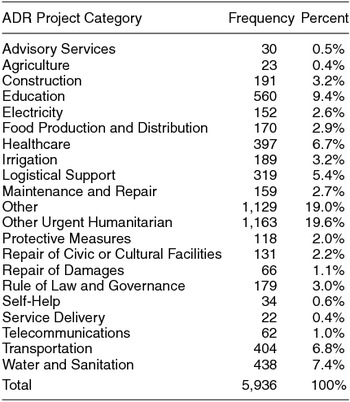
Between 2004 and 2011, more than $2.64 billion was spent through CERP in Afghanistan, with projects that ranged from road construction, cash-for-work, agricultural assistance to water projects, and militia payoffs (Johnson, Ramachandran, and Walz Reference Johnson, Ramachandran and Walz2011). Table 1 summarizes the frequency of various projects types from May 2008 to December 2010.
CERP Project Frequency by Project Type, 2008–2010

The U.S. COIN strategy during this period encompassed a broad range of civilian and military activities, of which CERP was one. Ranging from cultural sensitivity training, coordination with the host government and military, focus on infrastructure development and services, and the “Clear, Hold and Build” method, COIN doctrine is to counter an insurgency in a holistic manner. This includes challenging insurgents with respect to rule of law, governance and public goods provision, far beyond the traditional security sector tasks often assigned to a military occupation.
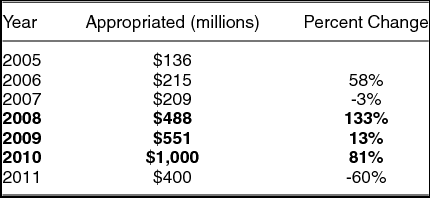
As part of the overall U.S. counterinsurgency (COIN) approach, the CERP program was ramped up extensively and rapidly in Afghanistan after 2007, increasing in appropriated funds from just over $200 million in 2007 to nearly $1 billion in 2010. As U.S. foreign policy priorities switched from Iraq to Afghanistan, and the so-called “surge” was authorized by President Obama, intense pressure to spend appropriated CERP funds fell on all levels of the military chain of command. Table 2 illustrates the surge in CERP appropriations to Afghanistan during the 2008–2010 years (Cordesman Reference Cordesman2013).
Appropriations to CERP Afghanistan
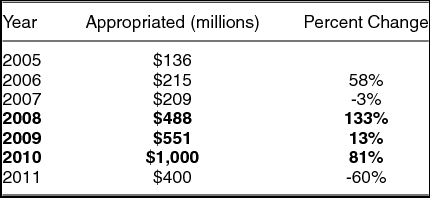
At the level of local commanders, there was additional pressure to produce proposals for CERP projects. How much money a unit could get “out the door” was strongly considered in evaluations for promotion.Footnote 2 As it was put in an internal ISAF review in 2011,“current incentives promote spending CERP funds without sufficient accountability” (Weggeland Reference Weggeland2011). The impacts of the projects barely measured, the only observable metric for evaluating contributions to governance was the amount of CERP money a commander had spent. This pressure, in addition to limited local contextual information on the part of overstretched commanders, meant that the decision to put a district into CERP treatment during a particular period or not was pushed up to the bureaucratic level as a slew of projects weaved their way through the approval process (Kilcullen Reference Kilcullen2010; Weggeland Reference Weggeland2011).
On the approval side, pressure to get spending done was not lost on higher level leadership in the U.S. military, who were eager to implement the well-publicized COIN strategy (SIGAR 2011; Weggeland Reference Weggeland2011). Extensive discussions in theater at ISAF headquarters and with civilian aid workers for the U.S. over a six-month period by the author in 2012 indicate that during the 2008–10 period, numerous rejections, delays in project approval, last minute budget changes, or adjustments in the siting of CERP were due to procurement and bureaucratic technicalities, as opposed to strategic considerations.Footnote 3 In addition, the timing of CERP project approvals was reportedly often difficult to predict, according to the office of the Special Inspector General for Afghanistan Reconstruction (SIGAR) in Kabul.Footnote 4 Even if projects were known to be coming to an area, it was uncertain when funds would actually arrive, and be able to be disbursed, due to highly technical and legalistic currency transfer and procurement rules.Footnote 5
Even if the approval and timing of CERP funds is plausibly independent of local week-on-week violence trends, it is possible that some commanders synched other military actions with the start of CERP projects. For example, a unit might use the start of a CERP project to undertake anti-Taliban clearing operations, or engage in outreach with local government partners. In this case, the “treatment” would be not only aid spending alone, but a bundle of CERP spending and some other activities. In the Mechanisms section, however, I show that CERP spending is not associated with an increase in anti-insurgent raids, airstrikes, or IED clearances by international or national security forces, suggesting that at least visible operations and outreach to security partners were not, on average, synched with CERP project starts.
It is also important to take account for the continuing nature of both violence and aid expenditure. Violence tends not to increase in just a single period, instead following longer term trends, including seasonality, persistant offensives, and pacification efforts. Similarly, aid projects, even if they include some random variation in approval and timing, are distributed over a period of weeks or months. In the empirical specification that follows, I address serial correlation in violence and aid spending, unobserved conditions in Afghan districts, concerns about reverse causality and selection into treatment, in order to remain secure that the variation in aid being exploited is in fact independent of local violence, military control, and other local characteristics.
While many observers have questioned the utility of CERP spending in Afghanistan for its chaotic nature, as scholars this random variation allows us to examine the effect of locally exogenous changes in CERP spending on local violence outcomes. By examining week-by-week changes in CERP expenditures and changes in several classes of violence, we can identify how civilian aid spending affects local level violence.
DATA
Violence is not the only means of measuring the effect of aid on an antigovernment insurgency. The legitimacy and popularity of the insurgency in the eyes of influential civilians and public support for the institutions of the incumbent government are important factors that may dictate the political settlement of a conflict (Lyall, Blair and Imai Reference Lyall, Blair and Imai2013). Unfortunately, they are both difficult to measure at a fine-grained level, and are indeed ephemeral concepts to measure even under favorable conditions.Footnote 6 Accordingly, the dependent variables of interest for this study are local level violence of several types. While violence against progovernment (counterinsurgency) forces is important and easy to measure—international forces keep track of it themselves—it is not the only violence of interest. We want to account for insurgency violence against all targets, as well as noninsurgency related violence.
This study introduces a new dataset of fine grained, geocoded violence in Afghanistan during the period of May 2008 to December 2010 that fills this gap. In contrast with previous studies, this dataset includes local violence against all targets during that interval, including bombings not against international or local security forces, as well as operations against insurgents carried out by international and domestic military forces.Footnote 7
The new data on bombings and operations by progovernment forces are compiled from detailed weekly incident reports from the Afghanistan NGO Safety Organization, an independent nonprofit organization that has kept track of security incidents throughout Afghanistan since October 2002. With more than 100 staff spread throughout Afghanistan, ANSO collects reported security incidents first hand, from humanitarian and development NGO (foreign and domestic), triangulated SMS and phone-in reports, and local news media.Footnote 8 The organization is funded by Swiss Development Cooperation, the Norwegian Ministry of Foreign Affairs, and the European Commission’s Directorate for Humanitarian Affairs and Civil Protection (ECHO) and is registered as a nonprofit and independent charity in the UK.Footnote 9 Each weekly report contains the date, province, district, and precise location of each reported incident, along with a one- to two-sentence description of the incident. The incident narratives follow a set of conventions regarding terminology, spelling, acronyms, and shorthand. For example, coalition forces are referred to as IMF, meaning “international military forces.” To illustrate, the following are two entries from the dataset, the first a bombing incident and the second an operation by progovernment forces:
-
Date: 2010 April 25
-
Location: Paktya Province, Shwak District, Main Gardez-Khost Road
-
Incident Narrative: An IED (improvised explosive device) planted on the road detonated while an ANA EOD team was attempting to defuse it.
-
Date: 2010 April 6
-
Location: Kunar Province, Chapa Dara District, Badigram Area
-
Incident Narrative: IMF/ANSF conducted a joint operation targeting suspected AOG locations, killing six suspected AOG.
Using keyword text analysis, the more than 46,000 security incidents that were reported by ANSO during the 138 weeks of the study period (May 2008 to December 2010)Footnote 10 are coded using regular expressions from ANSO documents.Footnote 11 This study includes the following three categories of violence, and two variables measuring IEDs cleared/defusedFootnote 12 :
-
1. bombings and attempted bombings by insurgents (against all targets);
-
2. operations against insurgents by international military forces and the Afghan National Army;
-
3. IEDs defused/cleared by the Afghan National Police or Afghan National Security Forces;
-
4. IEDs defused/cleared by international military forces.
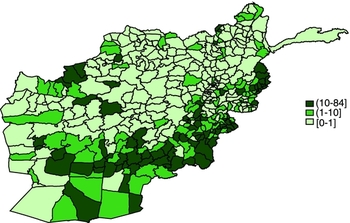
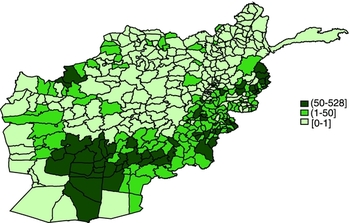
The violence data are collapsed into 138 weekly bins, across Afghanistan’s 398 districts for a total of 53,460 observations in the time series cross section from May 2008 to December 2010.Footnote 13 Figure 1 illustrates the geographic distribution of casualty-causing security incidents from the ANSO dataset (annually per 10,000 inhabitants).
Annual Casualty-Causing Security Incidents per 10,000 Inhabitants (ANSO data), Afghanistan, May 2008–December 2010

Data on the CERP treatment come from an unclassified database, entitled “Afghanistan Commanders Emergency Response Program (CERP) Spending Data 2010–2011,” publicly released by the U.S. military’s Central Command (CENT-COM) at the end of 2010. The files come from the Combined Information Data Network Exchange (CIDNE), the U.S. military’s internal management system for collecting tactical data from troops. The CERP dataset includes completed, ongoing, planned, and cancelled CERP projects in Afghanistan; in this study both completed and active projects are included.Footnote 14
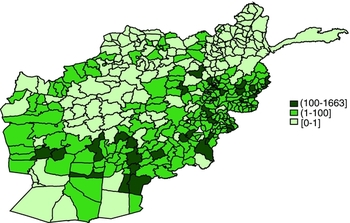
The CERP database includes the start and end dates of CERP projects, the budget, sector, and global positioning of each project. Using GIS software and a project’s latitude and longitude, I coded each CERP project with its appropriate district and province. In the study period, 5,843 CERP projects across all districts of Afghanistan are included. Figure 2 shows CERP spending per capita.
Annual CERP Spending per Capita (U.S. military data), Afghanistan, May 2008–December 2010

In addition to information on CERP spending, the CIDNE database contains information on “Significant Activities” (SIGACT), which are defined as “events of significance in the operational environment,” that are reported by U.S. military units. SIGACT data range from enemy engagements, friendly fire events, medical evacuations, requests for air support from local units and IED (improvised explosive device) discoveries, and explosions. “Enemy actions” and “explosive hazards” are included in this study as the measure of SIGACT-reported violence events. Figure 3 depicts the annual number of SIGACT per 10,000 inhabitants in each Afghanistan district.
Annual Attacks Against U.S. Troops per 10,000 Inhabitants (U.S. military data), Afghanistan, May 2008–December 2010

“Enemy actions” are defined as live fire attacks by insurgents against progovernment troops that are recorded by international military forces. These may be against fixed installations, military units on patrol, or others. “Explosive hazards” refer to IEDs and bombs that are encountered by progovernment forces, whether they explode or not.
In many cases there are several entries in CIDNE that relate to a single violence incident; for example if a U.S. military unit engages in combat with an AOG unit, then calls for air support and then requests a med-evac for an injured soldier. In order to identify the unique number of events, I collapse the SIGACT data, dropping duplicate observations that occurred in the same location at the same time. The study period contains a total of 62,944 unique SIGACT events, of which 44,304 are “enemy actions” or “explosive hazards” (the first coding of the event applies for the duration so that there is no double counting).
Using monthly reports published by the Institute for the Study of War (ISW) on the order of battle in Afghanistan, the positions of battalion-level and larger ISAF installations is coded by month into the time series. A battalion is the smallest sized unit that is considered by the U.S. military to be both “tactically and administratively self-sufficient.”Footnote 15 With around 1,000 soldiers and typically commanded by a Lieutenant Colonel, a battalion has the resources to control the district around them, including logistics, easy access to air support, regular patrols, and training of local allies. Larger installations, like brigade headquarters—often in provincial capitals, or divisions (in charge of regional commands), have even greater resources to maintain control of the district within which they sit.
The ISW reports indicate where “white” units are positioned, that is, regular military units as opposed to special forces units and other “black” operations. The locations of battalion-level forward operating bases (FOBs) and major installations and their primary listed areas of responsibility (AOR) are coded as “secured” with a dummy variable. These data are available at the district-month level of resolution. During the period under study, only two FOBs are decommissioned, otherwise it is a strictly additive process. The number of districts with battalion-level troop bases increases from 28 in May 2008 to 49 in December 2010.Footnote 16
Using battalion-level and larger installations as a measure of progovernment troop control is not ideal, as there may be some misclassifications where there are secure areas (progovernment sovereignty) without bases and areas with bases that do not necessarily have progovernment sovereignty. We might worry that as levels of violence change in a district, the ability of the measure to correctly classify progovernment control might change.
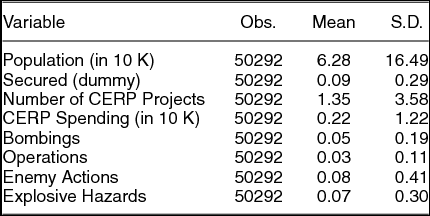
Following the logic of Imai and Yamamoto (Reference Imai and Yamamoto2010), I argue that there are three primary reasons why measurement error should not be correlated with the outcome in this case. First, control, as characterized in this study using the Kalyvas (Reference Kalyvas2006) definition of “division of sovereignty,” is slow moving by nature, while violence is deliberately measured in the short term (week-on-week). Sovereignty over a given district, in general, does not swing back and forth on a weekly basis, particularly where occupation forces have major military installations in place. Second, the expectations and sympathies of the population, key to sovereignty, do not typically react to short-term shifts in violence, especially in civil war contexts where endemic violence is a common phenomenon. Last, because the variable (both the conceptual understanding of control and actual military presence) is binary, as opposed to a continuous measure, it is less susceptible to week-to-week fluctuations (see Table 3). I conduct two additional robustness checks in Appendix C to give further evidence in favor of the measurement. Summary statistics for the data used in the study are presented in Table 3.
Summary Statistics
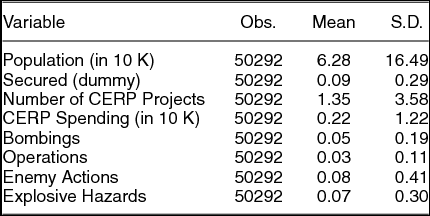
Note: Observations are 396 Afghan districts over 138 weeks from 2008 to 2010 and adjusted per 10,000 inhabitants.
EMPIRICAL APPROACH
Identifying a causal relationship in the study of military-led aid is challenging. Unlike civilian development aid, which has been relatively easily manipulated in an field experimental context, there have been no such experimental studies on counterinsurgency aid spending by military forces. As a result, we must rely on observational data to examine the effect of CERP and other programs.
In order to isolate the variation in CERP spending that is independent of local violence trends in the district in which the spending is taking place, I focus the analysis on week-by-week levels of CERP spending that are in part due to the bureaucratic and operational hurdles described two sections ago. To isolate this plausibly exogenous spending, I employ an empirical strategy that has three main features. First, I use individual district-weeks as the unit of analysis, allowing for a fine-grained examination of variation in CERP spending and violence. Second, I employ a lagged variables model (autoregressive distributed lag, or ADL; Beck and Katz Reference Beck and Katz2011) that addresses serial correlation in the time series,Footnote 17 ensures that previous weeks’ spending and violence are not confounding the estimates, and allows us to observe the dynamic effects of spending on the following period. Third, the model also includes unit and time fixed effects to eliminate confounding from any remaining non-time-varying characteristics of districts and nationwide trends in spending and violence.Footnote 18
To verify this approach I carry out a battery of robustness checks, located in Appendix C. In addition, I carry out a placebo test at the end of the Results section to confirm that there is no selection into treatment or “reverse-causality.”
For the purposes of each district-week observation, the presence or absence of a battalion-size or larger ISAF installation is treated as a covariate, which is interacted with CERP aid spending. In order to avoid post-treatment bias concerns, the “secured” variable is lagged by one period.Footnote 19 While long-term violence and aid trends may be endogenous to the decision-making process regarding where and when to extend large U.S. military installations, such decisions are not made with a week-to-week turnaround. That is, changes in violence in a given district in a given week should not make that district any more or less likely to have a large U.S. military installation put in place or taken away.
I estimate the effect of CERP spending, moderated by FOB presence, on three violence outcomes using the following specification, using OLS:
 $$\begin{eqnarray*}
Y_{it} &=& \beta _0 + \beta _1 \text{CERP}_{it} + \beta _2 \text{CERP}^{\ast}\text{secured}_{it-1} \nonumber\\
&&+\, \beta _3 \text{secured}_{it-1} + \beta _4 \text{CERP}_{it-1}\nonumber\\
&& +\, \beta _5 \text{CERP}^{\ast}\text{secured}_{it-2} + \beta _6 \text{secured}_{it-2} \nonumber\\
&&+\, \beta _7 Y_{it-1} + \beta _8 \text{District}_i + \beta _9 \text{Month} + \epsilon _{it},
\end{eqnarray*}$$
where Yit
is the violence outcome in levels per capita for district i in week t, β1 and β2 are the coefficients of interest for the first period,
 $\text{CERP}_{it}$
is CERP spending per capita in levels,
 $\text{CERP}^{\ast}\text{secured}_{it-1,t-2}$
are the interaction of CERP spending with the troop dummy, and
 $\text{secured}_{it-1,t-2}$
are dummies for whether a district had a battalion FOB or larger installation in a weeks t − 1 and t − 2 District and week fixed effects follow, along with ε
it
, the district-week error term.
The effects of interest are then β1 for the effect of CERP spending in unsecured districts and β1 + β2 for the secured districts in the first period. For the second period effects, the coefficient of interest is β4 + (β*7β1) for unsecured districts and β4 + β5 + [β*7(β1 + β2)] for secured. In order to estimate the predicted effects of a given project, for example CERP spending worth $500,000 over four weeks, the period one effects are summed with period two effects for each week of spending, providing a predicted cumulative effect. Standard errors for these predicted cumulative effects are estimated using simulation.Footnote 20
RESULTS
In this section I present the main results of the study, followed by a placebo test and exploration of mechanisms and secondary results that further elucidate the main results.
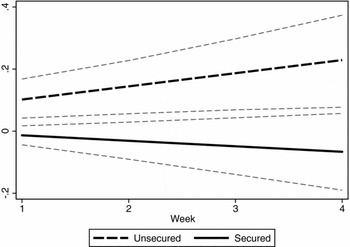
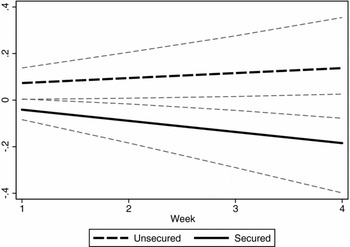
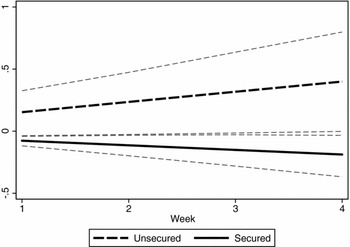
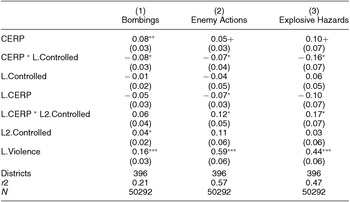
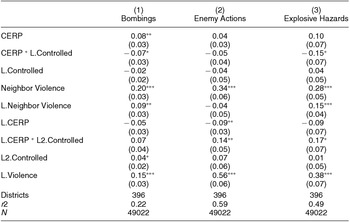
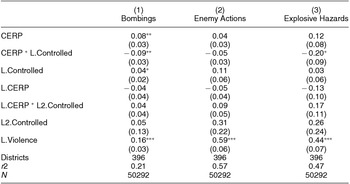
Table 4 presents the regression coefficients for each of the outcomes, while the predicted effect plots in Figures 4–6 illustrate the cumulative predicted effect of hypothetical CERP spending of $500,000 over four weeks; in practice this could be several smaller projects or one large project, and in many cases includes spending from multiple overlapping projects.
Bombings: Predicted Effects of $500,000 of Aid Over Four Weeks

Enemy Actions: Predicted Effects of $500,000 of Aid Over Four Weeks

Explosive Hazards: Predicted Effects of $500,000 per Capita of Aid Over Four Weeks

Main Results

Notes: SE clustered at the district level; +p < 0.1; *p < 0.05; **p < 0.01. District and week fixed effects included. Outcome incidents per 10,000 population.
For these tables, CERP spending levels have been divided by $100,000 in order to make easier visual inferences. The results indicate that CERP spending has dramatically different effects on violence depending on whether the aid is distributed in controlled or contested districts. In Table 4 we see that a significant negative effect of CERP spending on insurgent violence against progovernment targets in secured districts in the first period. On the other hand, when spending is done in contested districts, it causes a significant increase in insurgent violence in the week of spending. In terms of magnitude, $100,000 of aid spending results in increase of 0.08 bombings in a contested district, with no change in a controlled district. At the same time, $100,000 in aid spending in a contested district-week results in 0.05 more enemy actions against progovernment troops, while in a controlled district-week this causes a 0.07 attack reduction. In the following, across outcomes, there is some attenuation of the effect in the week after spending is done, whether it is in a controlled or a contested district. Looking across the outcomes the first week effects of $100,000 of aid spending is a increase of 0.23 attacks, while in controlled districts it is a reduction of 0.31 attacks.
When there is spending multiple weeks in a row, as is the case for the vast majority of CERP projects, the violence effects accumulate. In Figures 4–6 I show the predicted cumulative effects of $500,000 over four weeks. In an unsecured district, this spending results in 0.23 more bombings, 0.14 more enemy actions, and 0.40 explosive hazards, for a total of 0.77 attacks. In contrast, in a secured district, this level of spending is predicted to cause a reduction of 0.06 bombings, 0.18 enemy actions, and 0.19 explosive hazards, in total 0.43 attacks.
The results from this study offer important evidence in the debate regarding the counterinsurgency effect of civilian aid. We see that in districts where the U.S. military has already established control, aid spending drives a reduction in insurgent violence against security forces, but no effect on bombing violence against civilians. In unsecured districts, aid spending instead causes an increase in insurgent violence with both civilians and security forces as targets. These results indicate that insurgents indeed respond strategically to aid spending on the part of progovernment forces, as predicted by theory. These short run changes in violence in contested districts do not necessarily mean that aid cannot be part of a longer-term strategy to win, as violence may spike and then fall later, however as a short run strategy, it is clear that aid on its own does not appear to win over contested terrain.
These findings have important implications, both for scholarship on insurgency and policy-making with respect to counterinsurgency programs. First, these findings suggest that the distribution of aid on its own is not able to extend territorial control in the short term. Indeed, as Kalyvas (Reference Kalyvas2006) notes, “although control and collaboration interact, control may trump the political preferences of the population in generating collaboration.” We find that where districts are being heavily contested between incumbents and insurgents, this cuius region eius religio dynamic comes quickly to the fore.
Second, given that the U.S. Congress appropriated nearly $ 2.7 billion to CERP in Afghanistan between 2004 and 2011, there is substantial scope for policy change on this topic. During the period of study, about $120 million was spent on completed CERP projects. Of these funds, nearly 60 percent ($ 71.6 million) was spent in unsecured districts, whereas 40 percent ($47.7 million) was spent in secured districts. If we accept the predicted cumulative effects estimated above, and consider the measured events to be independent incidents, the $71.6 million spent in unsecured districts would have led to 33 additional bombings, 20 additional enemy actions, and 57 explosive hazards, together equaling 110 attacks. Considering secured districts, $47.7 million in CERP spending in secured districts is estimated to have reduced by a total of 42 attacks: 6 bombings, 18 enemy actions, and 18 explosive hazards.
Project Categories
The CERP program included a wide array of aid categories, including construction, healthcare and rule of law. While the record-keeping by the U.S. military for CERP has been criticized for often obscuring project aims (whether deliberately or not) by having quite broad project categories, we do have broad information for just over 80 percent of projects during the study period. Where the project category is known, however, it is often difficult to ascertain exactly what activities were conducted under the spending category, and how quickly we would expect strategic responses from insurgents could occur. The official U.S. CERP handbook explains that one of 20 categories may be used to log projects, with a wide range of potential activities (U.S. Army 2013).
For example, in the “healthcare” category, we do not know if the associated CERP projects involved providing medicine, upgrading existing health facilities, building or converting new health facilities, paying medical workers, or subsidizing care. In these cases of mixed potential project activities we would expect the average effects of the projects to be the same as overall CERP spending. Accordingly, subsample analyses of these more vague categories, including healthcare, education, telecommunications, and transport, are the same as the average effects reported earlier in this section.Footnote 21
Two categories lend themselves to a more nuanced analysis, as both the relevant strategic interaction is more clearly defined and sufficient projects exist to conduct a subsample analysis. The first is “Protective Measures,” which are projects designed to improve the security of critical infrastructure like Afghan government buildings and power stations; projects under “protective measures” include guard towers, protective fencing, security lighting, and walls/barriers. The second category is ‘‘other urgent humanitarian” projects, which include small, direct transfers to communities: primarily goods like tents, food, and fuel, as occasionally cash-for-work schemes.
“Protective measures,” which are projects most closely linked to the counterinsurgent capacity of a district, would be expected to provoke the strongest violent reaction from insurgents, especially in unsecured districts. We would expect humanitarian projects to provoke little or no insurgent violence, as the projects are, at least initially, only partially observable, and sabotage difficult in practice. Short of attacking the communities in punishment or taking the goods given by American troops, there is little insurgents can do to directly respond to such a project.
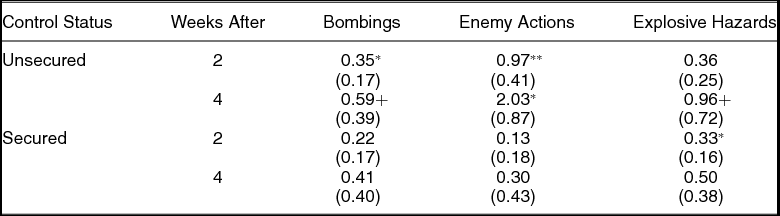
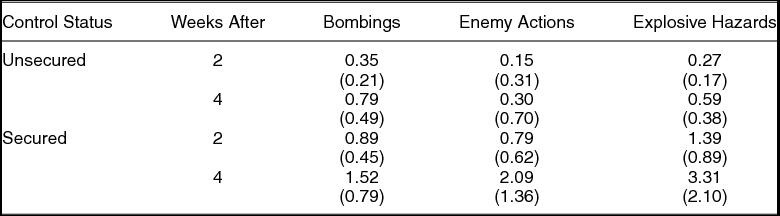
Table 5 displays the predicted effects of $100,000 per week in protective measures spending over two and four weeks, while Table 6 shows the same for other humanitarian projects. The associated regression tables are reproduced in the Appendix. We see that for protective measures projects in unsecured districts there is a large and significant increase in violence, both in attacks against U.S. troops and bombings against all targets. In secured districts the predicted effects are also positive, though smaller and less likely to be statistically significant. This suggests that insurgents are willing to attack these military capacity-building projects, even when secured by U.S. troops.
Protective Measures Projects: Predicted Cumulative Effects
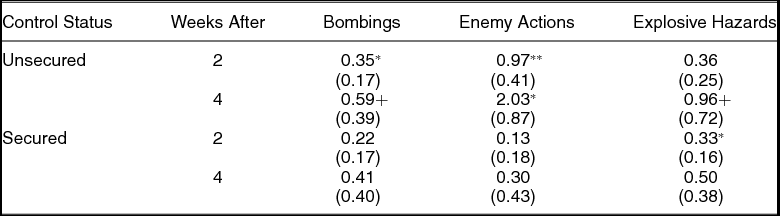
Note: Standard errors estimated from 1000 simulated draws of the coefficients
Humanitarian Projects: Predicted Cumulative Effects
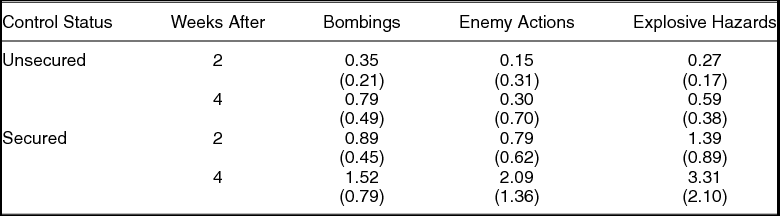
Note: Standard errors estimated from 1000 simulated draws of the coefficients.
Other Humanitarian projects do not have a statistically significant effect on the three outcomes, though in secured districts this may be in part due to noise.
These results support the contention that type of counterinsurgency aid project matters to the strategic interaction that occurs between insurgents and progovernment forces. Projects that boost the fighting and defense capacity of the government and progovernment forces are heavily and swiftly targeted by insurgents. At the same time humanitarian projects that are less visible in the short term and do not raise the fighting capacity of the government do not result in any changes in violence.
Geography of Violence
In this subsection I consider several features of geography that could impact the relationship between aid and insurgent violence. First, I explore the possibility of spillovers among neighboring districts, both of violence and counterinsurgent effects of aid. Second, I consider how the effects of CERP spending may be affected by large-scale strategic changes over swaths of terrain, in this case due to the establishment of ISAF’s Northern Distribution Network (NDN) supply line. Last, results in the Appendix show that the main findings displayed earlier in this section hold for two important geographic subsamples, majority Pashtun Southern and Eastern Afghanistan.
Geographic Spillovers
Civil wars are not fought within the bounds of individual geographic units like Afghan districts. Numerous scholars have found that geographic proximity to conflict is an important predictor of conflict breaking out in a given location, though most findings have been at the cross-national level (e.g., Anselin and O’Loughlin 1992; Buhaug and Gleditsch 2002). Accordingly, in the Afghan context we might be concerned that insurgent violence—openly part of a national guerilla movement—might be connected across district boundaries. Specifically, CERP spending in one district might affect violence in neighboring districts, while at the same time violence in a given district might affect its neighbors.
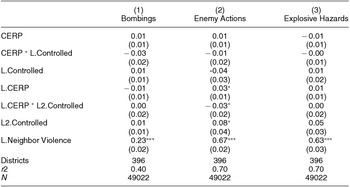
To investigate this question, I construct a measure of “neighbor violence” for each of the main outcome variables. “Neighbor violence” takes the average level of violence among the contiguous neighbors of a given district in a given week (Beck et al. Reference Beck, Gleditsch and Beardsley2006). I then include the neighbor measure as a covariate in the main regression specification to show that spillovers of violence from neighbor districts is not driving the results. Next, neighbor district levels of violence are considered as the outcome, in order to see if CERP spending has an effect beyond the district where spending is done.Footnote 22
As seen in Table 7, levels of violence in neighboring Afghan districts are indeed (weakly) correlated, as indicated by the significant positive coefficient for the “neighbor violence” variable. Nonetheless, the main results are substantively unchanged, establishing that geographic spillovers between districts are not driving the relationship between aid and violence. Table 8 illustrates this further, demonstrating that there is relationship between aid spending and violence in neighboring districts is weak. There is some evidence in Table 8 that spending in unsecured districts may drive a small increase in violence in neighboring districts in the following week.
Main Results Including Neighbor Violence

Notes: SE clustered at the district level; +p < 0.1; *p < 0.05; **p < 0.01. District and week fixed effects are included. Outcomes incidents per 10,000 population.
Effect of CERP Spending on Neighbor Violence

Notes: SE clustered at the district level; +p < 0.1; *p < 0.05; **p < 0.01. District and week fixed effects included. Outcomes incidents per 10,000 population.
Strategic Terrain: The Northern Distribution Network
A second important geographic consideration is how particular areas of terrain become more or less valuable over the course of a conflict. The case of the Northern Distribution Network (NDN) in Afghanistan shows how strategic interactions between progovernment forces and insurgents in a local areas relate to the overall strategic environment within a country and indeed outside the country.Footnote 23
As the U.S. government began to increase its military engagement in Afghanistan in 2008 and 2009, the military’s reliance on supply lines through Pakistan was identified as a key vulnerability. After several months of planning, shipments via the Northern Distribution Network began in late February 2009; containers of supplies traveled through Central Asia and eventually into Afghanistan via the northern border crossing at Termez, Uzbekistan. From the Afghan side the NDN route proceeds southeast to the Salang pass, cutting through four provinces: Balkh, Samangan, Baglan, and Parwan. From Parwan goods continue throughout the country: east to Kabul, south to Kandahar. While identifying an alternative supply route for military supplies was a priority for coalition forces for some time, the specific timing and routing of the NDN start was not publicly broadcast ahead of time by ISAF, in large part due to the strategic importance of highly valuable supplies that could be subject to attack by insurgent groups.
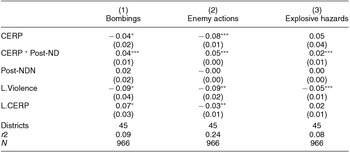
Using the same regression specification as earlier, I then estimate the effect of CERP spending on the three violence outcomes in the 24-week subsample, a period where violence increased dramatically on the whole as the NDN came into operation.Footnote 24 This subset analysis suffers from a lack of variation in the extent of secured districts in those four provinces during the NDN period, meaning that the results are not fully comparable to the main regression specifications. On average, the districts were secured, so the negative effects of CERP on violence are consistent with the full-sample effects. Nonetheless, when looking only at the total effects of CERP spending (not fully accounting for secured vs. unsecured), we see in Table 9 that in the period after 20 February 2009 CERP's effect on violence shrinks from an average reduction in violence before the NDN is operational to zero effect on violence after the NDN start date, except in the case of explosive hazards where spending tends to increase violence.
Northern Distribution Network

Notes: SE clustered at the district level; +p < 0.1; *p < 0.05; **p < 0.01. District and week fixed effects included. Outcomes incidents per 10,000 population.
This evidence suggests that aid spending’s relevance to the local battlefield can be swamped by major strategic changes, like the introduction of a new major supply line. On the other hand, in a relatively stable local environment, aid has highly significant effects on violence; in the case of the Northern Distribution Network provinces before the introduction of the new supply line, CERP on average reduced violence against U.S. troops and against all targets, including bombing against Afghans.
Mechanisms
While the main results provide strong evidence that progovernment aid indeed affects violence in ways that are consistent with strategic responses from insurgents, it has not been established by what channels this effect manifests. Previous work on the subject (Berman, Shapiro, and Felter Reference Berman, Shapiro and Felter2011) has hypothesized that there is an information sharing mechanism, whereby aid effectively buys information from the citizenry, which counterinsurgents then use to snuff out rebels. Recent empirical studies provide some evidence for civilian information sharing. Shapiro and Shaver (Reference Shaver and Shapiro2015) show evidence in Iraq that civilian casualties causes by coalition forces reduce the number of tips received from the population, while collateral damage from insurgent attacks increases the number of tips. Berman et al. find differential treatment effects for small and large aid projects, with small projects (< $50,000) having a larger violence-reducing effect against U.S. troops in Iraq than large projects. They attribute this to closer relations between U.S. troops and local host-nation allies, who then share more information.
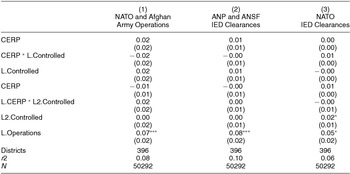
Since we do not have data on information exchange between progovernment forces and civilians with respect to insurgents, I will test this mechanism via three variables that would indicate counterinsurgent operations against insurgents that would be made possible by information gleaned from tips gained from CERP spending. The first is counterinsurgency raids and airstrikes against insurgent targets by ISAF.Footnote 25 The idea is that with better information about rebel locations, and the relative immobility of insurgents in the short term (as shown earlier in this section), progovernment forces will launch more raids and airstrikes to take advantage of the information advantage. Those attacks must be launched swiftly, before insurgents find out they have been compromised and move. In addition, IEDs are often hidden from plain view, whether on the roadside, in cars, or buried in dirt roads. Tips from civilians as a result of CERP spending would allow counterinsurgents to find and defuse these IEDs before they explode. These IEDs may be cleared by Afghanistan National Police, Afghanistan National Security Forces, or international coalition troops.
Table 10 shows that there is no effect of CERP spending on NATO and Afghan Army raids and airstrikes against insurgents, nor on IEDs cleared by Afghanistan National Security Forces/Police or NATO. These results provide evidence that neither the information sharing mechanism nor synched visible military operations explains the changes in violence due to CERP spending that we observe in Afghanistan. That said, these results do not rule out black or special operations carried out by progovernment forces that may not be captured by the ANSO data. In addition, the effect of CERP spending on informing by the public may be slower moving that these data can account for.
Effect of CERP on NATO Operations and IED Clearances

Note: District and week fixed effects included. Outcome per 10,000 population.
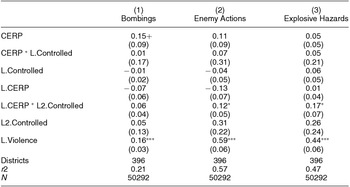
Tables 11 and 12 display the effects, respectively, of small and large CERP projects on the three violence outcomes. It turns out that small projects, rather than having a stronger violence reducing effect, in fact increase the magnitude of attacks in both controlled and contested districts, suggesting that small projects, perhaps viewed as easier targets for insurgents, actually attract more insurgent violence (per dollar spent) than large projects. The vast majority of projects are large ones, however, which is why the large project effects are about the same as the overall effects.
Only Small Projects (⩽ $50,000)

Notes: SE clustered at the district level; +p < 0.1; *p < 0.05; **p < 0.01. District and week fixed effects included. Outcome incidents per 10,000 population.
Only Large Projects (> $50,000)

Notes: SE clustered at the district level; +p < 0.1; *p < 0.05; **p < 0.01. District
and week fixed effects included. Outcome incidents per 10,000 population.
Placebo Test
In order to strengthen our belief that the above results are credible, I perform a placebo test.Footnote 26 This approach examines the effect of the treatment, in this case CERP spending, on a dependent variable known to be unaffected by the causal pathway in question.
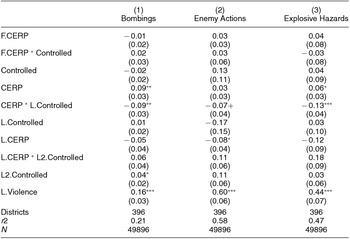
I estimate the same specifications as presented in main results (Table 4) with the independent variables at t + 1, in addition to the independent variables at t and t − 1. The identifying assumption of the study is that neither insurgents nor counterinsurgents can anticipate the arrival or departure of CERP funds, rendering the treatment as locally random.
Table 13 shows that there is no significant reported by the t + 1 coefficients (reported as F.), providing evidence for the exogeneity claim with respect to CERP spending, and for the main results in general. While the lack of statistical significance is noteworthy, the more important evidence from the table is the small coefficients, indicating the null result is not simply the result of large standard errors or sample size issues (Imai, King, and Stuart Reference Imai, King and Stuart2008).
Placebo Test of Main Results

Notes: SE clustered at the district level; +p < 0.1; *p < 0.05; **p < 0.01. District and week fixed effects included. Outcome incidents per 10,000 population.
CONCLUSION
In this article, I show evidence that military control dictates the effect of aid spending on insurgent and noninsurgent violence during an active rebellion. In contrast to previous formulations of the “hearts and minds” hypothesis that exclude rebels as strategic actors, the results indicate that insurgents in Afghanistan respond to aid spending in contested districts through violent and nonviolent resistance. In contested districts, aid spending provokes insurgents to carry out more bombings, as well as live fire attacks against progovernment forces.
It turns out that aid does have an insurgent violence reducing effect when distributed in districts already controlled by progovernment military forces, reducing bombings, attacks against coalition troops, and IED placements against progovernment forces. This suggests that hearts and minds spending does indeed function as a means of solidifying control of an area after military forces have already taken it.
In addition, this study indicates that the dynamics of violence depends on the type of project that is being implemented; humanitarian projects do not have an effect on insurgent violence, whereas projects designed to boost the military defenses of progovernment buildings massively increase insurgent violence in contested areas. Finally, I show that large strategic changes, for example the establishment of a major new progovernment supply line, disrupt the ability of aid projects to affect the local conflict environment.
Important policy implications come from the analysis in this study. First, from the perspective of an incumbent government, aid spending like the CERP program are unlikely to quickly pacific a contested area, though the data do not allow for any inferences about the long term impacts. It is worth noting that CERP was explicitly designed for “quick impacts,” however, with a strong focus on short-term opportunities rather than long-term strategy. That said, counterinsurgency aid in areas under progovernment control seems to have a fairly strong force protection and general pacification effect. Perhaps more importantly for policy makers, the analysis of the establishment of the Northern Distribution Network suggests that the relatively small CERP-type aid projects are easily overwhelmed by major battlefield shifts. With the aforementioned evidence about the importance of pre-existing military control, this implies that while aid may be a useful secondary tool to consolidate or bolster military activities, it is not capable of supplanting or preceding military operations.
As with other microlevel studies of violence, it is important to ask how well results from Afghanistan travel to other contexts (Blattman and Miguel Reference Blattman and Miguel2010). While Afghanistan has its peculiarities, the dynamics in play in the Afghan case map well onto other insurgencies, present and historical. Like most insurgencies, the neo-Taliban war has been asymmetric in nature, with progovernment forces maintaining objectively superior military capabilities. Like Algeria, Iraq, Syria, and Vietnam, the government in Afghanistan has been assisted by an outside military intervention, as well as by international civilian aid. The insurgents in Afghanistan have too have attracted foreign fighters and support, much like recent cases of insurgent in Mali, Syria, Chechnya, and Kashmir, and historical cases like the Cuban expedition in the Congo and the Spanish Civil War.
In some cases guerillas are more mobile than progovernment forces, while in others they are tied to specific terrain that favors them, such as in terms of cultural affinity, familiarity, and/or networks of support or supplies. In Afghanistan, this has varied not only over time but across the geography of the country. The Taliban have typically found more success in Pashtun areas of Southern and (to a lesser degree) Eastern Afghanistan, where a subsample analysis finds the main effects are amplified in magnitude, especially in the South.
In short, the evidence from this study applies far beyond Afghanistan, and indeed to any insurgency context where a repeated strategic interaction between progovernment and insurgent actors for control might include the usage of civilian aid projects.
Looking forward, key next steps in the research agenda will include collecting additional fine-grained data on violence sourced from nonmilitary actors, such as NGOs, collected using a similar methodology across countries. The International NGO Safety Organization and iMMAP are two such initiatives that do this type of data collection. To date, however, collaboration between scholars and these groups has been weak, with operational NGOs concerned that their data may be used to promote a military or donor aid agenda that would be negative for their operations. In addition, there are worries about leaking event data in a way that puts informants, staff members, or projects in danger with no real benefits to their mission: keeping aid workers safe. Scholars of conflict across the social sciences should work together to find ways to build cooperative initiatives that allow for data sharing that also produce actionable results for humanitarians.
In addition, moving beyond violence as the measure of progress or effectiveness is an important next step. Scholars and practitioners have long considered how to measure legitimacy, state presence, and control (incumbent or insurgent), but we have struggled to effectively do so in a civil war context.
Military-led counterinsurgency is a global phenomenon, with active insurgencies taking place on numerous continents. As noted by Harbom and Wallensteen (Reference Harbom and Wallensteen2007), most of today’s armed conflicts are intrastate affairs that tend to last for years. In recent years, we have seen insurgencies with direct military counterinsurgency efforts in nearly 40 countries, ranging from Mali to Turkey to Colombia to the Philippines. The results of this study indicate the effect of aid in a local counterinsurgency environment is highly contingent on local and national conditions, especially military control, project type, and a changing macrostrategic situation. While much is still up for debate, we can safely say that there is no single average effect of aid on insurgent violence.
SUPPLEMENTARY MATERIAL
To view supplementary material for this article, please visit http://dx.doi.org/10.1017/S0003055416000356




Comments
No Comments have been published for this article.