INTRODUCTION
Sexual systems of caridean shrimps are characterized by their high diversity and intraspecific plasticity, including gonochorism and various forms of protandric or simultaneous hermaphroditism (Correa & Thiel, Reference Correa and Thiel2003). Different patterns of protandry are frequent among carideans, and sex determination can be plastic either on evolutionary or on ecological time scales (Correa & Thiel, Reference Correa and Thiel2003). Protandrous hermaphroditism has been previously described in some species belonging to the family Pandalidae (e.g. Allen, Reference Allen1959; Butler, Reference Butler1964, Reference Butler1980). Individuals first mature as males and with increasing size, change sex to females. Typical caridean sexual male characters are the presence of cincinnuli on the endopodite of the first pair of pleopods and spines on the inner margin of the appendix masculina in the second pair of pleopods (Butler, Reference Butler1964; Hoffman, Reference Hoffman1972). These copulatory organs are present during the male stage and later get atrophied or disappear when changing to the female stage. Simultaneous hermaphroditism had only been suggested in some species of decapods, based solely on their reproductive morphology (Spitschakoff, Reference Spitschakoff1912; Buchanan, Reference Buchanan1963; Berreur-Bonnefant & Charniaux-Cotton, Reference Berreur-Bonnefante and Charnoioux-Cotton1965; Kagwade, Reference Kagwade1982).
Sukumaran (1973, Reference Sukumaran1982) examined the secondary sexual characters and gonad of Exhippolysmata ensirostris (Kemp). He observed that smaller individuals (20–30 mm total length) were mostly males, possessing cincinnuli on the endopodites of the first pair of pleopods. On the second pair, appendices masculinae were armed with 5–6 spines and an appendix interna with cincinnuli. The gonad of males is a true testis containing sperm at different stages of development. Medium sized individuals (31–40 mm) were considered to be in the early stage of transition from male to female. Endopodites of the first pair of pleopods are more slender and in a state of reabsorption. Appendices masculinae are reduced in size without strong spines. The gonad is only different from males by having immature eggs inside the gonad. Larger individuals (>40 mm) are females (majority berried), possessing slender and tapering endopodites of the first pair of pleopods. On the second pair of pleopods the appendices masculinae are greatly reduced and in a state of atrophy; the appendix interna has an increased number of cincinnuli. The gonad of these individuals was an ovotestis, having an anterior ovarian portion and a posterior testicular portion with a pair of vas deferens laterally. Sukumaran (Reference Sukumaran1982) concluded that E. ensirostris cannot be functional males through the female stage, as they are devoid of fully developed copulatory organs and the testicular portion showed signs of degeneration and absorption as the size of the shrimp increased.
On the other hand, Kagwade (Reference Kagwade1982) reported, based only on morphological evidence, that E. ensirostris is a simultaneous hermaphrodite. He observed that individuals ranging from 43–63 mm in total length have cincinnuli on the endopodite of the first pair of pleopods. The appendix masculina (AM) on the second pair of pleopods was observed to become shorter as size of the shrimp increased, even though a small number of specimens have well-developed appendices masculinae. Because of this variation in AM length, this character is not adequate to establish sex reversal. All individuals ranging from 20–100 mm total length in size had an ovotestis. The fact that sperm is noticed in immature as well as ovigerous specimens made Kagwade establish E. ensirostris as a hermaphrodite throughout its life. Both presence of sperm (testicular part) and ova (ovarian part) in ovigerous females shows synchronous hermaphroditism, ruling out the case of protandry.
Chacur & Negreiros-Fransozo (Reference Chacur and Negreiros-Fransozo1999) collected Exhippolysmata oplophoroides (Holthuis, Reference Chacur and Negreiros-Fransozo1948) from the Ubatuba, São Paulo, Brazil coastline and did not find any males in their samples, which led them to believe that this is a protandrous species. Fransozo et al. (Reference Fransozo, Rogério, Bertini and Cobo2005) also studied E. oplophoroides population biology in Ubatuba. They were not able to sex the specimens since ovigerous shrimps had the same sexual morphology as non-ovigerous ones.
Fiedler (Reference Fiedler1998) (Lysmata amboinensis De Man, 1888) and Bauer & Holt (Reference Bauer and Holt1998) (L. wurdemanni (Gibbs, 1850)) described for the first time in decapods a sexual system, protandric simultaneous hermaphroditism (PSH), followed by Lin & Zhang (Reference Lin and Zhang2001) for Lysmata ankeri Rhyne & Lin, Reference Rhyne and Lin2006, using both morphology and mating experiments. Juveniles first go through a typical caridean male phase (MP) and later pass to a female phase (FP), maintaining male characteristics such as male gonopores and an ovotestis terminating in ejaculatory ducts containing sperm, allowing them to copulate successfully both as males and females (Bauer & Holt, Reference Bauer and Holt1998; Fiedler, Reference Fiedler1998). Bauer (Reference Bauer2000) suggests that this sexual system may be widespread throughout the genus. Recent investigations demonstrate that Lysmata californica (Stimpson, 1866) (Bauer & Newman, Reference Bauer and Newman2004), L. nilita Dorn & Holthuis, 1950 and L. seticaudata (Risso, 1918) (D'Udekem D'Acoz, 1999), L. pederseni Rhyne & Lin, Reference Rhyne and Lin2006, L. bahia Rhyne & Lin, Reference Rhyne and Lin2006 and L. boggessi Rhyne & Lin, Reference Rhyne and Lin2006 display this same sexual system.
Observations by both Sukumaram (Reference Sukumaran1973, Reference Sukumaran1982) and Kagwade (Reference Kagwade1982) make us believe that PSH is not solely confined to Lysmata. The genus Exhippolysmata is taxonomically closely related to the genus Lysmata.
The present study was conducted to experimentally confirm that Exhippolysmata oplophoroides is a protandric simultaneous hermaphrodite.
MATERIALS AND METHODS
This study was conducted at the University Santa Úrsula's Aquaculture and Global Information System Laboratory in 2006. Adult Exhippolysmata oplophoroides were collected by trawl by local collectors off the coast of Victoria, Espirito Santo, Brazil and brought to Rio de Janeiro. Shrimps were maintained in pairs in 42 l aquaria. Their sex was determined and total length (TL: from post-orbital margin to the tip of the telson) and cephalothorax length (CL: from post-orbital margin to the posterior margin of the carapace) were measured in mm. Salinity was maintained at 35 ± 1 ppt, temperature at 26 ± 0.5ºC and photoperiod at 12 h day:12 h night. Shrimps were fed daily with frozen shrimp and squid.
In order to test the hypothesis that FP shrimps can mate and produce viable offspring, a mating experiment consisting of five gravid FP pairs was conducted. Both shrimps in each pair displayed a full gonad, indicating readiness to spawn. All shrimps had previously spawned at least one fertile clutch. Each tank was checked daily for moults and observations on the egg development were made. In order to follow their mating; one pair's activity was observed visually during the night using an infrared light. After all individuals moulted, mated and spawned, embryonic development was followed daily until a clutch of viable larvae hatched.
To confirm that this species is not capable of self fertilization, five FP shrimps with full gonads were maintained in isolation. All shrimps had previously spawned at least one fertile clutch. Each tank was checked daily for moults and observations on the egg development were made. After each moult, the presence of eggs attached to their pleopods was recorded and embryonic development followed.
In order to follow the sexual morph development, larvae were reared following the protocols described in Calado et al. (Reference Calado, Narciso, Morais, Rhyne and Lin2003) and adapted by Laubenheimer (Reference Laubenheimer2004). Ten newly metamorphosed juveniles were placed individually in 1 l beakers until they reached the FP. These shrimps were fed with newly hatched Artemia nauplii ad libitum and a 100% water change was conducted daily. Each beaker was checked daily for moults, which were removed with a pipette and observed under a stereoscopic (Zeiss–Stemi SV11) and/or optical microscope (Zeiss–Axioskop). The observed characters were presence/absence of cincinnuli (coupling hooks) on the endopodites of the first pair of pleopods, appendix masculina (AM) and appendix interna (AI) of the second pair of pleopods.
RESULTS
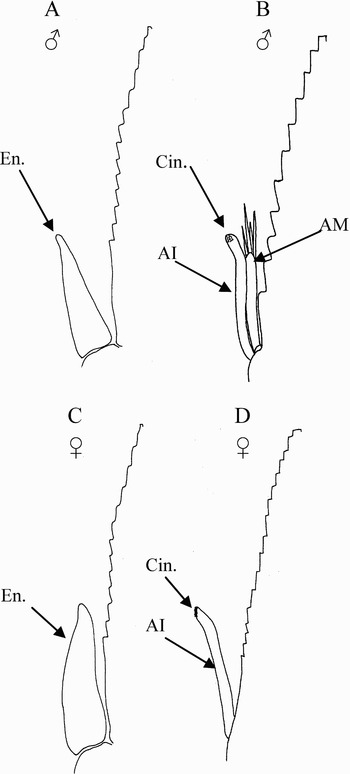
A total of twenty individuals were obtained from field collected specimens for this study and were maintained in the laboratory for approximately 50 d prior to being lost to bacterial infections (Vibrio sp.). Specimens ranged in size from TL 28.2 mm (CL 9.0 mm) to TL 39.8 mm (CL 11.5 mm). Only one, the smallest individual was a male, characterized by the presence of appendices masculinae on the second pair of pleopods (Figure 1 A & B). No cincinnuli could be observed on the endopodites of the first pair of pleopods. These fragile structures might have been lost during ‘handling’, as observed by Kagwade (Reference Kagwade1982). This shrimp did not display a visible gonad, nor did it show signs of development during the experiment. This specimen died from a bacterial infection after approximately three weeks in captivity. When kept with a FP individual, it was only able to successfully fertilize its mate, never capable of spawning a clutch. All other individuals were euhermaphrodites (mean TL 39.5 mm, CL 11.1 mm), characterized by the absence of both cincinnuli on the endopodites of the first pair of pleopods and appendices masculinae on the second pair of pleopods (Figure 1). All were observed to hold eggs at some point of our study.
Exhippolysmta oplophoroides sexual morph development. (A) First pair of pleopods in a male phase shrimp; En. (endopodite) thin and long, without cincinnuli (probably lost due to its fragile nature); (B) second pair of pleopods in a male phase shrimp; presence of AM (appendix masculina) with several spines on tip; and AI (appendix interna) with Cin. (cincinnuli) on tip; (C) first pair of pleopods in a euhermaphropdite shrimp, no cincinnuli present; En. larger and longer; and (D) second pair of pleopods in a euhermaphrodite shrimp, no appendix maculina present; AI longer with Cin. on tip (dense setation of endopodites in (C) were not drawn).

A mating experiment (N = 5) to test the hypothesis that FP specimens can copulate successfully both as male and female was conducted. In each of the five replicate pairs, both shrimps moulted, copulated, and incubated embryos. A successful fertilization event was characterized by the presence of eggs which developed by changing colour from bright green to a dark yellowish-brown over a 9–10 d period, resulting in hatching of viable larvae. Individuals kept separately were not able to self-fertilize, characterized by the extrusion of eggs to the abdomen of the shrimp and a total loss of those eggs within 5 d (normally less than 24 h) (Fiedler, Reference Fiedler1998).
After settling to metamorphosis, juvenile Exhippolysmata oplophoroides presented endopodites of the first pair of pleopods without coupling hooks. The endopods of the second pair of pleopods were provided with an AI with 2–6 coupling hooks. In the MP (Figure 1 A & B) the endopodites of the first pair of pleopods were more slender and tapering. No coupling hooks could be observed. On the second pair of pleopods, AM presented 4 spines on its tip reaching approximately three-quarters or until the end of the AI, which presented more then 6 coupling hooks. In the FP (Figure 1 D & C), the endopodite of the first pair of pleopods was broader, displaying no coupling hooks. On the second pair of pleopods the appendices masculinae regressed totally and the AI presented two rows of coupling hooks.
DISCUSSION
Exhippolysmata oplophoroides displays a PSH sexual system. Young individuals first develop as males and later, larger (older) individuals are functional hermaphrodites, serving as a reproductive female and male at the same time. This is the first study to confirm empirically PSH outside of the genus Lysmata.
Sukumaran (Reference Sukumaran1973) noticed that all individuals of Exhippolysmata ensirostris he examined have an AM on the second pair of pleopods. In smaller individuals (males) this structure is well developed bearing strong spines. As shrimps increased in size, this structure started to decrease (transitional phase) until it almost disappeared. At this stage, shrimps were females holding eggs. The endopodites of the first pair of pleopods in male shrimps had cincinnuli on their tip. In females, these structures disappeared and the endopodite was slender and tapering. Sukumaran (Reference Sukumaran1973, Reference Sukumaran1982) proposed that this species is a protandrous hermaphrodite. On the other hand, Kagwade (Reference Kagwade1982) did not support the idea that this species had a male phase, suggesting that this species is hermaphroditic throughout its life. All the specimens examined in his study, from the smallest TL (20 mm) to the largest (100 mm) were found to possess ovotestes and an AM on the second pair of pleopods. However, appendices masculinae did decrease in size in larger specimens, supporting the observations made by Sukumaran (Reference Sukumaran1973). Kagwade (Reference Kagwade1982) states that ‘even though appendix masculina is reduced in size in higher lengths, there still are some individuals, in very small percentage, in which it is well developed, rendering it difficult to rely fully on this character to establish sex reversal in this species'. Delayed sex change, which has been observed in populations of Lysmata ankeri held in the laboratory (Lin & Zhang, Reference Lin and Zhang2001), could explain the sampling bias. Bauer (Reference Bauer2002) suggested that the occurrence of large MP individuals could be explained by abiotic factors. Under suboptimal conditions (lower temperatures during autumn/winter) rates of change from the male to female phase were much lower. Shaikmahmud & Tembe (Reference Shaikmahmud and Tembe1960) noticed that the fishery of E. ensirostris was mainly supported by females throughout the year, and males only during certain months. Specimens collected for Kagwade's (Reference Kagwade1982) study were collected during November 1971 to December 1974, which could explain the reason for the appearance of larger males in both authors’ samples. Even though abiotic factors could be the cause for delayed sex change, recent studies (Lin & Zhang, 2001 Bauer & Baeza, Reference Bauer and Baeza2004; Zhang & Lin, Reference Zhang and Lin2005; Baeza, Reference Baeza2006) indicate that social factors also have an influence over sex change. The social control in E. oplophoroides is not known; more studies are needed to investigate in depth the reason for the occurrence of mostly FP individuals.
In our study, FP E. oplophoroides did not have appendices masculinae, unlike what Sukumaran (Reference Sukumaran1973) and Kagwade (Reference Kagwade1982) observed in E. ensirostris. It is believed that the appendix masculina serves as a copulatory projection (Descouturelle, Reference Descouturelle1971; Bauer, Reference Bauer1986), but its role in sperm transfer has been discounted in Lysmata wurdemanni (Zhang & Lin, Reference Zhang and Lin2004a). In another caridean shrimp Palaemonetes pugio Holthuis, 1949, the appendix masculina is necessary for sperm transfer (Berg & Sandifer, Reference Berg and Sandifer1984). When the appendices masculinae or endopodites of the first pair of pleopods were removed, Heptacarpus sitchensis (Brandt, 1851) (Wicksten et al., Reference Wicksten, Flynn and Fagarason1996) and H. pictus Stimpson, 1871 (Bauer, Reference Bauer1976) did not transfer the spermatophore as successfully as when these structures were intact. Even though all secondary sexual male characters are lost in Lysmata, FP individuals are still capable of functioning as males and fertilizing successfully other FP individuals. Therefore, it is not surprising that these characters (structures) are not necessary for sperm transfer. Fiedler (Reference Fiedler2000) states that, in Lysmata amboinensis, only the first pair of pleopods are necessary to successfully transfer the spermatophore. In L. wurdemanni, only when both first and second pairs of pleopods were removed, fertilization was not successful (Zhang & Lin, Reference Zhang and Lin2004a,Reference Zhang and Linb). The retention of these structures might be a phylogenetic restriction and/or not be a selective disadvantage (Fiedler, Reference Fiedler2000).
Ecology, social organization and implications for the evolution of PSH
Shrimps belonging to the genus Lysmata are commonly found on hard bottoms such as rocky ledges, tide pools and coral reefs, often associated with algae, sea grass and various other sessile invertebrates (Bauer, Reference Bauer2004). Even though PSH is widespread in the genus Lysmata, their social organization and ecology differ greatly (Bauer, Reference Bauer2000). Exhippolysmata oplophoroides is found living on sandy bottoms (Pires, Reference Pires1992) and in high aggregations (Chakur & Negreiros-Franzoso, Reference Chacur and Negreiros-Fransozo1999; Fransozo et al., Reference Fransozo, Rogério, Bertini and Cobo2005). Female individuals with a CL larger than 4.1 mm were the only specimens sampled (Chakur & Negreiros-Franzoso, Reference Chacur and Negreiros-Fransozo1999; Franzoso et al., Reference Fransozo, Rogério, Bertini and Cobo2005), indicating that juveniles and/or males might not share the same habitat, or recruit and change sex quickly. Another possibility for this absence of males in the samples from these studies is an inability to catch smaller shrimps in trawls. More sampling must be conducted to further investigate these findings.
Our study demonstrates that PSH is not confined to the genus Lysmata, indicating that this sexual system might evolve from a common ancestor. Exhippolysmata oplophoroides lives in high aggregations similar to ‘crowd living’ Lysmata spp. If Exhippolysmata is an ancestor of Lysmata the implications for current theories on how PSH evolved would be profound. Furthermore, studies investigating the cost of maleness or sexual allocation within Lysmata should be expanded to Exhippolysmata and other closely related genera.
ACKNOWLEDGEMENTS
The authors thank Dong Zhang, Cortney Ohs and two anonymous referees who greatly improved the manuscript; the Universidade Santa Úrsula and the Aquaculture and Global Information System Laboratory for giving us the opportunity to conduct this study; Alexander Talarico for his sponsorship; and Raul Fernandes Marinheiro Neto for his help in the laboratory.