Recurrent pericarditis is a rare but troublesome disease. After an acute pericarditis, 30% of the patients develop a second attack without an identifiable cause, and this entity is referred as idiopathic recurrent pericarditis thereafter.Reference Lazaros, Antonatou and Vassilopoulos 1 , Reference Brucato, Emmi and Cantarini 2
Non-steroidal anti-inflammatory drugs and colchicine are widely accepted as first-line therapies in management of acute pericarditis and prevention of recurrences.Reference Brucato, Emmi and Cantarini 2 – Reference Tarantino, Delogu, De Rosa and Rigante 4 Corticosteroid is the second-line therapy for resistant and remitting cases. However, systemic side effects associated with long-lasting therapy limit its use.Reference Lazaros, Antonatou and Vassilopoulos 1 , Reference Brucato, Emmi and Cantarini 2 , Reference Rodriguez-Gonzalez, Ruiz-Gonzalez and Castellano-Martinez 5
In recent years, there is a tendency of experts to classify idiopathic recurrent pericarditis in auto-inflammatory diseases after exploring the pivotal role of interleukin-1 cytokine in pathogeneses and significant clinical improvement with the anti-interleukin-1 agents.Reference Lazaros, Antonatou and Vassilopoulos 1 There have been increasing number of case reports and series, which describe the favourable efficacy of anakinra in idiopathic recurrent pericarditis.Reference Imazio, Brucato and Pluymaekers 3 , Reference Rodriguez-Gonzalez, Ruiz-Gonzalez and Castellano-Martinez 5 , Reference Brucato, Imazio and Gattorno 6 Anakinra is a competitive inhibitor of interleukin-1 receptor and has a short half-life of 4–6 hours. Canakinumab is a monoclonal antibody, which directly and selectively blocks the cytokine interleukin-1β and has a longer half-life (21–28 days).
Herein, we present a 6.5-year-old boy with steroid-dependent idiopathic recurrent pericarditis who showed a complete response to canakinumab after an anaphylaxis with anakinra. We demonstrated the effectiveness and safety of canakinumab for the first time in a child with idiopathic recurrent pericarditis.
Case report
A 6.5-year-old boy referred to paediatric cardiology outpatient clinic with the symptoms of fever, dyspnoea, and chest pain. His past medical history in the last 6 months included two similar manifestations, which has been found to be associated with pericardial effusions. Both of the flares have been subsided with ibuprofen treatment.
Physical examination revealed fever, tachypnoea, muffled heart sounds, normal blood pressure, and normal heart rate. There were no other remarkable pathological findings in examination related to the other organ systems.
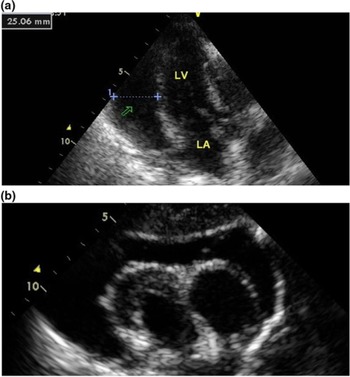
Enlarged cardiac silhouette and generalised QRS voltage suppression were detected on chest X-ray and electrocardiography, respectively. At transthoracic echocardiography, a circumferential pericardial effusion (25 mm in diameter) without evidence of tamponade was noted (Fig 1).
Echocardiographic images in parasternal long-axis ( a ) and subcostal transverse axis ( b ) view, demonstrating the diffuse pericardial effusion.

Laboratory tests showed an increased white blood cell count of 19,000/mm3, elevated C-reactive protein (24 mg/dl), and an erythrocyte sedimentation rate of 70 mm/hour. Anti-nuclear antibodies, anti-double-stranded DNA antibodies, and rheumatoid factor were negative. Complement levels (C3 and C4) were normal. Infectious aetiologies were ruled out by means of normal intradermal skin test (Mantoux method) and negative serologic tests for other bacterial and viral agents. Heterozygous R202Q variant was detected in MEFV gene analysis.
The diagnosis of idiopathic recurrent pericarditis was established. Pericardial effusion regressed within 1 week after ibuprofen (40 mg/kg/day) and colchicine (1 mg/day) treatment. Ibuprofen was discontinued and the patient was discharged with colchicine therapy at the end of the second week. At the end of third month, another pericarditis episode with the same manifestations was observed while he was on colchicine therapy. Corticosteroid treatment (2 mg/kg/day) for 7 days along with colchicine resulted in complete remission of effusion and good clinical response. Two another relapses with pericarditis again developed 1 week after cessation of corticosteroid therapy. The patient exhibited favourable response to corticosteroid therapy in both of these episodes. This entity was considered as steroid-dependent idiopathic recurrent pericarditis.
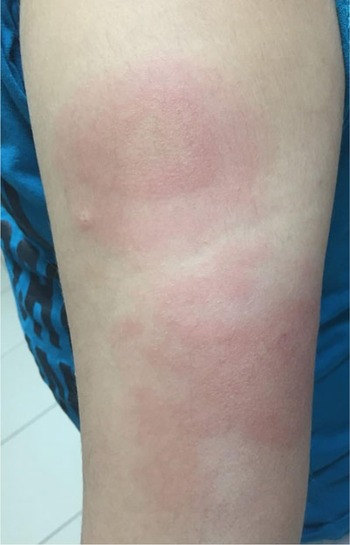
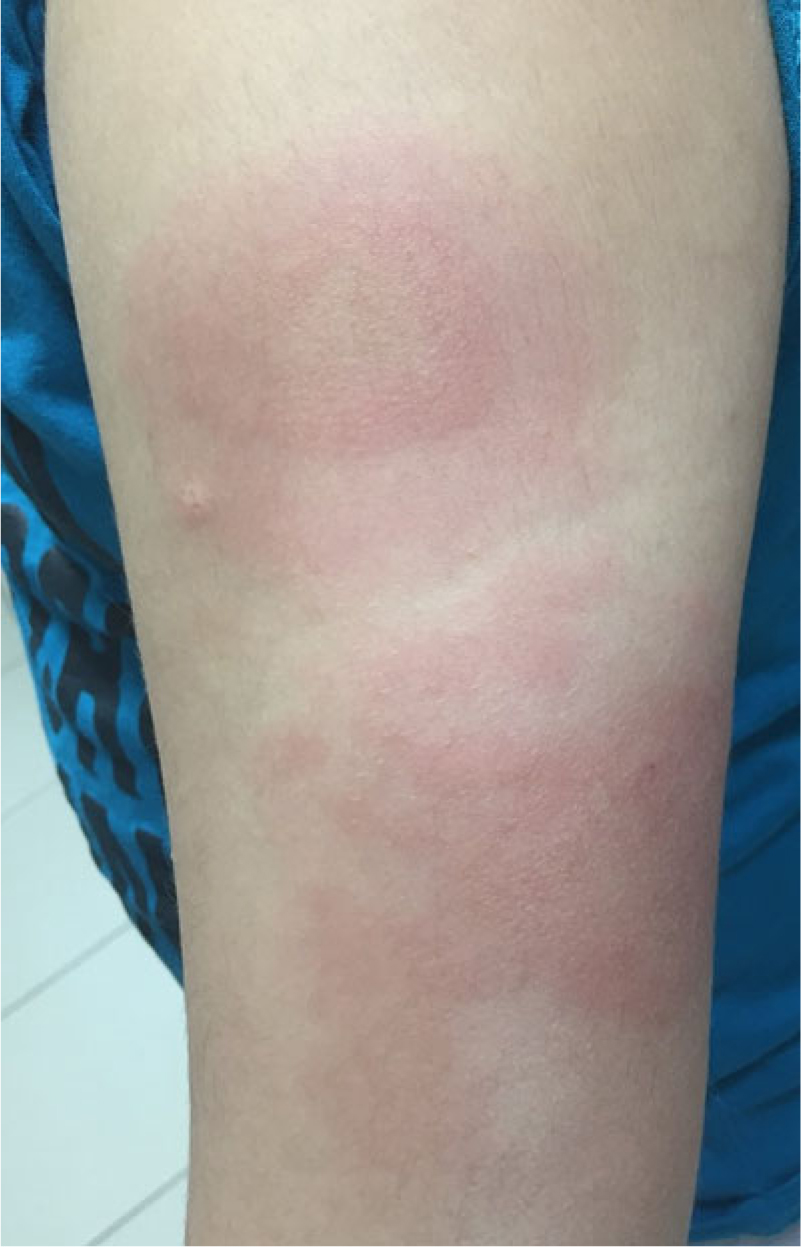
Daily subcutaneous anakinra treatment (5 mg/kg/day) was initiated. Pericarditis completely resolved within 72 hours and corticosteroid therapy was terminated at the end of the first month by a slowly tapering regimen. After 1 month of daily administration, the interval between injections was gradually prolonged. Injection-site skin reactions occurred during daily anakinra injections (Fig 2) and disappeared during the alternate-day dosing regimen.
One year later, while the patient was on a biweekly anakinra treatment regime, a new pericarditis flare developed that promptly improved within 48 hours by daily anakinra doses.
Local skin reactions on the arm at the injection sites of anakinra therapy.
Six months later, a severe anaphylactic reaction developed immediately after anakinra injection and he was hospitalised. Another anti-interleukin-1 agent, canakinumab (5 mg/kg monthly subcutaneous injections), was started after the anaphylaxis.
Monthly subcutaneous canakinumab (5 mg/kg/dose) injections were administered for 1 year, followed by alternate months dosing for another 1 year. The patient has never experienced a pericarditis flare or adverse event for 2 years under canakinumab and colchicine treatment.
Discussion
The recurrence rate of acute pericarditis is about 30% in patients who experienced the disease for the first time.Reference Lazaros, Antonatou and Vassilopoulos 1 , Reference Brucato, Emmi and Cantarini 2 Investigating the aetiology and management of recurrent pericarditis represents one of the most frustrating challenges in cardiology and rheumatology practice. Pericarditis appears to be idiopathic in 80% of the patients in developed countries.Reference Lazaros, Antonatou and Vassilopoulos 1 , Reference Brucato, Emmi and Cantarini 2 , Reference Picco, Brisca, Traverso, Loy, Gattorno and Martini 7
Results of various studies regarding the efficacy of colchicine in treatment and prevention of flares are contradictory.Reference Imazio, Brucato and Pluymaekers 3 , Reference Tarantino, Delogu, De Rosa and Rigante 4 , Reference Sambola, Roca Luque and Merce 8 A recent randomised-controlled multi-centre study did not find any difference in the rate of recurrence or time to first recurrence between patients using only non-steroidal anti-inflammatory drugs and patients using colchicine along with non-steroidal anti-inflammatory drugs.Reference Sambola, Roca Luque and Merce 8
Corticosteroids are widely used in patients unresponsive or resistant to conventional therapy. However, in addition to the significant side effects, corticosteroid treatment has been reported to be associated with an increased risk of recurrence.Reference Imazio, Brucato and Pluymaekers 3
Treatment of idiopathic recurrent pericarditis with anakinra, namely with an anti-interleukin-1 agent, for the first time described in 2009 was successful.Reference Picco, Brisca, Traverso, Loy, Gattorno and Martini 7 In addition, in this study, suggestion of the auto-inflammatory mechanisms in pathogenesis of the disease was first provided in the literature.Reference Picco, Brisca, Traverso, Loy, Gattorno and Martini 7 Anakinra has been found to decrease the risk of pericarditis flares.Reference Imazio, Brucato and Pluymaekers 3 , Reference Rodriguez-Gonzalez, Ruiz-Gonzalez and Castellano-Martinez 5 , Reference Brucato, Imazio and Gattorno 6 Moreover, anakinra provided withdrawal of concomitant therapies.Reference Lazaros, Vasileiou and Koutsianas 9 However, the protocol for tapering or cessation of anti-interleukin-1 therapy is still a matter of controversy.Reference Finetti, Insalaco and Cantarini 10 Previous reports consistently showed that more than half of the patients developed a flare during tapering process or after cessation, as in our case.Reference Rodriguez-Gonzalez, Ruiz-Gonzalez and Castellano-Martinez 5 , Reference Finetti, Insalaco and Cantarini 10
The most frequently reported minor and severe adverse events of anakinra are local skin reactions and anaphylactic reactions, respectively.Reference Brucato, Imazio and Gattorno 6 , Reference Lazaros, Vasileiou and Koutsianas 9 Both of these adverse events developed in our case. In AIRTRIP trial, local skin reactions were observed in 95% of the patients after anakinra administration.Reference Brucato, Imazio and Gattorno 6
Anti-interleukin-1 agents, either anakinra or canakinumab, should be considered in patients who are unresponsive to non-steroidal anti-inflammatory drugs and/or colchicine or dependent to corticosteroid. The efficacy and safety of anakinra in treatment of idiopathic recurrent pericarditis have been well established,Reference Brucato, Emmi and Cantarini 2 , Reference Rodriguez-Gonzalez, Ruiz-Gonzalez and Castellano-Martinez 5 , Reference Brucato, Imazio and Gattorno 6 whereas there has been no data so far regarding the usage of canakinumab which is the other anti-interleukin-1 biologic agent. This case report, for the first time, depicts the successful treatment of idiopathic recurrent pericarditis with canakinumab without any adverse event.
Author ORCIDs
Serdar Epçaçan 0000-0002-0189-0063; Sezgin Şahin 0000-0002-5365-3457
Acknowledgements
None.
Financial Support
This research received no specific grant from any funding agency, commercial, or not-for-profit sectors.
Conflicts of Interest
None.
Ethical Standards
All procedures and medications performed were in accordance with the ethical standards, with the 1964 Helsinki Declaration and its later amendments. Informed written consent from parents of the patient was obtained for treatment with anakinra and canakinumab and also publishing this experience.