Introduction
DNA marker techniques have been utilized in numerous applications, e.g. in the assessment of genetic diversity, in breeding programmes and in variety identification. In recent years, many promising markers have been developed (Poczai et al., Reference Poczai, Varga, Laos, Cseh, Bell, Valkonen and Hyvönen2013). Without access to prior DNA sequence information of the analysed organisms, start codon targeted (SCoT) and sequence-related amplified polymorphism (SRAP) are well-established because they target gene-related regions, and are highly reproducible and very efficient in genetic variation studies in plants (Li and Quiros, Reference Li and Quiros2001; Collard and Mackill, Reference Collard and Mackill2008). A search for publications on genetic diversity using SCoT or SRAP markers revealed more than 5000 publications in the last 5 years (2016–2020), demonstrating the popularity of using these types of markers for genetic diversity study.
SCoT or SRAP markers are semi-random markers and amplify multiple loci at a time, therefore they can cause uneven amplification. Accordingly, ambiguous band patterns from SCoT or SRAP have been shown in some publications (Mahmoud and Abdel-Fatah, Reference Mahmoud and Abdel-Fatah2012; Kumar and Agrawal, Reference Kumar and Agrawal2017; Agarwal et al., Reference Agarwal, Gupta, Haq, Jatav, Kothari and Kachhwaha2019; Rayan and Osman, Reference Rayan and Osman2019) and this is supported by our own experience.
Like multiplex PCR, SCoT or SRAP markers amplify more than one target sequence in a single reaction. Therefore, a PCR mix optimized for high yield and robust performance is required. Several multiplex PCR kits that enable efficient amplification of more than one target at a time have been launched commercially. Here we evaluated the performances of commercial multiplex PCR kits in SCoT or SRAP amplification, which has not been reported elsewhere. Five commercial multiplex PCR kits and one common Taq polymerase system were tested in six plant species with various genome sizes, namely in rice (Oryza sativa), oil palm (Elaeis guineensis), onion (Allium cepa), holy basil (Ocimum sanctum), chilli pepper (Capsicum annuum) and eggplant (Solanum melongena). These findings would be beneficial for the researchers who interested in the plant genetic resources and genetic diversity study in order to get a better result from SCoT and SRAP genotyping.
Materials and methods
Plant materials and DNA preparation
Six commercial crop plants with a wide range of genome sizes were used in this study, as shown in online Supplementary Table S1. Leaf samples were collected for DNA extraction with a modified CTAB method. Briefly, an approximately 100 mg leaf sample was powdered by grinding with liquid nitrogen. The samples were transferred to CTAB buffer containing 20 mg of polyvinylpolypyrrolidone and 10 μg/ml RNaseA, and incubated at 60°C for 1 h. After centrifugation, the supernatant was transferred into a new tube and added with an equal volume of 24:1 chloroform:isoamyl alcohol. The aqueous phase was transferred into a new tube, and added with an equal volume of cold isopropanol. The sample was incubated at −20°C for 1 h. After centrifugation, the DNA pellet was washed with 70% ethanol. The quality and quantity of DNA were measured by using a Nanodrop ND-1000 spectrophotometer (NanoDrop Technologies Inc., DE, USA) and with 1% agarose gel electrophoresis. DNA samples that had A260/A280 ratio of 1.7–2.0, A260/A230 greater than 1.5, and showed a tight band on agarose gel, were subjected to PCR.
PCR reagents
The multiplex PCR kits from commercial vendors used in the experiments were as follows: QIAGEN Multiplex PCR kit (QIAGEN, USA); Phusion U Multiplex PCR Master Mix (Thermo Scientific, USA); Multiplex PCR 5X Master Mix (New England Biolabs, USA); KAPA2 G Fast Multiplex PCR kit (KAPA Biosystem, South Africa); and 2X Master/MultiMAX PCR kit (iNtRON Biotechnology, Korea). Taq DNA polymerase (Vivantis, Malaysia) was used as a representative common Taq polymerase. The details of each Taq polymerase are shown in online Supplementary Table S2.
Amplification of SCoT and SRAP markers using commercial multiplex PCR reagents
Different amounts of DNA samples (1, 10 and 100 ng) were used as templates. The PCR mixture had 1X PCR master mix and 0.2 μM SCoT or SRAP primers in the total volume of 20 μl. The SCoT and SRAP primer sequences are shown in online Supplementary Table S3. The denaturation step was set according to the manufacturer's manuals. Then two cycles of 95°C for 30 s, 40°C for 1 min and 72°C for 2 min were run prior to performing 33 cycles of 95°C for 30 s, 50°C for 1 min and 72°C for 2 min. After the final extension at 72°C for 7 min, the PCR product was analysed in 2% agarose gel electrophoresis. The PCR amplification by Taq polymerase systems that show closed results was repeated in three new individual samples in some species and primers.
Data analysis
For the agarose gel images, a five-level scale was used to grade the quality of PCR fragments. The levels of the scale are 1 for no band or smear; 2 for unclear band; 3 for the number of bands lower than in the other reactions more than one time or bands with smear; 4 for fair band pattern; 5 for the best clear band patterns.
Results and discussion
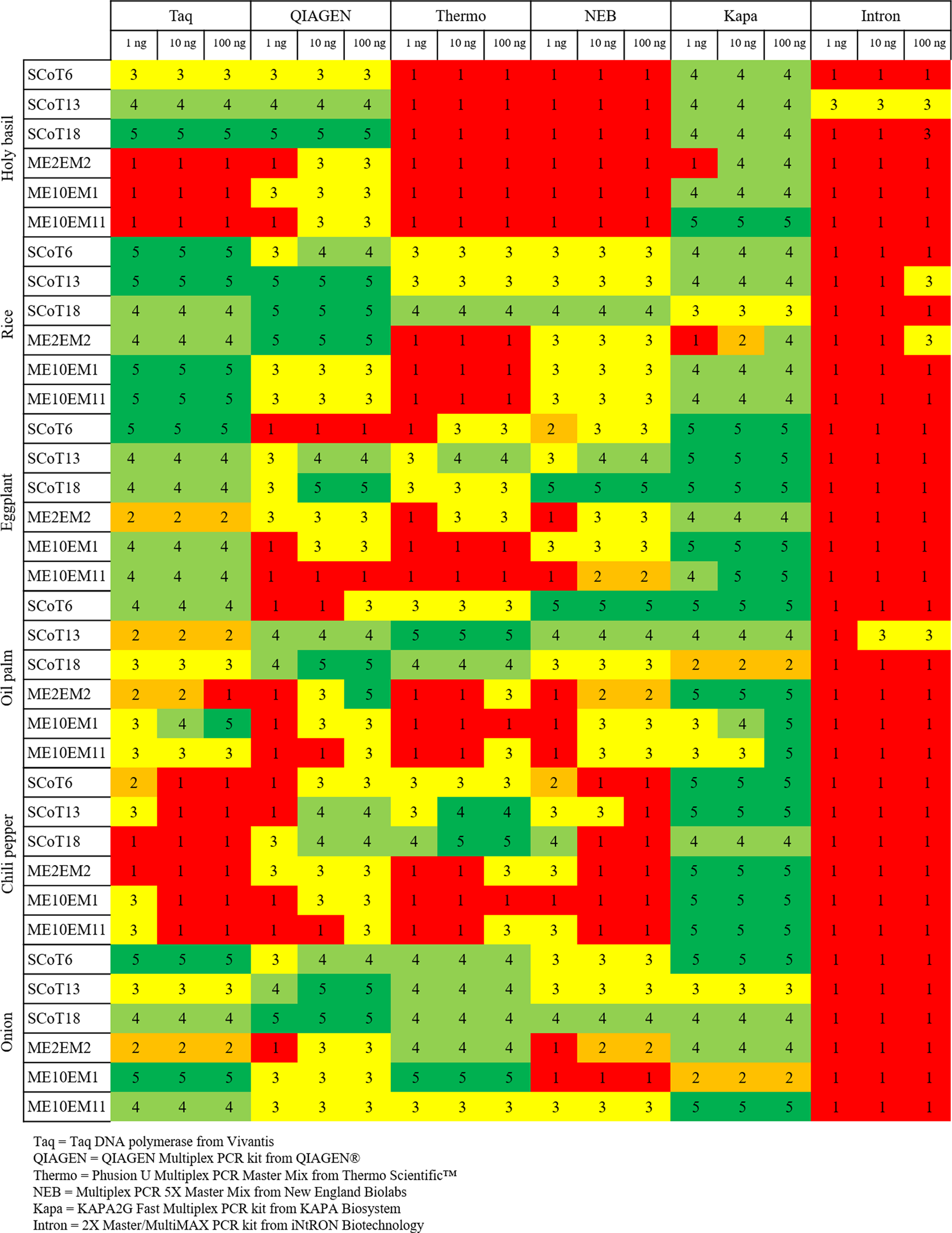
SCoT and SRAP, the semi-random markers, have been widely used to study genetic variation in several plants. Since they amplify multiple loci at a time like multiplex PCR, Taq polymerase system affected efficient PCR amplification resulting in accurate genotyping. In this study, the performance of SCoT and SRAP amplifications using multiplex PCR kits, including QIAGEN Multiplex PCR kit from QIAGEN® (QIAGEN), Phusion U Multiplex PCR Master Mix from Thermo Scientific™ (Thermo), Multiplex PCR 5X Master Mix from New England Biolabs (NEB), KAPA2 G Fast Multiplex PCR kit from KAPA Biosystem (Kapa) and 2X Master/MultiMAX PCR kit from iNtRON Biotechnology (Intron), was investigated. The Taq DNA polymerase from Vivantis (Taq) was used as a representative common Taq polymerase. A wide range of genome sizes was used, by choice of the plant samples from holy basil, rice, eggplant, oil palm, chilli pepper and onion. Globally, the results from both SCoT and SRAP markers, based on the scores for performance, revealed that Kapa had the best performance, followed by Taq and QIAGEN, in this rank order (Fig. 1). The Kapa contains KAPA2G Fast, which is an engineered DNA polymerase for efficient and fast multiplex PCR. The cocktail was formulated for highly specific multiplex PCR amplification of a wide range of GC contents, resulting in more even amplification of all target fragments (Kapabiosystem, 2017). No Taq polymerase system generated good results across all the tested plant species and markers. Considering the results by plant species, Kapa showed the best performance in holy basil, eggplant, oil palm, and chilli pepper, whereas Taq is the best choice for SCoT and SRAP amplification in rice. In onion, Thermo showed the best performance among the systems tested, even if it did not perform well in the other plants. Nonetheless, NEB and Intron are not recommended for SCoT or SRAP genotyping.
Performance in SCoT and SRAP amplification of various multiplex PCR kits, with samples of holy basil, rice, eggplant, oil palm, chilli pepper and onion; and 1, 10 and 100 ng DNA templates. SCoT6, 13 and 18 are SCoT markers, whereas ME2EM2, ME10EM1 and ME10EM11 are SRAP markers. The red (1), yellow (2), orange (3), light green (4) and dark green (5) colours represent ‘no band or smear’, ‘unclear’, ‘a few bands’, ‘fair band pattern’ and ‘best clear band patterns’, respectively.

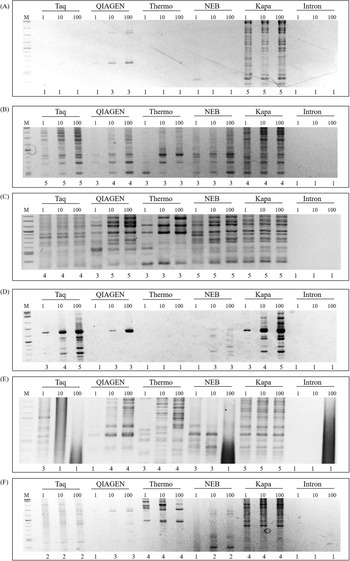
For sufficient amplification, an optimal DNA amount should be used. Too low or high amount of DNA template affects PCR amplification. For example, genotyping seagrass using DNA amounts of 10, 1 and 0.1 ng exhibited successful amplifications, while 100 ng failed to amplify (Angel, Reference Angel2002). In our results, the amount of DNA affected PCR amplification in some cases. One nanogram (ng) of DNA template sometimes showed fewer bands of the PCR products than 10 and 100 ng (Fig. 2). In holy basil, rice and eggplant, with 352–980 Mb genomes, the DNA templates of 10 and 100 ng showed nearly similar results. For the plant species with large genome size in this study (oil palm, chilli pepper and onion with genome sizes from 2116 to 14,082 Mb), thicker bands with slight smearing along the lane on agarose gel were found for oil palm amplified by Taq and Kapa, and for onion amplified by Kapa. Therefore, the optimal DNA amount should be evaluated before genotyping, for good results. For chilli pepper, a 100 ng DNA template was not amplified by Taq, NEB and Intron. Accordingly, Garner (Reference Garner2002) reported that large-sized genomes may encounter difficulties in PCR amplification, because of the dilution of the proportion of available target DNA. However, some Taq polymerase systems were not affected by the genome size. Since different amounts of DNA sometimes generated different PCR product band patterns in SCoT and SRAP genotyping, a fixed amount of DNA should be used consistently, especially when working with large genome size plants. It was noted that different Taq polymerase systems show different band patterns in many cases, therefore fixing also the Taq polymerase system for an experimental dataset or for a project is crucial to enable analyses and comparisons.
Examples of PCR products on 2% agarose gel from holy basil using ME10EM11 (a), rice using SCoT6 (b), eggplant using SCoT18 (c), oil palm using ME10EM1 (d), chilli pepper using SCoT13 (e) and onion using ME2EM2 (f). The numbers below each gel photo indicate the scored numbers.

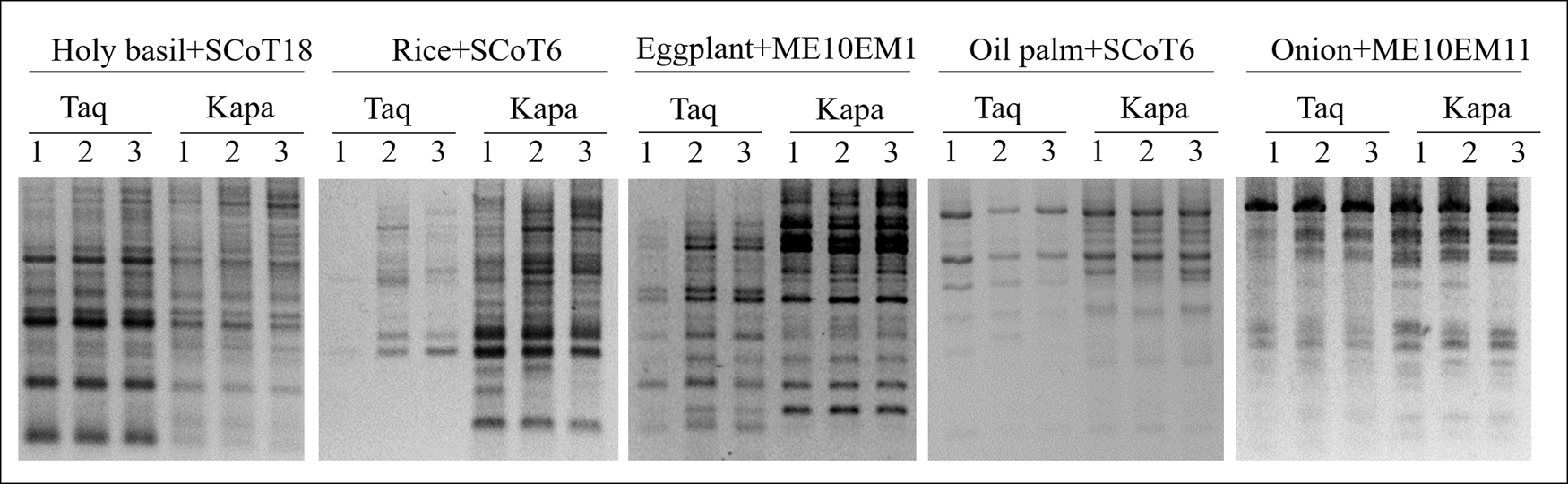
As the results, the amplified band patterns from Kapa and Taq were closed for some species and primers. PCR amplification in three more samples in such species with some primers confirmed the consistency of the result (Fig. 3). This result also ensured that 10 ng DNA template is sufficient for SCoT and SRAP genotyping if using proper Taq polymerase system.
PCR products on 2% agarose gel from three of each holy basil, rice, eggplant, oil palm and onion samples using Taq and Kapa. The name of primers is indicated after ‘+’ symbol.

Conclusion
The performance of multiplex PCR kits in SCoT and SRAP amplifications of various plant genomes, namely those of holy basil, rice, eggplant, oil palm, chilli pepper and onion, revealed that Kapa is suitable for both SCoT and SRAP in almost all the tested plant species. The cheapest alternative, Taq, generated good results for both SCoT and SRAP in rice, eggplant and onion. Thermo is recommended for both SCoT and SRAP in onion, the largest genome size plant in this study. Different Taq polymerase systems might generate different band patterns; therefore, using the same Taq polymerase system throughout an experimental design is recommended. On genotyping with SCoT and SRAP, the amount of DNA template should be also held fixed across all samples, typically between 10 and 100 ng in the DNA template.
Supplementary material
The supplementary material for this article can be found at https://doi.org/10.1017/S1479262121000046
Acknowledgement
This work was supported by Thaksin University Research fund (TSU63BRG006). The Department of Molecular Biotechnology and Bioinformatics, Faculty of Science, Prince of Songkla University is acknowledged for research facilities. We thank Associate Professor Seppo Karrila and Research and Development Office, PSU for language proofreading.