INTRODUCTION
Effective conservation requires measurement of the success of interventions (Saterson et al. Reference Saterson, Christensen, Jackson, Kramer, Pimm, Smith and Wiener2004; Sutherland et al. Reference Sutherland, Pullin, Dolman and Knight2004). There are, however, few studies that attempt to quantify the relative success of different conservation interventions in a controlled manner (Ehrenfeld Reference Ehrenfeld2000) and those that have attempted it highlight the problem of the lack of systematic monitoring schemes (Brooks et al. Reference Brooks, Franzen, Holmes, Grote and Borgerhoff-Mulder2006). The diversity of conservation actions that may be employed, from education and training to habitat restoration, means that it can often be difficult to define the meaning of ‘success’, as those undertaking conservation may prioritize different outcomes (Brooks et al. Reference Brooks, Franzen, Holmes, Grote and Borgerhoff-Mulder2006). There are a number of approaches to developing common measures of success that involve assessing impact according to the type of intervention employed (Salafsky & Margoluis Reference Salafsky and Margoluis1999; Jepson Reference Jepson2004; Mace et al. Reference Mace, Balmford, Leader-Williams, Manica, Walter, West, Zimmermann, Zimmermann, Hatchwell, Dickie and West2007).
Long-term saiga antelope (Saiga tarctica) conservation requires a combination of measures that include raising awareness and generating positive behavioural changes in the local population. Although it is difficult to directly observe and relate actual behavioural changes to a particular intervention (Holmes Reference Holmes2003), it is possible to obtain a measure of behavioural intention through economic tools (Mitchell & Carson Reference Mitchell and Carson1989). In this study, we used contingent valuation methods to identify an amount pledged for saiga conservation. We use this measure as a quantitative indicator of intention to contribute to conservation, allowing the relative effectiveness of three different antecedent interventions for saiga conservation, aimed at increasing awareness and promoting positive behavioural intentions, to be compared. This study thus addresses the lack of quantitative comparative studies of conservation intervention effectiveness.
The attitude-behaviour relationship (Fishbein & Ajzen (Reference Fishbein and Ajzen1975) predicts that human behaviour is governed by a series of beliefs that a person learns or forms on the basis of observation and information received. A belief is an individual's opinion about an object and, in the case of possible behaviour, the consequences of that act on the object (Bateman & Willis Reference Bateman and Willis2001). These beliefs then form the basis of a person's attitudes, which, in turn, are predicted to influence behavioural intentions: stated intentions to perform an act at a later date (Bateman & Willis Reference Bateman and Willis2001). However, the relationship between behavioural intentions and behaviour is contextual and depends on intervening experiences and information obtained (Foxall Reference Foxall1984).
Antecedent interventions, such as those employed in this study, target underlying behavioural determinants, for example knowledge, which, in turn, are hypothesized to influence behaviour (Luiselli Reference Luiselli2006). Studies of energy use show that the provision of information tends to result in higher knowledge of the subject (Abrahamse et al. Reference Abrahamse, Steg, Vlek and Rothengatter2005). Other studies show a positive relationship between knowledge and attitudes to conservation; for example greater knowledge about manatees was positively correlated with support for manatee conservation (Aipanjiguly et al. Reference Aipanjiguly, Jacobson and Flamm2002). Formal education level, even when not specifically tailored to conservation, also correlates with positive attitudes (Infield Reference Infield1988; Caro et al. Reference Caro, Pelkey and Grigione1994; Mehta & Heinen Reference Mehta and Heinen2001). Consequently, it can be hypothesized that there is a link between conservation interventions that raise awareness and the attitudes and behavioural intentions of the target population, which may occur through a change in knowledge levels.
The North-West Pre-Caspian region of the Russian Federation is one of the poorest regions of Russia (UNDP 2007). Between 2006 and 2007, the human development index (HDI) for the region was similar to that of a medium development country (UNEP 2006). The dissolution of the USSR in 1991 resulted in high levels of unemployment in the area (Grin Reference Grin2000). The consequent poverty and collapse in hunting controls drove substantial illegal hunting of the saiga antelope, Saiga tatarica (Kühl et al. Reference Kühl, Balinova, Bykova, Esipov, Arylov, Lushchekina and Milner-Gulland2009). The saiga is a nomadic ungulate of the Central Eurasian rangelands hunted both for its horn, which is used in traditional Chinese medicines, and for meat for local consumption (Milner-Gulland et al. Reference Milner-Gulland, Kholodova, Bekenov, Buhreeva, Grachev, Amgalan and Lushchekina2001). Post-Soviet over-hunting led to a dramatic population reduction from over a million to less than 50 000 individuals (Milner-Gulland et al. Reference Milner-Gulland, Kholodova, Bekenov, Buhreeva, Grachev, Amgalan and Lushchekina2001) and, in 2002, the species was officially classified in the IUCN Red List as Critically Endangered (URL http://www.redlist.org).
Known as the ‘friends of the steppe’ by the poet Alexander Pushkin, the Kalmyk people used to manage the saiga antelope populations that migrated through their territory, punishing those who broke hunting laws with severe fines (Kirikov Reference Kirikov1983; Lushchekina & Struchkov Reference Lushchekina and Struchkov2001). Although this practice is no longer carried out, the saiga still plays a significant part in Kalmyk life, being seen as a symbol of the steppe and being represented as a holy figure in statues in the Buddhist temples of the region. Saigas are also consumed by the local population and therefore there is a high meat value to the local human popualtion (Sokolov & Zhirnov Reference Sokolov and Zhirnov1998). The preservation of the saiga is therefore important, not only for the international organizations funding conservation, but also for the Kalmyk people, their culture and livelihoods.
In the study area, several saiga conservation initiatives have been initiated. In 1990, the Chernye Zemli Biosphere Reserve (CZBR) was established in the Autonomous Republic of Kalmykia, followed, in 2000, by the Stepnoi Reserve in the neighbouring Astrakhan Province. Both reserves undertake monitoring and protection of the species, with a particular emphasis on traditional ‘fences-and-fines’ conservation in and around the Stepnoi Reserve. In 2003, the first major saiga conservation project began in Kalmykia, funded by the UK Darwin Initiative. In 2006, a DEFRA-funded Small Environmental Projects Scheme (SEPS) project provided cows to two villages in Kalmykia. The aim of this project was to provide alternative livelihoods for the poorest members of society. Finally, the Darwin Initiative project was awarded post-project funding in 2006, specifically concerned with examining the effect of conservation interventions on attitudes and in extending public awareness of conservation. The Darwin and SEPS projects were focused on two villages to the north and west of the CZBR. They also involved a general media campaign in local newspapers and TV that reached the rest of Kalmykia. The villages in neighbouring Astrakhan province, on the eastern side of the two protected areas, are geographically, administratively and ethnically separated from the Kalmykian villages, and were exposed only to the conservation activities of the Stepnoi Reserve. This lack of leakage means the region provides a unique opportunity to compare how different conservation interventions, such as traditional ‘fortress’ conservation, social engagement and media campaigns, influence behavioural intentions. Owing to the geographically small area studied, cultural and demographic influences can be closely measured and controlled. The effect of blanket sociopolitical influences (such as the break-up of the Soviet Union in 1991) on attitudes towards saiga conservation in general can also be investigated.
The amount of money that people are prepared to give towards conservation efforts has been well established as a measure of behavioural intention (Mitchell & Carson Reference Mitchell and Carson1989; Bateman et al. Reference Bateman, Carson, Day, Hanemann, Hanley, Hett, Jones-Lee, Loomes, Mourato, Ozdemiroglu, Pearce, Sugden and Sawnson2002). In this study, we use a contingent valuation approach to compare the behavioural intentions of people subject to three different conservation interventions. We do not use the absolute values obtained to calculate willingness to pay, but instead compare the values between groups as a tool to evaluate the relative success of different approaches to conservation. Due to the cultural and economic importance of the saiga antelope to the Kalmyk people, the amount pledged was considered to be an appropriate metric since the benefits of conservation accrue to the local people, as well as to the international community. Kalmykia has a well-established market system and therefore the use of economic methods is valid for this region (Grin Reference Grin2000). Contingent valuation methods are a less direct form of questioning than asking straightforwardly about behavioural intention, and thus enabled us to not only quantify behavioural intention, but also consider protest-bidding behaviour, which may provide further understanding of underlying influences on attitudes.
It is hypothesized that the three conservation interventions had different effects both on the level of knowledge regarding saiga ecology conservation as well as on the attitudes and behavioural intentions of the local population. In turn, knowledge may also be a predictor of behavioural intention in its own right, and therefore may be the mechanism by which interventions influence behavioural intention. We asked four specific research questions. (1) Does the type of conservation intervention undertaken, taking into account confounding factors, have an effect on ecological knowledge? (2) Is behavioural intention (amount pledged for conservation) with regard to saiga conservation dependent on an individual's level of ecological or conservation knowledge? (3) What are the confounding effects of social, political and economic influences on individuals’ knowledge and behavioural intention towards saigas and their conservation? (4) Does the type of conservation intervention employed have an effect on an individual's behavioural intention towards saigas and their conservation?
METHODS
Study system
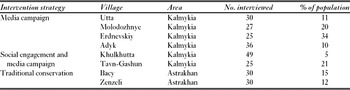
This study was conducted in eight villages in southern Russia. Four villages in the Autonomous Republic of Kalmykia (Utta, Erdnevskiy, Molodozhnye and Adyk) were exposed to a media campaign, through regional and local papers and local TV. Two villages in Kalmykia (Khulkhutta and Tavn-Gashun) were targets for social engagement and also exposed to the media campaign. By contrast, two villages in the Liman region of Astrakhan Province (Bacy and Zenzeli) were exposed only to the Stepnoi Reserve's traditional ‘fences-and-fines’ conservation (Table 1). The villages ranged in size from 415 people (Municipal Administration of Tavn-Gashun, unpublished data 2007) to 3112 people (Municipal Administration of Zenzeli, unpublished data 2007). All villages were located in steppe habitat, within the saiga range. None had running water, but all had electricity, a school to age 14 and mobile phone coverage. All but two (Bacy and Adyk) had medical facilities. Unemployment was generally high and employment was in the livestock sector, or in unskilled and temporary work. As the largest village, Zenzeli had a greater range of employment opportunities (details on interventions employed and study locations are provided in Appendix 1, see supplementary material at Journals.cambridge.org/ENC).
Sampling strategy indicating number of individuals interviewed by village and intervention strategy.

Field methods and data collection
The study was carried out over two months in September – October 2006. Two hundred and fifty respondents were chosen using systematic transects of each village. This methodology has potential bias issues if the houses are not representative of the village as a whole, however, owing to time constraints, it was the best method to obtain as random a sample as possible. Depending on the size of the village, 25–40 households (5–35% of the resident population) were interviewed in each village (Table 1). This was the minimum sample size required to ensure adequate power in subsequent analyses (Kirk Reference Kirk1995). The representativeness of the sample was validated by comparison with a previous study in the same region (Kuhl 2007) and with official demographic statistics.
Interviewees completed questionnaires (Appendix 2, see supplementary material at Journals.cambridge.org/ENC) using a combination of structured and semi-structured questions to obtain breadth and depth of information (Bernard Reference Bernard2002). The questions assessed their level of exposure to saigas, knowledge of population trends, knowledge of conservation projects locally and nationally and amount pledged for saiga conservation. Amount pledged was used a measure of behavioural intention to contribute to conservation (Mitchell & Carson Reference Mitchell and Carson1989; Bateman et al. Reference Bateman, Carson, Day, Hanemann, Hanley, Hett, Jones-Lee, Loomes, Mourato, Ozdemiroglu, Pearce, Sugden and Sawnson2002). A closed payment ladder, coupled with a voluntary payment scenario was used to elicit amount pledged, in order to encourage participants to respond honestly (Mitchell & Carson Reference Mitchell and Carson1989; Bateman et al. Reference Bateman, Carson, Day, Hanemann, Hanley, Hett, Jones-Lee, Loomes, Mourato, Ozdemiroglu, Pearce, Sugden and Sawnson2002). Individuals were asked to suggest a level of voluntary contribution ‘to support the conservation and protection of the saiga antelope’. The scenario used to elicit amount pledged was developed to take into consideration the means of payment, form of action to be undertaken and the organization that would undertake the work (Fischhoff & Furby Reference Fischhoff and Furby1988). Possible reasons for zero bids were provided to the respondents. Interviews were conducted in person by Caroline Howe (CH) and Ruslan Medzhidov (RM), together with a trained translator (Appendix 2, see supplementary material at Journals.cambridge.org/ENC, provides details concerning the specific wording of the amount pledged question, alongside questions used to obtain the level of respondents’ knowledge about saiga population trends and conservation).
Data analysis
People's knowledge about changes in saiga population status (‘population knowledge’) and the amount they would pledge for saiga conservation were used as dependent variables, representing knowledge and behavioural intention, respectively (Appendix 3, see supplementary material at Journals.cambridge.org/ENC). The explanatory variables were intervention, nationality, wealth, village, area, formal education, exposure to saigas, residence time in the village and knowledge about conservation projects in the area (‘conservation knowledge’; Table 2). Several of the variables were scored subjectively. In order to reduce the errors associated with recall and to make categorization as robust as possible, we collapsed the detailed scores into ordinal factors with between three and five levels (Appendix 4, see supplementary material at Journals.cambridge.org/ENC). Other potential variables related to conservation activities, found important in similar studies elsewhere, were not relevant to this scenario, as neither nature-based tourism nor conservation or community management groups, existed in the area. The relationship between population knowledge and conservation knowledge is likely to be mutually reinforcing, as knowledge of, and interest in, saiga ecology is likely to lead to a curiosity towards, and awareness of, conservation and vice versa. In the model for population knowledge, conservation knowledge was included along with the other factors, in order to determine which factors affect population knowledge after controlling for the effect of conservation knowledge. Endogeneity, which cannot be controlled for, is likely to have a serious effect in this model, making the results suggestive only. The second model, for amount pledged, only contained one of the two knowledge variables, in order to avoid issues of collinearity. Conservation knowledge was found to be a better explanatory variable than population knowledge, and hence we used that in the model.
Summary of statistical properties of explanatory variables. Variables defined in Methods (and see also Appendix 4, see supplementary material at Journals.cambridge.org/ENC). n = 250. SD = standard deviation.

Three factors were spatially confounded, namely administrative area (i.e. Kalmykia and Astrakhan), village and the conservation intervention. Area did not provide any explanatory power over and above village and intervention, and was therefore not used in the final models. A priori, nationality may take into account possible area effects but is not so confounded with intervention. In order to tease apart the effect of intervention from village, linear mixed effects models (LMEs) were used (Crawley Reference Crawley2007). Intervention was treated as a fixed effect and village as a random effect. In those cases where the random effect explained little or no variation, a generalized linear model (GLM) was tested using ANOVA against the LME, and accepted as the minimum adequate model (MAM) if there was no significant difference between the two models.
Error structure was defined by the distribution of the response variable. Explanatory variables were chosen using a tree model (Crawley Reference Crawley2007). As we were interested in the effects of intervention, this was always included in the saturated model. Two-way interactions between explanatory variables that a priori could be of interest were included in the models. Stepwise deletion was carried out based on non-significant p-values (5% and 10% significance), after removing the largest p-values and two-way interactions. Non-significant main effects were removed only if not involved in two-way interactions. After each variable removal, the model was rechecked with an ANOVA or F-test (where overdispersion occurred), to assess the significance of the subsequent increase in deviance (Crawley Reference Crawley2007). Fixed effects were analysed using maximum likelihood (ML) and random effects using restricted maximum likelihood (REML). We used residuals versus fitted values plots for informal exploration and the Breusch-Pagan test to test for heteroscedasticity. We used R.app GUI 1.19 (R Foundation for Statistical Computing 2007) for all statistical analyses.
RESULTS
As expected, there was a strong positive correlation between ‘population knowledge’ and ‘conservation knowledge’ indicating mutual reinforcement between the two forms of knowledge. Both formal education and length of time resident in village also have a positive relationship with population knowledge (Table 3). When asked whether they would pledge a sum of money for saiga conservation, 18% of the respondents gave zero bids. Of these, 98% were true protest bids (Table 4). Respondents were able to give more than one reason for not paying and, if they mentioned any one of the protest reasons, they were counted as a protest bid. Forty-eight per cent of the protest bids occurred under traditional conservation, accounting for 26% of the total number of respondents exposed to this form of conservation. These values were 41% and 15%, respectively, for the media campaign and 11% and 10%, respectively, for social engagement.
The minimum adequate model (MAM) for ‘population knowledge’. Generalized linear model (GLM) with Gaussian error structure. All variables are ordered factors. Significance: *p = 0.050–0.099, **p = 0.010–0.049, ***p < 0.010; n = 250.

Respondents’ reasons for not pledging anything for saiga conservation and the corresponding percentage responses. Respondents could answer yes to more than one statement.

Considering amount pledged as a binomial variable (where 0 = nothing pledged [true protest bid] and 1 = pledged something), three variables were retained in the minimum adequate model (MAM), namely exposure level to saigas, formal education and conservation knowledge (Table 5). The random effect of village explained almost none of the variation. This was due to conservation knowledge being strongly influenced by village, as conservation interventions are village-specific. Conservation knowledge therefore absorbed most of the variation explained by village in the MAM. All three explanatory variables had a positive influence on whether an individual was willing to pledge an amount for conservation or not.
The minimum adequate model (MAM) for pledging something or nothing for saiga conservation. Generalized linear model (GLM) with a binomial error structure. All variables are ordered factors. Significance: *p = 0.050–0.099, **p = 0.010–0.049, ***p < 0.010; n = 250.

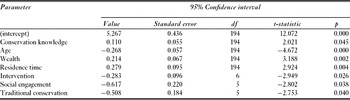
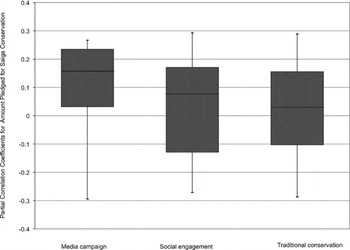
All true protest bids were removed and the model was re-run with amount pledged as a continuous variable (log-transformed in order to fit an LME with Gaussian errors), in order to determine which factors influenced the magnitude of pledges for saiga conservation. The MAM contained five explanatory variables: wealth, age, residence time, conservation knowledge and conservation intervention, with village as a random effect (Table 6). The magnitude of pledges increased with increased wealth, conservation knowledge and length of time resident in the village, and decreased with increasing age. Those exposed to the media campaign pledged the most for saiga conservation, followed by traditional conservation and social engagement (Fig. 1).
The minimum adequate model (MAM) for magnitude of amount pledged for saiga conservation. The random effect of village explained 12.80% of the variation. Model was a linear mixed effects model (LME) with Gaussian error structure and the dependent variable was log-transformed. All factors except intervention, which is nominal, are ordered factors. ‘Value’ of nominal factor represents difference in effect on willingness to pay between intervention types, where ‘media campaign’ = baseline for intervention. Protest votes are excluded. Significance: *p = 0.050–0.099, **p = 0.010–0.049, ***p < 0.010; n = 250.

Differences in partial correlation coefficients against amount pledged for saiga conservation under each conservation intervention strategy. Partial correlation coefficients are used to take into consideration all other background factors influencing amount pledged. The bold line represents the median, the box the 25th and 75th quartiles, and the whiskers the maximum and minimum points.

DISCUSSION
This study showed no direct effect of intervention on knowledge of the status of the species, and found instead that such knowledge was explained by background sociocultural factors. For example, residence time in the village was a key factor. Information regarding population changes was often gained through personal observation or communication with older residents (C. Howe, personal observation 2006). Consequently, the influence of local knowledge and inter-generational transfer of information should not be overlooked as a means for generating environmental knowledge (Jacobson et al. Reference Jacobson, McDuff and Monroe2006). Knowledge about conservation interventions accounted for a significant amount of the variation in population knowledge. This is understandable; those who are aware of conservation interventions are more likely to understand the underlying factors driving the need for conservation, and hence have a greater knowledge regarding population changes.
We also observed the influence of knowledge on behavioural intention. The number of protest bids made decreased and the magnitude of sums pledged for conservation increased with increased conservation knowledge. It has been shown that direct knowledge of a good reduces the observed disparity between hypothetical and real willingness to pay (Paradiso & Trisorio Reference Paradiso and Trisorio2001). Therefore, in this case we suggest that conservation knowledge aided individuals to make a more informed pledge for conservation. The type of knowledge imparted is also important, as it makes individuals differentially sympathetic to arguments used to promote conservation (Caro et al. Reference Caro, Mulder and Moove2003). Consequently, in this study a knowledge of specific conservation actions rather than population knowledge was more effective at promoting positive behavioural intentions towards saiga conservation.
While intervention did not appear to influence behavioural intentions through an increase in knowledge, it did have a direct influence on amount pledged. It has been suggested that there are ecocentric, biocentric and altruistic motives for giving and that these should be considered when interpreting the results of contingent valuation studies (Spash Reference Spash2000). Analysis of the reasons for the protest bids in the present case indicated many local people felt that the government or the international community should pay for conservation. It is possible that this feeling may be a relic from the Soviet period when government both provided for and controlled many aspects of daily life. Social engagement projects, provided by the international community, may sustain this feeling, resulting in people pledging smaller amounts for conservation than otherwise expected. Many studies have shown that past conservation actions, as well as historical practices and rights to land, have a long-term influence on attitudes towards conservation, and even a high level of awareness may not increase local support for conservation (Newmark et al. Reference Newmark, Leonard, Sariko and Gamassa1993; Ite Reference Ite1996). Taking account of historical influences is therefore vital when planning a conservation intervention in order not to weaken its potential success.
Pledging a non-zero amount and magnitude of the amount pledged were, like population knowledge, influenced by a number of sociocultural and demographic factors. Understanding the background of the target group of a conservation intervention allows existing sensitivity towards the species or area being conserved to be heightened, increasing receptivity to a campaign, thus hopefully maximizing success. For example, those with a high level of exposure to saigas were more likely to pledge something for saiga conservation. Consequently, it may be possible to build a conservation strategy based on reinforcing a visual awareness of saigas in order to increase the number of people with positive behavioural intentions towards saigas and saiga conservation. Participatory monitoring by local villagers is one such approach that is gaining ground as a way of increasing local awareness of the ecology of conservation targets (Danielsen et al. Reference Danielsen, Burgess and Balmford2005), and has been successfully trialled for saigas in Kalmykia (Whitebread et al. Reference Whitebread, Obgenova and Milner-Gulland2008). Wealth was not significant in influencing protest bidding, but as expected, it did become relevant when assessing the magnitude of the amount pledged.
This study is a portrayal of the situation at the moment at which the study was carried out and the effect of conservation interventions on knowledge and behavioural intention is likely to change over time (Luzar & Cosse Reference Luzar and Cosse1998). Likewise, understanding the motivation behind the protest bids and, in particular, whether they are due to transient effects of the Soviet legacy or some other factor, is necessary in order to design effective conservation strategies for this region. Most importantly, however, determining whether the positive behavioural intentions observed are translated into actual behaviours would enable the direct influence of conservation interventions to be quantified, and ultimately their true success measured. It is difficult to link any changes in behaviour directly to conservation interventions, as it was impossible to obtain direct data on poaching behaviour during the timescale of this study, and the saiga population is shared between the eight villages. Although farmers may hold positive attitudes to environmental stewardship, this may not translate into conservation behaviour (Nowak & Korsching (Reference Nowak, Korsching, Schaller and Bailey1983). The significant effect of demographic factors such as residence time and age suggests that relating behavioural change directly to intervention requires understanding of the social context (Holmes Reference Holmes2003). Poaching behaviour in the region may be driven by poverty (Kühl et al. Reference Kühl, Balinova, Bykova, Esipov, Arylov, Lushchekina and Milner-Gulland2009). Although media campaigns and, to some extent, social engagement, have had a positive influence on attitudes, it is quite possible that no behaviour change, in terms of poaching reduction, has occurred.
We propose that the amount pledged for conservation may be a practical tool for evaluating the relative effectiveness of projects aimed at increasing awareness and promoting positive behavioural intentions towards conservation. We demonstrate that conservation intervention may have a measurable effect on the behavioural intention of the local human population with the amount pledged for saiga conservation showing significant variation between conservation strategies. Our results also demonstrate that a combination of success measures and an understanding of demographic factors are required to understand the underlying reasons for observed differences in behavioural intention; Brooks et al. (Reference Brooks, Franzen, Holmes, Grote and Borgerhoff-Mulder2006) also emphasized the importance of including multiple measures of success in conservation evaluations. This study is one of the few in which the effectiveness of a set of conservation interventions, implemented in one region with regard to conserving a particular species, has been properly quantified and robustly compared.
Other studies often compare biologically-based interventions using methods from adaptive management (Innes et al. Reference Innes, Hay, Flux, Bradfield, Speed and Jansen1999) rather than social interventions. We acknowledge that there are debates concerning the use of economic tools to evaluate conservation effectiveness and that collecting quantitative social science data is not without controversy; however quantifying the relative success of conservation interventions is vital to guarantee that the most effective conservation strategy is implemented and to ensure that the impact of conservation efforts is properly assessed. The next step is to quantify the cost-effectiveness of interventions (Hughey et al. Reference Hughey, Cullen and Moran2003; Underwood et al. Reference Underwood, Klausmeyer, Morrison, Bode and Shaw2009). In this case study, the relatively cheap media campaign had the strongest effect on behavioural intention, as measured by the magnitude of pledges; however, the attitude-behaviour linkage remains unquantified.
ACKNOWLEDGEMENTS
This study was financially supported by ESRC/NERC and the Darwin Initiative (Project EIDP018). EJMG acknowledges the support of a Royal Society Wolfson Research Merit Award. We gratefully acknowledge the support and advice of Anna Lushchekina, Olga Obgenova, Iuri Arylov and the Centre for Wild Animals of the Republic of Kalmykia, Anatoly Khludnev and the Stepnoi Reserve. We are indebted to Tanya Mudzhaeva and Khongir Mandzhiev for their assistance and hard work during data collection. We thank Aline Kuhl and Nils Bunnefeld for advice during analysis. We are grateful to all 250 residents of the study villages for their patience and hospitality in answering our questions, and to two anonymous reviewers for their helpful comments.