1. Introduction
Construction grammar holds that language is a repertoire of inter-related constructions which emerge as a result of language use (Diessel, Reference Diessel, Dąbrowska and Divjak2015; Ellis, Reference Ellis, Hoffmann and Trousdale2013; Goldberg & Casenhiser, Reference Goldberg, Casenhiser, Robinson and Ellis2008). Morphemes, lexical words, and syntactic patterns are all subtypes of constructions, as they are essentially pairings of form and function, varying in complexity and abstractness (Eskildsen, Reference Eskildsen2009; Tomasello, Reference Tomasello, Bishop and Leonard2000).
Construction learning studies have revealed the powerful capacity of children and adults to learn the form–meaning mappings of novel syntactic constructions (Boyd, Gottschalk, & Goldberg, Reference Boyd, Gottschalk and Goldberg2009; Casenhiser & Goldberg, Reference Casenhiser and Goldberg2005). On the other hand, learning novel constructions is frequently influenced by already learned constructions, or alternative constructions at work.
One line of research focuses on how learned constructions resulting from statistical learning guide (L1) speakers to constrain generalizations. Specifically, frequency and usage distribution of constructions forge their contextual and functional constraints (Goldberg, Reference Goldberg2016), which help (L1) speakers prevent or retrieve from the overgeneralization. It further includes the effects of entrenchment and preemption. Overgeneralization of a construction is probabilistically blocked by all the attested usage of the construction, as entrenchment predicts, or by the high-frequency use of the alternative forms as preemption proposes (X. Zhang, Reference Zhang2017). Therefore, entrenchment is sensitive to the overall use of the construction, whereas preemption is specifically caused by the competition from acceptable alternatives (Ambridge, Barak, Wonnacott, Bannard, & Sala, Reference Ambridge, Barak, Wonnacott, Bannard and Sala2018). For instance, Ambridge et al. (Reference Ambridge, Bidgood, Twomey, Pine, Rowland and Freudenthal2015) found evidence of entrenchment: L1 speakers were more likely to reject erroneous use of a verb (e.g., *Daddy giggled the baby) if it was used with high frequency. Boyd and Goldberg (Reference Boyd and Goldberg2011) obtained support for preemption: L1 speakers preferred to use novel a-adjectives in the relative clause construction (e.g., the pig that was ablim) rather than the prenominal construction (e.g., the ablim pig) because this type of adjective reliably appears in the former construction based on their English language experience. A more recent meta-analytical synthesis further revealed that entrenchment and preemption are both reliable, suggesting that the competition between different constructions is a probabilistic process sensitive to language use (Ambridge et al., Reference Ambridge, Barak, Wonnacott, Bannard and Sala2018).
Intra-linguistic competition between syntactic constructions is common in L2 as well (Jackson, Reference Jackson2018; MacWhinney, Reference MacWhinney, de Groot and Kroll1997). However, L2 learners are less sensitive to the frequency distribution of constructions, and therefore less aware of their contextual or functional constraints (Robenalt & Goldberg, Reference Robenalt and Goldberg2016). As a result, their comprehension shows reduced differentiation between competing alternatives (Tachihara & Goldberg, Reference Tachihara and Goldberg2020b), and their production exhibits persisting optionality and L1 interference (Sorace & Serratrice, Reference Sorace and Serratrice2009). Put differently, there are less clearly delimited boundaries of semantically comparable constructions. Instead, L2 learners are more likely to map them onto the same meaning with little differentiation in their distributions, contexts, and functions.
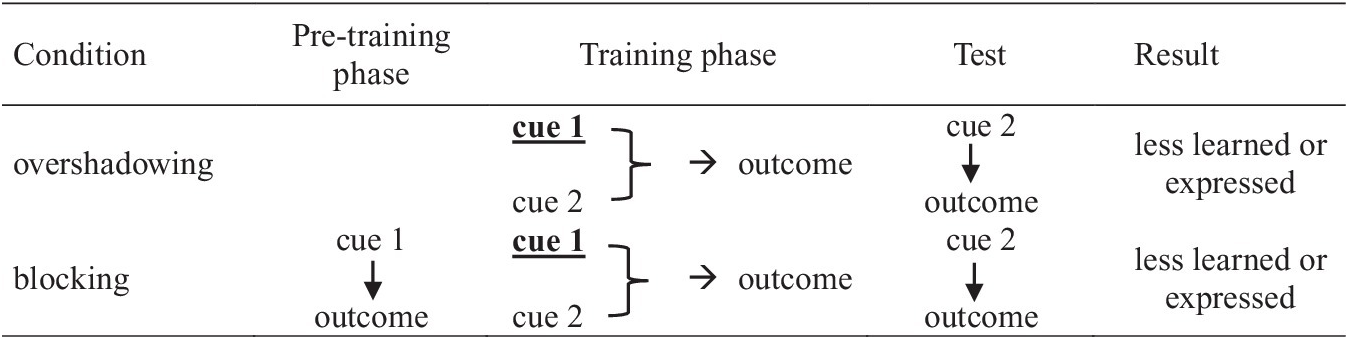
This creates the ideal conditions for overshadowing or blocking, which require that two cues are paired with the same outcome. More specifically, overshadowing and blocking are two negative competition effects. They both elucidate the attenuation of learning or expressing the association between a cue and an outcome, under the influence of another cue that is also associated with the same outcome. They differ, as shown in Table 1, when the two cues are learned together. In the overshadowing condition, two cues are learned simultaneously at the onset of learning. In the blocking condition, two cues are learned together after one cue has already been associated with the outcome (Moore & Schmajuk, Reference Moore and Schmajuk2008).
Typical designs to investigate overshadowing and blocking

The target constructions of the present investigation are two synonymous Chinese constructions; namely, the Ba-construction and its SVO counterpart.Footnote 1 Sentence (1) below with the Ba-construction, and Sentence (2) with its SVO counterpart, can both be used to describe the resultative-causative event ‘He drank up the water’.Footnote 2

Despite the semantic overlap, the Ba-construction and its SVO counterpart are by no means identical. In fact, the Ba-construction is a special phenomenon that has been extensively researched. The most pronounced syntactic feature of the Ba-construction is the preverbal placement of the object, in contrast to the majority of Chinese sentences in the canonical VO order (Sun & Givón, Reference Sun and Givón1985). As a consequence, the Ba-construction has several semantic and pragmatic constraints. Semantically, the Ba-construction gives prominence to the causative result that the causee receives in a causative event (Shi, Reference Shi2010). This attracts specific, generic, and definite objective NPs (F.-H. Liu, Reference Liu1997) and complex VPs (B. Zhang, Reference Zhang2020). Pragmatically, the usage of the Ba-construction is governed by communicative functions (Chen, Reference Chen1995), and involves the speaker’s subjective evaluation and emotional disposition (Jing-Schmidt, Reference Jing-Schmidt2005).
L1 acquisition studies have shown that children can produce prototypical Ba-sentences as early as two years old, and develop adult-like capacity by the age of five (Li, Zhou, & Kong, Reference Li, Zhou and Kong1990). The syntactic, semantic, and pragmatic constraints of the Ba-construction are well learned from the very beginning of acquisition (Chang & Zheng, Reference Chang and Zheng2017; Deng, Mai, & Yip, Reference Deng, Mai and Yip2017). L1 speakers’ sensitivity to those constraints is also reflected in their language production via corpus-based studies (Jing-Schmidt & Tao, Reference Jing-Schmidt and Tao2009; Su, Reference Su2017).
L2 learners are much less sensitive to those constraints. Studies have found that they tend to avoid using the Ba-construction (Du, Reference Du and Tao2016). Even if the Ba-construction is produced, the accuracy is low, particularly for the semantic and pragmatic aspects (Wen, Reference Wen2012; Xu, Reference Xu2012). Consequently, the lack of sensitivity to the Ba constraints leads L2 learners to equate the Ba-construction with its SVO counterpart, resulting in the substitution of the SVO construction for the Ba-construction in use (Du, Reference Du, Everson and Shen2010), as well as confusion about when to appropriately apply the Ba-construction (J. Lu, Reference Lu2016).
As seen, the Ba-construction is vulnerable to the interference of its SVO counterpart in L2 learning. The attenuation of learning or expression of the Ba-construction possibly originates from the overshadowing effect during initial learning, when the two constructions are learned simultaneously, as language instructors and textbooks often introduce them together and treat them as transformational counterparts (Jing-Schmidt, Peng, & Chen, Reference Jing-Schmidt, Peng and Chen2015; Lü, Reference Lü2010). To my knowledge, no study has empirically investigated this possibility. This study thus intends to fill this gap by examining the overshadowing effect on the Ba-construction.
2. Literature review
2.1. the overshadowing effect
Overshadowing refers to the reduced learning or expression of the association between a cue and an outcome in the presence of another cue, the phenomenon of which is a reliable cross-species effect, well established in classical conditioning studies for both animal (Jones & Haselgrove, Reference Jones and Haselgrove2013; Kamin, Reference Kamin, Campbell and Church1969) and human participants (Prados, Reference Prados2011; Spetch, Reference Spetch1995). The prerequisite for overshadowing to take place requires that two cues correspond to the same outcome. For instance, light and tone were the two cues that could trigger foot-shock in Kamin (Reference Kamin, Campbell and Church1969). In this pioneer study, rats received mild foot-shock after the simultaneous presence of light and tone during training. Later, when the two cues were tested in isolation, it was found that the perceptually salient cue overshadowed the less salient cue, as rats responded only to the light, but not to the 50-decibel tone.
It is generally believed that the direction of overshadowing between the two competing cues is not random. It is unidirectional, determined by the relative salience of two cues. The more salient cue overshadows the less salient one (Mackintosh, Reference Mackintosh1976). The greater the difference between the salience of the two cues, the greater the magnitude of overshadowing; for example, decreasing the salience of the overshadowed cue (Kamin, Reference Kamin, Campbell and Church1969), or increasing the salience of the overshadowing cue (Miles & Jenkins, Reference Miles and Jenkins1973), magnifies the overshadowing effect.
It is worth noting that disagreement has not been resolved over the nature of overshadowing; that is, whether overshadowing is a learning-deficit or expression-deficit effect. Rescorla and Wanger (Reference Rescorla, Wanger, Black and Prokasy1972) attributed overshadowing to a failure of the association between the less salient cue with the outcome. They suggested that the strength of the cue–outcome association is high for the salient cue, resulting in little associative strength available for the less salient cue. Alternatively, Miller and Matzel (Reference Miller, Matzel and Bower1988) proposed that both cues acquired associations with the outcome independently during learning. Those acquired associations competed with each other in the course of expression. Therefore, overshadowing is a failure to express the learned association between the less salient cue and the outcome, rather than a failure of learning the association per se (Miller & Witnauer, Reference Miller, Witnauer and Seel2012).
2.2. the investigation of the overshadowing effect in SLA
Despite sparse literature overall, the overshadowing effect was first introduced by Ellis (Reference Ellis2006b) to demonstrate the perceptual and learning biases that emerge from prior language experience. This was further investigated by Ellis and associates with regard to L2 learning of temporal reference in Latin (Cintrón-Valentín & Ellis, Reference Cintrón-Valentín, Ellis, Blumenthal-Dramé, Hanulíková and Kortmann2017; Ellis et al., Reference Ellis, Hafeez, Martin, Chen, Boland and Sagarra2014; Ellis & Sagarra, Reference Ellis and Sagarra2010, Reference Ellis and Sagarra2011). In Ellis and Sagarra (Reference Ellis and Sagarra2010, Exp. 2), English and Chinese participants were first exposed to short sentences containing an adverb and a verb that conjointly made temporal reference, such as hodie cogito ‘today I think’, and cogitabo cras ‘I will think tomorrow’. They were then tested on comprehension and production. During the comprehension task, participants made judgments on the temporal reference of all possible combinations of the adverbs and verbs, including the incongruent ones, such as *hodie cogitabo *‘today I will think’, or *cras cogitavi *‘tomorrow I thought’. In the production task, participants performed an English-to-Latin translation task.
Results for the comprehension task showed that English participants weighed both adverb and verb cues more or less equally in their judgment, but Chinese participants overwhelmingly depended on adverbs for the temporal interpretation. Results of the production task showed that Chinese participants were significantly less accurate in producing verbs than adverbs. Taken together, English participants used both adverbial cues and verbal cues in a more balanced fashion, whereas Chinese participants not only primarily relied on adverbs for temporal reference in comprehension, but also used them more accurately in production.
Those findings are intriguing. On the one hand, Chinese participants’ preference for the adverbial cue over the verbal cue demonstrates an overshadowing effect; while on the other hand, overshadowing only affects Chinese participants but not English participants, which suggests that psychophysical salience as perceptual prominence cannot be fully responsible for the occurrence of the morphological overshadowing effect, as English and Chinese participants encountered identical experimental materials. Instead, learners’ language experience and prior knowledge seem to play a critical role in determining the psychological salience of target constructions (Giora, Reference Giora2003; Kecskes, Reference Kecskes2006).
A follow-up study confirmed this speculation. Ellis and Sagarra (Reference Ellis and Sagarra2011) extended the investigation to four language groups: inflection-free Chinese, inflection-light English, and inflection-rich Russian and Spanish (with Spanish more similar to Latin than Russian in the use of tense inflections). It was first of all found that the richer the verbal morphology in learners’ L1, the more sensitive they were to Latin verbal inflectional cues. This suggested that the salience of Latin verbal inflectional cues was graded for learners with different L1 backgrounds, which was largely influenced by the availability and reliability of L1 verbal inflections (MacWhinney, Reference MacWhinney1987). Second, the similarity of verbal morphology between Spanish and Latin made Spanish learners more sensitive to Latin verbal inflections than Russian learners, even though both languages were rich in verbal morphology. In other words, Latin verbal morphology was more salient to Spanish learners because their knowledge of Spanish verbal morphology was more closely related to Latin by virtue of the similarity.
Additionally, although Ellis and associates did not directly tackle the nature of morphological overshadowing, their eye-tracking studies shed light on this issue (Cintrón-Valentín & Ellis, Reference Cintrón-Valentín, Ellis, Blumenthal-Dramé, Hanulíková and Kortmann2017; Ellis et al., Reference Ellis, Hafeez, Martin, Chen, Boland and Sagarra2014). It was found that learners’ experience and morphological knowledge, or lack thereof, did not cause attentional bias during learning. Both Chinese and English participants spent more or less equal time learning each cue. Even so, the difference in cue reliance was observed during testing, and was in line with previous findings. Overshadowing seems to be a competition effect at the time of testing, rather than during learning, as the expression-deficit account suggested.
In summary, Ellis and associates provided compelling evidence of the overshadowing effect at the morphological level. First and foremost, they documented that certain L2 learners fell short in utilizing Latin morphological inflections after being exposed to verbal and adverbial cues simultaneously. With the current scope of the investigation, it is, however, difficult to generalize the existing results to other linguistic levels (e.g., the syntactic level). Second, the discrepancy found between Chinese and English participants points to the limited explanatory power of psychophysical salience. On the contrary, L2 learners’ language experience and prior knowledge relevant to the target constructions appear to be more critical in explaining the direction of overshadowing, which conforms to the recent conceptual expansion of salience (see Section 2.3 for details). Third, the existing literature has not directly tackled the nature of overshadowing. Nevertheless, eye-movement data seem to favor the expression-deficit view, as overt attention was equally paid to each cue regardless of L1 background during learning, and the difference was only obtained in testing.
2.3. L2 learning of the Chinese Ba-construction: a potential case of syntactic overshadowing
Against this background, the present study attempts to find evidence of syntactic overshadowing when L2 learners simultaneously learn two Chinese syntactic constructions, namely the Ba-construction and its SVO counterpart. Note that it is extremely difficult, if not impossible, to acquire the constraints of the Ba-construction at the initial stage of learning due to the limited input and restricted context. I am more concerned about whether both syntactic structures can be mapped onto the resultative-causative meaning; and if so, whether there is any difference in the subsequent use of the two constructions.
I expect to observe the overshadowing effect on learning the Ba-construction, which manifests as a reduced use and/or lower production accuracy, due to its relatively low salience. Attention should be paid to the conceptual expansion of salience in linguistics and related disciplines (Blumenthal-Dramé, Haunulíková, & Kortmann, Reference Blumenthal-Dramé, Haunulíková and Kortmann2017; Ellis, Reference Ellis, Gass, Spinner and Behney2018; Schmid, Reference Schmid, Geeraerts and Cuyckens2007). The notion of salience is no longer limited to physical properties of linguistic stimuli, but is also a property of learners, which is a function of the degree of familiarity based on their prior knowledge and experience (Bardovi-Harlig, Reference Bardovi-Harlig1987; Kecskes, Reference Kecskes2006). In this study, I prioritized the influence of psychological salience. Some important reasons for shying away from the study of psychophysical salience include: (1) it is extremely difficult to determine the psychophysical salience at the sentential level (O’Grady, Kim, & Kim, Reference O’Grady, Kim, Kim, Gass, Spinner and Behney2018); (2) language learning requires more than just the perception of acoustic or visual prominence in spoken and written modes of a language (Giraudo & Dal Maso, Reference Giraudo and Dal Maso2016); and (3) it must integrate incoming linguistic information to our existing knowledge, the process of which is inevitably influenced by prior knowledge and experience (Ellis, Reference Ellis2006a).
Relating back to the present study, participants had zero experience with the target constructions prior to the experiment. Efforts were made to create an unbiased experience of the two constructions by manipulating input to ensure that participants were equally exposed to both constructions during learning. In the same vein as MacWhinney (Reference MacWhinney1987), availabilities of the Ba- and SVO constructions were balanced with the same number of occurrences, and reliabilities of each construction in predicting resultative-causative events were controlled by having an equal number of Ba and SVO sentences paired with the shared intended meaning.
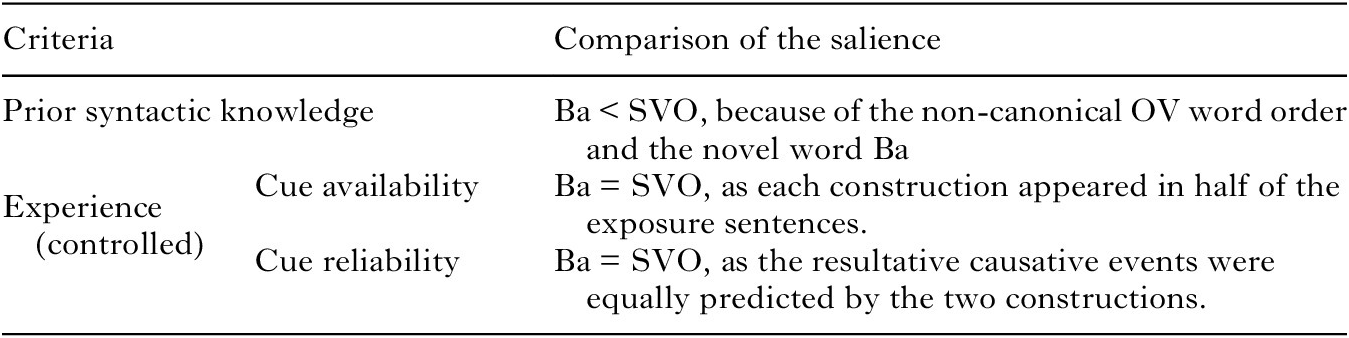
Although participants’ exposure was controlled, the salience of the two constructions varies due to their prior linguistic knowledge. Two formal aspects make the Ba-construction less familiar than its SVO counterpart; namely, the non-canonical word order and the function word 把 bǎ. Regarding word order, the influence of prior languages was controlled in this study. All the participants were proficient bilinguals in Russian, plus in the Turkic languages (Kazakh, Kyrgyz, or Uzbek), the canonical word orders of which are SVO and SOV respectively (Hawkins, Reference Hawkins1983). However, the OV order had been rare in their L2 input because (1) it only appears at the level of 10% or less in Chinese (Sun & Givón, Reference Sun and Givón1985), and (2) a survey of participants’ textbooks further revealed none of the OV sentences in the texts of the first ten lessons.Footnote 3 Therefore, the OV order of the Ba-construction was less familiar. As to the function word 把 bǎ, it further increased the unfamiliarity of the Ba-construction, because it was a novel word containing little lexical content. In a nutshell, the SVO counterpart was more salient to the participants than the Ba-construction, which should determine the direction of overshadowing.
Furthermore, findings on syntactic overshadowing may contribute to the dispute over the nature of overshadowing. Recall from Section 2.1 above that the core disagreement between the learning-deficit and expression-deficit accounts is whether an association is established between the overshadowed cue and the outcome. If participants’ language behavior indicates a failure of mapping between the Ba-construction and the designated meaning, which can be operationalized as (1) low comprehension accuracy and (2) incomplete sentences or null production for the video clips described with Ba-sentences during learning, we may infer that overshadowing is a learning deficit. If, however, they demonstrate success in form–meaning mapping by correctly comprehending Ba sentences and using the SVO construction to substitute the Ba-construction, we may conclude that overshadowing is an expression deficit.
In addition, with the purpose of promoting learning, some pre-known verbs and adjectives were used. However, the prior usage of those words could also potentially restrict their use to the novel Ba-construction. As the entrenchment hypothesis proposes, repeated occurrences of a word in one construction minimize the possibility that the same word could be used in another construction (Ambridge et al., Reference Ambridge, Barak, Wonnacott, Bannard and Sala2018; X. Zhang & Mai, Reference Zhang and Mai2018). Those two rationales regarding the role of the pre-known words would generate opposing predictions. One possibility is that the pre-known words could facilitate Ba-construction learning because they would reduce the learning difficulty, so participants would be expected to produce more Ba sentences. The other possibility is that participants could be more conservative in using the pre-known words in the Ba-construction due to the entrenchment of the previous usage, so fewer Ba sentences should be expected in production.
3. The present study
The primary goal of the present investigation was to look for empirical evidence of the syntactic overshadowing effect at the initial stage of learning. It also hoped to add to the discussion about the nature of overshadowing from a syntactic learning perspective and to explore the moderating role of familiar verbs and/or adjectives.
The study took advantage of two semantically comparable constructions – the Ba-construction and its SVO counterpart – with a design that embedded an overshadowing treatment in a construction learning paradigm. The logic of the design was as follows: the syntactic features of the Ba-construction were less familiar to participants, and hence less salient than its SVO counterpart, due to its non-canonical word order and the novel function word 把 bǎ. When the two constructions were learned simultaneously with unbiased input, the SVO counterpart was expected to overshadow the Ba-construction, owing to its privileged status in the formulation of form–meaning mapping (Zobl, Reference Zobl1986), which in turn would lead to reduced learning or expression of the Ba-construction.
3.1. method
3.1.1. Participants
Thirty-five international undergraduate students from one university in China completed the experiment. Five participants were removed from the analysis, as they (1) did not pass the pre-test, (2) showed little or no learning after training, or (3) did not meet the criteria of language background. The remaining 30 participants (Female: 13; Ages 18–21, M = 18.4, SD = 0.8) were from either Central Asia (Kazakhstan, Kyrgyzstan, and Uzbekistan) or Russia. Russian was the common language they used to communicate with each other on a daily basis, but they were also fluent in one Turkic language, such as Kazakh, Kyrgyz, or Uzbek.
The Chinese proficiency of the participants was considered homogeneous and categorized as the beginning level based on their self-evaluation and a character recognition test. They were asked to self-evaluate their Chinese proficiency on a 7-point scale, with 1 representing ‘very poor’, and 7 ‘excellent’. The results were clustered towards the lower end of the scale (Mself-evaluation = 2.0, SD = 0.7, Max = 3). In the meantime, they received low accuracy scores (Maccuracy = 7.5%, SD = 3.5%) in a character recognition task (H. Zhang, Reference Zhang2018).
3.1.2. Materials
Critical items consisted of 48 short videos, a set of 96 sentence recordings, and corresponding transcripts. There were 48 resultative causative events, belonging to 6 different scenario types determined by the verb phrases (VPs) (see Figure 1).
Flowchart of 48 resultative causative events.

Note that the perfective marker 了 le was added to each VP to indicate the completion of the action. The choice of VPs depended on the ease of visualization and linguistic complexity. Scenarios were chosen that could be depicted unambiguously in the format of videos. Half of the VPs consisted of familiar words to reduce learning difficulty. Specifically, for those three familiar VPs, the verbs (i.e., 喝 hē ‘to drink’, 洗 xǐ ‘to wash’, and 找 zhǎo ‘to look for’) and the corresponding adjectives as resultative complements (henceforth RCs; i.e., 完 wán ‘finished’, 好 hǎo ‘good’, and 到 dào ‘achieved’) were chosen from HSK level I (Beginner) and level II (Elementary), all of which had been formally introduced to participants.Footnote 4
The 48 resultative causative events were visualized in short video clips (8–12 seconds) and described by 48 Ba and 48 SVO sentences, which were recorded in 4-second audio clips and transcribed in simplified characters and Pinyin, the Chinese romanization system.
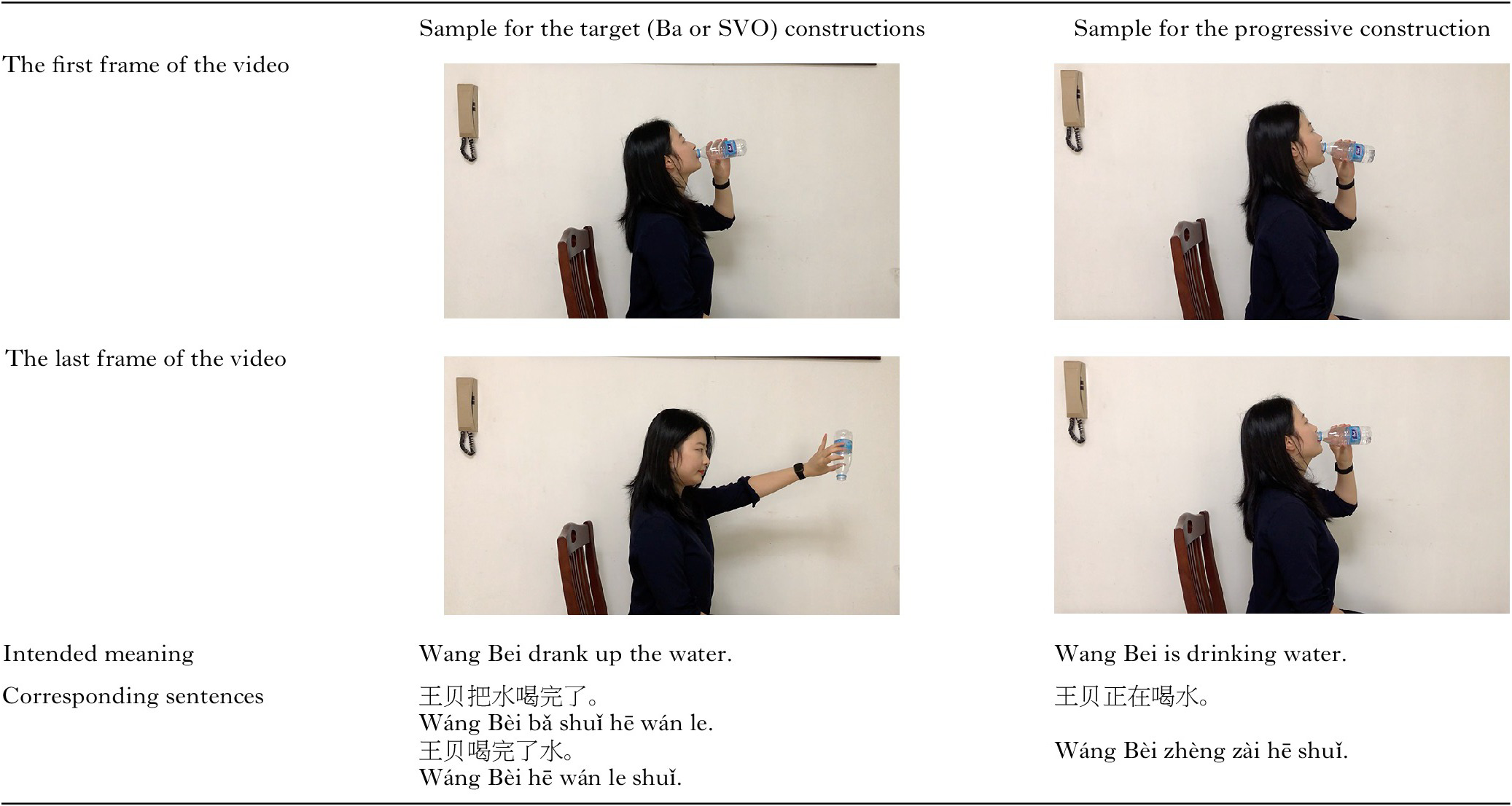
Filler items, including 48 short videos, a set of 48 sentence recordings, and corresponding transcripts, were created to discern whether participants actually mapped the target constructions onto their functions. The Chinese progressive construction was chosen because it: (1) was new to participants; (2) simply required a lexical word 正在 zhèngzài ‘-ing’ before the verb, which added minimal burden to the already complex task; and (3) was easy to visually distinguish from the target constructions (see Table 2 for comparison). The creation of filler items was identical to the critical items.
Comparison between target constructions and filler construction

3.1.3. Procedure
Three days prior to the experiment, a vocabulary list was given to participants, which consisted of all the inanimate objects they would encounter in the experiment. Allowing them to preview the non-core nouns not only reduced their burden of learning, but also minimized the impact of individual differences in prior knowledge of those nouns.
On the day of the experiment, participants came individually into a quiet room to take part in a 75-minute session with the researcher. The main experiment comprised three consecutive stages: namely, pre-test, construction learning, and testing.
The pre-test evaluated how well participants prepared for the vocabulary, while ensuring that they did not have pre-knowledge about the target and filler constructions. A naming test was designed for the previewed nouns, during which participants saw one object at a time, with a written question on the screen asking 这是什么? zhè shì shén me? ‘what is this?’ As to their pre-knowledge of the target and filler constructions, lexically, all verbs, adjectives, the function word 把 bǎ, and 正在 zhèngzài ‘-ing’ were presented in Chinese characters and Pinyin in a vocabulary list. Participants were asked to identify which words they knew. Syntactically, six pictures depicting six types of resultative-causative events were presented. Participants needed to use one sentence to describe them (see Figure 2).
Example of picture description task.

The experiment was terminated automatically if a participant: (1) failed to name three previewed nouns; (2) knew the keywords 把 bǎ and/or 正在 zhèngzài ‘-ing’; or (3) successfully described any resultative causative event.
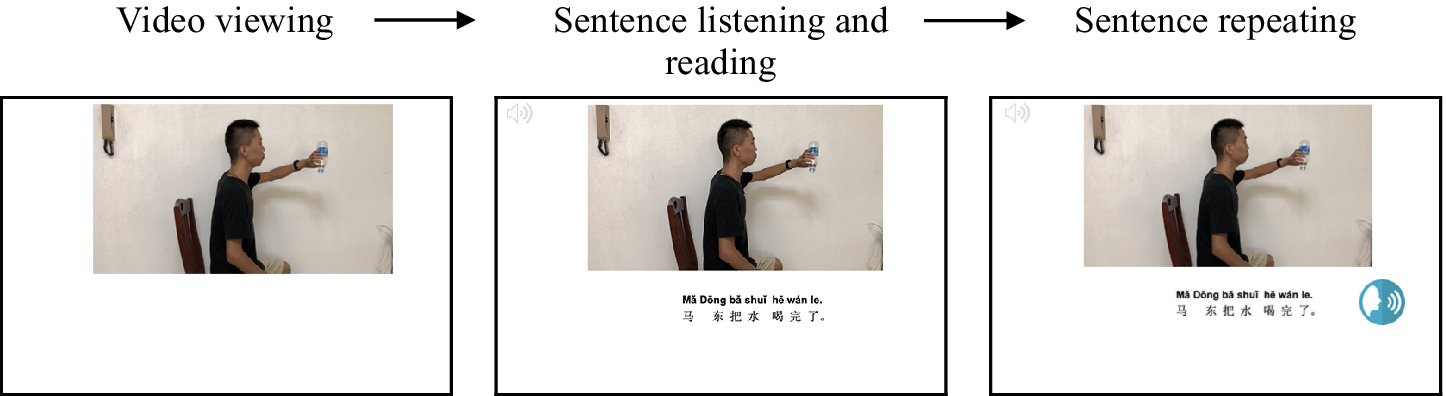
The learning phase started with familiarizing participants with the names of the two characters in the videos. They were then introduced to the main task, with two practice trials before the actual trials. In each trial, they first watched a short video, then saw a sentence appear beneath the video while hearing a recording of the sentence. They were asked to repeat the sentence once the blue icon appeared on the slide (see Figure 3).
Procedure of each construction learning trial.

There were 36 learning trials. Twenty-four of them were resultative causative events, half paired with Ba sentences, and the other half with SVO sentences. The remaining 12 trials were continuous events described by sentences with the progressive construction. The sequence of learning was pseudo-randomized: (1) constructions rotated throughout learning, so no consecutive trials involved the same construction; (2) each verb appeared six times in total, with a minimum of two trials between the appearance of the same verb; and (3) the male and female actors appeared alternately. Moreover, one potential drawback with using PowerPoint slideshows was that all slides could only be presented in a fixed order. In order to minimize discernible patterns caused by the fixed sequence of trials, six slideshows were created. Among them, half started with the Ba-construction, and the other half with the SVO counterpart to avoid the primacy effect.
The post-learning test consisted of a comprehension test, followed by a production test. The comprehension task was a forced-choice comprehension task, in which participants decided which one of the two video clips depicted the meaning of a sentence (Casenhiser & Goldberg, Reference Casenhiser and Goldberg2005). There were ten items, among which three targeted the Ba-construction and three the corresponding SVO construction. For the remaining four items, two targeted the progressive construction, one the verb, and one the object, to help mask the purpose of the investigation.
The production test was a video description test, where participants were encouraged to use one sentence to describe the video they viewed. All 36 videos were the ones they had encountered in the learning phase. They could pass if they did not know the answer.
3.2. Coding
All three predictor variables used in statistical analysis were dichotomous variables, which were dummy coded. The construction type used in the input were coded as Exposure_Type comprising Ba or SVO representing the input with the Ba or SVO construction. Participants’ pre-knowledge, or lack thereof, of verbs and adjectives was coded as Y or N, respectively. They were later included in data analysis as Known_Verb and Known_Adj. In the comprehension test, responses were coded for accuracy. One point was given per correct answer, up to a possible total of ten points. In the production test, responses were first classified into four categories based on the construction applied: namely, the Ba-construction, the SVO counterpart, the progressive construction, and others. The correctness of each sentence was manually evaluated. If a sentence was judged as incorrect, the error type was identified.
Two coders individually coded all 1,260 sentences produced by 35 participants (36 sentences per participant). Inter-rater reliabilities were κ = 0.935 (p < .001) for construction types and κ = 0.810 (p < .001) for production accuracy. Disagreement was resolved through discussion.
3.3. statistical analysis
Analyses of participants’ sentence production were conducted in R (Version 3.6.1) using mixed-effects logistic regression models with the glmer function in the lme4 package (Version 1.1.21). A full model was first built: Exposure_Type, Known_Verb * Known_Adj, were entered as fixed variables; and a random effects structure was constructed by including random intercepts for subjects and items (i.e., verb types), and by-subject random slopes for Known_Verb * Known_Adj. Due to convergence problems, random effects were eliminated to only include the random by-subject and by-item intercepts. Collinearity checks further led to omitting the collinear variable Known_Adj because of the substantial correlation between Known_Adj and Known_Verb (κ = 0.610, p < .001). By doing this, all correlations between factors were less than 0.158. Model comparison with the anova() function confirmed that adding Known_Verb to the model had a better fit to the data (χ2 = 11.09, p < .001), but adding Known_Adj did not (χ2 = 0.221, p = .638).
3.4. results
For the comprehension test, the accuracy was high (Moverall = 92.7%, SD = 8.3%). No participants made more than three mistakes. Upon closer scrutiny, the accuracies for the Ba-construction (MBa = 91.1%), its SVO counterpart (MSVO = 92.2%), and the progressive construction (Ming = 91.7%) were not statistically different (χ2(2, N=240) = 0.072, p = .964), indicating that participants had good comprehension of all three constructions.
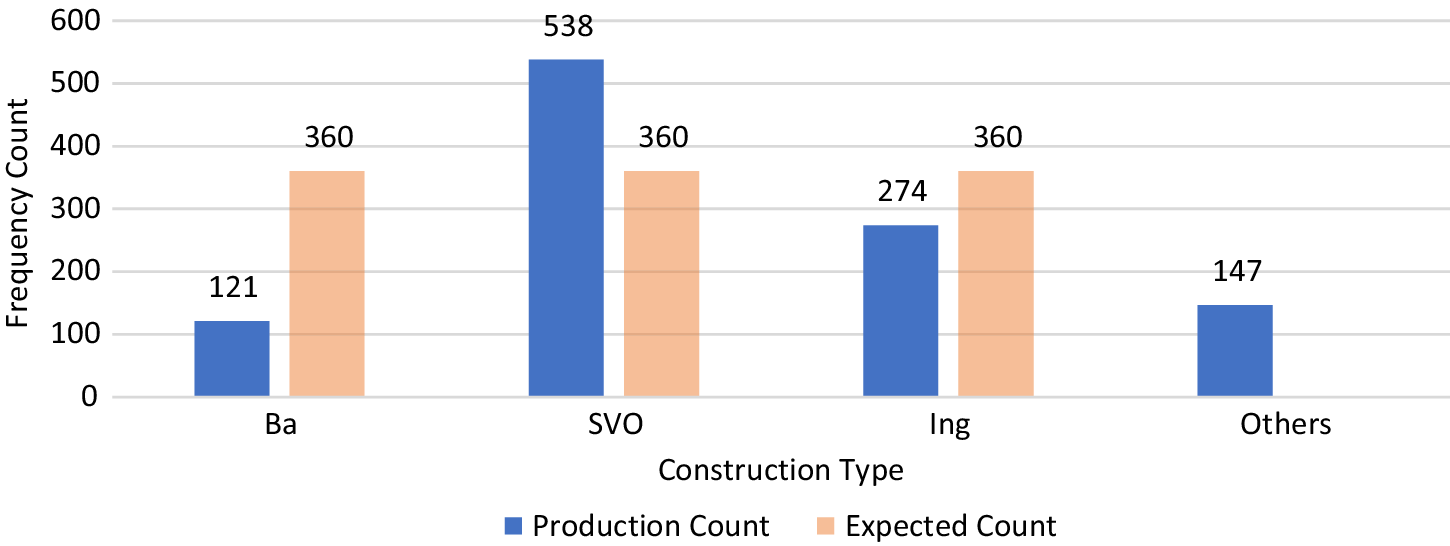
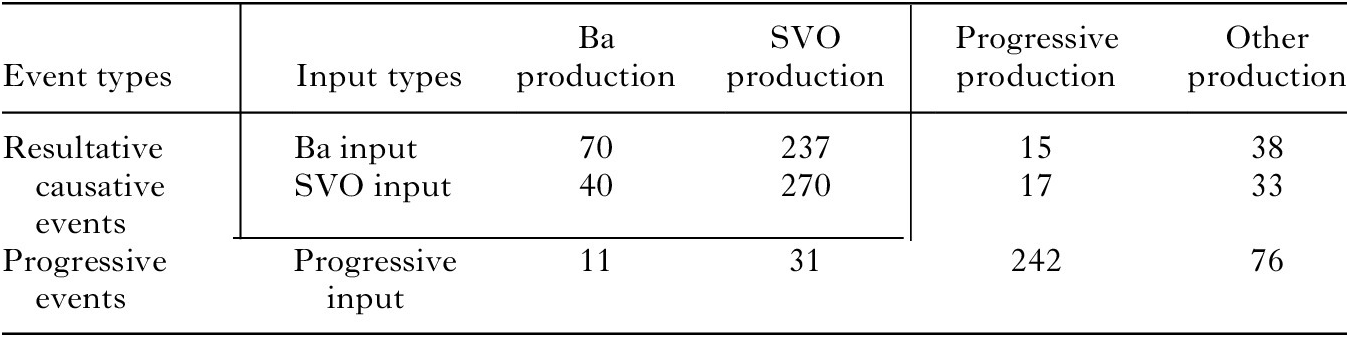
For the production test, participants produced 121 sentences with the Ba-construction, 538 sentences with the SVO counterpart, 274 sentences with the progressive construction, and 147 with other constructions (see Figure 4). The majority of resultative causative events were described with either the Ba or SVO construction, whereas the progressive construction was mainly produced for progressive events (see Table 3). This again indicated the successful form–meaning mapping of all three constructions.
Frequency count of each construction type.

Production of constructions by target input conditions

note: Numbers were frequency counts.
Critically, Table 3 further summarizes the relative proportion of the production in response to the construction encountered in the input. The input construction type significantly influenced the construction choices in production (χ2(6, N=1080) = 625.642, p < .001). Since the progressive construction was appropriately used for progressive events, the production issue was more specific to the Ba and SVO construction.
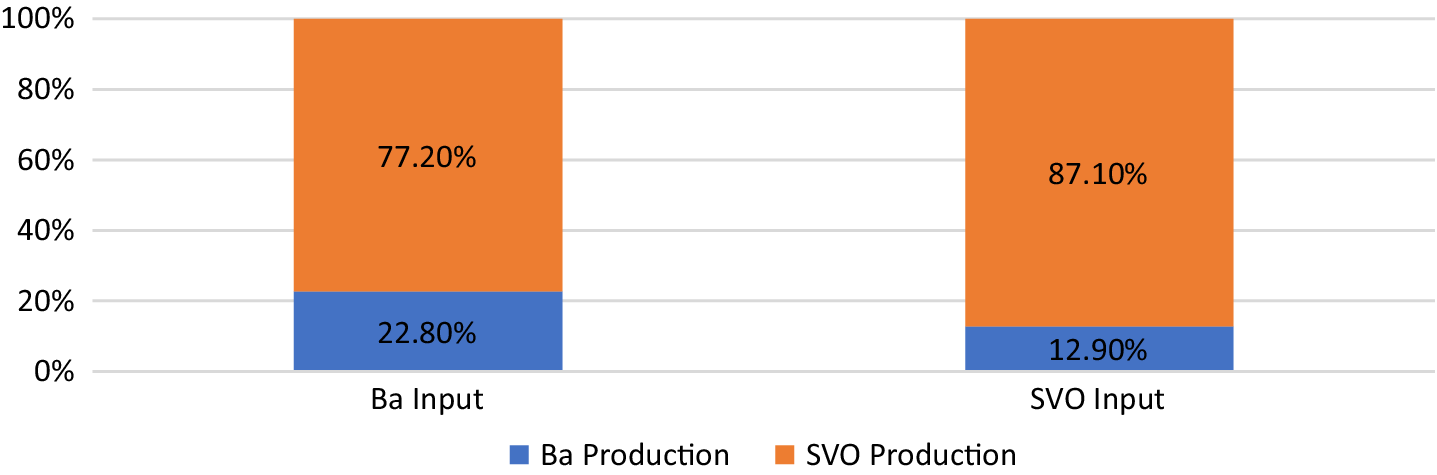
The 2x2 contingency table within Table 3 displays the interrelation between the input and output of the Ba and the SVO constructions (see also Figure 5 for the proportional representation). A total of 70 Ba (22.8%) and 237 SVO (77.2%) utterances were responses to the Ba input, with 40 Ba (12.9%) and 270 SVO (87.1%) utterances to the SVO input. The results suggested that the SVO construction not only predominated in production overall, but also became the main construction used for the input with the Ba-construction.
Ba and SVO production responding to construction witnessed during learning.

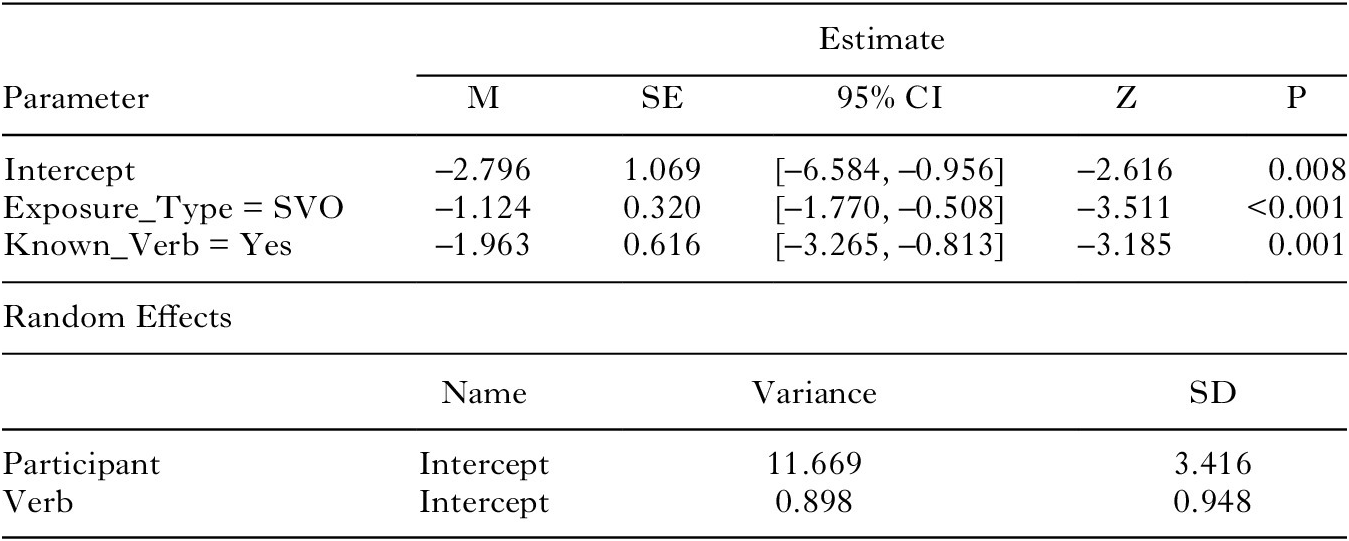
The results of the best-fitting model summarized in Table 4 confirm this tendency with statistical significance. The intercept indicates that the Ba production (22.8%) was significantly less than the SVO production (77.2%) in the condition of the Ba input. The SVO input generated 1.124 lower log counts of the Ba-construction than the Ba input, meaning the proportion of the Ba production was even smaller, being 12.9%. These results suggested the substitution of the Ba-construction by its SVO counterpart.
Summary of the best-fitting model

notes: a. Parameter estimates indicate likelihood of the Ba-construction production; b. Adjusted R2 = 0.571, indicating 57.1% of the variance can be explained by this model.
It is also worth noting that participants’ pre-knowledge of the verb led to 1.963 lower log counts of the Ba-construction. In other words, they were more conservative in applying the Ba-construction in production if they demonstrated their knowledge of the verb during the pre-test than if they did not.
Last, the quality of the participants’ production was examined. Among the three constructions, the accuracies of the progressive, SVO, and Ba-construction were 80.6%, 49.5%, and 25.5%. The differences were statistically significant (χ2(2, N=869) = 111.194, p < .001).
Error analysis revealed that the main error for the progressive construction was the mix-up between 正在 zhèngzài ‘-ing’ and the adverb 现在 xiànzài ‘now’. For both the Ba and SVO constructions, post-verbal RCs were the main source of the errors, which could be further classified into three subtypes: missing, misuse, and misplacement. Additionally, one type of error was unique yet highly frequent in the Ba production only: participants simply inserted the word Ba between the subject and the VP, without inverting the word order of the VP and the object (see examples in Table 5). To produce this type of error, participants must have noticed the novel Ba-construction and established the correct form–meaning mapping. This type of error nevertheless suggested that they failed to apply some of the low salient features in the Ba production.
Examples of errors

More information about this experiment, such as detailed participant information, data files, and the full list of experimental sentences, can be accessed at <https://osf.io/67zc5/>.
4. Discussion
4.1. syntactic overshadowing of the Chinese Ba-construction
The present experiment found evidence of overshadowing at the syntactic level: after being equally exposed to sentences with the Ba-construction and its SVO counterpart, L2 Chinese learners demonstrated a preference for the SVO construction over the Ba-construction in production to describe resultative causative events, and the accuracy rate of the SVO production was higher than the Ba production. Those results replicated the findings of morphological overshadowing by Ellis and associates: that Chinese learners of Latin L2 had much more reliance on Latin adverbials with higher production accuracies than verbal inflections when they were learned simultaneously to express temporal references (Ellis & Sagarra, Reference Ellis and Sagarra2010, Reference Ellis and Sagarra2011).
An alternative explanation would be that the reduced expression of the Ba-construction could simply be attributed to the complexity of the construction, irrelevant to the interference of the SVO counterpart. Although this explanation cannot be ruled out at this point, the overshadowing account is still preferred for the following three reasons: first, the present investigation was built upon the long-held recognition of the negative impact of the SVO counterpart on L2 learning of the Ba-construction (Du, Reference Du, Everson and Shen2010; Jing-Schmidt et al., Reference Jing-Schmidt, Peng and Chen2015), from the first-time exposure (e.g., Lü, Reference Lü2010), to the advanced level of Chinese (e.g., Wen, Reference Wen2012).
Second, the complexity of the Ba-construction mainly lies in its semantic and pragmatic constraints in use (S. Liu, Reference Liu2003), which was not the main concern of the present investigation, as the overshadowing effect occurs at the initial stage of learning. It is extremely difficult, if not impossible, to acquire the constraints of the Ba-construction due to limited input and confined contexts. By contrast, the main syntactic features of the Ba-construction do not present much difficulty for L2 learners (S. Liu, Reference Liu2018; Xu, Reference Xu2012). For instance, participants were able to successfully make grammatical judgments for the structure of ‘S + Ba + O + VP’ and correctly use this structure in the sentence translate task (Jin, Reference Jin1992).
Last, but not least, it must again be emphasized that adult learners have a powerful capacity to learn syntactic constructions, even for novel ones with unfamiliar syntactic features. For instance, Boyd et al. (Reference Boyd, Gottschalk and Goldberg2009, Exp. 2) asked two groups of participants to learn two novel constructions conveying the same novel meaning of appearance. Both constructions contained nonce verbs and novel non-canonical word order (Theme–Locative–Verb or Locative–Theme–Verb). It was found that after approximately three minutes of exposure participants were able to correctly use the newly learned construction in production. It is reasonable to assume successful initial learning of the Ba-construction if it was learned independently, as the syntactic features of the Ba-construction are reminiscent of the target constructions used in Boyd et al. (Reference Boyd, Gottschalk and Goldberg2009), in that both contain novel verbs with non-canonical word orders. Taken together, the reduced production of the Ba-construction observed in the present study is most likely due to the overshadowing of its SVO counterpart.
In accordance with previous studies, psychological salience is responsible for the occurrence of syntactic overshadowing. It is worth noting the conceptual expansion of salience: “Salience can be independently determined by physics and the environment, and by our knowledge of the world” (Ellis, Reference Ellis, Gass, Spinner and Behney2018, p. 21). Similar to findings of morphological overshadowing, learners’ prior syntactic knowledge and experience primarily influenced the psychological salience of the two constructions (Table 6), which in turn dictated the direction of the overshadowing.
An analysis of the salience of the Ba and SVO constructions

Moreover, sentential production allowed us to perform error analysis, which further provided unique insights into the role of salience in syntactic overshadowing. Since it was the first time that participants used adjectives as post-verbal RCs, their production reflected the challenges of learning RCs in both Ba and SVO production. More importantly, one common error type was identified in the Ba production only, where they correctly used the word 把bǎ, but mistakenly followed canonical VO word order.
It is reasonable to attribute this unique error type to the low salience of the Ba-construction, as the novel word 把 bǎ and the less familiar OV word order added additional layers of learning difficulty. Between those two features, the word 把 bǎ was relatively easily applied in production, as it was a concrete word consistently appearing in the same position of Ba sentences (similar to 正在 zhèngzài of the progressive construction, which were well learned with 80.6% accuracy). In contrast, applying the abstract feature of the OV order required more cognitive effort to assign concrete words to each position, and the order itself did not conform to the canonical word order of Chinese. On top of that, this feature of the Ba-construction was interfered with by its SVO counterpart following canonical VO word order. Taken together, in addition to the reduced quantity, the Ba production also suffered from lower accuracy rates.
4.2. the nature of syntactic overshadowing and the moderating role of the known verbs
The results of the present study shed light on the nature of syntactic overshadowing and the moderating role of prior knowledge of verbs in syntactic learning. First, participants’ high accuracy on the comprehension test suggests that they successfully assigned the resultative causative meaning to both Ba and SVO constructions, thus rejecting the learning deficit view that overshadowing would cause failure in the form–meaning mapping of the overshadowed Ba-construction. Furthermore, substituting the Ba-construction with the SVO construction further affirmed the expression-deficit view, which suggests that multiple associations are established (Miller & Witnauer, Reference Miller, Witnauer and Seel2012) between: (1) the Ba-construction and its designate meaning (the overshadowed cue and outcome); (2) the SVO construction and the same designate meaning (the overshadowing cue and outcome); and (3) the Ba and SVO construction (the two cues). Overshadowing occurred when the association strength was stronger for the SVO construction over the Ba-construction. That is, when participants were asked to describe resultative-causative events, the SVO construction was more accessible than the Ba-construction due to the salience as a function of familiarity (Tachihara & Goldberg, Reference Tachihara and Goldberg2020a). Consequently, the less salient Ba-construction was more difficult to retrieve, leading to quantitative and qualitative reduction.
Concerning the moderating role of the pre-known verbs, I did not find a facilitative role of those verbs by increasing the number of Ba utterances. Conversely, participants produced fewer Ba sentences if the verb had been known prior to the experiment, suggesting that the entrenchment of those verbs prevented them from being used in the less familiar post-object position in the Ba-construction. The finding of the entrenchment effect of pre-known verbs in syntactic overshadowing was important, as it: (1) demonstrated that cue competitions exist at different linguistic levels (i.e., syntactic vs. lexical); (2) showed that cue competitions at multiple linguistic levels can co-occur when a new syntactic construction is being learned; and (3) recognized the risk factor of entrenchment in L2 learning, wherein the entrenched verbal usage blocked learning of conflicting novel usage of the same verbs (MacWhinney, Reference MacWhinney and Schmid2017).
4.3. implications of the L2 Ba-construction learning
The present study serves as a window for the syntactic overshadowing effect. The findings in turn offer a fresh perspective for addressing issues regarding the challenges of L2 learning of the Ba-construction, which have been widely discussed in the existing literature (Du, Reference Du and Tao2016; Jin, Reference Jin1992; Y. Lu & Ke, Reference Lu, Ke and Ke2018; Wen, Reference Wen2012). The observed overshadowing effect adds a complementary perspective to the conventional analysis, which attributes the difficulty of the Ba-construction to its complex linguistic characteristics. It does, however, fall short in explaining why L1 and L2 learners end up with imbalanced learning outcomes, considering that linguistic complexity is something that all learners would face. The overshadowing effect, which considers learners’ cognitive factors, helps to explore this gap: L2 learners tend to treat the Ba-construction and its SVO counterpart indiscriminately, and the SVO construction is faster and better learned than the Ba-construction due to the discrepancy in salience between them.
One may argue that the observed overshadowing effect was a result of the experiment design. The question remains whether the findings are relevant beyond experimental conditions, or if the results can be extrapolated to real-life learning. Put differently, why are L2 learners, compared to L1 speakers, more prone to syntactic overshadowing?
The first reason is that L2 learners often learn grammatical constructions out of context. They may develop grammatical knowledge of the Ba-construction which is sufficient for adequate comprehension and production. But without contextual support, they are less capable of gaining an understanding of its appropriate use in given situations. In contrast, L1 children’s input is always accompanied by contexts. Situated instances of language use help them to tie grammatical constructions to a specific discourse context and communicative function (Tyler, Reference Tyler2012, p. 33). As a result, L1 children’s Ba production, which largely mirrors the input from their caregivers, demonstrates the emergence of the constraints of the Ba-construction (e.g., Deng et al., Reference Deng, Mai and Yip2017).
Another relevant reason is that L2 learners often learn synonymous constructions together because of their semantic overlap, whereas L1 children seldom observe synonymous constructions being used concurrently. As mentioned previously, the experiment design is grounded in real-life classroom learning. In contrast, if the Ba-construction is used, L1 children would almost definitely not encounter its SVO counterpart in the same context. Therefore, L2 learners are more likely to notice the interconvertible features of the Ba and SVO constructions, whereas L1 children are able to pay more attention to the distributional and pragmatic features of the target constructions.
Yet another reason is the granularity of linguistic units that L1 and L2 learners rely on in learning (McCarthy & Christiansen, Reference McCarthy and Christiansen2017). Adult L2 learners pay more attention to individual meaning-carrying words, such as verbs, but rely less on multiword units or whole expressions (Arnon & Ramscar, Reference Arnon and Ramscar2012; Paul & Grüter, Reference Paul and Grüter2016; Siegelman & Arnon, Reference Siegelman and Arnon2015). This allows them to quickly grasp the general meaning of an utterance, but may also prevent them from learning construction-level form–meaning mapping, which is important in distinguishing synonymous constructions (Goldberg, Reference Goldberg, Verspoor, Lee and Sweetser1997). On the other hand, children’s L1 grammar begins with concrete expressions from their input. Those expressions are commonly larger than words and correspond to specific functions. L1 children pick up those expressions as a whole, even if they may not fully understand each constituent of the expressions (Bannard, Lieven, & Tomasello, Reference Bannard, Lieven and Tomasello2009; Bannard & Matthews, Reference Bannard and Matthews2008; Borensztajn, Zuidema, & Bod, Reference Borensztajn, Zuidema and Bod2009).
In light of this, L1 children mapped the Ba-construction onto its functions as early as 2.5 years, which in turn allowed them to make a clear distinction between the Ba-construction and its SVO counterpart (Li et al., Reference Li, Zhou and Kong1990). Construction-level mapping develops rather slowly for adult L2 Chinese learners (Gao & Li, Reference Gao, Li and Zhao2002). Until then, they tend to count on VPs for determining the meaning of the construction (Jiang, Reference Jiang2018). For this reason, when participants observed VPs appearing in both constructions in the present study, they were triggered to equate the Ba-construction to its SVO counterpart, resulting in syntactic overshadowing.
5. Conclusion and future directions
Building upon the well-established overshadowing effect at the morphological level, the present study replicated and extended the findings to Chinese syntactic constructions. After being exposed to the Ba-construction and its SVO counterpart, L2 learners successfully established the form–meaning mapping of both constructions. However, when they were asked to describe resultative causative events, their syntactic choice was biased toward the SVO construction, and their SVO utterances enjoyed higher accuracy. Additionally, it was found that the entrenchment of the verbs further moderated the use of the Ba-construction. If a verb was known and had been overwhelmingly used before the object, L2 learners were more reluctant to produce Ba sentences.
Meanwhile, as a first attempt, the present study yields some unsettled questions for future investigation. First, the analysis was based solely on post-learning linguistic behavior. Future research could pay more attention to the learning process. For example, one could incorporate a comparison group where participants learn two unrelated constructions to gain more insights on how overshadowing alters the learning results. Second, there was only one group of participants. In order to investigate the L1 influences on syntactic overshadowing, future studies could recruit more L1 group participants with different canonical orders, or with or without the Ba equivalence. Third, from a teaching perspective, the present study encourages more research to help L2 learners reduce, if not eliminate, the effect of overshadowing on syntactic learning of the Ba-construction. It would be useful to compare the effectiveness of teaching the Ba-construction and the SVO counterpart concurrently or sequentially, or to explore other teaching techniques that would prevent L2 learners from equating the two constructions.