Israel is located in an area that has been struck several times by strong earthquakes in the past. The cycle of earthquakes in Israel has been about once every 80 to100 years. The last 2 severe earthquakes, which occurred in 1837 and 1927, caused enormous damage and a large number of injuries.Reference Ten Brink 1 Earthquakes cannot be predicted or prevented, so the best way to reduce the damage and number of victims is by effective preparedness. According to the Israeli National Steering Committee for Earthquake Preparedness, the State of Israel needs to be prepared for casualties that could reach 7000 deaths, 46 000 casualties, and 300 000 damaged buildings and homes. 2
Current literature reports that individual preparedness for future earthquakes might have a significant effect on reducing the loss of human life during the event.Reference Becker, Johnston, Paton and Ronan 3 , Reference Mulilis and Duval 4 Therefore, in many cases, it is necessary to invest in educational efforts to bring about a change in public behavior and to increase protective actions by the public.Reference Nathe, Gori and Mileti 5 It is also known that individuals will prepare for disasters only if they believe that such events might actually affect them.Reference Quarantelli 6 Yet, as the event recedes in the public’s memory, the level of personal preparedness drops.Reference Dynes 7
Multiple examples of media campaigns have been used to effect change in public behavior in the last few decades.Reference Snyder and Hamilton 8 Some well-known examples include eliminating tobacco use,Reference Friend and Levy 9 increasing seatbelt use and booster seats for children,Reference Williams, Lund, Preusser and Blomberg 10 encouraging road safety, and refraining from drinking among young drivers.Reference Glider, Midyett, Mills-Novoa, Johannessen and Collins 11 Overall, mass media campaigns can produce positive changes or prevent negative changes in health-related behaviors across large populations.Reference Wakefield, Loken and Hornik 12
Velan et alReference Velan, Boyko, Shenhar, Lerner-Gevab and Kaplan 13 have evaluated the public's response to 2 parallel campaigns in Israel dealing with immediate threats: the H1N1 influenza vaccination and gas mask distribution against possible chemical weapon attack. It was found that the public does not accept governmental recommendations unconditionally. This lack of response is not driven by lack of trust in authorities but rather by the perception of the responsibility of individuals in confronting forthcoming risks. The study found that most participants were passive and did not take any action, in spite of their exposure to the campaign.
The last strong earthquake in Israel occurred almost 85 years ago; therefore, the Israeli government decided to launch a national campaign during February 2011. The aim of the campaign was to change the Israeli citizens’ perception of risk of an earthquake in Israel and to motivate the population to take action and prepare for such an event. The message of the campaign was “Earthquake, don’t let it catch you unprepared.”
The 2011 campaign took place during a 2-week period through television, radio, and Internet broadcasts. The greater part of the campaign included video clips, in Hebrew, on the 3 major national TV channels (1, 2, and 10). In addition, a few TV broadcasts were in several other languages including Russian, Arabic, and English. English-language radio and Internet broadcasts were also used but less intensively. The total cost of the campaign was about 1 million US dollars. 2 The aim of the study was to assess the effectiveness of the 2011 campaign on Israeli citizens.
To motivate behavioral change, the campaign took the approach of frightening the audience. Many previous studies regarding fear-appeal theories have questioned whether a frightening message will be accepted or rejected by the public. Some researchers found that fear appeared to be a great motivator, as long as individuals believe they are able to protect themselves, while lower perception of self-efficacy leads to frustration and rejection.Reference Witte and Allen 14
The 2011 campaign included 2 different videos, each approximately 30 seconds long. The first showed a room beginning to shake while a baby was sleeping in a bed, after which the alarm clock falls and begins ringing. The voiceover says, "A strong earthquake in Israel is only a matter of time, don’t let it catch you unprepared." 15 The second video showed a mother taking her baby out of his bed, hugging him, and leaving the room. Then the room shakes and parts of the ceiling fall on the baby’s bed and destroys it. The voiceover says, "A strong earthquake in Israel is only a matter of time, strengthening infrastructure and learning how to act during an earthquake can save lives, don’t let it catch you unprepared."
Methods
The survey was carried out 2 weeks after the campaign concluded, between March 8 and March 14, 2011.
Study Population
This study was based on a randomly selected representative sample of the Israeli adult population (aged 18 years and older). A sample of households was built, based on official statistical areas characterized by sociodemographic characteristics. Areas were then matched with a computerized list of subscribers to the national telephone company, and households were randomly chosen. Excluded were fax numbers, disconnected numbers, and responses from voicemail and no answer.
According to the Israeli Bureau of Statistics, 16 85% of Israeli households had at least 1 phone line. 17 The survey was conducted in Hebrew, although assistance was available in Russian and Arabic. Several attempts were made to reach the households, and a total of 2545 telephone calls were placed. Disconnected numbers, faxes, voicemail, or no answer constituted 52% of the calls. Of the 1228 answered phone numbers of potential respondents, 630 people (51%) agreed to participate. This report was based on the results from the 630 telephone interviews.
On March 11, 2011, immediately following the campaign in Israel, a major earthquake of 9.0 magnitude took place in Japan, which was then followed by an enormous 10-meter tsunami.Reference Ten Brink 1 Such a serious disaster during a disaster awareness campaign could potentially influence the attitudes of the surveyed population toward the questions of the survey. Consequently, it was decided to enlarge the planned sample by adding 211 persons. To assess the influence of the Japanese earthquake on the study, we analyzed all of the results before and after March 11th. Except for a question regarding personal fear from hazardous materials, no statistically significant difference was noted between the before and after March 11 groups. Therefore, the 2 samples were combined and analyzed as 1 study population.
The survey included 46 closed questions. Of these, 10 questions provided demographic information (gender, age, marital status, and number of children [<18 years] and elderly [>65 years] living at home). Nine questions were intended for only those people who were exposed to the campaign. Twenty questions related to attitudes toward earthquake preparedness used Likert scales, which recorded answers on a scale of 1 to 5. The respondents could also answer don’t know or irrelevant. The main independent variable for comparison in the study was whether the respondent was or was not exposed to the campaign.
To compare and examine the differences between the various groups, χ2 and Fisher exact tests were performed. Spearman correlations were also used. Statistical analysis was performed using SAS statistical software version 9.2.
Results
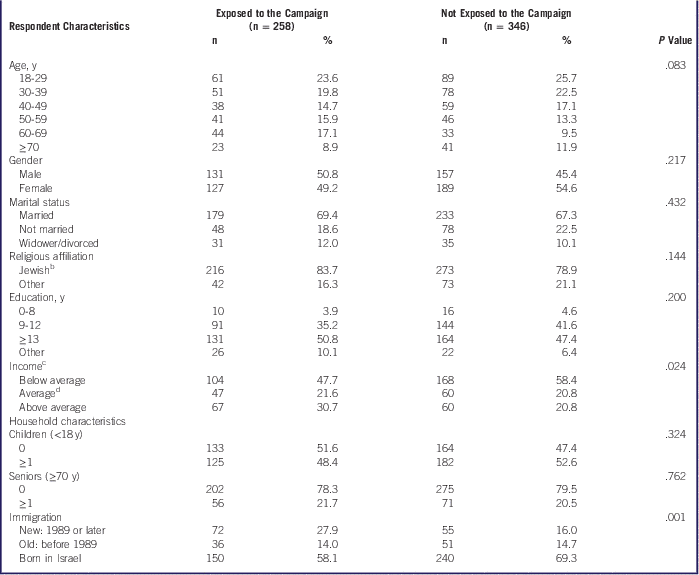
The sociodemographic characteristics of the study population are presented in Table 1. The exposed and non-exposed groups were compared. No significant difference was found for any of the sociodemographic parameters.
Sociodemographic Characteristics of Survey RespondentsFootnote a

a n=604 includes 26 (4.3%) missing.
b Israel’s Central Bureau of Statistics (2012) indicates Jews are 75.4% of the Israeli population.
c missing = 124 (20.5%).
d Average Income was defined as 10 010 new Israeli shekels for a household per month, as determined by Israel's Central Bureau of Statistics (2012).
To assess the influence of the Japanese disaster on our study, we analyzed all of our results before and after the Japanese earthquake. No significant differences were found between the 2 major ethnic groups (Jews and non-Jews).
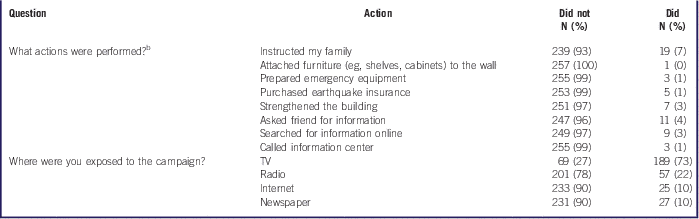
The results from the intervention group, those who were exposed to the earthquake campaign, are presented in Table 2. The majority watched the campaign on TV (73%), while 22% heard the campaign on the radio, 10% viewed it on the Internet, and another 10% saw in the printed newspaper. The survey evaluated which actions were taken after watching the campaign, such as instructing the family, preparing food and necessary equipment, and looking for information on how to prepare and buy earthquake insurance. The majority (>76%) reported not taking any action.
Ways Respondents Were Exposed to the Campaign and Preventive Actions Performed (Among Exposed Respondents)Footnote a

a More than 1 answer was accepted for these questions.
b 76% reported not taking any action.
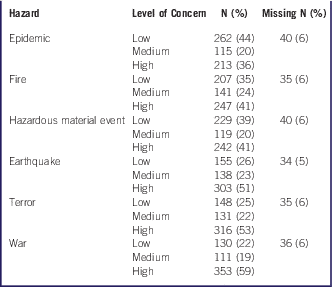
The respondents' concern toward a potential earthquake was compared with other relevant hazards, including war, terror, hazardous material event, fire, and an epidemic. The event that was perceived as the most serious (with the highest level of concern) was war (59%), followed by terrorism (53%), earthquake (51%), hazardous materials and fires (41% each), and epidemic (36% ) (Table 3). The level of high concern from hazardous materials increased from 38% before the earthquake to 50% after the earthquake (P<.01). Except for the question regarding fear of hazardous materials, the results from all of the other questions were not statistically significant between groups.
Personal Concern From Relevant Hazards in the Study Sample (N=630)

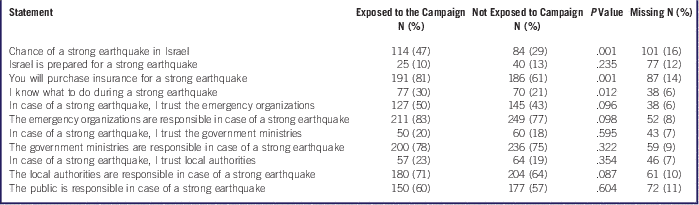
The comparison between those who were and were not exposed to the earthquake campaign are presented in Table 4. A statistically significant difference was found regarding the public’s assessment of a potentially strong earthquake occurring in Israel. Among those who were exposed to the earthquake campaign, 47% believed (assessed in high or very high levels) that a strong earthquake might occur, as compared to 29% among those who were not exposed, underlining the influence of the campaign on awareness of earthquakes. A statistically significant difference was noted regarding the public’s willingness to purchase earthquake insurance. Among those who were exposed to the campaign, 81% responded in high or very high levels that they will purchase insurance (only 2% reported that they had already purchased such insurance), as compared to 61% among those who were not exposed to the campaign. A statistically significant difference also was found regarding whether citizens know what to do during a strong earthquake (Table 5). Among those who were exposed to the earthquake campaign, 30% responded that they know what to do during a strong earthquake, as compared to 21% among those who were not exposed.
High Levels of Agreement to Statements Compared Between the Exposed and Unexposed Groups (Total N=630)

The Effect of the Campaign Among Those Who Were Exposed to It (n=258)

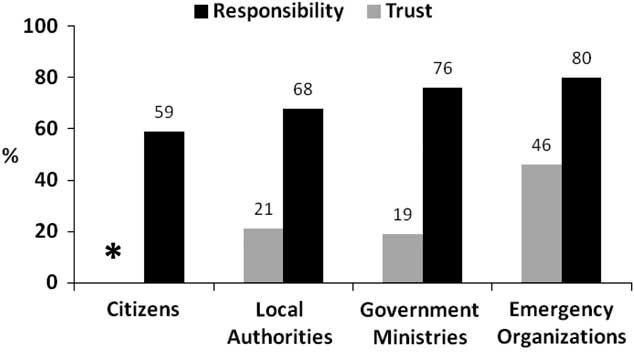
A comparison of the way the public understands the responsibility of the government ministries, first responder organizations, local authorities, and the public’s responsibility is presented in Table 4 and the Figure. In addition, the data show the public’s level of trust in these organizations. A huge gap (up to 60%) exists between the levels in which the public views the responsibility of the various organizations and ministries and their level of trust in those institutions (Figure).
The Public Trust in Different Organizations Is Compared With Their Respective Responsibility in Case of (a High or Very High Level) Emergency.* No data: respondents have not been asked if they trust themselves.

Among those who were exposed to the earthquake campaign, 41% reported a high feeling of fear, and 19% reported a medium feeling of fear (60% overall). Almost the same percentage reported that they felt a high or medium level of frustration (61%).
Correlation calculations were made between the levels of personal concern of a strong earthquake occurring in Israel to the level of personal concern of an earthquake in general. A highly significant correlation was found between the 2 levels (r=.43, P<.001). A strong correlation was also found between the level of personal concern of a strong earthquake occuring in Israel and the level of personal concern of an event with hazardous materials (r=.58, P<.001).
According to the new earthquake reference scenario that was published by the Israeli National Committee for Earthquake Preparedness, the estimated number of lives that would be lost during a strong earthquake is 7000. The respondents were asked how many lost lives were expected if a strong earthquake took place in Israel (6.5 on the Richter scale). More than half (57%) did not answer the question, while the remaining 43% were almost equally split between all possible numbers from 150 deaths to 700 000. No significant difference was found between the responses of those who were exposed and those who were not exposed to the campaign.
The state of Israel has a special program called TAMA 38 (national outline plan) for promoting the strengthening of buildings that were not built according to earthquake standards. Homeowners and developers who choose to strengthen their structures can receive a financial bonus and tax discounts from the government. The survey included a question asking, "Are you aware of the project TAMA 38?” The majority (79%) did not answer the question. Among the remaining 21%, only 31% reported that they knew about the program.
Discussion
An earthquake is a disaster that commonly strikes without warning. Thus, the only way to reduce the loss of lives and to control the extent of damage due to an earthquake is by implementing effective intervention and preparedness programs. However, in many countries, including Israel, a strong earthquake is extremely rare. Therefore, it is a big challenge to prepare a country, and specifically its population, for a potentially strong earthquake.
The aim of this study was to assess the efficacy of the 2011 national earthquake campaign on the Israeli public. The success of a campaign can be evaluated by assessing how many people were exposed to the campaign, whether the campaign raised the public’s awareness and knowledge of the subject, and whether behavioral changes took place after the campaign. Our study assessed all 4 parameters. Regarding exposure, 42% of the respondents were exposed to the earthquake campaign. As for increasing public awareness, 37% of the respondents estimated that a strong earthquake might occur in Israel during the coming years. Among those who were exposed to the campaign, only 23% (9% of the respondents) answered that the campaign improved their awareness. With regard to increasing knowledge, only 30% of those who were exposed to the campaign reported that they knew what to do during an earthquake, as compared to 21% of those who were not exposed to the campaign. For behavioral changes, 76% of those who were exposed to the campaign reported that they took no action to prepare for a potential earthquake as a result of the campaign. The remaining 24% took some action, which included looking for information on the Internet (9%) phoning call centers (1%), asking friends (4%), preparing their families (7%), preparing nursery equipment (1%), or purchasing insurance (2%).
According to the National Steering Committee for Earthquake Preparedness, the campaign goals were both to increase public awareness and improve the level of personal preparedness. Awareness must be achieved to gain public preparedness. Buying insurance can be one of the factors to evaluate the effectiveness of this campaign. According to our data, only 1% of those who were exposed to the campaign reported purchasing earthquake insurance coverage after the campaign, while, 81% reported a high or very high chance that they will purchase insurance coverage against earthquakes. It is possible that this vast difference could be explained by conducting the survey too soon after the campaign, which gave the respondents little time to acquire coverage. Among those who were not exposed to the campaign, only 57% claimed that they would purchase such insurance.
The Israeli government invested 1 million US dollars in this campaign, believing that the campaign will initiate preparedness among Israeli residents. Even when public awareness was raised, almost nothing was done to promote personal and family preparedness. To achieve a positive change of public preparedness, the government must provide relevant and effective tools. Regretfully, the 2011 campaign did not influence public behavior strongly enough to induce desired preparedness practices. However, limited influence on behavior is a known problem of health communication campaigns, and is achievable only when principles of campaign design are carefully followed.Reference Noar 18
Emergency organizations need to understand that a campaign must include tools and guidelines that instruct the public on how to prepare for events. Furthermore, a campaign cannot stand alone, but should be a part of a continued effort consisting of successive campaigns dealing with the subject. Behavioral changes as a result of every campaign, as well as actual earthquake preparedness, need to be evaluated to assess the efficacy of such an integrated program. Furthermore, as demonstrated in our study, those who were exposed to the campaign reported a medium or high level of fear and frustration (around 60%). When the public does not receive relevant information on what has to be done, the opposite intention might be achieved.Reference Witte and Allen 14 Not only will the public not be prepared, but they also might be frightened and frustrated.
While the survey was being conducted, a devastating earthquake and tsunami hit Japan, causing extensive damage. The event was broadcast around the world, and the vast majority of the fatalities and property damage were caused by the tsunami. 19 Within a few hours after the tsunami hit, the Japanese government declared a nuclear emergency, due to the damage at the Fukushima nuclear power plant. 20
We assumed that large-scale disasters that occur around the world can raise awareness. Nathe et alReference Mulilis and Duval 4 defined such events as "windows of opportunity." Therefore, we assessed the influence of the Japanese disaster on our study by analyzing all of our results before and after the incident in Japan. It was surprising that no statistically significant influence was found in the entire study except to the personal concern from a hazardous material event. The level of high concern from hazardous materials increased from 38% to 50% (P<.07).
The reason for this finding, we thought, was that by watching the news of the Japanese disaster, the respondents understood that the main problems were caused by the damage to the Fukushima nuclear power plant; therefore, this disaster was considered a hazardous material event. On the other hand, because almost no direct damage was reported to buildings from the earthquake itself, no statistically significant effect occurred on the earthquake-related aspects of our campaign. Of course, the geographical distance of the events in Japan from Israel could be an additional reason for their reduced effect on the respondents.
DynesReference Dynes 7 wrote that the presence of hazards and the potential for disasters are not issues people worry about, even if they know that they might be at some risk. Furthermore, because the last big earthquake in Israel occurred in 1927, we expected that the concern of an earthquake would be low, as compared to other threats that occur more frequently (eg, terrorist attacks and wars). The findings of our study did not show that. A type of contradiction was noted between the way the public prepares and the way they estimate the likelihood of an earthquake. The majority do not prepare in advance for an earthquake, even though they are highly concerned, similar to their personal concern for war or terrorist threats. This dissonance could be explained by the public's simultaneous belief that while earthquakes are a real threat globally (as witnessed by the events in Haiti, Japan, and Turkey), a local event seems too remote and not of immediate concern.
The lack of preparedness among the public could be explained by their belief that they have no effect on the outcome and that they are not responsible for earthquake preparation. However, this study found the opposite; 59% of respondents strongly believed that citizens have a personal responsibility. During the 2011 campaign the public did not know where to receive the necessary information to prepare. The message "don’t let it catch you unprepared" 15 could increase awareness, but unless more information and instructions are available, behavioral change would not be achieved. In future campaigns, it is recommended to include in the message what is expected to be done during the earthquake and to provide accessible information and guidance to all population groups, as was found in other campaigns such as the H1N1 campaign in 2010. 21
We also analyzed the level of public trust in relevant organizations, as compared to the way they assess their responsibility, and found a gap between those 2 factors. This gap could be explained by a very low public trust in the organization’s capability to deliver the necessary assistance and information. Perhaps the high level of public responsibility that was found in this study was due to the public understanding that almost no one can be trusted during an earthquake except themselves.
Limitations
This study examined the campaign at 1 period in time, and not at 3 points (before, during and after), which may have provided more information about the effectiveness of the campaign. In addition, a relatively low response rate of 51% may have had some influence on the results of the study.
Conclusions
The 2011 earthquake campaign, although generously funded, did not achieve its goal of improving public preparedness on the behavioral level, in spite of having a significant impact on knowledge and awareness. To be more effective, a preparedness campaign must include accessible materials for the entire target population. Also, it has to guide public expectations for change. Furthermore, a campaign should not be limited to a single intervention but rather be part of a multiyear intervention.