INTRODUCTION
Gasterochismatinae is a monotypic subfamily of the Scombridae (Teleostei, Perciformes) that includes Gasterochisma melampus Richardson, Reference Richardson1845; (Nelson, Reference Nelson2006). The species can be distinguished from all other scombrids by the presence of large cycloid scales covering the body. Juveniles of the species are easily identified by their large pelvic fins, which are longer than the head in young fish (Nelson, Reference Nelson2006). These pelvic fins, however, are proportionally reduced in size with growth and are depressible into a deep ventral groove in both juvenile and adult animals (Ito et al., Reference Ito, Hawn and Collette1994). The biology of the species remains poorly known (Collette & Nauen, Reference Collette and Nauen1983); however, molecular systematics and osteological analysis places the species as basal within the Scombridae (Graham & Dickson, Reference Graham and Dickson2004; Orrell et al., Reference Orrell, Collette and Johnson2006). The species can grow up to 195 cm in fork length (Collette, Reference Collette and Cole2010).
The known geographical distribution of G. melampus is limited to austral latitudes between 35°S and 50°S, mostly within the limits of the Southern Ocean, and is common in the epipelagic zone in waters from 8°C to 10°C. The abundance of adults decreases in waters above 11.5°C (Collette & Nauen, Reference Collette and Nauen1983). Only two other scombrids show similar geographical distributions centred in the Southern Ocean: Allothunnus fallai Serventy, 1948 and Thunnus maccoyii Castelnau, 1872 (Collette & Nauen, Reference Collette and Nauen1983; Collette & Díaz de Astarloa, Reference Collette and Díaz de Astarloa2008).
Gasterochisma melampus is recorded from the south-western Atlantic in oceanic waters off Uruguay and Argentina (i.e. below 35°S) (Lahille, Reference Lahille1905, Reference Lahille1913; Cousseau, Reference Cousseau1970). Voucher specimens confirm these records. Its occurrence in Brazil (i.e. north of 33°45′S) is rare, with only three previously recorded specimens, all of which were found off southern Brazil in subtropical waters (e.g. 34°18′S) (Coelho et al., Reference Coelho, Amorim and Arfelli1990; Lima et al., Reference Lima, Mincarone and Soto2002). The species is not exploited by international commercial fishing and is regarded as an occasional by-catch of tuna and swordfish fisheries (Collette et al., Reference Collette, Boustany, Carpenter, Di Natale, Fox, Graves, Juan-Jorda, Miyabe, Nelson, Oxenford and Uozumi2011). The conservation status for this species, based on the classification of the IUCN Red List, is considered as Least Concern (Collette et al., 2011).
Endothermy in teleosts is a rare specialization, restricted to the Xiphiidae (swordfish), the Istiophoridae (billfish) and the Scombridae (mackerels, bonitos and tunas) (Block, Reference Block1994). The origin and extension of endothermy shows two distinct mechanisms. Scombrids of the tribe Thunnini, except for A. fallai, are systemic endotherms that have the ability to raise the temperature of their brain tissue, viscera, and locomotor muscles above that of the surrounding water. This is possible due to a vascular system of counter-current heat exchangers known as retia mirabilia (Block, Reference Block1994; Collette, Reference Collette2003; Graham & Dickson, Reference Graham and Dickson2004). The conjugation of systemic endothermy, the efficiency of thunniniform locomotion and an elevated aerobic capacity allowed these scombrids to successfully inhabit cold waters and thus expand their latitudinal and vertical distributions (Graham & Dickson, Reference Graham and Dickson2004).
In turn, Xiphiidae, Istiophoridae and the scombrids A. fallai and G. melampus evolved minimum endothermy due to a heater organ located beneath the brain (Block, Reference Block1994). This organ, modified from the eye muscle, warms the central nervous system (Block, Reference Block1994). While phylogenetic relationships establish a common ancestry for the heater organ of billfish and the swordfish, G. melampus is considered to have developed the mechanism independently (Block, Reference Block1994). The species also bears a layer of fat under the scales, which may prevent loss of body heat (Collette & Díaz de Astarloa, Reference Collette and Díaz de Astarloa2008).
As in the Thunnini, the heater organ of swordfish, billfish and G. melampus allows these species to inhabit broader thermal ranges (Block, Reference Block1994). Biochemical data for G. melampus, a species from one of the coldest thermal environments, demonstrate a higher aerobic capacity in its heater cells when compared to the cold water species Xiphias gladius and the warm water species Makaira nigricans. Higher aerobic capacity in the heater cells leads to more heat production for its brain and eyes (Block, Reference Block1994). In M. nigricans, previous work implied that the amount of tissue modified into a heater organ may be responsible for the wider vertical distribution of the swordfish.
The present study reports the northernmost record of G. melampus in Brazil and provides meristic and morphometric data. In addition, previous records for the species are discussed, with emphasis on specimens from the Atlantic Ocean. A probable cause for this unusual occurrence is also given.
MATERIALS AND METHODS
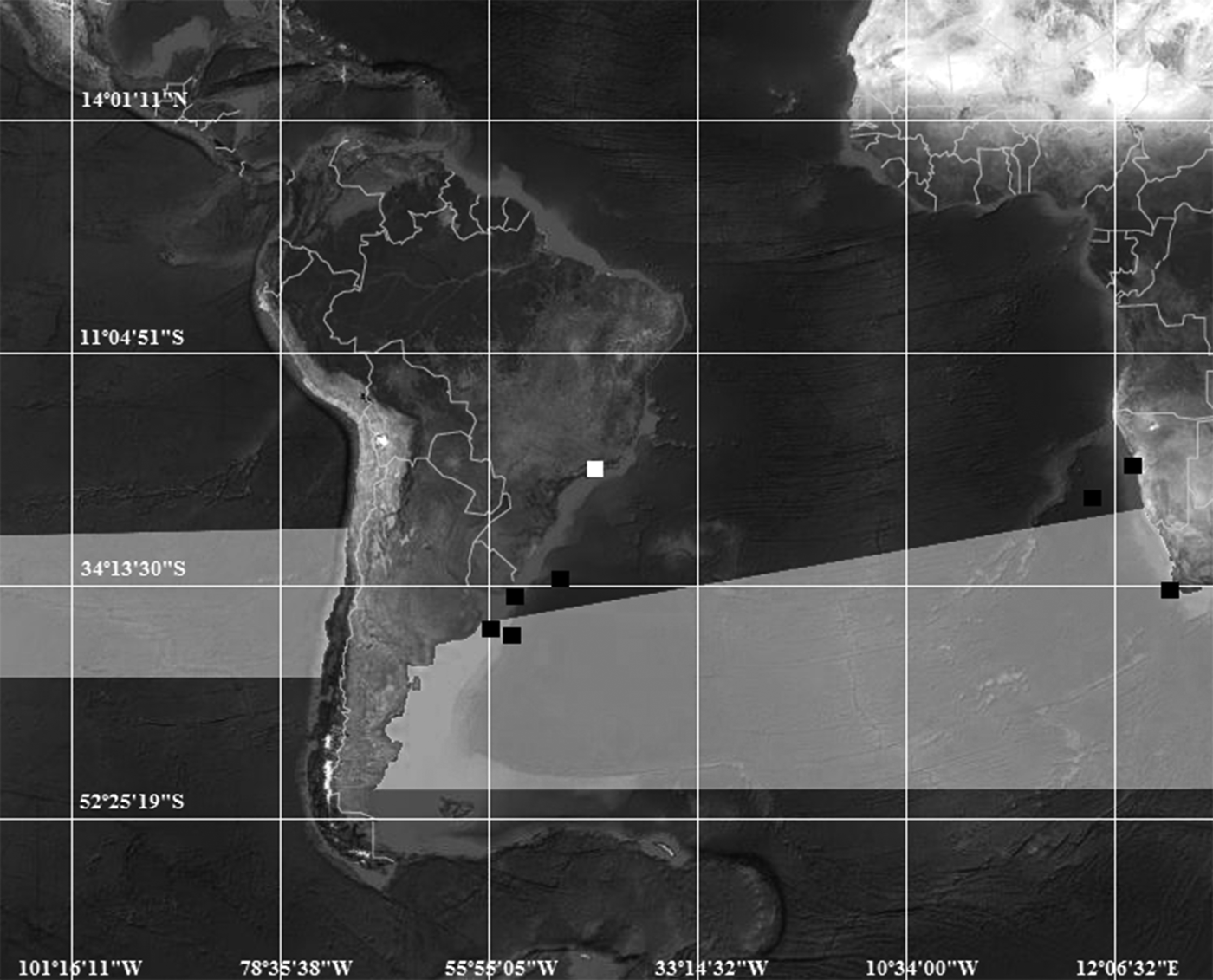
An adult specimen of Gasterochisma melampus was captured in August 2003 in a fence trap at Araçatiba beach, Ilha Grande, a continental island located off the coast of south-eastern Brazil at 23°09′S 44°19′W (Figure 1). The specimen, measuring 1,310 mm fork length (Figure 2A), was captured alive by local artisanal fishermen, who reported that it was in perfect condition. The specimen was donated to the Museu Nacional/Universidade Federal do Rio de Janeiro (MNRJ).
South Atlantic distribution of Gasterochisma melampus, with indications of previous records (black squares) and the specimen presented in this paper (white square) (based on Collette & Nauen, Reference Collette and Nauen1983).

(A) Male specimen of Gasterochisma melampus, 1,310.0 mm fork length, from south-eastern Brazil (23°09′S 44°19′W) (MNRJ 37,577); (B) head of specimen, showing the anterior nasal pore, the slit-like posterior nasal pore (red arrows), and the area covered by cycloid scales from behind the eye to the margin of preopercle; (C) inside view of mouth, showing uniserial teeth on both jaws and the vomerine and palatine dentition.
The specimen was examined and photographed on arrival at the laboratory, where meristic and morphometric data were recorded. Gut contents were examined and preserved in ethanol 70° GL. Posteriorly, the specimen was fixed in 10% formaldehyde and later transferred to ethanol 70° GL for preservation. The specimen is deposited at the ichthyological collection of the MNRJ under catalogue number MNRJ 37577. Abbreviations utilized in this paper are the following: total length (TL); fork length (FL); head length (HL); Brazilian National Museum (MNRJ); United States National Oceanic and Atmospheric Administration (NOAA); sea surface temperature (SST); South Atlantic Central Water (SACW); advanced very high resolution radiometer (AVHRR); high resolution infrared radiation sounder (HIRS).
RESULTS
Description
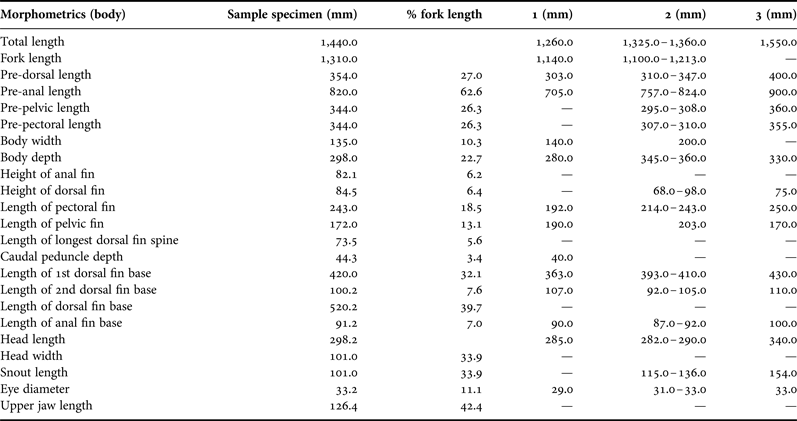
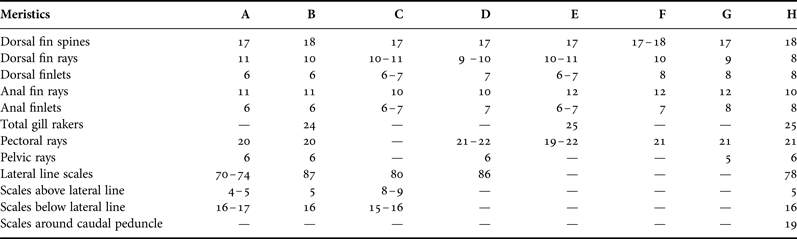
The head profile is strongly convex, ending at a terminal mouth. The head is scaleless, except for the area between the posterior margin of the eye and the margin of preopercle, which is covered by cycloid scales. The anterior nasal pore is situated 58.5 mm from the anterior margin of the eye and 86.0 mm from the tip of the upper jaw. The posterior slit-like nasal pore is 11.9 mm in length and is located 9.8 mm in front of the eye anterior margin (Figure 2B). The first branchial arch has a total of 25 tubercle-shaped gill rakers covered with villiform expansions. There is a single series of small conic teeth in both jaws—47 on the lower and 58 on the upper—decreasing in size posteriorly; the lower jaw teeth are slightly longer than those of the upper jaw and are up to 4.9 mm in length; the upper jaw teeth are up to 3.1 mm in length; and the roof of the mouth bears a vomerine patch of villiform teeth and two series of small conic teeth on the palatines (Figure 2C). An interpelvic process between the pelvic fins is small and bifid; a ventral groove 488.0 mm in length extends from the origin of the pelvic fins to the origin of the anal fin. The first dorsal fin is continuous with the second. The caudal peduncle has two fleshy keels as well as a dorsal and anal groove. The colour pattern does not have identifiable markings, and the body is dark bluish grey on its upper third and becomes silverish on the lower two-thirds. The caudal fin is darkish overall; the anal fin is silverish; the soft portion of the dorsal fin dark is bluish grey, turning lighter towards the apex; the spinous portion of the dorsal fin has translucent interspinal membranes; and the pelvic rays are white, with dark-coloured interadial membranes (Figure 2A). Measurements and counts of the specimen of Gasterochisma melampus are presented in Tables 1 and 2, respectively.
Morphometric measurements of a male adult specimen of Gasterochisma melampus captured in south-eastern Brazil (23°09′S 44°19′W) in August 2003. The following data are presented for comparative purposes, organized by size. 1, Specimen from the northern coast of the State of Rio Grande do Sul (Lima et al., Reference Lima, Mincarone and Soto2002); 2, three specimens captured in Argentina (39°10′S 54°05′W) (Cousseau, Reference Cousseau1970); 3, specimen from the entrance of La Plata River, in front of Montevideo, Uruguay (35°S) (Lahille, Reference Lahille1905).
Meristic counts of Gasterochisma melampus reported in the literature, ordered chronologically: (A) Specimen collected at the entrance of La Plata River, in front of Montevideo (35°S) (Lahille, Reference Lahille1905); (B) specimen from Mar del Plata (38°S) (Lahille, Reference Lahille1913); (C) specimen from Table Bay, South Africa (33°S 18°E) (Barnard, Reference Barnard1927); (D) three specimens captured in Argentina (39°10′S 54°05′W) (Cousseau, Reference Cousseau1970); (E) data provided by Collette & Nauen (Reference Collette and Nauen1983); (F) two specimens caught off the coast of the State of Rio Grande do Sul (34°18′S 49°58′W) (Coelho et al., Reference Coelho, Amorim and Arfelli1990); (G) specimen from the northern coast of the State of Rio Grande do Sul (Lima et al., Reference Lima, Mincarone and Soto2002); (H) specimen captured in south-eastern Brazil (23°09′S 44°19′W) in August 2003, presented in this paper.
DISCUSSION
The butterfly kingfish Gasterochisma melampus is a known by-catch of fisheries for the southern bluefin tuna, Thunnus maccoyii Castelnau, 1872, with which it shares a geographical distribution (Collette & Nauen, Reference Collette and Nauen1983; Ward et al., Reference Ward, Myers and Blanchard2004). The reported distribution of the species and its previous known record in waters off of the coast of southern Brazil (Collette & Nauen, Reference Collette and Nauen1983; Coelho et al., Reference Coelho, Amorim and Arfelli1990; Lima et al., Reference Lima, Mincarone and Soto2002) make the present specimen the northernmost record for the species in the western Atlantic Ocean. According to Collette & Nauen (Reference Collette and Nauen1983), large specimens of 1,100 mm FL or above dominate the landings of longline fishing vessels in the western parts of the Atlantic, Pacific and Indian Oceans, while smaller individuals are more frequent in eastern fishing grounds. The large size of the present specimen coincides with this pattern.
Despite the suggested scarcity of adult individuals in water temperatures higher than 11.5°C (Collette & Nauen, Reference Collette and Nauen1983), Cousseau (Reference Cousseau1970) and Coelho et al. (Reference Coelho, Amorim and Arfelli1990) have registered the presence of G. melampus in warmer waters. Previous studies on the hydrology of the bay of Ilha Grande—a tropical coastal environment—indicated water temperatures ranging from 21.2°C to 22.0°C near Araçatiba beach (Miranda et al., Reference Miranda, Ikeda, Castro-Filho and Pereira-Filho1977), the locality where the specimen was caught. The cephalopod remains found in the gut contents of the specimen indicate that it had recently fed. Although such an observation does not confirm an extension of the known distribution range of the species, the present record attests to the ability of G. melampus to inhabit waters with higher temperatures than those typical of its preferred habitat.
In Signorini (Reference Signorini1980), hydrological studies on the bay of Ilha Grande indicate the presence of mixed water masses formed by coastal waters and the SACW at depths higher than 15 m. In addition, a seasonal pycnocline starts to develop in the spring, reaching its maximum during summer. The SACW is characterized by cold waters of 6°C to 18°C and salinity between 34 and 36%, which flows underneath and in the opposite direction of the tropical Brazilian Current (Viana et al., Reference Viana, Faugères, Kowsmann, Lima, Caddah and Rizzo1998). The SACW is normally located at depths of 300 to 500 m along the Brazilian continental slope, but is found over the shelf in shallower areas in the Ilha Grande's bay area (Signorini, Reference Signorini1980). Seasonal coastal upwelling of the SACW occasionally brings cold water 300–400 km from its origin toward São Sebastião Island, about 115 km south of the bay of Ilha Grande (Lorenzzetti & Gaeta, Reference Lorenzetti and Gaeta1996). During the winter in the southern hemisphere, larger horizontal gradients found on the continental shelf of south-eastern Brazil are located in its southern portion, where cold waters below 18°C advance from the south between 50 and 100 m in depth, reaching close to São Sebastião Island. This is the same water mass that becomes the SACW in the subtropical convergence of the south-western Atlantic Ocean (Castro et al., Reference Castro, Lorenzzetti, Silveira, Miranda, Rossi-Wongtschowski and Madureira2006). It is remarkably important to note that São Sebastião Island is situated approximately 125 km from where the specimen was found during the winter of 2003.
Daily satellite imagery of SST from August 2003 for the Brazilian coast between 20°S and 36°S, provided by NOAA and measured with an AVHRR and a HIRS, indicates a mean temperature of 22.3°C for an area 75 km south of Grande Island. This pattern was broken only, on the 20 and 21 August 2003, where temperatures dropped to a minimum of 20.4°C. The decrease of SST is identifiable along the coast of Brazil between 23°S and 29°S, with the northward advection of colder waters starting on 19 August 2003, receding after reaching a maximum on the 21 August 2003. The local fishermen reported the capture of G. melampus in the following week.
Analysis of AVHRR imagery on the south-eastern Brazilian continental shelf during the winter of 1993 identified the same intrusion of cold waters (Campos et al., Reference Campos, Lorenzzetti, Stevenson, Stech and Souza1996). Campos et al. (Reference Campos, Lorenzzetti, Stevenson, Stech and Souza1996) suggest that these low temperature and low salinity waters (T ≈ 18°C, S ≈ 34) are an intrusion from the coastal branch of the northward-flowing Malvinas (Falklands) Current between the coast and the southward Brazilian Current during wintertime. While making comparisons between the distributions of foraminifera, ostracoda and microbivalves, Stevenson et al. (Reference Stevenson, Dias-Brito, Stech and Kampel1998) recognized the same cold water intrusion through satellite images and drifters. They identified a clear relationship between the limits of and the region covered by the northward advection of cold waters and the presence of species from temperate oceanic waters more typically found on the Argentine continental platform. The northern reach of this phenomenon was verified to be in the Ilha Grande and Sepetiba bays (Stevenson et al., Reference Stevenson, Dias-Brito, Stech and Kampel1998), where the present specimen of G. melampus was captured. Furthermore, Stevenson et al. (Reference Stevenson, Dias-Brito, Stech and Kampel1998) concluded that the passage of meteorological fronts might be the mechanism responsible for the sporadic entry of advected cold waters inside the Ilha Grande and Sepetiba bays.
Cold water upwellings, which are from the same water mass found on the northward advection of the Malvinas (Falklands) Current, are the main factor of fertilization for waters in the euphotic zone. They promote an increase in primary production that is essential for the maintenance of pelagic and demersal populations, including exploited stocks (Gaeta & Brandini, Reference Gaeta, Brandini, Rossi-Wongtschowski and Madureira2006).
In addition to the presence of cold water species of ostracoda, foraminifera and microbivalves (Stevenson et al., Reference Stevenson, Dias-Brito, Stech and Kampel1998), the coastal cephalopod fauna investigated between 23°S and 34°S indicates a greater diversity in its northern portion, with both warm and cold water species. Species with great bathymetric and geographical distribution, like Illex argentinus (Castellanos, 1960), which occurs in waters that G. melampus inhabits, may reach 20°S (Haimovici & Perez, Reference Haimovici and Perez1991).
The presence of cold water species at lower latitudes can also be visualized with the two other scombrid species with which G. melampus shares its geographical distribution. The slender tuna Allothunnus fallai is found between 20°S and 50°S, with specimens captured off the south-eastern and southern coasts of Brazil (Collette & Nauen, Reference Collette and Nauen1983; Collette, Reference Collette2003). This epipelagic species is known to feed mainly on krill (euphasids) but is also known to feed on squids and small fish. Juveniles are primarily encountered between 20°S and 35°S and at a SST range of 19 to 24°C, moving to higher latitudes and colder waters with maturity growth (Collette & Nauen, Reference Collette and Nauen1983). A pattern of juveniles at warmer temperatures than adults is also indicated for G. melampus (Collette & Nauen, Reference Collette and Nauen1983). The southern bluefin tuna Thunnus maccoyii is a highly migratory species and opportunistic feeder and is confined in cold waters at temperatures between 5°C and 20°C south of 30°S for most of its life. Nevertheless, it does engage in seasonal migrations to a spawning ground between Java and the north-western coast of Australia, an area that reaches 10°S and warmer waters (20–30°C) (Collette & Nauen, Reference Collette and Nauen1983). Therefore, both A. fallai and T. maccoyii are known to occur in latitudes above the Southern Ocean, reaching as far as 20°S for the slender tuna or even 10°S for the southern bluefin tuna.
In conclusion, the presence of cold waters, from coastal upwelling or the seasonal intrusion of waters from the subtropical convergence of the south-western Atlantic Ocean is common on the continental shelf of south-eastern and southern Brazil. The cold water promotes areas of lower temperatures across the coast that reaches tropical regions, such as where the specimen was found. The same phenomenon plays a role in the presence of cold water species in the same area of the Brazilian coast, some of which are known prey items of G. melampus. Thus, as evidenced by the AVHRR imagery from the period when the specimen was captured, the advection of the coastal branch of the cold water mass from the Malvinas (Falklands) Current may have transported the individual studied in this paper adrift into a tropical area, explaining the anomalous occurrence of G. melampus so far north.
Commentary on previous records of Gasterochisma melampus
The species was first described at Wellington Harbour, formerly known as Port Nicholson, in New Zealand. The description was based on a juvenile specimen that was 203.2 mm in TL (Richardson, Reference Richardson1845). Another individual of Gasterochisma melampus of 1,663.7 mm TL, this time an adult, was reported as being driven on shore at Lyttelton Harbour, New Zealand, in 1887 and was described by Günther (Reference Günther1889) as Lepidothynnus huttonii.
In 1920, a specimen measuring 1,092.2 mm SL was captured in Table Bay, South Africa (33°S 18°E) and was the first recorded specimen in the eastern Atlantic Ocean (Barnard, Reference Barnard1927). Barnard (Reference Barnard1927) also recognized that the specimens described from both the South Pacific and western Atlantic were a single species, which was supported by other studies (Barnard, Reference Barnard1927; Collette & Nauen, Reference Collette and Nauen1983; Collette, Reference Collette2003). A second individual was reported by Collette (Reference Collette, Smith and Heemstra1986) south of Cape Town, South Africa. Another specimen, carried onto land by water, was captured in 1986 from Walvis Bay, Namibia (22°53′S 14°27′E) (OBIS, 2014). This is the northernmost record for the species in the eastern Atlantic Ocean. More recently, another individual of G. melampus was captured off the coast of Namibia in 2004 (25°50′S 10°30′E) (OBIS, 2014).
The first western Atlantic Ocean specimen—a female of 1,550 mm TL—was found at the entrance of La Plata River in front of Montevideo, Uruguay (35°S) (Lahille, 1903). The author described this specimen as a new species, Chenogaster holmbergi, and later gave a detailed description (Lahille, Reference Lahille1905). The same author reported another specimen of 725 mm TL obtained in 1913 from La Plata (38°S) as a new species, Gastrochisma boulengeri (Lahille, Reference Lahille1913; Cousseau, Reference Cousseau1970).
Cousseau (Reference Cousseau1970) recorded three new specimens that were found off the coast of Argentina (39°10′S 54°05′W) in April 1969. Tuna fishing gear captured the fish in oceanic waters at a depth of 545.5 m. The specimens ranged from 1,100 to 1,213 mm FL, and two of them were identified as females. The sex of the third specimen was undetermined due to evisceration.
The first record for the species in Brazilian waters, off the coast of the State of Rio Grande do Sul (34°18′S 49°58′W), came from three specimens caught in July 1988. The individuals of G. melampus were captured by a Brazilian longliner between depths of 60 to 120 m in waters 3,000 m deep, with a SST of 17.1°C. Two, a male and a female, were adults of 1,226 and 1,270 mm TL, respectively. The third specimen was eaten by scavengers, rendering further examination impossible (Coelho et al., Reference Coelho, Amorim and Arfelli1990). A fourth specimen of 1,140 mm FL was captured by a fishing vessel in August 2001, also from the northern coast of the State of Rio Grande do Sul (Lima et al., Reference Lima, Mincarone and Soto2002). The new record is approximately 1,350 km further north from the first record.
All reports are restricted to the southern hemisphere except for a female specimen that had 1,755 mm FL. This specimen was captured 670 km north of the Hawaiian archipelago in 1993. It is the northernmost record for the species and is the only record in the northern hemisphere (Ito et al., Reference Ito, Hawn and Collette1994).
As mentioned before, all previous records refer to a single species, recognized as G. melampus (Barnard, Reference Barnard1927). Nevertheless, the specimens described by Cousseau (Reference Cousseau1970) had two distinct head profiles, while the body presented no other difference. One of the specimens had a strongly convex nape in the head, while the other specimen had a less rounded nape shape. The former is consistent with both the description by Richardson (Reference Richardson1845) and the specimen described by Günther (Reference Günther1889), as well as the present specimen obtained from south-eastern Brazil.
Another feature discussed in Barnard (Reference Barnard1927) and Cousseau (Reference Cousseau1970) is related to a wide separation of the first and second dorsal fins described by Günther (Reference Günther1889), which also appears in the diagnosis provided by Collette & Nauen (Reference Collette and Nauen1983). Barnard considered this feature to be erroneous and supported the original description, which indicated that the dorsal fins were continuous. Lahille (Reference Lahille1913) described a specimen with two separated dorsal fins, but he also found two rudimentary rays imbedded in the tissue that suggested a continuity that was lost with growth. The present specimen is an adult and possesses a continuous dorsal fin, as described originally by Richardson and agreed with the observations provided by Barnard (1927) and Cousseau (1970). Günther (1889) also noted the absence of vomerine teeth, which contradicts all other described specimens, including the present one.
Examination of the stomach contents from the individual presented in this paper revealed the presence of undigested body tissue and beaks of cephalopods. These items in the diet composition is confirmed by Cousseau (Reference Cousseau1970), who also included fish as preys. Further work is required to examine the ontogenetic development of the species as well as the occurrence of sexual dimorphism. This may elucidate the differences in the head profile observed by Cousseau; as well as the divergence between the original description by Richardson, based on a juvenile, and the description given by Günther from an adult of G. melampus.
ACKNOWLEDGEMENTS
The authors thank researchers Márcio L.V. Senna, Guilherme M.T. Souza and Wagner D. Bandeira for their invaluable assistance with the examination of meristic and morphometric data of the specimen and for the preservation procedure. This research received no specific grant from any funding agency, commercial or not-for-profit sectors.