




No CrossRef data available.
Longitudinal links among parenting, self-presentations to peers, and the development of externalizing and internalizing symptoms in African American siblings
Published online by Cambridge University Press: 07 April 2005
Abstract
A longitudinal model that linked involved–supportive parenting and siblings' ability-camouflaging self-presentations to peers with the development of externalizing and internalizing symptoms was tested with 152 pairs of first- and second-born African American siblings (mean ages 12.7 years and 10.2 years at the first wave of data collection). Three waves of data were collected at 1-year intervals. Teachers assessed siblings' externalizing symptoms, internalizing symptoms, and academic competence; siblings reported their own self-presentations and desire for peer acceptance; and mothers and siblings provided multiinformant assessments of involved–supportive parenting. Involved–supportive parenting at Wave 1 was linked with peer-directed self-presentations at Wave 2. Wave 2 self-presentations were linked indirectly with changes from Wave 1 to Wave 3 in externalizing and internalizing symptoms through their association with academic competence.
This study was supported by a grant (2 R01 HD30588) from the National Institute of Child Health and Human Development.
Information
- Type
- Research Article
- Information
- Copyright
- © 2005 Cambridge University Press
During adolescence, both internalizing symptoms (Fleming & Offord, 1990; Lewinsohn, Hops, Roberts, Seeley, & Andrews, 1993) and some forms of externalizing or antisocial behavior (see Moffitt, 1993) increase significantly in prevalence and incidence. The development of such problems during early and middle adolescence contributes to a nonnormative trajectory that includes peer rejection (Coie & Dodge, 1998), a lack of motivation, poor academic performance (Bergman & Magnusson, 1997), and risk of school dropout (Cairns, Cairns, & Neckerman, 1989; Ensminger & Slusarcick, 1992); it also forecasts alcohol abuse during late adolescence (Brook & Newcomb, 1995) and unemployment or underemployment during young adulthood (Sanford, Offord, McLeod, Boyle, Byrne, & Hall, 1994). It is therefore important to identify the processes that contribute to the development of internalizing and externalizing symptoms in adolescence, not only to further knowledge of their etiology and the developmental trajectories they foster, but also to inform the design of preventive interventions.
Current knowledge about the processes that contribute to the development of externalizing and internalizing symptoms was derived from research conducted almost exclusively with White children. Little systematic, longitudinal information is available about the contributions that etiological processes make to the development of internalizing and externalizing behaviors among young African American adolescents. Using a three-wave prospective sibling research design, we tested a theoretical model that linked parenting processes, siblings' self-presentations to peers, and academic competence with changes in their externalizing and internalizing symptoms. The use of a longitudinal sibling research design constituted what Bronfenbrenner (1977) termed an “experiment of nature,” which allowed us to replicate between siblings the linkages in the theoretical model. Few, if any, studies in the developmental psychopathology literature use data from sibling pairs in prospective analyses of the processes that contribute to changes in mental health outcomes among White youths; no such studies have been conducted with African American youths. This design not only allows a test of the findings' generalizability among children of different ages in the same family, it also provides an opportunity to explore simultaneously the contributions of sibling relationships to changes in youth mental health markers. In the sections that follow, we first discuss self-presentations to peers, a central construct around which the study is organized. We then describe a conceptual model that presents the links of parenting processes, self-presentations to peers, and academic competence with changes in externalizing and internalizing symptoms among African American siblings, along with the model's empirical bases.
Self-Presentations to Peers
As young people make the transition from childhood to early adolescence, they experience significant changes in their social relationships. They increase the time that they spend with their friends, often spending more time with them than they do with their parents or siblings (Collins, 1990). During this transition, children report a heightened concern with peer acceptance and an increase in their susceptibility to peer influence. Descriptive developmental data suggest that these attitudes peak at around 12–13 years of age and decline thereafter (Steinberg, 1990).
To garner peer acceptance, young adolescents use self-presentational behaviors as tactics to enhance the impressions that their peers form about them (Brown, 1990). If they believe that peers whom they wish to impress value negative attributes or feel threatened by positive self-presentations, young people may present themselves negatively (Leary & Kowalski, 1990; Ogbu, 1992; Steinberg, Brown, & Dornbusch, 1996). For some youths, these tactics include camouflaging their academic abilities and publicly displaying disinterest in academic achievement (Fuligni & Eccles, 1993; Ogbu, 1992; Steinberg et al., 1996). African American adolescents' use of self-presentational tactics that include public displays of antiacademic attitudes to garner peer acceptance has been a topic of considerable commentary (Ainsworth–Darnell & Downey, 1998; Cook & Ludwig, 1998; Fordham & Ogbu, 1986; Ogbu, 1991). Theoretically, African American youths adopt behaviors that contradict the majority culture's values to increase their acceptance among peers within their own culture and to avoid criticism for “acting White.” African American students have been found to form oppositional subcultures that devalue academic accomplishment (Graham, Taylor, & Hudley, 1998; Majors & Billson, 1993) and to pressure other African American youths to reject education and academic success (Fries–Britt, 1998; Ogbu, 1992). Adolescents' use of self-presentations that camouflage academic interests and abilities, however, appears to be prevalent across racial groups rather than specific to African Americans. Steinberg and colleagues (1996) found that antipathy toward academic success, including the devaluation and camouflaging of scholastic achievement, was common among his multiracial sample of 20,000 adolescents. In this study, we tested the hypothesis that camouflaging one's academic abilities or interests is a risk factor for the development of externalizing and internalizing symptoms. The existing literature indicates that some youths are more willing than others to engage in this behavior; however, thus far no attempts have been made to link the behavior prospectively to either kind of symptoms in youths from any racial or ethnic group.
Involved–Supportive Parenting, Self-Presentations to Peers, Academic Competence, Externalizing Symptoms, and Internalizing Symptoms
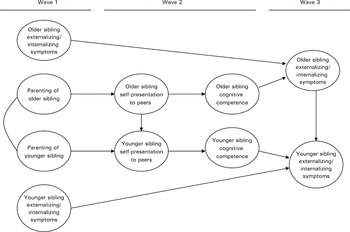
Figure 1 presents the conceptual model linking parenting processes and self-presentations with externalizing and internalizing symptoms. We hypothesized that receipt of involved–supportive parenting would be negatively associated with camouflaging self-presentations and preoccupation with peer group acceptance. Youths who receive developmentally appropriate parenting that includes high levels of parental involvement, instrumental assistance, and emotional support, and who participate frequently in harmonious parent–child discussions in which both viewpoints are considered, are likely to acquire the prosocial skills necessary for forming and maintaining positive peer relationships (Dishion, Patterson, Stoolmiller, & Skinner, 1991), develop a positive sense of self (Luthar, Cicchetti, & Becker, 2000), achieve academically, and avoid deviant peer affiliations (Brody, Ge, Conger, Gibbons, Murry, Gerrard, & Simons, 2001; Brody, Murry, Kim, & Brown, 2002). Other researchers have found that youths who do not receive instrumental and emotional support from their parents during preadolescence, and whose interactions with their parents during this time are markedly asymmetrical or consistently contentious, lack a primary source for the assimilation of conventional values. Hence, they are likely to be less accepting of parental values, less invested in schoolwork and academic achievement, and more disposed to seek out and conform to peers' values (Bogenschneider, Wu, Raffaelli, & Tsay, 1998; Brody, Flor, Hollett–Wright, & McCoy, 1998; Fuligni & Eccles, 1993; Steinberg, 1987). We therefore conjecture that involved–supportive parenting processes protect youths from developing peer relationships that devalue academic pursuits and encourage the adoption of norms that sanction antisocial behavior. The preponderance of evidence suggests that involved–supportive parenting will be associated with less use of camouflaging self-presentations and less concern with peer acceptance among both adolescent older siblings and preadolescent younger siblings.

The conceptual model linking parenting processes and self-presentations with externalizing and internalizing symptoms.
One of the primary purposes of this study was to test the hypothesis that camouflaging self-presentations and preoccupation with peer acceptance are associated with lower levels of academic competence, which, in turn, forecast high levels of externalizing and internalizing symptoms 1 year later. The rationales on which these links are based differ with the type of symptoms. Existing research has not focused on the pathways through which camouflaging self-presentations and concern about peer acceptance may act as risk factors for the development of externalizing symptoms. We used propositions derived from problem behavior theory and social learning theory (Bandura, 1989; Elliott, Huizinga, & Ageton, 1985; Patterson, DeBaryshe, & Ramsey, 1989) to address this issue. These theories suggest that camouflaging self-presentations and concern about peer acceptance will lead youths to place a low value on academic performance. By appearing disinterested in academic activities and performance, youths publicly assume an antiacademic identity with their peers. Poor academic performance, in turn, increases the likelihood that youths will affiliate with like-minded peers who model and approve engagement in problem behaviors (Jessor, 1992). This process has been linked to the development of externalizing symptoms among both White (Cairns & Cairns, 1994; Dishion, 1990; Patterson, Reid, & Dishion, 1992) and African American (Brody, Ge, Kim, Murry, Simons, Gibbons, Gerrard, & Conger, 2003) youths.
We further hypothesized that self-presentations that camouflage academic pursuits combined with preoccupation with peer acceptance also constitute a risk factor for the development of internalizing problems (see Figure 1). Studies using contemporaneous research designs have shown that camouflaging abilities to obtain peer acceptance is associated with elevated levels of depressive symptoms and loneliness among African American college students (Arroyo & Zigler, 1995; Irvine, 1986; Spurlock, 1985; Tyler & Pargament, 1981). As previously noted, camouflaging self-presentations and preoccupation with peer acceptance create a situation in which youths invest little time or effort in academic pursuits. Deficient academic performance builds on itself, occasioning increases in self-doubt, further academic failure, and strained relationships with parents, other adult family members, and teachers (Bandura, Barbaranelli, Caprara, & Pastorelli, 1996). Patterson and Capaldi's (1990) “failure model” predicts that an accumulation of such difficulties contributes to sadness, anxiety, and depression in adolescents.
We also included links between older and younger siblings' behavior in the following areas: self-presentations to peers, concerns for peer acceptance, externalizing symptoms, and internalizing symptoms. The available data support a link between older and younger siblings' externalizing symptoms (Bank, Patterson, & Reid, 1996; Brody, 2004; Conger, Conger, & Elder, 1994; Kim, Hetherington, & Reiss, 1999; Stocker, 1994; Stocker, Burwell, & Briggs, 2002). Presumably, younger siblings learn coercive and hostile behaviors from aggressive older siblings through both observation and direct interactions; these behaviors, acquired and rehearsed during sibling interactions, are generalized to other contexts such as peer relationships at school and in the neighborhood. The literature has yet to document links from older to younger siblings in self-presentations to peers, concern about peer acceptance, or internalizing symptoms. To determine whether these links exist, we included them in the model as exploratory.
In addition, we explored an ancillary hypothesis that supportive sibling relationships would occasion more similarity in siblings' externalizing symptoms, internalizing symptoms, camouflaging self-presentations, and concern about peer acceptance. This hypothesis is based on cognitive social learning theory (Bandura, 1997) and on Rowe and Gulley's (1992) “partners in crime” model. Cognitive social learning theory predicts that children and adolescents are more likely to attend to, practice, and perform acquired behaviors that are modeled for them when the observed model is nurturing and supportive. The partners in crime model maintains that sibling warmth creates a relational context in which each child reinforces and promotes antisocial behaviors while cooperating in antisocial activities. The literature supports both perspectives. Siblings who have warm, supportive relationships with one another evince greater similarity in delinquent behaviors (Rowe & Gulley, 1992; Slomkowski, Rende, Conger, Simons, & Conger, 2001), academic and social competence (Brody & Murry, 2001) and social understanding (Howe, Petrakos, & Rinaldi, 1998; Youngblade & Dunn, 1995) than do more distant brothers and sisters. We predicted, therefore, that the aforementioned links between older and younger siblings' behavior would be stronger among siblings experiencing more support in their relationships.
Summary of the Present Study
First- and second-born siblings residing in households headed by single mothers were assessed annually for 3 years. The families lived in small towns in rural Georgia in which poverty rates are among the highest in the nation (Dalaker, 2001). We focused on single-parent families because they are an understudied population even though almost half of the African American children in the rural Southeast live in such households, many of which are at or near poverty levels (Dalaker, 2001). The methodology used in this study was designed to minimize method variance artifacts. Each sibling's teacher provided data on academic competence, externalizing symptoms, and internalizing symptoms. Siblings reported their own use of camouflaging self-presentations, desire for peer group acceptance, and sibling relationship quality. Multiinformant reports from mothers and siblings were used to assess involved–supportive parenting toward each child. The predictions in the theoretical models were tested using structural equation modeling (SEM), which allowed multiple predictions to be evaluated in a single analysis while controlling for measurement error.
To enable us to determine whether the hypothesized models accounted for change in siblings' externalizing and internalizing symptoms across 2 years, we controlled the Wave 1 levels of those variables in the SEM analyses that addressed the following hypotheses: (a) Involved, supportive parenting practices with each sibling will be associated with a decrease in the likelihood that either sibling will use camouflaging self-presentations to gain peer group acceptance; (b) siblings' use of camouflaging self-presentations and concern about peer acceptance will be linked indirectly, through poor academic performance, with increases in externalizing and internalizing symptoms; and (c) older and younger siblings will display similar levels of externalizing symptoms.
Method
Participants
From nonmetropolitan counties in Georgia, 152 African American single-mother-headed families were recruited. As defined by the US Bureau of the Census, nonmetropolitan counties may include urbanized areas with populations of 20,000 or less. Only counties in which 25% or more of the population was African American were sampled to ensure that a viable African American community existed in the county. Families were recruited through community contacts. An African American staff member contacted members of the African American community, such as pastors and teachers, to explain the research project to them. After the community members understood the purposes of the project and had developed trusting relationships with the staff member, they contacted prospective participant families and described the project to them. Each community contact gave to the research staff member the names of families who expressed interest in the project, and the staff member contacted the families. For their participation, each family was compensated $150 at each of the three waves of data collection. Of the 152 families who provided data at Wave 1, 140 also provided complete data at Waves 2 and 3. This represents an overall retention rate of 92% of the sample across three waves of data collection that took place at 1-year intervals. Of the 12 families for whom three waves of data were not available, 8 declined further participation in the study and 4 relocated outside the sampled areas.
The families participating in this study live in small towns and communities in rural Georgia. In these areas, poverty rates are among the highest in the nation and unemployment rates are above the national average (Dalaker, 2001). The families in the sample can best be described as working poor (Dalaker, 2001). Although 75% of the mothers were employed for an average of 39 hr per week, 68% of the families lived below federal poverty standards and the remaining 32% lived within 150% of the poverty threshold. This poverty status reflects the dominance of low-wage, resource-intensive industries in the rural South. Total family annual income ranged from $2,532 to $62,412, and annual per capita income ranged from $636 to $9,648. A little more than half of the mothers had less than a high school education, 34% had received a high school diploma, and 8% had completed an associate of arts or bachelor's degree.
The families had an average of three children. Only the first- and second-born siblings took part in the study. At Wave 1, siblings' mean ages were 12.7 years (SD = 1.71) for first-born children (79 females, 73 males) and 10.2 years (SD = 1.52) for second-born children (78 females, 74 males). The participating sibling dyads included 39 pairs of brothers, 44 pairs of sisters, 34 pairs with an older brother and younger sister, and 35 pairs with an older sister and younger brother, all of whom were full biological siblings.
Procedures
To enhance rapport and cultural understanding, African American students and community members served as home visitors to collect data from the families. Prior to data collection, the visitors received 1 month of training in administering the protocol. The instruments and procedures were developed and refined with the help of a focus group of 40 African American community members who were representative of the population from which our sample was drawn. This process is described in detail by Brody and Stoneman (1992).
A 2-hr home visit was made to each family at each of the three waves of data collection. Informed consent was obtained, with the mother consenting to her own and her children's participation and the children assenting to their own participation. The mother also provided the names and locations of the children's schools and authorized each child's teacher to provide requested information. The mother and siblings responded to self-report questionnaires, which were administered in an interview format. Each interview was conducted privately between the participant and a researcher, with no one else present or able to overhear the conversation. At no time during the presentation of the self-report instruments did the researchers assume that a participant could read. This literacy concern was one of the reasons for presenting the questionnaires in an interview format. When responses to a Likert-type scale were required, the family member was shown a card with a series of dots in graduated sizes that corresponded to the magnitude of the responses from which he or she was to choose, and was asked to indicate his or her feelings using the dots on the card.
Measures
Involved–supportive parenting
Involved–supportive parenting was operationalized as high levels of positive affect, support, and involvement; frequent bidirectional discussions; and low levels of repetitious arguing. When parent–child relationships feature these attributes during late childhood and early adolescence, African American children display high levels of self-regulation and low levels of externalizing and internalizing problems (Murry, Bynum, Brody, Willert, & Stephens, 2001). Mothers and siblings assessed this construct at Wave 1. Mothers responded to each assessment scale twice: once for parenting of the older sibling and once for parenting of the younger sibling. Presentation of all assessments was counterbalanced across older and younger siblings to avoid order artifacts. Each sibling responded to the same instruments to assess his or her own experience with the mother's parenting. Two parenting scores were derived for each family, one for the mother's parenting of the older sibling and one for her parenting of the younger sibling. These scores were computed by summing the mother's responses to each instrument with those of the older and younger sibling, respectively. This procedure yielded a multiinformant assessment for each parenting indicator. Mothers' reports on each of the indicators of involved–supportive parenting were significantly correlated with those from each sibling (p < .05). Positive affect and involvement were measured using the short form of the Interaction Behavior Questionnaire (Prinz, Foster, Kent, & O'Leary, 1979). The short form, which correlates with the long form at .96, includes the 15 items with the highest phi coefficients and the highest item–total correlations from the 75 true–false items in the original form. Items include “You listen when your child needs somebody to talk to,” “You understand your child, you know where he or she is coming from,” and “You enjoy spending time with your child.” On the child-report version, the items were worded from the child's perspective. Cronbach's alphas for the mothers' version were .89 for reports about the older siblings and .91 for reports about the younger siblings. The alpha coefficients for the siblings' reports about mothers were .81 for older siblings' reports and .83 for younger siblings' reports.
Mother–child discussion quality was assessed using the Parent–Child Discussion Quality Scale, which was adapted from a scale that Brody et al. (1998) originally used. The mothers and children were asked about their discussions with one another regarding school, religion, and prosocial behavior. Three questions were asked concerning each topic, for a total of nine items. The first question, “How often do you talk about [topic]?” measured the frequency of discussions. It was rated on a scale ranging from 0 (we never talk about it) to 3 (we talk about it a lot). The second question, which assessed bidirectionality, was, “When you talk about [topic], how does the conversation go?” Ratings ranged from 0 (we don't talk about it) to 3 (we usually talk about it openly and we share our sides of the issue). The third question, “When you talk about [topic], how often do you end up arguing?” indicated the outcomes of the discussions. Responses ranged from 0 (never) to 4 (always/nearly every time) and were reverse scored. The nine were factor analyzed, and a one-factor solution emerged for all respondents. Mothers' reports about discussions with each sibling, and the siblings' reports about discussions with their mothers, all attained Cronbach's alphas exceeding .70.
The eight-item Emotional Support Scale (Wills, Vaccaro, & McNamara, 1992) indexed mothers' emotional attentiveness and responsiveness toward each of their children. Items in the children's version include, “I can share my feelings with my mom,” and “When I talk to my mom, she makes me feel better.” The mothers' version phrased the items from a parent's perspective: for example, “My child can share his or her feelings with me,” and “My child feels better after talking to me.” Cronbach's alphas for this scale were .84 to .85 for the mothers' version, .81 for the older siblings' responses, and .82 for the younger siblings' reports. The fourth parenting assessment, the Ineffective Arguing Inventory (Kurdek, 1994), was used to index a pattern of conflict that includes repetitive arguing over the same issues, knowing how arguments are going to end before they are over, ending arguments without resolving the issues that prompted them, and ending arguments with neither party feeling that he or she was given a fair hearing. Mothers and children indicated the extent to which scale items such as “Our arguments are left hanging” and “You and your [child/mom] go for days being mad at each other” reflect the way in which their disagreements are handled. Cronbach's alphas were .67 and .71 for mothers' reports about repetitive arguing with older and younger siblings, respectively, .57 for older siblings' reports, and .65 for younger siblings' reports.
Self-presentation to peers
The self-presentation construct was composed of two indicators on which the siblings reported at Wave 2. The four-item Impression Management Scale (Arroyo & Zigler, 1995) was used to assess the extent to which children camouflaged their abilities in an attempt to make their peers' impressions of them more favorable. Items were rated on a 3-point Likert-type scale ranging from 1 (untrue) to 3 (very true). Items included: “I never let my friends know when I get good grades in school,” “I sometimes do things I really don't like just so other students will like me,” “I feel like I must act less intelligent than I am so other students will not make fun of me,” and “I could probably do better in school, but I don't try because I don't want to be called a nerd.” Cronbach's alphas were .76 for older siblings and .60 for younger siblings. The eight-item Desire for Peer Group Acceptance Scale (Bowen & Chapman, 1996) was used in this study because its items addressed both peer-directed self-presentations and concern about peer acceptance. The items were rated on a 3-point Likert-type scale ranging from 1 (a lot like me) to 3 (not like me). Items include: “I am afraid to do things my friends won't approve of,” “I let my friends talk me into doing things I really don't want to do,” “I try to impress my friends,” and “I find it difficult to be myself when I am with my friends.” Cronbach's alphas were .67 for older siblings and .60 for younger siblings.
Children's academic competence
At Wave 2, teachers provided ratings on the single indicator of academic competence: the seven-item Academic Competence subscale of the Perceived Competence Scale for Children (Harter, 1982). For simplicity in rating and scoring this instrument, the response set was altered from the original two-step, forced-choice format. Teachers rated the items on a 4-point Likert scale ranging from 1 (not at all) to 4 (always). Items included, “This child is very good at his/her schoolwork,” and “She or he does well in class.” Cronbach's alpha was .92.
Externalizing and internalizing symptoms
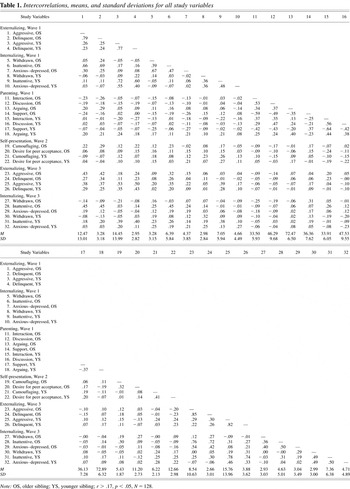
At Waves 1 and 3, each child's teacher reported on sibling externalizing and internalizing symptoms. Externalizing behavior problems were assessed using the Aggressive Behavior and Delinquent Behavior subscales from the teacher report form of the Child Behavior Checklist (CBCL; Achenbach, 1991). Externalizing problems included “arguing a lot,” “unusually loud,” and “hangs around with others who get in trouble.” Cronbach's alpha was .96 for both siblings. Internalizing behavior problems were assessed using the Withdrawn, Inattentive, and Anxious/Depressed subscales from the teacher report form of the CBCL. Internalizing problems included “underactive, slow moving, or lacks energy,” “feels worthless or inferior,” “daydreams or gets lost in his/her thoughts,” and “has difficulty following directions.” Cronbach's alphas were .90 for older siblings and .91 for younger siblings. These measures were obtained from teachers at Waves 1 and 3. The Wave 1 assessments allowed us to determine whether the conceptual model accounted for change in the differences between siblings' psychological functioning from Wave 1 to Wave 3. The means displayed in Table 1 indicate that the children in this community sample were experiencing normative levels of externalizing and internalizing symptoms (Achenbach, 1991). Only 5% of the older siblings and 5% of the younger siblings displayed either externalizing or internalizing behaviors at levels above clinical cutoffs.
Intercorrelations, means, and standard deviations for all study variables

Sibling relationship quality
At Wave 3, both siblings rated the quality of their relationship with one another using the Satisfaction, Affection, and Prosocial Behavior subscales of the Sibling Relationship Questionnaire (Furman & Buhrmester, 1985). In past research, children's responses to these subscales were associated with their observed rates of positive and negative behavior toward their siblings (Brody, Stoneman, & McCoy, 1994a, 1994b). Each sibling's subscale scores were summed. For each subscale, the older and younger siblings' scores were significantly correlated (all rs > .25, ps < .05). The two summed scores, one from the older and one from the younger sibling, were then summed to yield a multiinformant assessment of the pair's relationship quality. Cronbach's alphas for the older and younger siblings' summed scores were .81 and .78, respectively.
Results
Testing the hypothesized longitudinal paths to changes in siblings' externalizing and internalizing symptoms
Measurement models
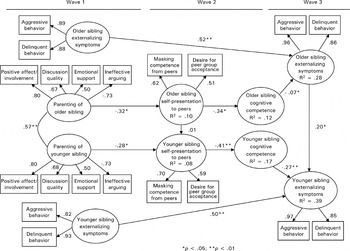
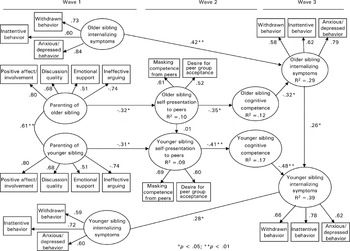
The hypothesized models were analyzed via SEM using AMOS 4.0 software (Arbuckle & Wothke, 1999), which uses the full information maximum likelihood (FIML) estimation method. FIML does not delete cases missing from one or more waves of data collection, nor does it delete cases that are missing data for one or more variables within a wave of data collection. This procedure thus avoids potential problems such as biased parameter estimates, which are more likely to occur if pairwise or listwise deletion procedures are used to compensate for missing data (Arbuckle & Wothke, 1999; Wothke, 2000). In addition, in studies in which SEM was compared with multilevel modeling approaches for analyzing family data involving sibling pairs (Khoo & Muthén, 2000) and husband–wife pairs (Wendorf, 2002), the results for the two approaches were nearly identical. This demonstrates that SEM provides unbiased estimates of the parameters and standard errors despite the nesting of individuals within families. Furthermore, SEM provides flexibility in analyzing longitudinal data with relatively small sample sizes. For these reasons, we used SEM to test the hypothesized model. Table 1 presents the correlation matrices, means, and standard deviations for the models forecasting externalizing and internalizing symptoms. Figures 2 and 3 present the results of the tests of the structural models for externalizing and internalizing symptoms, respectively. These figures also present the factor loadings of the manifest variables on their respective latent constructs.

Results of the tests of the structural model for externalizing symptoms, with factor loadings of the manifest variables on their respective latent constructs.

Results of the tests of the structural model for internalizing symptoms, with factor loadings of the manifest variables on their respective latent constructs.
The significant factor loadings for discussion quality, emotional support, involvement, relationship quality, and ineffective arguing confirm their utility as indexes of the latent constructs measuring involved–supportive parenting. Older and younger siblings' ratings of impression management and desire for peer group acceptance loaded positively on the latent constructs for peer-directed self-presentations. Because academic performance was indexed using a single measure, we fixed the factor loading at unity. Finally, teachers' ratings of externalizing and internalizing symptoms at Waves 1 and 3 loaded significantly, indicating their adequacy as measures of those latent constructs.
Structural model: Externalizing symptoms
After determining that the measurement model fit the data as specified, we tested the structural model for externalizing symptoms. It also fit the data well (χ2 = 324.7, df = 215, p < .01; χ2/df = 1.51). According to Arbuckle and Wothke (1999), a χ2/df ratio between 1 and 3 indicates a good fit. The comparative fit index (CFI) was .91, the root mean square error of approximation (RMSEA) was .05, and the 90% confidence interval (CI) was .04, .06. The structural coefficients (βs) represent tests of hypotheses about theoretical constructs.
The results were consistent with our hypotheses. Involved–supportive parenting toward older and younger siblings at Wave 1 was linked negatively with their use of camouflaging self-presentations and preoccupation with peer acceptance 1 year later at Wave 2. For both siblings, camouflaging self-presentations and preoccupation with peer acceptance were associated negatively with academic competence. In turn, both siblings' academic competence at Wave 2 was associated negatively with externalizing symptoms 1 year later at Wave 3. Because the initial levels of externalizing symptoms were controlled, the pathways in the structural model account for actual change in both siblings' symptoms across 2 years (see Figure 2).
The structural model also included hypothetical links between older and younger siblings' levels of externalizing symptoms and camouflaging self-presentations. As the results presented in Figure 2 indicate, this hypothesis was supported for externalizing symptoms but not for camouflaging self-presentations. We analyzed an additional model that included direct paths from older and younger siblings' camouflaging self-presentations and preoccupation with peer acceptance to their externalizing behaviors, to determine whether these paths would improve the model's fit to the data. None of the paths was reliably associated with externalizing symptoms 1 year later. This analysis further supported the hypothesis that camouflaging self-presentations and preoccupation with peer acceptance are indirectly linked, through academic competence, with increases over time in externalizing symptoms.
Structural model: Internalizing symptoms
Figure 3 presents the results for internalizing symptoms. This model also fit the data well (χ2 = 502.77, df = 306, p < .001; χ2/df = 165; CFI = .91; RMSEA = .05; 90% CI = .05, .06). Again, the results supported the hypotheses. For both siblings, receipt of involved–supportive parenting was negatively associated with camouflaging self-presentations and preoccupation with peer group acceptance. Peer-directed self-presentations, in turn, forecast internalizing symptoms for both siblings through its association with academic competence. Because the initial levels of internalizing symptoms were controlled, the results account for actual change in both siblings' symptoms over 2 years.
We also explored the possibility that internalizing symptoms and peer-directed self-presentations would be correlated between siblings. The analyses depicted in Figure 3 revealed a significant association between siblings' internalizing symptoms but not their self-presentations. As with externalizing symptoms, we analyzed a model that included direct paths from older and younger siblings' camouflaging self-presentations and preoccupation with peer acceptance to their internalizing symptoms. Again, none of these paths was linked with changes in either the older or younger siblings' internalizing behaviors.
Alternative structural models
Although we did not advance any predictions regarding gender effects, we checked for them. Our sample was too small to allow us to investigate the potential effects of sibling gender combinations on the paths in the conceptual model. We did, however, use the multigroup comparison procedures from LISREL 8.5 (Jöreskog & Sörbom, 1996; Jöreskog, Sörbom, Du Toit, & Du Toit, 2000) to determine whether older or younger sibling gender conditioned any of the paths in the models for externalizing or internalizing symptoms. Two analyses were executed in which the sample was divided, first by older, then by younger, sibling gender. For these analyses, we first estimated a two-group invariance model by imposing equality constraints on every estimate. We then relaxed one equality constraint at a time for the specific coefficient under investigation, allowing the coefficient to differ across groups, and reestimated the model. If the coefficients differed across groups, relaxing the equality constraint would result in a significant improvement in fit. None of the coefficients differed across older or younger sibling gender for either model.
Sibling relationship quality as a moderator of the link between older and younger siblings' externalizing and internalizing symptoms
An additional purpose of this study was to determine whether sibling relationship quality would condition any links that emerged from older to younger siblings' externalizing symptoms, internalizing symptoms, camouflaging self-presentations, and desire for peer group acceptance. Significant paths emerged for externalizing and internalizing symptoms; thus, the possibility of a moderating effect was examined only for these links.
To determine whether sibling relationship quality would evince the hypothesized moderational effect, we estimated the models separately for sibling pairs with relatively more or less positive sibling relationships. We formed these groups by performing a median split on the sibling relationship quality measure. Figure 4 presents the standardized coefficients for externalizing symptoms separately for sibling pairs experiencing high- and low-quality relationships. Using the multigroup comparison procedures described previously, we first estimated a two-group invariance model on the link between older and younger siblings' externalizing symptoms. We then relaxed this equality constraint, allowing the coefficient to differ across groups, and reestimated the model. Consistent with our hypotheses, the reestimated multigroup model resulted in a significant reduction in the chi-square value, Δχ2 (1) = 6.73, p < .01. This test indicates that the link between older and younger siblings' externalizing symptoms was significantly stronger for siblings with higher quality relationships. Figure 3 also shows that sibling relationship quality did not condition the other paths in the model. The multigroup comparison procedures did not detect any evidence for a moderational effect of sibling relationship quality on the link between older and younger siblings' internalizing symptoms.

Standardized coefficients for sibling pairs, presented separately for high- and low-quality sibling relationships. The numbers in parentheses represent findings for siblings with high-quality relationships.
Discussion
Using a sibling longitudinal design, we tested a model of the links among involved–supportive parenting, self-presentations to peers, externalizing symptoms, and internalizing symptoms. The results indicated that (a) involved–supportive parenting toward older and younger siblings at Wave 1 was linked negatively with their use of camouflaging self-presentations and preoccupation with peer acceptance 1 year later at Wave 2; (b) for both siblings, self-presentations to peers at Wave 2 were linked with changes in externalizing and internalizing symptoms at Wave 3 through academic competence at Wave 2; and (c) sibling relationship quality moderated the association between older and younger siblings' externalizing symptoms, with the association stronger among siblings with higher quality relationships. To our knowledge, this is the first study in which longitudinal pathways to the development of externalizing and internalizing symptoms were examined with African American siblings.
The negative association that emerged between involved–supportive parenting and the self-presentation construct for both older and younger siblings is consistent with the results of contemporaneous studies in which variations in parenting are linked to variations in youths' peer orientations. Involved parenting that includes emotional support, instrumental assistance, and frequent discussions that openly address potential areas of disagreement is associated with greater internalization of parental norms (Brody, Ge, Katz, & Arias, 2000), and a balanced consideration of parents' and peers' viewpoints in youths' personal decision-making processes (Bogenschneider et al., 1998; Fuligni & Eccles, 1993; Steinberg, 1987). Involved–supportive parenting also is associated with characteristics that reduce the likelihood that youths will camouflage their academic abilities or become excessively concerned about peer acceptance; these include self-regulation, academic competence, social competence, and avoidance of deviant peer affiliations. This association has emerged among both rural (Brody et al., 2001; Brody, Dorsey, Forehand, & Armistead, 2002; Brody, Murry, et al., 2002; Ge, Brody, Conger, Simons, & Murry, 2002) and urban (Bradley, Rock, Caldwell, Harris, & Hamrick, 1987; Taylor & Roberts, 1995) African American youths.
This study documented an indirect link between siblings' self-presentations to peers and development of externalizing and internalizing symptoms through academic competence. Performing well in school helps children to foster mutually supportive intellectual relationships with like-minded peers through differential affiliation processes (Elliott et al., 1985; Jessor & Jessor, 1977; Patterson et al., 1989). These relationships, in turn, reduce the likelihood that children will become involved with deviant peers, engage in antisocial conduct, or develop depressive symptoms (Bandura, Pastorelli, Barbaranelli, & Caprara, 1999). Future research should explore the possibility of an indirect link from academic competence to externalizing and internalizing symptoms through children's affiliations with academically minded or deviant peers.
Initially, a young adolescent may camouflage his or her abilities to facilitate entry into a particular peer group. After the youth becomes affiliated with these peers, the development of externalizing problems is likely fostered by explicit peer reinforcement of deviant behavior and disapproval of prosocial and academically oriented behavior (Dishion, Spracklen, Andrews, & Patterson, 1996). Externalizing behaviors can also develop without overt peer influence. For example, the literature on substance use indicates that youths' perceptions of drug-using peers as attractive also increase the attractiveness of the behaviors in which the peers engage and forecast youths' initiation of those behaviors (Gibbons & Gerrard, 1995). Similarly, perceiving a high level of substance use among peers is a risk factor for subsequent use, net of actual peer associations (Graham et al., 1998); such perceptions may alter youths beliefs concerning norms and consensus about substance use (Brody et al., 1998). We conjecture that the associations of self-presentations to peers and academic competence with externalizing behaviors may be mediated by both explicit peer processes and social perceptions about the acceptability of antisocial behaviors. Further research that includes these processes in the protocols is needed to clarify the ways in which these risk mediation processes operate. The inclusion of these parameters would also allow a precise test for protective effects of parenting practices against affiliation with peers who encourage development of antisocial attitudes and devaluation of academic pursuits, which increase youths' likelihood of masking their academic interests.
Internalizing problems develop from an accumulation of experiences rather than a single determinant. We hypothesized links from self-presentations to peers and academic competence to the development of internalizing symptoms based upon Patterson and Capaldi's (1990) failure model. When youths engage in ability–camouflaging self-presentations, their actual behavior may increasingly conform to the image of themselves that they wish to present to their peers. The resulting academic underachievement can produce conflict with parents and teachers, culminating in youths' development of anxiety, depression, and feelings of rejection. The negative emotions arising from relationship difficulties with adults may be layered onto a privately held sense of personal disappointment. Despite their public pronouncements that denigrate conventional academic pursuits, some youths may privately harbor internalized standards that endorse academic achievement. The discomfort generated by the discrepancies between their public and private selves can combine with parents' and teachers' disapproval to foster negative self-evaluations that contribute to internalizing symptoms. The results of the present study suggest that future research should focus on the interplay among self-presentations to peers, compromised relationships with adults, and discrepancies between public behavior and internalized standards in the development of internalizing symptoms.
The link between older and younger siblings' externalizing behaviors was moderated by sibling relationship quality; the link was stronger when the sibling relationship was supportive. These results replicate Rowe and Gulley's (1992) and Slomkowski et al.'s (2001) findings that warm, supportive sibling relationships condition the similarity in siblings' antisocial behaviors. Those studies included only White siblings; our study extends the findings to rural African American siblings. Although in this study we did not assess the mechanisms through which siblings came to evince more similarity in externalizing behaviors as a function of their relationship quality, we can offer a conjecture. Children who perceive support from their older siblings probably want to spend time with them and become their “partners in crime” (Rowe & Gulley, 1992). Becoming a partner in crime occurs after younger siblings learn antisocial behaviors from their older siblings and join them in antisocial activities.
Sibling relationship quality did not moderate the link between older and younger siblings' internalizing symptoms. This analysis was exploratory, as we had no a priori reason to expect a moderational effect on this link. The literature includes few, if any, reports of associations between siblings' internalizing symptoms during middle childhood and early adolescence, particularly when the assessments are obtained from reporters outside the family, such as teachers. Sibling similarities in either externalizing or internalizing symptoms may be a product of shared environmental influences, genetic predispositions, or a transaction between them. Understanding the processes that account for siblings' similarity in externalizing and internalizing symptoms will inform the etiology of such disorders in children and adolescents.
The sibling research design gave us the opportunity not only to replicate the hypothesized pathways to the development of externalizing and internalizing symptoms, but also to incorporate in the same model an examination of both parent and sibling contributions. Using this design, we found that siblings were not similar in their camouflaging self-presentations to peers even though they were somewhat similar in their externalizing and internalizing symptoms. A sibling design creates an opportunity for understanding why children differ in their self-presentations. Although we did not include the analyses in this already complex paper, we executed some exploratory analyses and found that differences in siblings' receipt of involved–supportive parenting at Wave 1 were associated with sibling differences at Wave 2 in peer-directed self-presentations. Children who received less involved–supportive parenting reported the use of camouflaging self-presentations more often than did their siblings.
Although in the conceptual model we did not predict any gender differences, we sought to determine whether gender conditioned any of the pathways in the models; no differences emerged. This result could be due to the size of the sample, which does not have enough power to detect these differences. In addition, past research suggests that siblings in certain gender combinations (specifically, two brothers) are particularly prone to externalizing behavior (Bank et al., 1996); however, our sample was not large enough to test the model separately by gender groupings. Further research conducted with larger samples is needed to determine whether the theoretical model tested in this study fits equally well for various gender combinations.
Limitations of this study and some caveats must be noted. First, it is not known whether the present results generalize to White families living in the same communities as the study participants or to urban families of any race. Second, the sample is not random; it is therefore possible that the families who participated in this study may have been functioning differently than the population at large because of self-selection processes. Third, because the participants did not display clinical levels of externalizing or internalizing symptoms, the results cannot be generalized to youths who meet the criteria for clinical diagnoses of behavior disorders. Fourth, the proposed model is not intended to be exhaustive. Models that incorporate different parameters than those included here could also account for variation in siblings' externalizing and internalizing symptoms. For example, the inclusion of peer affiliation and influence processes might yield a more robust model. These cautions notwithstanding, the present results demonstrate the importance to youths' mental health of parenting processes and the self-presentational tactics with which they are associated.
References
REFERENCES
Achenbach, T. M.
(1991).
Manual for the Youth Self-Report and 1991 profile.
Burlington, VT:
University of Vermont, Department of Psychiatry.
Ainsworth–Darnell, J. W., &
Downey, D. B.
(1998).
Assessing the oppositional culture explanation for racial/ethnic
differences in school performance.
American Sociological Review
63,
536–553.Google Scholar
Arbuckle, J. L., &
Wothke, W.
(1999).
Amos 4.0 user's guide.
Chicago:
SmallWaters Corporation.
Arroyo, C. G., &
Zigler, E.
(1995).
Racial identity, academic achievement, and the psychological
well-being of economically disadvantaged adolescents.
Journal of Personality and Social Psychology
69,
903–914.Google Scholar
Bandura, A.
(1989).
Self-regulation of motivation and action through internal standards
and goal systems.
In
L. Pervin (Ed.),
Goal concepts in personality and social psychology (pp.
19–85).
Hillsdale, NJ:
Erlbaum.
Bandura, A.,
Barbaranelli, C.,
Caprara, G. V., &
Pastorelli, C.
(1996).
Multifaceted impact of self-efficacy beliefs on academic
functioning.
Child Development
67,
1206–1222.Google Scholar
Bandura, A.,
Pastorelli, C.,
Barbaranelli, C., &
Caprara, G. V.
(1999).
Self-efficacy pathways to childhood depression.
Journal of Personality and Social Psychology
76,
258–269.Google Scholar
Bank, L.,
Patterson, G. R., &
Reid, J. B.
(1996).
Negative sibling interaction patters as predictors of later
adjustment problems in adolescent and young adult males.
In
G. H. Brody (Ed.),
Sibling relationships: Their causes and consequences (pp.
197–229).
Norwood, NJ:
Ablex.
Bergman, L. R., &
Magnusson, D.
(1997).
A person-oriented approach in research on developmental
psychopathology.
Development and Psychopathology
9,
291–319.Google Scholar
Bogenschneider, K.,
Wu, M.,
Raffaelli, M., &
Tsay, J. C.
(1998).
Parent influences on adolescent peer orientation and substance use:
The interface of parenting practices and values.
Child Development
69,
1672–1688.Google Scholar
Bowen, G. L., &
Chapman, M. V.
(1996).
Poverty, neighborhood danger, social support, and the individual
adaptation among at-risk youth in urban areas.
Journal of Family Issues
17,
641–666.Google Scholar
Bradley, R. H.,
Rock, S. L.,
Caldwell, B. M.,
Harris, P. T., &
Hamrick, H. M.
(1987).
Home environment and school performance among Black elementary
school children.
Journal of Negro Education
56,
499–509.Google Scholar
Brody, G. H.
(2004).
Siblings' direct and indirect contributions to child
development.
Current Directions in Psychological Science
13,
124–126.Google Scholar
Brody, G. H.,
Dorsey, S.,
Forehand, R., &
Armistead, L.
(2002).
Unique and protective contributions of parenting and classroom
processes to the adjustment of African American children living in
single-parent families.
Child Development
73,
274–286.Google Scholar
Brody, G. H.,
Flor, D. L.,
Hollett–Wright, N., &
McCoy, J. K.
(1998).
Children's development of alcohol use norms: Contributions of
parent and sibling norms, children's temperaments, and
parent–child discussions.
Journal of Family Psychology
12,
209–219.Google Scholar
Brody, G. H.,
Ge, X.,
Conger, R.,
Gibbons, F. X.,
Murry, V. M.,
Gerrard, M., &
Simons, R. L.
(2001).
The influence of neighborhood disadvantage, collective
socialization, and parenting on African American children's
affiliation with deviant peers.
Child Development
72,
1231–1246.Google Scholar
Brody, G. H.,
Ge, X.,
Katz, J., &
Arias, I.
(2000).
A longitudinal analysis of internalization of parental alcohol use
norms and adolescent alcohol use.
Applied Developmental Science
4,
71–79.Google Scholar
Brody, G. H.,
Ge, X.,
Kim, S. Y.,
Murry, V. M.,
Simons, R. L.,
Gibbons, F. X.,
Gerrard, M., &
Conger, R. D.
(2003).
Neighborhood disadvantage moderates associations of parenting and
older sibling problem attitudes and behavior with conduct disorders in
African American children.
Journal of Consulting and Clinical Psychology
71,
211–222.Google Scholar
Brody, G. H., &
Murry, V. M.
(2001).
Sibling socialization of competence in rural, single-parent African
American families.
Journal of Marriage and Family
63,
996–1008.Google Scholar
Brody, G. H.,
Murry, V. M.,
Kim, S., &
Brown, A. C.
(2002).
Longitudinal pathways to competence and psychological adjustment
among African American children living in rural single-parent
households.
Child Development
73,
1505–1516.Google Scholar
Brody, G. H., &
Stoneman, Z.
(1992).
Child competence and developmental goals among rural Black
children: Investigating the links.
In
I. Sigel,
A. McGillicuddy–DeLisi, &
J. Goodnow (Eds.),
Parental belief systems: The psychological consequences for
children
(pp.
415–432).
Hillsdale, NJ:
Erlbaum.
Brody, G. H.,
Stoneman, Z., &
McCoy, J. K.
(1994a).
Contributions of family relationships and child temperaments to
longitudinal variations in sibling relationship quality and sibling
relationship styles.
Journal of Family Psychology
8,
274–286.Google Scholar
Brody, G. H.,
Stoneman, Z., &
McCoy, J. K.
(1994b).
Forecasting sibling relationships in early adolescence from child
temperaments and family processes in middle childhood.
Child Development
65,
771–784.Google Scholar
Bronfenbrenner, U.
(1977).
Toward an experimental ecology of human development.
American Psychologist
32,
513–531.Google Scholar
Brook, J. S., &
Newcomb, M. D.
(1995).
Childhood aggression and unconventionality: Impact on later academic
achievement, drug use, and workforce involvement.
Journal of Genetic Psychology
156,
393–410.Google Scholar
Brown, B.
(1990).
Peer groups. In
S. S. Feldman &
G. Elliott (Eds.),
At the threshold: The developing adolescent (pp.
171–196).
Cambridge, MA:
Harvard University Press.
Cairns, R. B., &
Cairns, B. D.
(1994).
Lifelines and risks: Pathways of youth in our time.
New York:
Cambridge University Press.
Cairns, R. B.,
Cairns, B. D., &
Neckerman, H. J.
(1989).
Early school dropout: Configurations and determinants.
Child Development
60,
1437–1452.Google Scholar
Coie, J. D., &
Dodge, K. A.
(1998).
Aggression and antisocial behavior. In
W. Damon &
N. Eisenberg (Eds.),
Handbook of child psychology: Vol. 3. Social, emotional, and
personality development
(pp.
779–862).
New York:
Wiley.
Collins, W. A.
(1990).
Parent–child relationships in the transition to adolescence:
Continuity and change in interaction, affect, and cognition.
In
R. Montemayor,
G. Adams, &
T. Gullotta (Eds.),
Advances in adolescent development: Vol. 2. From childhood to
adolescence: A transitional period?
(pp.
85–106).
Beverly Hills, CA:
Sage.
Conger, K. J.,
Conger, R. D., &
Elder, G. H., Jr.
(1994).
Sibling relationships during hard times. In
R. D. Conger, &
G. H. Elder, Jr. (Eds.),
Families in troubled times: Adapting to change in rural
America (pp.
325–352).
Hawthorne, NY:
Aldine De Gruyter.
Cook, P. J., &
Ludwig, J.
(1998).
The burden of “acting White”: Do Black adolescents
disparage academic achievement?
In
C. Jencks &
M. Phillips (Eds.),
The Black–White test score gap (pp.
375–400).
Washington, DC:
Brookings Institution Press.
Dalaker, J.
(2001, September).
Poverty in the United States, 2000
(U.S. Census Bureau Current Population Reports Series
P60-214).
Washington, DC:
US Government Printing Office.
Dishion, T. J.
(1990).
Peer context of child and adolescent troublesome behavior.
In
P. Leone (Ed.),
Understanding troubled and troublesome youth (pp.
128–135).
Beverly Hills, CA:
Sage.
Dishion, T. J.,
Patterson, G. R.,
Stoolmiller, M., &
Skinner, M. L.
(1991).
Family, school, and behavioral antecedents to early adolescent
involvement with antisocial peers.
Developmental Psychology
27,
172–180.Google Scholar
Dishion, T. J.,
Spracklen, K. M.,
Andrews, D. W., &
Patterson, G. R.
(1996).
Deviancy training in male adolescents' friendships.
Behavior Therapy
27,
373–390.Google Scholar
Elliott, D. S.,
Huizinga, D., &
Ageton, S. S.
(1985).
Explaining delinquency and drug use.
Beverly Hills, CA:
Sage.
Ensminger, M. E., &
Slusarcick, A. L.
(1992).
Paths to high school graduation or dropout: A longitudinal study of
a first-grade cohort.
Sociology of Education
65,
95–113.Google Scholar
Fleming, J. E., &
Offord, D. R.
(1990).
Epidemiology of childhood depressive disorders: A critical
review.
Journal of the American Academy of Child and Adolescent
Psychiatry
29,
571–580.Google Scholar
Fordham, S., &
Ogbu, J. U.
(1986).
Black students' school success: Coping with the burden of
“acting White.”
Urban Review
18,
176–206.Google Scholar
Fries–Britt, S.
(1998).
Moving beyond Black achiever isolation.
Journal of Higher Education
69,
556–576.Google Scholar
Fuligni, A., &
Eccles, J.
(1993).
Perceived parent–child relationships and early
adolescents' orientation toward peers.
Developmental Psychology
29,
622–632.Google Scholar
Furman, W., &
Buhrmester, D.
(1985).
Children's perceptions of the qualities of their sibling
relationships.
Child Development
56,
448–461.Google Scholar
Ge, X.,
Brody, G. H.,
Conger, R. D.,
Simons, R. L., &
Murry, V. M.
(2002).
Contextual amplification of pubertal transition effects on deviant
peer affiliation and externalizing behavior among African American
children.
Developmental Psychology
38,
42–54.Google Scholar
Gibbons, F. X., &
Gerrard, M.
(1995).
Predicting young adults' health risk behavior.
Journal of Personality and Social Psychology
69,
505–517.Google Scholar
Graham, S.,
Taylor, S. Z., &
Hudley, C.
(1998).
Exploring achievement values among ethnic minority early
adolescents.
Journal of Educational Psychology
90,
606–620.Google Scholar
Harter, S.
(1982).
The Perceived Competence Scale for Children.
Child Development
53,
87–97.Google Scholar
Howe, N.,
Petrakos, H., &
Rinaldi, C. M.
(1998).
“All the sheeps are dead. He murdered them”: Sibling
pretense, negotiation, internal state language, and relationship
quality.
Child Development
69,
182–191.Google Scholar
Irvine, R. W.
(1986).
Education in the post-integration era.
Journal of Negro Education
55,
508–517.Google Scholar
Jessor, R.
(1992).
Risk behavior in adolescence: A psychosocial framework for
understanding and action.
Developmental Review
12,
374–390.Google Scholar
Jessor, R., &
Jessor, S. L.
(1977).
Problem behavior and psychosocial development: A longitudinal study
of youth.
New York:
Academic Press.
Jöreskog, K. G., &
Sörbom, D.
(1996).
LISREL 8 user's reference guide.
Chicago:
Scientific Software International.
Jöreskog, K. G.,
Sörbom, D.,
Du Toit, S., &
Du Toit, M.
(2000).
LISREL 8: New statistical features.
Chicago:
Scientific Software International.
Khoo, S. T., &
Muthén, B.
(2000).
Longitudinal data on families: Growth modeling alternatives:
Multivariate applications in substance use research.
In
J. Rose,
C. Chassin,
C. Presson, &
J. Sherman (Eds.),
Multivariate applications in substance use research: New methods for
new questions
(pp.
43–78).
Hillsdale, NJ:
Erlbaum.
Kim, J. E.,
Hetherington, E. M., &
Reiss, D.
(1999).
Associations among family relationships, antisocial peers, and
adolescents' externalizing behaviors: Gender and family type
differences.
Child Development
70,
1209–1230.Google Scholar
Kurdek, L. A.
(1994).
Conflict resolution styles in gay, lesbian, heterosexual nonparent,
and heterosexual parent couples.
Journal of Marriage and the Family
56,
705–722.Google Scholar
Leary, M. R., &
Kowalski, R. M.
(1990).
Impression management: A literature review and two-component
model.
Psychological Bulletin
107,
34–47.Google Scholar
Lewinsohn, P. M.,
Hops, H.,
Roberts, R. E.,
Seeley, J. R., &
Andrews, J. A.
(1993).
Adolescent psychopathology: I. Prevalence and incidence of
depression and other DSM-III-R disorders in high school
students.
Journal of Abnormal Psychology
102,
133–144.Google Scholar
Luthar, S. S.,
Cicchetti, D., &
Becker, B.
(2000).
The construct of resilience: A critical evaluation and guidelines
for future work.
Child Development
71,
543–562.Google Scholar
Majors, R., &
Billson, J. M.
(1993).
Cool pose: The dilemmas of Black manhood in America.
New York:
Lexington Books.
Moffitt, T. E.
(1993).
Adolescence-limited and life-course persistent antisocial behavior:
A developmental taxonomy.
Psychological Review
100,
674–701.Google Scholar
Murry, V. M.,
Bynum, M. S.,
Brody, G. H.,
Willert, A., &
Stephens, D.
(2001).
African American single mothers and children in context: A review of
studies on risk and resilience.
Clinical Child and Family Psychology Review
4,
133–155.Google Scholar
Ogbu, J. U.
(1991).
Minority coping responses and school experience.
Journal of Psychohistory
18,
433–456.Google Scholar
Ogbu, J. U.
(1992).
Understanding cultural differences and school learning.
Education Libraries
16(3),
7–11.Google Scholar
Patterson, G. R., &
Capaldi, D. M.
(1990).
A mediational model for boys' depressed mood. In
J. E. Rolf &
A. S. Masten (Eds.),
Risk and protective factors in the development of
psychopathology
(pp.
141–163).
New York:
Cambridge University Press.
Patterson, G. R.,
DeBaryshe, B. D., &
Ramsey, E.
(1989).
A developmental perspective on antisocial behavior.
American Psychologist
44,
329–335.Google Scholar
Patterson, G. R.,
Reid, J. B., &
Dishion, T. J.
(1992).
Antisocial boys.
Eugene, OR:
Castalia.
Prinz, R. J.,
Foster, S. L,
Kent, R. N., &
O'Leary, K. D.
(1979).
Multivariate assessment of conflict in distressed and nondistressed
mother–adolescent dyads.
Journal of Applied Behavior Analysis
12,
691–700.Google Scholar
Rowe, D. C., &
Gulley, B. L.
(1992).
Sibling effects on substance use and delinquency.
Criminology
30,
217–233.Google Scholar
Sanford, M.,
Offord, D.,
McLeod, K.,
Boyle, M.,
Byrne, C., &
Hall, B.
(1994).
Pathways into the work force: Antecedents of school and work force
status.
Journal of the American Academy of Child and Adolescent
Psychiatry
33,
1036–1046.Google Scholar
Slomkowski, C.,
Rende, R.,
Conger, K. J.,
Simons, R. L., &
Conger, R. D.
(2001).
Sisters, brothers, and delinquency: Evaluating social influence
during early and middle adolescence.
Child Development
72,
271–283.Google Scholar
Spurlock, J.
(1985).
Survival guilt and the Afro-American of achievement.
Journal of the National Medical Association
77,
29–32.Google Scholar
Steinberg, L.
(1987).
Single parents, stepparents, and the susceptibility of adolescents
to antisocial peer pressure.
Child Development
58,
269–275.Google Scholar
Steinberg, L. D.
(1990).
Autonomy, conflict, and harmony in the family relationship.
In
S. S. Feldman &
G. R. Elliott (Eds.),
At the threshold: The developing adolescent (pp.
255–276).
Cambridge, MA:
Harvard University Press.
Steinberg, L.,
Brown, B., &
Dornbusch, S. M.
(1996).
Beyond the classroom: Why school reform has failed and what parents
need to do.
New York:
Simon & Schuster.
Stocker, C. M.
(1994).
Children's perceptions of relationships with siblings, friends,
and mothers: Compensatory processes and links with adjustment.
Journal of Child Psychology and Psychiatry
35,
1447–1459.Google Scholar
Stocker, C. M.,
Burwell, R. A., &
Briggs, M. L.
(2002).
Sibling conflict in middle childhood predicts children's
adjustment in early adolescence.
Journal of Family Psychology
16,
50–57.Google Scholar
Taylor, R. D., &
Roberts, D.
(1995).
Kinship support and maternal and adolescent well-being in
economically disadvantaged African–American families.
Child Development
66,
1585–1597.Google Scholar
Tyler, F. B., &
Pargament, K. I.
(1981).
Racial and personal factors and the complexities of
competence-oriented changes in a high school group-counseling
program.
American Journal of Community Psychology
9,
697–714.Google Scholar
Wendorf, C. A.
(2002).
Comparisons of structural equation modeling and hierarchical linear
modeling approaches to couples' data.
Structural Equation Modeling
9,
126–140.Google Scholar
Wills, T. A.,
Vaccaro, D., &
McNamara, G.
(1992).
The role of life events, family support, and competence in
adolescent substance use: A test of vulnerability and protective
factors.
American Journal of Community Psychology
20,
349–374.Google Scholar
Wothke, W.
(2000).
Longitudinal and multigroup modeling with missing data. In
T. D. Little,
K. U. Schnabel, &
J. Baumert (Eds.),
Modeling longitudinal and multilevel data: Practical issues, applied
approaches, and specific examples
(pp.
219–240).
Mahwah, NJ:
Erlbaum.
Youngblade, L. M., &
Dunn, J.
(1995).
Individual differences in young children's pretend play with
mother and sibling: Links to relationships and understanding of other
people's feelings and beliefs.
Child Development
66,
1472–1492.Google Scholar
The conceptual model linking parenting processes and self-presentations with externalizing and internalizing symptoms.
Intercorrelations, means, and standard deviations for all study variables
Results of the tests of the structural model for externalizing symptoms, with factor loadings of the manifest variables on their respective latent constructs.
Results of the tests of the structural model for internalizing symptoms, with factor loadings of the manifest variables on their respective latent constructs.
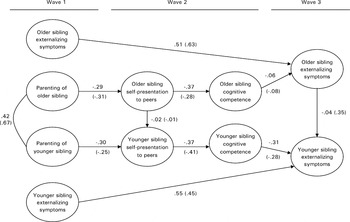
Standardized coefficients for sibling pairs, presented separately for high- and low-quality sibling relationships. The numbers in parentheses represent findings for siblings with high-quality relationships.
 You have
Access
- 19
- Cited by