Water that is used in health care can harbor pathogenic organisms that can threaten patient safety.Reference Kanamori, Weber and Rutala 1 – 3 Patients may be exposed to water sources and so-called “opportunistic pathogens of premise plumbing” through a variety of means.Reference Falkinham, Hillborn, Arduino, Pruden and Edwards 4 In healthcare facilities, water systems often have complex distribution pathways with areas of stagnation, exposure to a variety of plumbing materials, and wide variability in temperature, pH, and disinfectant types and levels. These conditions can promote the development of biofilms and the growth of environmental opportunistic pathogens (eg, Legionella, nontuberculous mycobacteria (NTM), and Pseudomonas species). These organisms can be transmitted to patients, directly or indirectly, through typical water uses involving showers, sinks, and toilets. Moreover, water is widely used in clinical care, often in association with medical devices; it is also a key component in many drug or medication formulations. Patient susceptibility to opportunistic pathogens found in water may be increased by morbidities such as non-intact skin, open wounds, immunocompromising conditions, or the presence of invasive devices. Furthermore, hospital wastewater plumbing, including sink drains, can harbor multidrug-resistant organisms (MDROs), such as carbapenemase-producing Enterobacteriaceae (CRE), and may be a source of transmission to patients and a cause of clusters of healthcare-associated infections (HAIs).Reference Tofteland, Naseer, Lislevand, Sundsfjord and Samuelsen 5 – Reference Carlin 7
Outbreaks related to these organisms can be challenging to identify, investigate, and resolve. A high level of suspicion is typically needed to recognize that an infection or cluster of infections might be related to some form of water exposure associated with healthcare delivery. Interruption of transmission may require multidisciplinary interventions, often involving public utilities, health authorities, and consultants with expertise in water and environmental health. Legionella is a well-described cause of water-related HAIs, and these outbreaks can be associated with considerable patient harm and costs.Reference Soda, Barskey and Shah 8 However, the occurrence of clusters of other water-related pathogens in healthcare has been less well described. In this report, we present a summary of Centers for Disease Control and Prevention (CDC) consultation experiences that have involved evaluating potential or confirmed transmission of water-related organisms, exclusive of Legionella. We describe the distribution of organisms, settings, and potential routes of transmission.
Methods
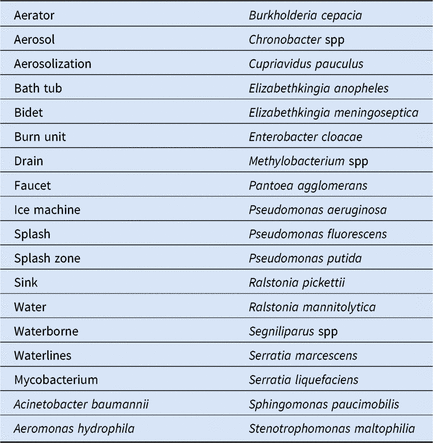
The Division of Healthcare Quality Promotion (DHQP) at CDC assists health departments and healthcare facilities with investigations of potential outbreaks involving the provision of health care. We reviewed our internal investigation consultation records from January 1, 2014, through December 31, 2017, using a query that involved a predefined set of water-related terms and list of water-related organisms (Table 1).
Search Terms Used to Query Division of Healthcare Quality Promotion Records to Identify Water-Related Investigations, CDC, United States, 2014–2017

Investigations were excluded if (1) the consultation was for laboratory referencing testing only; (2) the infections were likely community acquired; (3) the organism in question was not a water-related opportunistic pathogen 3 ; (4) an alternate transmission pathway was determined; or (5) the infections occurred outside the United States among non-US patients. Infections or outbreaks occurring abroad among non-US patients residing outside of the United States were excluded, whereas infections or outbreaks related to medical tourism where US patients travel abroad for medical care and acquire infections while abroad were included. Consultations involving Legionella infections and outbreaks were excluded because they have been summarized elsewhere.Reference Soda, Barskey and Shah 8 , Reference Benedict, Reses and Vigar 9 Multistate investigations (which may have involved individual consultations with multiple health departments) were analyzed and counted as a single investigation.
We compiled the following information for each investigation identified: (1) number of patients infected or colonized; (2) organism(s) identified, including multidrug-resistant designation; (3) classification as confirmed or pseudo-outbreak (ie, increase in positive cultures without evidence of disease in patients); (4) whether pediatric patients were involved; (5) type of healthcare facility (ie, inpatient, outpatient, long-term care); (6) whether hemodialysis was an exposure of interest; (7) whether surgery was an exposure of interest; and (8) details regarding medical product exposures. Information regarding the types of infections (eg, disseminated, respiratory) was not available for many consultations and was therefore not reported.
We classified investigations as medical-product related if the use of a medical device or medication was an exposure of interest. Medical devices included central venous catheters, injections, endoscopes, ventilators, and other types of medical devices. We classified investigations that implicated compounded or manufactured medication products as involving either intrinsic contamination (eg, medication supplied in a contaminated state due to a manufacturing error) or extrinsic contamination (eg, medication became contaminated at the point of care). Categories were not mutually exclusive. Although routes of transmission for patient colonization or infection were not always confirmed or documented for each investigation, we determined plausible exposure pathways and routes of transmission based on available epidemiologic and laboratory information. We also identified pathways associated with >1 investigation. Molecular typing methods are increasingly used to help determine potential transmission pathways in HAI investigations, but we did not have consistent or systematic information on molecular typing results for all consultations included in this analysis.
Two authors (K.M.P. and S.C.R.) reviewed a sample of 30% of the investigations to ensure agreement that all investigations met the inclusion criteria and agreement on investigation characteristics and classification. One author (K.M.P.) reviewed the remaining investigations.
Results
We provided consultation support for 620 investigations between 2014 and 2017. Of those, 134 (21.6%) consultations met our criteria (Table 2). These investigations involved 1,380 patients, with an average of 10.3 affected patients per investigation (range, 0–163). Pediatric patients were involved in 21.6% of investigations. More than 20 different organisms were identified as the pathogen of concern (Table 2). Investigations involving NTM accounted for the greatest number of investigations (n = 40, 29.9%) and patients affected (n = 549, 39.8%). Pseudomonas spp accounted for the next greatest number of investigations (n = 25, 18.7%; patients: n = 152, 11.0%). Burkholderia spp accounted for 10.4% of all water-related investigations but represented 26.2% of patients. Some water-related investigations included >1 organism (n = 10, 7.5%). One-third of investigations included pathogens that were multidrug-resistant, excluding NTM (n = 45, 33.6%).
Characteristics of Water-Related Investigations, Division of Healthcare Quality Promotion, CDC, United States, 2014–2017
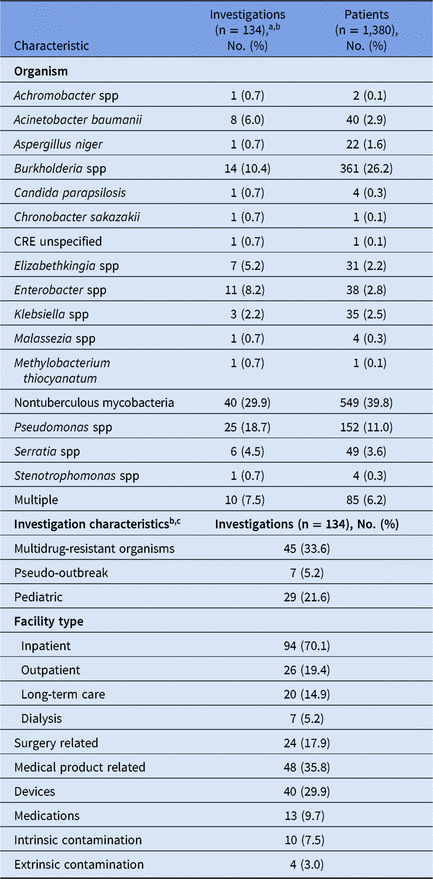
a 2 investigations involved water-related infection control issues without an identified organism of concern or confirmed patient infection at the time of consultation with CDC/DHQP.
b As described in the Methods section, multistate outbreak investigations were counted as a single consultation, such as the multistate investigation of Mycobacterium chimaera associated with contaminated heater-cooler devices.
c Categories are not mutually exclusive.
Consultations involved a variety of healthcare settings. Although most occurred in inpatient facilities (n = 94, 70.1%), many also occurred in outpatient (n = 26, 19.4%) and long-term care (n = 20, 14.9%) facilities. Surgery was an exposure of interest among 24 investigations (17.9%) and included cardiothoracic (n = 8), cosmetic (n = 5), and orthopedic (n = 3) surgeries among others. Medical products were involved in >35% of investigations, with medical devices representing the majority (n = 40, 83.3%). Medical device investigations involved 654 infected or colonized patients and included heater-cooler devices (n = 8), bronchoscopes (n = 5), other endoscopes (n = 3), and ventilators (n = 3), among others. Contaminated medications represented 9.7% of all investigations, with most involving probable intrinsic medication contamination (n = 10, 76.9%) and the remainder involving probable extrinsic medication contamination (n = 4, 30.8%).
As noted, NTM were involved in more investigations than any other bacterial pathogen. Of investigations involving NTM, most were Mycobacterium abscessus only (n = 10, 25.0%) or included multiple species of NTM (n = 11, 27.5%). Other NTM species included M. fortuitum, M. chelonae, M. avium complex, M. goodii, and M. mucogenicum, among others. NTM water-related investigations often involved a medical device (n = 20, 50.0%) or surgery (n = 21, 52.5%).
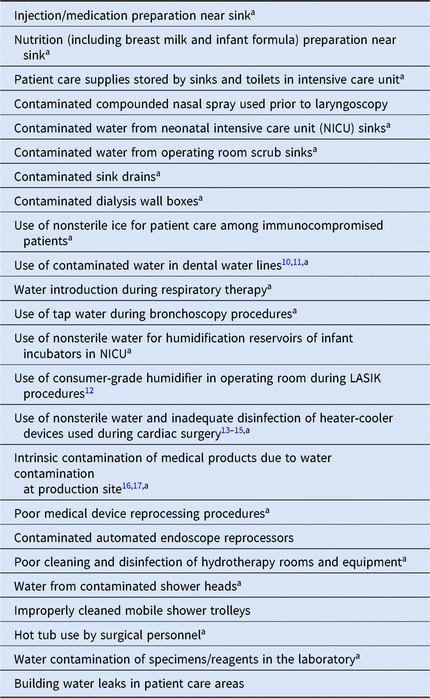
Table 3 lists examples of exposure pathways and routes of transmission for the investigations included in this study such as medication and nutrition preparation near the splash zones of sinks, contaminated water from operating room and patient care sinks, and poor practices in the reprocessing of reusable medical equipment, among others. Most exposure pathways and routes of transmission were identified in >1 investigation.
Possible Exposure Pathways and Routes of Transmission Involved in Water-Related Investigations, Division of Healthcare Quality Promotion, CDC, United States, 2014–2017

a Indicates a potential exposure pathway or route of transmission that was documented as the possible source of infection in two or more investigations.
Discussion
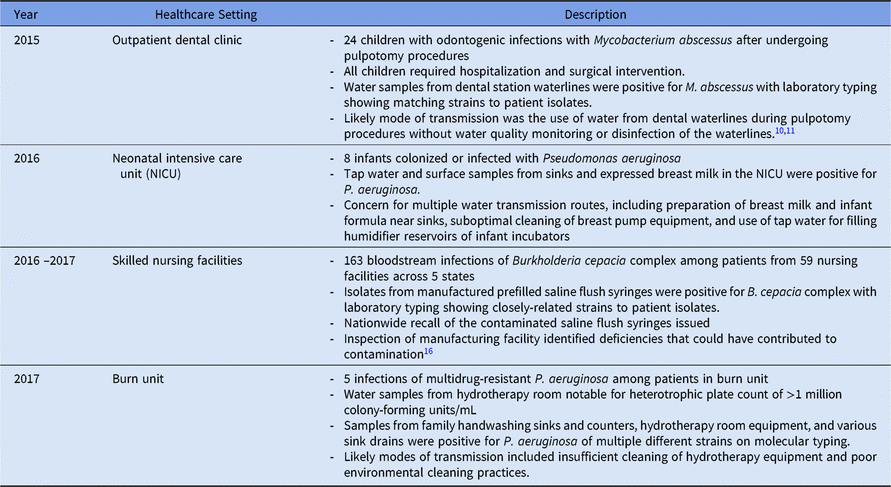
Water-related opportunistic pathogens appear to contribute in important ways to the US HAI burden. Investigations involving non-Legionella water-related organisms or water exposures accounted for more than one-fifth of HAI consultations supported by CDC/DHQP from 2014 to 2017. These involved >1,300 patients, both adult and pediatric. Additionally, these water-related investigations span the spectrum of healthcare settings, including inpatient, outpatient, and long-term care settings. Table 4 provides descriptions of selected examples of water-related investigation consultations that occurred during the study period and represent a variety of healthcare settings and patient populations.
Selected Examples of Water-Related Investigations, Division of Healthcare Quality Promotion, CDC, United States, 2014–2017

Our review may not represent the full spectrum of non-Legionella, water-related HAI investigations because we included only investigations in which CDC/DHQP provided consultation and assistance. The investigations summarized in our review likely represent more complex outbreaks and scenarios than those to which healthcare facilities and health departments might respond without consultation. Although CDC/DHQP tracks its response consultation activities, this does not constitute formal surveillance and final or complete information is lacking for many investigations. Therefore, information such as total number of patients infected or colonized reported in this review are likely underestimates. The number of patients not clinically infected or colonized by water-related organisms but affected by water-related outbreaks (eg, by patient notifications of exposed patients) is likely greater.Reference Marra, Diekema and Edmond 13 Additionally, as described in the Methods section, multistate outbreaks were counted as a single consultation, thereby underestimating the total number of consultations. For example, CDC/DHQP involvement in the multistate outbreak of Mycobacterium chimaera infections following cardiac surgery associated with contaminated heater-cooler devices was counted as a single investigation, despite more than a dozen individual consultations with various states across the United States.Reference Perkins, Lawsin and Hasan 14
In our review, a large proportion of water-related HAI investigations involved surgery (17.9%) or a medical device (29.9%). In the presence of surgical incisions, injections, and invasive devices, normal surface and mucosal host defenses are breached, potentially leading to invasive infections.Reference Decker and Palmore 18 , Reference Crist and Perz 19 As more invasive medical procedures are transitioned from the inpatient to the outpatient setting, patients at risk for becoming infected with water-related organisms are increasingly being exposed in ambulatory settings. Although more than two-thirds of water-related investigations occurred in the inpatient setting, we found that 20% occurred in outpatient settings. In recent years, increasing attention has focused on adherence to standard infection control practices in the outpatient setting because this setting has been identified as an area with limited to no regulatory oversight.Reference Maki and Crnich 20 Infection control issues related to water-related HAIs in ambulatory settings pose a special challenge because freestanding outpatient facilities may have little awareness or monitoring of their water quality and of the pathways through which water-related organisms can be transmitted to patients.
Medical products featured prominently in more than one-third of the investigations on which we consulted, with medical devices representing the majority. Transmission pathways from medical devices to patients should always be considered for any device that utilizes water. Water contamination of medical products can occur through local exposures at the facility-level or further upstream at the site of manufacture. Both points of contamination should be considered at the start of an investigation, but when the latter is suspected, CDC and the Food and Drug Administration (FDA) should be alerted early in the investigation because point-source contamination can manifest as sporadic cases across multiple institutions and can be challenging to detect. As the development of new medical devices evolves and the use of established medical devices continues to increase in the delivery of patient care, special attention to the potential introduction of water-related organisms is needed at the point of manufacture.Reference Brooks, Mitchell and Miller 16 , Reference Glowicz, Crist and Gould 17 , Reference Schreiber and Sax 15 , Reference Jhung, Sunenshine and Noble-Wang 21 – Reference Haller, Höller and Jacobshagen 23
The global outbreak of Mycobacterium chimaera infections associated with contaminated heater-cooler devices used during cardiothoracic surgery is a prime example of a medical device that uses water but had not been historically considered to have a water-transmission pathway from device to patient. During this global outbreak, heater-cooler devices were discovered to generate bioaerosols that were transmitted into the operating room environment, exposing patients to NTM and the risk of infection.Reference Schreiber and Sax 15 , Reference Haller, Höller and Jacobshagen 23 Prior to the outbreak, heater-cooler devices had been used for years during cardiothoracic surgery without an appreciation of this water-related risk. This example highlights the potential for widespread harm associated with contamination of a medication or device during production and the need for additional safeguards to protect against the introduction of water-related organisms at the site of manufacture. Nonetheless, the introduction of water-related organisms to medical products often occurs proximal to patient care. Examples include the preparation of injections near water sources such as sinks and the use of tap water in reprocessing reusable medical equipment (Table 3).
Nontuberculous mycobacteria featured prominently in our review as the single most common source of water-related organism infections and consultation requests during the study period. Surgery and medical devices were each involved in half of NTM water-related investigations. This finding is consistent with a systematic review of water-related infections of NTM in healthcare facilities, which found that the most common route of NTM infection transmission was through the use of nonsterile water during medical procedures, such as insertion of central venous catheters or with the use of tap water to rinse medical equipment.Reference Li, Abebe, Cronk and Bartram 24 The presence of NTMs in municipal water systems, their habitation in biofilms, and their relative chlorine resistance makes these organisms especially difficult to control or eradicate.Reference Falkinham, Hillborn, Arduino, Pruden and Edwards 4 , Reference Decker and Palmore 18 , Reference Crist and Perz 19 Given that NTM infections are often marked by long incubation periods, nonspecific symptomatology, and severe clinical impact, standard case reporting and public health surveillance for extrapulmonary NTM have been recommended; these measures could facilitate more timely identification of clusters and outbreaks.Reference Bancroft, Shih and Cassidy 25 – Reference Shih, Cassidy, Perkins, Crist, Cieslak and Leman 27
More than one-third of our water-related investigation consultations included an MDRO (not including NTM, which are intrinsically resistant to many antibiotics). Many of these MDROs were Enterobacteriaceae and other gram-negative organisms, for which routes of transmission other than water, such as person-to-person transmission, may play a significant role. Although incoming healthcare-facility water is often hypothesized as the ultimate source of infections with water-related organisms, MDROs have been identified in healthcare wastewater plumbing, such as sink drains and toilets, and these water reservoirs have been linked to patient transmission events.Reference Tofteland, Naseer, Lislevand, Sundsfjord and Samuelsen 5 – Reference Carlin 7 When investigating a cluster of these water-related MDROs, potential transmission from wastewater plumbing should especially be considered.
Water is increasingly recognized as a source of HAIs.Reference Hanlin and Myers 28 A 2016 review of published literature of healthcare outbreaks associated with water reservoirs revealed a wide variety of pathogens and infection types, including bloodstream infections, pneumonia, and disseminated disease.Reference Kanamori, Weber and Rutala 1 Reservoirs implicated in these outbreaks included potable water, bathing, decorative water fountains, faucets, ice machines, and hospital wastewater systems, among others, and they were consistent with many of the exposure pathways and transmission routes identified in our study (Table 3). CDC and the Centers for Medicare and Medicaid Services (CMS) encourage hospitals and nursing homes to establish water management programs to prevent water-related HAIs.Reference Soda, Barskey and Shah 8 , 29 CMS recently clarified a memorandum requiring “all hospitals, critical access hospitals and long-term care facilities to develop and adhere to policies and procedures that inhibit microbial growth in building water systems that reduces the risk of growth and spread of Legionella and other opportunistic pathogens in water.” 29 However, water management programs should go beyond mitigating the risk of Legionella and the traditional routes of spread; they should explore other pathways of transmission, such as those described in this report. CDC’s “Tap Water Quality and Infrastructure Discussion Guide for Investigation of Potential Water-Associated Infections in Healthcare Facilities” is available to assist healthcare facilities identify areas of concern. 3 Water management programs should also maintain awareness of the risks and benefits of water conservation efforts, such as those associated with green water systems.Reference Edwards, Rhoads, Pruden, Pearce and Falkinham 30
In summary, our review highlights the contribution of water-related organisms to healthcare outbreaks and transmission and helps illustrate some of the challenges surrounding their investigation and prevention. Modern healthcare facilities have large, complex water systems that predispose them to biofilm formation and bacterial growth if not properly maintained.Reference Decker and Palmore 18 For this reason, it is essential that healthcare facilities devise and implement a water management program that is effective in limiting water-related organisms from growing and spreading in their facility. Patient safety depends on assuring that water entering a healthcare facility meets all applicable quality standards and that the premise plumbing within the healthcare facility is designed and maintained in a way that minimizes growth and spread of water-related pathogens. Additionally, careful consideration should be taken of all potential pathways of water transmission to patients within a facility during patient care to minimize the risk of infection from water exposure. 3 Finally, because the potential exposure pathways for water-related organisms are numerous and extend from points of production to distribution, use, and disposal, primary prevention may never be absolute. Robust systems are needed, bridging healthcare and public health, to actively monitor and identify evidence of patient harms involving water-related organisms and to support timely investigation and effective interventions. This review highlights a wide variety of healthcare exposures and pathways that inform investigation and prevention of water-related healthcare-associated infections.
Acknowledgments
The authors thank Clifford McDonald, MD and the Division of Healthcare Quality Promotion Water work group for their helpful advice and thoughtful feedback on this manuscript. We thank Steven Franklin for his assistance in database management, and the Prevention and Response Branch, the Clinical and Environmental Microbiology Branch, and other DHQP and CDC staff who assisted with the consultations included in this report. The findings and conclusions in this report are those of the authors and do not necessarily represent the official position of the Centers for Disease Control and Prevention.
Financial support
No financial support was provided relevant to this article.
Conflicts of interest
All authors report no conflicts of interest relevant to this article.