Introduction
In Europe, oilseed rape (Brassica napus L., spp. napus) is an important crop. The oil extracted from seeds is used in various food and industrial applications, and the remaining meal is used as a protein-rich component in animal feed. Today, different genetically modified (GM) varieties are in the pipeline for commercialization in Europe, and, in that context, raise economic, agronomic and environmental concerns of dispersal of the inserted transgenes into conventional/organic crops and wild relatives. Therefore, new regulations for the coexistence of conventional, organic and GM crops are being implemented in European countries to limit the adventitious presence of GM in non-GM harvests. In most countries, these regulations are based on knowledge obtained from the propagation of conventional varieties, as it is believed that the present control measures for seed propagation will ensure a high degree of purity in the harvest, and thus limit the future presence of GM. However, the present purity assessment of varieties is based almost entirely on morphological markers, which are likely to underestimate the presence of other varieties for oilseed rape, due to morphological similarities between them (Tommasini et al., Reference Tommasini, Batley, Arnold, Cooke, Donini, Lee, Law, Lowe, Moule, Trick and Edwards2003; H.C. Ellegård, The Danish Plant Directorate, personal communication).
The presence of other varieties or hybrids in an oilseed rape harvest is caused by dispersal of seeds and pollen. By studying the dispersal of conventional oilseed rape genes, information on the dispersal of transgenes can be obtained, since there is no reason to believe that transgenes will behave substantially differently (Gruber et al., Reference Gruber, Pekrun and Claupein2004). Pollen dispersal in B. napus occurs via insects that can transfer the pollen several kilometres (Ramsay et al., Reference Ramsay, Thompson, Neilson, Mackay and Lutman1999; Rieger et al., Reference Rieger, Lamond, Preston, Powles and Roush2002); wind pollination is also possible, although it may be less important for long-distance dispersal (Cresswell et al., Reference Cresswell, Davies, Patrick, Russell, Pennel, Vicot and Lahoubi2004; Walklate et al., Reference Walklate, Hunt, Higson and Sweet2004). The seeds have both spatial dispersal to a new location and temporal dispersal via survival in the seed bank. When the seeds germinate, either as volunteers in a subsequent crop, or as feral plants (plants that have escaped from domestication and established in semi-natural habitats), they produce pollen and seeds that contribute further to gene flow in subsequent seasons. Oilseed rape is able to establish long-lived seed banks, e.g. due to dormancy induced by a combination of environmental conditions (Pekrun et al., Reference Pekrun, Lutman and Baeumer1997a, Reference Pekrun, Lutman and Baeumerb; Gruber et al., Reference Gruber, Pekrun and Claupein2004). These conditions are met when the seeds are incorporated into the soil by ploughing. In a normal year, approximately 2–10% of the seeds (2000–10,000 seeds m− 2) are shattered to the ground before or during harvest (Price et al., Reference Price, Hobson, Neale and Bruce1996; Gulden et al., Reference Gulden, Shirtliffe and Thomas2003). These seeds have no or little dormancy and will germinate on the soil surface, but if the seeds are incorporated into the soil, they can remain viable for several years (Lutman, Reference Lutman and Boelt2003). The timing and method of post-harvest cultivation therefore crucially influences the number of seeds incorporated into the seed bank (Lutman, Reference Lutman and Boelt2003). Almost all seeds germinate on the soil surface if ploughing after harvest is delayed by 4 weeks, and therefore the number of seeds incorporated into the seed bank would be small (Pekrun et al., Reference Pekrun, Hewitt and Lutman1998). An important factor for seed persistence is the potential dormancy of different genotypes, since it appears that there is a genetic basis for this (Gruber et al., Reference Gruber, Pekrun and Claupein2004). Seed survival is also affected by the soil depth at which the seeds are incorporated, since the seeds are better preserved in the environment of deeper soil layers (Lutman et al., Reference Lutman, Freeman and Pekrun2003). The survival of oilseed rape seeds has been determined as 5–10 years, in both undisturbed soil and in semi-natural habitats (Pessel et al., Reference Pessel, Lecomte, Emeriau, Krouti, Messean and Gouyon2001; Simard et al., Reference Simard, Légère, Pageau, Lajeunesse and Warwick2002; Lutman et al., Reference Lutman, Freeman and Pekrun2003). However, to date there are no data available on the long-term behaviour of seed banks of oilseed rape under arable conditions (Pekrun et al., Reference Pekrun, Lane and Lutman2005).
To obtain information about the dynamics of volunteer populations and their contribution to dispersal, we identified the volunteers to variety and assumed their age. The volunteers were assigned to variety by comparing their DNA marker profiles with those from a C1 (certified seed) assortment of reference varieties. By combining information on previously cultivated oilseed rape varieties at the site of the volunteers and year of cultivation of these varieties, the age of the volunteers was assumed. The reference varieties represented some of the most common varieties grown from 1985 to 2004, and their date of introduction and period on the variety list is known. DNA analysis and assignment of plants from the reference varieties also contributed to information on purity of these certified seed lots.
Materials and methods
Volunteers and certified seeds
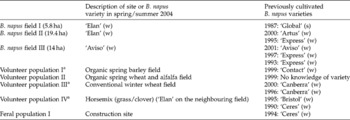
In 2004, from late April to mid-June, leaf material from B. napus plants was collected from three B. napus fields on different farms, plus four volunteer populations and one feral site in Zealand, Denmark (Table 1). In each of the B. napus fields, leaf material from six plants was collected at random from 8 m2 (1 m2 × 8) dispersed over the field (48 plants per field). From the feral and volunteer populations, leaf material from 30 randomly chosen B. napus plants was collected. All collected leaf material was stored at − 80°C until use.
The winter oilseed rape fields and volunteer populations analysed

(w), Winter variety; (s), spring variety.
a Populations where reproductive productivity was estimated.
In three of the volunteer populations (Table 1), these 30 plants were labelled, and pods were collected in July and August for analysis of reproductive productivity (seeds per plant). For calculation of seed production per m2, the number of volunteers m− 2 was calculated by dividing the total number of volunteers by the distribution area of the population. The seeds were separated from the pods by hand, and the numbers of seeds per plant were counted with a Numigral seed counter (Sinar Technology, Newbury, Berkshire, UK).
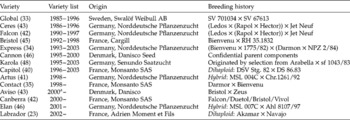
For the assortment of reference varieties from certified seed lots, seeds of the C1 generation from 14 of the varieties most commonly grown from 1985 to 2004 (Table 2) were germinated in the greenhouse. C1 seeds were obtained from the breeders or from The Nordic Gene Bank, Sweden (http://www.ngb.se/). Leaf material of plants at the four-leaf stage was collected from approximately 40 plants (Table 2) per variety.
Description of the reference varieties of B. napus varieties included in the analysis

( ), number of plants in the analysis; / indicates a complex cross.
a Aviso is not on the Danish variety list, but is accepted on the French variety list.
Plants from soil samples
In the B. napus fields, 16 soil cores were taken in each of the 8 m2, giving a total of 128 cores per field, covering 0.040 m2 from each field (volume 0.012 m3). The cores, which were taken before seed shattering, were 2 cm in diameter and separated into two layers; an upper 5 cm ‘germination layer’ and a ‘plough layer’ from 5 to 30 cm depth. To enhance the germination of the dormant seeds, the soil samples were kept cold for 3–4 weeks; thereafter they were poured into shallow trays, gently mixed with potting soil and placed in the greenhouse. To make sure that all seeds had germinated, the soil was mixed again after 3 weeks. After germination, leaf material was collected at the four-leaf stage from the B. napus plants and stored at − 80°C until DNA was extracted.
Field information
To obtain information about the possible sources of volunteer impurities in the analysed fields, the farmers were interviewed about the varieties of B. napus cultivated at the site and the year each was sown (Table 1). As far as the information was available, variety names of other present or previous oilseed rape crops at the farms were also provided (see Discussion). In 2004, there was no other oilseed rape field within a distance of c. 300 m, except for volunteer population IV. For fields I and II, the admission to the field was a farm track, while field III was bounded on one side by a small regional road. Farms I and III had their own agricultural machinery; farm II shared its machinery with other farms.
DNA extraction and ISSR analysis
To DNA-type reference varieties, volunteers and feral plants, DNA profiles were obtained with ISSR (Inter Simple Sequence Repeat) markers. DNA was extracted from leaves by the method described by Doyle and Doyle (Reference Doyle and Doyle1987) with some modifications: leaf samples were powdered in a mixer mill (Merck Retsch mm 300; Retsch, Haan, Germany) with 550 μl of 2 × CTAB [1 w/v hexadecyltrimethyl ammonium bromide, 2 M NaCl, 20 mM EDTA, 100 mM Tris (hydroxymethyl) methylamine, pH 8.0] and 2 μl 2-mercaptoethanol. The samples were incubated at 60°C for 1 h with regular swirling, and extracted with 550 μl chloroform–isoamyl alcohol (24:1), mixed gently for 10 min and centrifuged at 3700 g for 20 min. The upper DNA-containing phase (about 400 μl) was transferred to clean tubes, 4 μl RNase (Ribonuclease A, Merck) was added, and the samples were incubated at 37°C for 1 h. Nucleic acids were precipitated by adding cold 2-propanol (67% final v/v); samples were mixed gently and placed at − 20°C for a minimum of 1 h. Nucleic acids were isolated by centrifugation at 37,000 g for 40 min. Supernatants were removed, and the pellets were allowed to dry at room temperature. Pellets were resuspended in 80 μl of TE-buffer [10 mM Tris (hydroxymethyl) methylamine, 1 mM EDTA, pH 7.6]. The ISSR polymerase chain reaction (PCR) was performed using the procedure described by Charters et al. (Reference Charters, Robertson, Wilkinson and Ramsay1996) with modifications: one unit of Taq DNA polymerase (Promega Corporation, Birkerod, Denmark), 2.0 mM MgCl2 and 10 × buffer A (provided with the enzyme), 0.2 mM of each deoxynucleoside triphosphate (dNTP) (Amersham Biosciences, Amersham, Bucks, UK), 0.3 μM of a single primer (MWG-Biotech Scandinavia A/S, Munich, Germany) and 100 ng of genomic DNA. PCR was performed with the degenerate primers 834 [(AG)7–GYT] (Ma et al., Reference Ma, Fu, Tuevesson and Gertsson2003) and 888 [BDB–(CA)7] (Charters et al., Reference Charters, Robertson, Wilkinson and Ramsay1996). PCR amplifications were performed on a Techne Genius Thermocycler (Buch and Holm A/S, Herlev, Denmark) using the program described by Charters et al. (Reference Charters, Robertson, Wilkinson and Ramsay1996). After PCR, 5 μl formamide loading buffer (bromphenol blue xylem cyanol dye solution, Sigma-Aldrich, Steinheim, Germany) was added to the reaction products, and samples were heated for 5 min at 94°C and then quickly cooled on ice. To 60 ml gel solution [4.5% denaturing polyacrylamide gel (Sambrook et al., Reference Sambrook, Fritsch and Maniatis1989)], 500 μl of 10% APS (ammonium persulphate) and 60 μl TEMED were added, and a gel was cast using 31 × 38.5 cm glass plates. The running buffer was 1 × TBE buffer (Sambrook et al., Reference Sambrook, Fritsch and Maniatis1989). For electrophoresis, 5 μl of each sample was loaded, and electrophoresis was performed at a constant power of 85 W for c. 4 h. After electrophoresis, gels were silver-stained by the method described by Bassam et al. (Reference Bassam, Caetano-Anollés and Gresshoff1991) with modifications: rinsing in water after fixation was done for 2 × 4 min and 1 × 2 min, development was stopped by adding the stop solution to the developing solution (instead of transferring the gel between the two solutions), and the gel was finally rinsed in water 2 × 5 min and left to air dry.
Data analyses
Markers with clear bands within the 200–600 bp range were scored manually as present (1) or absent (0). Estimating the origin of the volunteers and feral plants is only possible if the varieties can be distinguished from each other. Therefore, the scored bands were used for calculating the Simple Matching Coefficient (similarity measure) and transformed to the distance measure, Mean Character Difference (distance = 1–similarity) (De Cáceres et al., Reference De Cáceres, Olivia and Font2003). The genetic dissimilarities between the reference varieties were visualized by a Principal Coordinate Analysis (PCA) with the freeware Gingko (De Cáceres et al., Reference De Cáceres, Olivia and Font2003).
The scored bands were analysed with the computer program AFLPOP 1.1 (Duchesne and Bernatchez, Reference Duchesne and Bernatchez2002a, Reference Duchesne and Bernatchezb) for allocation of dominant markers. AFLPOP was used (1) to re-allocate individual plants of the reference varieties back to the same set of varieties, and (2) to allocate the B. napus plants collected in the oilseed rape fields and in the volunteer and feral populations to the most likely reference variety.
AFLPOP computes the likelihood that each individual derives from each source population on the basis of band frequencies. The reference varieties were regarded as the source populations, and plants from the reference varieties were re-allocated to analyse the extent to which they allocated to their own variety. In the re-allocation procedure, each individual was withdrawn from its source population, and allelic frequencies for the source population were computed again. A loci filtering was performed to remove linked loci before the assignment tests.
For allocation to a given variety, two criteria had to be met:
(1) A certain individual was only allocated to a population when it was 102 times [minimum log likelihood difference (MLD) = 2] more likely to belong to that population than to any other. This stringent criterion prevents the risk of erroneous assignments, but also increases the number of individuals that could not be assigned (since genotypes with a MLD below 2 cannot be allocated).
(2) The probability that the B. napus plant really belonged to that population should not be rejected, P < 0.001 based on a resampling with 1000 artificial individuals generated by AFLPOP.
Results
The numbers of well-separated, reproducible and polymorphic bands were 31 for primer ISSR 888 and 23 for primer ISSR 834, providing a total of 54 loci. For some of the B. napus feral and volunteer field populations, it was not possible to score all 54 bands, and the total number of loci in these fields/populations was 53 in B. napus field III and volunteer population II, 52 in feral population I, 51 in volunteer population III and 49 in B. napus field I. The results of the PCA and re-allocation showed only minor differences when performed with the different number of loci.
Reference varieties
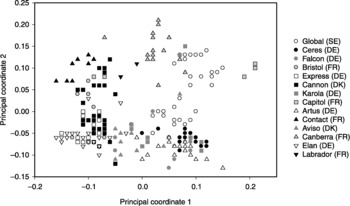
The PCA analysis (Fig. 1) showed a tendency towards clustering in two groups of varieties with French or German origin. Most of the plants from each variety were clustered together, but plants from ‘Capitol’, ‘Aviso’ and ‘Karola’ did not form well-defined groups.
Principal Coordinate Analysis (PCA) showing similarities between the oilseed rape reference varieties. When individuals are identical, only one signature is indicated. SE, Sweden; DE, Germany; FR, France; DK, Denmark.

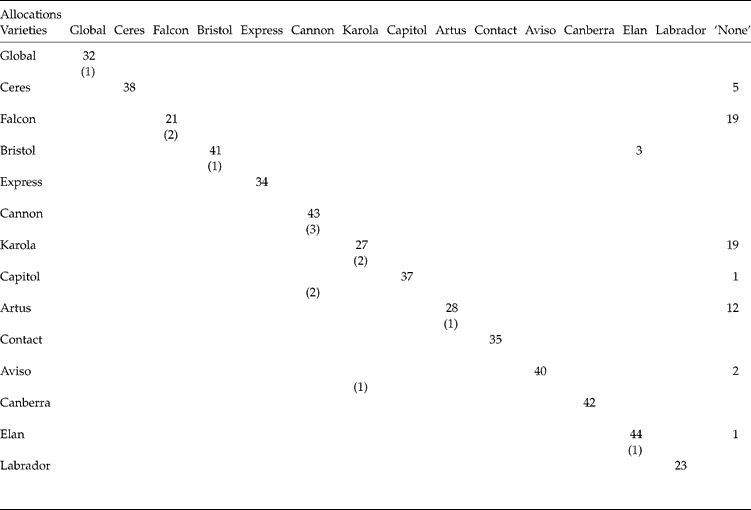
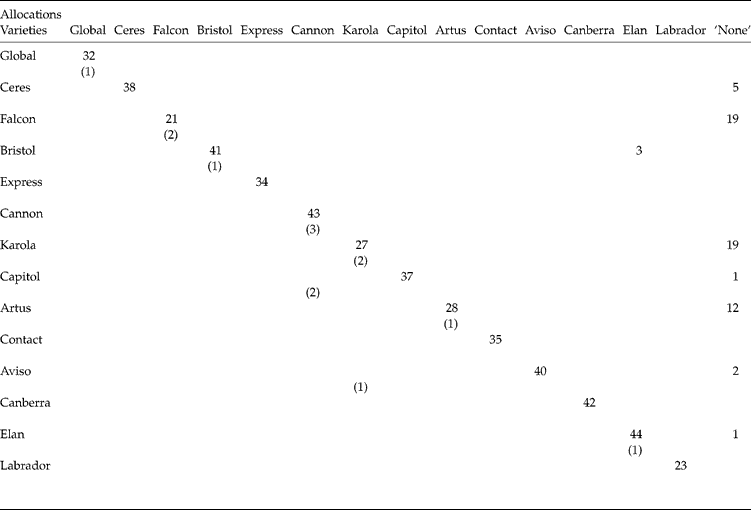
The re-allocation (with 54 loci) of the plants from the reference varieties is shown in Table 3. For four of the varieties, ‘Canberra’, ‘Contact’, ‘Express’ and ‘Labrador’, all individuals were allocated back to the variety of origin. The individuals from ‘Global’ and ‘Cannon’ were most similar to the variety of origin (criterion 1), but a few of them did not meet criterion 2 (indicated by brackets in Table 3), and were therefore significantly different from the variety of origin. For the rest of the varieties, a number of individuals allocated to either another known variety or were closely similar to more than one variety, and therefore they did not allocate to any of the varieties (could not fulfil criterion 1, indicated in the ‘none’ column in Table 3). For ‘Aviso’, ‘Bristol’, ‘Capitol’ and ‘Elan’ between 2 and 8% allocated to other varieties, and for four German varieties, ‘Artus’, ‘Ceres’, ‘Falcon’ and ‘Karola’ between 12 and 45% of the plants were so similar that they could not be allocated to one or the other of these four varieties, and thus allocated to ‘none’.
Re-allocation of individuals from the 14 oilseed rape reference varieties (listed according to age). The number of individuals that allocate back to the varieties of origin (fulfil both criterion 1 and 2, see Materials and methods). The numbers of plants that did not fulfil criterion 1 are shown in the ‘None’ column, and the numbers of plants that did not fulfil criterion 2 are shown in brackets
B. napus fields and feral/volunteer populations
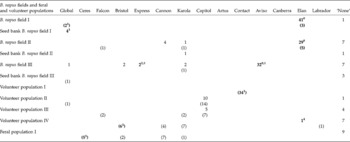
The final number of plants in the B. napus fields and the volunteer and feral populations were reduced by some individuals due to failed DNA extraction. Table 4 shows the allocations of the individuals from the three B. napus fields, from the volunteer and feral populations, and from the seedlings germinated from the soil samples. The allocation of plants from the three B. napus fields shows that most of the individuals allocated to the variety cultivated in the field in the year of collection (2004) (varieties previously grown are indicated by superscripts in Table 4). For the three B. napus fields at least three (field I), 14 (field II) and 15 (field III) of the plants could not be allocated to the variety in the field. This gives a frequency of volunteers between 6 and 32%. Some of these plants could be allocated to a variety cultivated earlier at the site. For example, in B. napus field III, two of the plants allocated to a variety (‘Express’) cultivated seven and 11 years earlier (1997 and 1993). Other plants were allocated to varieties not cultivated previously at the site, and their age could tentatively be determined from the time period the cultivar had been on the variety list. In both B. napus fields II and III, a number of volunteers were assigned to varieties that entered the variety list 1–19 years earlier.
Results of the allocation of B. napus plants and seeds from the B. napus fields, volunteer and feral populations

Reference varieties are ordered according to age. Numbers in bold indicate that the plants allocated back to previously cultivated varieties at the site.
0Variety cultivated 2004; 1variety from last cultivation; 2variety from second latest cultivation; 3variety from third latest cultivation; 4variety cultivated in the neighbouring field.
In addition, the number of plants that did not fulfil criterion 1 (‘None’) and 2 (shown in brackets) are shown.
The plants from the feral and volunteer populations (Table 4) were less likely to allocate than individuals from the fields. The only plants that allocated were from the varieties ‘Capitol’, in volunteer population II and III, and ‘Elan’ in volunteer population IV. None of the varieties were cultivated earlier on the site, but ‘Elan’ was cultivated on the neighbouring field in 2004. The lack of allocation seen for most of the plants in the volunteer/feral populations could either be because the plants did not belong to the varieties of the reference set (plants with resampling probabilities < 0.001, given in brackets in Table 4), or were due to similarities between more than one of the varieties (‘none’ in Table 4). The last alternative is partly due to similarities between the four German varieties (‘Artus’, ‘Ceres’, ‘Falcon’ and ‘Karola’) seen in the re-allocation of the varieties in the reference set. It cannot be ruled out that some of the non-allocations were hybrids between varieties. Hybrids might be identified, if both parental varieties were included in the reference set, as the MLD (from AFLPOP) between the hybrid and one and the other parental variety would be the same. This did not seem to be the case in our material.
Seedlings from soil samples
Ten oilseed rape seeds germinated from the soil samples (Table 4), viz. four plants from B. napus field I, two from B. napus field II and four from B. napus field III. From B. napus field I, the four seeds that germinated came from the deeper soil layer and allocated to ‘Global’ (on variety list 1985–1996) cultivated in the field 17 years earlier. From B. napus field II, one allocated to ‘Karola’ (on variety list 1995–2003), and one could not be allocated; both came from the plough layer. The last four seeds from B. napus field III could not be allocated with certainty to any of the varieties of the reference set; three were from the upper layer and one from the plough layer. On the basis of the 128 soil cores from each field, the soil seed-bank is tentatively estimated to a total of 50–100 seeds m− 2 (167–333 seeds m− 3).
Reproductive productivity
Pods and seeds were collected from three volunteer populations, and the number of seeds per plant and seeds m− 2 were measured. The average seed per plant and standard deviation (SD) were for volunteer population I, 95 (80); volunteer population III, 335 (294): and for volunteer population IV, 840 (772). For the three populations, values of 95, 1340 and 2520 seeds m− 2, respectively, were found.
Discussion
The results indicate that it was possible to separate the varieties with ISSR markers and estimate their purity in most cases. Varieties were also established for some of the volunteers, and age of seeds could thus be tentatively assumed, based on the information for previously cultivated varieties at the sites, or from the list of marketing periods of the varieties.
Varietal purity
Our results show that three of the certified seed lots (‘Aviso’, ‘Bristol’ and ‘Capitol’) were less pure than anticipated from the current seed propagation procedure. In these three varieties, the presence of other varieties was 7–8%, which is higher than the allowed adventitious presence ( < 0.03% for food and < 1% for feed). ‘Elan’ had 2% presence of other varieties, which is within the allowed range ( < 10%) in a hybrid variety.
Two criteria had to be met for both re-allocation and allocation: (1) a certain plant had to be 100 times more likely to belong to one variety than to any other; and (2) the probability that the plant did belong to the variety should not be rejected. Many of the individuals in ‘Artus’, ‘Ceres’, ‘Falcon’ and ‘Karola’ were so similar to each other that criterion 1 could not be fulfilled (those plants listed as ‘none’ in Table 3). ‘Artus’, ‘Ceres’ and ‘Falcon’ share the same genetic background (A. Jensen, Pajbjerg A/S, DK and M. Greve, DLF, Store Hedinge, DK, personal communications), while ‘Falcon’ and ‘Ceres’ are sister lines (Table 2), and ‘Falcon’ is the basis for the mother line of ‘Artus’. These heritage features could explain the similarities and the difficulties in separating the varieties in the re-allocation. The similarity with ‘Karola’ is not easily solved, but as they all are German varieties, they could be related.
Volunteer origin and turnover time of volunteer populations
The difficulties in separating ‘Artus’, ‘Ceres’, ‘Falcon’ and ‘Karola’ also influenced the allocation of the volunteers. From all the sites analysed, except in volunteer population IV and feral population I, most of the allocations that did not fulfil criterion 1 (listed as ‘none’ in Table 4) were due to similarity between the four varieties (data not shown). ‘Artus’, ‘Ceres’ and ‘Falcon’ have all together been on the variety list from 1986 until 2004. Further analyses with markers that can distinguish among these varieties are necessary, if we want to determine the origin of volunteers belonging to the four varieties. The rest of the allocations not fulfilling criterion 1 were due to similarity between all or a group of varieties in the analysis, and not just between two possible parents of a hybrid.
Our results suggest that volunteer populations can be long lived. The finding of viable ‘Global’ seeds from the seed bank of B. napus field I (Table 4) cultivated 17 years earlier, suggests long seed persistence. The seeds were from the deeper soil layer, and other studies have confirmed that dormancy is best preserved here, due to darkness and less disturbance (Lutman et al., Reference Lutman, Freeman and Pekrun2003). In B. napus field III, some of the volunteers allocated to a variety, ‘Express’, cultivated 7 and 11 years earlier (Table 4). In the same field, ‘Aviso’ was cultivated both in 2004 and 2001; so potentially some of the ‘Aviso’ plants could be volunteers from the cultivation 3 years earlier.
For volunteers belonging to varieties not cultivated previously on the site, the age of the volunteer population was assumed from the time period that the variety was on the variety list. In both B. napus fields II and III, a number of volunteers allocated to varieties that entered the variety list 1–19 years earlier. These volunteers could have been derived from seeds preserved in the soil seed-bank since their introduction in the field. However, volunteer populations could also have propagated and added new seeds to the seed bank after their first introduction on the spot.
Pinpointing the source of volunteers in fields I–III is difficult. We have assumed that volunteers were mostly derived from seeds spilled during previous cultivation of oilseed rape, but in this respect our study has obvious limitations. The certified seed lots sown in fields I–III were not obtained and thus not analysed as to their purity, nor do we know if seeds of other varieties were transferred to the field by agricultural machinery. Based on our observations and findings, as well as information from farmers, we can develop hypotheses about volunteer origin. For field I (6% volunteers), one volunteer source seems rather obvious: seeds and a volunteer were assigned to the variety ‘Global’ grown there 17 years ago. ‘Global’ was taken off the variety list 8 years before we collected plant material for analysis. This farm did not share machinery with other farms and only used certified seeds. The viable seeds of ‘Global’ were found in the deeper layers of the soil seed-bank of this field. For field II (29% volunteers), many more volunteer sources seemed to have been in play: this farm shared machinery with two other farms (the three farms tried to use the same varieties), and in addition, the farmer occasionally mixed the seeds left from the previous year with new certified seeds. These sources may explain the high frequency of volunteers in this field. As to field III (32% volunteers), the farmer had his own machinery and claimed that the varieties, ‘Global’, ‘Bristol’, ‘Express’ and ‘Karola’, found as volunteers in his fields, were not cultivated on his land for the past 7 years; he only used certified seeds. Therefore, it is likely that these volunteers derived from the soil seed-bank, although some volunteers might have been derived from spillage of seeds along the small road next to the field, as has been reported in other studies (Crawley and Brown, Reference Crawley and Brown1995; Pessel et al., Reference Pessel, Lecomte, Emeriau, Krouti, Messean and Gouyon2001).
In order to limit the presence of other varieties germinating from the seed bank, the cropping interval for propagation of certified seeds is 6 years. However, in the present study, survival of oilseed rape seeds in the seed bank was suggested to be up to 17 years, and other studies have shown survival between 5 and 10 years (Pessel et al., Reference Pessel, Lecomte, Emeriau, Krouti, Messean and Gouyon2001; Simard et al., Reference Simard, Légère, Pageau, Lajeunesse and Warwick2002). The EU-threshold value of GM in non-GM seed lots has not yet been set, but will be well below the EU-threshold of 0.9% (European Commission, 2003) for adventitious presence of GM in non-GM food. The 0.9% threshold was exceeded in the scenario observed in the B. napus fields. The frequencies of plants that belonged to varieties other than the ones cultivated in the three oilseed rape fields in 2004 were 6, 29 and 32%, respectively. These percentages are quite high considering the crop rotation practice (Table 1), but are in agreement with former predictions based on seed losses, seed survival and seedling emergence: Lutman et al. (Reference Lutman, Freeman and Pekrun2003) predicted 6–15 volunteers m− 2 in the next crop of oilseed rape, 4 years after the last oilseed rape crop. If these 6–15 volunteers m− 2 produce as many seeds as the crop plants, they would result in approximately 8–20% adventitious presence in the harvested seed at a crop density of 75 plants m− 2 (60–90 plants m− 2 is the recommended density). A recent Danish study (Damgaard et al., Reference Damgaard, Kjellsson and Haldrup2006) predicted the routes that would be most important for the adventitious presence of GM in a non-GM harvest. It was assumed that surviving seeds (volunteers) from the seed bank were the major source of GM admixture.
The new national coexistence regulations, aimed at ensuring low levels of GM in the non-GM harvest, are based to some extent on knowledge obtained from propagation of conventional varieties. Even though Denmark suggests that the cropping interval for both propagation of certified seeds and production should be raised to 8 years between GM and conventional crops, and 12 years between GM and organic crops, our results indicate that these cropping intervals may not always be sufficient to prevent dispersal of transgenes above the threshold level. However, other mitigating measures will also be invoked in a GM scenario. To what extent these measures would be sufficient to reduce adventitious presence to values below threshold is as yet unknown.
For most of the volunteer populations outside oilseed rape fields and the feral population, the plants could not be allocated with statistical certainty. It is worth noting that for most of the populations, the plants allocated to many different varieties, which could be an indication that several sources of admixture contributed. Only some volunteers in populations II and III fulfilled both criteria for successful allocation, and allocated to the dihaploid variety ‘Capitol’, which was on the variety list between 1996 and 2003. Volunteer population III and feral population I were located at the edge of the fields near main roads, and these populations could have originated from seeds lost during the transportation of oilseed rape seeds on open trucks (Crawley and Brown, Reference Crawley and Brown1995; Pessel et al., Reference Pessel, Lecomte, Emeriau, Krouti, Messean and Gouyon2001). For feral population I, seeds transported with soil to the construction site could be another possible source of origin.
A reason why the volunteers and feral plants did not allocate could be that the reference set was not sufficiently large, or an indication of the presence of hybrids or lack of random mating populations [Duchesne and Bernatchez (Reference Duchesne and Bernatchez2002b, AFLPOP program file)]. The oilseed rape cultivated in the B. napus fields in 2004 were from certified seeds, and therefore, have the same genotype and generation as the reference varieties, which was also reflected in the correct allocation of almost all the plants. The volunteers, on the other hand, were at least from the next generation, compared to the cultivated variety from which they were lost. Potentially, some of these volunteers could be hybrids due to pollen dispersal from other varieties cultivated in nearby fields or from other volunteers (Tolstrup et al., Reference Tolstrup, Andersen, Boelt, Buss, Gylling, Holm, Kjellsson, Pedersen, Østergård and Mikkelsen2003). The oilseed rape reference varieties (the 14 source populations that individuals are allocated to) most likely differed in genotype distribution and were not in Hardy–Weinberg equilibrium, as traditional open-pollinated varieties arise from 10–30% outcrossing (Becker et al., Reference Becker, Damgaard and Karlsson1992), whereas modern F1 hybrid varieties are produced by 100% outcrossing between male sterile seed lines and male fertile pollen donor lines. However, this does not seem to affect our allocations, as indicated by the re-allocation of the reference varieties, where almost all individuals allocated to their own variety. The ones that did not allocate were due to the known close relationship between the German varieties ‘Artus’, ‘Ceres’, ‘Falcon’ and ‘Karola’.
Reproductive productivity
The large variation found in average seeds per plant could be due to different plant competition at the three sites or to other factors in the agricultural practice. It is a general assumption that volunteers germinating in a spring crop will not be able to set seeds, as the growing season is too short (Tolstrup et al., Reference Tolstrup, Andersen, Boelt, Buss, Gylling, Holm, Kjellsson, Pedersen, Østergård and Mikkelsen2003). The volunteers that germinated in the organic spring barley field (volunteer population II) were indeed small, but were still able to set some seeds. Therefore, the spring variety is a possible explanation of the fewer seeds per plant, compared to volunteers in the winter wheat field. If the variation in the amount of seeds per plant was due to competition between the volunteers and the other plants at the site, one should expect the fewest seeds per plant in the grass field (volunteer population IV), where the competition from perennials would be intense. The presence of large volunteers, with a high number of seeds per plant, in the grass field was unexpected, because, to enable them to establish, oilseed rape seeds normally need competition-free gaps (Warwick et al., Reference Warwick, Beckie and Small1999). However, the plant cover in this field was rather loose. The seed production of the volunteers, expressed as the amount of seeds per plant, can be fed into models (e.g. GENESYS by Colbach et al., Reference Colbach, Clermont-Dauphin and Meynard2001a, Reference Colbach, Clermont-Dauphin and Meynardb) for calculating adventitious presence.
The soil seed-bank could influence the purity of seed lots over time. The estimated number of 50–100 seeds m− 2 in the soil seed-bank could be either an over- or underestimate due to local distribution of seeds within the fields. As the soil cores were taken in the year when oilseed rape was cultivated (and before seed shatter), it is likely that the seed bank would be rather depleted, and thus the 50–100 seeds m− 2 represented the minimum within the rotation period.
Conclusion
The relatively high frequencies of impurities that we found in both the certified seeds and in oilseed rape fields, together with the presumed long-term survival of seeds and a high degree of volunteers with an unknown origin, urge cautious cultivation of GM oilseed rape. As it is assumed that most GM oilseed rape will have life-cycle parameters comparable to conventional oilseed rape, it may be difficult to ensure GM content below the allowed threshold values for adventitious presence given by the coexistence regulations. However, to what extent our findings represent a general Danish scenario is not known. Even though our findings correspond well with previous predictions based on single parameters in the production of volunteers, we only analysed a limited number of accessions and plants. The results from the present study have prompted a larger Danish study on the topic.
There are ways to minimize the high frequency of volunteers, e.g. GM volunteers:
(1) The certified seed lots must have a low frequency of impurities. To guarantee this, DNA markers are necessary, since the use of morphological markers is apparently not sufficient and will not apply to most GM lines. Control of certified seeds, especially from countries with cultivation of GM oilseed rape, is thus very important for coexistence. In 2000, seeds of GM oilseed rape were detected in conventional seed lots imported from Canada, following which the EU introduced an action plan for inspection of seed lots from countries outside the EU (Tolstrup et al., Reference Tolstrup, Andersen, Boelt, Buss, Gylling, Holm, Kjellsson, Pedersen, Østergård and Mikkelsen2003).
(2) The amount of seeds incorporated into the seed bank should be minimized. As already mentioned, oilseed rape plants shed a lot of seeds before and during harvest, and if these seeds are incorporated in the soil, they have the potential to persist. A way to prevent this is to allow the seeds to germinate on the soil surface after harvest, since the more seeds that germinate, the fewer will be incorporated into the seed bank.
(3) In a future scenario with GM oilseed rape, it is not advised to use the same combines, lorries, storage rooms, etc. for GM, conventional and organic production, unless careful cleaning is performed.
(4) Pollen flow should be minimized by isolation distances.
(5) A future goal could also be to focus breeding on varieties with a genetically low affinity for secondary dormancy and survival.
Acknowledgements
Thanks to Bente Anni Andersen for help in the laboratory and to consultant Morten Nygaard (Landbocentrum) for providing contacts to the farmers. This study was carried out within the framework of, and with funding from, the EU project SIGMEA (http://sigmea.dyndns.org). Special thanks to the farmers who gave us access to their property.