Introduction
The incidence of psychotic disorders is increased in many immigrant groups around the world (Bourque et al. Reference Bourque, van der Ven and Malla2011). The most elevated risk has been found for African-Caribbeans and Black Africans in the UK (Coid et al. Reference Coid, Kirkbride, Barker, Cowden, Stamps, Yang and Jones2008) and for Moroccans in The Netherlands (Veling et al. Reference Veling, Selten, Veen, Laan, Blom and Hoek2006). The high risk seems context specific; it depends on social characteristics related to the country of origin and the host country. Associations have been reported between risk for psychotic disorders and factors within the broader social context in which ethnic minorities live after migration, such as a low social status, experiences of discrimination and poorer access to social support (Veling & Susser, Reference Veling and Susser2011). A younger age at migration was associated with a higher risk for psychotic disorders among immigrants (Veling et al. Reference Veling, Hoek, Selten and Susser2011), and the risk is increased for immigrants’ children as well (Bourque et al. Reference Bourque, van der Ven and Malla2011). These findings suggest that adverse social circumstances during early life increase vulnerability to adult psychotic disorders in ethnic minorities (Cannon & Clarke, Reference Cannon and Clarke2005; Morgan et al. Reference Morgan, Charalambides, Hutchinson and Murray2010; van Os et al. Reference van Os, Kenis and Rutten2010; Veling & Susser, Reference Veling and Susser2011).
Children who have psychotic experiences (PE), such as subclinical delusional and hallucinatory experiences, are at higher risk to develop psychotic disorders later in life (Poulton et al. Reference Poulton, Caspi, Moffitt, Cannon, Murray and Harrington2000; Welham et al. Reference Welham, Scott, Williams, Najman, Bor, O'Callaghan and McGrath2009; Zammit et al. Reference Zammit, Kounali, Cannon, David, Gunnell, Heron, Jones, Lewis, Sullivan, Wolke and Lewis2013). If PE in childhood are predictive of adult psychotic disorders and the increased risk for psychotic disorders among ethnic minorities develops in early life in interaction with social adversity, the distribution of PE should already be shifted towards a higher prevalence of PE in ethnic minority children and adolescents (Collip et al. Reference Collip, Myin-Germeys and van Os2008; van Os et al. Reference van Os, Linscott, Myin-Germeys, Delespaul and Krabbendam2009) and these PE should be associated with experiences of social adversity. There are few studies that have investigated ethnic differences in PE among children and adolescents in the general population. A longitudinal study in The Netherlands reported that non-Dutch adolescents had a higher risk of persistent PE than Dutch adolescents (Wigman et al. Reference Wigman, van Winkel, Raaijmakers, Ormel, Verhulst, Reijneveld, van Os and Vollebergh2011). Persistent PE were associated with childhood trauma, cannabis use and psychiatric problems. In the UK, African-Caribbean children had higher rates of PE than white British children (Laurens et al. Reference Laurens, West, Murray and Hodgins2008). That study was relatively small and did not explore associations of PE with experiences of social adversity. Neither study took cultural context into account, which is important because PE may fit the cultural or religious context in some non-Western cultures. For example, hallucinatory experiences or beliefs such as in the existence and possession of spirits, considered psychotic-like in Western culture, reflect cultural or religious beliefs in some cultures or religions (Blom et al. Reference Blom, Eker, Basalan, Aouaj and Hoek2010; Zandi et al. Reference Zandi, Havenaar, Smits, Limburg-Okken, van Es, Cahn, Algra, Kahn and van den Brink2010). Therefore, interpretation of the pathological significance of PE is more complicated in ethnic minorities (Vanheusden et al. Reference Vanheusden, Mulder, van der Ende, Selten, van Lenthe, Verhulst and Mackenbach2008).
PE are common in childhood and adolescence and in most cases transient and not pathological (van Os et al. Reference van Os, Linscott, Myin-Germeys, Delespaul and Krabbendam2009; Kelleher et al. Reference Kelleher, Connor, Clarke, Devlin, Harley and Cannon2012a ; Linscott & van Os, Reference Linscott and van Os2013). Additional measures are needed to increase the clinical significance and predictive value of PE in youth (Fusar-Poli et al. Reference Fusar-Poli, Yung, McGorry and van Os2014). Distress and functional impairment (from here: impact) of symptoms is used to determine the boundary between normality and ultra high risk for psychosis among (young) adults with subclinical psychotic symptoms (McGorry et al. Reference McGorry, Nelson, Goldstone and Yung2010). Such indicators are less routinely used in research of self-reported PE in children and adolescents but the available evidence shows that distress is strongly associated with the persistence of PE (Wigman et al. Reference Wigman, van Winkel, Raaijmakers, Ormel, Verhulst, Reijneveld, van Os and Vollebergh2011) and distinguishes clinical from non-clinical groups with PE (Lovatt et al. Reference Lovatt, Mason, Brett and Peters2010).
The present study examined the prevalence and impact of PE in a large community sample of ethnic minority and majority youth in The Netherlands, as well as the cultural context of these experiences and associations with other psychiatric symptoms and social adversity.
Methods
Participants
As the risk for psychotic disorders is highest among Moroccan immigrants in The Netherlands (Veling et al. Reference Veling, Selten, Veen, Laan, Blom and Hoek2006), this study was particularly aimed at Moroccan immigrant youth. A list was made of urban and rural districts in The Netherlands with corresponding percentages of Moroccan-Dutch inhabitants. We approached primary and secondary schools both in districts with small and large Moroccan-Dutch populations (range 1.9–9.2%), because the aim was to include a large sample of ethnic minority youths living in different social contexts; 78.2% of schools participated. Eight primary and ten secondary schools with various educational levels were included in the Dutch provinces of North Holland, South Holland, Utrecht, Gelderland, North Brabant and Limburg. Years 6–8 of primary schools (9- to 12-year-olds) and years 1–3 of secondary schools (12- to 15-year-olds) were included. The overall participation rate was 85.7% of the school students eligible for the study. Seven per cent were absent on the day of the survey, 6.3% did not have permission from their parents or caregivers to participate and 1.0% refused participation. The total sample consisted of 1563 participants. A few children (n = 18) did not complete the questionnaire, resulting in a total sample for analysis of 1545 participants. Teachers completed a questionnaire on 91.3% of the participating children (n = 1411, see section Instruments; ‘other psychiatric symptoms’).
Ethical Standards
The authors assert that all procedures contributing to this work comply with the ethical standards of the relevant national and institutional committees on human experimentation and with the Helsinki Declaration of 1975, as revised in 2008.
Classification of ethnicity
Based on the child's and parents’ countries of birth reported by the children and using the definitions of Statistics Netherlands, children were categorized as Dutch when both parents were born in The Netherlands. Children were categorized as ethnic minority when they (first-generation migrant) or one or both parents (second-generation migrant) were born in a foreign country. In case of parents with two different foreign countries of birth, the mother's country of birth was used to define the child's ethnic group. For this study, Moroccan-Dutch and Turkish-Dutch groups could be studied separately. The remaining minority children were classified as originating from other low- and middle-income countries (LMIC-Dutch) and other high-income countries (HIC-Dutch) according to the World Bank income groups (World Bank, 2012).
Procedure
Data was collected from June 2009 to April 2010. The medical ethics committee (METC) of the VU Medical Centre approved the study plan. After receiving approval from school administrators, pupils and their parents received an envelope including a letter of introduction, a description of the study and a passive informed consent form. Parents or primary caregivers had the option to decline participation of their children. Students had the option to decline at the time the survey was administered. Students completed the web-based survey during a regular school day. A trained research assistant introduced the study and at least two research assistants were available in the classroom to answer the children's questions during administration. To protect the confidentiality of the responses, children completed the questionnaires using a unique identification number. Only research team members had access to the electronic data. Teachers were not involved in the actual administration and completed paper questionnaires (see section Instruments; ‘other psychiatric symptoms’).
Instruments
PE, impact and cultural context
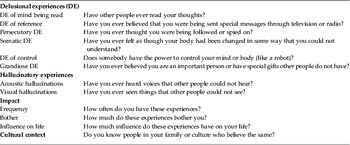
The presence of PE was assessed by eight items adapted for use in a self-report setting from the Kiddie-Schedule for Affective Disorders and Schizophrenia (K-SADS; Kaufman et al. Reference Kaufman, Birmaher, Brent, Rao, Flynn, Moreci, Williamson and Ryan1997). These items show high resemblance to items derived from the Diagnostic Interview Schedule for Children (DISC-C; Shaffer et al. Reference Shaffer, Fisher, Dulcan, Davies, Piacentini, Schwab-Stone, Lahey, Bourdon, Jensen, Bird, Canino and Regier1996), which were predictive of adult schizophreniform disorder (Poulton et al. Reference Poulton, Caspi, Moffitt, Cannon, Murray and Harrington2000). Six items were used to assess delusional experiences (DE) and two items assessed hallucinatory experiences (HE) (Table 1). Responses were made on a three-point scale: 0 – not true, 1 – yes, likely and 2 – yes, definitely. Only children who obtained a score of 2 (yes, definitely) on one of the PE entered the symptom present group.
Items used to assess psychotic experiences, impact and cultural context

To measure the impact of PE four additional questions (see last four items in Table 1) were administered for both DE and HE after a score of 1 (yes, likely) or 2 (yes, definitely). Children who scored very often on frequency (possible responses: 0 – seldom, 1 – sometimes, 2 – regularly, 3 – very often) or very on ‘bother’ or ‘influence on life’ (possible responses: 0 – not at all, 1 – slightly, 2 – quite, 3 – very) were considered to experience high impact of their symptoms. Furthermore, a question for both DE and HE was added to assess the cultural context of the PE: ‘Do you know people in your family or culture who believe the same?’ (Table 1, possible responses: 0 – no, 1 – yes).
Other psychiatric symptoms and social adversity
Psychiatric problems were measured by the Strengths and Difficulties Questionnaire (SDQ) self-report and teacher-report versions (Goodman, Reference Goodman1997). A total difficulties score is generated by summing the scores on four subscales: conduct problems, hyperactivity, emotional symptoms and peer problems (20 items, range 0–40). Cronbach's alphas were acceptable for the self-report (all participants 0.73, ethnic minority youth 0.72) and good for the teacher report (all participants 0.86, ethnic minority youth 0.85), confirming internal reliability.
As indicators of social adversity, measures of family socioeconomic status (SES), trauma experiences and perceived discrimination were available. Family SES was assessed with the Family Affluence Scale (FAS; Currie et al. Reference Currie, Molcho, Boyce, Holstein, Torsheim and Richter2008). The scale consists of four questions about material comforts children are likely to know about in their families (car, bedrooms, vacations, computers). A total FAS score is calculated by summing the responses to these four items (range 0–9). Trauma was measured by six items derived from the PTSD section of the DISC-C. When children responded positively to one of the trauma items, an additional question was administered: ‘Did you often think of this event during the past month?’ Children who had experienced a traumatic event and reported having thought often about it during the past month, were classified as trauma positive. Subsequently, the number of positive trauma items with positive responses to the additional question was summed (range 0–6). Perceived discrimination was measured by three items from the Discrimination Questionnaire assessing whether children perceived personal discrimination based on skin colour, origin or religion during the past year (Stevens et al. Reference Stevens, Vollebergh, Pels and Crijnen2005). Children answering ‘yes’ to one of these items were classified as having experienced discrimination. Details on the prevalence of psychiatric problems and several indicators of social adversity are available elsewhere (Adriaanse et al. Reference Adriaanse, Veling, Doreleijers and van Domburgh2014).
Statistical analysis
Analyses were performed using SPSS version 20.0 (SPSS Inc., USA). The sociodemographic characteristics of the sample were described for each ethnic group. Ethnic differences were tested using χ 2 tests and independent samples t tests.
The prevalence of children experiencing at least one PE and the prevalence of children experiencing at least one PE with high impact were calculated in two age groups, in first- and second-generation migrants and in all ethnic groups. Additionally, the proportion of youth with at least one PE who reported high impact and the prevalence of each PE separately were calculated in all ethnic groups. It was tested whether younger children had higher prevalence's of PE than older children using logistic regressions adjusting for ethnicity. It was tested whether there were no differences in the prevalence of PE between first- and second-generation migrants using logistic regressions adjusting for age and ethnicity. Differences between each ethnic minority group relative to the Dutch group were examined using logistic regressions adjusting for age. To account for possible bias based on differences in IQ, we controlled ethnic differences in the older age group for school level.
To account for cultural context additional analyses were performed. We tested whether differences in PE with high impact between ethnic groups persisted (a) leaving out a PE that could reflect cultural or religious beliefs and (b) adjusting for the indicator of cultural context. We left the DE of control out because in some religions and cultures it is believed a higher power influences human life and people can be possessed by spirits (Blom et al. Reference Blom, Eker, Basalan, Aouaj and Hoek2010). We adjusted for the indicator of cultural context by entering this variable in a logistic regression analysis with ethnicity as independent variable and high impact as dependent variable in children reporting at least one PE.
Finally, logistic regression analyses were used to test if PE with high impact among ethnic minority youth were associated with other psychiatric symptoms and social adversity. Sex and age were used as covariates. Testing interaction for ethnicity examined whether these associations were different among majority youth.
Results
Sociodemographic characteristics
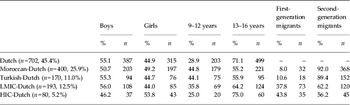
Boys and girls were almost equally represented in all ethnic groups (53.7% boys, 46.3% girls in the total sample) (Table 2). Because the proportion of Moroccan-Dutch and Turkish-Dutch youth was higher in primary schools than in secondary schools, their mean age was lower compared to that in Dutch youth (Moroccan-Dutch: t=−4.32, p < 0.001; Turkish-Dutch: t=−2.48, p = 0.013). There were no significant age differences between Dutch and LMIC-Dutch and HIC-Dutch children. Moroccan-Dutch and Turkish-Dutch youth were usually second-generation migrants, whereas children from the LMIC-Dutch or HIC-Dutch groups were a mix of first- and second-generation migrants (χ 2 = 114.89, p < 0.001).
Sociodemographic data of the sample

LMIC, Low- and middle-income countries; HIC, High-income countries.
Almost a third (29.0%) of the students attended primary schools. Of the secondary school students (71.0%), 49.8% followed lower secondary vocational education (VMBO) and 50.2% followed a higher educational track (MAVO, HAVO or VWO). There was an overrepresentation of Moroccan-Dutch (56.1%), Turkish-Dutch (70.8%), LMIC-Dutch (50.4%) and HIC-Dutch (64.5%) youth following VMBO compared to Dutch (42.0%) youths [χ 2(df = 2) = 28.54, p < 0.001].
PE and impact
The prevalence of PE decreased with age; 45.8% of children in the younger age group (9–12 years) reported at least one PE compared with 31.4% of children in the older age group (13–16 years) (OR 0.6, 95% CI 0.4–0.7); 9.3% of the younger age group and 4.2% of the older age group reported at least one PE with high impact (OR 0.5, 95% CI 0.3–0.7). There were no differences in the prevalence of PE with or without high impact between first- and second-generation migrants.
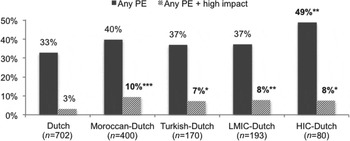
As shown in Fig. 1, the prevalence of at least one PE varied between 33 and 49% across ethnic groups. When impact was taken into account, ethnic minority youth were 2–3 times more likely to report at least one PE with high impact than Dutch youth (Moroccan-Dutch: OR 3.0, 95% CI 1.7–5.1; Turkish-Dutch: OR 2.2, 95% CI 1.1–4.6; LMIC-Dutch: OR 2.6, 95% CI 1.3–5.1; HIC-Dutch: OR 2.6, 95% CI 1.0–6.6). A similar ethnic distribution of PE was seen within the two age groups (online Supplementary Table S1). Controlling for school level did not change statistical significance of ethnic differences in the older age group.
Prevalence of at least one psychotic experience (PE) without and with high impact in Moroccan-Dutch, Turkish-Dutch, LMIC-Dutch and HIC-Dutch youth compared to Dutch youth (all analyses were adjusted for age). LMIC, Low- and middle-income countries; HIC, High-income countries. * p < 0.05, ** p < 0.01, *** p < 0.001.

Among children reporting at least one PE (n = 564), 9.5% of Dutch and 23.9%, 19.0%, 20.8% and 15.4% of Moroccan-Dutch, Turkish-Dutch, LMIC-Dutch and HIC-Dutch youth, respectively, reported having experienced high impact. Differences between Dutch youth and Moroccan-Dutch, Turkish-Dutch and LMIC-Dutch youth were statistically significant (Moroccan-Dutch: OR 2.9, 95% CI 1.6–5.1; Turkish-Dutch: OR 2.2, 95% CI 1.0–4.7; LMIC-Dutch: OR 2.5, 95% CI 1.2–5.2).
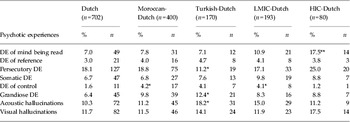
Moroccan-Dutch children were more likely to report a DE of control (OR 2.7, 95% CI 1.2–5.8) (Table 3). Turkish-Dutch youth more often reported a grandiose DE or acoustic HE (grandiose DE: OR 1.9, 95% CI 1.1–3.4; acoustic hallucinations: OR 1.8, 95% CI 1.1–2.9). They were, however, less likely to report a persecutory DE (OR 0.5, 95% CI 0.3–0.9). LMIC-Dutch youth were more likely to report a DE of control (OR 2.7, 95% CI 1.1–6.8) and HIC-Dutch youth were more likely to report a DE of the mind being read (OR 2.8, 95% CI 1.5–5.3).
Prevalence of various psychotic experiences in Moroccan-Dutch, Turkish-Dutch, LMIC-Dutch and HIC-Dutch youth compared to Dutch youth a

LMIC, Low- and middle-income countries; HIC, High-income countries; DE, delusional experiences.
a All analyses were adjusted for age.
* p < 0.05, ** p < 0.01.
Cultural context
To account for cultural context we tested whether differences in PE with high impact among ethnic groups persisted leaving out a PE that could reflect cultural or religious beliefs. When leaving the DE of control out, 3.1% of Dutch youth and 9.2%, 7.1%, 7.3% and 7.5% of Moroccan-Dutch, Turkish-Dutch, LMIC-Dutch and HIC-Dutch children, respectively, still experienced at least one PE with high impact. All differences between Dutch and ethnic minority youth remained statistically significant.
Regardless of ethnical background, the majority of children reporting at least one PE reported knowing somebody in their family or culture that believed in the same (psychotic) experiences; 48.1% of Dutch and 64.8%, 73.0%, 52.8% and 56.4% of Moroccan-Dutch, Turkish-Dutch, LMIC-Dutch and HIC-Dutch youth, respectively, responded positively. Moroccan-Dutch and Turkish-Dutch youth were more likely to report this indicator of cultural context than Dutch youth (Moroccan-Dutch: OR 1.9, 95% CI 1.3–2.9; Turkish-Dutch: OR 2.9, 95% CI 1.5–5.3). When entered into a logistic regression analysis as a control variable with ethnicity as independent variable and high impact as dependent variable in children reporting at least one PE, the difference between Moroccan-Dutch and Dutch youth remained significant and the effect size decreased slightly (OR 2.8, 95% CI 1.6–5.0). The difference in impact between Turkish-Dutch and Dutch children experiencing at least one PE while controlling for cultural context showed a trend (OR 2.0, 95% CI 0.9–4.5).
Associations with other psychiatric symptoms and social adversity
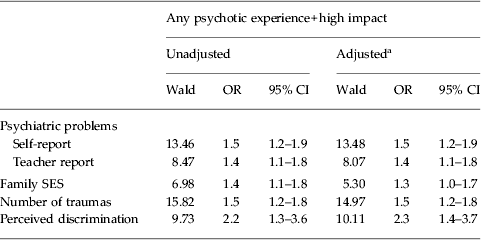
More psychiatric problems, a higher number of trauma and perceived discrimination were associated with the presence of PE with high impact among ethnic minority youth. High family SES was associated with more PE (Table 4). There were no interaction effects for ethnicity.
Associations between risk factors and psychotic experiences with high impact in ethnic minority youth (n = 843)

OR, Odds ratio; CI, confidence interval; SES, socioeconomic status.
a Associations were adjusted for sex and age.
Discussion
Summary of findings
In this large community sample in The Netherlands, ethnic minority youth reported more PE with high impact than majority youth. Differences between ethnic groups remained after examining measures to account for cultural context. PE with high impact were associated with other psychiatric symptoms, trauma, perceived discrimination and high family SES.
Increased risk among ethnic minorities
Minority children had a two- to threefold higher prevalence of PE with high impact compared to Dutch youth. This is consistent with the hypothesis that the increased vulnerability to developing psychotic disorders in ethnic minorities is already present in childhood (Cannon & Clarke, Reference Cannon and Clarke2005; Morgan et al. Reference Morgan, Charalambides, Hutchinson and Murray2010; van Os et al. Reference van Os, Kenis and Rutten2010; Veling & Susser, Reference Veling and Susser2011) and with previous reports suggesting that PE in childhood are associated with adult psychotic disorder (Poulton et al. Reference Poulton, Caspi, Moffitt, Cannon, Murray and Harrington2000; Welham et al. Reference Welham, Scott, Williams, Najman, Bor, O'Callaghan and McGrath2009; Zammit et al. Reference Zammit, Kounali, Cannon, David, Gunnell, Heron, Jones, Lewis, Sullivan, Wolke and Lewis2013). The most elevated prevalence of PE with high impact was found in Moroccan-Dutch children, which parallels the very high incidence of adult psychotic disorders in this group (Veling et al. Reference Veling, Selten, Veen, Laan, Blom and Hoek2006). Previous Dutch studies have shown a higher risk of persistent PE among non-Dutch than Dutch adolescents (Wigman et al. Reference Wigman, van Winkel, Raaijmakers, Ormel, Verhulst, Reijneveld, van Os and Vollebergh2011), a higher prevalence of self-reported hallucinations among ethnic minorities in a population sample of young adults (Vanheusden et al. Reference Vanheusden, Mulder, van der Ende, Selten, van Lenthe, Verhulst and Mackenbach2008) and a higher risk of psychotic symptoms among children and adolescents with a migration history in tertiary mental healthcare (Patino et al. Reference Patino, Selten, van Engeland, Duyx, Kahn and Burger2005).
Owing to environmental risk factors, normally transient PE may develop and persist at an increased rate, potentially leading to an increased rate of transition to psychotic disorders (Collip et al. Reference Collip, Myin-Germeys and van Os2008; van Os et al. Reference van Os, Linscott, Myin-Germeys, Delespaul and Krabbendam2009). Exposure to a higher level of social adversity originating at a young age (Veling et al. Reference Veling, Hoek, Selten and Susser2011) could hence explain the higher risk for psychosis among ethnic minorities (Selten & Cantor-Graae, Reference Selten and Cantor-Graae2005). As is reflected by the association between PE and a higher family SES, other aspects of the social context than financial resources seem to embody the concept of social adversity in explaining the excess risk for psychosis among ethnic minorities (Veling & Susser, Reference Veling and Susser2011). In this study support was found for perceived discrimination as an important aspect of social adversity among ethnic minorities, which is consistent with previous studies on psychotic disorders (Veling et al. Reference Veling, Selten, Susser, Laan, Mackenbach and Hoek2007).
Higher prevalence of PE among ethnic minorities may reflect cultural or religious differences (Vanheusden et al. Reference Vanheusden, Mulder, van der Ende, Selten, van Lenthe, Verhulst and Mackenbach2008), because PE may fit the cultural or religious context in some non-Western cultures (Blom et al. Reference Blom, Eker, Basalan, Aouaj and Hoek2010; Zandi et al. Reference Zandi, Havenaar, Smits, Limburg-Okken, van Es, Cahn, Algra, Kahn and van den Brink2010). In our study, the majority of Moroccan-Dutch and Turkish-Dutch children with PE reported knowing family or cultural members who had similar experiences. Nearly half of the Dutch children reported this as well and this variable reduced associations between ethnicity and impact of PE only slightly. The finding that (predominantly Muslim) Moroccan-Dutch and Turkish-Dutch youth were more likely to endorse the delusional experience of control item than Dutch youth may reflect that in Islam it is believed that a higher power controls life and that people can be possessed by spirits (Blom et al. Reference Blom, Eker, Basalan, Aouaj and Hoek2010). This is unlikely to explain the results, however, because ethnic differences in prevalence of PE with high impact persisted when this item was removed.
To correspond with the global health literature we classified children originating from countries with insufficient numbers for separate analyses, as minority children from LMIC or HIC. Both groups had increased PE with high impact compared to Dutch youth. Previous incidence studies on psychotic disorders in The Netherlands did not find an elevated risk in immigrants from Western or Westernized countries, which are generally HIC (Veling et al. Reference Veling, Selten, Veen, Laan, Blom and Hoek2006). Interpretation of our results is not straightforward since HIC have very heterogeneous social characteristics and the small numbers make it hard to draw firm conclusions.
Significance of PE
Although PE in childhood are predictive of adult psychotic disorders (Poulton et al. Reference Poulton, Caspi, Moffitt, Cannon, Murray and Harrington2000; Welham et al. Reference Welham, Scott, Williams, Najman, Bor, O'Callaghan and McGrath2009; Zammit et al. Reference Zammit, Kounali, Cannon, David, Gunnell, Heron, Jones, Lewis, Sullivan, Wolke and Lewis2013), such experiences are common in childhood and adolescence and in most cases transient and not pathological (van Os et al. Reference van Os, Linscott, Myin-Germeys, Delespaul and Krabbendam2009; Kelleher et al. Reference Kelleher, Connor, Clarke, Devlin, Harley and Cannon2012a ; Linscott & van Os, Reference Linscott and van Os2013). Studies have used various methods to increase the clinical significance and predictive value of PE. A recent review and meta-analysis of psychotic symptoms in children and adolescents reported an extremely wide prevalence range across studies, with rates of up to 90% (Kelleher et al. Reference Kelleher, Connor, Clarke, Devlin, Harley and Cannon2012a ). The authors restricted their analyses to the item of hearing voices and calculated a median prevalence of 17% among children (aged 9–12 years) and 7.5% among adolescents (aged 13–18 years) (Kelleher et al. Reference Kelleher, Connor, Clarke, Devlin, Harley and Cannon2012a ). Laurens et al. (Reference Laurens, Hodgins, Maughan, Murray, Rutter and Taylor2007) found rates of PE in various ethnic groups between 40% and 70% and followed another strategy by defining a triad of putative schizophrenia antecedents, including developmental delays and high scores of other psychiatric symptoms. Between 0 (South Asian) and 15% (African-Caribbean) of children met these criteria. The experience of at least one PE was very common in our sample as well and decreased with age, in agreement with the findings of two recent systematic reviews and meta-analyses (Kelleher et al. Reference Kelleher, Connor, Clarke, Devlin, Harley and Cannon2012a ; Linscott & van Os, Reference Linscott and van Os2013). Prevalence rates ranged from 33% to 49% across ethnic groups. To increase the significance of our findings, we additionally took impact into account; the prevalence rates were reduced to 3–10%. We think the additional measurement of impact is a valid method to increase the clinical significance and predictive value of PE in youth, because it follows definitions of psychiatric disorders in classification systems such as DSM and ICD, as well as the psychosis continuum hypothesis (van Os et al. Reference van Os, Linscott, Myin-Germeys, Delespaul and Krabbendam2009) and clinical staging models (McGorry et al. Reference McGorry, Nelson, Goldstone and Yung2010), in which severity, distress and impaired functioning distinguish between normality, subclinical symptoms and disorder (Fusar-Poli et al. Reference Fusar-Poli, Yung, McGorry and van Os2014). Additionally, high impact was associated with persisting PE in adolescents (Wigman et al. Reference Wigman, van Winkel, Raaijmakers, Ormel, Verhulst, Reijneveld, van Os and Vollebergh2011) and distinguished a clinical group from a non-clinical group with PE (Lovatt et al. Reference Lovatt, Mason, Brett and Peters2010).
PE may not specifically identify children at risk of psychosis, but of mental health problems in general, as PE were associated with other psychiatric problems. Previous research has shown that childhood psychopathology can precede PE (Scott et al. Reference Scott, Martin, Welham, Bor, Najman, O'Callaghan, Williams, Aird and McGrath2009), persisting PE in childhood are associated with (later) psychopathology (Wigman et al. Reference Wigman, van Winkel, Raaijmakers, Ormel, Verhulst, Reijneveld, van Os and Vollebergh2011; Downs et al. Reference Downs, Cullen, Barragan and Laurens2013), and that the majority of adolescents reporting PE have one or multiple diagnosable DSM-IV Axis I disorders (Kelleher et al. Reference Kelleher, Keeley, Corcoran, Lynch, Fitzpatrick, Devlin, Molloy, Roddy, Clarke, Harley, Arseneault, Wasserman, Carli, Sarchiapone, Hoven, Wasserman and Cannon2012b ). These findings are consistent with McGorry's clinical staging model in which early psychiatric symptoms in adolescence are still emerging and have not yet developed into a well-defined psychiatric disorder (McGorry et al. Reference McGorry, Nelson, Goldstone and Yung2010). Nonetheless, the presence of PE in childhood is relevant to later psychoses (Poulton et al. Reference Poulton, Caspi, Moffitt, Cannon, Murray and Harrington2000; Welham et al. Reference Welham, Scott, Williams, Najman, Bor, O'Callaghan and McGrath2009; Zammit et al. Reference Zammit, Kounali, Cannon, David, Gunnell, Heron, Jones, Lewis, Sullivan, Wolke and Lewis2013).
Strengths and limitations
Strengths of this study include the use of a large multi-ethnic community sample with a high participation rate. The high response is partly achieved by the passive informed consent procedure, which has probably led to less sample bias. We assessed various PE showing high resemblance with items predictive of adult schizophreniform disorders. Additionally, associated impact, cultural context and risk factors were assessed. There are also a number of limitations. First, PE were assessed by self-report and could easily be misinterpreted by children, and it is not known how well it predicts future psychotic disorders in our sample. However, the phrasing of the items strongly resembled those predictive of adult schizophrenia in a birth cohort study in New Zealand, in which 85% was of New Zealand European ethnicity (Poulton et al. Reference Poulton, Caspi, Moffitt, Cannon, Murray and Harrington2000). Furthermore, we were very strict by only entering children who obtained the most extreme scores on the respondent scales in the symptom present groups and added questions on the impact and cultural context to increase the significance of the findings. Second, psychometric properties and norms of the questionnaires measuring other psychiatric symptoms and social adversity have not been evaluated in all ethnic groups separately. However, we selected questionnaires that have been used worldwide and were validated cross-culturally (Achenbach et al. Reference Achenbach, Becker, Döpfner, Heiervang, Roessner, Steinhausen and Rothenberger2008; Currie et al. Reference Currie, Molcho, Boyce, Holstein, Torsheim and Richter2008) or were developed specifically for the use in ethnic minority youth (Stevens et al. Reference Stevens, Vollebergh, Pels and Crijnen2005). Third, the indicator of cultural context of PE was only evaluated in children reporting such experiences. Therefore, we were unable to examine whether ethnic differences in the prevalence of PE could be explained by cultural beliefs. Fourth, PE were only assessed once. Since childhood and adolescence are turbulent periods, levels of PE are likely to vary over time. Research indicates that increasing or persistent PE in particular have a higher predictive value of psychotic disorders (Wigman et al. Reference Wigman, van Winkel, Raaijmakers, Ormel, Verhulst, Reijneveld, van Os and Vollebergh2011; Downs et al. Reference Downs, Cullen, Barragan and Laurens2013). Fifth, interpretation of the results in LMIC-Dutch and HIC-Dutch children is not straightforward since numbers are small and they consist of children originating from many different countries with very heterogeneous social characteristics.
Conclusions and implications
The increased risk for psychotic disorders in ethnic minorities may already be detectable in childhood, since PE with high impact were more common among ethnic minority youth compared to majority youth, independent of measures to account for cultural or religious explanations of PE. Support was found for perceived discrimination as an important aspect of social adversity in explaining the excess risk for psychosis among ethnic minorities. The additional measurement of impact of PE appears to be a valid approach to identify those children at risk to develop psychotic or other more common psychiatric disorders.
Supplementary material
For supplementary material accompanying this paper visit http://dx.doi.org/10.1017/S0033291714001779.
Acknowledgements
This work was supported by the Department of Integration and Society of the Ministry of the Interior and Kingdom Relations of the Government of The Netherlands. The authors gratefully acknowledge all participating children and teachers, and all research assistants involved.
Declaration of Interest
None.