1. Introduction
The International Subcommission on Cambrian Stratigraphy has rejected regional stages as legitimate precursors for global chronostratigraphic units to avoid any confusion in nomenclature (Geyer & Shergold, Reference Geyer and Shergold2000; Peng & Babcock, Reference Peng and Babcock2011). This decision was intended to ensure that the concept of a global Cambrian chronostratigraphic subdivision would be free of historical baggage; however, under internationally accepted stratigraphic practice, the units of the Standard Global Chronostratigraphic Scale ‘are valid only as they are based on sound, detailed local and regional stratigraphy’ (Murphy & Salvador, Reference Murphy and Salvador1999, p. 267). The Standard Global Chronostratigraphic Scale itself is a synthesis of several regional stratigraphic scales that, pieced together, provide the most continuous framework for planetary-scale reconstruction of geological time. Accordingly, the route towards recognition of uniform global units is by means of local or regional stratigraphic scales (Murphy & Salvador, Reference Murphy and Salvador1999).
The Tommotian Stage of the Siberian Platform was originally defined as a succession of three assemblage zones – stratigraphically below trilobite-bearing strata – named after diagnostic species of archaeocyathan sponges, including Nochoroicyathus sunnaginicus, Dokidocyathus regularis and Dokidocyathus lenaicus (Rozanov & Missarzhevsky, Reference Rozanov and Missarzhevsky1966). However, referring to these assemblage zones as archaeocyathan is a common misconception, given that most taxa are small skeletal fossils (SSFs), including gastropods, hyoliths, tommotiids and brachiopods.
Subtle yet important differences in the definition of the lower Tommotian boundary have been the source of subsequent confusion about regional and global correlation of this horizon. According to Rozanov and his colleagues (Rozanov & Missarzhevsky, Reference Rozanov and Missarzhevsky1966; Rozanov et al. Reference Rozanov, Missarzhevsky, Volkova, Voronova, Krylov, Keller, Korolyuk, Lendzion, Michniak, Pyhova and Sidorov1969, Reference Rozanov, Khomentovsky, Shabanov, Karlova, Varlamov, Luchinina, Pegel’, Demidenko, Parkhaev, Korovnikov and Skorlotova2008; Rozanov & Zhuravlev, Reference Rozanov, Zhuravlev, Lipps and Signor1992), the lower boundary of the Tommotian should be treated as the base of an assemblage zone. Although the lower boundary of the Nochoroicyathus sunnaginicus Assemblage Zone was never explicitly defined (i.e. at the lowermost documented occurrence of a specified taxon in a specified section), it was arguably the regional stratigraphic scale that was understood by Rozanov et al. (Reference Rozanov, Missarzhevsky, Volkova, Voronova, Krylov, Keller, Korolyuk, Lendzion, Michniak, Pyhova and Sidorov1969) as a framework for the lower Cambrian biostratigraphy (Khomentovsky & Karlova, Reference Khomentovsky and Karlova2002, Reference Khomentovsky and Karlova2005). The lower Tommotian boundary was therefore meant to be the base of an Oppel zone (sensu Oppel, 1856–Reference Oppel1858, translated by Arkell, Reference Arkell1933; Mesezhnikov, Reference Mesezhnikov1969; Scott, Reference Scott2013; Balini et al. Reference Balini, Ferretti, Finney and Monechi2017; Page, Reference Page2017). In contrast, Missarzhevsky (Reference Missarzhevsky1982, Reference Missarzhevsky1983, Reference Missarzhevsky1989) writing alone discussed the lower Tommotian boundary in terms of ‘theoretical biozones’ based on individual groups of small skeletal fossils, assuming that the organisms first appeared in a wide range of depositional environments. According to Missarzhevsky (Reference Missarzhevsky1989, p. 109), the lower Tommotian boundary should be defined by ‘concurrent first appearance of newtaxa in several individual groups’ as a manifestation of synchroneity in evolutionary development in different lineages of organisms. While the view supported by Rozanov and his colleagues strictly follows the accepted international practice with regard to definition of the assemblage zone, comments by Missarzhevsky (Reference Missarzhevsky1982, Reference Missarzhevsky1983, Reference Missarzhevsky1989) allude to the means by which the lower Tommotian boundary can be recognized elsewhere and correlated with the stratotype.
Although an International Commission of Stratigraphical terminology was first established in 1952 (Hedberg, Reference Hedberg1954) at the 19th International Geological Congress, it was not until 1976 that an agreed International Stratigraphic Guide was eventually published (Hedberg, Reference Hedberg1976). Comprehensive guidelines for formally establishing global stratotype sections and points (GSSPs) were not available until 1986 (Cowie et al. Reference Cowie, Ziegler, Boucot, Bassett and Remane1986; Remane et al. Reference Remane, Bassett, Cowie, Gohrbandt, Lane, Michelsen and Naiwen1996). The view expressed by Missarzhevsky (Reference Missarzhevsky1989) underscores the need to articulate a clear, unambiguous definition of the lower Tommotian boundary that will stand the test of time. It also highlights the need to understand clearly the relationship between the definition of a GSSP and the means of identifying and correlating its base worldwide (cf. Babcock et al. Reference Babcock, Peng, Zhu, Xiao and Ahlberg2014).
2. Historical baggage
The concept of a Tommotian Stage was first expressed in 1965 at the All-Union Symposium on Precambrian and Early Cambrian Palaeontology in Novosibirsk as the lowermost subdivision of the Cambrian, marking the mass emergence of skeletal faunas (Missarzhevsky & Rozanov, Reference Missarzhevsky and Rozanov1965; Rozanov & Missarzhevsky, Reference Rozanov and Missarzhevsky1966; Rozanov et al. Reference Rozanov, Missarzhevsky, Volkova, Voronova, Krylov, Keller, Korolyuk, Lendzion, Michniak, Pyhova and Sidorov1969). It was further discussed with the International Precambrian/Cambrian Boundary Working Group in 1974 during a field excursion to the middle reaches of the Aldan and Lena rivers in Yakutia, southeastern Siberia (Cowie & Rozanov, Reference Cowie and Rozanov1974). The concept was treated with skepticism (Sokolov,Reference Sokolov1974) insofar as the skeletal fossils associated with the lower Tommotian boundary at Ulakhan Sulugur on the Aldan River were associated with a facies change and an unconformity of unknown duration (Cowie & Rozanov, Reference Cowie and Rozanov1974). Following the Oppel Zone concept, several Working Group members preferred to see a zonal assemblage below the suggested lower Tommotian boundary at the base of the Nochoroicyathus (then Aldanocyathus) sunnaginicus Zone.
Based in part on studies of lower Cambrian strata in northern and southeastern Siberia, Khomentovsky (Reference Khomentovsky1976, Reference Khomentovsky1986; Khomentovsky & Karlova, Reference Khomentovsky and Karlova1993, Reference Khomentovsky and Karlova2002, Reference Khomentovsky and Karlova2005) established just such a biozonation, and developed the concept of a pre-Tommotian Nemakit-Daldynian Stage. Furthermore, the distribution and diversity of earliest skeletal organisms in early Cambrian times was interpreted as an expression of a marked degree of environmental sensitivity and pronounced ecological specialization (Khomentovsky & Karlova, Reference Khomentovsky and Karlova1993, Reference Khomentovsky and Karlova1994). Nemakit-Daldynian and Tommotian strata throughout Siberia demonstrate a wide range of lithofacies, some recurring in a vertical succession. Significantly, each lithofacies contains a distinct assemblage of SSFs. Tommotian lithofacies include:(1) an open-marine assemblage, representing a mixed siliciclastic-carbonate depositional realm (Yudoma-Olenek Facies); (2) a reef assemblage, within a narrow, imperfectly developed biohermal belt (Anabar-Sinsk Facies); and (3) a restricted marine assemblage, confined to a mixed carbonate-evaporite depositional system (Turukhansk-Irkutsk-Olekma Facies) (Fig. 1). Khomentovsky reiterated the need for a lower Tommotian boundary stratotype in a continuous monofacial marine section of the Yudoma-Olenek Facies, claiming that the Ulakhan Sulugur section was heterofacial and that the abrupt appearance of skeletal fauna there could partially be due to migration (Khomentovsky & Karlova, Reference Khomentovsky and Karlova1993, Reference Khomentovsky and Karlova1994).
Simplified map of the Siberian Platform (left) showing Tommotian palaeogeography and principal facies distribution, modified after Khomentovsky & Karlova (Reference Khomentovsky and Karlova2002), with additions from Grazhdankin et al. (Reference Grazhdankin, Kontorovich, Kontorovich, Saraev, Filippov, Efimov, Karlova, Kochnev, Nagovitsin, Terleev and Fedyanin2015). Sections that are relevant to the discussion of the Tommotian chemostratigraphy are located in the SE of the platform (1, Aldan River), on the Igarka Uplift (2, Sukharikha River), on the Anabar Uplift (3, Kotui and Kotuikan rivers) and on the Olenek Uplift (4, Olenek and Khorbusuonka rivers). Studied area of the northwestern slope of the Olenek Uplift (right), showing locations of the sections most informative for lower Tommotian chemostratigraphy.

The lower Tommotian boundary has been defined by a point at the base of Bed 8 of the Ust-Yudoma Formation in the Ulakhan Sulugur section along the Aldan River (Krasnov et al. Reference Krasnov, Savitsky, Tesakov and Khomentovsky1983; Zhamoida, Reference Zhamoida1983; Spizharski et al. Reference Spizharski, Zhuravleva, Repina, Rozanov, Tchernysheva and Ergaliev1986). Equally recognized by Soviet stratigraphers, but much less widely discussed in the international literature, was an alternative view that the lower Tommotian boundary should be defined by the first appearance of fossil taxa comprising ‘the complete N. sunnaginicus assemblage’ (Sokolov, Reference Sokolov1974). This assemblage is thought to be hosted within continuous monofacial sections in the Olenek and Anabar uplifts of Arctic Siberia (Sokolov, Reference Sokolov1974; Khomentovsky & Karlova, Reference Khomentovsky and Karlova1993, Reference Khomentovsky and Karlova2005; Knoll et al. Reference Knoll, Kaufman, Semikhatov, Grotzinger and Adams1995b; Kaufman et al. Reference Kaufman, Knoll, Semikhatov, Grotzinger, Jacobsen and Adams1996; Nagovitsin et al. Reference Nagovitsin, Rogov, Marusin, Karlova, Kolesnikov, Bykova and Grazhdankin2015; Kouchinsky et al. Reference Kouchinsky, Bengtson, Landing, Steiner, Vendrasco and Ziegler2017). The International Precambrian/Cambrian Boundary Working Group was initially receptive to the alternative concept of ‘the Tommotian (sensu lato)’ (Cowie, Reference Cowie1978); however, the latter became gradually replaced by a notion that early skeletal faunas record a more gradual pre-Tommotian diversification of biomineralized metazoans (Landing Reference Landing1988; Landing et al. Reference Landing, Myrow, Benus and Narbonne1989; Knoll et al. Reference Knoll, Kaufman, Semikhatov, Grotzinger and Adams1995b; Kaufman et al. Reference Kaufman, Knoll, Semikhatov, Grotzinger, Jacobsen and Adams1996; Landing & Kouchinsky, Reference Landing and Kouchinsky2016).
Nonetheless, Sokolov (Reference Sokolov1984; Rozanov & Sokolov, Reference Rozanov and Sokolov1980, Reference Rozanov and Sokolov1982) advocated the concept of ‘the Tommotian (sensu lato)’ as it was important for definition of the Russian Vendian System. As for the lower Tommotian boundary problem, according to Sokolov (Reference Sokolov1974; Rozanov & Sokolov, Reference Rozanov and Sokolov1980) it could only be addressed using the Siberian model within the concept of ‘the complete Tommotian Stage of the lower Cambrian including the basal strata with massive pre-archaeocyathan assemblage of small skeletal fossils’. Insofar as Sokolov (Reference Sokolov1984, Reference Sokolov, Sokolov and Fedonkin1990, Reference Sokolov1995) regarded the sections of the Kessyusa Formation in the Olenek Uplift as the ‘synstratotype’ of the lower Tommotian boundary, we revisit the issue based on our detailed studies in Arctic Siberia.
Neither the Tommotian stratotype section on the Aldan River (Dvortsy) nor the nearby (c. 40 km downstream) section where the stratotype point is located (Ulakhan Sulugur) have yielded any rocks suitable for high-precision U–Pb zircon dating. In contrast, a U–Pb zircon date of 534.6 ± 0.5 Ma for cobbles of ultrapotassic trachyrhyolite porphyry from a fluvial conglomerate (in the lower Tyuser Formation of the Kharaulakh Ranges of northeastern Arctic Siberia) has long been regarded as the bestestimate for the age of the lower Tommotian boundary (Bowring et al. Reference Bowring, Grotzinger, Isachsen, Knoll, Pelechaty and Kolosov1993). Additional U–Pb zircon dates of 525.6 ± 3.9 Ma, 537.0 ± 4.2 Ma and 546.0 ± 7.7 Ma (the latter obtained for a single sample point) for other cobbles from the same stratum support the younger depositional age for the conglomerate (Prokopiev et al. Reference Prokopiev, Khudoley, Koroleva, Kazakova, Lokhov, Malyshev, Zaitsev, Roev, Sergeev, Berezhnaya and Vasiliev2016).
3. ‘Synstratotype’ of the lower Tommotian boundary
3.a. Lithostratigraphy and sequence stratigraphy
Early on, sections located in the Olenek Uplift (NE of the Siberian Platform; Fig. 1) were recognized as important for definition of the lower Tommotian boundary. The Kessyusa Group, a mixed, carbonate and siliciclastic succession cropping out along the northwestern slope of the Olenek Uplift and reaching 145 m in thickness, was informally referred to as ‘synstratotype’ by analogy with syntypes in the biological nomenclature. Formerly known as the Kessyusa Formation (Gusev, Reference Gusev1950), the unit was recently raised to group rank following detailed sedimentological and palaeontological studies (Nagovitsin et al. Reference Nagovitsin, Rogov, Marusin, Karlova, Kolesnikov, Bykova and Grazhdankin2015; Rogov et al. Reference Rogov, Karlova, Marusin, Kochnev, Nagovitsin and Grazhdankin2015). The Kessyusa Group comprises three sedimentary sequences, designated as the Syhargalakh, Mattaia and Chuskuna formations, characterizing a wide range of upper shoreface to proximal offshore depositional settings.
3.a.1. Syhargalakh Formation
The Syhargalakh Formation comprises 10–35-cm-thick beds and 0.7–1.5-m-thick bedsets of yellowish grey fine- and medium-grained finely laminated calcareous sandstone and sandy calcimudstone, locally with convolute lamination and hummocky stratification, 5–75-cm-thick beds of thick-bedded sparstone and sandy calcimudstone, with reworked calcite-cemented sandstone concretions, and intervals (of thickness 10–45 cm) of grey laminated shale and siltstone. The lowermost package of pale grey fine- to coarse-grained sandstones, with gravel/small pebble clasts, planar lamination, medium-scale (55–65 cm thickness) tabular and low-angle cross-beds and wave-rippled tops, fills palaeokarst caverns and sinkholes up to 9 m deep formed within the underlying carbonates of the Turkut Formation. The thickness of the Syhargalakh Formation is 27 m.
Our sedimentological and sequence stratigraphic framework for the Syhargalakh Formation is incomplete and speculative because of limited outcrop continuity (Nagovitsin et al. Reference Nagovitsin, Rogov, Marusin, Karlova, Kolesnikov, Bykova and Grazhdankin2015; Rogov et al. Reference Rogov, Karlova, Marusin, Kochnev, Nagovitsin and Grazhdankin2015); however, the only available complete section suggests that it is a condensed package that could be interpreted as a transgressive systems tract. In exposures along the Khorbusuonka and Olenek rivers, a swarm of diatremes of volcanic origin cuts vertically through the uppermost Ediacaran Khatyspyt, Turkut and the lowermost Syhargalakh formations. The diatremes are the most-likely source of sills within and flows upon the Turkut Formation, as well as the volcanic component in the stratiform breccia that at least partially appears to be coeval with deposition of the Syhargalakh Formation (Rogov et al. Reference Rogov, Karlova, Marusin, Kochnev, Nagovitsin and Grazhdankin2015). A U–Pb zircon date of 543.9 ± 0.24 Ma for tuff breccia within a diatreme intruded into the lowermost Syhargalakh Formation provides the best constraint on the base of the Kessyusa Group (Bowring et al. Reference Bowring, Grotzinger, Isachsen, Knoll, Pelechaty and Kolosov1993), corroborated by the detrital zircon age distribution for lowermost sandstones of the Syhargalakh Formation (Vishnevskaya et al. Reference Vishnevskaya, Letnikova, Vetrova, Kochnev and Dril2017). The uppermost Syhargalakh Formation, on the other hand, has yielded trace fossils including Treptichnus pedum, the index-ichnotaxon for the Ediacaran–Cambrian boundary.
3.a.2. Mattaia Formation
The Mattaia Formation represents a coarsening-upwards sequence that is divided into three informal members. The lower member comprises interbeds (0.14–0.40 m) and packages (0.5–4.8 m) of greenish-grey fine-grained thin-bedded sandstones interbedded with dark reddish-grey intervals (0.2–1.3 m up to 2.1 m thick) of graded siltstone-shale couplets. Thinner sandstone beds tend to consist of fine horizontal laminations. However, thicker units exhibit hummocky stratification, convoluted laminations, amalgamation surfaces, ball-and-pillow structure, isolated shale clasts and wave ripple laminations. In addition, the intervals of graded siltstone-shale couplets host isolated sandstone gutter casts (up to 0.12 m thick). In outcrops, at least the lowermost 25 m of the lower member is covered by scree and vegetation. The middle member of the Mattaia Formation consists of reddish-grey, greenish-grey and light greyish-olive, fine- and medium-grained, planar-, hummocky- and wave-bedded sandstones. The wave-bedded sandstones comprise thick, laterally persistent packages (from 1.2–1.9 m to 3.5–5.0 m, up to 17.8 m), which are extensively bioturbated at some levels. The thickness of well-mixed intervals in the wave-bedded sandstone lithofacies varies from 0.15 to 0.60 m, occasionally reaching 1 m. This is of the same scale as the average original bedding thickness measured in undisrupted intervals. The depth of bioturbation therefore reached bedding thickness. As a result, the intense and deep burrowing occasionally erased bed junctions and homogenized the sediment. The disrupted intervals are laterally continuous. The planar- and hummocky-bedded sandstones also form laterally discontinuous bodies (of thickness 3.6–5.0 m). The lower and middle Mattaia Formation constitutes a coarsening-upwards succession that is interpreted as a prograding lower shoreface system.
The upper Mattaia Formation has marked lateral facies variability (Fig. 2), with grey, medium-grained, planar-, hummocky-, cross-, and wave-bedded sandstones (0.5–1.1 m thick), light grey nodular limestones (0.2–1.4 m) and medium-grained, trough cross-bedded, wave-rippled oolitic grainstones (1.9–3.3 m). In addition, the upper Mattaia Formation includes a package of calcimicrobe framestones and intraclastic limestones that hasbeen referred to as the Suordakh Member (Meshkova et al. Reference Meshkova, Zhuravleva, Luchinina and Zhuravleva1973; Missarzhevsky, Reference Missarzhevsky1980; Zinchenko, Reference Zinchenko1985) and interpreted as a microbial-dominated, isolated carbonate platform (16.65 m thick). TheSuordakh Member can be identified in most of the outcrops of the upper Mattaia Formation, except for the sections at Boroulakh (Olenek River, section 1002) and Chuskuna in the SW, and the sections at Yuesse-Yuettekh and Mattaia in the NE (Figs 1, 2). The sections in the NE consist of cross-bedded oolitic grainstones, trough cross-bedded sandstones and conglomerates of winnowed and reworked calcisiltite and calcite-cemented siltstone concretions (from 0.03–0.07 m to 0.12–0.15 m in size); these deposits are interpreted to have accumulated in shallow-water upper-shoreface settings. The sedimentary succession in the SW, in contrast, comprises wave-bedded sandstones hosting abundant in situ concretions with no evidence for substantial winnowing or redeposition, thus suggesting a relatively distal setting. The Suordakh carbonate platform is thought to be coeval with the oolitic grainstones and reworked concretion conglomerates in the NE and with the interval of concretionary sandstones in the SW. This correlation is consistent with carbon isotope variations in both regions.
Sections of the upper Mattaia and Chuskuna formations that are most important for definition of the Tommotian lower boundary on the northwestern slope of the Olenek Uplift (refer to Fig. 1 for location of the sections). δ13C values corroborate the correlation of the Suordakh carbonate platform (section 0934) with the oolitic grainstones and reworked concretion conglomerates in the NE (section 0709) and with the interval of concretionary sandstones in the SW (section 1002). The flooding surface demarcates the boundary between the Mattaia and Chuskuna formations.

Zircons extracted from a light yellowish-grey volcanic tuff (0.2 m) within the uppermost Mattaia Formation in the section at the mouth of the Mattaia Creek (correlated with a stratigraphic level above the first occurrence of Aldanella attleborensis) and analysed by isotope dilution U–Pb techniques yield an age of 529.7 ± 0.3 Ma (Kaufman et al. Reference Kaufman, Peek, Martin, Cui, Grazhdankin, Rogov, Xiao, Buchwaldt and Bowring2012).
3.a.3. Chuskuna Formation
The Chuskuna Formation comprises a depositional sequence bounded by flooding surfaces (Fig. 2). It starts with greenish-grey medium-grained planar- and hummocky-bedded and wave-rippled sandstones, which at some levels are extensively bioturbated. The sandstones are interstratified with pinkish- and yellowish-grey nodular limestones (0.6–1.0 m), grey medium-grained planar-bedded oolitic grainstones (1.1–1.5 m), intervals of graded siltstone-shale couplets (0.3–1.4 m) and occasional conglomerates of reworked calcite-cemented sandstone concretions and flattened pebble-sized limestone clasts (0.7 m). This package is interpreted as a transgressive systems tract. The transgressive deposit is overlain by greenish-grey laminated shales, with fine-grained wave-rippled sandstone interbeds, coarsening upwards into greenish-grey, medium-grained, planar- and hummocky-bedded, extensively bioturbated sandstones. The depositional sequence is capped with greenish-grey, coarse-grained channelized sandstones interpreted as a prodelta deposit. The thickness of the Chuskuna Formation reaches 26 m.
The subdivision of the Kessyusa Group into the Mattaia and Chuskuna formations is straightforward in sections along the Kersyuke River, where the Suordakh carbonate platform is sharply overlain by the extensively bioturbated sandstones. The subdivision, however, is less obvious in sections along the Olenek and Khorbusuonka rivers. The flooding surface at the base of the Chuskuna Formation is correlated with a flooding surface at the top of the interval, hosting abundant winnowed and reworked concretions in a section opposite the Mattaia Creek, and with a flooding surface at the top of the wave-bedded sandstones hosting abundant in situ concretions in a section at Boroulakh (Fig. 2).
Approximately 80% of the total population of detrital zircons extracted from a sandstone of the uppermost Kessyusa Group from the Khastakhskaya-930 Borehole drilled in the adjacent Lena-Anabar Basin form a prominent peak at 715 Ma, along with smaller peaks at 600–595 Ma and 645–640 Ma along with a few Palaeoproterozoic and Archaean grains (Khudoley et al. Reference Khudoley, Chamberlain, Ershova, Sears, Prokopiev, MacLean, Kazakova, Malyshev, Molchanov, Kullerud, Toro, Miller, Veselovskiy, Li and Chipley2015; Nagovitsin et al. Reference Nagovitsin, Rogov, Marusin, Karlova, Kolesnikov, Bykova and Grazhdankin2015). The same sample has a positive ϵNd(t) value of +1.8, which lies significantly above the Siberian Craton basement field (Khudoley et al. Reference Khudoley, Chamberlain, Ershova, Sears, Prokopiev, MacLean, Kazakova, Malyshev, Molchanov, Kullerud, Toro, Miller, Veselovskiy, Li and Chipley2015). These data suggest a non-Siberian provenance for the zircons, most likely located in the eastern continuation of the Central Taimyr accretionary terrain (Khudoley et al. Reference Khudoley, Chamberlain, Ershova, Sears, Prokopiev, MacLean, Kazakova, Malyshev, Molchanov, Kullerud, Toro, Miller, Veselovskiy, Li and Chipley2015). The Kessyusa Group was therefore most likely to be deposited in a distal foreland, filling the accommodation space provided by basin subsidence.
The Kessyusa Group is erosionally truncated by maroon- to mauve-coloured lime mudstone and wackestone of the Erkeket Formation. The fossil trilobite Profallotaspis sp. occurs 11 m above the base of the Erkeket Formation, indicating the local position of the lower boundary of the Cambrian Stage 3 in the section (Astashkin et al. Reference Astashkin, Pegel, Shabanov, Sukhov, Sundukov, Repina, Rozanov and Zhuravlev1991; Rozanov et al. Reference Rozanov, Repina, Appolonov, Shabanov, Zhuravlev, Pegel, Fedorov, Astashkin, Zhuravleva, Egorova, Chugaeva, Dubinina, Ermak, Esakova, Sundukov, Sukhov and Zhemchuzhnikov1992; Korovnikov, Reference Korovnikov2002).
3.b. Biostratigraphy
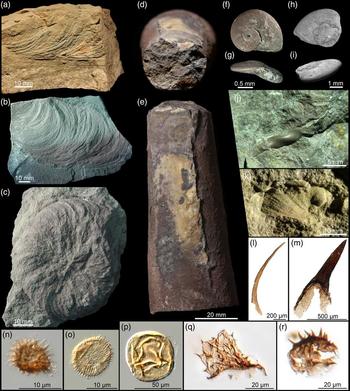
An increase in diversity of small skeletal fossils, including the local first appearance of fossil molluscs Aldanella attleborensis and Watsonella crosbyi (candidates for the index-species to define the base of the Cambrian Stage 2), is recorded throughout the Mattaia Formation (Parkhaev & Karlova, Reference Parkhaev and Karlova2011; Nagovitsin et al. Reference Nagovitsin, Rogov, Marusin, Karlova, Kolesnikov, Bykova and Grazhdankin2015) (Fig. 3). Supporting these occurrences as local first appearance data, there is no physical evidence of any stratigraphically significant changes in depositional rate, depositional hiatuses or local facies changes at this stratigraphic level. Occasional conglomerates consisting of reworked calcisiltite and calcite-cemented siltstone concretions in the Mattaia Formation may raise some concerns with regard to stratigraphic continuity of the succession; however, these conglomerates are interpreted to indicate episodic impingement of storm-induced, high-velocity oscillatory shear currents on the seafloor where early cemented siltstone and fine calcisiltite layers were reworked, accompanied by winnowing of patchily cemented lumps of sediment into lag deposits (cf. Knoll et al. Reference Knoll, Grotzinger, Kaufman and Kolosov1995a). It is one of these concretions in the section at Boroulakh that yielded the oldest local fossil occurrence ofAldanella attleborensis, although only one specimen (represented by a completely preserved dextral turbospiral conch 1800 µm in diameter) has been extracted from the concretion (Fig. 4f, g). The ratio of the shell height to greater diameter of the shell (K = 0.42), the ratio of greater to lesser diameters of the shell (Kiso = 1.23), and the ratio of the greater shell diameter to the diameter of the previous whorl (Kexp = 2.9) all suggest affinities with Aldanella attleborensis (cf. Parkhaev & Karlova, Reference Parkhaev and Karlova2011). This specimen occurs in strata depleted in 13C relative to those higher in the section that reveal a gradual increase in the heavy carbon isotope. Importantly, both Aldanella attleborensis and Watsonella crosbyi occur only in the SW of the Olenek study area, in the section at Boroulakh that represents a prograding storm-agitated shoreface depositional environment. None of these taxa has thus far been encountered in the adjacent carbonate platform and shallow-water upper-shoreface depositional environments to the NE. This is not surprising given the marked degree of environmental sensitivity of these organisms (Khomentovsky & Karlova, Reference Khomentovsky and Karlova1993, Reference Khomentovsky and Karlova1994).
Major evolutionary transitions and δ13C values recorded in the composite section of the upper Mattaia and Chuskuna formations on the Olenek Uplift (refer to Fig. 2 for legend). The carbon isotope curve is compiled from sections 1002 (solid circles) and 0934 (open circles).

(Colour online) Representatives of various fossil groups that first appear near the Tommotian lower boundary in the Kessyusa Group, Olenek Uplift. (a–c) Metazoan spreite burrow systems (stacked lamellae of reworked sediment) of Heimdallia chatwini(a), Rhizocorallium commune (b) and Zoophycos brianteus (c). (d, e) Enigmatic large-sized metazoan tubular fossils in cross-sectional (d) and lateral (e) view (Marusin & Grazhdankin, Reference Marusin and Grazhdankin2018). (f–i) The oldest fossils of Cambrian Stage 2 candidate index-taxa Aldanella attleborensis (f, g) and Watsonella crosbyi (h, i). (j) Large-sized spiral calcareous tube of Anabarites volutus. (k) Large-sized cup-shaped shell of a helcionellid mollusc Igorella maidipingensis. (l, m) Unresolved metazoan elements ‘Protohertzina compressa’ (cf. Slater et al. Reference Slater, Harvey, Guilbaud and Butterfield2017) (l) and Ceratophyton vernicosum (m). (n–p) Possible fossil phytoplankton producers, acritarchs with spinose ornament Heliosphaeridium sp. (n) andAsteridium sp. (o), porous spherical vesicles Tasmanites sp. (q, r) Putative priapulid teeth/scalidsCorollasphaeridium sp. (refer to Fig. 2 for stratigraphic position of the specimens).

A sudden increase in diversity and abundance of trace fossils occurs in close proximity to the lowest stratigraphic occurrence of Aldanella attleborensis in the Mattaia Formation (Fig. 3). The increase in ichnodisparity and behavioural complexity recorded here is interpreted as related to the most pronounced and rapid bauplan diversification of the Cambrian Explosion (cf. Mángano & Buatois, Reference Mángano and Buatois2014, Reference Mángano and Buatois2017). Among the trace fossils that first emerge at this stratigraphic level are abundant vertical simple andU-shaped burrows (Skolithos, Arenicolites and Diplocraterion), representing deep-tier suspension feeders. Furthermore, this stratigraphic level coincides with the first appearance of new behaviours of deposit feeders (e.g. Heimdallia, Nereites, Rhizocorallium and Zoophycos) (Fig. 4a–c). All these behavioural changes and evolutionary innovations are accompanied by a conspicuous increase in depth of bioturbation. The thickness of well-mixed intervals varies from 0.15 to 0.60 m, occasionally reaching 1 m. This is of the same scale as the average original bedding thickness measured in undisrupted intervals. The depth of bioturbation therefore reached bedding thickness. As a result, the intense and deep burrowing occasionally erased bed junctions and homogenized the sediment. The disrupted intervals are laterally continuous.
In addition to small skeletal fossils and trace fossils, the upper Mattaia Formation also yielded an assemblage of carbonaceous microfossils comparable to acritarchs of the Lontova Regional Stage of the Terreneuvian on the East European Platform (Ogurtsova, Reference Ogurtsova1975; Rudavskaya & Vasilieva, Reference Rudavskaya, Vasilieva, Kokoulin and Rudavskaya1985); however, most of the identified taxa have long stratigraphic ranges (Moczydłowska,Reference Moczydłowska1991) and are less useful for biostratigraphy. Higher in the section, a shaley interval in the Chuskuna Formation hosts the carbonaceous microfossils Asteridium tornatum, Comasphaeridiumagglutinatum, Granomarginata squamacea and Tasmanites sp., as well as small disarticulated elements of bilaterians (i.e. protoconodont spines and putative priapulid teeth/scalids identified as Corollasphaeridium sp.) (cf. Slater et al. Reference Slater, Harvey, Guilbaud and Butterfield2017) (Fig. 4l–r).
3.c. Chemostratigraphy
Carbon and strontium isotope stratigraphy of open-marine carbonate facies provides an independent means to correlate evolutionary events in basal Cambrian strata across Siberia and the world, assuming that well-preserved carbonates, as well as trace and body fossils, are available. The mixed siliciclastic and carbonate succession in the Olenek Uplift is therefore well suited as a synstratotype for the Tommotian interval on the Siberian craton.
Limestones in the middle Mattaia Formation are characterized by gradual up-section 13C enrichment, with δ13C values increasing from as low as –3.4‰ to an acme of +5.4‰ as recorded in the Suordakh Member in sections 705 and 935 (Fig. 2). The correlated interval in section 1002 preserves values as high as +4.2‰ that then fall to near zero, associated with the local first appearance of Watsonella crosbyi at the top of the Mattaia Formation. While the carbonates with negative carbon isotope values in the lower part of the Mattaia Formation are impure, their oxygen isotope compositions are similar to those of bedded limestones higher in the section and thus appear little altered (Fig. 5). Furthermore, this closely spaced population of samples collected across a 10 m interval – which crosses through several facies – defines a smooth stratigraphic trend of temporal significance.
Carbonate percentage (%), oxygen (δ18O, ‰ VPDB) and carbonate carbon isotope values (δ13C, ‰ VPDB), and strontium isotope ratios (87Sr/86Sr) measured in the upper Mattaia and lower Chuskuna formations at Boroulakh, section 1002 (refer to Fig. 1 for location of the section and to Fig. 2 for legend).

Limestones in the upper Mattaia Formation in section 1002 include grainstones and conglomerates, the latter consisting of imbricated reworked calcite-cemented concretions. The carbon isotope compositions of these carbonates oscillate between 0 and +4‰ but, given their oxygen and strontium isotope compositions (Fig. 5; including the lowest 87Sr/86Sr in the measured section at 0.70815), they were likely eroded from exposed more proximal upper Mattaia lithofacies. Bedded carbonates in the Chuskuna Formation are similarly well preserved based on their oxygen and strontium isotope compositions, but these closely spaced samples define a clear stratigraphic δ13C trend from near 0 to as high as +4.4‰.
Given the similarity of oxygen isotope compositions of samples from both the Mattaia and Chuskuna formations (Fig. 5) – which places them in the same diagenetic grade – it is permissible that the two closely spaced carbon isotope peaks are related to a single overall biogeochemical event. Furthermore, zircons extracted from a volcanic tuff within the uppermost Mattaia Formation in the section at the mouth of the Mattaia Creek (correlated with a stratigraphic level above the first occurrence of Aldanella attleborensis) and analysed by isotope dilution U–Pb techniques yield an age of 529.7 ± 0.3 Ma (Kaufman et al. Reference Kaufman, Peek, Martin, Cui, Grazhdankin, Rogov, Xiao, Buchwaldt and Bowring2012). The two-peaked carbon isotope excursion therefore occurred at c. 529.7 Ma (Fig. 3). This interpretation is consistent with the observation that the uppermost Kessyusa Group remains in the Nochoroicyathus sunnaginicus Assemblage Zone, and both the Dokidocyathus regularis andDokidocyathus lenaicus zones are missing in the section, having likely been eroded prior to Erkeket transgression.
4. Tommotian is coming of age
Just as the International Subcommission on Cambrian Stratigraphy rejected regional stages as legitimate precursors for global chronostratigraphic units (Geyer & Shergold, Reference Geyer and Shergold2000), the Interdepartmental Stratigraphic Committee of Russia set a course for researching and selecting GSSPs for stage boundaries to comply with international stratigraphic practice (Zhamoida, Reference Zhamoida2000). After the Tommotian boundary stratotype at Ulakhan Sulugur was shown to be associated with palaeokarst fissures and cavities (Khomentovsky & Karlova, Reference Khomentovsky and Karlova1993), a Tommotian boundary hypostratotype was proposed at the base of Bed 14d (0.3 m below the top of Bed 14, in the uppermost Ust-Yudoma Formation) at the Dvortsy section along the Aldan River (Rozanov et al. Reference Rozanov, Khomentovsky, Shabanov, Karlova, Varlamov, Luchinina, Pegel’, Demidenko, Parkhaev, Korovnikov and Skorlotova2008). Importantly, many taxa of small skeletal fossils that first appear at the lower Tommotian boundary at Ulakhan Sulugur have first appearances scattered through the uppermost 2 m of the Ust-Yudoma Formation in the hypostratotype, with no evidence for palaeokarstification (Khomentovsky & Karlova, Reference Khomentovsky and Karlova2002). The hypostratotype does contain a hiatus associated with the boundary between the Ust-Yudoma and Pestrotsvet formations; however, this boundary is within the Nochoroicyathus sunnaginicus Assemblage Zone, meaning that the duration of the hiatus is difficult to estimate by means of biostratigraphy (Rozanov et al. Reference Rozanov, Khomentovsky, Shabanov, Karlova, Varlamov, Luchinina, Pegel’, Demidenko, Parkhaev, Korovnikov and Skorlotova2008).
Parkhaev et al. (Reference Parkhaev, Karlova and Rozanov2011) and Demidenko & Parkhaev (Reference Demidenko and Parkhaev2014) suggested the lower Tommotian boundary to be placed at thelowermost occurrence of the fossil helcionelloid mollusc Aldanella attleborensis, which has a wide geographical distribution and a relatively narrow stratigraphic range. Along with Watsonella crosbyi, a putative representative of the bivalve stem group, Aldanella attleborensis has been regarded as a potential GSSP index fossil for the base of the Cambrian Stage 2 (Peng et al. Reference Peng, Babcock, Cooper, Gradstein, Ogg, Schmitz and Ogg2012; Landing et al. Reference Landing, Geyer, Brasier and Bowring2013). In the Dvortsy section, Aldanella attleborensis first appears in the uppermost Ust-Yudoma Formation at the base of Bed 14d within a unit (c. 0.1 m thick) of yellowish-grey dolostone with dolomudstone interbeds (Astashkin et al. Reference Astashkin, Pegel, Shabanov, Sukhov, Sundukov, Repina, Rozanov and Zhuravlev1991; Rozanov et al. Reference Rozanov, Repina, Appolonov, Shabanov, Zhuravlev, Pegel, Fedorov, Astashkin, Zhuravleva, Egorova, Chugaeva, Dubinina, Ermak, Esakova, Sundukov, Sukhov and Zhemchuzhnikov1992; Khomentovsky & Karlova, Reference Khomentovsky and Karlova2002).
In the stratotype area, the uppermost Ust-Yudoma Formation at Dvortsy (Fig. 6) is characterized by a trend of gradual enrichment in 13C, with δ13C values reaching as high as +3.4‰ (peak I) at the base of Bed 14d (Magaritz et al. Reference Magaritz, Holser and Kirschvink1986, Reference Magaritz, Kirshvink, Latham, Zhuravlev and Rozanov1991; Magaritz, Reference Magaritz1989; Kirschvink et al. Reference Kirschvink, Magaritz, Ripperdan, Zhuravlev and Rozanov1991; Brasier et al. Reference Brasier, Khomentovsky and Corfield1993) and decreasing to 0‰ at the lower boundary of the Pestrotsvet Formation. The trend continues through the Nochoroicyathus sunnaginicus Zone reaching a nadir at –1.3‰ in the middle of the biozone section and then reverses towards positive δ13C values, with an acme at +1.5‰ (peak II) in the middle of the Dokidocyathus regularis Zone (Brasier et al. Reference Brasier, Rozanov, Zhuravlev, Corfield and Derry1994). In contrast, sections in the north of Siberian Platform (e.g. Sukharikha Formation at Sukharikha River; Manykai and Medvezhya formations at Kotuikan River; Manykai and Emyaksin formations at Bol’shaya Kuonamka River) have carbon isotope trends dissimilar to those documented in the south (Knoll et al. Reference Knoll, Kaufman, Semikhatov, Grotzinger and Adams1995b; Kaufman et al. Reference Kaufman, Knoll, Semikhatov, Grotzinger, Jacobsen and Adams1996; Kouchinsky et al. Reference Kouchinsky, Bengtson, Missarzhevsky, Pelechaty, Torssander and Val’kov2001, Reference Kouchinsky, Bengtson, Pavlov, Runnegar, Val’kov and Young2005, Reference Kouchinsky, Bengtson, Pavlov, Runnegar, Torssander, Young and Ziegler2007, Reference Kouchinsky, Bengtson, Gallet, Korovnikov, Pavlov, Runnegar, Shields, Veizer, Young and Ziegler2008, Reference Kouchinsky, Bengtson, Landing, Steiner, Vendrasco and Ziegler2017; Landing & Kouchinsky, Reference Landing and Kouchinsky2016). Furthermore, positive excursions 1p to 7p in the Sukharikha Formation appear to match carbon isotope variations in theTifnout Member of the Adoudou Formation, Anti Atlas Mountains of Morocco (Maloof et al. Reference Maloof, Porter, Moore, Dudás, Bowring, Higgins, Fike and Eddy2010a). If this is the case, the peak 6p in the Sukharikha Formation is coeval with the U–Pb zircon date of 525.34 ± 0.09 Ma.
Comparison of δ13C values for carbonates in the Kessyusa Group with δ13C values recorded in sections that are most informative for lower Tommotian chemostratigraphy, as well as local stratigraphic occurrences of Cambrian Stage 2 candidate index-taxa Aldanella attleborensis and Watsonella crosbyi (Rozanov et al. Reference Rozanov, Repina, Appolonov, Shabanov, Zhuravlev, Pegel, Fedorov, Astashkin, Zhuravleva, Egorova, Chugaeva, Dubinina, Ermak, Esakova, Sundukov, Sukhov and Zhemchuzhnikov1992; Brasier et al. Reference Brasier, Khomentovsky and Corfield1993; Kaufman et al. Reference Kaufman, Knoll, Semikhatov, Grotzinger, Jacobsen and Adams1996; Kouchinsky et al. Reference Kouchinsky, Bengtson, Pavlov, Runnegar, Torssander, Young and Ziegler2007, Reference Kouchinsky, Bengtson, Landing, Steiner, Vendrasco and Ziegler2017). The dashed line proposes a tentative correlation for the base of the Tommotian Regional Stage. For the location of individual sections, see Figure 1.

Carbon isotope variations suggest that the depositional hiatus at the base of the Pestrotsvet Formation could be attributed to a combination of subaerial erosion and non-deposition, produced by a regional stratigraphic offlap of facies below and onlap above the hiatal surface, respectively. Furthermore, accumulation of the Cambrian transgressive deposits appears to have begun earlier in the northern part of the Siberian Platform than in the stratotype area in the south (Knoll et al. Reference Knoll, Kaufman, Semikhatov, Grotzinger and Adams1995b; Kaufman et al. Reference Kaufman, Knoll, Semikhatov, Grotzinger, Jacobsen and Adams1996; Kouchinsky et al. Reference Kouchinsky, Bengtson, Missarzhevsky, Pelechaty, Torssander and Val’kov2001, Reference Kouchinsky, Bengtson, Pavlov, Runnegar, Val’kov and Young2005, Reference Kouchinsky, Bengtson, Pavlov, Runnegar, Torssander, Young and Ziegler2007, Reference Kouchinsky, Bengtson, Gallet, Korovnikov, Pavlov, Runnegar, Shields, Veizer, Young and Ziegler2008, Reference Kouchinsky, Bengtson, Landing, Steiner, Vendrasco and Ziegler2017; Landing & Kouchinsky, Reference Landing and Kouchinsky2016). We interpret the two-peaked carbon isotope excursion at the Olenek River section to be equivalent to the 5p carbon isotope excursion at the Sukharikha River section (Kouchinsky et al. Reference Kouchinsky, Bengtson, Pavlov, Runnegar, Torssander, Young and Ziegler2007) and its equivalent in Morocco, which notably also has a two-peaked subdivision (Maloof et al. Reference Maloof, Ramezani, Bowring, Fike, Porter and Mazouad2010b). The two-peaked carbon isotope excursion is coeval with a U–Pb zircon date of 529.7 ± 0.3 Ma (Kaufman et al. Reference Kaufman, Peek, Martin, Cui, Grazhdankin, Rogov, Xiao, Buchwaldt and Bowring2012). The alternative would be to identify the Mattaia and Chuskuna peaks as equivalent to the 5p and 6p events, but in Morocco the 6p excursion is directly tied to a U–Pb zircon age of 525.34 ± 0.09 Ma, suggesting an inordinately long time (c. 4.3 Ma) between the two carbon isotope events.
In the Ary-Mas-Yuryakh, western Anabar Region of Siberia, the I’ excursion of the Medvezhya Formation is coeval with the lowest stratigraphic occurrence of Aldanella attleborensis and Watsonella crosbyi in the section (Landing & Kouchinsky, Reference Landing and Kouchinsky2016). If the I’ excursion is correlative to the two-peaked positive δ13C excursion of the Kessyusa Group in the Olenek Uplift as we suggest (Fig. 6), then the local first appearances of these taxa are broadly isochronous in the two regions. In the Tommotian stratotype at Dvortsy, however, the lowermost occurrence of Aldanella attleborensis is in the uppermost Ust-Yudoma Formation above the acme of the positive excursion in δ13C values associated with the I peak, and below the hiatus at the base of the Pestrotsvet (Parkhaev & Karlova, Reference Parkhaev and Karlova2011). Indeed, the concentration of small skeletal fossils at this boundary in the Dvortsy section is better explained as a result of low rates of net sedimentation than by erosion; even the fossil concentrations associated with fissures could represent a karst residue. In other words, the lower Tommotian boundary predates the hiatus associated with the boundary between the Ust-Yudoma and Pestrotsvet formations. Insofar as the Dvortsy I event is correlative with 5p in the Sukharikha River section and the Khorbusuonka event in the Olenek Uplift, the local first appearances of these taxa are diachronous, supporting the view that Cambrian transgressive deposits appeared earlier in northern Siberia relative to the stratotype area in the south. A somewhat older local first appearance of Aldanella attleborensis and Watsonella crosbyi therefore seems to be recorded in the Olenek Uplift.
This conclusion has another important implication, because it resolves a problem of the acritarch-based correlations suggesting that the Tommotian Stage of Siberia is coeval with trilobite-bearing Cambrian of the East European Platform (Moczydłowska & Vidal, Reference Moczydłowska and Vidal1988; Moczydłowska, Reference Moczydłowska1991; Vidal et al. Reference Vidal, Moczydłowska and Rudavskaya1995, Reference Vidal, Palacios, Moczydłowska and Gubanov1999). The concept of Tommotian post-dating the Lontova Regional Stage stems from Missarzhevsky’s (Reference Missarzhevsky1989) interpretation of the Manykai and lower Medvezhya formations in the Kotuikan section as pre-Tommotian (cf. Kaufman et al. Reference Kaufman, Knoll, Semikhatov, Grotzinger, Jacobsen and Adams1996); however, it seems more likely that the upper Manykai Formation is coeval with the upper Mattaia – lower Chuskuna interval in the ‘synstratotype’ of the lower Tommotian boundary. At least in the upper Mattaia – lower Chuskuna formations, the lowermost Tommotian strata host a Lontova assemblage of acritarchs (Ogurtsova, Reference Ogurtsova1975; Rudavskaya & Vasilieva, Reference Rudavskaya, Vasilieva, Kokoulin and Rudavskaya1985; Kir’yanov, Reference Kir’yanov1987, Reference Kir’yanov2006).
Carbonaceous microfossils in the Tyuser Formation in the Kharaulakh Ranges to the east of the Olenek Uplift have further fuelled the debate on the age of the Tommotian strata in Siberia. Acritarchs diagnostic of the Heliosphaeridium dissimilare – Skiagia ciliosa Assemblage Zone, which are thought to be equivalent in time to the Holmia kjerulfi trilobite Zone in Baltica (Moczydłowska, Reference Moczydłowska1991), were identified in strata correlated with the Dokidocyathus regularis Zone, the second assemblage zone of the Tommotian Stage (Vidal et al. 1995; Zang et al. Reference Zang, Moczydłowska and Jago2007), which is missing in the Olenek Uplift. The distribution of small skeletal fossils suggests that the lower Tyuser Formation is a relatively condensed succession (Repina et al. Reference Repina, Lazarenko, Meshkova, Korshunov, Nikiforov and Aksarina1974; Astashkin et al. Reference Astashkin, Pegel, Shabanov, Sukhov, Sundukov, Repina, Rozanov and Zhuravlev1991; Rozanov et al. Reference Rozanov, Repina, Appolonov, Shabanov, Zhuravlev, Pegel, Fedorov, Astashkin, Zhuravleva, Egorova, Chugaeva, Dubinina, Ermak, Esakova, Sundukov, Sukhov and Zhemchuzhnikov1992). In a section in the left bank of the Lena River near Chekurovka, the Dokidocyathus regularis Zone comprises the lowermostc. 10–15 m, and the Dokidocyathus lenaicus Zone extends at least up to 20 m above the base of the Tyuser Formation (Astashkin et al. Reference Astashkin, Pegel, Shabanov, Sukhov, Sundukov, Repina, Rozanov and Zhuravlev1991; Rozanov et al. Reference Rozanov, Repina, Appolonov, Shabanov, Zhuravlev, Pegel, Fedorov, Astashkin, Zhuravleva, Egorova, Chugaeva, Dubinina, Ermak, Esakova, Sundukov, Sukhov and Zhemchuzhnikov1992; Korovnikov & Novozhilova, Reference Korovnikov and Novozhilova2012); however, the exact position of the zonal boundaries is obscure. The structure of the lower Tyuser Formation is further complicated by basalt flows (Prokopiev et al. Reference Prokopiev, Khudoley, Koroleva, Kazakova, Lokhov, Malyshev, Zaitsev, Roev, Sergeev, Berezhnaya and Vasiliev2016). At least two such basalt flows (4 and 48 m thick) occur in the section near Chekurovka (Shpunt, Reference Shpunt1987). The lower basalt flow immediately overlies a fluvial conglomerate, with cobbles of ultrapotassic trachyrhyolite porphyry yielding U–Pb zircon dates of 525.6 ± 3.9 Ma, 537.0 ± 4.2 Ma and 546.0 ± 7.7 Ma (Bowring et al. Reference Bowring, Grotzinger, Isachsen, Knoll, Pelechaty and Kolosov1993; Prokopiev et al. Reference Prokopiev, Khudoley, Koroleva, Kazakova, Lokhov, Malyshev, Zaitsev, Roev, Sergeev, Berezhnaya and Vasiliev2016). The carbonaceous microfossils diagnostic of the Heliosphaeridium dissimilare – Skiagia ciliosa acritarch Assemblage Zone occur 5.7 m above the top of the upper flow (Vidal et al. Reference Vidal, Moczydłowska and Rudavskaya1995). The associated small skeletal fossils are represented by taxa that first appear in the Tommotian but range into the Atdabanian Stage. The exact stratigraphic position of the acritarchs in relation to the Tommotian–Atdabanian boundary in the section near Chekurovka is therefore inconclusive (cf. Zang et al. Reference Zang, Moczydłowska and Jago2007). Regardless of the interpretation, the stratigraphic range of acritarchs of the Heliosphaeridium dissimilare – Skiagia ciliosa Assemblage Zone could equally include some of the Tommotian strata (Palacios et al. Reference Palacios, Jensen, Barr, White and Miller2011; Landing et al. Reference Landing, Geyer, Brasier and Bowring2013).
In China, equivalent strata of the Dahai Member of the Zhujiaqing Formation in Yunnan Province preserves a singular positive carbon isotope excursion that was split into two by Maloof et al. (Reference Maloof, Porter, Moore, Dudás, Bowring, Higgins, Fike and Eddy2010a), given the remote possibility of a regional unconformity seen at the Meishucun section and projected to Xiaotan. However, there is no physical evidence for a hiatus in the Dahai Member at Xiaotan, and the uniformly low-Sr isotope compositions throughout the unit (Li et al. Reference Li, Ling, Shields-Zhou, Chen, Cremonese, Och, Thirlwall and Manning2013) are inconsistent with a major break in time. Furthermore, the 87Sr/86Sr compositions of Dahai limestones are a close match with those in the Mattaia and Chuskuna limestones. If correct, the Dahai positive carbon isotope excursion (which lies above the local first appearance of Watsonella crosbyi) should also be correlative with the 5p event.
In the Moroccan U–Pb–δ13Ccarb age model (Maloof et al. Reference Maloof, Porter, Moore, Dudás, Bowring, Higgins, Fike and Eddy2010a), the peak 5p is plotted against the age of 531–532 Ma; however, correlation with the upper Mattaia Formation suggests that the peak 5p is younger at 529–530 Ma. Importantly, the upper Mattaia Formation documents a sudden increase in diversity of small skeletal fossils and trace fossils. It is the age of 529–530 Ma (not 530–534 Ma) when a major diversification of fossil first appearance datums (FADs) occurs (pulsemND in Maloof et al. Reference Maloof, Porter, Moore, Dudás, Bowring, Higgins, Fike and Eddy2010a), and this pulse marks the lower Tommotian boundary in the Olenek Uplift of Siberia.
This chemostratigraphic and geochronologic framework yields age constraints (between 525.3 and 529.7 Ma) on the 5p and 6p events worldwide, but our palaeontological discoveries in the Olenek Uplift suggest both biogeochemical events are Tommotian in age (contra Maloof et al. 2010a, b). The northwestern slope of the Olenek Uplift hosting the massive appearance of diverse small skeletal fossils, along with the lowest stratigraphic occurrence of Aldanella attleborensis and Watsonella crosbyi in the Mattaia Formation, has always been regarded as the section important for definition of the base of the Nochoroicyathus sunnaginicus Assemblage Zone and of the base of the Siberian Tommotian Stage (Missarzhevsky, Reference Missarzhevsky1980, Reference Missarzhevsky1989; Sokolov & Fedonkin, Reference Sokolov and Fedonkin1984; Khomentovsky & Karlova, Reference Khomentovsky and Karlova1992, Reference Khomentovsky and Karlova1993; Knoll et al. Reference Knoll, Grotzinger, Kaufman and Kolosov1995a). At least on the northwestern slope of the Olenek Uplift the lower boundary of the Tommotian appears to meet the criteria widely used to define the base of the Cambrian Stage 2. The age (529.7 ± 0.3 Ma) and FAD (Aldanella attleborensis or Watsonella crosbyi) of the proposed Cambrian Stage 2 base is therefore characterized by a strong negative-to-positive carbon isotope excursion associated with the 5p peak noted elsewhere in Siberia and worldwide.
5. Conclusions
The Tommotian Regional Stage of the Siberian Platform has all the qualities, characteristics and functionality of a robust regional stratigraphic scale. Traditionally, the lower Tommotian boundary has been the base of the Nochoroicyathus sunnaginicus Assemblage Zone, which is traced by biostratigraphic correlation; by definition, biostratigraphic correlation only approximates chronostratigraphic correlation. In the case of small skeletal fossils, biofacies further prevent accurate correlation. Since a clear, unambiguous definition of the lower Tommotian boundary is lacking, the task of assessing and selecting potential GSSP candidate sections (a requirement in seeking formalization of the term) is being actively pursued.
Sections in the NE of the Siberian Platform characterize an open-shelf to basinal depositional setting and provide faunal ties and correlation with carbonate-dominated open-shelf areas. A section of the upper Mattaia Formation is suggested here as a model for the GSSP for the base of the Cambrian Stage 2. This level contains the lowest known occurrence of the cosmopolitan mollusc fossil Aldanella attleborensis (base of the Nochoroicyathus sunnaginicus Assemblage Zone). Geochemical markers near the base of the stage include a positive δ13C excursion with values reaching up to +5.4‰, a U–Pb zircon date of c. 529–530 Ma, massive appearance of diverse small skeletal fossils (including Watsonella crosbyi), a sudden increase in diversity and abundance of trace fossils, as well as a conspicuous increase in depth and intensity of bioturbation. Coincidently, it is this level that has always been regarded as the lower Tommotian boundary on the Olenek Uplift.
Acknowledgements
This study was supported by the Russian Foundation for Basic Research (grant no. 18-05-70110) and the Russian Science Foundation (grant no. 17-17-01241, palaeontological studies). The findings and conclusions have immediate implications for resolving chronology of the ‘Cambrian explosion’ (Russian Foundation for Basic Research, grant no. 17-05-00852). Fieldwork was conducted with the financial support of the National Geographic Society’s Committee for Research and Exploration (grant nos 8227-07, 8637-09, 9031-11 and NGS-372R-18). This publication was prepared under Government Contract 0331-2019-0002 (Ministry of Education and Science of the Russian Federation). We thank the National Science Foundation Sedimentary Geology and Paleontology and National Aeronautics and Space Administration Exobiology programs, as well as Sam Bowring (Massachusetts Institute of Technology) and George Gehrels (University of Arizona) for supporting this research.
Conflict of interest
None.