Ensuring sufficient surge capacity is a leading concern in disaster planning and response. 1 – Reference Peleg and Kellermann 8 A considerable body of work has advanced the concept of hospital surge capacity for adult patients and victims.Reference Kelen and McCarthy 6 , Reference Kaji, Koenig and Lewis 7 , Reference Hick, Hanfling and Burstein 9 – Reference Kelen, Kraus and McCarthy 13 Surge concepts and concerns about capacity during disasters in pediatrics have also been raised, in part, in recognition of a low pediatric hospital bed to pediatric population ratio and the highly regionalized nature of pediatric specialty care. 14 – Reference Kanter 19 Of further concern, children may be more susceptible to mass trauma events and contagious diseases because they are often cohorted at specific sites such as schools and attractions.Reference Allen, Parrillo, Will and Mohr 15 , Reference Vetter, Dulaev and Mueller 20 , Reference Dyb, Jensen and Nygaard 21 However, empirical research is lacking related to effective means to create or ensure adequate pediatric hospital surge capacity.
Several strategies have been advanced to create hospital surge capacity. These include canceling elective admissions, opening unstaffed or unlicensed beds, exploiting unconventional space, and altering standards of care.Reference Kelen and McCarthy 6 , Reference Kaji, Koenig and Lewis 7 , Reference Hick, Hanfling and Burstein 9 , Reference Hick, Barbera and Kelen 10 , Reference Kaji, Koenig and Bey 12 , Reference Kelen, Kraus and McCarthy 13 Recently, a new concept of reverse triage, a risk stratification technique that can be implemented during a disaster as well as during times of severe hospital crowding, has been proposed and explored.Reference Kelen, Kraus and McCarthy 13 , Reference Kelen, McCarthy and Kraus 22 Reverse triage allows the identification of hospitalized patients deemed safe for discharge and with continued out-of-hospital management for a period of time until the system recovers. The Joint Commission identified that hospitals should be prepared to stand alone for up to 96 hours before outside assistance can be expected during crises. 23 A strong advantage of reverse triage as a surge strategy is the emphasis on conserving rather than increasing overall resource requirements (particularly labor) when demand exceeds routinely available supplies.
A system for reserve triage has been developed for adult inpatientsReference Kelen, Kraus and McCarthy 13 and has been shown to be potentially highly effective.Reference Kelen, McCarthy and Kraus 22 However, reverse triage has not been explored in the pediatric population. Commonly, concepts developed for adult patients are not necessarily applicable to pediatric patients. It is recognized that children have unique medical and psychosocial issues and are considered by the US Department of Health and Human Services as an “at-risk population” during disasters and as a population for whom medical counter-measures during crises may not apply as readily as for adults.Reference Allen, Parrillo, Will and Mohr 15 , Reference Vetter, Dulaev and Mueller 20 , Reference Dyb, Jensen and Nygaard 21 Accordingly, we wished to develop a pediatric-specific risk-based disposition classification system that could form the basis for a pediatric reverse-triage strategy in the event of an overwhelming disaster or severe hospital crowding.
Methods
We used evidence-based materials, combined with expert panel consensus by use of a modified Delphi technique,Reference Kelen, Kraus and McCarthy 13 , Reference Kanter, Andrake and Boeing 24 to derive a pediatric risk-based disposition classification system. The Institutional Review Board on Human Subjects Research approved the study.
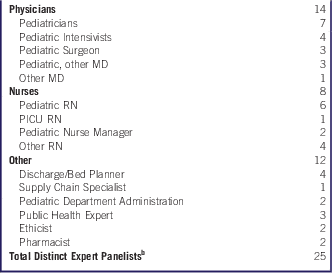
Expert Panel Composition
Conference organizers determined the desirable qualifications and subject matter expertise of the panel members, who were thus subsequently identified and invited. All panelists were involved in pediatric health care or disaster planning but represented diverse perspectives, including those of nonclinicians (Table 1). Although some of the panelists were from the lead author’s home institution, care was taken to ensure broad national and international experience and to include the perspective of major academic health centers, affiliate teaching centers, dedicated pediatric hospitals, and community hospitals. The training or work experience of the panelists encompassed 11 states from all 4 quadrants of the United States as well as Hawaii and 3 international settings (Israel, United Kingdom, and Canada). Panelists were included only if they could attend the entire event. Written consent to participate was obtained from each of the panelists.
Expertise of PanelFootnote a

a Abbreviation: PICU, pediatric intensive care unit.
b There were 25 panelists. Many had dual expertise and thus were counted twice.
Before convening the panel, the study organizers held 2 rehearsals for the conferenceReference Kelen, Kraus and McCarthy 13 to ensure that presentations, discussion, and anonymous electronic voting took place smoothly. An experienced facilitator conducted the proceedings but did not vote.
Conference Proceedings
The proceeding occurred in 2013 at a conference center distant from the host institution but in the same city. The proceeding was not associated with any society or organization’s conference. The objectives and methodology essentially mirrored that used for a previous exercise focused on reverse triage for adults.Reference Kelen, Kraus and McCarthy 13 The objectives of the expert panel were to (1) develop an evidence-based Pediatric Risk-Based Disposition Classification (Reverse Triage) System, based on tolerance of risk of a consequential medical event (CME) as defined by the need for a critical intervention (CI) during the ensuing 96 hours after discharge or transfer to a lower level of care (vide infra), and (2) assess the risk of a CME occurrence for each particular CI in a list should the intervention be withdrawn or not initiated. The concept of CME and CI are discussed below.
Before the convening of the panel, each panelist received a detailed manual containing background information on goals, objectives, literature, planned methodology, and expectations of the expert panel. The panel convened over 2 days. There were several presentations by experts, including on surge capacity, reverse triage, risk assessment and concepts of risk tolerance, and ethics as specifically related to disaster and the pediatric patient population.Reference Antommaria, Powll, Miller and Christian 17 , Reference Kraus, Levy and Kelen 25 – Reference Kissoon 27 Evidence-based information was presented on decision-making protocols based on riskReference Laupacis, Sekar and Stiell 28 (eg, Pneumonia Patient Outcomes Research Team [PORT]Reference Fine, Auble and Yealy 29 and APGAR,Reference Apgar 30 Bacterial Meningitis Score in Children,Reference Nigrovic, Kuppermann and Maciac 31 PRISM,Reference Pollac, Ruttimann and Getson 32 Westley Croup ScoreReference Westley, Cotton and Brooks 33 ), peer-reviewed publications,Reference Maguire, Kulik and Laupacis 34 and data on adverse events, readmission rates of discharged pediatric patients, and iatrogenic events related to being in the hospital. Open time for discussion was planned as part of these presentations.
Actual proceedings were conducted as follows. Items related to consensus definition, assumptions, or list inclusion were displayed on a screen by the facilitator and an open discussion would follow. When the facilitator felt consensus was reached, an anonymous electronic vote was taken to confirm. For items requiring a vote such as risk tolerance levels or ranking CI importance, the issue or item was displayed and an initial vote was taken prior to any discussion (aside from clarifying questions). The results of the vote were immediately displayed and a moderated discussion ensued. Following conclusion of the discussion, a final vote was taken. During all discussion, to protect against reticence to speak out, panelists could send anonymous comments via SMS text, which would be displayed without attribution during the discussion.
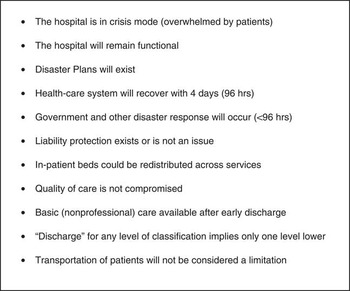
Discussions were also held on the first day on items such as assumptions, age range to be considered, and expected medical sophistication of early discharge destinations, particularly for low-risk groups. The uniform consensus on assumptions is shown in Figure 1. The age range agreement was full term (37 weeks) to 18 years of age (the limit for many pediatric hospitals). Panelists decided after considerable discussion that there should be no stratification of age groups for differential consideration, because the basic principles of reverse triage and CME related to CI importance cut across all age groups relatively equally as defined here. Also, the panelists concluded that age group divisions added unnecessary complexity and that adult criteria would be applied to most children falling into older age groups. Discharge destination for patients eligible for early discharge was assumed to be for non-medically-sophisticated destinations such as a family home or equivalent.
Assumptions Made in the Derivation of the Pediatric Risk-Based Disposition Classification System.

On the second day, addressing objective 1, the panelists were asked to reach consensus on the definition of each stratified level of risk tolerance. For example, for the lowest risk tier, the panelists discussed whether the definition should comprise 1 of 3 possibilities: no risk at all, risk no higher than baseline for routine discharge, or minimal if unlikely incremental risk. Then by using the modified Delphi technique a blinded computer-assisted vote was taken for the upper level of risk tolerance for each of 5 tiers, starting with the lowest risk level. The vote pertained to the upper limit of acceptable risk (in terms of percent) of a CME occurring as the result of early discharge over a 96-hour period. The software used (Turning Point Polling Software 4.5.1.224; Turning Technologies, Youngstown, OH) allowed for immediate display of the vote distribution. Using the software, panelists electronically submitted their upper limit of acceptable risk (in terms of a percentage) of a CME occurring specifically due to early discharge over a 96-hour period. Following an initial nonbinding electronic vote taken for each tier, there was a general discussion with a focus on outlier opinions. Subsequently, a final binding vote was taken. Each tier was discussed before proceeding to consideration of the next.
Using a similar process to address objective 2, panelists were given the definition of a CI (see below) and shown a list of CIs to be considered. The initial list developed by study investigators was based on those previously published for adults.Reference Kelen, Kraus and McCarthy 13 , Reference Kelen, McCarthy and Kraus 22 The list was further vetted by 5 pediatricians. The panel discussion allowed modification of the list including deletion, addition, and collapse of procedure categories. The modified Delphi technique was again used to rate each intervention on the final list by using a Likert scale of 1 to 10 for level of potential harm, corresponding to a sense of risk of a CME.Reference Kelen, Kraus and McCarthy 13 A score of 10 indicated virtual certainty of a CME; a 1 indicated a high unlikelihood of a CME. Panelists were asked to refrain from voting on interventions or procedures if they were not familiar with associated indications and risk profile. For purposes of analyses, any CI with a mean ranking of 7 or higher was considered high-risk for CMEs, a mean ranking between 4 and 6 indicated moderate risk, and a mean ranking of 3 or less modest risk.
Concept of Critical Interventions and Consequential Medical Events
The concept of CMEs and relation to CIs are discussed in detail elsewhere.Reference Kelen, Kraus and McCarthy 13 Briefly, a CI is any procedure or intervention that if withdrawn or withheld could reasonably be foreseen to result in preventable medical deterioration or untoward effect (ie, a CME). The adopted consensus operational definition of a CME was unexpected death, irreversible impairment, or reduction of function occurring within 96 hours of withdrawing or failing to initiate one or more in-hospital interventions (CIs) aimed at stabilizing, ameliorating, or alerting the presence of the medical condition for which it would be normally be applied. Thus, failure to initiate or continue a CI risked a CME within a 96-hour period.
Data Analysis
Data were electronically recorded and displayed in real time by using the Turning Point Polling Software. These data were permanently stored in a secure database. Only the final votes were used for analyses. Means and interquartile ranges were calculated as appropriate. Because the exercises protected anonymity in recording participant responses, subgroup analyses by medical discipline were not possible.
Results
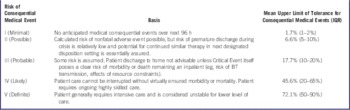
Panelists unanimously assented that a 5-category disposition classification system was optimal (Table 2). Consensus was reached on the wording and connotation of each of the tiers.
Consensus Pediatric Risk-Based Disposition Classification and Tolerance for Consequential Medical EventFootnote a

a Abbreviations: BT, biothreat; EMTALA, Emergency Medical Treatment and Active Labor Act; IQR, interquartile range.
The panelists judged that risk assumption for category 1 should be equivalent to that following routine discharge. Category 2 was judged to include patients who might warrant discharge if surge capacity were required in a constrained resource environment or if remaining hospitalized during a disaster posed unique incremental risks. Examples of these patients might include those requiring observation for trauma without obvious evident injury, partially treated asthma, and admission for control of nausea related to chemotherapy. Category 3 patients were generally judged inappropriate for early discharge except in highly unusual circumstances where risk of remaining in a hospital setting presented a risk of morbidity or mortality as may occur during a biothreat or emerging infectious agent spreading within the facility itself. Examples of patients in this category may include those on general surgical wards in the immediate period following non-life-threatening orthopedic surgery, where oral intake, voiding, and other functions are not yet a surety to ensure safe discharge. Patients in category 4 have a high likelihood of a CME if discharged early, even if moved to a lower level of care. Examples of such patients include those requiring emergency surgery, vasoactive infusions, continuous respiratory support, or special medications. Finally, category 5 patients were considered too unstable for discharge or transfer to a lower level of care. These would include a sizeable proportion of the intensive care unit (ICU) patient population. The upper limit of 72% (rather than 100%) reflects the opinion that a small proportion of patients being moved for upwards of 96 hours to a lower level of care would not result in mortality or permanent morbidity, and that for those patients who experience mortality or permanent disability, moving posed no actual incremental risk (ie, the CME was highly likely even without transfer).
The tolerance for placing children into the lowest tier (category 1) for risk of a CME caused by early discharge was under 2%. An example of those in this lowest risk category might include children receiving intravenous antibiotics where transition to oral antibiotics is not optimal but is acceptable. The next risk categories had upper risk tolerance limits of 7%, 18%, 46%, and 72% of a CME, respectively.
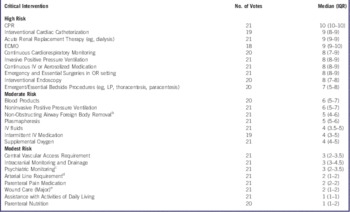
Table 3 shows the consensus ratings for the list of 25 CIs that if not initiated or withdrawn would result in a CME. Less than one-half of the CIs were considered as high risk (Likert scale score of 7 or greater), about one-quarter as modest risk (Likert scale score of 4 to 6), and about one-third as modest risk (Likert scale score of 3 or less).
Critical Interventions and Expert Panel Consensus of Likelihood of Consequential Medical Event if Procedure or Treatment Modality is WithdrawnFootnote a

a Abbreviations: CPR, cardiopulmonary resuscitation; ECMO, extracorporeal membrane oxygenation; IV, intravenous; OR, operating room; LP, lumbar puncture.
b Other foreign body removal falls under Wound Care, Interventional Endoscopy, or Essential Bedside Procedure.
c Includes suicide watch and lock down for self-protection or protection of others.
d Added by panelists; original items removed by panelists were dextrose IV, intermittent aerosolized medication, and interventional radiology.
e Packing change, dressing change, burn care, incision and drainage, wound FBR.
Discussion
Hospital surge capacity is a major concern in developed countries. In fact, the need to plan and develop methods to increase hospital capacity during times of high-consequent disasters or times of severe hospital crowding are standard recommendations of the Joint Commission and the American College of Emergency Physicians. 35 , 36 There has been considerable work during the last decade in defining concepts and general approaches to creating hospital surge capacity,Reference Hick, Hanfling and Burstein 9 – Reference Barbisch and Koenig 11 , Reference Kanter 19 , Reference Soremukun, Zane and Walls 37 but there is scant work specific to pediatric populations, even though this population is identified as a particularly vulnerable group.
We derived a system whereby pediatric inpatients can be tiered for consideration of early discharge (reverse triage) to allow the creation of surge capacity while conserving hospital-based resources. A similar consensus and modified Delphi technique was used to derive pediatric standards to be applied during disasters.Reference Kanter, Andrake and Boeing 24 The proposed system is based on acceptable assumed risk of a preventable untoward outcome or medical event, given a certain patient surge scenario. The system seeks to balance the needs of those who may be at a higher risk for a CME if denied a resource (eg, disaster victims) compared with those who currently have benefit from the resources but are at lower risk of a CME without the provision. In creating the system, the panelists relied on ethical precepts related to children, which differ in some respects from precepts related to adults owing to vulnerabilities in this population.Reference Antommaria, Sweney and Poss 26 , Reference Antommaria, Powel, Miller and Christian 38
Such a disposition classification system had been developed for adult patient populationsReference Kelen, Kraus and McCarthy 13 and this line of work is being further developed and gaining adherents,Reference Satterthwaite and Atkinson 39 – Reference Ranse and Zeitz 44 including in pediatric practiceReference Griffiths, Estipona and Waterson 45 and among USReference Timbie, Ringel and Fox 46 and foreign government agencies. 47 Whereas a similar methodology was used for the previous work that addressed adult inpatients,Reference Kelen, Kraus and McCarthy 13 , Reference Kelen, McCarthy and Kraus 22 the resulting pediatric classification system differs in some respects. The previous work assumed risk related to outright discharge back to the previous nonhospital setting of a given patient regardless of level of care in the hospital. The pediatric consensus panelists wished to assume that disposition was not discharge in all cases, but rather to one level of care lower than currently being resourced. Generally, this applies to ICU patients who may be transferred to a stepdown unit or general hospital ward to free up resources for disaster patients in greater need of the ICU-specific resources. All other pediatric patients were presumed discharged back to the community.
The panelists’ toleration of risk for pediatric patients was relatively conservative compared to a similar previously held exercise for adult patients that followed the same methodology, including the same objectives, preparatory work, and Delphi technique.Reference Kelen, Kraus and McCarthy 13 The panelists’ consensus determined that the lowest risk tolerance category should be no higher than that expected for a planned discharge. A previous study of acceptable assumed risk of early discharge among adults in this lowest category (3.8%)Reference Kelen, McCarthy and Kraus 22 is more than twice that determined by pediatric panel. This ratio of double accepted risks held for the second and third tiers as well (11.7% and 33.1%, respectively, in the adult study), and was still significantly lower in the fourth tier (61% in the adult study). Interestingly, the highest risk category had a lower tolerance of 72% (versus 92% for adults), reflecting the 2 precepts noted above.
To some extent, a direct comparison of the adult criteria to those derived here for pediatrics presents difficulties. The definitions for each tier are not perfectly aligned. For example, in the adult study the lowest tier was defined to include “minimum to no” risk, whereas in the current study the consensus definition was “no anticipated” risk. The differences in definitions for the 4th and 5th tiers between the 2 studies were inconsequential and yet the differences in risk tolerance are striking. Although not explored explicitly with the panelists, several reasons for these differences are postulated. First, typical pediatric mortality rates are dramatically lower than for adults, likely because of lower societal tolerance for an untoward event and an implicit bias for greater protection of children from preventable harms than adults. Also, children have many life years left and a CME may have a greater impact on those years. Finally, children are dependent on capable adults for all basic care.
The CIs for the pediatric population were derived to inform a currently ongoing study that can estimate potential surge capacity for a given ward, entire hospital, or even regional system given sufficient patient data that can associate risk of early discharge for individual patients. Given that the derivation of the CIs was based on previous work in adults, it is not too surprising that all 25 pediatric CIs had an equivalent in the published work on adults, although only 18 of these CIs were essentially identical. The pediatric panel wished that some CIs were subsumed under a more general rubric and that others were specifically considered as independent items. For example, extracorporal membrane oxygenation was identified as a specific CI, whereas in the adult work it was subsumed under “major surgical procedure,” although both were assigned the exact same risk score (9) in the 2 studies, respectively. One important differentiation involved intravenous (IV) medications and fluids. Whereas the original adult work had just one category (IV fluids, medications, pressors), the pediatric panel wished to distinguish risk on the basis of whether IV medication was continuous versus intermittent administration, and further separated IV fluids from medication. There were only 2 major differences in risk assignments between the current pediatric work and the previous adult work. Continuous cardiorespiratory monitoring as a CI was ranked an 8 in importance but only a 3 in adults. This reflects a difference of clinical practice, as many adult patients are routinely placed on monitors despite evidence that this has low bearing on outcomes, whereas the panelists felt that children are not routinely placed on such monitoring unless they actually need it. The other disparate procedure was intracranial monitoring and drainage, which received a low-risk score of 3 in the current report but a high-risk score of 8 in the previous work. The difference between the adult work and the current pediatric derivations raises the issue as to whether 2 scoring systems are really required for the targeted population. Although this was not explored, we believe the pediatric work represents some subtle advances in thought. For example, differentiating intermittent from continuous IV medication administration may represent a risk differentiation in adults, as was perceived in children by the current panel.
The convention of using CIs as a proxy to determine the need for continued inpatient stay has been previously detailed.Reference Kelen, Kraus and McCarthy 13 , Reference Kelen, McCarthy and Kraus 22 Briefly, because it would be unethical to conduct a randomized controlled trial to measure CME risk by withholding or withdrawing treatment, the concept of CIs as a proxy was developed. The failure to implement (or prematurely withdraw) some CIs, such as intubation, is associated with a high likelihood of a CME. Other CIs such as arterial line placement are associated with a relatively low risk of CME if not implemented or withdrawn. In this model, failure to implement (or withdrawal of) an indicated CI at any time during a 96-hour window from the time that early discharge is contemplated is presumed to be associated with some risk of a CME.
The ultimate goal of this line of work is to establish a scoring system predictive of the risk categories for use during crowding or disasters to allow early discharge. This type of risk “scoring” system would be similar to those noted earlier.Reference Laupacis, Sekar and Stiell 28 – Reference Maguire, Kulik and Laupacis 34 We currently are engaged in investigation to derive a scoring system that would predict risk of early discharge based on clinical condition and patient characteristics. Until such time, application of this pediatric reverse triage is conceptual, but during a disaster or other state of crisis, the risk associated with withdrawal or withholding of a CI can be used as a guide to determine which patients have the lowest likely risk profile. For example, one would seek early discharge from the lowest risk tier, ie, those essentially suitable for discharge, and not require a CI (that cannot be maintained in the community). However, where some risk is tolerable or required to address the surge demand at hand, one would seek early discharge among the 2nd risk tier, which would only apply to those with CIs in the “modest” risk (lowest) category for a CME if withdrawn.
Reverse triage as a technique has been found to offer significant potential for creating surge capacity,Reference Kelen, McCarthy and Kraus 22 with the added advantage of not having to increase resources. A study assessing the potential contribution of reverse triage in several different types of hospitals showed reverse triage as the largest contributing strategy to create adult surge capacity.Reference Kelen, McCarthy and Kraus 22 Several studies have offered validation related to the expected scope of such a strategy on capacity creation.Reference Davis, Poste and Hicks 48 , Reference Challen and Walter 49
A preliminary pilot survey sampling pediatric patients on general wards indicates that reverse triage, using the need for CIs as the measure, may contribute significantly less incremental capacity than for adults, freeing only 5% to 10% of capacity by use of a very conservative risk-tolerance protocol.Reference Clattenburg, Sauer and Kelen 50 However, as Kanter and Moran suggest, alteration in standards of care that includes liberalizing discharge criteria can assist in creating modest pediatric surge capacityReference Kanter and Moran 18 and would be necessary in a mass casualty event.Reference Kanter and Moran 18 , 51 Thus, restricting pediatric reverse triage to the lowest category would not likely create significantly needed capacity. Another uncontrolled study that attempted to apply reverse triage concepts to a recent influenza-related spike in pediatric patient volume noted limited success because there was no method of application or central authority to guide the process.Reference Van Cleve, Hagan, Lozano and Mangione-Smith 41 Reverse triage as a strategy would not be particularly effective if it were not woven into crisis response plans with clear means of application.
Limitations
We cannot be certain that the panel truly represented a national consensus. However, we made efforts to ensure diversity and the relatively conservative result indicates a cautious rather than liberal result. Further, we did not consider lay or patient perspectives, although an understanding of untoward outcomes and proxy measures may prove difficult to explain to a medically unsophisticated audience. The Delphi method does not ensure the “right” answer, but it is a well-accepted method for creating objective criteria. The CI list was derived without questioning whether the intervention was actually needed in the immediate designated time frame.Reference Kelen, McCarthy and Kraus 22 Although it was assumed that basic care of the child was available after discharge (Figure 1), the panel noted that safe discharge may be more challenging for pediatric patients than adult patients for several reasons: specialty facilities such as skilled nursing facilities and hospice are scarce for pediatric patients, home nursing is less available, and, owing to the centralized nature of pediatric centers, home may be a considerable distance from access to pediatric resources should acute needs arise. Finally, although we included ethics experts on the panel, and we believe an ethical perspective informed the outcomes derived, institutional ethics committees ultimately have fiat over medical decisions. However, each institution should consider the implications of reverse triage as part of preparedness planning, because uninformed actions are open to error in the heat of the moment.
Conclusions
The disposition classification system allows an ethical risk-based taxonomy for pediatric inpatient reverse triage that includes identification of those deemed safe for early discharge during surges in demand. We believe this study represents an important step in the development of an ethically acceptable approach to the allocation of pediatric inpatient resources during surge events. To initiate needed empirical validation of this approach, we are currently undertaking a large-scale study with rigorous methodology to assess the impact of the derived classification system on pediatric surge capacity creation. Derivation of clinical prediction rules awaits such investigations.
Support
This work was supported in part by the US Department of Homeland Security through a grant (N00014-06-1-0991) awarded to the National Center for the Study of Preparedness and Critical Event Response (PACER) at the Johns Hopkins University. Any opinions, finding, conclusions, or recommendations expressed in this publication are those of the authors and do not represent the policy or position of the Department of Homeland Security. The funders had no role in study design, data collection and analysis, decision to publish, or preparation of the article. None of the authors received an honorarium to write this article.
Acknowledgments
Preliminary data from this manuscript were presented in abstract form at the Society for Academic Emergency Medicine’s 2013 annual meeting.