Asymptomatic bacteriuria (ASB) is defined as the presence of bacteria in the urinary tract without genitourinary symptoms.Reference Nicolle, Gupta and Bradley1–Reference Givler and Givler3 Antibiotic treatment of ASB is not associated with a reduction in pyelonephritis or death, except among pregnant women and patients undergoing endourological procedures.Reference Nicolle, Gupta and Bradley1–Reference Givler and Givler3 In fact, treatment of ASB may cause harm, including adverse drug reactions, Clostridiodes difficile diarrhea, and an increased incidence of infections caused by antibiotic resistant uropathogens.Reference Daley, Garcia, Inayatullah, Penney and Boyd2–Reference Leis, Rebick and Daneman5 Catheterization increases the risk of invasion of uropathogens.Reference Claeys, Blanco, Morgan, Leekha and Sullivan6
Bladder catheterization is a common inpatient intervention.Reference Lo, Nicolle and Coffin7 Catheter-associated asymptomatic bacteriuria (CA-ASB) should not be screened for, nor treated, but it is often treated in response to a positive urine culture report rather than based on the application of published diagnostic definitions.Reference Nicolle, Bradley and Colgan4,Reference Claeys, Blanco, Morgan, Leekha and Sullivan6
Laboratory reporting interventions may influence antibiotic treatment decisions.Reference Daley, Garcia, Inayatullah, Penney and Boyd2,Reference Leis, Rebick and Daneman5 We previously performed a randomized trial evaluating a modified laboratory urine culture report in noncatheterized acute-care inpatients, which withheld bacterial identification and susceptibility information, unless requested. The modified report arm demonstrated a higher proportion of appropriate treatment (risk difference of +27.3%), without an increase in mortality or adverse events.Reference Daley, Garcia, Inayatullah, Penney and Boyd2 The current study assessed the same intervention in a new patient population. We hypothesized that the same modified reporting of positive urine cultures collected from catheterized inpatients would reduce treatment of CA-ASB, without causing harm.
Methods
Trial design
This study was a prospective, randomized, parallel, unblinded superiority trial comparing 2 different reporting styles for positive urine cultures. Consecutive eligible urine specimens were inoculated onto blood and MacConkey agars, incubated overnight, and interpreted according to standard laboratory protocol. There were no changes to the trial design during the study.
Participants
Consecutive urine specimens submitted for culture from inpatients at 2 tertiary-care academic hospitals in St John’s, Newfoundland and Labrador, Canada, were considered. The metropolitan area of St John’s has a population of 205,955 people.8 Eligibility of specimens was assessed prospectively using medical records. We applied the following inclusion criteria: age ≥18 years, admission to either Health Sciences Center (HSC) or St Clare’s Mercy Hospital (SCMH), not pregnant, urine specimen obtained from an indwelling catheter within the bladder for ≥48 hours, no antibiotic treatment at the time of collection, no neutropenia, and not admitted to the ICU or urology ward. Pathogen identification was not criteria for exclusion. The Provincial Public Health Microbiology Laboratory, Laboratory Services, Eastern Health performs all microbiological testing for the city, reporting ∼3 positive urine cultures from catheterized inpatients per day.
Intervention
Eligible specimens were randomized into 2 study arms: the standard reporting arm and the modified reporting arm. Before randomization, method of collection was confirmed with a call to the nursing ward because the method of collection listed was not consistently reliable. The culture report was released through the electronic health record. Specimens in the standard reporting arm were reported with bacterial identification, quantification, and susceptibility results according to standard laboratory protocol. The modified reporting arm report withheld this information and read as follows: “This POSITIVE urine culture may represent asymptomatic bacteriuria or urinary tract infection. If urinary tract infection is suspected clinically, please call the microbiology laboratory at [phone] between 9:00 a.m. and 11:00 p.m., or the microbiology technologist on-call at [phone] at night, for identification and susceptibility results.” Full reports were available 24 hours, 7 days a week by either calling the microbiology lab or the microbiology technologist on call. When a request for a full report was received, the full report was immediately provided in the electronic health record.
Patients who provided the enrolled specimens were followed for 7 days after reporting, using electronic medical records. If information was missing from electronic records, paper charts were reviewed. Diagnosis (CA-UTI or CA-ASB) and treatment appropriateness were determined at 72 hours. Diagnosis of CA-UTI was defined as having a positive urine culture with documentation of 1 or more of the following signs or symptoms: fever (≥38°C), suprapubic tenderness, costovertebral angle pain or tenderness, increase in urinary frequency, increase in urinary urgency, and dysuria. CA-ASB was defined as having a positive urine culture with no documented symptoms. There was no communication between investigators and attending physicians. If patients were discharged during follow-up, the family physician was contacted by telephone to assess adverse events.
Outcomes
To maintain consistency, our outcomes were the same as our previous study.Reference Daley, Garcia, Inayatullah, Penney and Boyd2 The primary efficacy outcome was the proportion of appropriate antibiotic treatment at 72 hours (treated CA-UTI or untreated CA-ASB). Inappropriate treatment was defined as untreated CA-UTI or treated CA-ASB. The secondary efficacy outcome was the proportion of requests for complete reports in the modified reporting arm. The safety outcomes were bacteremia rate over 7 days, mortality over 7 days, adverse event rate at 72 hours, and adverse event rate at 7 days. Adverse events were defined as meeting 2 or more of the criteria diagnostic of systemic inflammatory response syndrome (SIRS): body temperature >38.3°C or <36°C, heart rate >90 bpm, respiratory rate >20 per minute, leukocyte count >12,000 or <4,000 cells per cubic millimeter of blood, altered mental status, significant edema or positive fluid balance, and hyperglycemia in the absence of diabetes.Reference Boka9 Adverse events at 7 days were defined as the onset of any new signs or symptoms during the 7-day follow-up.
Sample size
Sample size was calculated based on the effect size observed in our previous study in the absence of other literature reporting the same intervention. Our previous study reported an increase in the proportion of appropriate treatment from 29 of 55 (52.7%) in the standard reporting arm to 44 of 55 (80.0%) in the modified reporting arm (+27.3%). A sample size calculation for a comparison of 2 proportions produced a sample size of 90 specimens (α = 0.05; β = 0.20). To account for loss to follow-up, 100 specimens were recruited.
Randomization
The randomization sequence was generated using Excel for Office 365 version 1903 software (Microsoft, Redmond, WA). Reporting assignments were placed into serially numbered, sealed, opaque envelopes.
Blinding
The reporting assignments were blinded; however, investigators learned the group assignment during follow-up, because the report was seen in the electronic medical record.
Statistical methods
All specimens randomized into the study were analyzed using intention-to-treat (ITT) analysis. Per-protocol (PP) analysis was also used to analyze the specimens that followed protocol. Interim analysis was performed when 50% of our sample was recruited, to assess safety outcomes only. There were no preliminary stopping rules. Outcomes were analyzed using a 2-sided Pearson χ2 test using SPSS version 26.0 software (IBM, Markham, ON). An adjusted analysis was not performed.
Ethics
The protocol was approved by the Provincial Health Research Ethics Board on July 16, 2018 (file 2018.098). The requirement for patient and physician consent was waived because awareness of the study may have influenced treatment decisions, and the intervention posed no more than minimal risk to participants. A letter was sent to all inpatient physicians informing them about the study prior to initiation. When the trial was completed, a debriefing meeting was scheduled. Physicians and patients were given the opportunity to withdraw their data. Each adverse event and death was assessed independently. Each death was reported to the ethics committee.
Results
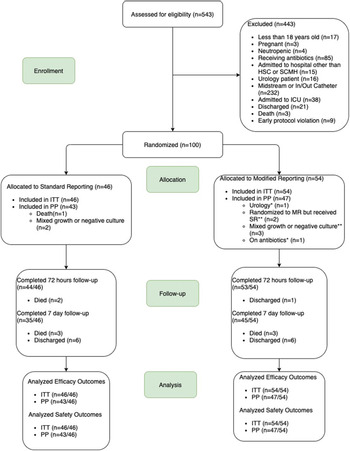
We assessed 543 consecutive positive urine cultures between November 6, 2019, and June 5, 2019; 443 did not meet inclusion criteria (Fig. 1). The 2 arms were comparable in mean age ± SD (standard report, 73.6 ± 13.9 years; modified report, 71.4 ± 13.1 years), proportion of CA-UTI (standard report, 26.1%; modified report, 22.2%), and proportion of CA-ASB (standard report, 71.4%; modified report,77.8%). The standard reporting arm had a lower proportion of females than the modified reporting arm (standard report, 39.1%; modified report, 51.9%) (Table 1).
Participant flow.
*Indicates recruitment error.
**Indicates laboratory error.

Patient Demographics

Note. SD, standard deviation; CA-UTI, catheter-associated urinary tract infection; CA-USB, catheter-associated asymptomatic bacteriuria.
Numbers analyzed
Overall, 100 specimens were randomized and included in ITT analyses. Furthermore, 46 samples were randomized to the standard reporting arm, and 54 samples were randomized to the modified reporting arm (Fig. 1).
Outcomes and estimation
Of 100 patients, 75 (75%) were diagnosed with CA-ASB and 25 (25%) with CA-UTI. Of these same 100 patients, 70 (70%) were treated with antibiotics. Of these 75 CA-ASB patients, 45 (60%) were treated, and all 26 CA-UTI patients (100%) were treated.
The proportion of appropriate treatment was higher in the modified reporting arm: ITT-MR was 57.4% and ITT-standard report was 50.0%, for an absolute increase of 7.4% (relative risk [RR], 1.15; 95% confidence interval [CI], 0.746–1.765) (Table 2).
Proportion of Appropriate Treatment

Treatment was given most often after urine collection (32 of 70, 45.7%), not after receiving the urine culture report (38 of 70, 54.3%) (Table 3). CA-UTI was treated earlier than CA-ASB in both study arms. Ciprofloxacin, nitrofurantoin, and ceftriaxone were the most commonly used antibiotics used in both study arms. Average treatment duration was similar in both study arms: ITT-MR showed a mean of 3.6 ± 3.6 days, ITT-SR showed a mean of 4.2 ± 4.4 days, PP-MR showed a mean of 3.5 ± 3.5 days, and PP-SR showed a mean of 4.3 ± 4.5 days.
Antibiotic Treatment Timing

Note. SR, standard report; MR, modified report; CA, catheter-associated; UTI, urinary tract infection; ASB, asymptomatic bacteriuria.
Ancillary analyses
Following the receipt of the modified report, a full report was requested in 18 (33.3%) of 54 cases using ITT analysis and 17 (36.1%) of 47 cases using PP analysis. Overall, 10 requests were received from physicians, 7 requests were received from nurses, and 1 request was received from a pharmacist.
Safety
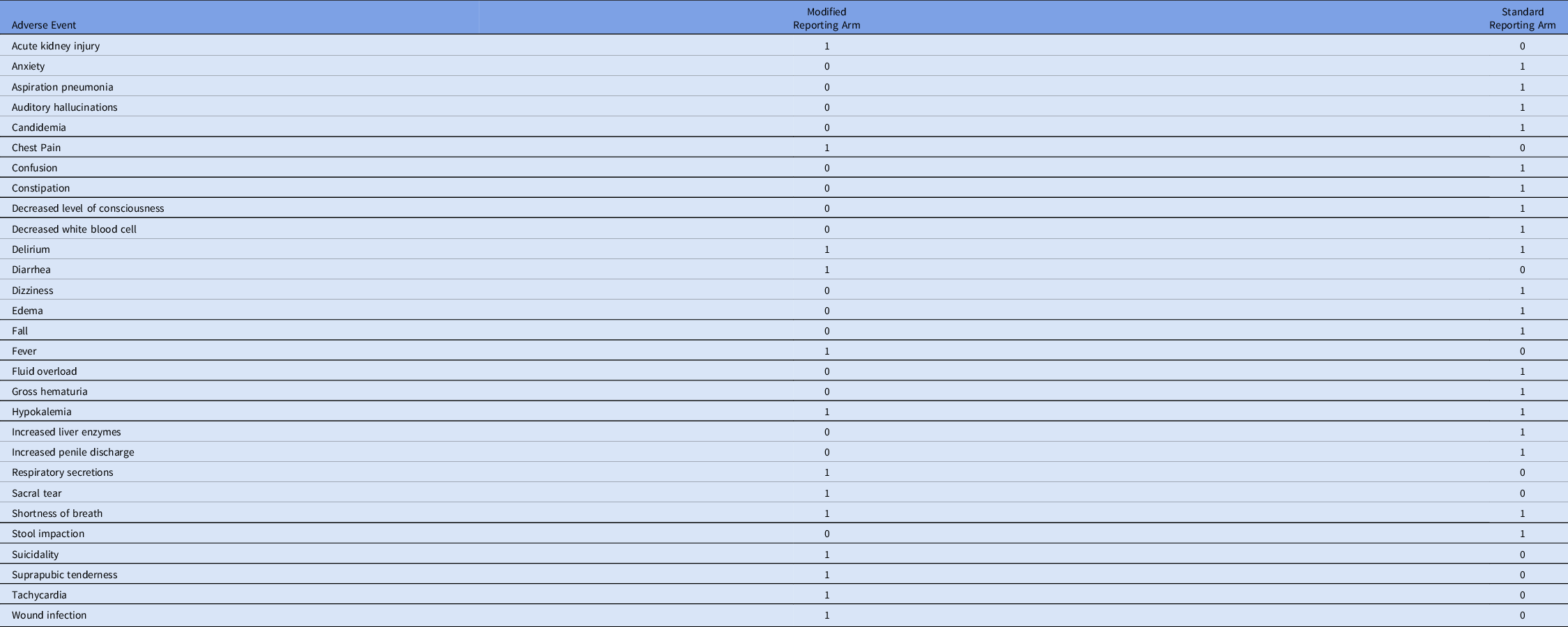
Our interim analysis revealed no significant differences in safety between groups (Table 4). There were no cases of untreated UTI in either study arm. There were 3 deaths in the standard reporting arm and 4 deaths in the modified reporting arm. No bacteremia cases occurred in the standard reporting arm, and 3 bacteremia cases occurred in the modified reporting arm. All positive blood cultures were collected at the time of urine culture collection, meaning that no new bacteremia cases were identified during patient follow-up. Each case of death and bacteremia was investigated independently by a physician, and none were related to the modified report. All deaths were reported to ethics. The occurrence of 2 or more SIRS criteria at 72 hours follow-up was more frequent in the modified reporting arm (24.1%) versus the standard reporting arm (17.4%; P = .414). Adverse events at 7 days were more common in the standard reporting arm: 19 of 46 (95% CI, 0.270–0.568) versus 16 of 54 (95% CI, 0.180–0.436) in the modified reporting arm. Adverse events varied across patients; however, delirium, hypokalemia, and shortness of breath were observed in both study arms (Table 5). There was no significant difference in adverse events at 7 days between the study arms (Table 4).
Safety

Note. ITT, intention to treat; PP, per protocol; SIRS, systemic inflammatory response syndrome; WBC, white blood cell count.
a Indicates 1-sided 97.5% confidence interval.
b SIRS criteria met if patient exhibited 2 or more of body temperature >38.3°C or <36°C, pulse >90/min, respirations >20/min, WBC count >12,000 or <4,000 cells per cubic millimeter of blood, altered mental status, significant edema or positive fluid, or hyperglycemia without diabetes.
Adverse Events at 7 Days

Discussion
We have demonstrated that modified urine-culture reporting has a higher proportion of appropriate treatment in the catheterized population, however not significantly, without a significant increase in adverse events. This finding agrees with the results of our previous study, which showed a significant improvement in appropriate treatment following the modified report.Reference Daley, Garcia, Inayatullah, Penney and Boyd2 The proportion of inappropriate treatment in both study arms was high: 22 (47.8%) of 46 in the standard reporting arm, and 23 (42.6%) of 54 in the modified reporting arm. These findings confirm that physicians continue to treat positive urine cultures without applying the diagnostic definitions, as seen in our previous study.Reference Daley, Garcia, Inayatullah, Penney and Boyd2 This behavior contributes to antibiotic overuse.
Of the urines included, most were collected from patients with CA-ASB and therefore should not have been collected. This finding reaffirms that the overordering of cultures is a significant issue in acute care.Reference Daley, Garcia, Inayatullah, Penney and Boyd2,Reference Jaeger, Waymack and Sullivan10,Reference Redwood, Knobloch, Pellegrini, Ziegler, Pulia and Safdar11 The overordering and treatment of positive culture results, rather than consideration of symptoms and physical examination findings, may be caused by a clinical bias toward treatment.
The proportion of inappropriate treatment in the modified reporting arm was much higher in the catheterized population compared to our previous study among noncatheterized inpatients (51.1% vs 25.7%, respectively), suggesting that treatment of catheterized patients may need improvement.Reference Daley, Garcia, Inayatullah, Penney and Boyd2 Most treatment was given at the time of receipt of urine culture report, suggesting that a modified reporting intervention occurs at the right time to influence many treatment decisions. Treatment duration was extremely variable in both groups (ranges, 1–21 days in the standard reporting arm and 1–13 days in the modified reporting arm). CA-UTI treatment guidelines recommend 7–14 days duration.Reference Hooton, Bradley and Cardenas12
There were no significant differences in safety between the standard reporting arm and the modified reporting arm, although our sample size was small. Thus, we cannot confidently say that modified report is fully safe in the catheterized population. The modified reporting arm had no cases of untreated CA-UTI, meaning that the risk of pyelonephritis due to the modified report was low.Reference Hooton and Gupta13 The modified reporting arm had a lower proportion of cumulative adverse events, and no case of death or bacteremia was caused by the intervention. The proportion of patients meeting SIRS criteria was higher in the modified reporting arm. SIRS criteria are nonspecific, are not solely indicative of CA-UTI, and may be caused by other medical problems, among older inpatients with comorbidities.Reference Boka9
Our findings indicate that further research using a modified report of urine culture may be justified.Reference Daley, Garcia, Inayatullah, Penney and Boyd2,Reference Leis, Rebick and Daneman5 The present study contributes to our previous findings that modified reporting improved treatment decisions in noncatheterized inpatients.Reference Daley, Garcia, Inayatullah, Penney and Boyd2 Modified reporting is an inexpensive and practical intervention that is easy to implement in a programmable laboratory information system.Reference Daley, Garcia, Inayatullah, Penney and Boyd2,Reference Leis, Rebick and Daneman5
Most studies reporting the impact of antimicrobial stewardship interventions use a quasi-experimental (before and after) design, but our study was a randomized control trial design, which reduced the risk of bias.Reference Leis, Rebick and Daneman5,Reference Langford, Leung and Haj14,Reference Maclaggan, Le and Iverson15 The lack of blinding of investigators would not influence treatment because investigators were not involved in treatment decisions. Previous research on the use of laboratory reporting interventions to improve treatment outcomes has been performed either in a noncatheterized population or including catheterized patients but using the modified report as part of a larger intervention.Reference Leis, Rebick and Daneman5,Reference Maclaggan, Le and Iverson15 The present study contributes to the gap between these studies by including only catheterized patients and using the modified report as the sole intervention. This research is important because it contributes to the assessment of the modified report as a generalizable intervention across acute-care patients. Outcome assessment used a standardized case report form, limiting the bias caused by lack of investigator blinding.
Our study has several limitations. Due to our narrow eligibility criteria, these findings are not generalizable to all catheterized acute care inpatients. Furthermore, other hospital settings may have different CA-ASB treatment patterns, and the intervention may have had more impact.
Investigators could not be blinded to diagnosis and treatment because this information was in the chart. Assessment of diagnosis was based on objective criteria, and assessment of treatment was objective; however, the lack of blinding may have biased our conclusions.
The follow-up duration was too short to assess late adverse events. Randomization was partly successful; however, more women were randomized to the modified report than the standard report, which could have been adjusted for in our analysis.
Inconsistencies in charting may have created an interpretation bias toward the diagnosis of CA-ASB because symptoms were recorded from progress notes. The presence of a catheter was confirmed by telephone discussion with the nurse.
The calculated sample size was based on the available data from a single randomized controlled trial with the same design. This approach led to an underpowered study (power, 12%), due to a smaller observed effect size compared to the previous study. The a priori sample size assumptions may not have been suitable for the catheterized population.
Furthermore, this study was implemented in the same sites as the previous study, so physicians and nurses may have been familiar with the intervention. The present study proceeded without the involvement of the urology department by their request following the previous study published in 2018, which may have biased patient selection.
Study patient retention was high, with minimal loss to follow-up due to discharge or death during the 7-day follow-up. A small number of protocol errors occurred (eg, urine culture result changed after randomization, randomization not followed, recruitment of ineligible patients). However, ITT and PP analyses reached the same conclusion, which indicates that these errors did not significantly impact our results.
With these limitations in mind and the lack of evidence in laboratory AMS interventions, we recommend further trials of laboratory reporting interventions, using a larger sample size and a more inclusive population. Interventions should target early time points during treatment decision making. A qualitative study exploring physician attitudes toward antibiotic use, stewardship, and participation in clinical trials may be helpful in shaping future AMS initiatives.
Acknowledgments
We thank the staff of the Public Health Microbiology Laboratory for identification of eligible specimens and assistance with modified reporting.
Financial support
No financial support was provided relevant to this article.
Conflicts of interest
All authors report no conflicts of interest relevant to this article.