Anxiety represents one of the most common problems reported in youth, occurring as various different subtypes including generalized, panic, social, and separation anxiety. Prevalence rates fall between 2.4 and 8.3%, with subthreshold symptoms affecting up to 16.5% of this age group (Costello, Mustillo, Erkanli, Keeler, & Angold, Reference Costello, Mustillo, Erkanli, Keeler and Angold2003; Lewinsohn, Shankman, Gau, & Klein, Reference Lewinsohn, Shankman, Gau and Klein2004). Anxiety symptoms not only impair academic, social, and family functioning (Langley, Bergman, McCracken, & Piacentini, Reference Langley, Bergman, McCracken and Piacentini2004), but they may also lay the foundation for later adult psychopathology (Gregory et al., Reference Gregory, Caspi, Moffitt, Koenen, Eley and Poulton2007; Pine, Cohen, Gurley, Brook, & Ma, Reference Pine, Cohen, Gurley, Brook and Ma1998). For example, adult patterns of anxious behavior have been traced to complex interactions among risk factors occurring at earlier stages of development, which may lay the foundation for a longer lasting diathesis (Gross & Hen, Reference Gross and Hen2004). Understanding the mechanisms by which pediatric anxiety symptoms manifest is thus crucial for developing effective treatments for their prevention in youth and planning earlier interventions to what may be a lifelong illness.
Risk for anxiety symptoms has been studied at various levels, from genes to the external environment. A consistent body of research implicates moderate genetic effects on anxiety phenotypes assessed in childhood and adolescence, with the remainder of the variance because of moderate shared (family general) and large nonshared (individual specific) environmental influences (Gregory & Eley, in press). Findings of the importance of the environment are consistent with psychosocial studies reporting the role of acute life events as putative environmental precipitants of anxiety symptoms (Finlay-Jones & Brown, Reference Finlay-Jones and Brown1981). Despite progress quantifying and identifying these factors, less is known about how these risks are expressed. Recent studies have found interactions between genetic and environmental factors (gene–environmental interactions [G × E]) on a number of developmental conditions, such that the effect of one variable varies across levels of another variable. What these results imply is that the expression of genetic risk on a condition may be modified by exposure to certain environmental conditions, and/or that genetic risks are expressed by altering susceptibility toward environmental stressors. Such concepts are not entirely unfamiliar to existing theories of developmental psychopathology, which have long sought diathesis–stress theories as explanations of the mechanisms by which latent predispositions are expressed in the face of environmental adversity. Anxiety in particular has been conceptualized by a number of theoretical perspectives as a maladaptive response to acute environmental stress (e.g., Gray, Reference Gray1982). Where theories differ, however, is in the nature of the vulnerability factors that account for the greater responsiveness to stress among anxious individuals. Whereas some have highlighted neural abnormalities (Gray, Reference Gray1982), others implicate information-processing biases (Vasey, Dalgleish, & Silverman, Reference Vasey, Dalgleish and Silverman2003). To the extent that these aspects of vulnerability reflect inherited risks, the presence of these diathesis–stress factors allows inferences to be drawn on the presence of G × E on anxiety-related conditions. Conversely, positive findings of G × E in anxiety can also be used to infer the nature of intermediate risk mechanisms (through diathesis–stress) by which genetic and environmental risks are expressed. In summary, the study of G × E on behavioral conditions such as anxiety is both compatible with and can extend current theories of developmental psychopathology by shifting from recognition of risk “markers” to risk “mechanisms.”
A growing literature implicates G × E in adolescent depression (Eaves, Silberg, & Erkanli, Reference Eaves, Silberg and Erkanli2003; Eley et al., Reference Eley, Sugden, Corsico, Gregory, Sham and McGuffin2004; Silberg, Rutter, Neale, & Eaves, Reference Silberg, Rutter, Neale and Eaves2001); notably, fewer studies explore anxiety-related traits. This dearth of research is particularly surprising given that anxiety and depressive symptoms have been found to share a common genetic basis (Eley & Stevenson, Reference Eley and Stevenson1999), and moreover, that this genetic liability may be associated with variation in the serotonin transporter gene (Lesch et al., Reference Lesch, Bengel, Heils, Sabol, Greenberg and Petri1996), known to moderate responses to stress (Eley et al., Reference Eley, Sugden, Corsico, Gregory, Sham and McGuffin2004; Fox et al., Reference Fox, Nichols, Henderson, Rubin, Schmidt and Hamer2005). The few available findings of anxiety emerge from both quantitative and molecular approaches. Twin analyses have shown that the presence of genetic risk for anxiety symptoms enhanced sensitivity toward negative life events in adolescent females (Eaves et al., Reference Eaves, Silberg and Erkanli2003; Silberg et al., Reference Silberg, Rutter, Neale and Eaves2001). Furthermore, heritability estimates for anxiety symptoms were larger among individuals who had reported life events than individuals who reported no life events, indicating environmental moderation of genetic effects (Silberg et al., Reference Silberg, Rutter, Neale and Eaves2001). Although the convergence of these studies on the same conclusion is noteworthy, these studies relied on data from the same sample restricted to adolescent females only. The third study, adopting a molecular genetic approach, also found a significant interaction between a specific DNA variant located in the serotonin transporter gene and maternal levels of social support on behavioral inhibition in middle childhood (Fox et al., Reference Fox, Nichols, Henderson, Rubin, Schmidt and Hamer2005). Among children receiving less maternal support, risks associated with the short allele of the genetic variant on behavioral inhibition were greater. As this temperamental construct is associated with risk for later anxiety disorders, this result may reflect G × E on anxiety operating at an earlier stage of development.
Given a theoretical context for expecting G × E on child and adolescent anxious phenotypes, the paucity of data attesting to this underscores the need for further exploration. As such, the first goal of the current study was to confirm and replicate findings of G × E on anxiety symptoms. Beyond this, we also wanted to extend prior findings by addressing two further issues relating to the nature of G × E on anxiety. Specifically, we aimed to assess whether the expression of G × E differed across developmental periods (childhood vs. adolescence or within each of these periods) and across specific anxiety symptom types. Consideration of these two questions is driven by previous findings of differences in the importance of risk factors on anxiety across development and across symptom types.
The transition from childhood to adolescence is marked by turbulent changes in biological (e.g., gene expression, brain maturation), cognitive (e.g., information processing, cognitions), and social (e.g., increasing salience of peers over the family) domains. Such critical changes warrant adopting a developmentally sensitive framework when considering risk mechanisms on psychopathology. In terms of specific changes relating to genetic and environmental influences, there is preliminary evidence that indicates subtle differences in the levels of these factors across development. Studies testing for age effects find larger genetic but reduced shared environmental effects operating on anxiety in adolescence than middle childhood (Eley & Stevenson, Reference Eley and Stevenson1999; Feigon, Waldman, Levy, & Hay, Reference Feigon, Waldman, Levy and Hay2001; Topolski et al., Reference Topolski, Hewitt, Eaves, Silberg, Meyer and Rutter1997). Parallel to these findings, longitudinal data have found evidence for both “stable” genetic (and shared environmental) factors influencing the continuity of symptoms across time and “age-specific” genetic (and shared environmental) factors emerging at certain time points (Topolski et al., Reference Topolski, Hewitt, Eaves, Meyer, Silberg and Simonoff1999; van der Valk, van den Oord, Verhulst, & Boomsma, Reference van der Valk, van den Oord, Verhulst and Boomsma2003). Interpreting these findings within the broader literature of developmental change suggest that risks are not static, but instead, dynamically unfold across development. As such, any interplay between genetic and environmental influences may also be expected to differ across age, possibly giving rise to the observed biological, cognitive, and social changes.
Given nosological differences across anxiety subtypes, uniformity in the emergence of G × E on these symptom types can also not be assumed. This is particularly pertinent given distinct physiological and psychological factors on each of these symptoms. Although there are some commonalities across symptom types such as biased attention for threat, there are also specific appraisal biases associated with symptom types (for a review, see Pine, Reference Pine2007). For example, individuals with separation and panic anxiety symptoms are more likely to exhibit appraised threat when faced with respiratory stimuli, such as exposure to CO2-enriched air relative to both healthy counterparts and subjects with social anxiety (Pine, Klein, Roberson-Nay et al., Reference Pine, Klein, Roberson-Nay, Mannuzza, Moulton and Woldehawariat2005). In comparison, adolescents with social anxiety report greater threat responses to social stimuli, such as when asked to evaluate internal levels of fear to emotional facial expressions (Pine, Klein, Mannuzza, et al., Reference Pine, Klein, Mannuzza, Moulton, Lissek and Guardino2005). Although separation and panic anxiety can be placed in a distinct category from social anxiety, individuals with general anxiety may be less specific in responsiveness to types of threat. In terms of genetic and environmental contributions, heterogeneity has also been reported for different adult syndromes (e.g., Hettema, Prescott, Myers, Neale, & Kendler, Reference Hettema, Prescott, Myers, Neale and Kendler2005) as well as pediatric anxiety symptom types (Eley et al., Reference Eley, Bolton, O'Connor, Perrin, Smith and Plomin2003; Feigon et al., Reference Feigon, Waldman, Levy and Hay2001; Topolski et al., Reference Topolski, Hewitt, Eaves, Silberg, Meyer and Rutter1997). Moreover, although genetic and environmental factors on anxiety symptom types are strongly correlated with one another, they do not necessarily reflect a common set of shared factors (Eley et al., Reference Eley, Bolton, O'Connor, Perrin, Smith and Plomin2003). These findings carry the implication that risks, including G × E may be differentially expressed on different anxiety subtypes.
On the basis of these findings, we explored three issues. First, we investigated G × E in different age groups using data from two community studies of childhood and adolescence. Specifically, across these age groups, we examined whether genetic risks for anxiety varied as a function of negative life event exposure. Second, given longitudinal data, we differentiated between stable genetic effects that influence continuity of symptoms across time from age-specific genetic effects that uniquely influence anxiety at a certain time point. Assessing the extent to which each of these genetic components is moderated by negative life events allows inferences on the continuity of G × E across time (indexed by moderation of the stable factor) or whether G × E emerges at a specific age (indexed by moderation of the age specific factor). Third, we repeated these analyses across the different anxiety symptom types, thus seeking similarity in etiological risk mechanisms between them.
Method
Sample
Data from two different longitudinal twin studies, The Emotions, Cognitions, Heredity and Outcome (ECHO) and G1219 studies, comprised the child and adolescent samples, respectively. Both studies are based at the Institute of Psychiatry and have been given ethical approval by the Research Ethics Committee of the Institute of Psychiatry, Kings College, London, and South London and Maudsley NHS Trust. The ECHO study consists of 300 twin pairs who were selected from a larger ongoing longitudinal sample of twins born in England and Wales during 1994–1996, which is known as the Twins Early Development Study (TEDS; Trouton, Spinath, & Plomin, Reference Trouton, Spinath and Plomin2002). At Wave 1, 247 8-year-old twin pairs were selected from TEDS using an extremes design, that is, on the basis of high scores on parent-reported anxiety at age 7. A random selection of 53 control twin pairs was also chosen to ensure coverage of the full range of scores on test measures (see Gregory, Eley, & Rijsdijk, Reference Gregory, Eley and Rijsdijk2006, for details). This design maximizes power and ensures inclusion of children with high levels of emotional symptoms. Because 11 families were considered unusable at Wave 1 because of autistic spectrum disorders, severe receptive language impairments, and persistent attention problems in at least one of the twins, only 289 families were contacted at Wave 2 approximately 2 years later. Of these, 250 families (87%) agreed to participate. Data collection for ECHO took place at the Institute of Psychiatry with a small number of families visited in their homes. Written informed consent was obtained from parents of all twins.
The initial contact (Wave 1) for the G1219 study consisted of an invitation to complete a short depression measure, and the sample was recruited through two sources (see Lau & Eley, Reference Lau and Eley2006, for details). The first were the adolescent offspring (ages 12–19 years) of adults (including nontwin sibling pairs) from a large-scale population-based study; of these families, 40% responded either to our study or one targeting younger children. The second was a random selection of twin pairs born between 1985 and 1988, 47% of which responded at Wave 1. In total, twins and siblings from 1,820 families took part at Wave 1. Wave 2 questionnaires were completed approximately 8 months (range = 0–2 years) after Wave 1 by 2,651 individuals from 1,372 families (73% of Wave 1 sample), whereas Wave 3 questionnaires were returned approximately 25 months (range = 1–4 years) after Wave 2 by 1,597 adolescents from 824 families (44% of the original sample at Wave 1). Informed consent was obtained from parents of adolescents under 16 and from adolescents themselves when over 16.
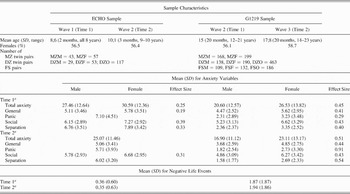
Demographic characteristics of each sample at each time point are presented in Table 1. Both samples were of higher than average socioeconomic status (SES). For example, in ECHO 60% of mothers and 53% of fathers and in G1219 39% of parents (mother or father) were educated to A-level (school leaving exams at age 18 years) compared to 32% in a large nationally represented sample of parents (Meltzer, Gatward, Goodman, & Ford, Reference Meltzer, Gatward, Goodman and Ford2000). It should be noted, however, that this sample may contain somewhat older parents than ours, particularly those of the ECHO sample who had fairly young parents. Zygosity in each study was established through parent-reported questionnaire measure assessing physical similarity between twins. These scales have accuracy rates of over 90% when discriminating between monozygotic (MZ) and dizygotic (DZ) pairs (e.g., Goldsmith, Reference Goldsmith1991). Ambiguity in determining zygosity was resolved using highly polymorphic DNA markers. Final classifications are also shown in Table 1.
Sample characteristics, and means and standard deviations of anxiety and life event variables in child (ECHO) and adolescent (G1219) participants

Note: Ages are in years;months. MZ, monozygotic; DZ, dizygotic; FS, full sibling; M, male; F, female.
aTime 1 refers to data from ECHO Wave 1 but G1219 Wave 2; Time 2 refers to data from ECHO Wave 2 but G1219 Wave 3.
Two sources of response bias characterized each sample, warranting the use of a weighting system to adjust parameter estimates to allow population inference of results. A weight that controlled for bias associated with ascertainment across waves (oversampling of symptomatic children in ECHO) as well as bias associated with attrition (individuals with mothers reporting higher levels of emotional symptoms and who experienced greater negative life events were less likely to participate) was constructed for ECHO analyses. This used the ratio of the selection probability of high symptom families to that of nonsymptom control families and the inverse of the predicted probability of families remaining at Wave 2 using significant predictors. For G1219, because of initial response biases (where individuals whose parents had somewhat higher levels of education and were more likely to own their own houses were more likely to respond) and attrition biases at Waves 2 and 3 (where being female, reporting lower levels of self-reported delinquent behavior, and having parents with higher educational qualifications and who owned their own homes predicted response), three separate weights were made and multiplied to create a single variable. The sample was first reweighted to match the distribution of educational qualifications in a nationally representative sample of parents (Meltzer et al., Reference Meltzer, Gatward, Goodman and Ford2000). Next, two response weights from the inverse of the predicted probability of families remaining in the study at Waves 2 and 3 were constructed using significant predictors. Weighting effectively involves assigning lower weights to individuals from categories overrepresented and higher weights to individuals from categories underrepresented in the sample relative to the population distribution.
Measures
We used measures collected from Waves 1 and 2 of ECHO (child study) and from Waves 2 and 3 of G1219 (adolescent study). To minimize confusion of these different labels, we refer subsequently to data collected at the first time point of both studies as Time 1 and to data collected at the second time point as Time 2. We collected data on anxiety symptoms and life events at both time points in each sample. Anxiety measures from both samples were self-reported. As different measures of anxiety were used across samples, only subscales that were commonly assessed in both were used: general, panic, social, and separation anxiety. Life events were reported by parents of ECHO (child) participants and self-reported by G1219 (adolescent) participants. As gene–environment correlation, which refers to genetic influences on environmental measures, may potentially confound effects associated with G × E, we only used negative life events that were hypothesized to reflect minimal heritability. This resulted in only using items that were considered “independent” (e.g., death of a parent), that is, not arising as a consequence of an individual's own behavior.
Screen for Child Anxiety Related Emotional Disorders (SCARED; ECHO child study)
The SCARED (Birmaher et al., Reference Birmaher, Khetarpal, Brent, Cully, Balach and Kaufman1997) is a 41-item form that screens for DSM-IV childhood anxiety disorders including panic, general, separation, social, and school anxiety. We used the child but not parent version of this scale. In this version, the child rates the severity of symptoms in the past 3 months from 0 to 2 (0 = not true, hardly ever true, 1 = sometimes true, 2 = true or often true). Items can also be summed as a total score of anxiety or as five individual subscales. The psychometric properties of the SCARED have been extensively reviewed (Birmaher et al., Reference Birmaher, Khetarpal, Brent, Cully, Balach and Kaufman1997, Reference Birmaher, Brent, Chiappetta, Bridge, Monga and Baugher1999; Monga et al., Reference Monga, Birmaher, Chiappetta, Brent, Kaufman and Bridge2000), with high internal consistency (α = .90 for the total score, α = .78–.87 for individual factors) and moderate to high test–retest reliability (.60–.90). It discriminates well between anxiety disorders and nonanxiety psychiatric disorders, such as disruptive and depressive disorders, and subscale scores further differentiate between specific anxiety subtypes. The SCARED also correlates well with the State-Trait Anxiety Inventory for Children (r = .73) and the internalizing scale of the Child Behavior Checklist (r = .61). Internal consistency of the SCARED in the current sample was comparable to published statistics: α = .88 and .90 at each time point, and α = .63–.75 and .74–.77 for individual subscales used in these analyses.
Spence Children's Anxiety Scale (SCAS; G1219 adolescent study)
The SCAS (Spence, Reference Spence1997) is a 47-item self-report measure of anxiety with items assessing separation anxiety, social phobia, panic, generalized anxiety disorder, obsessive–compulsive disorder, and fears of physical injury. The child rates the frequency with which items are experienced on a 4-point scale (never, sometimes, often, always). Items can be summed as a total score or as six individual subscale scores. The SCAS has high internal consistency (α = .92 for the total score, α = .60–.73 for individual factors), and acceptable test–retest reliability (.45–.57) over a 6-month period (Spence, Reference Spence1998). The SCAS discriminates well between children with clinical anxiety versus healthy controls and correlates highly with the Revised Children's Manifest Anxiety Scale (Spence, Reference Spence1998). Internal consistency of the SCAS in the current sample at each time point was .91 (.67–.77 for individual subscales used here) and .87 (.50–.78 for individual subscales used here).
Life events checklist (ECHO child study)
Eleven events were selected from the Life Event Scale for Children (LES-C; Coddington, Reference Coddington and Humphrey1984). These included 10 negative events and 1 positive event that were judged to involve the most stress and the longest time needed for readjustment. Parents indicated whether each event had occurred to their child in the last 6 months. This was completed for each twin separately. All 10 negative events were considered independent and summed to create a total negative events scale. Psychometric properties of this scale have been performed for the entire scale of the LES-C only (Coddington, Reference Coddington and Humphrey1984). This showed adequate test–retest reliabilities for 3- and 7-month intervals and reasonable content validity, whereby in 84.4% of administrations of the checklist to parents, no “other” events were added. However, there have been reports of low agreement between child and parent reports of life events with children reporting on average fewer events. Given that most items in the current scale were objective events of a severe nature (e.g., death of a sibling) parent reports were likely to be accurate.
Negative life events (G1219 adolescent study)
The Life Event Scale for Adolescents (Coddington, Reference Coddington and Humphrey1984) is a checklist of 50 events, whose occurrences are judged to require some degree of social readjustment by an individual. Twenty-four are negative events. Twelve of these are considered independent events and were summed to make a total negative events scale. Psychometric testing shows adequate test–retest reliabilities at 0.69 and 0.67 for a 3- and 7-month interval for both negative and positive events (Coddington, Reference Coddington and Humphrey1984).
Statistical analyses
Descriptive statistics, univariate genetic models, and models of G × E on longitudinal data were performed separately for total anxiety and anxiety subscale scores across time points in ECHO (child) and G1219 (adolescent) samples using Mx Software (Neale, Reference Neale1997). This software is a widely used statistical package for the analysis of genetically informative data. It can control for nonindependence of data from family members and can incorporate sampling weights into all descriptive and model-fitting analyses.
Descriptive statistics were tested by fitting saturated models that estimate the variance, covariance, and means of all variables. Mean gender and zygosity differences on variables were ascertained by comparing a model that estimates separate means for males and females (or among MZ, DZ, and full siblings), with a submodel that constrains these means to be the same across the whole sample. Group differences are reflected by significant deviations in model fit associated with these different models. As these models also estimate the covariance between variables from Twin 1 and variables from Twin 2, shared variance between family members is controlled for in these statistics.
Genetic (a 2), shared environmental (c 2), and nonshared environmental (e 2) effects were estimated in univariate genetic models through comparisons of within-pair similarity among MZ twins, who share 100% of their genetic makeup, and DZ twins (and/or full siblings [FS]), who share on average 50% of segregating genes. Higher MZ compared to DZ similarity is attributed to increased genetic resemblance among MZ twins and used to estimate heritability (a 2). Within-pair similarity not because of genetic factors is assigned as shared environmental variance (c 2) contributing toward resemblance among individuals in the same family. Finally, nonshared environmental influences (e 2), or individual-specific factors, create differences among individuals from the same family and are estimated from within-pair differences between MZ twins, that is, the difference between MZ twin correlations and 1. This term also includes measurement error. These parameter estimates can be specified to vary across males and females to test for gender differences in variance components.
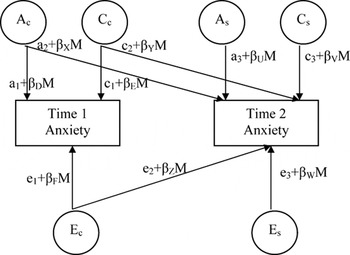
Moderation of stable and “new” genetic factors by negative life events was tested through bivariate models of G × E. Cholesky decomposition of two variables parameterizes their covariance into “common factors” (A 1, C 1, E 1) that influence both variables, and “unique factors” (A 2, C 2, E 2) specific to the second variable only (Figure 1). Applying this model to longitudinal anxiety data at two time points allows examination of a stable genetic factor (the common factor, A 1) contributing to anxiety at both time points, and thus the continuity of symptoms across time, and an age-specific genetic factor (the unique factor, A 2) that only emerges at Time 2. Similar principles for stable and age-specific effects also apply to common and unique shared and nonshared environmental factors (C 1, C 2 and E 1, E 2).
Bivariate Cholesky decomposition of Time 1 and Time 2 anxiety, incorporating interaction coefficients that index the extent to which paths from common (stable) and specific (new) factors are moderated by an environmental moderator (negative life events).

Interaction coefficients can be incorporated into this model by redefining each path as a linear function of a “moderator” variable (Purcell, Reference Purcell2002). Thus, the path representing common genetic effects (Ac) on Time 1 anxiety (a 1) can be reexpressed as a 1 + βDM where a 1 reflects “main” genetic effects, and βD reflects moderation effects by the moderator variable M. Given that our moderator variable is negative life events, the significance of βD indicates whether genetic effects on Time 1 anxiety symptoms vary significantly across environmental risk levels, thus testing for linear G × E on anxiety symptoms at this time point. Interactions between common genetic effects and negative life events on Time 2 anxiety can be similarly tested by reexpressing the path a 2 as a linear function of negative life events: a 2 + βXM. As this path represents effects of the common genetic factor shared between Time 1 and Time 2 anxiety, the significance of βX can be interpreted as environmental moderation of stable genetic effects on Time 2 anxiety. Finally, the interaction between specific genetic effects (As) and negative life events on Time 2 anxiety is tested by significance of the beta term in a new algebraic expression, a 3 + βUM, and interpreted as moderation of age-specific genetic effects.
The same principles of algebraic expression and interpretation were also applied to common and unique shared and nonshared environmental factors (Figure 1). Estimating the moderation of specific nonshared environmental effects on Time 2 anxiety also forms a crucial test of G × E. As this nonshared environmental component includes any residual error variance, estimating interaction with the moderator ensures that positive results of G × E cannot be explained purely by increasing error variance at higher levels of risk (heteroscedasticity). Negative life events assessed at Time 1 was used as the environmental moderator of genetic effects on Time 1 anxiety, whereas negative events measured at Time 2 was used as the moderator of genetic paths to Time 2 anxiety.
Model fit is the extent to which estimated parameters reflect observed statistics and was indexed by a chi square, the Akaike information criterion (AIC), and root mean square error of approximation (RMSEA). Lower chi-square values, more negative AIC values, and RMSEA values below 0.10 generally indicate good fit and parsimony (models with fewest estimated parameters). The RMSEA is generally a more sensitive indicator of fit in models performed on data from large sample sizes; however, when the number of degrees of freedom exceeds the chi-square value, the RMSEA cannot be calculated. In such models, the low chi-square value sufficiently demonstrates good fit. All fit statistics are derived through comparisons of log-likelihood (−2LL) statistics generated from raw data models and those from saturated models. Gender differences in means were included in all models. Because of a smaller sample size and decreased power, gender differences in genetic and environmental variance components were not examined in the ECHO sample. We examined gender differences in univariate models of the G1219 sample but because of the complexity of bivariate models of G × E, additional terms reflecting gender-specific effects could not be implemented. Significance of interactions in these models was tested by dropping coefficient terms from the model while assessing changes in the chi-square value. All models were fit to standardized data, from which mean effects of age were regressed.
Results
Descriptive analyses
Table 1 presents means and standard deviations of full anxiety symptom and subscale scores and negative life events. Where males and females reported significantly different levels of anxiety symptoms, separate means as well as effect sizes to index the magnitude of these differences are displayed. Although all adolescent anxiety variables and approximately half of child variables showed significant mean gender differences, large sample sizes warrant consideration of effect sizes as well as significance levels per se. The majority of these differences reflected small to medium effects (0.19–0.67), with only one constituting a large effect: adolescent females reported more panic symptoms compared to their male peers at Time 2. No mean differences in anxiety variables associated with zygosity emerged. Males and females did not differ in the number of negative life events in either sample.
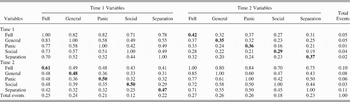
Intercorrelations among Time 1 and Time 2 anxiety variables are presented in the four main quadrants of Table 2. The top left and bottom right quadrants show correlations among anxiety variables at Time 1 and Time 2, respectively. Figures appearing above the central diagonal (containing values of 1.0) are for child data, whereas the same information for the adolescent data is presented below the central diagonal. Correlations among anxiety variables at the same time point vary between 0.42 and 0.82 for Time 1 and 0.42 and 0.84 for Time 2 child data. Corresponding correlations among anxiety variables for adolescent data range from 0.44 to 0.83 for Time 1 and 0.45 to 0.85 for Time 2. Correlations between anxiety variables across time are shown in the top right and bottom left quadrants for child and adolescent data, respectively. The cross-time stability of each anxiety variable is presented in bold in Table 2. Adolescent anxiety variables showed somewhat greater stability over time (0.47–0.61) than child variables (0.29–0.42).
Intercorrelations between anxiety variables and life events

Note: Values above and below the diagonal are for child (ECHO) and adolescent (G1219) participants, respectively. Correlations reflecting cross-time stability of each anxiety variable are in bold.
Correlations between anxiety variables and negative life events for ECHO child and G1219 adolescent data appear in the last row and column, respectively. Correlations were estimated within each time point only; thus, figures represent correlations between Time 1 anxiety variables and Time 1 negative life events, and Time 2 anxiety variables and Time 2 negative life events. There were stronger relationships between anxiety variables and negative life events in adolescents (0.12–0.27, last row in Table 2) than in children (0.01–0.11, last column in Table 2). Given the wide age range of the G1219 cohort, age trends were studied further in this sample: no significant relationships emerged between age and Time 1 or Time 2 full scale anxiety scores (r = −.04 for both) or between age and negative life events (r = −.004 and .05, respectively).
Univariate genetic models
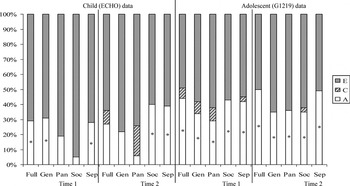
Genetic, shared environmental, and nonshared environmental variance components estimated from univariate models on full anxiety and individual subscale scores in children and adolescents are shown in Figure 2. Heritability of anxiety symptoms in adolescence ranged from 29 to 50%. For children, the range was smaller, falling between 5 and 40%, with only separation anxiety significant at both time points. Although genetic effects on some adolescent anxiety variables appeared somewhat greater than child variables, these differences did not reach significance, as indicated by overlapping confidence intervals. Shared environmental variance was nonsignificant on all variables. Nonshared environment on anxiety variables were significant and similarly substantial in both samples at both time points. Variation in parameter estimates on adolescent full anxiety and separation anxiety scores at both time points emerged between males and females, but because of the complexity of models of G × E, additional terms reflecting gender-specific effects in variance components could not be implemented. Further details on fit statistics, confidence intervals, and variations in parameter estimates by gender are available upon request.
Genetic (a 2), shared environmental (c 2), and nonshared environmental (e 2) variance components estimated from univariate models on full anxiety and individual subscale scores in children and adolescents at Time 1 and Time 2.

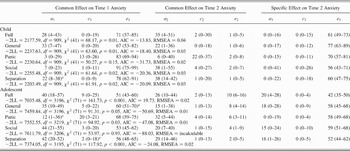
Bivariate models of G × E
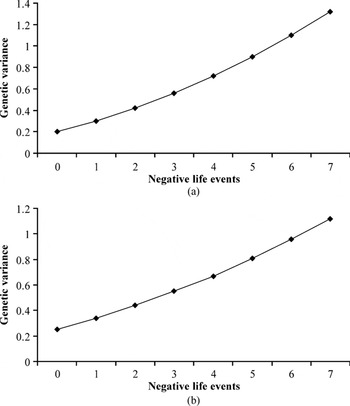
Fit indices and parameter estimates derived from bivariate models are presented in Table 3. Good fit was obtained on all variables. Where a genetic and/or environmental parameter varied significantly as a function of negative life events, that is, a significant interaction effect is highlighted in bold. Where there were no significant interaction effects, main genetic and environmental effects on the anxiety variable are presented. Negative life events significantly moderated genetic effects on Time 1 separation anxiety symptoms in childhood and Time 1 panic anxiety symptoms in adolescence. To illustrate these significant interactions, genetic variance of the particular anxiety variable at each level of the negative events scale was calculated using interaction coefficients and plotted visually in Figure 3a and b. For both symptom types genetic variance increased across negative life events. This implies that the increased phenotypic variance seen at the extremes of environmental risk may be driven by genetic differences.
Plots of the genetic variance on (a) Time 1 separation anxiety symptoms in childhood across levels of independent negative life events and (b) Time 1 panic anxiety symptoms in adolescence across levels of independent negative life events.

Bivariate models of Time 1 and Time 2 anxiety data in children and adolescents

Note: Paths significantly moderated by negative life events are in bold. LL, log likelihood; AIC, Akaike information criterion; RMSEA, root mean square error of approximation.
aThis variance component increased across levels of negative life events.
Negative life events also significantly moderated shared environmental variance on adolescent separation anxiety symptoms at Time 1, and nonshared environmental variance on adolescent general anxiety symptoms at Time 1. Calculating these environmental variance components across levels of negative life events also revealed greater variance at the extremes (graphs are available from the authors upon request).
Discussion
The current study examined the presence of G × E on child and adolescent anxiety symptoms by assessing the extent to which genetic risks varied across negative life events. Three main findings emerged. First, consistent with G × E, we found that genetic variance on separation anxiety symptoms in childhood (mean age = 8 years, 6 months) and panic anxiety symptoms in adolescence (mean age = 15 years) increased across higher levels of negative events. This implies that greater phenotypic variance at the extremes is driven mainly by genetic differences. Second, in comparison to these positive findings, we found no support for environmental moderation of genetic effects on full anxiety symptom scores, general anxiety, or social anxiety symptom types. Third, larger shared and nonshared environmental variance on adolescent separation and general anxiety symptoms respectively was also found at Time 1 (mean age = 15 years).
Existing studies of G × E on anxiety have focused on trait or general anxiety symptoms in adolescence, or temperamental precursors of anxiety such as behavioral inhibition in childhood. Moreover, these studies are typically conducted using data from a single time point. The current study possesses three unique features: assessment of G × E in different aged samples, examination of the emergence of G × E across time and distinction of various anxiety symptom types. Interpretations of our results can thus be discussed in the context of G × E on anxiety in general, but also its role on early separation and later panic anxiety in particular. Nevertheless, several caveats of the study design also caution against drawing strong conclusions from these preliminary findings, prior to further replication.
The first limitation arises from the exploratory nature of our statistical approach. We adopted this given the paucity of studies examining G × E in pediatric anxiety, coupled with the low statistical power on tests of interactions. Specifically, we relied on an alpha of 0.05, without further correction for multiple tests of data from different samples and time points. In light of this relatively liberal threshold, our findings should be viewed as preliminary and suggestive of patterns worthy of replication. This point becomes more salient, in view of the fact that of the two positive findings of G × E, these were only demonstrated at one time point but not the other. Although this may reflect a “true” finding in which G × E emerges at a specific developmental stage, it could also plausibly indicate a false positive finding of G × E at the first time point or a false negative finding of G × E at the second time point.
A second limitation relates to differences in the study design of our two developmental age groups, precluding definitive developmental comparisons. One of these was the different scales used in each age group. As a result, the convergence of underlying constructs assessed by each scale cannot necessarily be assumed. A second source of difference was the variability of age in each sample. In the child sample, all subjects fell in the same year group (8 years at Time 1 and 10 years at Time 2), and were thus comparable in terms of developmental stage. In contrast, adolescent participants ranged from 12 to 19 years at Time 1 and 14 to 23 years at Time 2. This large age range at each time point makes it difficult to attribute the emergence of developmental influences to specific ages or stages of development. Thus, conclusions of when G × E becomes effectual during development are based tentatively on the mean age of the sample at a particular wave of data collection. Nevertheless, it is worth noting that we found similar patterns of trajectory in the emergence of new and stable genetic and environmental factors across adolescence and in the transition to young adulthood in this sample (Lau & Eley, Reference Lau and Eley2006).
A third set of limitations pertains to measurement. First, we assessed anxiety symptoms using questionnaire measures within nonclinical subjects. Thus, generalizing findings to anxiety disorders should be cautious. Second, measurement of negative life events by a “count” of recent events is also problematic and may reflect oversimplistic depictions of social adversity. Because these checklists rely on the presence or absence of an event, they may reflect more “objective” measures of life events, minimizing recall biases. However, more subjective elements of detailed assessments, such as contextual ratings of severity and personal appraisals, are omitted. Including these moderators of stress could under- or overestimate the impact of the negative event on anxiety. Furthermore, because of potential confounds with gene–environment correlation our analyses ignored risks from dependent events. A final issue over assessment of life events is that of the general set of stressors selected, some may not be specifically associated with anxiety. Moderate correlations were found between anxiety symptoms and negative independent life events in adolescence, but the corresponding child data indicated a lack of main effects. Despite this, we continued to assess negative life events as a potential moderator of genetic risk. Implications associated with this, especially in regard to negative findings of G × E on general and social anxiety symptoms, are discussed later.
To date, few published studies speak directly to the presence or the absence of G × E on child and adolescent anxiety. However, at least four sets of empirical findings set the stage for expecting G × E as a risk mechanism operating on different anxiety symptoms. First, anxiety is conceptualized by most stress–diathesis theories as a maladaptive response to the environment, evoked by acute environmental stress (e.g., Gray, Reference Gray1982). Although theories differ in the level at which liability is studied such as neural abnormalities (Gray, Reference Gray1982) or deficient information-processing biases (Vasey et al., Reference Vasey, Dalgleish and Silverman2003), findings supporting these theories show that “risk” for anxiety may be expressed by altering responsivity to the environment. As these indices of neural and cognitive reactivity may reflect genetic influence, these pathways could plausibly mark effects of G × E. Second, growing research attests to the presence of G × E on depressive symptoms (Eaves et al., Reference Eaves, Silberg and Erkanli2003; Eley et al., Reference Eley, Sugden, Corsico, Gregory, Sham and McGuffin2004; Silberg et al., Reference Silberg, Rutter, Neale and Eaves2001). As anxiety and depression have been found to share overlapping genes but to have specific environmental influences (Eley & Stevenson, Reference Eley and Stevenson1999), G × E may be how this shared genetic vulnerability is expressed. Third, molecular genetic studies link anxiety to a DNA polymorphic region located in the serotonin transporter gene (Lesch et al., Reference Lesch, Bengel, Heils, Sabol, Greenberg and Petri1996). This genetic variant also alters neural reactivity toward emotional stimuli (Hariri et al., Reference Hariri, Mattay, Tessitore, Kolachana, Fera and Goldman2002), and moderates depressive reactions toward negative stressors (Eley et al., Reference Eley, Sugden, Corsico, Gregory, Sham and McGuffin2004), as well as the relationship between stress and an inhibited temperament (Fox et al., Reference Pine, Klein, Roberson-Nay, Mannuzza, Moulton and Woldehawariat2005). Collectively, these findings suggest that genetic factors influencing anxiety also alter environmental responsiveness. Fourth, animal studies demonstrate robust effects of G × E on anxiety, manifesting across diverse paradigms in multiple mammalian species and in multiple laboratories (Gross & Hen, Reference Gross and Hen2004). Given strong parallels between the physiological, cognitive, and behavioral manifestations of anxiety in rodents, nonhuman primates, and humans, this work raises questions on the degree to which stress moderates relationships between genes and symptoms of anxiety in humans.
Our findings implicate preliminary support for G × E that specifically emerges in child separation anxiety and adolescent panic anxiety. This suggestion is particularly intriguing, given evidence of clinical, developmental, and biological links between these two symptom types. This evidence includes retrospective clinical reports describing elevated rates of childhood separation anxiety among adults with panic disorders (Klein, Reference Klein1964) and prospective studies of risk for panic disorder following separation anxiety in youth (Klein, Reference Klein1995). Moreover, other evidence documents familial aggregation between parental panic disorder and offspring separation anxiety disorder (Biederman et al., Reference Biederman, Farone, Hirshfeld-Becker, Friedman, Robin and Rosenbaum2001) as well as common physiological perturbations in the two conditions (Pine et al., Reference Pine, Klein, Coplan, Laszlo, Hoven and Martinez2000; Pine, Klein, Roberson-Nay et al., Reference Pine, Klein, Roberson-Nay, Mannuzza, Moulton and Woldehawariat2005; Slattery et al., Reference Slattery, Klein, Mannuzza, Moulton, Pine and Klein2002). Collectively, these findings implicate common pathophysiology in separation anxiety disorder and panic disorder, relative to other anxiety disorders (Pine et al., Reference Pine, Klein, Coplan, Laszlo, Hoven and Martinez2000; Pine, Klein, Mannuzza et al., Reference Pine, Klein, Roberson-Nay, Mannuzza, Moulton and Woldehawariat2005). Although preliminary, the current findings extend these similarities to the manner in which G × E relates to these two syndromes. Future studies may wish to test this hypothesis more rigorously, by examining the predictive effects of G × E on adolescent panic anxiety among individuals who had manifested separation anxiety as children.
In comparison to these positive findings, interactions were not demonstrable on other anxiety symptom types or on the full anxiety symptom scales. This is somewhat surprising given the convergence of different lines of research that G × E is likely to contribute to anxiety. One possible explanation is that the type of environmental stress relevant to G × E for these anxiety symptom types may be different from that assessed within these studies, where results have been more positive for depressive symptoms and conduct problems (Button, Lau, Maughan, & Eley, Reference Button, Lau, Maughan and Eley2007; Lau & Eley, Reference Lau and Eley2007). A wealth of data has demonstrated the specificity of stressor–symptom relationships. For instance, behavioral genetic research indicates that, although anxiety and depression share a common genetic basis, environmental factors may be somewhat distinct to each symptom type (Eley & Stevenson, Reference Eley and Stevenson1999). Longstanding psychosocial studies have also distinguished between the importance of threat and danger events to anxiety but loss events to depression (Finlay-Jones & Brown, Reference Finlay-Jones and Brown1981). Finally, neuropsychological models typically depict anxiety as a reaction to acute threat, whereas depression develops as a longer term response to an ongoing stressor (Gray, Reference Gray1982). Such fine-grained distinctions in the type of stressor may be more pertinent when considering associations with different anxiety subtypes. Complicating these distinctions further are developmental differences in the salience of particular stressors. Although familial stressors may be critical in childhood, social stressors may gain prominence in adolescence (Grant et al., Reference Grant, Compas, Thurm, McMahon, Gipson and Campbell2006).
Given these findings, our reliance on a composite negative events score consisting of broadly grouped heterogeneous stressors may therefore pose problems relating to the specificity with which these predicted general and social anxiety. Of note, although we discriminated threat events from nonthreat (loss) events, this resulted in lowering overall phenotypic correlations with anxiety symptom types. Identifying naturally occurring stressors on the basis of “pure” threat is, however, complicated; an event may comprise a hybrid of threat and loss elements. For example, being bullied at school may constitute a “loss” of a friendship network, yet also pose various physical and social threats. An alternative strategy for future studies is to assess “on-line” anxiety reactions that manifest as a result of experimentally manipulated stressors known to elicit specific types of symptoms. Paradigms that lend themselves well to this purpose include those that can successfully discriminate fear responses of adolescents with general or social anxiety, from their nonanxious healthy counterparts. Simple designs comparing subjective fear levels (“how afraid are you?”) to fearful faces (e.g., McClure et al., Reference McClure, Monk, Nelson, Parrish, Adler and Blaire2007) have been reasonably effective in yielding between-group differences among patients and controls. However, recent innovations tapping into specific anxiety-provoking situations may be even more sensitive in detecting patient-control differences in subjective threat response. For example, our group has recently developed a paradigm assessing fear responses to neutral stimuli (blonde and brunette faces) that were each either paired (blonde face) or unpaired (brunette face) repeatedly with an unconditioned aversive stimulus (morphed fearful expression and shrieking scream), finding greater ratings among anxious patients relative to their healthy counterparts to both sets of neutral stimuli (Lau, Lissek, et al., Reference Lau, Lissek, Nelson, Lee, Roberson-Nay and Poeth2007). We further found that such group differences instantiated during fear learning could extend to the degree of active avoidance of neutral stimuli previously paired with aversive outcomes (Lau, Gregory, et al., Reference Gregory, Caspi, Moffitt, Koenen, Eley and Poulton2007; Lau & Viding, Reference Lau and Viding2007). We have also begun to develop paradigms simulating more socially relevant threats, such as peer rejection that may be instrumental in assessing socially anxious threat responses. Conducting these paradigms within genetically informative designs promises insights into genetic effects on reactivity to threat, and thus G × E.
Another implication of these results concerns the role of environmental risk mechanisms. We demonstrated that shared (family general) and nonshared (individual specific) aspects of the environment on separation and general anxiety symptoms in adolescence also increase at higher levels of negative life events. These findings are generally consistent with existing literature showing interactions among different aspects of the psychosocial environment on psychopathology in children and adolescents (Grant et al., Reference Grant, Compas, Thurm, McMahon, Gipson and Campbell2006). Adult data fuel further speculation that for anxious and depressed conditions, interactive effects occur between social variables, such that risks associated with certain vulnerability factors (e.g., family adversity) may be exacerbated (or attenuated) in the presence of precipitating factors (e.g., negative life events; Brown, Bhrolchain, & Harris, Reference Brown, Bhrolchain and Harris1975). Confirmation of such results in children and adolescents calls for the examination of moderating as well as mediating pathways among psychosocial variables, which to date has been rare (Grant et al., Reference Grant, Compas, Thurm, McMahon, Gipson and Campbell2006). What may also be critical is the examination of these synergistic effects among social variables within genetically sensitive designs, allowing some attempts at disentangling the main effects of genes on a phenotypic outcome from pathways that represent social risk (e.g., Lau & Viding, in press). These “multirisk” models may prove useful in the shift of approach from risk markers to risk mechanisms, be they socially or genetically mediated pathways.
Finally, if replicated, these results may also enhance current models of treatment and intervention for anxious youth, in particular by highlighting disorder specificity. At present, most treatments and therapies are routinely applied to a range of different presenting subtypes with little consideration for differences in etiology. Our results suggest that there may be subtle differences in which panic and separation anxiety manifest during childhood and adolescence, which do not extend to understanding social and general anxiety. Such variations need to be taken into account when developing newer protocols. On a more general level, the findings of G × E could be taken to recommend teaching at-risk individuals how to effectively cope with stress from an earlier age prior to the manifestation of symptoms. As one study has also highlighted, genetic risk for anxiety symptoms can equally be attenuated in the presence of positive environmental factors such as social support (Fox et al., Reference Pine, Klein, Roberson-Nay, Mannuzza, Moulton and Woldehawariat2005). Thus, findings of G × E are similarly applicable to mechanisms of resilience as they are to mechanisms of risk.
In summary, extant data is suggestive of G × E in anxiety. Given developmental perspectives on anxiety in heralding risk for later adult psychopathology, interest in G × E as it relates to pediatric anxiety has been generated. The current findings note G × E arising in a select set of anxiety symptoms, including separation anxiety and panic symptoms. In parallel to the replication of these preliminary findings, future work should also begin to consider the pathways through which specific genes and environmental factors influence risk for these two syndromes, possibly by shaping an underlying diathesis manifest in core biological systems.