Introduction
The inadvertent contamination of extraterrestrial environments, particularly those germane to life-detection, with microbes originating from robotic spacecraft hardware could have profound repercussions (NRC 2006). Continued monitoring and assessment of the bioburden associated with outbound spacecraft is therefore requisite to validate bioreduction measures and mitigate the transfer of viable micro-organisms to other solar system bodies (e.g. Mars, Europa).
The vast majority of attempts to enumerate microbes present on spacecraft and associated surfaces have been carried out using traditional, culture-based techniques (Puleo et al. Reference Puleo, Fields, Bergstrom, Oxborrow, Stabekis and Koukol1977; La Duc et al. Reference La Duc, Nicholson, Kern and Venkateswaran2003). This has been largely due to a lack of rapid and inexpensive culture-independent methods and the inherent difficulty involved with differentiating dead and live microbes. Furthermore, the current understanding of bioburden embedded in spacecraft materials is based on research performed in the Viking era (Brewer et al. Reference Brewer, Paik, Smith, Robillard and Green1972), and on the ability to culture micro-organisms extracted from spacecraft materials of that time. Since then, only a few reports have been published on work in this specific field, once again based on classical culturing of once-embedded organisms from spacecraft hardware (Vasin & Trofimov Reference Vasin and Trofimov1995). In their 2006 study, the National Research Council identified opportunities to improve this situation, given the sensitivity and utility of modern molecular methods, and recommended that NASA should transition away the NASA standard spore assay and take advantage of molecular techniques for missions launching in the 2016 timeframe (NRC 2006).
Previously utilized cultivation-dependent bacteriological methods have two major shortcomings with regard to assessing the bioburden of modern spacecraft. First, spacecraft materials used and planned for contemporary and future missions are substantially different than those of their 1970s Viking counterparts, which are made up of newer and lighter composite materials which might have porosities unlike that of traditional spacecraft grade stainless steel that was used on Viking (Zeitlin et al. Reference Zeitlin, Guetersloh, Heilbronn and Miller2006). Second, classic microbiological methods of culturing are known to be insufficient in terms of scope, but a small fraction of known microbial lineages can be grown and detected using them (Ward et al. Reference Ward, Weller and Bateson1990; Venkateswaran et al. Reference Venkateswaran, Satomi, Chung, Kern, Koukol, Basic and White2001; La Duc et al. Reference La Duc, Osman, Vaishampayan, Piceno, Andersen, Spry and Venkateswaran2009a). Additionally, viable but non-culturable micro-organisms on the surfaces and/or embedded within spacecraft materials would remain undetected through current cultural-based methods and pose a potentially significant threat to the unaltered Martian surface as well as other solar system exploration targets.
Nucleic acid-based PCR amplification is a frequently used molecular-based method for identifying and quantifying micro-organisms present in various sample matrices (La Duc et al. Reference La Duc, Osman, Vaishampayan, Piceno, Andersen, Spry and Venkateswaran2009a). PCR has several advantages to that of cultural-based methods, which include: (i) sensitivity, (ii) rapidity, (iii) ease of use and (iv) cost.
PCR-based methods require very little template DNA for amplification as was demonstrated in a study by Raghunathan et al. (Reference Raghunathan, Ferguson, Bornarth, Song, Driscoll and Lasken2005), where they amplified genomic DNA isolated from a single bacterial cell. Unlike traditional cultural-based methods that take days for results (NASA standard spore assay is 72 hours), PCR results are finalized in a matter of hours depending on the protocol. The most time-consuming part of PCR is optimizing and establishing a protocol. However, once everything has been optimized (thermocycling conditions, primers and reaction reagents) and a protocol has been established, then repeating the reaction on the samples is easy. Lastly, in recent years, PCR has become more readily available and reagent prices have decreased. In a 2008 study by Zitterkopf looking at the cost of switching from cultural to PCR-based surveillance in a hospital setting, it was determined that per test there was a substantial overall cost savings by using PCR, which is also partially due to the time savings from 48 hours to several hours.
However, the amplification of nucleic acids from biological materials embedded in rocks, ambers and various other solids remains problematic, likely due to the inhibitory effects of trace humic chemicals in the sample matrices. Advances in molecular biology have led to the development of successful methodologies for amplifying DNA from paraffin- and methyl methacrylate-embedded tissues (Berhards et al. Reference Berhards, Weitzel, Werner, Rimpler and Georgii1992), teeth and bone (Gilbert et al. Reference Gilbert, Cuccui, White, Lynnerup, Titball, Cooper and Prentice2004), foodstuffs (Lampel et al. Reference Lampel, Orlandi and Kornegay2000), prehistoric amber (Cano et al. Reference Cano, Poinar and Poinar1992), minerals such as Antarctic and deep sea rock (Wang & Edwards Reference Wang and Edwards2009; Olsson-Francis et al. Reference Olsson-Francis, de la Torre and Cockell2010) and plant cellulosic material (Baker et al. Reference Baker, Rugh and Kamalay1990). To the best of our knowledge, this is the first report detailing the direct extraction of DNA from, and subsequent development and optimization of molecular methods to measure the microbial burden embedded within spacecraft hardware.
Materials and methods
Bacterial strains and spore purification
Five different sporulating Bacillus spp. strains along with vegetative cells of Deinococcus radiodurans R1, Ralstonia picketii 31v3, Curtobacterium flaccumfaciens 48v2, Microbacterium imperialae 47v1 and Acinetobacter radioresistens 50v1 were used in this study and isolated from spacecraft-associated surfaces (La Duc et al. Reference La Duc, Nicholson, Kern and Venkateswaran2003; Kempf et al. Reference Kempf, Chen, Kern and Venkateswaran2005) or procured from the American Type Culture Collection. The Bacillus strains included Bacillus odesseyi 34hs1, Bacillus subtilis 168, Bacillus pumilus KL-052, Bacillus safensis FO-36b and B. pumilus SAFR-032. All Bacillus spp. were grown overnight on tryptic soy agar (TSA; Becton Dickinson, Franklin Lakes, NJ), and a single isolated colony was then aseptically picked and transferred into liquid nutrient sporulation medium (NSM) (Schaeffer et al. Reference Schaeffer, Millet and Aubert1965; Nicholson & Setlow Reference Nicholson and Setlow1990), which was incubated at 32°C with shaking overnight. Wet mounts of the resulting culture were examined via phase/contrast microscopy to determine the level of sporulation. Once the number of free spores in each culture exceeded 95% of the total number of entities present, typically 3–5 days, cultures were subjected to spore purification. Spores were purified via repeated centrifugation (10 000 g at 4°C for 10 minutes) and washing with detergents, various salts and nuclease-free water (Nicholson & Setlow Reference Nicholson and Setlow1990). Purified spores were resuspended in sterile deionized water, heat-shocked (80°C for 15 minutes) to ensure the inactivation of any remaining vegetative cells and stored at 4°C in glass tubes.
Embedding of spores within silicone epoxy
Aluminum-6061 coupon (1×2 cm) surfaces were sterilized in a UV cross-linker (254 nm; UV Products, Upland, CA) for 60 minutes on each side prior to use (Venkateswaran et al. Reference Venkateswaran, Chung, Allton and Kern2004). UV-sterilized aluminum coupons were then overlaid with black silicone (CB-2500-2; NuSil Technology, Carpinteria, CA), which was cured for 10 minutes at 150°C, and allowed to cool to room temperature (27°C). Ten microlitres of spore suspension (102–107 spores per coupon) was applied to the cured and cooled silicone, and allowed to dry for a minimum of 2 hours. A second layer of black silicone at room temperature was applied to the basal one using a sterile coupon to gently dispense the silicone, blanketing the dried spores completely and cured at room temperature for 24 hours. Control coupons were prepared with black silicone without spores for each experiment. The thick consistency of the silicone epoxy precluded filter sterilization; however, all Bacillus spp. used in this study as well as other organisms were never detected in any of the silicone-epoxy control coupons via plate count or species-specific PCR-based methods.
Release of spores via digestion of silicone epoxy
Silicone-laden coupons were placed in sterile glass screw cap tubes and 10 ml of dimethylacetamide-based PolyGone™ 500 solvent (RPM Technology, LLC, Reno, NV) was added. Silicone digestion was facilitated by shaking tubes for 12 hours or overnight at 160 rpm at room temperature.
Spore recovery via MPN and plate count analyses
PolyGone-500 digested reaction mixtures were diluted 100-fold in tryptic soy broth (TSB) to counteract the inhibitory effects of this solvent on the germination and outgrowth of spores. Subsequent 10-fold serial dilutions were prepared in TSB and incubated overnight at 32°C. The recovery of viable organisms was evaluated visually according to the level of turbidity of the resulting media, and appropriate most probable number (MPN) values were deduced as previously described (Rowe et al. Reference Rowe, Todd and Waide1977). In addition, all dilutions were pour-plated in TSA and incubated at 32°C for 48 hours, at which time colonies were enumerated and recovered spores per reaction were calculated according to dilution value.
Recovery and purification of DNA
Aliquots (1 ml) of the PolyGone-500 digested reaction mixtures were washed three times with nuclease-free dH2O, and resuspended in 1 ml of spore coat extraction buffer (8 M urea, 150 mM β-mercaptoethanol, 1% SDS, 50 mM Tris and 1 mM EDTA, pH 8) (all chemicals from Sigma–Aldrich, Saint Louis, MO). Samples were then incubated at 60°C for 60 minutes, harvested via centrifugation (10 000 g for 10 minutes) and suspended in 1 ml of phosphate-buffered saline (PBS, pH 7.2) augmented with 25% sucrose. To promote degradation of the cortex, 50 μl of lysozyme (100 mg ml−1) was added followed by incubation at 32°C for 60 minutes. Compromised spores were then harvested via centrifugation (10 000 g for 10 minutes) and subjected to DNA extraction using a MoBio Ultra-Clean Microbial DNA isolation kit, according to manufacturer's instructions (MoBio Laboratories Inc., Carlsbad, CA).
Quantitative PCR (qPCR)
All qPCR were carried out with a Cepheid Smart Cycler system (Cepheid, Sunnyvale, CA). B. pumilus-specific primers targeting a 380 bp region of the DNA gyrase subunit B encoding gyrB gene were used for all amplifications. Reactions mixtures consisted of 2×Bio-Rad iQ SYBR Green SuperMix (Bio-Rad Laboratories, Hercules, CA), 10 mM each forward (5′-TGAAGATGTGCGAGAAGGCT-3′) and reverse primers (5′-AGGATCTTCCCTCTTAACGG-3′) and nuclease-free water to reach a final volume of 25 μl. Amplification was achieved according to the following thermal cycling program: initial melting at 95°C for 2 minutes (1 cycle) followed by 40 cycles of melting at 95°C for 15 seconds, annealing of primers at 58°C for 30 seconds and elongation at 72°C for 30 seconds. The limit of detection of this assay was determined via standards whose threshold cycle (C T) values were obtained from serially diluted DNA originally extracted from a 108 spores ml−1 spore crop. All subsequent serial dilutions were verified via plate count enumerations on TSA.
Results and discussion
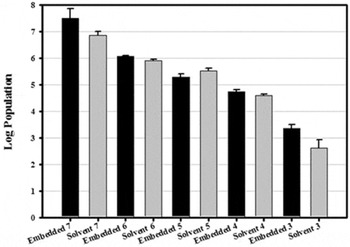
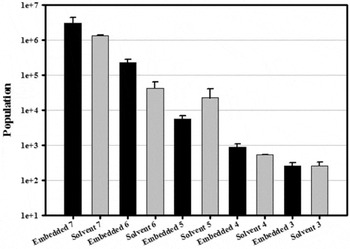
In an attempt to develop a suitable and standardized method to detect and estimate the abundance of embedded microbes, several materials used on the Phoenix and Mars Science Laboratory spacecraft were systematically examined. Most of these materials proved to be difficult as there was no one universal sample processing method (physical nor chemical) available to recover microbes that were naturally or artificially embedded into the spacecraft materials. Therefore, in this study, we only focus on the use of one spacecraft material, a silicon-based resin. The use of a chemical instead of a physical-grinding method to degrade spacecraft materials proved superior for downstream microbial detection and quantification, and facilitated tracking of the loss in the recovery tested microbes. Of the numerous material/solvent combinations tested for use as a model embedding/release system for spores, the best recovery of both viable spores (30–100%) and DNA (5–28%) was achieved from NuSil silicone epoxy digested with PolyGone-500 (Figs. 1 and 2). Other material/solvent combinations also demonstrated the ability to recover B. pumilus SAFR-032 spores, although the efficiency of such recovery was often times much lower. Furthermore, the most rapid and complete degradation was achieved with NuSil black silicone and 10 ml of Polygone-500.
Recovery of B. pumilus SAFR-032 spores embedded in silicone as measured by colony counting. Embedded: Test spores first embedded in silicone epoxy and released via PolyGone solvent. Solvent: Purified spores suspended in PolyGone solvent without embedding. The numerals proceeding “Embedded” and “Solvent” refer to the log number of spores initially deposited. Error bars represent standard error mean of 3 replicates.

Recovery of B. pumilus SAFR-032 spores embedded in silicone, released via PolyGone solvent, and assayed by qPCR. See Fig. 1 for explanation of abbreviations. Error bars represent standard error mean of 3 replicates.

It is unclear whether the differences in recovery efficiency between NuSil silicone epoxy and the various solvents stem from a loss of spore cultivability or a decrease in the effectiveness of the solvent for a given embedding compound. In each instance, the inoculation of 1 ml of full-strength (no dilution) solvent-digested sample directly into TSB resulted in an inhibition of spore outgrowth. Subsequent dilutions from these original inoculations, however, did not display solvent-associated spore outgrowth inhibition. Samples indicative of positive outgrowth (turning turbid with time) were streaked onto TSA and B. pumilus colony morphologies were confirmed. None of the coupon blanks or un-inoculated negative controls yielded positive outgrowth.
The vegetative cells of several micro-organisms isolated from spacecraft and associated facility surfaces (including Deinococcus radiodurans R1, Ralstonia picketii 31v3, Curtobacterium flaccumfaciens 48v2, Microbacterium imperialae 47v1, Acinetobacter radioresistens 50v1 and the vegetative cells of all the Bacillus species) were used to examine the effect of the PolyGone-500 solvent on cultivablity. None of these vegetative cell lines were able to withstand the toxicity of the solvent, as no growth was observed whatsoever. However, DNA recovery between vegetative cell lines was inconsistent so our research efforts focused on optimization of spore embedding and recovery. When B. pumilus SAFR-032 spores were embedded within silicone epoxy at concentrations ⩾104 spores per cm3, there was no significant loss in cultivability following PolyGone-500 dissolution (Fig. 1). However, the embedding of spore concentrations ⩽103 spores per cm3 of silicone and subsequent dissolution with PolyGone-500 resulted in considerable variation in spore outgrowth and cultivability. Detection and enumeration of embedded spores by traditional colony-count methods could only be achieved upon dilution of the PolyGone-500 dissolved sample slurries at least 100-fold prior to culturing, presumably due to inhibition of germination and/or cultivability of spores at higher concentrations. Since PolyGone-500 was shown to hinder spore germination and inhibit the growth of vegetative cells, culture-independent molecular techniques were shown to more accurately assess bioburden embedded and released in the manner of the model system. The spores of several other Bacillus species also withstood PolyGone-500 exposure (data not shown), and yielded survival/outgrowth indices of up to 78% (B. safensis FO-36b), which was not altogether surprising given the recalcitrant nature of bacterial spores (Driks Reference Driks1999).
Previously described ATP-based microbial abundance assays (Venkateswaran et al. Reference Venkateswaran, Hattori, La Duc and Kern2003) proved incapable of discerning embedded microbes. PolyGone-500 interfered with the ATP reagents as well as degraded the plastic tubes required for the ATP assay. Phase/contrast and epifluorescent microscopy also proved problematic in attempting to discern test spores and cells from indigenous debris and particulates. Although flow cytometry has been shown to be very effective at detecting single cells in liquid regardless of their ability to be cultured (Wang et al. Reference Wang, Hammes, De Roy, Verstraete and Boon2010), the background noise associated with the silicone epoxy and PolyGone-500 aggregates in this test system severely limited the efficacy of this technology. Nucleic acid dyes could possibly help to circumvent such shortcomings; however, non-specific binding of such dyes to random exogenous particulates can still result in false positives (Muller & Nebe-von-Caron Reference Muller and Nebe-von-Caron2010). Additionally, the inability of the solvent to digest silicone slurry particle sizes below the clogging threshold of flow cytometers would prevent accurate quantification with this technology. Matrix-assisted laser desorption ionization time-of-flight (MALDI-TOF) mass spectrometry has also been used for the rapid detection of bacterial cells and spores (Dickinson et al. Reference Dickinson, La Duc, Haskins, Gornushkin, Winefordner, Powell and Venkateswaran2004); however, the necessity of extremely high-bacterial concentrations (108 cfu ml−1) for effective and efficient detection (Bizzini et al. Reference Bizzini, Jaton, Romo, Bille, Prod'hom and Greub2010) hinders this technology with respect to the quantification of microbes from presumed low-biomass environments.
Purification and subsequent qPCR-based quantification of the multi-copied 16S rRNA gene, which encodes small subunit ribosomal RNA and is universally conserved in all bacteria, was initially devised to measure the microbial burden resulting from embedding and solvent dissolution in this study. Unfortunately, the amplification of 16S rDNAs from organisms associated with the silicone epoxy and/or solvent rendered, this means of PCR screening ineffective (data not shown). To circumvent the problems arising from indigenous DNA, primers specific for the B. pumilus gyrB house-keeping gene were used for subsequent qPCR-based analyses. The gyrB amplicon size and specificity of the primer set for B. pumilus were confirmed by testing a diverse suite of bacterial lineages (Satomi et al. Reference Satomi, La Duc and Venkateswaran2006).
Ultimately, a model test system was developed where bacterial spores (B. pumilus SAFR-032) could be: (a) embedded within a spacecraft material (silicone epoxy), (b) subsequently released by a solvent amenable to molecular biology (PolyGone-500) and (c) investigated using traditional (plate count assay) and molecular (qPCR-based, gyrB gene-derived) methods to assess the recovery of both viable and total spores.
The effects of PolyGone-500 solvent on the cultivability and nucleic acid extraction from purified spores of various Bacillus species previously isolated from spacecraft and associated environments were examined. Upon direct exposure to PolyGone-500 for 24 hours, a 1-log reduction in the cultivability of B. pumilus SAFR-032 spores was observed (Fig. 1), whereas the spores of B. atrophaeus suffered a 2-log reduction in cultivability (data not shown). However, irrespective of phylogeny, total nucleic acids were uniformly recovered from all spores examined following 24-hour direct exposure to PolyGone-500 (data not shown). This factored largely into the choice of this solvent for the model test system.
The extraction and purification of nucleic acids from the silicone-embedded B. pumilus SAFR-032 spores were particularly challenging as the PolyGone-500 solvent degraded several of the plastics typically used in such protocols. Prior to being subjected to DNA extraction reagents, samples had to be washed several times with, and finally re-suspended in, nuclease-free sterile water to completely remove the solvent. In addition, since the DNA of bacterial spores is localized in the core, which is environed by a thick cortex, inner and outer membranes, a germ cell wall and several coat layers (Setlow Reference Setlow2007), protocols were tailored to remove these coat and cortex layers prior to targeting isolation of the nucleic acids. To this end, spores were decoated with a protein denaturant followed by lysozyme-driven enzymatic lysis to enhance DNA recovery.
The detection limits for the qPCR method of assessing spore recovery as inferred from gyrB gene presence were 102 spores ml−1 (Fig. 2), and standard curves used to interpolate gene quantities yielded statistically significant r 2 values of equal to or greater than 0.90. When gyrB gene copy numbers were used as the metric by which to derive the quantity of corresponding B. pumilus SAFR-032 spores, resulting values were approximately 1-log lower than plate count results. This might be due to an inefficient DNA extraction protocol from spores. Losses of up to 90% of the total nucleic acids are typical when harsh treatments are required to extract DNA (La Duc et al. Reference La Duc, Osman and Venkateswaran2009b).
The selectivity, sensitivity and reproducibility of this molecular protocol for recovering DNA from several lineages of bacterial spores will help devise and set appropriate standards and specification values for future life-detection missions. Furthermore, the model molecular system developed herein bears relevance not only to the investigation of spores but also to the vegetative microbiota embedded within certain spacecraft-qualified solids, unlike cultivation-based analyses wherein the PolyGone-500 solvent quelled all cultivability. The gyrB-based qPCR approach for assessing the microbial burden embedded within silicone epoxy evaluated in this study should be further tested and optimized for detecting the presence of many other microbes of interest to planetary protection and astrobiology.
Conclusions
The inadvertent exposure of the Martian surface or other extraterrestrial setting to microbes on or embedded within exploratory spacecraft (forward contamination) remains a major concern for future missions, both life-detection oriented and otherwise. Current specification values for allowable spacecraft-associated embedded-bioburden are based on hardware materials and bacteriological culture-based approaches of the Viking era, which may not be relevant to modern-day mission scenarios. The research conducted herein compared various strengths and limitations of molecular methodologies (i.e. qPCR) with those of more traditional culturing techniques with respect to the detection of bacterial spores embedded within solid spacecraft materials. For bacterial spores artificially embedded within silicone epoxy and subsequently released via organic solvent dissolution, reasonable correlations in recovery efficiency (within ∼1-log) were observed between results from molecular qPCR-based and traditional cultivation-based methods. However, the PolyGone-500 solvent used to digest the spacecraft-qualified silicone epoxy was shown to inhibit the cultivability of vegetative bacterial cells, which would result in an underestimation of total embedded microbial burden if only culture-based analyses were implemented. Therefore, coupling traditional approaches with a gene-based qPCR detection and enumeration regime, such as the gyrB gene-based quantitative method described herein, would lead to more accurate assessments of the total embedded bioburden of a spacecraft, not to mention improved detection and enumeration of difficult-to-culture microorganisms. Ultimately, methods to detect and quantify micro-organisms embedded in spacecraft materials will be of relevance to the larger goal of comprehensively assessing the total microbial burden of spacecraft, and therefore minimizing the risk of forward contamination of extraterrestrial environments.
Acknowledgements
We thank W. Schubert and J. N. Benardini for technical assistance and valuable consultation. The research described in this publication was carried out at the Jet Propulsion Laboratory, California Institute of Technology, under a contract with the National Aeronautics and Space Administration. This research was funded by a 2007 NRA ROSES grant. We are grateful to C. Conley for useful discussion. Copyright 2011 reserved.