

In spite of increasing levels of inclusive placements for students with disabilities in many countries (e.g., McLeskey, Landers, Williamson, & Hoppey, Reference McLeskey, Landers, Williamson and Hoppey2012; Nota, Soresi, & Ferrari, Reference Nota, Soresi, Ferrari, McLeskey, Waldron, Spooner and Algozzine2014), academic outcomes for these students have not improved substantially and remain less than desirable (Florian & Rouse, Reference Florian, Rouse, McLeskey, Waldron, Spooner and Algozzine2014; National Center for Education Statistics, 2015). For example, in the United States (US) in 2015, 33% of fourth grade students with disabilities scored at a basic level or above in reading, compared to 74% of students without disabilities. Similarly, 37% of students with disabilities in eighth grade scored at a basic level or above in reading, compared to 81% of students without disabilities. These results were not substantially different from 2009 and 2011 achievement levels for students with disabilities (National Center for Education Statistics, 2015).
To address the need for improved student achievement, researchers have developed a range of evidence-based practices that have been demonstrated as highly effective in improving achievement and behaviour outcomes for students with disabilities and others who struggle to learn (Cook, Cook, & Landrum, Reference Cook, Cook and Landrum2013; Grima-Farrell, Bain, & McDonagh, Reference Grima-Farrell, Bain and McDonagh2011). Although information regarding these practices has been disseminated widely through government agencies, textbooks used in teacher preparation, and professional development activities, the practices are not often used in classrooms (Cook et al., Reference Cook, Cook and Landrum2013).
Several reasons have been posited for the very limited use of evidence-based or other effective practices (Carnine, Reference Carnine1997; Cook & Odom, Reference Cook and Odom2013; Grima-Farrell et al., Reference Grima-Farrell, Bain and McDonagh2011; McLeskey & Billingsley, Reference McLeskey and Billingsley2008). For example, Cook and Odom (Reference Cook and Odom2013) contend that insufficient emphasis has been placed on implementing these practices in classrooms, and that the ‘emerging field of implementation science . . . can be applied in special education to enhance the utilization of EBPs [evidence-based practices]’ (p. 136). Moreover, the primary intention of implementation science is to ‘promote the systematic uptake of research findings and other evidence-based practices into routine practice’ (Eccles & Mittman, Reference Eccles and Mittman2006, p. 1). Still another compelling and widely cited potential contributor to the research-to-practice gap was described by Carnine (Reference Carnine1997), who contended that research is typically not designed to make a difference in practice. He further noted that practitioners often lack confidence in the practices that are developed by researchers and find that the practices have limited usability in their classrooms.
Still other scholars have contended that how teachers are prepared may contribute to the research-to-practice gap (Golder, Norwich, & Bayliss, Reference Golder, Norwich and Bayliss2005; McLeskey & Billingsley, Reference McLeskey and Billingsley2008), although this topic has not been addressed in sufficient depth in the teacher education literature (Grima-Farrell et al., Reference Grima-Farrell, Bain and McDonagh2011). In this paper, we contend that teacher preparation is an important contributor to the lack of use of effective practices in inclusive classrooms. The major reason this occurs is that during the course of teacher preparation, preservice teachers (PSTs) are seldom systematically taught to use effective practices in classrooms. In the following sections, we describe why this lack of systematic preparation occurs, and offer a direction for improving teacher practice by centring teacher preparation in field-based settings. We then describe a set of practices that has been developed by the Council for Exceptional Children (McLeskey et al., Reference McLeskey, Barringer, Billingsley, Brownell, Jackson, Kennedy and Ziegler2017) that may serve as the core curriculum for practice-based teacher preparation. This is followed by a discussion of the implications of these changes for teacher educators and preparation programs.
Improving Teacher Education and Teacher Use of Effective Practices
Both the limited use of effective practices in most classrooms as well as the low achievement outcomes for students with disabilities and others who struggle to learn have placed pressure on teacher educators to improve teacher preparation so that program graduates are classroom ready with the skills needed to demonstrably improve the achievement of all students (Council for the Accreditation of Educator Preparation, 2013). Furthermore, the need to improve teacher preparation has taken on added importance given research that demonstrates that the instructional practices of teachers are the most powerful influence on student learning (Windschitl, Thompson, Braaten, & Stroupe, Reference Windschitl, Thompson, Braaten and Stroupe2012). Improving teacher practice is thus the most direct approach to improve the learning of all students, especially those who struggle to learn in inclusive classrooms (McLeskey & Waldron, Reference McLeskey and Waldron2011).
Several teacher education scholars have begun to closely examine how teacher preparation programs might be improved to enhance teacher practice (e.g., Ball & Forzani, Reference Ball and Forzani2009; Forzani, Reference Forzani2014; McLeskey & Brownell, Reference McLeskey and Brownell2015). These teacher educators have recognised that much of teacher preparation does not generalise to classroom practice (Korthagen, Reference Korthagen, Kessels, Koster, Lagerwerf and Wubbels2001; Levine, Reference Levine2006; McLeskey & Billingsley, Reference McLeskey and Billingsley2008), and have taken the position that these programs are not designed to prepare PSTs to use practices in classrooms (Ball, Sleep, Boerst, & Bass, Reference Ball, Sleep, Boerst and Bass2009; Grossman, Hammerness, & McDonald, Reference Grossman, Hammerness and McDonald2009). The following concerns have been identified regarding the design of teacher education programs that likely contribute to this less than desirable outcome:
1. Teacher preparation largely occurs in settings that are removed from the practice of teaching, and most coursework emphasises reflection, investigation, and knowing about practice rather than directly focusing on the use of practices in classrooms (Ball et al., Reference Ball, Sleep, Boerst and Bass2009).
2. Most teacher education programs have very limited connections between coursework and field experiences. When this fragmentation occurs between theory and practice, practice primarily focuses on the ‘conceptual underpinnings of teaching as opposed to the concrete practices new teachers may need to enact when they begin teaching — practice is not at the core of the curriculum’ (Grossman et al., Reference Grossman, Hammerness and McDonald2009, p. 275).
3. The specific practices that PSTs learn to use are largely left to chance. This occurs primarily because teacher educators expect that practices will be learned during field experiences, the component of their programs over which they have the least control (Grossman & McDonald, Reference Grossman and McDonald2008). PSTs thus learn practices that they happen to encounter in field settings, and these may or may not be effective practices.
4. Effective instructional practices that are critical to the success of beginning teachers are seldom systematically taught during teacher preparation through closely aligned coursework and field experiences (Forzani, Reference Forzani2014).
To address these concerns, a range of teacher educators have called for major changes in teacher preparation to substantially improve the practice of beginning teachers (Ball & Forzani, Reference Ball and Forzani2010; Hlas & Hlas, Reference Hlas and Hlas2012; McLeskey & Brownell, Reference McLeskey and Brownell2015; Windschitl et al., Reference Windschitl, Thompson, Braaten and Stroupe2012). These scholars have recommended centring teacher preparation in clinical settings and identifying a set of effective practices that would become the core curriculum of teacher education. In short, teacher preparation programs should be primarily designed to systematically and thoroughly prepare teachers to use the most important instructional practices in their classrooms.
Ball and Forzani (Reference Ball and Forzani2010) provide a rationale for this systematic preparation when they assert that teaching requires specialised knowledge and skill in unpacking content so that it is accessible and learnable by all students. They go on to note that teachers must be prepared to see this instructional content from the perspectives of their students, who may learn in ways that are different from how the teacher learns. Furthermore, effective instruction requires that teachers design and manage classroom environments to support the learning of a broad range of students. Learning to use teaching practices in classrooms is thus intricate work, requiring the careful design of teacher education programs in ways that help PSTs learn to enact teaching practices skillfully.
The type of instruction that Ball and Forzani (Reference Ball and Forzani2010) describe is especially important for students with disabilities and others who struggle to learn in inclusive classrooms, but it is not sufficient. For example, to effectively meet the needs of these students, whole-group instruction must not only be differentiated so that all students remain engaged and benefit, but it is also necessary to regroup students and provide small-group instruction that is intensive and explicit (Archer & Hughes, Reference Archer and Hughes2011; Batsche, Reference Batsche, McLeskey, Waldron, Spooner and Algozzine2014; McLeskey & Waldron, Reference McLeskey and Waldron2011) to accelerate learning related to critical content (e.g., reading skills). Special education teachers thus must learn to use specialised skills to meet the needs of students with disabilities that are not typically used in inclusive elementary and secondary classrooms (McLeskey & Brownell, Reference McLeskey and Brownell2015).
The major changes in teacher preparation that we have described have been advocated for and included in program approval standards by the national organisations in the US that accredit teacher preparation programs. These changes were initially addressed in 2010 when the National Council for Accreditation of Teacher Education released an influential report that called for turning teacher preparation upside down by centring preparation in clinical practice:
To prepare effective teachers for 21st century classrooms, teacher education must shift away from a norm which emphasizes academic preparation and course work loosely linked to school-based experiences. Rather, it must move to programs that are fully grounded in clinical practice and interwoven with academic content and professional courses. (p. ii)
These changes require that teacher preparation programs move away from specifying knowledge related to instruction (i.e., learning about teaching), and move toward the identification of a set of complex practices that become the core curriculum of teacher preparation (McDonald, Kazemi, & Kavanagh, Reference McDonald, Kazemi and Kavanagh2013). Teacher educators from several disciplines have begun to develop this core curriculum by identifying sets of high-leverage practices (HLPs) for teachers in science, mathematics, foreign language, reading, and elementary and special education (Ball & Forzani, Reference Ball and Forzani2009; Grossman et al., Reference Grossman, Hammerness and McDonald2009; Hlas & Hlas, Reference Hlas and Hlas2012; Kucan et al., Reference Kucan, Palincsar, Busse, Heisey, Klingelhofer, Rimbey and Schutz2011; Martin-Raugh, Reese, Tannenbaum, Steinberg, & Xu, Reference Martin-Raugh, Reese, Tannenbaum, Steinberg and Xu2016; McLeskey & Brownell, Reference McLeskey and Brownell2015; Peercy & Troyan, Reference Peercy and Troyan2017; Windschitl et al., Reference Windschitl, Thompson, Braaten and Stroupe2012). HLPs have been defined as ‘a set of practices that are fundamental to support K-12 student learning, and that can be taught, learned, and implemented by those entering the profession’ (Windschitl et al., Reference Windschitl, Thompson, Braaten and Stroupe2012, p. 880).
The Council for Exceptional Children (McLeskey et al., Reference McLeskey, Barringer, Billingsley, Brownell, Jackson, Kennedy and Ziegler2017) recently developed a set of HLPs for special education teachers in Grades K–12. These HLPs are intended to be applicable for teachers in inclusive classrooms as well as separate settings (i.e., across tiers of instruction). In the following section, background information regarding these practices is provided, and they are briefly reviewed.
High-Leverage Practices for Special Education Teachers
A work group convened by the Council for Exceptional Children used a systematic process to identify essential practices for K–12 special education teachers. The purpose of this group's work was
to provide those involved in special education teacher preparation and professional development with a set of HLPs that were identified through consensus among special educators. These HLPs may be used to design a cohesive set of practice based opportunities to support teacher candidates and practicing teachers in learning to put this know-how to use on behalf of the complex learners they teach. (McLeskey et al., Reference McLeskey, Barringer, Billingsley, Brownell, Jackson, Kennedy and Ziegler2017, p. 11)
This work proceeded from January 2015 to July 2016 and included extensive feedback regarding the draft HLPs from teachers, teacher educators, and administrators through the use of focus groups, surveys, and conference presentations.
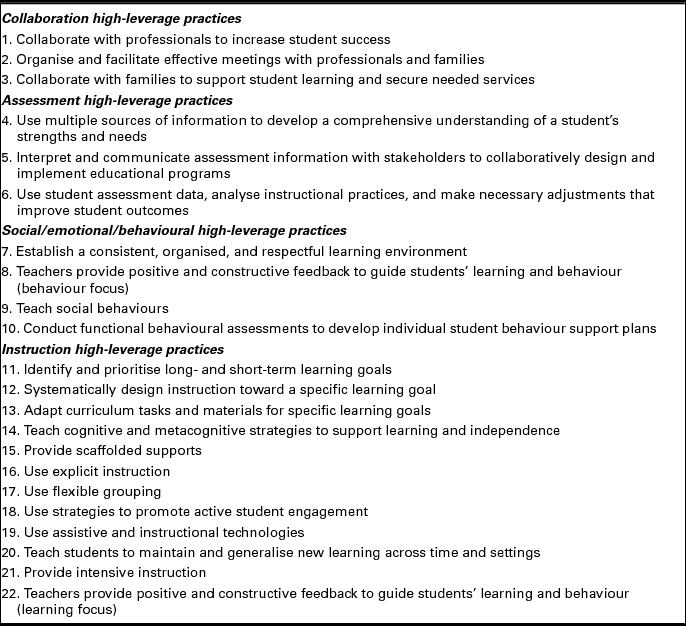
The final HLPs address four areas of special education teacher practice that are critically important to improving student outcomes. These areas are collaboration (e.g., working with other professionals to improve student outcomes), assessment (e.g., formative assessment to guide instructional decision-making), social/emotional/behaviour (e.g., establishing a consistent, organised, respectful learning environment), and instruction (e.g., using explicit instruction). More generally, as the HLPs were developed, special education teachers were viewed as
flexible problem solvers who not only have expertise in using highly effective practices, but also are proficient in monitoring the effectiveness of these practices with individual students and making decisions regarding changes in practice as needed. This routine analysis of practice and its impact on important student outcomes is foundational for effective special education teachers. Further, given the disproportionate number of students with disabilities from culturally and linguistically diverse backgrounds, special education teachers must have expertise in delivering instruction and behavioral interventions in a culturally responsive manner. (McLeskey et al., Reference McLeskey, Barringer, Billingsley, Brownell, Jackson, Kennedy and Ziegler2017, p. 8)
It is important to emphasise that the HLPs were developed with the intention that teacher knowledge of culturally responsive practice (Aronson & Laughter, Reference Aronson and Laughter2016) would be infused into each of the HLPs as they were used in practice. For example, this is addressed in the preface to the assessment HLPs, which states that effective special education teachers ‘are knowledgeable regarding how context, culture, language, and poverty might influence student performance; navigating conversations with families and other stakeholders; and choosing appropriate assessments given each student's profile’ (McLeskey et al., Reference McLeskey, Barringer, Billingsley, Brownell, Jackson, Kennedy and Ziegler2017, p. 16). Similar statements are included in the prefaces to the collaboration, social/emotional/behavioural, and instruction HLPs. Knowledge of culturally responsive practice is especially important for special education teachers, given the disproportionate representation of students in special education from culturally and linguistically diverse backgrounds and from high poverty settings (Klingner, Brownell, Mason, Sindelar, & Benedict, Reference Klingner, Brownell, Mason, Sindelar, Benedict, Griffin, Lane, Israel, Oakes, Menzies, Germer, Park, Gitomer and Bell2016; U.S. Department of Education, 2016).
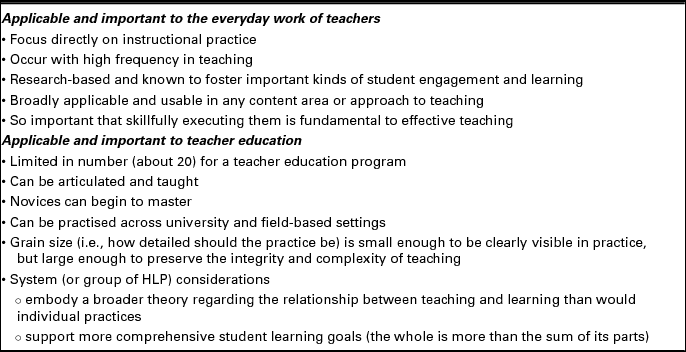
The criteria that were used to select the HLPs for special education teachers are included in Table 1. These criteria were intended to result in the identification of HLPs that constitute the fundamentals of effective practice for special education teachers. Furthermore, these were intended to be practices that were practical and useful for teachers, and that had been shown to be effective in improving academic and behavioural outcomes. The criteria also emphasised the identification of a limited number of practices (i.e., around 20) that could be taught during the course of a teacher preparation program.
Criteria for Identifying High-Leverage Practices (HLP; Ball, Sleep, Boerst, & Ball, Reference Ball, Sleep, Boerst and Bass2009; Grossman, Hammerness, & McDonald, Reference Grossman, Hammerness and McDonald2009; McDonald, Kazemi, & Kavanagh, Reference McDonald, Kazemi and Kavanagh2013; Windschitl, Thompson, Braaten, & Stroupe, Reference Windschitl, Thompson, Braaten and Stroupe2012)

The HLPs developed by the Council for Exceptional Children are included in Table 2. (For a more extensive description and background information regarding each HLP, including brief reviews of research support for the practices, see McLeskey et al., Reference McLeskey, Barringer, Billingsley, Brownell, Jackson, Kennedy and Ziegler2017). As noted previously, these practices may be used as the core curriculum for teacher preparation and may also be used for teacher induction and professional development as special educators continue to develop their practices over the first years of teaching. Using HLPs as the core curriculum for teacher preparation and induction has significant implications for those engaged in supporting teachers to learn to use these practices. These implications are addressed in the next section.
High-Leverage Practices for K–12 Special Education Teachers (McLeskey et al., Reference McLeskey, Barringer, Billingsley, Brownell, Jackson, Kennedy and Ziegler2017)

Considerations for Teacher Preparation
In the following sections, we consider the challenges of implementing HLPs in special education teacher preparation. We first discuss content and contextual considerations that relate to implementing HLPs, followed by implications for the restructuring of coursework and field-based experiences to advance teacher candidates’ core practices. Given that most of the research on HLPs to this point has been conducted by general educators, we draw on this research as we examine teacher educators’ work as they have incorporated core practices into preparation programs.
Content and contextual considerations
Incorporating HLPs into teacher education requires attention to several challenges for teacher education faculty and their K–12 partners. An initial consideration is how HLPs are integrated within and across curricular content in coursework and field-based experiences. In the US, the majority of states have adopted the Common Core State Standards (2010), suggesting that teacher candidates would use HLPs to teach mandated curricular content. In states and countries where other standards exist, faculty need to consider how core practices will be integrated within their critical content.
The content–pedagogy connection may be understood within a conceptual framework for preparing effective special educators (Lignugaris/Kraft & Harris, Reference Lignugaris/Kraft, Harris, Sindelar, McCray, Brownell and Lignugaris/Kraft2014). Lignugaris/Kraft and Harris (Reference Lignugaris/Kraft, Harris, Sindelar, McCray, Brownell and Lignugaris/Kraft2014) suggest the importance of how both ‘knowledge’ (including content/curricular knowledge and basic learning principles) and ‘pedagogical practice’ are integrated into ‘situated practice’ (p. 235). Leko, Brownell, Sindelar, and Kiely (Reference Leko, Brownell, Sindelar and Kiely2015) further emphasise the important connections between what special educators ‘know about the content and how to use high-leverage practices’, as both are essential to developing ‘well-integrated knowledge and practice’ (p. 29). A strength of the instructional HLPs as a foundation for special educators’ practice is they have an evidence base and are broadly applicable across K–12 content areas. At the same time the connection between knowledge (content/curriculum) and HLPs is particularly challenging in preparing special educators as the content requirements are often more extensive for special education teachers than for other teacher groups, as special educators are often prepared for K–12 licensure, spanning multiple grades and content areas. Integrating HLPs within multiple content areas is a formidable challenge and requires careful prioritising as teacher educators prepare PSTs to use HLPs within content areas, especially given the resource and time limitations of teacher preparation programs.
Another question is how HLPs will be integrated into different preparation models. Pugach and Blanton (Reference Pugach and Blanton2009) categorised three general preparation models for special education, including (a) discrete (special and general teacher education programs operate separately with little interaction), (b) integrated (intentional efforts to coordinate elements of coursework and field-based experiences across special and general education), and (c) merged models (students in general and special education participate in a coordinated curriculum and earn initial licensure in special and general education). Faculty in merged or dual programs using HLPs will need to determine how sets of HLPs for special and general education (e.g., Davis & Boerst, Reference Davis and Boerst2014) will be incorporated. Teacher educators may use existing crosswalks between general and special education HLPs (e.g., http://ceedar.education.ufl.edu/hlp-crosswalk-2/) or generate their own, clarifying the relationships between the two sets of HLPS as they consider instructional priorities for dual or merged programs.
The relationship between special and general education HLPs should also be considered in discrete programs. For example, the teacher collaboration HLPs for special education teachers (McLeskey et al., Reference McLeskey, Barringer, Billingsley, Brownell, Jackson, Kennedy and Ziegler2017) emphasise the importance of productive collaboration between special and general educators and others. These collaborative HLPs should be priorities for the development of both general and special education PSTs, as both groups need opportunities to plan, co-teach, and assess student learning in inclusive settings. Both general and special educators also need to learn to use collaborative skills to interpret data and inform decisions within a multi-tiered system of support in inclusive settings (Batsche, Reference Batsche, McLeskey, Waldron, Spooner and Algozzine2014). Brownell, Chard, Benedict, and Lignugaris-Kraft (in press) explain:
General and special education teachers need to understand how to collect and analyze progress-monitoring data, and they must have the skills to enact explicit teaching or guided, interactive practice . . . General educators need to learn how to apply HLPs in the context of teaching large groups of students, in terms of both assessment, and instructional differentiation. In contrast, special educators need to learn how to apply HLPs in the context of intensive individualized instruction, assessment, and differentiation. (p. 10)
Regardless of the program model used, special and general education faculty need to engage in thoughtful planning to prepare all teacher candidates for their collaborative roles within multi-tiered system of support frameworks.
Teacher educators should also clarify language and concepts as PSTs are introduced to a range of instructional terminology, supporting their understanding regarding how these varied terms align. Recently, Riccomini, Morano, and Hughes (Reference Riccomini, Morano and Hughes2017) provided a conceptual overview illustrating how specialised instruction, HLPs, EBPs, and intensive interventions relate and suggested that teachers need to have an understanding of these relationships to prevent confusion. McCray, Kamman, Brownell, and Robinson (Reference McCray, Kamman, Brownell and Robinson2017) discussed differences between HLPs and EBPs, indicating that HLPs apply across content and grades, whereas EBPs are often related to specific content and may not apply across all grade levels (e.g., teaching reading summarisation skills is applicable to Grades 3 and above). McCray et al. (Reference McCray, Kamman, Brownell and Robinson2017) also provide an example of how faculty in one university collaborated to examine the terms and practices of HLPs, created a structure for making decisions about HLPs, and selected specific pedagogies for instruction.
Finally, teacher education faculty need to be flexible about how to incorporate HLPs, depending on the specific needs of the program. Faculty may choose to prioritise some HLPs over others, while sequencing, combining, and reinforcing them in deliberate ways across course and field placements. For example, faculty in low incidence programs may need to reduce or augment HLPs, tailoring them in ways that support teacher candidates’ effectiveness in specialised areas of practice. In places where HLPs do not exist, faculty may choose to develop their own core practices, as Peercy and Troyan described (Reference Peercy and Troyan2017) when they created core practices in a program for English language learners. They discussed the challenges of undertaking this work:
How did you identify [the three core practices you focus on in your methods course?]. . . . I'm wondering about your process. Did you do a literature review? Did you talk with other experts in the field or in your program, generate a longer list, and then come to consensus? I am trying to decide how it is that I can support an argument for the kinds of practices I decide to . . . focus on in this course . . .’. (p. 31)
Considerations regarding structuring coursework and field-based experiences
The adoption of HLPs as a core curriculum is only an initial step in considering the detailed work and planning needed to improve special education teacher preparation. In discussing the use of core practices in science, Windschitl et al. (Reference Windschitl, Thompson, Braaten and Stroupe2012) stated that after the practices were constructed, they realised the need for tools and methods for supporting candidate development. Pedagogies designed to support core practices are underdeveloped (Peercy & Troyan, Reference Peercy and Troyan2017), leaving teacher educators with relatively few guidelines for undertaking this work. An initial step is considering what theories, frameworks, or approaches should inform teacher preparation pedagogy. Leko et al. (Reference Leko, Brownell, Sindelar and Kiely2015) suggested using principles from the learning sciences to inform teacher education practice-based pedagogies. They describe several principles, including (a) ‘deliberate practice’ (sequenced to build on knowledge and skill levels over time); (b) ‘interleaved and distributed practice’ (interleaved builds on conceptual understanding so PSTs learn to differentiate among problems and select knowledge and skills needed to address them, whereas distributed practice means scheduled over time); (c) ‘situated in content and authentic context’ (application of practices in specific content and in school settings), and (d) ‘performance feedback and self-assessment’ (external and self-assessment as PSTs receive feedback and are encouraged to engage in focused critical reflection; pp. 30–31).
Scholars have suggested principles and a range of pedagogies for use in practice-based teacher education. Benedict, Holdheide, Brownell, and Foley (Reference Benedict, Holdheide, Brownell and Foley2016) summarised three key considerations in teaching core practices across a program: focus, coherence, and duration. Teacher preparation programs need to be clear about the specific HLPs to be taught (focus) with deliberate decisions about their distribution (i.e., coherence across the program related to where they will be introduced, taught, practised, assessed), and with sufficient time allocated to the development of each HLP across the program (duration). Examples of specific pedagogies to support PSTs in learning to use these practices include micro-teaching, cases, tutoring, lesson study, peer coaching, bug-in-ear technology, simulated experiences such as TeachLivE/Mursion, video analyses, practice opportunities with feedback and reflection, incorporating practice opportunities with external and self-assessments, and courses carefully linked to field-based learning experiences (e.g., Benedict et al., Reference Benedict, Holdheide, Brownell and Foley2016; Leko et al., Reference Leko, Brownell, Sindelar and Kiely2015; Maheady, Smith, & Jabot, Reference Maheady, Smith, Jabot, Sindelar, McCray, Brownell and Lignugaris/Kraft2014; McDonald et al., Reference McDonald, Kazemi and Kavanagh2013; McDonald et al., Reference McDonald, Kazemi, Kelley-Petersen, Mikolasy, Thompson, Valencia and Windschitl2014; Peercy & Troyan, Reference Peercy and Troyan2017).
Finally, specific activities need to be mapped to the core practices and carefully sequenced, providing PSTs with opportunities to ‘learn in, from, and through practice’ (McDonald et al., Reference McDonald, Kazemi, Kelley-Petersen, Mikolasy, Thompson, Valencia and Windschitl2014, p. 504). Incorporating both formative and summative assessments allow teacher educators to monitor the success of both individual activities in supporting PSTs’ practices in specific course and field experiences as well as their collective impact on candidates completing their programs.
Examples of teaching core practices
Examples of general education teacher educators working to teach core practices in practice-based settings illustrate the nature of this work. In a self-study, Peercy and Troyan (Reference Peercy and Troyan2017) developed instructional activities (IA) for teaching specific practices. They used a five-step cycle to scaffold teacher candidates’ practice during IA. The steps are deconstructing, demonstrating, rehearsing, implementing, and analysing the practice, with support and feedback from faculty and cooperating teachers in field-based settings. The researchers provide examples as they engaged teacher candidates in the use of this cycle as they described the
systematic deconstruction and rehearsal of a core practice through a particular IA. This is followed by implementation of the practice with students, usually in a K-12 setting. . . . Afterward, novice teachers share the videotaped implementation for discussion in the teacher education setting, and collectively analyze their implementation of the focal practice(s) with the students. Novice teachers often write a reflection about their practice as a culmination of the experience. These opportunities to engage in practice in concrete ways are intended to support novice teachers in knowing how to do some of the most essential work of teaching prior to entering their first year of teaching. (p. 28)
Peercy and Troyan (Reference Peercy and Troyan2017) also describe some of the challenges in doing this work, including questions about how teacher candidates should be involved in enacting the practices and the need to not only teach practices, but also help teachers understand their theoretical underpinnings.
In another example of teaching core practices, McDonald et al. (Reference McDonald, Kazemi and Kavanagh2013) used a learning cycle to offer guided assistance to help candidates learn particular practices. They provide an overview of this cycle, indicating that it
intends to offer guided assistance to candidates to learn particular practices by introducing them to the practices as they come to life in meaningful units of instruction, preparing them to actually enact those practices, requiring them to enact the practices with real students in real classrooms, and then returning to their enactment through analysis. (p. 382)
McDonald and colleagues (Reference McDonald, Kazemi and Kavanagh2013) also describe how their learning cycle progresses through varied settings, including controlled (university classrooms), designed (both controlled and authentic, such as teaching courses in schools with faculty and cooperating teacher involvement), and authentic settings (K–12 classrooms).
These illustrations emphasise the role that clinical experiences play in supporting teachers’ use of core practices. Today, there is international interest in authentic teaching experiences in teacher preparation (Peercy & Troyan, Reference Peercy and Troyan2017); however, researchers emphasise that simply increasing the time that teacher candidates spend in schools is not sufficient to improve preparation (Forzani, Reference Forzani2014; Peercy & Troyan, Reference Peercy and Troyan2017). Rather, field-based experiences must be designed to support teacher candidates’ effective use of core practices by aligning content and pedagogy. As Lignugaris/Kraft and Harris (Reference Lignugaris/Kraft, Harris, Sindelar, McCray, Brownell and Lignugaris/Kraft2014) explain, a ‘teacher's effectiveness results from the application of pedagogical principles to a content domain, taking into account the instructional context that includes learners’ skills and previous knowledge’ (p. 234).
Possibilities for special education teacher preparation
HLPs offer the potential to improve teacher preparation through the development of a shared language for instruction and the development of instructional sequences, tools, and strategies to support teachers’ development of these practices (Windschitl et al., Reference Windschitl, Thompson, Braaten and Stroupe2012). Teacher educators interested in developing or using HLPs should consider a resource by Benedict and colleagues (Reference Benedict, Holdheide, Brownell and Foley2016) that provides practical information regarding the development and support of core practices across both coursework and field-based experiences. This guide provides examples of high-quality practice-based opportunities that are used in specific teacher education programs, as well as infrastructure challenges and how they might be addressed. This information should be helpful to state and national education agencies, teacher education programs, and local school districts interested in supporting the use of core practices. Other resources related to this work are available from the CEEDAR Center (https://ceedar.education.ufl.edu/), the IRIS Center (https://iris.peabody.vanderbilt.edu/), and the National Center on Intensive Intervention (https://intensiveintervention.org/resources/tools-charts).
Although practice-based approaches in initial preparation show promise in supporting the use of effective practices for PSTs, continuing support is needed to further develop effective practices for beginning teachers. Induction programs are thus important in clarifying and reinforcing instructional expectations for new teachers (Billingsley, Bettini, & Jones, Reference Billingsley, Bettini and Jones2018; Israel, Kamman, McCray, & Sindelar, Reference Israel, Kamman, McCray and Sindelar2014), and providing ongoing professional learning and mentoring as early career teachers deepen their expertise related to complex practices (Billingsley, Griffin, Smith, Kamman, & Israel, Reference Billingsley, Griffin, Smith, Kamman and Israel2009; Israel et al., Reference Israel, Kamman, McCray and Sindelar2014). Ideally, induction programs will serve as a bridge, supporting early career teachers in the use of HLPs during their first years of teaching through well-designed and supported induction and mentoring programs, with continuing professional development (Leko & Roberts, Reference Leko, Roberts, McLeskey, Waldron, Spooner and Algozzine2014) to foster their learning and effectiveness in improving academic and behavioural outcomes for all students.
Conclusion
As HLPs are employed to focus teacher preparation on learning to use practices in the classroom, major changes must occur to develop programs that are centred in clinical practice and that provide systematic support for teacher candidates as they learn to use these practices (Benedict et al., Reference Benedict, Holdheide, Brownell and Foley2016). The title of this article suggests the possibility that incorporating HLPs in teacher preparation programs may reduce the research-to-practice gap. Obviously, this will depend on a range of factors, including the challenges that may interfere with the success of this work. Previous impediments to change in teacher preparation that are particularly relevant to the changes we describe should be considered, such as the possible lack of willingness of K–12 schools to partner with teacher education programs in new models of preparation, and the tendency when change is complex to slightly modify and rename existing practices rather than actually engaging in substantive change (McDonald et al., Reference McDonald, Kazemi, Kelley-Petersen, Mikolasy, Thompson, Valencia and Windschitl2014; Sykes, Bird, & Kennedy, Reference Sykes, Bird and Kennedy2010). Many additional issues may also arise. For example, substantive changes cannot simply occur within discrete elements of teacher preparation (e.g., methods courses); these changes require that several faculty develop intensive collaborative relationships to develop and sustain these changes. This type of collaboration may be difficult given the many demands on the time of university faculty (Zeichner, Reference Zeichner2012). There are also substantial challenges that must be addressed regarding the structure of teacher preparation programs to ensure that coursework and field experiences are intimately intertwined in ways that support candidates in learning to use practices in the classroom. Concerns such as these warrant serious consideration as faculty move forward with practice-based approaches to teacher preparation.
Although these challenges may be daunting, there are many potential benefits for faculty as they engage in this work. Foremost among these benefits is the improved preparation of teachers as they learn to use practices with proficiency and enter the profession classroom ready to improve student outcomes. In addition, practice-based approaches provide teacher educators with opportunities to study how teaching practices influence student outcomes. Maheady (Reference Maheady2015) suggests that this type of research could be used to ‘elevate practice and its improvement as legitimate and important areas for empirical inquiry’ and provide the ‘opportunity to improve our professional standing among critical policy-makers’ (p. 16).
Finally, although practice-based approaches show promise in supporting the use of more effective practices, additional support beyond initial preparation is needed to develop highly proficient teachers. Induction programs are important in clarifying and reinforcing instructional expectations for beginning teachers (Israel et al., Reference Israel, Kamman, McCray and Sindelar2014), and there is also the need for ongoing professional learning as these teachers deepen their expertise related to complex practices (Billingsley et al., Reference Billingsley, Griffin, Smith, Kamman and Israel2009; Israel et al., Reference Israel, Kamman, McCray and Sindelar2014). Ideally, induction programs will serve as a bridge, supporting early career teachers in the use of HLPs during their first years of teaching through well-designed and supported induction and mentoring programs, and high-quality continuing professional development (Leko & Roberts, Reference Leko, Roberts, McLeskey, Waldron, Spooner and Algozzine2014) will be provided for teachers as they continue to learn and grow as professionals who are proficient in using a wide range of effective practices that improve academic and behavioural outcomes for all students.