INTRODUCTION
Buildings in Roman Britain, depending on circumstances, are known to have been roofed using either ceramic tiles (tegulae, imbrices), stone roof-tiles, thatch or reeds, or perhaps wooden boards. Thatch was a by-product of cereal farming and reeds were cut from coastal and riverine marshlands. Ceramic tiles could be fired on-site at many locations and, in geologically favourable parts of the country, there was suitable stone to be quarried. It is a testament to the efficiency of the Roman transport system in Britain, as well as to the appeal of stone that was easy to work, durable and of attractive appearance, that large quantities of stone roof-tiles were carried in late Roman times to the town of Calleva Atrebatum (Silchester),Footnote 1 in the stone-poor Berkshire-Hampshire borderlands. A journey of up to 100 km or more was involved. The rocks chiefly in question were the Brownstones and the Pennant Measures, quarried from closely associated outcrops in the West Country. Making an occasional appearance at Silchester was a third rock-type, the Stonesfield Slate from the South Midlands. There is no clear evidence that the Collyweston Slate of much the same age from the East Midlands ever reached as far south as Silchester.
The Brownstones and Pennant Measures are quartz sandstones, and the Stonesfield Slate is a slightly sandy, shelly limestone. These characteristics allowed many of the tiles a vigorous afterlife as whetstones, implements essential in the home, on the farm, in workshops and at military garrisons where edge-tools and the like required sharpening and metal objects were made.Footnote 2 This paper examines the transformation of Brownstones, Pennant and Stonesfield roof-tiles into whetstones at Silchester and the roles these may have played. The analysis presented rests on a substantial assemblage of whetstones accumulated from a number of excavations ranging over a century in the town.
THE ASSEMBLAGE
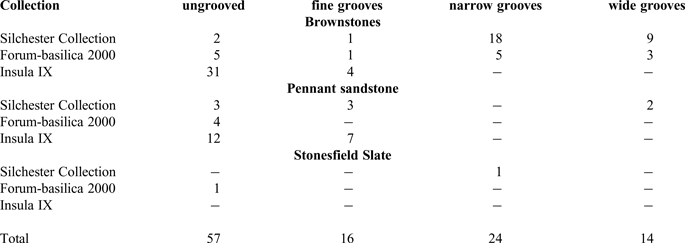
The full assemblage is of three elements: the whetstones collected by Victorian-Edwardian excavators, now held as part of the Silchester Collection at Reading Museum and Art Gallery (n = 51);Footnote 3 the re-examined material surviving from excavations of the 1980s and early 1990s at the forum-basilica and North Gate (Forum-basilica 2000 hereafter; n = 18);Footnote 4 and the group recovered over the last two decades from the stratigraphic area excavation at Insula IX (n = 87).Footnote 5 Roughly two-thirds of the total of 156 whetstones represented by these collections can be attributed geologically to the Brownstones, Pennant sandstone or Stonesfield Slate (table 1), on the basis of hand-lens inspection and the study of representative examples of all three types in thin-section under the petrographic microscope. The material in the Silchester Collection is poorly localised, but appears to date mainly from the later Roman period; several items of Brownstones are individually marked as coming from the basilica. The forum-basilica of the late third and fourth centuries is also the source of most of the whetstones recovered during the 1980s and early 1990s. Most of the whetstones of Pennant sandstone and Brownstones found at Insula IX come from third- or fourth-century contexts.Footnote 6
LITHOLOGICAL COMPOSITION OF WHETSTONE COLLECTIONS FROM SILCHESTER

GENERAL CHARACTER OF THE WHETSTONES
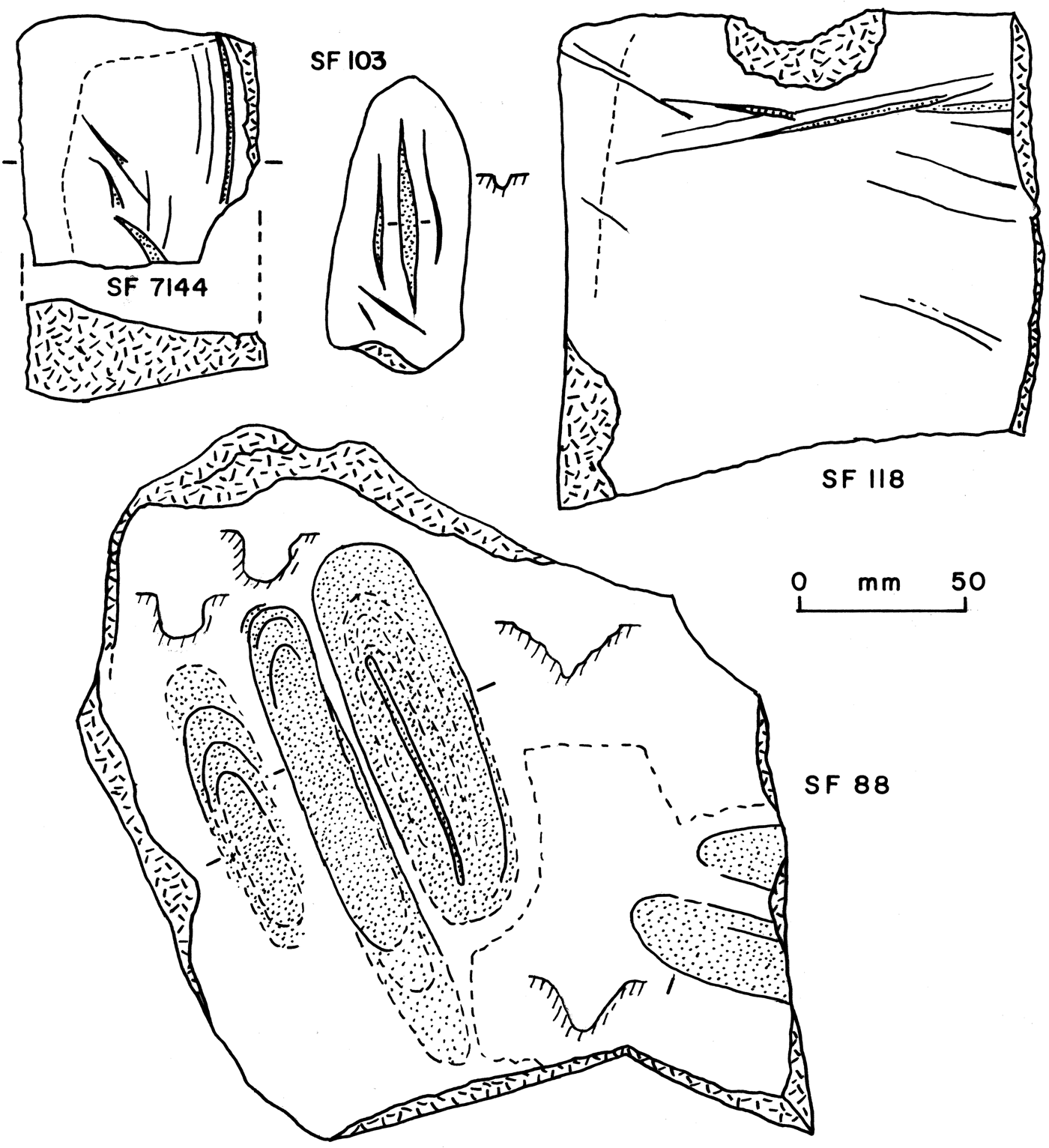
On what evidence can the whetstones be regarded as exploited roof-tiles? Firstly, several preserve fixing holes for nails: one from the North Gate; two from the forum-basilica (fig. 1, SF 118; fig. 3, SF 975); and three from the Silchester Collection. None from Insula IX, which are generally smaller in size, show this feature. The tiles were evidently pierced from one side only using a pointed hammer or punch, creating a single, rough-sided, conical fracture. There is no evidence for drilling. Secondly, the whetstones in general are tablet-shaped and 10–20 mm thick, the approximate thickness range of Brownstones, Pennant and Stonesfield Slate roof-tiles.
Whetstones with fine grooves, a fixing hole and wide grooves: SF 7144, Pennant sandstone, Insula IX; SF 103, Brownstones, Silchester Collection; SF 118, Brownstones with a fixing hole, Forum-basilica 2000; SF 88, Pennant sandstone, Silchester Collection.

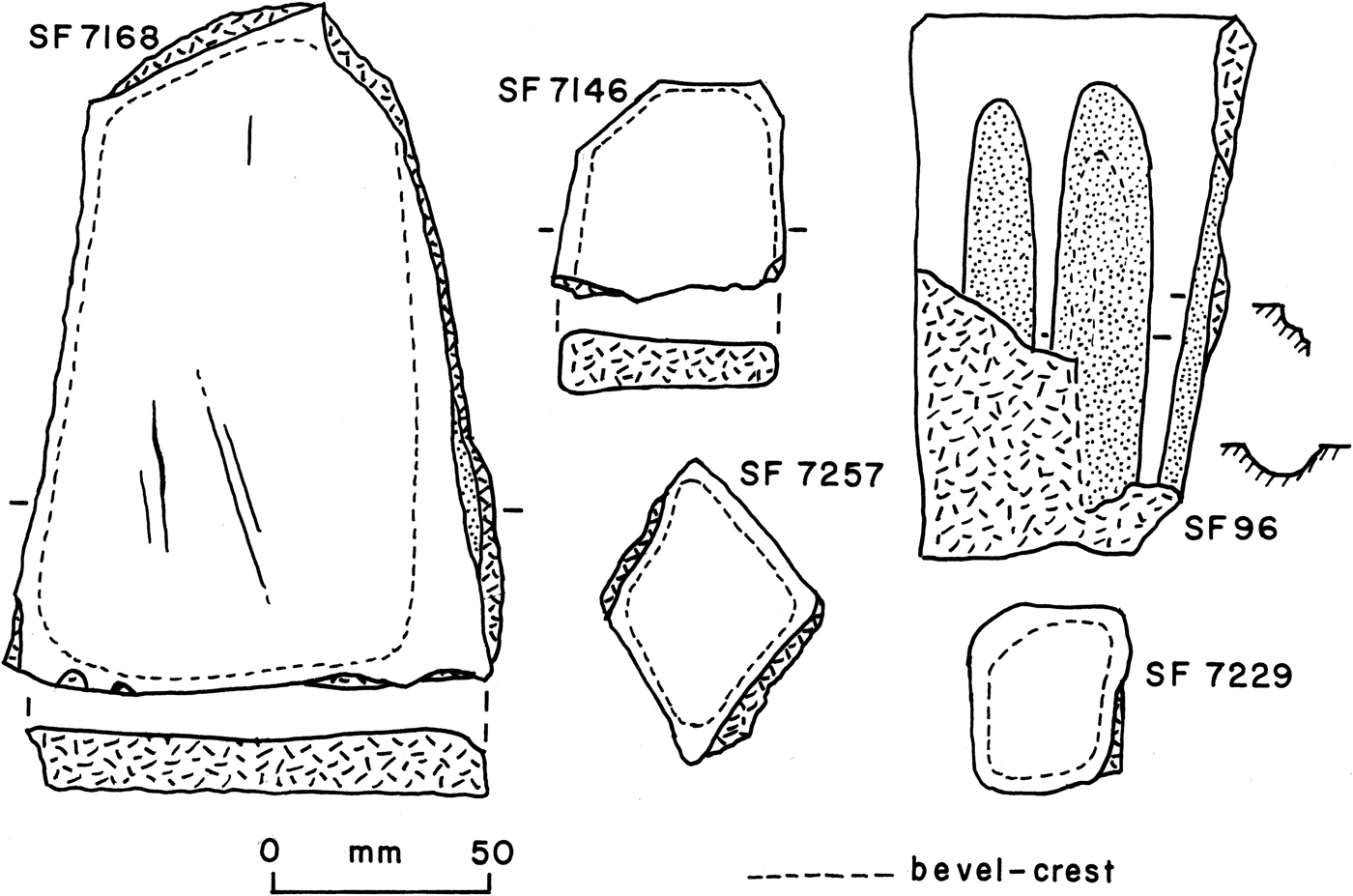
The whetstones as found are tablet-like and range from fragmentary to complete, with both faces well-smoothed through use. Many of those complete as whetstones are themselves based on fragments of tile, selected as of a convenient size and shape. As might be expected, the complete ones are generally the smaller in size, displaying unbroken bevel-crestsFootnote 7 at the circumference of the smoothed faces (fig. 2). Most of the whetstones, however, were damaged after being used and discarded. The bevel-crests (e.g. fig. 2, SF 7146) and, in many cases, surface grooves (e.g. fig. 3) are slighted by broken edges. Moreover, in a few cases in the Silchester Collection and Insula IX, the items entered the assemblage as joining fragments. Some of the whetstones, although now broken and with slighted features, are large enough to have been based on whole tiles that had either been discarded or never actually used on a roof.
Representative complete and damaged whetstones: SF 7168, bevel-crest complete, Brownstones, Insula IX; SF 7146, broken, bevel-crest slighted, Brownstones, Insula IX; SF 96, broken, grooves slighted, Pennant sandstone, Silchester Collection; SF 7257, bevel-crest complete, Brownstones, Insula IX; SF 7229, bevel-crest complete, Brownstones, Insula IX.

Whetstones with narrow grooves and a fixing hole: SF 975, with fixing hole, Brownstones, Forum-basilica 2000; SF 87 (top and underside), Brownstones, Silchester Collection; SF 139, Stonesfield Slate, Silchester Collection; SF 140, Brownstones, Silchester Collection.

The criteria required for worthwhile implements of this type, namely, a bonded mixture of hard, angular and ‘soft’ grains (including voids),Footnote 8 are admirably fulfilled by the rocks used for the tiles converted into whetstones described here. Bound together and supported by the soft elements, the hard grains act as chisels, removing tiny slivers of metal as the result of the relative motion of whetstone and object being treated. The Brownstones, of Lower Devonian age, is an upward-coarsening, sandstone-dominated formation with accessible outcrops well-positioned for quarrying at Portishead on the south-east shore of the Bristol Channel, the eastern flank of the Forest of Dean and the Wye Valley.Footnote 9 The reddish brown, very fine- to fine-grained sandstones quarried for tiles come from the lower part of the formation. Under the microscope, they are a mixture of quartz grains (hardness 7 on Moh's Scale) and, forming the soft element, rock fragments and some voids. The rock fragments are subordinate to the quartz and include much igneous and metamorphic material. The Pennant sandstone from the sandstone-dominated, high Upper Carboniferous measures, comes from much the same geographical region as the Brownstones, with outcrops in the Bristol-Somerset Coalfield, the Forest of Dean and the east crop of the South Wales Coalfield.Footnote 10 Roof-tiles of Brownstones and Pennant sandstone have much the same age and geographical distribution in the south of Roman Britain and could represent a single industry.Footnote 11 Pennant sandstones are typically greenish-grey or grey, medium- to coarse-grained and composed of angular quartz with very abundant rock fragments, chiefly phyllites, tightly squeezed together, and a little feldspar but no voids. They are clearly distinct from the Brownstones on all criteria. The occasionally seen Middle Jurassic Stonesfield SlateFootnote 12 from the South Midlands is basically a slightly sandy, micaceous, occasionally oolitic, shelly limestone that weathering renders fissile. Accompanying the shell debris and quartz as the soft element is abundant calcite cement (Moh's hardness 3). The solitary whetstone of this lithology found in the collections proved to be shellier than seems typical of the Stonesfield Slate, and has some affinity with the Colleyweston Slate in the Middle Jurassic Lincolnshire Limestone of the East Midlands.Footnote 13
GROOVED WHETSTONES
A striking feature of the whetstones of these lithologies as a whole is the prevalence of grooving. Three types of groove are recognised, arbitrarily described as fine, narrow or wide. The three collections differ significantly, however, in terms of the extent of grooving and in the kinds of groove present (table 2). Fine grooves only are represented at Insula IX, to the extent of roughly 11 per cent in the case of the Brownstones and 39 per cent of the Pennant sandstone. In contrast, all three types of groove are found in the Silchester Collection. A few of these whetstones carry more than one type and only roughly 13 per cent lack grooves. Similarly, all three types are represented on Brownstones whetstones from the Forum-basilica 2000. None of the few Pennant sandstone whetstones in this particular collection are grooved.
INCIDENCE OF TYPES OF GROOVE ON WHETSTONES OF BROWNSTONES, PENNANT SANDSTONE AND STONESFIELD SLATE FROM SILCHESTER

FINE GROOVES
These are the smallest encountered and amongst the least common. They vary from quite faint, linear scratches, occurring singly, in pairs, or lying roughly parallel in small groups, to conspicuous slit-like features of V-shaped to U-shaped profile that measure 2–3 mm in greatest width and depth (fig. 1, SF 7144, SF 103, SF 118). The latter vary from straight to slightly curved or almost hooked and seldom exceed 50 mm in length.
NARROW GROOVES
These are represented only in the Silchester Collection and Forum-basilica 2000, and, with the exception of a single Stonesfield Slate, are limited to the Brownstones (table 2). The more complete whetstones are illustrated in fig. 3.
These whetstones are mostly incomplete. Typically, they have been thoroughly smoothed on both faces through use. The grooves are normally limited to one face but in several cases occur on both. Sets of up to seven narrow grooves can be present in total on a single whetstone, and very rarely they occur with wide grooves. Their preserved length ranges between a few and 15 cm. In plan narrow grooves are straight to gently curved and 8–12 mm across with invariably rectangular profiles, in contrast to the fine grooves above and the wide grooves described below. The narrow grooves in some sets lie roughly parallel but in others partly intersect. A distinctive feature is the very gradual manner in which they deepen along their length, from a flat, barely perceptible depression on the smoothed surface at one end, to a bold, vertical-sided, fully semicircular termination up to 3–6 mm deep at the other. This suggests that each whetstone, when in use, was laid flat and kept stationary, and whatever item was being handled was pushed with increasing force by the operator along the groove from the faint (proximal) toward the crescentic (distal) end, which acted as a stop (e.g. arrows in fig. 3, SF 140). Some grooves seem to have been exploited more than once, and in rare cases from opposite directions.
WIDE GROOVES
Whetstones with these features are less common than the narrowly grooved ones and are restricted to Forum-basilica 2000 and the Silchester Collection (table 2). Most are found on Brownstones.
The grooves are straight to very slightly curved, with rounded ends, and measure 20–35 mm across, up to18 mm deep, and as much as 148 mm in length (fig. 1, SF 88; fig. 2, SF 96). The profile varies from mainly U-shaped to more rarely a rounded V-shape; slightly stepped profiles are occasionally seen, apparently reflecting the differential wear of the sedimentary laminae present in the flaggy rock. Wide grooves are normally the only ones seen on a whetstone, but in very rare cases are associated with narrow grooves (fig. 2, SF 96).
DISCUSSION
As a product of more than a century of excavation in Silchester, a description is given above of all the recovered whetstones that appear to have been derived from roof-tiles brought to this substantial settlement. Almost all of them date from the later Roman period, and many seem to have come from the forum-basilica. They are diverse in geological provenance and character, and amount to about two-thirds of the total number of whetstones so far recovered from the town. How should they be understood?
Efforts have been made to create a typology of whetstones,Footnote 14 but final agreement has yet to be reached. In essence, whetstones are of two kinds, primary and secondary. Primary whetstones are either deliberately manufactured items or ‘found’ objects from the natural environment (e.g. outcropping rocks, fields, beach gravels, river gravels). So far as the archaeological evidence goes, the manufactured ones were made by snapping bars off thin slabs of stone that had been prepared by shaping and then grooving on opposite faces by means of saws or chisels.Footnote 15 ‘Found’ whetstones are simply pieces of naturally occurring stone considered to be of a suitable lithology, shape and size to serve the purpose of a whetstone without much if any modification. They could be picked up by individuals in the course of their daily activities, or deliberately collected for sale by pedlars or market traders. Secondary whetstones, on the other hand, are artefacts with a definite biography,Footnote 16 having been introduced to a site in one guise but subsequently repurposed. Of this kind are the whetstones of Brownstones, Pennant sandstone and Stonesfield Slate discussed here. All of them are considered to share in common the same three initial stages in their biography: (1) production as a roof-tile at a quarry/mine and workshop; (2) transport to Silchester; (3) application to the roof of a building (occasional tiles could have been discarded/repurposed at this stage). Different subsequent steps seem probable.
That Insula IX and the forum-basilica (Insula IV), 150 m to the south-east, differ as activity-sites is strongly suggested by the individual whetstone collections. Those from Insula IXFootnote 17 are comparatively small and often complete (e.g. fig. 2, SF 7168, SF 7229, SF 7257). They could have been used to finish off/sharpen relatively small items, such as small knives, razors and scalpels. It is these whetstones, clearly small enough to have been portable, that commonly show fine grooves (fig. 1) but lack the narrow and wide ones prevalent at the forum-basilica (table 2). The finely grooved whetstones were plausibly also used to finish off or re-sharpen such pointed items as awls, engraving/chasing tools, meat skewers, needles, pins and styli. These various applications seem compatible with the diversified activities — domestic, artisanal and ‘light’-industrial at best — which the evidence suggests had taken place at Insula IX.Footnote 18 The remaining stages in the biography of these whetstones would therefore seem to be: (4) tile-fragmentation; (5) selection and use of fragments as whetstones for a range of activities; and, (6) discard, followed in many cases by (7) further fragmentation and repurposing (e.g. packing/hardcore).
The forum-basilica, as represented by Forum-basilica 2000 and the Silchester Collection, is clearly a different kind of site in terms of the whetstones present, arguably more heavily industrial in the later Roman period.Footnote 19 Although most if not all were broken after use, these artefacts are comparatively large: SF 88 measures 185 mm in length (fig. 1), SF 975 206 mm (fig. 3), SF 139 240 mm (fig. 3) and SF 140 334 mm (fig. 3). This strongly suggests that substantially complete or whole roof-tiles were being selected as whetstones, probably laid flat on a bench or other working surface. Another noticeable feature is that, typically, the whetstones have been extensively smoothed on both faces, no traces of the original rough surface of the cleaved rock remaining. Such whetstones mounted in this way could have been used to smooth/polish/sharpen comparatively large items of metal, such as daggers, knives and small cleavers, by rubbing them flat or almost so over the surface, perhaps with a lubricant of water. No evidence has been recognised to suggest whether the grooves found on so many of the whetstones arose as part of this process.
The wide grooves are enigmatic. The size, and particularly the profiles, of these grooves (fig. 1, SF 88; fig. 2, SF 96) suggest that they record the processing of stout items with either a globular end, a terminal ball or a terminal ring of semicircular or circular cross-section. None of the many Roman iron objects so far described from the forum-basilicaFootnote 20 and other Silchester insulaeFootnote 21 quite match this prescription. The Silchester Gallery at Reading Museum, however, displays stout punches (? for leatherwork) and one-piece razors/knives with looped handles that could have been among the kinds of object indicated.
Many examples of whetstones of medium to large size with narrow grooves can be found in the Forum-basilica 2000 group and the Silchester Collection (e.g. fig. 3). Almost invariably, these grooves stretch across surfaces, on both faces of the implement, which are also smooth through repeated use. What were these whetstones being used to manufacture?
The objects would appear to have been thin and flat, of rectangular section, about 10 mm wide, and with one end that was perfectly semicircular. BoonFootnote 22 linked the whetstones to the carving or repair of the Corinthian capitals at the forum-basilica, implying that mason's tools were being sharpened. Alternatively, WoodersFootnote 23 accepted the view that they were used to sharpen gouges. The items could have been carpenter's chisels, many Roman examples of which are known.Footnote 24 Of them, however, only mortise chisels have a rounded end — and also a curved cross-section — but with a degree of curvature that is considerably less than that at the ends of the narrow grooves (fig. 3). Spatulae are certainly items of about the right shape, dimensions and degree of rounding at the end,Footnote 25 but these are such very rare finds that they are perhaps unlikely to have been made in any quantity at Silchester, where none have so far been found.Footnote 26
Allowing for the effects of corrosion on the shape and dimensions of surviving Roman ironwork, the narrow grooves could plausibly record the finishing of the tangs of knives, cleavers, swords, or even perhaps ladles.Footnote 27 It may nevertheless be questioned why the tangs of these implements should be given a bright finish when eventually a handle may be expected to be fitted. One reason is to remove unsightly forging scale, and so create a pleasing appearance to match that of the blade already polished and sharpened on a whetstone. Another is to reduce the risk of corrosion after adding a handle. It is plausible that there were purchasers who preferred to add their own handles and to whom a bright overall appearance at the point of sale was most appealing.
The final stages in the biography of the whetstones with wide and narrow grooves from the forum-basilica would therefore seem to be: (4) some tile fragmentation; (5) the selection and use of comparatively large tile fragments (or even whole tiles) for the large-scale production, by polishing and shaping, of substantial objects of forged iron; then (6) discard, followed in many cases by (7) further fragmentation and repurposing.
The analysis of the Silchester assemblage of items of Brownstones, Pennant sandstone and Stonesfield Slate outlined above serves to illustrate that whetstones — finds apparently simple and unpretentious — can have surprisingly complex origins and uses.
ACKNOWLEDGEMENTS
I am indebted to Professor Michael Fulford (University of Reading) for the opportunity to examine the whetstones from Insula IX, and to the Acquisition Group and Angela Houghton for access to the Victorian-Edwardian collections at Reading Museum and Art Gallery.