1 Introduction
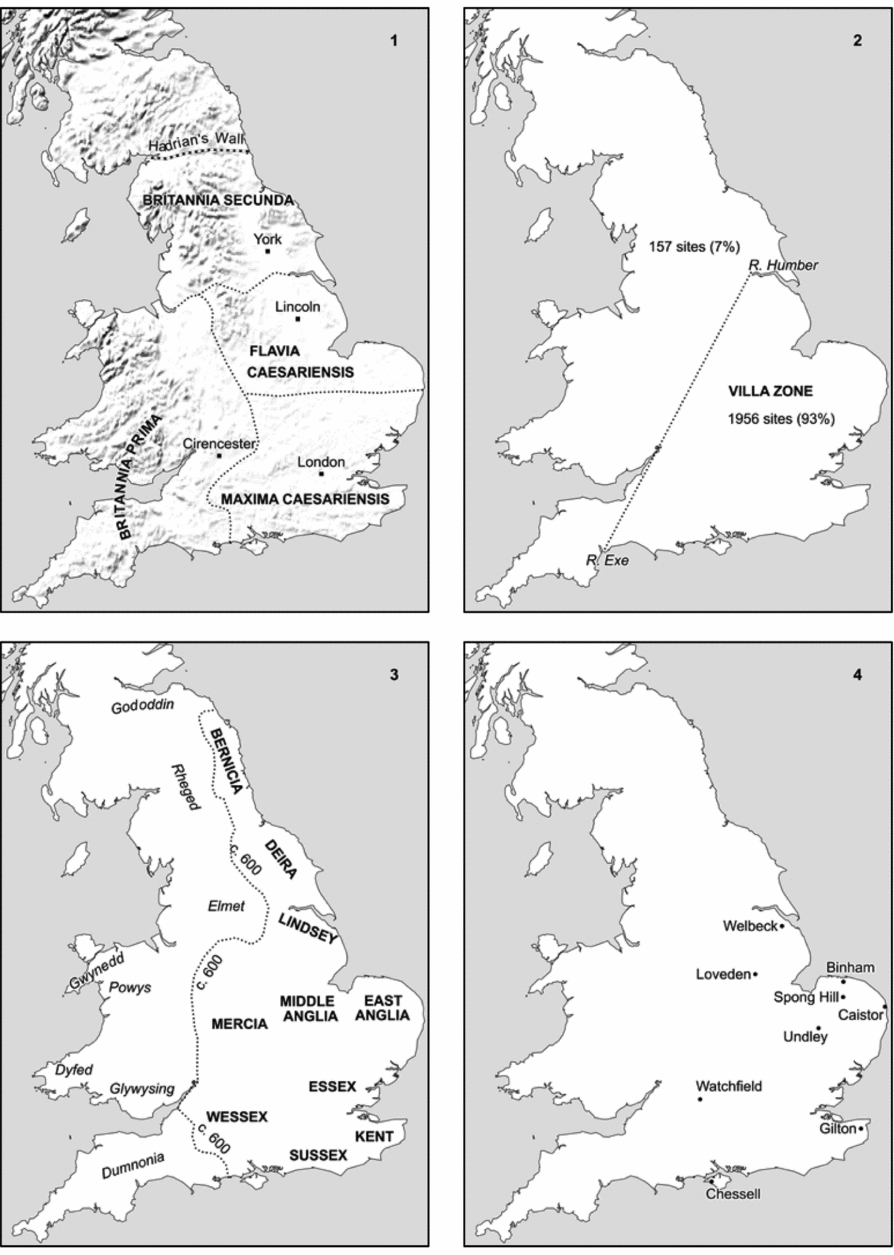
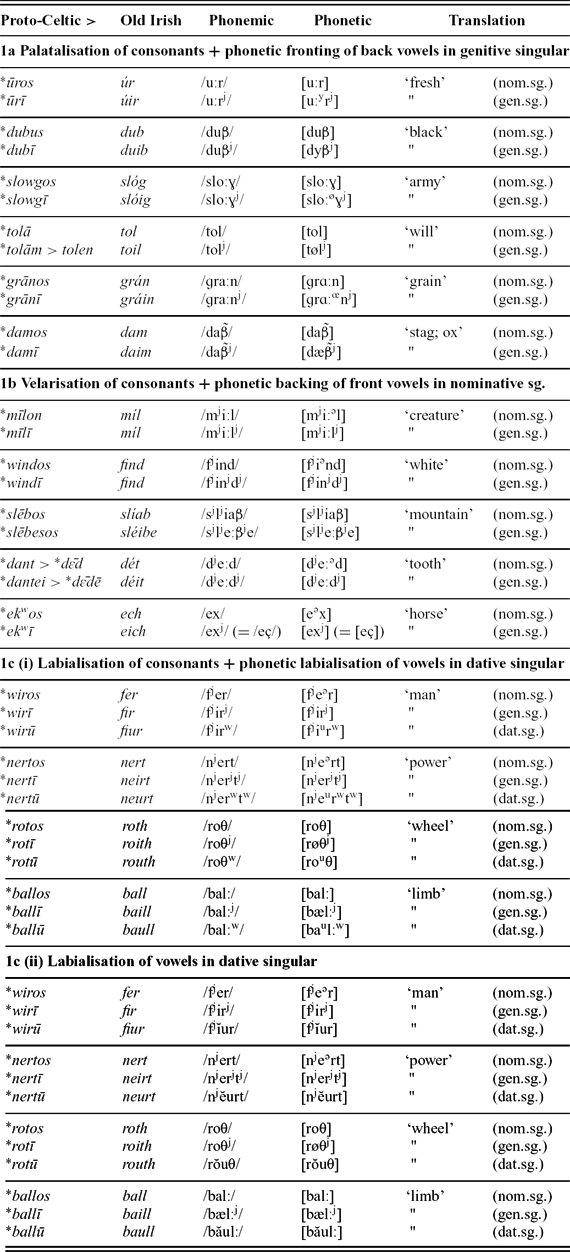
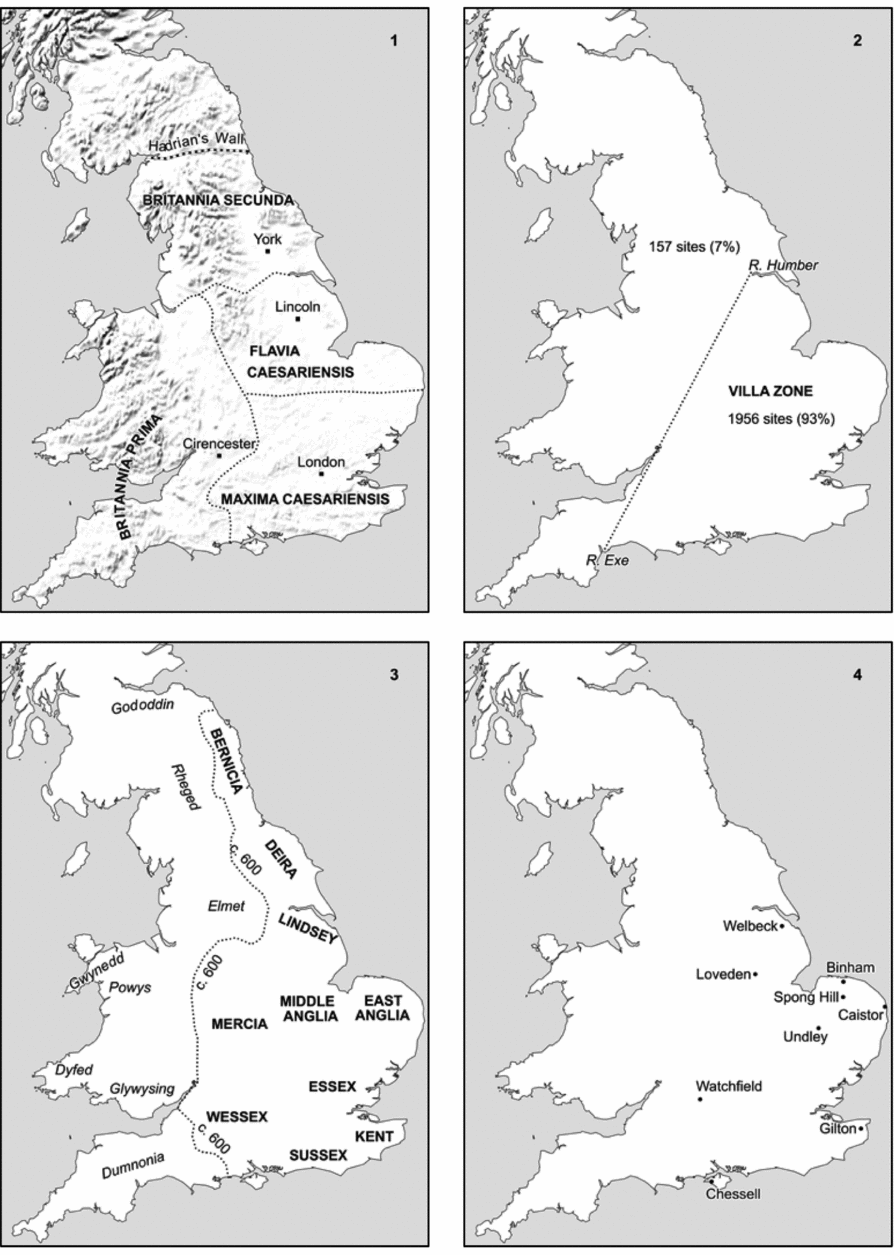
It is generally agreed that when the Romans conquered Britain in ad 43 they met with a Celtic-speaking population, but there is uncertainty about what the linguistic landscape was like when they left in ad 409. Nobody really knows what kind of a foothold Latin had gained by this time and what level of influence it had exerted on Celtic. To judge from the archaeological record, different areas of Britain were Romanised to greater and lesser degrees. The hub of Romanisation was in the lowland areas of southeastern Britain, especially in Maxima Caesariensis, with influence petering out in the provinces to the north and west (map 1). To give one example, out of over 2,100 known or potential villa sites identified in England and Wales, some 93 per cent of them are found southeast of a line stretching from the River Humber to the River Exe (map 2). This is roughly the same area that was settled by Anglo-Saxons between the fifth and sixth centuries (map 3), and where pre-Old English dialects developed (as indicated by earliest runic inscriptions in map 4) before spreading further inland.
Four provinces of Roman Britain in the fourth century ad with upland and lowland areas indicated by the shaded relief (adapted from Gerrard Reference Gerrard2013: 29); Map 2. Roman villa zone between the Rivers Humber and Exe (English data from Holbrook & Morton Reference Holbrook and Morton2008: 36, to which thirteen known Welsh villa sites are added); Map 3. Westwards expansion of Anglo-Saxons till c. 600 (after Cunliffe Reference Cunliffe2013: 452); Map 4. Find locations of pre-Old English runic inscriptions, c. 450–600 (adapted from Waxenberger Reference Waxenberger, Sauer and Waxenberger2013: 55)
Because Old English replaced all earlier languages in all but the western fringes of Britain, it is impossible to get a handle on the earlier linguistic situation except by indirect means. Place-names have been one avenue of enquiry (Parsons Reference Parsons2011; Dietz Reference Dietz, Haubrichs and Tiefenbach2011; Schrijver Reference Schrijver2014). The other, which is the focus of this article, has been to search for linguistic influence in Old English. Schrijver (Reference Schrijver2009, also Reference Schrijver2014, Reference Schrijver, Breatnach, hUiginn, McManus and Simms2015a) argues that either direct or Latin-mediated Celtic influence is observable in Old English, and he argues that the Celtic variety must have resembled Old Irish. Remarkable as this sounds, the thesis can potentially explain three core Old English sound changes: breaking, i-umlaut and a-/u-umlaut, which are all identifiable in the earliest Old English documents from c. 700 onwards. If correct, the linguistic situation of post-Roman Britain and the beginnings of the English language must be seen from a completely new perspective.
Although it seems contradictory to suppose that precisely lowland British Celtic – at the centre of Romanisation – would retain archaic Old Irish-like traits, the thesis has struck a chord with a number of scholars. Miller in his monograph on external influence on English endorses it without offering much of an assessment or review: ‘Celtic influence on English phonology seems to have been on prehistoric Old English via an Irish-type substrate’ (Reference Millar2012: 234). Others draw attention to the idea, possibly seeing it as the most credible candidate of early Celtic phonological influence on English among a variety of candidates, but offer little by way of analysis: Ahlqvist (Reference Ahlqvist2010: 48–50) is receptive to it; Millar (Reference Millar2012: 148, Reference Millar2015) has for a while been intrigued by it, but admits that he does not know whether to believe it or not; both Minkova (Reference Minkova2011: 47, fn. 42) and Kiparsky (Reference Kiparsky, Bowern and Evans2015: 67) detect nothing wrong with the proposal, though they do not explicitly endorse it either. Given the large amount of analysable linguistic data that is available both for Old English and Old Irish, such ambivalent attitudes seem unnecessary. This article begins by introducing the associated Old Irish and Old English changes (section 2); the remainder of the article offers a negative evaluation of the arguments for Irish-like influence on Old English (section 3) and, especially, late Northumbrian Old English (section 4). Finally, the main conclusions are drawn up in section 5.
2 Palatalisation, velarisation and labialisation in Old Irish and Old English
Schrijver (Reference Schrijver2009 and subsequent work) argues that British Celtic was formerly quite similar to Old Irish. After making this connection, he argues that Old Irish palatalisation, velarisation and labialisation are linked to the rise of Old English i-umlaut, breaking and a-/u-umlaut. These changes are briefly described in this section in preparation for a discussion of the correspondences (or lack thereof) in sections 3 and 4. For more detailed treatments, see McCone Reference McCone1996: 111–12, 115–20 and Hogg Reference Hogg1992: §§74–86, §§16–34, §§103–12.
2.1 Palatalisation
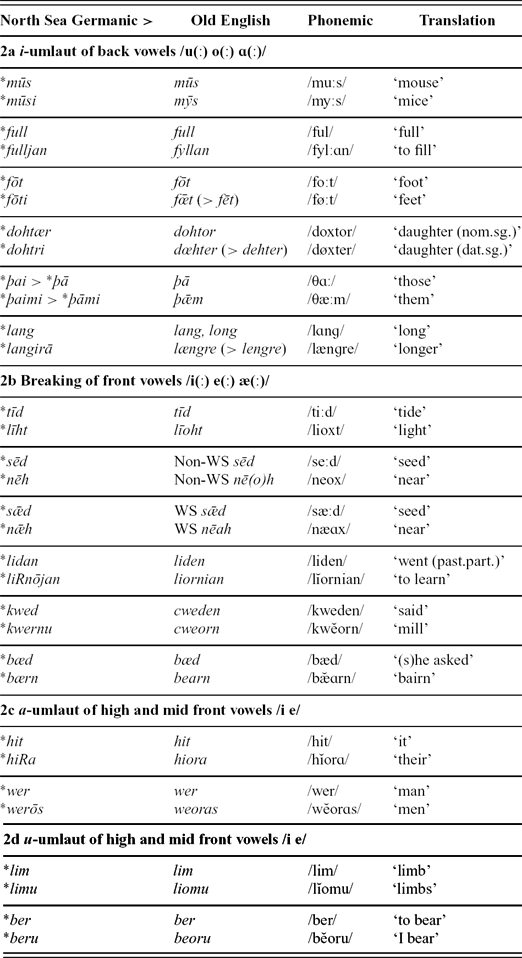
Old Irish distinguished consonants in terms of whether they were palatal or velar. A series of non-palatalised consonants was original to Celtic, and through phonemic split a series of palatal counterpart phonemes arose secondarily. Phonemicisation was caused by loss of unstressed final and medial palatal vowels (i.e. /i e/), which left a trace on preceding consonants. Thus, the pre-Old Irish consonant system, which started out with 23 consonants, gained a further 23 palatalised phoneme counterparts. Old Irish palatal consonants are marked in this article with a superscript /j/ (e.g. /pj tj kj bj dj/ etc.; note that these are not sequences of two consonants), and non-palatalised (henceforth: velar) consonants are unmarked.Footnote 2 Although consonants in Old Irish were either velar vs palatal at the phoneme level, Schrijver (Reference Schrijver2009: 202) points out that vowels flanking palatal consonants were inevitably influenced phonetically, through coarticulation, when at variance with them. Consequently, Old Irish back vowels (i.e. /aː oː uː a o u/) had fronted allophones before palatal consonants. The exact phonetics of these variants are uncertain, but it is uncontroversial for a back or low vowel to be somewhat fronted when next to a palatal consonant, since the vocal organs prepare for the new articulation milliseconds beforehand (table 1, part 1a ‘Palatalisation’ provides an approximate phonetic transcription of this vocalic variation).Footnote 3 It is this palatalising effect on vowels which bears a resemblance to Old English i-umlaut.
Old Irish palatalisation, velarisation and labialisation (NB for labialisation two possible analyses are given)

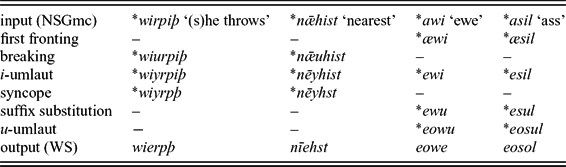
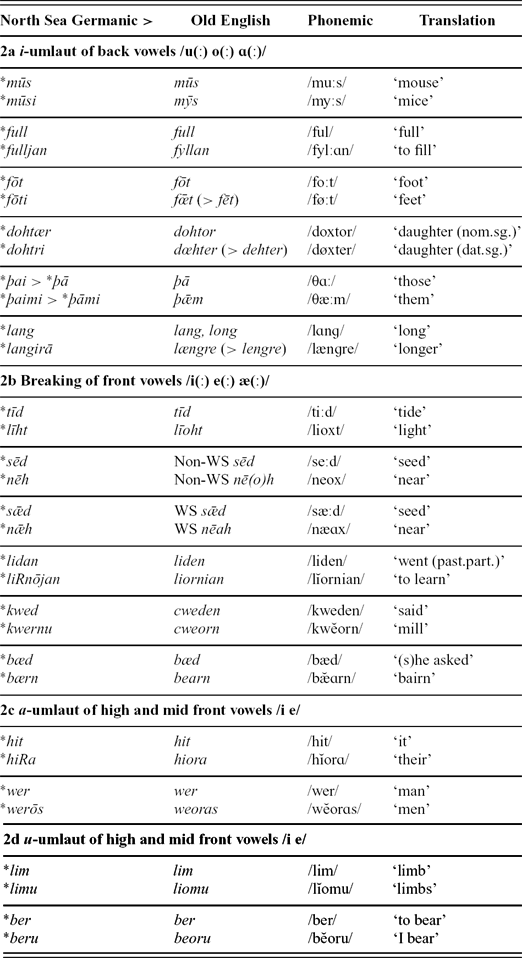
I-umlaut refers to a change in pre-Old English whereby /iː i j/ had a palatalising effect on preceding long and short stressed back vowels and diphthongs. Table 2 shows how /uː oː aː u o a/ underwent phonemic split by gaining palatalised counterparts, i.e. /yː øː æː y ø æ/. Rather like Old Irish palatalisation, i-umlaut also impacted on morphology, in that grammatical information was transferred from endings to the lexical root.Footnote 4 An obvious problem for Schrijver's Old Irish thesis is that i-umlaut is found across a range of other Northwest Germanic languages (see section 3.3), but he argues that there are specific correspondences that link the Old Irish and Old English changes, and these are dealt with in sections 3.3.1 and 3.3.2.
Old English i-umlaut, breaking, a-umlaut and u-umlaut
2.2 Velarisation
Old Irish velarisation is essentially a by-product of Old Irish palatalisation. As explained in section 2.1, to signal the distinction of palatal and velar consonants, secondary effects on neighbouring vowels are inevitable. Whereas back and low vowels were fronted when next to palatal consonants, the front vowels /iː eː ɛː i e/ were backed by following velarised consonants. In most cases, this involved a phonetic transition vowel developing between the front vowel and a velar consonant, which Schrijver symbolises with superscript [ə]. The transition vowel is not generally registered in Old Irish spelling, but it is found in Modern Irish spellings (e.g. nominative vs genitive singular are not distinguished in the Old Irish spellings míl and find in table 1, but they are now in Modern Irish míol vs míl and fionn vs fínn). The exception is PCelt. */eː/, which developed to /ia/ before a velarised consonant but remained as /eː/ before a palatal one, showing there was a phoneme split already in (pre-)Old Irish (see OIr. slíab and sléibe in table 1).Footnote 5
Schrijver associates Old Irish velarisation with the rise of Old English breaking and a-umlaut. Breaking involves the diphthongisation of front vowels before certain consonants. Simplifying somewhat, pre-Old English long front vowels /iː eː æː/ are broken before <h> (= [x]) and yielded OE /io eo æa/, and the short front vowels /i e æ/ develop to /ĭo ĕo  a/ before /x(C)/, /lC/ and /rC/. Examples of breaking of long and short vowels are given in table 2, and further details of the change are covered in sections 3.1.1, 3.2, 3.4 and 4.1. The other Old English change that Schrijver connects with Old Irish velarisation is a-umlaut. Both a- and u-umlaut (for the latter, see section 2.3 below) are usually referred to as velar or back umlaut in handbooks and grammars, but in this article the two types are differentiated in line with Schrijver's proposal. Basically (pre-)Old English /i e/ were diphthongised to /ĭo ĕo/ when followed by a single consonant plus /a/ (< PGmc */oː/, */a/). Table 2 gives examples of the change, and aspects of dialectal variation are discussed in sections 3.4 and 4.2.
2.3 Labialisation
Old Irish u-affection is closely aligned to Old Irish velarisation, but it is debated whether a separate labial series of consonants resulted from the change (McCone Reference McCone, Breatnach, hUiginn, McManus and Simms2015; Anderson Reference Anderson2016) or instead a series of short (i.e. monomoraic) diphthongs (Greene Reference Greene, Sovijärvi and Aalto1962). For completeness sake, both analyses are offered in table 1 (along with palatalised and velarised variants). Schrijver (Reference Schrijver2009 and subsequent work) thinks that short phonemic diphthongs were created. Graphemically, at least, pre-Old Irish /i e o a/ appear as Early Old Irish <iu eu ou au>. However, compared to palatalisation and velarisation, u-affection was a much more limited change: both <ou> and <au> became <u> before the end of the Old Irish period – the <ou> diphthong is attested only once in the Würzburg glosses, while <au> lingers on much longer (McCone Reference McCone1996: 138–9). Greene (Reference Greene, Sovijärvi and Aalto1962: 622) draws attention to the relatively low functional load of u-affection (unlike palatalisation vs velarisation) in Old Irish.Footnote 6
Schrijver (Reference Schrijver2009) connects Old Irish u-affection with the rise of Old English u-umlaut. The effects of u-umlaut are basically the same as those described already for a-umlaut. One difference is that West Saxon /e/ was subject to u-umlaut but not a-umlaut, and other differences are seen in late Northumbrian Old English (see section 4.2). Typical Old English reflexes of u-umlaut are given in table 2. Old Irish u-affection and Old English u-umlaut have much in common, but one difference is that the Old English change was restricted to front vowels (basically /i e/ and in Mercian dialects /æ/).
3 Lack of substantive congruence between the Old Irish and Old English phenomena
Section 2 demonstrated that Old Irish and Old English share a number of palatalising, velarising and labialising developments connected with the reduction or loss of unstressed vowels. However, these changes are usually assumed to have taken place independently in both languages. In particular, the Old English changes have been compared to similar developments in other Northwest Germanic languages that may have been brewing from an early date.Footnote 7 Therefore, strong arguments and striking connections in the data are required to demonstrate that Celtic influenced specific developments in Old English, but these are hard to find.
3.1 Problems of relative chronology
Not a great deal of attention is paid to the chronology of sound changes in Schrijver's proposal. Consequently, it is unclear whether all the relevant changes happened at roughly the same time or over a longer period, nor is it clear in what order they took place. This section attempts to shed more light on matters.
3.1.1 Where do Old English diphthongs come from?
As sketched in section 2.2, pre-Old English long vowels underwent breaking (i.e. diphthongisation) before specific consonants. Because the change is conditioned – thus fully predictable – these diphthongs could be viewed as allophones. However, it is usually assumed that the long diphthongs from breaking became phonemes by merging with inherited Proto-Germanic diphthongs, whose second element had lowered at an early date (i.e. PGmc */iu eu au/ > OE <io eo ea>). Yet Schrijver (Reference Schrijver2009: 199, Reference Schrijver2014: 62, Reference Schrijver, Breatnach, hUiginn, McManus and Simms2015a: 208) always presents the changes in a different order: (i) Breaking and a-/u-umlaut; (ii) Opening of inherited diphthongs; (iii) i-umlaut. Although Schrijver does not state that he is offering a relative chronology, it is difficult to imagine him doing otherwise, since chronology plays such a defining role in any historical phonological investigation.Footnote 8 The question of what merged with what may at first seem unimportant, but Schrijver's ordering puts breaking into the driving seat as the motor for change – a change which can then be connected with Celtic influence. It also implies that breaking is the original source of the Old English open-type diphthongs.
In my view, however, the simplest scenario is to regard the inherited diphthongs, which were already phonemes in their own right, as primary. That is, the conditioned diphthongs from breaking only became phonemes through merger with the inherited diphthongs. A strong argument for this scenario is that breaking of long vowels was defective and rare: defective because it created maximally two long diphthongs in any given Old English dialect, and rare because it is restricted to the environment before <h> (= [x]), such that only ten lexical roots with long vowels are in this environment, nine of which involve /iː/, as in (1).
(1) Old English breaking of long vowels (Ringe & Taylor Reference Ringe and Taylor2014: 178–9)
PGmc *linhtaz ‘light (in weight)’ > PWGmc *l
 ht > OE līoht > lēoht Footnote 9
PGmc *wīhaz ‘consecrated, holy’ > PWGmc *wīh ‘sacred object’ > OE *wīoh > wēoh ‘idol’
PGmc *tīhaną ‘to announce’ > PWGmc tīhan ‘to accuse’ > OE *tīohan > tīon > tēon
PGmc *līhwaną ‘to lend’ > PWGmc *līhwan > OE *līohan > *līon > lēon
PGmc *sīhwaną ‘to filter, to strain’ > PWGmc *sīhwan > OE *sīohan > sīon > sēon
PGmc *þīnhaną ‘to thrive’ > PWGmc *þ
han > *þīhan > OE þīon > þēonPGmc *twīhnai ‘a pair; two each’ > OE *twīohn- > OE betwēonum ‘between’
PWGmc *wrīhan ‘to cover’ > OE *wrīohan > wrīon > wrēon
PWGmc *fīhlu ‘file’ > OE *fīohlu > *fīol > fēol

The other long vowel in a breaking environment is the reflex of PGmc */æː/, which came down in West Saxon as <æ> (= /æː/) and other dialects as <e> (= /eː/). Only one lexical root, PGmc *nǣh ‘near’, has the mid-vowel in a breaking environment. This root appears in West Saxon as nēah. In Anglian and Kentish dialects, PGmc */æː/ was raised to /eː/ prior to breaking, so must have been broken to *nēoh. This word is not attested as such in the small Kentish corpus, and in Anglian dialects the word underwent Anglian monophthongisation (also known as Anglian smoothing) to nēh. But the earlier diphthongised form survives in derived forms and compounds where /h/ was lost prior to monophthongisation. For example, pre-Anglian *nēhwisti ‘neighbourhood’ gave *nēowest (attested in the dative singular on neoweste); *nēhlākian ‘to near, to approach’ came down as nēolǣċan, -laċan, -leċan; and *nēhor ‘nearer’ gave Mercian and Kentish nēor ‘nearer’ (Kentish also attests a raised form nīor).
Breaking, therefore, can maximally explain the origins of only two long diphthongs in any early Old English dialect: Anglian and Kentish <ea> /æa/ can only derive from the inherited diphthong */au/, while West Saxon <eo> /eo/ still has to derive from PGmc */eu/.Footnote 10 Therefore, it is more economical to assume that all three Old English long diphthongs derive from one source: inherited diphthongs. The alternative is to assume a complication of the facts by positing mixed origin: two diphthongs by breaking and one inherited. Also, the two diphthongs from breaking and the single inherited diphthong would have different origins depending on whether a West Saxon or a non-West Saxon dialect was involved. Lastly, the dearth of broken long vowels makes it implausible to see these roots as the chief origin of Old English front-to-back diphthongs (or the magnet to which inherited diphthongs were drawn). Thus, breaking of long vowels appears to have been a conditioned change initially, with the ten or so roots with broken long-vowel reflexes merging with the inherited diphthongs that had gained prominence on their first element to become falling front-to-back diphthongs. As a result of the merger, the inherited diphthongs were then, as Schrijver correctly observes, ‘tied into the simple vowel system’ (Reference Schrijver2009: 199).
This leaves one problem: Old English short (i.e. monomoraic) diphthongs. Their status is debated among scholars. So far, White (Reference White2015: 6 with references) has refuted all claims that short diphthongs exist as contrastive phonemes in living languages (including Schrijver's (Reference Schrijver2009: 198, fn. 15) assertion that they are found in Inari Sámi). Curiously, however, Old English scribes render what were short vowels /i e æ/ historically with the digraphs <io eo ea> in breaking and a-/u-umlauting environments (see diphthongs table 2, parts 2b, 2c and 2d). Given that spelling systems typically express meaningful phonemic rather than phonetic variation, it has been natural to assume that short diphthongs were phonemic in Old English or, at the very least, that they had a status ‘between an allophone and phoneme’ (Minkova Reference Minkova2013: 180). Whatever they were, they were short-lived because they became short monophthongs again in Middle English.
In my view, the status of the short diphthongs has never been satisfactorily explained, but the traditional view, summarised by Hogg (Reference Hogg1992: §2.22), still seems the only credible one:
It is certain that the Gmc diphthongs developed as diphthongs in OE, as in ON, OHG . . . It is therefore probable that if <ea, eo, io> were used to represent diphthongs from Gmc diphthongs, they would represent the same sounds in cases where breaking exercised an effect on *ǣ, *ē, *ī. Since it is inconceivable that the relevant sound changes would affect short and long vowels in quite different ways, the above diphthongs would contrast only in length with the sounds developed by the operation of breaking and back umlaut on short vowels. Hence there would have arisen a contrast between long and short diphthongs, which did not occur in Gmc.
In other words, short front vowels which underwent phonetic diphthongisation before velarised consonants – first via breaking and later via a-/u-umlaut – gained some degree of phonemic (or semi-phonemic) status on the analogy of their qualitatively similar long diphthongal phonemic counterparts, and this is made more probable by the fact that a binary length contrast permeated all vowels and almost every consonant within the Old English phonological system. Proponents of this idea also cite other examples where changes in long vowels had systemic effects on short vowels in Germanic languages (see Nielsen Reference Nielsen1984: 77 with references, and compare ideas of Luick and Britton mentioned in section 4.4 below).
The other solution – possibly it may be viewed as a variant of the former one – is that of Daunt (Reference Daunt1939) and White (Reference White2015). They argue that the Old English spelling system was devised by Irish scribes who were overly sensitive to phonetic variation in pre-Old English and used digraphs to express it, even where unnecessary, as in the case of short diphthongs. This system was then taught to and the propagated by Anglo-Saxon scribes. Of course, this proposal is very different from Schrijver's because it argues that Old English orthography, not phonology, was influenced by speakers of Old Irish. The idea has garnered almost no support, but given that Old English insular script and other conventions were taken from or influenced by Irish practices (O'Neill Reference O'Neill, Graham-Campbell and Ryan2009), it may yet explain part of the puzzle.
3.1.2 In what order did breaking, i-umlaut and a-/u-umlaut occur?
Breaking is usually assumed to have preceded i- and a-/u-umlaut according to most grammars and handbooks (e.g. Hogg Reference Hogg1992: chapter 5; Ringe & Taylor Reference Ringe and Taylor2014: chapter 6). New diphthongs created by breaking show the same effects of i-umlaut as inherited diphthongs, so it is reasonable to think that i-umlaut followed breaking. (If the new long and short diphthongs from breaking emerged after i-umlaut had taken its course, they would have been unaffected by it.) Also, there is agreement that i-umlaut preceded a- and u-back umlaut, not only because a-/u-umlaut (unlike i-umlaut) is inconsistently reflected in the earliest sources (Ball & Stiles Reference Ball and Stiles1983), but also because some forms (e.g. eowe ‘ewe’ and eosol ‘ass’) are explained by assuming i-umlaut was followed by suffix substitution, with the front vowels created by i-umlaut undergoing u-umlaut too (table 3).
Most likely ordering of breaking, i-umlaut and u-umlautFootnote 11

A problem for the Celtic thesis may be the relative chronology of breaking and i-umlaut. For Schrijver, breaking is connected with Old Irish velarisation, while i-umlaut is connected with Old Irish palatalisation. But, as explained in section 2.1, Old Irish palatalisation and velarisation are two sides of the same coin: the rise of phonological palatalisation gave rise to phonological velarisation as a knock-on effect. Yet with OE wierpþ and nīehs (table 3), the ordering of events is different: breaking (velarisation) precedes i-umlaut (palatalisation).
The ordering of i- and u-umlaut, in relation to the prehistory of OE eowe and eosol, seems less problematic, since u-affection probably initiated after or during palatalisation in Old Irish (McCone Reference McCone1996: 138–9). The problem is rather with a-umlaut, which Schrijver puts on a par with breaking: breaking is agreed to be a much earlier change, because a-umlaut (as well as u-umlaut) is not consistently reflected in the earliest sources.
Overall, then, Schrijver's proposal does not adequately account for the relative or absolute chronologies of the Old English changes. In addition, it is unclear whether other changes nestled within the relative chronologies of breaking, i-umlaut and u-/a-umlaut (e.g. Mercian second fronting) resulted from Celtic influence or not.Footnote 12
3.2 Why do only a few select consonants cause Old English breaking?
Aside from the ten roots that evidence breaking of long vowels before <h> (= this was a fricative /x/ after vowels), the change mainly involves the pre-Old English short front vowels /i e æ/ before /x/ and the consonant groups /xC rC lC/. These consonants appear to have had velarising effects on preceding vowels in other West Germanic dialects too, so the idea of Celtic influence is somewhat weakened.
For instance, the trio /xC rC lC/ blocked the palatalising effect of primary i-umlaut (i.e. /a/ > /e/) in southern Old High German dialects, and /xC rC/ had the same effect in Old Saxon (Nübling Reference Nübling, Fleischer and Simon2013: 37). Furthermore, in Old Frisian, breaking of /i e/ is restricted to /xC/ (the output of both is spelt either <iu> or <io>). And no breaking of /æ/ occurred because fronting of NSGmc */a/ > [æ] was blocked before /xC lC rC/, which again suggests that these clusters had some kind of velarising/backing effect (Bremmer Reference Bremmer2009: §40, §§48–9).
The difference with Old Irish is that any long or short front vowel and any consonant cluster could be either velarised or palatalised (and possibly also labialised) depending on the following vowel, so not just <lC rC> but also <nC sC mC tC kC dC> etc.Footnote 13 There is one exception: the Old Irish cluster <cht> /xt/, which was always velar. In my view, the velarising effects of /x(C) lC rC/ in Old English – not a whole raft of consonants and consonant clusters as in Old Irish – suggest there was a level of continuity or conservatism rather than innovation.Footnote 14 Much the same can be said about i-umlaut in Germanic languages, to which I now turn.
3.3 What is special about i-umlaut in Old English?
Excluding Gothic and Early Northwest Germanic Runes, i-umlaut is found in all historically attested Germanic languages, as illustrated by the following Old English, Old Norse and Middle High German examples. Thus, whereas PNWGmc *mūs ‘mouse’ came down unchanged as OE mūs with /uː/ (similarly, ON mús, MHG mūs), in the plural PNWGmc *mūsiz ‘mice’ came down as OE mȳs with fronting of the root vowel to /yː/ (exactly as in ON mýs, MHG miuse). Similarly, we find OE fōt, ON fótr, MHG vuoz ‘foot’ vs fronted OE f̄œt, ON føtr, MHG vüeze ‘feet’ and OE lang, ON langr, MHG lanc vs fronted OE længre, ON lengre, MHG lengere ‘longer’ (see table 2 for reconstructions). Hundreds more examples could be listed. Therefore, the only way of rescuing the notion of contact having had a hand in the Old English change would be to prove there is something unique about Old English i-umlaut that corresponds specifically with Old Irish palatalisation. Two arguments have been put forward: the date of i-umlaut (section 3.3.1) and its conditioning (section 3.3.2). Both are problematic.
3.3.1 Was i-umlaut abnormally early in Old English?
According to Schrijver, i-umlaut as a phonemic change was strikingly early in Old English (Reference Schrijver2009: 201):
All of West and North Germanic shows i-umlaut, and one may plausibly argue that, at least phonetically, back vowels had started to become fronted in i-umlaut contexts already in pre-settlement North Sea Germanic. What requires an explanation, however, is that the phonemicisation of i-umlaut and the rise of phonemically rounded vowels had taken place before the earliest sources of the eighth century in Old English, Old Frisian, and Old Coastal Dutch, whereas Low Franconian, High German, and Old Norse lagged centuries behind.
Schrijver (Reference Schrijver2009: 202) then argues that Celtic contact could have promoted early phonemicisation of i-umlaut in Old English. Before accepting this idea, let us examine how i-umlaut in Old English and other Germanic languages has been dated in recent research.
Schrijver rightly notes that in Old English i-umlaut appears to have fully taken its course in all dialects by the time of the first written documents (c. 700).Footnote 15 This leaves only runic inscriptions to provide yet earlier evidence. The earliest likely example of i-umlaut is on the Harford Farm Brooch (c. 610–50), discovered at Caistor-by-Norwich. This inscription has the form gibœtæ, which has been connected with the Old English weak verb ġebētan (< PGmc *ge-bōtjan) in the 3.sg.pres.subjunctive form ‘may (he) make amends’, reflecting PGmc *ge-bōtjai (Bammesberger Reference Bammesberger2003). Since i-umlaut has already been committed to writing in the early seventh century, it is logical to assume it occurred even earlier in speech (e.g. late sixth century). Further, a newly created rune < >, designed to reflect the i-umlaut vowel /y(ː)/, is used in the Whitby Comb inscription (c. 675–725) and in the Franks (Auzon) Casket inscription (c. 700–25).Footnote 16
Some earlier runic evidence (see Undley, Chessell and Watchfield on map 4 above) could place i-umlaut before the sixth or seventh century, which could possibly strengthen Schrijver's argument, but it is controversial. Since it is not widely known, I introduce it here. The logic runs as follows: the oþil-rune < >, which was formerly used to indicate /oː o/, stopped being used to represent /oː o/ because it started to breach the acrophonic principle, which dictates that a rune's name must contain the phoneme it stands to represent. This is because the oþil-rune became by i-umlaut the œþil-rune, which then represented /øː ø/. Consequently, a new rune <
 >, called ōs, was created to indicate /oː o/ afresh. This new rune appears first on the Undley Bracteate (c. 450–500). Furthermore, in other fifth- and sixth-century inscriptions, the œþil-rune <> is always used where i-umlaut would be expected, while the ōs-rune <> is used where no i-mutated vowel would be expected (see Waxenberger Reference Waxenberger, Sauer and Waxenberger2013). Thus, the Undley Bracteate (c. 450–500) contains <> in a non-i-umlaut environment (i.e. no /iːi j/ in the next syllable): gægogæ (my underlining here and elsewhere). The Chessell Down Scabbard Mount (c. 525–50) contains <> in a non-i-umlaut environment: æco, but also <> in an i-umlaut environment: sœri. Finally, the Watchfield Purse Mount (c. 500–50) contains <> ‘œ’ in an i-umlaut environment: hæribœki. Therefore, in these pre-550 inscriptions, i-umlaut might have taken place. The problem is that, with only four pieces of evidence, coincidence might be invoked. But it would be a rare coincidence – the same as tossing a coin four times and getting four heads in a row (1 in 16 or 6 per cent chance).Footnote 17 If these forms are taken as evidence for early i-umlaut, then i-umlauted vowels could already have been phonemes in their own right in the late fifth or early sixth century, leading to the rejection of the traditional assumption (i.e. Twaddel Reference Twaddell1938) that phonemicisation of i-umlauted vowels only took place upon complete loss of the i-umlaut factor.Footnote 18 To sum up, a (mid to late) sixth-century date for i-umlaut in Old English is a safe estimate at present and is accepted by most scholars (e.g. Nielsen Reference Nielsen1985: 89 with references), though a slightly earlier date is quite conceivable.
Now, I turn to the date of i-umlaut in other Northwest Germanic languages. Schrijver (Reference Schrijver2009: 201 cited above) acknowledges that phonemicisation of i-umlaut was early in Old Frisian and Old Coastal Dutch, and that it had occurred before the earliest written documents. Old Frisian documents are rather late (c. 1200), but there are indications that the change was much earlier. Front rounded vowels from i-umlaut already appear fully unrounded in the earliest sources – predating some Middle English dialects in this regard. Relevant runic inscriptions are scarce: the Folkstone inscription (c. 650), which is usually viewed as Frisian, probably contains the name æniwulufu ‘Aunwulf’ (< PGmc *auni-), the Britsum inscription (no date) has æ ‘always’ (< *aiwi), and the Rasquert inscription (late eighth century) has umædit ‘unmadden’ (PGmc *un- + *maiþiþ if from *maiþjan ‘to make mad’). Taken together with other eighth- and ninth-century personal- and place-name evidence, i-umlaut in Frisian and Coastal Dutch is usually dated to the late sixth or early seventh century (Buccini Reference Buccini1995: 32–3; Versloot Reference Versloot2014: 58).
As for Old Norse, all recent scholarship dates the change to between c. 500 and 700. It was fully implemented in the first written documents of the twelfth century (though many of these, especially poetry, date back to at least the ninth century). Runes again provide earlier data. While the younger-futhark inscriptions of the early Viking age do not generally render the i-umlauted vowels, syncope of the i-umlaut factor had occurred by the seventh century, which implies that the change must have taken place: Björketorp (c. 600) bArutz ‘breaks (3sg.)’ (with a syncopated ending, and not -iþ) and Eggja (c. 700) manz ‘men (nom.pl.)’ (< PGmc *manniz). Finally, the Ribe Cranium (before 725–50) uiArki ‘pain (dat.sg.m)’ (< PGmc *warki) does show the effects of i-umlaut (Nielsen Reference Nielsen2000: 261). Grønvik (Reference Grønvik1998: 54–7, 59–60) and Schulte (Reference Schulte1998: 235–6, 257) argue that the change can be backdated further. One argument is that forms such as PGmc *kunja- ‘kin’ must have had j-umlaut before, or at the time of, a-apocope (c. 500), thus *kunja- > *kyni > ON kyn. A different development (e.g. *kunja- > *kuni) would not have produced i-umlaut because /i/ after a short syllable does not yield umlauted forms in Old Norse (e.g. pre-ON *staði ‘place’ > ON stað, not *steð).
In contrast, it is generally agreed that Low Franconian, High German and Old Saxon did lag behind Old English. This is demonstrable from the fact that PWGmc */i/ after heavy syllables, which was lost at an early prehistoric stage, induced i-umlaut in Old English and Old Frisian but not in Old Franconian, Old Saxon and Old High German. For example, PWGmc *brūdi- ‘bride’ and *wurmi- ‘worm’ give OE brȳd, wyrm (with umlaut) vs OHG brūt, wurm (no i-umlaut). In addition, Old Franconian, Old Saxon and Old High German are slow to register the change even after its implementation. While i-umlaut of */a/ > /e/ (so-called primary umlaut) is signalled in the earliest eighth-century texts (presumably because the product of i-umlaut of /a/ merged with an existing phoneme /e/), i-umlaut of back rounded vowels (e.g. /uː u/ > /y yː/) is expressed in spelling somewhat later in the early ninth century, and only in a select few documents (Gütter Reference Gütter2011). I-umlauted vowels (i.e. other than primary umlaut of /a/) are more regularly spelt out in Middle High and Low German as well as Middle Dutch, but again not consistently so (especially with rounded vowels). Even Luther's Bible Translation of 1522 does not register i-umlaut in spellings, but the change must have taken place (Durrell Reference Durrell, Flood and Yeandle1989).
To sum up, English, Frisian and Norse all underwent i-umlaut at a similarly early date well before inland West Germanic dialects. There seems no point in developing an argument that basically implies that Old High German developed i-umlaut at an expected pace while Old English was unusually precocious. Rather, the late date of i-umlaut in Old High German could well be suspicious. Nielsen (Reference Nielsen, Askedal and Nielsen2015) seems to think so. He reasons that i-umlaut resulted in the first instance from reduction or loss of unstressed final vowels, and it is demonstrable that Old High German trailed behind other dialects in this regard. Early Alemannic texts of the eighth century still have a system of five long and short vowels in both accented and unaccented syllables, which is nothing like the unaccented system of Old English (four short vowels) and Old Norse (three short vowels).Footnote 19 If i-umlaut is linked to the reduction and loss of unaccented vowels, these fundamental differences must have played a role.Footnote 20
3.3.2 Is double i-umlaut particular to Old English?
Schrijver (Reference Schrijver2009: 203–4) argues that there is a more specific correspondence between Old English and Old Irish: double i-umlaut. Accordingly, ‘in Old English, vowel + *u + *i . . . became vowel + *i + *i, and the vowel underwent i-umlaut’, which is similar to the change in prehistoric Irish whereby ‘vowel + *u + *i became vowel + *i +*i, and if the i in the second syllable was syncopated, it palatalized the preceding consonant . . . the only original back vowel to do so’. Schrijver provides two examples to illustrate the change, given in (2).
(2) Double i-umlaut in Old English and Old Irish (Schrijver Reference Schrijver2009: 204)
PGmc *latumista > *latimista- (or rather *lætymist- (see Ringe & Taylor Reference Ringe and Taylor2014: 252)) > OE lætemest ‘last’
PCelt. *Lugudikos > pre-OIr. *Luɣiðeχ > OIr. Luigdech /luɣjðjəχ/ [lyɣjðjeəχ] (gen.sg. of the personal name Luguid)
However, this development is not unique to Old English. Two examples of Old English double i-umlaut given by Ringe & Taylor (Reference Ringe and Taylor2014: 251–2) are supplemented with examples from Old Frisian in (3).
(3) Double i-umlaut in Old English and Old Frisian
PWGmc *abunsti Footnote 21 ‘envy’ > *ab
sti > *æbȳsti > OE æfest (Mercian efest with second fronting), OFris. efēstPNWGmc *aþulingaz ‘prince’ > *aþuling > *æþuling > *æþyling > OE æþeling, OFris. etheling

As regards the two Old Frisian examples, the <e> in the first syllable does not demonstrate double umlaut because first fronting of PGmc */a/ > */æ/ (spelled <e>) occurred even when a back vowel was in the next syllable in Old Frisian (unlike Old English). However, the medial vowel must have umlauted to yield the medial unrounded <e> reflexes, which suggests that double i-umlaut had actually taken place in pre-Old Frisian.Footnote 22
It also seems quite likely that pre-Old Norse had double umlaut. Schulte (Reference Schulte1998: 223–6) argues that the process was exactly as in Old Irish because the only back vowel that could appear in the middle syllable was /u/. The intervening vowel was subsequently syncopated, but it could have a knock-on rounding (u-umlaut-like) effect on the vowel in the first syllable, especially in West Norse, as in (4).
(4) Double i-umlaut in Old Norse (Schulte Reference Schulte1998: 223–6)
PNGmc *aðulija > *aðyli > ON øðli, eðli ‘nature’
PNGmc *-farulija > *-faryli > ON at-ferli, at-førli ‘procedure’
PNGmc *-hugulī > *-hugyli > ON at-hygli ‘attentiveness’
An alternative derivation of the forms given in (4) would be to put u-umlaut and syncope before i-umlaut (e.g. PNGmc *aðulija > *ǫðuli > *ǫðli > ON øðli, eðli). Schulte (Reference Schulte1998: 224–5) acknowledges that this alternative scenario works in the mechanical sense, but he argues on functional grounds that double umlaut is more likely.
In conclusion, little weight can be given to the connection between double umlaut in Old English and Old Irish because the same effect is found in Old Frisian and (possibly) Old Norse.
3.4 Is dialectal variation in Old English a good argument for substrate influence?
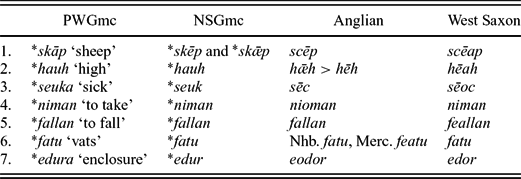
Aside from a few differences in West Saxon (e.g. the diphthong <ie> not found in other dialects), the vowel and diphthong inventories of all Old English dialects were about the same. However, when one compares individual Old English words in the different dialects, several distributional differences emerge. Compare the Anglian and West Saxon forms in table 4 (after Schrijver Reference Schrijver2009: 200).
Vowel differences among different words in Old English dialects

The existence of a similar underlying vowel inventory with differences in the distribution of vowels among lexis has been used to suggest that a shared substrate induced the vowel changes in pre-Old English, and to oppose any idea that they could have spread by interdialectal contact and diffusion:
The similarity of the vowel systems and of the processes leading up to them cannot be explained just on the basis of contact between the speakers of the Old English dialects, as the processes produced such different results that they impaired rather than improved mutual comprehension. It is as if the dialects adopted the same phonemic and phonetic system without contact with one another. That, I submit, is one of the best possible indicators of a common substratum, more explicitly, of a language shift by a non-Anglo-Saxon population to Anglo-Saxon in the period between c. 450 to 700. (Schrijver Reference Schrijver2009: 200)
However, a common substratum need not be invoked to explain the vowel variation among identical words in different dialects. Every instance of dialectal variation in table 4 can be plausibly explained on other grounds.
First, some variation stems from before the proposed contact scenario and should not even be cited. Example 1 (in table 4) reflects inherited variation: the difference between WS *skǣp vs non-WS *skēp (probably pre-settlement in origin) was preserved as well as strengthened by later palatal diphthongisation (i.e. *skǣp > scēap) in West Saxon (see Hogg Reference Hogg1992: §5.50).
Second, some variation arose after breaking, i-umlaut and back umlaut, so it is irrelevant to the argument being made. With examples 2 and 3, it is generally accepted that diphthongs once existed in these words in all Old English dialects as in the West Saxon forms, but these diphthongs were subject to late monophthongisation before velar consonants in Anglian dialects: hēah > hǣh > hēh and sēoc > sēc (Hogg Reference Hogg1992: §5.93). On the other hand, the variation in example 4 is explained by analogical levelling: West Saxon levelled out an earlier diphthongised form *nioman on the analogy of the 2, 3 present indicative singular, the subjunctive singular and plural, and the imperative singular, because these forms never had a back vowel in the following syllable (unlike *nioman), so they did not have an a- or u-umlauted vowel in their root syllable (see Hogg & Fulk Reference Hogg and Fulk2011: §6.8 for details).
Third, as Schrijver is well aware, the effects of breaking, i-umlaut and back mutation are clearly dependent on the types of vowels that existed in the lexical root at the time of application, and these vowels differed somewhat in pre-Old English dialects. This is the case in environments where first fronting (*/a/ > */æ/) did not occur in Anglian dialects. In example 5, the root vowel of PWGmc *fallan underwent first fronting (*/a/ > */æ/), then breaking (*/æ/ > *[a] spelled <ea>) in West Saxon dialects. However, in Anglian there was no fronting in this environment, so no breaking occurred (or if there was fronting it was annulled before breaking; see Hogg Reference Hogg1992: §5.10). Similarly, the variation in example 6 is explained by the fact that Mercian dialects underwent second fronting (*/a/ > */æ/) prior to a- and u-umlaut (Hogg Reference Hogg1992: §5.112). In other words, at the time of the change (in this case u-umlaut) only Mercian dialects had a front vowel *fætu in the root. Hence, the variation in Old English is unsurprising: reduced and apocopated /i a u/ inevitably influenced any root vowel that could be affected, but existing dialectal variation must be calculated into the process.Footnote 23
Finally, there are well-known rules governing which intervening consonants promoted back umlaut – especially in West Saxon – and this created further dialectal variation. In example 7, PWGmc *edura did not undergo u-umlaut in West Saxon because it only happens in this dialect if the intervening consonant was a liquid or labial consonant /l r p f w/ (Hogg Reference Hogg1992: §5.103). Such consonantal rules for a- and u-umlaut cannot be connected with properties of velarisation or u-affection in Old Irish, or any other early Celtic language, so example 7 is likewise unhelpful for the argument of Celtic influence.
4 Overstatement of developments in Late Northumbrian Old English
Claimed correspondences of Old Irish and late Northumbrian Old English sound changes seem to provide a strong argument for language contact. The connections come from an interpretation of spellings in the glosses of the Lindisfarne Gospels and the Durham Ritual (henceforth ‘Lindisfarne’ and ‘Ritual’):
The Northumbrian dialect of the glosses in the Lindisfarne Gospels and the Durham Ritual contains a number of forms in which the Proto-Germanic diphthongs *eu and *au merged as ēa (as against ēo and ēa, respectively, in other dialects: lēaf, dēath as opposed to lēof ‘dear’, dēath ‘death’ elsewhere). Similarly, breaking and a-umlaut of long and short *æ and *e merged as long and short ea, too: hearg, hearta (cf. ea, eo elsewhere, as in hearg ‘temple’, heorta ‘heart’). Only by u-umlaut and by the influence of immediately following *w do long and short *e become long and short eo: seofo ‘seven’, heofon ‘heaven’ (Campbell 1968 [Reference Campbell1977, SL]: 118 §278 (b)). The fact that in this dialect *e becomes ea by a-umlaut and breaking but eo by u-umlaut is strikingly reminiscent of the Old Irish developments which gave rise to the difference between such forms as nert ‘strength’ /n´ert/ [n´eərt] < *nertah < *nertos and its dative singular neurt /n´eurt/ [n´eurt] < *nertū.Footnote 24 (Schrijver Reference Schrijver2009: 209)
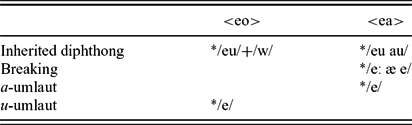
In other words, the <eo> and <ea> spellings are said to underlie the vowel developments in table 5.
Origins of vowels spelt <eo> and <eo> in Lindisfarne and Ritual (after Schrijver Reference Schrijver2009: 209)

But the alignments in table 5 are incorrect. It is not true, for instance, that there is a neat division whereby */eː e/ became <ea> by breaking and a-umlaut but <eo> by u-umlaut, reflecting similar effects of velarisation and labialisation as in Old Irish. Instead, breaking regularly yielded the rounded variant <eo>, and both a- and u-umlaut of /e/ yielded <eo>, precisely as in other Old English dialects. The difference with the dialect of Lindisfarne and Ritual is that there was a later lowering effect on the second elements of diphthongs, and this caused some former <eo> diphthongs to change to <ea> when /w/ did not directly follow or /u/ was not in the next syllable.
Unfortunately, Campbell's (Reference Campbell1977) and Hogg's (Reference Hogg1992: §5.44[2]) grammars do not provide sufficient information on scribal variation and its interpretation in Northumbrian Old English to address such matters. And while some of the details can be derived from a closer reading of the specialised works of Lindelöf (Reference Lindelöf1890, Reference Lindelöf1901, Reference Lindelöf1923), Stolz (Reference Stolz1908) and Britton (Reference Britton1961), none of these presents a clear dissection of the evidence. I therefore avail myself of the opportunity to offer a more exacting treatment of the late Northumbrian diphthongal spellings, incorporating some new frequency data from the DOEC.
4.1 Breaking
For long vowels, only */iː eː/ (but no */æː/) existed in a breaking environment in Anglian dialects. However, as a rule, Anglian monophthongisation subsequently occurred, which destroyed all evidence of breaking. The only exceptions to this in Lindisfarne and Ritual involve breaking in root *nēh ‘near’ (as discussed in section 3.1.1 above), and this mainly boils down to the verbal form *(to)(ġe)nēhlākian ‘approach’. A search of Lindisfarne revealed that the verb is found 101 times: 96 have the <eo> spelling and only 5 have <ea> (similar figures in Stolz Reference Stolz1908: 47). All 5 <ea> spellings turn up in Matthew, but in the same gospel there are a further 47 <eo> spellings with the same verb, so breaking of */eː/ yields <eo> in the overwhelming majority of cases. In the shorter Ritual gloss, there are two attestations of *(ġe)nēhlākian, both with <eo>. Finally, there is one occurrence of another word with *nēh minus Anglian monophthongisation in Lindisfarne: neawung ‘near, proximity, approaching’. In short, North Northumbrian */eː/ is almost categorically broken to <eo> not <ea>.Footnote 25
As for short vowels, breaking of */i/ gave <io> with just a few exceptional <eo> spellings (Stolz Reference Stolz1908: 44–5; Lindelöf Reference Lindelöf1890: 13–14). Breaking of */æ/ is also highly consistent: out of approximately 350 instances of breaking in Lindisfarne, there is just one <eo> spelling, namely ġeoro ‘ready’ < pre-OE *gærwa (Stolz Reference Stolz1908: 42–3). In Ritual there are approximately 120 examples of */æ/ breaking to <ea>, with only two exceptional instances of <eo>, namely beorno ‘children’ and eornungu ‘earnings, rewards’ (Lindelöf Reference Lindelöf1890: 11).
The situation with breaking of */e/ is more complicated. In Lindisfarne <eo> is more than twice as frequent as <ea>, approximately 350:160 (Stolz Reference Stolz1908: 44). But in Ritual the situation is reversed, for <ea> is more than three times as popular, approximately 40:140 (Lindelöf Reference Lindelöf1890: 13). Yet these total numbers provide no clue as to what is influencing the different outputs. In particular, breaking before /lC/ and /rC/ must be distinguished. In the former case, we are concerned exclusively with seolf ‘self’ (< PGmc *selban-), which consistently appears with <eo> in Lindisfarne (80×) and Ritual (14×).Footnote 26 For breaking before /rC/, the majority spelling is <eo> in Lindisfarne, at a ratio of 250:165. However, in Ritual <ea>-spellings are in the majority (26:137). Close analysis, especially of Lindisfarne, reveals that this variation is in part lexically determined and in part dependent on the quality of vowels in inflectional syllables.
In Lindisfarne, either <ea> or <eo> is categorical in certain words.Footnote 27 Other etyma have a mix of <eo> and <ea> reflexes, though usually not in a random way. For instance, while reflexes of PGmc *erþō- f. ‘earth’ and *hertōn- nt. ‘heart’ come down in other Old English dialects as eorþe f. and heorte f., in Lindisfarne the former usually has <eo> (107:7) but the latter typically has <ea> (31:48). Here we are dealing with a dialectal development, since ‘earth’ shifted to a different nominal class in Northumbrian Old English and usually had back rounded vowels in its inflections that influenced the <eo> reflex (see Ross Reference Ross1937: 64). In contrast, heart usually had /-a/ or /-e/ in its inflections and typically has the lowered reflex <ea> (but in the dative plural <eo> is slightly more popular, at a rate of 5:3, which suggests the /-um/ inflection was influential). In Ritual, the <ea> reflex is more common in both words, but similar variation to that found in Lindisfarne can be inferred in a probabilistic sense because <eo> spellings are proportionally more frequent in earth (12:23) than in heart (10:87). In Lindisfarne, further lexical tendencies are detectable, as in the adverb ġeorne ‘gladly’ (< *gerna) (and derivatives), which usually has <eo>, in contrast to the adverb fearra ‘from far’ (< *ferran) (and derivatives), which usually has <ea>, presumably because the latter retains /a/ in the next syllable.
To sum up, breaking of */eː/ yielded <eo> as did breaking of */e/ before /lC/. The situation with */e/ before /rC/ varies. In Lindisfarne the most frequent reflex is <eo>, while in Ritual it is <ea>. The evidence from Lindisfarne strongly suggests that <eo> was original, as in other Old English dialects (just as breaking of short */i/ consistently yielded a rounded second element <io> in both Lindisfarne and Ritual, not <ia>). After breaking, <eo> was retained with some consistency if /u/ or /o/ was in the following syllable. However, there was a tendency – especially when /a/ was in the following syllable – for the second element of the diphthong to lower to <ea>.
4.2 a- and u-umlaut
Both a- and u-umlaut of /i/ regularly yielded <io> in Lindisfarne and Ritual (Stolz Reference Stolz1908: 87–8; Lindelöf Reference Lindelöf1890: 13–14). On the other hand, */e/ became either <ea> or <eo>, and this was in part dependent on whether /a/ or /u/ was in the following syllable. The split development is most transparent in Lindisfarne. In total, Stolz (Reference Stolz1908: 85–6) identifies some 565 diphthongs that stem from a-/u-umlaut: 123 have <ea> and 446 have <eo>. Of the 123 <ea> spellings, 103 have <a> in the following syllable (84 per cent). Of the 446 <eo> spellings, 256 have <u> or its weakened variant <o> in the next syllable, while a further 156 words formerly had <u> in the next syllable, i.e. before late syncope. In total, then, 412 of the 446 words with <eo> reflexes have (or had) /u/ in the next syllable (92 per cent). Therefore, in Lindisfarne the <ea> and <eo> reflexes are indeed largely dependent on the vowel in the following syllable.
The situation in Ritual is less obvious. Lindelöf (Reference Lindelöf1890: 17) did not distinguish between a-umlaut and u-umlaut in his study but noted that <eo> was slightly less common than <ea> overall. My analysis of the spellings indicates that they are distributed in a way similar to Lindisfarne: u-umlaut appears to have yielded <eo>, at least when the /u/ that caused the change was in the second syllable of a lexical root (Lindelöf Reference Lindelöf1890: 15). Thus, PWGmc *hebun- ‘heaven’, *sebun- ‘seven’, *ġemedumōjan- ‘to allot’ almost categorically have <eo> reflexes, as in OE heofon (35:2), seofon (3:0), ġemeodumian (46:2), and the same is true for the interjection heonu ‘look!’ (9:0). In contrast, when u-umlaut was caused by an inflectional ending of a nominal or verbal paradigm (i.e. where there was a mix of a-, u- as well as non-umlauted forms in the same paradigm), there seems to have been a tendency to level the <ea> diphthong. This is certainly the case for neuter a-stems like (ġe)bead ‘prayer’ and feminine ō-stems like ġeafo ‘gift’, both of which are frequent nouns in Ritual. However, the <eo> spellings are proportionally more common in (ġe)bead than in ġeafo, which can probably be put down to the fact that u-umlaut was found in more parts of its paradigm than ġeafo.Footnote 28
Given that there is strong evidence that */e/ developed to <ea> and <eo> depending on whether /a/ or /u/ was in the next syllable, we must address the important question of how and when the split took place. Did the two reflexes, <ea> and <eo>, arise instantaneously with a-/u-umlaut (as in Schrijver's account; see quotation above)? Or did back umlaut first yield <eo> (or even <eu> at an earlier stage) as in other Old English dialects, which was retained in certain contexts (i.e. before /u/ or /o/ in the following syllable) but lowered in others (i.e. especially before /a/ in the next syllable)? Based on the parallel evidence from breaking (section 4.1), a later process of conditioned lowering of <eo> to <ea> is far more likely, and this scenario is strengthened by the fact that the same lowering development demonstrably occurred with the inherited long diphthong /eo/ (< PGmc */eu/), as will be described in the next section.
4.3 Developments of /eu/ and /au/
Of the three PGmc diphthongs */iu eu au/, the first usually appears as <io> in Northumbrian (or as <iu> /iu/ before /w/) (Stolz Reference Stolz1908: 29–30, Lindelöf Reference Lindelöf1890: 41–2). The other two diphthongs, */eu au/, remain distinct in early Northumbrian sources but merge, at least in spelling, as <ea> in the late Northumbrian dialect of Lindisfarne and Ritual. Of course, <ea> is the usual spelling for the reflex of PGmc */au/ in almost all Old English dialects, so this is unremarkable.Footnote 29 Remarkable is the fact that PGmc */eu/ comes down usually as <ea> (i.e. not as <eo> as in other Old English dialects). In Lindisfarne, <ea> spellings are three times as popular as <eo> spellings (75:25 approx). Importantly, however, if the inherited */eu/ diphthong appears before /w/ (or /u/ in the next syllable), <eo> forms are in the majority (Stolz Reference Stolz1908: 28, plus my translation):
Der sehr früh eingetretene Übergang von ēo zu ēa scheint durch ein u (oder daraus entstandenes o) in der nächsten Silbe gehemmt worden zu sein . . . Erhaltend wirkte auf ēo dann ferner noch unmittelbar folgendes w, da bei bewahrtem Diphthong in dieser Stellung die Belege mit ēo diejenigen mit ēa weit überwiegen.
[The very early transition of ēo to ēa appears to have been hindered by u (or its later reflex o) in the following syllable . . . A w that directly followed ēo also had a retentive effect on the diphthong, because in this position attestations with ēo clearly outnumber those with ēa in cases where the diphthong is maintained.]
Lindelöf (Reference Lindelöf1890: 60, Reference Lindelöf1901: 24) reports the same dynamic in Ritual: */eu/ only occurs regularly as <eo> before /w/. Evidently, /w/ and /u/ in the next syllable had a conserving effect on the rounded second element of the two inherited diphthongs */iu eu/.Footnote 30 If */iu/ and */eu/ were not reinforced by /w/, lowering and/or unrounding of the back element usually took place, giving <io> and <ea>.Footnote 31
4.4 Summary of results
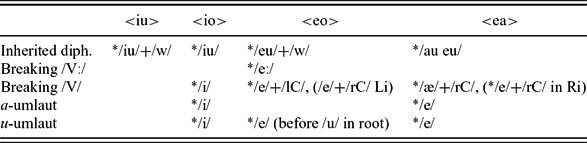
A revised overview of the relationships between the sound changes and usual spellings in Lindisfarne and Ritual is presented in table 6.
Origins of vowels spelt <iu>, <io>, <eo> and <eo> in Lindisfarne and Ritual

Now it is clear that */eː e/ became <eo> by breaking, as in other Old English dialects. Only with breaking of short /e/+/rC/ was there a tendency to lower the reflex <eo> to <ea>, especially if /a/ was in the next syllable. The simplest explanation is that the original breaking reflex of /e/ was <eo> (similarly breaking of */i/ yielded <io>). Thus, the idea that */eː e/ yielded <ea> by breaking in late North Northumbrian – the only argument for aligning Old English breaking with Old Irish velarisation – must now be abandoned.
A similar lowering effect can also explain the different reflexes of a- and u-umlaut. Of course, it looks synchronically as if in Lindisfarne /e/ becomes <ea> by a-umlaut and <eo> by u-umlaut (Schrijver Reference Schrijver2009: 209). However, as I have shown, the evidence plainly shows that /e/ became <eo> by a- and u-umlaut, but at a later stage the second element of the diphthong lowered if /u/ was not in the next syllable (similarly, Luick Reference Luick1914–40: §228, fn. 2; Britton Reference Britton1961). Note also that this lowering only took place with <eo> (because a- and u-umlaut of */i/ yielded only <io>, the same reflex as with breaking of */i/, not <ia>). There is no reason to suppose that either a-umlaut or breaking created non-rounded second elements of diphthongs in order to connect them with Old Irish velarisation or to separate them from u-affection.
Finally, the argument that short <eo> could subsequently become <ea> gains in plausibility because the development can be compared with parallel changes involving long inherited diphthongs. Of course, lowering of the second element of diphthongs happened in all Old English dialects (PGmc */iu eu au/ > OE <io eo ea>; see section 3.1.1). Similarly, in Lindisfarne and Ritual */iu/ became <io> unless a following /w/ promoted retention of the second rounded element, in which case <iu> is found. Likewise, */eu/ lowered to <eo> – as early Northumbrian documents demonstrate – but in Lindisfarne and Ritual it lowered further to <ea>. Crucially, however, <eo> usually remains unchanged before /w/. Thus, according to Luick (Reference Luick1914–40: §127, §133, §228, fn. 2) and Britton (Reference Britton1961: 1), the late Northumbrian developments of short diphthongs from breaking and a-/u-umlaut were influenced by their long counterparts.
In summary, based on the evidence from Lindisfarne and Ritual, there is no factual basis for pairing Old English breaking and a-umlaut with Old Irish velarisation or Old English u-umlaut with Old Irish u-affection. And since these late Northumbrian glosses provided the main or only argument for such a velar vs labial division, the foundations of the Old Irish contact thesis are very much weakened.
5 Conclusion
Various sound changes of pre-Old English resemble ones found in pre-Old Irish. The most obvious parallelism is that vowels in unstressed syllables had a qualitative influence on vowels and consonants in preceding syllables. But the thesis that an Irish-like substrate influenced pre-Old English developments runs into chronological difficulties, and arguments that there are unique similarities between the two languages do not stand up to close scrutiny.
1. The deduced relative chronology of the Old English sound changes causes unsolved problems for the Celtic contact thesis (section 3.1)
2. Closer links were found between Old English and other Northwest Germanic languages than with Old Irish, such as with breaking (section 3.2) and i-umlaut (section 3.3).
3. I-umlaut was not abnormally early in Old English (section 3.3.1), and double i-umlaut was not unique to Old English either (section 3.3.2).
4. Appeals to dialectal variation at word level in Old English are weak because the variation developed either before or after the changes posited by the contact scenario, and other variation cannot be connected with Old Irish influence (section 3.4).
5. The late North Northumbrian spellings and phonological rules have been misinterpreted; they do not reveal any intimate connection with Old Irish phonology (section 4.4).
To sum up, hardly any Celtic influence has been found in written Old English sources so far, and this seems especially true when it comes to phonology and phonetics.