Introduction
Inhaled corticosteroids can cause systemic and local side effects. Systemic side effects have been extensively reported in the literature, but local side effects have not been well documented even though most clinicians acknowledge their existence. Systemic complications can occur with high-dose inhaled corticosteroid therapy, because up to 80 per cent of the dose delivered by a conventional metered-dose inhaler is swallowed.1 Osteoporosis can occur as a consequence of altered calcium and phosphate metabolism.Reference Toogood, Crilly, Jones, Nadeau and Wells2, Reference Packe, Douglas, McDonald, Robins and Reid3 There is a risk of adrenocortical suppression,Reference Maxwell4, Reference Hanania, Chapman and Kesten5 bruising and skin thinning,Reference Capewell, Reynolds, Shuttleworth, Edwards and Finlay6, Reference Mak, Melchor and Spiro7 posterior sub-capsular cataracts,Reference Cumming, Mitchell and Leeder8 and glaucoma.Reference Garbe, LeLorier, Boivin and Suissa9 The incidence of systemic glucocorticoid activity is influenced by the potency and pharmacokinetics of individual preparations, and by the dose at which they are delivered.
We have previously reviewed and presented the local side effects of inhaled corticosteroids.Reference Roland, Bhalla and Earis10 One of the most commonly reported local side effect is pharyngolaryngitis. This may be transient, at the onset of treatment, or it may develop into a chronic condition which correlates with the dose of inhaled steroid. The symptoms typical of pharyngolaryngitis are local pain and chronic sore throat, dysphonia and even odynophagia (which may progress, when severe, to dysphagia). Other local side effects associated with the use of inhaled steroids include recurrent oral and oropharyngeal candidiasis,Reference Hanania, Chapman and Kesten5, Reference Babu and Samuel11, Reference Barnes, Pedersen and Busse12 troublesome coughing during inhalation, perioral dermatitis,Reference Held, Ottervanger, Petersen and Weismann13 tongue hypertrophy,Reference Linder, Kuint, German, Lubin and Loewenthal14 laryngeal disorders,Reference Williams, Baghat, Stableforth, Cayton, Shenoi and Skinner15 and a sensation of thirst (Figure 1).
Perioral dermatitis in a patient using an inhaled corticosteroid.

Persistent symptoms can mimic more serious underlying pathology, including carcinoma of the upper aerodigestive tract. This frequently results in referral to an otorhinolaryngology clinic. In addition, pharyngolaryngitis can hamper compliance with therapy, particularly if conservative measures, such as gargling or a spacer device, are ineffective.
The impact of stopping inhaled steroid therapy, with subsequent resolution of dysphonia, has been reported by DelGaudio.Reference DelGaudio16 However, this study failed to control for co-morbidities such as reflux disease, and it offered no objective measures of vocal handicap or performance before and after cessation.
The prevalence of local side effects of inhaled corticosteroids varies widely in the literature. Many trials assume symptoms to occur in the region of 5–10 per cent, whereas others quote figures as high as 58 per cent.Reference Williams, Baghat, Stableforth, Cayton, Shenoi and Skinner15, Reference Williamson, Matusiewicz, Brown, Greening and Crompton17 However, little robust evidence is provided to corroborate these claims, and prevalence is usually calculated on the basis of associated symptoms discovered when assessing other systemic conditions. A review of the world literature failed to identify any English language studies with the sole objective of reporting the local side effects of inhaled corticosteroids.
Whilst not usually serious, such local side effects often cause considerable morbidity. This can result in frequent presentations to the general practitioner and to the ENT or respiratory out-patient clinic. The main purpose of this study therefore, was to present the prevalence of side effects attributable to the use of inhaled corticosteroids. It is only when the prevalence is more clearly understood that effective therapeutic strategies can be implemented, including management of co-morbidities and other risk factors.
Methods
The study design was observational and based on a structured, specifically designed postal questionnaire.
Recruitment
Patient volunteers were recruited from the databases of two local general practices, with the assistance of asthma nurse specialists. The asthma nurse specialists were able to identify those patients on the practice database who were currently using inhaled corticosteroids.
Ethical considerations
A study protocol, sample questionnaire, patient information sheet and consent form were approved by the local research and ethics committee. Patient data were collected anonymously. A study number that correlated with the general practice database number identified the volunteers for inclusion in the study.
Questionnaire design
A pilot respiratory symptom questionnaire was designed. This incorporated elements from existing validated questionnaires. A novel symptom questionnaire was deemed necessary, as those in use targeted specific vocal disability alone at a single point in time without addressing putative causative factors.
The pilot questionnaire was distributed to 20 patients who had definite symptoms of pharyngolaryngitis due to inhaled corticosteroids. This sample was recruited from ENT clinics. The pilot study enabled us to simplify the questionnaire, to incorporate further questions based on symptom expansion, and to present it in a format that would be more easily analysed at a later date.
Inclusion criteria
In total, 190 patients were included on the basis of current steroid inhaler use and asthma. Only patients with peak flow and reversibility-proven asthma were included. Those using steroid inhalers to treat chronic lung disease were excluded. The questionnaires were distributed by post with a reply-paid envelope to encourage participation. Non-responders were encouraged to participate by telephone and by being sent two further postal questionnaires.
Data collection
Individuals were classified as mild, moderate or severe asthmatics, using the guidelines of the British Thoracic Society.18 This classification evolved from the stepwise management of asthma in adults. General demographic data, including a smoking history, was assessed. The number, type, strength, dosing regime and duration of individual inhaler use were recorded. The specific side effects enquired about were: hoarseness, voice weakness and voice loss, sore throat, throat irritation, and long-standing cough. A 10-point visual analogue scale was used to investigate throat discomfort induced by inhaled corticosteroids. Co-morbidities (reflux disease, rhinitis and post-nasal drip) and preventive measures (spacer device and gargling) were also recorded.
Statistical analysis
Univariate analysis involved simple plots and analysis using Kruskal–Wallis analysis of variance, the Mann–Whitney U test and Spearman's rank correlation. The data were next analysed by multiple logistic (binary) regression (M log R). This technique is related to multiple linear regression but the covariates are reduced to binary data. The dependent variable is a logit, and its relation to the covariates is expressed as an estimate, which is tested for significance. The odds ratios were calculated by raising e to the power of the estimate. M log R was carried out using the categorical modelling procedure in the SAS statistical analysis system (SAS Institute Inc., Cary, USA).19
Results
There was a 75.8 per cent response rate (144/190 questionnaires). Sixty-three (43.8 per cent) respondents were male and 81 (56.2 per cent) were female. The mean age of responders was 53.4 years (range 18 to 79). There were 25 smokers (17.4 per cent). Patients with reflux or a significant post-nasal drip and those using an intra-nasal steroid were excluded on the basis of laryngopharyngeal inflammation attributable to some cause other than inhaled corticosteroid use.
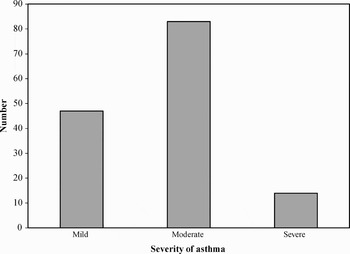
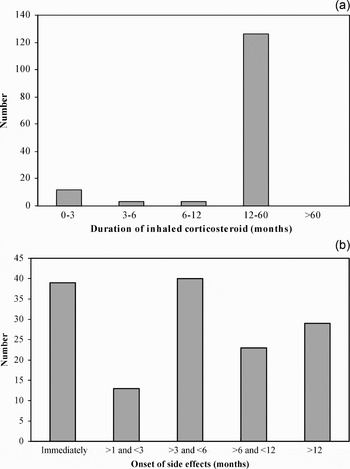
The distribution of asthma severity is shown in Figure 2. The majority of our patients were mild or moderate asthmatics.18 The median and mean discomfort scores on the visual analogue scale were 4.8 and 4.26, respectively. On this scale, zero indicated no discomfort caused by the inhaled corticosteroid and 10 indicated the most severe discomfort imaginable. The vast majority of our patients (126/144) had been using their inhaled corticosteroid for between one and five years (Figure 3a).
Distribution of asthma severity; classification according to the British Thoracic Society 2003 guidelines.18

(a) Duration of inhaled corticosteroid use. (b) Onset of side effects following commencement of inhaled corticosteroid.

Univariate analysis was performed using the Spearman rank correlation for non-parametric data. A Bonferroni correction was performed for p values because of multiple correlations. Hence, significance was only considered where p < 0.01.
As expected, asthma severity was positively correlated to longer duration of corticosteroid inhaler use (p = 0.0016). Figure 3(b) shows the onset of side effects after commencement of inhaled corticosteroid therapy. Broadly, side effects were observed to occur either immediately or after a short delay of three months. However, by using a steroid inhaler for longer, individuals were more susceptible to weakness of their voice (p = 0.0016), hoarseness (p = 0.0001) and throat irritation (p = 0.008). Figure 4 illustrates the prevalence of hoarseness, weakness of voice, aphonia, sore throat, throat irritation and persistent cough in individuals using inhaled corticosteroids. Hoarseness, throat irritation, sore throat and cough were observed much more frequently than anticipated. Moreover, the duration of use of non-steroid inhalers, such as regular short-acting β2-agonists, was also positively correlated to hoarseness (p = 0.0039) and to higher scores on a 10 cm visual analogue scale measuring discomfort (p = 0.0004). A weak voice was observed more frequently than complete aphonia.
Prevalence of specific laryngeal and pharyngeal side effects in individuals using inhaled corticosteroids: (a) hoarseness; (b) weakness of voice; (c) loss of voice (aphonia); (d) sore throat; (e) throat irritation; (f) persistent cough.

Worsening asthma severity was also positively correlated to frequency of aphonia (p = 0.0044). Furthermore, the duration of use of both corticosteroid (p = 0.0001) and non-steroid (p = 0.0039) inhalers was positively correlated to the prevalence of hoarseness.
The presence of cough was positively correlated to hoarseness (p = 0.0015), and both symptoms were more likely to be present in more severe asthmatics (p = 0.0024). A cough also predisposed individuals to a sore throat (p = 0.004) and to throat irritation (p = 0.001). The presence of throat irritation was positively correlated with voice loss (p = 0.0065). Throat irritation was found to be more common the longer a corticosteroid inhaler had been used (p = 0.001) and in the presence of cough (p = 0.008).
Multivariate analysis (p < 0.05) showed that voice weakness was directly proportional to the use of inhaled corticosteroid (p = 0.0487; odds ratio 1.79). Individuals who used a non-steroid inhaler alone did not complain of voice weakness. The prevalence of throat symptoms was directly proportional to smoking (p = 0.0486; odds ratio 1.90) and to the combined use of non-steroid and corticosteroid inhalers (p = 0.0313; odds ratio 2.82). Use of the inhaled corticosteroid for less than three months or over two years had no impact on the onset of undesirable side effects (p > 0.9). Conversely, the duration of non-steroid inhaler use was directly proportional to throat irritation (p = 0.0488; odds ratio 1.80).
We also determined that asthma sufferers were more likely to use a spacer device compliantly as the severity of their asthma worsened (p = 0.0487; odds ratio 1.53). Furthermore, individuals over the age of 60 years were more likely to have severe asthma, by definition requiring more than one inhaler to maintain control (p = 0.0280; odds ratio 1.60). In addition, the more severe the asthma, the greater the incidence of side effects (p = 0.0049; odds ratio 1.87), particularly vocal disability including loss of voice (p = 0.0491; odds ratio 1.34).
Discussion
The pharyngeal and laryngeal complications of long-term inhaled corticosteroid administration are well documented. Oral and oropharyngeal opportunistic infections are frequently encountered. Other ‘surface contact’ complications include perioral dermatitis and tongue hypertrophy. The most troublesome functional complications are cough during inhalation and laryngeal disorders that result in dysphonia.
The implications of these unwanted side effects are far-reaching. Investigations to exclude a possible underlying neoplasm are required. If no malignancy is found, the patient can be reassured that their symptoms are attributable to the inhaler. Unfortunately, the management of unwanted side effects is wholly unsatisfactory. Sufferers are advised to gargle and to use a spacer device.Reference Selroos, Backman, Forsen, Lofroos, Niemisto and Pietinalho20 However, despite stringent compliance with these measures, there remains a group of asthmatic patients who continue to be affected. This is not surprising, since up to 80 per cent of an inhaled dose may deposit in the oropharynx.Reference Lipworth21
It is our experience that the various side effects cannot be lumped together as one single entity. Subtle mucosal-derived symptoms, such as irritation or frank soreness, and subtle functional symptoms, such as voice weakness, dysphonia or aphonia, may be missed. Also, confounding factors such as smoking, reflux disease and nasal pathology must be accounted for when presenting data.
Our results corroborate previous findings that asthma severity is directly proportional to the incidence of side effects.Reference Babu and Samuel11 This would seem logical since more severe asthma requires a combination of inhalers, often augmented with oral therapy, to control symptoms. The incidence of side effects is also a dose-dependent phenomenon.Reference Williamson, Matusiewicz, Brown, Greening and Crompton17
By discriminating between users of non-steroid inhalers and corticosteroid inhalers, we have shown that some side effects, such as voice weakness, are attributable to corticosteroid alone. However, other complications, such as throat irritation or soreness, are more likely to occur if steroid and non-steroid inhalers are used in combination. We have also shown that non-steroid inhalers alone may cause throat irritation. This may be a consequence of the ‘cold Freon effect’ of pressurised metered-dose inhalers,22 a toxic effect of inhaled excipients (oleic acid), or lactose in dry-powder inhalers.Reference Bryant and Pepys23, Reference Shim and Williams24
We have not shown a difference in the prevalence of side effects attributable to the duration of inhaled corticosteroid use. Hence, unwanted side effects may be reported very soon after commencement of inhaled corticosteroid therapy, and should be recognised.
As would be expected, asthmatics who continue to smoke are more likely to complain of undesirable throat symptoms. Presumably, this is due to the additive effect of irritation, to both the oropharyngeal and laryngeal mucosa, from the inhaled corticosteroid and the cigarette smoke. The implication is that asthmatics who continue to smoke should be discouraged and offered anti-smoking advice and therapy.
Other findings were that patients with severe asthma tended to use a spacer device, and that patients over 60 years were more likely to use a combination of inhalers. Accordingly, this latter group had a greater prevalence of side effects.
Little is known about the mechanism by which inhalers cause inflammation of the oropharyngeal and laryngeal mucosal surfaces. Some have speculated that a ‘residue’ from the inhaled substance irritates the pharyngolaryngeal mucosa. Indeed, both the propellant and lubricant components of metered-dose inhaler preparations have been shown to have a pro-inflammatory local effect. This may partly explain the difference in frequency of local side effects, comparing steroid, pressurised, metered-dose inhalers and high to medium-high resistance, dry-powder inhalers.
Low resistance, steroid, dry-powder inhalers, such as Rotahaler (Cipla Ltd, Mumbai, India), Diskhaler (GlaxoSmithkline, Brentford, UK), and Diskus and Accuhaler (GlaxoSmithkline, Brentford, UK) are associated with higher frequencies of local side effects because of the greater oropharyngeal deposition, compared with dry-powder inhalers with a higher inbuilt resistance. We have already alluded to the fact that lactose, as a component of lactose-based, dry-powder inhalers, may also act as an irritatant on the pharyngolaryngeal mucosa. But why would an anti-inflammatory steroid preparation cause inflammation in the upper airway? The aetiology is very likely to be multifactorial and may depend on several factors (Table I).
Airways inflammation: possible contributory factors

Our study has demonstrated convincingly that there is an association between the use of inhaled corticosteroids and the appearance of local side effects in the oropharynx and larynx. In order to establish more effective treatment, such complications first need to be recognised by those providing treatment. Whilst such complications are mostly minor and of little consequence to the patient's overall health, sufferers are frequently alarmed. This can hamper compliance. Some of the local side effects are likely to be dose-dependent, and this emphasises the need to find the lowest effective dose of inhaled steroid.
More importantly, however, the literature shows that many of the local side effects are device-dependent, and a change of inhalation device should be considered. Precautions such as rinsing the mouth, gargling and washing the face after inhalation should also be recommended, but are of uncertain efficacy. Leukotriene receptor antagonists are useful oral, non-steroidal, anti-inflammatory drugs which may have an adjunctive role in the management of asthma.Reference Currie and McLaughlin25 Their capacity in reducing the detrimental side effects of inhaled corticosteroids has yet to be evaluated.
• This study investigated the prevalence of pharyngeal and laryngeal symptoms associated with the use of inhaled corticosteroids
• A questionnaire was distributed to 190 patients on the basis of current inhaled corticosteroid use
• Hoarseness, throat irritation, sore throat and cough were observed much more frequently than anticipated
• More observational and randomised controlled trials are necessary to examine existing inhalers; specifically, how and why they cause local side effects
Conclusion
It is evident from our study that more observational and randomised controlled trials are necessary to examine existing inhalers; specifically, how and why they cause local side effects. However, successful recruitment and analysis would depend on cooperation and collaboration between pulmonologists, voice care specialists and other laryngologists involved in the care of asthmatic patients requiring inhaled corticosteroids.