‘The guerrillas are badly organized and poorly led. They have no sanctuary, no organized army, no central government …’
Zbignew Brzezinski, Reflections on Soviet Intervention in Afghanistan, 1979.Footnote 1
By most accounts, National Security Advisor Brzezinski's assessment of the mujahedeen was correct. Throughout the Afghan War, the only element the collection of militant groups appeared to have in common was their opposition to the Soviet Union.Footnote 2 Yet, despite being clearly overmatched, the groups allied together and produced the necessary military power to outlast the Soviets and force their withdrawal. For states in the international system, this case clearly illustrates the danger associated with alliances between militant groups. Given the potential gains in power, and the bargaining advantage provided by multiple wings, it appears as if allied militant groups represent a more dangerous enemy.Footnote 3
Yet, despite these potential gains from cooperation, the historical record indicates that numerous militants fail to form alliances, even when facing a more powerful common threat.Footnote 4 For example, during the 1970s, the FARC and the ELN failed to ally despite their similar ideologies and an unfavourable balance of power with the Colombian state. Similarly, in the early stages of the American occupation of Iraq, both Sunni and Shi'a militant groups appeared far more concerned about fighting each other rather than banding together against the Americans. These observations raise the question: why, given the potential gains in military power, do militants often fail to form alliances?Footnote 5
While banding together appears instrumentally rational, studies in the co-operation literature argue that alliances often fail to form due to the commitment problem.Footnote 6 This explanation argues that parties will not enter into co-operative agreements if there is no expectation that such agreements will be fulfilled. Typically, states in the international system develop expectations of credibility by believing in a high prospect for future interactions, as well as positive signals of punishment for broken promises.Footnote 7 In examining militant groups, however, the modal group does not survive for extended periods, nor does the group often possess the transparent structures needed to establish credibility.Footnote 8 As a result, bargaining theory would predict that alliances between militants would rarely form, and that, if they did, these commitments would be highly unstable and prone to collapse. Yet, empirically, we observe alliances amongst militants in several of the world's conflicts, including those in Latin America, the Middle East, Africa and Asia. Although bargaining explanations would predict instability in each of these alliances, in a significant number of cases, militants do sustain co-operation, despite numerous incentives to defect.
This study seeks to develop an explanation for alliances forming between militants and provide empirical predictions as to when security co-operation between militant groups is likely to emerge.Footnote 9 Using two game theoretic models, we specify the conditions under which militants form both bilateral and asymmetric alliances. The models demonstrate that, while groups that are less vulnerable to government repression rely on the shadow of the future to enforce co-operation, weaker groups require an enforcer to sustain alliance co-operation. This enforcer often comes in the form of a state sponsor,Footnote 10 which both governs relations between weaker militants and punishes defectors. We next test these hypotheses using the Uppsala Conflict Data Project/Peace Research Institute of Oslo (UCDP/PRIO) data, and discuss the implications of this research for the study of violent non-state actors.
Bilateral Alliance Co-operation
Consider a hypothetical case of political violence between a government G and two militant groups A and B.Footnote 11 Operating alone, G maintains a power advantage relative to both A and B in that it has international legitimacy, foreign alliances and is already providing public goods to its population.Footnote 12 Additionally, G already has a functioning military organization that is capable of collective action. By contrast, both groups may lack membership and legitimacy, as well as face a need to create collective action to oppose the status quo. Although they may be both individually weak, both A and B can pool their resources to conduct a more effective military campaign than either would do alone. This represents the logic of specialization and comparative advantage. Such efficiency gains can be realized through security co-operation and co-ordination.Footnote 13 To illustrate, consider the alliance between the Quetta Shura and the Haqqani network in the current Afghan conflict. Although the two groups appear to differ about what the government of Afghanistan will ultimately look like, both groups seem to have benefited considerably by pooling their resources to fight their formidable American adversary.Footnote 14 The comparative advantage of the Quetta Shura appears to be in recruiting local fighters for conventional operations, whereas the Haqqanis are quite adept at recruiting foreign fighters and engaging in spectacular terrorist attacks. Additionally, while the Quetta Shura's stronghold appears to be in the south closer to Kandahar, the Haqqanis’ centre is located near Khost in the northwest area of Pakistan. We see that by allying, the Quetta Shura and the Haqqani network are able to specialize in their areas of strength, and maintain a stronger grip on their respective centres of gravity, thereby producing a more efficient and more powerful insurgency for the Americans to fight.Footnote 15
In theory, an efficient alliance between the groups should pose a greater threat to the government. However, given that A and B operate in an environment of anarchy, both groups have incentives to abuse co-operation opportunistically and improve their own security at their partner's expense.Footnote 16 If the two groups do not share identical preferences, as is typically the case, both sides would have incentives to maximize their individual agendas relative to the collective gains of the alliance. For example, suppose A and B agree that G is illegitimate, but A and B believe that they individually should assume power once G is defeated. In such a case, both A and B gain from helping each other, but also have incentives to prevent their partner from becoming too powerful. After forming an alliance with B, A could improve its welfare by trading its knowledge of B's operations to G for a greater share in the government. In doing so, A uses the alliance to improve its bargaining power, while simultaneously eliminating B as a potential political competitor. Since both A and B are equals, and there is no third party to enforce co-operation, both A and B have incentives to exploit their partners. These incentives to exploit represent a key opportunity for G to break the alliance.Footnote 17
We can see the dilemmas in alliance formation for militant groups. Faced with a stronger government adversary and an unfavourable balance of power, militants should be inclined to ally. However, due to mutual incentives to exploit each other, and government efforts to exacerbate such tensions, co-operation is often undermined. Therefore, any explanation of inter-group co-operation must identify when and how militants overcome the commitment problem. The following section presents a simple model of bilateral co-operation to identify the conditions under which groups can overcome these problems, and sustain security co-operation through conflict.
Model
The model consists of the three players previously introduced: militant group A, militant group B, and a government G.Footnote 18 While A and B are separate entities with distinct preference profiles, both consider G to be a common enemy. The primary goal of G is to disarm both A and B, thereby re-establishing its monopoly on force. By contrast, A and B seek to survive G's repressive attempts. Should A and B ally, both organizations improve their ability to survive by pooling resources and improving efficiency through co-operation.
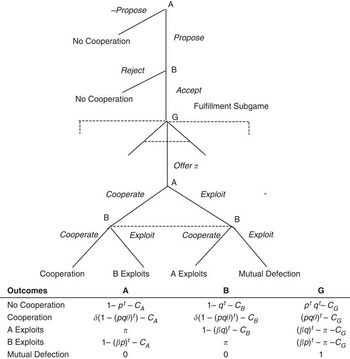
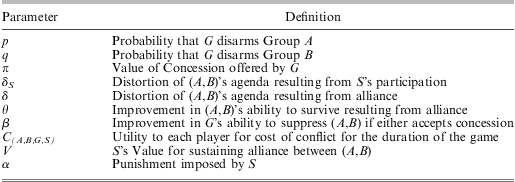
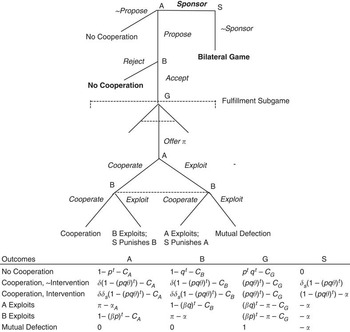
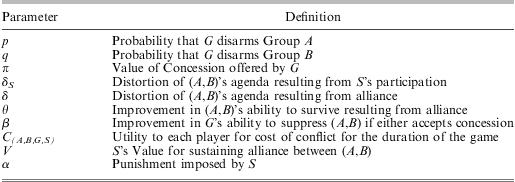
Figure 1 presents the sequence of moves in the game, while Table 1 presents the interpretation of the model's parameters.Footnote 19 At the first move, A decides whether or not to propose an alliance between itself and B. If A does not propose an alliance, both A and B fight G separately, using only their own resources. However, if A makes an alliance proposal, and B accepts, both A and B develop security ties, and improve their efficiency and joint survival capability. However, since A and B are separate entities with variable preferences, forming such an alliance will to some degree dilute the original agendas.
Bilateral game

Parameters of Model
If an alliance forms, G begins the fulfilment subgame by offering a concession π, where π∈[0,1].Footnote 20 The concession is available to A and B if either breaks co-operation with their respective partner. If the concession is taken by either group, the group disarms and shares information with G. However, G only grants the concession to the defecting group if it requires the information to defeat the group's partner. In other words, if both A and B disarm in hopes of accepting the concession, G does not grant the concession to either party. Since both groups voluntarily disarm and surrender their political ambitions, G has little need to pay either of them to gain information.Footnote 21
The table beneath Figure 1 presents each of the possible outcomes of the game along with the payoffs to each player. We assume that G's top preference is to disarm both groups A and B. Therefore, G receives a payoff of 1 if it disarms A and B, either through violence or negotiation. If G is successful in disarming either group, the group receives a payoff of 0. By contrast, A and B receive payoffs of 1 should they independently withstand G's repression. However, since the alliance dilutes the agendas of both groups, A and B's payoffs are discounted by δ∈[0,1] if they survive as part of an alliance. The agendas of the two groups are more compatible as δ→1 and less compatible as δ→0.
The fulfilment subgame repeats infinitely until G successfully disarms both militant groups. We assume that G forcibly disarms A with probability p∈[0,1] and forcibly disarms B with probability q∈[0,1], which are assumed to be drawn from independent distributions. Since the game terminates for either player if they are disarmed, the groups’ probabilities of survival (p,q) serve as their respective discount factors.Footnote 22 We further assume that while G's power to repress is at its highest in the initial stages of the conflict G's ability to repress both A and B declines with time. This assumption is based on previous empirical studies indicate that the ability of governments to repress militant groups appears to be decreasing as the duration of the conflict increases.Footnote 23 These studies suggest that these groups grow more resilient with time due to their adaptation to government tactics, their ability to innovate, and their ability to signal their staying power to their target population.Footnote 24 We assume that G disarms both groups with probability p tq t, where t represents the number of rounds played. As is standard in models of conflict, each player (G, A, B) is assumed to pay a cost c to engage in armed conflict. For simplicity, we assume that the total cost for each player for the entire campaign is represented by C (G ,A ,B )∈[c,∞).
Should A and B form an alliance, the efficiency gains from co-operation reduce G's probability of disarming both groups to θpq, where θ∈[0,1]. This indicates that if A and B ally, G's probability of success is less than its probability of disarming either A and B individually. If G fails to disarm either group, G receives a payoff of 0, minus the cost of prosecuting the conflict CG. If either A and B accept G's concession, the group that accepts the concession receives a payoff of π and agrees to disarm. The information provided by the group that accepts the concession improves G's chance of forcefully disarming the other group by β∈[1,2].Footnote 25 If G successfully disarms one group through negotiation and the other through force, G receives a payoff of 1−π, which captures G's benefit for suppressing the militants minus the cost of the concession. If both groups disarm and attempt to exploit each other in hopes of getting G's concession, both groups receive payoffs of 0 since G reneges on its commitment to grant either side π.
Solution
We solve the game using the subgame perfect solution concept (SPE). While the complete formal solution is presented in the appendix, this section outlines the intuition behind the model's solution. We begin by examining the fulfilment subgame. We see that if 0 > 1−β(p,q)−c (A ,B ), both groups will exploit each other. Since the price of exploitation exceeds the cost of disarming, both groups will disarm if they believe they will be exploited. This indicates that co-operation is increasingly unlikely if (p,q)→1, or as C (A ,B ) increases. We see that vulnerable militants who suffer greater costs are unlikely to sustain co-operation. If either A or B perceive the other group as vulnerable, the groups will anticipate opportunistic behaviour prior to forming the alliance, and will choose to fight individually at the beginning of the game. This suggests that the mutual fear of defection is a valuable tool for governments. Since both militant groups fear that the other will exploit, governments have an easier time repressing the groups.
If 0 > 1−β(p,q)−c (A ,B ) and G is willing to offer a concession, both groups have dominant strategies to exploit. However, if the government does not offer a concession and sets π=0, the strategy pairing (Co – operate, co – operate) is also a Nash solution. Assuming that militants choose the efficient equilibrium in multiple equilibria situations, the solution to the fulfilment subgame is (Co – operate, co – operate). In other words, if G refuses to negotiate, alliances will be sustained in the fulfilment subgame, which gives groups incentives to form alliances at the game's outset. The model illustrates a somewhat interesting prediction. Governments that are conciliatory can use the mutual distrust between militants to prevent alliances from forming. By contrast, governments that refuse to negotiate allow militants to develop credible alliances. Footnote 26
To induce A successfully to betray B, G must make an offer π with a value greater than or equal to A's value for sustaining long term co-operation with B. Should A co-operate with B indefinitely, A's payoff converges to a value of
 $$\frac{\delta }{{1\,{\rm{ - }}\,(1\,{\rm{ - }}\,pq\theta )}}\,{\rm{ - }}\,{{C}_A}\, = \,\frac{\delta }{{pq\theta }}\,{\rm{ - }}\,{{C}_A}.$$
Similarly, B's value for extended co-operation with A converges to a value of (δ/pqθ) – CB. We see that as pqθ→1, indicating that G has greater repressive power, the value for extended co-operation decreases for both A and B. This in turn decreases the value of π needed to induce either group into negotiation. Consequently, we see that if G has a high likelihood of disarming either A or B, both A and B are more likely to accept concessions. Formally, if the following condition is true, G offers a concession to A, which is also generalizable to B:
 $$\beta q\left[ {1\,{\rm{ - }}\,\left( {\frac{\delta }{{pq\theta }}\,{\rm{ - }}\,{{C}_A}} \right)} \right]\, + \,(1\,{\rm{ - }}\,\beta q)({\rm{ - }}{{C}_G}) \gt pq\theta \,{\rm{ - }}\,{{C}_G}$$
Simplified:
 $$q(\beta (1\, + \,{{C}_G}\, + \,{{C}_A})\,{\rm{ - }}\,p\theta )\,{\rm{ - }}\,\frac{{\beta \delta }}{{p\theta }}\, \gt \,0.$$
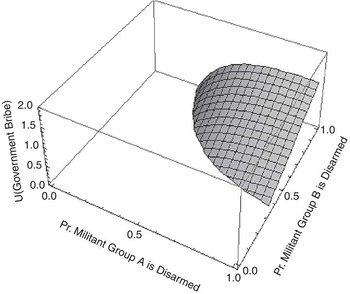
Figure 2 presents a graphical interpretation of Condition 2. We see that as {p,q}→1, G is more likely to negotiate. We also see that alliances between vulnerable militants are unstable since these groups are relatively easy to pay off. Facing at least one weaker group, G's strategy would be to find the weak link in the alliance and negotiate with that party. Since the weak link is either less likely to survive conflict or less resolute, the weak link offers G an opportunity to use a ‘divide and conquer’ strategy. To avoid this outcome, militants are only likely to co-operate with other groups that can both resist government repression and share some degree of affinity. Groups with compatible agendas that can withstand government repression increase the value of future co-operative interactions, thereby increasing the level of concessions that G must pay. If both groups are capable of surviving long into the future, the benefits for extended co-operation will exceed any offer that G makes. Consequently, we see that if G has a low probability of disarming the groups through force, both groups stand to gain from alliance co-operation.
Government's utility for negotiating as a function of its ability to disarm militant groups A and B

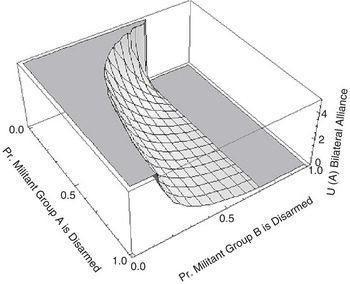
We are able to see the extent of these gains from Figure 3, which plots the militants’ EU(Co – operation) – EU(∼Co – operation). We see that bilateral co-operation is only preferable if the government's repressive capacity is low. These results indicate that we should observe bilateral co-operation between militants to occur in cases where the government is unlikely to repress both of the groups, and where the groups share similarities in ideology.
Utility to militant group A for bilateral co-operation as a function of the government's ability to disarm militant groups A and B

Hypothesis 1: The likelihood of bilateral alliance formation increases as the government's repressive capacity decreases.
Implications
From the bilateral model, we see that if governments are likely to disarm their militants using violence, the groups’ value for extended co-operation falls. In these cases, the government can negotiate with the militants, rendering the groups unable to ally due to their mutual fears of exploitation. Similar to previous studies, these results indicate that the divide and conquer approach appears to be a very effective tool of counter-insurgency. However, since groups operating in weaker states are less likely to be disarmed forcibly, the value of extended co-operation to these groups will be higher. Governments may be unable to offer either group a concession that is more enticing than the prospect of extended co-operation, particularly if the groups are ideologically compatible. Consequently, we would expect that bilateral co-operation is only likely amongst ideologically similar groups operating in weaker states.
Empirically, we do see groups that are capable of resisting government repression banding together to form alliances. For example, Osama bin Laden's al-Qaeda and Ayman al- Zawahiri's Egyptian Islamic Jihad were both well-developed organizations with similar ideologies. According to the model, these groups should be capable of forming a credible alliance. Yet, although some anecdotal evidence exists in favour of the model, we also see many alliances that do not appear to match these predictions. For example, consider the alliance between the Zimbabwe African National Union (ZANU) and the Zimbabwe African Peoples’ Union (ZAPU) during the Rhodesian civil war. Despite facing a government with a powerful military force, and considerable rivalry between the parties, this alliance was sustained throughout the conflict. This observation, and several others, suggests a different type of alliance pattern between militants. While the current model allows us to understand bilateral co-operation, we next turn to a discussion of asymmetric alliances. This new specification makes the argument that groups facing powerful governments will seek alliances involving a state sponsor to constrain other groups from exploitative behaviour.
Asymmetric Co-operation
The bilateral model examines when co-operative agreements may be self-enforcing between militant groups. We see from this model that co-operation is only likely to occur if the groups are less vulnerable, which suggests that weaker militants, who probably have the greatest need for co-operation, are unable to ally due to the fear of mutual exploitation. However, from the co-operation literature, we know that states under anarchy can overcome the problem of mutual distrust by creating institutions to bind themselves to agreements.Footnote 27 These institutions include the development of international norms, the establishment of reciprocal punishments for violations and the use of third-party enforcement.Footnote 28 If states are capable of forming these institutions, militants might likewise seek these mechanisms for establishing stable co-operation. Of these strategies, the first two are difficult for weaker militants, given that the majority of these groups will be repressed quickly and do not have the durability needed to establish norms. However, the strategy of third-party enforcement may provide a way for weaker groups to sustain co-operation. While the two groups are considered equals, militants may turn to a state sponsor to serve as a third party that governs relations. To illustrate, consider the Soviet campaign in Afghanistan. In this case, the vast majority of the mujahedeen groups were heavily dependent on the Pakistani Inter-Services Intelligence (ISI) for military support, as well as the US Central Intelligence Agency (CIA) for funding. Due to this dependence, the participants deferred some decision making to both the ISI and the CIA, which allowed for co-ordination between the groups. Similarly, in the aforementioned case of ZANU and ZAPU, both of these groups relied on several sponsors for material support and basing, which allowed the leaders of the Frontline states to govern relations between the two groups.
The participation of states in inter-militant alliances creates a different security dynamic. While the previous cases consist of alliances between equals, the intervention of a state frequently creates a situation resembling a hierarchical, asymmetric alliance.Footnote 29 These types of alliances are frequently studied by examining the trade off between security and autonomy. In the case of a rebellion, a militant group can gain security from a sponsor by trading decision-making authority and freedom of action to its patron. Like bilateral alliances, this produces a more efficient and often more deadly fighting force. In addition to improving the capability of the groups, and absorbing a larger share of the costs of the campaign, state sponsors can also serve as a mechanism to co-ordinate inter-group alliances. This suggests that militants might seek sponsorship not only for material support, but also as a form of institution to govern inter-group co-operation. By intervening, and controlling material supplies, a sponsor can threaten to punish any group that reneges on a commitment to the other. Such a threat of punishment might deter groups from behaving opportunistically. In this way, the sponsor acts as a guarantor of co-operative agreements between militants.
To illustrate this behaviour with an example, consider the case of Pakistan's support for several of the Kashmiri militant groups operating against India during the 1990s. According to Byman, Pakistan has supported numerous groups, including the Jammu and Kashmir Liberation Front (JKLF), Jaish-e-Muhammad and Lashkar-e-Tayyeba.Footnote 30 Many of these groups coalesced into an umbrella organization known as the United Jihad Council, largely with Pakistan's backing. Byman argues that while some of these groups attempted to make cease-fires with India, several others in the coalition rejected attempts at a peace process and continued fighting. The continuation of conflict by the hard-line groups appeared to be fueled by Pakistani support. In terms of the model, this suggests that Pakistan was capable of punishing those groups that attempted peace by cutting their funding and unleashing the militant factions against them while simultaneously rewarding those groups that continued with the violent campaign. This enabled the alliance amongst the militant groups to sustain itself, and produced a more formidable insurgency for India to deal with.Footnote 31
However, while sponsors can facilitate co-operation amongst militants, engaging in this activity may be costly for all parties involved. From the militants’ perspective, the ideological agenda of both groups is further diluted. As part of the security/autonomy trade-off, the militants will have to cede even greater autonomy to the sponsor. The sponsor might have less ideological devotion to the militants’ cause, or may seek to use the militants for alternative goals. In the previous case of Kashmir, Byman notes that, increasingly in the 1990s, the character of the Kashmiri insurgency began to change.Footnote 32 Whereas the violence could initially be characterized as separatist, the violence gradually took on Islamic fundamentalist characteristics. One possible explanation for this is that Pakistan preferred groups that would be amenable to re-uniting with their state as opposed to groups that favoured Kashmir's independence and non-alignment. We see that the addition of a third player, particularly a dominant one such as the sponsor, can further diminish the overall benefit of the alliance to the groups if the sponsor significantly dilutes their agenda. From the sponsor's perspective, policing the alliance might produce significant governance costs. If governance costs are low, it is relatively easy for the sponsor to sustain an alliance. However, if maintaining the alliance requires a significant level of military resources, or puts the sponsor at risk of potential retaliation from the government, the sponsor may lose the gains from co-operation, thereby undermining the incentive to sustain such an alliance.
Given that the sponsor's gains from co-operation diminish as governance costs grow, a sponsor should only intervene if the payoff for co-operation is high, and the costs and risks of sustaining such co-operation are low. The following section presents a model outlining when such asymmetric alliances can form amongst militant groups, as well as when governance costs may undermine the incentives of sponsors to create such security structures.
Model
To model the conditions under which asymmetric alliances form and sustain, we introduce the sponsor S into our previous game (see Figure 4). If S participates in an alliance with A and B, S alters the dynamic of co-operation. In its role as the dominant partner in the alliance, S agrees to absorb the costs of conflict for both parties (CA, CB), so long as both sides sustain co-operation. However, should either A or B defect from the alliance, S imposes a punishment α (A ,B )∈[0,1]. As a result of S's participation, defection is no longer costless for either group, and this would be intended to deter both groups from betraying the alliance. In exchange, S assumes control over the alliance and further distorts the agenda of both groups by δS. In doing so, S gains some value V∈[0,1] for each period in which the alliance is sustained. However, due to both the cost of policing the militants and the risk of potential government retaliation, S must pay a governance cost Cs∈[CA + CB, ∞) to sustain the alliance. Assume that S must pay this cost up-front, regardless of whether or not A or B attempt to exploit their alliance partner. S's utility for intervening is represented by the following statement:
 $${{U}_S}\,{\rm{ = }}\,{{V}^t} \,{\rm{ - }}\,{{C}_S}{\rm{.}}$$
Asymmetric game

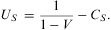
Since V∈[0,1] and is discounted by t, S's payoff converges to:
 $$ {{U}_S}\, = \,\frac{1}{{1\,{\rm{ - }}\,V}}\,{\rm{ - }}\,{{C}_S}. $$
Let us assume that S's value for sponsoring the alliance V remains private information, and that the players do not have complete information as to its value. This indicates that both A and B are uncertain whether S will sustain the alliance indefinitely or whether, at some point, S will cease serving as a guarantor. Let us assume that the players have a flat prior belief as to the value of V. If this is the case, the probability that S will continue to participate in the alliance indefinitely is
 $$\frac{{{{C}_S}{\rm{ - }}1}}{{{{C}_S}}}\, = \,V_{S}^{\rad } .$$
If  $ {{V}_S}\, \gt \,V_{S}^{\rad } $, S participates indefinitely whereas if
 $ {{V}_S}\, \lt \,V_{S}^{\rad } $, the governance costs of the alliance are too high for S to sustain, and S will eventually abandon the alliance. Should this occur, the alliance between A and B transitions to the bilateral fulfilment game depicted in Figure 2. Substantively, this indicates that if S exits the alliance, A and B will continue in sustaining the alliance only if both groups trust that their counterpart will also sustain co-operation in the absence of external enforcement. Therefore, we see that for both A and B, allowing S to participate in the alliance contains some element of risk. On one hand, if the groups are unwilling to trust each other without an external enforcement mechanism, and there is some possibility that S will eventually abandon the alliance, there is some risk that both A and B will at some point become vulnerable to the other's exploitation. On the other hand, if both A and B are able to co-operate in the bilateral setting, S's decision to abandon the alliance does not alter the incentive to co-operate. However, since S's participation further distorts the agenda of the alliance, it is possible that these groups will prefer bilateral co-operation as opposed to asymmetric co-operation.
Solution
As in the previous model, the decision of the militants to become allies is determined by G's power to repress the groups. In the previous game, G's divide and conquer strategy effectively prevented relatively weaker militants from forming alliances, due to their mutual fear of betrayal. In this version of the game, however, G's power to divide and conquer is undermined by S's threat to punish defectors α. While both A and B always exploit if 0 > 1−β(p,q)−C (A,B ) in the bilateral game, A and B will only exploit in an asymmetric alliance if −α (A ,B ) > 1−β(p,q)−C (A ,B ). We see that exploitation is more difficult for both A and B if S governs the alliance. Additionally, if S's punishment is sufficiently large, A and B will require additional concessions to offset the cost of punishment α, which raises the price G must pay to break the alliance. If S is part of the alliance, G negotiates with A if:
 $$ \beta q\left[ {1\,{\rm{ - }}\,\left( {\frac{{\delta {{\delta }_s}}}{{1\,{\rm{ - }}\,\left( {1\,{\rm{ - }}\,\frac{{{{C}_S}\,{\rm{ - }}\,1}}{{{{C}_S}}}} \right)(pq\theta )}}\,{\rm{ - }}\,{{C}_A}\,{\rm{ - }}\,{{\alpha }_A}} \right)} \right]\, + \,(1\,{\rm{ - }}\,\beta q)({\rm{ - }}{{C}_G})\, \gt \,pq\theta \,{\rm{ - }}\,{{C}_G}. $$
Therefore, a credible alliance forms if:
 $$ \beta q\left( {1\, + \,{{C}_G}\, + \,{{C}_A}\,{\rm{ - }}\,p\,{\rm{ - }}\,{{\alpha }_A}\, + \,\frac{{\delta {{\delta }_S}}}{{1\,{\rm{ - }}\,\left( {1\,{\rm{ - }}\,\frac{{{{C}_S}\,{\rm{ - }}\,1}}{{{{C}_S}}}} \right)(pq\theta )}}} \right)\, \gt \,0. $$
In bilateral conditions, the militants’ mutual fear of exploitation could prevent alliances from forming unless both groups were relatively more resistant to collapse. However, with a state sponsor, the threat of sponsor punishment increases the price governments must pay. As intuition suggests, the model predicts that as α (A ,B )→1, indicating greater levels of punishment for defectors, both groups are more likely to sustain co-operation, indicating that the sponsor's threat to punish shores up the weak link in the alliance. In effect, the sponsor serves as an institution to constrain the groups from breaking contracts. Interestingly enough, this logic appears to resemble the traditional role of the mafia boss, which is intended to enforce contracts among illegitimate entities.Footnote 33 Similarly enough, the sponsor acts in the same capacity by constraining the weak link from behaving opportunistically. These results reflect the intuition that weaker groups should band together, while simultaneously addressing the concern that agreements must be credible. If a sponsor intervenes, militants become credible by building security institutions, not unlike states in the international system. While we typically think of militants as operating outside legal structures, the model seems to indicate that unless groups are very strong they should prefer asymmetric security agreements that will constrain their behaviour.
Yet, the introduction of a sponsor does not always improve the prospects for co-operation due to the uncertainty over the sponsor's willingness to sustain the alliance. From the bilateral game, we know that if A and B are capable of resisting G's efforts to suppress, they can sustain an alliance if Condition 2 is false. Substantively, this indicates that if the groups are facing a relatively weaker G, they are capable of sustaining an alliance with or without S's assistance. S's decision to exit the alliance may actually be beneficial to the two groups, given that S further distorts both groups’ agenda. However, if Condition 2 is true, this indicates that A and B cannot co-operate in the bilateral setting, and require S's assistance to sustain the alliance. In this case, G is relatively stronger, and both A and B have incentives to exploit each other. A and B can only be deterred from exploiting each other if S participates in the alliance and threatens to punish either group should they defect. Once S abandons the alliance, neither A nor B can credibly commit to sustaining the alliance, which will cause co-operation amongst the militant groups to collapse. We see that the decision to participate in an asymmetric alliance is risky for weaker A and B, and depends on both groups’ belief that S will sustain the alliance indefinitely.
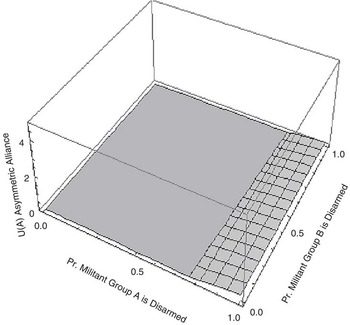
Figure 5 replicates Figure 3 using the asymmetric conditions. Unlike the bilateral game, we see that asymmetric alliances are more likely to form if one or both of the alliance partners are weaker. If S's governance costs are high, S is increasingly likely to abandon the alliance at some point, which will eventually undermine the incentive to sustain co-operation with the other group. However, we see that if {p,q}→1, the groups are likely to co-operate with S, even if S is likely to abandon the alliance at some point in the future. On the one hand, since these groups are likely to disarmed by G, these weaker groups are increasingly willing to risk co-operation with S to give themselves some chance of survival. Substantively, this indicates that desperate militant groups facing stronger government adversaries are likely to accept S as a guarantor, even if doing so will only temporarily extend their alliance. On the other hand, we see that co-operation is also likely if (p,q}→0, indicating that G is less likely to repress the groups. In these cases, Condition 2 is likely to be false, indicating that both A and B can simply transition to bilateral co-operation if S abandons the alliance. These results suggest that S's participation has no effect on the probability that relatively stronger groups co-operate, but has a significant effect on the probability that weaker groups co-operate. While weaker groups are more likely to seek sponsorship than stronger groups, sponsors can free-ride if the groups are stronger. We know that if, on the one hand, A and B cannot sustain a bilateral alliance, the probability that S sustains co-operation indefinitely is:
 $$V_{S}^{\ast } \, = \,\frac{{{{C}_S}\,{\rm{ - }}\,1}}{{{{C}_S}}}.$$
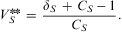
On the other hand, if A and B can sustain bilateral co-operation without sponsorship, the probability that S sustains co-operation throughout the alliance is:
 $$ V_{S}^{{\ast\ast }} \, = \,\frac{{{{\delta }_S}\, + \,{{C}_S}\,{\rm{ - }}\,{\rm{1}}}}{{{{C}_S}}}. $$
Utility to militant group A for asymmetric co-operation as a function of the government's ability to disarm militant groups A and B

For S to sustain co-operation, it must be true that  $ {{V}}\, \gt \,V_{S}^{\ast } $ in the first case and
 $ {{V}_S}\, \gt \,V_{S}^{{{\rm{\ast}}\ast }} $ in the latter. Since
 $ V_{S}^{{{\rm{\ast}}\ast }} \, \gt \,V_{S}^{\ast } $, we see that it is more difficult for S to sustain an alliance indefinitely in the second case as opposed to the first. This demonstrates that S is more likely to sustain co-operation indefinitely when A and B are too weak to form an alliance on their own as opposed to cases where S can free-ride. Therefore, we see that sponsors are more likely to intervene in alliances if the militant groups that are facing governments with relatively greater repressive power. Further, we see that, as in the previous case, S is more likely to intervene as CS→0, indicating that S prefers to intervene if the cost of governing the alliance between A and B decreases.
Hypothesis 2: The likelihood of an asymmetric alliance increases if the government's repressive power increases.
Hypothesis 3: The likelihood of sponsorship increases if the government's repressive power increases.
Implications
The asymmetric model gives us several insights into the alliance behaviour of militant groups. Militants facing governments with substantial repressive power have incentives to form alliances, yet these groups have little credibility in the eyes of potential alliance partners. To overcome this problem, militants have incentives to bind themselves to a sponsor, which signals credibility to possible alliance partners. Once vulnerable groups establish credibility, they are capable of co-operating with other groups, which in turn increases the prospects of resisting the government's repressive efforts. We also see an additional role typically not considered for sponsors of militant groups. Rather than just serving as a pool of potential resources, sponsors can serve a key function by constraining militants from negotiating with target governments, particularly when target governments are powerful. This may explain why governments are very quick to denounce states for supporting militants. Sponsors effectively eliminate the ability of governments to use negotiation for counter-insurgency, which appears to be one of their most effective weapons. We further see that sponsors are selective as to when they take on this role. In cases where the groups are already capable of forming alliances, sponsors will free-ride off the efforts of the groups rather than directly participate. However, if the militant groups are too vulnerable to co-operate credibly on their own, sponsors are more likely to intervene. Empirically, we observe this behaviour in several cases, including Iran's assistance in coalescing multiple groups into Hezbollah, American and Saudi co-ordination of elements of the mujahedeen, and Pakistani use of various Kashmiri groups. In addition to this anecdotal evidence, Asal et al. provide some evidence that sponsorship may increase the ability of groups to seek partners, though this analysis does not specify the conditions under which sponsorship can be either helpful or harmful.Footnote 34 We now present a research design to test the model's hypotheses.Footnote 35
Research Design
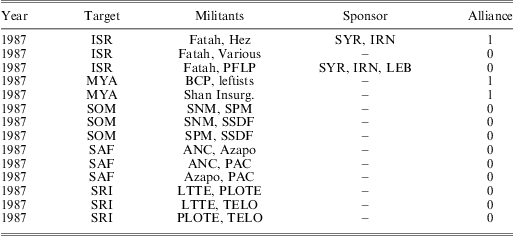
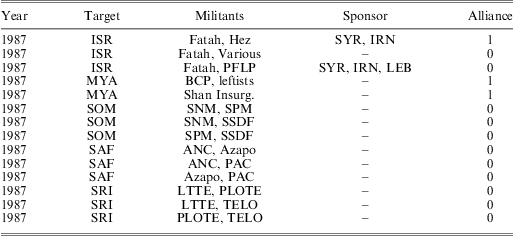
In order to test the hypotheses, we require a sample of cases in which multiple militant groups could potentially ally against a common enemy, but do not always do so. We construct this dataset using information from the UCDP/PRIO Armed Conflicts Dataset (Version 4-2009). These data identify the conflicts involving two or more non-state actors that are competing against a recognized government (identified as Side A in the data). Upon identifying the appropriate conflicts, we next organize these data into annual dyads consisting of two militant groups. To illustrate with an example, consider Rhodesia's conflict with both ZANU and ZAPU in 1972–79. In this case, we examine the dyadic relations between ZANU and ZAPU in each year of the conflict. There are only two militant groups in this case, so the data consist of annual dyads of ZANU/ZAPU in 1972–79. In other instances, such as the case of India, the government is fighting more than two militant groups. In these cases, we again create annual dyads consisting of each possible combination of the active groups. For example, in 1992, the JKLF, Hizub-al-Mujahedeen and Jaish-e-Muhummad were all engaged in armed conflict with India. We constructed dyadic pairs consisting of JKLF/Hizub-al-Mujahedeen, JKLF/Jaish-e-Muhummad and Hizub-al-Mujahedeen/Jaish-e-Muhummad for each year when each of these parties was in conflict. Each observation in the dataset captures the interaction of two groups that are fighting a common enemy in a particular year in 1946–2001. In other words, an alliance between groups was only possible in years when both groups were active.Footnote 36 We then examined each dyad for evidence of alliance co-operation. After removing cases involving major powers, the final dataset includes 1,318 alliance-dyad years, 33 per cent of which (429) actually have alliances among the identified militant groups. In total, there are forty different target governments and over 150 militant groups.Footnote 37 For clarification, a sample of these data is provided in Table 2.Footnote 38
Sample Data
These data allow us to test Hypothesis 1 and 2, which predict whether or not a potential alliance between a pair of militant groups forms. However, Hypothesis 3 relates to the decision of a sponsor to intervene in an alliance amongst militant groups. To test this hypothesis, we require data consisting of cases in which a potential sponsor could have intervened to create an alliance amongst two militant groups, but did not necessarily do so. Both the policy-making literature and empirical literature identify that interstate rivals can serve as sponsors of each other's militant groups.Footnote 39 Based on these findings, we have used the Thompson rivalry data to identify the rivals of each target government.Footnote 40 We consider a state to be a potential sponsor if it is classified as a Thompson rival of a government in conflict with multiple militant groups during the period in which two or more militant groups are active. We then organize the data to test Hypothesis 3 by potential intervention years in 1946–2001, in which the potential sponsor could have intervened to support an alliance amongst any of the militant groups.Footnote 41 For the purposes of these data that test Hypothesis 3, target states that had no rivals as defined by the Thompson data were excluded from the analysis.Footnote 42
Theoretical Variables
Alliance
The first dependent variable is a dichotomous indicator signifying the presence of an alliance between the militants. Alliances were identified and coded as in existence when there was evidence of resource-sharing or tactical co-ordination between the groups at some time during that year (i.e. sharing weapons or personnel, joint attacks or communiqués). This evidence was gathered from historical accounts and case studies of individual conflicts, conflict actor and event encyclopaedias and domestic and foreign media reports.Footnote 43 Of the 1,318 possible alliance years between 1946 and 2001, there were seventy-two militant alliances accounting and 429 instances of alliance co-operation (33 per cent).
Sponsorship
We consider a state to be a sponsor if the state engaged in the provision of material (i.e. funding, weapons) or tactical assistance (i.e. training, intelligence) to (a) both of the actors in the alliance dyad or (b) one of the actors in the alliance dyad without prejudice against the other. States that simply provide refuge for group members or a staging ground for foreign attacks do not count as sponsors.Footnote 44 We code the potential sponsor as 1 if its behaviour meets this criteria and 0 otherwise. In examining the potential alliance-dyad years, we identified alliances as having sponsors if we found evidence of this behaviour, even if the sponsoring state was not a Thompson rival. However, we do not include all of these sponsors in the test of Hypothesis 3, since doing so would be selecting on the dependent variable. Instead, we simply consider any state that is classified as a Thompson rival to be a potential sponsor, and drop the cases in which a target government had no rivals. The dataset used to test Hypothesis 1 and 22 consists of thirteen sponsors, which make up 317 of the 1,318 dyad years (24 per cent). The dataset to test Hypothesis 3 consists of 699 potential intervention years, in which we identify nine cases of sponsorship, which account for 113 of the potential intervention years (16.17 per cent).
Government repressive power against the weak link
According to the theoretical model, the government's equilibrium behaviour is to co-opt the weak link, or the weaker of the two groups, in order to break the alliance. We therefore need some indicator that captures the ability of the weaker group to withstand the government's repression. We capture this variable using Cunningham et al.’s data on dyadic relations between violent non-state actors and governments.Footnote 45 The expanded non-state actor conflict data (NSA) contain a variable that dyadically estimates the power of various militant groups relative to their target governments. The scale ranges from much weaker, indicating the government is far more powerful and likely to disarm the group, to a stronger score, indicating that the government is unlikely to disarm the group. We compile the NSA strength score for both groups in each of the conflict dyads of the dataset. Since the theoretical prediction is that the government will offer concessions to the weaker of the two groups, we use the weaker of two NSA strength scores as our indicator to capture the government's repressive power against the weak link. If the dyadic pair contains a much weaker link, or a group that is quite vulnerable, our expectation is that an alliance will not form unless a sponsor is present. To illustrate the coding procedure, consider the case of the South African conflict during the 1980s. UCDP/PRIO identifies three major groups engaging in political violence against the state: the African National Congress (ANC), the Pan Africanist Conference (PAC) and the Azanian People's Organization (AZAPO). Both PAC and AZAPO are coded as being ‘much weaker’ than the South African state, whereas the ANC is coded as ‘weaker’. Therefore, in the dyad between PAC and AZAPO, the weak-link variable would be coded as ‘much weaker’, given that neither group was likely to resist efforts by South Africa to co-opt. Similarly, in the dyad consisting of the ANC and PAC, the weak-link variable is also coded as ‘much weaker’. While the ANC was relatively stronger than the PAC and, therefore, better able to resist the state's efforts to co-opt it, PAC was a weaker organization and was therefore vulnerable to becoming co-opted by the South African government. The weak-link variable captures the crucial component in predicting whether alliances form, and what type of alliances form. On the one hand, if the weak link in the dyad is much weaker than the state, we would expect these groups to be less likely to form bilateral alliances, but more likely to form asymmetric alliances with the help of a sponsor. On the other hand, if the weak link in the dyad is at parity or stronger than the state, this would suggest that the values of {p,q} are much lower, indicating that bilateral alliances are more likely to form and asymmetric alliances are less likely to form. When merged with the alliance data, the NSA data consist of groups with five categorizations of the relative power of the group to the state: much weaker, weaker, parity, stronger and much stronger. Using the dyadic pairings, our weak-link variable is distributed as follows:

We see that the weak-link variable is heavily skewed towards the weaker categories. Unfortunately, this scaling creates two categories that account for 97 per cent of the variation in the key independent variable. Therefore, we use three different measures of the weak-link variable in our analysis. First, we use the weak-link scale as it is, despite the fact that two of the categories consist of only 3 per cent of the observations combined. We then create a second, dichotomous weak-link indicator that simply combines categories (1, 2 and 3). This indicator essentially differentiates those groups that have a much weaker link from those whose weak links have a score that is > 0. We believe that these three indicators collectively will allow us to test both Hypotheses 1 and 2, since the indicator exhibits variation and best captures how the weak link affects the probability of an alliance.Footnote 46
Alliance Control Variables
We include several control variables to test both Hypotheses 1 and 2, and Hypothesis 3. To test the former set, we first include the state's per capita gross domestic product (GDP) score, which Fearon and Laitin use a proxy for state strength.Footnote 47 The authors argue that increased per capita GDP scores serve ‘as a proxy for the state's overall financial, administrative, police and military capabilities and … will mark more developed countries with terrain more “disciplined” by roads and rural society more penetrated by central administration’.Footnote 48 The authors further argue that lower per capita GDP scores may make joining an insurgency more appealing to individuals, given the poor prospects of high economic returns from the legitimate economy. The per capita GDP variable, therefore, serves as a continuous indicator of the government's ability to project power over its territory. While our key independent variable captures the strength of the groups relative to the government, we believe that we must also control for the government's absolute ability to control and police its territory. The mean GDP per capita score is 1.96, with a min of 0.196 and a max of 11.3.
Non-Contiguous State
A non-contiguous territory is an area of the state that is geographically separate from the territory where the capital is located. Case examples from the data include the Philippines and Indonesia, where the respective insurgencies took place on islands that were disconnected from the main islands of Luzon and Java. Given that non-contiguous territory is geographically separate from other parts of the territory, this may limit the opportunities various groups have to form alliances with each other. The variable is coded as 0 if the state has no territory that is non-contiguous, and 1 if it does. Approximately 15 per cent of the observations in the dataset include states with non-contiguous territory.
State Durability
Several studies in the civil war literature suggest that the central government's ability to consolidate the state is at its lowest when the government is first forming. At this point, the central government's rules are more likely to be challenged in multiple areas of the state. Empirically, this may contribute to a greater number of militant groups early in the state's existence, thereby allowing greater opportunities for these groups to form alliances. The mean logged durability score in the alliance dataset is equal to 2.1, the min is equal to 0 (indicating that a transition is taking place) and the max is equal to 4.36.
Ethnic and Religious Fractionalization
It is possible that states are more likely to observe many militant groups, and therefore more possibilities for alliances, if the state contains greater ethnic and religious fractionalization. These characteristics may allow various political entrepreneurs to mobilize along these lines, thereby producing more groups. However, this variable may also signify competing preferences amongst the groups, which would suggest that although having many groups is necessary for co-operation the potential diversity of preferences may decrease the probability of co-operation. Additionally, an argument in the literature is that states with ethnic and/or religious diversity or fractionalization may be more prone to outside interference from states with ethnic kin.Footnote 49 This indicator has a mean of 0.69, a min of 0 and a max of 0.93. We further include religious fractionalization, which is measured in the same way as ethnic fractionalization. Religious fractionalization has a mean score of 0.45, a min of 0 and a max of 0.75.
Log Military Expenditure
In addition to the indicators identified by Fearon and Laitin, we include a logged measure of the government's military expenditure.Footnote 50 The motivation for including this variable comes from studies by Hegre and Sambanis and by Lyall and Wilson, who argue that the modernization of military force contributes to a decrease in the effectiveness of military force in combating insurgencies.Footnote 51 This would suggest that increased military expenditure is indicative of a decrease in the government's overall ability to contain and suppress its non-state actors. Since this is likely to be correlated with the estimates of the military balance between the groups and the government, we log the government's military expenditure variable from EUgene and include it as a control variable.Footnote 52
Duration
We control for duration dependence using the techniques outlined by Carter and Signorino by including a measure duration of the actual number of years between the event of interest, as well as the square and the cube of this value.Footnote 53 In our case, the duration measure captures the number of years since the particular pair of groups in the dyad formed an alliance. The mean duration score is equal to 4. The maximum amount of time that two groups interact without forming an alliance is twenty-six years.
Sponsorship Control Variables
To test Hypothesis 3, we also require several control variables to capture the dynamics between the potential sponsor and the target government. By using only Thompson rivals, we control for the level of hostility between the two states. However, we also require measures of several other concepts that are systematically correlated with hostile international interactions.Footnote 54 These variables are as follows.
Balance of Military Capabilities
We measure the balance of military power by examining both the government's and sponsor state's Composite Indicator of National Capabilities (CINC) scores, represented as follows: (Gov. CINC)/(Gov. CINC + Pot. Sponsor CINC).Footnote 55 This ratio captures the government's military preponderance over the sponsor. We predict that increasing the capability balance in favour of the government decreases the likelihood of a successful asymmetric alliance. The mean capability balance score is 0.5, with a standard deviation of 0.23, a min of 0.04 and a max of 0.98.
Political Affinity
The structure of the dataset assumes that each potential sponsor is a rival of the government. However, several studies argue that states that are status quo oriented may be less willing to resort to supporting militant groups, whereas revisionist states may see this as a more palatable policy option. Therefore, we control for the willingness of the sponsor to intervene on behalf of the militants by Signorino and Ritter's S regionally weighted system leader score, which is the regional weighted correlation between the sponsor's alliance portfolio with the alliance portfolio of the system's leader.Footnote 56 The potential sponsor's score has a mean of 0.28, a min of −0.17 and a max of 1. We similarly include the correlation of the government's alliance portfolio with the system leader's as another control. The government's S score has a mean of 0.34, a min of −0.01 and a max of 0.81.
Joint Democracy
A considerable literature provides substantial evidence that democratic states are less likely to fight each other, though they are willing to fight other autocracies. If this is true, it is possible that democracies are also less likely to use support for non-state actors against each other in conducting their foreign policy. We use the Polity IV data to create a dichotomous variable for joint democracy.Footnote 57 The variable is coded as 1 if both states have democracy scores that are greater than or equal to 7, and is coded 0 otherwise. There are thirty-six instances of joint democracy in the data, accounting for only 5 per cent of the observations.
Distance
We further include a measure for the distance in miles between the capital city of the sponsor (if one is present) and the government's territory. The mean distance is 279 miles, the min of 0 and a max of 6,669.
Duration
As in the alliance formation model, we control for duration dependence using an indicator that captures the number of years since the previous instance where a potential sponsor supported a militant group against its rival target government. We include this duration measure, along with its square and cube in the model.
Method
The data to test both Hypotheses 1 and 2 are organized as a cross-sectional time series using a binary dependent variable (BTSCS).Footnote 58 Since both the alliance and sponsorship variables are dichotomous, we test the hypotheses using a probit model. We first test Hypotheses 1 and 3 using the dataset on potential alliance formation. Hypotheses 1 and 2 argue that if the government's repressive capacity is low the militants are more likely to form bilateral alliances, whereas these groups require a sponsor to assist them when the government's repressive capacity is high. We test these hypotheses using three models. We first present the results using the first weak link score, followed by the results produced by the second. We then present a model that uses the second weak-link score and includes regional control variables for sub-Saharan Africa, North Africa/Middle East and Asia. Latin America is left as the excluded category.Footnote 59 Each model is estimated with robust standard errors clustered on the government.
We next test Hypothesis 3 using the set of potential sponsors. The key explanatory variable in this test is the government's repressive power against the alliance. Our expectation is that the potential sponsors are more likely to intervene if the government's repressive power is relatively high, but are more likely to free-ride (and therefore not intervene) if the government's repressive power is weaker. Unfortunately, the loss of observations resulting from the use of the weak-link indicator results in only eight observations of sponsorship, which are perfectly predicted by all three of the weak-link indicators. Therefore, we follow Fearon and Laitin's 2003 study and use per capita GDP as a proxy for the government's repressive power against the weak link. Again, each model is estimated with robust standard errors clustered on the government.
Results
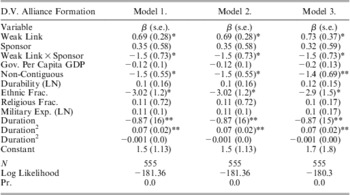
Table 3 presents the results from the test of Hypotheses 1 and 2. Across each of the models, the interaction term is significant and in the anticipated direction. We see that both the weak-link score and the interaction term are significant at the 0.05 levels across each of the tests. Interestingly enough, we see that both Models 1 and 2 produce virtually identical results despite the different specification of the weak-link independent variable, and the results do not change with the addition of the controls.Footnote 60 Consistent with the theoretical model's expectations, the constitutive weak-link coefficient is positive and significant, indicating that the probability of a bilateral alliance increases if the groups are collectively stronger relative to the government. Further, we see that although the sponsorship constitutive term is insignificant the interaction coefficient is negative, significant at the 0.01 level, and larger than the weak link constitutive coefficient. These results are robust to the control variables, and the controls tend to be in the anticipated direction, though few of them are statistically significant. We see that per capita GDP is negative, though not significant at the conventional levels. This indicates that increasing per capita GDP (or making the state stronger relative to the militants) decreases the probability of a bilateral alliance. This result is consistent with the theoretical expectations.
Alliance Formation†

*p < 0.05, **p < 0.01
†Coefficients for Regional Dummies not reported, available on request.
We also see that the non-contiguous variable is negative and significant, suggesting that alliances are less likely to form if the territory is non-contiguous. This makes intuitive sense, as groups operating in geographically separate enclaves may never interact with each other, even less form alliances.
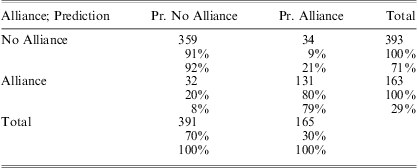
Furthermore, we see that increasing ethnic fractionalization significantly decreases the probability of alliance formation. This result suggests that alliances amongst militants are less likely to form in states that are more ethnically diverse, perhaps due to variation in the preferences of ethnically based militants. We see from Table 4 that the third model performs quite well in terms of predicting alliances, and is an improvement over simply predicting the mode of ‘no alliance’. On one hand, using the mode successfully predicts 392 of the 556 observations (71 per cent). The model, on the other hand, successfully predicts 478/556 (86 per cent). Additionally, the model successfully predicts 80 per cent of the alliances identified in the data. Therefore, the model improves forecasting power by roughly 18 per cent, and reduces error by about 52 per cent.
Fit of the Alliance Model
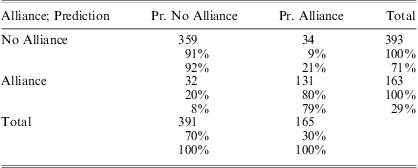
Note: Percentage predicted correctly: 88% . Pr > χ 2 = 0.00.
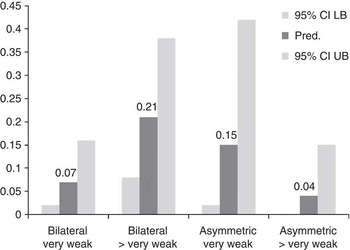
While the coefficients are in the anticipated direction, we cannot directly interpret the effect of the variables since they are estimated using probit models. To estimate the substantive effect of each variable, we hold all of the variables constant while generating predicted probabilities at various levels of our variable of interest. Since the first two hypotheses focus on the government's repressive power, we begin by estimating the substantive effect of the weak-link variable. Figure 6 presents a graphical interpretation of the effects of the explanatory variables in Model 2. We generate the predicted probabilities to estimate the effect of increasing the weak link in bilateral alliances by holding the sponsor variable equal to 0, and generate the second set of predicted probabilities by setting the sponsor variable equal to 1. If we set the weak link equal to 0, indicating that the weakest militant group is in the ‘much weaker’ category, we see that the predicted probability of a bilateral alliance is equal to 0.07 (0.02, 0.16).Footnote 61 If we then increase the weak link's strength to the weak and above category, the predicted probability of a bilateral alliance increases to 0.21 (0.08, 0.38). Therefore, there is an approximately 200 per cent increase in the probability of a bilateral alliance if the weak link in the militant groups becomes relatively stronger. This result provides strong support for Hypothesis 1, and for the bilateral model's empirical predictions. We see that two groups that are better able to withstand government repression are more likely to become allies on their own, and we are far less likely to see an alliance in a pairing that includes at least one relatively weaker militant group.
Effect of increasing government repressive power on probability of alliance (bilateral and asymmetric)

However, if the alliance is asymmetric and includes a sponsor, we see the opposite effect. If the sponsor variable is equal to 1, we see that the predicted probability of an alliance when the weak link = 0 is 0.15 (0.02, 0.42). However, we see that if sponsorship = 1, the probability of an asymmetric alliance falls to 0.04 (0, 0.15). This indicates that if a sponsor is involved, and the groups become relatively stronger, the probability of an asymmetric alliance drops by roughly 73 per cent. These results support the theoretical prediction that weaker groups need a guarantor, whereas groups that are less vulnerable should prefer bilateral alliances. Interestingly enough, these results also contradict balance of power explanations, which would argue that vulnerable groups should be more likely to become allies in order to balance stronger governments. We see from the results that more vulnerable groups are instead less likely to ally without a third party to police them, which supports the predictions of the theoretical model.
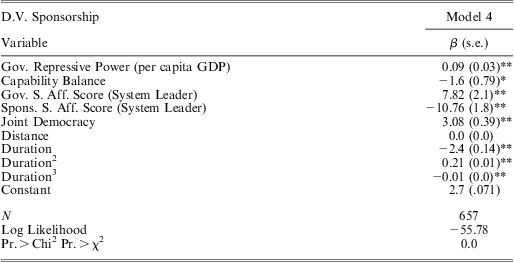
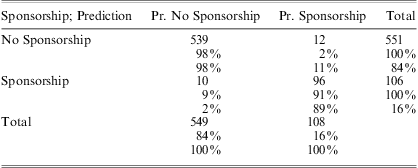
Our final test focuses on Hypothesis 3, which was tested on the data consisting of potential sponsors. The results from this test are presented in Table 4. We see from Table 5 that the model performs quite well in terms of fit. While predicting ‘no sponsorship’ successfully predicts 84 per cent of the cases, using the model correctly predicts 97 per cent of the cases, and successfully predicts 92 per cent of the instances of sponsorship. Although the model only modestly improves forecasting power by 15 per cent, it reduces error by 81 per cent. We further see that the test produces a very interesting result with respect to the joint democracy control. The joint democracy variable is positive and significant, indicating that democracies may be more likely to support violent non-state actors against other democracies. A quick analysis of the data suggests that this is driven by the India/Pakistan dyad. Since observations with joint democracy account for only 5.5 per cent of the data, and India/Pakistan dyad accounts for 28 per cent of these observations, we can see that joint democracy appears to be working as a proxy for this particular conflict.
Sponsor Decision to Intervene to Create Asymmetric Alliance
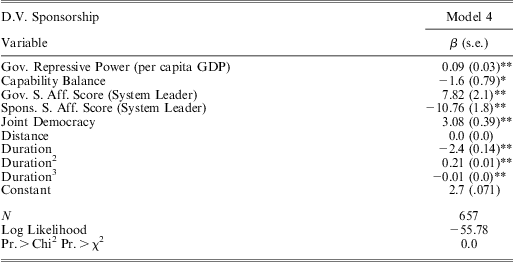
*p < 0.05, **p < 0.01.
Fit of the Sponsor Model
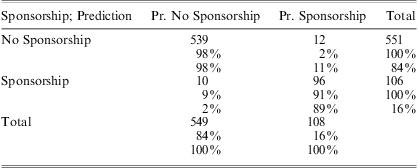
Notes: Percentage predicted correctly: 97%. Pr. > χ2 = 0.00.
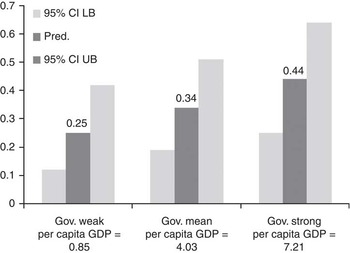
In examining the test of Hypothesis 3, we see that the coefficient for the government's per capita GDP is positive and significant, which is supportive of the theoretical predictions. This result indicates that states are more likely to sponsor militant groups if the groups are relatively weak in comparison to the government. Figure 7 estimates the predicted probabilities of sponsorship while holding each of the other variables at their means. We see that if we hold the government's per capita GDP at its mean value of 4.03, the predicted probability of sponsorship is equal to 0.34 (0.19, 0.51). If the government becomes relatively weak, and per capita GDP is decreased by one standard deviation to 0.85, the predicted probability of sponsorship decreases to 0.25 (0.12, 0.42), which is about a 26 per cent decrease. However, if the government appears relatively strong, and per capita GDP is increased by one standard deviation to 7.21, the probability of sponsorship increases to 0.44 (0.25, 0.6), which represents a 29 per cent increase. Although the proxy of per capita GDP does not produce as substantial effects as the sharper weak link variable, these results provide evidence in favour of Hypothesis 3. We see that potential sponsors are less likely to intervene if the government is internally weak, but substantially more likely to intervene if the government is likely to repress the alliance. This supports the contention that sponsors are only likely to pay the cost of intervention if they must, and will free-ride otherwise.
Effect of increasing government repressive power on probability of sponsorship

These findings provide evidence for our theoretical models regarding inter-group co-operation. While groups that face weaker governments are capable of forming alliances without sponsorship, groups facing stronger governments seek to bind themselves to an enforcer that can guarantee the credibility of their partner. However, these groups will only do so if their sponsor is seen as credible, and if the sponsor's governance costs are relatively low. Empirically, this suggests that we are most likely to observe militant alliances in cases where a government has difficulty with repression, or a government is powerful but facing a sponsor that is governing an alliance of weaker groups, and is heavily invested in the success of those groups.
Conclusion
This study began with the question of when we should expect to observe militant organizations forming alliances. Studies in bargaining theory suggest that by forming alliances militants leave themselves open to exploitation by their partners. Given that militants typically lack a ‘good’ reputation, a high prospect of future interaction and transparent structures, militants seemingly cannot demonstrate trustworthiness, much less trust each other to form credible commitments. Yet, we do observe co-operation between militants, and, in some cases, this co-operation appears to thrive. From the theoretical models, we argue that militants can form credible commitments by crafting particular security arrangements for their circumstances. On the one hand, if militants face a weak government with poor repressive capacity, they can form stable bilateral agreements. On the other hand, if militants face a powerful government, they might have to rely on some enforcement mechanism to punish defectors in order to establish credibility. The theoretical work, and the subsequent evidence, suggests that militants often turn to sponsors for precisely this reason. In addition to providing material goods, sponsors can serve as a guarantor, or capo, that enforces co-operation amongst the groups. The fear of punishment from the sponsor enables weaker groups that genuinely need the efficiency gains from joint action to sustain co-operation. It is no wonder that targets often fear sponsors, since these states have the ability to blunt target efforts to divide and conquer.
In addition to addressing the puzzle of when militants will co-operate, this study offers further insight into how non-state actors design institutions for security co-operation. Even though weaker, vulnerable groups are frequently characterized by policy makers as very dangerous due to their lack of constraints, it is these groups that should have the greatest interest in regulation. Although this requires a loss in autonomy, it allows groups to survive. This explains the freqently found pattern of sponsors allying with groups that are politically weak.Footnote 62 By contrast, less vulnerable militants will prefer weaker institutions that rely mainly on reputation. If militants reach this level of strength, they can establish co-operation based on the prospect of future interactions, without imposing costly constraints on their behaviour. A possible area for future research is to extend the theoretical model into the realm of larger alliances, such as those involving N players or complex networks. From the model's perspective, it may be interesting to see whether an alliance can be sustained by a state sponsor in this setting, or to see whether the stronger groups simply eliminate and/or absorb the weaker factions and form a bilateral alliance.
From a policy standpoint, the models demonstrate that playing on the mutual incentives to defect is one of the best weapons available to states facing potential militant alliances. Rather than looking at negotiation in a negative light, the model illustrates that negotiating with militants prevents alliances from forming and, consequently, prevents militants from strengthening. While it may be true that adopting a conciliatory policy may encourage more political violence, it does preclude militants from uniting and, therefore, might deny these groups the efficiency gains of an alliance. The exception to this, however, is that if militants gain sponsorship, it becomes more difficult for states to turn the partners in the alliance against each other. In these cases, it might be advisable to negotiate directly with a sponsor in order to increase the perception that the sponsor is non-credible. Doing so might prevent militants from initially forming alliances, or induce the militants within the alliance to break co-operation amongst themselves.
Mathematical Appendix
1 Bilateral
1.1 Fulfilment Subgame
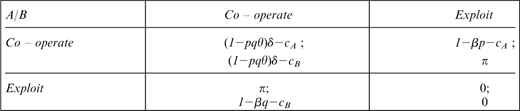
1. (Co – operate, co – operate):
 $\frac{\delta }{{1\,{\rm{ - }}\,(1\,{\rm{ - }}\,pq\theta )}}\,{\rm{ - }}\,{{C}_A}\, \gt \,\pi ;\; \; \frac{\delta }{{1\,{\rm{ - }}\,(1\,{\rm{ - }}\,pq\theta )}}\,{\rm{ - }}\,{{C}_B}\, \gt \,\pi $
2. (Co – operate, exploit):
$\frac{\delta }{{1\,{\rm{ - }}\,(1\,{\rm{ - }}\,\beta p )}}\,{\rm{ - }}\,{{C}_A}\, \gt \,0 ;\; \pi \, \gt \,\frac{\delta }{{{\rm{1}}\,{\rm{ - }}\,({\rm{1}}\,{\rm{ - }}\,pq\theta )}}\,{\rm{ - }}\,{{C}_B} $3. (Exploit, co – operate): π > δ/(1−(1−pqθ))−CA;
$\frac{\delta }{{{\rm{1}}\,{\rm{ - }}\,(1\,{\rm{ - }}\,\beta q)}}\,{\rm{ - }}\,{{C}_B}\, \gt \,0 $4. (Exploit, exploit): 0 > δ/(1−(1−βp))−CA;
$0\, \gt \,\frac{\delta }{{{\rm{1}}\,{\rm{ - }}\,(1\,{\rm{ - }}\,\beta q)}}\,{\rm{ - }}\,{{C}_B} $




Condition 1 (Exploit, exploit) is Nash if:  $\pi \, \gt \,\frac{\delta }{{1\,{\rm{ - }}\,(1\,{\rm{ - }}\,pq\theta )}}\,{\rm{ - }}\,{{C}_A} $or
 $\pi \, \gt \,\frac{\delta }{{1\,{\rm{ - }}\,(1\,{\rm{ - }}\,pq\theta )}}\,{\rm{ - }}\,{{C}_B} $. If π < min{δ/(1−(1−pqθ))−CA; δ/(1−(1−pqθ))−CB}, {Co – operate, co – operate} is also Nash. If true, {Co – operate, co–operate} Pareto dominates {Exploit, exploit}.
1.2 Government
Condition 2Negotiate if:  $1\,{\rm{ - }}\,\left( {\frac{\delta }{{1\,{\rm{ - }}\,(1\,{\rm{ - }}\,pq\theta )}}\,{\rm{ - }}\,C} \right)\, \gt \,pq\theta \,{\rm{ - }}\,{{C}_G} $where C = max{CA, CB}.
1.3 Militants
1. If CA > CB & Condition 2 is true: B rejects if
$\frac{1}{{1\,{\rm{ - }}\,(1\,{\rm{ - }}\,q)}}\,{\rm{ - }}\,{{C}_B}\, \gt \,\frac{\delta}{{1\,{\rm{ - }}\,(1\,{\rm{ - }}\,\beta q)}}\,{\rm{ - }}\,{{C}_B}. $ Simplified: $\frac{1}{q}\, \gt \,\frac{\delta }{{\beta q}}. $ Since β ≥ 1 and 1 ≥ δ, this condition is always true. ∴ {Propose, exploit}; {Reject, exploit}; {Negotiate} is SPE.2. If CB > CA & Condition 2 is true: B accepts if
$\frac{\delta }{{pq\theta }}\,{\rm{ - }}\,{{C}_B}\, \gt \,\frac{1}{q}\,{\rm{ - }}\,{{C}_B}. $ Simplified, δ > pθ. A ∼Propose since $\frac{\delta }{{1\,{\rm{ - }}\,(1\,{\rm{ - }}\,\beta p)}}\,{\rm{ - }}\,{{C}_A}\, \lt \,\frac{1}{{1\,{\rm{ - }}\,(1\,{\rm{ - }}\,p)}}\,{\rm{ - }}\,{{C}_A}, $ which simplifies to: $\frac{\delta }{{\beta p}}\, \lt \,\frac{{\rm{1}}}{p} $. ∴ if δ > pθ, {∼Propose, exploit}; {Accept, exploit}; {Negotiate} is SPE. Else, {∼Propose, exploit}; {Reject, exploit}; {Negotiate} is SPE.3. If CA > CB & Condition 2 is false: B accepts if
$\frac{\delta }{{1\,{\rm{ - }}\,(1\,{\rm{ - }}\,pq\theta )}}\,{\rm{ - }}\,{{C}_B}\, \gt \,\frac{1}{{1\,{\rm{ - }}\,(1\,{\rm{ - }}\,q)}}\,{\rm{ - }}\,{{C}_B}, $ which simplifies to δ > pθ. A Proposes if $\frac{\delta }{{1\,{\rm{ - }}\,(1\,{\rm{ - }}\,pq\theta )}}\,{\rm{ - }}\,{{C}_A}\, \gt \,\frac{1}{{1\,{\rm{ - }}\,(1\,{\rm{ - }}\,p)}}\,{\rm{ - }}\,{{C}_A}, $ which simplifies to δ > qθ. If true, {Propose, co – operate}; {Accept, co – operate}, {∼Negotiate} is SPE. Else, {∼Propose, exploit}; {Reject, exploit}; {∼Negotiate} is SPE.4. If CB > CA & Condition 2 is false: B accepts if δ > pθ. A Proposes if δ > qθ. If true, {Propose, co – operate}; {Accept, co – operate}, {∼Negotiate} is SPE. Else, {∼Propose, exploit}; {Reject, exploit}; {∼Negotiate} is SPE.







2 Asymmetry
2.1 Fulfilment Subgame
Define  ${{V}^{\ast}} \, = \,\frac{{{{C}_S}\,{\rm{ - }}\,1}}{{{{C}_S}}} $ and define
 ${{V}^{\ast{\ast}}} \, = \,\frac{{{{\delta }_S}\, + \,{{C}_S}\,{\rm{ - }}\,1}}{{{{C}_S}}}. $ Let V ′∈(
 $ {{V}^{\ast }, \ V^{\ast\ast } $) represent the belief that S will not sustain co-operation throughout the alliance. Let V′ = V
 $\ast$ if Condition 2 is true, and let V′ =
 $V^{\ast\ast } $ where Condition 2 is false.
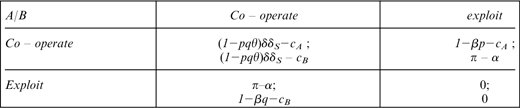
1. (Co – operate, co – operate):
$\frac{{\delta {{\delta }_S}}}{{1\,{\rm{ - }}\,((1\,{\rm{ - }}\,V^{\prime})(1\,{\rm{ - }}\,pq\theta ))}}\, + \,{{\alpha }_A}\, \gt \,\pi ;\; \; \frac{{\delta {{\delta }_S}}}{{1\,{\rm{ - }}\,((1\,{\rm{ - }}\,V^{\prime})(1\,{\rm{ - }}\,pq\theta ))}}\, + \,{{\alpha }_B}\, \gt \,\pi $2. (Co – operate, exploit):1/(1−(1−βp))−CA > 0;
$\pi \, \gt \,\frac{{\delta {{\delta }_S}}}{{1\,{\rm{ - }}\,((1\,{\rm{ - }}\,V^{\prime})(1\,{\rm{ - }}\,pq\theta ))}}\, + \,\alpha $3. (Exploit, co – operate : π > (δδs)/(1−((1−V′)(1−pqθ)))+α;
$\frac{1}{{1\,{\rm{ - }}\,(1\,{\rm{ - }}\,\beta q)}}\,{\rm{ - }}\,{{C}_B}\, \gt \,0$4. (Exploit, exploit): 0 > 1/(1−(1−βp))−CA;
$0\, \gt \,\frac{1}{{1\,{\rm{ - }}\,(1\,{\rm{ - }}\,\beta q)}}\,{\rm{ - }}\,{{C}_B}. $




Condition 3 (Exploit, exploit) is Nash if:  $\pi \, \gt \,\frac{{\delta {{\delta }_S}}}{{{\rm{1}}\,{\rm{ - }}\,((1\,{\rm{ - }}\,V^{\prime})(1\,{\rm{ - }}\,pq\theta ))}}\, + \,\alpha .$If
 $\pi \, \lt \,\frac{{\delta {{\delta }_S}}}{{{\rm{1}}\,{\rm{ - }}\,((1\,{\rm{ - }}\,V^{\prime})(1\,{\rm{ - }}\,pq\theta ))}},$ {Co – operate, co – operate} is also Nash. If true, {Co – operate, co – operate} Pareto dominates {Exploit, exploit}.
2.2 Government
Condition 4Negotiate if:  $1\,{\rm{ - }}\,\left[ {\frac{{\delta {{\delta }_S}}}{{{\rm{1}}\,{\rm{ - }}\,((1\,{\rm{ - }}\,V^{\prime})(1\,{\rm{ - }}\,pq\theta ))}}\, + \,\alpha } \right]\, \gt \,pq\theta \,{\rm{ - }}\,{{C}_G}$
2.3 Militants
1. If Conditions 2 and 4 are true: B accepts if 1/βq−CB > max{0, 1/q−CB} and rejects otherwise. A Propose if
$\frac{1}{{\beta p}}\,{\rm{ - }}\,{{C}_A}\, \gt \,max\left\{ {\frac{{{\rm{0,1}}}}{p}\,{\rm{ - }}\,{{C}_A}} \right\} $ and ∼Propose otherwise. If both 1/βq−C ↓B > max{0, 1/q−C ↓B} and $\frac{1}{{\beta p}}\,{\rm{ - }}\,{{C}_A}\, \gt \,max\left\{ {0,\frac{{{\rm{1}}}}{p}\,{\rm{ - }}\,{{C}_A}} \right\}, $ {Propose, co – operate}; {Accept, co – operate}, {Negotiate} is SPE. Since $\frac{1}{{\beta q}}\,{\rm{ - }}\,{{C}_B}\,{&#x003C;}\,\frac{1}{q}\,{\rm{ - }}\,{{C}_B}\,{\rm{and}}\,\frac{1}{{\beta p}}\,{\rm{ - }}\,{{C}_A}\,{\lt}\,\frac{1}{p}\,{\rm{ - }}\,{{C}_A}, $ this cannot be true. ∴{∼Propose, exploit}; {Reject, exploit}, {Negotiate} is SPE.2. If Condition 2 is true and Condition 4 is false: B accepts if
$\frac{{\delta {{\delta }_S}}}{{1\,{\rm{ - }}\,((1\,{\rm{ - }}\,{{V}^ \ast } )(1\,{\rm{ - }}\,pq\theta ))}}\, \gt \,\frac{1}{q}\,{\rm{ - }}\,{{C}_B}. $A Proposes if $\frac{{\delta {{\delta }_S}}}{{1\,{\rm{ - }}\,((1\,{\rm{ - }}\,{{V}^ \ast } )(1\,{\rm{ - }}\,pq\theta ))}}\, \gt \,\frac{1}{p}\,{\rm{ - }}\,{{C}_A}. $ If both conditions are true: {Propose, co – operate}; {Accept, co – operate}, {∼Negotiate}. Else {∼Propose, exploit}; {Reject, exploit}, {∼Negotiate}3. If Condition 2 is false and Condition 4 is true: If CA > CB, B accepts if
$\frac{\delta }{{1\,{\rm{ - }}\,(1\,{\rm{ - }}\,pq\theta )}}\,{\rm{ - }}\,{{C}_B}\, \gt $$\,\frac{1}{{1\,{\rm{ - }}\,(1\,{\rm{ - }}\,q)}}\,{\rm{ - }}\,{{C}_B}, $ which simplifies to δ > pθ. A Proposes if $\frac{\delta }{{1\,{\rm{ - }}\,(1\,{\rm{ - }}\,pq\theta )}}\,{\rm{ - }}\,{{C}_A}\, \gt \,\frac{1}{{1\,{\rm{ - }}\,(1\,{\rm{ - }}\,p)}}\,{\rm{ - }}\,{{C}_A}, $ which simplifies to δ > qθ. If true, {Propose, co – operate}; {Accept, co – operate}, {∼Negotiate} is SPE. Else, {∼Propose, exploit}; {Reject, exploit}; {∼Negotiate} is SPE. If CB > CA, B accepts if δ > pθ. A Proposes if δ > qθ. If true, {Propose, co – operate}; {Accept, co – operate}, {∼Negotiate} is SPE Else, {∼Propose, exploit}; {Reject, exploit}; {∼Negotiate} is SPE.4. If Conditions 2 and 4 are false: B accepts if ((δδS)/(1−((1−V′(**))(1−pqθ))), δ/(1−(1−pqθ))−CB) >
$\frac{1}{q}\,{\rm{ - }}\,{{C}_B} $. A Proposes if $\left( {\frac{{\delta {{\delta }_S}}}{{{\rm{1 - }}((1\,{\rm{ - }}\,{{V}^{ \ast \ast }} )(1\,{\rm{ - }}\,pq\theta ))}}{\rm{,}}\frac{\delta }{{{\rm{1 - }}(1\,{\rm{ - }}\,pq\theta )}}\,{\rm{ - }}\,{{C}_A}} \right)\, \gt \,\frac{{\rm{1}}}{p}\,{\rm{ - }}\,{{C}_A} $. If both conditions are true: {Propose, co – operate}; {Accept, co – operate}, {Negotiate}. Else {∼Propose, exploit}; {Reject, exploit}, {∼Negotiate}.










2.4 Sponsor
Condition 5 {S: Sponsor; A: Propose, co – operate; B: Accept, co – operate; G: ∼Negotiate} is SPE if:
1. Condition 4 is false.
2.
$\frac{{\delta {{\delta }_S}}}{{{\rm{1}}\,{\rm{ - }}\,((1\,{\rm{ - }}\,{{V}^^{\prime}} )(1\,{\rm{ - }}\,pq\theta ))}}\, \gt \,\frac{{\rm{1}}}{p}\,{\rm{ - }}\,{{C}_A}.$3.
$\frac{{\delta {{\delta }_S}}}{{{\rm{1}}\,{\rm{ - }}\,((1\,{\rm{ - }}\,{{V}^^{\prime}} )(1\,{\rm{ - }}\,pq\theta ))}}\, \gt \,\frac{{\rm{1}}}{q}\,{\rm{ - }}\,{{C}_B}.$4. If V′ =
$V^{\ast\ast } $, $\frac{1}{{1\,{\rm{ - }}\,V}}\,{\rm{ - }}\,{{C}_S}\, \gt \,0 $. If $\frac{1}{{1\,{\rm{ - }}\,V}}\,{\rm{ - }}\,{{C}_S}\, \lt \,0 $, Sponsor if V t−cS > 0 and ∼Sponsor otherwise. If V′ = $V^{\ast\ast } $, $\frac{1}{{1\,{\rm{ - }}\,V}}\,{\rm{ - }}\,{{C}_S}\,{\rm{ - }}\,\frac{{{{\delta }_S}}}{{1\,{\rm{ - }}\,V}}\, \gt \,0 $. If $\frac{1}{{1\,{\rm{ - }}\,V}}\,{\rm{ - }}\,{{C}_S}\,{\rm{ - }}\,\frac{{{{\delta }_S}}}{{1\,{\rm{ - }}\,V}}\, \lt \,0 $Sponsor if ${{V}^t} \,{\rm{ - }}\,{{C}_s}\, \gt \,\frac{{{{\delta }_S}}}{{1\,{\rm{ - }}\,V}} $ and ∼Sponsor otherwise.