I. INTRODUCTION
In the past few decades, extensive research has been made on metal matrix composites (MMCs) which normally show promising mechanical properties, such as high specific stiffness, strength, and abrasion resistance.Reference Wang, Xu, Wu, Chen, Peng, Jin, Xin, Zhang, Liu, Chen, Chen, Deng and Wang1–Reference Wu and Lavernia3 Various kinds of MMCs have been designed and developed to serve different applications in aerospace, automobile, electronic, marine, nuclear, and recreation industries.Reference Yang, Wang and Fan4,Reference Raj and Thakur5 Normally, the final stage of making of MMCs involves thermal treatments including solution, quenching, and artificial aging. Therefore, the study of aging behavior in MMCs is rather necessary according to a practical point of view. Compared with the unreinforced metals, addition of ceramic reinforcements can alter the nucleation and growth of the precipitates in the matrix, as a result of which the aging response and properties of the composites may be altered.Reference Jin, Xiao, Wang, Ma, Liu and Li6–Reference Pal, Mitra and Bhanuprasad14 One widely accepted viewpoint is that the aging behavior depends on the characters of reinforcements and its volume fraction, alloy composition, heat treatment, and other processing parameters.Reference Pal, Mitra and Bhanuprasad14 Despite supportive opinions on the aging kinetics and effects of reinforcements on aging process, a consensus is still not achieved.Reference Wang, Hu, Liu, Du, Wu, Huang and Zheng15
Till now, most of the investigations on aging behavior of MMCs focussed on the Al matrix composites.Reference Raj and Thakur5 Unfortunately, studies on the magnesium matrix composites are still inadequate.Reference Yang, Wang and Fan4,Reference Wang, Hu, Liu, Du, Wu, Huang and Zheng15–Reference Gu, Wu, Jin and Koçak23 Magnesium matrix composites overcome the demerits of the monolithic magnesium alloys, such as low stiffness, elastic modulus, and strength.Reference Gu, Wu, Jin and Koçak23,Reference Chelliah, Singh and Surappa24 Particularly, the particulate-reinforced magnesium matrix composites fabricated by stir casting are very cost-effective and widely used in aerospace, defense, and automobile industries.Reference Gu, Wu, Jin and Koçak23,Reference Chelliah, Singh and Surappa24 Most of the researchers concluded that the aging efficiency of Mg matrix could be affected by the addition of reinforcements.Reference Wang, Hu, Liu, Du, Wu, Huang and Zheng15,Reference Badini, Marino, Montorsi and Guo16,Reference Zheng, Wu, Kamado and Kojima18–Reference Sun, Wang, Deng, Nie, Zhang and Xiao20 Wang reported that the “necklace” particle distribution could affect the aging behavior of the cast SiCp/AZ91 composite.Reference Wang, Hu, Liu, Du, Wu, Huang and Zheng15 Sun et al.’s study on the aging behavior of the SiCp/AZ91 composites with different volume fractions indicated that the amount of discontinuous precipitates decreased while the continuous precipitates were promoted with increasing SiCp content.Reference Sun, Wang, Deng, Kang, Bai and Nie19 In general, detailed investigations on the effects of the ceramic particles on the aging kinetics of magnesium matrix composites are still very limited.
In the present study, the effect of SiCp particles on aging behavior of the extruded SiCp/AZ91 composite fabricated by stir casting is investigated. One of the reasons is that hot extrusion is an effective secondary deformation method to improve the mechanical properties of magnesium matrix composites by eliminating the casing defects. Secondly, for the particle-reinforced magnesium matrix composites, extrusion process could result in the redistribution of SiCp and refined grain of the matrix, which would further affect the aging behavior and the mechanical properties of the SiCp/AZ91 composite.
II. EXPERIMENTAL
SiC particulate-reinforced AZ91 magnesium matrix composite (SiCp/AZ91) used in this research was fabricated by stir casting. The average diameter of SiCp was about 10 µm, and the volume faction of SiCp was 15%. The SiCp/AZ91 composite was stirred at the semisolid condition at 590 °C with 1000 rpm for 30 min, then reheated to 700 °C, and finally solidified under a 100 MPa pressure to obtain ingots without porosity. Monolithic AZ91 alloy ingots were also cast under the same conditions as the SiCp/AZ91 composite. The composite and matrix alloy were extruded at 350 °C with the extrusion ratio of 12:1 and then solution treated (T4) at 415 °C for 24 h. Then, the alloy and composite were aged at 175 °C for different periods with samples taken every four hours.
The age-hardening response of the composite and unreinforced alloy was characterized by tensile tests according to ASTM: E8/E8M-13a standards. An Instron5569 universal testing machine (Instron, Canton, Massachusetts) was utilized to carry out the tests with a constant cross-head speed of 0.5 mm/min. The yield strength (YS), ultimate tensile strength (UTS), elastic modulus, and elongation were recorded based on an average of 3–5 tests. The microstructure of the alloy and composite was investigated by optical microscopy (OM), scanning electron microscopy (SEM) (Quanta 200FEG, FEI, Hillsboro, Oregon, 20 kV voltage), and transmission electron microscopy (TEM) (TecnaiF30, FEI). The specimens for microstructure analysis were mechanical polished and etched by picric acid (composition: 5 mL acetic acid + 5.5 g picric acid + 100 mL H2O + 90 mL ethanol). Specimens for TEM observation were made into 3-mm-diameter disks and then thinned by ion beam after grinding–polishing the sample to produce a foil of about 50 µm thickness.
III. RESULTS AND DISCUSSION
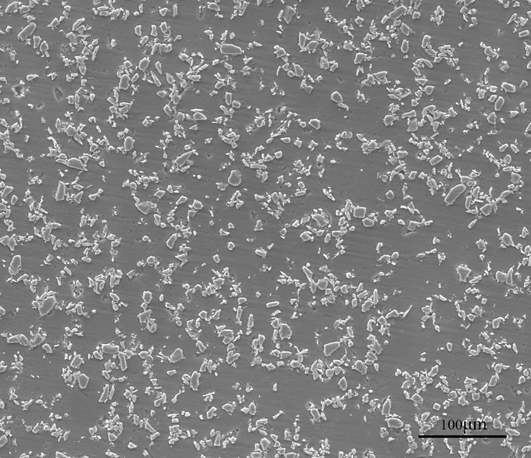
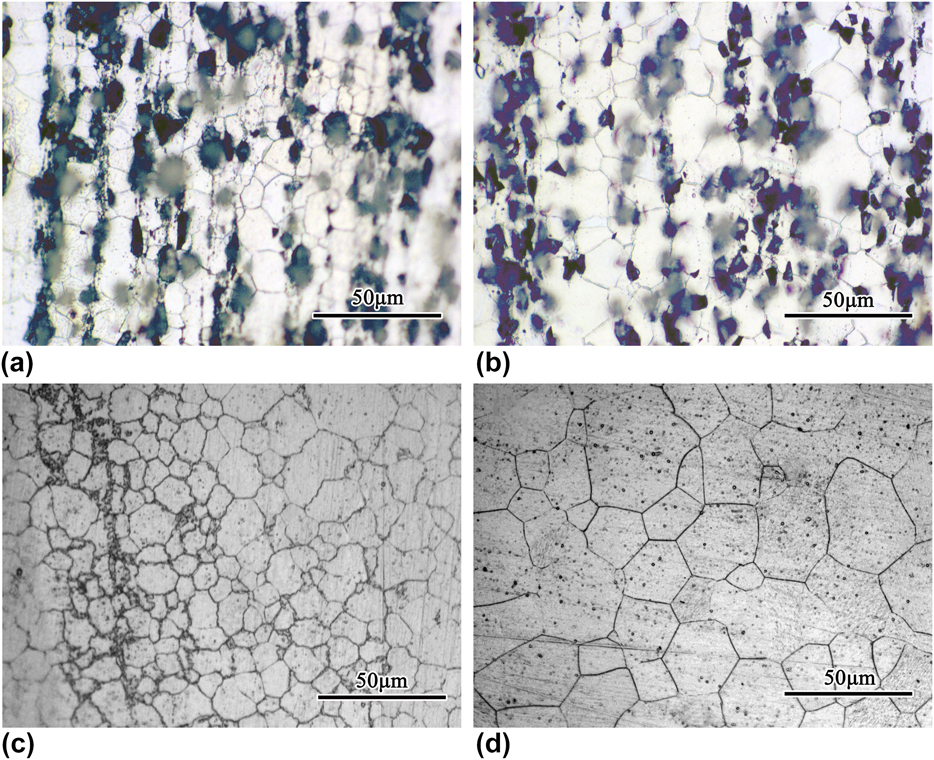
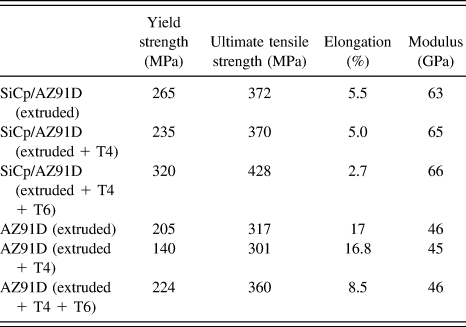
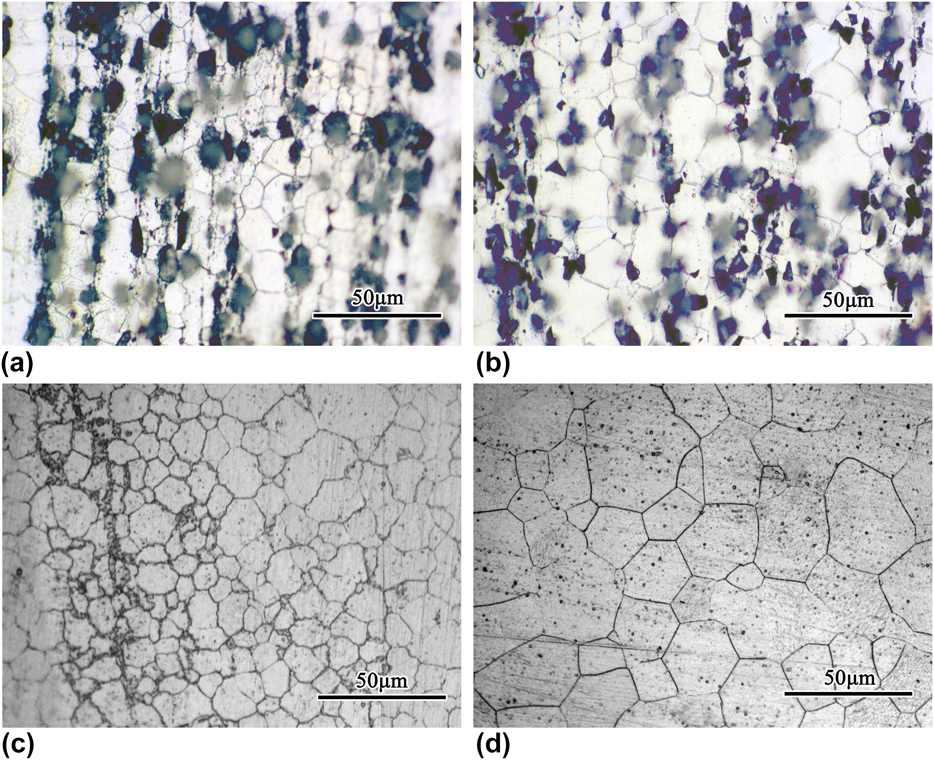
Figure 1 shows the SEM microstructure of the cast SiCp/AZ91 composite. Most particles were segregated along grain boundaries and made a necklace-type distribution. Figure 2 shows the microstructure of the extruded SiCp/AZ91 composites and AZ91 alloy before and after T4 treatment. The necklace-type distribution of the particles was destroyed, and the extrusion bands, consisting of SiCp aligning along the extrusion direction and small dynamic recrystallized grains, formed during extrusion. The residual precipitation phase in both composite and alloy was dissolved into the matrix, and no obvious precipitation could be observed at the grain boundary after T4 treatment. Moreover, grains of the composite did not grow rapidly during T4 treatment, as shown by Figs. 2(a) and 2(b), whereas the grain size of the monolithic AZ91 alloy increased obviously, which is indicated by Figs. 2(c) and 2(d). The tensile properties of the composites and alloy after extrusion and T4 treatment are shown in Table I. Both the extruded SiCp/AZ91 composite and AZ91 alloy showed reduced yield stress after T4 treatment. However, the smaller grain growth resulted in a small decrease in the YS of composite compared with that of monolithic AZ91 alloy according to the classic Hall–Petch relationship.
Global SEM microstructure of the as-cast composite.

Optical microstructure of the extruded SiCp/AZ91 composites and AZ91 alloy before and after T4 treatment: (a), (b), SiCp/AZ91 composites; (c), (d), AZ91 alloy.
Tensile properties of composites and alloy after extrusion, T4 treatment, and peak aging, respectively.

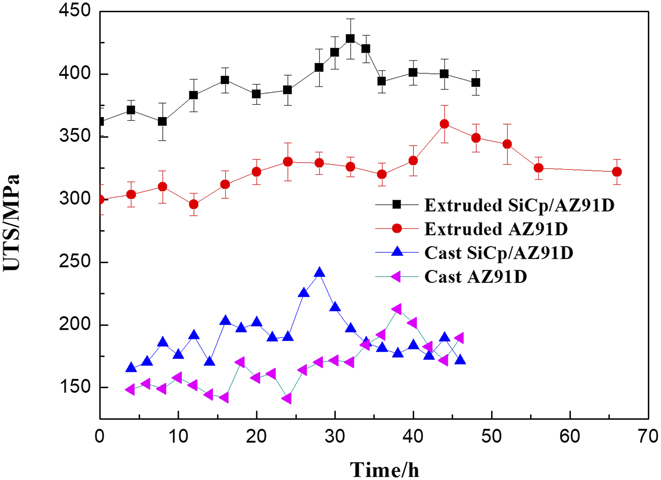
Figure 3 shows the effects of aging time on UTS of the as-extruded SiCp/AZ91 composites and monolithic AZ91 alloy under 175 °C. Also, the UTS variation of the cast SiCp/AZ91 composite and AZ91 alloy were plotted as shown in Fig. 3 similar to that recorded in Ref. Reference Wang, Hu, Liu, Du, Wu, Huang and Zheng15. In general, UTS of these two materials showed similar trend: increasing first with the aging time till the peak and then decreasing gradually. The SiCp/AZ91 composite showed an accelerated aging kinetics than that of the AZ91 alloy. For example, the time taken to reach the peak aging of the extruded SiCp/AZ91 composite is 32 h, which was 12 h earlier than that of the extruded monolithic alloy (44 h). Furthermore, the peak aging time of the as-extruded materials was retarded for about 4 h compared with that of the cast materials.
Effects of aging time on UTS of the as-extruded SiCp/AZ91 composites and monolithic AZ91 alloy under 175 °C.
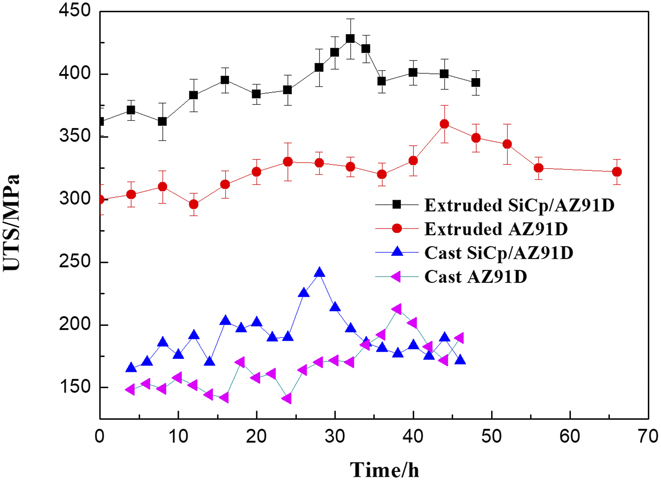
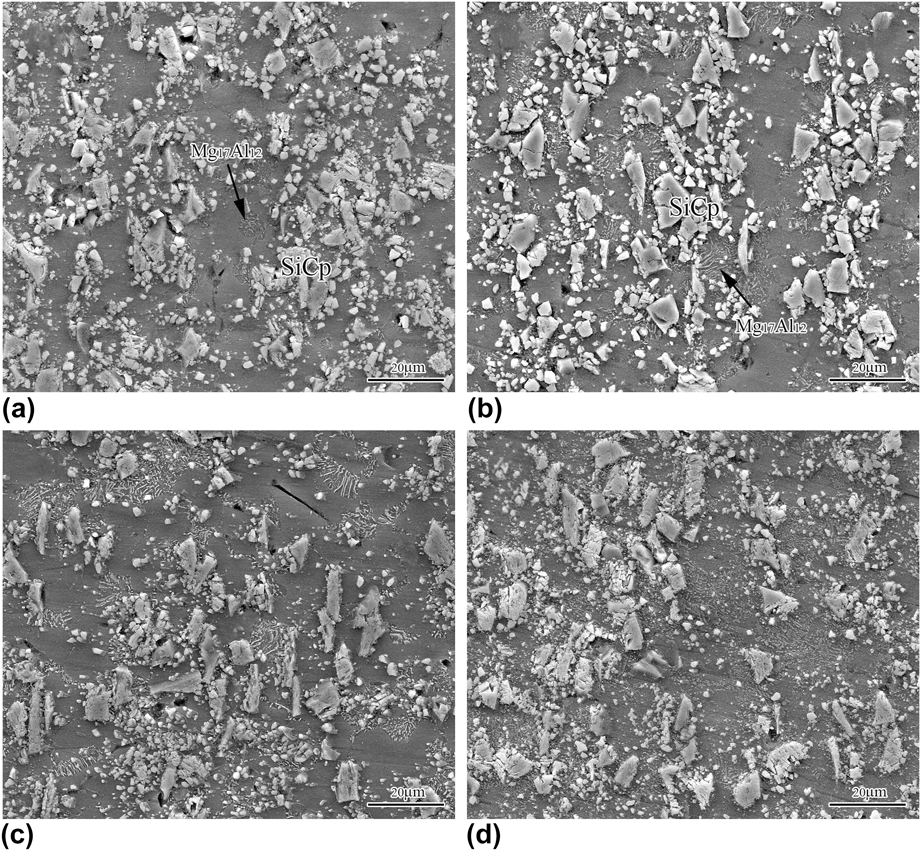
Figure 4 shows the global SEM microstructure of the extruded composite aging after different times. The discontinuous precipitation which was characterized by the cellular growth of alternating layers of Mg17A112 near-equilibrium magnesium matrix was the typical microstructure after aging, as shown in Figs. 4(a) and 4(b). The precipitation could mainly be observed at the interface of the matrix and reinforcement particle. The total amount of discontinuous precipitation increased as aging time increased. After 32 h, the precipitation kept growth and some SiCp had been surrounded by the cellular precipitation. After 48 h, the discontinuous Mg17A112 precipitation moved into intragranular regions and some grains were totally occupied.
Global SEM microstructure of the extruded composite aging after different times, (a) 4 h; (b) 16 h; (c) 32 h; (d) 48 h.

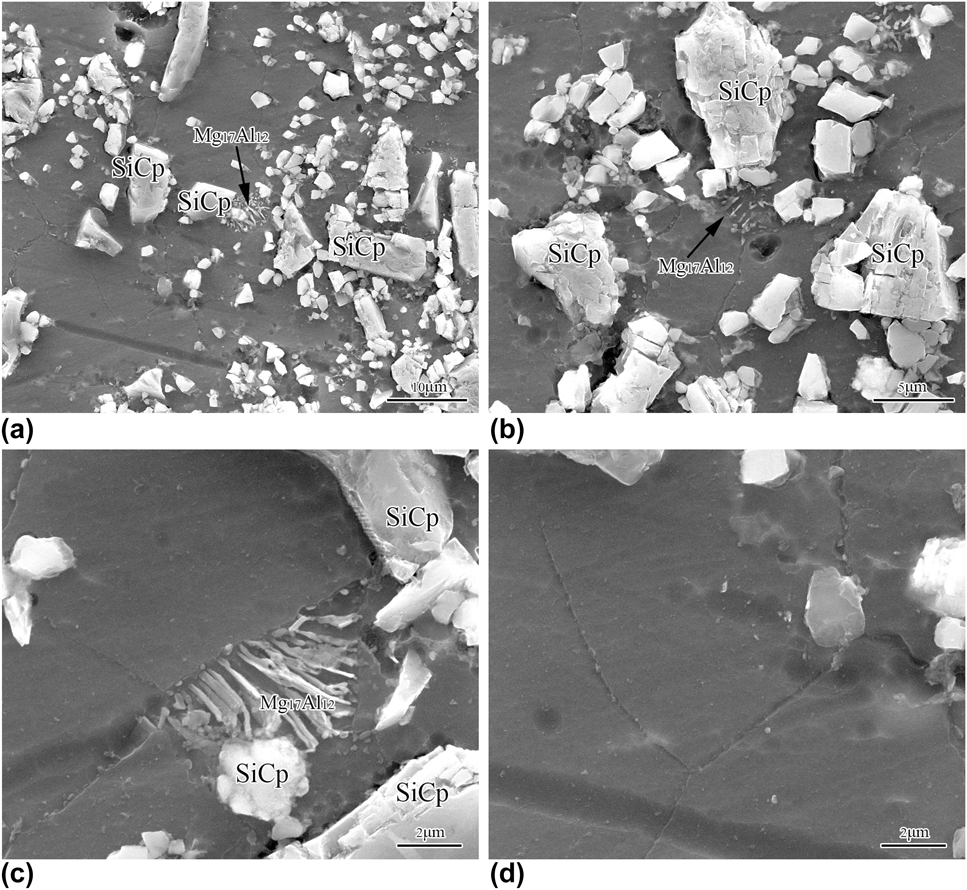
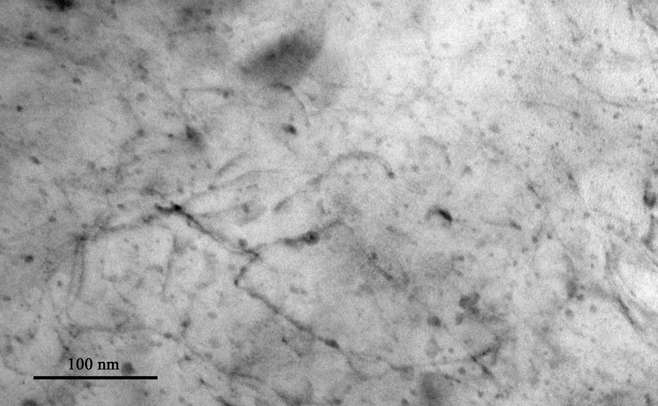
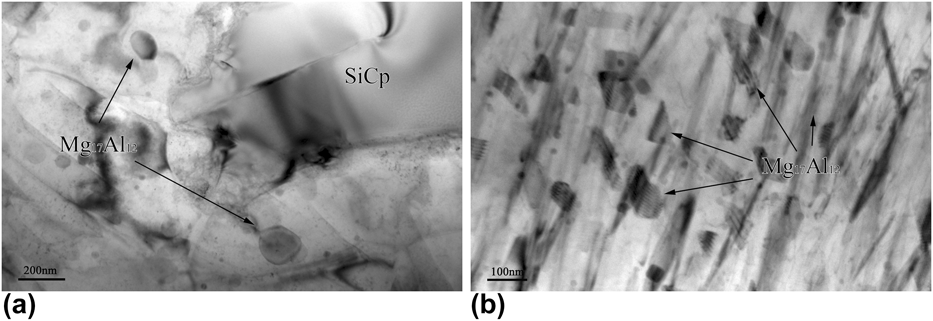
To study the precipitation behavior of the as-extruded SiCp/AZ91 composite in detail, microstructure of the composite before aging were summarized as shown in Fig. 5. After 4 h of aging, the discontinuous Mg17A112 precipitates started mainly at the interface between SiCp and matrix, shown in Figs. 5(a) and 5(b), and the grain boundaries near particles, as shown in Fig. 5(c). Seldom Mg17A112 precipitates could be discovered at the grain boundaries in the particle-free region of the composite, which is indicated in Fig. 5(d). Figure 6 reveals the TEM micrograph of the intragranular continuous precipitates in composite aged at 175 °C for 4 h. At this stage, fine continuous nano-size precipitates formed and dispersed uniformly in the matrix.
Discontinuous Mg17A112 precipitates originated at different regions in the composite aging after 4 h: (a), (b) at the SiCp/AZ91 interface in the particle rich region (c), at grain boundaries near particles; (d) particle-free region.

TEM micrograph of the intragranular continuous precipitates in composite aged at 175 °C for 4 h.

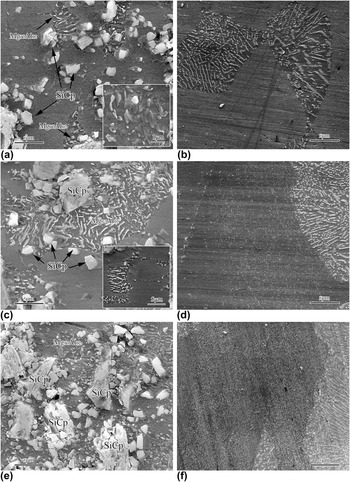
Figure 7 shows the precipitation process of the extruded SiCp/AZ91 composite and alloy aging after different times. As the aging time of the composite increased to 16 h, the precipitates near the particle grew up and the total amount of discontinuous precipitation increased. In particular, some precipitates had extended to grains in the particle-rich region in the extrusion bands, as shown in Fig. 7(a). The lamellar and the rod-like Mg17A112 precipitates with nano-diameter size were distributed randomly in the precipitation region, which is shown in the inset in Fig. 7(a). For the AZ91 alloy, the discontinuous precipitation which was characterized by the cellular growth of alternating layers of Mg17A112 starts at the grain boundaries and then continues in the inner part of the grains, which is shown in Fig. 7(b). Moreover, no obvious intragranular precipitates could be observed in the composite or the alloy. Figures 7(c) and 7(d) show the SEM microstructure of the composite and alloy at the peak aging time, respectively. The precipitates colony had spread out all over the particle-rich region of the composite and some particles had been surrounded by the lamellar Mg17A112 which had grown up with increasing aging time, as shown in Fig. 7(c). Meanwhile, the precipitates had extended from the particle-dense region to intragranular regions in the particle-free region [the inset figure in Fig. 7(c)]. By comparing Figs. 7(c) and 7(d), it could be discovered that besides the discontinuous precipitation at grain boundary, the continuous intragranular precipitation with nano-size could be observed in the AZ91 alloy, whereas no intragranular precipitation could be discovered in the composite. As aging time further increased to the overage time, massive precipitate bridges connected the small broken SiCp and most observation area of the composite was covered by precipitates [Fig. 7(e)]. For the alloy, the length of the lamellas was found significantly increased by comparing Figs. 7(d) and 7(f). The distribution of continuous intragranular precipitation seems to be homogenous within AZ91 alloy. Figure 8 shows the TEM micrographs of the intragranular continuous precipitates of the composite and AZ91 alloy at peak aging time. Although the fine continuous precipitates in the SiCp/AZ91 composite grew up, most of them still kept their morphology of particulates and no precipitates grew into laths. However, massive irregularly shaped plates or lath-shaped precipitates dominated in the monolithic AZ91 alloy.
Precipitation process of the extruded SiCp/AZ91 composite and alloy aging after different times: (a), (c), and (e) composite aged for 16 h, 32 h and 44 h, respectively; (b), (d) and (f) AZ91 alloy aged for 16 h, 44 h, and 60 h, respectively.

TEM micrographs of the intragranular continuous precipitates of the composite and AZ91 alloy at peak aging time: (a) SiCp/AZ91 composite; (b) AZ91 alloy.

According to previous reports,Reference Wang, Hu, Liu, Du, Wu, Huang and Zheng15,Reference Zheng, Wu, Kamado and Kojima18,Reference Zhang, Liao, Ma and Wang22 the SiC/Mg interfaces could act as vacancy sinks which will result in the solute enrichment in the matrix near the interfaces, so that the interfaces provide efficient diffusion paths for the Al element to reach the supersaturation for the precipitation of Mg17A112. Moreover, the addition of SiCp would introduce the mismatch strains around the SiCp particles during cooling after the T4 treatment because of the large mismatch between the coefficients of thermal expansion (CTE) of SiC and AZ91 alloy. The local high-density dislocations in matrix caused by the mismatch strain can promote the diffusion of alloying elements, which would further cause the solute enrichment near SiCp and then makes the compositional requirement for the precipitation more favorable.Reference Gupta and Surappa25 Consequently, the discontinuous Mg17A112 prefer to precipitate at the SiC/Mg interfaces in the present research, as shown in Fig. 5(a). Actually, it has been accepted that the mismatch strains caused by CTE mismatch could introduce high density of dislocations in the matrix and the plastic zone formed around the micron particles.Reference Wang, Hu, Liu, Du, Wu, Huang and Zheng15,Reference Sun, Wang, Deng, Kang, Bai and Nie19 According to previous reports, the plastic zone can be estimated as 1.5–1.8 times of the particle size.Reference Wu and Lavernia3 Therefore, the particle zone is approximately 15–18 µm. Moreover, assuming the particles to be equiaxed, the inter-particle spacing can be ascertained by Eq. (1),Reference Pal, Mitra and Bhanuprasad14
 $$\lambda = 0.77d{\left( {{V_{\rm{P}}}} \right)^{ - 0.5}}\quad ,$$
where λ is the inter-particle spacing and V P is the volume fraction of SiCp. The λ has been calculated as 19.9 μm in this study. This calculation is based on the assumption that the particle distribution is uniform. In fact, some particles broke during extrusion process and the real inter-particle spacing in the extrusion bands could be smaller than the calculated value. Therefore, it can be deduced that the inter-particle spacing could be covered by the overlapped plastic zone in this study. Compared with the as-cast SiCp/AZ91 composite in Ref. Reference Wang, Hu, Liu, Du, Wu, Huang and Zheng15, the extrusion process destroyed the necklace-type segregation particles which retarded the Al diffusion in the cast composite, so that it is easy to get the supersaturation of the Al element around the SiCp in the extruded composite. Consequently, the discontinuous Mg17A112 colonies could easily be nucleated and grew up in the extruded SiCp/AZ91 composite.
Another important factor affecting the nucleation and growth of discontinuous precipitation is grain boundary diffusion. It is well known that the discontinuous precipitation developed from an original grain boundary into intragranular region by the grain boundary migration with depleting solute behind boundaries.Reference Fournelle and Clark26 Based on the research of Huang et al.Reference Huang, Yu, Li, Cui, He and Zhang27 and Duly et al.,Reference Duly and Brechet28 nucleation rate per unit area of grain boundary can be analyzed by F–C mechanism,Reference Tu and Turnbull29 which is given as follows:
 $${I_{{\rm{s,FC}}}} \propto v\exp \left[ {{{ - E} / {RT}}} \right]{{\gamma {V_{\rm{m}}}} \over d}{P_{{\rm{nuc,FC}}}}\quad ,$$
where v is the vibration frequency of the grain boundary which is considered as a membrane, E is the activation energy for the vibration of the membrane, g is surface energy, V m is the molar volume, γV md −1 is the capillarity energy causing the first displacement of grain boundary, and P nuc,FC is the probability that the displacement of grain boundary induced by capillarity forces will allow discontinuous precipitation. As v is estimated to be proportional to d −1 and the dependence of P nuc,FC on d is small, the I s,FC is proportional to d −2. Therefore, the decreasing grain size is propitious to improve the nucleation rate of discontinuous precipitation. Moreover, several kinds of defects such as dislocations and vacancies exist at the grain boundary, which is the diffusion path for the supersaturation elements. Thus, for the extruded composite, obvious grain refinement caused by the dynamic recrystallization which was promoted by the formation of particle plastic zone around micron particle would supply more grain boundaries serving easily as a reaction front for the discontinuous precipitation growth in this study. Consequently, the discontinuous precipitates nucleating within the extrusion bands could easily be expanded into small grains and then grow connecting the SiCp as shown in Fig. 7(c).
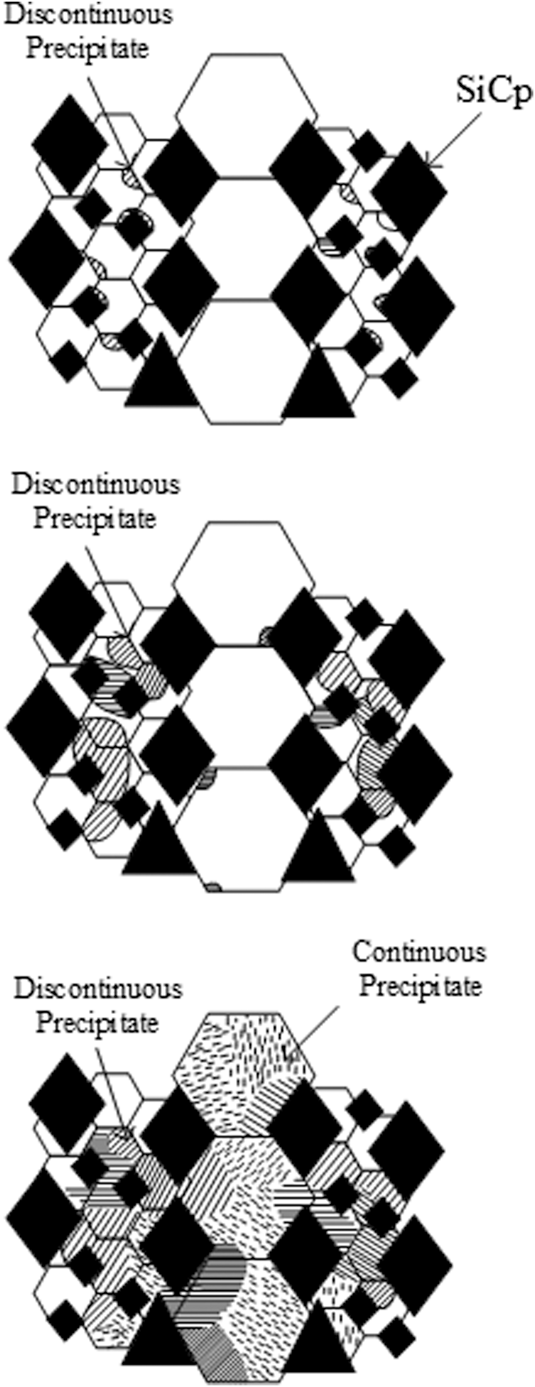
Overall, it has been demonstrated that particle distribution could affect the aging behavior of the discontinuous precipitates.Reference Wang, Hu, Liu, Du, Wu, Huang and Zheng15 In the cast SiCp/AZ91 composite, the discontinuous precipitates were formed near segregated particles and few precipitates could be discovered in the particle segregation. However, in this study, the segregated particles in the cast SiCp/AZ91 composite were destroyed. The discontinuous precipitates preferred to nucleate at the SiCp/AZ91 interface and grain boundaries of the small grains in the extrusion bands due to the particle deformation zone. Then, the discontinuous precipitates grew up and expanded in to the particle-free region. Meanwhile, the continuous precipitates occurred simultaneously. The aging process of the extruded SiCp/AZ91 composite is illustrated by Fig. 9.
Illustration of the aging process of the extruded SiCp/AZ91 composite.

Sun et al. investigated the aging behavior of the AZ91 matrix reinforced by 5 μm SiCp of different volume fractions.Reference Sun, Wang, Deng, Kang, Bai and Nie19 It is noticeable that as the volume fraction of SiCp increased to 15%, almost only continuous precipitates could be discovered in the aged SiCp/AZ91 composite. Zheng reported that the main difference in the microstructure between the unreinforced AZ91 alloy and SiCw/AZ91 composite is that the discontinuous cellular precipitates at the grain boundaries are essentially absent in the matrix of the composite.Reference Zheng, Wu, Kamado and Kojima18 However, in this case, the SiCp/AZ91 composite with the SiCp volume fraction of 15% indicated the discontinuous precipitates occurred more obviously than the continuous precipitates.
Normally, discontinuous and continuous precipitates can occur simultaneously or competitively, dependently on the aging temperature. The volume fraction of continuous precipitates increased with aging temperature.Reference Braszczyńska-Malik30 Although the aging temperature of 473 K in Sun et al.’s investigation is higher than the aging temperature in the present observation, both are still at the low temperature range which is favored by discontinuous precipitation. As it was revealed, the amount of the discontinuous precipitates depends on the local conditions for nucleation and growth at grain boundaries.Reference Sun, Wang, Deng, Kang, Bai and Nie19 The movability of the grain boundaries is a crucial factor for the nucleation and growth of discontinuous precipitation. For the SiCw-reinforced composite, the grain boundaries bounded by SiCw have limited movability and the discontinuous precipitation was restricted.Reference Zheng, Wu, Kamado and Kojima18 In the case of SiCp/AZ91 composite, the composites reinforced by smaller reinforcements contain larger quantity of SiCp than the composites reinforced by larger particles of same volume fraction. Therefore, the large amount of small SiCp which was distributed along the grain boundaries will impede the movement of grain boundaries and only continuous precipitates become formative in SiCp/AZ91 composite reinforced with 5 μm SiCp.Reference Sun, Wang, Deng, Kang, Bai and Nie19 In the present study, on the contrary, the larger particles did not have the similar strong pinning effect on grain boundary migration as the small particles have, so that the accelerated discontinuous precipitates were promoted because of the particle plastic zone and grain refinement caused by extrusion process. The promote discontinuous cellular precipitates at grain boundary strongly depleted the alloying elements in the matrix; then, at the peak ageing time of the precipitation process, as shown by Fig. 8, inside the composite metal matrix, continuous intragranular precipitation was retarded compared with the unreinforced AZ91 alloy.Reference Badini, Marino, Montorsi and Guo16
Table I summarizes the tensile properties of both the extruded SiCp/AZ91 composite and AZ91 before and after peak aging. The YS and UTS of both the composite and alloy were improved dramatically after aging, whereas the elongation decreased. As shown in Fig. 3, UTS of both the composite and alloy was improved obviously after extrusion and thereafter increased with the aging time till the peak and then gradually decreased during the artificial aging. Generally, the strengthening mechanism of composites mainly include grain refinement, precipitation strengthening, and reinforcement strengthening.Reference Sun, Wang, Deng, Kang, Bai and Nie19 In this study, the matrix grains were refined due to the dynamic recrystallization; therefore, strength of the matrix of SiCp/AZ91 composite and AZ91 alloy increased obviously according to the Hall–Patch relationship. Moreover, for the composite, improvement of the particle distribution and microstructure homogeneity would also be propitious to increase in the mechanical properties after extrusion process. It has been reported that precipitates could introduce the pile-up and dislocation tangle which can inhibit dislocation movement during tensile test.Reference Sun, Wang, Deng, Kang, Bai and Nie19,Reference Yuan, Ma, Jiang, Sun, Lu, Zhang and Song31 Consequently, in this case, the YS and UTS of both composite and AZ91 alloy increased gradually with increasing precipitate volume fraction and precipitate growth before reaching the peak aging. As the heat treatment time increased, coarsening of the discontinuous precipitates caused a dramatic decrease in the strengthening effect of discontinuous precipitates, leading to the UTS decrease after the peak aging.Reference Kim, Lee, Kim, Bae, You and Park32 Furthermore, the decreased elongation after artificial aging could be attributed to the large amount of discontinuous precipitates which acted as the crack source.Reference Kim, Lee, Kim, Bae, You and Park32 It is interesting that the UTS of extruded composite showed one small peak at 16 h before the peak aging at 32 h. Kim pointed out that the reduced grain size could accelerate discontinuous precipitation at the early stage of aging and prematurely terminates continuous precipitation due to the depletion of Al caused by the formation of discontinuous precipitation.Reference Kim, Lee, Kim, Bae, You and Park32 The precipitation strengthening is related to the variation in discontinuous precipitates and continuous precipitates. In the present investigation, it can be deduced that the promoted discontinuous precipitates at the early stage, shown in Fig. 7, resulted in the small peak at 16 h whereas thereafter the aging rate deceased because of the suppressed continuous precipitates. During the following aging treatment, the continuous precipitates gradually grew up and contributed to the increase in the strength of the aged composite, and a best combined strengthening effect of the discontinuous precipitates and continuous precipitates was achieved at the peak aging time up to 32 h. Moreover, the retarded continuous precipitates could also result in the delayed peak aging time of the extruded SiCp/AZ91 composite by 4 h longer than that of the cast materials reported in Ref. Reference Wang, Hu, Liu, Du, Wu, Huang and Zheng15, as shown in Fig. 3.
IV. CONCLUSIONS
(1) The SiCp/AZ91 composite was extruded successfully at 350 °C with the extrusion ratio of 12:1. The matrix grain of SiCp/AZ91 composite was refined due to the dynamic recrystallization after extrusion. The necklace-type distribution of the particles in the cast SiCp/AZ91 composite was destroyed and the extrusion bands consisting of SiCp with small grains formed aligning along the extrusion direction. The YS and UTS of both composite and A91 alloy increased obviously due to the refined grain size and improved microstructure homogeneity.
(2) After aging at 175 °C, the YS and UTS increased obviously due to the precipitation strengthening, whereas the elongation decreased. The fine grains and the addition of SiCp could accelerate the aging kinetics of the AZ91 matrix in the extruded composite. The discontinuous precipitates preferred to nucleate at the SiC/Mg interfaces and the grain boundaries within the extrusion bands and then expanded into the particle-free region in the extruded SiCp/AZ91 composite.
(3) Inside the composite metal matrix, continuous intragranular precipitates were retarded with respect to the unreinforced AZ91 alloy, at the peak aging time of the precipitation process, because the discontinuous precipitates were promoted due to the grain refinement and the particle plastic zone introduced by SiCp. The promoted discontinuous precipitates at the early stage resulted in the small peak of the UTS of the composite aged up to 16 h.
ACKNOWLEDGMENTS
This work was supported by “National Natural Science Foundation of China” (Grant Nos. 51671066, 51201006, 51471059, 51771178, and 51401200).