Introduction
Concurrent chemo-radiation therapy (CCRT) is considered the standard treatment of locally advanced head and neck cancers (LA-HNC).Reference Ko and Citrin1 A conclusion of the meta-analysis of chemotherapy in head and neck cancer (MACH-NC) is that adding chemotherapy to radiotherapy results in a 5-year absolute survival benefit around 8% for oral cavity and oropharyngeal cancers and around 5% for laryngeal and hypo-pharyngeal cancers.Reference Blanchard, Baujat and Holostenco2 However, many studies concluded that the combination of chemotherapy with radiotherapy improves the results with the cost of increased toxicity.Reference Kouloulias, Thalassinou and Platoni3
In many randomised trials, accelerated radiotherapy without concomitant chemotherapy has been proved to be an effective regimen for patients with head and neck squamous cell carcinoma (HNSCC). For accelerated regimens without dose reduction, the MARCH meta-analysis showed a significant absolute reduction in locoregional relapse of slightly above 7% translating into a small (2%) but significant benefit in overall survival (OS). The benefit in locoregional control was in favour of altered fractionation versus conventional radiotherapy (6·4% at 5 years; p < 0·0001).Reference Baujat, Bourhis and Blanchard4
Intensity-modulated radiation therapy (IMRT) is used for the treatment of head and neck (H&N) patients with complex-shaped planning target volumes (PTV), especially as the concave targets are close to a large number of organs-at-risk (OAR).Reference Pursley, Damato and Czerminska5
Graded dose levels to tumour targets and for subclinical tumour spread, lymph node-bearing areas with sparing normal tissues to the greatest extent, can be done using ‘simultaneous integrated boost’ (SIB). The SIB-IMRT strategy is also an easier, more efficient and perhaps a less error-prone way of planning and delivering IMRT.Reference Yazici, Dirican and Kara6
Many studies comparing volumetric modulated arc therapy (VMAT) to IMRT in H&N radiotherapy showed that VMAT has comparable dose distribution with less number of monitor units and less treatment time.Reference Ozdemir, Coban and Akin7, Reference Holt, Van Gestel and Arends8
Although the efficacy of adding chemotherapy concomitantly with radiotherapy has been proven in many studies, the additive value of concurrent chemotherapy on local/regional control and survival rates for LA-HNC patients treated with IMRT is largely unknown.Reference Li, Yang and Hu9 A retrospective study prescribing 70 Gy/33 fr for T1 & T2 lesions and 74 Gy/33 fr for T3 & T4 lesions in 333 patients with locally advanced nasopharyngeal cancer (LA-NPC) did not demonstrate any significant differences in LC, OS, DFS and distant metastasis-free survival (DMFS) between patients treated with IMRT-SIB with or without concurrent chemotherapy.Reference Yi, Huang and Gao10 Another study done in early and moderately advanced SCC of H&N concluded that dose escalation SIB-IMRT protocol using 69, 72 and 75 Gy/30 fr was safe and effective as a sole treatment without chemotherapy. The 2-year LC was 82% for the three groups. The 2-year OS was 89% for dose levels I and II and 95% for dose level III.Reference Leclerc, Maingon and Hamoir11
In this work, we hypothesised that the added benefit of chemotherapy to radiotherapy may be compensated by increasing the biological effective dose through using the dose-escalated hypo-fractionated regimen omitting chemotherapy. To the best of our knowledge, no randomised trials were done to compare the dose-escalated hypo-fractionated regimen without chemotherapy with the conventional CCRT regimen.
The aim of this study is to compare the slightly dose-escalated accelerated hypo-fractionated VMAT regimen omitting chemotherapy in radical treatment of LA-HNC to the standard CCRT regimen in terms of local control (LC), progression-free survival (PFS), OS and also acute and late toxicities.
Materials and Methods
This is a pilot study that was carried out during the period from January 2016 to September 2018. Sixty-three patients with histopathologically confirmed locally advanced HNSCC (T3-T4 &/or N1-3) (stage IIB, III and stage IV-A), according to TNM staging (7th edition),Reference Edge and Compton12 who met the inclusion criteria for definitive radiation treatment were recruited and were randomised to both treatment arms.
Radiotherapy technique
Patients were immobilised in the supine position with thermoplastic head, neck and shoulder masks. Computed tomography (CT) scan was done for each patient from skull vertex to the middle of the chest, with 2·5 mm slice thickness with intravenous (IV) contrast. CT scan images were transferred to the treatment planning system.
Definition of the target volumes was done according to the International Commission on Radiation Units (ICRU) report 50 and the supplement ICRU 62 and 83 guidelines.Reference Landberg, Chavaudra and Dobbs13 The primary tumour and clinically involved lymph nodes were delineated as gross target volume (GTV). Image fusion with magnetic resonance imaging (MRI) and/or positron emission tomography-computed tomography (PET-CT) was done if available. Clinical target volume (CTV) primary is created around GTV with a 5-mm margin to account for possible microscopic spread. PTV is created around CTV with a 5-mm margin to account for setup errors. The cervical lymph node stations were delineated based on the published DAHANCA, EORTC, HKNPCSG, NCIC CTG, NCRI, RTOG and TROG consensus guidelines.Reference Grégoire, Ang and Budach14
The following OARs were delineated: brain stem, temporal lobes, optic chiasma, bilateral optic nerves, bilateral cochleas, bilateral globes, bilateral lenses, bilateral parotids, uninvolved oral cavity, mandible and temporomandibular joint, brachial plexus, larynx excluding laryngeal cancers, thyroid gland, spinal cord and pituitary gland.
Rapid arc plans were produced for all patients, at least two arcs plans were created for better dose homogeneity and risk organs sparing. Eclipse treatment planning system was used (from Varian Medical System Inc., UK) version 11.0 with anisotropic analytical algorithm (AAA) and Acuros XB (AXB) algorithms.
The patients were randomised to either:
Arm A: Thirty-three patients were treated by 6MV photons Varian linear accelerator (Inc.3100 Hansen Way, Palo Alto, CA, USA), 5 fr/week, with a total treatment time of 7 weeks (47 days). The prescribed dose was 70 Gy in 35 fr at 2 Gy/fr to the PTV of the GTV primary or lymph nodes, 60 Gy to the PTV of the CTV high risk, and 54 Gy to the PTV of the CTV low risk volumes. The chemotherapy was cisplatin 100 mg/m2 every 3 weeks for three doses during the radiation course (Conventional CCRT-VMAT protocol) or
Arm B: Thirty patients were treated by 6MV photons Varian linear accelerator, 5 fr/week, with a total treatment time of 6·5 weeks (45 days). The prescribed dose to PTV of the primary or nodal GTV was 74 Gy in 33 fr at 2·24 Gy/fr, 60 Gy to the PTV of the CTV high-risk and 54 Gy to the PTV of the CTV low-risk volumes (VMAT—SIB alone protocol).
Plan quality was analysed using dose–volume histogram (DVH) data. The treatment goal was to deliver 95% of the prescribed dose to ≥ 95% of each PTV.
Accepting the plan risk organs in both arms according to:
Arm A: QUANTEC model risk organs dose constraints and
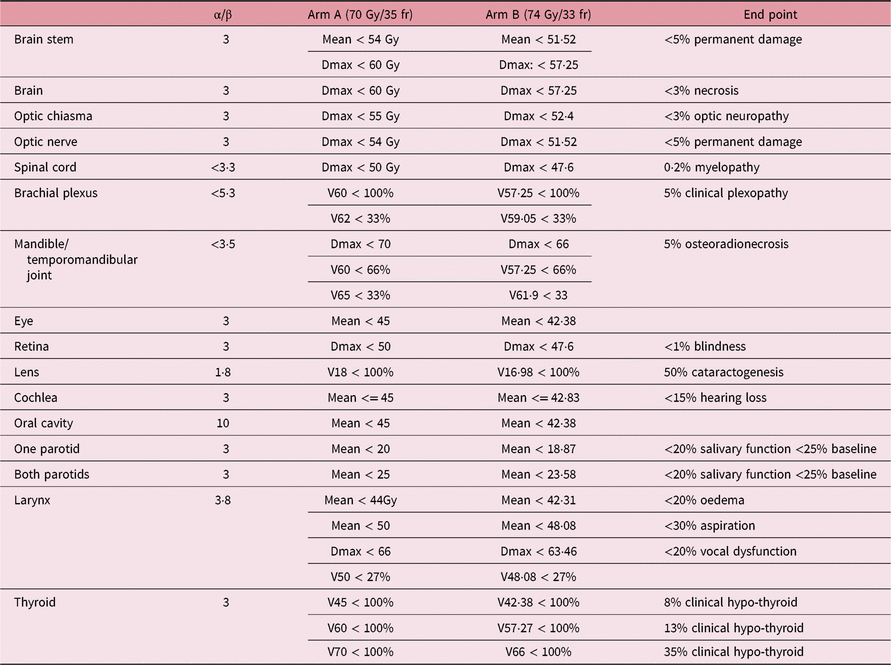
Arm B: calculated EQD2 in comparison to 2·24 Gy according to α/β ratio.
Both are demonstrated in Table 1.
Organs at risk dose constraints in both arms

Patients were treated on ‘UNIQUE’ Varian machine.
Acute toxicities were scored according to common terminology criteria for adverse events (CTCAE, version 4.03) from the start of radiation therapy until 3 months of follow-up.15 Late toxicities were scored thereafter until the end of follow-up.
The response evaluation criteria in solid tumours (RECIST 1.1) were used to score tumour response at the end of the second-month post-radiotherapy, by regional MRI with contrast.Reference Schwartz, Litière and De Vries16
Statistical methods
Data were coded and entered using Statistical Package for the Social Sciences (SPSS) version 25. Data were summarised using mean, standard deviation, median, minimum and maximum quantitative data and using frequency (count) and relative frequency (percentage) for categorical data. The non-parametric Kruskal–Wallis and Mann–Whitney tests were used to compare between quantitative variables. For comparison of serial measurements within each patient, the non-parametric Friedman test and Wilcoxon signed rank test were used. Chi square (χ2) test was done to compare categorical data. When the expected frequency is less than 5, exact test was performed instead. For survival curves Kaplan–Meier method was used and compared using the log-rank test. Independent prognostic factors were estimated by the Cox proportional hazards in univariate and multivariate regression models. Statistically significant p-values were considered as less than 0·05.
Results
Sixty-three patients were included in the study (33 patients were in Arm A and 30 patients were recruited in Arm B). Median follow-up period was 24·2 months (ranging from 13·4 to 31·2 months).
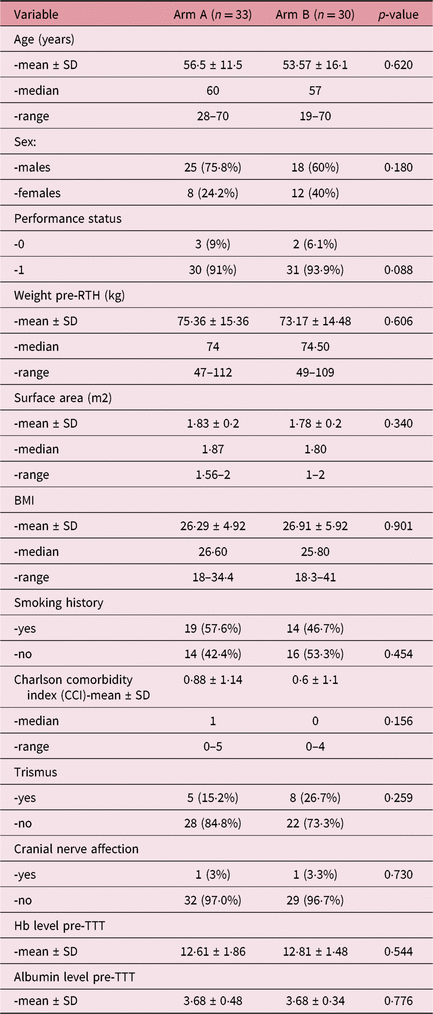
Median age of all patients was 58 year old with range (19–70). Most of the patients were males representing (43 patients: 68%). Thirty (47·6%) patients were non-smokers and 42 (66·7%) patients were performance status (PS) 0/1.
Patients’ and tumours’ characteristics were well balanced between the two groups of patients (Table 2).
Patients’ characteristics

Response assessment
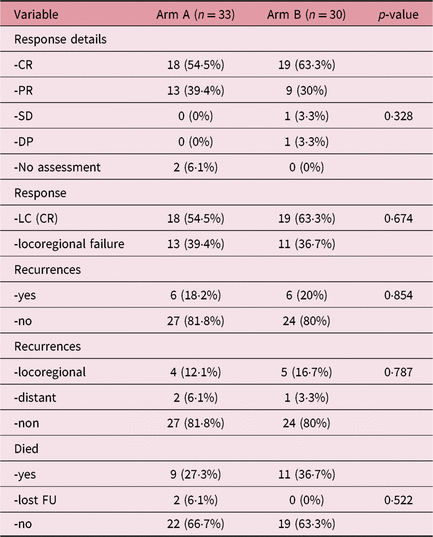
Thirty-seven patients (58·7%) of the whole cohort had complete remission (CR): 18 (54·5%) patients in Arm A and 19 (63·3%) patients in Arm B. Response across the two groups was not statistically significant (p = 0·328).
Twelve patients (19%) had recurrences, six patients in each arm (p = 0·854). In Arm A, four patients had locoregional recurrences in Arm A and two patients had distant recurrences while in Arm B, there were five patients with locoregional recurrences and one patient with distant recurrence. Twenty patients died during the follow-up period (Table 3).
Response details

Assessment of toxicities
There was statistical significance in all symptoms experienced including anaemia, neutropenia, elevated kidney function tests (KFT), nausea and vomiting in favour of Arm B (p < 0·001). There was no statistical significance between the two groups in grade 3/4 toxicities; however, neutropenia presentation had a trend towards significance (p = 0·054).
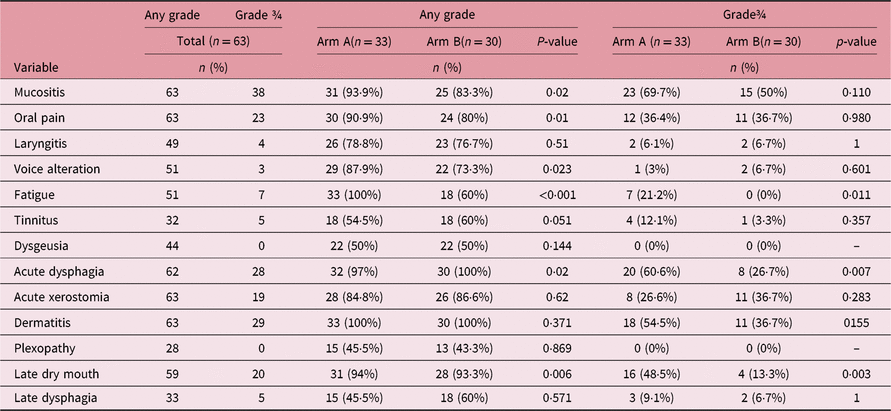
Mucositis, oral pain, voice alteration, fatigue, acute dysphagia and late dry mouth were all statistically significant in favour of Arm B (p < 0·05). Grade 3/4, fatigue, acute dysphagia and late dry mouth were statistically significant in favour of group B (p < 0·05). Mucositis G3/4 was present in 38 patients (38%) (Table 4).
Assessment of acute and late radiotherapy toxicity

Forty-seven (74·6%) patients developed G3/4 toxicities with borderline statistical significance among the two groups (p = 0·05). Regarding non-haematological toxicity, results were not statistically significant among the two groups despite there being more patients in Arm A (26 patients) versus 19 patients in Arm B, respectively.
Survival analyses
Progression-free survival
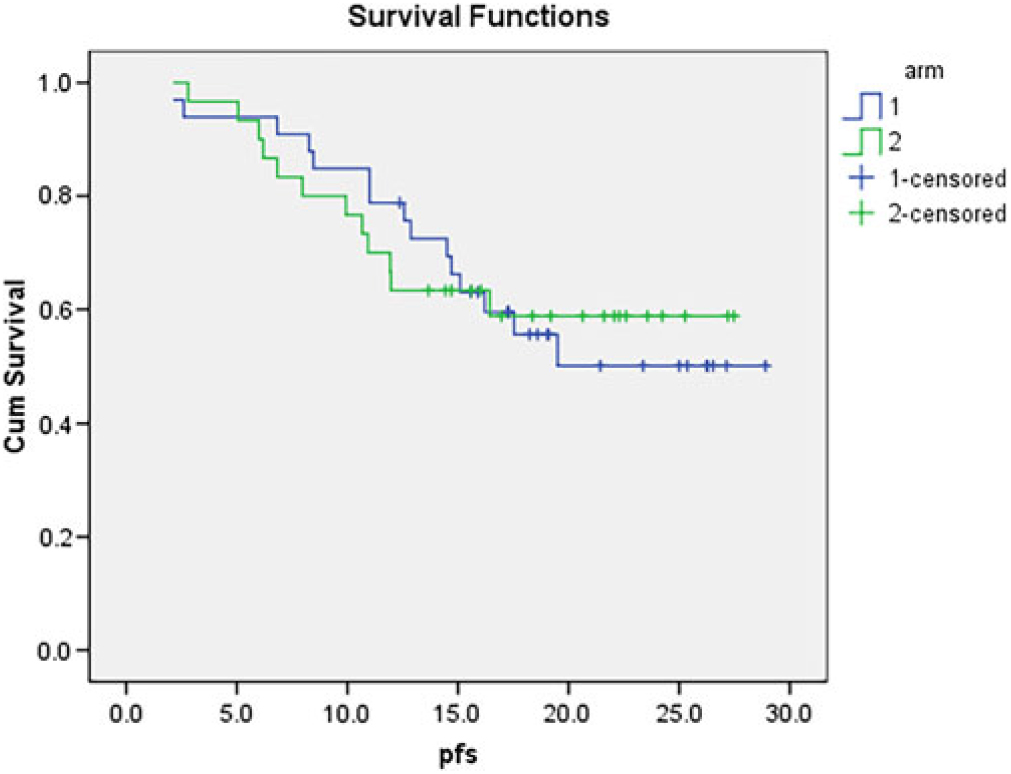
The mean PFS for the whole group of patients was 20·6 months (95% CI: 18·8–23). The median PFS was not reached at the time of data collection. The mean PFS for group A was 20·52 months (95% CI: 17·29–23·75) with median PFS was 19·5 months and for group B, the mean was 19·91 months (95% CI: 16·53–23·29). The median PFS was not reached. The difference between the two groups was not statistically significant (p = 0·929) (Figure 1).
Kaplan–Meier survival curve showing PFS across the two arms (Arm A = 1 and Arm B = 2).

Overall survival
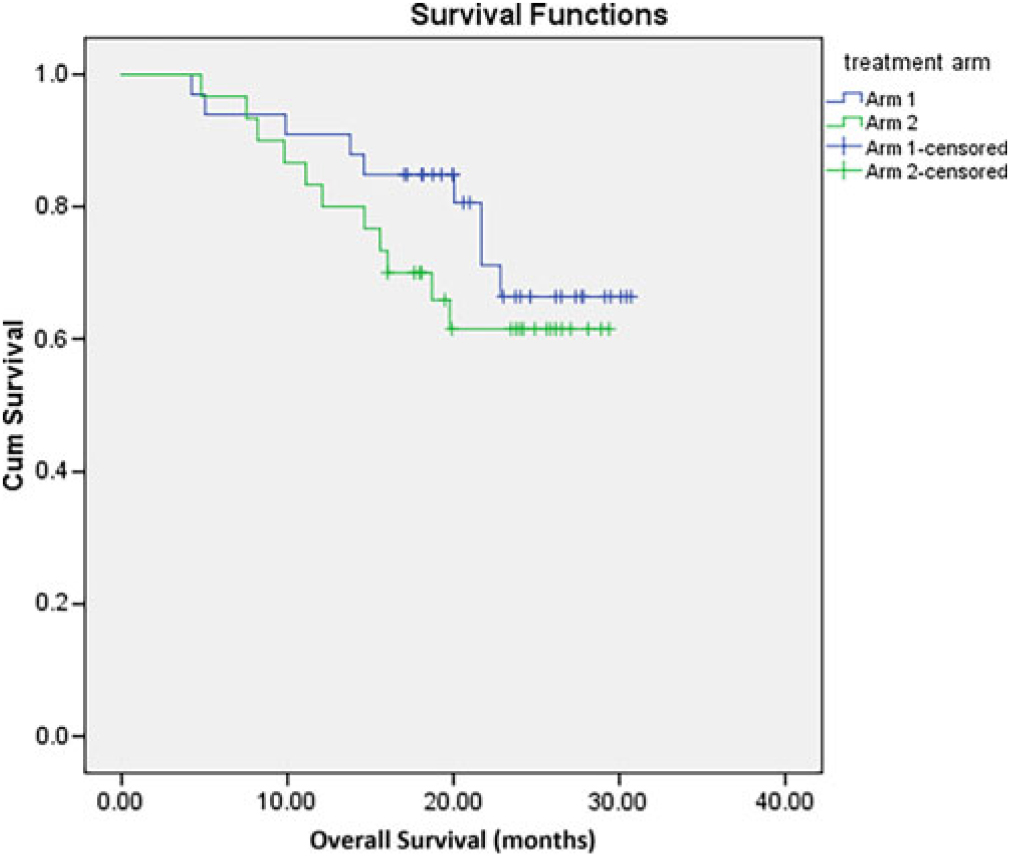
The mean OS for the whole group of patients was 24·9 months (95% CI: 22·7–27·1).The median OS was not reached. The mean OS for group A was 25·8 months (95% CI: 23–28·6) and for group B was 23·02 months (95% CI: 19·9–26·1). The median OS was not reached in either group. There was no statistically significant difference between the two treatment arms (p = 0·374) (Figure 2).
Kaplan–Meier survival curve showing OS across the two arms (Arm A = 1 and Arm B = 2).

Discussion
CCRT is known to be superior to radiotherapy alone in the treatment of LA-HNSCC. However, the resultant acute toxicity and long-term morbidity can reduce the compliance to therapy, quality of life and life expectancy. And hence, altered fractionation was offered as an alternative treatment option.Reference Bernier and Bentzen17
Many centres use the relatively simple 6 fr/wk regimen or mild hypo-fractionation as (2·12 Gy/fr) as the standard radiotherapy for patients with LA-HNSCC.Reference Overgaard, Mohanti and Begum18
The addition of concurrent chemotherapy to altered fractionation radiotherapy may increase the acute mucosal dose. Altered fractionation radiotherapy did not offer any advantage regarding the LC, PFS and OS, when concurrent chemotherapy was added compared to the conventional fractionation group in the updated MARCH meta-analysis in 2018. So, adding chemotherapy to altered fractionation was not advised.
Both cisplatin 100 mg/m2 given during D1, 21 and D42 and weekly cisplatin 40 mg/m2 can be given with conventionally fractionated irradiation as the standard of care for patients with advanced HNC.Reference Al-Sarraf19–Reference Melotek, Cooper and Koshy21
The survival benefit of concurrent chemotherapy in older patients (>65 year old) was not proved,Reference Pignon, le Maître and Maillard22 due to the risk of bone marrow suppression, increased infections/pneumonia and nutritional problems.
However, with IMRT technique, significant disease locoregional control and better OARs sparing were achieved, and the role of CCRT was reconsidered.Reference Wang and Eisbruch23
There were concerns about the use of hypo-fractionated regimens due to the higher risk of late toxicity. However, the use of IMRT, with a careful patient selection, hypo-fractionation may prove to be safe and effective regimen.Reference Teckie, Lok and Rao24
Radiobiological view
We prescribed the same dose as in Yi et al.; the study used 74 Gy/33 fr for T3/T4 H&N tumours.Reference Yi, Huang and Gao10 The prescribed doses to the GTV were 74 Gy with 2·24 Gy/fr given in 5 fr/week for locally advanced primary and nodal lesions. Their equivalent biological dose was 75·5 Gy if given in 2 Gy/fr according to the linear quadratic model, which is about 7·85% increase of total dose when comparing it to 70 Gy/35 fr at 2 Gy/fr.
There is a steep dose–response relationship in HNC for locoregional control and thus improved survival. An increase of 1·7% of locoregional control per 1% change in total dose, considering an α/β is 10 Gy for H&N tumours.Reference Okunieff, Morgan, Niemierko and Suit25 And hence, the LC rate of our patients would be 13·6% higher than those patients who received 70 Gy at 2 Gy/fr in the non-IMRT era, if we refer to dose–response curve for HNC.Reference Bentzen26 Also this investigational dose escalation was higher than the average gain of 3·6 fr of 2 Gy for the effect of concurrent chemotherapy in H&N radiotherapy as concluded by Kasibhatla et al.Reference Kasibhatla, Kirkpatrick and Brizel27
In our schedule, acute BED was 55·49 Gy10 (EQD2 = 46·24 Gy) which lays in the ‘grey zone’ 59–61 Gy10 wide (EQD2 = 49–52·5 Gy10) for tolerable acute mucosal reactions proposed by Fowler et al., to guide further treatment regimens in H&N radiotherapy and to compare acute responses in chemo-radiotherapy.Reference Fowler28 The conventional arm acute mucosal BED was 47·02 Gy10 (EQD2 =39·2 Gy10). It was less than the investigational arm; however, addition of concurrent chemotherapy to the conventional fractionation added more acute mucosal reactions proved that the average gain of chemotherapy addition concurrently to radiotherapy was 3·6 fr of 2 Gy/fr with no verified method to calculate it in clinical practice.Reference Fowler29
When comparing late tissues BEDs, despite the relatively high late tissue BED3/2·24 (129·2 Gy3) in the dose-escalated hypo-fractionated arm, concurrent chemotherapy used in the conventional arm with late BED3/2 (116·7Gy3) would add to the late effect which could not be accurately calculated.
Response and survival analysis
Our results did not demonstrate any significant differences in LC, PFS and OS between patients treated with either treatment regimens at a median follow-up period 24·2 months.
In our study, LC (CR patients) for the whole group of patients was 58·7%, representing 54·5 and 63·3% in the CCRT and dose-escalated arm, respectively. There was no significant difference (p = 0·674) in the LC between both groups. The overall response rate (CR, PR and SD) was 93·9% in concurrent conventional arm versus 96·7% in dose-escalated accelerated arm. Our investigational arm has comparable results to Bahl et al. who recorded CR in 68% of patients treated with VMAT concurrent with chemotherapy 66–70 Gy/33–35 fr, and their median disease-free survival was 16 months.Reference Bahl, Oinam and Kaur30
The median PFS was 19·5 months in the CCRT arm; however, the median PFS was not reached in the dose-escalated arm. The median OS was not reached in either arm. This necessitates further long-term follow-up.
The 2-year PFS and OS were 50 and 66·4% in CCRT arm versus 58·8 and 61·5% for the dose-escalated hypo-fractionated arm. Our results were higher than results of RTOG 9003 using different dose schedules including accelerated concomitant boost as 72 Gy/42 fxs/6 weeks. RTOG 9003 study concluded that 2-year DFS and OS in the concomitant boost were 39 and 51%, respectively. This is mainly due to the dose escalation leading to this improvement in the outcomes.Reference Fu, Pajak and Trotti31
RTOG 0225 study evaluated IMRT (70 Gy/33 fr) concurrent with chemotherapy in the treatment of 68 patients with stage I–IVB nasopharyngeal cancer, the estimated 2-year PFS rate was 72·7% and the OS rate was 80·2%.Reference Lee, Harris and Garden32 These rates were higher than our results, most probably due to inclusion of all stages of NPC patients only, as a group of patients were in lower stages. RTOG 99–14 used CCRT concomitant boost radiotherapy (72 Gy/42 fxs/6 weeks) and concluded that 2-year OS and PFS were 71 and 53·5%, respectively. They had 18% of patients developed distant metastasis.Reference Medina, Rueda and de Pasos33 The difference compared to our study may be due to different prognostic patients as age, comorbidity, anemia and hypo-albuminemia, in addition to short follow-up period.
Toxicity assessment
All chemotherapy-related toxicities, (anaemia, neutropenia, nausea and vomiting) were evident in most of CCRT arm patients and some developed elevated KFT grade I. However, a small number of patients in the dose-escalated arm had anaemia pre-treatment and one patient had nausea during radiotherapy administration (p < 0·001).
The acute adverse effects during radiotherapy were mostly statistically significant in favour of the dose-escalated arm including mucositis, oral pain, voice alteration, fatigue and acute dysphagia. It was noticeable that higher grades of fatigue (p = 0·011) and acute dysphagia (p = 0·007) were found in the CCRT.
Late effects were higher in the CCRT arm versus the dose-escalated arm. The significant one was late xerostomia in which less number were in the dose-escalated arm (p = 0·006) even with higher grades (p = 0·003) with noticeable early recovery of xerostomia in the dose-escalated arm.
The relatively small number of patients is the main limitation of our study. However, the study has concluded that omitting of chemotherapy during radical radiotherapy to LA-HNC can be possible using slightly dose-escalated accelerated hypo-fractionated regimen with comparable efficacy and less toxicity in comparison to the standard conventional CCRT. This regimen can be beneficial to patients who cannot receive cisplatin. Also, this study opens the window to evaluate this regimen in further prospective randomised trials to confirm that benefit on larger number of patients.
Conclusion
Slightly dose-escalated accelerated hypo-fractionated VMAT regimen omitting chemotherapy presented here used in LA-HNC is safe and feasible with moderate acute toxicities and late side effects and resulted in comparable outcomes to CCRT arm. Larger randomised trials with longer follow-up period are needed for further evaluation of the outcomes.
Author ORCIDs
Ehab Saad 0000-0002-0273-357X
Acknowledgements
None.
Financial support
This research received no specific grant from any funding agency, commercial or not-for-profit sectors.
Conflict of interest
No authors have any conflicts of interest.
Ethical approval
The authors assert that all procedures contributing to this work comply with the ethical standards of the relevant national guidelines on human experimentation (please name) and with the Helsinki Declaration of 1975, as revised in 2008, and has been approved by the institutional committees (Ref: a12016).
Clinical trial information
This study was registered in clinicaltrials.gov data base with NCT number: NCT03699969.