I. INTRODUCTION
Due to either high or low stored energy nucleation, two kinds of oriented nucleation occur during the nucleation stage of recrystallization,Reference Wierzbanowski, Tarasiuk, Bacroix and Sztwiertnia1–Reference Larsen, Poulsen, Margulies, Gundlach, Xing, Huang and Jensen3 namely, high stored energy nucleation that generally leads to {111} oriented nuclei irrespective of the precise nature of the nucleation mechanism, and low stored energy nucleation that occurs after the application of low rolling reductions and favors {001} oriented grains or other rolling direction (RD) fiber nuclei (RD-fiber = <110>//RD). Therein, no matter what kind of nucleation mode, dislocation mobility always plays a great role at the nucleation stageReference Wierzbanowski, Tarasiuk, Bacroix and Sztwiertnia1−Reference Doherty, Hughes, Humphreys, Jonas, Jensen, Kassner, King, McNelley, McQueen and Rollett5 and the various recrystallization theories that have been generated in this context have been critically investigated.
Electric current pulses (ECPs) treatment as an effective method for grain refinement through recrystallization has also been widely utilized.Reference Conrad, Karam and Mannan6−Reference Hu, Shek, Zhu and Tang12 Conrad et al.Reference Conrad, Karam and Mannan6,Reference Conrad, Karam and Mannan7 found that ECP could enhance the nucleation rate of recrystallization and refine the grain size of a cold-worked copper by accelerating the dislocations mobility. Qin et al.Reference Qin, Xiao, Guo, He and Zhou8 demonstrated in theory that ECP could increase nucleation rate by decreasing the thermodynamic barrier during recrystallization. Zhou et al.Reference Zhou, Xiao and Guo9 obtained ultrafine recrystallized grains in a cold-rolled brass by ECP treatment, and its dislocations were much less than the sample treated under conventional annealing. Xiao et al.Reference Xiao, Guo and Li10 found that the dislocation density was decreased in the fatigued cold-worked copper during ECP treatment. Hence, dislocation mobility is also the main mechanism of the recrystallization process induced by ECP. Recently, Dai et al.Reference Dai, Wang, Zhao and Zhao13 proposed that the recrystallized nuclei preferred to form along the current direction when ECP was applied to a cold-rolled Fe–3% Si steel with the current direction either parallel to the rolling direction or perpendicular to the rolling direction. They reported that a relationship between crystals preferred orientation and recrystallization nucleation site.
In this work, the effect of current direction on recrystallization rate and the resulting texture was investigated by changing the angles at 0, 15, 30, 45, 60, 75, and 90° between the current direction and the rolling direction, and the relative mechanism is also discussed.
II. EXPERIMENTAL DETAILS
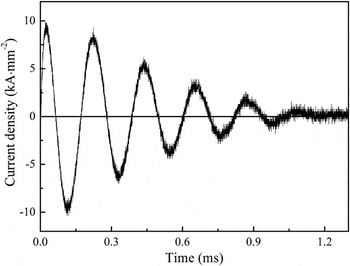
A 40% reduction in thickness direction of a cold-rolled commercial Cu–Zn alloy sheet with a composition of Cu 63.8 mass% and Zn 36.2 mass% was used as the research object in this study. By using the electrospark discharge technique, dog-bone-shaped samples with effective dimensions of 10 mm in length, 5 mm in width, and 1 mm in thickness were prepared, and the as-received cold-rolled sheet was designated as Sample A. In our previous work,Reference Dai, Wang, Zhao and Zhao13−Reference Wang, Wang, Wang, Wang and Guo15 we just investigated the effect of electric current on nucleation rate when the exerted current was along the rolling direction. Here, we varied the angle between the exerted current direction (CD) and the rolling direction (RD): Samples B to H, the electric-current-pulsed samples, had angles from 0 to 90° with an interval of 15°. A single ECP was produced through a discharge of capacitor banks under ambient conditions. During the ECP process, the two ends of each sample were put into copper electrodes. Then the temperature rise of the two ends was very small and could be regarded as room temperature. Thus, due to the cooling effect of the two cool ends, a higher cooling rate could be obtained in the effective part of sample during cooling. The wave form of the ECPs was detected to be a damped oscillation wave using a Rogowski coil and a TDS3012 digital storage oscilloscope (Tektronix, Beaverton, Oregon). To make the caused Joule heat identical, the same input energy with a single current density was exerted upon electric-current-pulsed samples. As revealed in Fig. 1, the wave form of the electric current density (j) versus the applying time (t) was approximately described as damping sinusoids with j m = 9.86 kA/mm2 and pulse duration of an electropulse t d = 1.5 ms and the period t p = 220 μs.
The typical wave form of ECPs.

The characteristics of the samples were examined by x-ray diffraction (XRD) with Cu Kα radiation. The macrotextures were measured using an X’Pert MRD-type x-ray diffractometer in backreflection method with Co Kα radiation. For all the x-ray texture measurements, the plate-like 10 × 10 mm specimens were composed of two electric-current-pulsed samples. It should be noted that the detected plane was the rolling plane, which is placed along the same rolling direction. The flat areas for diffraction were mechanically ground and polished to move the residual deformation caused by previous machining. Then, three incomplete pole figures {111}, {200}, and {220} were measured and used to calculate the orientation density function (ODF) using the two-step method (L max = 16). All the results were shown in the constant ϕ2 (Bunge’s notation) of the ODF. The result of ODF analysis was given in terms of the notation {hkl}//ND and <uvw>//RD characterizing texture type {hkl}<uvw>. Electron backscattered diffraction (EBSD) measurement was used to observe the microstructure characteristics. To remove the residual deformation in the surface layer of specimens for good EBSD patterns, all the surfaces were mechanically ground and polished, and the electropolishing was subsequently carried out for the flat surfaces in a solution of 47.4% water (H2O), 23.7% ethanol (C2H5OH), 23.7% phosphoric acid (H3PO4), 4.7% isopropyl alcohol [(CH3)CHOH] and 0.5% carbamide (CH4N2O) in volume ratio at room temperature. EBSD measurements were carried out on the samples using a JEOL JSM-7100F SEM (JEOL, Akishima, Japan) equipped with HKL’s Channel 5 software. The “beam-controlled” mode was applied with a step size of 0.2 μm.
III. RESULTS
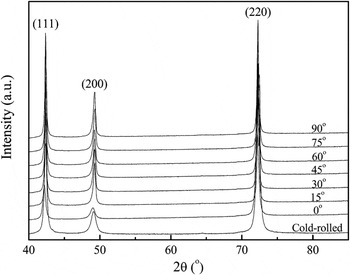
The XRD patterns of the as-received cold-rolled sample and electric-current-pulsed samples are presented in Fig. 2. The main phase of the as-received cold-rolled sample and electric-current-pulsed samples was the single α phase, showing minimal difference on the intensity of the peaks.
The XRD patterns of the electric-current-pulsed samples with different angles between the CD and the RD.

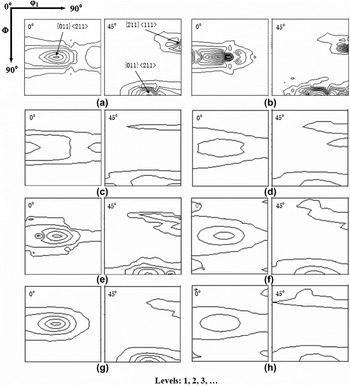
Figure 3 shows the ϕ2 = 0° and ϕ2 = 45° sections ODF plots of the α phase. In the as-received cold-rolled sample (Sample A), the {011}<211> (brass) and {211}<111> (copper) were the major texture components. Specially, in the Sample B (CD//RD), the major texture components {011}<211> and {211}<111> became stronger, whereas the orientation density apparently decreased in other electric-current-pulsed samples. The strength of {011}<211> and {211}<111> decreased in the 15 and 30° samples, and increased in the 45° sample. Then, with the increase of angle between the CD and the RD, the intensity of {011}<211> and {211}<111> components had a little increase in the 75° sample, decreasing again in the 90° sample.
The ϕ2 = 0° and ϕ2 = 45° sections of ODF plots for the α phase in samples with (a) as cold rolled, (b) 0°, (c) 15°, (d) 30°, (e) 45°, (f) 60°, (g) 75°, and (h) 90°.

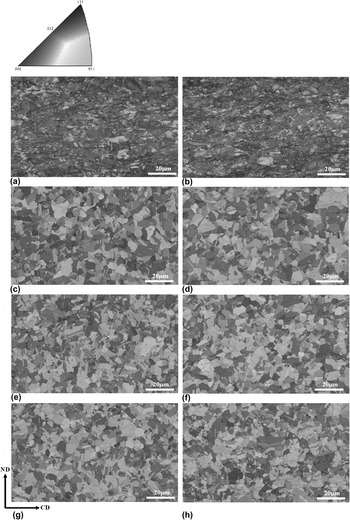
Figure 4 shows the inverse pole figure (IPF) components obtained by EBSD images of samples. In the cold-rolled sample, the main grain orientation was along <111> and <112>, and the grains elongated along the rolling direction. In the sample with CD//RD, a little change was observed in the IPF image and the microstructural evolution. However, when there was an angle between the CD and the RD, the grains with <011> orientations increased, whereas grains with <111> orientation sharply decreased. From Fig. 4, it could be found that the grains distribution in the as-received sample and the CD//RD sample almost had no change and still elongated along the rolling direction. Through the EBSD analysis, their recrystallized fraction and twin fraction were less than 4%. When there was an angle between the CD and the RD, the average grain sizes of the 15 and 30° samples were 2.2 μm, and those of the 45 to 90° samples were 2.0 μm. In addition, the twin fractions of the 15 to 75° samples were about 51%, and the 90° sample was about 34%. Obviously, those samples were undergone a recrystallization process during ECP treatment. Hence, it could be assumed that the increase of texture intensity in the sample with CD//RD shown in Fig. 3 was due to the occurrence of the recovery process without an obvious microstructural evolution.
EBSD orientation mapping for characterizing the change of microstructural features of the samples treated before and after ECP (a) as cold rolled, (b) 0°, (c) 15°, (d) 30°, (e) 45°, (f) 60°, (g) 75°, and (h) 90°. It should be noted that the change of microstructural features can be clearly evidenced from the color variation among grains in samples with different angles between the CD and the RD. The investigated surfaces (the longitudinal section) contain the current direction (CD) and normal direction (ND).

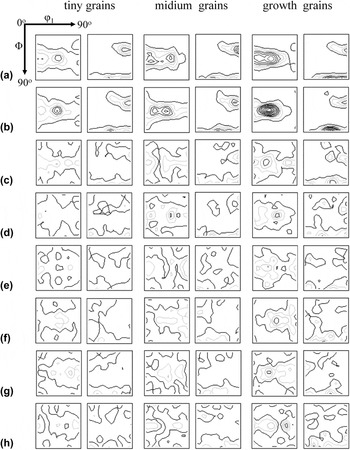
To investigate the recrystallization process induced by ECP, Fig. 5 shows the micro-ODF constant ϕ2 = 0° and ϕ2 = 45° sections of recrystallized grains with different sizes. The micro-ODF was calculated using the HKL software, with the axis of coordinates paralleled to the current direction. The grains were classified into three groups according to the grain size for each sample: the tiny grains (the grain areas between 0.5 and 3 μm2), the medium grains (the grain areas between 3 and 7 μm2); and the large grains (the grain areas greater than 7 μm2). It was supposed that the large grains possessed a rapid nucleation rate at the early stage of recrystallization, and the tiny grains’ nucleation lagged behind the former ones. The actual orientation distribution in a polycrystalline is the result of the manufacturing process, and thus, texture contains detailed information about the production history of a work piece. First, it could be found that the main texture components in the original cold-rolled sample were always the {011}<211> (brass) and {211}<111> (copper). When the CD paralleled to the RD, the cold-rolled texture components {011}<211> and {211}<111> became much stronger. However, when there was an angle between the CD and the RD, the tiny grains distributed randomly without an apparent perfect orientation. The perfect distribution of the grains became more and more obvious with the growth of the grain. The above results implied that the recrystallized grains induced by ECP nucleated randomly, but with an oriented growth.
ODF constant ϕ2 = 0° and ϕ2 = 45° sections of recrystallized grains with different sizes in samples with (a) as cold rolled, (b) 0°, (c) 15°, (d) 30°, (e) 45°, (f) 60°, (g) 75°, and (h) 90°.

IV. DISCUSSION
Because the temperature increments of the samples during the ECP treatment are induced by Joule heating, and it is dominated by the energy input by ECPs, the temperature increments can be evaluated according to the wave forms of ECPs based on the following equation,Reference Conrad, Sprecher and Nabarro16
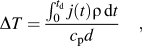 $$\Delta T = {{\int_0^{t_{\rm{d}} } {j(t){\rm{\rho }}\,{\rm{d}}t} } \over {c_{\rm{p}} d}}\quad,$$
where j(t) is the electric current density at time t, ρ is the resistivity (0.062 × 10⁻⁶ Ω·m), t d is the pulse duration (220 μs), c p is the specific heat (378 J/(kg K), and d is the density (8.40 g/cm3) of the specimen. According to the wave form shown in Fig. 1, the temperature increment can be calculated as 417 K at room temperature 293 K, and that of the electric-current-pulsed samples are lower than the phase transformation temperature (953 K). Based on the analysis from Figs. 2 and 4, the recrystallization nucleation rates differ from each other due to the different angles between the CD and the RD. However, it is obvious that the recrystallized nucleation rate is greatly accelerated due to the angles arranged.
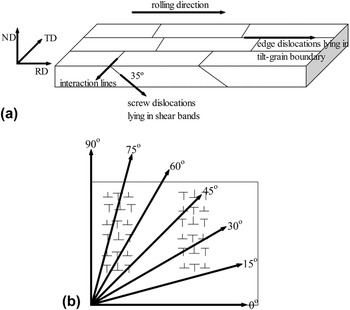
Some factors cause ECPs to enhance the recrystallization nucleation rate. One is the effect of overheating. Because the same current density and the same research object were used in the study, its effect on recrystallization nucleation rate could be ignored. Another factor is the dislocation mobility. The glide and climb of dislocation play very important roles in the recrystallization nucleation. Because cold-rolled samples are utilized in this study, the dislocation mobility should be considered in the electric-current-pulsed samples. Based on the frequency of occurrence of tilt and twist grain boundaries among random boundaries calculated by Morawiec,Reference Morawiec17 it has been proposed that the percentage of random boundaries was close to pure tilt boundaries, which consisted entirely of edge dislocations.Reference Morawiec17,Reference Hibbard and Dunn18 Compared with edge dislocations, the screw dislocation is a band of shear in the slip plane, two or three atomic spacing wide, thus, the shear bands are the dominant distribution of screw dislocations.Reference Kiselev19Figure 6 schematically plots the different types of dislocation and the arrangement of the dislocations as compared with the current direction. When the CD is parallel to the RD, the dislocation line is parallel to the CD, while  $\mathord{\buildrel{\lower3pt\hbox{$\scriptscriptstyle\rightharpoonup$}}\over b} $ tends to be perpendicular to the CD. Due to the varied distribution of dislocations during the ECP treatment, the dislocation mobility will also vary.
(a) A schematic illustration of tilt-type grain boundaries and shear bands composed of edge or screw dislocations, respectively, and (b) the arrangement of the dislocations when there is a different angle between the CD and the RD.

In a current-carrying metallic material, the effect of electron wind force and transient thermal compressive stress on dislocation mobility cannot be neglected. The electron wind force exerted on dislocations can be written asReference Okazaki, Kagawa and Conrad20,Reference Sprecher, Mannan and Conrad21
 $$F_{{\rm{ew}}} = {\rm{\alpha }}\mathord{\buildrel{\lower3pt\hbox{$\scriptscriptstyle\rightharpoonup$}}\over b} p_{\rm{f}} (j/e - n_{\rm{e}} v_{\rm{d}} )\quad,$$
where α is 0.25–1.0,  $\mathord{\buildrel{\lower3pt\hbox{$\scriptscriptstyle\rightharpoonup$}}\over b} $ the Burgers vector, p f the Fermi momentum, j the current density, e the electron charge, n e the electron density, and v d the dislocation velocity. From Eq. (2), the distinct difference for the electric-current-pulsed samples is the effect of electric current on Burgers vector when there is an angle between the CD and the RD. Under the same current density, the different electron wind force may be exerted on the edge dislocation or on the screw dislocation as compared with the different arrangement between the CD and the RD, respectively. Due to the different angle between
 $\mathord{\buildrel{\lower3pt\hbox{$\scriptscriptstyle\rightharpoonup$}}\over b} $ and the CD, the effect F ew for the CD parallel to the RD may be less than for the other conditions. That is why recovery happened when the CD was parallel to the RD and significant recrystallization was revealed for other samples.
Besides the effect of the electron wind force, the transient thermal compressive stress is also regarded as an important factor for the increase of the mobility of dislocations. According to the theory of thermoelasticity, thermal stresses in elastic bodies arise from the following casesReference Tang, Zhou, Cao and He22,Reference Zhou, He, Gao, Zhao and Guo23 : (i) restrained external deformations, or nonfree thermal expansion in bodies with temperature rise; (ii) restrained reciprocal deformations, or uniform temperature distribution in nonuniform bodies; (iii) restrained internal deformations, or inhomogeneous temperature distribution in uniform bodies. The studies of nonequilibrium thermal stress have concentrated on the cases of moving heat sources and sudden heat sources in infinite bodies. Under these conditions, as soon as the temperature is uniformly distributed, the nonstationary thermal stress will vanish. In the present work, because the heating rate of the ECP treatment is about 8 × 10⁵ K/s, the temperature increment and the thermal expansion are nonsynchronous, and then the transient thermal compressive stress can come into being. The maximum theoretical thermal compressive stress may be estimated as followsReference Tang, Zhou, Cao and He22:
 $${\rm{\delta }}_{\max } = E{\rm{\alpha }}\Delta T\quad,$$
where E is the Young′s modulus, and α is the thermal expansion coefficient. The crystal structure has a very marked effect on the elastic anisotropy of crystals. For a cubic material, the elastic moduli can be determined along any orientation, from the elastic constants, by application of the following equationReference Meyers and Chawla24:
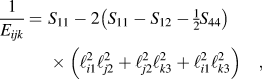 $$\eqalignb{{1 \over {E_{ijk} }} = \,\,S_{11} - 2\left( {S_{11} - S_{12} - {\textstyle{1 \over 2}}S_{44} } \right) \cr \times \left( {\ell _{i1}^2 \ell _{j2}^2 + \ell _{j2}^2 \ell _{k3}^2 + \ell _{i1}^2 \ell _{k3}^2 } \right)\quad,$$
where E ijk is the Young’s modulus, respectively, in the [ijk] direction; l i1, l j2, and l k3 are the direction cosines of the direction [ijk]. For copper, S 11 = 1.498 × 10⁻² GPa−1, S 44 = 1.326 × 10⁻² GPa−1, and S 12 = −0.629 × 10⁻² GPa−1, according to these parameters, E 100 = 66 GPa, E 110 = 130 GPa, E 111 = 191 GPa, E 211 = 130 GPa. The standard ordering of Young’s moduli in FCC and BCC crystals is E 111 > E 110 > E 100. Theoretically, from Eq. (3), the different thermal compressive stresses will be obtained along different orientations. In this work, the different texture components can be detected for the electric-current-pulsed samples as shown in Fig. 5. When the CD is parallel to the RD, the {011}<211> (brass) and {211}<111> (copper) are the stronger components. Although there is an angle between the CD and the RD, the texture intensity becomes weaker. By taking into account only the effect of thermal compressive stress, it can be found that due to the anisotropic Young’s modulus, the stronger compressive stress should be obtained for samples with the CD parallel to the RD. However, compared with our results, there is no obvious recrystallization formed for samples with the CD parallel to the RD. Therefore, the major factors which control the mobility of dislocations should be the electron wind force. The last one is the migration of atoms, which plays an important role in the recrystallization process. However, due to the same current density, the average atom drift velocity can be considered identical.
V. CONCLUSION
(1) Based on the above-mentioned results, it can be proposed that compared with the thermal compressive stress, the electron wind force is the principal driving force to carry out the different microstructural evolution for recrystallization induced by ECPs.
(2) When there is an angularity between the current direction and the rolling direction, the nucleation rate of recrystallization induced by ECPs will be promoted.
(3) In addition, an important finding is that recrystallized grains induced by ECPs nucleate randomly, but with an oriented growth. It is believed that by changing the angles between the CD and the RD, a new and effective approach to control the recrystallization process can be provided.
ACKNOWLEDGMENTS
This work was supported by the National Nature Science Foundation of China, Grant No. 50901018. The authors thank Professor J.D. Guo of Institute of Metal Research, Chinese Academy of Sciences, for many helpful discussions.