INTRODUCTION
The study of how children acquire region-specific linguistic features can reveal a great deal about how dialect transfer occurs and how language acquisition in general responds to variability in the input. In the case of phonetic variation, children are exposed to both inter- and intra-speaker variability which is likely to exhibit sensitivity to social as well as linguistic context. While some of this variability may be thought of as freely occurring, there is no doubt a great deal of social-indexical variation that children are exposed to and eventually learn (Docherty, Foulkes, Tillotson & Watt, Reference Docherty, Foulkes, Tillotson, Watt, Goldstein, Whalen and Best2006; Smith, Durham & Fortune, Reference Smith, Durham and Fortune2007, Reference Smith, Durham and Fortune2009). Despite this recent interest in ‘sociophonetic’ variation (Foulkes, Reference Foulkes2010), there is still a tendency to view language or phonological acquisition as a distinct process to dialect acquisition. However, as pointed out by Roberts (Reference Roberts and Ball2005: 154), variation in child language should not be considered a ‘by-product’ of language learning but as an integral part of the process.
The study presented here adds to the growing literature on the acquisition of sociophonetic variation but looks at a variable that is both highly contextualized and newly emerging. Specifically, the reported trend for speakers to retract the /s/ in /str-/ onsets (e.g., street) to [ʃ] with the possible co-occurrence of /t/ affrication (Shapiro, Reference Shapiro1995; Rutter, Reference Rutter2011). The study set out to investigate the presence of this novel, vernacular form in the speech of eight primary caregivers and compare this to the developing usage patterns of their children, aged between 4;0 and 8;0.
Acquisition of sociophonetic variation
Studies looking at the acquisition of sociophonetic variation have tended to focus on salient dialect features that are well established within a particular region (Roberts & Labov, Reference Roberts and Labov1995). Foulkes, Docherty, and Watt (Reference Foulkes, Docherty and Watt1999, Reference Foulkes, Docherty and Watt2005), for example, have looked extensively at the phenomenon of /t/ glottalization in the northeast of England, UK. The analysis focused on the phonetic realization of /t/ in forty children aged 2;0 to 4;0 and found ‘sophisticated mastery’ of the adult patterns of /t/ glottalization that were both lexically and phonologically appropriate (1999: 15). The study also considered the realization of /t/ variables in adult–adult speech versus child-directed speech (CDS) and found that CDS demonstrated a significant reduction in the use of the vernacular glottalized variants.
The role of CDS in dialect acquisition has been emphasized elsewhere by, for example, Smith, Durham, and Fortune (Reference Smith, Durham and Fortune2007), who looked at the acquisition of stable variation by children learning the Buckie dialect of Scotland, UK. One area that has been far less explored is the mechanism underlying the acquisition of sociophonetic variation that is newly emerging and/or at a stage of rapid change. Rather than being relatively stable (as in the /t/ glottalization discussed above), variability of this kind is likely to be continuously in flux. This is particularly interesting for theories of acquisition because it is quite possible that infants may be attempting to learn variation from adults who are themselves involved in the transmission stage of a sound change.
The variable /str-/
The focus of this paper is this exact scenario and concerns the onset cluster /str-/. Specifically, research suggests the cluster is starting to exhibit varying degrees of /s/ palatalization, meaning the word street, for example, is realized as [ʃtɹit] or [ʃtʃɹit]. This has been reported for American English (Shapiro, Reference Shapiro1995; Durian, Reference Durian2007), New Zealand English (Lawrence, Reference Lawrence2000), and British English (Altendorf, Reference Altendorf2003; Bass, Reference Bass2009). An acoustic study reported in Rutter (Reference Rutter2011) used spectral peak measures to compare the /s/ productions of adult American-English speakers in the words street, struck, strudel, and strip and found that for those speakers who did demonstrate some usage of the change, the initial /s/ in these target words showed high similarity to their typical /ʃ/ productions. Phonologically, this seems to be a change from [s] to[ʃ] in a specific place of structure that is facilitated by the fact that the initial consonant of ternary clusters in English is non-contrastive.
The variable represents a particularly interesting piece of sociophonetic variation, as there is variation present in the ambient dialect that is highly contextualized. Children encountering this phenomenon are faced with an alternation between [s] and [ʃ] in one particular context (the onset cluster /str-/) but must maintain a contrastive distinction between these two sounds in all other places (e.g., see and she or bus and bush). There is also the potential for changes in the statistical distribution of usage over a short period of time as adults in the local speech community become more entrenched in the sound change.
Studies of how children respond to sound changes are rare, but among those that have been reported it has consistently been found that children as young as 3;0 demonstrate the ability to acquire newly occurring variants. In a seminal paper, Roberts and Labov (Reference Roberts and Labov1995) looked at the phenomenon of the short a pattern in the Philadelphia dialect of English. This concerns the alternation between a tense and raised /a/ in certain lexically and phonologically determined environments. The study found that between the ages of 3;0 and 4;0 children were actively engaged in the sound change as their usage patterns moved towards the norms of the local community. In a follow-up study, Roberts (Reference Roberts1997) examined the acquisition of three vowels by children in Philadelphia. The vowels, specifically the diphthongs /au/, /ei/, and /ai/, were undergoing change in the local dialect and were contrasted with the acquisition of the more stable /a/ vowel. Again, it was found that many of the children were starting to adopt the novel forms of the variables by as young as 3;0.
Results such as these suggest that children are not only able to acquire the dialect features of their local speech community from a very young age, but may in fact also be participating in the propagation of sound changes themselves (Roberts, Reference Roberts1997). The present study looked at the use of the variable /str-/ in both read and conversational speech in caregiver–child pairs in order to investigate the acquisition of /s/ palatalization. Of particular concern was the use of this variable in read speech versus CDS by the caregivers, and the relationship between the individual caregivers' adoptions of the change and its presence in the speech of their children.
Also of interest are the usage patterns of those children whose parents are exhibiting non-categorical usage of the [ʃ] variant (e.g., in some lexical items but not others). If children can be shown to acquire this so-called ‘probabilistic tendency’ (Hudson Kam & Newport, Reference Hudson Kam and Newport2009), this poses difficulties for models of phonological acquisition that are categorical in nature (e.g., traditional generative approaches). However, models of phonological learning and storage that are probabilistic in nature (e.g., Pierrehumbert, Reference Pierrehumbert, Bod, Hay and Jannedy2003; Johnson, Reference Johnson2006), and based on the idea of multiple-entry, exemplar lexicons, would predict such non-categorical patterns. Within such models, it would be hypothesized that children would adopt adult patterns of /ʃ/ usage without necessarily generalizing this across their system. Exposure to words being pronounced with the /ʃ/ variant would trigger a restructuring of the phonological representation for that specific word, due to the specific exemplars being stored, while other words would be represented with the /s/ variant.
METHOD
Participants
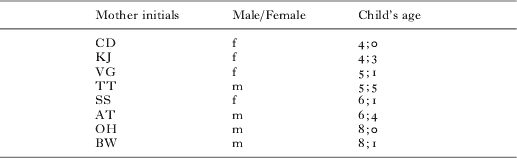
The method employed was designed to elicit read and spontaneous speech that included target words containing the cluster /str-/. The participants, listed in Table 1, were eight mother–child pairs from Oklahoma City, Oklahoma in the USA. The children were aged between 4;0 and 8;0 and were the oldest or only child within their family (so as to reduce any potential of older sibling influenced accent features). Smit and Hand (Reference Smit and Hand1997) report that phonological processes involving /s/ are suppressed in 90 percent of children by the age of 5;0. Consonant cluster reduction would be the most likely phonological process still active (Bauman-Waengler, Reference Bauman-Waengler2012), which would see /str-/ realized as [tɹ].
The children had no history of speech-, language-, or hearing-related problems. Both mother and child were born and reside in Oklahoma City, Oklahoma. As a result, they spoke the dialect typical of this area, which combines midwestern and general southern US features. Although no prior research on the variable /str-/ has been conducted in this area, anecdotal reports suggested it was both common and widespread. In the Speech and Hearing Clinic at the University of Oklahoma Health Sciences Centre (where the data were collected), /s/ palatalization in the cluster /str-/ was routinely reported by clinicians as a noted dialect feature, although one that has emerged only recently.
Procedure
Two separate speech elicitation tasks were used in the study. The first of these elicited read speech while the second elicited spontaneous, conversational speech. Read speech was elicited using sentence lists that included target words containing the variable /str-/. Sixteen sentences were used; four of these contained a target word with the other twelve being filler sentences. The four target words were street, string, strong, and strawberry. Two of the filler sentences contained the words Sam and shop in order to facilitate acoustic comparison with the target words. All sentences took the form You can say x again. The read speech task took place first with the caregiver then the child being asked to read the sentences naturally, as if they were talking to another person. The caregiver/child left the recording room while the other was carrying out the task.
Spontaneous speech samples were elicited using a story task which is similar in nature to the map task (Brown, Anderson, Shillcock & Yule, Reference Brown, Anderson, Shillcock and Yule1984) commonly used in sociolinguistics. The story task involved the caregiver–child pair being presented with sixteen picture cards. The pictures were labelled and were designed to illustrate the same words as the sixteen items in the read sentences. Each mother/child pair was asked to devise a story together that would feature each of the sixteen items at least once. They were left alone in the recording room and were also told that their discussion would be recorded by a microphone that was present in the room. The task was designed to encourage discussion between the participants that was both naturalistic and involved numerous repetitions of the sixteen target words. Below is a short transcript exemplifying the sort of data yielded:
MOM: And what about Mr Strong? What shall we do with him?
CHILD: Mr Strong? Well he could be walking down the street couldn't he?
MOM: OK so Mr Strong is walking down the street. What then?
Recording
Both the reading task and the story task took place in a sound-attenuated recording room in the Speech and Hearing Clinic of the University of Oklahoma Health Sciences Centre. All audio-recordings were made using a shock-mounted condenser microphone (AKG C1000s) coupled with a compact flashcard recorder (Marantz PMD660). Recordings were digitized using a 44·1 kHz sampling rate and 16 bit quantization and stored as WAV files. Audio-recordings were copied from the flashcard to a laptop computer running Windows 7 and downsampled to 22·050 kHz for analysis in the acoustic programme Praat (Boersma & Weenink, Reference Boersma and Weenink2009).
Analysis
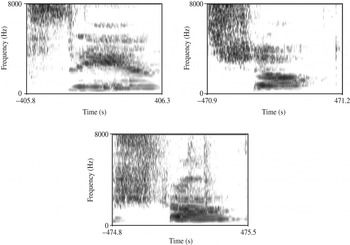
All tokens of /str-/ were identified auditorily using AKG K701 headphones. Any token that was produced during overlapping speech or which featured cluster reduction (n=6) was excluded from the analysis. All remaining tokens were categorized as being realizations of [ʃ] or [s] by carrying out a combination of phonetic transcription with acoustic analysis, using the method outlined in Rutter (Reference Rutter2011). At this stage the categorization process is binary, as the variation is being treated as phonological in nature. That is, the assumption is made that the initial fricative should be within the phonological space associated with either /s/ or /ʃ/. The acoustic analysis involves placing a 40 ms Hamming window in the centre and/or steady state of the fricative and measuring the location of the first major spectral peak in a spectrum. FFT (fast Fourier transform) and LPC (linear predictive coding) were used to generate the fricative spectra. The major spectral peak was measured on the FFT spectra and was defined as the frequency location of the peak with the highest amplitude (Rutter, Reference Rutter2011). Jongman, Wayland, and Wong (Reference Jongman, Wayland and Wong2000) have previously concluded that spectral peak measurement seems to be a reliable method for distinguishing English fricatives. Specifically, the larger anterior cavity size of /ʃ/ results in acoustic energy extending further down the spectrum than in /s/ (Reetz & Jongman, Reference Reetz and Jongman2009). A comparative method of acoustic analysis was used, which involved comparing the location of the major spectral peak in a participants' /str-/ productions with their productions of /s-/ and /ʃ-/ onsets in the words Sam and shop. Although these were not vowel matched, it did facilitate a broad categorization of /str-/ tokens based on the speakers' typical /s/ and /ʃ/ productions. The spectrograms in Figure 1 illustrate the distinction between three productions from the same child: VG's daughter. In the productions of shop and strong, the spectral energy associated with the initial fricative covers a much broader range of frequencies than the /s/ of Sam, which has a cut-off point typical of an alveolar occlusion. This reflects the use of the [ʃ] variant in the word strong.
Spectrograms of one child participant's (VG's child) productions of Sam (top left), shop (top right), and strong (bottom). Note the similarity between the fricatives in shop and strong.

RESULTS
The results of the analysis are presented below, first for the read speech task and second for the spontaneous conversational speech task.
Read speech
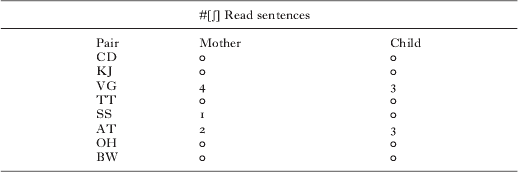
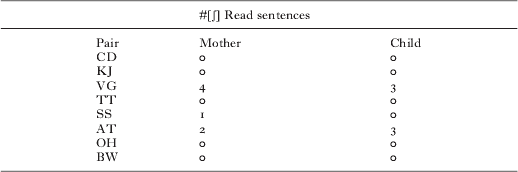
Results for the read speech task are shown in Table 2. The number of tokens produced with the [ʃ] variant are provided for both mother and child for each pair. The participants are ordered according to increasing age of the child, as in Table 1.
Child's age and gender for each mother–child pair
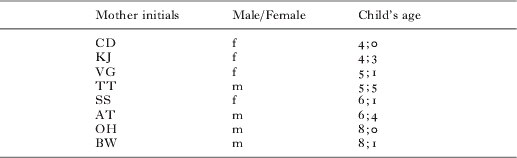
Table 2 shows that, of the eight mothers, three exhibited use of the [ʃ] variant, using it in 4, 1, and 2 of the four target words. This is somewhat surprising given the perceived prevalence of the sound change in the Oklahoma City area, although likely reflects the tendency for speakers to adopt a greater number of standard forms when producing read speech. Among the children, only 2 (25%) exhibited some use of the [ʃ] variant, with these children being aged five and six, respectively. Both of these were the children of mothers who themselves exhibited some [ʃ] usage. Both the children produced 3 (75%) of their /str-/ tokens with the [ʃ] variant. At this point it was noted that the two youngest children (both within the four-year bracket) did not exhibit any palatalization of /s/, as this was a commonly reported phenomenon among young children in the speech clinic. However, it was clear that both the four-year-old children were ‘sounding out’ many of the more complex words they read and were thus more likely to be influenced by orthography.
The number of tokens produced during the reading task with the variant [ʃ] for the caregiver and child pairs (max. 4)
We now move on to an analysis of the specific lexical items that were produced with [ʃ] during the reading task. These are shown in Table 3 for the three mothers who exhibited some [ʃ] usage along with their children.
Lexical items exhibiting [ʃ] usage among mothers and children in read speech. Items marked with ✓ exhibited the use of [ʃ] while x indicates the use of [s]

VG was the only mother who used [ʃ] in all four lexical items, and while her daughter used [ʃ] in the words street, strawberry, and strong she did not use it in string. It was noted at this stage that both VG and her daughter also used [ʃ] in the word restaurant. This could indicate that VG is a speaker for whom [ʃ] is used in the word-internal and possibly also word-boundary position (as alluded to in Shapiro, Reference Shapiro1995, and Rutter, Reference Rutter2011). It can be seen that her daughter is also using [ʃ] for the majority of lexical items, even during read speech. SS used [ʃ] in the word street but none of the other target words, while her daughter used [s] in all four contexts. This may indicate that SS is at a very early stage of adopting the sound change, with just a few lexical items being affected. The pair AT provided an interesting case as they were the only pair where the child used [ʃ] in more items than the adult. Specifically, AT used [ʃ] in street and strong while her son used [ʃ] in street, string, and strawberry but not strong.
Conversational speech
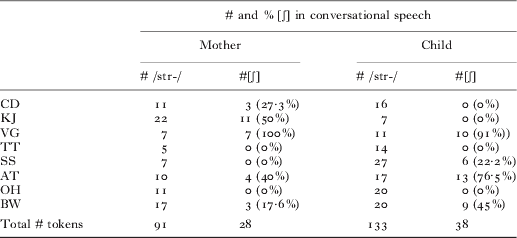
Results for the spontaneous speech task are shown in Table 4. The total number of /str-/ tokens that were identified during the task is given for both the mother and the child, along with the percentage of these variables that were realized with the [ʃ] variant.
Number of occurrences of the variable /str-/ for both mothers and children with the number and percentage of those tokens featuring [ʃ] usage
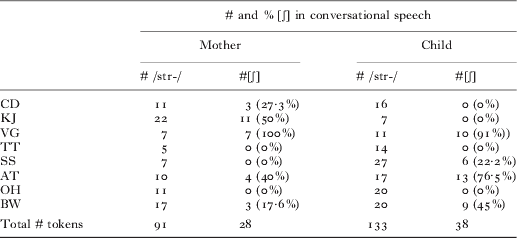
The table shows that five of the total of eight mothers used [ʃ] in at least some tokens, with one mother, VG, using it categorically. It is worth noting that SS, who used [ʃ] once in the read speech task, did not use it at all during the conversational task. The mothers CD, KJ, and BW all used [ʃ] at least some of the time in the conversational task, despite not using it at all during the reading task.
Among the children, four of the eight used [ʃ] at least some of the time, with the daughter of VG using it with the greatest frequency (91%). Interestingly, apart from SS, the children that exhibit some [ʃ] usage all have mothers who also use [ʃ] themselves during conversational speech. It is clear that the two youngest children, CD and KJ, did not use [ʃ] at all despite their mothers using it on some occasions. This is particularly noteworthy given previous findings showing that children as young as 3;0 have exhibited the use of newly emerging vernacular forms (e.g., Roberts, Reference Roberts1997). In the present study, the sound change did not appear until the age of 5;0. The relatively late emergence may due to the fact that it is confined to a specific onset, rather than a single segment as in previous studies.
In terms of lexical distribution, Table 5 shows the distribution of [ʃ] variants across specific lexical items.
Use of the [ʃ] variant for both mothers and children across the four lexical items
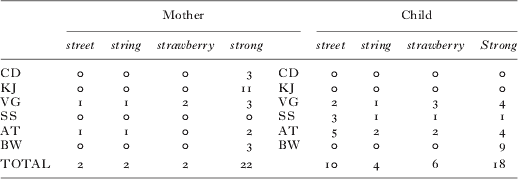
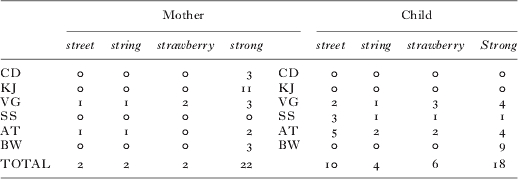
Table 5 shows that for the two mothers, CD and KJ, who use [ʃ] but whose children do not, the use of [ʃ] is restricted in both speakers to a single lexical item (strong). This is interpreted as indicating that the sound change is at a very early stage for these speakers and has yet to diffuse through their lexicon (as found elsewhere by Phillips, Reference Phillips, Bybee and Hopper2001). This would mean that the children of CD and KJ have had limited exposure to the novel form and have thus not yet adopted it themselves. The pattern for VG is much clearer, as both mother and child are using [ʃ] in all four lexical items. This suggests the change has spread fully throughout their lexicon and is at a stage of being phonologized. Conversely, for BW, [ʃ] is limited in both mother and child to the lexical item strong. This presents a similar situation to both CD and KJ, and may indicate that strong is a high-frequency word in these speakers' lexicons.
Interpretation of the results for SS and AT is slightly more difficult. SS used [ʃ] once in the reading task in the word street, but did not use it at all during the conversational task. However her daughter, aged six, uses [ʃ] at least once in all four lexical items, suggesting this is a sound change she is adopting. It may be the case that SS does in fact use [ʃ] occasionally but refrained from using it during the data-collection session. However, it could also be the case that SS's daughter is being influenced by the use of [ʃ] by another speaker (e.g., her father, another relative, or classmates). The results for AT are interesting as she uses [ʃ] in three words but not strawberry. However, her son seems to have fully adopted the use of [ʃ], using it in all four target words. This may indicate a level of phonologization in the child that is not present in the mother.
Discussion
The emerging variability associated with /str-/ looks on the surface like it could pose challenges during phonological acquisition as it is confined to a particular place in structure, meaning that children have to maintain a stable /s/−/ʃ/ contrast in other contexts (e.g., seat vs. sheet), while attempting to master the variability associated with /str-/. However, the data presented in this paper suggest that for those children with at least one family member who is exhibiting some form of adoption of this variable, they too are starting to use the novel form.
However, while previous evidence has been found for the use of newly emerging variation by the age of 3;0, the youngest children in this study to use the novel form of the /str-/ variable were 5;0. The results also indicate that specific lexical items that the child is hearing used with the novel form may influence the extent to which they adopt the change. For the three children whose mothers seemed to be using the [ʃ] form in only one lexical item (strong), two of the children (both aged four) did not use [ʃ] at all while the other (aged 8;1) used it only in the word strong. However, for VG, high levels of [ʃ] usage were present in all lexical items for both the child (aged 5;1) and her mother.
It is acknowledged that the study is limited by a relatively small number of participants and a small number of tokens for each participant. Future studies investigating the variability surrounding /str-/ would benefit from a greater number of participants, which would allow statistical analysis of the variability. However, the results presented in this paper do add to the ongoing study of sociophonetic variation and its role in language acquisition. As the results in Roberts and Labov (Reference Roberts and Labov1995), Roberts (Reference Roberts1997), Foulkes et al. (Reference Foulkes, Docherty and Watt2005), and Smith et al. (Reference Smith, Durham and Fortune2007, Reference Smith, Durham and Fortune2009) indicate, children begin engaging in the process of dialect acquisition from a very early age. An interesting question surrounds the distinction between learning this sort of variability in a rule-based/categorical fashion or via a process of lexical diffusion. Roberts (Reference Roberts1997: 249) interprets the Philadelphia data as being indicative of a rule-based process, although the data presented in this paper would more likely point to a process involving lexical diffusion. This sort of model of learning is well handled by phonological theories that are probabilistic or frequentist in nature (Pierrehumbert, Reference Pierrehumbert, Bod, Hay and Jannedy2003; Chater & Manning, Reference Chater and Manning2006). Such models posit a multiple entry lexicon that is phonetically rich, whereby the same lexical item (e.g., street) may be represented not by a single phonological form but by multiple phonetic forms each indexed for socio-indexical features such as speaker and context. The frequency with which a particular phonetic realization is encountered gradually begins to affect a speaker's own production of that form.
Finally, as suggested in the ‘Introduction’, it is important that the distinction between phonological acquisition and the acquisition of a regional dialect is not held too firmly (Roberts, Reference Roberts and Ball2005). Ultimately, children are exposed to a specific dialect during the first four years of their life, and it is this that shapes their own linguistic development. As well as informing our understanding of the process of language acquisition, this should also be taken into account in educational and clinical contexts by, for example, speech–language pathologists. As suggested by Damico and Ball (Reference Damico, Ball, Ball, Perkins, Muller and Howard2008), the assessment of suspected speech disorders should be carried out with ‘sociolinguistic sensitivity’. It is therefore important that we are aware of the fact that regional variation does start to emerge very early in childhood and that it is central to the language-learning process.