


Introduction
Decentralized clinical trials (DCTs) and direct-to-participant research, catalyzed in part by the COVID-19 pandemic, have led to a fundamental shift in how and where research is conducted. Increasingly, decentralized research has leveraged social media and/or web-based study listings to facilitate study recruitment [Reference Baker, Mitchell and Thomas1]. Unlike traditional site-based research, where participants visit specific locations for study procedures, decentralized studies utilize digital tools and remote engagement strategies to broaden research participation [Reference Mclocklin2]. This shift presents several key advantages, including increased accessibility to research opportunities for populations underrepresented in research studies, more efficient recruitment, and enhanced representation of study populations and generalizability of research findings. Direct-to-patient recruitment offers the promise of generating real-world data in real time, as evidenced by studies evaluating the effectiveness of COVID-19 immunization among populations excluded from registration trials [Reference Singh and Sagar3,Reference Wang, Calderon and Hager4]. However, an inherent risk of decentralized research is the potential for participant misrepresentation [Reference Sharma, McPhail, Kularatna, Senanayake and Abell5].
In this manuscript, we use the phrase “insincere participants” to collectively refer to people who misrepresent themselves or their medical history, as well as bots (automated computer programs imitating genuine subject responses), to gain eligibility and access to study benefits (i.e., drugs/treatment, compensation) [Reference Politi, Goldstein, Schmitz and Cooksey6]. As decentralized recruitment expands through online platforms, research teams must confront the growing challenge of distinguishing genuine participants from those who are insincere in research [Reference Pageau and Ling7].
A growing body of research indicates that insincere practices among participants are prevalent, with deceit rates ranging from 3% to 25% across multiple studies among healthy volunteers [Reference Loebenberg, Oldham and Brown8,Reference Schneider, Ahuja, Dietch, Folan, Coleman and Bogart9]. In clinical research, up to 75% of participants have withheld information to avoid exclusion, and 1 in 3 admitted to fabricating their responses to qualify for studies [Reference Devine, Waters and Putnam10,Reference Lee, Holmes, Neri and Kushida11]. Given the magnitude of the problem, insincere study participation represents a major threat to the validity of decentralized research. Moreover, the management of insincere participation is time-consuming for teams, who are often short-staffed, resulting in a shift of resources away from genuine participants [Reference Cascio12]. Furthermore, the question of whether research teams are obligated to compensate insincere participants raises both ethical and regulatory concerns [Reference Kumarasamy, Goodfellow, Ferron and Wright13]. Thus, ensuring that study populations accurately represent the intended population is critical to conducting scientifically, operationally, and ethically sound research.
Even when research teams are aware of potential fraud risks and knowledgeable about available mitigation tools, identifying and preventing insincere participation can remain a complex challenge. Many mitigation strategies introduce additional barriers that may unintentionally exclude genuine participants. As decentralized recruitment continues to expand, research teams must continuously balance accessibility with verification, often without clear guidance on what is ethically appropriate. This can reflect what is described as an access-integrity paradox where the same features that enable decentralized research to reach broader populations (i.e., remote participation) also create vulnerabilities that threaten data integrity.
This paper aims to address the issue of insincere participation in decentralized research by examining case studies from the University of North Carolina in Chapel Hill (UNC-CH) and emerging literature to review, summarize, and characterize the challenges of insincere participation and the impact on study outcomes. The paper will propose various mitigation strategies, evaluating their potential effectiveness, benefits, and unintended consequences. By offering practical solutions, this discussion seeks to support research teams in maintaining the integrity of their studies, ensuring ethical participant recruitment in decentralized research and contributing to ongoing efforts to refine recruitment practices. Our aim is to provide a foundation for understanding the occurrence, risk factors, impact, and mitigation strategies surrounding insincere participation in decentralized research.
Methods
We present four case studies from UNC-CH that illustrate different manifestations of insincere participation in decentralized research. These cases were then used as a contextual framework to interpret findings from a literature review on insincere participation and mitigation strategies. To further characterize the extent of insincere participation in research and synthesize mitigation strategies, we then conducted a systematic search of existing literature on insincere participants recruited through social media and/or other web-based modalities. We searched PubMed, Google Scholar, Academic Search Premier, ProQuest Central, and PsycInfo utilizing Boolean operators to capture relevant literature. We used the following search terms: “imposter OR impostor OR insincere OR decept* OR deceit* OR fraud* OR lying OR bot OR bots OR scammer* OR dishonest*) AND (participants OR subjects OR respondents OR response*).”
We included all peer-reviewed articles available in English that specifically addressed insincere participants in research recruitment and studies discussing ethical concerns in participant verification.
Results
Case studies at the University of North Carolina in Chapel Hill
Case Study 1: Detecting duplicate enrollment in a multiple myeloma study
Study design and topic
A research team conducted a qualitative study exploring barriers to the timely diagnosis of multiple myeloma among African American patients. Participants were compensated $45 in the form of a gift card.
Recruitment was conducted through the Research for Me (RfM) platform, a patient-facing, web-based directory of clinical trials and human subjects research at UNC-Chapel Hill. Study details, including purpose, procedures, and compensation, were publicly listed on the platform. Interested individuals were directed to complete a brief Qualtrics screening survey, with responses sent directly to the research team for eligibility review and follow-up.
Description of the issue and results
Recruitment began in July 2024, and within three days of posting, 39 interest surveys were submitted. During initial review, the research team identified several irregularities suggesting potential insincere participation.
Geolocation data and IP addresses indicated that multiple responses originated from the same location. Email addresses followed repetitive naming patterns, and participants frequently changed names across communications. Phone numbers collected during screening were often disconnected or linked to unrelated individuals.
During scheduled qualitative interviews, additional concerns emerged. Participants declined to turn on cameras, provided vague or non-specific responses to questions about multiple myeloma, and were unable to answer follow-up questions with sufficient depth. Some demonstrated only minimal or surface-level knowledge of the condition.
Based on these patterns, the research team determined that a subset of participants was likely not genuine. Participation for these individuals was terminated. While the Institutional Review Board advised that compensation was not required for suspected insincere participants, the research team elected to compensate all participants to avoid the risk of withholding payment from potentially eligible individuals.
Mitigation strategies used
Even though some mitigation techniques (geolocation/IP tracking) were used, the research team implemented additional tactics to reduce future risk. Recruitment shifted away from decentralized, web-based approaches to clinic-based recruitment, allowing for direct interaction and verification of participants.
The team also incorporated more rigorous eligibility verification practices during screening and follow-up, including closer scrutiny of contact information and consistency across participant communications. Interview procedures were adapted to better assess participant authenticity, including deeper probing questions that genuine participants could answer and attention to condition-specific knowledge.
Case Study 2: Identifying insincere inquiries in a post-ICU caregiver study
Study design and topic
A research team conducting a qualitative study to adapt a family-centered intervention for ICU survivors and their caregivers aimed to recruit 15 dyads of patients recovering from acute respiratory failure and their family caregivers. Recruitment launched in February 2025 and included follow-up phone calls after an initial in-person approach during the ICU stay, flyers in outpatient clinics, and a study listing on RfM. Compensation was $50 per participant for completing a virtual interview or focus group about their experience of discharging home after an ICU stay, with this amount disclosed in study materials.
Description of the issue and results
After the RfM listing went live, the team experienced over 60 inquiries over a span of a few months. This recruitment interest in this time frame felt abnormal in the context of the population of interest. The research team noticed a few common signals among participants that were ultimately deemed to be insincere: proposing Zoom calls (which were not part of the protocol), using generic or misspelled names with trailing numbers in their emails, contacting the research team after hours (typically overnight between 7 pm and 7am), and not leaving a phone number as a contact option. In one case, a participant completed a phone screening and claimed to be the caregiver of an ICU survivor, but after being asked to connect the team with the patient and authorize medical record review, they never called back. Overall, of these approximately 60 inquiries, only six of these resulted in direct phone contact with a verified, eligible participant who received compensation.
Mitigation strategies used
The main downstream impact of this high volume of insincere participants was increased time and administrative burden on the research team. Although the signals were helpful clues, the research team ultimately felt that it would be better to attempt to contact each potential insincere participant than to miss even one sincere participant. Thus, a high volume of ultimately futile emails and phone calls were attempted with associated documentation.
Case Study 3: Managing insincere participation in the context of community engagement
Study design & topic
A research team investigating barriers to participation in lupus clinical trials partnered with the Patient and Community Engagement in Research (PaCER) Program at NC TraCS to gather feedback from community members and individuals living with lupus. Using the Community Engagement Studio model, the team aimed to better understand how to improve access to and representation in clinical trials. Initial recruitment through physician referrals proved challenging with only five individuals expressing interest between February and May 2024. To expand recruitment, the research team distributed the screening link more broadly through emailing PaCER’s community and patient engagement networks in late July 2024. The recruitment materials included mention of compensation of $100 via gift card for a one-time, 1.5-hour virtual Zoom meeting. Within a week after the recruitment materials were shared with the broader community and patient networks, over 900 survey responses were received. Given the limited responses to previous recruitment efforts (n = 5 prior respondents) and narrowly defined population of US adults living with lupus, this influx of responses signaled insincere participation to the team and warranted further investigation.
Description of the issue & results
To better filter through the hundreds of new respondents, the team subsequently implemented stronger participant verification strategies, including pre-session Zoom calls, revised surveys with open-ended screening questions, and additional survey fraud detection tools, such as “ExpertReview” response quality in Qualtrics (i.e., a built-in fraud detection tool that flags low-quality survey responses). Additionally, during communications to setup Zoom pre-screening calls with participants, the research team identified time zone inconsistencies (e.g., email communications were timestamped with time zones inconsistent with US locations, another indicator of potential insincere participation.
During the feedback session with pre-screened participants, several individuals provided vague, inconsistent, or peculiar answers to questions about their background, location, or history with lupus. Additionally, when the participants were off mute, there was substantial background noise from multiple, loud external conversations. The research team quickly realized that many of the attendees were insincere participants and removed them from the meeting, apologizing to eligible/sincere participants and letting them know that a follow-up session would be rescheduled. No compensation was provided to those deemed insincere.
In retrospect, indicators of insincere participation during recruitment included 1) use of email addresses that followed a common pattern and used free email services (e.g., the vast majority of suspicious email addresses contained a combination of first and last name with numeric characters and used @gmail or @yahoo email domains), 2) continuous responses to the screening survey with minutes or less between submissions, 3) numerous survey responses during early morning hours, and 4) overrepresentation of certain demographic characteristics in the responses. For example, lupus is more prevalent among women, who represent approximately 90% of patients with lupus. Yet, only about 40% of respondents identified as women.
Mitigation strategies used
To deter individuals motivated solely by incentives, they also removed compensation details ($100 gift cards) from recruitment materials. The team also narrowed promotion of the activity to trusted contacts from the UNC lupus patient advisory board. In addition to these changes in recruitment procedures, the team also conducted internet searches of the names of interested participants, using publicly available information to verify their legitimacy. To further balance confidentiality with verification needs, the team also implemented verification measures during Zoom sessions, requiring participants to confirm their location and time zone and briefly turn on their cameras to ensure their identity. Following the delays in recruitment, revisions to the screening process, manual review and vetting of participant eligibility, and outreach to trusted contacts, these safeguards allowed the team to successfully complete their engagement studio with nine participants in August 2024.
Case Study 4: Addressing automation fraud in physician survey research
Study design & topic
A research team conducted an online survey inviting family physicians practicing in North Carolina to assess beliefs and practices related to the care of transgender and gender-diverse patients. The survey, administered through Qualtrics, included 55 required questions and was estimated to take approximately 20 minutes to complete. Participants received $25 compensation.
Recruitment strategies included mailed letters with QR codes, announcements in the North Carolina Academy of Family Physicians bulletin, and distribution through statewide professional networks and listservs. To support large-scale recruitment and streamline compensation, the team implemented an application programming interface (API) between Qualtrics and Tango, enabling automated payments.
Baseline validation measures included required responses to all questions, branching logic to confirm eligibility (licensed NC family physicians), unique email address restrictions, and prevention of duplicate payments.
Description of issue & results
The survey link and API integration were launched on April 18, 2024. Prior to the incident, approximately 140 participants completed the survey and were manually compensated.
On April 22, 2024, at approximately 11:30 p.m., bot activity was first documented in Qualtrics. By the following morning, over 1,800 insincere responses had been submitted, rapidly depleting approximately $9,000 in participant incentives through the automated payment system. The survey link is believed to have been exposed through a public or semi-public listserv, allowing unauthorized access.
Despite existing safeguards, including required responses, email validation, and duplicate prevention, bots were able to navigate the survey and trigger compensation. The use of valid-looking email address domains (e.g., Gmail, Hotmail, Outlook) allowed insincere responses to bypass detection systems within both Qualtrics and Tango. Notably, Tango’s fraud detection did not flag these responses due to the presence of valid email formats.
The issue was identified when funds were exhausted and a suspicious individual contacted the team requesting compensation. While it is possible that some legitimate responses occurred during the attacking window, all responses associated with the bot activity period were ultimately excluded from analysis.
When the survey was briefly reopened using the same link with additional Qualtrics bot protections enabled, bot activity resumed immediately, continuing to bypass platform-level safeguards.
Mitigation strategies used
Following the attack, the research team implemented several mitigation strategies. The API integration between Qualtrics and Tango was paused, and the team reverted to manual payment distribution. CAPTCHA (Completely Automated Public Turing test to tell Computers and Humans Apart) verification was added to the survey, and geolocation tracking was enabled.
To strengthen participation verification, respondents were required to provide first and last names along with professional (clinician-affiliated) email addresses. The study coordinator manually verified participant identities by cross-referencing names and emails with publicly available information (e.g., institutional websites or directories) prior to issuing payment. Participants using non-professional email addresses were not compensated.
A new survey link and a new Tango account were created to prevent reuse of the compromised link. Additionally, the survey was no longer distributed via listservs to reduce the risk of further exposure.
Review of the literature
Insincere participation in research
We identified 20 studies reporting insincere participation in research (Supplemental Table 1), many of which have been reported over the last few years. Evidence from the literature suggests that many instances of insincere participation likely go undetected and/or unreported by study investigators; hence, reported cases likely represent a small fraction of the overall problem. Greater transparency and documentation of suspected fraud in publications may help raise awareness, strengthen study credibility, and protect research integrity [Reference Kumarasamy, Goodfellow, Ferron and Wright13]. Studies were categorized by the type or form of insincere participation described and are summarized below.
One category of insincere participants consisted of individual respondents who were either frankly fraudulent (i.e., ineligible) and/or inattentive during study contact or participation [Reference Brazhkin14–Reference Yarrish, Groshon and Mitchell17]. This category also included individuals who provide falsified or misleading responses and/or rush through surveys or interviews solely for financial gain [Reference Johnson, Adams and Byrne16,Reference Garcia-Iglesias, Heaphy, Yodovich, Atherton and Merchant18]. These patterns were observed in Case Study 1, where participants provided inconsistent identities and limited condition-specific knowledge during qualitative interviews.
Some of these insincere participants bypassed location-based eligibility criteria to falsely appear as though they reside in approved study regions to take part in the study [Reference Johnson, Adams and Byrne16,Reference Garcia-Iglesias, Heaphy, Yodovich, Atherton and Merchant18]. Similarly, Case Study 3 demonstrated inconsistencies in time zones and geographic indicators that suggested misrepresentation of participant location.
A second category of insincere participant is a duplicate taker, an individual who uses a VPN or proxy server to complete a survey multiple times to receive more than one incentive. These behaviors are typically carried out at the individual level. Patterns consistent with repeated or clustered submissions were observed in Case Study 1 and Case Study 3, where multiple responses originated from similar IP addresses or followed patterned email structures.
A third category of insincere participants was comprised of “click farm” respondents, who operate at a larger scale and may involve coordinated or semi-automated efforts to register for the same study, often under different and multiple identities. Unlike individual duplicate takers, these respondents are often part of organized systems designed to maximize financial gain. They often utilize scripted or low-effort answers to maximize compensation and minimize engagement [Reference Davies, Monssen and Sharpe15]. Case Study 2 reflects similar large-scale behaviors, where a high volume of inquiries with generic or patterned identifiers resulted in minimal true participant engagement.
The final category of insincere participants was comprised of bots and automated respondents: software programs designed to generate fake responses to exploit study compensation [Reference Johnson, Adams and Byrne16,Reference Yarrish, Groshon and Mitchell17,Reference Carey and Babicheva19–Reference Pozzar, Hammer and Underhill-Blazey22]. This phenomenon was most clearly demonstrated in Case Study 4, where over 1800 automated responses rapidly depleted study funds through an API-based payment system. These automated scripts can bypass security measures and flood online surveys with fabricated data, creating a significant challenge for decentralized recruitment and potentially data security [Reference Johnson, Adams and Byrne16].
Mitigation strategies for insincere participation
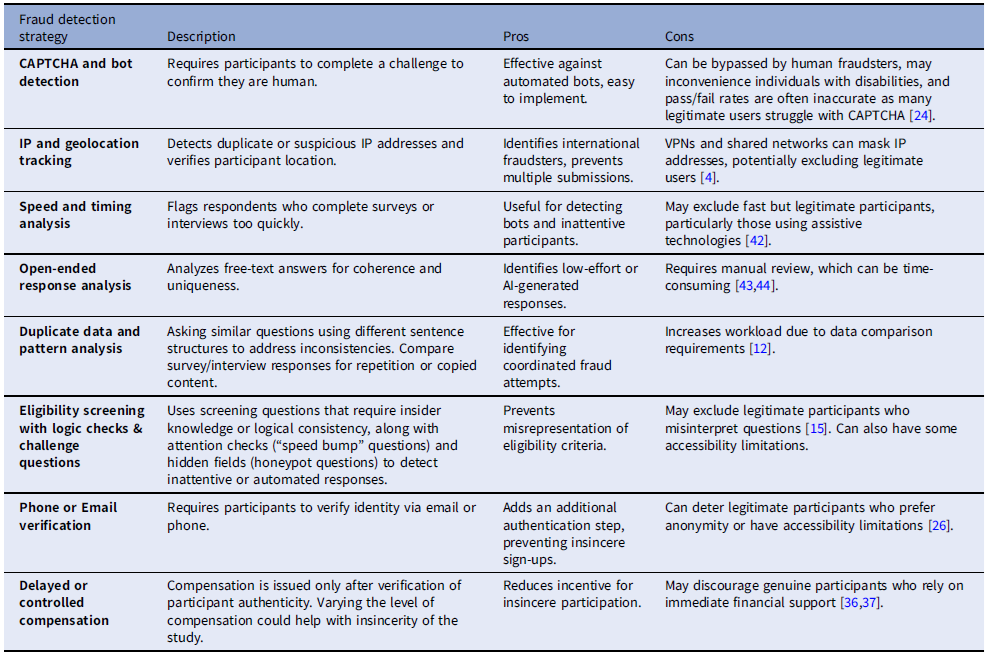
Several strategies to mitigate insincere participation in research have been proposed in the literature and are reviewed below. Ultimately, the selection of mitigation strategies must consider the risks of insincere participation, a study’s cost and resource constraints, and considerations to ensure that legitimate participants, particularly those from vulnerable populations, are not unfairly excluded [Reference Chandler, Sisso and Shapiro23]. Prior to data collection, researchers may attempt to prevent insincere participation through targeted recruitment and screening strategies. For example, personalized or single-use surveys links can limit widespread distribution, and pre-screening questions can help determine whether potential participants meet study eligibility criteria. However, these strategies are not foolproof. As seen in Case Study 4, even structured survey design and eligibility were insufficient to prevent large-scale automated fraudulent responses when links were broadly accessible. Individuals motivated to gain access to a study may repeatedly attempt screening questions to infer eligibility criteria or request additional survey links to participate multiple times. It is important to note that these strategies often require manual oversight by research teams to identify and prevent insincere activity. This was evident in Case Studies 2 and 3, where a high volume of insincere inquiries required extensive follow-up, screening, and documentation efforts despite yielding few eligible participants. Table 1 compares strategies to navigate insincere participation and guide researchers in deciding which solutions to implement based on the specific requirements of their study.
Comparison of insincere participant mitigation strategies

Table 1. Long description
This table presents eight fraud detection strategies for identifying insincere participants in decentralized research, with pros and cons for each. CAPTCHA and Bot Detection — A challenge confirming the participant is human. Pros: blocks automated bots, easy to implement. Cons: bypassable by human fraudsters, can inconvenience people with disabilities, and often misclassifies legitimate users. IP and Geolocation Tracking — Flags duplicate or suspicious IP addresses and verifies location. Pros: catches international fraud and multiple submissions. Cons: VPNs and shared networks can mask IPs, risking exclusion of legitimate users. Speed and Timing Analysis — Flags responses completed too quickly. Pros: helps detect bots and inattentive participants. Cons: may wrongly exclude fast, legitimate participants, including those using assistive technology. Open-Ended Response Analysis — Reviews free-text answers for coherence and uniqueness. Pros: catches low-effort or AI-generated responses. Cons: time-consuming manual review. Duplicate Data and Pattern Analysis — Compares responses across differently worded questions and checks for repetition or copied content. Pros: effective against coordinated fraud. Cons: adds workload for data comparison. Eligibility Screening with Logic Checks & Challenge Questions — Uses insider-knowledge or logic-based screening, attention checks, and honeypot fields. Pros: guards against misrepresented eligibility. Cons: may exclude legitimate participants who misread questions; some accessibility limitations. Phone or Email Verification — Confirms identity via phone or email. Pros: adds an authentication step against insincere sign-ups. Cons: can deter participants who value anonymity or face accessibility barriers. Delayed or Controlled Compensation — Pays only after verifying authenticity; may vary payment amount. Pros: reduces incentive for insincere participation. Cons: may discourage genuine participants who need immediate payment.
One approach to preventing insincere participation involves multi-layered screening techniques, such as eligibility verification, geolocation tracking, and CAPTCHA [Reference Wang, Calderon and Hager4,Reference Wardropper, Dayer, Goebel and Martin24]. However, excessive security measures may inadvertently exclude individuals with disabilities, neurodivergent individuals, or those with limited technological access [Reference Flicker25]. To address this, researchers should use verification methods, such as simple logic-based screening questions that ask for similar information in different formats (e.g., age vs. date of birth, city vs. state) [Reference Gordon, Fujinaga-Gordon and Sherwin26]. For example, a survey might first ask, “Do you live in North Carolina?” and later ask, “Please provide your city and state.” Consistency in responses helps flag inattentive participants. Another effective approach is to include questions that require insider knowledge of the study, which only genuine participants with lived experience could answer accurately, without the need for invasive checks like medical record reviews.
Another strategy to minimize insincere participation is behavior-based fraud detection, which includes monitoring response behavior such as response limits, completion times, response patterns, and answer consistency [Reference Heffner, Watson and Dahne27]. Insincere participants often complete surveys unrealistically fast or provide inconsistent answers. Researchers can consider inclusion of questions with false or implausible response options, where participants who enter implausible responses are flagged as “insincere” [Reference Wang, Calderon and Hager4,Reference Cascio12]. An example of this approach could be asking, “How did you hear about the study?” The first response option might be a “TV ad,” an implausible choice since the study was never advertised through that channel. Placing this option first can help flag insincere participants, who may likely select the first available answer and quickly move on without reading carefully. Additionally, cross-form validation strategies, where the same questions are used in both the screening and survey forms, can help detect inconsistencies.
Additionally, IP and geolocation verification can be useful in detecting insincere participants using VPNs [Reference Kennedy, Hatley and Lau28]. IP address monitoring can also help identify duplicate submissions. While dynamic IP addresses and shared networks may occasionally flag legitimate participants, repeated survey attempts from identical IP addresses within short time intervals can provide strong signals of coordinated fraudulent activity. However, this method should be used alongside other strategies, as some individuals rely on VPNs for legitimate reasons, such as security concerns in politically sensitive regions or for accessing studies from rural areas with limited connectivity. Researchers could incorporate manual verification options, allowing participants to clarify discrepancies rather than facing automatic exclusion [Reference Ridge, Bullock and Causer29].
Open-ended question analysis is another effective tool in detecting insincere responses. By requiring participants to provide qualitative answers that test comprehension and authenticity, researchers can identify copy-paste or inconsistent responses [Reference Louis and Thompson21,Reference Roehl and Harland30]. For example, if a researcher is recruiting participants with a certain health condition, the research team can incorporate open-ended questions on their primary care provider or a question that potential insincere participants would not know the answer to (known as insider knowledge questions). However, digital accessibility must be considered for those with literacy challenges, cognitive impairments, or limited English proficiency. Offering alternative response formats, such as voice recordings, can help ensure broad inclusion of sincere participants [Reference Cascio12]. It is important to recognize that individuals with cognitive disabilities or those who use assistive technologies may also show atypical response patterns. Instead of exclusions based on timing metrics alone, researchers should combine behavior tracking with manual review processes to prevent false positives [Reference Hydock31].
Additionally, open-ended screening questions can be incorporated to confirm that respondents are attentive and meet basic eligibility criteria. These questions can be paired with branching logic, allowing the remainder of the survey to remain hidden unless all questions are answered correctly [Reference Lawlor, Thomas, Guhin, Kenyon, Lerner and Drahota32,Reference Donkin, Henry, Kercher, Pedersen, Wilson and Chan33]. These “speed bump” questions are attention checks designed to slow respondents and encourage careful reading, helping to identify inattentive or automated responses. They may include simple comprehension prompts, such as “To confirm you are carefully reading the question, please select ‘Strongly Disagree’ for this item.” Honeypot questions provide an additional layer of protection [Reference Lawlor, Thomas, Guhin, Kenyon, Lerner and Drahota32,Reference Donkin, Henry, Kercher, Pedersen, Wilson and Chan33]. A honeypot question is a hidden field in REDCap embedded within a survey that is not visible to human respondents but may be detected and completed by automated bots. If a survey response contains values in a honeypot field, it is a strong indication that the response was generated by a bot rather than a human [Reference Lawlor, Thomas, Guhin, Kenyon, Lerner and Drahota32,Reference Donkin, Henry, Kercher, Pedersen, Wilson and Chan33]. Examples of a honeypot field include hidden text fields such as “Leave this field blank” or “What is your referral code?” that genuine participants never see.
In qualitative research and community engagement, reluctance to engage in interviews on camera, vague or scripted verbal responses, and unusual behavior during interactions, such as avoiding follow-up questions, were observed as behavioral patterns of insincere participants [Reference Johnson, Adams and Byrne16,Reference Roehl and Harland30,Reference Pullen Sansfaçon, Gravel and Gelly34]. To mitigate this risk, researchers can incorporate rapport-building techniques, use follow-up probes that require individualized responses, and cross-check interview data with other sources to differentiate genuine participants from insincere ones [Reference Roehl and Harland30,Reference Pullen Sansfaçon, Gravel and Gelly34–Reference Klein and Cruys36].
As compensation is a key driver in insincere participation, controlled compensation disbursement is another valuable strategy for reducing insincere participation. Delaying payment until authenticity is verified discourages opportunistic behavior [Reference Santinele Martino, Perrotta and McGillion37]. However, accessibility issues arise when participants rely on immediate compensation, such as those with lower incomes or unstable financial situations. Instead of delays, researchers can implement tiered payment structures, where initial small incentives are provided before full compensation upon verification [Reference Cascio12,Reference Santinele Martino, Perrotta and McGillion37]. Confirming the identity of a participation with an email or phone call before releasing compensation can also be a helpful strategy; however, it raises an ethical question on how to pay participants who are non-responsive to researchers’ efforts in contacting them [Reference Wang, Calderon and Hager4]. Verification of disease with documentation from a local clinician or uploading some identification could also be a strategy to show participant authenticity. Additionally, researchers could choose not to display incentives on public-facing materials and instead use language such as “Compensation Provided if You Qualify” to deter insincere participation and be transparent for legitimate participants. Careful wording in recruitment materials, such as avoiding overt emphasis on compensation and a focus on eligibility, can deter individuals motivated solely by financial gain [Reference Klein and Cruys36–Reference O’Donnell, Satherley, Davey and Bryan38]. Researchers should be transparent about the research they are conducting; however, displaying incentives or detailed inclusion criteria may lead to more insincere participation [Reference Salinas39]. With that, it is important to inform survey takers at the beginning that insincere activity is being monitored with submitted surveys that are deemed questionable or insincere will not be compensated.
The format of compensation may also influence risk of insincere responses. Digital incentives such as electronic gift cards can be rapidly exploited by individuals managing multiple email accounts or automated systems. In contrast, compensation distributed through mailed payments or physical addresses may deter some insincere activity by requiring a verifiable mailing address. However, such approaches must be balanced against administrative burden and participant accessibility.
In certain research contexts, particularly those with an elevated risk of insincere participation, more rigorous strategies may be warranted. For example, recruiting from electronic health records or controlled recruitment pools, where basic demographic, condition, and treatment data are already verified, can reduce misrepresentation by ensuring that only participants with confirmed diagnoses are screened. Additionally, requiring participants to provide standard proof of documentation, such as a driver’s license or student ID, can significantly deter insincere responses, although this approach raises concerns regarding privacy, technological accessibility, and the administrative burden of verification. Similarly, directly requesting medical records or disease confirmation from treating physicians or clinics can be highly effective in confirming eligibility, but such measures are time-consuming and lead to consent and privacy challenges.
In addition to study-level screening strategies, technological tools embedded within research data platforms (i.e., REDCap) may help mitigate some risks. For example, modules developed for REDCap (Cheatblocker & QuoteConfig) have been designed to flag potential duplicate screening submissions and monitor enrollment characteristics during recruitment. These types of automated tools can assist investigators in identifying potential insincere participation or sampling imbalances while maintaining the scalability for decentralized research [Reference Fronk, Hawk, Cates, Clark, Natale and Dahne40].
To uphold ethical standards, collaboration with Institutional Review Boards (IRBs) is crucial. Implementing standardized protocols that consider access and opportunity is critical to ensure that screening and security measures do not discriminate against marginalized populations [Reference Shine41]. These approaches may require the collection of additional data (e.g., IP addresses or verification information), which should be transparently described and justified within IRB application to ensure appropriate oversight. For instance, studies focusing on neurodivergent individuals or those with disabilities should involve experts from these communities in designing fair screening criteria that balance insincere prevention with accessibility [Reference Singh and Sagar3].
Discussion
With the increasing occurrence of insincere participation in research studies, investigators using low-touch recruitment and enrollment approaches should be aware of the potential risks and implement appropriate countermeasures. There is a continuum between maximizing recruitment speed, efficiency, accessibility, and generalizability versus ensuring rigorous participant eligibility verification. Striking the right balance depends on the nature of the study, the recruitment challenges faced, and the researcher’s tolerance for data quality risks.
Different study designs vary in susceptibility to insincere participants. Online studies, particularly surveys, are vulnerable due to limited direct interaction. This pattern was observed across case studies relying on web-based recruitment, where compensation and broadly accessible recruitment methods increased risk.
Central to this work is the concept of risk tolerance, which serves as the primary decision anchor for addressing insincere participation. Risk tolerance reflects the extent to which invalid responses could compromise the scientific validity, interpretability, or ethical integrity. Rather than applying uniform mitigation strategies, researchers should determine where their study falls along a continuum, from higher tolerance (where limited inaccuracies are unlikely to affect conclusions) to lower tolerance (where even minimal inaccuracies could compromise findings).
This continuum is shaped by key study characteristics, particularly sample size and protocol complexity. Studies focused on causal inferences typically have lower tolerance compared to exploratory and/or descriptive studies. Smaller studies are more vulnerable to distortion, while larger studies may be more resilient. Similarly, studies with complex protocols, longitudinal follow-up, or those that pose more than minimal risk to participants may require more rigorous verification than simple, one-time surveys. Ultimately, researchers should determine where their study falls along the continuum and establish a risk mitigation plan accordingly.
Importantly, all studies, regardless of their position along the continuum, should implement a baseline set of safeguards to protect data quality. These foundational practices include basic eligibility verification surveys, monitoring for duplicate submissions, response consistency checks across questions, and manual review of suspicious responses. Eligibility screening is not itself a fraud detection method, though it can deter individuals who misrepresent their eligibility. We include it as a baseline safeguard because confirming basic eligibility is foundational to every study.
However, many studies require more intensive safeguards. For example, qualitative studies and community engagement sessions require high participant authenticity, while large scale online surveys may become vulnerable due to compensation structures and shareable recruitment methods. In such cases, even a small number of insincere participants can compromise study integrity.
These characterizations are broad generalizations meant to support initial decision-making, not definitive classifications. Individual studies may not fit neatly into either category, as factors such as study goals, risk to participants, population characteristics, and resource constraints can shift a study’s position along the continuum.
To address this, we propose a risk-based mitigation framework in which strategies are scaled according to a study’s position along the risk tolerance continuum. We emphasize that this framework is a conceptual guide, not a prescriptive algorithm, and encourage investigators to adapt it to their study’s needs. As illustrated in Figure 1, mitigation can be applied across three phases of the study lifecycle – prevention, monitoring, and detection/response – with increasing intensity as tolerance decreases.
Risk analysis mitigation framework along a risk tolerance continuum.

Figure 1. Long description
This figure shows a framework for research fraud safeguards, organized along a gradient from "Lower Risk Tolerance / More Safeguards" (left) to "Higher Risk Tolerance / Fewer Safeguards" (right). A banner lists baseline safeguards applied across all studies: eligibility screening, duplicate detection, response consistency checks, manual review, response pattern monitoring, clear eligibility messaging, and transparent compensation communication. Below this, three rows represent stages of fraud safeguarding, each with examples ranging from more intensive (left) to lighter-touch (right): Prevention (pre-data collection): verified registries and pre-enrollment ID checks (lower tolerance); personalized links and email verification (moderate); careful recruitment wording and bot deterrents like honeypot fields (higher). Monitoring (during data collection): real-time behavioral monitoring and device checks (lower); attention checks and behavioral pattern monitoring (moderate); CAPTCHA and basic spot-checks (higher). Detection & Response (data validity evaluation): strict exclusion criteria and full verification before compensation (lower); systematic pattern evaluation (moderate); removal of invalid/duplicate responses and basic cleaning (higher). Overall, safeguards lighten left to right within each row based on risk tolerance, while the three rows represent sequential mitigation stages — before, during, and after data collection — all layered atop the baseline safeguards.
Mitigation should be viewed as an iterative process rather than a one-time decision. Researchers should anticipate vulnerabilities during study design, monitor response patterns during data collection, and define clear thresholds for identifying and excluding insincere data. Indicators such as clustering of IP addresses or unusually rapid response times can inform real-time adjustments.
The case studies illustrate the framework in practice. Studies classified as lower risk tolerance implemented intensive strategies across all phases, including restricted recruitment, identity verification, and strict exclusion criteria. Case Study 4, classified as moderate risk tolerance given its non-interventional protocol, narrowly defined professional population, and clinically relevant topic, initially used accessible recruitment and automated payments. After identifying a large-scale, automated episode of insincere participation, they paused automated payments and shifted to manual identity verification and controlled incentive distribution, adapting their methods in response to observed fraud, without changing the study’s underlying risk tolerance.
Each mitigation strategy introduces trade-offs. Tools like CAPTCHA can reduce automated responses but may create barriers for some participants, while duplicate detection may exclude individuals sharing devices. As such, strategies should align with both the study design and the intended population. Structured planning approaches can help researchers anticipate vulnerabilities, define expected response patterns, and establish criteria for identifying suspicious data prior to study launch [Reference Lawlor, Thomas, Guhin, Kenyon, Lerner and Drahota32].
Decisions regarding suspected insincere participants during analysis should be context dependent. If insincere participation is minimal, automated approaches may be sufficient. If large volumes of questionable data emerge, additional work may be needed. Funding, institutional policies, and IRB requirements may also influence mitigation strategies used, particularly in studies involving sensitive populations or high-risk topics.
Approaches to handling questionable data vary. Some studies may exclude such data to preserve validity, while others, particularly qualitative or exploratory studies, may retain responses if they provide meaningful insight [Reference Garcia-Iglesias, Heaphy, Yodovich, Atherton and Merchant18,Reference Flicker25,Reference McCaul and Wand45]. Rather than viewing authenticity as strictly binary, responses can be evaluated for consistency and relevance with the broader dataset to determine whether there is alignment with their risk tolerance for insincere participants [Reference Garcia-Iglesias, Heaphy, Yodovich, Atherton and Merchant18].
Expanding access to research through digital tools increases inclusivity but simultaneously introduces vulnerabilities. Effective governance requires balancing accessibility with data integrity as complementary components of ethical research.
Addressing insincere participation may also require coordinated institutional responses [Reference Donkin, Henry, Kercher, Pedersen, Wilson and Chan33]. IRB should consider requiring mitigation plans as part of IRB submission. Incorporating these practices into grant proposals and study protocols may further increase awareness of this emerging challenge amongst researchers. Research institutions can support investigators by developing standardized screening templates, compensation policies, centralized fraud monitoring systems, and shared toolkits. Infrastructure-level solutions within platforms such as REDCap can further support automated fraud detection. Broader dissemination of these tools can help protect data integrity while preserving accessibility.
Conclusion
Insincere participation poses a growing threat to decentralized research, requiring a balanced mix of automated and manual safeguards. Multi-tiered screening, such as eligibility verification, CAPTCHA, IP/geolocation tracking/blocking, time zone verification, and behavior-based fraud detection, can flag questionable entries, while open-ended, “speed bump” questions, and false-response questions, add further protection. Delayed or tiered compensation and careful incentive wording reduce opportunistic participation. These measures must be applied carefully to avoid excluding legitimate participants and compromising representativeness. Importantly, this challenge is likely to evolve into an ongoing “arms race,” as researchers implement countermeasures and insincere participants adapt in turn. Explicit reporting of recruitment experiences in publications, particularly those involved insincere participation, can further increase awareness, strengthen the evidence base, and support the development of more effective mitigation strategies. This underscores the need for constant adaptation of frameworks, institutional guidance, and standardized processes and protocols to safeguard both data integrity and ethical participation. We emphasize that the framework proposed is not intended as an evidence-based algorithm, but rather a preliminary synthesis to support systematic thinking about mitigation. We hope this will catalyze future research toward more rigorous guidance across diverse study contexts.
Supplementary material
The supplementary material for this article can be found at https://doi.org/10.1017/cts.2026.10819.
Acknowledgements
We would like to acknowledge Nicholas Shaheen, MD, and Andrea Carnegie, PhD, for their valuable expertise and guidance on this emerging topic in translational science. We also would like to extend our thanks to Ese Aikhuele, MPH, and Simone Frank, MPH, of the PaCER Program at NC TraCS for insightful contributions in addressing the challenge of insincere participants during community feedback sessions.
Author contributions
Sarah Sutter: Conceptualization, Data curation, Formal analysis, Methodology, Project administration, Resources, Visualization, Writing - original draft; Summer Choudhury: Conceptualization, Supervision, Writing – review & editing; Blair Wendlandt: Methodology, Writing – review & editing; Tessa Englund: Methodology, Writing – review & editing; Saira Sheikh: Methodology, Writing – review & editing; Victoria Scott: Methodology, Writing – review & editing; Ashley Brown: Methodology, Writing – review & editing; Michael Kappelman: Conceptualization, Data curation, Methodology, Supervision, Writing – original draft, Writing – review & editing.
Funding statement
We further acknowledge the editorial assistance of the NC Translational and Clinical Sciences (NC TraCS) Institute, which is supported by the National Center for Advancing Translational Sciences, National Institutes of Health, through Grant Award UM1TR004406.
Competing interests
Author 5 is on the Board of American College of Rheumatology and LuCIN/Lupus Therapeutics, LLC. Author 5 has also received grants from Cabaletta Bio, Biogen Inc., American College of Rheumatology, National Institute of Health, Lupus Foundation of America, Bristol-Myers Squibb, Aurinia Pharmaceuticals, Genetech, Biogen MA Inc, CRISPR Therapeutics, Celgene Corporation, and Lupus Research Alliance.


 Open access

