Introduction
The societal implications of population ageing are often framed in terms of increasing costs, burden and dependency ratio (Phillipson Reference Phillipson2015). This framing not only derives from simplified forecasts of care costs in later life (e.g. Healy Reference Healy2004; Lloyd-Sherlock Reference Lloyd-Sherlock2002), but also portrays older adults as dependent by default, largely neglecting their contribution to society as providers of informal care and services (Healy Reference Healy2004; Kincade et al. Reference Kincade, Rabiner, Bernard, Woomert, Konrad, DeFriese and Ory1996; Ranzijn, Harford and Andrews Reference Ranzijn, Harford and Andrews2002). Research evidence indicates that across developed societies older adults provide substantial amounts of financial, emotional and practical support to their adult children and their grandchildren (Brandt, Haberkern and Szydlik Reference Brandt, Haberkern and Szydlik2009; Bucx, van Wel and Knijn Reference Bucx, van Wel and Knijn2012; Deindl and Brandt Reference Deindl and Brandt2011; Fingerman et al. Reference Fingerman, Miller, Birditt and Zarit2009; Ranzijn, Harford and Andrews Reference Ranzijn, Harford and Andrews2002).
However, little is known about the trends in the support that older adults provide to their adult children over time or how the determinants and drivers of this support may interact with changing lifestyles of older adults. Despite increasing longevity and improvements in health, no consensus exists on whether this development means that older adults are increasingly able, willing or both to provide help and services to others (Henretta, Grundy and Harris Reference Henretta, Grundy and Harris2002). Some family sociological scholarship suggests that older adults’ support for their adult children and their grandchildren is becoming increasingly restricted in late modernity, partly because of loosening family ties and partly because many grandparents are now balancing employment, social commitments and leisure (Chambers Reference Chambers2012: 100). However, some empirical findings argue the opposite, showing that the provision of child care by grandparents is actually increasing over time (Geurts et al. Reference Geurts, Van Tilburg, Poortman and Dykstra2015). Nevertheless, this increase is generally explained as a consequence of factors such as higher maternal employment rates and growth in single motherhood, rather than as a reflection of an increase in grandparents’ ability or willingness to help (e.g. Bordone, Arpino and Aassve Reference Bordone, Arpino and Aassve2017).
This paper contributes to the scholarly understanding of how intergenerational support is determined in the era of changing later life by investigating both the practical support that Danish older adults provide to their adult children and the socio-economic and lifestyle determinants of this support. We investigate, first, the overall development in provision of support from parents to adult children over a 15-year period by age and cohort. Second, we analyse the drivers of such support in three different phases of late adulthood (late mid-life, third age and old age) in 2012. This study adds the perspective of the Scandinavian universal welfare model to the study of intergenerational relationships and their determinants. In such a welfare context, where citizens depend very little on informal help, the provision of private support between generations is driven not by necessity but by willingness.
Changing late life and intergenerational ties
The supposedly loosening intergenerational ties are attributed not only to late modern societal values but also to the changing lifestyles and identities adopted by older adults. Emerging discourses portray older adults increasingly as a group who, in addition to enjoying good retirement benefits and leading active lives, want to pursue their own interests and increasingly reject normative (family) obligations (Binstock Reference Binstock2010; Whittington Reference Whittington2008). These discourses respond partly to the emergence of ‘new ageing’ and particularly to the concept of the third age (Laslett Reference Laslett1989): a period characterised by mature consumption and active leisure patterns; a period in which an individual is free from obligations, can choose a fresh start and can fulfil personal goals and dreams (Karisto Reference Karisto2007; Laslett Reference Laslett1989).
According to the literature, these changing ideals of later life are likely to be a combination of cohort and period effects. While active lifestyles and consumption reflect the zeitgeist and are new ideals for modern late life in general (Katz Reference Katz2000), they are often attached to the new cohorts of older adults, particularly the baby-boom cohorts (e.g. Higgs and Gilleard Reference Higgs and Gilleard2007). However, in the light of research evidence, whether or not each successive cohort is increasingly translating these ideals into actions remains unclear. While the public media increasingly embrace an image of new cohorts of older adults redefining nearly all aspects of everyday life, including intergenerational relationships (e.g. McLaren Reference McLaren2014), recent longitudinal research evidence suggests that younger cohorts neither necessarily live up to the ideals of the third age nor dramatically differ from their parents’ generation in terms of their daily activities (Karisto and Haapola Reference Karisto, Haapola, Komp and Johansson2015).
Determinants of practical support from older parents to adult children
Previous scholarship has indicated that needs and resources for support, on one hand, and family characteristics, on the other, influence the likelihood of intergenerational support (Deindl and Brandt Reference Deindl and Brandt2011). The resources for giving practical support include health and time available for providing support, while family characteristics include geographical proximity, number of family members and having grandchildren or not. Previous studies have identified age, health, employment status, income, educational status and gender of the parent among the determinants of social and practical support to adult children (Albertini, Kohli and Vogel Reference Albertini, Kohli and Vogel2007).
Social policy context and available formal support also demonstrably influence the patterns of intergenerational solidarity and support, and a strong welfare state regime increases the likelihood of support from older parents to adult children (Albertini, Kohli and Vogel Reference Albertini, Kohli and Vogel2007; Brandt and Deindl Reference Brandt and Deindl2013; Daatland and Lowenstein Reference Daatland and Lowenstein2005; Deindl and Brandt Reference Deindl and Brandt2011). Previous scholarship has explained this mechanism by the ‘crowding in’ thesis, according to which generous public support and transfers back up private resources and facilitate private support provision between generations (Deindl and Brandt Reference Deindl and Brandt2011).
In addition to resources, needs and structures, motivational and value-based factors play a part in determining intergenerational relations. Kohli (Reference Kohli2004) suggests that cultural factors, manifested on both macro (society) and micro (individuals, family) levels – such as religious traditions, family values, attitudes and beliefs – affect intergenerational transfers. In a similar vein, Bengtson and Roberts’ (Reference Bengtson and Roberts1991) intergenerational solidarity model suggests that, in addition to opportunities and availability dimensions, interpersonal factors such as affection, emotional closeness and shared values between the generations facilitate interaction.
However, very little is known about these value-based lifestyle factors, which either facilitate or hinder older adults from giving practical support to their adult children. Lifestyles and life priorities nevertheless affect both the time available for providing support and the personal value (motivation) of providing such support. Furthermore, they play a key role in discourses about older adults supposedly increasingly adopting active, self-centred lifestyles in late modernity, at the expense of familial values and activities.
Aims of this study
The purpose of our study is twofold. First, we examine whether empirical evidence supports the popular discourse on loosening intergenerational ties between older adults and their offspring over time. We use data from the Danish Longitudinal Study of Ageing (DLSA) to analyse trends in the provision of support by Danish older adults from 1997 to 2012. Second, we analyse the determinants of such support in different phases of late adulthood (late mid-life, third age and old age), particularly investigating whether the data support the assumption of active lifestyles as an obstacle to supporting adult children. To do so, we use cross-sectional data from the latest wave of DLSA, with provision of practical help as the dependent variable and various individual characteristics as independent variables.
To test the evidence supporting the popular discourses of loosening intergenerational ties over time and as a consequence of changing late life, we set out two hypotheses. First, according to the discourse on loosening ties over time, one should expect to find decreasing levels of support from older adults to their adult children, especially when comparing different cohorts. Second, according to the discourse on loosening ties as a consequence of changing later life, its activities and its priorities, one should also expect to find lower levels of support from older adults who are actively engaged either in work-life activities (for those still in the labour market) or in leisure and social activities (for those who are retired).
Methods
Data
The data come from the DLSA. For the first part of the analysis, we used the four waves of DLSA, collected in 1997, 2002, 2007 and 2012. For the second part of the analysis, we used cross-sectional DLSA data from the 2012 wave combined with national population register micro-data on individual income.
DLSA has a panel structure, with the same respondents contacted in each wave and an additional cohort of 52-year-olds added in each wave. Respondents belong to one-year birth cohorts born five years apart, i.e. 1920, 1925, 1930, 1935, 1940, 1945, 1950 (only in 2002, 2007 and 2012), 1955 (only in 2007 and 2012) and 1960 (only in 2012). The DLSA population is randomly selected from these cohorts, drawn from the Danish central population register, which includes all Danish residents (for a detailed overview of the registers, see Thygesen et al. Reference Thygesen, Daasnes, Thaulow and Bronnum-Hansen2011). Thus, the samples in DLSA are highly representative (Kjær, Poulsen and Siren Reference Kjær, Poulsen and Siren2016).
There are 33,669 records across the four waves with 17,462 unique respondents. The number of interviewed respondents and the response rates for each wave are as follows: in 1997, N = 5,864, the response rate was 70 per cent; in 2002, N = 8,207, the response rate was 83 per cent; in 2007, N = 9,633, the response rate was 74 per cent; and in 2012, N = 9,965, the response rate was 74 per cent.
Analyses
To identify trends in the provision of help across age groups, cohorts and years, we performed cross-tabulations with data from 1997 to 2012. As the outcome variable, we used providing practical support to adult children. We used cohort and year as the independent variables. For the cross-tabulations, we included age groups 52, 57, 62, 67, 72 and 77, because including them allowed us to compare provision of support across age groups, cohorts and waves (age groups 82, 87 and 92 are not available for each wave).
To identify factors that predict the likelihood of older adults providing practical support to their adult children in the three phases of older adulthood, we performed a set of regression analyses (probit model) with data from 2012. The different phases of older adulthood were later mid-life (adults aged 52–62 years, employed), third age (adults aged 62–72 years, retired) and old age (adults aged 77–92 years, retired). In our model we used the provision of practical support as an outcome, and used background, work-related, family-related and lifestyle variables as predictors (for details, see the next section).
Measures
Provision of practical support
To measure the practical support that the respondents provided, we used the following question from the DLSA: ‘Within the past month, have you helped your child (children) with the following tasks: (a) cleaning, shopping or cooking; (b) gardening or home maintenance; (c) child care?’ Each task was coded as a categorical variable with a binary outcome (yes versus no) and also recoded into a total score with value ranging from 0 (not helping with any) to 3 (helping with all).
Background variables
We used gender, cohort, income and subjective health as background variables. The income variable was retrieved from the population registers and categorised into four quartiles. Subjective health was measured through the following question from the DLSA: ‘How would you rate your health?’ We used a five-point scale: excellent, good, satisfactory, poor and very poor. We categorised the response into a variable with a binary outcome (very good or good versus satisfactory, poor or very poor).
For the regression analyses, using information about each respondent's age and employment status, we constructed three groups reflecting different phases of later life: later mid-life (adults aged 52–62 years, employed), the third age (adults aged 62–72, retired) and old age (adults aged 77–92 years, retired). The retirement age in Denmark varies by birth cohort. For those respondents aged 62–92 in 2012, the retirement age was 65 years, with an option for early retirement at age 60. For those aged 52 and 57 in 2012, the retirement ages were 67 years and 66.5 years, respectively. According to Statistics Denmark, in 2012 approximately 48 per cent of Danes aged 62 and approximately 80 per cent of Danes aged 67 were retired. As people aged 52 or 57 years were not eligible for retirement, the vast majority were in employment, while approximately 95 per cent of people aged 72 or older were retired (Statistics Denmark 2016).
Family variables
We used the following information from the DLSA: having grandchildren (yes or no), gender of the closest living child, travel time to the closest living child (under/over 30 minutes) and employment status of children (all children employed/not all children employed).
Work-related variables
The work-related variables were used only in regression analyses with respondents in later mid-life. The variables are employment, life priorities, work-related stress, job flexibility, physical job demands and willingness to extend one's working life. We operationalise these variables as follows.
For employment, we used information on weekly hours from the DLSA, coded as a variable with a binary outcome (part-time versus full-time employment). For measures of life priorities, we used two questions from the DLSA: ‘How important is work for you?’ and ‘How important is leisure for you?’ The answers to both questions were ‘very important’, ‘somewhat important’ or ‘not at all important’. We coded both questions with a binary outcome (very important versus less important).
To measure work-related stress, we used the following question from the DLSA: ‘Is your satisfaction with work hampered by (a) the pace of work, (b) being busy, (c) lack of influence, (d) lack of respect, (e) insecure employment’? We coded this question into a variable with three categories, according to how many of these factors respondents reported: (0 factors for no stress, 1or 2 factors for moderate stress, 3–5 factors for high stress). For a measure of job flexibility, we used the question ‘If you wish to do so, do you have the possibility of (a) decreasing your working hours, (b) changing to less demanding tasks, (c) changing to a less challenging job within your workplace?’ We calculated a sum score ranging from 0 to 3 and coded it as a variable with a binary outcome (3 for high flexibility versus 0–2 for less flexibility).
For a measure of how physically demanding each respondent's job was, we included this question: ‘Does your work require the following: (a) physical strength, (b) too much physical labour, (c) too much lifting and carrying, (d) physically monotonous work, (e) too much bending?’ We calculated a sum score ranging from 0 to 5, coded as a variable with a binary outcome (1–5 for physically demanding job versus 0 for physically undemanding job). Finally, we included information on whether or not the respondent wished to continue working beyond retirement age (yes versus no).
Lifestyle variables
The lifestyle variables were used only in regression analyses that included the respondents in the third age and old age. These variables were active volunteering, participation in leisure activities and having a driving licence. For a measure of active volunteering, we used the question ‘Within the past year, have you done volunteer work in the following areas: (a) culture, (b) sport, (c) other leisure, (d) education, (e) health, (f) social, (g) environment, (h) community, (i) labour organisations, (j) legal matters, (k) political organisations, (l) international organisations, (m) religion, (n) other?’ We calculated a sum score ranging from 0 to 14 and coded it as a variable with a binary outcome (1–14 for volunteering versus score of 0 for not volunteering).
For a measure of participation in leisure activities, we used this question: ‘How often do you normally do the following: (a) walk, trek or cycle; (b) exercise; (c) fish or hunt; (d) attend lectures or study groups; (e) attend senior clubs; (f) attend association meetings; (g) attend religious activities; (h) go to the theatre, movies or concerts; (i) play cards; (j) do handicrafts with others; (k) read books?’ The possible answers were daily, several times a week, at least once a month, rarely or never. We grouped the activities into three categories: physical (a–c), cultural or spiritual (g, h), social (g–f, I, j) and home-based cultural (k) activities, coding each category as a variable with a binary outcome (yes versus no) if the respondent reported doing at least one of the activities in the category at least once a week (for activities a–g and i–k) or at least once a month (for activity h). Finally, we used information on whether or not each respondent had a driving licence, coding it as a binary variable (yes versus no).
Results
Period, age and cohort trends in provided support
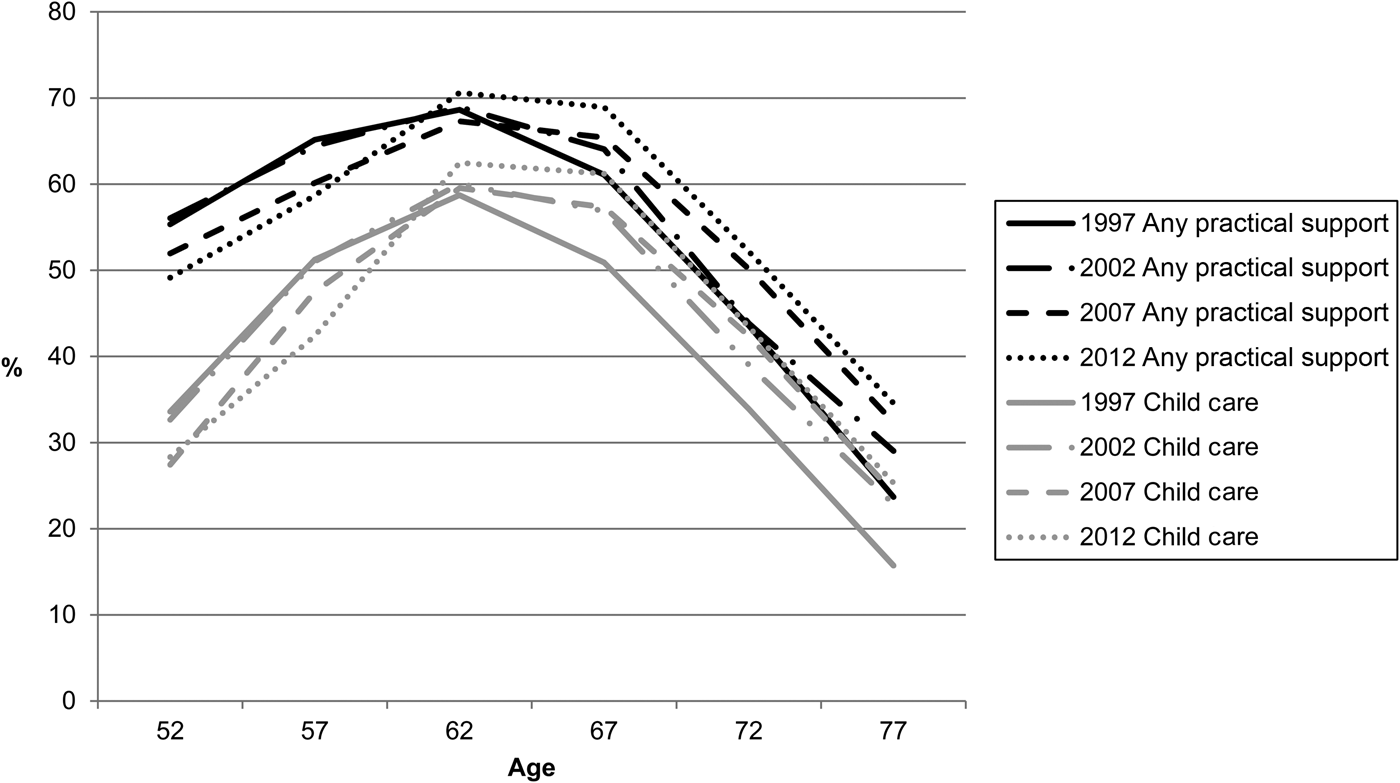
We found a general increase over time in practical support provided by older adults to their children (Figure 1). Overall, in 2012, over 50 per cent of people aged 52–77 regularly helped their adult children; for people aged 62–67 this proportion was around 70 per cent. However, while the provision of practical support among people aged 62 and over has noticeably increased, the share providing practical support among people aged 52–57 years has decreased.
Practical support and help with child care provided to adult children, by age and year.

Overall, with increasing age, practical support to children first increases, peaking around the third age (62–67 years), and then decreases. Compared to the oldest cohorts (born 1920–1930), the younger cohorts (born 1945–1960) tended to help their adult children less in late mid-life. Nevertheless, in the third age, for those younger cohorts who had already reached that phase (i.e. cohorts 1945–1950), we found a prominent increase in the share providing support compared to the older cohorts (those born 1920–1940).
A specific look at the task of child care, the most common form of practical support given to adult children, reveals a similar pattern. Figure 1 shows an overall general increase in the provision of child care help for age groups 62 and older, and an overall decrease for younger age groups.
Factors predicting the likelihood of providing help in the three phases of later life
Using a set of regression analyses, we investigated different factors that may predict the likelihood of providing help to adult children in the three phases of older adulthood: in later mid-life (adults aged 52–62 years, employed), in the third age (adults aged 62–72, retired) and in old age (adults aged 77–92 years). We differentiated between (a) all kinds of help; (b) help with cooking, cleaning and shopping; (c) help with gardening and home maintenance; and (d) help with child care.
Later mid-life
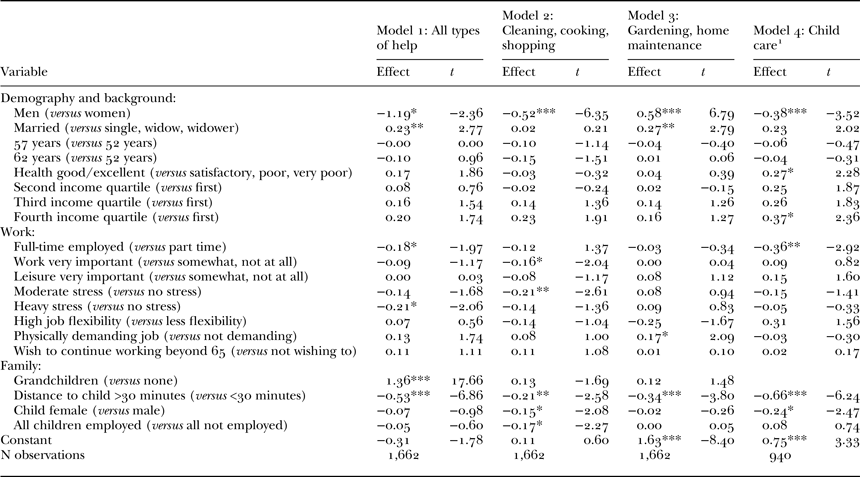
Factors significantly predicting the likelihood of adults in later mid-life providing practical support to their adult children were being female, being married, having grandchildren and living close to one's child (children). Having part-time employment and having no or only moderate work-related stress were significant predictors at the p < 0.05 level. The findings were similar for models predicting different types of practical support (Table 1). However, being married was a significant predictor for providing help only with gardening and home maintenance; having part-time employment was a significant predictor for providing help with child care; and moderate work-related stress significantly predicted a lesser likelihood of providing help with cleaning, cooking or shopping.
Probit models with providing help to children as the predicted variable; later mid-life (52–62 years, employed)

Note: 1. In Model 4, only those individuals who have grandchildren are included.
Significance levels: * p < 0.05, ** p < 0.01, *** p < 0.001.
Third age
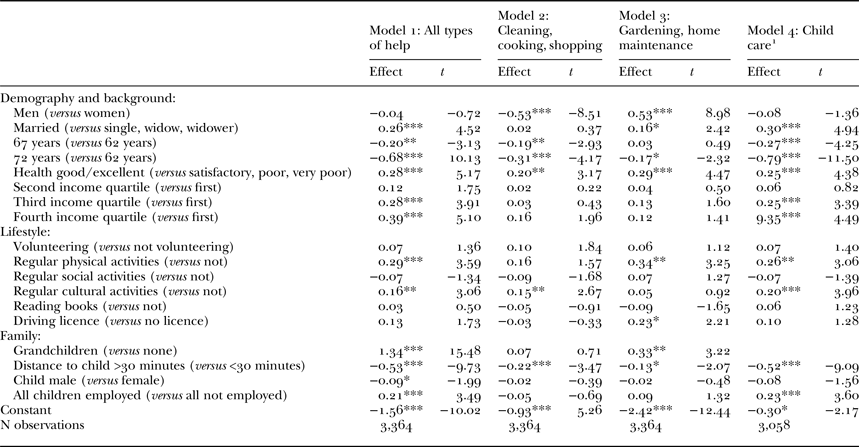
Factors significantly predicting the likelihood of adults in the third age providing practical support to their adult children were a younger age (i.e. 62 years as opposed to 67 or 72), higher income, better health, active attendance at physical leisure activities and cultural activities, having grandchildren, living close to one's child (children), having a daughter as the closest residing child and having children all in full-time employment. While the findings were similar for models predicting different types of practical support (Table 2), marital status, having grandchildren and regularly attending physical leisure activities were not significant predictors for providing their adult children help with cleaning, cooking and shopping. Moreover, younger age, living close to one's adult child, and regularly attending cultural activities were not significant predictors for providing gardening or home maintenance help. Earning income and having children with full-time employment were significant predictors only for providing help with child care.
Probit models with providing help to children as the predicted variable; third age (62–72 years, retired)

Note: 1. In Model 4, only those individuals who have grandchildren are included.
Significance levels: * p < 0.05, ** p < 0.01, *** p < 0.001.
Old age
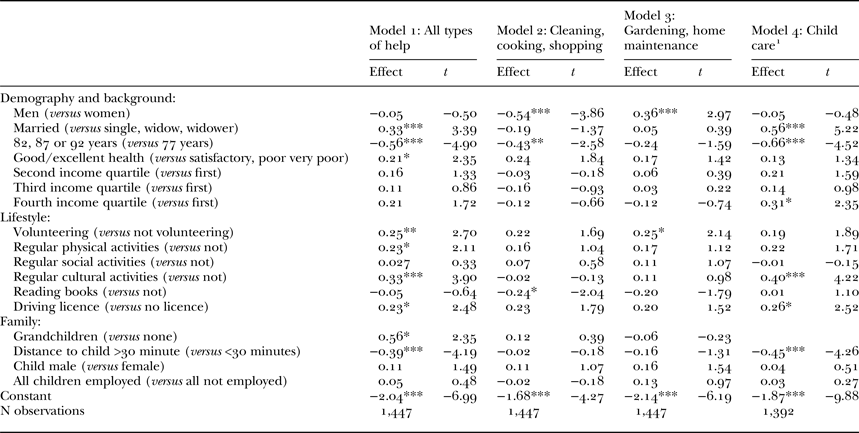
For the age group 77–92, we found that factors significantly predicting the likelihood of providing all kinds of practical support to adult children were being married, being in a younger part of the group (i.e. 77 or 82 years as opposed to 87 or 92), doing volunteer work, regularly attending cultural activities and living close to one's child (children). For models predicting different types of practical support (Table 3), we found that female gender increased the likelihood of providing help with cleaning, cooking and shopping, whereas being male predicted the likelihood of providing help with gardening and home maintenance. Age was not a significant predictor for providing help with gardening or home maintenance, nor did regularly attending cultural activities or living close to one's child (children) predict the likelihood of providing help with cooking, cleaning or shopping or with gardening and home maintenance.
Probit models with providing help to children as the predicted variable; old age (77–92 years, retired)

Note: 1. In Model 4, only those individuals who have grandchildren are included.
Significance levels: * p < 0.05, ** p < 0.01, *** p < 0.001.
Discussion and conclusions
This study, using nationally highly representative data from Denmark, extends the literature on intergenerational relationships and support in later life in the following ways: (a) by studying the age and cohort trends over time in older adults’ provision of practical support with a large, longitudinal population-based data-set; (b) by investigating the determinants of providing practical support to adult children in different phases of later life; and (c) by examining these factors in a context of a generous welfare state (Denmark). The findings suggest that the proportion of Danish older adults providing practical support to their adult children is relatively high and has increased over time. In addition, we find that with each successive cohort entering the third age and old age, the provision of practical support to adult children increases, that is, each new cohort is providing more support than the previous ones. However, in later mid-life, this cohort effect is reversed, with the provision of practical support decreasing for each successive cohort.
Finally, our results indicate that in the third age and old age, having various resources (financial, transport-related and health-related), volunteering and actively engaging in physical and cultural leisure activities increase the likelihood of providing practical support to adult children. In late mid-life, however, full-time work and work–life imbalance decrease the likelihood of giving support.
Taken together, the results suggest that older adults clearly play an important role in providing services to others. Moreover, the results do not support the discourses of older adults being increasingly ‘too busy’ or ‘too selfish’ to provide support or help to their offspring as a consequence of adopting active lifestyles. Large and increasing proportions of older adults provide practical support to their adult children, and those doing so are also likely to be engaged in various other activities. In other words, those activities that older adults wish to pursue are complementary, not exclusive.
Previous scholarship has identified available resources and opportunities as key determinants for provision of intergenerational support. In contemporary society, while ageing parents’ functional limitations are less often a constraint for downward support, parents’ time-related constraints and changing priorities may have become influential restricting factors. Nevertheless, our findings do not support the argument that the active lifestyles and leisure patterns of older adults would significantly restrict opportunities for intergenerational interactions.
The trend of increasing child care by grandparents has also been found elsewhere (e.g. Geurts et al. Reference Geurts, Van Tilburg, Poortman and Dykstra2015). Nevertheless, previous scholarship has framed contemporary grandparenting primarily as an activity that allows mothers to enter work (Goodman and Silverstein Reference Goodman and Silverstein2001; Kemp Reference Kemp2007; Minkler Reference Minkler1999), a frame explaining the increase in child care by grandparents as merely a reflection of increasing employment rates for women. However, in Denmark, women's employment rates have been both very high (approximately 80% among women aged 25–50) and very stable for the past four decades. In addition, Denmark has a universal child care regime, with over 90 per cent of all children aged 1–5 years in institutional day care (Statistics Denmark 2016). Thus, grandparenting in Denmark clearly has another role beyond that of merely allowing women to work, and the increases one sees in child care by grandparents are due to factors other than changes in maternal employment.
The finding that the provision of practical support, while increasing in the third age and old age, had decreased in later mid-life calls for reflection. One possible explanation is that more people today become grandparents later in life, usually in the third age. Our analyses, which reveal that having grandchildren in later mid-life increases the probability for providing help, support this explanation. Another explanation is that extending working lives predisposes later mid-life to stress, time pressure and work–life imbalance. According to the Organisation for Economic Co-operation and Development (2017), the average retirement age in Denmark increased from 62.7 to 63.7 years for men and from 58.7 to 63.1 years for women between 1996 and 2016. While the full implications of this development on life priorities, time usage and activities in later mid-life remain unknown, our analyses for 2012 reveal that in later mid-life higher levels of work-related stress and full-time employment indeed decrease the probability of providing help to adult children.
Study limitations
As Denmark has a very strong welfare state model, its citizens are not very dependent on informal help. By international comparison, Danish levels of both women's employment and children's attendance in institutional day care are exceptionally high. These factors may limit the direct generalisation of the present findings. Nevertheless, this unique context offers a valuable opportunity for studying the provision of intergenerational help that is voluntary in that it is not a substitute for institutionalised care but is fully complementary. A welfare context such as the Danish one allows older adults to a high degree to choose freely the activities they want to pursue, whether third-age activities (e.g. leisure and social activities) or others, and thus provides a valuable insight into older adults’ priorities. Conducting similar studies in other social policy contexts may provide useful comparative perspectives on and further scholarly knowledge of the welfare regime's role in influencing intergenerational relationships.
While controlling for income and employment, this study did not directly address individual opportunities or motivations for supporting adult children. As the existence of intra-variability within older adults in terms of willingness, available time and financial resources for providing support is likely, future studies should examine these issues to refine this variability and its implications for intergenerational interaction.
Implications
This study demonstrates that research evidence does not support current public discourses about loosening intergenerational bonds among new cohorts of older adults and their offspring. Nevertheless, these discourses have a major impact not only on how people view the relationships between different generations but also on policies that target the expected implications of demographic changes. Many recent debates have focused on intergenerational conflicts that are supposedly taking place in the public sphere, e.g. in the labour market and housing market, and in terms of accumulated capital and retirement benefits (e.g. Hood and Joyce Reference Hood and Joyce2013; Szydlik Reference Szydlik2012; Whittington Reference Whittington2008). However, while calling for policy measures to target the presumed increasing inequalities between the generations (Hood and Joyce Reference Hood and Joyce2013), these debates neglect emerging evidence on the solidarity and mutual help that take place in the private sphere – in families and interpersonal relationships (e.g. Albertini, Kohli and Vogel Reference Albertini, Kohli and Vogel2007; Attias-Donfut and Arber Reference Attias-Donfut, Arber, Arber and Attias-Donfut2000).
Not recognising the support provided by older adults to their adult children may also have consequences for other age groups. Our results demonstrate that when people have the possibility of giving practical support to their adult children, they choose to do so. In Denmark thus far, older adults have been given the choice of retiring in the third age and relatively freely pursuing activities that reflect their life priorities. As our results demonstrate, many older adults have chosen to engage in activities with their adult children and grandchildren. Nevertheless, as previous scholarship has shown, combining employment with unpaid care is challenging (e.g. Proulx and Le Bourdais Reference Proulx and Le Bourdais2014), and current policies for extending work life will likely limit the abilities of older adults to balance unpaid care and other obligations and, in turn, likely limit their ability, time or willingness to help their adult children. Ultimately, such limitations may have consequences not only for younger age groups, who will have the strain of juggling work and family life, but also for the way in which intergenerational relationships can thrive.
Acknowledgements
The authors wish to thank Professor Simon Biggs and Professor Philip Lalander for their constructive comments on an earlier version of this paper. The authors are also grateful to Natalie Reid for her help in language consultation on the final version of the paper. This work was supported by a grant ‘Meeting the challenges in population ageing through innovation and cultural adaptation of welfare society’ (grant number 6158-00002B) from Innovation Fund Denmark. Data collection, processing and analysis of the personal data of respondents in the Danish Longitudinal Study of Ageing have been approved by the Danish Data Protection Agency (J.nr. 2015-57-0083). The authors declare that both authors have made substantial contributions to the conception and design, and/or acquisition of data, and/or analysis and interpretation of data; that both authors have participated in drafting the article or revising it critically for important intellectual content; and that both authors have approved the final version. The authors certify that they have no affiliations or involvement with any organisation or entity with any financial or non-financial interest in the subject matter or materials discussed in this article.